of computer based techniques, as well as laser-optics methods, nanotechnologies
and nanomaterials, among many other technological advances, added new dimension
and perspectives to minim ize or prevent catastrophic failures of engineering systems,
structures and components.
This volume contains the extendedAbstracts of the 380 papers accepted for presentation
in the IRF2013-4
1hInternational Conference on In tegrity, Relia bility and fa ilure held in
Funchal/Portugal, 23-27 June 2013. The book is complemented by an accompanying
CD-ROM containing the full length papers.
799 RO I R03 R05 807 809 RI I SI3 815 RI7 819 821 823 R25 827 829 13
EDlTORS PREFACE
As the engineering community continues lo cross the boundaries
Df
known practices, materiais and manufacturing techniques into lhe frontiers af new functional materiais, environrnents and applications. the opportunities for catastrophic failures w ill inevitably incrcase.Ir
our knowledge af how to engineer systems, slTUctures and components to minimize or prevent catastrophic failure is to keep pile e with modem manufacturing technologies, the demanding applications, and the intolerance af a safety conscious society, we musl continue aur efforls to develop and use superior materiais, apply reliable analytical techniques and validate lhese with sound experimental tools. lt is with this in mind that lhis series of conferences was organised.The objectives of this gathering are to provi de a forum for the discussion and dissemination of recent advances in assessing the integrity, reliabilily and failure of engineering structurcs, components, and assemblies, foster research in these arcas, and promote international co-operation arnong scientists and engineers in the field . The goal is to enable concerncd researchers and scientists from ali over the world to exchange ideas on mechanics, materiais and design as Ihey relate lo system integrily and reliabilily.
This fourth intemational conference, which is sponsored by the Univcrsity Df Porto, lhe University ofToronto and the University of Madeira, is part ofa prestigious series of Integrity Reliability and Failure conferences coordinated by the Intemational Scientific Committee on Mechanics and Materiais in Design. The conference atlractcd over 300 participants with 380 accepted submi ssions [rom
45
different countries around lhe world. These papers were presenled in June 23-27, 2013 in lhe magnificenl cily of Funchal, Madeira. The confcrence themcs which address integrity, reliability and failurc focu sed on Analytical and Numerical tools, Testing and Diagnostics, Surfacc and Interface Engineering, Sensors and Instrumentation, Tribology, Mechanical Design and Prototyping, Modes of Failure, Composite Materiais, Nanotcchnologies and Nanornaterials, Biomechan ícs, Energy and Thenno-Fluid Systems, Impact and Crashworthiness and Case Studies.We are particularly indebted lo the authors and speeial gucsls for their plcnary lectures and presentations. Each of lhe more than 380 contributions offered opportunities for thorough discussions with the authors. We acknowledge ali of the participants, who contributed with innovations, new research approaches, novel modeling and simulation efforts, and invaluable criticai commems. We are also indebled to lhe outstanding plcnary lecturers who highlighled the conference thcrnes with their contributions: Professor Xiong Zhang (Tsinghua University, P. R. China), Professor E.A. Elsayed (Rutgers University, USA) and Professor Norilsugu Umehra (Nagoya University, Japan). We also take this opportunity to thank lhe members of lhe Intemational Scientific Committee and reviewers for thcir time and effort.
Last but by no means least, we offer our sincere gratitudc to the symposia organisers [ar th cir contribution to the success of the cvent and lhe local organising commíttec for attending to many aspeels oflhe conference dcmands. For ali ofthem, wc are truly very grateful.
Shaker A. Meguid alld J.F. Silva Gomes Fundlal ! Madeira, June 2013
International Scientific Committee
Abcn, H. (Estonia) Dourado, N. (Portugal) Masato, Y. (Jap'lIl) Sainov, V. (Bulgaria) Abreu, M.J. (portugal) Ebcrhardsteincr, J. (Austria) Mcda, A. (tlnly) Santos, J.M. (Portugal) Adali, S. (5. Africa) Estcvcs, l.L. (Portugal) Mcguid, S.A. (e:mada) Santos, Telmo (Portugal)
Afonso, C.F. (Portugal) Fanguciro. R. (Portugal) Melo, F.Q. (Portugal) Serncnski, D. (Croatia) Alcxopoulos, N. (Grecec) Fernandes, A.A. (Portugal) Milciko, S.T. (Russia) Silva, AJ. (Portugal) Alves, A. (Portugal) Ferreira, D. (Portugal) Millcr. R.E. (Canada) Silva. Lucas (Portugal)
António,
c.c.
(Portugal) Ferreira, J.G. (Portugal) Mines, R. (UK) Silva Gomes, l.F. (Portugnl) Banks-Sil1s, L (Israel ) FiúZll, A. (Portugal) Miranda, R. (Portugal) Sjõdahl, M. (Sweden) Baptista, J.S. (Portugal) Fonseca E. (Portugal) Morcim, F. (Portugal) Soares, C.M. (Portugal) Barros, R.C. (Portugal) Gdoutos, E. (Grecce) Moreira, P. (Portugal) Sousa, LC. (Portugal) Bathe, K.1. (USA) Gcraldes, M. (Portugal Morimoto, Y. (Japan) Sousa, R. (Portugal) Botsis, J. (Switzcrli,lnd) Guedes, R.M. (Portugal) Moura, M.F. (Portugal) Suleman, Afzal (Portugal) Brcrnand, F. (Franee) Hejum, Ou (Singapore) Muc, Aleksander (Poland) Takagi, T. (Japan) Caetano, E. (Portugal) 19artua, A. (Spain) Navarro, C. (Spain) Talllia, M. (Portugal) ClImllnho, P. (Portugal) Ignaszak, Z. (Poland) Navas, H. (Portugal) Tamalsky, E. (Bmzil) Campos, lR. (Portugal) Iliescu, N. (Romania) Pappalettere, C. ([taly) Tamuzs, V. (Latvia) Castro, C.F. (Ponugal) Jones, N. (UK) Pieczyska, E. (Poland) Tavares, 1M. (Portugal) Castro, P.T. (Portugal) Jorge, R.N. (Ponugal) Piloto, P. (Portugal) Tavares, P. (Portugal) Catarino, A. (Portugal) Kahlen, F-J. (S. Africa) Pindera, M,J. (USA) Thomscn, O.T. (Denmark) Cavalcante, M. (Brazil) Klein, W. (Genmllly) Prime, M. (USA) Tooren, M,J. (Netherlands) Chen, T. (Taiwan) Kourkoulis, S. (Greece) Quc!has, O. (Brazil) TrumtlO, C.E. (UK) Chenot, J-L (France) Laermann, K. (Germany) Ramesh, K. (Jndia) VanHemc!rijck, D. (Belgium) Cime, J. (Portugal) Langseth, M. (Norway) Reddy, J.N. (USA) Varom, H. (Portugal) Correia, A. (Ponugal) Lima, G. (Brazi]) Restivo, M.T. (Ponugal) Vasques, C. (Ponugal)Croccolo, D. (ltaly) Lino, J. (Ponugal) Ribeiro, J.E. (Portugal) Vaz, Mnrio P. (Ponugal) Cunha, A. (Ponugal) Lopes, H. (Ponugal) Robinson, J. (Ircland) Vilas-Boas, l (Portugal) Daua, S. (USA) Lu, Jian (I~ong Kong) Rocha, A.B. (Portugal) Wang, Wci-Chung (Taiwan) Degrieck, J. (Belgium) Madureira, L (Portugal) Rodrigues, H. (Portugal) Weng, G. (USA)
Dias, G. (Ponugal) Maia, Lino (Portugal) Rodrigues, lO. (Portuglll) Yoneyama, Satoro (Japan) Dietrich, L. (Poland) Mal, A. (USA) Ruiz, G. (Spain) Yoon, Y.C. (Singapore) Diago, M.T. (Portugal) Marques, A.T. (Portugal) Ruzieka, M. (Czech R.l Zhang, Z. (China)
J)
Institutional Sponsors
FEUP
MADL
CCEE
Ul1iversily Df Porto Portugal
Ulliversity ofToronto Callada
University of Madeira Portugal
Co-Chairs
J.F. Silva Gomes
CU.
PorIa)
Shaker A. Meguid
CU.
Toronto)
Organizing Committee
Carlos C. Antánio, CHto F. Afonso, José M. Cime
Lino Maia, Mário A.P. Vaz, Paulo G. Piloto, Pedro M.G.P. Moreira
Conference Secretariat
Nuno Pinto, Lurdcs Calalino, Carla Gonçalves M.F. Silva Gomes,
lVi/h lhe mppor/ of
ABREU-pea, Profcssional Congress Organizcr (http://pco.abrcu.pt) Mcrcatura Confcrcncc Systcrn (http://www.mcrcatura.pt)
~.
J
~f
--
xxx
ACKNOWLEDGMENTS
IRF2013 confercnce is sponsored by the following institutions, whose contributions are gratefully acknowledged:
FEUP-Faculdade de Engenharia, Universidade do Porlo MADL-Mechanics Gnd Aerospace Design Lab, Universily ofToronto CCEE-Cenlro de Ciências Exae/as e de Engenharia, Universidade da A1adeira
Governo Regional da Madeira
IVBAM-lllstitllto do Vinho, do Bordado e do Artesanato da Madeira, !.P. APAET-Porlugucse Associatioll for Experimental Mechanics
EURASEM-El/ropean Sacie'y for Experimental Mechanics SEM-American Saciely for Experimental Mechanics
BSSM-British Saciely for Stl'ain A1easuremenl JSME-Japallcse Society of Mechanical Engilleering
IMEKO-Inlernational Measuremenl Conjederation AFM-Associatioll Française de MécGnique DY.MAT-EuropeaJl Associationjor Dynamics of Materiais INEG1-lnstitulo de Engenharia Mecânica e Gestão Industrial
LABIOMEP-Laboralório de Biomecânica do Porto FCT-Fundação para a Ciência e a Tecnologia ABREU-PCO, Professional Congress Organize/'
(grORTO
••••••••
••••••••
MEDiANlCS ANO AEROSPACE DE5IGN lAB
---
.. t11.
~
i-;'-TRACKS
I
MAIN TOPICS:Topic_ A: Analytical and Numerical 1001s Topic_B: Testing and Diagnostics
Topic_ C: Surface and lnterlàce Engincering Topic_D: Civil Engineering Applications Topic_ E: Sensors and Instrumentation Topic_ F: Tribology, Geurs and Transmissions Topic _ G: Mechanical Design and Protolyping Topic _H: Modes af Failurc
Topic_I: Composite Materiais
Topic_J: Nanotechnologics and Nanomaterials Topic _ K: Biomechanical Applications Topic_L: Encrgy and Thenno-Fluid Systems Topic_M: Impact and Crashworthiness Topic_N: Case Studies
SPECIAL SYMPOSIA:
Symp_OI: Smarl Materiais and Structures
Coordinafor: MJ. Gera/des (UBI)
Symp_03: lmaging and Vizualization
Coordinator: João Tavares (U.Porto)
Symp_04: OpticaI Techniques ofExperimental Mechanics in Dcsign
Coordinators: Hernani Lopes (lPB), João Ribeiro (IPB)
Symp_05: Blood Flow Mcchanical Behaviour
Coordinalors: Catarina Castro (U.Porto), Luisa Sousa (U.Porto)
Symp _ 06: Integrity, Reliability and Failure in Dental Materiais
Coordinalors: J.c. Reis Campos (U.Porlo), André Correia (U.Porto)
Symp_ 07: Mechanical Characterization ofBone Behaviour
Coordinators: Marcelo Moura (U.Porto), Nl11l0 Dourado (UTAD)
Symp _ 1o: Structural and Multidisciplinary Optimization
Coordinalor: Carlos C. António (U.Porto)
Symp _ 11: Innovative Joining Processes
Coordillalors: Pedro Moreira (lNEGl/ U.Porto), LlIcas Silva (U.Porto)
Symp _12: Vibration and Structural Acoustic Analysis
COOl'dinalor: César Vasqlles (INEGI)
Symp_ 13: Dynamics, Stability and Control in Engineering Structures
Coordinator: Rui C. Barros (U. Porto)
Symp 14: Assessment, Monitoring and Control ofCivil Engineering Structurcs
- Coordillalors: Álvaro Cunha (U.Porto), Eisa Caetano (U.Porto)
Symp_ 15: Behaviour Characterization ofConstructions for Earthquake Demands
Coordinators: Humberto Vantm (U.Aveiro), Hugo Rodrigues (U.Aveiro)
Symp_ 17: Concrete Material Perfonnance
Coordinators: Nuno Dourado (UTAD), Marcelo Moura (U.Porto)
Symp_J 8: Safety ofWooden Structures
Coordinalors: Elza Fonseca (IPB), Débora Ferreira (IPB)
Symp_ 19: Occupational Safety and Health
Coordinators: J. Santos Baptista (U.Porlo), M Tato Diogo (U.Porto), Gilson Lima
(LATEC), Osvaldo Quelhas (LATEC)
Symp_20: Thclll10dynamics and Thenno-Fluid Systems
Coordiflators: Clilo F. Afonso (U.Porto), Carlos C. Anlól/io (U.Porlo)
Symp_21: Lean and Green Manufacturing
Coordinators: AI/abeta Alves (U.Minho), Rui SOl/sa (U. Minho), Franz-Josef Kallen (U. Cape Town)
Symp_26: Advanccs in Fibrous and Composite MateriaIs for Civil Engineering
Coordillators: Raul Fanglleiro (U. Minha), Sohel Rana (U.Minho)
Symp_27: Structural Health Monitoring of Advanced Structures
Coordinators: Júlio C. Viana (CriticaI MateriaIs, SA), Gustavo Dias
(CriticaI Malerials, SA)
Symp_28: Fire and StructuraI Engineering
Coordinators: Paulo G. Piloto (IPB), Alberto Medo (U. Roma)
Symp_29: Metrology, Quality Contrai and Reliability
Coordinator: Helena v.G. Novas (FCT/ UNL)
Symp_30: MedicaI Devices and Healthcare Materiais
Coordinators: Maria José Abreu (U.Minho), André Calarino (U.Minha)
Symp_31: Micromechanics and Homogenization af Hctcrogeneous Media
Coordinalors: Marek-Jerzy Pindem (U. Virginia), Marcio Cavalcante (U.Alagoas)
Symp_32: Failure and Fatigue ofStructural Elements
Coordinator: Aleksander Muc (Cracow U.T.)
the thal Icnt
the
lere
?re-j in :rgy
The
nlal
)wn
".
Ition :sive
lode
Icch.
:rete itute
20J3
RECENT ADVANCES IN
INTEGRITY -RELlABILlTY -FAILURE
J.F. Silva Gomes, Shaker A. Meguid (Ed)
Proceedings IRF2013
4th International Conference on Integrity, Reliability and Failure
FunchallPortugal, 23-27 June 2013
SYMPOSIUM_18
Safety
Df
Wooden StructuresCoordinators:
Elza M.M. Fonseca")
Departmenl af Applied Mechanics, Polylechnic Institule of Bragança. Portugal
Débora RS.M. Ferreira" )
Departmenl of Applied Mechanics, Polytechnic Institule Df Bragança, Portugal
I
f
rch
!sis.
ling.
20/3
/NTEGRlTY, RELlABILlTYAND FAILURE
PAPER REF: 4090
THERMAL ANAL YSIS OF WOOD-STEEL HYBRID CONSTRUCTION
E.M.M. Fonscca(*', H.I\'I.E. Rumos, H.J.G. Silva, D.R.S.M. Ferreira
Polytcchnic Inslitulc af Bragança, Bragança, Portugal
(* IEmail: [email protected]
ABSTRACT
The main objective of this work is to provi de the thermal analysis in wood-steel hybrid elemenls for building constructions under fire conditions. A transient thennal analysis \Vith nonlinear material behaviour will be solved with ANSYS programo The use of wood-steel hybrid models has major advantages as increascd fire resistance, and improvcd high strength. Wood is a Iightweight material , easy to assemble, great architectural features, thermal and acoustic characteristics. However, lhe high vulnerabílity af wooden clements under fire, involves evaluating their behaviour accurately. Its physical behaviour is conditioned by the charring layer fonnation, which may allow the insulation into the structural scction. The steel is a curreot use material allowing high structural strength. However, steel is a 000-combustible material, aod when compared with wood is a very good conductor of heat. Consequently, the unprotectcd sections of steel under fire quickly heats , and the fire resistance decreases considerably. The numerical modelling of thesc hybrid models, providing the analysis at high temperatures, is complicated due to the heat produced, to form a layer of carbonizalion surrounding lhe wood, and also the properties of both materiais are nontincar. Using a computer model,
it
wilI become possible to calculate lhe fire resistance of these hybrid elements, an important parameter for safety and design rules.KeYlVords:
wood-stcel, hybrid construction, tire, numerical model.INTROOUCTION
The use of hybrid materiaIs could increase the structural integrity of the construction elements. Steel material has many advantages over wood elements, strength, stabilily, resistance lo woodwonn, among olhers. Steel is incombustible and most of lhe times it can full recover strenglh afier fire but, steel material conducts heat extremely well, (lan et aI , 2002), (Barbosa et aI, 2012). Wood is a renewable resouree, rceently attraeted by public attention. Wood is a natural material with good structural characteristics. The wood when exposed to accidental actions, such as fire conditions, has a surrouDding charring depth. However, lhis layer can delay the heating process lO the core section, acting as an insulating. [n Ihi, work wood-stcel hybrid pro files subjected to fire are presented lo verify the best solution used in design construction. The complexity of tbis analysis nccds some numerical techniques with high performance, which is the case of the fioite element analysis.
RESULTS ANO CONCLUSIONS
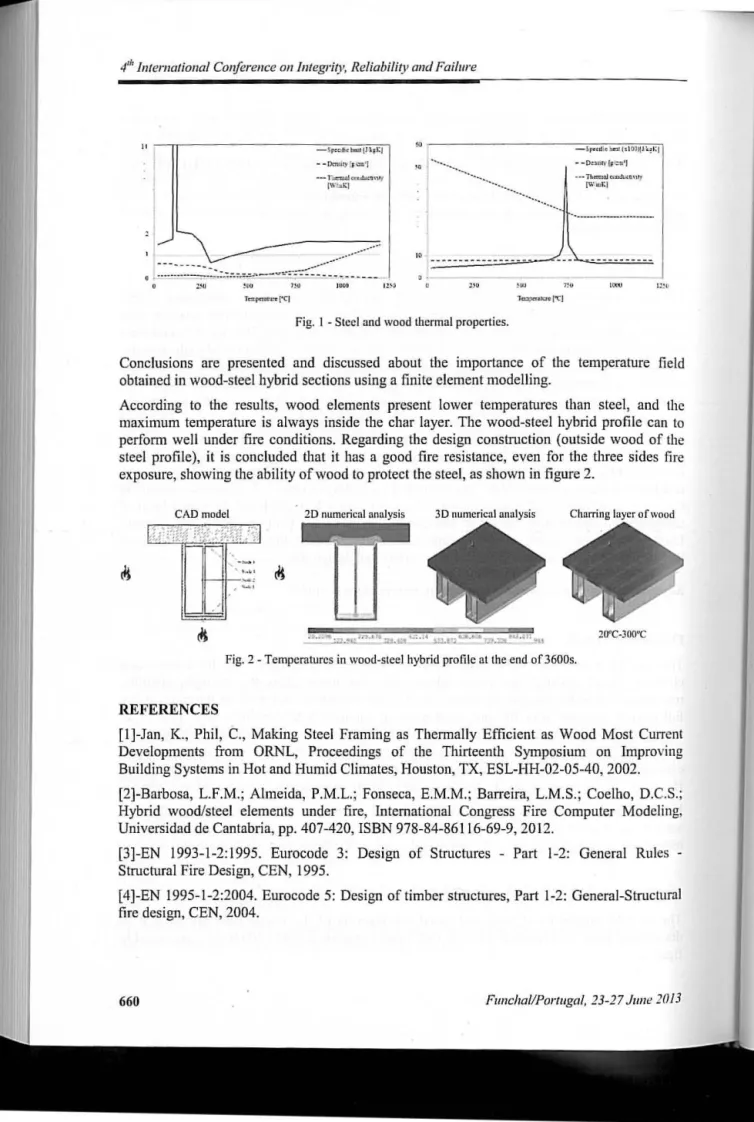
The thermal properties of steel and wood are function of the temperature and s hould be determined from the Eurocode 3 (CEN 1995) and Eurocode 5 (CEN 2004), as represented in figure I.
4/1• /llJemaJional Conference on /lItegriJy, ReliabiliJy anel Failllre
"
-- Tr--- ---=_~." = o= . '~-~, n c. , '"'·,- - D<T<l1y
II ,,"'I
---Tho=oI~ . "ry
[Wt.al:1
,, -' _o_o
·---= - ~ . ="'~" ~._~I ' ~' .~. '~ , ., "" K I
- -O!:w ~ ' lf ':;11'1
-- -T~ "'nl::<Q"!J'
" 1" ... .
-'"
-
...
( .... ... 1:1-....
....
-,
.
""
'O"Fig. I - Stccl and wood thermal properties,
Conclusions are prcsented and discussed about lbe importance of lhe temperaturc field obtained in wood-slee! hybrid sections using a finite element modelling.
According to the rcsults, wood elern cnts present lower temperatures than steel, and lhe maximum temperature is always inside lhe char layer, The wood-steel hybrid profile can to perform well under fire conditions. Regarding the design construction (outside wood af the steel profile), it is concluded that it has a good fire resistance, even for the three sides fire exposure, showing the ability ofwood to protect the stecl, as shown in figure 2.
CAO model 20 numerical anlllysis 3D numerical nnulysis -
,
1-'.;'
('j.ff, ij": ..?"ii,í,ji
,\1
<li
a'::::::
, -'<li
o
II
IJ ~
21l"C·300"C
Fig. 2· Tempcraturcs in wood-stcel hybrid profilc at the end of3600s.
REFERENCES
[I]-Jan, K., Phil, C" Making Sleel Framing as Thermally Efficient as Wood Most Currenl Developments ITom ORNL, Proceedings of the Thirleenlh Symposium on Improving Building Systems in Hol and Humid Climates, Houslon, TX, ESL-HH-02-05-40, 2002,
[2]-Barbosa, L.F,M.; Almeida, P,M.L.; Fonseca, E.M.M.; Barreira, L.M.S.; Coelho, D,C,S.; Hybrid waod/steel elements under fire, lntemational Congress Fire Computer Modeling, Universidad de Canlabria, pp. 407-420, ISBN 978-84-86 116-69-9, 20 12,
[3]EN 199312:1995. Eurocode 3: Design of Structures Part 12: General Rules -Structural Fire Design, CEN, 1995.
[4]-EN 1995-1-2:2004. Eurocode 5: Design of timber structures, Part 1-2: General-Struclural fire design, CEN, 2004.