246
www.scielo.br/rsbmt Address to: Dra. Elizabeth De Francesco Daher. Rua Vicente Linhares 1198,
60135-270 Fortaleza, CE, Brasil.
e-mail: [email protected]; [email protected]
Received 13 August 2012
Accepted 21 January 2013
Revista da Sociedade Brasileira de Medicina Tropical 46(2):246-248, Mar-Apr, 2013
http://dx.doi.org/10.1590/0037-8682-1739-2013
Case Report
INTRODUCTION
CASE REPORT
Atrial lutter complicating severe
leptospirosis: a case report
Francisco Theogenes Macêdo Silva
[1],
Geraldo Bezerra da Silva Junior
[2],[3],
André Nunes Benevides
[1]and
Elizabeth De Francesco Daher
[1],[3][1]. Serviço de Nefrologia, Hospital Geral de Fortaleza, Fortaleza, CE. [2].Curso de Medicina, Centro de Ciências da Saúde, Universidade de Fortaleza, Fortaleza, CE. [3]. Departamento de Medicina Clínica, Faculdade de Medicina, Universidade Federal do Ceará, Fortaleza, CE.
ABSTRACT
Cardiac disturbances are relatively common and electrocardiographic abnormalities may be found in more than 70% of patients with leptospirosis. We report the case of a 68 year-old male with severe leptospirosis who developed atrial lutter. Effective treatment was done with amiodarone. The patient became clinical stable, with complete recovery. Rigorous clinical observation and continuous electrocardiogram (ECG) monitoring may facilitate the identiication of rhythm disorders, and thus prevent a probable fatal outcome, in severe cases of leptospirosis.
Keywords: Leptospirosis. Weil syndrome. Arrhythmia. Atrial lutter. Electrocardiogram.
Leptospirosis is a zoonotic disease of global distribution associated with a diverse clinical spectrum. It is caused by species of Leptospira, and transmitted to humans by direct contact with infected tissues or contaminated urine, or indirectly by contact with contaminated water or soil. Mammalian reservoirs are the main distributors, and although rodents are the most important reservoir, other animals, including livestock, wild and domestic animals may excrete leptospires in their urine and, therefore, be a potential source of infection1-3. Leptospirosis is associated with occupational and recreational exposure, usually occurring as endemic in rural areas with outbreaks associated with loods1,3.
Clinical spectrum is broad in leptospirosis. Multiple clinical presentations may occur and a wide variety of diseases may mimic different stages of leptospirosis1. Most patients will present a febrile self-limited condition, often misdiagnosed as inluenza or dengue1,2,4. Severe manifestations occur in approximately 5-10% of human infections and are characterized by the presence of jaundice, acute renal failure and hemorrhagic disorders, including severe pulmonary hemorrhage syndrome1,2,5. In severe forms the biphasic presentation becomes more evident. The irst phase is commonly referred as septicemic; it lasts for 5 to 7 days and high fever, myalgia, headache, conjunctival suffusion, abdominal pain and vomiting are usually seen during this period. A brief afebrile period may follow this phase just before the immune phase of
the disease begins. The latter is characterized by multiorgan involvement and a higher mortality rate2,3,5,6.
Less common presentations may occur in a signiicant number of cases and lead to misdiagnosis. Pulmonary involvement may range from clinically undetectable to massive hemoptysis and respiratory failure, with severe pulmonary forms present in up to 74% of lethal cases, representing the main cause of death in Brazil2,5. Neurological manifestations such as symptomatic aseptic meningitis, myeloradiculopathy and myelopathy may be found in case-reports throughout the literature4. Pancreatitits is a rare complication, however asymptomatic hyperamylasemia is often present2,4. Cardiac disturbances are quite common and electrocardiographic abnormalities may be found in more than 70% of patients; nonetheless cardiac life-threatening conditions are unusual7,8. In recent study in Sri Lanka, during an outbreak in 2008, myocarditis was reported in 7.1% of cases and heart failure in 3.9%9.
The objective of this article is to report a case of severe leptospirosis complicated by the occurrence of atrial lutter, an uncommon arrhythmia in the course of the disease.
247
www.scielo.br/rsbmt
Silva FTM et al - Atrial lutter in leptospirosis
TABLE 1 - Laboratorial tests during hospital stay
Days of disease 8th Day 9th Day 11th Day 12th Day 13th Day 16th Day 17th Day
Hemoglobin (mg/dL) 13.5 12.8 12.8 12.2 10.3 8.27 7.96 White Blood Cells Count (/mm3) 12,900 21,600 13,700 14,400 12,500 9,610 8,240
Neutrophil (%) 67.0 94.0 85.0 84.0 83.0 78.9 70.0
Lymphocytes (%) 23.0 3.2 13.0 0.7 6.5 4.1 13.3
Platelets (/mm3) 42,000 59,000 123,000 145,000 161,000 504,000 652,000
Urea (mg/dL) - 214 235 206 130 87 56
Creatinin (mg/dL) 6.0 7.4 5.3 5.0 3.3 - 1.4
Potassium (mEq/L) - 6.0 5.2 4.7 - 3.5
AST (IU/L) 76 19 17 30 39 75
-ALT (IU/L) 80 33 38 60 66 64
-Total Bilirubin (mg/dL) - 7.23 11.37 13.41 15.3 3.82 -Direct Bilirubin (mg/dL) - 6.82 7.59 8.98 9.77 3.77
-CPK (IU/L) - 89 377 636 486 - 62
Amylase (IU/L) - 221 250 261 362 -
-AST: aspartate aminotransferase; ALT: alanine aminotransferase; CPK: creatine phosphokinase.
for transurethral resection e subtotal prostatectomy for benign prostatic hypertrophy four years ago.
Upon admission the patient presented with a reduced consciousness, with a Glascow Coma Scale of 13 (verbal response: 6; ocular response: 3; motor response: 4), febrile to the touch, severe conjunctival hemorrhage in both eyes, taquicardic but with normal cardiac auscultation, breath sounds were unremarkable, liver and spleen were not palpable at the abdomen examination and bowel sound were present, severe tenderness of abdominal, thigh and calf muscles, painful even to supericial palpation and bilateral and symmetrical edema of inferior limbs.
His initial blood work, related to the eighth day of the disease, showed a hemoglobin of 13.2mg/dL, a white blood cell count of 12,900/mm3, with 67% of neutrophils and 23% of lymphocytes, platelets of 42,500/mm3, a creatinin level of 6.0mg/dL, an aspartate aminotransferase of 80U/L, an alanine aminotransferase of 76U/L, with 2.0g/dL of albumin and creatine phosphokinase (CPK) of 89 U/L. Total bilirubin was 7.3mg/dL with a direct bilirubin of 6.82mg/dL and amylase was 221U/L. Kidney function continued to decrease over the next days, with blood urea level of 214mg/dL, creatinine of 7.2mg/dL, a metabolic acidosis (pH of 7.26, pCO2 of 31 and HCO3- of 14.6) and hyperkalemia of 6.0mEq/L.
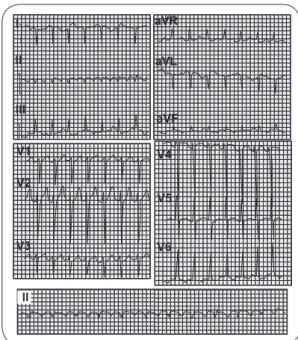
Upon admission to this hospital, intravenous ceftriaxone as initiated along with supportive measures, including vigorous hydration, to which there was rapid response with diuresis. On the tenth day of the disease a central venous catheter was obtained for emergency hemodialysis. The day after the patient’s pulse rate increased to 180/min and an electrocardiogram revealed an atrial lutter, with abnormal F waves (Figure 1), a 2:1 atrium-ventricular block and an atrial frequence of 360/min. The patient showed no signs of hemodynamic instability; his blood pressure maintained
at a baseline level of 110 over 90mmHg, there was no worsening FIGURE 1 - Abnormal F waves with a 2:1 atrium-ventricular block and an atrial frequence of 360/min.
I
II
III
V1
aVR
aVL
aVF
V4
V5
V6 V2
V3
II
of his consciousness level, no acute onset of dyspnea or precordial pain. An attack dose of amiodarone was then administered and reverted the atrial lutter to a sinus tachycardia with a pulse rate of 120/min. The patient was transferred to an intensive care unit bed for further monitoring.
248
www.scielo.br/rsbmt
Rev Soc Bras Med Trop 46(2):246-248, Mar-Apr, 2013
REFERENCES DISCUSSION
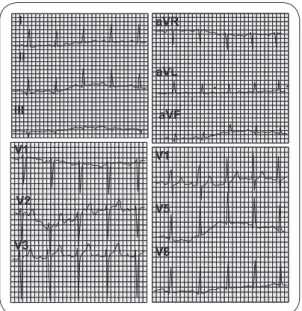
FIGURE 2 - Normal electrocardiogram.
Cardiac involvement is usually subclinical, in milder forms, or masked by pulmonary hemorrhage, in severe leptospirosis8. Most of the reports have been clinical and tachycardia, electrocardiogram (ECG) abnormalities and refractory hypotension are the usual clinical manifestations1,10-12. Pericardial effusion has been reported in patients with leptospirosis and advanced renal failure, suggesting a possible role for uremia in such patients12.
The mechanism of cardiac involvement is poorly elucidated but may, as for kidney damage, result from toxic mechanisms associated with endotoxins, immunoallergic phenomena or direct damage by leptospira1. Disseminated intravascular coagulation can also play an important role in leptospirosis-associated cardiac involvement9. Autopsy studies have shown a high prevalence of cardiac involvement in severe leptospirosis, with up to 96% of patients dying from such disease8,11. The autopsy indings are many; cardiomegaly, pericardic hemorrhage, perivascular inlammation, endocarditis and intimitis of coronary arteries and of the aorta were among the features of cardiac damage8,11. The predominant histophatological inding was an interstitial myocarditis, present in up to 96% of the studies mentioned and highly associated with inlammation of the conduction system8,11.
Electrocardiographic abnormalities may be found in numerous patients undergoing hospitalization for leptospirosis treatment. Some series report these changes in 48% to 80% of patients7,8,10. These results are probably overestimated since most
1. Abgueguen P, Delbos V, Blanvillain J, Chennebault JM, Cottin J, Fanello S, et al. Clinical aspects and prognostic factors of leptospirosis in adults. Retrospective study in France. J Infection 2008; 57: 171-178.
2. Daher EF, Lima RSA, Silva Junior GB, Silva EC, Karbage NNN, Kataoka RS, et al. Clinical presentation of leptospirosis: a retrospective study of 201 patients in a metropolitan city of Brazil. Braz J Infect Dis 2010; 14: 3-10.
3. Levett PN. Leptospirosis. In: Mandell GL, Bennett JE, Dolin R, editors. Principles and practice of infectious diseases. Pennsylvania: Elvevier; 2007. 4. Bal AM. Unusual clinical manifestations of leptospirosis. J Postgrad Med 2005;
51:179-183.
5. Medeiros FR, Spichler A, Athanazio DA. Leptospirosis-associated disturbances of blood vessels, lungs and hemostasis. Acta Tropica 2010; 115:155-162. 6. Daher EF, Trevisan DM, Cavalcante MB, Abdulkader RCRM. Risk factors for
death and changing patterns in leptospirosis acute Renal failure. Am J Trop Med Hyg 1999; 61:630–634.
7. Sacramento E, Lopes AA, Costa E, Passos OL, Costa YA, Matos ED. Electrocardiographic Alterations in Patients Hospitalized with Leptospirosis in the Brazilian City of Salvador. Arq Bras Cardiol 2002; 78:267-270. 8. Shah K, Amonkar GP, Kamat RN, Deshpande JR. Cardiac findings in
leptospirosis. J Clin Pathol 2010; 63:119-123.
9. Navinan MR, Rajapakse S. Cardiac involvement in leptospirosis. Trans R Soc Trop Med Hyg 2012; 106:515-520.
10. Assimakopoulos SF, Michalopoulou S, Papakonstantinou C, Lekkou A, Syrokosta I, Gogos C. A Case of Severe Sinus Bradycardia Complicating Anicteric Leptospirosis. Am J Med Sci 2007; 333:381-383.
11. Chakurkar G, Vaideeswar P, Pandit SP, Divate SA. Cardiovascular lesions in leptospirosis: An autopsy study. J Infection 2008; 56:197-203.
12. Trivedi SV, Bhattacharya A, Amichandwala K, Jakkamsetti V. Evaluation of Cardiovascular Status in Severe Leptospirosis. J Assoc Physic India 2003; 51:951-953.
I aVR
aVL
aVF II
III
V1
V1
V5
V6 V2
V3
On the sixteenth day of the disease he was readmitted to the infirmary with significant improvement of the mylagia, disappearing of conjunctival hemorrhage, normal ECG (Figure 2)
and an improved kidney function (Table 1). His treatment was concluded after twenty six days of disease and the patient was discharged from the hospital.
of the series analyze only hospitalized patients and, therefore, more likely to have severe leptospirosis, a clinical scenario where cardiac involvement becomes more evident4,7. Changes in ECG are the most commonly described cardiovascular abnormality in leptospirosis, but they may have low speciicity for myocardial involvement and can relect electrolyte abnormalities9. ECG changes includes sinus tachycardia, relative and marked bradycardia, bundle branch blocks, changes in the P-QRS-T complexes, low voltage QRS complexes, ST-T wave disturbances, intraventricular conduction disturbances, non-speciic ventricular repolarization disturbances, ventricular and supraventricular extrasystoles, irst-degree and third-degree heart block and atrial ibrillation9. In a study with 157 patients with serologic proven leptospirosis performed at Salvador, Bahia, Brazil, 107 exhibited ECG abnormalities. Alteration of ventricular repolarization and disorders of condution (including bundle branch block and atrioventricular block) were the commonest disturbances found, followed by atrial ibriliation in 17 patients and extrasystoles in 97.
Atrial flutter is a rare arrhythmia in the course of the leptospirosis. Patient’s clinical condition was not signiicantly altered by the presence of such condition, however more persistent and refractory arrhythmias may lead to severe hemodynamic instability. Atrial ibrillation and irst degree atrioventricular block are the most common arrhythmias found 7,10,12.