Depression among Migrant and Left-Behind
Children in China in Relation to the Quality of
Parent-Child and Teacher-Child Relationships
Jing Guo1☯
*, Xuezhu Ren2☯, Xiaohua Wang3
*, Zhiyong Qu3, Qianyun Zhou1, Chun Ran3, Xia Wang4, Juan Hu5
1Department of Sociology, Huazhong University of Science and Technology, Wuhan, P. R. China,2School of Education, Huazhong University of Science and Technology, Wuhan, P. R. China,3School of Social Development and Public Policy, Beijing Normal University, Beijing, P. R. China,4Beijing Haidian Institute for Educational Research, Beijing, P. R. China,5Community health service center, Huazhong University of Science and Technology, Wuhan, P. R. China
☯These authors contributed equally to this work. *[email protected](JG);[email protected](XHW)
Abstract
The objective of this study was to examine rates of depression among migrant children (MC) and left-behind children (LBC) as compared to non-left-behind children (NLBC) and also to examine the relationship between depression among these children and the quality of their parent-child and teacher-child relationships. This study collected data from a large sample of 3,759 children aged from 8 to 17 years, including 824 who had been left behind by one parent (LBCO), 423 who had been left behind by both parents (LBCB), 568 MC and 1944 NLBC. Children’s Depression Inventory–Short Form was used to measure child depression. Parent-Child Relationship Scale (PCRS) and Teacher-Child Relationship Scale (TCRS) were used to measure the quality of parent-child and teacher-child relation-ships, respectively. The results showed that the prevalence of depression was 10.5% among NLBC, 13.1% among LBCO, 16.1% among LBCB, and 20.1% among MC. Depres-sion was related to parent-child relationship quality and teacher-child relationship quality. Negative parent-child relationship was more relevant to depression than negative teacher-child relationship among LBCB, while negative teacher-teacher-child relationship was the most cor-related with depression among MC.
Introduction
In China, left-behind children (LBC) are defined as“children under 18 who have been left behind at their original residence while one or both parents migrate into other places for work, and have been not living together with them for at least six months”[1]. Migrant children (MC) are defined as“children under 18 who have left their original residence and migrated to a big city at least six months ago”[2]. Non-left-behind rural children (NLBC) are“children under 18 who live with both parents at their original residence”. With the rapid increase, in OPEN ACCESS
Citation:Guo J, Ren X, Wang X, Qu Z, Zhou Q, Ran C, et al. (2015) Depression among Migrant and Left-Behind Children in China in Relation to the Quality of Parent-Child and Teacher-Child Relationships. PLoS ONE 10(12): e0145606. doi:10.1371/journal. pone.0145606
Editor:Jacobus van Wouwe, TNO, NETHERLANDS
Received:April 11, 2015
Accepted:December 7, 2015
Published:December 31, 2015
Copyright:© 2015 Guo et al. This is an open access article distributed under the terms of theCreative Commons Attribution License, which permits unrestricted use, distribution, and reproduction in any medium, provided the original author and source are credited.
Data Availability Statement:All relevant data are available from Figshare (https://dx.doi.org/10.6084/ m9.figshare.2008044). Additional data are available from the Corresponding Author.
Funding:The study was only supported by“the Fundamental Research Funds for the Central Universities”, HUST: 2015AE004. The funders had no role in study design, data collection and analysis, decision to publish, or preparation of the manuscript.
recent years, in the number of migrant workers who have moved from rural areas to cities or factory enclaves for better work opportunities, the numbers of MC and LBC have been growing fast in China. It is estimated that around 61 million children were left behind in their rural hometowns by their parents, and nearly 35.81 million migrant children relocated to cities with their parents, in 2013[3]. Numerous studies have found that MC and LBC are more likely to report poor interpersonal relationship satisfaction, and depression [4,5,6]. Therefore, the cur-rent study focused on depression among migrant and left-behind children and on the relation-ship between child depression and the quality of teacher-child and parent-child relationrelation-ships.
In China, the majorities of migrant workers are employed in low-paying jobs and live in crowded conditions in cities. Moreover, China’s place-based public resource distribution and management systems pose formidable obstacles, for rural-to-urban migrants, to access to pub-lic goods like primary education and medical care [7]. Thus, a considerable number of migrant workers cannot afford to bring their children to the destination cities. A consequence of this is a long-term parental separation from children, which can be quite injurious to the mental health of the left-behind children. On the other hand, for those rural children who live with their parents in cities, they are not entitled to the same privileges as urban children because of the Hukou system of household registration. Consequently, most rural children are unable to enroll in city public schools. Although there are unregistered schools in cities set up specifically for migrant children, those schools are usually small, lack qualified teachers, and do not have standard teaching materials or adequate sanitation facilities[4]. The evidence that is available suggests that children of migrant workers may not be experiencing positive peer and teacher– student relationships [6]. Negative relationships with parents and teachers may, to a large extent, increase children's internalizing and externalizing problems.
Attachment theory provides a conceptual framework for understanding the impact of nega-tive parent-child and teacher-child relationships on the likelihood in depression for MC and LBC. Early experiences with parent and teachers are important in developing secure attach-ment relationships. Children with secure attachattach-ment are more likely to o exhibit a more positive, integrated view of self, are more prone to positive self-disclosure, and cope more adap-tively with stressful situations[8]. Experience of separation and confliction with their parents and teacher develop insecure attachment relationships for LBC and MC. Children with inse-cure attachment use less effective strategies in stressful situations and show higher frequencies of internalizing problems (e.g., depression). Both theoretical accounts and empirical work indicate that left-behind and migrant children are subject to mental health problems such as depression[5]. Recent studies suggest that MC and LBC are at increased risk for mental health problems, particularly depression and anxiety [9,10]. Compared to the general children popu-lation, LBC exhibit more psychological problems, such as low self-esteem, lack of self-confi-dence, loneliness, depression, emotional instability and social anxiety[11].Similarly, relatively high levels of separation anxiety, generalized anxiety disorder and depression have been found among MC [6]. Unfortunately, no prior study has simultaneously examined social and psycho-logical risk factors associated with depression among MC and LBC as compared to rural chil-dren who live with their parents in their hometowns.
satisfactory are less likely to be depressed [15]. Children’s relationships with their teachers are also important for their mental health given that school-aged children spend most of their weekdays in classrooms where they interact with teachers, who are the only available adults. Carlo Schuengel argues that studying children’s relationships with important adults in their lives other than their parents, such as teachers, is indispensable for a complete understanding of children’s socio-emotional development[16]. A number of studies have indicated that posi-tive teacher–child relationships help protect children against depression [17,18].
An attachment perspective also guides research hypotheses regarding the consequences of adult–child relationship quality and the intervening mechanisms explaining these effects[16]. Investigations of the impact of interpersonal relationships on childhood depression are compli-cated by the fact that the effects on depression of teacher-child relationships and parent-child relationships may be interactive. A recent review suggests that children’s relationships with teachers and their parents may be concordant, but in some cases teacher-child relationships may moderate the effects of detached parent-child relationships on child risk [16]. Therefore, high-quality teacher–child relationships may protect or promote functioning among at-risk children. Therefore, it is important that studies of MC and LBC, who are considered to be at risk because of either changing living environments or family separation, take such moderating effects into consideration.
The aim of the present study is to extend existing research on depression among MC and LBC, by addressing both parent-child and teacher-child relationships. Using cross-sectional data on a large sample of Chinese children, we firstly examined whether MC, LBC, and NLBC differed with regard to depression. Secondly, we examined the compare effects of teacher-child relationship quality and parent-child relationship quality on children’s depression status across MC, LBC and NLBC.
Methods
Participants
The sample is comprised of 3,759 children aged between 8 to 17 years, including 824 LBCO, 423 LBCB, 568 MC, and 1944 NLBC. The LBC and NLBC were recruited from nine primary and middle schools in three rural counties of Henan Province and Shanxi Province. The sample of MC was randomly selected from three schools for migrant children located in Beijing. Over the past decade, Henan and Shanxi have been the major labor-exporting provinces, and Beijing has been the major labor-importing city in China.
the lower grades, trained interviewers (including one university teacher and 19 graduate stu-dents in psychology) provided assistance by explaining survey items to them.
This study was approved by the Human Subjects Review Committee of the School of Social Development and Public Policy at Beijing Normal University. Approved verbal informed con-sent was used rather than signatures or fingerprints, because the latter were regarded as sensitive issues in the local culture. We obtained informed consent from next of kin, caretakers, or guard-ians on behalf of the children enrolled in our study. Verbal consent was also obtained from the children after they were informed the aim of the survey and their rights to refuse to participate.
Measurement
1. Demographic informationA number of demographic and economic variables were col-lected, including gender (male, female), age category (under 11, 11–13, 14 and above), parental education attainment (primary school or below, junior high school, senior high school or above), and self-reported family financial situation (poor, middle class, rich).
2. Depressive symptomswere assessed using the Children’s Depression Inventory-Short Form (CDI-S). The full Children’s Depression Inventory has been widely used to diagnose depression in children according to theDiagnostic and Statistical Manual of Mental Disor-ders(4th edition) criteria. CDI-S has been found to have a correlation of 0.89 with the full inventory[20]. It is the most commonly used valid and reliable screening tool for depressive symptoms in 7- to 17-year olds in China[10]. This questionnaire was composed of 10 items. For each item children were asked to choose which of three statements best described their feelings in the past 2 weeks. Responses to each item were then rated 0 to 2, with 0 being assigned for the statement indicating the least depressed mood and 2 being assigned to the statements endorsing the most depressed mood. The total score was calculated by adding the scores of all the items (range, 0–20). Depression was defined as a CDI-S total score greater than or equal to 7 based on international norms [21,22]. The internal consistency coefficient for the CDI-S for this sample was Cronbach’sα= 0.75.
3. The Teacher–Child Relationship Scale (TCRS)is a 28-item rating scale, using a
assessed by Cronbach’sαfor conflict, closeness, supportiveness and satisfaction in this sam-ple was 0.86, 0.82, 0.79, and 0.76.
4. The original version of the Parent–Child Relationship Scale (PCRS) was used inthe
development of the Inventory of Parent and Peer Attachment (IPPA), a self-report instru-ment for use with children[25]. The Chinese version of the PCRS has been found to have satisfactory psychometric properties [26]. Subjects complete a 15-item questionnaire by indicating how often each statement is true for them on a 5-point Likert scale. Response cat-egories are“Almost Never or Never”,“Seldom”,“Sometimes”,“Often”, and“Almost Always or Always”. The items were demonstrated through principal components analysis to cluster into three factors (trust; communication; anger and alienation) [26]. The items were designed to assess the child's trust that her/his mother understands and respects her/his needs and desires, and is sensitive and responsive to her/his emotional states and concerns (security). Items assessing anger toward or emotional detachment from the mother are also included, since frequent and intense anger or detachment is seen as a response to actual or threatened disruption of the mother-child bond. Higher trust scores, higher communication scores, and lower alienation scores indicate more positive relationships. The internal consis-tency indexed by Cronbach’sαfor the parent-child relationship scale in this sample was 0.88. The internal consistency coefficient assessed by Cronbach’sαfor trust, communica-tion, and alienation in this sample was 0.78, 0.81, and 0.53.
Statistical analysis
Our preliminary analyses produced descriptive statistics for the independent and dependent variables. Chi-square analyses were conducted to test for between-group differences in the depression and demographic variables. ANOVA and Post hoc analysis was used to examine the relationships between depression scores and the individual dimension scores of the inter-personal relationship scales, among MC, LBC and NLBC. It is hard to run a simple regression with interaction terms since the PCRS contains three subscales, and the TCRS contains four subscales, which reflecting different richness information. Cluster analysis of the teacher-child and parent-child relationship quality data was used to reduce complexity by generating groups with shared characteristics. The data was break down into two clear groups: positive interper-sonal relationship and negative interperinterper-sonal relationship. The primary analyses consisted of a series of regression analyses for depression. Logistic regression analysis was also used to exam-ine the relationship among type of child (MC, LBC or NLBC), quality of interpersonal relation-ships, and depression. Additional logistic regression analyses were applied to see what specific aspects of the relationships are most predictive of depression. Then, the whole sample was divided into 4 groups according to quality of interpersonal relationships to examine the com-pare effect of com-parent-child relationship quality (Positive/negative), and teacher-child relation-ship quality (Positive/negative) on depression. Multiple logistic regressions were employed to examine the effect of parent-child relationship quality and teacher-child relationship quality on depression among MC, LBC, and NLBC respectively.
The analyses were conducted using the SPSS statistical software program (PASW 18.0).
Results
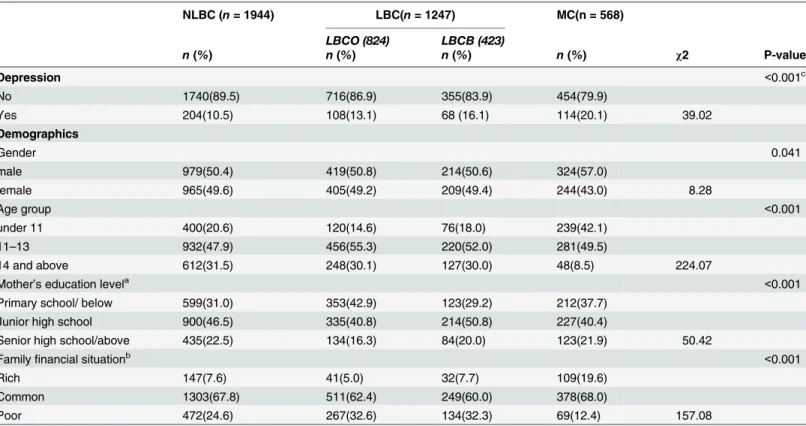
Descriptive results
of 12.64 (Standard Deviation, SD = 1.91). There was an almost even gender distribution among the LBC and NLBC, but there were more boys than girls among the MC (57.0% vs. 43.0%). The prevalence of depression in the overall sample was 13.0%, but rates of depression were higher for the MC (20.1%), LBCO (13.1%), and LBCB (16.1%), and lower for the NLBC(10.5%). Post-hoc comparison showed that MC had higher rates of depression than LBCO and NLBC. Com-pare to LBC and MC, NLBC had a lower rates of depression.
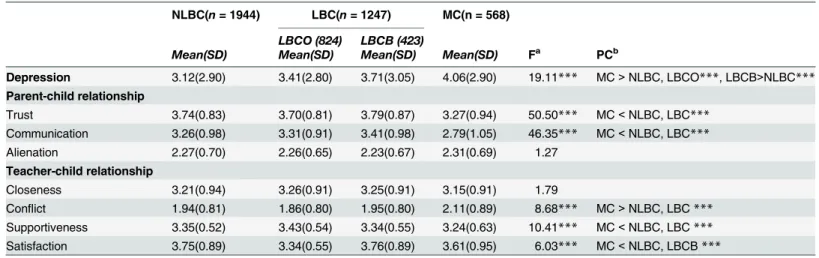
In order to examine the relationship between depression and interpersonal relationship quality among NLBC, LBC and MC, ANOVA and post-hoc analysis were conducted. The results are summarized inTable 2. There were higher scores of depression for the MC, and LBCB than for the other groups. There were significant differences between different groups of children with respect to trust(F(3,3755)= 50.50, p<0.001), communication(F(3,3755)= 46.35,
p<0.001), conflict(F(3,3755)= 8.68, p<0.001), supportiveness(F(3,3755)= 10.41, p<0.001), and satisfaction(F(3,3755)= 6.03, p<0.001). Compared to the other groups, the MC had the lowest
scores on the trust and communication dimension of parent-child relationship quality, and had the highest scores on the alienation dimension. With respect to the teacher-child relation-ship quality, MC had the lowest scores on the supportiveness and satisfaction dimensions, and the highest scores on the conflict dimension.
Table 1. Depression rates and demographic characteristics of NLBCs, LBC and MC(N = 3759).
NLBC (n= 1944) LBC(n= 1247) MC(n = 568)
LBCO (824) LBCB (423)
n(%) n(%) n(%) n(%) χ2 P-value
Depression <0.001c
No 1740(89.5) 716(86.9) 355(83.9) 454(79.9)
Yes 204(10.5) 108(13.1) 68 (16.1) 114(20.1) 39.02
Demographics
Gender 0.041
male 979(50.4) 419(50.8) 214(50.6) 324(57.0)
female 965(49.6) 405(49.2) 209(49.4) 244(43.0) 8.28
Age group <0.001
under 11 400(20.6) 120(14.6) 76(18.0) 239(42.1)
11–13 932(47.9) 456(55.3) 220(52.0) 281(49.5)
14 and above 612(31.5) 248(30.1) 127(30.0) 48(8.5) 224.07
Mother’s education levela <0.001
Primary school/ below 599(31.0) 353(42.9) 123(29.2) 212(37.7)
Junior high school 900(46.5) 335(40.8) 214(50.8) 227(40.4)
Senior high school/above 435(22.5) 134(16.3) 84(20.0) 123(21.9) 50.42
Familyfinancial situationb <0.001
Rich 147(7.6) 41(5.0) 32(7.7) 109(19.6)
Common 1303(67.8) 511(62.4) 249(60.0) 378(68.0)
Poor 472(24.6) 267(32.6) 134(32.3) 69(12.4) 157.08
Note: NLBC = Non-left-behind rural children, LBC = Children who were left behind, LBCO = Children who were left behind by one parent, LBCB = Children who were left behind by both parents, MC = Migrant children. a&b have some missing data.
a.N = 3739; b.N = 3712.
c.Post-hoc comparison showed that MC had higher rates of depression than LBCO and NLBC.
Cluster analyses of Q-Set items were used to categorize the parent-child and teacher-child relationships as positive or negative. The data was break down into two clear groups.“Positive parent-child relationship”and“Negative parent-child relationship”were abbreviated as PPCR and NPCR respectively.“Positive teacher-child relationship”and“Negative teacher-child rela-tionship”were abbreviated as PTCR and NTCR. Independent-Sample T Tests were performed to externally validate these categories. The results of the independent-sample test are presented inTable 3. The positive parent-child relationship group (n = 2289; 60.9%) consisted of high trust and communication scores, and those with negative parent-child relationships (n = 1470; 39.1%) were more likely to have high alienation scores. The positive teacher-child relationship group (n = 1921; 51.1%) consisted of high closeness, supportiveness and satisfaction scores, Table 2. Comparisons among NLBC, LBC and MC regarding depression and quality of interpersonal relationships (N = 3759).
NLBC(n= 1944) LBC(n= 1247) MC(n = 568)
LBCO (824) LBCB (423)
Mean(SD) Mean(SD) Mean(SD) Mean(SD) Fa PCb
Depression 3.12(2.90) 3.41(2.80) 3.71(3.05) 4.06(2.90) 19.11*** MC>NLBC, LBCO***, LBCB>NLBC*** Parent-child relationship
Trust 3.74(0.83) 3.70(0.81) 3.79(0.87) 3.27(0.94) 50.50*** MC<NLBC, LBC*** Communication 3.26(0.98) 3.31(0.91) 3.41(0.98) 2.79(1.05) 46.35*** MC<NLBC, LBC***
Alienation 2.27(0.70) 2.26(0.65) 2.23(0.67) 2.31(0.69) 1.27
Teacher-child relationship
Closeness 3.21(0.94) 3.26(0.91) 3.25(0.91) 3.15(0.91) 1.79
Conflict 1.94(0.81) 1.86(0.80) 1.95(0.80) 2.11(0.89) 8.68*** MC>NLBC, LBC*** Supportiveness 3.35(0.52) 3.43(0.54) 3.34(0.55) 3.24(0.63) 10.41*** MC<NLBC, LBC*** Satisfaction 3.75(0.89) 3.34(0.55) 3.76(0.89) 3.61(0.95) 6.03*** MC<NLBC, LBCB*** Note: NLBC = Non-left-behind rural children, LBC = Children who were left behind, LBCO = Children who were left behind by one parent, LBCB = Children who were left behind by both parents, MC = Migrant children.
***= p<0.001.
a.The F value was from ANOVA results. b.PC indicate the signi
ficance of pairwise comparisons in the post-hot analysis. LBCB>NLBC***means“LBCB had a significant higher score than NLBC”.
MC>NLBC, LBC***means“MC had a significant high score compared with NLBC, LBCO and LBCB”. MC<NLBC, LBC***means“MC had a significant low score compared with NLBC, LBCO and LBCB”. MC<NLBC, LBCB***means“MC had a significant low score compared with NLBC and LBCB”. doi:10.1371/journal.pone.0145606.t002
Table 3. Parent-child relationship and teacher-child relationship quality ratings (Positive/Negative) by subscale scores(N = 3759).
Parent-child relationship Teacher-child relationship
Trust Communication Alienation Closeness Conflict Supportiveness Satisfaction
Mean SD Mean SD Mean SD Mean SD Mean SD Mean SD Mean SD
Positive 4.17 0.51 3.83 0.62 2.14 0.64 3.82 0.70 1.48 0.57 3.62 0.40 4.39 0.52
Negative 2.88 0.69 2.26 0.64 2.47 0.70 2.57 0.70 2.46 0.74 3.06 0.54 3.06 0.70
T-test 65.63*** 73.75*** -14.88*** 54.84*** -45.70*** 36.38*** 66.55***
Note:
***= p<0.001.
and those with negative teacher-child relationships (n = 1838; 48.9%) were more likely to have high conflict scores.
Regression results
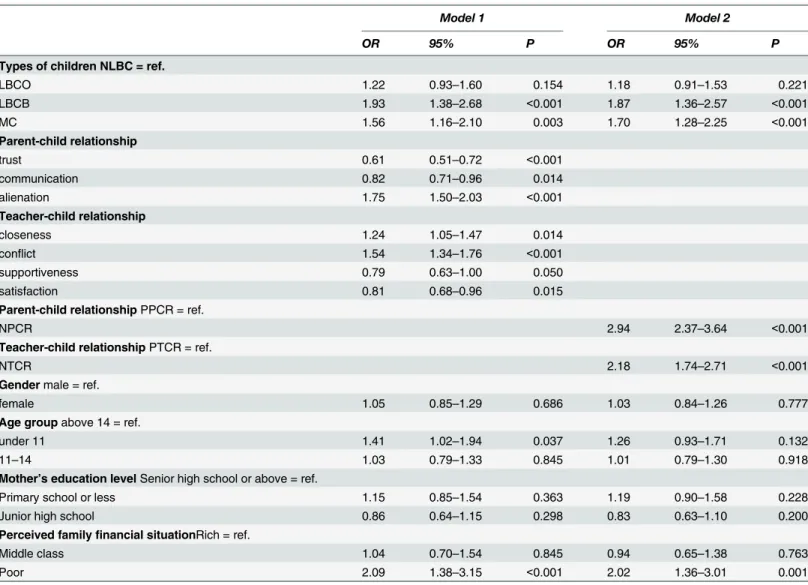
Table 4presents the logistic regression analysis results for depression by type of child, interper-sonal relationship quality ratings, and demographic characteristics. Two models were investi-gated in this analysis. The seven dimension variables of the interpersonal relationship quality scales were included in Model 1. The two dichotomous variables of the interpersonal relation-ship quality scales were included in Model 2. The results show that, adjusting for demographic information, child type, parent-child relationship quality, and teacher-child relationship qual-ity are related to depression. Model 1 indicated that the degree of trust(OR, 0.61; 95% CI, 0.51– 0.72), communication(OR, 0.82; 95% CI, 0.71–0.96), and alienation(OR, 1.75; 95% CI, 1.50– 2.03) of the parent-child relationship were significantly related to depression. In addition, chil-dren who have conflict relationship with their teacher reported more depression (OR, 1.54; 95% CI, 1.34–1.76), and those who have satisfaction relationship with their teacher reported less depression (OR, 0.81; 95% CI, 0.68–0.96).
In further regression analysis, there was significant interaction between closeness and con-flict. Due to limited space, this will not delve into the details. The Model 2 results show that, compared to the NLBC, LBCB were more likely to be depressed (OR, 1.87; 95% CI, 1.36–2.57), as were MC (OR, 1.70; 95% CI, 1.28–2.25). Negative parent-child relationship quality almost tripled the risk of depression (OR, 2.94; 95% CI, 2.37–3.64). Children with perceived negative child relationships were twice as likely to be depressed as those with positive teacher-child relationships (OR, 2.18; 95% CI, 1.74–2.71).
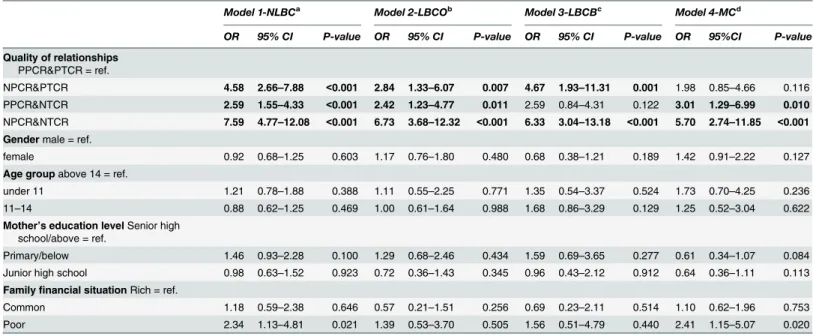
addition, negative parent-child and negative teacher-child relationships have significant nega-tive impact on all groups.
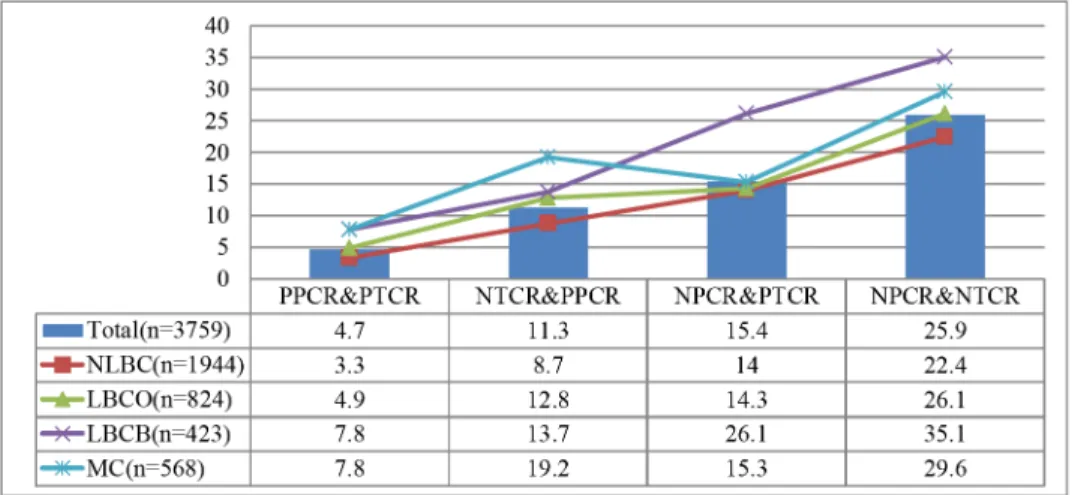
Finally, the compare effect of parent-child relationship and teacher-student relationship quality was significantly related to depression. This pattern is illustrated inFig 1. The rate of depression was as high as 26.1% for LBCB who had negative parent-child relationships and positive teacher-child relationships, compared to 13.7% for those with negative teacher-child relationships and positive parent-child relationships, suggesting that, among LBCB, depression is most strongly affected by the parent-child relationship. Among MC, the depression rate was a high 19.2% for those having negative teacher-child relationships and positive parent-child relationships, compared to 15.3% for those having negative parent-child relationships and pos-itive teacher-child relationships, suggesting that, among MC, depression is most strongly affected by the teacher-child relationship (Fig 1).
Table 4. Regression analysis for depression by type of child, interpersonal relationship quality ratings, subscale scores, and demographic char-acteristics (N = 3696).
Model 1 Model 2
OR 95% P OR 95% P
Types of children NLBC = ref.
LBCO 1.22 0.93–1.60 0.154 1.18 0.91–1.53 0.221
LBCB 1.93 1.38–2.68 <0.001 1.87 1.36–2.57 <0.001
MC 1.56 1.16–2.10 0.003 1.70 1.28–2.25 <0.001
Parent-child relationship
trust 0.61 0.51–0.72 <0.001
communication 0.82 0.71–0.96 0.014
alienation 1.75 1.50–2.03 <0.001
Teacher-child relationship
closeness 1.24 1.05–1.47 0.014
conflict 1.54 1.34–1.76 <0.001
supportiveness 0.79 0.63–1.00 0.050
satisfaction 0.81 0.68–0.96 0.015
Parent-child relationshipPPCR = ref.
NPCR 2.94 2.37–3.64 <0.001
Teacher-child relationshipPTCR = ref.
NTCR 2.18 1.74–2.71 <0.001
Gendermale = ref.
female 1.05 0.85–1.29 0.686 1.03 0.84–1.26 0.777
Age groupabove 14 = ref.
under 11 1.41 1.02–1.94 0.037 1.26 0.93–1.71 0.132
11–14 1.03 0.79–1.33 0.845 1.01 0.79–1.30 0.918
Mother’s education levelSenior high school or above = ref.
Primary school or less 1.15 0.85–1.54 0.363 1.19 0.90–1.58 0.228
Junior high school 0.86 0.64–1.15 0.298 0.83 0.63–1.10 0.200
Perceived familyfinancial situationRich = ref.
Middle class 1.04 0.70–1.54 0.845 0.94 0.65–1.38 0.763
Poor 2.09 1.38–3.15 <0.001 2.02 1.36–3.01 0.001
Note:NLBC = Non-left-behind rural children, LBC = Children who were left behind, LBCO = Children who were left behind by one parent,
LBCB = Children who were left behind by both parents, MC = Migrant children. PPCR = Positive parent-child relationship, NPCR = Negative parent-child relationship, PTCR = Positive teacher-child relationship, NTCR = Negative teacher-child relationship
Discussion
The present study sought to examine the relationship among parent–child relationship quality, teacher–child relationship quality, and depression, among MC, LBCB, LBCO, and NLBC. The results indicate that MC and LBCB are at higher overall risk for depression than the other groups. MC are more likely to have negative parent-child and teacher-child relationships. In addition, negative parent-child relationship is more relevant to depression than negative teacher-child relationship among LBCB, while negative teacher-child relationship is the most correlated with depression among MC.
The results suggest that rates of depression are significantly higher among MC and LBCB than other groups. Migrant workers often faced a hard choice as parents:“Bring the child along or leave her/him behind?”The results of the present study indicate that the rate of depression among migrant children is as high as 20.1%, as compared to16.1% among children left behind by both parents. Prior studies have reported higher rates of depression and anxiety among LBC than among their age-matched peers[10]. This study contributes to the literature by comparing different groups of children affected by migration, and adds information concerning the rela-tionship between migration and health. Particularly striking is the finding that MC are the most vulnerable group with regard to mental health. Migration entails not only loss of family and friends and the sense of home, but also the need to adapt to a new cultural environment that involves different sets of moral values and standards. These factors are likely to lead to a high level of stress and strain for MC. Poverty may also add to the stress for MC. Since many Table 5. Regression analysis for depression by interpersonal relationship quality among NLBC, LBC and MC.
Model 1-NLBCa Model 2-LBCOb Model 3-LBCBc Model 4-MCd
OR 95% CI P-value OR 95% CI P-value OR 95% CI P-value OR 95%CI P-value
Quality of relationships
PPCR&PTCR = ref.
NPCR&PTCR 4.58 2.66–7.88 <0.001 2.84 1.33–6.07 0.007 4.67 1.93–11.31 0.001 1.98 0.85–4.66 0.116 PPCR&NTCR 2.59 1.55–4.33 <0.001 2.42 1.23–4.77 0.011 2.59 0.84–4.31 0.122 3.01 1.29–6.99 0.010
NPCR&NTCR 7.59 4.77–12.08 <0.001 6.73 3.68–12.32 <0.001 6.33 3.04–13.18 <0.001 5.70 2.74–11.85 <0.001
Gendermale = ref.
female 0.92 0.68–1.25 0.603 1.17 0.76–1.80 0.480 0.68 0.38–1.21 0.189 1.42 0.91–2.22 0.127
Age groupabove 14 = ref.
under 11 1.21 0.78–1.88 0.388 1.11 0.55–2.25 0.771 1.35 0.54–3.37 0.524 1.73 0.70–4.25 0.236 11–14 0.88 0.62–1.25 0.469 1.00 0.61–1.64 0.988 1.68 0.86–3.29 0.129 1.25 0.52–3.04 0.622
Mother’s education levelSenior high
school/above = ref.
Primary/below 1.46 0.93–2.28 0.100 1.29 0.68–2.46 0.434 1.59 0.69–3.65 0.277 0.61 0.34–1.07 0.084 Junior high school 0.98 0.63–1.52 0.923 0.72 0.36–1.43 0.345 0.96 0.43–2.12 0.912 0.64 0.36–1.11 0.113
Familyfinancial situationRich = ref.
Common 1.18 0.59–2.38 0.646 0.57 0.21–1.51 0.256 0.69 0.23–2.11 0.514 1.10 0.62–1.96 0.753 Poor 2.34 1.13–4.81 0.021 1.39 0.53–3.70 0.505 1.56 0.51–4.79 0.440 2.41 1.15–5.07 0.020
Note, NLBC = Non-left-behind rural children, LBC = Children who were left behind, LBCO = Children who were left behind by one parent,
LBCB = Children who were left behind by both parents, MC = Migrant children. PPCR = Positive parent-child relationship, NPCR = Negative parent-child relationship, PTCR = Positive teacher-child relationship, NTCR = Negative teacher-child relationship
a, b, c, d have missing data.
a.
N = 1912;
b.
N = 817;
c.N = 413, d.
N = 554.
migrants originate from villages with low educational resources, and then have to start“from scratch”in their new homes, migrant families frequently suffer from poverty, unemployment and problems finding accommodation [27]. Indeed the present finding indicates that there was a significant relationship between perceived poverty and depression among MC children. Another factor contributing to depression may be the educational inequalities that adversely affect migrant children. In 2003, the General Office of the State Council of China issued a docu-ment advocating that migrant children be provided with equal access to education, and public schools be prohibited from charging them extra fees. However, this policy has yet to be imple-mented [4].
An important finding of the current study is that MC were significantly more likely to have negative/detached relationships with their parents and teachers than LBC and NLBC. Although MC live with their parents, they may receive insufficient care from their parents. The occupa-tions of most migrant parents tend to be extremely time consuming, laborious, and unstable, thus interfering with their ability to spend time with their children [28]. Experiences of stigma-tization might also affect parent-child relationships for MC. Prior study indicate that rural-to-urban migrant workers in China experience various forms of stigmatization including labelling, stereotyping, separation, status loss and discrimination[29]. In addition, the occupational and residential instability of parents (they tend to frequently change jobs and move from one work-site to another) leads to repeated changing of schools for MC. Not only would this affect the development of peer and student–teacher relationships among children of migrant workers, it may also further increase their sense of isolation and reduce their sense of belonging. Fur-thermore, there is evidence that urban public schools are generally well-resourced with quali-fied teachers, but in contrast the private migrant schools often have poor resources and conditions, with many under-qualified teachers. Teachers in public schools showed signifi-cantly more positive attitudes to inclusion of migrant students than migrant school teachers [30]. A report on 300 migrant schools in Beijing, for example, showed that only 63 were Fig 1. Prevalence of depression in different types of interpersonal relationship by types of children (%).There are highest prevalence of depression in NPCR&NTCR for all types of children. For NTCR&PPCR, MC have the highest prevalence of depression. For NPCR&PTCR, LBCB have the highest prevalence of depression.
licensed. Teachers’wages in those migrant schools were low and the workload was intense. Many teachers accepted jobs in migrant schools only as a stepping stone to a better position in public schools. As a result, the teacher turnover rate was high, disrupting the learning schedules of students [31]. Thus, it is not surprising that migrant students in these schools tend to perceive low intimacy and support, and high conflict, in their relationships with their teachers.
Another important finding is that children with negative parent-child and teacher-child relationships were more likely to be depressed. Negative parent-child and negative teacher-child relationships have significant negative impact on all groups. This is consisted with the view of attachment theory that adult-child relationship is vital for children mental health. Fur-thermore, the negative parent-child relationship has significant impact for NLBC, LBCO, and LBCB. The negative teacher-child relationship has significant impact for NLBC, LCBO and MC. Prior studies suggest that a positive teacher-student relationship can function as a“ correc-tive experience”, and moderate the negative influences of a poor and conflictive parent-child relationship [32]. The current work indicates that negative parent-child relationship emerged as a more relevant factor related to depression than negative teacher-child relationship for LBCB, while negative teacher-child relationship was the most correlated with depression for MC. Because parental migration leads to the separation from parents for LBC, it may contrib-ute to an unfavorable home environment for their social development. Thus negative parent-child relationship increased the likelihood of depression among LBC. The implication is that parents should try to maintain communication with LBC and support them, even if they can-not live with them. Teacher-child relationship quality is especially important for migrant chil-dren, perhaps because these children may got support and guidance from their teachers to partially compensate for the disadvantages with which their migrant status burdens them [33]. This finding suggests that interventions focused on improving teacher-child relationships may enhance the mental health of MC.
Limitations and Implications
Several shortcomings of the present study should be pointed out. First, the current work cross-sectional in nature, and future longitudinal research is required to consolidate the current find-ings. Second, the use of a self-reported continuous measure of depression instead of a clinical diagnosis is another limitation of this study. Cautions should be taken to generalize the present findings to clinical condition. In addition, the cut-score is lack of external validity because these are depressive symptoms perceived by the children without any external diagnostic infor-mation to validate. Third, more variables related with families should be considered in future research. Many related factors (i.e., family social capital, the local cost of living and cost of housing, et al.) may influence a parent’s decision to either leave their children behind or migrate with them. Clarifying those factors is of assistance in further understanding the par-ent-child relationship. Moreover, children’s relationship with their caretakers may explain more variability in the children’s mental health than that of relationship with absent parents for the left behind children. It would also be informative to learn more about the amount of time that they are spending with adult caretakers for the migrant children.
made to tackle the children’s educational disadvantages by developing programs that facilitate better understanding and respect between children of migrant workers and their teachers. At the community level, efforts should be made to build public facilities and create public spaces that can facilitate interaction between adults and children in neighborhoods, thus building up the stock of social capital. In addition, since left-behind children are vulnerable to emotional difficulties, special attention must be paid to these children to help them overcome the chal-lenges induced by the absence of their parents. It is also of importance to help left-behind chil-dren maintain regular and positive communications with their migrant parents.
Conclusions
The results show that MC and LBCB are at increased risk of depression. Negative parent-child relationship is more relevant to depression than negative teacher-child relationship among LBCB, while negative teacher-child relationship is the most correlated with depression among MC. Negative relationships with both parents and teachers were doing the worst on the depres-sion regardless which group they were in. These results support the need for further research on negative interpersonal relationships as a risk factor for depression, and the need for pro-grams aimed at improving the parent and teacher relationships of vulnerable children. Further-more, the mental health needs of LBC may differ from those of MC.
Acknowledgments
The authors want to thank the schools and the child respondents who supported the design and implementation of the study.
Author Contributions
Conceived and designed the experiments: JG XW ZQ. Performed the experiments: JG XW ZQ. Analyzed the data: JG XR XW ZQ. Contributed reagents/materials/analysis tools: JG XR ZQ QZ CR JH XW XHW. Wrote the paper: JG XR ZQ QZ CR JH XW XHW.
References
1. Zhou FL, Duan CR (2006) Literature review on studies on left behind children Population Research 3:60–65.
2. Liang Z, Guo L, Duan C (2008) Migration and the well-being of children in China. The Yale-China Health Journal 5:25–46.
3. Federation Research group of the All-China Women’s (2013 May 10) A study of the conditions of left behind children in rural China and migrant children in cities. Available at:http://acwf.people.com.cn/n/ 2013/0510/c99013-21437965.html. Accessed December 29, 2015.
4. Keung WDF, Li CY, Song HX (2007) Rural migrant workers in urban China: living a marginalised life. International Journal of Social Welfare 16:32–40.
5. Liu Y, Li X, Chen L, Qu Z (2015) Perceived positive teacher–student relationship as a protective factor for Chinese left-behind children's emotional and behavioural adjustment. International Journal of Psy-chology 50:354–362. doi:10.1002/ijop.12112PMID:25410645
6. Wong FK, Chang YL, He XS (2009) Correlates of psychological wellbeing of children of migrant work-ers in Shanghai, China. Social Psychiatry and Psychiatric Epidemiology 44: 815–824. doi:10.1007/ s00127-009-0003-yPMID:19247562
7. Wen M, Lin D (2012) Child Development in Rural China: Children Left Behind by Their Migrant Parents and Children of Nonmigrant Families. Child Development 83: 120–136. doi:10.1111/j.1467-8624. 2011.01698.xPMID:22181046
9. Chen L, Su S, Li X, Tam CC, Lin D (2014) Perceived discrimination, schooling arrangements and psy-chological adjustments of rural-to-urban migrant children in Beijing, China. Health Psychology and Behavioral Medicine 2:713–722. PMID:25750813
10. Cheng J, Sun YH (2014) Depression and anxiety among left-behind children in China: a systematic review. Child: Care, Health and Development 41:515–523.
11. Zhao JX, Liu X, Shen JL (2008) Left-home adolescents’perception of social support networks and their associations with individual depression and loneliness: Variable-centered and person-centered per-spectives. Psychological Development and Education: 36–42.
12. McCarty CA, Zimmerman FJ, Digiuseppe DL, Christakis DA (2005) Parental emotional support and subsequent internalizing and externalizing problems among children. Journal of Developmental & Behavioral Pediatrics 26:267–275.
13. Sabol TJ, Pianta RC (2012) Recent trends in research on teacher–child relationships. Attachment & Human Development 14: 213–231.
14. George C, Herman KC, Ostrander R (2006) The family environment and developmental psychopathol-ogy: the unique and interactive effects of depression, attention, and conduct problems. Child Psychiatry & Human Development 37:163–177.
15. Sheeber LB, Davis B, Leve C, Hops H, Tildesley E (2007) Adolescents' relationships with their mothers and fathers: associations with depressive disorder and subdiagnostic symptomatology. Journal of Abnormal Psychology 116:144–154. PMID:17324025
16. Verschueren K, Koomen HM (2012) Teacher-child relationships from an attachment perspective. Attachment & human development 14:205–211.
17. Wang MT (2009) School climate support for behavioral and psychological adjustment: Testing the mediating effect of social competence. School Psychology Quarterly 24:240–251.
18. Cavell TA, Elledge LC, Malcolm KT, Faith MA, Hughes JN (2009) Relationship quality and the mentor-ing of aggressive, high-risk children. Journal of Clinical Child & Adolescent Psychology 38:185–198.
19. Hu X, Xiao S, Chen B, Sa Z (2012) Gaps in the 2010 measles SIA coverage among migrant children in Beijing: Evidence from a parental survey. Vaccine 30:5721–5725. doi:10.1016/j.vaccine.2012.07.007
PMID:22819988
20. Kovacs M (1985) The Children's Depression, Inventory (CDI). Psychopharmacology Bulletin 21:995– 998. PMID:4089116
21. Davanzo P, Kerwin L, Nikore V, Esparza C, Forness S, Murrelle L (2004) Spanish translation and reli-ability testing of the Child Depression Inventory. Child Psychiatry & Human Development 35:75–92.
22. Comiskey CM, O'Sullivan K, Quirke MB, Wynne C, Hollywood E, MGillloway S. (2012) Baseline Results of the First Healthy Schools Evaluation Among a Community of Young, Irish, Urban Disadvantaged Children and a Comparison of Outcomes With International Norms. Journal of School Health 82: 508– 513. doi:10.1111/j.1746-1561.2012.00730.xPMID:23061554
23. Pianta RC (1994) Patterns of relationships between children and kindergarten teachers. Journal of School Psychology 32:15–31.
24. Wang Y, Wang XH (2002) Development of Teacher-Student Relationships and Its relation to Factors in Primary School. Psychological Development and Education 28:18–23.
25. Armsden GC, Greenberg MT (1987) The inventory of parent and peer attachment: Individual differ-ences and their relationship to psychological well-being in adolescence. Journal of Youth and Adoles-cence 16:427–454. doi:10.1007/BF02202939PMID:24277469
26. Zhang X (2011) Parent–child and teacher–child relationships in Chinese preschoolers: The moderating role of preschool experiences and the mediating role of social competence. Early Childhood Research Quarterly 26:192–204.
27. Stevens GW, Vollebergh WA (2008) Mental health in migrant children. Journal of Child Psychology and Psychiatry 49:276–294. PMID:18081765
28. Knight J, Song L, Huaibin J (1999) Chinese rural migrants in urban enterprises: three perspectives. Journal of Development Studies 35:73–104.
29. Li X, Zhang L, Fang X, Xiong Q, Chen X, Lin D, et al. (2007) Stigmatization experienced by rural-to-urban migrant workers in China: findings from a qualitative study. World health & population 9: 29–43.
30. Liu T, Holmes K, Albright J (2015) Urban teachers’perceptions of inclusion of migrant children in the Chinese educational institution: a comparative study. International Journal of Inclusive Education 19: 994–1008.
32. Wang MT, Brinkworth M, Eccles J (2013) Moderating effects of teacher-student relationship in adoles-cent trajectories of emotional and behavioral adjustment. Developmental psychology 49:690–705. doi:
10.1037/a0027916PMID:22582833