2011 July-Aug.;19(4):1039-46
www.eerp.usp.br/rlae
Corresponding Author: Ma. del Carmen Pérez Rodríguez
Universidad Autónoma de San Luis Potosí. Facultad de Enfermería. Av. Niño artillero s/n Zona Universitaria, C.P. 78290
San Luis Potosí, San Luis Potosí, México E-mail: [email protected]
Changes in the care context: challenges for nursing
Maribel Cruz-Ortiz
1Cristina Jenaro-Río
2Ma. Del Carmen Pérez-Rodríguez
3María Lourdes Hernández-Blanco
4Noelia Flores-Robaina
5This research aimed to identify global changes in the way of practicing and understanding
care, as well as the demands population change has generated and the implications
for family and professional caregivers. An integrative literature review was performed,
identifying 284 papers with the following descriptors: care and caregivers, associated
with the descriptor “Nursing”, published between 2005 and 2010. Forty-one papers were
selected that correspond to the intended goal. The results point towards a care transition
model, reconfigured by new care demands, which are mainly associated with the increase
in chronic conditions and population aging. In addition, the change in social and individual
roles takes care beyond the family sphere and closer to shared social responsibility. Care is
the axis around which nurses rotate. Hence, it is fundamental to analyze this context, which
demands evolution in professional care development.
Descriptors: Care; Caregivers; Nursing.
1 Doctoral Student, Universidad de Salamanca, Spain. E-mail: [email protected].
2 Ph.D. in Psychology, Full Professor, Departamento de Personalidad, Evaluación y Tratamiento Psicológico, Facultad de Psicología, Universidad de Salamanca, Spain. E-mail: [email protected].
3 Ph.D. in Nursing, Professor, Facultad de Enfermería de San Luís Potosí, Universidad Autónoma de San Luís Potosí, Mexico. E-mail: [email protected].
4 RN, Facultad de Enfermería de San Luís Potosí, Universidad Autónoma de San Luís Potosí, Mexico. E-mail: [email protected].
Mudanças no contexto do cuidado: desaios para a enfermagem
Este trabalho teve por objetivo identiicar mudanças globais, relacionadas à forma de fazer e entender o cuidado, assim como as demandas geradas pela mudança populacional e as implicações para cuidadores familiares e proissionais. Realizou-se revisão integrativa da literatura, identiicando-se 284 artigos com os descritores: cuidado e cuidadores,
associados ao descritor “Enfermagem”, entre os anos 2005 e 2010, selecionando-se 41 artigos que correspondem ao objetivo proposto. Os resultados apontam para um modelo
de transição no cuidado, reconigurado pelas novas demandas de atenção associadas, principalmente, ao incremento das doenças crônicas e ao envelhecimento populacional. Além disso, a mudança nos papéis sociais e individuais situam o cuidado além do âmbito
familiar e o aproximam da responsabilidade social compartida. O cuidado é o eixo onde gravitam as enfermeiras, daí resulta indispensável analisar esse contexto que demanda
evolução no desenvolvimento do cuidado proissional.
Descritores: Cuidado; Cuidadores; Enfermagem.
Cambios en el contexto del cuidado: desafíos para la enfermería
Este trabajo tuvo por objetivo identiicar cambios globales relacionados con la forma de
hacer y entender el cuidado, así como las demandas generadas por el cambio poblacional y las implicaciones para cuidadores familiares y profesionales. Se realizó una revisión
integradora de la literatura, identiicando 284 artículos con los descriptores: cuidado y
cuidadores, asociados al descriptor Enfermería, entre los años 2005 y 2010, seleccionando 41 artículos que corresponden al objetivo planteado. Los resultados apuntan a un
modelo de transición en el cuidado, reconigurado por las nuevas demandas de atención
asociadas principalmente al incremento de las enfermedades crónicas y el envejecimiento poblacional. Además, el cambio en los roles sociales e individuales sitúan al cuidado mas allá del ámbito familiar y lo aproximan a la responsabilidad social compartida. El cuidado es el eje gravitatorio de las enfermeras, por ello resulta indispensable analizar este contexto que demanda evolución en el desarrollo del cuidado profesional.
Descriptores: Cuidado; Cuidadores; Enfermería.
Introduction
In current times, changes have emerged in the people offering care as well as in the people taken care
of. This pair interacts in an environment that relects
and conditions those changes. Through a systems perspective, it could be appointed that, in the macro-system, demographic structure changes, mainly brought about by the drop in mortality and birth rates, and increased life expectancy have led to the so-called population aging which, in turn, entails a notable rise in family care needs(1).
The fact that, historically, the family has been the central institution in terms of care for people would
explain why the changes families are going through
exert a decisive inluence on the way care is delivered
to the people who need it. Like the family itself, a new care concept is emerging, which has driven changes that condition transformations in the way care is understood and practiced(2). Concrete issues like the collapse
of social-sanitary systems and changes in family composition and functioning have enhanced this even further, and this involves women, who are the main care
providers and produce modiications in the way they
Method
The goal of this integrative review was to answer the following question: from a systemic perspective, what are the most relevant changes that have been generated in care and how do they affect professional and family caregivers?
Thus, a review was carried out in SciELO and LILACs, between 2005 and 2010, using the descriptors caregivers and care, associated with the descriptor Nursing, resulting in 284 papers. After identifying the papers, abstracts were read and 41 were selected, related to the study goal.
Articles were grouped in three thematic categories,
which the team identiied and deined as follows.
- Structural population changes, related to the demographic and epidemiological transition.
- Changes in family and social-sanitary systems. - Changes in the ways of understanding and practicing care.
Results
The number of publications identiied in this review
increased by 75% in 2010 when compared with 2005 (58 and 33 publications, respectively), underlining the growing interest in the care theme.
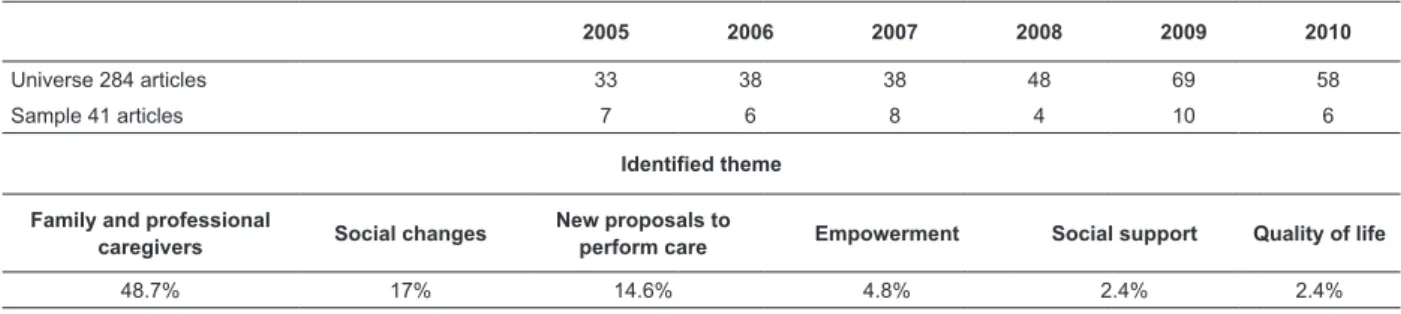
The age groups are mainly those focusing research on children and elderly people (19.4%), the complexity of the theme is more oriented to the analysis of conditions that surpass age groups, such as impairment (14.6%), dependence (24.2%) and chronicity (17%). On the other hand, the analysis of the care experience from the (family or professional) caregiver’s perspective is the most recurrent topic in this group of papers (48.7%), while other themes like the empowerment of people who receive the necessary care or social support appear less (Table 1).
Table 1 – Themes identiied in the selected papers
2005 2006 2007 2008 2009 2010
Universe 284 articles 33 38 38 48 69 58
Sample 41 articles 7 6 8 4 10 6
Identified theme
Family and professional
caregivers Social changes
New proposals to
perform care Empowerment Social support Quality of life
48.7% 17% 14.6% 4.8% 2.4% 2.4%
Next, the obtained information is presented in an integrated way, like in the papers under analysis, as the discussion of the care theme clearly goes beyond the standardization approach, focused on one-dimensional factors like age, situation (chronic, acute) or condition (disease, impairment).
Structural population changes related to the demographic and epidemiological transition
Changes in the population structure are happening all over the world, but the aging trend is clearer in developed countries(4). Demographic(5) and
epidemiological(6) transition theories have described
this trend, alluding to changes in the population’s age structure, such as the decrease in infectious diseases at the expense of chronic degenerative ones. Despite these theories limited ability to explain variants present in distinct social realities, and their failure to analyze
the social component in structural changes(5,7-8), they are
useful to show how care needs and, consequently, care
burdens have been modiied.
A more speciic analysis of implicit igures in the
new population pyramid evidences that this is not only about the aging phenomenon, related to the rise in life expectancy and the drop in mortality rates. Instead, the increasingly large silhouette of these population
graphs relects the decrease in birth rates and, thus,
in population and family size(9). Hence, this is about the
growth phenomenon of the population with care needs and the reduced availability of home caregivers(10).
According to the global aging report the UN presented in 2008, the elderly represented 10% of people around the world, i.e. almost 700 million(4). On the other hand,
Rev. Latino-Am. Enfermagem 2011 July-Aug.;19(4):1039-46.
world, surpassing 30% in Europe and 20% in developing countries(11).
These population phenomena multiply and enhance the complexity of current care activities. In other words, today, the family core can comprise, to a greater or lesser extent, children, elderly, ill people, disabled people, or the combination, in the same person, of several of these conditions(10). That evidences not only the increased
complexity of home care, but also the constant need for innovation and adaptations that improve care.
Changes in family and social-sanitary systems
When the demographic and epidemiological transition are combined with social evolution and
consequent modiications in social and gender roles, care
moves from the private to the public sphere, turning into a social function, through State participation, through social policies that attempt to satisfy these people’s basic needs, thus moving beyond the limit of the family context as an exclusive care space(9,12).
In countries that have incorporated social services as the welfare state’s fourth pillar, the State had taken responsibility for tasks families can no longer address, either due to the knowledge they demand or to lesser availability. That includes a large part of activities related to care for people, increasingly considered a social right not only the State, but all welfare societies grant(13), offering public care services to those who need
them and thus directly responding to the needs of those who cannot claim them by themselves, and granting time off from work to take care of relatives who need them. That supposes inverting the priority productive activity generally receives to reproductive activity, and implicitly suggests that the job world should make room for workers’ family responsibilities(9,14).
Many countries that have assumed this welfare model, privileging productive over reproductive activity, display a consolidated phenomenon called the second demographic transition. Lesthaeghe coined the term to describe the changes related to the dissolution of families and unions, and in the patterns for their reconstitution present in Western countries since the Second World War(15). In addition to this second demographic transition, there is the effect of the irst transition, which is aging,
characterized by: (a) increased number of single people,
(b) postponed matrimony, (c) delay to have one’s irst
child, (d) expansion of consensual unions, (e) expansion of extra-marital births, (f) increased number of broken
marriages and (g) diversiication of family structure
modes.
These changes undoubtedly condition the transformation of the traditional family model, which presupposed a stable matrimony, a woman at home busy with family maintenance and children’s education, and a man who got out to work to obtain the resources needed for family survival(16). Thus, this transformation
includes a functional change through a much more individualistic orientation of its members, and also a change in composition, broadening the family concept far beyond the inclusion of father, mother and children and presenting new family forms(2,15).
Changes in the ways of understanding and practicing care
At the end of the 1980’s, in most Western countries, a crisis emerged in social protection systems, which encouraged the reinterpretation of family care in view
of the laws and limits of public or group solidarity. It
is the addition and enhancement of all of these factors that has granted visibility and new relevance to care as a concept and activity(9, 17-18).
Care aims to guarantee subjects’ life and enhance their autonomy(19), but has often been understood from
a clinical focus only, fundamentally directed at disease control. In its most basic sense, the goal of care centers on guaranteeing survival through attendance to basic needs. When extending the life expectancy of ill or disabled people, however, and claiming their right to an integrated life, like other people, a movement is generated that is centered on independent and self-determined life, which implies that the goal of care has had to agree with and diversify in response to as many spheres and forms of support as people’s needs(18,20- 21).
In that sense, the subjects framed under medicine, predominantly characterized by the search for cure, have varied this trend, among other things through the increase in diseases and chronic conditions. As a result, quality of life-related issues have been enhanced when cure is impossible and the goal of treatment has been converted into maximum functionality and good existence, with quality of life. Consequently, a new preponderant role for the family and care is due(22).
From this perspective, in the health context, the evolution from the cure to the care concept and from healing to recovering gain relevance(22). This refers not
A care-related core issue precisely refers to the postural change, which implies the central and active role of people in what has been called self-care(18).
That is how programs and interventions focused on the promotion of self-determination have been structured, through the provision of general support. Also, initiatives
have been developed related to speciic training for
medication handling, sign and symptom control, coping with diseases and, in general, support for independent life in a broad sense(23-27). These support forms, necessary in
the distinct spheres of individual development, demand the participation of distinct actors who comprise the social network and, in different contexts, offer natural and formal support. In other words, care is needed which is offered and developed at the heart of the family and social group, as well as care designed with due
competence, with a speciic goal and offered by entities
external to the family(28).
It has been observed that the origin of care clearly rests in the family, which in the simplest sense aims to guarantee the survival of its members. That does not mean that its nature is innate. Even if great social changes have been produced, modifying women’s position inside the family, it is not less certain that the naturalization and biologization socially imprinted on care still label women as the best or most adequate for care. Despite the persistence of this naturalization, an evolution of the care concept is already perceptible(29-30).
In the above approach to the care evolution, the intrinsic characteristics of home care providers seem to have changed less, as they are linked with continuing
gender differences, and whose best relection is the
existence of most women as caregivers. This situation occurs despite women’s increasing labor role, in addition to men’s scarce contribution to the domestic/family sphere, to women’s daily tasks(9,16) and to the changes
that can be observed in three characters’ new dynamics: immigrant women, elderly people and men(10,31).
The migration phenomenon could be understood as a contribution to the second demographic transition. The United Nations Population Fund informed that 3% of the world population had migrated(31-32). One of the
main stimuli for this phenomenon is the possibility to
ind employment, and care delivery has generated
a particularly attractive market for women from less developed countries, who in turn exchange care for their own families with other women, giving rise to a
phenomenon called global care lows, deined as
cross-country links constituted to sustain life on a daily base, in which home care activities have been transferred from one to the other, based on power axes, among which gender, ethnic origin, social class and place of origin can be highlighted(32-35). In this case, they refer to female
caregivers, which have basically focused on care for sick elderly(36), in which one women replaces another.
In case of elderly people, in countries with aged demographic structures, basically, grandchildren or partners deliver care, corresponding to women’s incorporation in the job market and population aging, which demands social policies according to these realities(9,37).
In case of male participation, changes seem to be oriented at care delivery by children. Studies on care show this challenge for the 21st century. A
study developed in Spain appoints that men are more involved in tasks that are gratifying or related to the public sphere (strolls, baths, games, help to crawl…), while mothers still perform heavier and more monotonous tasks in the domestic sphere(9). A similar
trend is observed in Mexico, where the study Men and Women in Mexico observes that men enhance their participation in care for the temporarily ill, but are hardly involved in care for children and the physically or mentally disabled(38).
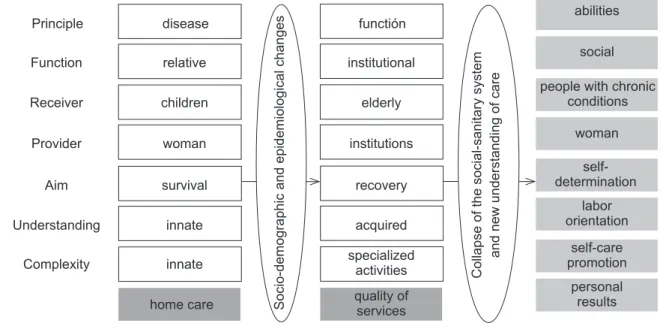
This evolution proceeds at the same speed as the multiple technical knowledge transfer to home care providers. Thus, alternatives like early discharge, outpatient management and medical technology management at home, as well as the increase in chronic degenerative conditions in the general population, make care today different from what it was some decades ago(1,39-40) (Picture 1). The above, in combination with the growing acceptance of the beneits of keeping people
linked with their family environment, has enhanced knowledge acquisition to accomplish specialized care tasks. These go beyond traditional help, accelerating the need to transfer knowledge to caregivers and also to care receivers(30,41).
This understanding of care and the evolution of
its complexity lead to a distinct coniguration of the informal caregiver and care receiver’s proiles. The
Rev. Latino-Am. Enfermagem 2011 July-Aug.;19(4):1039-46.
Figure 1 – Systemic changes that have modiied care
Principle Function Receiver Provider Aim Understanding Complexity home care disease relative children woman survival innate innate So ci o -d e mo g ra p h ic a n d e p id e mi o lo g ica l ch a n g e s functión institutional elderly institutions recovery acquired specialized activities quality of services C o lla p se o f th e so ci a l-sa n it a ry syst e m a n d n e w u n d e rst a n d in g o f ca re abilities social
people with chronic conditions woman self-determination labor orientation self-care promotion personal results
In some European countries, care delivery to dependents represents a strategy to increase female work(43). This possibility raises the discussion on the
implications of care in the sociopolitical sphere, like in the Spanish case, where the Law for the Promotion of Personal Autonomy and Care to people in situations of dependency proposes economic compensation for people who serve as care providers for a relative and, therefore, cannot perform a remunerated job (Law No 39/2006, November 14th).
In this respect, since the Law was published, the issue emerged about the possible professionalization of caregivers in view of the traditional consideration of their caregiving role and, in 2009, this discussion was revived when the possibility was announced that people who had lacked the opportunity to get a degree in the care area could get professional education, accrediting family experience in care delivery to minors or dependent relatives, with a view to integrating them into the job market. To recognize professional competencies gained through job experience, Royal Decree No 1224/2009, intends to facilitate citizens’ employability, mobility, enhance learning across the lifetime and social cohesion, especially for those groups lacking acknowledged
qualiication (R.D. No 1224/2009, July 17tt).
This recognition raises a new issues, deriving
from the perspective of inding a mixed form between
formal and informal caregivers, given their job insertion and, thus, the possibility of new job markets(44). This possibility relects that the care context is experiencing
a new feminization and that, in a way, the establishment of this new job option again places women in the
domestic sphere(41). Hence, family pressures are
maintained for women, who have taken care free of charge, to continue doing this, but now with economic help and social security, reinforcing all aspects of the female naturalization of care(43).
On the other hand, the emergence of this economic activity sector entails the genesis of new job characters, like family worker, geriatric assistant or personal assistant for autonomy for example. All of these emerge at a precarious time in the job market. Given their incipient professionalization process, this puts them in a vulnerable situation and results in discrimination for the people performing these jobs. That is, as these jobs are frequently mixed up with an expression of femininity, they tend towards invisible jobs(33,41). On the other hand,
as these jobs are executed in the family context, they entail the implicit understanding about the permanent availability of women’s time at the service of the family, as opposed to what happens in the economic sphere, where
goods are exchanged for other goods and a speciic time
exists for this exchange(45). This phenomenon has been
called the domestication of work, a term that implies that remunerated work is increasingly similar to domestic/ family work: elasticity, fragmentation and dispersion in terms of job conditions, such as time availability,
lexibility, dedication and polyvalence. Besides, and
to an increasing extent, they suppose an underlying quality – affect – which was considered exclusive to the private sphere of individuals’ lives until now, and totally detached from any work concept(33).
in this sector. To give an example, in Sweden, qualiied occupations have been created with qualiied jobs, in
the framework of universal policies and public services parallel to and integrated with gender equality policies. In Southern European countries, on the other hand, with scarce social services and a greater trend towards monetary transfers, a precarious job market sector and
employment conditions similar to the British case are
being generated(33,43).
Despite the care formal caregivers deliver, it is predictable that the characteristics of the social-sanitary support network indirectly determine the level of informal support patients receive from their close environment(46). The degree of access to technical
help, as well as the price and availability of informal care substitutes, can affect its intensity and nature. In view of these changes and growing care demands, the perspective is increasingly complex, as individualized foci are needed to address this diversity(18).
Conclusions
In structural population changes related to the demographic and epidemiological transition, it can be
identiied that aging, which occurred to different extents
around the world, has enhanced the dependence phenomenon, a situation in which two conditions are intertwined: chronicity and impairment, which entail enhanced care complexity. This situation increasingly demands family caregivers’ participation and the emergence of new professional caregiver characters. On the other hand, it also reinforces the new for care receivers to assume a new position, moving towards knowledge appropriation with a view to self-care.
Implications for professional caregivers not only appoint a change in the way they perform their individual
practice, but also modiications in social-sanitary service
organization and position, which demand, besides new modes like home care, a new concept aimed at understanding care as a social function, more than an individual issue. Increased social support needs for care
delivery in more diversiied areas and populations raises
the opportunity and need for professional nurses to participate not only in direct care delivery to people, but also in care planning and management, given that that is the discipline’s rotational axis.
References
1. Ewijk H, Hens H y Lammersen G. Care Work in Europe Current Understandings and Future Directions, Mapping of Care Services and the Care Workforce National Report
- The Netherlands. Utrecht: Netherlands Institute of Care and Welfare/NIZW; 2002.
2. Mejía L y López L. La familia y la cultura: una conexión innovadora para el cuidado de la salud. Index Enferm 2010;19(2-3).
3. Vaquiro S y Stiepovichi J. Cuidado informal, un reto
asumido por la mujer. Cienc enferm. 2010;16(2):9-16. 4. ONU. World population ageing United Nations. Population Division. Nueva York: Department of Economic and Social Affairs,; 2009.
5. Vera M. Revisión crítica a la teoría de la transición epidemiológica. Papeles de población Universidad Autónoma del Estado de México. 2000;25:179-206. 6. Omran A. The epidemiologic transition. A theory of the epidemiology of population change, reproducción
del original de 1971. Bulletin of the World Health
Organization. 2001;79(2):161-70.
7. Gómez-Arias RD. La transición en epidemiología y salud pública ¿explicación o condena? Revista Facultad Nacional de Salud Pública (Medellín). 2001;19(2):57-74. 8. Martínez C y Leal G. La transición epidemiológica en México: Un caso de políticas de salud mal diseñadas y desprovistas de evidencia. Estudios Demográficos y Urbanos El Colegio de México, AC. 2002;51:547-69. 9. Tobío C, Agulló M.,Gómez M y Martín M. El cuidado de las personas. In: Caixa” Fl, ed. Un reto para el siglo XXI 2010.
10. Rodríguez S, Watanabe HA y Derntl A. A saúde de idosos que cuidam de idosos. Rev Esc Enferm USP. 2006; 40(4):493-500.
11. ONU. Development in an ageing world. Nueva York: Department of Economic and Social Affairs; 2007. 12. Villagómez E. La actividad laboral de las mujeres en España: Retos económicos y sociales del sistema impositivo y de seguridad social Gaceta Laboral 2005;11(2):208-29.
13. Montoro R. La reforma del Estado de bienestar: Derechos, deberes e igualdad de oportunidades. Revista Española de Investigaciones Sociológicas. 1997;79:9-42. 14. Santolaria E, Fernández A y Daponte A. La salud y el sistema sanitario desde la perspectiva de género y clase social: El sector productivo. Gac Sanit 2004;18(1):24-30.
15. Lesthaeghe R. On theory development and applications to the study of familiy formation. Population and development review. 1998;24(1):1-14.
16. Larrañaga I, Valderrama MJ, Martín U, Begiristain JM, Bacigalupe A y Arregi B. Mujeres y hombres ante
Rev. Latino-Am. Enfermagem 2011 July-Aug.;19(4):1039-46.
17. Robles L. El cuidado en el hogar a los enfermos crónicos: un sistema de autoatención. Cad Saúde Pública. 2004; 20(2):618-25.
18. WHO. Innovative care for chronic conditions: building blocks for action: global report. Geneva: World Health Organization; 2002.
19. Torralba i Roselló F. Enfermería y mutación paradigmática. XX Congreso Nacional de Enfermería de Salud Mental; 2003; Alicante,España: Asociación Nacional de Enfermería de Salud Mental; 2003.
20. De la Cuesta C. El cuidado del otro: Desafíos y posibilidades. Invest Educ Enferm. 2007;25(1):106-12.
21. Cruz M, Jenaro C y Pérez C. Enfermería y discapacidad:
Una visión integradora. Index de Enfermería 2009;19(2-3):177-81.
22. Roberts G y Wolfson P. The rediscovery of recovery: Open to all. Advances in Psychiatric Treatment. 2004;10:37-49.
23. Pires M. Politicidade do cuidado como referência emancipatória para a enfermagem: conhecer para cuidar melhor, cuidar para confrontar, cuidar para emancipar. Rev Latino-Am Enfermagem. 2005;13(5):729-36. 24. Droulout T, Liraud F y Verdoux H. Relationships between insight and medication adherence in subjects with psychosis. Encephale. 2003;29(5):430-7.
25. Rummel-Kluge C y Kissling W. Psychoeducation for patients with schizophrenia and their families. Expert Rev Neurother. 2008;8(7):1067-77.
26. Brêda M, Rosa W, Pereira M y Scatena M. Duas estratégias e desafios comuns: a reabilitação psicossocial
e a saúde da família. RevLatino-Am Enfermagem. 2005;13(3):450-2.
27. Lussi I, Pereira M y Pereira J. A proposta de reabilitação psicossocial de Saraceno: um modelo de auto-organização? . Rev Latino-Am Enfermagem.
2006;14(3):448-56.
28. Vega O y González D. Apoyo social: Elemento clave en el afrontamiento de la enfermedad crónica. Enfermería Global. 2009;16:1-11.
29. La Parra D. Contribución de las mujeres y los hogares más pobres a la producción de cuidados de salud informales. Gac Sanit 2001;15(6):498-505. 30. García-Calvente M, Mateo-Rodríguez I. y Eguiguren,A. El sistema informal de cuidados en clave de desigualdad. Gac Sanit. 2004;18(Supl 1):132-9.
31. Moreno M. La relación con el paciente inmigrante: Perspectivas investigadoras. Index de Enfermería. 2005;14(50):25-9.
32. UNFPA. Estado de la población mundial: Fondo de Población de las Naciones Unidas; 2006.
33. Martín M. Los cuidados y las mujeres en las familias. Política y Sociedad. 2008;45(2):29-47.
34. ONU. Seguimiento de la población, con especial referencia a la migración internacional y el desarrollo. Nueva York: Organización de las Naciones Unidas; 2006.
35. Román M y Martínez A Las cadenas globales de cuidados: un análisis sociodemográfico. Sociedad y utopía. 2005;26:261-78.
36. Cameron C y Moss P. La atención a personas dependientes en Europa: conceptos actuales y perspectivas futuras. Intervención Psicosocial. 2007;16(1):7-22.
37. Tobío C. Redes familiares, género y política social en España y Francia. Política y Sociedad. 2008;45(2):87-104.
38. INEGI. Mujeres y Hombres en México. México: Instituto Nacional de Estadística y Geografía; 2009. 39. Harwood R, Sayer A y Hirschfeld. Currente and future worlwide prevalence of dependency, its relationship to
total population, and dependency ratios. Bulletin of the
World Health Organization. 2004;82(4):251-8.
40. Izquierdo M. Cuidar cuesta: costes y beneficios del cuidado. Del sexismo y la mercantilización del cuidado a su socialización: Hacia una política democrática del cuidado. Donosti: Emakunde 2003.
41. Cruz M, Pérez MC, Jenaro C, Flores N y Segovia
Díaz de León, MG. Necesidad social de formación de recursos informales para el cuidado: Una disyuntiva para la enfermería profesional. Index de Enfermería. 2010;19(4):269-73.
42. Daly M y Lewis J. The concept of social care and the analysis of contemporary welfare status. British Journal
of Sociology. 2000;51(2):281-98.
43. Simonazzi AM. Care regimes and national
employment models. Cambridge Journal of Economics.
2009;33(2):211-32.
44. BOE. Reconocimiento de las competencias
profesionales adquiridas por experiencia laboral. Ministerio de la Presidencia 2009:72704-27.
45. Martin M. Domesticar el trabajo: una reflexión a partir de los cuidados. Cuadernos de Relaciones Laborales. 2008;26(2):13-44.
46. Jenaro C, Robaina N y Cruz M. Vigor and dedication
in nursing professionals: Towards a better understanding
of work Journal of Advanced Nursing 2009.