in this system may result in unpleasant sensations such as dizziness, nausea and a feeling of imbalance accompanied by uncontrollable eye movements, i.e., nystagmus1,2.In humans, the vestibular system
consists of three key components: a peripheral sensory system, a central processor, and a motor response mechanism. The peripheral system consists of a set of motion sensors which send information to the central nervous system (CNS)3.
The central vestibular system produces a response to head movement which is transmitted to the extraocular muscles and the spinal cord, triggering the vestibulo-ocular relex (VOR) and vestibulo-spinal relex (VSR).The VOR generates eye movements, which maintain vision stable during head movement. Electronystagmography (ENG), in its different forms, is the most appropriate procedure for assessing ocular and/or vestibular information. It records eye movement, which represents the major element in the investigation and assessment of vestibular disorders 4,5. The standard response for
FUNCTIONAL EVALUATION OF THE VESTIBULAR SYSTEM
OF GUINEA PIGS POISONED BY AN ORGANOPHOSPHATE
THROUGH CALORIC STIMULATION
Avaliação funcional do sistema vestibular de cobaias intoxicadas
agudamente por organofosforado por meio da prova calórica
Lícia Assunção Cogo(1),Adriana de Andrade Batista Murashima(2),
Valdete Alves Valentins dos Santos Filha (3), Miguel Angelo Hyppolito(4), Aron Ferreira da Silveira(5)
(1) Federal University of Pampa – Uruguaiana Campus,
Uru-guaiana, Brazil.
(2) University of São Paulo, Ribeirão Preto, SP, Brazil. (3) Federal University of Santa Maria – UFSM, Santa Maria,
Brazil.
(4) Department of Ophthalmology, Otorhinolaryngology and
Head and Neck Surgery, School of Medicine, Ribeirão Preto, University of São Paulo. Ribeirão Preto – SP, Brazil.
(5) Federal University of Santa Maria – UFSM, Santa Maria,
RS, Brazil. Funding agency: Capes
Conlict of interest: non-existent
INTRODUCTION
Body balance is maintained by the joint operation of three structures: the vestibular system, the visual system and the proprioceptive system. The vestibular system detects the sensations of balance, assisting in the coordination of head and eye movements, and also in adjustments of body posture. Dysfunctions
ABSTRACT
Purpose: this study aimed to assess the functioning of the vestibular system of guinea pigs exposed to the organophosphate chlorpyrifos, acutely, through caloric stimulation electronystagmography.
Methods: the research conducted an experimental electronystagmography of guinea pigs exposed
to organophosphate for 10 consecutive days, at doses 0.5 mg / kg / day and 1.0 mg / kg / day intraperitoneally and compared with a control group that received distilled water administration. We performed caloric ice (10 º C) and compared the variables frequency of appearance of nystagmus in 10 seconds (u / s) and angular velocity of the slow component (º / s). Results: the results showed no statistically signiicant difference in the comparison of variables between groups. Conclusion: we conclude that the tested doses of the pesticide organophosphate chlorpyrifos caused no detectable functional damage in the caloric test.
KEYWORDS: Postural Balance; Vestibule, Labyrinth; Insecticides, Organophosphate; Pesticides;
was approved by the Ethics Committee on Animal Research of the School of Medicine of Ribeirão Preto, University of São Paulo, under no. 135/2011, on November 8, 2011.
This study used 18 male albino guinea pigs, species Caviaporcellus, English breed, weighing between 300 and 500g, with Preyer’s relex but no signs of otitis externa and/or media, and absence of tympanic perforation after otoscopic assessment. Preyer’s relex is assessed by observation of small twitching movements in the pinna of guinea pigs, when stimulated with sounds of small and medium intensity. Such relex is used to assess auditory function in rodents12.
The animals were housed in the Animal Laboratory of Experimental Surgery of the Department of Surgery of the School of Medicine of the university. They were kept in collective cages with shavings, sorted by group, under light/dark for 12 hours, controlled temperature and humidity, with unlimited access to feed and water.
For poisoning purposes, the animals received intraperitoneal application of the pesticide OF Pyrinex 480 CE®, marketed by Milenia Agrociências S/A, whose active ingredient is chlorpyrifos. Pyrinex ® 480 EC is an OP insecticide whose mode of action is by contact and ingestion, It is recommended for pest control in cotton, potatoes, coffee, citrus, beans, apples, corn, soybean, what and processing tomato for industrial use. The product is registered with the Ministry of Agriculture, Livestock and Food Supply (MAPA) under No. 09 298.
The intraperitoneal route was chosen to ensure the absorption of the rate; otherwise the exact rate might not have been absorbed.
The guinea pigs were divided into three groups: group I (control) received intraperitoneal admin-istration of distilled water once daily, in the same volume as the rate of pesticide for the weight of the animal; in group II, the pesticide was intraperitoneally administered in a single daily rate of 0.5 mg / kg / day; in group III,pesticide was administered intra-peritoneally in a single daily rate of 1.0 mg / kg / day – all of them for ten consecutive days. The weight of the guinea pigs was monitored daily for calculation of the appropriate rate of pesticide to be used. The control had ive guinea pigs, and the treated groups II and III had six and seven guinea pigs, respectively. The number of guinea pigs per group was deined according to the standards of the National Health Surveillance Agencyfor toxicological studies, with a minimum of ive animals for each rate tested in the experiment. Thus, the minimum number of animals the exam is nystagmus, which appears every time
the vestibular system is stimulated. This is due to an imbalance between antagonistic vestibular forces which helps keep the orientation of the eyeballs. Likewise, a pathology in the peripheral system or its central connections may determine the onset of nystagmus. Nystagmus is the fundamental element for analysis of VOR in ENG. Abnormalities of VOR can be found in the research on caloric stimulation4.
Some chemicals cause harm to humans and the environment, e.g., pesticides, some of which are known for their neurotoxic properties. Pesticides are often considered responsible for poisoning agricul-tural workers that are exposed to them, especially in developing countries6,7. Pesticides are an important
risk factor for human health. These products are used in large-scale by various productive sectors and more intensely by the agricultural sector8,9.
As a type of pesticides, organophosphate (OP) insecticides are cholinesterase inhibitors that cause varying degrees of toxicity to humans. Because of the beneits that this pesticide brings to planta -tions, agricultural workers usually underestimate its effects on their own health when they are exposed to the product10.This exposure often causes clinical
changes that silently affect the lives of workers11.
It is known that short-term exposure causes the so-called acute effects. This clinical picture varies in intensity, and may be characterized by nausea, vomiting, headache, dizziness and other symptoms. Dizziness is a major symptom, considered one of the clinical manifestations of exposure to pesticides7,8.
It is important to note that not only agricultural workers are exposed to pesticides, but also their families, which live next to plantations. This fact highlights the need for research that deeply analyzes methodologies for assessment of exposure to toxic agents and the risks associated with these products, both in cases of acute poisoning and long-term exposure to pesticides11.
The objective of this research was to evaluate, by means of electronystagmography, the functioning of the vestibular system of guinea pigs acutely exposed to organophosphate chlorpyrifos.
METHODS
This research was a prospective cohort study, based on Severino (2008)12. It was conducted in
After healing of the surgical wound, the animals were kept in boxes suitable for recording of nystagmus, caused by irrigation with 20 ml of ice water at 10 º C in the external auditory canal.
Ten days after administration of the pesticide, the guinea pigs were subjected to a new recording of nystagmus (Figure 3), using the permanent electrode previously implanted, again by irrigation of the external auditory canal with 20 ml of water at 10 º C.
For animal handling and administration of the pesticide, personal protective equipment was used as recommended in the product information. The rate of the pesticide was chosen based on oral LD
50 for rats of Pyrinex 480 CE ®, found in the product information, which is 300 mg / kg, and it considered the standards of ANVISA whereby the rate must not exceed 80% of LD50.
The functional assessment selected to be performed in this study was the ice water caloric test(water at 10 º C), according to the protocol of Marseillan, Grellet and Colafêmina (1969) within the spectrum of the ENG test. The variables selected were: frequency of nystagmus onset (Fn) in 10-second recording, measured in units per second (u / s) and angular slow-component velocity (SCV), measured in degrees per second (° / s).
ENG was performed 24 hours before starting the experiment and 24 hours after the last administration of pesticides and distilled water in the control group. The irst test was carried out so that it could be used as a comparison of the situation of the vestibular system of guinea pigs, before and after poisoning. The second procedure was performed to assess the effect of the pesticide in the vestibular system of these guinea pigs by means of a functional test by analyzing their vestibulo-ocular relex.
The technique used for the study of vestibular responses to thermal stimulation was developed by Marseillan, Grellet and Colafêmina in 1969. This technique is based on the electronystagmographic recording of ocular reactions to thermal stimulation in guinea pigs prepared for chronic experiments with permanent electrodes13. All animals selected
were submitted to an aseptic surgical procedure for implanting one frontal subcutaneous electrode and two subcutaneous electrodes in the periorbicu-lares regions (left and right) under intramuscular anesthesia with 2% xylazine hydrochloride (0.5 ml / kg - Dopaser ®; Laboratórios Calier do Brasil Ltda) and ketamine hydrochloride 10% (0.9 ml / kg - Ketamin ® 50mg/ml; Laboratório Cristália).
The implanted electrodes were made of metal wire as the model developed by the creators of the technique (Figure 1), and the head of the animal had an external electrical connector to capture the signal (Figure 2).
Figure 1 – Image of permanent electrodes implanted
The preampliiers were adjusted for the ink pen movement within 2cm on the recording paper. The electrodes are polarized so that right-sided eye movement moves the ink pen upwards and left-sided eye movement moves the ink pen downwards. Movements were calibrated by stabilizing the ink pen and keeping the guinea pigs’ heads in a stable position.
For test recording, single-channel Nistagmocil ® equipment was used to record nystagmus induced by the RALPAC method (air or water caloric stimu-lation). The equipment is portable and simple to use, consisting of a registration system with special pre-ampliiers coupled by capacitors which record changes in corneo-retinal potential but do not record the absolute values of these potentials.
RESULTS
ENG results, when compared among groups, showed no signiicant difference across ears in any of the groups, which shows similarity among ears both for the variable Fn and the variable SCV. The comparison test in the pre-experiment among groups I, II and III showed no signiicant difference between them; thus, the groups were homogeneous.
These tests were performed to ensure homoge-neity among the ears and among the groups. This fact allows the comparison of the results in the post-experiment, considering they were statistically similar beforehand.
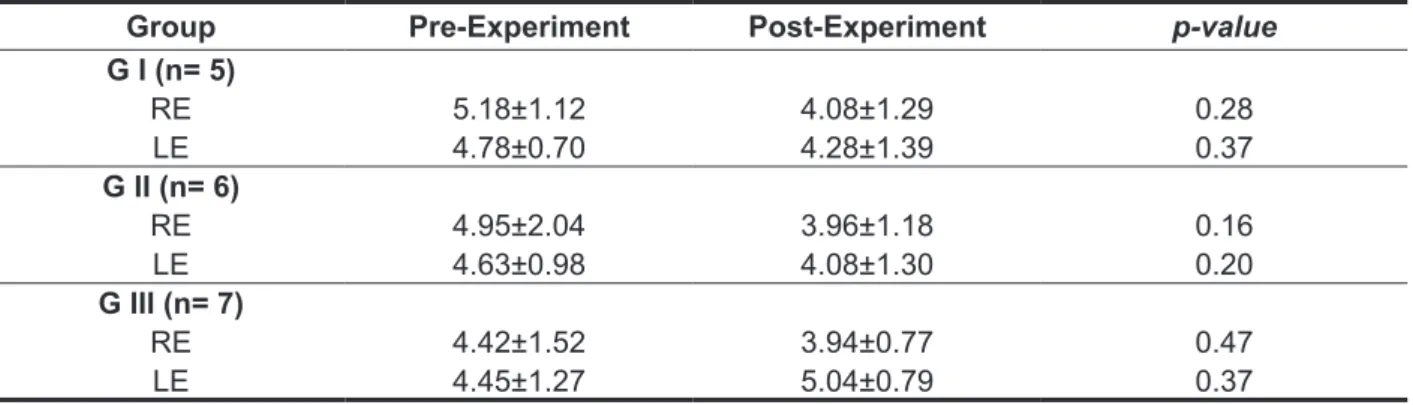
The mean Fn and SCV for the ears of the animals in each group are shown in Tables 1 and 2.
The values of frequency of nystagmus onset (Fn) were obtained by counting the number of nystagmus present in 10-secondrecording, based on paper speed of 25 mm / s in the machine.
The values for angular slow-component velocity (SCV) were obtained with three measurements of nystagmus with equal bases at three different locations: at the beginning, middle and end of the record. The value considered for SCV for each guinea pig ear was the average of the nine values measured.
The data were treated statistically using the program Statistica, version 9.0. The collected data were tested for normality with Lilliefors test. For normal data within groups, Student’s t-test was used for dependent variables, while ANOVA was used for data among groups, considering the level of signii-cance of 5%.
and carbamates14,15. A study on the quality of life
and hearing health of workers exposed to pesticides noted that these compounds cause worse life quality scores and hearing health effects in comparison with population that had not been exposed, showing the inluence of these substances on human health16.
Several studies were conducted to evaluate the impact of using OP pesticides on human health. As a method, these studies used interviews with rural workers exposed to these compounds17-24.The
results showed dizziness as a recurrent symptom reported by these workers. This suggests functional The comparison of the groups in the
post-exper-iment showed no statistically signiicant difference in the variables Fn and SCV.
DISCUSSION
There was no statistically signiicant difference in the post-experiment tests, showing that the OP pesticide chlorpyrifos at the rates of 0.5 mg / kg / day and 1mg/kg for 10 days did not cause detectable damage in the functional test of the vestibular system of guinea pigs.
Researchers warn that the vast majority of
Table 1 - Comparison of mean values of frequencies of nystagmus onset (u/s) between the pre-and
post-experiment of Groups I, II and III (#)
Group Pre-Experiment Post-Experiment p-value
G I (n= 5)
RE 5.18±1.12 4.08±1.29 0.28
LE 4.78±0.70 4.28±1.39 0.37
G II (n= 6)
RE 4.95±2.04 3.96±1.18 0.16
LE 4.63±0.98 4.08±1.30 0.20
G III (n= 7)
RE 4.42±1.52 3.94±0.77 0.47
LE 4.45±1.27 5.04±0.79 0.37
(#) Data were shown as mean ± standard deviation
RE–right ear; LE –left ear; n - number of guinea pigs; u/s - unit/second
Intra-group test –Student’s t-test; Intergroup test - ANOVA
Table 2 - Comparison of mean values of angular slow-component speeds(°/s) between pre- and post-experiment of Groups I, II and III(#)
Group Pre-Experiment Post-Experiment p-value
G I (n= 5)
RE 59.75±19.19 63.21±21.39 0.79
LE 55.59±23.25 73.39±22.70 0.09
G II (n= 6)
RE 59.05±17.42 57.34±15.74 0.76
LE 44.31±14.37 52.86±11.19 0.36
G III (n= 7)
RE 55.85±23.17 69.45±24.18 0.17
LE 62.66±16.71 68.31±25.69 0.54
(#) Data were shown as mean ± standard deviation
RE–right ear LE –left ear; n –number of guinea pigs; º /s – degree per second
child development27.This reinforces the notion that
even in the presence of this compound in the body, a functional relationship with this result is often not found.
Acute exposure to organophosphates may not be able to represent changes in functional tests, as shown in the study that evaluated the effects of these compounds in the auditory system of guinea pigs. The research found changes in outer hair cells of the cochlea after acute intoxication by OPs, but this morphological lesion did not translate into functional changes in the peripheral auditory system of guinea pigs assessed by tests for distortion product otoacoustic emissions and brainstem auditory evoked potential11.
The acute period of exposure and assessment may have been the determining factor for the non-signiicant results in this study, pointing to the need for further research with different rates and for a longer period of time so that the use of this substance can be determined more reliably.
Although the results remain controversial with respect to morphological effects of pesticide exposure, studies show the observation of signs and symptoms in the population exposed to these compounds, and they also show that such reports are due to the incorrect use of the substances, the lack of proper product handling by workers and underestimation of the effects of these compounds on human health28,29.
CONCLUSION
The organophosphate pesticide chlorpyrifos, at the rates tested, showed no functional damage to the vestibular system of acutely poisoned guinea pigs.
ACKNOWLEDGMENTS
We would like to thank the staff of the Laboratory of Surgical Technique and Experimental Surgery, the Department of Surgery and Anatomy, the Laboratory of Electron Microscopy, the Department of Cell and Molecular Biology and Pathogenic Bioagents, at the School of Medicine of Ribeirão Preto, University of São Paulo, for their collaboration in this research. We are also grateful to CAPES (Coordination for the Improvement of Higher Education Personnel) for their inancial support.
It should be noted that interviews with workers are subjective and, therefore, are not as reliable as the functional test performed in the present study. This examination gives a measurable result of the effect caused by exposure to the substance in question. In contrast to this research, those studies assess chronic symptoms on humans, while the sample of this research was exposed for a brief period and assessed the acute effect on animals.
The study that evaluated morphological changes of the vestibulocochlear apparatus of guinea pigs exposed to OPs found evidence of changes by electron microscopy scanning in cochleae, saccules and utricles. This result shows that a morpho-logical change may suggest a functional disorder25.
However, in the present study, there has been no manifestation of functional symptoms, and this may have been due to difference of the active ingre-dient tested, although it was an organophosphorus compound.
The results of this study showed no statistically signiicant difference between the variables studied. This is at odds with other researchers, who found functional changes in sensorimotor tests in humans as a change in the measure of postural sway with eyes closed and on a smooth surface, suggesting subclinical effect of the pesticide on the vestibular and proprioceptive systems7. It also disagrees on
the research which examined the vectoelectronys-tagmography results of workers chronically exposed to OPs, where changes were found in 50% of cases, with these changes being translated into caloric hyperrelexia in VENG; however, the present study evaluated the acute effects of this organophosphate compound26.
The study on acutely exposed rural workers is dificult to conduct, since most of these subjects have been previously exposed to these substances for long periods. Another limitation of the study with humans is that they are rarely exposed to only one agent, which hinders the evaluation of the speciic effects of a single active. For this reason, experi-mental studies are an alternative to search the isolated effect of an active ingredient.
9. Domingues MR, Bernardi MR, Ono EYS, Ono MA. Agrotóxicos: Risco à Saúde do Trabalhador Rural. Semina: Ciênc. Biológicas e da Saúde. 2004 [acesso em 5 de agosto de 2013]; 25:45-54. Disponível em:http://www.uel.br/revistas/uel/index. php/seminabio/article/view/3625/0.
10. Körbes D. Toxicidade de agrotóxico organofosforado no sistema auditivo periférico de cobaias: estudo anatômico e funcional. [dissertação]. Santa Maria (RS): UFSM - Distúrbios da Comunicação Humana; 2009.
11. Silva LMF, Araújo GT, Silva ADV, Junior MV, Carvalho CM. Levantamento dos agrotóxicos utilizados na horticultura no município de Ubajara-CE. RevBrasAgricultura Irrigada. 2011 [acesso em 5 de agosto de 2013]; 5(4):280-5. Disponível em:http://www.inovagri.com.br/index. php/2011/12/levantamento-dos-agrotoxicos utilizados-na-horticultura-no-municipio-de-ubajara-ce/.
12. Jero J, Coling DE, Lalwani AK. The use of Preyer’s relex inevaluation of hearing in mice. ActaOtolaryngol.2001;121(5):585-9.
13. Oliveira JAA,Cicilini GA, Souza ML, Andrade MH. Efeitos do ácido etacrínico sobre o sistema vestibular. Rev Bras Otorrinolaringol. 1979;45(1):8-16.
14. Moraes ACL. Contribuição para o estudo da intoxicação humana por carbamatos: o problema do “chumbinho” no Rio de Janeiro. [dissertação]. Rio de Janeiro(RJ): FIOCRUZ – Saúde Pública; 1999. 15. Moraes ACL, Brabora EM. A Toxicovigilância na Gestão da Saúde Pública e Ambiental: a questão dos agrotóxicos. Cad Saude Colet.2005[acesso
REFERENCES
1. Mor R, Fragoso M. Vestibulometria na prática Fonoaudiológica. São José dos Campos, SP: Pulso Editorial, 2012. P.19-27.
2. Morozetti PG, Ganança CF, Chiari BM. Comparação de diferentes protocolos de reabilitação vestibular em pacientes com disfunções vestibulares periféricas. J SocBrasFonoaudiol. 2011 [acesso em 5 de agosto de 2013]; 23(1):44-50. Disponível em:http://www.scielo.br/pdf/jsbf/v23n1/ v23n1a11.pdf
3. Mazzucato A, Borges APO. Inluência da reabilitação vestibular em indivíduos com desequilíbrio postural. RevNeurocienc. 2009 [acesso em 5 de agosto de 2013]; 17(2):183-8. Disponível em: http://www.revistaneurociencias. com.br/edicoes/2009/RN%2017%2002/17.pdf 4. Mor R, Fragoso M. Vestibulometria na prática Fonoaudiológica. São José dos Campos, SP: Pulso Editorial, 2012.P. 43-99.
5. Munaro G, Sleifer P, Pedroso FS. Análise da inluência do nistagmo espontâneo e pré-calórico na Vectoeletronistagmograia. Rev CEFAC.2009;11(2):331-7.
6. Teixeira CF, Augusto LGS, Morata TC. Saúde auditiva de trabalhadores expostos a ruído e inseticidas. Rev Saúde Pública.2003;37(4):417-23. 7. Hoshino ACH, Pacheco-Ferreira H, Taguchi CK, Tomita S, Miranda MF. Estudo da ototoxicidade em trabalhadores expostos a organofosforados.Rev Bras Otorrinolaringol. 2008;74(6):912-8.
8. Silva JM, Novato-Silva E, Faria HP, Pinheiro
RESUMO
Objetivo: avaliar o funcionamento do sistema vestibular de cobaias expostas ao organofosforado clorpirifós, de forma aguda, por meio da prova calórica da eletronistagmograia. Métodos: a pesquisa do tipo experimental realizou a eletronistagmograia de cobaias expostas a organofosforado durante 10 dias consecutivos, nas doses 0,5mg/kg/dia e 1,0mg/kg/dia por via intraperitoneal e comparadas com grupo controle que recebeu administração de água destilada. Foi realizada prova calórica gelada (10ºC) e comparadas as variáveis frequência de aparecimento de nistagmos em 10 segundos (u/s) e velocidade angular da componente lenta (º/s). Resultados: os resultados não demonstraram dife-rença estatisticamente signiicante na comparação das variáveis entre os grupos. Conclusão: con-clui-se que nas doses testadas o agrotóxico organofosforado clorpirifós não causou danos funcionais detectáveis na prova calórica.
DESCRITORES: Equilíbrio Postural; Vestíbulo do Labirinto; Inseticidas Organofosforados;
(AL): Fundação Osvaldo Cruz – Saúde Pública; 2010.
23. Azevedo KAA. Neurotoxicidade perinatal por cádmio em ratos Wistar e interação com clorpirifós. [tese] São Paulo (SP): UNESP - Clínica Veterinária; 2009.
24. Souza JLNC. O uso de agrotóxicos entre produtores de hortaliças na localidade rural de Passo do Vigário, Viamão/RS. [monograia]. Balneário Pinhal (RS): UFRGS – Tecnólogo em Planejamento e Gestão para o Desenvolvimento Rural; 2011.
25. Körbes D, Silveira AF, Hyppolito MA, Munaro G. Ototoxicidade por organofosforados: descrição dos aspectos ultraestruturais do sistema vestibulococlear de cobaias. Braz J Otorhinolaryngol. 2010 [acesso em 15 de novembro de 2012];76(2):238-44. Disponível em: <http:// www.scielo.br/scielo.php?script=sci_arttext& pid=S180886942010000200015>.
26. Dick RB, Steenland K, Krieg EF, Hines CJ. Evaluation of acute sensory–motor effects and test sensitivity using termiticide workers exposed to chlorpyrifos. Neurotoxicology and Teratology. 2001 [acessoem 15 de novembro de 2012]; 23(4):381-93. Disponível em: <http://www.sciencedirect.com/ science>.
27. Guodong D, Pei W, Ying T, Jun Z,YuG,Xiaojin W, et al. Organophosphate pesticide exposure and neurodevelopment in young Shanghai children. EnvironSci Technol. 2012 [acesso em 15 de novembro de 2012];46(5):2911-7. Disponível em: http://www.ncbi.nlm.nih.gov/pubmed/22304368. 28. Silva EF, Paniz VMV, Last G, Torres ILS. Prevalência de morbidades e sintomas em idosos: um estudo comparativo entre zonas rural e urbana. Ciênc saúde coletiva. 2013 [acesso em 5 de agosto de 2013];18(4):1029-40.Disponível em:http://www. scielosp.org/pdf/csc/v18n4/16.pdf.
29. Friedrich K. Desaios para a avaliação toxicológica de agrotóxicos no Brasil:desregulação endócrina e imunotoxicidade. Vigilância Sanitária em Debate.2013 [acesso em 5 de agosto de 2013]; 1(2): 2-15. Disponível em:http://www.visaemdebate. incqs.fiocruz.br/index.php/visaemdebate/article/ view/30.
16. Sena TRR, Vargas MM, Oliveira CCC. Saúde auditiva e qualidade de vida em trabalhadores expostos a agrotóxicos. Ciênc saúde coletiva. 2013[acesso em 5 de agosto de 2013]; 18(6):1753-61. Disponível em:http://www.scielosp. org/pdf/csc/v18n6/26.pdf.
17. Manjabosco CW, Morata TC, Marques JM. Peril Audiométrico de Trabalhadores Agrícolas. Arq Otorrinolaringol. 2004 [acesso em 15 de novembro de 2012]; 8(4):285-95. Disponível em:<http:// www.arquivosdeorl.org.br/conteudo/acervo_port. asp?id=293>.
18. Araújo AJ, Lima JS, Moreira JC, Jacob SC, Soares MO, Monteiro, MCM etal.Exposição múltipla a agrotóxicos e efeitos à saúde: estudo transversal em amostra de 102 trabalhadores rurais, Nova Friburgo, RJ.Ciênc saúde coletiva. 2007[acesso em 15 de novembro de 2012];12(1):115-30. Disponível em:<http://www.scielo.br/scielo.php?pid=S1413812 32007000100015&script=sci_arttext>.
19. Lisboa R, Sena J, Dutra T. Uso de agrotóxicos na produção de hortaliças da Bacia Hidrográica do Natuba, aluente do Tapacurá – PE e consequências sobre o meio ambiente e saúde dos agricultores. Artigo apresentado no II Congresso de Pesquisa e Inovação da Rede Norte e Nordeste de Educação Tecnológica, João Pessoa, PB, 2007.
20. Faria NMX, Rosa JAR, Facchini LA. Intoxicações por agrotóxicos entre trabalhadores rurais de fruticultura, Bento Gonçalves, RS. Rev Saúde Pública. 2009 [acesso em 15 de novembro de 2012];43(2):1-10. Disponível em: <http://www. scielo.br/pdf/rsp/2009nahead/7200.pdf>.
21. Hoshino ACH, Pacheco-Ferreira H, Taguchi CK, Tomita S, Miranda MF. A auto-percepção da saúde auditiva e vestibular de trabalhadores expostos a organofosforados. Rev CEFAC. 2009 [acesso em 15 de novembro de 2012];11(4):681-7. Disponível em: http://www.scielo.br/scielo.php?pid=S1516184 62009000800017&script=sci_abstract&tlng=pt 22. Magalhães MAS. Exposição a agrotóxicos na atividade agrícola: um estudo de percepção de riscos á saúde dos trabalhadores rurais no distrito de Pau Ferro – Salgueiro – PE. [dissertação]. Recife
Received on: June 01, 2013 Accepted on: October 20, 2013
Mailing address: Lícia Assunção Cogo
Av. Mons. Pascoal Gomes Libreloto, 199, Parque Dom Antônio Reis
Santa Maria – RS – Brasil CEP: 97065-290