The problematic aspects of the family
caregiver of people who suffered strokes
1 Nurse at the Dr. José Frota Hospital. Assistant Professor at the University of Fortaleza. Fortaleza, CE, Brazil. [email protected] 2 Nurse. Fortaleza, CE, Brazil. [email protected] 3 Adjunct Professor of the Nursing Department at the Federal University of Ceará. Fotaleza, CE, Brazil. [email protected] Nurse. Professor at Federal University of Rio de Janeiro. Rio de Janeiro, RJ, Brazil. [email protected] Nursing undergraduate at Federal University of
O
RIGINAL
A
R
TICLE
A PROBLEMÁTICA DO CUIDADOR FAMILIAR DO PORTADOR DE ACIDENTE VASCULAR CEREBRAL
LA PROBLEMÁTICA DEL CUIDADOR FAMILIAR CON EL PORTADOR DE ACCIDENTE CEREBRAL VASCULAR
RESUMO
Objetivou-se identificar a problemática da família de pessoas acometidas de acidente vascular cerebral hospitalizadas e discutir as dificuldades do cuidador familiar para o cuidado no âmbito domiciliar. A amostra constou de 154 famílias de pacientes inter-nados em um hospital da rede pública de saúde, Fortaleza-CE. Conforme os resulta-dos denotam, a maioria resulta-dos cuidadores são mulheres, 104 (67,5%); 122 casos (79,2%) apresentam comprometimento familiar e alterações na vida diária em 115 dos acom-panhantes (74,7%); 150 (97,4%) não rece-beram orientações acerca dos cuidados, mas 143 (92,9%) sentem-se seguros para acompanhá-los. O sentimento predomi-nante foi a tristeza, 125 (81,2%), e as dúvi-das principais foram: alimentação, 64 (41,6%), administração de medicamentos, 49 (29,9%), e possíveis complicações clíni-cas após a alta, 49 (29,9%). Estes resulta-dos alertam para o papel do enfermeiro como educador, não somente na preven-ção das doenças crônico-degenerativas, mas, também, na orientação aos cuidado-res familiacuidado-res sobre os cuidados dispensa-dos após a alta hospitalar.
DESCRITORES Assistência domiciliar. Cuidadores.
Acidente cerebral vascular. Enfermagem.
Luciene Miranda de Andrade1, Maria de Fátima Maia Costa2, Joselany Áfio Caetano3,
Enedina Soares4, Eveline Pinheiro Beserra5
ABSTRACT
The purpose of this study was to identify the problematic aspects of the families of people who were hospitalized because of strokes, and discuss the difficulties of the family caregiver toward household care. The sample consisted of 154 families of patients admitted in a public hospital in Fortaleza, Ceará state, Brazil. The results showed that most caregivers are women, 104 (67.5%); 122 cases (79.2%) showed family commitment and changes in the daily life of 115 accompanying partners (74.7%); 150 (97.4%) were not instructed about the care, but 143 (92.9%) felt safe to provide care. The predominant feeling was sadness, in 125 (81.2%) of the subjects, and the main doubts were: eating habits, 64 (41.6%); administering medication, 49 (29.9%); and possible clinical complications after discharge, 49 (29.9%). These results are worth noting for the nurse’s role as an educator, not only regarding the prevention of chronic-degenerative diseases, but also concerning delivering instructions to fam-ily caregivers about providing care after hospital discharge.
KEY WORDS Home nursing. Caregivers. Stroke. Nursing.
RESUMEN
El objetivo fue identificar la problemática de la familia de personas acometidas de acciden-te vascular cerebral hospitalizadas y discutir las dificultades del cuidador familiar en el ámbito domiciliar. La muestra fue constitui-da por 154 familias de pacientes internados en un hospital de la red pública de salud, en Fortaleza, CE. Conforme los resultados deno-tan, la mayoría de los cuidadores son muje-res, 104 (67,5%), 122 casos (79,2%) presen-tan comprometimiento familiar y alteracio-nes en la vida diaria en 115 de los acompa-ñantes (74,7%); 150 (97,4%) no recibieron orientaciones acerca de los cuidados; sin embargo 143 (92,9%) se sienten seguros para acompañarlos. El sentimiento predominante fue la tristeza, 125 (81,2%), y las dudas prin-cipales fueron: alimentación, 64 (41,6%), ad-ministración de medicamentos, 49 (29,9%), y posibles complicaciones clínicas después del alta hospitalaria, 49 (29,9%). Estos resultados alertan sobre el papel del enfermero como educador, en la prevención de las enferme-dades crónico degenerativas, y también la orientación dada a los cuidadores familiares sobre los cuidados a ser realizados después del alta hospitalaria.
DESCRIPTORES
Atención domiciliaria de salud. Cuidadores.
INTRODUCTION
Cerebrovascular accident (CVA) or stroke is a sudden loss of brain function resulting from the rupture of the blood supply to a part of the brain. As shown in studies, this event is the main cause of death and permanent injuries (sequels, disability) in Brazilian adults. The stroke is classified in two broad categories: ischemic stroke, when an artery irrigat-ing a given part of the brain is blocked, deprivirrigat-ing this re-gion of nutrients and oxygen, and hemorrhagic stroke, when
an encephalic blood vessel ruptures(1-2).
Although preventive measures have caused a significant decline in its incidence in the past years, stroke is still the third top cause of death worldwide, with a mortality rate of 12 to 37% for the first episode and above 62% for the subsequent episodes. As shown in statistics, nearly two million people who survive strokes remain with some
dis-ability: of these, 40% need assistance in daily activities(1).
As observed, a series of neurological deficits may be present after a stroke episode. With that, the deterioration of the patients’ quality of life becomes evident, since at least two thirds of the survivors retain some
sort of disability and become dependent, es-pecially to speak, walk, see or feel, and they are sometimes incapable of performing their daily activities. In this context, a very impor-tant person arises: the family member who
provides care(1). By caregiver, we understand
a person whose duty is to perform the tasks which the patient impaired by the morbid
episode cannot do any longer(3). These tasks
may vary from personal hygiene to financial participation in the family.
Therefore, in the authors’ opinion, this theme was con-sidered relevant for discussion, since there are no specific strategies focused on care for people with chronic and de-generative diseases at home, when the family caregiver is called to action, supporting care. As seen, transferring the function of caring to the family requires clarity regarding the family structure, the type of care that will be provided, the time demanded, the characteristics of the disease and the importance of monitoring by healthcare professionals. It is understood that the family should be responsible for the health of its members and, as such, needs to be heard, valuated and encouraged to participate in the whole care / cure process(4).
The family, either the nuclear type, formed by parents and children, or the extended type, including people con-sidered as members of the same family, regardless of blood or parental ties, is the primary source of care and help for
its members, from birth to death(5).
According to findings of studies about this theme, in order to subsidize Public Healthcare Policies, it is necessary
givers, so as to perform care on the dependent clientele, because the physical alterations caused by the disease gen-erate a series of weaknesses and, consequently, deficits in self-care and dependence for a caregiver. Therefore, the impact of the disease in the family is very strong, and can involve changes in affective, financial, power relationships and other variables, depending on the process of family organization.
This reality, in view of situations like those caused by strokes and their sequels, shows that the implementation of nursing actions focused on improving family coping is necessary, by teaching the family members about health-care and strengthening their collaboration in planning health-care. In this situation, the family members are expected to show positive attitudes and have adequate coping mechanisms to participate actively in the rehabilitation process, thus encouraging the patient to seek recovery and collaborate with the treatment.
Studies in the nursing field show that the family care-giver responsible for a stroke victim lacks qualification and support. Therefore, the need to perform studies on this theme is fundamental, because it is important to know and investigate the difficulties experienced in home care and to develop, implement and evaluate educational programs for the fam-ily caregiver.
Therefore, it is worth questioning: what are the problems of families of hospitalized stroke victims and the difficulties to maintain care at home?
The objective of the present study was to identify the problems of the families of hos-pitalized stroke victims and to discuss the impact caused on the family caregiver related to the diffi-culties for care, in order to maintain care at home after the patient is discharged from hospital.
METHOD
This is a descriptive, exploratory study with a quantita-tive approach, developed in the emergency and inpatient units of a public hospital, a reference in the area of Neurol-ogy in the city of Fortaleza, CE. These units were selected since they had high demands of stroke-specific care for pa-tients from Ceará and its neighboring states.
The target population consisted of the accompanying partners of patients with a stroke diagnosis, which yielded a sample of 154 accompanying partners. The following in-clusion criteria were adopted: being an accompanying part-ner or family caregiver during the hospital stay and after hospital discharge, and volunteering to take part in this research.
Structured interviews were used for data collection,
By caregiver, we understand a person
whose duty is to perform the tasks which
jective questions about gender, age, degree of relativity; changes in daily activities during hospitalization; orienta-tion and safety in the provision of care; feelings manifested after the stroke and difficulties in the care process.
As determined by resolution #196/96 of the Ministry of
Health(5), this study was submitted to the Ethicis
Commit-tee of the study institution and approved according to file #9000/05 in December 14, 2005. Next, after the term of consent had been signed, the participation of the family caregiver in the study was started.
Data collection was performed in the first semester of 2006, with one of the authors performing the interviews during his work shift, in a reserved place, away from the client and at a time convenient for the respondents.
The results were presented in descriptive percentages and in tables, which allowed for the visualization of the find-ings according to the proposed objectives. Regarding the quantitative answers, the values are different from the to-tal subjects in the study, since some of them mentioned more than one justification in their answers.
RESULTS AND DISCUSSION
Data related to the accompanying partners of hospital-ized stroke patients regarding gender, age and type of rela-tion showed that the main caregivers are women, with a total of 104 (67.5%). The age ranges were as follows: from 31 to 44 years old, 59 caregivers (38.3%); from 17 to 30 years old, 44 caregivers (28.6%), followed by 45 to 58 years old, with 42 caregivers (27.3%). Regarding female caregivers, daughters are worth of note, with 74 (48%) accompanying partners.
Due to their higher sensitivity and attention towards the human being, women have always been seen as the ones responsible for providing care to sick people. This re-sult can be the reflection of cultural standards. Frequently, the role of women in the family, as the main or primary
caregiver, as seen in foreign literature(6), has been described
in terms of characteristics of the caregiving person, in view of the circumstances of care and the person receiving care. In addition, over the years, the practice of life-supporting care is fundamentally linked to the activities of women. They give birth and have the responsibility of overseeing every-thing that maintains life in its most minute details(7). As seen,
young people are sometimes made responsible for other family members, for monitoring and providing the care they demand. This may be a consequence of the necessity of better physical conditions to withstand the hospital envi-ronment – by itself uncomfortable, at times, and the stroke victim’s dependency of care.
In this natural order of human evolution, it is common, at first, for the parents to care for their offspring during
childhood and throughout the whole development process, including the moments when they are infirm. Later, when the parents reach an advanced age, they require care and, since they cannot perform this self-care, their children usu-ally assume this responsibility.
In this study, changes in the daily routine during the hospital stay occurred in 115 (74.7%) of the accompanying partners. This put the family structure at risk in 122 (79.2%) cases. It was also observed that low family income (lower than two times the minimum wage) was often cited. There-fore, there were no resources to hire someone to provide care for the patient. Consequently, one of the members of the family had to take this responsibility.
As observed, even with unfavorable conditions for the accommodation of the accompanying partners, they are present during the hospital stay. Regarding receiving ori-entation within the hospital environment about the care to be provided to their relatives, as observed, most of them, 159 (97.4%) had not received orientation related to direct care, especially the care to be provided at home after dis-charge.
Regarding their confidence in accompanying their pa-tient, 143 (92.9%) said they felt safe due to the trust they had in the healthcare team that provided care, and because they were in a well-regarded hospital, itself a reference in Neurological care. Most caregivers took turns in their ac-companying routines, 122 (79.9%).
Providing care to a patient uninterruptedly for twenty-four hours after a stroke is not an easy task, demanding more than one caregiver to take turns, sharing the work and the accompanying times. Taking turns is a form of re-laxing from the hospital dynamics, although the accompa-nying partner is often incapable of detaching himself/her-self from the patient(8).
These accompanying partners, often seen as caregivers, are constantly worried – for example, about never leaving the patient alone for long, and they fear neglecting care. As it is known, lack of technical preparation due to lack of information may be the cause of personal overload, caus-ing changes in the life dynamics of the caregiver, as well as inefficient care for themselves and the patients. Therefore, when advised and oriented, the family members will be better prepared to adequately intervene in the situations of care, without damage for their lifestyle or their physical
and emotional health(9).
From these concerns, being away from work is worth of note, especially since it causes financial damages for the family, even for the purchase of medicine, food, hygiene products, among others. This is directly reflected in not being paid. According to the evidence, in some cases, the absence meant dismissal from the job. When this occurs, the situation is aggravated, because the risk of losing one of the financial providers leads to fear and increased ne-cessities of maintenance, associated to non-complementa-tion by the other family members.
Another factor seen as grieving is the concern for younger children who are home alone, being taken care of by neighbors or, in some cases, children being taken care of by other children.
Issues related to these changes concern the family caregivers because, as they see it, their loved ones cannot live by themselves at home, since they cannot manage their domestic environment. Therefore, the family caregiver as-sumes this managerial responsibility, which will be even
greater when added to managing their own life(10).
Changes in the family’s daily life can unbalance its struc-ture, because of the vulnerability of its members who are still not stabilized after changing roles. This makes the en-vironment ripe for the occurrence of severe family crises, because the pace of these relatives’ lives is intensified by the disease, which can consequently bring ruptures.
As seen, in spite of the stress caused by hospitalization associated to the fear of the death of a family member, the caregivers feel safe because they trust the care that was being provided by the healthcare team and the institution.
In all circumstances, safety is a decisive factor, and the reasons that cause insecurity turn care into an activity that is even more stressful and wearisome. As observed, one of the most significant difficulties faced by the caregiver is cer-tainly due to obtaining resources to maintain treatment. These factors can cause a vicious circle around the disease – lack of treatment – aggravation of the disease, making the
caring activity harder and harder for the caregiver(2).
Nowa-days, the healthcare system aims at dehospitalization but, for so, it is necessary to create adequate strategies to see to
Table 1 - Distribution of the alterations in daily activities of caregivers responsible for stroke patients - Fortaleza - 2006
Variables
Being away from work
Concerns about younger children
Altered household routine
Stress
Concerns about the household
Missing school days
Health problems
%
40.9
23.4
14.9
7.8
5.2
3.9
3.9
F
36
12
8
6
6 63
23
However, in spite of all the difficulties related to care in the hospital environment, such as the need to transfer the patient to third-party services for neurological evaluation, the cost of treatment, insufficient beds for hospitalization, increased incidence of infections, poor accommodation conditions and low availability of prophylactic physical therapy treatment, in addition to treatment performed in specialized units, it is important to keep in mind that diag-nosing and treating strokes does not mean simply diagnos-ing and treatdiagnos-ing the resultdiagnos-ing disabilities. It is also necessary to enable the individuals to reacquire the ability to interact with their environment and to aid their social inclusion.
Regarding the feelings manifested by the caregivers af-ter the stroke, sadness is most often mentioned, with 125 (81.2%), followed by concerns, depression, pain, faith and hope and loss. Uselessness and nervousness are mentioned less often.
Providing care to a relative who has suffered a stroke triggers several antagonistic feelings in a short time span: love and hatred, patience and intolerance, affection, sad-ness, irritation, frustration, pity, anger, insecurity, negativ-ity, loneliness. All these feelings raise several questions about care, the fear of becoming ill, fear that the patient is
suffering, fear that the patient may die(11).
Culturally, stroke is associated with death, disability and dependence. Therefore, coping with this disease within the family environment brings more intimate implications and, sometimes, people become more fragile by the imminence of the loss of a loved one. This sadness may also be associated to having to face the situation of dependence, especially be-cause it is a person whose life was happy and independent, to develop activities that were not characteristic before.
The caregivers are exposed to several events that cause fear, anguish and insecurity. They suffer because they do not know what may happen to the stroke victim, uncer-tainties regarding the disease and treatment, and by fear-ing the possibility of disability. The caregivers suffer by watching the suffering along with the relatives who had a stroke, and by seeing them suffer; also, they experience the pain of feeling important, of being incapable of freeing their relatives from the suffering.
Religion emerges as one of the ways of coping with suf-fering. This factor was evidenced due to the feelings of faith and hope in view of the perspectives of improvement, ei-ther favorable or unfavorable. Representations of loss and uselessness also emerged from the interviews. All these feel-ings are awakened when life and living are seen as not be-ing the same any longer, since the loss of the physical inde-pendence of the stroke victims renders them incapable of performing activities experienced before. Another feeling mentioned was nervousness, which emerges because the caregivers feel tired and overwhelmed.
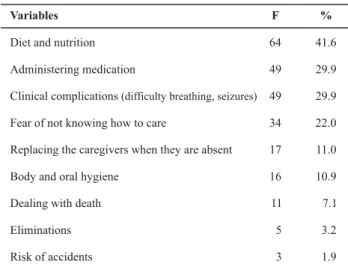
the main aspects mentioned were: diet and nutrition, 64 (41.6%), as they ask which food can be offered? How should this food be given? What should be done when they cannot chew or have trouble swallowing? Next are items like how to administer the prescribed medication and how to deal with or prevent clinical complications like breathing diffi-culty and seizures, both with 49 (29.9%).
Table 2 - Distribution of the doubts presented regarding the procedures to be performed in order to maintain care to the stroke victim in the household after hospital discharge - Fortaleza - 2006
Variables
Diet and nutrition
Administering medication
Clinical complications (difficulty breathing, seizures)
Fear of not knowing how to care
Replacing the caregivers when they are absent
Body and oral hygiene
Dealing with death
Eliminations
Risk of accidents
F
64
49
49
34
17
16
11
5
3
%
41.6
29.9
29.9
22.0
11.0
10.9
7.1
3.2
1.9
Other questions reported by the family caregivers were: the fear of not knowing how to provide care, 34 (22%), since these caregivers are required to provide special care to their patient; body and oral hygiene, 16 (10.9%), due to depen-dency for daily life activities; replacing the caregivers in case they are absent, 17 (11%), due to concerns about main-taining care, as well as the turns that are necessary to man-age their own lives; and finally, difficulties in dealing with death, 11 (7.1%), since stroke victims are susceptible to complications.
However, as mentioned, such difficulties, faced when one has to perform the activities attributed to the family caregiver adequately, require basic orientation and guid-ance. These orientations should always be addressed in sev-eral aspects, within a basic informative plan. For example, questions about human, social and psychological relation-ships, notions about the most frequent diseases that can afflict the patients with stroke sequels, attention to hygiene, diet, small bandages, aid in walking, among others. There-fore, when these orientations are seen to, household care may be efficient as a form of rehabilitation or improvement in the clinical situation(2).
Although a part of the caregivers have several doubts and reasons for distress, these are justified and stem from the fact that the stroke is usually a disease followed by the patient’s dependency regarding self-care. Moreover, since most caregivers are lay people, they are afraid of not know-ing how to care adequately and cause further complications to the patients under their care. Therefore, the healthcare
team, especially the nurse, should prepare the patient for discharge as early as the hospitalization period by carefully instructing the caregivers about care, from simple hygiene to preventive measures against infection and pressure ulcers.
As known, the caregiver’s lack of preparation may cause serious damage to the patient and result in further hospi-talizations. In addition, it can cause anxiety, greater physi-cal exhaustion and cause situations of risk for both the care receiver and the caregiver. As such, it is necessary that the caregiver can develop skills to care for the patient, as well as strategies to cope with stress(12-13).
In order to maintain the care provided by the family caregiver at home, a process of healthcare orientation should be started while the patient is still hospitalized. This means effectively preparing the patient for hospital dis-charge, and the nurse should be truly committed to this purpose and clarify the possible dependencies of the pa-tient and the initial care to be provided by the family,
forg-ing a relationship of mutual cooperation(14).
As we see it, care provided to stroke patients should also be directed towards the family, because resolution re-quires a certain amount of preparation and, sometimes, it triggers doubts and conflicting feelings. In view of such de-mands, in the role of healthcare educators, the nurses need to be aware that hospitalization represents a temporary situation in the lives of the patients, while the family is a permanent institution that will provide for them. As such, orientation is essential, considering the qualification of fami-lies to provide care, especially in the case of dependent diseases with a long period of rehabilitation, such as stroke.
Therefore, the philosophy of caring for the victim of this type of disease requires a lot of thought, due to the unde-niable importance of physical and emotional support to the caregiver and, especially, the positive result of this care to those afflicted by strokes.
FINAL CONSIDERATIONS
As verified in this study, most caregivers are females in the age range from 31 to 44 years old, usually the daughter of the patient, with alterations in their daily routines and family commitment. Such caregivers do not usually receive orientations about the care to be provided in order to main-tain family treatment, although they usually feel secure to provide care and take turns with other family members or with other people whom they have affinity with.
As mentioned, the feeling most usually manifested by the caregiver was sadness, and the most distressing doubts regarding care provided to the patient at home were re-lated to the diet, administering medication and possible clinical complications after discharge, such as breathing difficulty and seizures. For these reasons, as we see it, the caregiver should receive basic orientation and guidance to perform the activities done at home, since they revealed a lack of knowledge in their discourses. It is up to the nursing professionals to transform these caregivers’ anxiety and lack of preparation into productive forces oriented towards care, being their right and duty to play this role.
As the patient’s recovery is directly linked to the early start of a rehabilitation program and care focused on pre-venting deformities, the nursing team should be prepared to provide this type of care and encourage the patients and their relatives to perform them correctly. The household is a space where the nurse can also collaborate. In this case, it becomes homecare, which represents a work method that needs to be better developed and explored by the health-care professionals, in consonance with the health-caregivers.
We believe that publicizing this knowledge may become a reference to the healthcare team during the elaboration of interventions focused on families of stroke victims, as a strategy to cope with difficulties and, consequently, to im-prove these families’ quality of life.
However, it is observed that neither healthcare profes-sionals nor public and private hospital institutions are suf-ficiently prepared or motivated to deal with this reality and guarantee the continuity of household care. However, it is necessary, particularly when there is a desire to provide better quality of life for the population and lower rates of re-hospitalization.
Other factors are added to these distressing factors, such as the absence of support programs for family caregivers and the lack of financial resources and community organi-zations, because chronic-degenerative diseases impose new demands on the families. In this perspective, real and fea-sible spaces are needed to develop orientation programs for the caregivers. As such, they can act adequately and competently.
REFERENCES
1. Smeltzer SC, Bare BG. Brunner & Suddarth: tratado de enfer-magem médico-cirúrgica. 10ª ed. Rio de Janeiro: Guanabara Koogan; 2005. Tratamento de pacientes com distúrbios vasculares cerebrais; p.1996-2020.
2. Costa LB, Bellotti L, Portella MR. Dificuldades no cuidado domi-ciliar em seqüela de acidente vascular. In: André C. Manual de AVC. 2ª ed. Rio de Janeiro: Revinter; 2006. p. 59-73.
3. Karsch UM. Idosos dependentes: famílias e cuidadores. Cad Saú-de Pública. 2003;19(3):861-6.
4. Cecagno S, Souza MD, Jardim VMR. Compreendendo o contex-to familiar no processo saúde-doença. Acta Sci Health Sci. 2004;26(1):107-12.
5. Marilene NO, Perlini G, Leite MT, Furini AC. Em busca de uma instituição para a pessoa idosa morar: motivos apontados por familiares. Rev Esc Enferm USP. 2007;41(2):229-36.
6. Given BA, Given CW. Family caregiving for the elderly. Annu Rev Nurs Res. 1991;9(1):77-101.
7. Chagas NR, Monteiro ARM. Educação em saúde e família: o cuidado ao paciente, vítima de acidente vascular cerebral. Acta Sci Health Sci. 2004;26(1):193-204.
8. Shiotsu CH, Takahashi RT. O acompanhante na instituição hos-pitalar: significado e percepções. Rev Esc Enferm USP. 2000;34 (1):99-107.
9. Lavinsky AE, Vieira TT. Processo de cuidar de idosos com aci-dente vascular encefálico: sentimentos dos familiares envolvi-dos. Acta Sci Health Sci. 2004;26(1):41-5.
10. Pavarini SCL, Tonon FL, Silva JMC, Mendiondo MZ, Barham EJ, Filizola Cla. Quem irá empurrar minha cadeira de rodas? A escolha do cuidador familiar do idoso. Rev Eletrônica Enferm [periódico na Internet]. 2006 [citado 2006 nov. 25];8(3):[cer-ca de 10 p.]. Disponível em: http://www.fen.ufg.br/revista/ revista8_3/v8n3a03.htm
11. Silveira TM, Caldas CP, Carneiro TF. Cuidando de idosos alta-mente dependentes na comunidade: um estudo sobre cui-dadores familiares principais. Cad Saúde Pública. 2006;22 (8):1629-38.
12. Schier J, Gonçalves LHT, Lima MGO. Programa de acompanhan-te hospitalar para pacienacompanhan-te geriátrico. Rev Gaúcha Enferm. 2003;24(1):61-8.