Proposal for a telehealth
concept in the translational
research model
I Laboratório de Telessaúde. Instituto Nacional
de Saúde da Mulher, da Criança e do Adolescente Fernandes Figueira. Fundação Oswaldo Cruz. Rio de Janeiro, RJ, Brasil
II Centro de Desenvolvimento Tecnológico
em Saúde. Fundação Oswaldo Cruz. Rio de Janeiro, RJ, Brasil
III Departamento de Ciências Sociais. Escola
Nacional de Saúde Pública Sergio Arouca. Fundação Oswaldo Cruz. Rio de Janeiro, RJ, Brasil
Correspondence: Angélica Baptista Silva Laboratório de Telessaúde do IFF
Av. Rui Barbosa, 716 Prédio Anexo 5º andar Flamengo
22250-020 Rio de Janeiro, RJ, Brasil E-mail: [email protected] Received: 5/3/2013
Approved: 10/17/2013
Article available from: www.scielo.br/rsp
ABSTRACT
OBJECTIVE: To review the conceptual relationship between telehealth and translational research.
METHODS: Bibliographical search on telehealth was conducted in
the Scopus, Cochrane BVS, LILACS and MEDLINE databases to ind
experiences of telehealth in conjunction with discussion of translational research in health. The search retrieved eight studies based on analysis of
models of the ive stages of translational research and the multiple strands
of public health policy in the context of telehealth in Brazil. The models were applied to telehealth activities concerning the Network of Human Milk Banks, in the Telemedicine University Network.
RESULTS: The translational research cycle of human milk collected, stored and distributed presents several integrated telehealth initiatives, such as video conferencing, and software and portals for synthesizing knowledge, composing elements of an information ecosystem, mediated by information and communication technologies in the health system.
CONCLUSIONS: Telehealth should be composed of a set of activities in a computer mediated network promoting the translation of knowledge between research and health services.
DESCRIPTORS: Translational Medical Research. Research in Health Services Health Research Policy. Milk Banks. Breast Feeding. Review. Angélica Baptista SilvaI
Carlos Médicis MorelII
Telehealth has been used with a broad scope in different countries, directly related to the myriad of health care practices.5 However, the meanings of telehealth vary according to emphasis: sometimes they tend toward
technological discussion, sometimes towards the ield
of investigation or even towards the cyber-cultural dimension of health care, or program management. This multiplicity can be explained by the role of telehealth that is being highlighted.
In terms of programmatic and executive actions in Brazil, telehealth and translational research are the responsibi-lity of government departments, including the Ministries of Science, Technology and Innovation, Health and Education. The inaugural landmark of the concept was the establishment of the Telemedicine University Network (RUTE), by the Ministry of Science, Technology and Innovation National Teaching and Research Network,
in 2005. RUTE’s activities were, during the irst stage
(2006-2008), concentrated in public universities, as these institutions train health care professionals and are the locus of clinical and translational research in this country, as well as being those mainly responsible for
regional permanent education in the Brazilian Uniied
Health System (SUS).44
According to Schmittdiel et al42 (2010), translational research in health care is a type of research that appe-ared mainly in order to decrease the distance between production of knowledge in laboratories and its effec-tive use in the daily practice of medicine in health care services by innovative interventions for that population.
This study aims to contribute to understanding the
spe-ciicity of the Brazilian experience, adding both the
classic telehealth concept,a as well as deinitions that broaden the telehealth scope to other health-related activities5,10,16 to the dimension of telehealth related to translational research.
The concept of translating knowledge originated in the actor-network theory of Latour et al (1994),30 in which translating or transferring means moving objectives, inte-rests, devices and human beings. In its ethnography of laboratories, translating knowledge implies diversions from the route, inventing a thread between previously inexistent actors and, in some way, modifying the ele-ments involved.29
Innovation in health care is, in principle, linked to pro-ducing new medicines. However, in a wider concept,
INTRODUCTION
innovation covers the whole process of implementing new ideas, products, services, processes, practice and policies,17 as well as including learning and
construc-ting skills at different levels of aggregation, coniguring
assumptions of translational research.35
Translational research (TR) has two stages:
• TR1 – transferring new laboratory acquired know-ledge on disease mechanisms in order to develop new methods of diagnosis, treatment and
preven-tion, as well as irst tests in humans, and • TR2 – translating the results of these clinical
stu-dies into daily clinical practice and decision making in health.46,51
Scientists involved in clinical research create
subdi-visions to deine TR1, involving: pre-discovery of the
research; preclinical discovery; initial development
stage; inal development stage; stage IV approval of
application and studies.25,b
In the presented models of analysis of the translatio-nal research most often applied in highly industrialized countries with high per capita gross domestic product (GDP), the pharmaceutical industry is present at the start of TR1. However, there are other important actors who are absent during the above mentioned stages. The
university accompanies the irst three subdivisions of
TR1 such as, for example, the intense debate within the international consortium of governments of more than 18 countries coordinated by Francis Collins and the Celera Genomics company, by Craig Venter to
con-clude the irst mapping of the human genome.
Stage IV, known as pharmacovigilance or drug safety, is the tenuous limit of TR2, which is developed in various pieces of translational research using the model propo-sed by Khoury & Gwinn et al,26 the so-called ive stage model of translational research (FSMTR). Producing a new drug, the last point for “from workbench to hos-pital bed” translational research (TR1), in Brazil, the equivalent of gaining National Health Surveillance Agency (Anvisa) approval, is only the starting point of the second stage (TR2) of translation.27
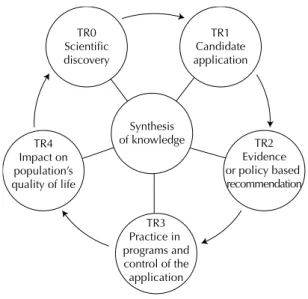
In FSMTR, epidemiology is presented as the basis of
translational research, using examples from the ield of genome studies. From this focus, the ive stages of
this research are:
a According to the World Medical Association – WMA and the World Health Organization – WHO, telehealth is the use of information and
communication technologies – ICT to offer health care and services at a distance. Cf. www.wma.net/en/30publications/10policies/t5/index. html and www.who.int/kms/initiatives/ehealth/en/
b Clinical research involving human beings is, in general, classified into four stages: I to IV. In short, in stage I the medication is tested in
TR0 Scientific discovery
TR1 Candidate application
Synthesis of knowledge TR4
Impact on population’s quality of life
TR2 Evidence or policy based recommendation
TR3 Practice in programs and control of the application
Source: Adapted from Khoury et al (2010).
Figure 1. Model of the five stages of translational research.
• TR0 – scientiic discovery from the research. • TR1 – from discovery to choice of application.
• TR2 – the stage at which localized pilot studies are conducted, providing for the scale of the health care service. It includes ensuring the appropriateness of the candidate application (medication, clinical intervention, among others) until the policy for its adoption or, even, an evidence-based recommen-dation is consolidated.
• TR3 – stage at which the policy or recommenda-tion of the practical applicarecommenda-tion of the programs is effectively disseminated in health care system and their controls.
• TR4 – the stage covering the practice of the trans-lational research and its impact on the population, directly involving health care program monito-ring practices.
There is one more stage that links TR4 to TR0, thus closing the translational research cycle, in which the
research solidiies future lines of health care research.
Central to the model is synthesis of knowledge, unders-tood as a systematic and indispensable approach at all stages of translational research (Figure 1) to review
evi-dence concerning peer knowledge of speciic topics.26
The methods of synthesizing knowledge, such as meta-analysis, begin to become standardized in the development of evidence-based recommendation for practice (TR2) and can be seen in the Cochrane Collaborationc and in independent groups such as the US Preventive Services Task Forced and the Human Genome Epidemiology Network (HuGENet),e which synthesize data on genome research.
In the ambit of contemporary science, the health care
practice paradigm has been modiied based on human
genome mapping and the discovery of genetic engine-ering.37,38 Moreover, the development of information and communication technologies is responsible for
gre-ater dissemination of scientiic knowledge.11 Biology has become an informational, rather than taxonomic science, as rapid processing machines means scientists can create and apply algorithms to include models to explain complexity.4,f Genome studies, population gene-tics and quantitative genegene-tics, making up the so-called genetic epidemiology7,12,13 require broad collaboration and multi-disciplinary and network teamwork. The new
questions posed by this dynamic of scientiic investigation
bring dynamism into bioethics6 and it was these trends that inspired the Khoury group to systemize FSMTR.
The aim of this article was to review the telehealth concept in light of processes involving translational research in health care services, as there is a gap in the literature regarding the relationship between transla-tional research practice in health and telehealth. To demonstrate telehealth in health care services, the the-oretical framework of the stages of translational rese-arch was applied in observing Network of Human Milk Banks (HMBN) activities as part of the Telemedicine University Network with broad national and interna-tional coverage.
METHODS
The study had two different phases: a detailed, narrative review of telehealth and translational research;
parti-cipant observation in the ield to test the model of TR
stages including multiple policy streams.
The detailed review aimed to identify conceptual
ele-ments of telehealth in the scientiic community, linked
to discussion of translational research in health care during the 2009 to 2012 period. A search strategy was established and the following four bibliographic data-bases were selected: Scopus, for its multi-disciplinary
c The Cochrane Collaboration [Internet]. Oxford (UK); c2014 [cited 2014 Mar 14]. Available from: http://www.cochrane.org/
d U.S. Preventive Service Task Force [Internet]. Rockville, MD; 2010 [cited 2014 Mar 14]. Available from: http://www.uspreventiveservicestaskforce.org/ e Centers for Disease Control and Prevention, Office of Public Health Genomics. Population Research: Human Genome Epidemiology Network -
HuGENET [Internet]. Atlanta, GA; [updated 2013 Jan 29; cited 2014 Mar 14]. Available from: http://www.cdc.gov/genomics/hugenet/
f The complex object is a non-linear and multi-faceted systemic-model object. It forms part of the system of partial totalities and can be
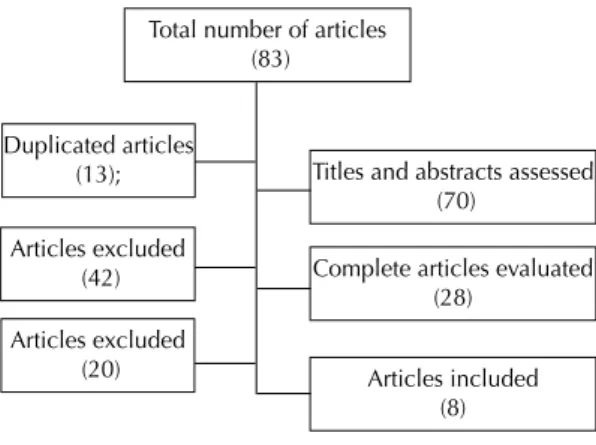
coverage; Cochrane Library for the Virtual Health Library (Cochrane VHL), in order to identify studies and reviews; LILACS (Latin American and Caribbean Literature on health sciences) and Medline. Three search terms were used: “telemedicine” OR “telehealth” AND “translational”.
In Scopus, 20 works were recovered, seven of which were articles, four reviews, three conference summa-ries, two brief communications, one book, one chap-ter of a book, an editorial and a note. In the Cochrane VHL, 45 studies were found, all systematic reviews. In LILACS, the search was conducted using the key work telemedicine and it returned seven journal articles and one learning object. The Medline search retrieved 11
articles indexed in scientiic journals.
Articles that were duplicated, without abstracts or missing hyperlinks were eliminated. Of the 83 studies found, 28 were assessed regarding their relevance to the topic and eight were used in the second part of the rese-arch. Systematic reviews were privileged, as in general they included previous discussion of terminology and an outlined objective for elimination of treatment of a
speciic health problem.
The second stage of this work involved an analytica-conceptual study based on identifying characteristics of the translational research cycle in government telehealth actions, the RUTE. The aim was to investigate aspects of possible relationships between telehealth and trans-lational research, as well as the bibliographical analysis. For the analysis, the FSMTR was used as a reference to support the model analyzing the multiple streams fra-mework in the manner established by Kingdon28 (2002).
RUTE, the ield of observation in this study, was esta -blished in 2005 as an action aiming to implement and interconnected infrastructure between university hos-pitals and health care education units in Brazil. The RUTE has been strengthened by, still incipient, telehe-alth projects facilitating exchange between national groups of researchers by a high speed network con-nection. Moreover, it provides equipment to research groups in participating institutions and operationally supports multi-institutional discussion hubs, Special Interest Groups (SIG).43
In the RUTE universe, the initiative coordinated by the
Instituto Nacional de Saúde da Mulher, da Criança e
do Adolescente Fernandes Figueira (IFF/Fiocruz –
Fernandes Figueira National Institute for Women’s, Children’s and Adolescents’ Health), was selected for its coverage. The IFF/Fiocruz brings together 30 points in the Network of Human Milk Banks and 23 countries in the Ibero-American Human Milk Bank Program, the
world’s largest such network.8 The human milk bank network uses telehealth actions, stimulating the exchange of knowledge and permanent education so as to gua-rantee that all newborns have access to breast milk.g
In this context, the FSMTR was applied to observe the functionality of telehealth in the passage of breast milk in the public health network, from the donating to the recipient mother, including babies with low birth wei-ght and with long hospitalizations in neonatal inten-sive care units.
FSMTR is a closed, cyclical system. In the case of
cli-nical research, TR2, TR3 and TR4, easily identiied in
health care services, are connected to TR0 and TR1, so-called pre-innovation, which cover the pre-disco-very to licensing stages of new medications. In the care practices provided by the health care system, this process can also be observed and systematized in the whole translational research cycle.
Before identifying more connections linking telehealth to translational research, it is important to emphasize one criticism of the FSMTR. For Hiatt23 (2010), the above mentioned model divides translational research into many stages, which may cause confusion in choo-sing monitoring and evaluation indicators. He therefore postulates that the central problem of health research
is the need to put tested and eficient evidence-based
interventions into practice in the shortest time possible. Another concern highlighted is the possibility of
frag-menting the translational science process in the ield of
health care. The need for a trans-disciplinary approach to resolve this division is also highlighted.
The World Health Organization (WHO), allied to the International Telecommunication Union (2012),50 pro-posal of a global model to evaluate telehealth outlines the interlocutors involved in planning and executing monitoring and evaluation activities in each process. On the other hand, governments19 use adaptations of FSMTR to perfect their health care and health infor-mation system networks.
Hiatt’s23 proposal for a trans-disciplinary view of FSMTR, with the decisive contribution of studies of public policy, outlines political spaces and actors, detail micro-pro-cesses of stages and create a structured outline in order to understand telehealth as translational research in the context of SUS health care networks.
Kingdon’s multiple streams framework has been
use-ful in investigation including speciic themes in gover -nment policy agendas9 and, in this study, was used to respond to gaps in FSMTR highlighted by Hiatt’s criti-cism. The model divides analysis of policies into three
g Silva AB, Souza KS. Estratégia de telessaúde do núcleo RUTE do IFF reúne países em prol da diminuição da mortalidade infantil prevista
TR0 Scientific
discovery Scientistsand industry
Scientists and administrators Scientists and
administrators
Pre-innovation
Health care administrators and professionals Health care
professionals and the population
TR1 Candidate application
Synthesis of knowledge TR4
Impact on population’s quality of life
TR2 Evidence or policy based recommendation
TR3 Practice in programs and control of the application
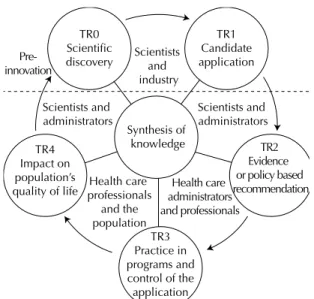
Source: Adapted from Khoury et al (2010) and Kingdon (2002).
Figure 2. Interest groups at the five stages of translational research, together with the multiple streams framework. streams: that of problems, that of alternatives and that
of policies. Each stream follows a speciic path, espe -cially that of policy which, despite problems and avai-lable alternatives, follows its own dynamic and rules.
To recognize the problem, there are three relevant dimen-sions: indicators referring to the issue in question, public opinion and economic viability. When constructing alter-natives, centrality of ideas is fundamental to including persuasion and diffusion. In the political stream, coali-tions are constructed in the negotiation and bargaining process. Thus, the model seeks to comprehensively cover this process of drawing up public policies, identifying and studying these three streams in a differentiated manner.44
In the case of FSMTR, identifying the predominant interest groups during the transition from one stage to another could contribute to understanding the transla-tional research cycle in health care services (Figure 2).
The scientiic community, interacting with industry, is
the protagonist in the passage from TR0 to TR1. In TR1 to TR2, the interest groups are predominantly made up of scientists and administrators. Health care professio-nals deal with administrators in the passage from TR2 to TR3. The population interact with health care profes-sionals in diverse ways (as SUS users, by social control and in research and evaluations) in TR3 and in TR4.
In health, this interaction feeds into evaluation research in which social scientists, epidemiologists and resear-chers from a variety of disciplines interact. The results
obtained support administrators and the scientiic com -munity itself in new discoveries, moving from TR4 to TR0 and closing the cycle.
RESULTS
Much polysemy was observed in the telehealth con-cept in the way the word was used in the area of health. When searching the four databases using the key words “telehealth” and “translational research” and the des-criptor “telemedicine”, eight works were recovered. Studies citing translational research in health care
analyzed tele-education in combatting speciic public
health problems such as, e.g., the prevalence of type 2 diabetes in ethnic minorities,22 distance monitoring of medication use by the elderly population39 and sup-port for family members and carers of those suffering from dementia.34 Three articles dealt with the context in which FSMTR was conceived: discussion of the role of national institutes in the health care system.10,14,47
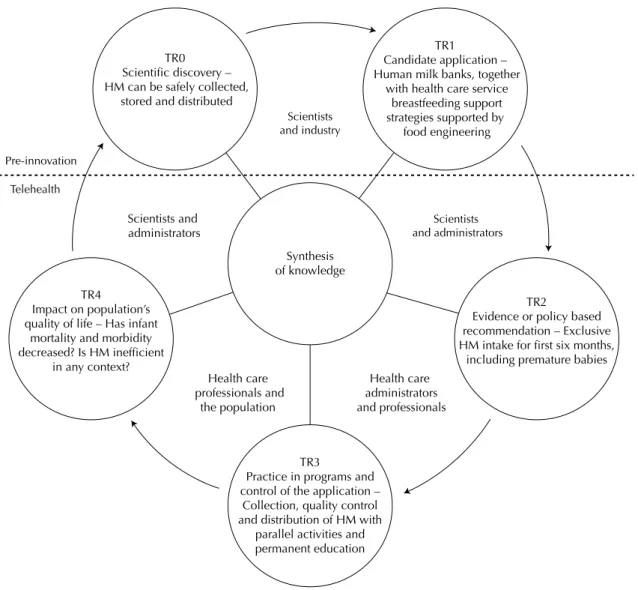
When applying FSMTR, combined with the actors
identiied in the multiple streams, it was possible to
identify the problem (infant mortality), alternatives (preserve donated human milk and stimulate breastfe-eding) and policies (constructing and regulating the
HMB in high complexity hospitals, close to neonatal ICU) within the SUS.
It is worth explaining that the objective of the HMB network is the practice of breastfeeding, human milk and awareness of its properties by society in general as it meets the child’s nutritional needs and peculiarities of metabolism, with the value of exclusive
breastfee-ding for the irst six months in no doubt.3
Even though they are common sense, it is worth highli-ghting the advantages of breast milk: better digestibi-lity; balanced chemical composition; lack of principal allergens; protects child’s organism against infection; encourages babies’ IQ development and costs nothing. To summarize, breastfeeding is the best way to feed the baby, being the basis for biological and emotional effects in the child’s development.2
TR4 Impact on population’s quality of life – Has infant
mortality and morbidity decreased? Is HM inefficient
in any context?
TR2
Evidence or policy based recommendation – Exclusive HM intake for first six months,
including premature babies Health care
administrators and professionals Health care
professionals and the population Scientists and
administrators
TR3
Practice in programs and control of the application –
Collection, quality control and distribution of HM with
parallel activities and permanent education
Synthesis of knowledge
TR1
Candidate application – Human milk banks, together
with health care service breastfeeding support strategies supported by food engineering TR0
Scientific discovery – HM can be safely collected,
stored and distributed
Scientists and industry
Pre-innovation
Telehealth
Scientists and administrators
Source: Silva, Moraes and Morel (2013), adapted from Khoury et al (2010) and Kingdon (2002).
Figure 3. Model of the five stages of translational research in the context of multiple streams framework applied to the Human Milk Bank Network.
The HMB network exists in 23 countries and has used the RUTE since 2009. Web conferencing and video conferencing and other telehealth devices, including support of synchronous and asynchronous health infor-mation systems, are used to exchange knowledge and practice. The scale of telehealth service use, e.g., the need to compare microbiological samples of human milk from laboratories in different locations,h has increased.
It was possible to apply FSMTR to the multiple stre-ams in order to contextualize it in the SUS health care network. Some telehealth processes were observed integrated in this cycle (Figure 4).
TR0 is a scientiic discovery that has been perfected
over a period of more than 50 years: the pasteurization process means human milk can, at low cost, be stored,
conserving its properties, and puriied of manipula -tion from the collec-tion, storing and distribu-tion sta-ges.31 Telehealth is present at this stage as it provides audio-visual records of the techniques used in the milk bank and disseminates them via the information and technology networks for permanent education purposes.
At stage TR1, the IFF/Fiocruz Human Milk Bank National Reference Centre candidate application of the HMBN, was recognized by Anvisa,i which established
h According to HMB National Reference Center, doubts come from states and countries regarding equipment which, in general, are not
programmed to identify bacteria typical to the microbe ecology of HM and are concerned about impurities. Telehealth actions, such as remote configurations, can respond to these issues of HM quality control.
i Agência Nacional de Vigilância Sanitária, Diretoria Colegiada. Resolução de Diretoria Colegiada – RDC nº 171, de 4 de setembro de 2006.
Total number of articles (83)
Duplicated articles (13);
Articles excluded (42)
Articles excluded (20)
Titles and abstracts assessed (70)
Complete articles evaluated (28)
Articles included (8)
Source: Silva, Moraes and Morel (2013).
Figure 4. Flow chart of the process of selecting articles for detalied literature review (2009-2012).
HMB as a specialized service linked to maternity and children’s hospitals. The HMB was responsible for actions promoting, protecting and supporting bre-astfeeding, as well as collecting milk and selecting, classifying and processing, quality control and distri-bution activities, with commercialization of the pro-ducts distributed being strictly prohibited.j The WHOk
recommends exclusive breastfeeding for the irst six
months and continuing to breastfeed until two years of age (TR2). The evidence-based policy or directive providing human milk to babies, including premature babies, is considered a food security strategy aimed at achieving the UN Millennium Development Goal of
reducing the 1990 infant mortality rate in under-ive
children by two thirds by 2015.l
Permanent and continuous education of health care pro-fessionals, and of the population, is an essential element in health activities involving collection, quality control and distribution of human milk (TR3). However,
micro-biological analysis of samples of human milk, deini -tion of collec-tion rounds, maintaining the cold chainm during transportation from donor’s house to the HMB, are potential objects of telehealth applications regar-ding quality control.
That UN Millennium Development Goal has been met in almost the whole of Brazil. Mortality and morbidity have decreased and the infant population’s state of health improved (TR4) with the health care services’ promo-tion of breastfeeding being a decisive contribupromo-tion.49
There are many scientiic possibilities that remain to be
explored in relation to human milk, such as the disco-very of a technique for multiplying stem cells found in human milk,40 made by researchers at a Brazilian public university,n,o facilitated by the context of donated human milk and by the presence of HMB integrated into the SUS health care network (TR4 – TR0).
Synthesis of knowledge appears in the HMBN internet portal. This is the principal reference for the HMBN community and brings together various activities rela-ted to telehealth and translational research, such as: facilitated access to systematic reviews, clinical trials; technical norms; international network management; virtual community; listings of research groups; minu-tes of video conferences; web conference rooms; infor-mation systems on the production of human milk and a direct channel to the population according to the trends of change in the care paradigm observed in the review, which emphasizes the formal aspects of modelling and implementing telehealth ubiquitously and multi-disci-pline integration to provide personalized health care.20
DISCUSSION
The models of the ive stages of translational research
and the multiple streams emphasize the strategic role of HMB coordinators in RUTE hospitals, as they are scientists or administrators who train professionals who will work in the SUS.
An example is the “Human Milk Debate” session, in 2011, a HMBN video conference in the Hospital
Universitário of the Universidade de São Paulo (USP),
in which the results of research on bone mineralization in newborns fed on human milk were presented to the community before journal publication.
On the other hand, the processes involved in the passage from TR3 to TR4 require social participation beyond the user-patient role, prioritized in the majority of pri-mary epidemiological studies. The basic research is only characterized as translational when it has a high degree of effectiveness in the health care system and predicted improvements in health are achieved. To measure the degree of effectiveness of translational research in the health care system, its real performance (monitoring the system) needs to be documented, as well as the per-formance that health care science and technology can
j Silva DA. Ensaios de proficiência para bancos de leite humano: formulação e avaliação de uma proposta para a Rede Brasileira de Bancos de
Leite Humano [doctoral thesis]. Rio de Janeiro: Instituto Fernandes Figueira/Fiocruz; 2009.
k World Health Organization. The WHO´s infant feeding recommendation. Geneva; 2002 [cited 2014 Jan 14]. Available from: http://www.
who.int/nutrition/topics/infantfeeding_recommendation/en/index.html
l Ban Ki-Moon. Children and the Millennium Development Goals: progress towards a world fit for children. New York: UNICEF;2007 [cited
2014 Jan 14]. Available from: http://www.unicef.org/publications/files/Children_and_the_MDGs.pdf
m Maintaining the temperature of the transport so the product remains frozen between the point of origin and the destination, with no changes
in temperature which would cause microbiological or physicochemical non-compliance.
n Motta C. Cientistas obtêm células-tronco de leite materno. O Globo. 2011 out 10 [cited 2014 Jan 14]; Ciência. Available from: http://oglobo.
globo.com/ciencia/mat/2011/10/25/cientistas-obtem-celulas-tronco-de-leite-materno-925660765.asp
CONCLUSION
Telehealth is not a synonym of video conferencing,24 wireless technology33 or an organizational component to establish information and communication techno-logy or networks in health care units.41 Thus, it does not compete with other terms in the literature, such as telemedicine, ehealth or mhealth. Based on analysis of FSMTR, together with the multi-streams model, the opportunity to view telehealth as all computer-mediated network activity promoting translation of knowledge between research and health care services appears. Thus, a wide and structured concept emerges in the
context of a health care system qualiied by technolo -gical advances.
Seeking to broaden the World Medical Association and WHO concept of telehealth, which can be summari-zed as information and communication technology in
health care, we propose redeining telehealth as health
care practice and knowledge that, by mediation of tech-nology, materializes in the health care information and knowledge ecosystem.10 In effect, telehealth grows ever closer to the translational research process as it enables
individuals doing science to beneit those in health care
services. Thus, this dimension is added to the cultural and institutional framework: cyberculture in health.
Identifying the cybercultural connections and proces-ses of this ecosystem procesproces-ses in which the research stages occur may help in evaluating telehealth and indi-cate better practice for health care systems.
achieve in “ideal” conditions (eficacy of application
generated by research). This comparative calculation is known as relative effectiveness.15
It is necessary to see how telehealth processes in the SUS could be essential facilitators in conducting the stages of translational research from the point of view of relative effectiveness, the concept adopted in the SUS Evaluation Program.48 Stages TR2, TR3 and TR4, in the triangle proposed by Glasgow19 (2012), extrapolate
scientiic means and rely on the intervention of diffe -rent segments of society to become reality. Telehealth could even help in the cycle’s feedback loop, returning to TR0, as remote access technology to the databases pro-duced by their respective platforms, when well-planned and interoperable, can be of great service to health sur-veillance and health care management. In this sense, the widespread tele-cardiology service covering more than 800 locations in Minas Gerais stands out.1
The strategy of coordinating centers of excellence all over the world to research cures for poverty-related dise-ase is another example of research that mobilizes scien-tists, administrators and civil society organizations.32
With the support of social sciences, it is expected that
the redeinition of telehealth can support choices of
1. Alkmim MB, Figueira RM, Marcolino MS, Cardoso CS, Abreu MP, Cunha LR, et al. Improving patient access to specialized health care: the Telehealth Network of Minas Gerais, Brazil. Geneva: World Health Organization; 2012.
2. Almeida JAG, Maia PRS, Novak FR, Sydronio K. Bancos de leche humana y promoción de políticas públicas favorables a la salud materno-infantil. Rev
Cubana Salud Pública [revista en la Internet]. 2006 Sep
[citado 2014 Mar 17] ; 32(3). Disponible en: http:// scielo.sld.cu/scielo.php?script=sci_arttext&pid=S0864-34662006000300012&lng=es
3. Almeida JAG. Breastfeeding: a nature-culture hybrid. Rio de Janeiro: Editora Fiocruz; 2001.
4. Almeida Filho N. Epidemiologia e modelos de complexidade: perspectivas metodológicas. In: Almeida Filho N, Barreto ML, coordenadores. Epidemiologia e saúde: fundamentos, métodos, aplicações. Rio de Janeiro: Guanabara Koogan; 2012. p.291-306.
5. Bashshur R, Shannon G, Krupinski E, Grigsby J. The taxonomy of telemedicine. Telemed J E Health. 2011;17(6):484-94. DOI:10.1089/tmj.2011.0103
6. Bergel SD. Bioética, genética y derechos humanos: la declaración de la Unesco. Rev Bioética. 1999;7(2):165-78.
7. Blanton RE, Silva LK, Melo PRS. Epidemiologia genética. In: Almeida Filho N, Barreto ML, coordenadores. Epidemiologia e saúde: fundamentos, métodos, aplicações. Rio de Janeiro: Guanabara; 2011. p.342-9.
8. Cánepa MA. Un modelo de cooperación horizontal: la Red Iberoamericana de Bancos de Leche Humana (BLH). Madrid: OPAS; 2011.
9. Capella AC. Perspectivas teóricas sobre o processo de formulação de políticas públicas. In: Hochman G, Arretche M, Marques E, organizadores. Políticas públicas no Brasil. Rio de Janeiro: Editora Fiocruz; 2007. p.87-124.
10. Carroll M, James JA, Lardiere MR, Proser M, Rhee K, Sayre MH, et al. Innovation networks for improving access and quality across the healthcare ecosystem.
Telemed J E Health. 2010;16(1):107-11. DOI:10.1089/
tmj.2009.0157
11. Castells M. A Galáxia Internet: reflexões sobre a Internet, negócios e a sociedade. Rio de Janeiro: Jorge Zahar; 2003.
12. Cordell HJ, Clayton DG. Genetic association studies. Lancet. 2005;366(9491):1121-31. DOI:10.1016/S0140-6736(05)67424-7
13. Devlin B, Roeder K. Genomic control for association studies. Biometrics. 1999;55(4):997-1004.
14. Doarn CR, Portilla LM, Sayre MH. NIH conference on the future of telehealth: essential tools and technologies for clinical research and care: a summary. Telemed J E
Health. 2010;16(1):89-92. DOI:10.1089/tmj.2009.0151
15. Donabedian A, Bashshur R. An introduction to quality assurance in health care. New York : Oxford University Press; 2003.
16. Eysenbach G. What is e-health? J Med Internet Res. 2001;3(2):E20. DOI:10.2196/jmir.3.2.e20
17. Gardner CA, Acharya T, Yach D. Technological and social innovation: a unifying new paradigm for global health. Health Aff (Millwood). 2007;26(4):1052-61. DOI:10.1377/hlthaff.26.4.1052
18. Giugliani ERJ. Rede Nacional de Bancos de Leite Humano do Brasil: tecnologia para exportar. J Pediatria (Rio J). 2002;78(3):183-4. DOI:10.1590/S0021-75572002000300001
19. Glasgow RE, Green LW, Taylor MV, Stange KC. An evidence integration triangle for aligning science with policy and practice. Am J Prev Med. 2012;42(6):646-54. DOI:10.1016/j.amepre.2012.02.016
20. Hall JA, Blobel B. Paradigm changes in health lead to paradigm changes in pathology. Stud
Health Technol Inform. 2012;179:38-50.
DOI:10.3233/978-1-61499-086-4-38
21. Hall RW, Hall-Barrow J, Garcia-Rill E. Neonatal regionalization through telemedicine using a
community-based research and education core facility.
Ethn Dis. 2010;20(1 Suppl 1):S1-136-40.
22. Hawthorne K, Robles Y, Cannings-John R, Edwards AGK. Culturally appropriate health education for type 2 diabetes mellitus in ethnic minority groups.
CochraneDatabase Syst Rev. 2008;(3):CD006424.
DOI:10.1002/14651858.CD006424.pub2
23. Hiatt RA. Invited commentary: the epicenter of translational science. Am J Epidemiol. 2010:172 (5):525-7. DOI:10.1093/aje/kwq212
24. Kailas A, Ingram MA. Wireless aspects of telehealth.
Wireless Pers Commun. 2009;51(4):673-86.
DOI:10.1007/s1277-009-9763-7
25. Kaitin KI. Deconstructing the drug development process: the new face of innovation. Clin Pharmacol Ther. 2010 Mar;87(3):356-61. DOI: 10.1038/ clpt.2009.293. Epub 2010 Feb 3. Review. Erratum in: Clin Pharmacol Ther. 2011 Jan;89(1):148.
26. Khoury MJ, Gwinn M, Ioannidis JPA. The emergence of translational epidemiology: from scientific discovery to population health impact. Am J Epidemiol. 2010;172(5):517-24. DOI:10.1093/aje/kwq211
27. Khoury MJ, Gwinn M, Ioannidis JPA. Khoury et al. respond to “The epicenter of translational science”: crossing all the T’s. Am J Epidemiol. 2010;172(5):528-9.
28. Kingdon JW. Agendas, alternatives, and public policies. 2.ed. New York: Longman Publishing Group; 2002. (Longman Classics in Political Science).
29. Latour B. Ciência em ação: como seguir cientistas e engenheiros sociedade afora. São Paulo: Editora UNESP; 2000.
30. Latour B. Jamais fomos modernos: ensaio de
antropologia simétrica. Rio de Janeiro: Editora 34; 1994.
32. Manderson L, Aagaard-Hansen J, Allotey P, Gyapong M, Sommerfeld J. Social research on neglected diseases of poverty: continuing and emerging themes. PLoS Negl Trop Dis. 2009;3(2):e332. DOI:10.1371/journal.pntd.0000332
33. Masi C, Hamlish T, Davis A, Bordenave K, Brown S, Perea B, et al. Using an established telehealth model to train urban primary care providers on hypertension management. J Clin
Hypertens (Greenwich). 2012;14(1):45-50.
DOI:10.1111/j.1751-7176.2011.00559.x
34. Moniz Cook ED, Swif K, James I, Malouf R, De Vugt M, Verhey F. Functional analysis-based interventions for challenging behaviour in dementia.
Cochrane Database Syst Rev. 2012;2:CD006929.
DOI:10.1002/14651858.CD006929.pub2
35. Morel CM. Inovação em saúde e doenças negligenciadas [editorial]. Cad Saude Publica. 2006;22(8):1522-3. DOI:10.1590/S0102-311X2006000800001
36. Novak FR, Almeida JAG. Teste alternativo para detecção de coliformes em leite humano ordenhado. J Pediatria (Rio J). 2002;78(3):193-6. DOI:10.1590/S0021-75572002000300005
37. Oda L. Mudança de paradigma científico. Hist
Cienc Saude Manguinhos. 2000;7(2):515-7.
DOI:10.1590/S0104-59702000000300022
38. Offit K. Personalized medicine: new genomics, old lessons. Hum Genet. 2011;130(1):3-14. DOI:10.1007/s00439-011-1028-3
39. Patterson SM, Hughes C, Kerse N, Cardwell CR, Bradley MC. Interventions to improve the appropriate use of polypharmacy for older people.
Cochrane Database Syst Rev. 2012;5:CD008165.
DOI:10.1002/14651858.CD008165.pub2
40. Patki S, Kadam S, Chandra V, Bhonde R. Human breast milk is a rich source of multipotent
mesenchymal stem cells. Hum Cell. 2010;23(2):35-40. DOI:10.1111/j.1749-0774.2010.00083.x
41. Schmeida M, McNeal R. The telehealth divide: disparities in searching public health information
online. J Health Care Poor Underserved. 2007;18(3):637-47. DOI:10.1353/hpu.2007.0068
42. Schmittdiel JA, Grumbach K, Selby JV. System-based participatory research in health care: an approach for sustainable translational research and quality improvement. Ann Fam Med. 2010;8(3):256-9. DOI:10.1370/afm.1117
43. Silva AB, Amorim AC. A Brazilian educational
experiment: teleradiology on web TV. J Telemed Telecare. 2009;15(7):373-6. DOI:10.1258/jtt.2009.090204
44. Silva AB; Moraes, IHS. O caso da Rede Universitária de Telemedicina: análise da entrada da telessaúde na agenda política brasileira. Physis. 2012;22(3):1211-35. DOI:10.1590/S0103-73312012000300019
45. Sousa PPR, Silva JA. Monitoramento da qualidade do leite humano ordenhado e distribuído em banco de leite de referência. Rev Inst Adolfo Lutz. 2010;69(1):7-14.
46. Sung NS, Crowley Jr WF, Genel M, Salber P, Sandy L, Sherwood LM, et al. Central challenges facing the national clinical research enterprise.
JAMA. 2003;289(10):1278-87. DOI:10.1001/ jama.289.10.1278
47. Topol EJ, Schork NJ, Smith JM. Digital medicine and the Scripps Translational Science Institute. Clin Transl Sci. 2011;4(1):8-9. DOI:10.1111/j.1752-8062.2010.00256.x
48. Viacava F, Ugá MAD, Porto S, Laguardia J, Moreira RS. Avaliação de desempenho de sistemas de saúde: um modelo de análise.
Cienc Saude Coletiva. 2012;17(4):921-34.
DOI:10.1590/S1413-81232012000400014
49. Victora CG, Aquino EML, Leal MC, Monteiro CA, Barros FC, Szwarcwald C. Maternal and child health in Brazil: progress and challenges. Lancet. 2011;377(9780):1863-76. DOI:10.1016/S0140-6736(11)60138-4
50. World Health Organization. National eHealth Strategy Toolkit: overview. Geneva; 2012.
51. Woolf SH. The meaning of translational research and why it matters. JAMA. 2008;299(2):211-3. DOI:10.1001/jama.2007.26
Article based on the doctoral thesis of Silva AB, entitled: “Política pública, educação, tecnologia e saúde articuladas: como a telessaúde pode contribuir para fortalecer o SUS?”, presented to the Escola Nacional de Saúde Pública Sergio Arouca/
Fiocruz, in 2013.