This paper presents the analysis of the mechanical and durable properties of recycled aggregate concrete (RAC) for using in concrete. The porosity of recycled coarse aggregates is known to inluence the fresh and hardened concrete properties and these properties are related to the speciic mass of the recycled coarse aggregates, which directly inluences the mechanical properties of the concrete. The recycled aggregates were obtained from con -struction and demolition wastes (CDW), which were divided into recycled sand (ine) and coarse aggregates. Besides this, a recycled coarse aggregate of a speciic mass with a greater density was obtained by mixing the recycled aggregates of the CDW with the recycled aggregates of concrete wastes (CW). The concrete was produced in laboratory by combining three water-cement ratios, the ratios were used in agreement with NBR 6118 for structural concretes, with each recycled coarse aggregates and recycled sand or river sand, and the reference concrete was produced with natural aggregates. It was observed that recycled aggregates can be used in concrete with properties for structural concrete. In general, the use of recycled coarse aggregate in combination with recycled sand did not provide good results; but when the less porous was used, or the recycled coarse aggregate of a speciic mass with a greater density, the properties of the concrete showed better results. Some RAC reached bigger strengths than the reference concrete.
Keywords: recycled aggregate, speciic mass, concrete, properties.
Este artigo apresenta as análises das propriedades mecânicas e de durabilidade de concreto com agregados reciclados (CAR) para em concreto. Sabe-se que a porosidade dos agregados reciclados inluencia as propriedades frescas e endurecidas do concreto e estas propriedades estão rela -cionadas com a massa especíica dos agregados graúdo reciclado, que diretamente inluencia as propriedades mecânica do concreto. Os resíduos de construção e demolição (RCD), que deram origem aos agregados reciclados, foram separados em agregado miúdo e agregado graúdo. Também, um agregado graúdo reciclado de maior densidade foi obtido misturando o agregado reciclado do RCD com o agregado reciclado de resíduo de concreto (RC). Os concretos com agregados reciclados foram produzidos com três níveis de relação a/c, as razões foram usadas de acordo com a NBR 6118 para concretos estruturais, combinando-se cada agregado graúdo reciclado com o agregado miúdo reciclado e com uma areia natural. Concretos de referência também foram produzidos utilizando-se agregados naturais. Observou-se que CAR tem potencial para aplicação como concretos estruturais. Em termos gerais, o uso combinado dos agregados graúdos e miúdos reciclados não foi vantajoso, mas as propriedades dos CAR eram tanto melhores quanto maior a massa especíica dos agregados graúdos reciclados. Alguns CAR chegaram a apresentar resistências mecânicas maiores que as de seus respectivos concretos de referência.
Palavras-chave: agregado reciclado, massa especíica, concreto, propriedades.
Concrete produced with recycled aggregates
Concreto produzido com agregados reciclado
J. J. L. Tenório a [email protected]
P. C. C. Gomes b [email protected]
C. C. rodriGues c [email protected]
T. F. F. de ALenCAr d [email protected]
a Programa de Pós-Graduação em Engenharia Civil, Centro de Tecnologia, Universidade Federal de Alagoas, [email protected], Av. Lourival Melo Mota, s/n, Tabuleiro do Martins. CEP: 57072-970, Maceió, Brasil.
b Programa de Pós-Graduação em Engenharia Civil, Centro de Tecnologia, Universidade Federal de Alagoas, [email protected], Av. Lourival Melo Mota, s/n, Tabuleiro do Martins. CEP: 57072-970, Maceió, Brasil.
c Engenharia Ambiental, Centro de Tecnologia, Universidade Federal de Alagoas, [email protected], Av. Lourival Melo Mota, s/n, Tabuleiro do Martins. CEP: 57072-970, Maceió, Brasil.
d Engenharia Civil (Bolsista PIBIC), Centro de Tecnologia, Universidade Federal de Alagoas, Av. Lourival Melo Mota, s/n, Tabuleiro do Martins. CEP: 57072-970, Maceió, Brasil.
Received: 03 May 2011 • Accepted: 19 Jul 2012 • Available Online: 02 Oct 2012
Abstract
1. introduction
The heterogeneity of the composition; the speciic mass with lower density; the adhered mortar quality and the amount of adhered mortar and the variability of the properties are all important char -acteristics of recycled aggregates, which represent obstacles not only for their use as well as for the reliability of the same in con-cretes used in structural applications (Lovato et al. [1], Etxeberria et al. [2], Tabsh et al. [3], Kwan et al. [4], Cabral et al. [5]). The consequences of these characteristics are observed in the recy -cled aggregates themselves. Their properties normally do not obey the norms commonly destined to natural aggregates (QUEBAUD et al. [6]); and in the recycled aggregate concretes (RAC) made with the same aggregates tend to give less work, be weaker, more deformed (smaller module of elasticity), more porous and more permeable (Tabsh et al. [3], Etxeberria et al. [2]). In the case of recycled aggregate concrete, more cement needs to be added to the concrete made of 100% of recy-cled aggregate in order to achieve the same workability and compres -sional strength as conventional concrete (Etxeberria et al. [2]). In the aggregates, the porosity affects more of their properties (MEHTA and MONTEIRO [7]) and two of them relect well their level of porosity and are of relatively easy determination: the wa -ter absorption and the speciic mass. In the concrete, its strength, durability, shrinkage and permeability suffers direct inluence from the number, type, size and distribution of pores present in the ag -gregates, cement paste and transition zone (BASHEER et al. [8]). As outlined by Kou et al. [9], the porosity of recycled aggregate con -crete (RAC) is normally higher than that of natural aggregate con-crete (NAC) due to the adhered mortar present in the recycled aggregates. The porosity and the pore size distribution are the most important char -acteristics of the pore system of concrete which inluences the penetra -tion of external substances to the interior of the concrete. Therefore it is important to understand the development of the pore system in order to assess the durability properties of the recycled aggregate concrete. Based on the criteria commonly related to the water absorption, speciic mass or values of Los Ángeles abrasion, it is an important beginning given by the Science of Materials that is the existent inversely proportional relation between porosity and the mechani -cal strength of that material, valid in several materials and also in concrete and ceramic (MEHTA and MONTEIRO [7]).
Many studies, norms and recommendations have been proposed or established forms of classifying the recycled aggregate accord-ing to the percentage of each phase (concrete, mortar, ceramic etc.). With the intention of assuring a smaller variation of the phas -es, the norms and recommendations have deined criteria that must be obeyed with recycled aggregates (e.g. values of water ab -sorption). The classiication is usually made in visual form and the deinition of the best phase begins with the selection of aggregates with stronger and more resistant materials (e.g. concrete), which are also more resistant and can be used in applications of larger importance. One of the reasons for which the concrete is seen as more resistant is because it has rocks.
The classiication based on the visual criteria which is limited be -cause of each phase of CDW has its own variability. For instance, it is possible to ind concretes of different strengths produced with different water/cement (w/c) ratios, and different amounts of coarse aggregates, originated from rocks of different resistances. The studies of CARRIJO [10] and ANGLE [11] prove these facts.
separated by speciic mass, showed a larger relation with the den -sity rather than with the visual criteria called “grey aggregate” or “red aggregate”, demonstrating the fallibility of the visual classiication system. The density separation (d) done by CARRIJO [10] was based on the speciic mass of the aggregates or, in other words, each aggregate inside a certain order of speciic mass (d < 1.9 kg/ dm³, 1.9 kg/dm³ < d < 2.2 kg/dm³, 2.2 kg/dm³ < d < 2.5 kg/dm³ e d > 2.5 kg/dm³) has grains with speciic mass of that order so that its denser aggregates, for instance, a great part of them are grains of rock. The concrete showed improvement in its properties (compres -sive strength, elasticity module, etc.) with the increase of the speciic mass of the recycled aggregates. The compressive strength of the recycled aggregate concrete (RAC) was less resistances in com -parison to the conventional concrete, and decreased as the density of the aggregates decreased. However, concrete made with aggre -gates of density ranges between d > 2.5 kg/dm³ and 2.2 kg/dm³ < d <2.5 kg/dm³ showed resistance values close to those of conven -tional concrete. Furthermore, the RAC obey the Abrams Law.
1.1 Objectives
An experimental study was developed in order to evaluate the me -chanical and durable concrete properties produced with recycled coarse aggregates from different speciic mass and compared to those obtained with natural aggregates with the possible objective of obtaining recycled aggregate concretes (RAC) appropriate for applications in concrete with properties to structural concrete.
2. materials and experimental program
2.1 Material
Samples of mineral fraction from the CDW were obtained from around the city of Maceió and from the CW of the Laboratory of Structures and Materials (LSM) of the Federal University of
Alagoas. Both the recycled sand and coarse aggregates were obtained by the reduction process in a mill of hammers. The ig -ure 1 shows the composition of the recycled coarse aggregates from the CDW.
The naturally ine aggregate used was natural river sand, but the recycled sand aggregate was from the mineral fraction of CDW obtained in a mill of hammers, sieved in a 4.75 mm sieve. The properties of the ine aggregates are shown in table 1 and igure 2. The natural coarse aggregate used was crushed stone of the maximum of 19 mm in diameter, typically used in the city. There were two types of recycled coarse aggregates: the irst from CDW (called G1), igure 3a, and the other from the mixture of G1 with the CW (called G2), igure 3b. Both aggregates were sieved in a 25.4 mm sieve and were predominantly retained in the 4.75 mm sieve. The speciic mass of G2 was deined based on the studies of CAR -RIJO [10] and ANGLE [11]. In their studies, the speciic mass aver -age of the aggregate particles was formed by mixing particles of different materials (mortar, rock, ceramic etc.), each one with a different speciic mass.
The amounts of CDW and CW aggregates were calculated by an equation system formed by the equations 1 and 2 listed below. The
Ta�le � � �ine aggregate properties
Property
River sand
Recycled sand
Standard procedure
Water absorption (%)
1.22
9.34
NBR NM 30 [12]
Density (kg/dm³)
2.68
2.50
NBR 9776 [13]
% organic matter (ppm)
< 300
< 300
NBR NM 49 [14]
% particles with D<0,075 mm
1.00
8.61
NBR NM 46 [15]
Dmax (mm)
4.75
4.75
�
�
NBR 248 [16]
Fineness modulus
2.82
2.78
Grading zone
Usable
Usable
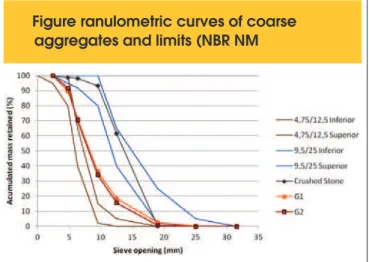
aggregates and limits (NBR NM 248:2003)
F
igure � � �e����ed aggregate: (a) G1 and (b) G2
igure 4.
The cement used was composed by Portland CPII-F-32. A 3rd generation superplasticizer based on an ether-modiied carboxylic chain was used to used to assure an appropriate consistency to the concrete. The water used was the water available in the labora -tory’s water system.
2.2 Mix design
The composition parameters of the concrete taken as independent variables in this study were:
n Effective water-cement ratios: 0.67, 0.50 and 0.40 were de -termined ixing the used in agreement with NBR 6118 [20] for structural concretes;
n The speciic mass of the recycled coarse aggregate: 2.08 kg/ dm³ for G1 and 2.27 kg/dm³ for G2;
n Fine aggregate: natural sand and recycled ine aggregate of CDW.
The compositions obtained for the combination of the param-eters and reference mixtures are shown in Table 3. The water was ixed at 20% of 1 m3 (200 kg) and cement dosage at 300, 400 and 500 kg/m3. The method of mixing did not follow any commonly used method. The amount of coarse aggregate was ixed at 40% for all the mixtures; this percentage was deter -mined previous to the normal mixture with a mortar content of 50%. First, the form of mixing of the reference concrete was determined in volume and only the mixtures of RAC were calcu -lated. This was done so that the difference between the speciic mass of the natural and recycled aggregates did not lead the production of different concrete volumes.
2.3 Production
According to FERREIRA [21] the reducing of the effective w/c ra -tio of the mix can to be overcome if the water absorbed by the recycled aggregates is compensated or by extra water added to the mix or by the recycled aggregates pre-saturated added to the irst is a formulation that relates the speciic mass of each aggre
-gate and the second is a relation by mixing two materials.
(1)
γ
γ
%M
γ
%M
G1
G1
CWA
CWA
G2(
2)
1
%M
%M
G1
CWA
In the equations 1 and 2, %MG1 is G1’s coarse aggregate percent -age in mass; γG1 is the speciic mass of G1’s coarse aggregate; %MCWA is CW’s coarse aggregate percentage in mass; γCWA is the speciic mass of CW’s coarse aggregate and γG2 is the spe -ciic mass of the mixture or, in other words, G2’s coarse aggregate. The resolution of the system of equations above with the adequate values of speciic mass resulted in %MG1 = 22.74 and %MCWA =
Figure 4 � �
ranul�metri� �ur�es �� ��arse
aggregates and limits (NBR NM 248:2003)
Ta�le 2 � �oarse aggregate properties
Property
Brita
(1)G1
G2
Standard procedure
Water absorption (%)
0.49
8.41
5.37
NBR NM 53 [17]
NBR NM 53 [17]
Specific mass (kg/dm³)
2.62
2.08
(2)
2.27
Index of particle shape
2.60
2.30
2.20
NBR 7809 [18]
(3)
% particles with D< 0.075 mm
0.33
0.75
0.45
NBR NM 46 [15]
�
�
Dmáx (mm)
19.0
19.0
19.0
NBR 248 [16]
Fineness modulus
6.86
5.76
5.85
Grading zone
9.5/25
None
None
mix. Therefore, the recycled aggregates (ine and coarse) were pre-soaked in mixer for one minute before the preparation of the concrete to avoid the absorption of part of the mixture water. The quantity of this water was calculated with the difference between the water required for the full saturation of the aggregates and the water actually absorbed by the aggregates in one minute. The ab-sorption of 70% of the total water absorbed by each aggregate had already been observed in one minute.
The superplasticizer was used for a plastic consistence to be reached.
The preparation of the concrete was: 1 - Reference concrete: coarse and ine aggregates, and a little of water mixed for one minute in a mixer. 2 - Recycled concrete: recycled coarse and ine aggregates, and absorbed water from the recycled aggre -gates (70%) mixed for one minutes in a mixer. Afterwards, the cement and the water of the mix are placed in the mixer for two minutes. At the end, the superplasticizer was mixed for one min -ute and a half more.
After casting, the samples (cylinders with 10 cm in diameter and 15 cm in height) were led in molds for 24 hours, stripped and cured in water for twenty-eight days. All concrete cylinders were capped with a thin layer of sulfur with cement to ensure the smoothness of the top surface.
2.4 Properties and test
The compressive strength, water absorption, air content and time of air-permeability (Figg method) properties were obtained with the intention of analyzing the possibility of producing concretes with recycled aggregates. For each concrete, the tests were made in cylinders of 100 mm in diameter and 200 mm in height; three specimen for the compressive strength (NBR 5739 [22]), three for the water absorption and air content (NBR 9778 [23]). For the measurement of the air-permeability time (LNEC-E 413 [24]), a prismatic mold of 15x15x30 cm was used with 5 holes of 6 mm in diameter and 40 mm in height were made. The reference age for the accomplishment of the tests was 28 days. The adopted cure method for all the concretes was the total immersion of the speci-mens in water.
3. results and discussions
3.1 Aggregate Properties
The results obtained from the recycled aggregate properties: wa-ter absorption and particles percentage with D < 0.075 mm, which obeyed the minimum requirements deined by the NBR 15116
Ta�le
3 � �oncrete mixtures
(*) 67, 50 and 40 refer to effective w/c ratio; MR = recycled sand; MN = river sand; G1 and G2 = recycled coarse aggregates.
Mix(*)
Effective
w/c
ratio
3
Materials in volume (dm³)/m
Materials in mass (kg)/m
3water
cement
Aggregate
water
cement
Aggregate
Fine
coarse
fine
coarse
67MRG1
0.67
200
99
301
400
200
300
752.5
832
67MRG2
0.67
200
99
301
400
200
300
752.5
900
67MNG1
0.67
200
99
301
400
200
300
806.7
832
67MNG2
0.67
200
99
301
400
200
300
806.7
900
50MRG1
0.50
200
132
268
400
200
400
670.0
832
50MRG2
0.50
200
132
268
400
200
400
670.0
900
50MNG1
0.50
200
132
268
400
200
400
718.2
832
50MNG2
0.50
200
132
268
400
200
400
718.2
900
40MRG1
0.40
200
165
235
400
200
500
587.5
832
40MRG2
0.40
200
165
235
400
200
500
587.5
900
40MNG1
0.40
200
165
235
400
200
500
629.8
832
40MNG2
0.40
200
165
235
400
200
500
629.8
900
Reference concrete (Ref)
Ref67
0.67
200
99
301
400
200
300
806.7
1048
Ref50
0.50
200
132
268
400
200
400
718.2
1048
[25]. The higher water absorption of recycled aggregates was in -luenced by the presence of constituents red aggregate, which also they inluenced the speciic mass.
In the igure 2, the content of ine and powdered materials is ob -served to be higher in recycled sand, however, the recycled sand demonstrated to be thicker than river sand, and could it in the grading zone used for natural ine aggregate. In igure 4, the recy -cled coarse aggregates (G1 and G2) are observed to have similar granulometries and which do not it in granulometric zones of the standard.
3.2 Compressive strength
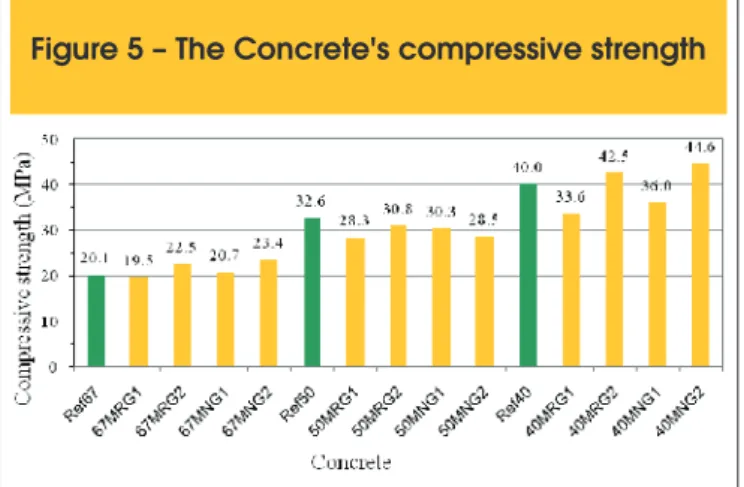
Figure 5 shows the average of the results for the compressive strength tests (fc) in samples.
In igure 5, it is possible to notice how the concrete, independent
gregate, obey the Abrams law, i.e., a higher w/c ratio corresponds to a lower compressive strength, and in general, the RAC showed compressive strength near the reference concrete. The accentu -ated reductions of the strengths become evident to the negative inluence of the recycled aggregate G1, CDW origin and lower speciic mass, on the compressive strength of the concrete. The strength values which were equaled or overcame the strengths of the reference concrete were of the concrete with recycled G2 ag -gregate, mixing G1 with CW, with larger density. In general, the recycled aggregate concrete with larger speciic mass (G2) had compressive strength greater than those of concrete with recycled aggregates of lower speciic mass. And when w/c = 0.40 and 0.67, the compressive strength of these concretes is also higher than those of the concrete with natural aggregates.
The strengths of 19.0 MPa < fc < 23.5 MPa of the RAC with w/c = 0.67 were similar to the reference concrete. This displays that the recycled aggregate and its characteristics (composition and speciic mass) were not the decisive factors for the strength, but the high w/c ratio, which did with that the paste and the transition zone gov -erned the strength. According to NEVILLE [26], the paste becomes a more and more limiting factor of the strength with the increase of the w/c ratio, which was also veriied by CARRIJO [10]. Another justiication is that the recycled aggregate could have absorbed part of the water mixture, reducing the effective of the w/c ratio of the concrete and increasing its strengths. LEITE [27] and VIEIRA [28] also observed that behavior to high w/c ratio. Whereas for concrete with w/c = 0.50 and the strength of 28.0 MPa < fc < 33.0 MPa, RAC showed values of lower strength than the reference concrete, in this case, the recycled aggregate can be considered to be the limiting factor to the strength. For concretes with w/c = 0.40 and strength in the range 33.5 MPa < fc < 45.0 MPa, the inluence of the aggregate type in the strength of the concretes is more evident. The concrete
Figure � � �he �oncrete's compressive strength
Ta�le
� � ��pt�re aspect of the recycled aggregates
Concrete
Type of recycled aggregates that appeared in the specimens
67MRG1
Non-rock grains + rock and non-rock grains detached
67MRG2
Non-rock grains + rock grains detached
67MNG1
Non rock grains
67MNG2
Non-rock grains and some rock grains
50MRG1
Non-rock grains
50MRG2
Non-rock and some rock grains
50MNG1
Non-rock grains
50MNG2
Rock e non-rock grains
40MRG1
Rock e non-rock grains
40MRG2
Rock and non-rock grains + a few detached rock grains
40MNG1
Non-rock + some detached rock grains
with recycled aggregates, type G1, showed lower resistances than the reference concrete, which shows their limitation, whereas con-crete with G2 showed superior strength to the reference concon-crete. The G2 aggregate showed smaller particles than the natural aggre -gates, which collaborates enough to provide a stronger transition zone, but besides the difference between the supericial texture and larger porosity of G2 in relation to the natural aggregates, allowed a larger adherence to the paste, which helped the concrete with G2 to overcome the strength of the reference concrete. Table 4 shows the aspect of the rupture of the samples of the RAC.
The concretes with recycled ine aggregates showed smaller resis -tances in relation to the concrete with natural sand. In general, the
compressive strength obtained by the concrete agrees with NBR 6118 [20] in structural concretes.
The related aspects with the rupture and detachment of the coarse aggregate are shown in table 4. They also conirm that which was mentioned in terms of the resistance of the concrete when the w/c ratio is altered. For the w/c = 0.67, the rupture happened predomi -nantly in the non-rocky aggregates (ceramic and mortars) which have low resistance and, probably, similar strength to the paste. The rocky aggregates, just as if detached, prove the weakness of the transition zone. For the w/c = 0.4, there was also some rupture in the rocky aggregates, which showed that in these cases the paste was more resistant. The concrete of w/c = 0.5 showed an intermediate behavior.
e � � �ater absorption and air content of the concretes
3.3 Water absorption, air content
and air-permeability time
The results of water absorption and air content are shown in igure 6, and the results of the air-permeability time are shown in igure 7. In igure 6, the RAC generally has a larger absorption and a larger air content than the reference concrete, demonstrating that the recycled aggregate negatively inluences the porosity of the com -posite. It is also possible to notice a normal tendency of decrease in the water absorption and in the air content when moving from the recycled ine aggregate to the sand and of the coarse aggre -gate G1 to G2, that is, when less porous aggre-gate is used in the concrete. On the other hand, so much for the RAC as for the refer -ence concrete, the two properties seemed not to be sensitive to the alteration of the w/c ratio. Noticed that any concrete with similar composition (for instance xxMNG1) had an absorption value or an air content very similar to the three studied w/c ratios. Therefore demonstrating that in any concrete, the absence of a clear relation inversely proportional between the porosity of the material and its compressive strength. It is still observed the fact that the tests they give indications (igure 6) that they are not sensitive, or they are little sensitive, to the alterations of the w/c ratio.
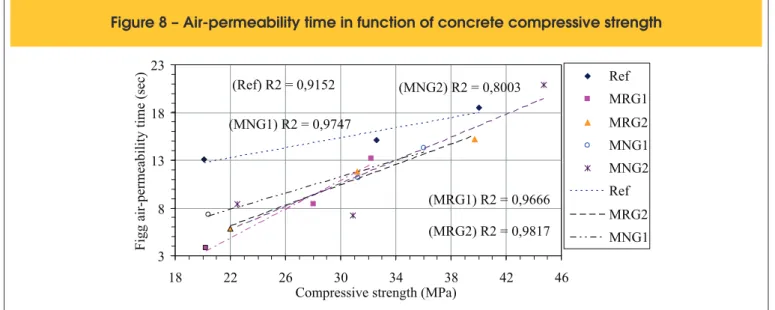
In igure 7, the property air-permeability time of the RAC was sen -sitive to the changes in the types of aggregates, it also happened with the water absorption and the air content. The test, unlike the absorption and of the air content, measuring the air-permeability time was sensitive to the alteration of the w/c ratio, decreasing as this increased, and to the aggregate type, increasing when the ine aggregate is normal and the recycled coarse aggregate is G2. The relation between the permeability and compressive strength of the concretes can be seen in the igure 8, in which, for each concrete, each point corresponds to a w/c ratio.
In igure 8, the air-permeability time demonstrated a relation with the compressive strength of the concrete, the larger the air-perme -ability time the larger the resistance to the concrete. The concretes tended to be more resistant the smaller the permeability, conirm -ing that for this composite, independent of the type of aggregate used. The relation between porosity and resistance is valid proven
by the Science of the Materials. Part of the porosity of the RAC might have been caused by the migration of part of the water pre-soaked of the aggregates recycled for the paste.
4. Conclusions
This study developed the following inal considerations:
n The composition and properties of the recycled aggregates in-luence on the production and in the fresh and hardened prop -erties. In the mixture, the absorbed water from the aggregates needs to be controlled; and the density of the recycled coarse aggregate may be a parameter for selection of recycled aggre-gates with structural purpose.
n The values of the strength obtained were inside of the struc -tural concrete norms and speciied in the Brazilian norm for the calculation of structures of armed concrete.
n The compressive strength of the RAC was approximately 20 MPa for the w/c = 0.67, the strength was approximately 30 MPa for the w/c = 0.50 and was approximately 40 MPa for the smallest w/c = 0.40. This behavior happened independently from the type of aggregate used, and therefore shows that all concretes obeyed the Abrams Law, which is with the increase of the relation, the compressive strength is decreased. n The properties of compressive strength and those related to
the durability of the concretes generally showed better per-formance in the concretes with recycled coarse aggregate of larger density (G2), compared to the concretes with recycled aggregate of smaller density (G1) independent of the type of ine aggregate.
n The concretes with recycled ine aggregate normally had their properties inferior to the one of the concretes with natural ine aggregate.
n The RAC were more porous and permeated than the conven -tional concretes, with exception to the 40MNG2 concrete which refers to the permeability. The more porous concretes and per-meated, tend to be less durable for providing, in the case of the applications structural, smaller protection to the steel against external aggressive agents that can penetrate the composite.
!
e � � �ir-permeability time in function of concrete compressive strength
(Ref) R2 = 0,9152
(MRG1) R2 = 0,9666
(MRG2) R2 = 0,9817
(MNG1) R2 = 0,9747
(MNG2) R2 = 0,8003
3
8
13
18
23
18
22
26
30
34
38
42
46
Compressive strength (MPa)
Figg air
-permeability time (sec)
However, that will only come to be extremely a limiting factor to the use of those concretes in the case of those structures in that the same ones are apparent. The Brazilian Norm of project reinforced concrete structures mentions that coatings can be applied on the concrete in the intention of protecting the mate-rial of the noxious environmental conditions.
n The concrete properties were revealed sensitive to the de -crease of the porosity of the recycled coarse aggregate so that the values of these tended, in some cases, to be very close or until overcoming the values of the properties of the conven -tional concretes.
Based on the results found in this study for the RAC properties, it seems possible the use of this material in structural elements since observed their particularities and other mechanical proper -ties, dimensional and of durable, which can come to be factors limits in some structural applications. Furthermore, in the case of application in structures, testing for veriication of contaminants in the recycled aggregates must be performed in order to avoid pos -sible pathologies.
The results reached in the concretes with recycled aggregate of larger density showed that the aggregate’s density, which is re-lated to the resistance and porosity of the same, and that had a great inluence in the obtained concrete properties. Therefore, this property can be a decisive factor for obtaining structural concretes.
5. Acknowledgements
Partial inancial support for this work was provided by MCT/FINEP (Ministry of the Science and Technology/Financial of Studies and Projects). The Laboratory of Structures and Materials of the Center of Technology and the PPGEC (Program of Masters degree in Civil Engineering). Jonathas J. L. Tenório was funded by the CAPES (Co-ordination of Improvement of Personnel of Superior Level) during his master’s degree at the Federal University of Alagoas (UFAL), Brazil. BASF by chemical additive used in this study.
6. references
[01] Lovato P. S.; Possan, E.; Dal Molin, D. C. C.; Masuero, Â. B.; Ribeiro, J. L. D. Modeling of mechanical properties and durability of recycled aggregate concretes. Construction and Building Materials, n. 26, 2012, pp 437–447.
[02] ETXEBERRIA, M.; VÁZQUEZ, E. ; MARÍ, A.; BARRA, M. Inluence of amount of recycled coarse aggregates and production process on properties of recycled aggregate concrete. Cement and Concrete Research, n. 37, 2007, pp 735–742.
[03] Tabsh, Sami W.; Abdelfatah, Akmal S. Inluence of recycled concrete aggregates on strength
properties of concrete. Construction and Building Materials, n. 23, 2009, pp 1163–1167.
[04] Kwan, W. H.; Ramli, M.; Kam, K. J.; Sulieman, M. Z. Inluence of the amount of recycled coarse aggregates in concrete design and durability properties.
Construction and Building Materials, n. 26, 2012, pp 565-573.
[05] Cabral, A. E. B.; Schalch, V.; Dal Molin, D. C. C.; Ribeiro, J. L. D. Mechanical properties modeling of
recycled aggregate concrete. Construction and Building Materials, n. 24, 2010, pp 421–430. [06] QUEBAUD, M. R.; ZAHARIEVA, R.; WIRQUIN,
E.; BUYLE-BODIN, F. Inluência do teor em agregados provenientes da reciclagem de materiais de demolição (agregados reciclados) na
permeabilidade do concreto. 41º Congresso Brasileiro do Concreto. Salvador, Brasil. 1999. 1 CD-ROM. [07] MEHTA, P. M.; MONTEIRO, P. J. M. Concreto:
Estrutura, propriedades e materiais. São Paulo: PINI, 1994.
[08] BASHEER, L.; KROPP, J.; CLELAND, D. J. Assessment of the durability of concrete from its permeation properties: a review. Construction and Building Materials, n. 15, 2001, pp 93-103. [09] Kou, Shi-Cong; Poon, Chi-Sun; Etxeberria,
M. Inluence of recycled aggregates on long term mechanical properties and pore size distribution of concrete. Cement & Concrete Composites, n. 33, 2011, pp 286-291.
[10] CARRIJO, P. M. Análise da inluência da massa especíica de agregados graúdos provenientes de resíduos de construção e demolição no desempenho mecânico do concreto. Dissertação de mestrado. São Paulo, Universidade de São Paulo, 2005. [11] ANGULO, S. C. Características de agregados de
resíduos de construção e demolição reciclados e a inluência de suas características no comportamento de concretos. Tese de doutorado. São Paulo, Universidade de São Paulo, 2005.
[12] ASSOCIAÇÃO BRASILEIRA DE NORMAS TÉCNICAS. “Agregado miúdo - Determinação da absorção de água”. NBR NM 30, Rio de Janeiro, 2000. [13] ASSOCIAÇÃO BRASILEIRA DE NORMAS
TÉCNICAS. “Agregados - Determinação da massa especíica de agregados miúdos por meio do frasco de Chapman”. NBR 9776, Rio de Janeiro, 1987. [14] ASSOCIAÇÃO BRASILEIRA DE NORMAS
TÉCNICAS. “Agregado ino - Determinação de impurezas orgânicas”. NBR NM 49, Rio de Janeiro, 2001.
[15] ASSOCIAÇÃO BRASILEIRA DE NORMAS
TÉCNICAS. “Agregados - Determinação do material ino que passa através da peneira 75 μm, por lavagem”. NBR NM 46, Rio de Janeiro, 2003. [16] ASSOCIAÇÃO BRASILEIRA DE NORMAS
TÉCNICAS. “Agregados - Determinação da composição granulométrica”. NBR 248, Rio de Janeiro, 2003.
[17] ASSOCIAÇÃO BRASILEIRA DE NORMAS TÉCNICAS. “Agregado graúdo - Determinação de massa especíica, massa especíica aparente e absorção de água”. NBR NM 53, Rio de Janeiro, 2003. [18] ASSOCIAÇÃO BRASILEIRA DE NORMAS
TÉCNICAS. “Agregado graúdo - Determinação do índice de forma pelo método do paquímetro - Método de ensaio”. NBR 7809, Rio de Janeiro, 1983.
Janeiro, 1987.
[20] ASSOCIAÇÃO BRASILEIRA DE NORMAS TÉCNICAS. “Projeto de estruturas de concreto armado - Procedimento”. NBR 6118, Rio de Janeiro, 2003.
[21] FERREIRA, L.; De BRITO, J.; BARRA, M. Inluence of the pre-saturation of recycled coarse concrete aggregates on concrete properties. Magazine of Concrete Research, no 63, 2011, pp 617–627. [22] ASSOCIAÇÃO BRASILEIRA DE NORMAS
TÉCNICAS. “Concreto - Ensaio de compressão de corpos-de-prova cilíndricos - Método de ensaio”. NBR 5739, Rio de Janeiro, 1994.
[23] ASSOCIAÇÃO BRASILEIRA DE NORMAS TÉCNICAS. “Argamassa e concreto endurecidos - Determinação da absorção de água, índice de vazios e massa especíica”. NBR 9778, Rio de Janeiro, 2004. [24] LABORATÓRIO NACIONAL DE ENGENHARIA
CIVIL. “Betões - Determinação da permeabilidade ao ar e à água - Método de Figg”. E 413, Portugal, 1993.
[25] ASSOCIAÇÃO BRASILEIRA DE NORMAS TÉCNICAS. “Agregados reciclados de resíduos sólidos da construção civil – Utilização em pavimentação e preparo de concreto sem função estrutural – Requisitos”. NBR 15116, Rio de Janeiro, 2004.
[26] NEVILLE, A. M. Propriedades do Concreto. 2 ed. São Paulo: PINI, 1997.
[27] LEITE, M. B. Avaliação de propriedades mecânicas de concretos produzidos com agregados reciclados de resíduos de construção e demolição. Tese de doutorado. Porto Alegre, Universidade Federal do Rio Grande do Sul, 2001.