Comparison between the retropubic and transobturator
approaches in the treatment of female stress urinary
incontinence: a systematic review and meta-analysis of
effectiveness and complications
_______________________________________________
Xincheng Sun
1, Qingsong Yang
1, Feng Sun
1, Qinglu Shi
11 Department of Urology, Cangzhou People Hospital, Cangzhou, Hebei 061000, China
ABSTRACT
ARTICLE
INFO
______________________________________________________________ ______________________
Objective: This study aimed to compare the effectiveness and complications between the retropubic and transobturator approaches for the treatment of female stress urinary incontinence (SUI) by conducting a systematic review.
Materials and Methods: We selected all randomized controlled trials (RCTs) that com-pared retropubic and transobturator sling placements for treatment of SUI. We estima-ted pooled odds ratios and 95% confidence intervals for intraoperative and postopera-tive outcomes and complications.
Results: Six hundred twelve studies that compared retropubic and transobturator appro-aches to midurethral sling placement were identified, of which 16 were included in our research. Our study was based on results from 2646 women. We performed a subgroup analysis to compare outcomes and complications between the two approaches. The evi-dence to support the superior approach that leads to better objective/subjective cure rate was insufficient. The transobturator approach was associated with lower risks of bladder perforation (odds ratio (OR) 0.17, 95% confidence interval (CI) 0.09-0.32), retropubic/ vaginal hematoma (OR 0.32, 95% CI 0.16-0.63), and long-term voiding dysfunction (OR 0.32, 95% CI 0.17-0.61). However, the risk of thigh/groin pain seemed higher in the transobturator group (OR 2.53, 95% CI 1.72-3.72). We found no statistically significant differences in the risks of other complications between the two approaches.
Conclusions: This meta-analysis shows analogical objective and subjective cure rates be-tween the retropubic and transobturator approaches to midurethral sling placement. The transobturator approach was associated with lower risks of several complications. Howe-ver, good-quality studies with long-term follow-ups are warranted for further research.
Key words:
stress urinary incontinence; retropubic tape; transobturator tape; meta-analysis; systematic review
Int Braz J Urol. 2015; 41: 220-9
_____________________
Submitted for publication: May 06, 2014
_____________________
Accepted after revision: July 28, 2014
INTRODUCTION
Stress urinary incontinence (SUI) is a ma-jor health problem that affects millions of women throughout the world. It is estimated to affect 15% to 35% of women in the general population (1).
Since it was first described by Ulmsten et al. (2) in 1996, the tension-free vaginal tape (TVT)
Delorme (7) described a new route of inserting the tape, which the author called transobturator ta-ping (TOT), in which the tape was inserted through the obturator foramina.
In 2003, de Leval (8) introduced a modi-fied technique called TVT-O, in which the tape is inserted in a reverse route, in through a vaginal incision and out through the obturator foramen (inside out).
Both the TOT and TVT-O procedures pro-ved to have high success rates in short and me-dium term follow-ups and to be associated with few perioperative complications (9, 10). However, the use of transobturator slings is associated with specific complications such as thigh pain (11). Fur-thermore, whether the TOTs (both TOT and TVT-O) are equal to the TVT in effectiveness for the treat-ment of SUI is controversial. Some studies showed that the TOTs were as effective as the TVT (12, 13), but some trials proved that the TVT was superior than the TOT in terms of outcomes (14).
However, current researches were often dri-ven by local norms and individual surgeon prefe-rences instead of evidence-based medicine. Proper comparisons of effectiveness and associated compli-cations between TVT and TOTs are currently limited. The objectives of this systematic review were to determine and compare effectiveness be-tween the TOTs and TVT in randomized controlled trials (RCTs) and to explore complication rates.
MATERIALS AND METHODS
A prospective protocol for this systematic review was developed. The study inclusion and exclusion criteria, statistical method, approach to estimating study quality, and outcomes are des-cribed in the sections that follow. This study was conducted in accordance with the declaration of Helsinki. This study was conducted with approval from the Ethics Committee of Cangzhou People Hospital. Written informed consent was obtained from all participants.
Sources
All RCTs that compared retropubic and transobturator midurethral sling placement in the
treatment of SUI were collected. We searched li-teratures from 2001 to 2011 using the following online databases: PubMed, Springer, OVID, EBS-CO, SAGE Journals, and Web of Science. We also found meeting abstracts from 2001 to 2011 on the Web sites of the International Continence Society, the American Urogynecologic Society, and Socie-ty for Urodynamics and Female Urology.
Our search strategy included the Medical Subject Heading term “urinary incontinence” and other “free” keywords such as “retropubic,” “tran-sobturator,” “tension-free vaginal tape,” “TVT,” “TVT-O,” “TOT,” “Monarc,” “SPARC,” and “midu-rethral sling.” These search terms were used sin-gly and in combination. There were no language restrictions on our searches. Two reviewers colla-boratively performed our literature research. The corresponding author of each RCT included in the analysis was contacted.
Inclusion/Exclusion Criteria
All prospective RCTs that compared TOTs (TOT or TVT-O) and TVT in the treatment of uro-dynamically proven SUI were included. The follo-wing inclusion criteria were used: (i) prospective randomized studies that compared between the retropubic and transobturator approaches to ten-sion-free midurethral polypropylene sling place-ment for SUI; (ii) clearly defined objective and/ or subjective outcome measures; and (iii) clearly defined follow-up periods. Studies were excluded on the basis of the following criteria: (i) duplicate reports, in which case the report containing the most complete data was included; (ii) patients who had previously undergone anti-incontinence sur-gery; (iii) the rate of loss to follow-up was higher than 15% in general; (iv) fewer than 40 included cases; (v) the operation method included TVT-se-cure; and (vi) animal experiments.
Data Abstraction
to reach a consensus. We collected the following information: (i) the quality of the trials (allocation concealment, randomization method, blinding, power calculation, and intention-to-treat analy-sis); (ii) the participants’ characteristics (number, type of sling used, and type of SUI, either isolated or mixed); (iii) follow-up duration and number of patients lost to follow-up; (iv) outcomes, namely subjective and/or objective cure; (v) intraoperati-ve (bladder perforation and retropubic/vaginal he-matoma) and postoperative complications (thigh/ groin pain, de novo urgency or urge incontinence, transient voiding dysfunction, long-term voiding dysfunction, and tape erosion).
Statistical analysis
Statistical analysis was performed using the RevMan 5.0.24 software. For the dichotomous data in our review, we assessed statistical hete-rogeneity using the following criteria: “P≤0.05 or I2≥50%” was considered to represent statistically significant heterogeneity, and the Mantel-Ha-enszel random effects model was used to estimate odds ratios (ORs) and 95% confidence intervals (95% CIs). The Peto fixed effects model was used if “P>0.05 and I2<50%.”
We assessed publication bias using fun-nel plots. Subgroups were established prior to the analysis of the objective/subjective outcomes, ac-cording to two perspectives as follows: (i) women with isolated and mixed incontinence and women with isolated incontinence, and (ii) “TVT vs. TOT” and “TVT vs. TVT-O.” The subgroups established prior to the analysis of the complications included only “TVT vs. TOT” and “TVT vs. TVT-O.”
RESULTS
Characteristics of the studies
Our search identified 612 reports, of which 588 were excluded on the basis of their titles/abs-tracts because of several shortcomings, including the following: lack of a comparative study design, a retrospective design, midurethral slings made of autogenous materials, non-randomized study de-sign, association with other pelvic operations, and fewer than 40 study subjects. The remaining trials
were assessed in detail. Three were excluded becau-se neither the objective nor subjective cure criteria were defined (16-18). One was excluded because of lack of a clear explanation of the randomiza-tion method (19). Another was excluded because of a high rate of loss to follow-up (20). Three were excluded because of duplicate reports (21-23). Six-teen prospective randomized studies (24-39) were included in the review. The included studies used different objective cure criteria, singly or in combi-nation, such as negative cough stress test result in the urodynamic testing (24-27, 29-39), and 1-hour pad test <1 g (28,29,34), <2 g (32,38), and <3 g (30). Twelve trials reported subjective cure rates (24-30, 32-35, 39). Different subjective measures such as the visual analogue scale, Incontinence Im-pact Questionnaire, Urogenital Distress Inventory, and other validated questionnaires were also used. Patient satisfaction of the subjective cure was des-cribed as “satisfied,” “very satisfied,” or “dry.”
We randomized 2646 women to undergo midurethral sling placement for SUI using either TOTs (TOT/TVT-O) or TVT. Nine trials included wo-men with either isolated or mixed SUI (25-27, 30-32, 34, 35, 39). Seven trials included women with isolated SUI only (24, 28, 29, 33, 36-38). Ten trials compared between TVT-O and TVT (24-26, 29, 34-39); 5 trials compared between TOT and TVT (27, 28, 31-33); and 1 trial included both TOT and TVT--O (30). Perioperative cystoscopy was performed for all the patients in 7 trials (25-28, 30, 31, 38); cys-toscopy was used only for the TVT group in the re-maining trials. Five of the trials reported allocation concealment (26, 28, 32, 33, 38). Thirteen trials had computer-generated randomization (24-28, 30-37), whereas the other trials used quasi-randomization. Only one trial had a single-blind design (24). Po-wer calculation was performed in 10 trials (25-28, 31, 33, 34-36, 38); intention-to-treat (ITT) analysis was performed in only 1 trial (25). In all the trials, the general rates of loss to follow-up were not hi-gher than 15%. The mean follow-up periods ranged from 6 to 36 months. The details of the included trials are shown in Table-1.
Effectiveness
mixed SUI” and “isolated SUI”). When compared with the TVT group, the objective cure rate in the transobturator group was equivalent to that of the “isolated and mixed SUI” subgroup (OR 0.90, 95% CI 0.63-1.28), as well as that of the “isola-ted SUI” subgroup (OR 0.86, 95% CI 0.48-1.55). The differences in combined objective cure rate were not statistically significant (OR 0.90, 95% CI 0.67-1.21). When the transobturator and TVT groups were compared in terms of subjective cure, the “isolated and mixed SUI” (OR 0.91, 95% CI 0.68-1.23) and “isolated SUI” subgroups had equi-valent results (OR 1.17, 95% CI 0.71-1.93), while differences in combined subjective cure were not statistically significant (OR 0.97, 95% CI 0.76-1.26). Figure-1 provides the objective cure rates Table 1 - Basic data of research from literatures.
Author Year Country Follow-up
duration (month)
Research quality
Retropubic
group Transobturator group
Zhu et al 2008 China 14.5 A 35 (TVT) 34 (TVT-O)
Karateke et al 2009 Turkey 14 A 83 (TVT) 84 (TVT-O)
Palva et al 2010 Finland 36 B 136 (TVT) 131 (TVT-O)
Deffieux et al 2010 France 24 B 67 (TVT) 67 (TVT-O)
Porena et al 2007 Italy 31 B 70 (TVT) 75 (TOT)
Ross et al 2009 Canada 12 B 105 (TVT) 94 (TVT-O)
Liapis et al 2006 Greece 12 B 46 (TVT) 43 (TVT-O)
Wang et al 2011 China 12 B 32 (TVT) 36 (TVT-O)
David et al 2011 Switzerland 12 B 65 (TVT) 70 (TVT-O/TOT)
Lee et al 2006 Republic of Korea 13 B 60 (TVT) 60 (TVT-O)
David-Montefiore et al 2006 France 24 B 42 (TVT) 46 (TOT)
Ahmed et al 2010 Egypt 20 B 19 (TVT) 21 (TVT-O)
de Tayrac et al 2004 France 12 B 31 (TVT) 30 (TVT-O)
Krofta et al 2010 Czech 12 B 149 (TVT) 151 (TVT-O)
Meschia et al 2007 Italy 6 B 114 (TVT) 117 (TVT-O)
Angelo et al 2007 Italy 12 B 35 (TVT) 37 (TVT-O)
Zhu et al 2009 China 6 B 160 (TVT) 155 (TVT-O)
Araco et al 2008 Britain, Italy 12 B 120 (TVT) 120 (TVT-O)
Total 1369 1371
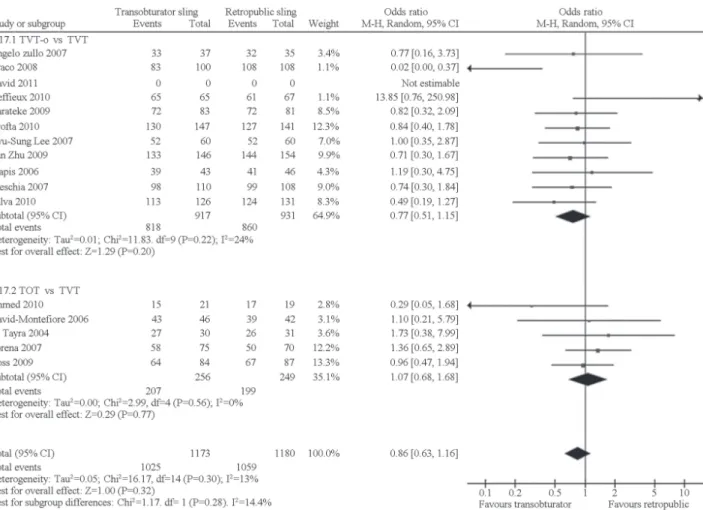
of the transobturator group (TVT-O and TOT) in comparison with those of the TVT group in the first subgroup analysis.
was also not statistically significant (TVT-O vs. TVT: OR 0.97, 95% CI 0.71-1.33; TOT vs. TVT: OR 1.05, 95% CI 0.37-2.99, and total: OR 1.02, 95% CI 0.77-1.34). Figure-2 provides the objective cure rates of the two approaches (TVT-O and TOT) in comparison with that of the TVT in the subgroup analysis. The funnel plots indicated symmetrical distribution of the studies, indicating a low like-lihood of publication or reporting bias (Figure-3).
COMPLICATIONS
We excluded one study (30) in the analysis of complications because it used the combination of TVT-O and TOT in the transobturator group.
All the trials provided data on bladder per-foration. In comparison with TVT, TVT-O and TOT were associated with statistically significantly lo-wer risk of bladder perforation as follows: TVT--O group (OR 0.18, 95% CI 0.08-0.38), TOT group (OR 0.17, 95% CI 0.06-0.49), combined TVT-O and TOT (OR 0.17, 95% CI 0.09-0.32).
All trials reported data on retropubic/vagi-nal hematoma. In the subgroup aretropubic/vagi-nalysis, the risk
of hematoma was lower in both the TVT-O (OR 0.42, 95% CI 0.19-0.93) and TOT groups (OR 0.13, 95% CI 0.03-0.53) than in the TVT group.
Eleven trials (25-28, 31, 32, 34-37, 39) re-presented data on thigh/groin pain. The descrip-tion and criteria of pain in each trial were not ac-cordant. The TVT-O group seemed to be associated with a higher risk of pain than the TVT group (OR 2.8, 95% CI 1.81-4.45). However, no statistically significant difference was found between the TOT and TVT subgroups (OR 1.85, 95% CI 0.88-3.90). The risk of thigh/groin pain was higher for the combined TVT-O and TOT group (OR 2.53, 95% CI 1.72-3.72).
Figure 2 - Meta-analysis of the objective cure of the two approaches (TVT-O and TOT) in comparison with TVT.
between the TOT (OR 0.54, 95% CI 0.19-1.49) and TVT groups.
Eleven studies (24, 25, 28, 29, 31, 33, 34, 36-39) described postoperative symptoms of de novo urgency/urge incontinence. The risks were equivalent between the transobturator and retro-pubic groups (TVT-O vs. TVT: OR 0.96, 95% CI 0.56-1.65 and TOT vs. TVT: OR 1.03, 95% CI 0.41-2.60).
All the trials reported data on tape erosion. The risks of tape erosion were equivalent (TVT-O vs. TVT: OR 0.95, 95% CI 0.45–1.98 and TOT vs. TVT: OR 2.40, 95% CI 0.54-10.62).
Figure-4 provides a summary of the com-plications associated with the two tapes (TVT-O and TOT) in comparison with the TVT.
DISCUSSION
We found no statistically significant di-fference in either objective or subjective cure between the transobturator and retropubic ap-proaches for the treatment of female SUI. The funnel plots of the outcomes in the two subgroup analyses were evenly distributed, indicating a less likelihood of publication bias and higher confi-dence in the results. These results are consistent with those of most of the included trials (24-31, 33-37, 39). However, these findings cannot de-monstrate the equivalent effectiveness of the two approaches. Although we compared between the transobturator and retropubic approaches in the “isolated and mixed SUI” and “isolated SUI” sub-groups, the comparison between the two approa-ches in women with intrinsic sphincter deficiency (ISD) was ignored because of the lack of sufficient relative trials. In fact, several studies (14, 40)
pro-ved that the transobturator approach was inferior to the retropubic approach in the treatment of ISD in women. Thus, further research in this field is warranted.
Figure 4 - Complications of the two procedures (TVTO and TOT) in comparison with TVT.
not necessary for transobturator approach, surgeons must be aware of the risk of bladder perforation, even with the transobturator procedure.
We found that the transobturator approach, especially the TVT-O procedure, was associated with a lower risk of long-term voiding dysfunction than the TVT. This result may be explained by the follo-wing, as reported by Juma (42) and Morey (43): the orientation of the transobturator tension-free midu-rethral sling was more similar to the natural ham-mock shape, as compared with the TVT procedure.
As a result of lower shearing force to the urethra, the transobturator tape is more appropriate for women with slow urine flow rate.
sup-port that claim, or that one approach leads to a lower risk of tape erosion.
Our study has potential limitations. First, the quality of the included trials was not good enough. For example, only one of the 16 trials had a single--blind design (24) and intention-to-treat analysis was performed only in one study (25). That may be a sour-ce of heterogeneity. Second, the criteria of objective and subjective cure, and complications such as pain were not consistent. These negative factors may cau-se bias and heterogeneity. Among our trials, the last one had the longest follow-up period of 36 months. The follow-up periods were too short to appropriately reflect long-term outcomes and complications.
In conclusion, the transobturator and retropu-bic approaches were equally effective for the treatment of SUI. In particular, the transobturator approach was associated with a decreased risk of complications. Ho-wever, good-quality studies with long-term follow-up are warranted for further research.
CONFLICT OF INTEREST
None declared.
REFERENCES
1. Maral I, Ozkardes H, Peskircioglu L, Bumin MA. Prevalence of stress urinary incontinence in both sexes at or after age 15 years: a cross-sectional study. J Urol. 2001;165:408-12. 2. Ulmsten U, Henriksson L, Johnson P, Varhos G. An
ambu-latory surgical procedure under local anesthesia for treat-ment of female urinary incontinence. Int Urogynecol J Pelvic Floor Dysfunct. 1996;7:81-5.
3. Celebi I, Gungorduk K, Ark C, Akyol A. Results of the tension-free vaginal tape procedure for treatment of female stress urinary A ncontinence: a 5-year follow-up study. Arch Gynecol Obstet. 2009;279:463-7.
4. Olsson I, Abrahamsson AK, Kroon UB. Long-term efficacy of the tension-free vaginal tape procedure for the treatment of urinary incontinence. A retrospective follow-up 11.5 years post-operatively. Int Urogynecol J. 2010;21:679-83.
5. Karram MM, Segal JL, Vassallo BJ, Kleeman SD. Complications and untoward effects of the tension-free vaginal tape procedure. Obstet Gynecol. 2003;101:929-32. 6. Sander P, Sørensen F, Lose G. Does the Tension-Free Vaginal
Tape Procedure (TVT) Affect the Voiding Function Over Time? Pressure-Flow Studies 1 Year and 3½ Years after TVT. Neurourology and Urodynamics. 2007;26:995-7.
7. Delorme E. Transobturator urethral suspension: mini-invasive procedure in the treatment of stress urinary incontinence in women. Prog Urol. 2001; 11:1306-13.
8. de Leval J. Novel surgical technique for the treatment of female stress urinary incontinence: transobturator vaginal tape inside-out. Eur Urol. 2003;44:724-30.
9. Shaker HS, Ban HM, Hegazy AS, Mansour MF. Functional and quality of life outcome of transobturator tape for treatment of female stress urinary. Int Urogynecol J. 2011;22:99-103. 10. Rajendra M, Han HC, Lee LC, Tseng LA, Wong HF. Retrospective
study on tension-free vaginal tape obturator (TVT-O). Int Urogynecol J. 2012;23:327-34.
11. Hazewinkel MH, Hinoul P, Roovers JP. Persistent groin pain following a trans-obturator sling procedure for stress urinary incontinence: a diagnostic and therapeutic challenge. Int Urogynecol J Pelvic Floor Dysfunct. 2009;20:363-5.
12. Lier D, Ross S, Tang S, Robert M, Jacobs P. Trans-obturator tape compared with tension-free vaginal tape in the surgical treatment of stress urinary incontinence: a cost utility analysis. BJOG. 2011;118:550-6.
13. George S, Begum R, Thomas-Philip A, Thirumalakumar L, Sorinola O. Two-year comparison of tension-free vaginal tape and transobturator tape for female urinary stress incontinence. Obstet Gynecol. 2010;30:281-4.
14. Chawla A. Transobturator tapes are preferable over transvaginal tapes for the management of female stress urinary incontinence: Against. Indian J Urol. 2009;25:554-7.
15. Jadad AR, Moore A, Carroll D, Jenkinson C, Reynolds DJ, Gavaghan DJ, et al. Assessing the quality of reports of randomized clinical trials: Is blinding necessary? Control Clin Trials. 1996;17:1-12.
16. Dyrkorn OA, Kulseng-Hanssen S, Sandvik L. TVT compared with TVT-O and TOT: results from the Norwegian National Incontinence Registry. Int Urogynecol J. 2010;21:1321-6. 17. Aniuliene R. Tension-free vaginal tape versus tension-free
vaginal tape obturator (inside-outside) in the surgical treatment of female stress urinary incontinence. Medicina (Kaunas). 2009; 45:639-43.
18. Wang AC, Lin YH, Tseng LH, Chih SY, Lee CJ. Prospective randomized comparison of transobturator suburethral sling (Monarc) vs suprapubic arc (Sparc) sling procedures for female urodynamic stress incontinence. Int Urogynecol J Pelvic Floor Dysfunct. 2006;17:439-43.
19. Chen Z, Chen Y, Du GH, Yuan XY, Wu J, Zeng XY, et al. Comparison of three kinds of mid-urethral slings for surgical treatment of female stress urinary incontinence. Urologia. 2010;77:37-41. 20. Barry C, Lim YN, Muller R, Hitchins S, Corstiaans A, Foote A, et
21. Rinne K, Laurikainen E, Kivela A, Aukee P, Takala T, Valpas A, et al. A randomized trial comparing TVT with TVT-O: 12-month results. Int Urogynecol J Pelvic Floor Dysfunct. 2008;19:1049-54.
22. Laurikainen E, Valpas A, Kivela A, Kallioal T, Rinne K, Takala T, et al. Retropubic Compared With Transobturator Tape Placement in Treatment of Urinary Incontinence. A Randomized Controlled Trial. Obstet Gynecol. 2007;109:4-11.
23. Angioli R, Plotti F, Muzii L, Montera R, Panici PB, Zullo MA. Tension-Free Vaginal Tape Versus Transobturator Suburethral Tape: Five-Year Follow-up Results of a Prospective, Randomised Trial. Eur Urol. 2010;58:671-7.
24. Karateke A, Haliloglu B, Cam C, Sakalli M. Comparison of TVT and TVT-O in patients with stress urinary incontinence: Short-term cure rates and factors influencing the outcome. A prospective randomised study. Aust N Z J Obstet Gynaecol. 2009;49:99-105. 25. Palva K, Rinne K, Aukee P, Kivela A, Laurikainen E, Takala T,
et al. A randomized trial comparing tension-free vaginal tape with tension-free vaginal tape-obturator: 36-month results. Int Urogynecol J. 2010;21:1049-55.
26. Deffieux X, Daher N, Mansoor A, Debodinance P, Muhlstein J, Fernandez H. Transobturator TVT-O versus retropubic TVT results of a multicenter randomized controlled trial at 24 months follow-up. Int Urogynecol J. 2010;21:1337-45.
27. Porena M, Costantini E, Frea B, Giannantoni A, Ranzoni S, Mearini L, et al. Tension-Free Vaginal Tape versus Transobturator Tape as Surgery for Stress Urinary Incontinence: Results of a Multicentre Randomised Trial. Eur Urol. 2007;52:1481-91. 28. Ross S, Robert M, Swaby C, Dederer L, Lier D, Tang S, et al.
Transobturator Tape Compared With Tension-Free Vaginal Tape for Stress Incontinence, A Randomized Controlled Trial. Obstet Gynecol. 2009;114:1287-94.
29. Liapis A, Bakas P, Giner M, Creatsas G. Tension-Free Vaginal Tape versus Tension-Free Vaginal Tape Obturator in Women with Stress Urinary Incontinence. Gynecol Obstet Invest. 2006; 62:160-4.
30. Scheiner DA, Betschart C, Wiederkehr S, Seifert B, Fink D, Perucchini D. Twelve months effect on voiding function of retropubic compared with outside-in and inside-out transobturator midurethral slings. Int Urogynecol J. 2012;23:197-206.
31. David-Montefiore E, Frobert JL, Grisard-Anaf M, Lienhart J, Bonnet K, Poncelet C, et al. Peri-Operative Complications and Pain After the Suburethral Sling Procedure for Urinary Stress Incontinence: A French Prospective Randomised Multicentre Study Comparing the Retropubic and Transobturator Routes. Eur Urol. 2006;49:133-8.
32. Ahmed S, Hefnawy EL, Bassem S, Nabeeh A. TOT for treatment of stress urinary incontinence: how should we assess its equivalence with TVT? Int Urogynecol J. 2010;21:947-53. 33. de Tayrac R, Deffieux X, Droupy S, Chauveaud-Lambling A,
Calvanese-Benamour L, Fernandez H. A prospective randomized
trial comparing tension-free vaginal tape and transobturator suburethral tape for surgical treatment of stress urinary incontinence. Am J Obstet Gynecol. 2004;190:602-8.
34. Krofta L, Feyereisl J, Otcenasek M, Velebil P, Kasikova E, Krcmar M. TVT and TVT-O for surgical treatment of primary stress urinary incontinence: prospective randomized trial. Int Urogynecol J. 2010;21:141-8.
35. Meschia M, Bertozzi R, Pifarotti P, Baccichet R, Bernasconi F, Guercio E, et al. Peri-operative morbidity and early results of a randomised trial comparing TVT and TVT-O. Int Urogynecol J Pelvic Floor Dysfunct. 2007;18:1257-61.
36. Zullo MA, Plotti F, Calcagno M, Marullo E, Palaia I, Bellati F. One-Year Follow-up of Tension-free Vaginal Tape (TVT) and Trans-obturator Suburethral Tape from Inside to Outside (TVT-O) for Surgical Treatment of Female Stress Urinary Incontinence: A Prospective Randomised Trial. Eur Urol. 2007; 51:1376-82. 37. Wang W, Zhu L, Lang J. Transobturator tape procedure versus
tension-free vaginal tape for treatment of stress urinary incontinence. Int J Gynaecol Obstet. 2009;104:113-6.
38. Araco F, Gravante G, Sorge R, Overton J, De Vita D, Sesti F, et al. TVT-O vs TVT: a randomized trial in patients with different degrees of urinary stress incontinence. Int Urogynecol J Pelvic Floor Dysfunct. 2008;19:917-26.
39. Lee KS, Han DH, Choi YS, Yum SH, Song SH, Doo CK, et al. A Prospective Trial Comparing Tension-Free Vaginal Tape and Transobturator Vaginal Tape Inside-Out for the Surgical Treatment of Female Stress Urinary Incontinence: 1-Year Followup. J Urol. 2007;177:214-8.
40. Long CY, Hsu CS, Wu MP, Liu CN, Wang TN, Tsai EM. Comparison of tension-free vaginal tape and transobturator tape procedure for the treatment of stress urinary incontinence. Curr Opin Obstet Gynecol. 2009;21:342-7.
41. Bonnet P, Waltregny D, Reul O, de Leval J. Transobturator vaginal tape inside out for the surgical treatment of female stress urinary incontinence: anatomical considerations. J Urol. 2005;173:1223-8.
42. Juma S, Brito CG. Transobturator tape (TOT): Two years follow-up. Neurourol Urodyn. 2007;26:37-41.
43. Morey AF, Medendorp AR, Noller MW, Mora RV, Shandera KC, Foley JP, et al. Transobturator versus transabdominal mid urethral slings: a multi-institutional comparison of obstructive voiding complications. J Urol. 2006;175:1014-7.