Geographic distribution of deaths among elderly due to trafic
accidents*
Distribuição geográica dos óbitos de idosos por acidente de trânsito
Distribución geográica de fallecimientos de ancianos por accidentes de tránsito
Ana Maria Ribeiro dos Santos1
Rosalina Aparecida Partezani Rodrigues2
Claudia Benedita dos Santos2 Gustavo Bussi Caminii2
1. Universidade Federal do Piauí. Teresina - PI, Brazil.
2. Universidade de São Paulo. Ribeirão Preto - SP, Brazil.
Corresponding author: Ana Maria Ribeiro dos Santos. E-mail: [email protected]
Submited on 07/31/2015. Accepted on 10/21/2015.
DOI: 10.5935/1414-8145.20160018
A
bstrActObjective: Analyze traic accidents with fatalities involving elderly people according to the condition of the injured subjects, place
of occurrence and cause of death, preparing maps of geographic distribution. Methods: A cross-sectional study was developed
at the Police Station for Traic Crimes Punishment in Teresina in 68 accident and police investigation records from 2010 to 2011. Local Moran Index and Kernel density were used for spatial analysis. Results: Regarding the condition of the elderly at the time
of the accident, 57.3% of the deceased were pedestrians. In regard to the place of occurrence and the irst cause listed, it was found that 49.6% of the deaths occurred at the scene, with multiple trauma being the major cause. Conclusion: The deaths
were concentrated in urban areas, with agglomeration of neighborhoods with a high rate of traic accidents, presenting positive correlation, also highlighting the existence of regions with higher density of occurrences.
Keywords: Elderly; Traic accidents; Death; Spatial analysis.
r
esumoObjetivo: Analisar os acidentes de trânsito envolvendo idosos em que ocorreu desfecho fatal, segundo condição do acidentado,
local de ocorrência e causa do óbito, elaborando mapas de distribuição geográica. Métodos: Estudo transversal realizado
na Delegacia de Repressão aos Crimes de Trânsito de Teresina, em uma população de 68 boletins de registro de acidente e inquéritos policiais de idosos nos anos de 2010 e 2011. Na análise espacial utilizaram-se o Índice Local de Moran e a densidade de Kernel. Resultados: Em relação à condição do idoso no momento do acidente, comprovou-se que 57,3% dos óbitos foram
de pedestres. Considerando o local de ocorrência e a primeira causa registrada, constatou-se que 49,6% ocorreram no local do acidente, a maior causa o politraumatismo. Conclusão: Os óbitos concentraram-se na área urbana, com aglomerado de
bairros com alta ocorrência de acidente, apresentando correlação positiva, evidenciando também a existência de regiões com maior densidade de ocorrências.
Palavras-chave: Idoso; Acidentes de trânsito; Óbito; Análise espacial.
r
esumenObjetivo: Analizarlos accidentes de tránsito que involucran apersonas de edad avanzada que se produjeron desenlace fatal, de
acuerdo a la condición áspera, lugar de ocurrencia y causa de la muerte, la elaboración de mapas de distribución geográica.
Métodos: Estudio transversal en el Precinto Represión de Delitos de Tráico de Teresina, en una población de boletines icha
68 accidentes y las investigaciones de la policía en 2010y 2011. El análisis espacial se utilizó el índice de Moran ubicación y la densidad Kernel. Resultados: En cuanto a la condición de personas de edad avanzada en el momento del accidente, se
encontró que57,3% de las muertes fueron peatones. Teniendo en cuenta el lugar de ocurrencia y la pregunta primero registrado, se encontró que el 49,6% estaban en la escena, siendo la mayor causa del politraumatismo. Conclusión: Las defunciones se
produjeron en la zona urbana, con el racimo de los barrios con alta incidencia de accidentes, y positivamente relacionados, mostrando también la existencia de regiones con mayores ocurrencias de densidad.
INTRODUCTION
Worldwide, 5.8 million people die every year as a conse
-quence of trauma, which corresponds to 10% of all deaths, of which about one-quarter are due to traic accidents1.
Mortality rate as result of these accidents in middle-income countries is 20.1 per 100,000 inhabitants, whereas in high and low-income countries it is 8.7 and 18.3 per 100,000 inhabitants, respectively. Therefore, middle-income countries present the highest rates, representing 80% of the worldwide deaths due to accidents, although they represent 72% of the world's population and only own 52% of all the worldwide registered vehicles2.
Brazil has high mortality rates caused by road accidents. According to the Global Status Report on Road Safety, the situation is worrying, since the country ranks the ifth position in road accident death rate in the world, behind countries such as China, India, Russia and the United States3.
Parallel to this, among the main changes the country has gone through in the last century, the demographic revolution stands out, with an increase in the percentage of the elderly population, from 9.1% in 1999 to 11.3% in 2009, which currently accounts for over 22 million people, exceeding the number of elderly individuals in several European countries such as France, England and Italy, as estimated by the United Nations4.
Furthermore, it is particularly worth mentioning data found in a systematic review of the Brazilian academic production about external causes and violence within the elderly population, which identiied, from the death rate point of view, the prominence of traic accidents among this population5.
In the light of this reality, the authors of this study decided to investigate the elderly mortality rate in this speciic region of the country, with the purpose of analyzing traic accidents with fatal outcome, according to the elderly condition, place of occurrence and cause of death, by producing geographical distribution maps.
METHODS
A cross-sectional study was developed with data obtained from the Police Station for Traic Crimes Punishment in Teresina, in a population comprising 68 accident and police investigation reports of elderly individuals from both genders, living in this capital city, who had been victims of traic accidents in this city, between 2010 and 2011, with a fatal outcome. Data were collected by using a form validated by experts in trauma care and descriptively analyzed using the software Statistical Package for the Social Sciences (SPSS).
For spatial analysis, the addresses of the places where the accidents occurred, resulting in death, were geocoded. The points were marked with the use of a global positioning system (GPS), the Garmin Etrex Legend GPS Receiver. After the geocoding, the points were gathered into a single shapeile for the development of maps through the Geographic Information
System (GIS), using the software Terraview 4.2.2, provided by the National Institute of Spatial Research (INPE, as per its acronym in Portuguese).
The cartographic base of the city of Teresina was used, and spatial autocorrelation was determined through the Local Moran's I with a Box Map. The punctual intensity of the event was also investigated and examined through the Kernel smoothing method.
The study proposal was submitted to the Human Re
-search Ethics Committee and approved under CAEE Nº 02342412.9.0000.5393.
RESULTS
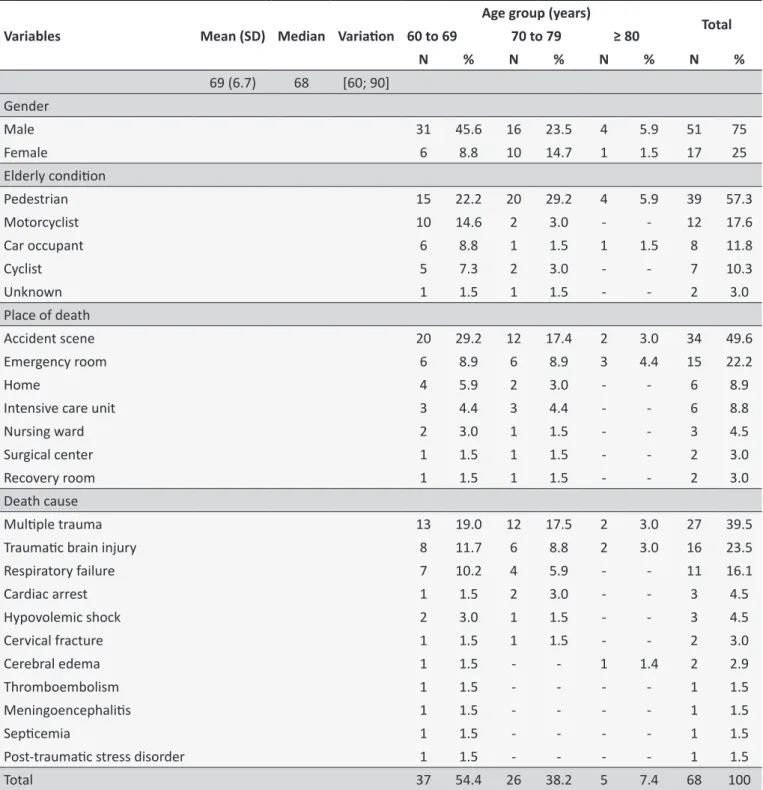
Table 1 describes deaths among the elderly victims of traic accidents, considering age groups. A mean age of 69 (SD = 6.7), median of 68, and variation between 60 and 90 years was found. Most deaths occurred among men (75%) and the age group between 60 and 69 years (54.4%). Regarding the condition of the elderly at the time of the accident, it was proved that 57.3% of the deceased ones were pedestrians. Considering the place of occurrence and the irst cause recorded on the death certiicate, 49.6% of the deaths occurred at the accident scene, and the major cause was multiple trauma (39.5%), followed by traumatic brain injury (23.5%). Regarding the deaths occurred in the hospital, most occurred in the emergency room (22.2%).
Figure 1 shows the punctual distribution of places where traic accidents with the elderly occurred, according to the death occurrence site. There was a concentration of deaths caused by traic accidents in the urban area, but a signiicant number was also observed in the city rural area.
Of the 68 deaths registered at the Police Station for Traic Crimes Punishment in the researched period, 34 occurred at the accident site itself and 34 occurred later. Among those that occurred later, 28 were in health centers where the elderly were assisted after the accident, and six occurred at their homes after hospital discharge, having been recorded in medical reports as caused by traic accidents. Among deaths that occurred in the hospital, most were in the emergency room.
Figure 2 presents the Box Map of the elderly deaths caused by traic accidents in Teresina. In this quantitative Box Map of deaths occurred in Teresina in 2010 and 2011, neighborhoods in dark grey present high death numbers caused by traic accidents, with a positive correlation, and neighborhoods in light grey present low death numbers caused by traic accidents with a positive correlation. In this respect, the neighborhoods of Santa Maria da Codipi, Zoobotânico, Piçarreira, Morada do Sol, Nossa Senhora de Fátima, Horto, Jóquei, São Cristovão, Santa Isabel, Gurupi, Tabuleta, Redenção, Lourival Parente, São Lourenço and Parque Piauí, located in caption 1, exhibited high death numbers caused by traic accident with a positive correlation.
Table 1.
Distribuion of elderly deaths by traic accident according to age group, gender, condiion of the elderly,
place of occurrence and cause of death. Teresina, Piauí, 2010/2011
Variables
Mean (SD)
Median
Variaion
Age group (years)
Total
60 to 69
70 to 79
≥ 80
N
%
N
%
N
%
N
%
69 (6.7)
68
[60; 90]
Gender
Male
31
45.6
16
23.5
4
5.9
51
75
Female
6
8.8
10
14.7
1
1.5
17
25
Elderly condiion
Pedestrian
15
22.2
20
29.2
4
5.9
39
57.3
Motorcyclist
10
14.6
2
3.0
-
-
12
17.6
Car occupant
6
8.8
1
1.5
1
1.5
8
11.8
Cyclist
5
7.3
2
3.0
-
-
7
10.3
Unknown
1
1.5
1
1.5
-
-
2
3.0
Place of death
Accident scene
20
29.2
12
17.4
2
3.0
34
49.6
Emergency room
6
8.9
6
8.9
3
4.4
15
22.2
Home
4
5.9
2
3.0
-
-
6
8.9
Intensive care unit
3
4.4
3
4.4
-
-
6
8.8
Nursing ward
2
3.0
1
1.5
-
-
3
4.5
Surgical center
1
1.5
1
1.5
-
-
2
3.0
Recovery room
1
1.5
1
1.5
-
-
2
3.0
Death cause
Muliple trauma
13
19.0
12
17.5
2
3.0
27
39.5
Traumaic brain injury
8
11.7
6
8.8
2
3.0
16
23.5
Respiratory failure
7
10.2
4
5.9
-
-
11
16.1
Cardiac arrest
1
1.5
2
3.0
-
-
3
4.5
Hypovolemic shock
2
3.0
1
1.5
-
-
3
4.5
Cervical fracture
1
1.5
1
1.5
-
-
2
3.0
Cerebral edema
1
1.5
-
-
1
1.4
2
2.9
Thromboembolism
1
1.5
-
-
-
-
1
1.5
Meningoencephaliis
1
1.5
-
-
-
-
1
1.5
Sepicemia
1
1.5
-
-
-
-
1
1.5
Post-traumaic stress disorder
1
1.5
-
-
-
-
1
1.5
Total
37
54.4
26
38.2
5
7.4
68
100
with lower numbers of deaths, such as Angelin, Três Andares, Cidade Nova, Dirceu, Centro, Primavera, Real Copagre, Mo
-cambinho, Porto do Centro, and Vale quem Tem, they presented a negative correlation. Finally, the neighborhoods in black color showed low number of deaths, surrounded by neighborhoods with signiicant death occurrences, verifying a negative correlation.
Figure 1. Elderly deaths caused by traic accidents, according to the occur -rence site. Teresina, Piauí, 2010/2011.
Figure 2. Box Map of elderly deaths caused by traic accident. Teresina,
Piauí, 2010/2011.
of the neighborhoods of Tabuleta, Redenção, Morada Nova, Triunfo and Lourival Parente.
DISCUSSION
The coeicients of mortality by traic accident among the elderly population for the city of Teresina in 2010 and 2011 corresponded to 43.4 and 54.4 deaths per 100 thousand inhabitants, respectively, based on the last census for 20106 and the Brazilian Institute of Geography and Statistics (IBGE, as per its acronym in Portuguese) population estimate, stratiied
by gender and age by the Brazilian Health System Information (DATASUS7, as per its acronym in Portuguese) for 2011. Hence, these are higher numbers than the ones reported by the Ministry of Health for this age group in 2010, which corresponded to 30.8 deaths per 100 thousand inhabitants8.
In the United States of America, from 2000 to 2006, the mortality rate due to car accidents with people aged 65 years or older decreased 13%, but the mortality rate caused by accidents with motorcycles increased 145.8%. As regards morbidity, there was a reduction of 16% of injuries in car occupants, but an increase of 86% was observed in injuries involving motorcycles9. A study conducted in Turkey with 2,003 patients to determine the traic accidents epidemiology and analyze costs veriied an increase of mortality rate as age advanced, and such fact was attributed to the presence of comorbidities and weaker compensation mechanisms among the elderly10.
In this study, considering the condition of the deceased elderly due to traic accidents, it was found that most of them were pedestrians. In a study conducted in the United States, the mortality rate of elderly individuals was signiicantly higher than that of non-elderly people. As regards pedestrians, the mortality rate was twice that of the non-elderly, although they presented similar scores in the trauma severity level at the time of their admission14.
In Brazil, pedestrians amounted almost one third of the deaths by traic accidents, about 10 thousand deaths per year, between 1998 and 200815. A study conducted in the city of Campinas proved that of every one thousand accidents involving motorcycles, four had caused the death of pedestrians, with records of 6.7 deaths of pedestrians run over by motorcyclists, to one fatal run over by car. Furthermore, promoting awareness
concerning safe driving among conductors, especially of
motorcycles, combined with the intensiication of control and innovation in monitoring motorcyclists remain a challenge16.
Considering this context and the significant growth in vehicle fleet observed in Teresina, preventive measures are needed to reduce factors that contribute for the occurrence of accidents with elderly pedestrians. With this in mind, it is noticed that in order to maintain the health and safety of this population, it is of upmost importance to reduce risks that aggravate their health, with the planning of gerontological measures for the prevention of run over occurrences. However, a better control by traffic authorities is also necessary, with interventions towards conductors' awareness, maintenance of public road conditions and speed control by means of systematic and comprehensive control, with adoption of punitive measures for traffic violators.
By examining places of deaths, it was found that most deaths occurred at the accident scene, caused mainly by multiple trauma, thus showing the elderly's greater vulnerability, probably due to the reduction of physiological reserve. Among the hospitalized individuals, most deaths occurred in the emergency room.
In this respect, the need for a more rigorous evaluation for correct diagnosis of the injured elderly has been discussed, both for irst aid and re-evaluation at the time of hospital discharge. In this context, the role of experts in gerontology in medical care teams is of utmost importance to the elderly traumatized, as recommended by the Statute of the Elderly17, as well as the
incentive for continuous training and education of professionals,
as indicated by the Health Pact18.
A study conducted in the United States recommended special attention for the elderly, victims of trauma, since the higher the number of admissions by this cause in this age group, the higher the importance of care improvement and prevention of complications. The study also indicates multidisciplinary care so that this vulnerable population may return to their heathy functional condition previous to the injury occurrence19.
It is worth mentioning the need for third-party evaluation for severe cases, in victims with diiculty in expressing their complaints and those with neurological sequelae, since
Figure 3. Kernel density esimate of elderly deaths caused by traic accident.
Teresina, Piauí, 2010/2011.
A study conducted in Minas Gerais with information recorded at the Mortality Information System database, highlighted the signiicant coeicient of mortality by traic accidents among the elderly, which were the second category of death by this cause. In this age group, traic mortality was 2.5 times higher than the total of deaths of children and adolescents, with a mean number of deaths of 85.22 elderly people/100,000 inhabitants per year11. In another study conducted in Minas Gerais about mortality among the elderly by external causes, between 1999 and 2008, the coeicients of transport accidents throughout the researched period were considered high12.
in these groups, the number of hidden injuries increases signiicantly, which may occur with the elderly, even because of communication diiculties20.
Reinforcing the issue related to the presence of professionals
in gerontology in care teams for elderly victims of accidents and
violence, the researchers of a study that analyzed Brazilian hospital services for elderly victims of accidents and violence in ive Brazilian capital cities, reported that medical care for these patients is diicult for the services, due to the need for a
multidisciplinary team21, which is not observed in most Brazilian
emergency services.
In addition, traumatized elderly individuals with risk clinical factors associated with acute injury require early monitoring, since their hemodynamics conditions may be masked with associated diseases and use of medications. There is also the risk that neurological symptoms may be mistaken with the altered state of the level of consciousness related to the age. For this reason, services must develop speciic protocols, considering that these symptoms may be found in the traumatized elderly20.
Therefore, the qualiication of professionals who work in this area is important for the identiication, practice, monitoring and appropriate referral of accident and violence cases with the elderly, and this training must begin in undergraduate courses, with further specialization in graduate courses. However, these concerns must also be understood by the institutions, with the adoption of coherent actions, such as adequacy of resumes,
provision of special training courses, community and
inter-sectoral interaction in this ield22.
On the other hand, it was also observed that for a complete analysis of death occurrences by traic accident, complete record of the occurrence sites are needed, since this is the only way to accurately distinguish the risk areas of such occurrences. Despite the evolution of the Mortality Information System, there is still a need for improving information quality, especially in the identiication of diferent types of external causes23. Among them, traic accidents draw attention, since their occurrence site is not always recorded appropriately. Often, only the place of death occurrence is informed, which is not always the accident occurrence site.
The present study is the irst to use the spatial analysis technique to investigate the deaths of the elderly by traic accident in Teresina, of which 92.6% of positive results of the accident addresses were found in police records iled by the repression for traic crimes agency. The mentioned capital city is subdivided into 114 neighborhoods, distributed into ive regions: city downtown, and northern, southern, eastern and southeast zones.
The igure illustrating the deaths by occurrence site enabled the clear visualization of the number of accidents with fatal victims in the urban area of the city. However, the number of occurrences in the rural area draws attention, demonstrating that in this area, although traic is lower, other factors may be intervening to the occurrence of fatal accidents, such as speed excess, lack of inspection and speed control devices, besides
the environmental conditions found in the area rural roads, such as the precarious pavement conditions and the presence of animals on lanes (Figure 1).
The areas with high risk of death indicated by the Box Map, as well as areas of high death density demonstrated by the Kernel density in some neighborhoods of the city, allows inferring the existence of a pattern in the occurrence of these events. A similarity was observed when comparing the places of accidents in which victims died in the hospital and those accidents in which deaths occurred at the place itself, that is, it was veriied that areas with high occurrence of accidents are the same in both situations (Figure 3).
A possible hypothesis for the high rates of accidents found in neighborhoods such as Zoobotânico, São João, Recanto das Palmeiras, São Cristóvão, Santa Isabel and Gurupi is based on the existence of state highways, such as the PI-112 and the PI-113 that link the capital city to the north of the state and the BR-343, a diagonal federal highway that links the state capital city to the coast, and links Piauí to the state of Ceará. Likewise, the neighborhoods of Tabuleta, Redenção, Lourival Parente, São Lourenço, Parque Piauí and Angelim are located around highway PI-130, which leads to the state southeastern cities as well to the highway BR-226, a cross-country road that links the Northeast region to the Center-west region, and the BR-316, a diagonal federal highway that links the state to the country's North region (Figure 3).
On the other hand, it was also veriied that neighborhoods such as Dirceu Arcoverde, the most populous of the city and others such as Piçarreira presented a high number of fatal accidents (Figure 2). These neighborhoods, in turn, have intense trade, schools, health centers and markets around them, which attracts many people, especially pedestrians, who, with the high number of motor vehicles, including buses, generate a higher risk and exposure for more vulnerable users, the elderly amongst them.
It is important to note that neighborhoods such as Nossa Senhora de Fátima, Horto and Jóquei Clube, located in the most upscale area of the capital city, also presented high death occurrences (Figure 2). Such neighborhoods have a high concentration of pubs and restaurants, which may encourage the consumption of alcoholic beverages, factor that is relevant to traic accidents.
A cross-sectional study conducted with data of 13,305 road accidents registered in 2008 and 2009 in Ciudad Juarez in Mexico identiied, by means of spatial analysis, the risk areas of these occurrences and showed the possibility of low cost measures for the reduction of mortality rates and injuries. This leads to the conclusion that this technique is helpful to deine areas with high level traic accidents, implement a preventive approach and establish itself as a supporting tool for road safety
measures24.
epidemiological proile of traic victims and the distribution of services by transport accident based on spatial analysis, showed the utmost importance of the integration between the healthcare sector and other agencies for the implementation of preventive
and corrective measures25.
A study conducted in São Paulo, with the use of spatial analysis to identify city agglomerations with a high level of admission rates by motorcycle accident, highlighted the importance of this analysis technique for the implantation of interventions in areas with high occurrence of accidents26.
Another study conducted in São Paulo, for the identiication of spatial agglomerations of micro-regions according to death rates by traic accident before and after the amendment of "Lei Seca" (an anti-drinking and driving law), concluded that most micro-regions had worsened their rates and showed places where surveillance activities must be reviewed to ensure higher prevention and traic safety27.
CONCLUSION
The present investigation showed that the main importance of the spatial analysis consisted in being characterized as an important tool for the identiication of agglomerations that have high death risks by traic accident, highlighting areas with a high number of accidents. It is particularly worth mentioning the importance of this technique for the determination of priority areas for the implementation of interventions for prevention and control of these events, enabling actions of public management from diferent areas, as well as of health care professionals working in several health care programs from diferent groups of users of the health system, especially those who are more vulnerable, such as the elderly.
The development of further studies about this issue with the use of the spatial analysis technique may be of utmost importance for the region's public health.
ACKNOWLEDGEMENT
To the Coordination for the Improvement of Higher Education Personnel (CAPES, as per its acronym in Portuguese) with an Inter-institutional Doctoral Project between the Graduate Program in Fundamental Nursing of the Ribeirão Preto College of Nursing at the University of São Paulo and the University of Paraíba and the University of Piauí, by funding this research.
REFERENCES
1. Organización Mundial de la Salud (OMS). Traumatismos y violencia. datos. Ginebra: Mundial de la salud. 2010. 20p. [citado 12 ago 2013]. Disponível em: http://apps.who.int/iris/bitstream/10665/44335/1/9789243599373_ spa.pdf?ua=1
2. World Health Organization (WHO). Global status reporton road safety 2013: supporting a decade of action. Luxembourg: World Health Organization, 2013. 318p. [citado 05 ago 2013]. Disponível em: http:// ile:///C:/Users/Usuario/Downloads/9789241564564_eng%20(2).pdf
3. Ministério da Saúde (BR). Secretaria de Vigilância em Saúde. Departamento de Análise de Situação de Saúde. Projeto Vida no Trânsito. Brasília: Ministério da Saúde; 2011. 36p.
4. Minayo MCS. O envelhecimento da população brasileira e os desaios para o setor saúde [editorial]. Cad. Saúde Pública. 2012 fev; 28(2): 208-10. 5. Minayo MCS, Souza ER, Paula DR. Revisão sistemática da produção acadêmica brasileira sobre causas externas e violências contra a pessoa idosa. Ciênc. saúde coletiva. 2010;15(6):2709-18.
6. Instituto Brasileiro de Geograia e Estatística (IBGE). Sinopse dos resultados do censo 2010. [citado 6 ago 2013]. Disponível em: http:// www.censo2010.ibge.gov.br/sinopse/webservice/default.php?cod1=2 2&cod2=221100&cod3=22&frm=piramide
7. Ministério da Saúde (BR). Estimativas populacionais enviadas para o TCU, estratiicadas por sexo e idade pelo MS/SGEP/DATASUS. 2011. [citado 18 out 2013]. Disponível em: http://www2.datasus.gov. br/DATASUS/index.php?area=0206&VObj=http://tabnet.datasus.gov. br/cgi/deftohtm.exe?ibge/cnv/pop
8. Ministério da Saúde (BR). Secretaria de Vigilância em Saúde. Mortalidade por acidentes e violências no Brasil: situação em 2010 e tendências de 2001 a 2010. In: Brasil. Saúde Brasil 2011: uma análise da situação de saúde e a vigilância da saúde da mulher. Brasília: Ministério da Saúde; 2012. p. 251-77.
9. Hu G, Baker SP. Recent increases in fatal and non-fatal injury among people aged 65 years and over in the USA. Inj Anterior. [on line]. 2010 fev; [citado 2013 set 06 ]; 16(1): [aprox. 6 telas]. Disponível em: http:// injuryprevention.bmj.com/content/16/1/26.full.pdf+html
10. Karadana GA, Aksu NM, Akkas M, Akman C, ÜzümcügiL A, Özmen MM. The epidemiology and cost analysis of patients presented to Emergency Department following traic accidents. Med Sci Monit. [on line]. 2013 dec; [citado 2015 set 16]; 19:[aprox.6 telas]. Disponível em: http://www.ncbi. nlm.nih.gov/pmc/articles/PMC3867490/pdf/medscimonit-19-1125.pdf 11. Camargo FC, Hemiko H. Vítimas fatais e anos de vida perdidos por
acidentes de trânsito em Minas Gerais, Brasil. Esc. Anna Nery. 2012; 16(1): 141-146.
12. Gomes LMX, Barbosa TLA, Caldeira AP. Mortalidade por causas externas em idosos em Minas Gerais, Brasil. Esc. Anna Nery. 2010 out/ dez. 14(4):779-86.
13. Silva PHNV, Lima MLC, Moreira RS, Souza WV, Cabral APS. Estudo espacial da mortalidade por acidentes de motocicleta em Pernambuco. Rev. Saúde Pública. 2011 abr; 45(2):409-415.
14. Mcelroy LM, Juern JJ, Bertleson A, Xiang Q, Szabo A, Weigelt J. A single urban center. Experience with adult pedestrians struck by motor vehicles. WMJ. [on line]. 2013 jun; [citado 2013 set 06]; 112(3): [aprox.7 telas]. Disponível em: http://www.ncbi.nlm.nih.gov/pmc/articles/PMC3845352/ pdf/nihms519491.pdf
15. Bacchieri G, Barros AJD. Acidentes de trânsito no Brasil de 1998 a 2010: muitas mudanças e poucos resultados. Rev. saúde pública. 2011; 45(5):949-963.
16. Marín-León L, Belon AP, Barros MBA, Almeida SDM, Restitutti MC. Tendência dos acidentes de trânsito em Campinas, São Paulo, Brasil: importância crescente dos motociclistas. Cad. Saúde Pública, 2012; 28(1): 39-51.
17. Ministério da Saúde (BR). Estatuto do Idoso. Brasília: Ministério da Saúde; 2003. 27 p. [citado 2012 jun 12]. Disponível em: <http://conselho. saude.gov.br/biblioteca/livros/estatuto_idoso2edicao.pdf
18. Ministério da Saúde (BR). Portaria nº 399/GM de 22 de fevereiro de 2006. Divulga o Pacto pela Saúde 2006 - Consolidação do SUS e aprova as Diretrizes Operacionais do referido pacto. Brasília: Ministério da Saúde; 2006. 39 p. [citado 2013 out 10]. Disponível em: http://bvsms.saude.gov. br/bvs/publicacoes/prtGM399_20060222.pdf
20. Parreira JG, Soldá SC, Perlingeiro JAG, Padovese CC, Karakhanian WZ, Assef JC. Análise comparativa das características do trauma entre pacientes idosos e não idosos. Rev. Assoc. Med. Bras. 2010; 56(5):541-6.
21. Lima MLC, Souza ER, Acioli RML, Bezerra ED. Análise dos serviços hospitalares clínicos aos idosos vítimas de acidentes e violências. Ciênc. saúde coletiva. 2010; 15(6):2687-97.
22. Mello ALSF, Moysés SJ. Análise diagnóstica do atendimento pré-hospitalar para acidentes e violências contra idosos em Curitiba (PR, Brasil). Ciênc. saúde coletiva. 2010; 15(6):2709-18.
23. Ministério da Saúde (BR). Secretaria de Vigilância em Saúde. Departa
-mento de Análise de Situação em Saúde. Saúde Brasil 2010: uma análise da situação de saúde e de evidências selecionadas de impacto de ações de vigilância em saúde. Brasília: Ministério da Saúde, 2011. 372 p.
24. Hernández VH. Análisis exploratorio espacial de los accidentes de tránsito em Ciudad Juárez, México. Rev Panam Salud Publica. [on line]. 2012 may [citado 2015 sep 18]; 31(5): [aprox. 7 telas]. Disponível em: http://www.scielosp.org/pdf/rpsp/v31n5/a07v31n5.pdf
25. Cabral APS, Souza WV, Lima MLC. Serviço de Atendimento Móvel de Urgência: um observatório dos acidentes de transportes terrestre em nível local. Rev. bras. epidemiol. 2011; 14(1): 03-14.
26. Nunes MN, Nascimento LFC. Internações hospitalares por acidentes de moto no Vale do Paraíba. Rev. Assoc. Med. Bras. 2010; 56(6): 684-687.
27. Nunes MN, Nascimento LFC. Análise espacial de óbitos por acidentes de trânsito, antes e após a Lei Seca, nas microrregiões do estado de São Paulo. Rev. Assoc. Med. Bras. 2012; 58(6): 685-690.