LEARNING OPPORTUNITIES IN PEER INTERACTION AND THE INFLUENCE OF THE SOCIAL CONTEXT
Carolyn E. Leslie [email protected]
Faculdade de Ciências Sociais e Humanas, Universidade Nova de Lisboa (Portugal)
Abstract: This study investigated peer oral interaction in two adult task based language teaching classrooms, both at B1 level, ffocusing on how learners created learning opportunities during peer interaction and the way in which the social context shaped the provision of these opportunities. The study was carried out over the period of one academic year with research being conducted in the classrooms as part of regular class work. The research was framed within a sociocognitive perspective of second language learning and the data presented here comes from audio-recorded talk of dyads, triads and groups of four students completing oral tasks. These audio recordings were transcribed and analysed qualitatively using conversation analysis for interactions that led to learning opportunities and those which encouraged a positive social dimension. Transcriptions were also analysed quantitatively for language leading to learning opportunities. Analysis of interactions revealed the many ways in which learners in both groups created learning opportunities. Results showed that the social context influences the number of learning opportunities created, and it is often the nature of the relationship between the individual members of the small groups completing the tasks, which influences the effectiveness of oral interaction for learning. This study contributes to our understanding of the way in which learners individualise the learning space and highlights the situated nature of language learning. It shows how individuals interact with each other and how talk in interaction changes moment-by-moment as learners react to the here and now of the classroom environment.
Keywords: Peer oral interaction; learning opportunities; sociocognition; social dimension; situated nature of language learning: task based language learning
1- Introduction
In many second and foreign language learning classrooms today, oral interaction between learners is seen as a way in which learners can participate in real communication, which supports the learning process. Although it is not claimed that interaction can be regarded as a complete, causal theory of second language learning, it can be seen as “a window through which we can view
and socially orientated theories of learning recognise the role it plays in second language learning.
1.1 - Interaction and cognitive theories of language learning
From a cognitive perspective, interaction is argued to provide L2 learners with learning opportunities by facilitating the many processes involved in L2 development. One such process is that of providing the input necessary for learners to move from their current level to the next level (Krashen 1982). Another theory based on input and interaction is Long’s Interaction Hypothesis (1996), which places a similar emphasis on input as Krashen’s Input Hypothesis, but claims that optimum input for language learning is that which occurs when learners have the opportunity to negotiate meaning when communication problems occur.
The importance of oral interaction, not only for input but also output in L2 learning was described by Swain (1995) in her Output hypothesis, based on research carried out on students in French-medium instruction. Swain suggested that output
was necessary for learners to increase fluency, to impose syntactic structure on utterances and to learn to use their interlanguage confidently and routinely. Swain further suggested that it may be significant in hypothesis testing, as interacting
in the target language gives learners the opportunity to experiment with new language and receive either positive or negative feedback from their interlocutor. In addition, interaction is thought to provide the opportunity for learners to notice the difference between their own (imperfect) formulations and the target-like language produced by their conversational partners, which subsequently leads to
restructuring and modification of their exising knowledge (Schmidt 1994).
1.2 - Interaction, sociocultural and sociocognitive theories of language learning
In 1997, Firth and Wagner published a paper calling for a reconceptualisation of second language acquisition research, as a more balanced exploration and explanation of both the social and cognitive dimensions of second and foreign language acquisition and use. One major impact of this has been that other theories of learning have become more relevant, such as sociocultural theory, which views social interaction as a necessary part of learning.
Based principally on the work of Vygotsky (1987), sociocultural theory
proposes that new developmental stages are first accomplished with the help
of others in a social environment and can then become intrapsychological accomplishments. As explained by Lantolf:
humans do not act directly on the physical world but rely, instead, on tools [...], we also use symbolic tools, or signs, to mediate and regulate our relationships with others and with ourselves. [...] Included among symbolic tools are numbers and arithmetic systems, music, art, and above all, language. (2000: 80)
In Vygotskian theory, language is seen as a way to both manage mental activity and to interact socially. Lantolf (2000) further suggests that mediation can occur externally, for example, when a learner is given help by an expert or physical artefact, such as a computer, or internally, through the individual’s use of his or her own resources to achieve control. Ellis (2003: 176) claims that “the essence of a sociocultural theory of mind is that external mediation serves as the
means by which internal mediation is achieved”. Sociocultural theorists take
the view that development is more taking part in a social activity than acquiring knowledge. Here “the distinction between ‘use’ of the L2 and ‘knowledge’ of the
L2 becomes blurred because knowledge is use and use creates knowledge” (Ellis
2003: 176). Sociocultural theory therefore perceives interaction as the basis of language learning, with some researchers believing that learning does not occur through interaction, but that interaction is learning (Swain & Lapkin 1998: 321).
A sociocognitive approach sees language learning as being both cognitive and social in nature. Sociocognition proposes that “neither language use nor language
learning can be adequately defined or understood without recognizing that they have both a social and a cognitive dimension” (Batstone 2010: 4), and Atkinson (2002:
529) argues that the development of language depends on “greater engagement
with and adaptation to the (socially mediated) world – or more accurately on the progressive interarticulation of the social and the cognitive” (2002: 534).
1.3 - Language learning and the social context
One researcher whose work illustrates the sociocognitive perspective is the variationist Elaine Tarone (2008; 2010) who argues that interaction in different
social contexts involving interlocutors with different relationships can influence
the learner’s interlanguage development. She maintains that cognitive constructs such as input, output, attention etc., should be considered sociocognitive in nature
as they are strongly influenced by the relationship between interlocutors (Tarone
2010: 54). She further claims that learners adjust their output when they converse with different interlocutors and that they are more likely to attend to feedback from some interlocutors than others (Tarone 2008). She illustrates this (Tarone & Liu 1995) with the example of Bob, a 6 year old Chinese boy learning English in Australia, showing how the quality of his interactions in three different contexts
– with his teachers, his classmates and a familiar adult figure, varied greatly in
Mondada and Pekarek Doehler (2004) also note the importance of considering the social realm in learning not as the backdrop to activities but as an integral part of learning and discuss how learners in second language classrooms interpret and make decisions in relation to tasks in a moment-by-moment fashion, adapting to local interactional contingencies, transforming them through interaction, thereby
shaping and defining them.
1.4 - Oral interaction and task based learning
The research described here took place in classrooms where a task based approach was adopted and interaction was of special importance. Oral tasks in the task based learning (TBL) classroom may be real world tasks such as planning a holiday, or may be pedagogical tasks such as performing an information gap activity, but what both have in common is that the tasks are meaningful to the learner and involve real communication (Richards & Rodgers 2001: 223-228).
Tasks themselves vary in type, and are thought to provide opportunities for learning from the perspective of both cognitive and socially oriented theories. From a cognitive viewpoint, closed tasks, that is, those which have a predetermined answer, are thought to provide more opportunities for negotiation of meaning
and interactional modifications than open tasks, that is, those which have no
predetermined answer (Mackey 2012: 62). However, it has been suggested that open tasks could provide learners with more opportunities to produce longer turns and manage their discourse more effectively (Leaver & Willis 2004: 234). From a socially oriented perspective, tasks are thought to provide an opportunity for learning through collaborative interaction and scaffolding. Donato (1994: 44) showed how, when engaged in a small group task with a focus on form, learners were able to collectively scaffold each other to produce a complex form which no individual member of the group could have produced individually. Ohta (2001) carried out a longitudinal study on peer scaffolding during group tasks and noted that learners assisted each other by explaining in L1, through repetition, through co-construction by providing a word or phrase, or by providing repair.
2- Methodology
2.1- Research questions
The aims of this study were to determine how learning opportunities were created in peer to peer oral tasks in the TBL classroom and if the social context
influenced the provision of these opportunities. This led to the following two
research questions:
• How are learning opportunities created during peer to peer oral interaction from a sociocognitive viewpoint in the TBL classroom?
• Does the social dimension influence the creation of learning opportunities
from a sociocognitive viewpoint in the TBL classroom?
2.2 - Context, tasks, research tools and data analysis
This research was undertaken in two classes (Class 1 and Class 2) of adult learners at B1 level, where a task based learning approach had been adopted. A textbook, New Cutting Edge Intermediate (Cunningham & Moor 2005) was used in class, and the syllabus for each term was heavily supplemented with tasks produced in-house. Both groups had the same teacher, followed the same syllabus and attended one 3 hour lesson a week at the same private language school.
Eight tasks related to course work were used to foster oral interaction between
peers, with peers being defined as L2 learners. These tasks were compatible with
class work, were devised to mimic the types of tasks students were accustomed to performing in class, and were administered by the class teacher in normal class time over the course of the academic year. Two were implemented in term 1, and three each in terms 2 and 3. Learners were grouped randomly into pairs, triads and groups of 4 to carry out the oral tasks and each task lasted approximately
10-15 minutes. The tasks in term 1 were both closed tasks, the first being an error
correction task and the second a dictogloss. In term 2, two open discussion tasks were used as well as a group focus on form writing task. Lastly, in term 3, an additional dictogloss and group discussion task were used, as well as a focus on form discussion task.
Audio recordings of two groups of students per class were made, transcribed, and certain sections re-transcribed and analysed using conventions from conversation analysis (CA). CA is a methodology which tries to explain the details of interaction and to “uncover the communicative and social competences that
structure and render meaningful talk-in-interaction” (Firth & Wagner 2007: 813).
Transcription conventions used can be found in Appendix A. The data was analysed
qualitatively for behaviours which could provide learning opportunities, defined
by Crabbe (2003: 18) as “access to any activity that is likely to lead to an increase
analyst should be prepared to discover new phenomena rather than searching with preconceived ideas. Although information on the possible learning opportunities offered by oral tasks has been mentioned in section 1.4, it is only by analysing
the data that categories for study can be identified. Because language form and
discourse functions do not neatly map onto each other, this study used function to guide coding. Transcripts of oral tasks were read and re-read while simultaneously listening to the recordings, as only by determining intonation patterns could utterances be accurately coded. Once coded into categories, transcripts were once more re-read and the incidences of talk which created a learning opportunity were counted per group, per task. Transcripts were also qualitatively analysed for talk which could encourage or discourage a positive social dimension using the emic approach of CA which aims to interpret from the data rather than impose pre- -determined categories (Walsh 2011). One limitation of this research is that the results presented relate only to the classrooms and students involved, and these results cannot be generalised to all language classrooms.
3 - Results
3.1 - Qualitative analysis of interaction for behaviours which lead to learning opportunities
The sociocognitive framework used here to study L2 interaction analyses how learners work in their zones of proximal development to collaborate and achieve their goals. Qualitative analysis of transcripts showed how interaction in both pairs and small groups provided plentiful opportunities for learning as learners engaged with tasks. These opportunities were at times realised collaboratively, other times individually and occurred both during focus on form and oral discussion tasks.
Learning behaviours identified were coded into categories which can be seen in
Appendix B. Three examples of these, languaging, repair practices, and collective scaffolding, are shown below.
3.1.1 - Languaging
Excerpt 1 shows 3 learners, taking part in the initial error correction task. Here they are discussing the phrase, We immediately felt in love. The first column highlights utterances of interest, the second shows the line number, the third
identifies the student and the last column shows the utterance. L indicates several
(1) → → → → → → → → → 43 44 45 46 47 48 49 50 51 52 53 54 55 56 57 58 59 71 A B A C A C A C A B A B C A B A B A so:?
i don’t understand [your wrote] [yo:u]? (3) oh
no:.
it’s not in the past (.) you think it’s the present yeah? (2) no. (.) hang on (.) hang on.
((laughs)) we immediately fall in love you feel (.) and you felt (.) ok? yes
you feel is present (.) you felt is [past] [is the past] [[yes]] right but here (.) the expression is <fall in love> but the
so the past of the <fall is fell> correct ((laughs))
yes (.) it’s fell in love.
When we consider Student A’s turns, especially lines 47, 49, 51, 53, 56 and 58, they appear to be self-directed and used to organise her own thoughts. In fact, if these utterances are strung together it can be seen that they form coherent discourse, No, no. Hang on. Hang on. You feel and you felt, OK? You feel is present, you felt is past. But here the expression is fall in love so the past of the fall is fell. Student A is speaking to organise her own thoughts and these verbalised thoughts
are interspersed by the contributions of the others. This “talking-it-through” or
languaging has been posited as a source of learning (Swain 2010: 112). Swain believes that one aspect of languaging is “explaining to oneself or to others,
that which is cognitively complex for the speaker”, which then allows “further elaboration and shaping of the now realized idea” (Swain 2010: 115). Through
using language to resolve the error correction problem, Student A transforms her cognitive processes into words, which in turn makes these processes more accessible to herself and perhaps the others in the group, affording learning opportunities which allow them to reach new meanings and understandings.
3.1.2- Repair Practices
(2) → → → → 150 151 152 153 154 155 156 157 158 159 D E D E F E D E D E
a: nd (1) five years later º 5 years later º ?
he (.) he won a best novel
<he (.) he he he he [ o:wn] (.) ? he [o:wn]?> (1) no. (1) won.
no?
he >won won won< wo:n?
a best novel?
<won (.) won (.) won (.) an awarded? award award>
Excerpt 2 exemplifies explicit correction, also known as exposed correction in
CA (Wong & Waring 2010: 238). On line 153 Student E signals the trouble source (pronunciation of the verb ‘won’) through repetition and rising intonation. Student F’s correction on the following line is mitigated by a one second pause, perhaps to allow Student E time to self-repair. His correction is initially queried by Student E on line 155, but is then accepted on line 159, which can be seen through Student E’s repetition of the corrected form.
Excerpt 3 involves Student D (line 191) and Student G (line 285) self- -correcting while engaged in a term 2 discussion task.
(3) → → 191 280 281 282 283 284 285 286 287 D G D G D G D G
it’s my best party i ever (1) i have been to.
well it’s interesting because when I went to Conimbriga, (.) mhmm,
was in a programme (1) Ciencias no Verão, ((tra.:Science in the summer,))
mhmm,
and (.) I have a (1) and I had a tour, Ok,
(.) a free tour,
Research on peer interaction in a Thai university found that 83% of learners’
modified output was self-initiated rather than peer initiated (McDonough 2004:
221), so it may be that the space peer interaction provides for the individual to correct their own output is more important than the opportunity it provides for other correction.
3.1.3 - Collective Scaffolding
2001: 91), by testing various grammatical or lexical hypotheses, by suggesting, by requesting and receiving help, through translation and use of L1 and metalanguage.
Excerpt 4 shows an example of collective scaffolding where Students H, I and J work collaboratively to reconstruct the sentence If she hadn’t had an accident, they
might never have seen one another again from the second dictogloss task. These learners resort to translation (line 108), metatalk and L1 (line 111), suggestions (line 114) and corrections (line 123) to produce the target-like sentence, If she hadn’t had the accident they probably wouldn’t have seen each other again, which they achieve in 18 turns.
(4)
→ 104 H ºif she didn’t had (2) didn’t had the carº 105 L (2) didn’t had
106 I she
107 H didn’t had
→ 108 J didn’t have had, se ela não tivesse tido (tra.: if she hadn’t
109 had))
110 H didn’t have had?
→ 111 J o terceiro condicional.((tra.: the third conditional))
112 H yes! if she 113 I (2) didn’t
→ 114 J or if she hadn’t had
115 H (6) <hadn’t had (2) if she hadn’t had> 116 J ºeu acho que simº
117 I do you have a (.) yes (.) a rubber please, 118 J if she did
119 L if she hadn’t
120 H <had (coughing in background) accident (.) probably> 121 J they would probably (2) they wouldn’t probably (13) they 122 wouldn’t probably saw each other again?
→ 123 H (18) they probably wouldn’t have (1) seen each other
124 again?
125 J Foi o que eu pus. exactamente ((tra.: that’s what I put. 126 exactly)) (laughter)
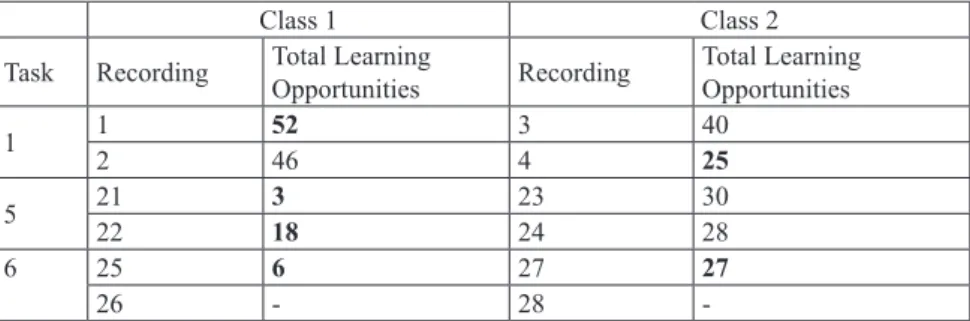
Class 1 Class 2 Task Recording Total Learning
Opportunities Recording
Total Learning Opportunities
1 1 52 3 40
2 46 4 25
5 21 3 23 30
22 18 24 28
6 25 6 27 27
26 - 28
-TABLE 1 Quantitative Analysis of number of Learning Opportunities by Class, Recording and Task for tasks 1, 5 and 6.
In an effort to gain a better understanding of the reasons for these discrepancies, transcripts of interactions were further analysed qualitatively to determine if the social context was a factor contributing to differing results, and the results for tasks 1 and 5 are further discussed below. Excerpt 5 shows Students I, K and M in recording 1, task 1, the error correction task, correcting the sentence, We didn’t
knew that the train was late.
(5) → → → → → → → → → → → → 55 56 57 58 59 60 61 62 63 64 65 66 67 68 69 70 71 72 K M K I K M K I K M K M K M K M I M
we didn’t knew, (.) that the train was late. ºokº.
the mi:stake here (.) is (1) two past. didn’t, and knew! ºknewº
>we didn’t know<. (5) sorry say that
i think we have [two of the time past.] [ººin the , theºº] yes! we have ( ) .
knew in the present
you alr…you still have the past in didn’t so it’s correct.
knew is (1) is not correct (2) ah ok
we didn’t know. it’s in the present . that the train [was late.] [ºokº]
On line 57, Student K defines the problem and resolves it on line 59. On line 60, Student M asks for clarification and on lines 61 and 65, Student K assumes
position as a language expert by providing an explanation of her correction. On line 66, Student M misunderstands, but this is resolved on lines 67 and 69, when
Student K clarifies the correction. Student M signals her understanding on line
sequence, Student K assumes the role of language expert and establishes a joint understanding of the problem. By asking and answering, explaining and involving all the interactants in decisions, she and the others encourage a positive social dimension during the course of the task and create more learning opportunities than other groups. In contrast, excerpt 6 shows how four learners, while taking part in the same task (recording 4), fail to consult each other on decisions or provide explanations. (6) → → → → 85 86 87 88 89 90 91 92 93 94 95 96 97 98 99 100 101 102 103 N&H H E O N E H&N E H N E H E N H E H E N
we didn’t knew that the
train was late. (( read from the tasksheet)) <ºwe didn’t knewº >
ºdoesn’tº we didn’t KNOW
>yes (.) we didn’t know. yes (.) it’s correct< we didn’t know,
mmm’
kno:w (.) we didn’t know [º when we write ( )º] [no it’s correct.] (2) his life
his life use to be (1) simpler (( reads from tasksheet)) use:d use:d
ºhis lifeº use:d use:d to be used
>used to be simpler. < mmhmm’
On line 88 Student O suggests doesn’t as a way of correcting this sentence. This is Student O’s only participation in this sequence. Here his suggestion is ignored and his opinion is not sought in the resolution of these two problem sentences. On line 89, Student N suggests didn’t know, and this is accepted unconditionally by Students H and E on lines 90 and 91. No explanation is offered and none is sought. The same happens with the next sentence, His life use to be simpler. On line 97, Student E suggests substituting use for used which is accepted by the others although once more Student O is not consulted. Further consideration of the discourse of this group shows that on three separate occasions decisions are made on corrections without the consensus of all group members and no attempt is made to explain decisions. This lack of interest in the opinions of peers could explain the lower level of peer correction in this task and ultimately leads to this task being less successful in terms of the creation of learning opportunities.
correction and discussion task. In excerpt 7, it can be seen how Students P and Q, both students in class 1, fail to engage in interactional work to complete the error correction task. There is no metalanguage, no explaining, no collective scaffolding, and a lack of engagement on the part of the learners with the task. On line 1, Student P reads the sentence for correction thereby positioning herself as the task manager,
and affirms that she thinks the sentence is correct. This is followed immediately
by Student Q, who agrees on line 3, but fails to expand her turn to elaborate why. This is followed by both Students P and Q again agreeing on lines 4 and 5, but again with no further expansion on the part of either. On lines 6 to 24, the learners take turns to read the sentences. The only other language Student P produces is
Yes (lines 10, 15 and 20), I think yes, and Yes OK (lines 17 and 24), It’s correct and Now question on lines 17 and 24 respectively. Similarly, apart from repetition of the sentences for correction, Student Q’s only expansion is limited to, And this part is correct (line 11), and she fails to comment on the correction of the 3rd, 4th
and 5th sentences. Neither learner comments on the opinions of their partner nor
expands on their reasons for corrections. There is a noticeable lack of continuers or other signs of phatic communication. There is no real engagement with each other or the task and a total lack of any social dimension in the interaction, and this has negative consequences for the number of learning opportunities.
(7) → → → → → → → → → → → → 1 2 3 4 5 6 7 8 9 10 11 12 13 14 15 16 17 18 19 20 21 22 23 24 P Q P Q P Q P Q P Q P Q P Q P Q P
ºthe first one I think it’s correct’º if you won a lot of money (.) you would move house.
yes
i think it’s correct. (.) ºº correct. okºº
second one, (.) what’ would you do, if you didn’t like the food your friend (.) cooked for you. ((reads question)) would. what
would you do what would would. (.) yes.
you do (.) and this part is correct (.) the food your friend cooked
<yo:ur frie:nd> yes.
yes. (1) ºº<what country would you vi:sit (1) if you co:uld>ºº ººtravelºº (5) ºº<if you could travel>ºº
(3) ººif you could travelºº (3) i think yes. (1) it’s correct (5) ººif you needed to borrow some money (.) who would you askºº
(2) yes
(4) if your friend have a (.) a [horrible haircut]
In contrast, excerpt 8 shows how Students R and S take 27 turns to discuss the
first sentence and they continue in this way during the rest of the task.
(8) → → → → → → → → → → → 1 2 3 4 5 6 7 8 9 10 11 12 13 14 15 16 17 18 19 20 21 22 23 24 25 26 27 R S R S R S R S R S R S R S R S R S R S R S
so (2) if you won a lot (.) a lot of money’ (1) you would move house? i think this is incorrect?
why?
<because (.) when you do: the question you put would first> would you
why not (.) is a conditional (.) is a conditional
yes it’s a conditional. (.) but when you make a (.) a question I think it’s
[yeah this is a]
[would you] move house
it’s (.) i think it’s correct. you put(.) > if you won if you won
is past simple yes it’s correct ’ a lot of money’ yes’
you would move?<
no would! you move house.(.) would you? (2) ah question ( you’re correct ) if you put this
if you won if you won a lot of money’ (.) would you move house’ yes.
because if (1) if you put this (3) backwards ok
you didn’t said would you ah(.) you would move house if you won a lot of money?
ok I’m understanding
On line 3 Student S raises a doubt rather than accepting Student R’s assertion
that the first sentence is incorrect. In this way he is questioning her position as
language expert. He continues to challenge her expertise on lines 6, 11, 13, and 17. On line 18, Student R asserts her authority by repeating the corrected sentence with special emphasis on the word would. Student S then pauses for 2 seconds, possible thinking time, before he accepts the correction on line 19 using the discourse marker Ah which may reflect a change of state for the speaker and an observable
4 - Conclusion
This study responded to calls made for research to take the classroom context more seriously (Batstone 2012; Philp, Walter & Basturkmen 2010), as it is only through classroom based research that we can better understand what factors contribute to learning in the context in which many students study. Equally it
responded to calls made for investigation of how social factors can influence not
just interaction, but also learning (Batstone 2012; Mondada & Pekarek Doehler 2004; Philp & Mackey 2010). Furthermore, the study gave insight into the impact of the social context in TBL, an area which is often ignored, as task based learning is more frequently studied within a cognitive framework (Batstone 2012: 459).
4.1- Research Question 1
Research question 1 addressed how learning opportunities were created during peer to peer oral interaction from a sociocognitive viewpoint in the TBL classroom. Results showed that learners were able to give and receive assistance, even in the absence of a communication breakdown. Through scaffolding, learners provided explanations and translations, asked and answered questions, tested out hypotheses and co-constructed utterances, thereby providing learning
opportunities. In this way, peers benefited as they worked towards independent performance. Results here confirm and add to the work of Foster and Ohta (2005)
who similarly described examples of learning opportunities in peer interaction.
4.2 - Research Question 2
Research question 2 asked whether the social dimension influenced the creation
of learning opportunities from a sociocognitive viewpoint in the TBL classroom. Here qualitative analysis gave an insight into how the social dimension of the
group could influence the number of learning opportunities created in small group
interaction. Results showed that while some learners engaged with each other and the task, scaffolding each other and creating numerous opportunities for learning, the interaction of others was characterised by a lack of phatic communication which was indicative of a lack of a positive affective climate between these interactants, and this led to the provision of fewer learning opportunities. These
results corroborate the findings of Hellerman and Pekarek Doehler (2010: 27)
who also showed that peer interaction allowed for different learning opportunities even when learners engaged in the same or similar tasks. This work has served to illustrate the situated nature of language learning where factors such as how individuals interact with other learners and the task, and how talk in interaction is organised change moment-by-moment, as learners react to local contingencies. This supports the claim that language learning is a complex dynamic system and
4.3 - Pedagogical implications
The language learning classroom is different to other classrooms students may experience, in that it is social in nature. Within a sociocognitive framework, learning takes place in a social context through interaction with others, and these interactions can foster a sense of belonging, or can alienate. They can encourage
or discourage positive attributions, and as this study has shown, they can influence
how effective language learning is, especially in the task based learning classroom where oral interaction with a peer forms the basis of classroom activity. For this reason teachers should be aware of which learners work best together and be prepared to adjust group composition if the desired outcome is not achieved. Clearly students’ personalities contribute to the relationships they form in class and determine how assertive, motivated and willing to communicate they are with
others. Students often sit with friends and these pairings can often be beneficial
although some research has shown that learners are less likely to correct friends in task-based peer work for fear that their partner would see this as social positioning (Philp et al. 2010).
This study has shown that groups which create the most learning opportunities are those where the individual members scaffold each other’s learning by asking and answering questions, explaining and co-constructing discourse. It is suggested that learners be made aware of these behaviours, which could be conceptualised as goals to achieve during peer interaction, thereby serving as an increased motivational factor.
4.4 - Areas for future study
Further research could profitably focus on the use of stimulated recall
techniques to give a more comprehensive view of classroom discourse and learners’ thoughts and feelings. Another possible future area of research could be an emic perspective of the learning opportunities afforded by different task types. Lastly, as the constitution of the groups which engage in peer interaction is important for the pedagogical success of oral tasks, more research should be carried out on the most effective ways to group students for these tasks.
_________________
Recebido em dezembro de 2017; aceite em março de 2017.
References
Batstone, R. 2010. Issues and options in sociocognition. In: R. Batstone (Ed.).
Sociocognitive perspectives on language use and language learning. Oxford: Oxford University Press, 3-23.
Batstone, R. 2012. Language form, task-based language teaching, and the classroom context. ELT Journal. 66: 459-467.
Crabbe, D. 2003. The quality of language learning opportunities. TESOL
Quarterly. 37: 9-34.
Cunningham, S.; Moor, P. 2005. New cutting edge intermediate. Harlow: Longman.
Donato, R. 1994. Collective scaffolding in second language learning. In: J. Lantolf; G. Appel (Eds.). Vygotskian approaches to second language research.
Norwood, NJ: Ablex, 33-56.
Ellis, N. 2007. Dynamic systems and SLA: The wood and the trees.
Bilingualism: Language and Cognition. 10: 23-25.
Ellis, R. 2003. Task Based Language Learning and Teaching. Oxford: Oxford University Press.
Firth, A.; Wagner, J. 1997. On discourse, communication, and (some) fundamental concepts in SLA research. The Modern Language Journal. 81: 285-300.
Firth, A.; Wagner, J. 2007. Second/foreign language learning as a social accomplishment: Elaborations on a reconceptualized SLA. The Modern Language Journal. 91: 800-819.
Foster, P.; Ohta, A.S. 2005. Negotiation for meaning and peer assistance in second language classrooms. Applied Linguistics. 26: 402-430.
Hellerman J.; Pekarek Doehler, S. 2010. On the contingent nature of language learning tasks. Classroom Discourse. 1: 25-45.
Krashen, S. 1982. Principles and practice in second language acquisition. Oxford: Pergamon.
Lantolf, J.P. 2000. Second language learning as a mediated process. Language Teaching. 33:79-96.
Leaver, B. L.; Willis, J. 2004. Task-Based Instruction in Foreign Language Education. Georgetown: Georgetown University Press.
Long, M.H. 1996. The role of the linguistic environment in second language acquisition. In: W. C. Ritchie; T. K. Bhatia (Eds.). Handbook of second language
acquisition. San Diego, CA: Academic Press, 413-468.
Mackey, A. 2012. Input, interaction, and corrective feedback in L2 learning. Oxford: Oxford University Press.
Mitchell, R.; Myles, F. 2004. Second language learning theories, 2nd edn.
London: Hodder Arnold.
Mondada, L.; Pekarek Doehler, S. 2004. Second language acquisition as situated practice: Task accomplishment in the French second language classroom.
The Modern Language Journal. 88: 501-518.
Ohta, A. S. 2001. Second language acquisition processes in the classroom: Learning Japanese. Mahwah, NJ: Lawrence Erlbaum.
Philp, J.; Mackey A. 2010. Interactional research. In: R. Batstone (Ed.).
Sociocognitive Perspectives on Language Use and Language Learning. Oxford: Oxford University Press, 201-227.
Philp, J.; Walter, S.; Basturkmen, H. 2010. Peer interaction in the foreign language classroom: what factors foster a focus on form? Language Awareness. 19: 261-279.
Richards, J.; Rodgers, T. 2001. Approaches and methods in language teaching.
Cambridge: Cambridge University Press.
Schmidt, R. 1994. Deconstructing consciousness in search of useful definitions
for applied linguistics. AILA Review.11: 11-26.
Seedhouse, P. 2004. The Interactional Architecture of the Language Classroom:
A Conversation Analysis Perspective. Oxford: Blackwell.
Swain, M. 1995. Three Functions of Output in Second Language Learning. In: G. Cook; B. Siedlhofer (Eds.). Principle and Practice in Applied Linguistics:
Studies in Honour of H.G. Widdowson. Oxford: Oxford University Press, 125-144. Swain, M. 2010. ‘Talking-it-through’: Languaging as a Source of Learning. In: R. Batstone (Ed.). Sociocognitive Perspectives on Language Use and Language Learning. Oxford: Oxford University Press,112- 130.
Swain, M.; Lapkin, S. 1998. Interaction and second language learning: Two adolescent French immersion students working together.The Modern Language Journal. 82: 320-337.
Tarone, E. 2008. A Sociolinguistic Perspective in Interaction in SLA. In: A. Mackey; C. Polio (Eds.). Multiple Perspectives on Interaction: Second Language Research in Honor of Susan M. Gass. New York: Routledge, 41-56.
Tarone, E. 2010. Social Context and Cognition in SLA: A Variationist Perspective. In: R. Batstone (Ed.). Sociocognitive Perspectives on Language Use and Language Learning. Oxford: Oxford: University Press, 54-72.
Tarone, E.; Liu, G. 1995. Situational Context, Variation and Second Language Acquisition Theory. In: G. Cook; B. Siedlhofer (Eds.). Principle and Practice
Vygotsky, L. 1987. The Collected Works of L.S. Vygotsky: Volume 1. Thinking
and Speaking. New York: Plenum Press.
Walsh, S. 2011. Exploring Classroom Discourse. Language in Action. Abington: Routledge.
Appendix A. Transcription Conventions
: (.) (3.2) word !
CAPITALS ° ° °° °° < > > < ( ) →
sim ((tr.: yes)) T: L1: L: [ [[
(( )) [ finished] ? , . ↑ ↓
Elongation of a syllable Brief untimed pause
Interval between utterances (in seconds) Speaker emphasis
Animated or emphatic tone
Loud sound relative to surrounding talk
Utterances which are noticeably quieter than surrounding talk Whispered utterances
Talk produced slowly and deliberately
Talk produced more quickly than surrounding talk
Unclear or unintelligible speech or attempt to transcribe such speech
A feature of special interest
Non-English words are written in italics and followed by English translation in double brackets
Teacher
Unidentified learner
Several or all learners simultaneously
Indicates overlap with portion in the next turn that is similarly bracketed Indicates overlap with portion in the next turn that is similarly bracketed when the single bracket is used in the previous line and or turn so there will be no confusion regarding what brackets correspond to.
Comments
An approximation of the right sound in the case of inaccurate pronunciation Rising intonation
Slight rise in intonation Falling intonation
Appendix B. Examples of learning behaviours in the interaction
Learning Behaviours Description/Example
Languaging Talking through what is cognitively challenging for the speaker.
Private Speech Self-addressed language produced either when the learner is alone or in the presence of others
Peer Correction Explicit correction or implicit correction through recasts Self-repair Learners self-initiated correction
Co-construction ‘[…] they played with the some, not the calf skin but the, ‘ Oh, leather’
‘The leather, yes […]’
Using metalanguage ‘[…] por acaso não punha o ((tra.: in fact I wouldn’t put the )) past perfect’
Asking others (students and teacher)
‘By a Scottish. How do I write?’ ‘Mary, we have a doubt’
Explaining (students) ‘So if you won a lot of money you would move house? I think this is incorrect […] because when you do the question you put would first, would you.’
Translation ‘Learning it’s aprender ’ Testing
hypotheses/suggesting
‘Can be I have met?’
‘No, é só (tra.: no it’s only) I met’
Use of coursebooks/notes ‘Interesting in, was one of the workbook exercises, interesting in, page 35’
Overhearing Overhearing the interaction of others Individual struggling with
language