Investigation of a Measles Outbreak in China
to Identify Gaps in Vaccination Coverage,
Routes of Transmission, and Interventions
Xiang Zheng1,2,3☯, Ningjing Zhang4☯, Xiaoshu Zhang4, Lixin Hao1, Qiru Su1, Haijun Wang5, Kongyan Meng6, Binglin Zhang4, Jianfeng Liu4, Huaqing Wang1, Huiming Luo1, Li Li1, Hui Li4*, Chao Ma1*
1National Immunization Program, Chinese Center for Disease Control and Prevention, Beijing, China, 2Chinese Field Epidemiology Training Program, Chinese Center for Disease Control and Prevention, Beijing, China,3Taizhou Prefecture Center for Disease Control and Prevention, Taizhou Prefecture, Zhejiang Province, China,4Gansu Provincial Center for Disease Control and Prevention, Lanzhou, Gansu province, China,5Longnan Prefecture Center for Disease Control and Prevention, Longnan Prefecture, Gansu Province, China,6Wudu County Center for Disease Control and Prevention, Longnan Prefecture, Gansu Province, China
☯These authors contributed equally to this work. *[email protected](HL);[email protected](CM)
Abstract
Background
A measles outbreak occurred in a western county of China in 2013, the year after China’s historic nadir of measles. We conducted a field investigation to identify gaps in measles vac-cination coverage and immunization program weaknesses, and to provide recommenda-tions for measles outbreak response and immunization program improvement.
Methods
We analyzed surveillance data from 2008 to 2013 to describe the measles epidemiology of the county. Measles-containing vaccine coverage was estimated using two methods: previously-reported administrative coverage and an estimation of coverage by clinic-kept vaccination records (n = 542). We conducted a rapid field coverage assessment in a migrant population village to evaluate coverage after emergency vaccination. We con-ducted a review of hospital records of measles cases to address the role hospital transmis-sion played during the early stage of this outbreak.
Results
There were 153 cases in the outbreak, primarily among children too young to vaccinate, unvaccinated children less than 3 years old, and adults. Measles-containing vaccine cover-age by the field assessment showed that 20% of children cover-aged 8–17 months had zero doses, and 9% of2 years old children had fewer than two doses. The vaccination statuses of all adult cases were either zero doses or unknown. At least 61% of cases had been
OPEN ACCESS
Citation:Zheng X, Zhang N, Zhang X, Hao L, Su Q, Wang H, et al. (2015) Investigation of a Measles Outbreak in China to Identify Gaps in Vaccination Coverage, Routes of Transmission, and Interventions. PLoS ONE 10(7): e0133983. doi:10.1371/journal.pone.0133983
Editor:Yang Yang, University of Florida, UNITED STATES
Received:September 14, 2014
Accepted:July 4, 2015
Published:July 24, 2015
Copyright:© 2015 Zheng et al. This is an open access article distributed under the terms of the
Creative Commons Attribution License, which permits unrestricted use, distribution, and reproduction in any medium, provided the original author and source are credited.
Data Availability Statement:Relevant data are within the paper and its Supporting Information files.
hospitalized. The proportion of cases who had been hospital-exposed 7 to 21 days prior to rash onset decreased from 52% to 22% after hospitals strengthen their isolation measures.
Conclusions
This outbreak was a result of measles vaccination coverage gaps among young children and adults, and insufficient hospital isolation of cases. The lower coverage seen in the field estimation compared with reported coverage showed that reported coverage could have been overestimated. Hospitals were sites of transmission in the early stage of the outbreak. A strict hospital isolation policy could decrease spread of measles. Emergency vaccination was associated with stopping measles transmission in low coverage areas.
Introduction
Measles is a highly contagious infectious disease that can be eliminated by immunization pro-gram strategies that are guided by laboratory-supported surveillance. China has been imple-menting a routine, two-dose schedule of measles containing vaccine (MCV), with one dose of measles and rubella vaccine given at 8 months of age, and one dose of measles, rubella, and mumps vaccine given between 18 months and 24 months of age [1]. As China works toward the elimination of measles, outbreaks of the indigenous measles genotype still occur. These out-breaks offer opportunities to identify program weaknesses that can be improved and provide opportunities to evaluate outbreak response efforts.
In March 2013, a measles outbreak occurred in Wudu County (W county) in western Chi-na’s Gansu province. During May 3rdto 8th, the National Immunization Program of the Chi-nese Center for Disease Control and Prevention (China CDC) was asked by Gansu province CDC to support their ongoing investigation and response to this outbreak. We report the results of our efforts to identify causes of this outbreak and key strategies for emergency response.
Methods
Setting
W county has 560 thousand residents and a population density of 124 people per square kilo-meter. Routine immunization services are offered at no charge to parents. Each of the 36 town-ships in W county has one large clinic that provides vaccination services. Data from China’s National Notifiable Disease Reporting System (NNDRS) showed that in 2008 the county had a peak measles incidence of 68.5 cases per 100,000 population. The age distribution of cases in 2008 was: 12% were less than 8 months old; 10% were between 8 months and 17 months old; 15% were between 18 months and 3 years old; 35% were between 4 years and 17 years old; and 28% were over 17 years of age.
Between 2008 and 2012, W county reported 2-dose, routine MCV administrative coverage to be greater than 95% each year. Since 2008, W county has performed four rounds of supple-mentary measles immunization activities (SIA) in addition to the 2-dose routine immunization policy (Table 1). Reported administrative coverage for each SIA was greater than 95%, which is similar to reported coverage from SIAs elsewhere of China [2–4].
Case data collection
We analyzed NNDRS measles surveillance data from Jan 1stto the end of July 2013 to deter-mine the basic epidemiology of the outbreak. According to the Chinese National Measles Sur-veillance guidelines [5], measles is required to be reported to China’s Internet-based NNDRS, and county CDC staffs are responsible for infectious disease case investigations and collection and transportation of blood specimens. A suspected case was defined as a person presenting with fever, rash, and one or more of cough, coryza, or conjunctivitis; a laboratory-confirmed case was a suspected case with a positive measles IgM antibody test or measles virus isolation result; and a clinically-diagnosed case was a suspected case without positive laboratory evi-dence of infection, but with either epidemiological linkage to a laboratory-confirmed case or without a clear diagnosis other than measles. In this study, we analyzed data from laboratory-confirmed and clinically-diagnosed measles cases. Consistent with Chinese National Measles Surveillance guidelines, we defined the incubation period of measles as 7–21 days before the rash onset date. Hospital-exposed means a person who had visited any hospital at least once, regardless of the reason for the visit.
The measles vaccination history for each case was determined through record review, and was categorized into one of five types when reported to NNDRS: zero doses, one dose, two doses or more, unknown, and missing dose information. For our analyses, we combined unknown and missing into a single category. All data were analyzed with the use of Microsoft Office Excel 2010 software.
Identifying coverage gaps
In addition to examining reported administrative MCV coverage from routine immunization, SIAs, and screening and vaccination activities (SVA), we estimated clinic-based MCV coverage by review of clinic-kept vaccination records. Reported administrative MCV coverage had been determined by dividing the number of clinic-administered doses by the number of children registered in the clinic.
SIAs and SVAs were organized by the county government and conducted by the clinics. SIA coverage was determined by dividing the number of clinic-administered doses, regardless of individual’s MCV history, by the size of the clinic-reported target population of each SIA. SVA coverage was determined by dividing the number of clinic-administered doses by the size of the clinic-reported target population who had not yet received the full MCV regimen for their age group (8 months to 17 months of age children should have received one MCV dose and children over 18 months of age should have received 2 doses). The clinic-reported target popu-lations included both locally-registered children and non-locally-registered children.
Table 1. Supplementary immunization activities (SIAs) and screening-and-vaccination activities (SVA) conducted during 2008–2013, W county,
China.
Time Category Age range No of vaccinated Total Coverage %(95% CI)
2008† SIA 8 months-14 years 87041 90275 96.4 (96.3–96.5)
September 2010‡ SIA 8 months-4 years 27069 27268 99.3 (99.2–99.4)
September 2011 SIA 8 months-14 years 89731 92722 96.8 (96.7–96.9)
March to April 2012 SVA 8 months-6 years 5737 5800 98.9 (98.6–99.2)
March 2013 SIA 8 months-4 years 33852 34984 96.8 (96.6–96.9)
†An SIA conducted after the Wen-chuan great earthquake.
‡As part of China’s nation-wide SIA in 2010
Individuals with contraindications to measles vaccine at the time of vaccination were excluded from the denominator. The county government requested that clinics find and record informa-tion on all children living in their jurisdicinforma-tion.
We reviewed vaccination records of children born between Jan 1, 2008 and July 15, 2012 from the five clinics of five townships (there is only one vaccination clinic in every township) with the most measles cases (accounting for 36% of all cases reported before review) in order to estimate measles vaccination coverage and on-time vaccination in these townships. We tran-scribed records from a random sample of 20 to 25 children per birth cohort per township clinic, for a total of 542 children.
Review of hospital records of measles cases
By analyzing surveillance data from when the first cases were reported until the end of April, we found that approximately 53% cases had been hospital-exposed during their incubation periods. We conducted a review of hospital records of all measles cases reported by any of 3 hospitals reporting the most cases in this outbreak. An attempt was made to identify all admis-sion and discharge dates from these cases between February 1 and May 5.
Rapid field coverage assessment
We found a clustering of cases in a suburban village in which many migrant families from dif-ferent townships lived. We conducted a rapid coverage assessment targeting children aged 8 months to 14 years of age using house-to-house visits in the morning, before the start of school. We divided investigators into two groups, each led by an EPI officer, and walked in an opposite directions to identify for 20 children for each group. Once an age-eligible child was found, we asked parents for the child’s vaccination certificates. We found 39 children, but 4 parents of 4 children had left vaccination certificates in their hometowns, leaving a total of 35 records avail-able for review.
Ethical considerations
This study did not involve endangered or protected species, and no human subjects were obtained. Administrative (doses administered) data, coverage survey data, and vaccination record review data that were collected as part of a vaccine preventable disease outbreak investi-gation are considered by China CDC’s Ethical Review Committee to be exempt from IRB review. Therefore, informed consent was not obtained for accessing administrative, survey, and immunization clinic record data. Individual identifying data were not retained in analytic data sets.
Results
Outbreak profile
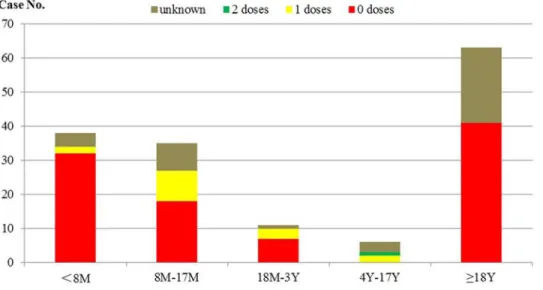
7% were between 18 months and 3 years old; 4% were between 4 years and 17 years; and 41% were more than 17 years old. Among all of the cases aged more than 7 months, 13% had received at least one MCV dose. Among cases between 8 months and 17 months old, 26% had received one MCV dose. Among the 63 adults, the vaccination status was either 0 doses or unknown (Fig 2).
Estimation of clinic MCV coverage
The clinic record review showed that 20% of children, aged 8 months to 17 months, had zero MCV doses; 39% children aged between 18 months and 23 months had one MCV dose or no dose; 91% of children24 months of age had at least two doses [Table 2]; 56% of children had received their first MCV dose (MCV1) at 8 months of age[Table 3]; 62% of children had received their second MCV dose (MCV2) at 18–24 months of age; and 15% of children had received their second dose between 9–17 months of age [Table 4].
Fig 1. Time distribution of measles cases by illness onset date, categorized by hospital exposure history.
doi:10.1371/journal.pone.0133983.g001
Fig 2. Distribution of MCV vaccination status among different age groups.
Hospitalization information of measles cases
The field review showed that among the 94 cases hospitalized (61% of the total), 52 had been hospitalized after the onset of measles, and 42 had been hospital-exposed during their measles incubation period. There were 25 cases whose illness onset dates were before April; 13 of these 25 cases (52%) had been hospital-exposed during their incubation period; 10 of the 13 cases (77%) were less than one year old (Fig 3). All of the 13 cases had been hospital-exposed before or after 4 days of their rash onset. The sources of infections could not be identified. Age strati-fied data showed that 35% of cases (54/153) had been hospital-exposed during their incubation period and 44% of cases (20/45) were between 8 months and 2 years old.
Transmission linked to hospitalized cases from a migrant village
There were 11 cases that resided in and around a densely populated village located in a suburb of W County. In this village, approximately 60% of residents are from other townships. This village does not offer routine immunization services to children who are not registered in the village due to limited public health resources. Nine out of the 11 cases in this village were among migrant people, but only one case had a vaccination record. We were able to contact 6 cases, and among these, 3 had been exposed to an index case who had been hospitalized for treatment but who returned to the village while still ill, and 2 had been hospitalized between 1 and 3 weeks prior to their rash onset.
Table 2. MCV coverage assessment of different age groups*.
Age range 0 dose 1 dose 2 doses
No. Percentage (95% CI) No. Percentage (95% CI) No. Percentage (95% CI)
8–17 months 22 19.6 (12.7–28.2) 62 55.4 (45.7–64.8) 28 25.0 (17.3–34.1)
18–23 months 2 3.5 (0.4–12.1) 20 35.1 (22.9–48.9) 35 61.4 (47.6–74)
24 months 7 1.9 (0.8–3.8) 25 6.7 (4.4–9.7) 341 91.4 (88.1–94.1)
sum 31 5.7 (3.9–8) 107 19.7 (16.5–23.3) 404 74.5 (70.7–78.2)
*The MCV doses include both routine immunization doses and SIA/SVA doses.
doi:10.1371/journal.pone.0133983.t002
Table 3. Distribution of MCV1 vaccination month
Vaccination month Number of records %
8 320 59.0
9 85 15.7
10 32 5.9
11 29 5.4
12 11 2.0
13 7 1.3
14 2 0.4
15 3 0.6
16 3 0.6
17 3 0.6
18 16 3.0
unvaccinated 31 5.7
Total 542 100
Emergency public health responses
The local government took several measures in response to the outbreak. Starting March 28th, the local hospitals implemented strict isolation measures, including using set-aside rooms to receive suspected measles cases, and widespread distribution of masks for respiratory precau-tions. Surveillance was intensified, as the government implemented a daily reporting system for all health care institutions to detect and confirm suspected cases as soon as possible. Close contacts were notified to monitor their temperature for 21 days after their last contact with a measles case, and to report to community doctors if fever or rash appeared.
On April 12th, a countywide emergency MCV vaccination campaign was initiated. The cam-paign included screening and vaccination activities in some townships and unselective SIAs in other townships. The target ages included children 8 months to 14 years of age. Each township conducted their campaign before April 25th. A rapid, countywide coverage assessment was conducted from April 26thto 28th.
Table 4. Distribution of MCV2 vaccination month.
Vaccination month Number of records %
9–17 62 14.8
18 94 22.5
19 58 13.9
20 30 7.2
21 28 6.7
22 21 5.0
23 21 5.0
24 9 2.2
25months 53 12.7
unvaccinated 42 10.0
Total 418 100
doi:10.1371/journal.pone.0133983.t004
Fig 3. Hospital exposure histories prior to rash onset for 13 cases.
Impact of responses
Between March 17thand March 28th, 52% of cases had been hospital-exposed during their measles incubation period. On March 28th, measures to strengthen isolation in hospitals were implemented. After fourteen days following implementation of isolation measures, the propor-tion of cases that were hospital-exposed during the incubapropor-tion period decreased to 22% (21 hospital-exposed cases / (97 total cases from April 12thand after). Of 46 cases occurring after April, none were hospital-exposed during the incubation period. (Fig 1)
The emergency MCV immunization campaign that started on April 12thvaccinated 40,231 children with single-antigen measles vaccine. The follow-up countywide coverage assessment showed: one-dose MCV coverage of children between 8 months and 18 months was 94.9%; two-dose MCV coverage of children between 18 months and 2 years was 95.9%; and two-dose MCV coverage of children between 18 months and 6 years was 97.6%.
Prior to the April immunization campaign, a rapid coverage assessment conducted by Gansu CDC in the migrant village (mentioned above) showed that 2-dose MCV coverage among children 18 months to 4 years of age was 48% (11/23). After the emergency vaccination campaign, the assessed MCV coverage with one or more doses was 100% among 35 children. Two-dose MCV coverage among children aged 18 months to 4 years increased from 48% of pre-campaign to 87% (13/15). Two-dose MCV vaccination coverage among children aged 18 months to 14 years was 88% (21/24). Eleven percent of children assessed had received their first-ever measles vaccine in this campaign. There were no measles cases reported from this vil-lage after April 22nd.
Discussion
This measles outbreak of 153 cases was primarily among young children and adults, lasted for 10 weeks, and ended after an 8-week response that included enhancing surveillance, assessing coverage, improving hospital measles precautions, and emergency vaccination. Hospitals were shown to be significant points of transmission to a community with a routine immunization program that did not include non-registered children. Our investigation showed differences between official administrative coverage assessments and survey-based coverage assessments, with survey-based coverage being lower.
Interpretation of findings
This outbreak appears to have been triggered by transmission of measles from one or more hospitals to villages with low vaccination coverage. Local hospitals lacked measles isolation measures, likely facilitating transmission. Once the hospitals changed their management of suspected measles cases, fewer children acquired measles in the hospitals.
Nearly one third of cases were among children 8 months to 3 years of age, and the majority of these children had not received measles vaccination. Our coverage assessments showed lower-than-reported coverage and a lack of on-time vaccination, since fewer than 60% of chil-dren received MCV1 during their 8thmonth of life, and only 77% of children received their MCV2 before 24 months of age. Thus, the outbreak happened as susceptibles had accumulated. W county reported that vaccination services for 84% of the county population were provided on fewer than 5 days per month.
following immunization. Although we could not assess coverage of adults, the presence of either-zero-or-unknown vaccination records of adults, coupled with many cases of measles among children too young to vaccinate, raises challenges for China’s elimination of measles.
Delayed vaccinations are not rare in China or other countries. Timely vaccination with high coverage is critically important for measles elimination. Our estimate of coverage during this outbreak was lower than the 95% that had been reported based on administrative data. A field outbreak investigation that was conducted in 2013 in Hunan province of China also reveals a similar discrepancy [7].
Transmission of measles in health care facilities is well-known and has been also reported in many different settings [8–11]. An investigation in the Republic of Korea showed that nosoco-mial transmission appeared to precede community transmission when nosoconosoco-mial and com-munity transmission of measles coexisted in the same outbreak [8]. This phenomenon also was seen in our investigation. It is possible that unidentified measles cases occurred in the commu-nity and in hospitals prior to the onset of the outbreak [8]. Lack of ventilation in some hospitals may facilitate spread of measles virus [12], as can a high density of patients in a crowded healthcare facility [13,14]. Strict isolation procedures were temporally associated with reduced transmission of measles in this outbreak as has been seen in other outbreaks in China [13]. Nosocomial transmission of measles primarily affects children [14,15]. In our investigation, the distribution of cases hospitalized at early stage of the outbreak showed the susceptibility of young children.
The risk brought by low immunization coverage among migrants seen in this investigation has also been seen in other parts of China [2,16,17] and in other developing countries [18– 20]. According to China’s Sixth Population Census in 2010, there were more than 261 million migrants in China, which was an increase of 81% over China’s Fifth Population Census in 2000 [21].
Recommendations
This investigation and response support some recommendations. (1) Health authorities should immediately notify all hospitals in their jurisdiction if measles is identified in their communi-ties so that the hospitals can review and strengthen their measles management and isolation procedures. (2) Measles patients who are able to be cared for and isolated at home or in their community should not be hospitalized. (3) Routine immunization services should be offered to all children living in a community, not just children registered in the community. (4) Vaccina-tion services should be offered frequently enough to provide timely vaccinaVaccina-tion access. (5) Research and evaluation should be conducted to determine how to reduce the incidence of measles among adults. (6) Administrative coverage assessment methods should be augmented with survey-based coverage assessments to identify areas with low vaccination coverage. (7) Well-conducted screening and vaccination activities should be considered as alternatives to nonselective SIAs.
Limitations
various reporting and recording systems (e.g., NNDRS, case investigation forms, and hospital medical records), which may be incomplete. Fifth, coverage levels were used as a proxy for immunity, which can be better assessed with serological surveys.
Conclusions
This outbreak provided an opportunity to study routes of transmission and program weak-nesses in order to not only stop the outbreak, but also to learn lessons that can be valuable in the China immunization program’s effort to eliminate measles. Improving the routine program efforts to measure coverage, include all children in the jurisdiction, conduct effective cam-paigns, and reduce nosocomial measles transmission has implications for other parts of China and other countries.
Supporting Information
S1 Dataset. Dataset of 153 cases.
(XLSX)
Acknowledgments
We thank Dr. Lance Rodewald for his valuable comments and editing the English.
Author Contributions
Conceived and designed the experiments: CM HL XZ NJZ HML XSZ. Performed the experi-ments: CM XZ NJZ BLZ XSZ LXH HJW KYM JFL HQW HL LL. Analyzed the data: XZ CM NJZ HML QRS HJW KYM JFL BLZ. Contributed reagents/materials/analysis tools: HQW LL HL. Wrote the paper: XZ CM NJZ.
References
1. Gao J, Chen EF, Wang ZG, Shen JC, He HQ, Ma HL, et al. Epidemic of measles following the nation-wide mass immunization campaign. BMC Infect Dis. 2013 Mar 18; 13:139. doi: 10.1186/1471-2334-13-139PMID:23506461
2. Hu XJ, Xiao SW, Chen BL, Sa ZH. Gaps in the 2010 measles SIA coverage among migrant children in Beijing: evidence from a parental survey. Vaccine. 2012 Aug 24; 30(39):5721–5. doi:10.1016/j. vaccine.2012.07.007PMID:22819988
3. Shi XJ, Zhou LW, Li HJ. Analysis of supplementary immunization of measles vaccine in Ningxia in 2010. J Modern Prev Med. 2013; 40 (17): 3200–3202.
4. He J, Zeng XX, Mo SX, Sun LY, Chen BY, Li J, et al. Evaluation on supplementary immunization activi-ties of measles attenuated live vaccine in Hainan in 2010. China Tropical Med. 2013; 13(10): 1217–
1219. doi:10.13604/j.cnki.46-1064/r.2013.10.007
5. National Health and Family Planning Commission of the People’s Republic of China. Chinese National Measles Surveillance guidelines. National Health and Family Planning Commission of the People’s Republic of China. 2 Feb 2009. Available:http://www.nhfpc.gov.cn/jkj/s3581/200902/
9ea8e400444c45b0a48e3e55d929c9b5.shtml. Accessed 27 May 2015.
6. Dabral M. Cost-effectiveness of supplementary immunization for measles in India. Indian Pediatr. 2009 Nov; 46(11): 957–62. PMID:19578225
7. Ma C, Li FJ, Zheng X, Zhang H, Duan MJ, Yang YH, et al. Measles vaccine coverage estimates in an outbreak three years after the nation-wide campaign in China: implications for measles elimination, 2013. BMC Infect Dis. 2015 Jan 22; 15(1):23. doi:10.1186/s12879-015-0752-z
8. Choi WS, Sniadack DH, Jee Y, Go UY, So JS, Cho H, et al. Outbreak of measles in the Republic of Korea, 2007: importance of nosocomial transmission. J Infect Dis. 2011 Jul; 204 Suppl 1:S483–90. doi:10.1093/infdis/jir087PMID:21666204
10. Kelly HA, Riddell MA, Andrews RM. Measles transmission in healthcare settings in Australia. Med J Aust. 2002 Jan 21; 176(2): 50–1. PMID:11936282
11. Rivera ME, Mason WH, Ross LA, Wright HT Jr. Nosocomial measles infection in a pediatric hospital during a community-wide epidemic. J Pediatr. 1991 Aug; 119(2): 183–6. PMID:1861204
12. Weston KM, Dwyer DE, Ratnamohan M, McPhie K, Chan SW, Branley JM, et al. Nosocomial and com-munity transmission of measles virus genotype D8 imported by a returning traveller from Nepal. Com-mun Dis Intell Q Rep. 2006; 30(3): 358–65. PMID:17120490
13. Zhu X, Xie QM, Ren YH, Sun L. Analysis on a measles outbreak caused by hospital exposure. Chin J Vacc Immun. 2008; 14(5):398–402.
14. Xiong CL, Chen C, Shui TJ, Tao YH, Li GJ, Zhou JH, et al. Analysis on Risk Factors for Measles Among 0–3 Years Old in Dehui City. Chin J Vacc Immun. 2006; 12(5):350–352.
15. Biellik RJ, Clements CJ. Strategies for minimizing nosocomial measles transmission. Bull World Health Organ. 1997; 75(4): 367–75. PMID:9342896
16. Sun MP, Ma R, Zeng Y, Luo FJ, Zhang J, Hou WJ. Immunization status and risk factors of migrant chil-dren in densely populated areas of Beijing, China. Vaccine. 2010 Feb 3; 28(5):1264–74. doi:10.1016/j. vaccine.2009.11.015PMID:19941996
17. Liu DW, Sun MP, Liu WX, Fan CY, Lu L, Liu DL, et al. Comparative study on immunization coverage rates of nine vaccines between local and floating children. Chin J Vaccine Immun. 2007; 13(2):165–9. 18. Canavati S, Plugge E, Suwanjatuporn S, Sombatrungjaroen S, Nosten F. Barriers to immunization
among children of migrant workers from Myanmar living in Tak province, Thailand. Bull World Health Organ. 2011 Jul 1; 89(7):528–31. doi:10.2471/BLT.10.084244PMID:21734767
19. Kusuma YS, Kumari R, Pandav CS, Gupta SK. Migration and immunization: determinants of childhood immunization uptake among socioeconomically disadvantaged migrants in Delhi, India. Trop Med Int Health. 2010 Nov; 15(11):1326–32. doi:10.1111/j.1365-3156.2010.02628.xPMID:20955496
20. Kiros GE, White MJ. Migration, community context, and child immunization in Ethiopia. Soc Sci Med. 2004 Dec; 59(12): 2603–16. PMID:15474213