Structural Variabilities in
β
-Lactamase (blaA)
of Different Biovars of Yersinia enterocolitica:
Implications for
β
-Lactam Antibiotic and
β
-Lactamase Inhibitor Susceptibilities
Neelja Singhal1, Abhishikha Srivastava2, Manish Kumar2, Jugsharan Singh Virdi1*
1Department of Microbiology, University of Delhi South Campus, Benito Juarez Road, New Delhi, India,
2Department of Biophysics, University of Delhi South Campus, Benito Juarez Road, New Delhi, India
Abstract
Yersiniosis caused byYersinia enterocoliticahas been reported from all continents. The bacterial species is divided into more than fifty serovars and six biovarsviz. 1A, 1B, 2, 3, 4 and 5 which differ in geographical distribution, ecological niches and pathogenicity. Most
Y.enterocoliticastrains harbor chromosomal genes for twoβ-lactamases,blaA an Ambler class A penicillinase andblaB an Ambler class C inducible cephalosporinase. In the present study, susceptibility to b-lactam antibiotics andβ-lactamase inhibitor was studied for
Y.enterocoliticastrains of biovars 1A, 1B, 2 and 4. We observed thatβ-lactamases were ex-pressed differentially among strains of different biovars. To understand the molecular mech-anisms underlying such differential expression, the sequences of genes and promoters of
blaA were compared. Also, the variants of blaA present in different biovars were modeled and docked with amoxicillin and clavulanic acid. The mRNA secondary structures of blaA variants were also predictedin-silico. Our findings indicated that neither variations in the pro-moter regions, nor the secondary structures of mRNA contributed to higher/lower expression of blaA in different biovars. Analysis of H-bonding residues of blaA variants with amoxicillin and clavulanic acid revealed that if amino acid residues of aβ-lactamase interacting with amoxicillin and the clavulanic acid were similar, clavulanic acid was effective in engaging the enzyme, accounting for a significant reduction in MIC of amoxicillin-clavulanate. This finding might aid in designing betterβ-lactamase inhibitors with improved efficiencies in future.
Introduction
Yersinia enterocolitica, the causative agent for Yersiniosis has been reported from all conti-nents, but is most common in Europe. It is represented by more than fifty serovars and six bio-varsviz. 1A, 1B, 2, 3, 4 and 5 which differ in their geographical distribution, ecological niche and pathogenic potential [1]. MostY.enterocoliticastrains harbor chromosomal genes for twoβ-lactamases—blaA, a constitutively expressed Ambler class A penicillinase andblaB, an
OPEN ACCESS
Citation:Singhal N, Srivastava A, Kumar M, Virdi JS (2015) Structural Variabilities inβ-Lactamase (blaA) of Different Biovars of Yersinia enterocolitica: Implications forβ-Lactam Antibiotic andβ-Lactamase Inhibitor Susceptibilities. PLoS ONE 10(4): e0123564. doi:10.1371/journal.pone.0123564
Academic Editor:Freddie Salsbury , Jr, Wake Forest University, UNITED STATES
Received:December 17, 2014
Accepted:March 5, 2015
Published:April 28, 2015
Copyright:© 2015 Singhal et al. This is an open access article distributed under the terms of the
Creative Commons Attribution License, which permits unrestricted use, distribution, and reproduction in any medium, provided the original author and source are credited.
Data Availability Statement:All relevant data are within the paper.
Ambler class C inducible cephalosporinase [2]. Resistance inY.enterocoliticaagainst penicillins and cephalosporins is primarily due to blaA which is a constitutively expressed Ambler class-A
β-lactamase [3]. As in other enteric bacteria, resistance toβ-lactams has become common in Y.enterocolitica. A very successful strategy to overcomeβ-lactamase mediated resistance and restore the efficacy ofβ-lactams has been to use inhibitors ofβ-lactamases like clavulanic acid, sulbactam and tazobactam. Inhibitors form stable intermediates withβ-lactamases,‘tying up’ the enzymes, while the partner-lactam inhibited the drug target in the bacterial celli.epenicillin binding proteins. Theβ-lactam antibiotic/inhibitor combination, amoxicillin-clavulanate (AMC) is one of the most commonly used antimicrobials, for which an increase in resistance has been noted in recent years due to the acquisition of point mutations inβ-lactamases [4].
Various factors might lead to differentialβ-lactam antibiotic/inhibitor susceptibility in bac-terial cells, like point mutations in theβ-lactamase gene, modifications in the promoters or reg-ulatory regions of the gene, integration of insertion sequences containing efficient promoters etc. Yi et al. [5] reported that whenBurkholderia thailandensiswas grown in the presence of an-tibiotic, point mutations arose in the coding region ofβ-lactamases followed by mutation in the promoter region. Sarovich et al. [6] identified two single-nucleotide polymorphisms (SNPs)̶one in the coding region near the active site and the other within the promoter region ofβ-lactamase gene (bla) that directly increased ceftazidime hydrolysis byBurkholderia pseudomallei.
The objective of the present study was to understand the molecular bases of differential
β-lactam antibiotic andβ-lactamase inhibitor susceptibility inY.enterocoliticastrains of differ-ent biovars. In pursuance of this, genes, promoters and secondary structures of mRNA ofblaA of different biovars were analyzed. The three dimensional (3D) structures of blaA were mod-eled and docked with amoxicillin (AMX) and clavulanic acid to understand the relationship between amino acid substitutions in binding affinities of blaA forβ-lactam/β-lactamase inhibi-tor. Our findings indicated that variations in the promoter regions and secondary structures of mRNA were not responsible for higher/lower expression of blaA in different biovars. Docking studies revealed that if amino acid residues of aβ-lactamase interacting with amoxicillin and the clavulanic acid were similar, clavulanic acid effectively engaged the enzyme, resulting in a significant reduction in MIC of amoxicillin-clavulanate.
Materials and Methods
Bacterial strains
Four clinical strains ofY.enterocoliticarepresenting biovars 1A, 1B, 2 and 4 were examined. The details of the strainsviz., biotype, serotype, laboratory accession numbers and country of origin are given inTable 1. All strains were maintained on trypticase soy agar at 4°C.
Table 1. MIC ofβ-lactam antibiotics forY.enterocoliticabiovar 1A, 1B, 2 & 4 strains.Strain designation.
n Source (country of origin) Biovar Serotype AMX(mg/L) AMC(mg/L) FOX(mg/L) CPD (mg/L) CTX(mg/L)
Y. e strainC760 Clinical (India) 1A O:6,30 >256(R) >256(R) 4(S) 1(S) 0.064(S)
Y. e strain 8081 Clinical (U.S.A) 1B O:8 48(R) 16(I) 4(S) 4(I) 0.38(S)
Y. e strain W22703 Clinical (Europe) 2 O:9 32(R) 4(S) 1(S) 0.5(S) 0.032(S)
Y. e strain IP26332 Clinical (Europe) 4 O:3 48(R) 6(S) 3(S) 0.75(S) 0.064(S)
AMX, amoxicillin; AMC, co-amoxiclav; FOX, cefoxitin, CPD, cefpodoxime; CTX, cefotaxime Alphabet in parenthesis shows the drug susceptibility, R, resistant; I, intermediate; S, sensitive
doi:10.1371/journal.pone.0123564.t001 and analysis, decision to publish, or preparation of the manuscript.
Determination of the Minimal Inhibitory Concentration (MIC)
MICs of amoxicillin (AMX), amoxicillin-clavulanate (AMX), cefotaxime (CTX), cefoxitin (FOX) and cefpodoxime (CPD) for different strains ofY.enterocoliticawere determined using E-test (bioMerieux Inc., MO, USA). The protocol followed has been described previously [7]. The MICs were interpreted as per the guidelines of Clinical Laboratory Standards Institute [8].
Preparation of genomic DNA
Bacteria were grown overnight in trypticase soy broth at 28°C. One ml of the bacterial culture was centrifuged at 8, 000 rpm for 10 min and the pellet was used for DNA extraction. The total genomic DNA was prepared using DNeasy Tissue kit (Qiagen, Hilden, Germany) according to the manufacturer’s instructions. Purified DNA was eluted in sterile water and quantitated spectrophotometrically at 260 nm.
PCR amplification of complete coding sequence (CCDS) of
bla
A gene
PCR amplification of complete coding sequence (CCDS) ofblaA was carried out using pub-lished primers and protocol described earlier [9] using a My Cycler (Bio-Rad, CA, USA).Selection of blaA of different biovars for homology modeling and
validation of the protein model
The alignment of blaA of different biovars revealed that the amino acid sequence of strains of biovar 2 and 4 were identical. Aminoacid sequence of biovar 1A and biovar 1B strain was dif-ferent from each other and from that of strains of biovars 2 and 4. Therefore, the amino acid se-quence of strain of biovar 1A, biovar 1B and biovars 2 and 4 was selected for modeling and named as blaAx, blaAy and blaAz respectively. Since, the 3D structure of blaA ofY. enterocoli-ticais not known; these were predicted by homology modeling. The pair-wise alignment be-tween the target and template sequences was performed with PDB-BLAST. The 3D structures of blaAx, blaAy and blaAz were built using MODELLER 9.12 (http://salilab.org/modeller/). Of the twenty models built for each of the blaAx, blaAy and blaAz, the 3D model with the lowest modeler objective function was selected. The modeled structures were validated by PRO-CHECK and Verify3D [10–11].
Molecular docking
The modeled structures of blaAx, blaAy and blaAz were docked with AMX, and clavulanic acid to evaluate the effect of amino acid sequence substitutions on their binding affinity to
β-lactam antibiotic AMX andβ-lactamase inhibitor clavulanic acid using AutoDock Vina. The binding poses for each enzyme-ligand were determined and different poses were generated based on the total Dock score. The docking parameters and the procedure have been described previously [6]. Hydrogen bonding and hydrophobic interactions in the enzyme-ligand com-plex were analyzed by PyMOL [12].
Analysis of mRNA secondary structure
PCR amplification of
bla
A gene including the promoter region
PCR amplification of partial CCDS ofblaA gene along with the promoter region was per-formed in a My Cycler Thermal Cycler (Bio-Rad, CA, USA) using primers and protocol de-scribed previously [7]. The gels were stained with ethidium bromide (0.5μg/ml) and visualized under UV transilluminator.
Sequencing of CCDS of
bla
A along with its promoter
PCR amplicons representing CCDS and promoters ofblaA were purified and sequenced fol-lowing the published protocol [7]. The CCDSs ofblaA ofY.enterocoliticawere translated into their corresponding amino acid sequences using the software expasy (www.expasy.org/
translate). The amino acid sequences of blaA were aligned by ClustalΏ. (http://www.ebi.uc.ak/
clustalΏ). Since the initial 30 amino acids are signal sequences which are cleaved before the
mature enzyme is released in the periplasmic space, these were excluded from comparative studies. The promoter regions ofblaA were also aligned and compared by clustalΏ.
Results and Discussion
The E-test showed thatY.enterocoliticastrains, irrespective of the biovar were sensitive to certain cephalosporins such as cefoxitin, cefpodoxime and cefotaxime. However, these were all resistant to AMX, though the level of resistance differed among strains of different biovars (Table 1). The
β-lactamase inhibitor, clavulanic acid reduced the MIC of AMC for biovars 1B, 2 and 4 strains differentially, indicating that blaA was not only heterogeneous, it might also be resistant to in-hibitor, as observed in biovar 1A strain. Earlier studies reported thatY.enterocoliticastrains of bioserovars 2/O: 9 were resistant to both ampicillin and AMX but that of 4/O: 3 and 1B/O:8 though resistant to ampicillin were sensitive to AMX [13]. However, we observed that strain of bioserovar 1B/O: 8 though resistant to AMX showed intermediate susceptibility to AMC, while those of bioserovars 2/O: 9 and 4/O: 3 though resistant to AMX were sensitive to AMC.
The present study aimed at understanding the molecular mechanisms underlying such dif-ferentialβ-lactam antibiotic/inhibitor susceptibilities ofY.enterocoliticabiovars 1A, IB, 2 and 4. To see, if variations in gene sequences ofblaA were responsible for differential antibiotic/inhib-itor susceptibilities, the amino acid sequences of blaA of different biovars were analyzed. The amplification ofblaA gene using published primers [9] gave the desired product of 896 bp in strains of all biovars. The amino acid sequences of blaA of biovars 1A, 1B, 2 & 4 were quite sim-ilar, except for variations in a few amino acids. The sites of variations in blaA of different bio-vars are shown (Fig 1,Table 2). The amino acid sequence analysis revealed that no amino acid substitution was present in the four significant motifs conserved across class Aβ-lactamases. In majority of the amino acid substitutions, the chemical nature of the functional groups of the substituent and the substitute were similar thus, affecting the bulkiness of the side chain of the protein without affecting the enzyme-activity. On the other hand, substitution of certain amino acids like glutamate with alanine and arginine with leucine in biovars 1A and 1B might have af-fected the enzyme activity because the chemical nature of functional groups of the substituent and the substitute were different and the latter lies in the omega-loop region of blaA which constitutes the active site of the enzyme. Similarly, of the three amino acid substitutions ob-served in biovar 1B, only two might affect the enzyme activity due to difference in the chemical nature of the functional group of the substituent and the substitute.
flexibility, thereby affecting substrate binding. Theβ-lactamase ofBurkholderia multivorans (PDB code 3W4Q_A; Uniprot ID A9ANW2) was selected as the template protein for modeling due its high sequence similarity (85%), identity (64%) and low E-value (1e-115). PROCHECK validated the modeled blaA types ofY.enterocoliticashowing approx. 90% of the residues in the
Fig 1. Multiple sequence alignment of the amino acid sequences of blaA fromY.enterocoliticabiovar IA, 1B, 2 and 4 strains. Amino acid substitutions are shown in bold.
doi:10.1371/journal.pone.0123564.g001
Table 2. Aminoacid substitutions in blaA ofY.enterocoliticaof different biovars.
Sr. No. Biovar Amino acid change
Y.enterocolitica1A,1B L31I
2. Y.enterocolitica1A,1B A33G
3. Y.enterocolitica1A,1B V35L
4. Y.enterocolitica1A,1B E41A
5. Y.enterocolitica1A,1B R44H
6. Y.enterocolitica1A,1B N45S
7. Y.enterocolitica1A,1B V52I
8. Y.enterocolitica1A,1B A67G
9. Y.enterocolitica1A,1B R178L
10. Y.enterocolitica1A,1B V214A
11. Y.enterocolitica1A Q69R
12. Y.enterocolitica1A D87G
13. Y.enterocolitica1A I144L
14. Y.enterocolitica1A M195I
15. Y.enterocolitica1A R205H
16. Y.enterocolitica1A A213T
17. Y.enterocolitica1B T57S
18. Y.enterocolitica1B N59A
19. Y.enterocolitica1B H120C
most favored regions and only 1% in the disallowed regions in the Ramachandran contour plot. Verify3D profiles also showed that 90% region of the protein model of each blaA variant scored>0.2 which was highly significant.
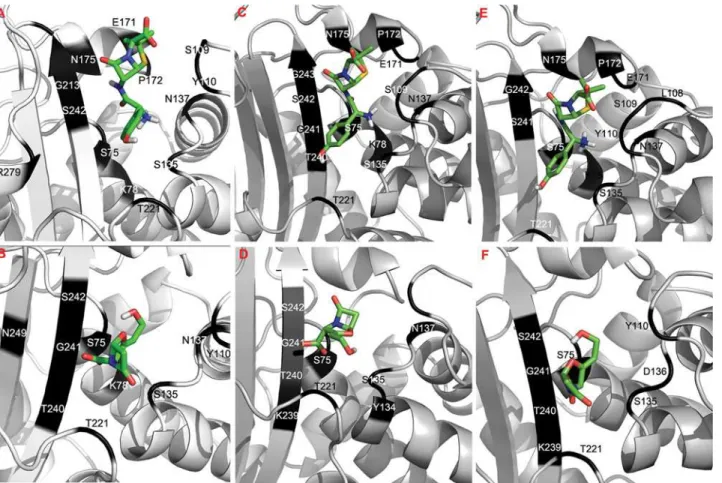
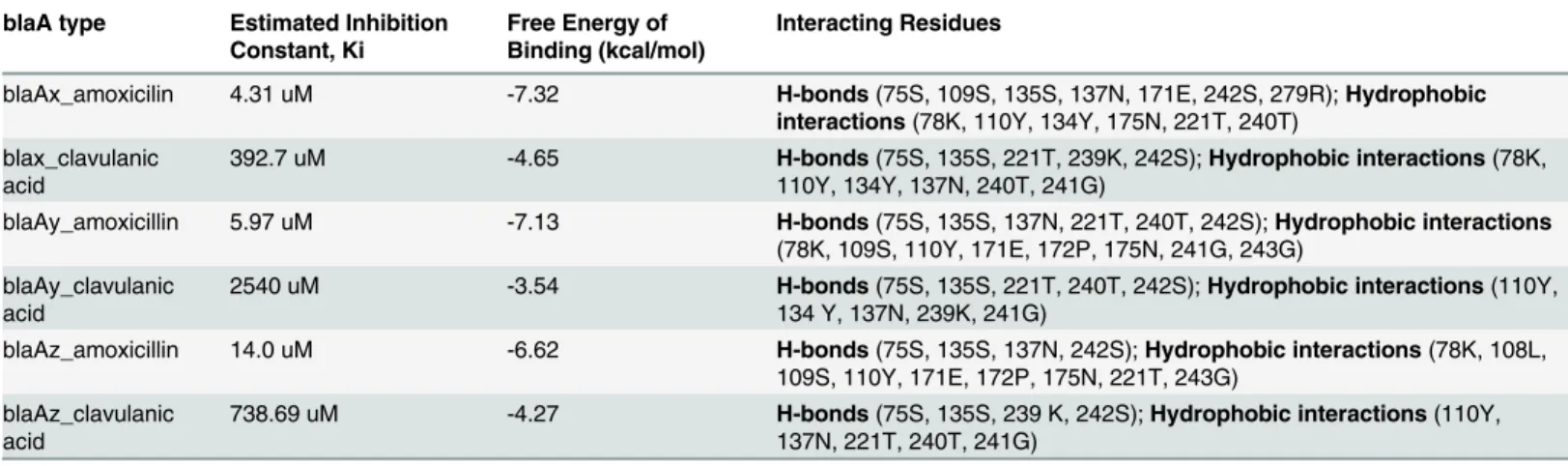
In-silicodocking of the blaA types with amoxicillin and clavulanic acid was carried out. Mo-lecular interactions of the docked complexes of blaAx, blaAy and blaAz with amoxicillin and clavulanic acid are shown inFig 2. The free energy of binding, estimated inhibition constant, hydrogen bond and hydrophobic interaction of amoxicillin and clavulanic acid with the blaA types were analyzed and the details are given inTable 3. The negative low free energy of bind-ing of docked complexes indicated high affinity ofβ-lactamases for both amoxicillin and clavulanic acid. It is well known that the inhibition constant (Ki) which is equivalent to
Mi-chaelis constant (Km) indicates affinity of binding of enzyme-ligand complex. Lower theKi,
higher the affinity ofβ-lactamase for an antibiotic/inhibitor [14]. Based onKi, the blaA types interacted with amoxicillin in the following order: blaAx>blaAy>blaAz, indicating highest
af-finity of blaAx for amoxicillin, and predicting a greater hydrolysis of amoxicillin by blaAx. The number of residues of blaA involved in H-bonding with amoxicillin was in the following order: blaAx>blaAy>blaAz. More the number of residues involved in hydrogen bonding in an
en-zyme-ligand complex, greater is the binding affinity of enzyme for a ligand [15].This predicted highest binding affinity of blaAx for amoxicillin and a greater hydrolysis of amoxicillin by blaAx inY.enterocoliticabiovar 1A. In the present study, we observed that the MIC of amoxi-cillin for different blaA types was in the following order blaAx>blaAy>blaz. Thus,in-silico Fig 2. Molecular docking analysis of the blaA variants ofY.enterocolitica. Molecular interactions of docked blaAx (A & B), blaAy (C & D), blaAz (E & F) with amoxicillin and clavulanic acid respectively.The two antibiotics are represented by stick and the interacting aminoacids are shown in dark color.
analysis predicted as well as explained the highest MIC for AMX as observed in case ofY. enter-ocoliticabiovar 1A.
The number of residues which were involved in H-bond formation with clavulanic acid in different blaA types was in the following order: blaAx = blaAy>blaAz. TheKifor blaA types
and clavulanic acid was in the following order: blaAy>blaAz>blaAx. However, reduction in
MIC brought by the AMX combination was in the order: blaAz>blaAy>blaAx. No co-relation
was observed between theKior the number of H-bonds, and the MIC of different blaA vari-ants. Since the concentration of the inhibitor (clavulanic acid) in each E-test strip was same, the anomalous behavior shown by clavulanic acid might be attributed to the differences in ami-noacid sequence of each blaA type which resulted in a different set of residues participating in H-bonding with amoxicillin/clavulanic acid. When the H-bonding residues of blaAy with amoxicillin and clavulanic acid were compared, it was observed that interacting residues were same. Similarly, it was observed that the residues involved in H-bonding with amoxicillin and clavulanic acid in blaAz were similar, except threonine. However, analysis of interacting amino acids of blaAx showed that except for the catalytic serine at positions 75, 135 and 242, amino acid residues that H-bonded with amoxicillin or clavulanic acid were quite different. This im-plied that clavulanic acid was successful in inhibiting thoseβ-lactamases whose H-bonding res-idues with clavulanic acid and amoxicillin were similar. This probably might have led to an inhibitor-resistant phenotype observed in blaAx ofY.enterocoliticabiovar 1A.
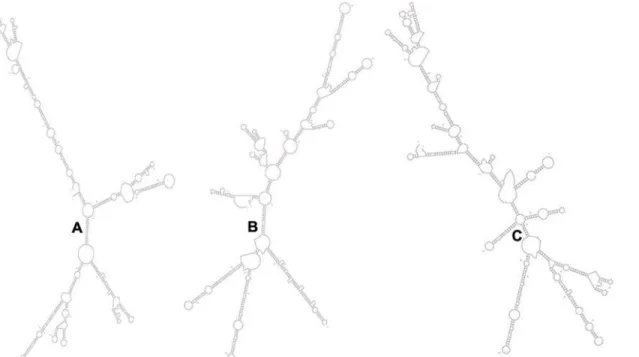
Apart from variations in the amino acids, other confounding factors like secondary structure of mRNA, and/or mutations in the promoters ofblaA genes might also influence antibiotic/ inhibitor susceptibility of blaA types. Therefore the secondary structures of mRNA and promot-er sequences of blaA types wpromot-ere also investigated. The mRNA secondary structure directly af-fects the rate of gene translation, and thus the enzyme activity. The mfold webserver predicted a similar free energy change (ΔG values) and similar mRNA secondary structure for the three blaA types (Fig 3). This implied that the mRNA secondary structure was not responsible for the observed increase in MIC of AMX and/or AMC inY.enterocoliticabiovar 1A. However, intro-duction of mutations that would change the secondary structure of the mRNA molecule are re-quired further to validate this finding.
Mutations and insertions in the promoters ofβ-lactamase genes have also been reported to be associated with differential expression ofβ-lactamases [5]. Thus, the nucleotide sequences of promoters ofblaA of strains of different biovars were analyzed. The sequence of the -10
Table 3. Estimated inhibition constants, free energy of binding, H-bond interactions and hydrophobic interactions between amoxicillin and clavu-lanic acid with blaA types ofY.enterocolitica.
blaA type Estimated Inhibition Constant, Ki
Free Energy of Binding (kcal/mol)
Interacting Residues
blaAx_amoxicilin 4.31 uM -7.32 H-bonds(75S, 109S, 135S, 137N, 171E, 242S, 279R);Hydrophobic interactions(78K, 110Y, 134Y, 175N, 221T, 240T)
blax_clavulanic acid
392.7 uM -4.65 H-bonds(75S, 135S, 221T, 239K, 242S);Hydrophobic interactions(78K, 110Y, 134Y, 137N, 240T, 241G)
blaAy_amoxicillin 5.97 uM -7.13 H-bonds(75S, 135S, 137N, 221T, 240T, 242S);Hydrophobic interactions
(78K, 109S, 110Y, 171E, 172P, 175N, 241G, 243G) blaAy_clavulanic
acid
2540 uM -3.54 H-bonds(75S, 135S, 221T, 240T, 242S);Hydrophobic interactions(110Y, 134 Y, 137N, 239K, 241G)
blaAz_amoxicillin 14.0 uM -6.62 H-bonds(75S, 135S, 137N, 242S);Hydrophobic interactions(78K, 108L, 109S, 110Y, 171E, 172P, 175N, 221T, 243G)
blaAz_clavulanic acid
738.69 uM -4.27 H-bonds(75S, 135S, 239 K, 242S);Hydrophobic interactions(110Y, 137N, 221T, 240T, 241G)
box of all biovars, TATAAT was identical in all biovars and closely resembled the canonical E.colipromoter implying that the rate of transcription ofblaA inY.enterocoliticawas quite high. It is well known that the sequences in the -35 and -10 regions or sometimes the spacer be-tween these regions affect the transcription efficiency of bacterial promoters. Two single nucle-otide substitutions were observed in the -35 region and three in the ribosomal binding region in biovars 1A and 1B (Fig 4). These substitutions might exert lesser influence on enzyme ex-pression, as mutations in the -10 region rather than in -35 regions have been reported to be as-sociated with drug resistance in several members of the familyEnterobacteriaceaesuch as Klebsiella oxytoca[16]. However, this might be proved by comparison of blaA expression levels in strains of different biovars by quantitative PCR (QPCR). Moreover, these nucleotide substi-tutions might have not been responsible for higher expression of blaAx which was observed in biovar 1A strain because the same promoter sequence was present in blaAy which showed con-siderably lower MIC for AMX and AMC.
In conclusion, this study showed that theβ-lactam antibiotic/β-lactamase inhibitor suscepti-bility varied among strains of different biovars. Amino acid sequence comparison indicated that there was limited genetic heterogeneity in blaA of different biovars. Analysis of the
Fig 3. The mRNA secondary structures of blaAx (A), blaAy (B) and blaAz (C) predicted by mfold based on complete coding sequences of different blaA variants ofY.enterocolitica.
doi:10.1371/journal.pone.0123564.g003
Fig 4. Multiple sequence alignment of the promoter region ofblaA ofY.enterocoliticabiovar IA, 1B, 2 and 4 strains.The transcription start site (TSS), -10 and -30 regions are shown. The -10 region was conserved but variations were observed in the -30 region.
secondary structures of mRNA ofblaA variants and promoter sequences showed that these did not contribute to higher/lower expression of blaA in different biovars.In-silicostudies though explained the observed high MIC of AMC, but could not explain the high MIC of AMX ob-served inY.enterocoliticabiovar 1A. Analysis of H-bonding residues of blaA variants with AMX and clavulanic acid revealed that if the interacting amino acid residues ofβ-lactamase with AMX and clavulanic acid were similar, the MIC of AMC reduced significantly. This also suggested that if the H-bonding residues ofβ-lactamase with antibiotic and inhibitor were sim-ilar, inhibitor was effective in engaging the enzyme, while the partner lactam antibiotic inhib-ited the drug target in the bacterial cell, eventually killing the bacteria. This information might serve as an important feature for designing betterβ-lactamase inhibitors in future. Further ex-periments on the effect of amino acid mutations on H-binding residues of blaA and their inter-action with AMX and clavulanic acid are required to strengthen these findings.
Acknowledgments
We thank Mr. Rajesh Kumar Mahto for technical help. Neelja Singhal is supported by UGC-Dr. D. S. Kothari Postdoctoral Fellowship. Abhishikha Srivastava was supported by Indian Council of Medical Research grant (Grant no. AMR/17/2011-ECD-1). The project was sup-ported by Indian Council of Medical Research grant (Grant no. AMR/17/2011-ECD-1), DU-DST-PURSE grant and the UGC-Special Assistance Programme (DRS-I) to the Department of Microbiology, University of Delhi South Campus.
Author Contributions
Conceived and designed the experiments: NS JSV. Performed the experiments: NS AS MK. An-alyzed the data: NS MK JSV. Wrote the paper: NS MK JSV.
References
1. Bottone EJ. (1999)Yersinia enterocolitica: overview and epidemiologic correlates. Microbes Infect 1: 323–330. PMID:10602666
2. Pham JN, Bell SM, Lanzarone JYM. (1991) A study of theβ-lactamases of 100 clinical isolates of
Yersi-nia enterocolitica. J Antimicrob Chemother 28: 19–24. PMID:1769940
3. Bent ZW, Young GM. (2010) Contribution of BlaA and BlaB beta-lactamases to antibiotic susceptibility
ofYersinia enterocoliticabiovar 1B. Antimicrob. Agents Chemother, 54: 4000–4003. doi:10.1128/
AAC.01754-09PMID:20547799
4. Bradford PA. (2001) What's new in beta-lactamases? Curr Infect Dis Rep 3: 13–19. PMID:11177726 5. Yi H, Cho KH, Cho YS, Kim K, Nierman WC, Kim HS. (2012). Twelve positions in aβ-lactamase that
can expand its substrate spectrum with a single amino acid substitution. PLoS One 7: e 37585. doi:10. 1371/journal.pone.0037585PMID:22629423
6. Sarovich DS, Price EP, Limmathurotsakul D, Cook JM, Von Schulze AT, Wolken SR, et al. (2012) De-velopment of ceftazidime resistance in an acuteBurkholderia pseudomalleiinfection. Infect Drug Resist 5: 129–132. doi:10.2147/IDR.S35529PMID:22977307
7. Singhal N, Kumar M, Virdi JS. (2014) Molecular analysis ofβ-lactamase genes to understand their dif-ferential expression in strains ofYersinia enterocoliticabiotype 1A. Sci Rep 4: 5270. doi:10.1038/ srep05270PMID:24920253
8. Clinical and Laboratory Standards Institute. (2010) Performance standards for antimicrobial susceptibil-ity testing. 20th informational supplement M100–S20 Clinical and Laboratory Standards Institute, Wayne, PA.
9. Sharma S, Mittal S, Mallik S, Virdi JS. (2006). Molecular characterization ofβ-lactamase genes (blaA and blaB) ofYersinia enterocoliticabiotype 1A. FEMS Microbiol Lett 257: 319–327. PMID:16553870 10. Laskowski RA, MacArthur MW, Moss DS, Thornton JM. (1993) PROCHECK—a program to check the
stereochemical quality of protein structures. J App Cryst 26: 283–291.
12. Lill MA, Danielson ML. (2011) Computer-aided drug design platform using PyMOL. J Comput Aided Mol Des 25, 13–19. doi:10.1007/s10822-010-9395-8PMID:21053052
13. Baumgartner A, Küffer M, Suter D, Jemmi T, Rohner P. (2007) Antimicrobial resistance ofYersinia
enterocoliticastrains from human patients, pigs and retail pork in Switzerland. Int J Food Microbiol
115, 110–114. PMID:17196695
14. Dhara L, Tripathi A. (2014) Genetic and structural insights into plasmid-mediated extended-spectrum
β-lactamase activity of CTX-M and SHV variants among pathogenicEnterobacteriaceaeinfecting Indi-an patients. Int J Antimicrob Agents 43: 518–526. doi:10.1016/j.ijantimicag.2014.03.002PMID: 24794736
15. Kumar KM, Lavanya P, Anbarasu A, Ramaiah S. (2013). Molecular dynamics and molecular docking studies on E166A point mutant, R274N/R276N double mutant, and E166A/R274N/R276N triple mutant forms of class Aβ-lactamases. J Biomol Struct Dyn 32: 1953–1968. doi:10.1080/07391102.2013. 847804PMID:24261683