785
Ori
gi
na
l A
rti
cle
s
Factors associated with the use of dental care by elderly residents of
the state of São Paulo, Brazil
Emílio Prado da Fonseca1,2
Suelen Garcia Oliveira da Fonseca2
Marcelo de Castro Meneghim3
1 Prefeitura Municipal de Divinópolis, Secretaria Municipal de Saúde, Diretoria de Vigilância em Saúde,
Vigilância Sanitária. Divinópolis, MG, Brasil.
2 Universidade Estadual de Campinas, Faculdade de Odontologia de Piracicaba, Programa de Pós-Graduação
em Odontologia. Piracicaba, SP, Brasil.
3 Universidade Estadual de Campinas, Faculdade de Odontologia de Piracicaba, Departamento de
Odontologia Preventiva e Saúde Pública. Piracicaba, SP, Brasil.
Correspondence Emílio Prado da Fonseca E-mail: [email protected]
Abstract
Objective: To investigate factors associated with the use of dental care services. Methods: A cross-sectional study with a representative sample of elderly individuals aged 65 years or older residing in the state of São Paulo in 2015 was performed. Hierarchical multivariate logistic regression analysis was used based on the theoretical model of access determination proposed by Andersen (1995) to predict dental care visits. Results: The prevalence of public service use by the elderly was 1.981 (37.8%), while 3.253 (62.2%) used the private service/ health plan/ other type of service. Hierarchical multiple analysis (p≤0.05) identified that less schooling or never having studied, non-white, lower income and motivated by pain/extraction were associated with the use of public dental services. The study showed a reduced use of public dental care among elderly persons who required some type of upper dentures (except complete dentures), need for some type of lower dentures (including complete dentures) and demonstrated a positive self-perception of oral health condition. Conclusions: A higher prevalence of the use of private dental care/ health plan/other type of service was identified. Less schooling or never having studied, non-white skin color, lower income and seeking the dentist with pain or to extract teeth were factors associated with the use of public dental services by the elderly.
786
INTRODUCTION
Brazil is undergoing a demographic and epidemiological transition due to the accelerated growth of the elderly population, with repercussions for the organization of health services, including
dentistry1. The main oral illnesses, caries and
periodontal disease have a cumulative nature and can compromise quality of oral health and result in significant tooth losses and complex and costly
rehabilitation needs1-4. In this context, offering
universal access is one of the main challenges faced by the Sistema Único de Saúde (the Unified Health System) (SUS) if it is to serve as a model of public
health care policy for the elderly population1,2,5.
The most recent epidemiological survey of the oral health condition of the Brazilian population identified an index of caries (measured by the DMFT scale for the number of decayed, missing
and filled teeth) of 27.53 for the 65-74 age group3.
The missing component accounted for 92% of this
index3. Periodontal conditions in the 65-74 age group
showed that 90.5% had excluded sextants and of the few sextants that could be examined in this age group, 4.2% had calculus and 3.3% had periodontal
pockets, while 2.5% were shallow pockets3. In terms
of the use and need of dentures, only 23.5% of the elderly did not use any type of upper denture and the percentage of users of complete dentures was 63.1%. A total of 7.6% of individuals used partial removable dentures, while the proportion of individuals who did not require dentures was 7.3%. These results indicate that the Brazilian elderly have high rates of edentulism, caries, periodontal disease and the
need for dentures1,3.
Despite these poor oral health conditions and the low prevalence of the use of dental services, 46.6% of the elderly required dental treatment3,4. Overall,
14.7% have never visited the dentist at any time in their lives and 42.3% of those who have used the dentist last did so more than three years prior to the survey3. Recent studies have indicated that access to
dental services is modulated by contextual factors relating to both the oral health services and the individual2,5-9. The regular use of dental services contributes to the maintenance of oral health by
means of less complex and preventive treatment, the early detection of diseases in distinct stages of
life and improving the quality of life of the elderly2.
In Brazil the elderly can use the public dental service, acquire a private dental plan or pay directly for treatment. This structure provides greater access to elderly persons who can pay for a dental service or plan, which increases iniquities in the
use of oral health services1,5,6. Unlike with medical
services, the majority of Brazilian elderly people do not use the public dental service when seeking
treatment5. In countries such as Brazil, which has a
universal coverage system, the healthcare network is expected to offer better access to dental care for older populations. The present study is relevant as few studies have investigated the determinants relating to
the use of the public dental service by the elderly4,5.
The aim of the present study was therefore to investigate factors associated with the use of public dental care services by elderly persons, based on the epidemiological survey of the Conditions of Oral Health of the Population of the State of São Paulo (SB-SP) carried out in 2015.
METHOD
An epidemiological cross-sectional population-based study representing the state of São Paulo, Brazil,
was performed10. To achieve this, 178 municipal
regions plus the state capital (Primary Sampling
Units - PSU) were drawn9. In the second stage 390
Census Sectors (Secondary Sampling Units - SSU) were drawn, with two sectors for each of the 177 municipal regions and 36 sectors for the city of São
Paulo10. The sample plan was elaborated by clusters
in two stages of draws based on the Probability
Proportional to Size (PPS) of the population10.
Individuals aged 65 and over were interviewed. This age group is recommended by the World Health Organization (WHO) for oral epidemiological studies and has become more important with changes in life
expectancy10. Data from this group are necessary
both for the effective planning of treatment for the elderly and for monitoring the general effects of
787 The sampling plan design was elaborated by
clusters in two stages of draws, considering the sample weight and the effect of the draws in the
respective stages9. The state of São Paulo was
stratified into six macro-regions described as
domains10. In each domain 33 PSU were selected,
with the exception of Macro I (the Metropolitan Region of the Capital), where 12 municipalities were
drawn, in addition to the capital itself10. The draws
were carried out based on the PPS of the population of each of the municipalities. In the second drawing stage, two SSU were drawn from each municipality, also respecting the probability proportional to the number of inhabitants in the sectors, while in the city of São Paulo, 36 SSU (corresponding to 18 collection points) were drawn. All the households in the selected sectors were analyzed for individuals belonging to
the respective age group index10.
The sample was defined based on frequency estimation, the variability of the problem being investigated and the acceptable margin of error. Dental caries were used as the reference standard for the calculation of the sample, as this measure was used in the last two national surveys and is still the most common oral health problem10. However, the present study also used periodontal condition and usage and need for dentures data as a basis of calculation, taking as parameters the results of the Southeastern
Region obtained by an earlier national study10. The
sample size was calculated for each of the health problems and for the respective age group with the results of mean dental caries, periodontal condition and dentures (use and need), standard deviation and
prevalence, acceptable margin of error (ε), design
effect (deff) and non-response rate (NNR) of the diseases for the age index, with this value considered as a population parameter for the calculation of the
sample10. The formula for calculating the sample
size for each of the diseases was adjusted for the size of the elderly population living in the state of São Paulo, according to the Population Projection System data for the municipalities of the state of
São Paulo of the SEADE Foundation10. From the
data of the population size index of the state, it was possible to apply the formula and, thus, to define a
sample size that would allow statistical inference10. In
this equation the deff and the NNR were added, thus
adjusting the sample size formula to minimize the
effect of the two-stage cluster draw10. The number
of elderly persons examined was 5,951 individuals10.
The households visited were those of the census tracts drawn from each municipal region through the exhaustive technique with the minimum
sample size for each PSU10. As it was not possible
to perform a simple draw of the households based on the municipality as a whole, drawing stages per level were added to maintain the probabilistic basis
of the study10. In this way, the census sector was
the field of work of the team and guided the spatial distribution of the populations, and the sectors were drawn with probability proportional to the number
of inhabitants in each of the municipal regions10.
A questionnaire was applied to the individuals examined, which contained questions related to socioeconomic characterization, the use of dental services and reported oral morbidity or the
self-perception of oral health10.
The calibration of the dental and support teams was carried out to simulate the conditions that the examiners would encounter, discuss the operationalization of the stages of the study and the attributions of the participants, and ensure an
acceptable degree of uniformity in the procedures10.
The consensus technique was used, calculating the Kappa coefficient in the final round, weighted for each examiner, age group and injury studied, with
a value of 0.65 as the minimum acceptable limit10.
The consensus revealed no concerns in comparisons
with a standard examiner10.
The dependent variable of the present study was the type of dental service last used: public or private/ health plan/other. Individuals who never visited the dentist, were unable to provide information or did not respond were excluded from the analysis.
The selection of the independent variables was based on the theoretical model of the determination of the use of health services revisited by Andersen and employed in studies on the use of dental
services4,5,11,12. According to the model, the use
of health services is a result of the interaction of individual and contextual characteristics, the health
system and the history of use of such services4,5,11,12.
788
into three groups: predisposing (related to the individual and sociodemographic factors), facilitating (income, characteristics of the health service) and need (perception of the health condition and health
needs presented) factors4,5,11,12. The predisposing
variables used were: gender, schooling, ethnicity/ race and history of toothache. The facilitating variables were: family income, when a dentist was last consulted, reason for last visit and satisfaction with the treatment. The need variables were the presence of dental calculus, need for endodontic treatment, need for upper and lower dentures and satisfaction with oral/dental condition.
Data analysis involved the calculation of prevalence and bivariate analysis through the chi-square test to associate the independent variables with
the outcome4,5,12,13. The variables with significance
lower than 0.20 in the bivariate analysis were then accepted for the construction of the multiple logistic regression model and Odds Ratio (OR) with 95% confidence interval. The model was constructed to predict the probability of the elderly using the
public dental service4,5,12,13. Gender, family income
or schooling were considered as confounding
variables12,13. Three alternative logistical models
were therefore constructed: in the first, the gender variable was excluded; in the second, schooling was included, but not family income; in the third, family
income was included, but not schooling12. We chose
to show the model that excluded the gender variable, as it exhibited greater strength of association with
the use of public dental services12. Furthermore,
the association with the gender variable remained statistically significant in the crude model. However, the OR measures produced by this technique may overestimate associations, and the possibility that the results obtained are overestimated cannot be
ruled out 4,12,13. In this sense, hierarchical logistic
regressions were performed to estimate the multiple models, inserting each of the three blocks of variables according to the distal and proximal factors of the
theoretical model used5. The final model presents
the adjusted values of the variables that remained
associated at the level of p≤0.05, with 95% confidence
intervals in each of the steps of the hierarchical
analysis5.
The research project was approved by the Ethics Research Committee under number 111/2015 and complied with Resolution 466, dated 12 December 2012, of the National Health Council relating to research involving human beings. A Free and Informed Consent Form (FICF) was applied and signed by each individual examined in the study.
RESULTS
Of the sample of 5,951 elderly persons, 5,234 (87.9%) took part in the study, as 717 (12.1%) were excluded because they had never visited the dentist, could not provide the information or did not answer the question about where their last dental appointment took place.
789
to be continued
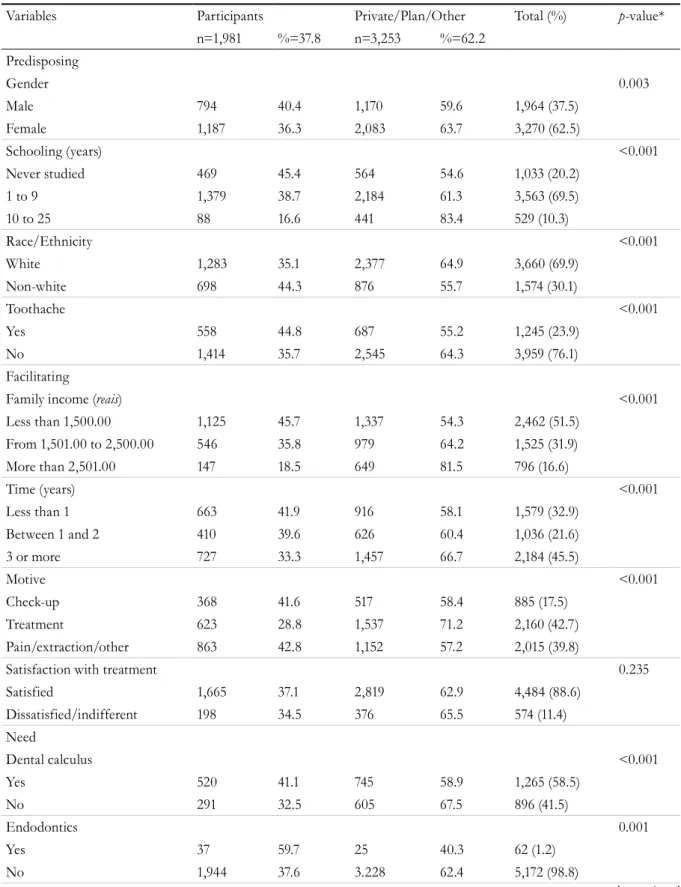
Table 1. Prevalence and bivariate analysis of the predisposing, facilitating and need factors associated with the
use of dental services by elderly people in the state of São Paulo, 2015.
Variables Participants Private/Plan/Other Total (%) p-value*
n=1,981 %=37.8 n=3,253 %=62.2
Predisposing
Gender 0.003
Male 794 40.4 1,170 59.6 1,964 (37.5)
Female 1,187 36.3 2,083 63.7 3,270 (62.5)
Schooling (years) <0.001
Never studied 469 45.4 564 54.6 1,033 (20.2)
1 to 9 1,379 38.7 2,184 61.3 3,563 (69.5)
10 to 25 88 16.6 441 83.4 529 (10.3)
Race/Ethnicity <0.001
White 1,283 35.1 2,377 64.9 3,660 (69.9)
Non-white 698 44.3 876 55.7 1,574 (30.1)
Toothache <0.001
Yes 558 44.8 687 55.2 1,245 (23.9)
No 1,414 35.7 2,545 64.3 3,959 (76.1)
Facilitating
Family income (reais) <0.001
Less than 1,500.00 1,125 45.7 1,337 54.3 2,462 (51.5)
From 1,501.00 to 2,500.00 546 35.8 979 64.2 1,525 (31.9)
More than 2,501.00 147 18.5 649 81.5 796 (16.6)
Time (years) <0.001
Less than 1 663 41.9 916 58.1 1,579 (32.9)
Between 1 and 2 410 39.6 626 60.4 1,036 (21.6)
3 or more 727 33.3 1,457 66.7 2,184 (45.5)
Motive <0.001
Check-up 368 41.6 517 58.4 885 (17.5)
Treatment 623 28.8 1,537 71.2 2,160 (42.7)
Pain/extraction/other 863 42.8 1,152 57.2 2,015 (39.8)
Satisfaction with treatment 0.235
Satisfied 1,665 37.1 2,819 62.9 4,484 (88.6)
Dissatisfied/indifferent 198 34.5 376 65.5 574 (11.4)
Need
Dental calculus <0.001
Yes 520 41.1 745 58.9 1,265 (58.5)
No 291 32.5 605 67.5 896 (41.5)
Endodontics 0.001
Yes 37 59.7 25 40.3 62 (1.2)
790
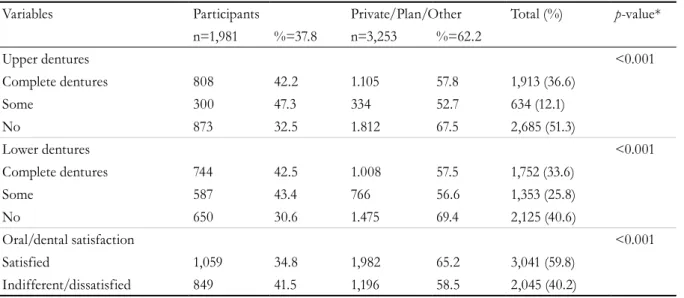
Continuation of Table 1
Variables Participants Private/Plan/Other Total (%) p-value*
n=1,981 %=37.8 n=3,253 %=62.2
Upper dentures <0.001
Complete dentures 808 42.2 1.105 57.8 1,913 (36.6)
Some 300 47.3 334 52.7 634 (12.1)
No 873 32.5 1.812 67.5 2,685 (51.3)
Lower dentures <0.001
Complete dentures 744 42.5 1.008 57.5 1,752 (33.6)
Some 587 43.4 766 56.6 1,353 (25.8)
No 650 30.6 1.475 69.4 2,125 (40.6)
Oral/dental satisfaction <0.001
Satisfied 1,059 34.8 1,982 65.2 3,041 (59.8)
Indifferent/dissatisfied 849 41.5 1,196 58.5 2,045 (40.2)
*p-value: probability of significance by Pearson Chi-Squared Test.
In the bivariate analysis, the associated
predisposing, facilitating and need factors (p≤0.20)
for the use of dental services were identified. This analysis supported the hierarchical logistic model (Table 1).
The hierarchical multiple analysis (p≤0.05) is
presented in table 2. It was observed that being less educated or never having studied, non-white, lower income and motivated by pain/extraction were associated with the use of public dental services. In addition, elderly persons were 1.4 (95% CI: 1.05; 1.87) times more likely to wait three or more years to visit the public dental service in comparison with those
who used the private service. In addition, there was a lower use of the public dental service among elderly persons who needed some type of upper dentures (except complete dentures), need for some type of lower dentures (including complete dentures) and those with a positive self-perception of their oral health condition.
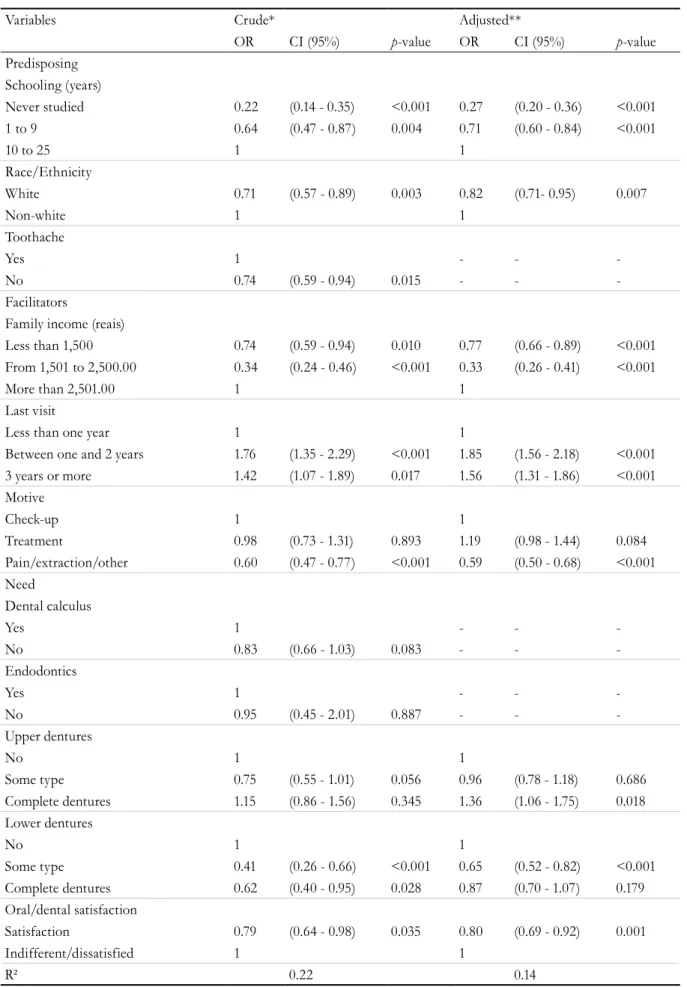
Table 3 shows the crude and adjusted models for
the significant variables (p≤0.05) of the hierarchical
model and their respective R2 values, with the
791
Table 2. Hierarchical multiple logistic regression analysis of factors associated with the use of public dental
services by elderly people in the state of São Paulo, 2015.
Variables Block 1 Block 2 Block 3
OR CI (95%) p-value* OR CI (95%) p-value* OR CI (95%) p-value*
Predisposing Schooling (years)
Never studied 0.26 (0.20 - 0.33) <0.001 0.27 (0.20 - 0.37) <0.001 0.22 (0.14 - 0.35) <0.001
1 to 9 0.79 (0.68 - 0.91) 0.001 0.72 (0.61 - 0.85) <0.001 0.66 (0.48 - 0.89) 0.007
10 to 25 1 1 1
Race/Ethnicity
White 0.72 (0.63 - 0.81) <0.001 0.78 (0.67 - 0.89) <0.001 0.71 (0.57 - 0.88) 0.002
Non-white 1 1 1
Toothache
Yes 1 1 - -
-No 0.71 (0.62 - 0.81) <0.001 0.92 (0.78 - 1.07) 0.276 - -
-Facilitating
Family income (reais)
Less than 1,500.00 0.77 (0.67 - 0.89) <0.001 0.73 (0.58 - 0.92) <0.001
From 1,501.00 to 2,500.00 0.32 (0.26 - 0.40) <0.001 0.33 (0.24 - 0.45) 0.008
More than 2,501.00 1 1
Last visit
Less than one year 1 1
Between one and 2 years 1.70 (1.45 - 1.99) <0.001 1.83 (1.41 - 2.38) <0.001
3 years or more 1.51 (1.28 - 1.80) <0.001 1.40 (1.05 - 1.87) 0.020
Motive
Check-up 1 1
Treatment 1.08 (0.89 - 1.31) 0.424 0.95 (0.71 - 1.26) 0.713
Pain/extraction/other 0.57 (0.49 - 0.66) <0.001 0.58 (0.46 - 0.74) <0.001
Need
Dental calculus
Yes 1
No 0.83 (0.67 - 1.03) 0.085
Endodontics
Yes 1
No 0.92 (0.43 - 1.95) 0.827
Upper dentures
No 1
Some type 0.74 (0.55 - 0.99) 0.043
Complete dentures 1.17 (0.87 - 1.57) 0.299
Lower dentures
No 1
Some type 0.41 (0.26 - 0.66) <0.001
Complete dentures 0.62 (0.41 - 0.95) 0.028
Oral/dental satisfaction
Satisfied 0.77 (0.62 - 0.95) 0.015
Indifferent/unsatisfied 1
R² 0.05 0.12 0.21
792
Table 3. Crude and adjusted model of hierarchical multiple logistic regression analysis of factors associated with
the use of public dental services by elderly people in the state of São Paulo, 2015.
Variables Crude* Adjusted**
OR CI (95%) p-value OR CI (95%) p-value
Predisposing Schooling (years)
Never studied 0.22 (0.14 - 0.35) <0.001 0.27 (0.20 - 0.36) <0.001
1 to 9 0.64 (0.47 - 0.87) 0.004 0.71 (0.60 - 0.84) <0.001
10 to 25 1 1
Race/Ethnicity
White 0.71 (0.57 - 0.89) 0.003 0.82 (0.71- 0.95) 0.007
Non-white 1 1
Toothache
Yes 1 - -
-No 0.74 (0.59 - 0.94) 0.015 - -
-Facilitators
Family income (reais)
Less than 1,500 0.74 (0.59 - 0.94) 0.010 0.77 (0.66 - 0.89) <0.001
From 1,501 to 2,500.00 0.34 (0.24 - 0.46) <0.001 0.33 (0.26 - 0.41) <0.001
More than 2,501.00 1 1
Last visit
Less than one year 1 1
Between one and 2 years 1.76 (1.35 - 2.29) <0.001 1.85 (1.56 - 2.18) <0.001
3 years or more 1.42 (1.07 - 1.89) 0.017 1.56 (1.31 - 1.86) <0.001
Motive
Check-up 1 1
Treatment 0.98 (0.73 - 1.31) 0.893 1.19 (0.98 - 1.44) 0.084
Pain/extraction/other 0.60 (0.47 - 0.77) <0.001 0.59 (0.50 - 0.68) <0.001
Need
Dental calculus
Yes 1 - -
-No 0.83 (0.66 - 1.03) 0.083 - -
-Endodontics
Yes 1 - -
-No 0.95 (0.45 - 2.01) 0.887 - -
-Upper dentures
No 1 1
Some type 0.75 (0.55 - 1.01) 0.056 0.96 (0.78 - 1.18) 0.686
Complete dentures 1.15 (0.86 - 1.56) 0.345 1.36 (1.06 - 1.75) 0.018
Lower dentures
No 1 1
Some type 0.41 (0.26 - 0.66) <0.001 0.65 (0.52 - 0.82) <0.001
Complete dentures 0.62 (0.40 - 0.95) 0.028 0.87 (0.70 - 1.07) 0.179
Oral/dental satisfaction
Satisfaction 0.79 (0.64 - 0.98) 0.035 0.80 (0.69 - 0.92) 0.001
Indifferent/dissatisfied 1 1
R² 0.22 0.14
793
DISCUSSION
Brazilian elderly persons must carry the burden of inheriting a disease-centered care model with invasive curative dentistry practices and limitations in access
to public dental services1,14. A study suggests that
the use of dental services in adults and the elderly is
related to the corresponding habits in childhood15.
Analysis of the use of public health services allows an indirect evaluation of the equity of a
health system12. A study in Montes Claros, Minas
Gerais, found a lower prevalence of public service use
among the elderly3,5. A study conducted in European
countries with a universal coverage system found a variation of 50% to 82% in the use of public dental services, except in Poland, where the prevalence of
such use was 23%15. Systematic review studies have
identified the scarcity of public services as one of the main barriers to access to health services by the
elderly1,16. The present study found that 37.8% of the
elderly used the public dental service.
Acceptable standards of health service use are influenced by socioeconomic and demographic
determinants16,17. In this sense, poorer elderly persons
may suffer greater difficulties in obtaining health care, which reinforces social inequities in the use of
dental services among this age group16-18. Previous
studies have shown that elderly women with higher incomes and levels of schooling used dental services more4,17,18. A higher income can facilitate paying for dental services, the purchasing of dental products and adherence to health insurance, while greater schooling can be translated into a higher level of information
about the importance of regular visits to the dentist1,18.
A study found that Brazilians spent an average of
R$42.19 reais on dental care services and R$10.27
reais on oral hygiene products19. In addition, spending on health and insurance plans increases with age, favoring the access of richer elderly persons to this
type of coverage19. In the USA, elderly persons over
the age of 65 are covered by public health insurance (Medicare), which covers individual expenditure on
medical costs6. In Brazil, the elderly can either use the
public service, pay directly, or pay for private health insurance. This structure allows greater access to health services for elderly persons who can pay for the service, which reinforces the iniquities in oral health and explains the findings.
Studies in countries such as Japan and the USA have identified difficulties in public transportation, place of residence, low mobility, an inability to drive, and lack of family transport support as barriers to
accessing dental care20,21. Another study pointed out
that the association between socioeconomic factors and the use of health services may vary according to the countries (the health system adopted) and the type
of service used16. However, a study in Ponta Grossa
in Parana did not identify an association between lower family income and delays in consulting the
dentist among the elderly4. The removal of economic
barriers would not necessarily make the prevalence of health service utilization in different contextual
levels more equal4.
Race is a limiting factor in the use of dental
services by the elderly22. A study conducted among
the Brazilian elderly showed that the chance of black elderly persons not having used the dental service at least once in their lives is 0.62 OR times less than
among white elderly persons22. The findings of the
present study indicated that there is less chance of a white elderly person using public oral health services. In this sense, social determinants may explain poor access to oral health services by
non-white elderly persons22. Differences in access to oral
health services among whites and non-whites can in
part be attributed to the effects of discrimination22.
Studies that used data from the National Household Sampling Survey (PNAD) of 1998, 2003 and 2008 identified a reduction in the percentage of elderly people who had never been to the dentist, despite this group having the lowest prevalence of
regular dental service use (less than one year)7-9.
A previous study with elderly people in São Paulo showed high rates of use of health services, with 83.3% reporting having had at least one visit in the 12
months prior to the interview12. However, only 32.9%
of the elderly interviewed reported having visited the dentist in the previous year and the findings
of this and other studies4,5,18 indicate that elderly
persons wait longer before visiting the dental service. This fact can be explained by the fact that dental appointments tend to decrease with aging due to
the high prevalence of dental loss and edentulism4.
794
health insurance and difficulties in accessing public
dental services1,4,12.
Elderly people reported greater chances of seeking
outpatient and inpatient health services12,16. In terms
of oral condition, the presence of toothache was the reason why 23.9% of the elderly visited the dentist,
a finding similar to a previous study4. The main
reasons cited for non-use of the services, if specified, were related to the issues of disease severity, self-medication, quality of service, distance and cost of
services12,21. The elderly with lower income cited
reasons such as the non-serious nature of the health
problem, distance and the quality of health services23.
The study also identified a lower prevalence (17.5%) of the use of preventive dental services. Studies in Montes Claros, Minas Gerais, with elderly people aged 65 to 74 years, identified greater demand for
dental treatment than for check-ups or prevention5.
The high prevalence of seeking dental care for treatment, pain or extraction shows the reflexes of oral diseases and of curative/invasive practices
experienced in this age group1,5. On the other hand,
the increase in the dentate and edentulous elderly population may represent an increase in health demands and the need for dental treatment. Changing this profile requires strategies and attitudes of co-responsibility, as the curative approach is limited by offering uneconomical actions of prevention and health promotion, with repercussions for the health
system and the population1.
For Andersen (1995), individuals and families
should perceive health problems and seek care11.
Perceived needs (need for upper and lower dentures) are individual factors that identify barriers to access
and the use of dental services4,11. In the present study,
the need for dentures (both complete and some type of dentures) was associated with access to public dental services. These findings may indicate the existence of suppressed demands by specialized dental services. When undergoing one or more tooth extraction the elderly will need future prosthetic rehabilitation treatment, which is costly both for the elderly and for the public service. In Brazil, the Centro de Especialidades Odontológicas (the Center of Dental Specialties) and the Laboratórios Regionais de Prótese Dentária (the Regional Dental Prosthesis Laboratories) are responsible for the supply and manufacture of dentures in the public
service5. Paradoxically, the increase in the number
of people with teeth, difficulty accessing this type of rehabilitation and the high costs of the private service were related to the lack of recent use of dental
services4,5,18. In this sense, studies on access to public
dental services are important tools for reorienting the care model for non-priority population groups through oral health policy and planning.
Regarding satisfaction with mouth/teeth, 40.2% of elderly individuals described self-rated dissatisfaction or indifference in relation to their oral health. The precarious oral health condition of the Brazilian elderly may account for the negative evaluation of dental services, and dental loss can be perceived as
a natural process of aging24,25. Studies carried out
in the cities of São Paulo and Florianópolis (Santa Catarina) showed that the elderly self-evaluated their
oral health as good or very good24,26. The perception
of oral health among the elderly can be affected by personal beliefs and values, as pain and disability are
inevitable at this age25,26, despite the high prevalence
of need for upper and lower dentures identified in this study. Even if not associated with the use of the public service, the presence of calculus can be an important indicator for not visiting the dentist.
795 residing in rural areas or isolated communities may
be confronted with the reduced supply of dental services due to residing in these types of areas, which can entail difficulties of movement, lack of public transport or precarious road conditions. It is therefore suggested that studies that identify patterns and barriers to the use of dental services by elderly people living in rural or remote areas are carried out.
CONCLUSION
There was a lower frequency of use of public dental services by the elderly in the present study.
The multiple model identified schooling, non-white skin color/ethnicity, family income, long periods without consulting the dentist, motivation of pain or extraction, the need for complete upper dentures, some type of lower denture and negative self-perception of oral/dental condition as factors associated with the use of public dental services by the elderly. Local health systems should therefore be organized to minimize the impacts of social and oral vulnerabilities that accompany advancing age. The expectation is that the results of the present study will support the expansion of non-specialized and specialized dental public services for the elderly population residing in the state of São Paulo.
REFERENCES
1. Moreira RS, Nico LS, Tomita NE, Ruiz T. A saúde bucal do idoso brasileiro: revisão sistemática sobre o quadro epidemiológico e acesso aos serviços de saúde bucal. Cad Saúde Pública. 2005;21(6):1665-75.
2. Austregésilo SC, Leal MCC, Marques APO, Vieira JCM, Alencar DL. Acessibilidade a serviços de saúde bucal por pessoas idosas: uma revisão integrativa. Rev Bras Geriatr Gerontol. 2015;18(1):189-99.
3. Brasil. Ministério da Saúde, Secretaria de Atenção à Saúde, Secretaria de Vigilância em Saúde. SB Brasil 2010: Pesquisa Nacional de Saúde Bucal: resultados principais. Brasília, DF: MS; 2012.
4. Martins AMEBL, Ferreira RC, Santos-Neto PE, Carreiro DL, Souza JGS, Ferreira EF. User’s dissatisfaction with dental care: a population based household study. Rev Saúde Pública. 2015;49:1-14.
5. Oliveira RFR, Souza JGS, Haikal DS, Ferreira EF, Martins AMEBL. Equidade no uso de serviços odontológicos provenientes do SUS entre idosos: estudo de base populacional. Ciênc Saúde Coletiva. 2016;21(11):3509-23.
6. Bós AMG, Bós AJG. Determinantes na escolha entre atendimento de saúde privada e pública por idosos. Rev Saúde Pública. 2004;38(1):113-20.
7. Gulcan F, Ekback G, Ordell S, Lie SA, Astrom AN. Social predictors of less frequent dental attendance over time among older people: population averaged and person-specific estimates. Community Dent Oral Epidemiol. 2016;44(3):263-73.
8. Manhães ALD, Costa AJL. Acesso a e utilização de serviços odontológicos no Estado do Rio de Janeiro, Brasil, em 1998: um estudo exploratório a partir da Pesquisa Nacional por Amostra de Domicílios. Cad Saúde Pública. 2008;24(1):207-18.
9. Peres KG, Peres MA, Boing AF, Bertoldi AD, Bastos JL, Barros AJD. Redução das desigualdades sociais na utilização de serviços odontológicos no Brasil entre 1998 e 2008. Rev Saúde Pública. 2012;46(2):250-8.
10. Frias AC, Pereira AC, Vieira V. Pesquisa Estadual de Saúde Bucal: relatório final [Internet]. São Paulo: Livronovo; 2015 [acesso em 10 maio 2017]. Disponível em: http://w2.fop.unicamp.br/sbsp2015/ down/ebook_relatorio_SBSP_2015.pdf
11. Andersen RM. Revisiting the behavioral model and access to medical care: does it matter? J Health Soc Behav. 1995;36(1):1-10.
12. Louvison MCP, Lebrão ML, Duarte YAO, Santos JLF, Malik AM, Almeida ES. Desigualdades no uso e acesso aos serviços de saúde entre idosos do município de São Paulo. Rev Saúde Pública. 2008;42(4):733-40.
13. Matos DL, Lima-Costa MFF, Guerra HL, Marcenes W. Projeto Bambuí: estudo de base populacional dos fatores associados com o uso regular de serviços odontológicos em adultos. Cad Saúde Pública. 2001;17(3):661-8.
796
15. Manski R, Moeller J, Chen H, Widström E, Listl S. Disparity in dental attendance among older adult populations: a comparative analysis Across Selected European Countries and the United States. Int Dent J. 2016;66(1):36-48.
16. Almeida APSC, Nunes BP, Duro SMS, Facchini LA. Determinantes socioeconómicos do acesso a serviços de saúde em idosos: revisão sistemática. Rev Saúde Pública. 2017;51:50.
17. Ritter F, Fontanive P, Warmling CM. Condições de vida e acesso aos serviço de saúde bucal de idosos da periferia de Porto Alegre. Bol Saúde. 2004;18(1):79-85.
18. Ferreira CO, Antunes JLF, Andrade FB. Fatores associados à utilização dos serviços odontológicos por idosos brasileiros. Rev Saúde Pública. 2013;47(Supl 3):90-7.
19. Cascaes AM, Camargo MBJ, Castilhos ED, Silva AMR, Barros AJD. Gastos privados com saúde bucal no Brasil: análise dos dados da Pesquisa de Orçamentos Familiares, 2008-2009. Cad Saúde Pública. 2017;32(1):1-13.
20. Borrel LN, Northridge ME, Muller DB, Golembeski CA, Spielman SE, Sclar ED, et al. Oral health and health care for older adults: a spatial approach for addressing disparities and planning services. Spec Care Dentist. 2006;26(6):252-6.
21. Hanibuchi T, Aida J, Nakade M, Hirai H, kondo K. Geographical accessibility to dental care in the Japanese elderly. Community Dent Health. 2011;28(2):128-35.
22. Souza EHA, Oliveira PAP, Peagle AC, Goes PSA. Raça e o uso dos serviços de saúde bucal por idosos. Ciênc Saúde Coletiva. 2012;17(8):2063-70.
23. Grönbeck-Linden I, Hägglin C, Petersson A, Linander PO , Gahnberg L. Discontinued dental attendance among elderly people in Sweden. Int J Dent Hyg. 2016;6(3):224-29.
24. Andrade FB, Lebrão ML, Santos JLF, Duarte YAO, Teixeira DSC. Fatores associados à autopercepção de saúde bucal ruim entre idosos não institucionalizados do Município de São Paulo, Brasil. Cad Saúde Pública. 2012;28(10):1965-75.
25. Martins AMEBL, Jardim LA, Souza JGS, Rodrigues CAQ, Ferreira RC, Pordeus IA. A avaliação negativa dos serviços odontológicos entre idosos brasileiros está associada ao tipo de serviço utilizado? Rev Bras Epidemiol. 2014;17(1):71-90.
26. Benedetti TRB, Mello ALSF, Gonçalves LHT. Idosos de Florianópolis: autopercepção das condições de saúde bucal e utilização de serviços odontológicos. Ciênc Saúde Coletiva. 2007;12(6):1683-90.