Bull Pan Am Health Organ 15(l), 1981.
FAMILY
PRACTICE
IN BARBADOS
M. D. Hoyos,l
J. E. Yeo, * S. Renwick,’
D. A. Gale,’ W. A. DosSantos,2
R. Wilson,2 J. D. Gibling,2
C. E. Hoare,
J. Shepard,2
R. G. Webster,’
and P. A. DaSilva2
A sigr$kant portion of all medical care in Barbados is provided by private fan+ physicians. This article reports survg, results dealing with the role now played by these physicians in Barbados. These a&a are relevant for the plan- ning and a’evelopment of a prepaid national health service in which primary care will be &livered to the people by the family physician and his team.
Introduction
Primary health care is provided in Barba- dos by the casualty and general outpatient clinics of the Queen Elizabeth Hospital, the district medical officers, the polyclinics, and health centers in the community. These gov- ernment services are all free to the patients at the point of delivery. Private medical care is available to patients from family physician practices and from some hospital consultants
who also engage in private practice. This private care is financed by the patients on a fee-for-service basis.
The primary health care provided is essen- tially low-technology care for ambulatory pa- tients. Its main components are preventive, curative, and continuing care. The preventive component includes prophylactic immuniza- tions, family planning, and examinations- both for health screening and to rule out specific diseases. The curative component provides management for a wide spectrum of patient illnesses and includes first-contact care for the more life-threatening conditions re- quiring secondary and tertiary care. Continu- ing care is the long-term component that pro- vides care for individual patients needing
‘Family physician and principal investigator; Elcourt Cliiic, Maxwell Road, Christ Church, Barbados.
2Participating family physicians, Barbados.
ongoing health care management; it includes management of patients with chronic diseases.
The annual report of the Chief Medical Officer (I) gives statistics on the services pro- vided in government clinics, but little is known of the care provided by private physi- cians. Clearly, health care systems need to be developed to meet the general medical needs of the people (2); but in planning and develop- ing a national health service it is necessary for data from private physicians to be considered along with those from the government clinics. A principal aim of the survey reported here was to determine how people have been using the private family physician service and to col- lect some, basic data on how the physicians have coped with this demand.
Methods
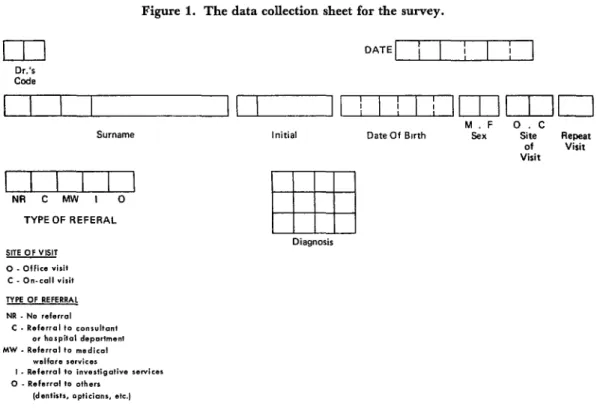
In 1978,52 physicians were engaged in full- time family practice in Barbados. A cluster sample of 11 of these physicians (21.2 per cent) recorded information about each physi- cian-patient encounter over a twelve-month period which began on 1 September 1977 and ended on 31 August 1978. The survey employed a data collection sheet (Figure 1) that had been designed and tested by the doc- tors themselves. Its most important feature was simplicity; only those data deemed most necessary were recorded, so as to create
4 PAHO BULLETIN l vol. 15, no. 1, 1981
Figure I. The data collection sheet for the survey.
I I 1
DATE i I I 1I I
Dr.45 Code
Surname Initial Date Of Birth
M.F 0.C
sex Site Repeat of Visit Visit
I I I I I I
NA C MW I 0 TYPE OF REFERAL
Diagnosis SITE OF VISIT
0 . Ollies visit C - On-call visit
0 - Rsfarrd to ofharr
minimum interference with busy clinical prac- tices.
None of the doctors working in Barbados have received formal postgraduate training in family medicine. The 11 doctors in this survey had family practice experience ranging from 6 months to 26 years, the average being 9.7 years. There was one solo practice, the other 10 doctors working in groups of two. These practices offered care to anyone who re- quested it, there being no need for referral from any other health worker. The main factor limiting the availability of care was economic, since the patients paid for the serv- ices received and for any resulting investigato- ry or therapeutic work. It is fair to say that the people from very low socioeconomic strata have tended to use these practices for only the more acute and severe illnesses. In general the doctors worked from 8 a.m. to 5 p.m. daily- either at their offices or making house calls. After-hour and weekend services were pro- vided as needed.
At every physician-patient encounter the
family practice staff recorded the doctor’s identification code; the patient’s name, date of birth, and sex; the site of the encounter (office
or home); and whether this was the first or a subsequent encounter within the survey period. The data collection sheet was then clipped to the patient’s record, and after the encounter the physician recorded the type of referral (if any) that resulted. Completed data sheets were collected from the 11 practices at intervals throughout the survey for central computer analysis.
Results
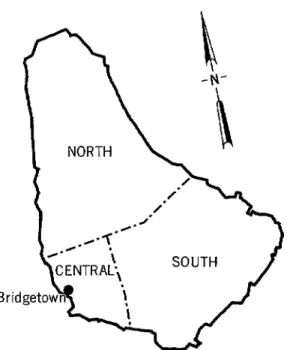
The 11 practices were well-distributed among the island’s three geographic zones, and the number of practices in each zone cor- related closely with the population of that zone (see Table 1).
Table 1. Distribution of the family practices surveyed and the general population of Barbados among the
nation’s three geographic zones.
ZOll.2
General population Family practices studied
NO. % of total No. % of total
North 66,800 24.8 2 18.2 Central 111,600 41.5 5 45.4 south 90,800 33.7 4 36.4 Total 269,200 100 11 100
The only notable differences were a relative dearth of children 5- 14 years of age among the survey group and a relatively large number of females of reproductive age (see Figure 3). Because of these differences, the 20,618 pa- tients 15-44 years of age accounted for 58.1 per cent of the survey group, while people in this age range accounted for only 41.9 per cent of the general population.
A total of 53,094 physician-patient en- counters were recorded during the twelve- month survey. Of these, 18,824 involved male patients and 34,270 involved female patients;
Hoyos et al. l FAMILY PRACTICE IN BARBADOS 5
17,97 1 were repeat encounters-there having been a previous encounter between the same patient and physician during the survey period. Overall, there was an average of 1.5 encounters per patient seen per year. Patients of all ages were seen, but most (58.1 per cent) were in their reproductive years. The sex ratio of survey patients under age 15 was 1: 1, but in all other age groups the females outnumbered males by approximately 2: 1 (see Table 2).
A total of 1,403 encounters (2.64 per cent) involved physicians on call, working outside their usual office schedules. Most of these en- counters occurred at the patients’ homes, but after-hour calls resulting in an encounter at the physician’s office were also included in this category. Elderly patients had the largest number of on-call encounters (162 per 1000 patients), and those 45-64 years of age were next with 41.2 calls per 1,000 patients. The sex ratio of on-call encounter patients was similar to those of other patients-except for patients in their reproductive years, where on- call encounters with male patients predomi- nated (see Table 3).
6 PAHO BULLETIN l vol. 15, no. 1, 1981
Figure 3. Percentage distribution, by age and sex, of the Barbados population (dark bars) and the patients included in the survey (light bars).
1 65 -
45-64 -
s 0
g 15-44 -
2
5-14 -
o-4 -
MALE FEMALE
30 20 10 5 5 10 20 30
PERCENTAGE OF TOTAL
Table 2. The ratio of encounters with male and female patients, by age group, showing the percentages of encouuters in each group.
A egroup f vears~
Encounters with: All encounter3 Male-female
Male uatients Female patients MiO No. % of total
o-4 1,895 1,905 1:l 3,800 7.2
5-14 2,122 2,057 1:l 4,179 7.9
15-44 9,914 20,959 1:Z.l 30,873 58.1
45-64 3,040 5,311 1:1.8 8,351 15.7
2 65 1,853 4,038 1:z.z 5,891 11.1
Total 18,824 34,270 1:1.6 53,094 100
Table 3. Patients involved in on-call encounters, by sex ratio, age group, and number of on-call encounters per 1,000 patients in each group. Age group
(Yews)
No. of No. of patients Oil-Cd
surveyed encounters
Male-female
ratio of on-call on-call encounters patients per 1,000 patients
o-4 2,826 55 1:l 19.5
5-14 3,116 78 1:0.8 25.0
15-44 20,618 522 1:0.7 25.3
45-64 5,318 219 1:1.7 41.2
t 65 3,265 529 1~2.4 162.0
Hops et al. . FAMILY PRACTICE IN BARBADOS 7
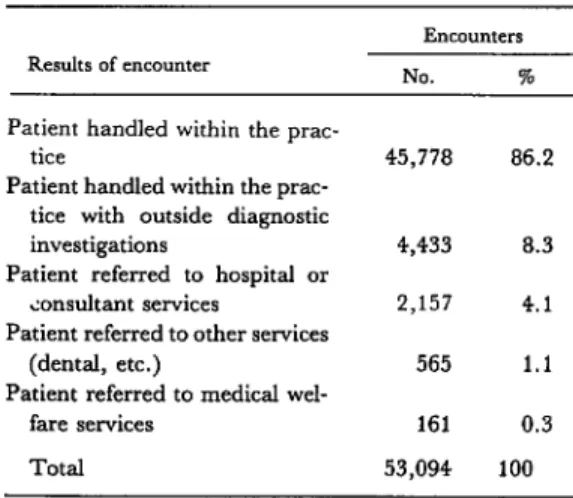
The participating physicianshandled 45,778 (86.1 per cent) of the encounters in their own practices without making any type of referral; 4,433 encounters (8.3 per cent) resulted in ad- ditional investigations being requested; and 2,157 (4.1 per cent) resulted in referrals to consultants or hospital services (see Table 4).
Discussion
Making a random sample of physicians and patients was not practical in this survey. Nevertheless, the large cluster sample of fami- ly physicians used, their distribution in the community, and the similarity of the patients’ distribution by age and sex to that of the island’s general population all support the belief that the patients seen were representa- tive of people in the community. The results can therefore be said to reflect the demands that the population made on the private family physician services. Hence the results of the survey, when used together with data from the government clinics, appear to provide a com- plete picture of the primary health care demands of the Barbadian people for the twelve-month period beginning in September
1977. Data of this kind would have even greater value if collected on an on-going basis over a period of several years.
Table 4. Management of the recorded encounters and referrals.
Results of encounter
Patient handled within the prac- tice
Patient handled within the prac- tice with outside diagnostic investigations
Patient referred to hospital or consultant services
Patient referred to other services (dental, etc.)
Patient referred to medical wel- fare services
Total
Encounters NO. % 45,778 86.2
4,433 8.3 2,157 4.1 565 1.1 161 0.3 53,094 100
Consultation rates in the United Kingdom have been reported at 3.01 encounters per pa- tient at risk per year (3). Rates on this order or higher are the general rule in several developed countries where prepaid health services are available. In this survey, as pre- viously noted, the observed consultation rate was 1.5 encounters per patient per year; the rate of encounters per patient at risk per year would have been even lower, since it was not possible to include patients at risk who had no encounters during the survey period.
One important factor influencing this low rate was the free availability of several primary care services provided by the govern- ment clinics. The direct cost of professional fees, drugs, and investigations probably helps to explain the low consultation rate observed. When these financial barriers are removed, upon implementation of a prepaid health ser- vice system, consultation rates can be ex- pected to increase considerably. In fact, it can be anticipated that these rates will become similar to those prevailing in developed coun- tries, since other factors that influence the rates-namely literacy, communications, transportation, and the quality of primary care -are comparable in Barbados to those in many developed societies.
The predominance of female patients is a fairly common finding in family practices (4, 5). Obvious reasons include obstetric and gynecological problems during the reproduc- tive years that increase the need for care, and a preponderance of females amongthe elderly. However, the reversal of the sex ratio for on- call encounters by patients in their reproduc- tive years was an interesting finding. This may reflect an underutilization of the family physi- cian services by the male early in his illness, resulting in more acute problems requiring after-hour or on-call encounters. Another fac- tor may be that higher employment of males may afford less time for health maintenance.
8 PAHO BULLETIN l vol. 15, no. 1, 1981
“calls.” Most studies have been done in England, where it is reported that night visits vary from 3.8 to 17 per 1,000 patients per year (6,). In the present survey, call encounters in- cluded all visits made outside of the physi- cian’s office at any time of day, together with after-hour encounters regardless of the site. Forty calls were made per 1,000 patients per year, elderly patients receiving a large propor- tion of these. This subject of domiciliary and after-hour care by the primary care physician is one in need of further study, especially since some of this care was of an emergency nature and much of it provided valuable service to patients made relatively immobile by age or illness.
Comparison with government outpatient and emergency services is difficult, because no similar survey has been conducted in the government clinics. The matter is further complicated by the fact that doctors in the government services do not make house calls. However, there is some basis for estimation, because in 1977 there were 254,626 patient visits to these services for primary health care. Of the total, 73,127 were to the “casualty and general outpatients” department (1). Since about 20 per cent of these latter cases are usually considered emergency or casualty cases, it may be estimated that the govern- ment services appeared to handle about 57 emergencies per thousand visits in 1977.
In recent years, governments throughout the world have shown great interest in devel- oping comprehensive primary care services. An important reason for this has been the phenomenal escalation in the cost of second- ary and tertiary care and the logical belief that effective prevention, first-contact care, and continuing care can reduce the demands on the more expensive hospital services. Some of our survey data seems to support this reason- ing with regard to family physician services, since 86.1 of the encounters were managed entirely by the family practices involved. It seems clear that this reduced hospital admis- sions for care that could be provided else- where, thereby reducing overcrowding of
hospital departments and enabling these ex- pensive facilities to be used more effectively.
Overall, the referral rate for hospital or con- sultant services was 4.1 per cent, a rate con- siderably lower than the 11.5-20.8 per cent reported by various studies in England (7, 8, 9). One reason for this was the wider use of family physician services by the British people as compared with our limited use of them in Barbados. Another consideration is the dif- ferent method of remuneration used, the fee- for-service method in Barbados encouraging physicians to work harder, provide more types of services, and make fewer referrals.
There are no comparable data on the rate at which patients receiving outpatient care from government health services were referred to hospital or consultant services. The annual report of the Chief Medical Officer (I) reported 344,119 outpatient visits in 1977; of these, 28,814 (8.4 per cent) were first visits to specialized clinics or hospital admissions. This does not mean there was a higher rate of refer- ral by the government services, however, as some of these hospital services were provided for patients referred to them by family physi- cians.
There are reports of much variation (10,
11, 12) in the use of diagnostic facilities by family physicians, the younger and more recently qualified physicians making greater use of them (13); in general, the requests made for such investigations tend to be for the simpler and less costly types (14, 1.5). It is thus reasonable to anticipate a rise in the rate of in- vestigations requested when these are avail- able without direct cost to the patient, since an effective family physician service would re- quire ready access to such investigations. However, the great majority of these investi- gations would be simple laboratory tests such as those for blood sugar, hemoglobin, and sickling in addition to straight X-rays of the chest and limbs.
Hoyos et al. l FAMILY PRACTICE IN BARBADOS 9
This suggests that a large share of the popula- but long-term requirements would be better tion received primary care from sources other satisfied by attracting qualified nationals to than the family physician. Hence it seems this specialty. Therefore, some changes in the clear that a national health service geared to present system of medical training will be deliver primary health care through a family necessary, including the establishment of a physician service will require a large increase university department of family medicine to in family physician manpower. In the short promote undergraduate instruction and post- run some of this manpower may be imported, graduate training in this discipline.
ACKNOWLEDGMENTS
We are indebted to the Pan American Health Organization and the Government of Barbados for the funds provided to make this survey possible.
SUMMARY
A survey was conducted in Barbados to obtain basic data about the extent of health services pro- vided by private family physicians. Eleven partici- pating physicians recorded information about all encounters with patients on a special data collection sheet. Overall, data were obtained from 35,143 pa- tients accounting for 13.1 per cent of the population of Barbados.
Analysis of these data showed that the patients had an average of 1.5 encounters per year with the physicians, and that female patients tended to predominate. The ratio of male patient encounters to female patient encounters was 1:1.6.
Most of the encounters (86.1 per cent) were handled entirely by the physicians’ family practice
facilities; 8.3 per cent prompted requests for addi- tional diagnostic investigation; and 4.1 per cent resulted in referrals to consultants or hospital serv- ices. These data strongly suggest that family physi- cians make an important contribution to reducing the demand for expensive, specialized, and limited hospital services on Barbados.
The data also show, however, that during the one-year survey period 21 per cent of the island’s family physicians provided primary care for only 13 per cent of the national population. Hence, it ap- pears that any national health service geared to deliver its primary care through family physicians will require a substantial increase in the number of family physicians.
REFERENCES
(I) Chief Medical Officer. Annual Report, 1977. Ministry of Health and National Insurance, Bridgetown, Barbados, 1978.
(2) Milhs, J. S. A Rational Public Poliq for Medical Education and Its Financing. National Fund for Medical Education, New York, 1971.
(3) Crombie, D. L., R. J. Pinsent, P. M. Lambert, and D. Birch. Comparison of the first and second national morbidity surveys. JR Coil Gen Pratt 25:874-878, 1975.
(4) Marsland, D. W., M. Wood, and F. Mayo. The content of family practice: Part I. Rank order of diagnoses by frequency. Part II. Diagnoses by disease category and age/sex distribution. J Fam Pratt 3 (1):37-68, 1976.
10 PAHO BULLETIN l vol. 15, no. 1, 1981 \
(6) Buxton, M. r., R. E. Klein, and J. Sayers. Variations in G 1 night visiting rates: Medical organization and consumer demand. Br Med J 1827-838, 1977.
(7) Wright, H. J. General practice in south-west England: Reports from General Practice No. 8., London. J R Co11 Gen Pratt, 1978.
(8) Scott, R., and M. Gilmore. Problems and Progress in Medical Care. Second series. Oxford Uni- versity Press, London, 1966.
(9) Scott, R., J.A.D. Anderson, and A. Cart- wright. Just what the doctor ordered: An analysis of treatment in a general practice, BrMedJ2:293-299,
1960.
(10) Fry, J., J. B. D&me, A. C. Glendinning,
and J. Keall. Diagnostic facilities for general practi- tioners: a closer look. Med World 101:23-31, 1964. (II) Anderson, J.A.D. Requests for X-ray ex- aminations from general practitioners and hospital out-patients. Lancet 2:97-99, 1968.
(12) Irvine, D., and M. Jeffreys. B.M.A. Plan- ning Unit survey of general practice, 1969. Br Med J 4:535-543, 1971.
(23) Hitchens, R.A. N., and C. R. Lowe. Labo- ratory service in general practice. Med Care 4:142-149, 1966.
(II) Eimerl, T. S. Aspects of General Practice, 1943-1960. M.D. Thesis, University of Liverpool, 1960.
(15) Macaulay, H. M. Diagnostic facilities for general practitioners. Lancet 1:791-793, 1962.
WASTE MANAGEMENT IN THE CARIBBEAN
A project for “Protection of the Marine and Coastal Environment of the Caribbean Islands” was recently launched by the Caribbean Community Secretariat and the United Nations Environment Program. The project’s aims are to help the smaller island countries better understand their envi- ronmental health problems, especially those related to waste management; to prepare for a coastal water pollution monitoring program; and to assess developmental effects on the environment in the region. In addition, the pro- ject is expected to assist the proposed Caribbean Community Environmental