Hemoglobin A
1c
Levels Predicts Acute Kidney
Injury after Coronary Artery Bypass Surgery in
Non-Diabetic Patients
Cevdet Ugur Kocogulları
1, MD; Atike Tekeli Kunt
2, MD; Rezan Aksoy
3, MD; Cagrı Duzyol
2, MD; Hakan Parlar
2, MD;
Huseyin Saskın
2, MD; Orhan Fındık
2, MD
Abstract
Introduction: Elevated hemoglobin A1c levels in patients with diabetes mellitus have been known as a risk factor for acute kidney injury after coronary artery bypass grafting. However, the relationship between hemoglobin A1c levels in non-diabetics and acute kidney injury is under debate. We aimed to investigate the association of preoperative hemoglobin A1c levels with acute kidney injury in non-diabetic patients undergoing isolated coronary artery bypass grafting.
Methods: 202 non-diabetic patients with normal renal function (serum creatinine <1.4 mg/dl) who underwent isolated coronary bypass were analyzed. Hemoglobin A1c level was measured at the baseline examination. Patients were separated into two groups according to preoperative Hemoglobin A1c level. Group 1 consisted of patients with preoperative HbA1c levels of < 5.6% and Group 2 consisted of patients with preoperative HbA1c levels of ≥ 5.6%. Acute kidney injury diagnosis was made by comparing baseline
and postoperative serum creatinine to determine the presence of predefined significant change based on the Kidney Disease Improving Global Outcomes (KDIGO) definition.
Results: Acute kidney injury occurred in 19 (10.5%) patients after surgery. The incidence of acute kidney injury was 3.6% in Group 1 and 16.7% in Group 2. Elevated baseline hemoglobin A1c level was found to be associated with acute kidney injury (P=0.0001). None of the patients became hemodialysis dependent. The cut off value for acute kidney injury in our group of patients was 5.75%.
Conclusion: Our findings suggest that, in non-diabetics, elevated preoperative hemoglobin A1c level may be associated with acute kidney injury in patients undergoing coronary artery bypass grafting. Prospective randomized studies in larger groups are needed to confirm these results.
Keywords: Coronary Artery Bypass. Kidney. Dialysis. Acute Kidney Injury. Mammary Arteries.
DOI: 10.21470/1678-9741-2016-0010
1Siyami Ersek Training and Research Hospital, Istanbul, Turkey. 2Derince Training and Research Hospital, Kocaeli, Turkey. 3Kartal Kosuyolu Training and Research Hospital, Istanbul, Turkey.
This study was carried out at the Siyami Ersek Training and Research Hospital, Istanbul, Turkey.
No inancial support.
No conlict of interest.
Correspondence Address: Rezan Aksoy
Cevizli Mah., Denizer Cad. Cevizli Kavşağı - Istanbul, Turkey - Zip code: 34865 E-mail: [email protected]
Article received on September 2nd, 2016.
Article accepted on December 6th, 2016.
Abbreviations, acronyms & symbols
ACT AKI AUC BUN CABG CPB DM GFR HbA1c
ICU KDIGO LAD LIMA LVEF ROC
= Activated clotting time = Acute kidney injury = Area under curve = Blood urea nitrogen
= Coronary artery bypass grafting = Cardiopulmonary bypass = Diabetes mellitus = Glomerular filtration rate = Hemoglobin A1c
= Intensive care unit
= Kidney Disease Improving Global Outcomes = Left anterior descending artery
= Left internal mammary artery = Left ventricular ejection fraction = Receiver operating characteristic
INTRODUCTION
Coronary artery bypass grafting (CABG) operations are performed safely and successfully in our country as well as in the rest of the world. Acute kidney injury (AKI), not rarely seen following cardiac surgery, is associated with morbidity, increased
health costs, and mortality rates[1,2].
The risk factors and pathophysiology of AKI following CABG were described in the literature and have been the subject of multiple studies[3,4].
The incidence of AKI following cardiac surgery has been reported as being 5-30% and renal replacement therapy is
required in 1-2% of these patients[5,6]. Hemoglobin A
1c (HbA1c) is
widely used as a marker of average blood glucose concentrations over the preceding 2 to 3 months and it has advantages over
glucose tests[7]. Some evidence indicates that high HbA1c levels
prior to surgery are strongly associated with the severity of
HbA1c levels were found to be related to cardiovascular and
renal complications following open heart surgery[9]. Multiple factors
have been implicated as contributors to postoperative AKI, including advanced age, female gender, presence of diabetes mellitus, chronic kidney disease, extended time between heart catheterization and surgery, aortic cross clamp time, duration of cardiopulmonary
bypass (CPB), and blood transfusion following surgery[6].
However, association of elevated HbA1clevels in non-diabetics
with AKI after CABG surgery is under debate. The purpose of
this study is to investigate the association of preoperative HbA1c
levels in non-diabetics with AKI after isolated CABG.
METHODS
In this study, medical records of 315 open cardiac surgery patients operated in the same center by the same surgical team between June 2012 and July 2014 were investigated
consecutively and retrospectively. Patients who underwent isolated CABG with CPB and who were non-diabetic with preoperative serum creatinine levels less than 1.4 mg/dl were included in the study. The number of patients that met that criteria was 202. For descriptive purposes, receiver operating characteristic (ROC) curve analysis was performed to identify the cut-of point with the highest sensitivity and speciicity. Patients were grouped according to HbA1c status: < 5.6% (low HbA1c group; group 1) and ≥5.6% (high HbA1c group; group 2).
AKI diagnosis was made by comparing baseline and postoperative serum creatinine to determine the presence of predeined signiicant change based on the Kidney Disease Improving Global Outcomes (KDIGO) deinition (increase in serum creatinine by ≥0.3 mg/dl within 48 hours of surgery or
increase in serum creatinine to ≥1.5 times baseline within 3 days of cardiac surgery)[10]. AKI diagnosis was based on the highest
serum creatinine concentration measured during the irst 3 days after surgery compared to the baseline serum creatinine concentration, deined as the last concentration measured
before surgery.Urine output was not used to deine AKI because
it may be inluenced by diuretics administered during anesthesia and CPB.
Exclusion criteria included patients who had peripheral arterial disease, moderate to severe valvular heart disease,
decompensated congestive heart failure, congenital cardiac
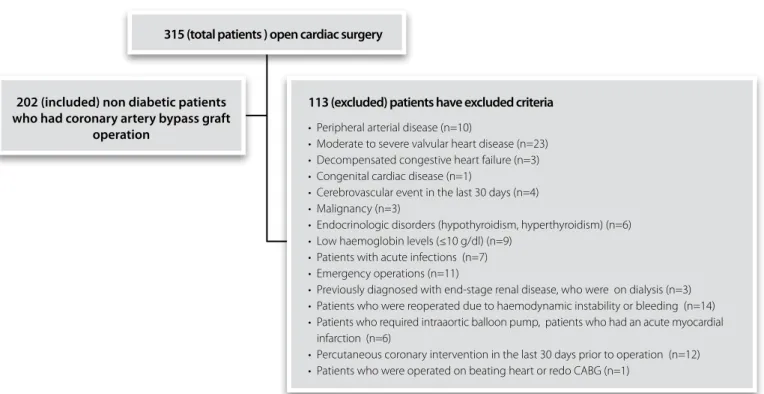
disease, cerebrovascular event in the last 30 days, malignancy, endocrinological disorders (hypothyroidism, hyperthyroidism), low hemoglobin levels (≤10 g/dl), acute infections, emergency operations; patients who had previous diagnosis of end-stage renal disease and who were on dialysis; patients who were reoperated due to hemodynamic instability or bleeding; patients who required intra-aortic balloon pump; patients who had acute myocardial infarction and percutaneous coronary intervention in the last 30 days prior to operation; and patients who were operated on beating heart or redo CABG. A total of 113 patients were excluded from study, as shown in Figure 1. Additionally, patients for whom data on serum creatinine levels or urine output were missing were also excluded.
Patients’ demographic and clinical data were obtained by using the hospital’s software system of records and archives to investigate patient iles, epicrisis, operation notes, and laboratory results. Age, gender, smoking history, hypertension, hyperlipidemia, left ventricular ejection fraction (LVEF), preoperative and postoperative laboratory parameters (hemoglobin, fasting blood glucose, creatinine, urea, creatinine
315 (total patients ) open cardiac surgery
113 (excluded) patients have excluded criteria
• Peripheral arterial disease (n=10)
• Moderate to severe valvular heart disease (n=23)
• Decompensated congestive heart failure (n=3)
• Congenital cardiac disease (n=1)
• Cerebrovascular event in the last 30 days (n=4)
• Malignancy (n=3)
• Endocrinologic disorders (hypothyroidism, hyperthyroidism) (n=6)
• Low haemoglobin levels (≤10 g/dl) (n=9)
• Patients with acute infections (n=7)
• Emergency operations (n=11)
• Previously diagnosed with end-stage renal disease, who were on dialysis (n=3)
• Patients who were reoperated due to haemodynamic instability or bleeding (n=14)
• Patients who required intraaortic balloon pump, patients who had an acute myocardial
infarction (n=6)
• Percutaneous coronary intervention in the last 30 days prior to operation (n=12)
• Patients who were operated on beating heart or redo CABG (n=1)
202 (included) non diabetic patients who had coronary artery bypass graft
operation
clearance), perioperative data, duration of CPB and aortic cross clamp, amount of blood products used, and intensive care unit (ICU) and hospital length of stay were recorded.
Patients were followed in the ICU in the postoperative period, according to protocols of our institution. Electrocardiography, systemic mean arterial pressure, central venous pressure, arterial blood gases, chest tube drainage, and urine output were monitored. Preoperative and postoperative creatinine clearances and peak creatinine clearance were calculated according to the
formulas reported in the literature[11,12].
Operative Technique
All of the patients were operated with median sternotomy under general anesthesia and CPB with aortic and venous cannulations following systemic heparin administration (300 IU/kg). Activated clotting time (ACT) was maintained at over 450 seconds during the operation. Standard CPB circuit and surgical management were used. Antegrade hypothermic and hyperkalemic blood cardioplegia was applied to all patients. Surgery was performed under moderate systemic hypothermia
(28-30ºC). CPB low was maintained at 2.2-2.5 l/min/m2, mean
perfusion pressure was maintained between 50 and 80 mmHg, hematocrit level was maintained between 20 to 25% during CPB. For the coronary bypass operations, arterial grafts for left anterior descending artery (LAD) revascularization were preferably harvested from the left internal mammary artery (LIMA) whereas saphenous venous grafts were used for the other vessels. Distal anastomoses were done during aortic cross-clamp period and proximal anastomoses were done on beating heart onto the ascending aorta using a lateral clamp.
Statistical Analysis
Statistical analysis was performed using SPSS version 13.0 (SPSS Inc, Chicago, IL, USA). Normal distribution was evaluated by histogram or Kolmogorov-Smirnov test; homogeneity of distribution was evaluated by ‘Levene’s test for equality of variance’. Normally distributed data were demonstrated as mean
± standard deviation whereas non-normally distributed data were demonstrated as median (minimum-maximum). Diference between groups was evaluated by ‘Student’s t test’ in normal and homogenous distribution and by ‘Mann-Whitney U test’ in non-normal distribution. Diferences between groups were evaluated by parametric or non-parametric Pearson Chi-Square test or Fisher’s Exact test with respect to the distribution. Forward stepwise multivariate logistic regression models were created to identify the independent predictors of postoperative AKI.
Variables with a P value less than 0.10 in univariate analyses were
included in the multivariate model. The sensitivity and speciicity of the independent risk factors to predict postoperative AKI were
determined by ROC curve analysis. P value less than 0.05 was
accepted as signiicant. Chi-square test was performed for odds ratio. Continuous variables were described as means (standard deviation) or medians (interquartile range), as appropriate; categorical variables were described as percentage.
RESULTS
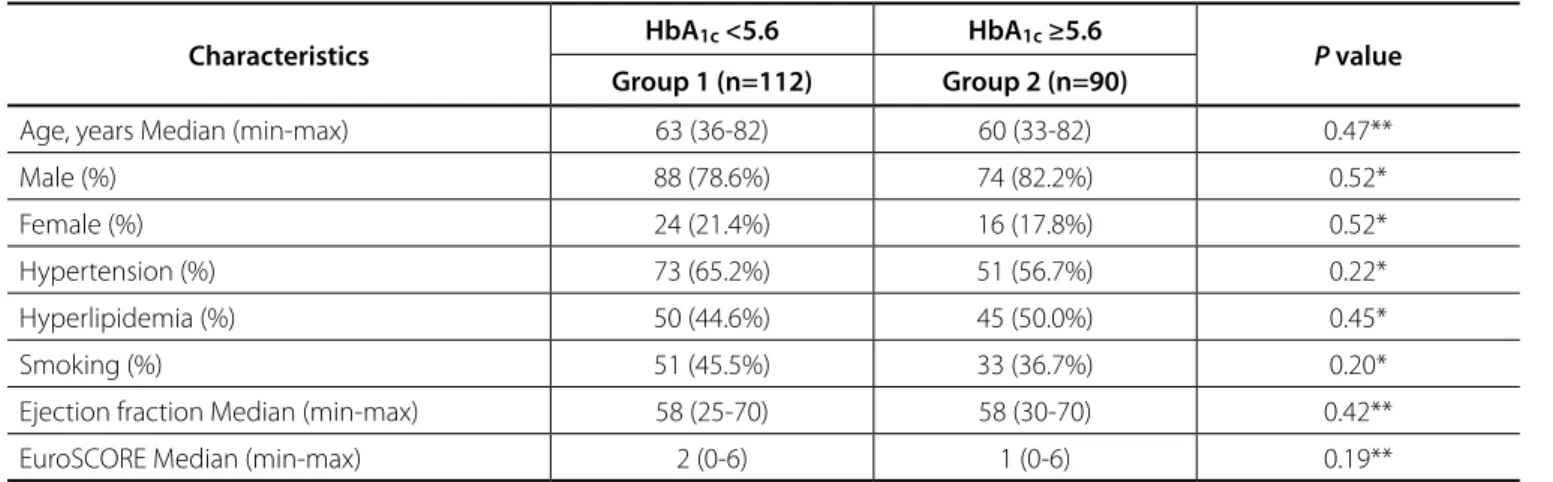
The demographic characteristics and clinical data of the
patients were summarized in Table 1.There were no diferences
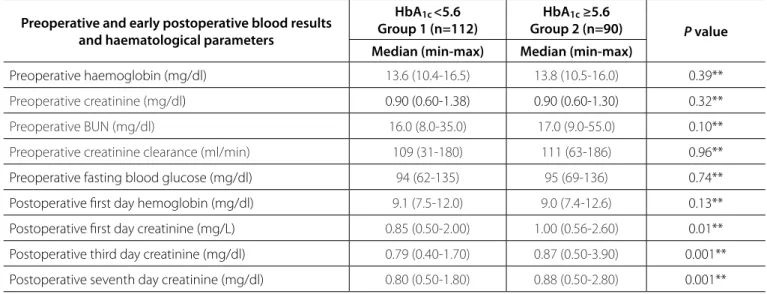
between the two groups in terms of demographic or clinical data. Preoperative and postoperative blood analysis and haematological parameters of the patients were summarized
in Table 2. First postoperative day creatinine levels (P=0.01),
3rd postoperative day creatinine levels (P=0.0001), and 7th
postoperative day creatinine levels (P=0.0001) were signiicantly
diferent between the groups.
Intraoperative and postoperative data of the patients are
shown in Table 3. ICU length of stay (P=0.004) was signiicantly
diferent between the groups.
Postoperative AKI occurred in 4 (3.6%) patients in group 1 and in 15 (16.7%) in group 2, showing a statistically signiicant
diference between the groups (P=0.0002). Mortality in the early
postoperative period occurred in 2 (1.8%) patients in group 1 and in 6 (6.7%) in group 2, and there was no statistically signiicant
diference between the groups (P=0.14). Renal replacement
therapy in the early postoperative period was required in 4
Table 1. Demographic and clinical properties of the patients.
Characteristics HbA1c <5.6 HbA1c ≥5.6 P value
Group 1 (n=112) Group 2 (n=90)
Age, years Median (min-max) 63 (36-82) 60 (33-82) 0.47**
Male (%) 88 (78.6%) 74 (82.2%) 0.52*
Female (%) 24 (21.4%) 16 (17.8%) 0.52*
Hypertension (%) 73 (65.2%) 51 (56.7%) 0.22*
Hyperlipidemia (%) 50 (44.6%) 45 (50.0%) 0.45*
Smoking (%) 51 (45.5%) 33 (36.7%) 0.20*
Ejection fraction Median (min-max) 58 (25-70) 58 (30-70) 0.42**
EuroSCORE Median (min-max) 2 (0-6) 1 (0-6) 0.19**
(3.6%) patients in group 1 and in 6 (6.7%) in group 2, showing no
statistically signiicant diference between the groups (P=0.35).
Sensitivity and speciicity of preoperative HbA1c levels to
predict AKI in non-diabetic patients after CABG was 79% and 59%, respectively. Positive predictive and negative predictive
values were 17% and 96%, respectively. Preoperative HbA1c
levels higher than 5.6% had an odds ratio of 5.41 for AKI.
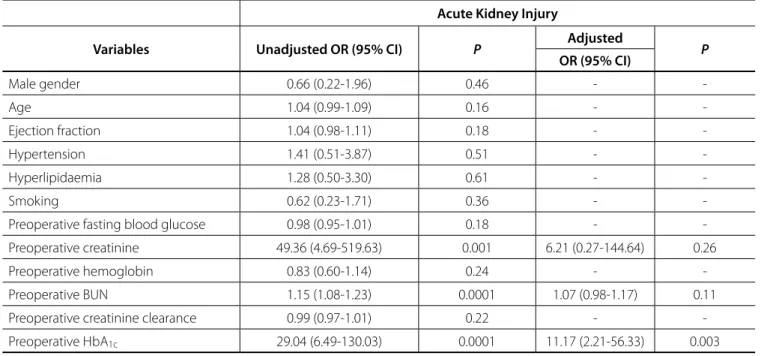
Results of univariate and multivariate regression analyses of preoperative risk factors that may inluence the development of AKI after CABG in non-diabetic patients are shown in Table 4.
In univariate regression analysis, preoperative creatinine (P=0.001),
Table 2. Preoperative and early postoperative blood results and haematological parameters of patient.
Preoperative and early postoperative blood results and haematological parameters
HbA1c<5.6
Group 1 (n=112)
HbA1c ≥5.6
Group 2 (n=90) P value
Median (min-max) Median (min-max)
Preoperative haemoglobin (mg/dl) 13.6 (10.4-16.5) 13.8 (10.5-16.0) 0.39**
Preoperative creatinine (mg/dl) 0.90 (0.60-1.38) 0.90 (0.60-1.30) 0.32**
Preoperative BUN (mg/dl) 16.0 (8.0-35.0) 17.0 (9.0-55.0) 0.10**
Preoperative creatinine clearance (ml/min) 109 (31-180) 111 (63-186) 0.96**
Preoperative fasting blood glucose (mg/dl) 94 (62-135) 95 (69-136) 0.74**
Postoperative irst day hemoglobin (mg/dl) 9.1 (7.5-12.0) 9.0 (7.4-12.6) 0.13**
Postoperative irst day creatinine (mg/L) 0.85 (0.50-2.00) 1.00 (0.56-2.60) 0.01**
Postoperative third day creatinine (mg/dl) 0.79 (0.40-1.70) 0.87 (0.50-3.90) 0.001**
Postoperative seventh day creatinine (mg/dl) 0.80 (0.50-1.80) 0.88 (0.50-2.80) 0.001**
BUN = blood urea nitrogen. *Pearson Chi-Square test or Fisher’s Exact test; **Mann-Whitney U test
Table 3. Intraoperative and postoperative data of the patients.
Characteristics HbA1c <5.6
Group 1 (n=112)
HbA1c ≥5.6
Group 2 (n=90) P value
Aortic cross clamp time (minutes)
Median (min-max) 60 (12-102) 57.5 (16-97) 0.94**
CPB time (minutes)
Median (min-max) 95 (30-138) 93.5 (37-138) 0.75**
Use of blood products 48 (42.9%) 44 (48.9%) 0.39*
Use of inotropic support 20 (17.9%) 14 (15.6%) 0.66*
Amount of drainage (ml)
Median (min-max) 350 (150-1100) 350 (150-1200) 0.51**
Intubation time (hours)
Median (min-max) 5 (3-9) 5 (3-12) 0.74**
Intensive care unit stay (hours)
Median (min-max) 21 (17-46) 21.5 (18-67) 0.004**
CPB = cardiopulmonary bypass. * Pearson Chi-Square test or Fisher’s Exact test; ** Mann-Whitney U test
preoperative blood urea nitrogen (BUN) (P=0.0001), and
preoperative HbA1c (P=0.0001) levels were found to be associated
with postoperative AKI occurrence. In multivariate regression
analysis, HbA1c (OR 11.17, 95% CI:2.21-56.33, P=0.003) was found
to be independently associated with an increased risk for AKI.
ROC curve analysis of HbA1c level, which was found to be
a risk factor for postoperative AKI occurrence in multivariate
regression analysis, is depicted in Figure 2. Cut-of value for HbA1c
level was determined as 5.75%, at which sensitivity, speciicity of the test, and AUC (area under curve) were calculated as 73.7%,
Study Limitations
There are some limitations to our study. This study was carried out at a single center, with a limited number of patients, and it was designed as a retrospective study rather than a randomized trial.
DISCUSSION
AKI, not rarely seen following cardiac surgery, prolongs ICU and hospital length of stay and results in increased health costs and mortality rates[1,2].
AKI following cardiac surgery is a multifactorial state. Risk factors are advanced age, presence of diabetes mellitus, hypertension, low preoperative glomerular iltration rate
(GFR) (<60 ml/min/m2), left ventricular systolic dysfunction
(LVEF<35%), preexisting kidney dysfunction, atherosclerosis of the ascending aorta, urgent or emergent surgery following myocardial infarction or percutaneous cardiac intervention, and
administration of nephrotoxic agents[13,14]. Intraoperative factors
also contribute to the development of AKI during cardiac surgery, such as renal hypoperfusion, nonpulsatile low, and systemic
inlammatory response syndrome due to CPB[15,16]. Demographic
data and risk factors for AKI such as hypertension, low ejection fraction and EuroSCORE values were similar in both groups.
Long term survival of patients operated for cardiac surgery is directly proportional to the severity of AKI, which is related
to changes in serum creatinine levels[17]. Our results showed
that patients with higher preoperative HbA1c levels had higher
creatinine levels at 1st, 3rd and 7th postoperative days. Nevertheless,
Fig. 2 - ROC curve analysis of preoperative HbA1c regarding occurrence of postoperative AKI. Cut-off value for HbA1c level was determined as 5.75%, at which sensitivity, specificity of the test, and AUC (area under curve) were calculated as 73.7%, 65.0%, and 0.76 (95% CI=0.62-0.95, P=0.0001), respectively
Table 4. Univariate and multivariate regression analysis of preoperative risk factors for acute kidney injury.
Acute Kidney Injury
Variables Unadjusted OR (95% CI) P Adjusted P
OR (95% CI)
Male gender 0.66 (0.22-1.96) 0.46 -
-Age 1.04 (0.99-1.09) 0.16 -
-Ejection fraction 1.04 (0.98-1.11) 0.18 -
-Hypertension 1.41 (0.51-3.87) 0.51 -
-Hyperlipidaemia 1.28 (0.50-3.30) 0.61 -
-Smoking 0.62 (0.23-1.71) 0.36 -
-Preoperative fasting blood glucose 0.98 (0.95-1.01) 0.18 -
-Preoperative creatinine 49.36 (4.69-519.63) 0.001 6.21 (0.27-144.64) 0.26
Preoperative hemoglobin 0.83 (0.60-1.14) 0.24 -
-Preoperative BUN 1.15 (1.08-1.23) 0.0001 1.07 (0.98-1.17) 0.11
Preoperative creatinine clearance 0.99 (0.97-1.01) 0.22 -
-Preoperative HbA1c 29.04 (6.49-130.03) 0.0001 11.17 (2.21-56.33) 0.003
there was no diference in mortality. Instead, there was a signiicant diference when associated with prolonged ICU stay.
AKI following CPB is an important cause of morbidity and
mortality[18]. Postoperative AKI requiring renal replacement has
an independent efect on morbidity and early mortality. It is
reported that the overall mortality due to AKI is 40-80%[11]. In
the recent literature, there are several studies regarding early diagnosis of AKI and prevention of the inlammation process that
is an accepted cause of AKI[19,20]. In a study by Freeland et al.[6],
blood transfusion was found as an independent risk factor for development of AKI following cardiac surgery. The same study also mentioned that longer aortic cross clamp and CPB times
increased the incidence of AKI following cardiac surgery[6]. In a
study by Khilji et al.[21], both CPB and total cross-clamp times have
been known as potential risk factors for developing kidney injury. In contrast with the literature, we did not ind any signiicant diferences between patients with AKI and without AKI regarding CPB and aortic cross clamp times and usage of blood products.
High mortality and morbidity rates following CABG operations have been reported in several studies in patients with type 2
diabetes mellitus (DM)[22]. In addition, some studies have shown
that type 2 DM increases postoperative AKI after CABG[23]. HbA
1c
level is a parameter used to evaluate long term glycemic control
in patients with DM[22]. The American Diabetes Association
included HbA1c level in the criteria for diagnosing DM[24]. Normal
HbA1c levels are accepted as 4-6%. Tekumit et al.[25] found that
the borderline level of HbA1c was 6.1% for patients undergoing
CABG. In their retrospective study, Hudson et al.[26] reported that
preoperative HbA1c levels over 6% were associated with 30-days
postoperative mortality and occurrence of AKI in patients without DM who underwent open cardiac surgery.
In our study, patients were grouped according to HbA1c
levels, with borderline level being described as 5.6%. Patients with levels higher than 5.6% had signiicantly higher incidence of AKI, according to KGIDO classiication. Our results revealed lower
levels of HbA1c than other studies as a risk factor for AKI[27,28].
According to the KDIGO 2012 AKI Guideline, cardiac surgery
with CPB is a 1B risk factor[28]. Despite the lack of consensus on
AKI and Hba1c levels in patients with no known renal disease,
HbA1c over 7% is deined as a Class 1A risk factor for patients with
chronic renal disease[28]. The cut-of value for AKI in our group of
patients was 5.75%.
Azevedo et al.[29] observed that, in critical illness, there was
a signiicant correlation between blood glucose levels and the
incidence of AKI. Halkos et al.[30] found that HbA1c levels greater
than 7% were associated with renal failure. Additionally, Gumus
et al.[9] found that elevated levels of HbA1c were associated
with increased renal complications. Likewise, in our study, a relationship was found between high preoperative creatinine,
BUN, HbA1c levels and occurrence of postoperative AKI in our
study. It was also observed that average HbA1c level in the
preoperative period is a predictor of AKI in the early postoperative period following CABG.
CONCLUSION
AKI following cardiac surgery causes multiple postoperative complications and leads to prolonged hospitalization, increased
costs, and eventually increased mortality rates. Our results
suggest that elevated preoperative HbA1c level is associated
with postoperative AKI and prolonged ICU stay in non-diabetic patients undergoing CABG. However, further prospective randomized studies are warranted to conirm these results.
Authors’ roles & responsibilities
CUK
ATK
RA
CD
HP
HS
OF
Conception and study design; execution of operations; analysis and/or data interpretation; statistical analysis; manuscript writing or critical review of its content; final manuscript approval
Conception and study design; execution of operations; analysis and/or data interpretation; statistical analysis; manuscript writing or critical review of its content; final manuscript approval
Conception and study design; execution of operations; analysis and/or data interpretation; statistical analysis; manuscript writing or critical review of its content; final manuscript approval
Conception and study design; execution of operations; analysis and/or data interpretation; statistical analysis; manuscript writing or critical review of its content; final manuscript approval
Conception and study design; execution of operations; analysis and/or data interpretation; statistical analysis; manuscript writing or critical review of its content; final manuscript approval
Conception and study design; execution of operations; analysis and/or data interpretation; statistical analysis; manuscript writing or critical review of its content; final manuscript approval
Conception and study design; execution of operations; analysis and/or data interpretation; statistical analysis; manuscript writing or critical review of its content; final manuscript approval
REFERENCES
1. Beyazpınar DZ, Gültekin B, Kayıpmaz AE, Kayıpmaz Ç, Sezgin A, Giray TA, et al. A comparison of two coronary artery bypass graft surgery techniques with respect to acute kidney injury. Turk Gogus Kalp Dama. 2015;23(4):643-50.
2. Ricci Z, Di Nardo M, Iacoella C, Netto R, Picca S, Cogo P. Pediatric RIFLE for acute kidney injury diagnosis and prognosis for children undergoing cardiac surgery: a single-center prospective observational study. Pediatr Cardiol. 2013;34(6):1404-8.
3. Kochi AC, Martins AS, Balbi AL, Silva MAM, Lima MCP, Martin LC, et al. Preoperative risk factors for the development of acute renal failure in cardiac surgery. Braz J Cardiovasc Surg. 2007;22(1):33-40.
4. Rodrigues AJ, Evora PRB, Bassetto S, Alves Júnior L, Scorzoni Filho A, Araújo WF, et al. Risk factors for acute kidney injury after cardiac surgery. Braz J Cardiovasc Surg. 2009;24(4):441-6 .
6. Freeland K, Hamidian Jahromi A, Duvall LM, Mancini MC. Postoperative blood transfusion is an independent predictor of acute kidney injury in cardiac surgery patients. J Nephropathol. 2015;4(4):121-6. 7. Ikeda F, Doi Y, Ninomiya T, Hirakawa Y, Mukai N, Hata J, et al. Haemoglobin
A1c even within non-diabetic level is a predictor of cardiovascular disease in a general Japanese population: the Hisayama Study. Cardiovasc Diabetol. 2013;12:164.
8. Faritous Z, Ardeshiri M, Yazdanian F, Jalali A, Totonchi Z, Azarfarin R.
Hyperglycemia or high hemoglobin A1c: which one is more associated
with morbidity and mortality after coronary artery bypass graft surgery? Ann Thorac Cardiovasc Surg. 2014;20(3):223-8.
9. Gumus F, Polat A, Sinikoglu SN, Yektaş A, Erkalp K, Alagol A. Use of a lower
cut-of value for HbA1cto predict postoperative renal complication risk
in patients undergoing coronary artery bypass grafting. J Cardiothorac Vasc Anesth. 2013;27(6):1167-73.
10. Okusa MD, Davenport A. Reading between the (guide)lines: the KDIGO practice guideline on acute kidney injury in the individual patient. Kidney Int. 2014;85(1):39-48.
11. Lassnigg A, Donner E, Grubhofer G, Presterl E, Druml W, Hiesmayr M. Lack of renoprotective efects of dopamine and furosemide during cardiac surgery. J Am Soc Nephrol. 2000;11(1):97-104.
12. Cockcroft DW, Gault MH. Prediction of creatinine clearance from serum creatinine. Nephron. 1976;16(1):31-41.
13. Maitra G, Ahmed A, Rudra A, Wankhede R, Sengupta S, Das T. Renal dysfunction after of-pump coronary artery bypass surgery: risk factors and preventive strategies. Indian J Anaesth. 2009;53(4):401-7. 14. Doddakula K, Al-Sarraf N, Gately K, Hughes A, Tolan M, Young V, et al.
Predictors of acute renal failure requiring renal replacement therapy post cardiac surgery in patients with preoperatively normal renal function. Interact Cardiovasc Thorac Surg. 2007;6(3):314-8.
15. Suen WS, Mok CK, Chiu SW, Cheung KL, Lee WT, Cheung D, et al. Risk factors for development of acute renal failure (ARF) requiring dialysis in patients undergoing cardiac surgery. Angiology. 1998;49(10):789-800. 16. Isbir SC, Tekeli A, Ergen A, Yılmaz H, Ak K, Civelek A, et al. Genetic
polymorphisms contribute to acute kidney injury after coronary artery bypass grafting. Heart Surg Forum. 2007;10(6):E439-44.
17. Hobson CE, Yavas S, Segal MS, Schold JD, Tribble CG, Layon AJ, et al. Acute kidney injury is associated with increased long-term mortality after cardiothoracic surgery. Circulation. 2009;119(18):2444-53. 18. Cruz DN, Ronco C, Katz N. Neutrophil gelatinase-associated lipocalin:
a promising biomarker for detecting cardiac surgery-associated acute
kidney injury. J Thorac Cardiovasc Surg. 2010;139(5):1101-6.
19. Arun O, Çelik G, Oc B, Unlu A, Celik JB, Oc M, et al. NGAL and cystatin C as early biomarkers for prediction of acute kidney injury in diabetic and non-diabetic patients undergoing coronary artery bypass graft
surgery. Presented at the 63rd International Congress of the European
Society for Cardiovascular and Endovascular Surgery 2014 Apr 24-27; Nice, France. J Cardiovasc Surg. 2014;55(Suppl 2 to No 2):79. 20. Loef BG, Henning RH, Epema AH, Rietman GW, van Oeveren W, Navis
GJ, et al. Efect of dexamethasone on perioperative renal function impairment during cardiac surgery with cardiopulmonary bypass. Br J Anaesth 2004;93(6):793-8.
21. Khilji SA, Khan AH. Acute renal failure after cardiopulmonary bypass surgery. J Ayub Med Coll Abbottabad. 2004;16:25-8.
22. Cohen Y, Raz I, Merin G, Mozes B. Comparison of factors associated with 30-day mortality after coronary artery bypass grafting in patients with versus without diabetes mellitus. Israeli Coronary Artery Bypass (ISCAB) Study Consortium. Am J Cardiol. 1998;81(1):7-11.
23. Kubal C, Srinivasan AK, Grayson AD, Fabri BM, Chalmers JA. Efect of risk-adjusted diabetes on mortality and morbidity after coronary artery bypass surgery. Ann Thorac Surg. 2005;79(5):1570-6.
24. American Diabetes Association. Standards of medical care in diabetes. Diabetes Care. 2005;28:4-36.
25. Tekumit H, Cenal AR, Polat A, Uzun K, Tataroglu C, Akinci E. Diagnostic
value of hemoglobin A1c and fasting plasma glucose levels in coronary
artery bypass grafting patients with undiagnosed diabetes mellitus. Ann Thorac Surg. 2010;89(5):1482-7.
26. Hudson CC, Welsby IJ, Phillips-Bute B, Mathew JP, Lutz A, Chad Huges G, et al. Glycosylated hemoglobin levels and outcome in non-diabetic cardiac surgery patients. Can J Anesth. 2010;57(6):565-72.
27. KDIGO clinical practice guideline for acute kidney injury. Kidney Int Suppl. 2012;2(1):1-138.
28. KDIGO 2012 clinical practice guideline for the evaluation and management of chronic kidney disease. Kidney Int Suppl. 2013;3(1):1-150.
29. Azevedo JRA, Azevedo RP, Lucena LC, Costa NNR, Silva WS. Impact of glycemic control on the incidence of acute kidney injury in critically ill patients: a comparison of two strategies using the RIFLE criteria. Clinics (Sao Paulo). 2010;65(8):769-73.
30. Halkos ME, Puskas JD, Lattouf OM, Kilgo P, Kerendi F, Song HK, et al.
Elevated preoperative hemoglobin A1c level is predictive of adverse