Case Study: Determinants for Choosing a Successor on
a Family Business
By
Gabriel Alexandre Tuna Canelas
Thesis Master in Management
Supervised by:
Professor Rui Couto Viana
iii
Biographical Note
Gabriel Alexandre Tuna Canelas was born in Zurich, Switzerland, in April 1993. Graduated in Economics by the Faculty of Economics of Porto (FEP) in June 2015. Started in September, the same year, the Master in Management at the same University as he graduated.
Did a professional internship at Sogrape Vinhos, S.A., in planning and management control, which concluded in August 2017. In September 2017, started working at Deloitte working as a consultant analyst.
iv
Abstract
The thesis aims to understand if the manager of a family business, who runs a company on the first stages of development and is addressing the succession process, takes in account the determinants, covered on the literature review, when choosing a successor.
The reason for this thesis resides on companies, which are profitable and are on the first stages of development, that have an open incognita over their future, being that future set on the next generation which may leverage the company to a new stage of development. The purpose is then to know if the interviewed companies take in consideration the determinants covered by the literature.
On the literature review there were selected some of the determinants taking in account the decision making process of the manager on a family business. The object of study are managers of companies which placed on the first stages of development, working as a proxy to a Small and Medium Enterprise. To gather the necessary information, there were conducted semi-structured interviews to enable the
understanding of a broad topic as succession. The survey was disregarded due to the complexity over the subject, time constrains and difficulty in targeting the necessary number of companies to withdraw robust conclusions.
The older son is the chosen successor having aligned their academic education with the branch of activity of the company, feeling a sense of duty to the family. A specific academic background was regarded as mandatory as well as the experience in other companies on the same branch. On all cases the successors were not interested on succeeding their father, therefore the managers were adapting the company to better fir the desire of the successor.
JEL Codes: L29; M19; M59
Keywords: Succession, Family Business, Transition Process, SME, Life Stages,
v
Resumo
Esta tese tem como objetivo perceber se o gestor da empresa familiar, que esta nos primeiros estágios de desenvolvimento da empresa e está a endereçar o processo de sucessão, leva em consideração os determinantes, cobertos na revisão da literatura, quando é feita a escolha do sucessor.
A razão da tese reside em empresas, que sejam lucrativas e que estejam nos primeiros estágios de vida, que tenham o futuro em aberto, estando esse futuro na próxima geração que poderá vir a alavancar a empresas para um novo estágio de
desenvolvimento. O propósito é então perceber se os determinantes que levam à escolha do sucessor nas empresas entrevistadas são os mesmos endereçados na literatura.
Na revisão de literatura foram selecionados determinantes que são tomados em consideração pelo gestor nas empresas familiares. O objeto de estudo são empresas que se encontravam nos primeiros estágios de vida da empresa por serem uma melhor aproximação a Pequenas e Médias Empresas. Para a recolha de informação, foram realizadas entrevistas semiestruturadas com vista a entender um tópico tão abrangente como é o da sucessão. O inquérito não foi considerado devido à complexidade do tema, limitação face ao tempo disponível e a dificuldade em conseguir obter respostas de um numero de empresas suficientes para retirar conclusões robustas.
A escolha recai sobre o filho mais velho, tendo alinhado a sua formação académica com o setor de atividade da empresa, havendo um sentido de
responsabilidade para com a família. A formação especifica numa área é tida como obrigatória, assim como experiencia em companhias do mesmo ramo de atividade. Todos os gestores reconheceram a falta de interesse do sucessor, e estavam a tentar adaptar a empresa ao desejo dos filhos.
JEL Codes: L29; M19; M59
Palavras-chave: Sucessão, Empresa Familiar, Processo de Transição, PME, Estágios
vi
Table of Contents
1. Family Business Review ... 4
2. Family Management and Succession ... 13
3. Life Stages ... 26
1. Company Presentation ... 39
2. Stage Placement ... 43
3. Determinants for the Succession ... 51
1. Appendix 1 ... 61
2. Appendix 2 ... 68
vii
Figure Index
viii
Table Index
Table 1: Characteristics of Family Firms……….…….8
Table 2: Weight of Family Firms Worldwide……….10
Table 3: Weight of Family Businesses Among All Businesses by Size Class……..…..11
Table 4: Factors Contributing for a Successful Transition………..…22
Table 5: Determinants of succession in a Family Business………...…24
Table 6: Matrix of Variables Description per Life Stage………....30
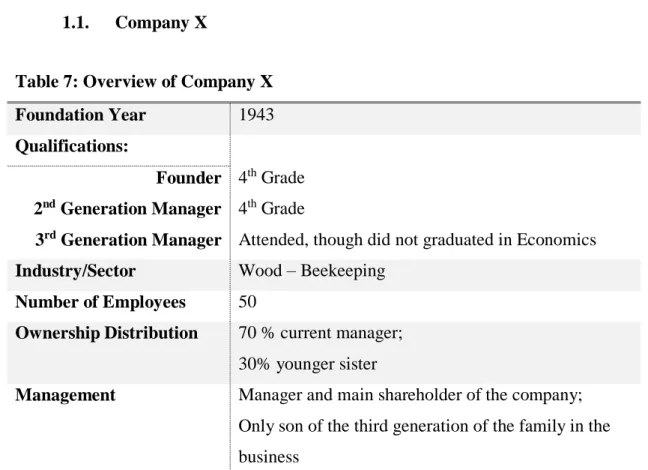
Table 7: Overview of Company X………..39
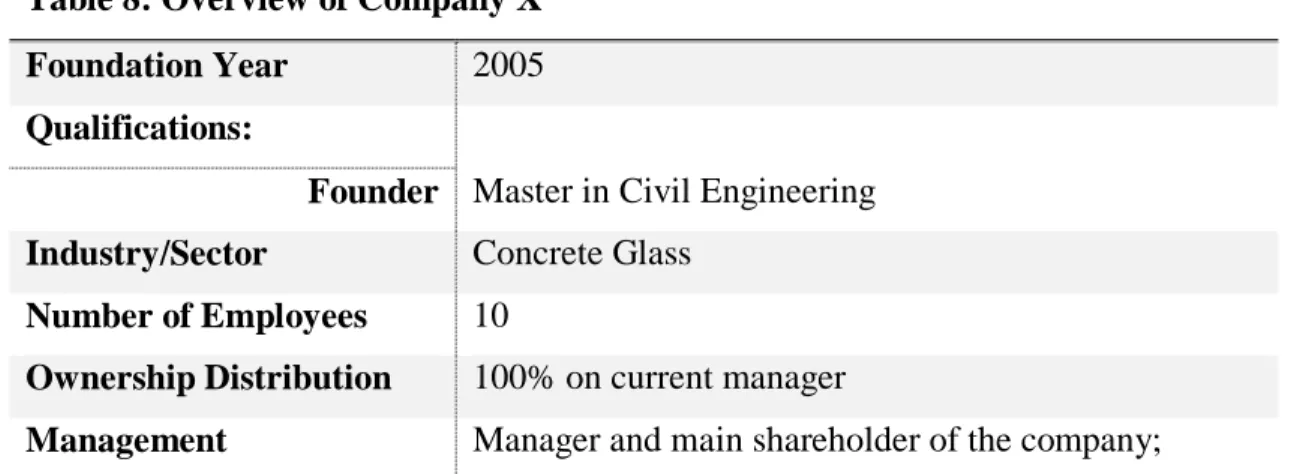
Table 8: Overview of Company Y………..41
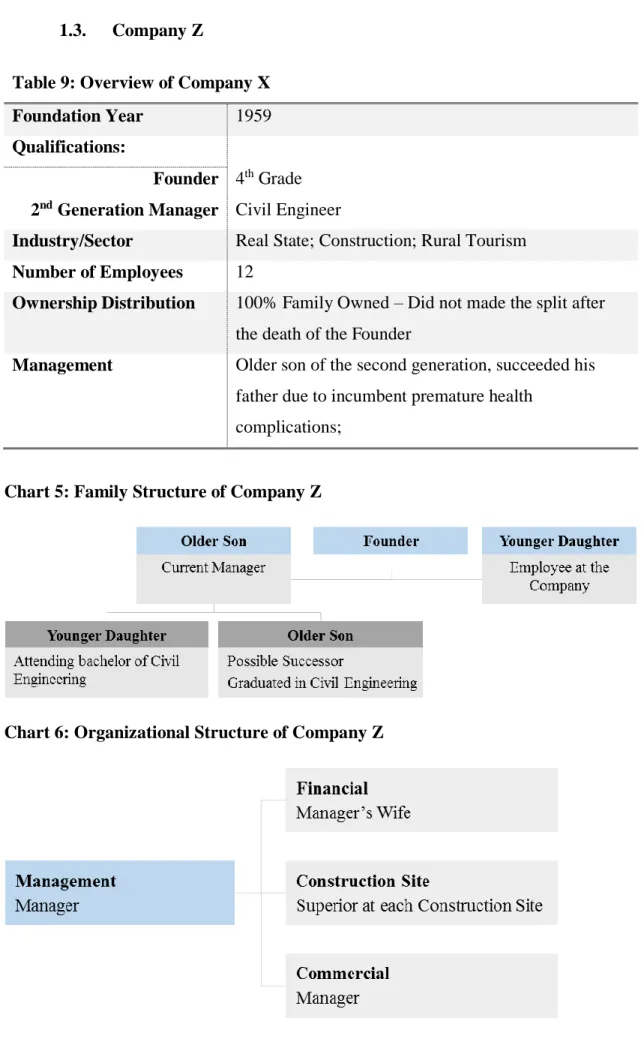
Table 9: Overview of Company Z………...42
ix
Charts Index
Chart 1: Family Structure of Company X………...40
Chart 2: Organizational Structure of Company X………...40
Chart 3: Family Structure of Company Y………...41
Chart 4: Organizational Structure of Company Y………...41
Chart 5: Family Structure of Company Z………....42
x
Abbreviations
APEF – Associação Portuguesa das Empresas Familiares CEO – Chief Executive Officer
CFO – Chief Financial Officer EG. – Example
FEP – Faculdade Economia do Porto
GDP – Gross Domestic Product
Introduction
The defining moment of succession sets as one of the major moments for a family business to test its endurance and flexibility capacity to a change in management, especially when the position we meant is the one which holds the responsibility of leading the entirely company. A change in who is the responsible for the decision making of the company in the future relies on the current manager of the company.
The thesis aims at understanding in the manager opinion what are the
determinants for choosing a person in particular to succeed him. The manager who is aware of the needs of the company is the best person to hold the power of choosing his own successor, such power is easier for a manager to have, in case he also has the control over the company. The particularity of the thesis is then to narrow the analysis within the family business scope. The complexity increases since the company, besides the wide number of stakeholders that has to address, has the interference of family.
The vast majority of the companies throughout the country, as well as
worldwide, are family businesses. Reinforcing the importance of the study, in Portugal, family firms are particularly young, being 50,51% on the first or 31,31% on the second generation, and therefore did not yet had the need to seriously engage on the transition topic. A growing number of successful family businesses in Portugal are coming to that same defining moment, the lack of references from other companies to aid the CEOs of the firms, are an obstacle surrounding the process (Familiares, 2010a). {Familiares, 2010 #62}
To mention, there is the opportunity to test some of the extensive scientific studies conducted on successions in family business. Most of the studies done were concerning the process of succession and how it should be conducted or the difference in firm’s performance between those whose manager got replace by a family member and an external agent.
The succession presents itself as a problem to overcome by the company, due to the passage of time, the renewal to a new generation is inevitable and the transition tends to gain importance as the company grows in size. The growth puts an emphasis over the person who will lead the company in the future to assess if in fact the person is
2 capable of performing at the desired level. The owner and manager have then an
obligation of correctly choose the successor.
The case studies analysed consist on family businesses which are addressing the succession of the business and are on the first stages of development. The manager addresses the succession if in fact the business is worth to pass to the successor, on this case, it needs to be profitable to support the next generation. Moreover, only when a manager is addressing the succession will he think more carefully on what are the determinants for the choice of the successor.
On the first chapter, after defining Family Business, it is addressed the
characteristic of a family business as well as the importance of family firms worldwide and more specifically in Portugal. Secondly, the literature review over succession, started by defining family business, overviewing then the major family stakeholders on succession. There were specified the factors which lead the company to a successful transition and then the determinants when choosing the successor. Thirdly, an analysis over the literature of Life Stages of companies is conducted to place the companies on a life stage.
On the second chapter, the Methodology focus firstly on the arguments
supporting the choice over a qualitative analysis of the problem, and a literature review supporting the validity of conclusions withdrawn from a semi-structured interview.
The third chapter concerns the analysis over the interviews first doing an overview over the company and the family’s chart, followed by the placement of the company on one stage of its development. Afterwards the literature contributions concerning the determinants for the succession were explained. The determinants were then observed to know if the manager took them in account when choosing the
successor.
3
Literature Review
The literature review is structured to properly introduce the concept as they are analysed throughout the interview analysis. Firstly, there is a definition of family business, which the companies interviewed need to be align with, secondly, there is a synthesis on the characteristics of a family business, followed by an assessment on the weight of the family business both worldwide and on Portugal.
Afterwards there is the literature on succession analysing first the family
management of a company, followed by addressing the stakeholders directly influenced by the business transition on a family business. As an analysis over the positive
influencers of the succession on the enterprise, emphasizing the importance of a strategic approach on a company. Lastly, there are an analysis over the determinants covered by the literature.
The last subchapter there is an introduction on life stages of a company that sets the basis for the placement of the interviewed companies on a given stage. After the definition, there is an overview over some of the existing theories of the Life Stages, to finally aggregate on a matrix to assess the companies to be studied.
4
1.
Family Business Review
Social organization in anthropology arises a norm so that concerns under the
sphere of influence of the family are dealt by the family itself and so deciding their course of action (Fortes, 1970, p. 305). A family firm is therefore seen as a family oriented occupation and focused primarily on the support of their own relatives, the logical assumption is that family businesses are considered to belong to the category of Small and Medium Enterprises and the normal attitude is to overlook these companies.
Although, worldwide the weight of family firms its around 65 to 80 percent, when assessing the Standard & Poor’s 500 firms between 1992 and 1999, 35% of the companies were family enterprises (Anderson and Reeb, 2003; Faccio & Lang, 2002). The ratio of family firms in Europe is believed to be of about 66% of all the European companies, moreover, it accounts for 40% to 50% of the jobs holders (Flören, 2010). The vast majority of companies worldwide are controlled either by the founders or the descendants, regardless if they are privately or publicly owned.
1.1. Definitions
Family control and ownership can be a distinctive feature influencing a company in a way a professionalized company is not, giving the goal of a family for shaping it according with their values (Chua, et al. 1999). Though being “family” a hard concept to define, the definition of family business is not the same throughout the literature
(Astrachan, et la., 2002).
As an example, family business can be defined as: “A business is a family
business when it is an enterprise growing out of the family’s needs, built on the family’s abilities, worked by its hands and minds, and guided by its moral and spiritual values; when it is sustained by the family’s commitment, and passed down to its sons and daughters as a legacy as precious as the family’s name” (Astrachan et al., 2002, p. 46).
A second definition is provided by the Portuguese Family Business –
“Associação Portuguesa das Empresas Familiares”- supporting itself more over the functional approach of a family business, “A company is a family business if its
ownership is wholly or substantially in the hand of one or more families, and the family has control over the management of the company.” (Familiares, 2010b).
5 A third definition: “The family business is a business governed and/or managed
with the intention to shape and pursue the vision of the business held by a dominant coalition controlled by members of the same family or a small number of families in a manner that is potentially sustainable across generations of the family and families”
(Chua et al., 1999, p. 25).
The first definition delivers a more ambiguous and abstract conception, non the less, emphasizes the moment for the succeeding generation to take the control of the company, referred as a family’s legacy.
The second definition enhances the family control of the company as a necessity and the rest of the family involvement for it to be considered a Family Business.
Although it still lags towards the first definition not considering the generational transition of the company and the consequent burden or responsibility, enhanced as the “legacy” transferred from the incumbent to the successor, being the last, a family relative.
The importance of the transition and control is addressed in the third definition, as the first does, though it enhances the family ownership.
The control and ownership makes it effortless for the family to frame the firm’s strategy aligned with their vision since the time needed for that objective to be achieved under their governance is easier to be spared if they have the control over the company, by either the founders or the descendant successors. In addition, the option for that control to be kept throughout time provided their power of decision towards the company’s policies for being the owners.
The third definition is therefore the one that encompasses the broad topics directly dealt by this thesis.
Authors agree on the importance of the topics related with control, ownership and transition for differentiating a family business from a non-family firm. While some of the authors reflect on defining it on a broad and theoretical way (Chua et al., 1999; Dyer, 1994), as the definitions above demonstrate. Some other authors decided to define it under a more objective scope and to better access if a company is in fact a family business, they needed to obey to the following characteristics (Astrachan & Kolenko, 1994):
6 More than one family relative works on the company or the founders as already
appointed the second generation for the family control; The company has ten or more employees;
The annual volume of sales is superior to two million dollars; The company has at least more than ten years of existence.
The main objective to retain from the criteria above is that firm sets as a property of the family, having the control over the decision process. Their role on the firm is different from any other stakeholders, since they are representatives of the company.
Providing the economic landscape of Portugal, we are going to disregard the fourth point considering the annual volume of sales, though the other criteria will be relevant providing the basis to validate the companies as to classify if they are a family
business.
1.2. Characteristics of Family Businesses
In this case, the definitions are an extension over the characteristics of the family business, arising most of them from the difficulty of managing family and corporate relationships when owning or managing a business (Tagiuri & Davis, 1992).
A company faces internal dilemmas, adding to this we have all the
unpredictability of the market or sector they are operating. Family is presented when dealing with the challenges, either by being crucial employees, part of the board
advisors or shareholders. The holistic model of family businesses and their environment can explain the conflict of interest taking place in the company (Ussman, 1996).
7 The family oriented reasoning of family member assumes that the identity of the family depends on the company and perceives it as a heritage and his primary financial security. The employees who have their careers dependant on the company emphasizes the need for the company to generate profits and grow. The shareholders are focus rather on the profits seeing the company only as an investment (Ussman, 1996).
The expectancy for the firm to successfully manage the goals of the different stakeholders would appeal for it to be profit oriented, though it carries a strong emotional connection (Davis & Stern, 1988), providing the possible family conflicts, that can be both corporate or familiar related (Levinson, 1971).
The proper management of expectations from the stakeholders is common to all firms; the only different factor is the family ties being drawn to the company and,
Source: (Donckels and Fröhlich,1991; Andrea, et al.,2008)
8 according to Holland et all. (1984), it poses as a possible reason that can lead the family business to a better or worse financial performance (Olson et al., 2003; Ussman, 1996).
The characteristics dealing with family relations and the passage of the family’s identity to the company are the characteristics analysed on Table 1, taking in account their relevance for the studied topic.
Table 1: Characteristics of Family Firms Characteristic
Founder Dependency
Company is an extension of the founders Vision, experience and knowledge, being the banner for the company to grow. Vision is kept throughout the years and generations valuing it as tradition (Levinson, 1971; Ussman, 1996).
Descendants
Pressure for their professional orientation to be aligned with the company’s needs, and so for the descendants to follow the strategic vision of their predecessor (Ussman, 1996).
Conflict of Interests
Generational conflicts related with ownership, leadership or birth right in having a certain part to play on the firm (Levinson, 1971).
Partisanship
Family engagement is complete, creating barriers for family members to find occupations elsewhere and for new entrants to assume relevant management positions, creating a sense of commodity and responsibility for the family relatives
depending on the level of elaborated institutional restrictions (Donnelley, 1964; Ussman, 1996).
Family Identity
The importance of the family name leading for a change from a rational in favour of an emotional reasoning, the link the family’s reputation can then be beneficial (as an example, the assurance in loans) and maleficent in case the prospects of profits are remote (Donnelley, 1964; Ussman, 1996).
9
Long Term Oriented
Strategy is seen as a “legacy” and preferable actions lay on long-term profits rather than immediate results (Donnelley, 1964; McCann, et al., 2001).
Conservative
The “Modus Operandi” once successful is the right one to follow, an attempt to change it meets a strong opposition, reflecting on a slow adjustment to the market enabling it to adopt to market developments or seizing opportunities (Donnelley, 1964).
Loyalty
Leading to a dedication of the core management group of the family and the employees, being reflected on a lower
turnover, particularly important to Small Firms considering the time and expenses incurred to train employees (Donnelley, 1964; Schulze, et al., 2001).
Ownership
New entrants by acquiring or selling part of the company are not seen as a viable way for founding. A public offer in the stock market requires also a higher level of information release, contradicting the conservative characteristic of the family business (Schulze et al., 2001; Ussman, 2004).
Qualitative characteristics appear throughout the time existence of the company being able to validate the definition on the previous subchapter, and are needed for the family to keep the ownership and the voting control over the company as well as the family involvement to so possess the characteristics above mentioned. The third
demand would rely on the generational transition not to be solely a “one person” project as to keep the essence of long-term oriented strategy, but to be a coordinated process to better meet the expectation of the stakeholders.
10
1.3. Family Business in Numbers
The contribution of family firms to a country’s economy is normally sizable, consisting on over 50% of the companies present in the country. When accessing the major owner of the withstanding shares of a publicly traded firm, 30% of those
companies were family owned in a pool of 36% of widely held companies (Porta, et al., 1999).
As seen on Table 2, family firms’ wide presence on the market is reflected on their contribution to the economies where they are operating.
Portugal follows the same path as the examples above provided, during the same period, 70% of the Portuguese companies were family firms and totalizing 60% of the Portuguese Gross Domestic Product (Geoffrey et al., 2008).
Table 2: Weight of Family Firms Worldwide
Country Relative Share (%) Percent of GDP (%)
Austria 83,2 - Belgium 69 55 Germany 82 55 Finland 63,2 - France 60,5 - United Kingdom 67,3 - Netherlands 51,7 54 Switzerland 67,2 -
United States of America 92 40
Italy 75-95 -
Spain 70-80 65
Sweden 90-95 -
Poland 50-80 35
Brazil 80 65
Source: Donckels & Fröhlich (1991); Geoffrey et al. (2008); Neubauer & Lank (2016); Shanker & Astrachan (1996); Ussman (2004)
11
1.3.1. Dimension
Although most of the family businesses are thought to be Small and Medium Enterprises, there are several big conglomerates such as Wal-Mart in the United States of America or Grupo SONAE and Amorim in Portugal (NEVES, 2001).
The inferred conclusion is partly correct since the growth on size of the company reflects on the decrease of the weight of family firms on the segment, as showed on table3.
Table 3: Weight of Family Businesses Among All Businesses by Size Class Number of Employees Relative Share (%)
1-9 77.4
10-19 69.2
20-49 67.8
50-99 51,6
Over 100 50,8
Source: Donckels & Fröhlich (1991)
Following one of the characteristics, previously presented the family firms are reluctant to accept external founding if it consists on acquiring shares of the company. Being the objective of the family to keep the ownership of the company, it can possible be an obstruction to the company´s rapidly growth (Schulze et al., 2001).
Being the family firms potentially less profitable, they are not able to reach a considerable scope. However, the same reasoning supports the idea that such an underlying logic can be a factor for the enterprise to grow and prosper. Since the managers are deeply connected with the company, being themselves the major shareholders on most of the times (Familiares, 2010a), they are less willing to adopt potentially riskier strategies which have a higher probability of jeopardizing the
company. The choice than relies on lower risk strategies bearing a possibly lower return on capital, though, increasing the chances of a higher net present value from the profits of the investment decision (Ussman, 2004).
12
1.3.2. Portuguese Landscape
According to APEF (Associação Portuguesa das Empresas Familiares) the majority of the Portuguese family firms are located on the north and coastal regions of Portugal, represented more on the service sector (36%), followed by the commercial sector (28%) and industrial sector (23%). The ownership of the company is either retained as a whole by the family (86%) or then more than 51% (7%) (Familiares, 2010a).
The family owning the company is reluctant to the entrance of new shareholders, such an approach is more common in countries where the minority shareholders are less protected by state of law, which is the case of Portugal (Porta, et la., 1998), emphasizing then the fear of the families losing their influence over the company, when selling their shares to external shareholders. Since downsizing the percentage of the ownership will affect their voting power, it is expected from them to retain the ownership as time permits it, to efficiently keep the control of the company.
In Portugal, 10% of the large public traded firms were widely held; being 45% owned by the family, in the case of the Medium sized companies, 50% were family owned. The families own 38% of the market value of the top 20 firms of the country and in 44% of the cases, if the family controls the company than manages it as well. To emphasize the power of the family companies, it is to note that is Portugal, in 56% of the family owned businesses, are the only shareholder (Porta et al., 1999).
1.4. Conclusion
A change in a company, with a sizable cash flow as some big family businesses in Portugal and worldwide, affects various stakeholders, their employees’ poses as the most direct one. Considering the family firm’s employment and GDP weight in a country’s panorama, any shift on their procedure that could change the company’s performance draws the attention of market and public.
Therefore, is natural for the spotlight to be set on not only the firm decision though also on the family itself.
13
2.
Family Management and Succession
Succession is an event that affects every enterprise, the reasons for such are various, the incumbent, being the member of the family serving as the company CEO who transfers the position to another person (De Massis, et al., 2016), resigns, retires or dies, or it can be required for the company to change. In the other cases, such as firing or relocation, the company can take some action over the decision making process (Gephart, 1978).
A company addresses the problem of succession when it ages and reaches a dimension when the concern over the succession is important for the survival of a company that has now more stakeholders to address. The same happens when a company does the mistake of not planning a succession and when the problem arises and they are faced with a difficult transition, they take precautions for it not to happen again on future generational transitions (Handler, 1994).
Despite all, the succession in a company is a certainty; therefore, it could be controlled by anticipating it.
2.1. Definition
Succession Planning is how “an organization identifies and develops strategies
aimed at reducing or eliminating existing or anticipated human capita gaps”
(Crumpacker & Crumpacker, 2007, p. 1).
Succession planning when applied to family business generates a formal process which easies the management control transfers from the incumbent to the successor (Sharma, et al., 2003).
2.2. Family Management
Concerning the moment of deciding whom to be the successor. The professionalization of the company is always an option, that same moment can define the end of the family business in what control is concerned, though the ownership can be kept (Handler, 1990). The optimal choice could be for the management to be kept on the family, provided the better financial performance of a family managed company when
14 compared to a professional managed company (Anderson & Reeb, 2003). Despite it, there is the possibility of withdrawing the family factor, which encompass an emotion to an environment which appeals for a rational behaviour with a professionalized management (Barnes & Hershon, 1976) as well as removing an adversity to expand internationally the business as are the family business (Harris, et al., 1994). As on De Massis et al. (2016) the higher the ownership duration, and the higher perceived positive firm performance, less likely it is for the founder to engage in a family succession process.
The dichotomy of choosing between a professionalized management and family managed rely on the objective of choosing the best for the company. The priorities rely on long-term financial performance and an effective management team to meet these objectives. Proof of this is the willingness of innovative family business on favouring the career developments of non-family members over family members (McCann et al., 2001).
The long run thinking is one of the characteristics of the family business, being the company the support of the family. For such the company needs to assure the prosperity of the business for the future and being the life spam of a family business 24 years in medium, than it must be assured the survival through the succession process as possibly a transgenerational succession as well to survive through the first generation (Anderson & Reeb, 2003; Daspit, et al., 2016; Handler & Kram, 1988).
The process tends to be neglected (McCann et al., 2001; Sharma, et al., 2000), despite the concerns over it. On the annual survey on family business, the primary concerns were on the implementing intergeneration communication, family control of the company and to instruct the successor (KPMG, 2016). Although in 2016, 43% of the family firms did not possess a succession plan and only 15% had a broad sketch of their action plan of the succession on the company (PWC, 2016).
In a survey conducted to American Companies, 56% of the companies will be dealing with the retirement of their CEO in the next 10 years, and only 40 % of the enquiries had already chosen a successor (Galvin, et al., 2007). The pressure over the decision is important not only for the survival of the company, though also important for the national economy, given the number of family firms in the economy (Flören, 2010).
There is general lack of planning for a succession process, despite the recognition of the same people who ignore it, of the importance to plan the transition for the next
15 generation. A reaction approach to the problem would be to avoid a possible a threat, as a succession. As so, the best practice would be to prepare the succession between a professional or a family managed transition process, being the responsibility of the manager to decide.
2.3. Stakeholders
A decision as a transition holds in regard to wide number of stakeholders, who directly or indirectly have an interest on the transition process and the successor choice. The reasons for choosing a successor depend on the CEO of the company, having him the sole power in case the holds the control of the company as well. Despite that, there are agents who are influenced and influence the manager. On this case, we are going to analysed the primary stakeholders on how they regard the succession, putting an
emphasis over the manager and owner of the company. Despite the primary agent being the founder, we are going to revise the successor, and the family being the possible influencers in the process.
2.3.1. Founder
The vast majority of the literature studies the holder of the company, such dependence of the company over the founder is reciprocate, being on most cases the owner of the company (Rubenson & Gupta, 1996), holding the founder constrains towards the succession and the succession planning. In (Lansberg, 1988), the reasons could be related with the reluctance on ceasing to control the company, by increasing the dependency of the company towards him by taking in responsibilities that could be delegated to lower management levels.
The negative effect of seeing his role on his community compromised with the loss of his defining positioning on the company (Lansberg, 1988) is a sight of deviation from what are the best interests of the company (Barnes & Hershon, 1976; Peiser & Wooten, 1983).
Opposing the notion is De Massis et al. (2016) who defends incumbents
(patriarchs of a family business) have a positive attitude towards succession planning on certain scenarios. The higher the number of children, the more children he has the more responsible he feels to accommodate jobs in the firm for his children to maintain their
16 living standards. Founder’s emotional attachment to the firm increases his responsibility to leave the business in the proper hands, being such a position better suited for a family member. Despite such reasons, he is negatively influenced to engage in a succession process: by the number of family shareholders, high ownership duration, and the higher perceived positive firm performance.
Concerning Handler and Kram (1988), the focus resides on the resistance to change, addressing on the individual level, the founder perspective, is positively influenced by his bad health, though negatively by his perception of the company
independence towards him, having delegated responsibility to other management layers. Long-term critical self-analysis leading to an anticipation of the transition of power, openness and initiative on seeking specialized advice increases the acceptance and delivering the desire of a successful transition. On an interpersonal level, the avoidance of honest communication inside the company and family, concerning the subject and the timing of the heir’s engagement, compromises the heir. It was not provided time for him to adjust to the demands as well as to the system to absorb the successor, being the primary objective to pair the retirement of the founder with the readiness of the successor (Lansberg, 1988).
As found in Peay and Dyer (1989), the probability of an entrepreneur preparing a succession planning is as higher as more oriented the leader is in making choices which will benefit the others. On the other hand, if the incumbent takes pleasure of its position as a leader, for the opportunity of influencing and controlling with power invested on him, the less likely it is for him to initiate and plan the succession process.
Levinson (1971) undermines the feeling of the leaders towards the company as being their symbol of authority over the figures who controlled them (usually their father), assessing their employees as instruments and holding the company as their legacy. Rivalry feeling over the possibility of the power being taken by someone of the company can lead to a defensive behaviour to mitigate such threat.
De Massis, et al. (2008) also address the unwillingness of the incumbents in resigning his obligation throughout time and to assure the integration of the potential successor allowing him/her with enough time to adapt and not long enough for the successor to look for opportunities outside the company. Incumbent’s premature death
17 reinforces the need for planning and to alignment the criteria between the competences of the successor and the business needs.
According to Sharma et al. (2003) the incumbents are inclined towards the hypotheses of management of the business being kept on the family in case a member of the family shows enough potential. The same transition over management needs to be agreed by the manager, to so prevent a possible desire of the same coming back. In case of a worthy successor, the incumbent is proactive in planning the succession process and willing for the succession to take place within the family scope.
Wasserman (2003) focus on succession in smaller firms, noting that a skilful and successful entrepreneur is normally replaced soon after overcoming a tremendous challenge the company was facing and demanded his competences to solve it, and so the needs evolver faster than the CEO competences. On an early stage company, the
founder possesses technical competences aiming at product development, when priorities shift for marketing and commercial activities; the founder’s competences mismatch the demands. In the same line, raising new capital, on a company’s early stage, or equity control on a later stage, can have a similar effect, lack of trust on the CEO and the strength of investors, can lead to a replacement of the founder.
Barnes and Hershon (1976) transitions in family business carry a new generation to power and new objective being no longer the survival but the growth of the business. The newly orientation is perceived by different stakeholders, putting then pressure over the founder, who does not perceive the necessity for change and avoiding to address the transition topic the more pressured they are (Rubenson & Gupta, 1996).
The broad investigation is set on the unwillingness of the leader to leave and prepare the successor, though an engagement on the succession process needs to be initiated by the leader or accepted by him. There is also a need for the incumbent to create an awareness, or have someone who aids him, to recognize the flaws of his behaviour, as well as keeping the focus on the company needs rather than on his owns.
2.3.2. Successors
The second end point of the transition is the person to replace the soul of the company, encompassing the responsibilities of such a position, for so Barach, et al. (1988) enhanced the best practices for introducing the successors to gain a position of power. The normal approach relies on early entry to obtain acceptance, by behaving in
18 accordance to the company culture and modus operandi, or by earning credibility, in introducing a disruptive work behaviour, to so achieve legitimacy over his destiny of becoming the successor and leader of the company.
Decisions concerning the succession process can be delayed until the last moment leaving little time for training. From the heir perspective about intentions for the future, in Birley (1986), the majority (58%) expected to work in the family company at some point in time, a will not imposed by their parents’ pressure, feedback shared by the older son as well. Although the successor felt a duty towards the family and
business provided the higher education pursued. An opposing view however is given by Sharma (2004), stating the uncertainty of the successor towards their future endeavours when compared to their peers.
Levinson (1971) refers the struggle of the successor, who demands responsibility, to overcome his father’s control, who sees him as immature and unprepared, ending in a constant dispute between the two. Such a dispute is not to be emotionally based, and needs to be understood by both parts if the confrontation is helping or jeopardizing the business, if not so, a possible third party moderator might be needed.
De Massis et al. (2008) defend the integrity needed to be recognized by the stakeholders of the company to give attention to the family commitment with the successor. Identified factors such as lack of motivation, insufficient exposure, rivalries with the incumbents, mediocre feedback tend to undermine the successor prospects.
For Ip and Jacobs (2006), in case an heir does exist, the first choice is the older son, if not yet prepared, but willing to lead the business, succession is postponed, until he is or the circumstances demand it. Gender preferences tend to fall over the male rather than female, not being such a tendency due to performance differences.
Being the goal is for the new generation, if the successor desires, to not only assume the management but to be capable of taking the company to the next stage, then there is a need to account for a timely process and to start planning for a transition.
2.3.3. Family
Davis and Stern (1988) identify the problem of a family business transition from the first to the second generation normally calling for a change from an entrepreneurial to a professional management structure. The change tests the ability of the family to
19 assimilate the change without majors constrains to so mitigate the negative effects on the scenario where the incumbent and the successor behave inadequately.
While the family can be seen as an element to balance relationships in Levinson (1971) it is appealed to the need of professional guidance who can distance himself from the family dynamics. Being the different family members so imbedded in the company behaviour, the confrontation between all the branches of the family can support a professional managed transition.
Being then the family’s harmony the major objective, in Lansberg (1988) the founder’s partner interference can avoid the transition to not compromise that harmony. As in Levinson (1971) the partner is mentioned has to have a preference for the older son.
Considering the intergenerational transitions, Barnes and Hershon (1976) refers that the younger generations do not undergo the same distress as companies going through a transition for the first to the second or second to third generations. Since the growth of different family branches, tend to complicate the choice. There are more back stages games of influence to seize the opportunities inside the company.
The first transition it is characterized for consisting on confrontations between father and son being a constant trade-off between authority and autonomy. The second generation has as trademark collaboration, being the third, cousins, emotionally more distant than the previous ones, turning top management very likewise to the professional managed companies (Hershon, 1975).
The interference of the family in the transition process is different on the several generational transition of the company. The intrusion is natural provided the closeness of the entire family in the business, being themselves a stakeholder with a power
decision who need to aligned their preference with the company, and being possible that one of the family members needs to stand as a mediator on the transition process.
2.3.4. Employees
The employees of the company are the direct agents who are going to experience the transition and have to adapt to the new management style.
Different life stages of the company demand distinctive competences from the employees (Greiner, 1972), not aiming for their replacement though rather the growing necessity of more employees (Peiser & Wooten, 1983). The growth in size creates
20 layers of management and distance the top management from the employees, specially the original who perceive the change in behaviour towards them. Long-term employees had an informal relationship, and need to establish a new with the upcoming generation being it generally a formal one (Lansberg, 1988).
As the new generations lead to a change in the work environment and the demand over the competences for the job, the older employees starts to perceive throughout time a loss of power and respect they used to possess. Emphasized by the development of this new employees oriented towards a proper talent management (McCann et al., 2001), creating an uncertainty over the maintenance of their jobs (Barnes & Hershon, 1976).
2.4. Environment Influence
Undoubtedly the uncontrolled variables of the business which make their environment can be both an opportunity or a threat for the transition, the holistic model by Donckels and Fröhlich (1991) refers, though does not develop to what extent it can impact the company, leaving there a gap on the theory.
Greiner (1972) based the transition between the different phases on a need of the company to change, being influenced by internal operations which were not enough to respond to the growing company’s demands towards the market it was inserted on, management transition though not encompassed on the theory and can then be that change to deal with those same demands.
The answer to the problem may also turn in a weakness with agents who are placed on the wider scope of the business see their relationship as either customers, suppliers or debt holders compromised provided the shift on the firm’s representative (Lansberg, 1988).
Other environmental factors such as the geographical location, remote and undesirable, narrow the possibilities of people to succeed. The industry unpredictable arisen problems on a company which does not have the ability to respond properly, a disruptive innovation on the industry or an industry that advocates for the family’s ownership or management (Handler, 1990).
21
2.5. Factors Contributing to a Successful Transition
Each case is a case, the different studies based their theories on patterns of practices which allowed the transitions on the business to be conducted on the best matter. Besides the already mentioned need for the succession to start being address on an early stage (Peiser & Wooten, 1983), it also demands an informative and deliberate thoughtful process, rather than an operational or tactical approach for executing a plan (Gersick, et al., 1999).
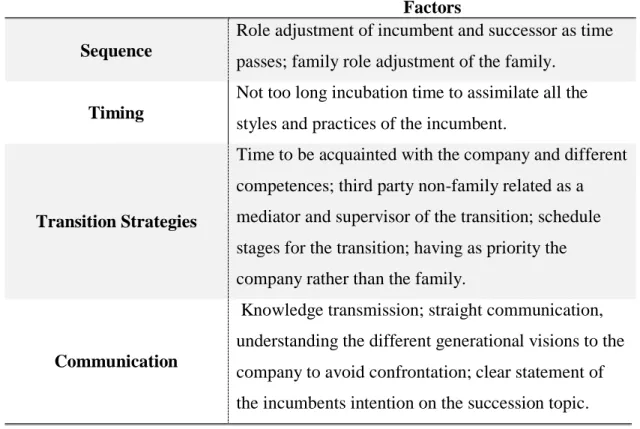
As in Dyck, et al. (2002) it is defended the importance of sequence, timing, transition strategy and communication. High level of agreement and clear
communication between the two agents and a long transition process raises the probability of an optimal outcome. However, the successor may assimilate alike competences and managerial skills as his predecessor and running the company by keeping the same management style may not be what the company needs.
Aligned with the sequence and different roles taken by the successor and
incumbent (Handler, 1990) through the transition, being firstly the founder the operator, then monarch, followed by coordinator and finally a consultant while the successor with no role at beginning, becomes a helper following to be a director and finally a leader.
As for the thoughtful process, the time to start thinking on the transition is needed for assumptions such as: meditation to better deal with the confrontation;
dialogue mechanisms either formal or informal, usually aided by third parties to mediate and to sharp the agenda. If the last two assumptions are correctly played, then the role that each stakeholder of the company and family will play in the future will be clearer throughout time (Barnes & Hershon, 1976). The manager has the knowledge of the entire company, being necessary that same good relationship to properly transmit the information to the successor (Sharma, 2004).
Confrontations between the founder and successor can lead to an abdication from the successor, although it advised different visions, although with a without a troublesome confrontation between the two (Peiser & Wooten, 1983).
Sharma et al. (2003) call for the family acceptance of their part in the company as to aid in the transition process. The new roles played by the family in the business are discovered during the transition, aiming at avoiding confrontation and prioritizing the company’s needs over the family’s desires (Chrisman, et al., 2009).
22 Another agent who can aid the transition is a consultant or a member of the board of the company, non-family related, on the role of mediator. With clear criteria over the feedback to be provided, it is demanded from the person a capacity to solve conflict, and respond to management problems and have a strategic approach towards the succession (Peiser & Wooten, 1983).
The best practices in family business transition focus on the right timing, strategies to avoid confrontation and a clear schedule. The importance of having as the primary goal the company needs as a guidance over personal and family desires is the spine of the literature review.
Table 4: Factors Contributing for a Successful Transition Factors Sequence
Role adjustment of incumbent and successor as time passes; family role adjustment of the family.
Timing
Not too long incubation time to assimilate all the styles and practices of the incumbent.
Transition Strategies
Time to be acquainted with the company and different competences; third party non-family related as a mediator and supervisor of the transition; schedule stages for the transition; having as priority the company rather than the family.
Communication
Knowledge transmission; straight communication, understanding the different generational visions to the company to avoid confrontation; clear statement of the incumbents intention on the succession topic. Source: Barnes & Hershon (1976); Dyck, et al. (2002); Handler (1990); Sharma (2004); Peiser
23
2.6. Determinants of Succession
The last decision over who to take charge is the person who will train his own successor, such an event is even more likely on companies on the first stages of
development, as intended, since on those the likelihood of the manager being the owner is higher, and as so, the sole decider of the decision.
Despite being a family business, the founder prioritizes the company over the family. Therefore, the question arises on what are the determinants for the current manager to decide who the successor is. The choice tends to be within the family (Sharma et al., 2003), easing also the family support (De Massis et al., 2016). On Levinson (1971) the decision tends to be the older son of the family, being aligned with Ip and Jacobs (2006) over the family’s preference for a male successor over a female of the family.
After the first transition in a business, due to the lack of preparation of the successor, or troublesome dispute between the second-generation heirs, there is a precaution for the same problems not to happen again (Hershon, 1975).
In what competences is concerned, the manager may pursue alike competences, (Rubenson & Gupta, 1996), not excluding the possibility of the manager expecting the successor to assimilate alike managerial style being exposing him for a longer period of time to the transition process (Dyck et al., 2002). Despite all, there is a recognition for a need of a different vision to the company from the successor (Peiser & Wooten, 1983; Upton, et al., 2001), although not always recognise and taken in account by the incumbent (Barnes & Hershon, 1976).
The experience needs to have two components, internal and external instruction. Needing the successor to work in the company (Barach et al., 1988; Sharma, 2004), to demonstrate maturity, commitment to the business, respect for non-family employees, decision making abilities and show their interpersonal skills (Sharma, 2004). In addition, have experienced working on another company (Morris, et al., 1996; Trow, 1961) to validate their competences. There is a specific academic and professional background to have to be considering as a potential successor (Chrisman, et al., 1998; Morris et al., 1996).
Health condition of the incumbent can be a reason to accelerate the succession process (De Massis et al., 2008), existing the need for the successor to demonstrate the
24 commitment to the business, particularly important in case the company is set on a remote location (Handler, 1990). That same attachment, but from the incumbent, demonstrates that his willingness to guarantee a well-done succession I as high as his attachment to the company, although it can also be an obstacle not to address it (De Massis et al., 2016).
Table 5: Determinants of succession in a Family Business
Family Related
Family pressure for a particular person; Pressure over the incumbent to choose a person in particular; Predisposition to plan a succession process the higher the number of children; The choice tends to be the older son of the manager; Willingness for the family to keep the control over the company.
Transition Experience
Predisposition to address the succession is higher in case of bad experiences in prior transitions.
Competences Instruction
The manager prefers the successor that has alike competences; Preference towards a specific academic background; Manager desires someone who can bring a new vision to the company.
Company Constrains
Necessity for the successor to move to a remote geographical location.
Incumbent Condition
The incumbent’s bad health increases the necessity to account for a succession; The emotional attachment of the incumbent to the company decreases his will to plan a transition.
Source: Sharma et al. (2003); De Massis et al. (2016); Levinson (1971); Ip and Jacobs (2006); Hershon (1975); Rubenson & Gupta (1996); Dyck et al. (2002); Peiser & Wooten (1983); Upton et al. (2001); Barach et al. (1988); Sharma (2004); Morris, et al. (1961); Morris et al. (1996); Chrisman et al. (1998); De Massis et al. (2008); Handler (1990)
25
2.7. Conclusion
On overall, the different factors play a role on the decision of the manager; some are related with the company needs, while others come from the family pressure or the conformity bias to choose someone from the family on the first place for the sole reason of being from the family. There is a tendency for further generations to formalize the business and to start considering a professional management. Time to prepare to succession is of the most priority, to better accommodate the successor and to prepare the rest of the stakeholders of the company to the transition.
26
3.
Life Stages
Successful transitions depend on the capacity to recognize and prepare a plan to properly apply the necessary solution when a new stage on the company is set (Cohen & Levinthal, 1990; Kazanjian, 1988).
The new stage demonstrates a stronger formalization of the company, something that tends to happen with the passage to another generation (Greiner, 1972; Hershon, 1975), being more plausible for an issue as the transition to be less structurally plan on companies on the first stages of development.
Taking in account the aim of analysing the transition on small companies, the objective is to target the companies on the first stages that have not yet dealt with a major problem as the one that sets a company on a new stage of development. As to analyse if a company is profitable enough, and on the first stages of development, has the same determinants as the ones analysed on the previous section.
Early attempts to study succession on family business determined the need for studying the development of family business. The difference between the family business and professionalized companies lay on the direct intervention of the family on the business and the overlapping generational transition on the life stages of the
company (Barnes & Hershon, 1976). Proof of the family intervention is on Gersick (1997) who introduced The Three Circle Model consisting on Family, Ownership and Business, being those variables the base to expand to The Developmental Model, to so assess how did the three variables behaved over time. As in the transgenerational transition process, Peiser and Wooten (1983) enhances the conflicts of desires between the generations that can lead to a potential crisis or development to a new life stage.
It is accepted that a transition leads to a development in business. To understand if the companies interviewed are placed on the first stages we are going to overview Life Stages theories. The objective is to divide the company into stages of development not by age or generated revenues but by criteria related with internal performance and structure.
27
3.1. Defining Life Cycle
Life cycle is a unique configuration of variables related to organization context and structure (Hanks et al., 1993, p. 7).
Being it a cycle, it implies dependency of what preceded and the base to what proceeds it, therefore a stage is inserted on a circular reasoning being both a
consequence and a reason from a previous stage. It is a consequence of the behaviour of certain variables and the cause for those variables to change in further stages, creating a stage of interdependency.
3.2. Life Stages of a Company
Provided the study, the interest resides on companies that grows organically rather than by acquisition, being the vast majority the literature review done under the same assumption (Greiner, 1972; Lewis & Churchill, 1983; Phelps et al., 2007; Quinn & Cameron, 1983; Steinmetz, 1969).
Regarding the possible different life stages of a company, the characteristics to assess them tends to differ from theory to theory, though, there is a logical three step division to be noticed on the theories studied.
Being each stage classified differently there were introduced parameters used on the states framework theory in order to allow a cross comparison between the Life Stage of a Company Theories.
3.2.1. Life Stages Division
The consensual idea is that each phase undergoes through three moments, first when its implemented, turning it into a period of steady and stable growth, second when a problem arises, and third when the system in motion demands a change, there is a phase of change, which, if well conducted, will dictate the company on a new stage (Flamholtz, 1995; Greiner, 1972; Lewis & Churchill, 1983; Steinmetz, 1969).
The successful transition to a new stage depends on the capacity of the company to recognize the problem at hand, then afterwards to discover and finally to apply the necessary solution. Once the problem is overcome the solution allows the company to enter a new development stage (Cohen & Levinthal, 1990; Kazanjian, 1988).
28
3.2.2. States Framework Theories
States Frame Theories defines that a company goes through several events reaching on a Tipping Point, due to problems relating with management, size and the environmental context of the company, or within the industry or service branch it is inserted upon. The Tipping Point is the defining moment when problems reach a breaking point, when a change is recognized to be needed and a plan is put in motion to see it through. The tipping point on this theory is similar to the challenge previously mentioned on Life Stages of a company that dictates the end of a stage. The Tipping Point occurs in different moments and does not have a defined set of characteristics to define them (Phelps et al., 2007). A company needs to be able to solve these problems in order for the company to survive and thrive.
In Phelps et al. (2007), regarding the states framework it is presented a set of criteria which enable the possible cross analysis of the growth stages theories.
1. People Management: Personnel management varies according to size of the company, starting on the approaches the leader needs to change. From the need to delegate work, given the rising number of employees; leadership change, constant and face-to-face to occasional long distance contact. The changes of leadership and employee’s treatment change provided the size of the company and so does a leader practice concerning the topic (Phelps et al., 2007).
2. Strategic Orientation: a strategic driven behaviour and thinking is generally believed to contribute to a better performance of the company, predict and avoid the problems the company may face provided the market changes (McCann et al., 2001; Tagiuri & Davis, 1992; Upton et al., 2001). The approach towards this practice varies provided the company size: smaller firms act more spontaneous providing the market opportunities, taking in account their need for survival; with growth, companies tend to frame their options to make their decisions according to their objectives (eg.
Diversification) rather than their needs (eg. survival) (Phelps et al., 2007). 3. Formalized System: systems formed when the company is first set starts to
present inefficiencies given the challengeable environment the company faces throughout the time and growth. Rationalization of the systems starts
29 their formalization, concentrating efforts on a narrower area task or
expertise.
4. New Market Entry: awareness towards the customer needs changes as the firm sets new objectives or grows in size and influence. Adaptation to new demands of the market rather for the current or new costumers or product adaptation or creation may demand a change in the business model. 5. Obtaining Finance: transition from self-financing when launching the
business to more constrains over the pressuring agents who funded the company’s growth. Risk management, business plan and inner knowledge is required to attract and correctly manage the relationships from the funding agents.
6. Operational Improvement: starts with the practices that leads to the task fulfilment to adoption of best practices aiming to efficiency gains and error avoidance.
For the aim of the thesis, the first addressed point of People Management was divided in two criteria being the first Manager Requirements and the second People Management. Manager Requirements refers to the demanded obligations towards the manager and the positioning he has on the business. People Management refers to the structure of the company and the treatment it exists towards the employees.
Finally, it was introduced the variable Management & Ownership to assess the state of the management and ownership towards the business, as it is the disengagement between the management and the ownership of the business throughout time.
3.2.3. Brief Explanation of Life Stage Models
In Greiner (1972), the different stages are influenced by the age and size originating different stages of evolution, characterized by a stable growth, leading then to a period of revolution, when the systems and policies, characterizing the evolution stage are changed, giving place to a new evolution stage. Depending on the growth of the industry the company is operating on, the firm can experience the stages in an either shorter, if inserted on a mature market, or longer period of time, if in a fast growing market.
30 The theory implies that each company grows at a steady rate and that there is no point in time when the company stagnates or goes through losses. To add, the theory does not draw any scenario where the company is not able to live through all the five stages in a sequential way. [Appendix 1]
In Lewis and Churchill (1983) the analysis is dynamic, recognizing also five stages of growth, similar to the previous model, which they based themselves upon. The theory aims to address the small and short-termed businesses, as well as creating within the stages scenarios where the companies are not able to adapt to the requirements of the stages ahead. [Appendix 2]
In Steinmetz (1969), the assumption is for the constant growth or failure of the business, once a person starts a company he/she either leads the company to reach the three stages described, or the company goes bankrupt. The theory defines three possible stages, focusing on the obligations and positioning of the manager throughout the process, being the decisive methods to create the need for change, the size in number of employees or number of products, the financial obligations due to the cost and profits structure. [Appendix 3]
The theories were assessed accordingly to the six criteria of the States
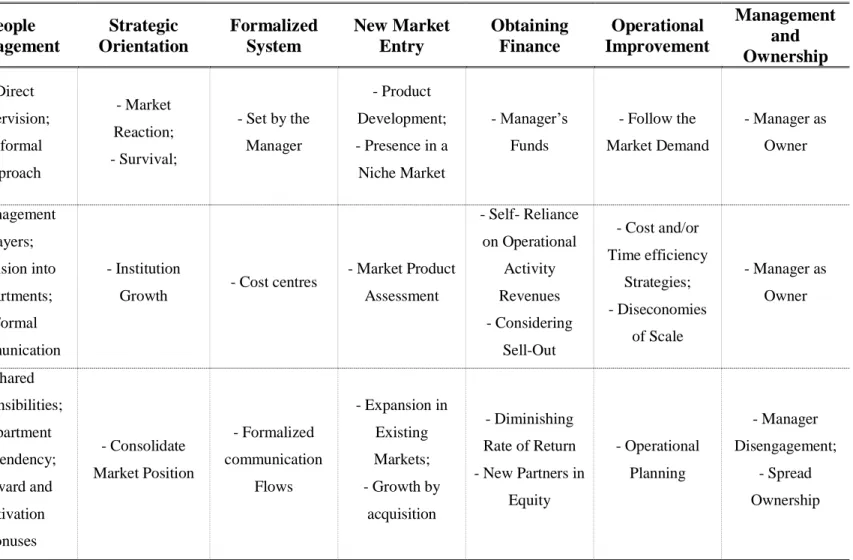
Framework Theories, in each stage developed by the authors (see in Appendix 1-3). A matrix was put together, as showed on Table 4, by aggregating all the criteria
description of the 3 theories present on the appendix. This table is the one to be later used to place the companies analysed on a given the stage.
32
Table 6: Matrix of Variables Description per Life Stage Manager Requirements People Management Strategic Orientation Formalized System New Market Entry Obtaining Finance Operational Improvement Management and Ownership Stage 1 -Entrepreneurial spirit; - Technically oriented; - Sole Manager - Direct Supervision; - Informal Approach - Market Reaction; - Survival; - Set by the Manager - Product Development; - Presence in a Niche Market - Manager’s Funds - Follow the Market Demand - Manager as Owner Stage 2 - Top Management dependence due to centralized decision power - Management Layers; - Division into Departments; - Formal Communication - Institution
Growth - Cost centres
- Market Product Assessment - Self- Reliance on Operational Activity Revenues - Considering Sell-Out - Cost and/or Time efficiency Strategies; - Diseconomies of Scale - Manager as Owner Stage 3 - Delegation; - Distant; - Punctual communication through formalized systems -Shared Responsibilities; - Department Independency; - Reward and Motivation Bonuses - Consolidate Market Position - Formalized communication Flows - Expansion in Existing Markets; - Growth by acquisition - Diminishing Rate of Return - New Partners in Equity - Operational Planning - Manager Disengagement; - Spread Ownership
33 Manager Requirements People Management Strategic Orientation Formalized System New Market Entry Obtaining Finance Operational Improvement Management and Ownership Stage 4 - Strategic Oriented Focus; - Supervision via Formalized Communication - Department Freedom of operation; - Stock Options as Reward - Diversified Portfolio - Investment Centres; - Monthly Information Flows - Increasing Debt - Incorporate Specialized Personnel - Minority stock control Stage 5 - Flexible Management; - Problem Solver - Risk Taking Mind-set - Consolidation - Self-discipline - Extensive number of Formalized Processes
- Consolidation - Control over Financial Gains - Cost Saving Orientation - Split between Ownership and Management
34 Theories of life stages are an attempt of categorizing the vast information
collected by the different authors. Each stage possesses different characteristics and being sequential, disclose the possibility of predicting the problems of a business. Such assumptions were criticized on the literature review (Rutherford et al., 2003; Stubbart & Smalley, 1999), enhancing the unpredictability of the processes of a company.
3.3. Conclusion
The important thing to retain is the different life stages a company can go
through, emphasizing the change on the behaviour to each of the criteria assessed on the literature review. The choice to deal on one variable in a certain way does not dictate a failure because it is identifiable with an early stage of development, since each variable behaves according to the company´s needs, changing those needs as time passes and as size increases. A growth on the company is what demands a change on behaviour and reluctance to do it only jeopardizes it, since a company that grows implies an inevitable change.
The perception over the determinants in the family business can change as a company grow and develop. Analysing the life stages and how the changes take shape can more easily reinforce the determinants for the succession, if the size does not influence the incumbent’s reasons on choosing a successor on a family business.
35
Methodology
The thesis confers a qualitative analysis, therefore the method for the Data Gathering needs to be aligned with the category of the analysis. Provided the different stakeholders the entity has, the incumbent, rest of the family relatives and other external entities with the direct or indirect interest over the successions choice, there is not a single factor that can affect the incumbent choice over who should succeed (Chua et al., 1999; Ussman, 1996).
Given the high number of structures operating in a social event, it is doubtful to treat it as an integrated event that once understood can be generalized to explain all the other similar events, then it needs to be treated separately to better assess the structures operating over it (Lawson, 1997). Provided the time available and the attention not to incur in an overgeneralization of the conclusions withdrawn from a possible quantitative analysis over the topic, the case studies poses as the option to choose, aligning with the small sample of three companies which is used.
On the other hand, a quantitative approach would overlook factors that can be better assessed when conducted through interviews, as an example, it would help to get a context over a response provided in an inquiry. Therefore, to better analyse the reasoning linked to a choice in particular, as to the person who the incumbent wants to succeed him, it is necessary a different approach rather than the quantitative analysis.
Finally, there is the time constrain, which inhibits the possibility for the observation by participating, or by experimenting, which demanded a superior timeframe to obtain valid conclusions (Quinn & Cameron, 1983).
The Method used were the semi-structured interviews done to the manager of the company and if provided the chance to be present the possible successor of the business. To properly justify the choice an assessment over the literature review supporting the benefit of the method is done to properly justify the choice.
There are three types of interviews, structured, semi structured, or unstructured (Manzini, 2004). Being the structured interview closer to a questionnaire and the unstructured an observation. A semi-structured interview, especially an in-person interview, provides the freedom to adapt the interviewer’s questionnaire to the situation and understanding up to a bigger extension the problem sought (Ritchie et al., 2013).