Antagonism of BST-2/tetherin is a conserved function of the Env glycoprotein of primary 1
HIV-2 isolates 2
Chia-Yen Chen1, Masashi Shingai1, Sarah Welbourn1, Malcolm A. Martin1, Pedro Borrego2,
3
Nuno Taveira2,3, and Klaus Strebel1*
4
1Laboratory of Molecular Microbiology, National Institute of Allergy and Infectious Diseases,
5
NIH; Building 4, Room 310; 4 Center Drive, MSC 0460; Bethesda, MD 20892-0460, USA. 6
2Research Institute for Medicines (iMed.ULisboa), Faculty of Pharmacy, University of Lisbon,
7
Lisbon, Portugal. 3Centro de Investigação Interdisciplinar Egas Moniz, Instituto Superior de
8
Ciências da Saúde Egas Moniz, Caparica, Portugal. 9 10 11 Abstract: 249 words 12 Importance: 149 words 13 14
Running Title: Conservation of BST-2 antagonism in HIV-2 Env 15 16 17 18 19 *) corresponding author 20 21
Correspondent footnote: Klaus Strebel, Viral Biochemistry Section, Laboratory of Molecular 22
Microbiology, NIAID, NIH; Bldg. 4, Room 310; 4 Center Drive, MSC 0460; Bethesda, MD 23
20892-0460, Tel. (301) 496-3132; Fax. (301) 480-2716; E-Mail: [email protected]
24
JVI Accepted Manuscript Posted Online 28 September 2016 J. Virol. doi:10.1128/JVI.01451-16
Copyright © 2016, American Society for Microbiology. All Rights Reserved.
on November 15, 2016 by Jose Moniz Pereira
http://jvi.asm.org/
Abstract 26
Although HIV-2 does not encode a vpu gene, the ability to antagonize BST-2 is conserved in 27
some HIV-2 isolates where it is controlled by the Env glycoprotein. We previously reported that 28
a single amino acid difference between the lab-adapted ROD10 and ROD14 Envs controlled the 29
enhancement of virus release (referred to here as Vpu-like) activity. Here we investigated how 30
conserved the Vpu-like activity is in primary HIV-2 isolates. We found that almost half of the 35 31
tested primary HIV-2 Env isolates obtained from 7 different patients enhanced virus release. 32
Interestingly, most HIV-2 patients harbored a mixed population of viruses containing or lacking 33
Vpu-like activity. Vpu-like activity and Envelope functionality varied significantly among Env 34
isolates; however, there was no direct correlation between these two functions suggesting they 35
evolved independently. In comparing the Env sequences from one HIV-2 patient, we found that 36
similar to the ROD10/ROD14 Envs, a single amino acid change (T568I) in the ectodomain of the 37
TM subunit was sufficient to confer Vpu-like activity to an inactive Env variant. Surprisingly, 38
however, absence of Vpu-like activity was not correlated with absence of BST-2 interaction. 39
Taken together, our data suggest that maintaining the ability to antagonize BST-2 is of functional 40
relevance not only to HIV-1 but to HIV-2 as well. Our data show that as with Vpu, binding of 41
HIV-2 Env to BST-2 is important but not sufficient for antagonism. Finally, as observed 42
previously, the Vpu-like activity in HIV-2 Env can be controlled by single residue changes in the 43
TM subunit. 44
45
on November 15, 2016 by Jose Moniz Pereira
http://jvi.asm.org/
Importance 46
Lentiviruses such as HIV-1 and HIV-2 encode accessory proteins whose function is to overcome 47
host restriction mechanisms. Vpu is a well-studied HIV-1 accessory protein that enhances virus 48
release by antagonizing the host restriction factor BST-2. HIV-2 does not encode a vpu gene. 49
Instead, the HIV-2 Env glycoprotein was found to antagonize BST-2 in some isolates. Here, we 50
cloned multiple Env sequences from 7 HIV-2-infected patients and found that about half were 51
able to antagonize BST-2. Importantly, most HIV-2 patients harbored a mixed population of 52
viruses containing or lacking the ability to antagonize BST-2. In fact, in comparing Env 53
sequences from one patient combined with site-directed mutagenesis, we were able to restore 54
BST-2 antagonism to an inactive Env protein by a single amino acid change. Our data suggest 55
that targeting BST-2 by HIV-2 Env is a dynamic process that can be regulated by simple changes 56
in the Env sequence. 57
58
on November 15, 2016 by Jose Moniz Pereira
http://jvi.asm.org/
Introduction 59
Human immunodeficiency virus type 1 (HIV-1) and type 2 (HIV-2) infections are well 60
defined as viral zoonoses. Phylogenetic analysis shows that HIV-1 is closely related to simian 61
immunodeficiency virus (SIV) from chimpanzees (SIVcpz), and HIV-2 is closely related to SIV 62
from sooty mangabeys (SIVsm) (1). At least nine lineages of HIV-2 have been identified, 63
referred to as HIV-2 groups A through I. However, only groups A and B are known to cause 64
human epidemics. In fact, group A viruses account for the vast majority of HIV-2 infections 65
worldwide, which are concentrated mainly in West Africa, Europe, and some Asian countries (1-66
3). Like all primate retroviruses, HIV-2 encodes three structural proteins (Gag, Pol, and Env) and 67
a set of accessory proteins (Vif, Vpx, Vpr, and Nef). Most if not all of the accessory proteins 68
serve to antagonize host restriction factors, which are part of the host’s innate immune system 69
and are considered a first line of defense against viruses. Overall, the genomes of HIV-1 and 70
HIV-2 are very similar. Two notable differences are (i) the presence of a vpu gene in HIV-1 71
which is absent in HIV-2 and (ii) the absence of a vpx gene in HIV-1 which is present in HIV-2. 72
Vpu targets bone marrow stromal antigen 2 (BST-2) and induces degradation of CD4 while Vpx 73
induces degradation of sterile alpha motif and HD domain-containing protein 1 (SAMHD1) (for 74
review see (4)). There is no known functional homolog to Vpx in HIV-1 to target SAMHD1 and 75
while Nef is well-known to down-regulate CD4 from the cell surface (5), the ability to induce 76
proteasomal degradation of CD4 is limited to viruses expressing Vpu (6, 7). Thus, the Vpu and 77
Vpx proteins are not functional homologs. On the other hand, the ability to enhance virus release 78
by antagonizing BST-2 is not limited to Vpu encoding viruses. In fact, in HIV-2 antagonizing 79
BST-2 is a functional property of the Env glycoprotein (8, 9), while in SIV this function is 80
on November 15, 2016 by Jose Moniz Pereira
http://jvi.asm.org/
executed by the Nef protein (10-13). For the remainder of this manuscript we refer to the ability 81
of HIV-2 to enhance virus release as Vpu-like activity. 82
BST-2, also known as tetherin or CD317, is a 30- to 36-kD type II transmembrane 83
protein that inhibits the release of retrovirus particles by physically tethering virions to the cell 84
surface (14, 15). The exact mechanism of how Vpu antagonizes BST-2 is still unclear. However, 85
it is thought to involve a process that interferes with the resupply of newly synthesized BST-2 86
from the ER to the cell surface (reviewed in (4)). Similar to HIV-1 Vpu, the ability of HIV-2 Env 87
to overcome the restrictive phenotype of Vpu-deficient HIV-1 was known long before the 88
cellular target was identified (8, 9, 16, 17). Direct evidence that HIV-2 Env, like Vpu, 89
antagonizes human BST-2 was provided for two HIV-2 laboratory isolates (ROD10 and RODA 90
(16, 18, 19)) and for one SIVtan isolate, which was adapted for replication in a human CD4+ T 91
cell line (20). It is also interesting to note that serial passaging of a nef-deleted SIV in rhesus 92
macaques resulted in the acquisition of mutations in the cytoplasmic domain of gp41 that 93
conferred resistance to rhesus BST-2 (21). In contrast, the Env proteins of HIV-2 and SIVtan 94
were found to target BST-2 through ectodomain interactions (20, 22) leading to the recruitment 95
of a clathrin adaptor AP2 complex via a membrane-proximal GYXXφ motif in the cytoplasmic
96
domain of gp41 and resulting in the sequestration of BST-2 in the trans-Golgi network (TGN) 97
(23). 98
We had previously found that a single amino acid change in the ectodomain of the HIV-2 99
Env TM subunit can regulate the ability of HIV-2 Env to enhance virus release (24). However, 100
these studies were done with highly lab-adapted virus isolates and it was not clear how relevant 101
the Vpu-like activity was in vivo. To address this question we cloned primary HIV-2 env 102
sequences from viruses that had been isolated by coculture of patient peripheral blood 103
on November 15, 2016 by Jose Moniz Pereira
http://jvi.asm.org/
mononuclear cells (PBMCs) with PBMCs from uninfected individuals (25). In total, we isolated 104
35 full-length HIV-2 Env sequences from 8 patients. All 35 Env isolates were analyzed for Vpu-105
like activity in a virus release assay and their envelope function was tested by pseudotyping Env-106
defective HIV-2. We found that all Env proteins were functional in the pseudotyping assay 107
although there was significant variability in the relative pseudotyping efficiency. Interestingly, 108
almost half of the primary HIV-2 isolates also exhibited Vpu-like activity and viruses with Env 109
proteins capable or incapable of antagonizing BST-2 were found to coexist in the same patient. 110
Finally, mutational analysis of an Env isolate lacking Vpu-like activity revealed that a single 111
amino acid change could lead to gain of Vpu-like function. Interestingly, gain of Vpu-like 112
activity was not caused by a gain of interaction with BST-2 since both inactive and active Envs 113
interacted with BST-2 with similar efficiency. Taken together, our data reveal that the ability to 114
target BST-2 is conserved not only in HIV-1 but in HIV-2 as well. Our data also show that the 115
ability of HIV-2 to target BST-2 is a dynamic process that can be regulated by very subtle 116
changes in the Env amino acid sequence. These changes can occur in the same patient in vivo 117
without correlating to the functionality of the Env proteins with respect to producing infectious 118
virus. Finally, consistent with our observations on Vpu, the ability of HIV-2 Env to interact with 119
BST-2 is presumably necessary but not sufficient for antagonism. 120
121
on November 15, 2016 by Jose Moniz Pereira
http://jvi.asm.org/
Materials and Methods 122
Cell culture and transfections. HeLa, HeLa-TZM-bl, and 293T cells were propagated in 123
Dulbecco's modified Eagles medium (DMEM) containing 10% fetal bovine serum (FBS). For 124
transfection, cells were grown in 25 cm2 flasks to about 80% confluency. Cells were transfected
125
using LipofectAMINE PLUS™ (Invitrogen Corp, Carlsbad CA) following the manufacturer's 126
recommendations. A total of 6 μg of plasmid DNA per 25 cm2 flask was used. Total amounts of
127
transfected DNA was kept constant in all samples of any given experiment by adding empty 128
vector DNA as appropriate. Cells were harvested 24 h post transfection. 129
130
Viral RNA extraction, HIV-2 envelope cloning, and sequence analysis. Virus culture samples 131
from 8 patients infected with HIV-2 were obtained from the Research Institute for Medicines 132
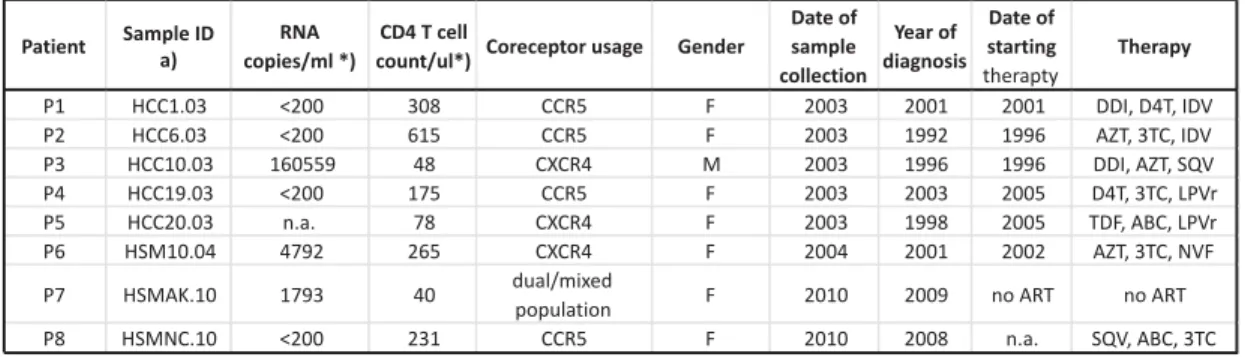
(iMed.ULisboa), University of Lisbon, Portugal (25, 26). Patient data are summarized in table 1. 133
For each sample, 140 µl of culture supernatant were used to extract viral RNA using a QIAamp 134
Viral RNA mini kit (Qiagen). RNA was eluted in 60 µl of elution buffer and immediately 135
subjected to first strand cDNA synthesis using the SuperScript III Reverse Transcriptase kit 136
according to manufacturer's instructions (Invitrogen Life Technologies). The resulting cDNA 137
was subjected to 1st round PCR using primers to conserved regions upstream or downstream of
138
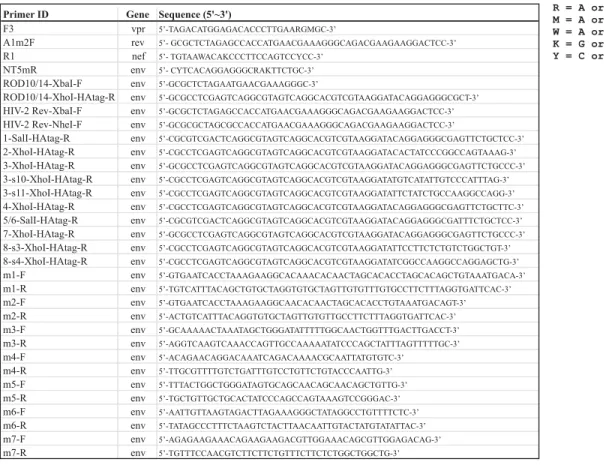
env (table 2: 5’-primers F3 or A1m2F; 3’-primers R1 or NT5mR). PCR products were cloned 139
into the pCR4-TOPO vector (Invitrogen) and sequenced. Specific primers were designed for sub-140
cloning of individual env isolates into a mammalian expression vector (table 2). Note that the 3’-141
primers were designed to add an HA tag to the C-terminus of Env. Also, the 5’ primer (HIV-2 142
Rev-Xba-F) was designed to include the first exon of Rev. Using these primers, a 2600~2700 bp 143
fragment encompassing the entire env gene and the rev gene was amplified from individual 144
on November 15, 2016 by Jose Moniz Pereira
http://jvi.asm.org/
TOPO clones by 2nd round PCR using Platinum Taq DNA Polymerase High Fidelity (Invitrogen) 145
and cloned into the Env-expression vector pCM10 (24). This vector allows for the expression of 146
Env proteins in a Tat- and Rev-independent manner. As a control we also created C-terminally 147
HA-tagged variants of the HIV-2 ROD10 and ROD14 Env using primers listed in table 2. For 148
consistency, these vectors also included the upstream first exon of Rev. All PCR fragments were 149
cloned via the primer-encoded XbaI and XhoI restriction sites into the corresponding sites in 150
pCM10 (24). 151
152
Phylogenetic analysis. Clonal envelope sequences from each patient were codon aligned with a 153
set of reference sequences representative of HIV-2 groups A and B obtained from the Los 154
Alamos HIV Sequence Database (http://www.hiv.lanl.gov/) using MUSCLE (27) and the 155
alignment was manually edited with GeneDoc
156
(http://iubio.bio.indiana.edu/soft/molbio/ibmpc/genedoc-readme.html). Maximum likelihood 157
(ML) phylogenetic analysis was performed using the best-fit model of molecular evolution 158
estimated by Modeltest v3.7 using the Bayesian Information Criterion. ML tree was inferred 159
with program MEGA6 (28). To find the ML tree the nearest neighbor interchange (NNI) iterative 160
heuristic method was used. The reliability of the obtained topology was estimated by bootstrap 161
(1000 replicates). The nucleotide sequence data was deposited in GenBank under the following 162
accession numbers: KX791206-KX791239. 163
164
Site-directed mutagenesis. HIV-2 envelope point mutants were created using QuikChangeTM 165
site-directed mutagenesis (Stratagene, La Jolla CA) and primer pairs m1-m7 (table 2). Mutations 166
were verified by sequencing. 167
on November 15, 2016 by Jose Moniz Pereira
http://jvi.asm.org/
168
Antibodies. HIV-1 Gag proteins were identified using human HIV-1 IG (NIH Research and 169
Reference reagent program (Cat #3957). HIV-2 Gag proteins were identified using HIV-2 patient 170
serum (NIH Research and Reference reagent program (Cat #1495; discontinued)). Mouse anti-171
tubulin and mouse anti-HA mABs were from Sigma (Sigma-Aldrich, St. Louis MO; cat# T-9026 172
& H9658, respectively). 173
174
Western blotting. Cells were washed with ice-cold PBS twice and lysed with 1× SDS protein 175
loading buffer (50 mM Tris-HCl pH 6.8, 2% SDS, 5% glycerol, 5% β-mercaptoethanol, and
176
0.01% bromophenol blue). Samples were then heated at 95°C for 10 min with occasional 177
vortexing of the samples. The lysates were resolved by SDS-PAGE and transferred to 178
polyvinylidene fluoride membranes (EMD Millipore, Billerica MA). The membrane was blocked 179
with dry milk (5% solution in 1x TNT buffer [10 mM Tris-HCl pH 7.4, 150 mM NaCl, 0.3% 180
Tween-20]) and probed with the primary antibodies in TNT buffer followed by incubation with 181
alkaline phosphatase-conjugated secondary antibodies (Sigma-Aldrich, St. Louis MO). Finally, 182
signals were detected using chemiluminescence following the manufacturer's recommendations 183
(Applied Biosystems, Foster City CA).α-tubulin was used as a loading control.
184 185
Assessment of viral particle release. Pulse-chase analysis was performed as described 186
previously with some modifications (9). Briefly, HeLa cells were co-transfected with 4 µg of 187
Vpu-defective pNL4-3/Udel-1 (29) and 2 µg of one of the HA-tagged Env expression vectors 188
using LipofectAMINE PLUS™. Cells were pulse-labeled 24 h later with [35S]-EXPRE35S35
S-189
label (2 mCi/ml; Perkin Elmer, Waltham MA) for 30 min at 37°C and chased in 1 ml of 190
on November 15, 2016 by Jose Moniz Pereira
http://jvi.asm.org/
prewarmed complete DMEM-FBS for 0, 2.5, or 5 h. At each time point, cells were collected and 191
lysed in 400 μl of lysis buffer (50 mM Tris-HCL pH 7.4, 150 mM NaCl, 1% Triton-X100). Cell 192
lysates were precleared by incubation at 4°C for 1 h with protein A-Sepharose beads (Sigma).
193
The cell-free culture supernatants were mixed with 200 µl of lysis buffer. Cell lysates and 194
detergent-treated supernatants were immunoprecipitated with HIV-IgG (NIH Research and 195
Reference reagent program (cat#3957)). Immunoprecipitates were solubilized by heating in 196
sample buffer and separated by SDS-PAGE using 12% polyacrylamide gels. Gels were treated 197
for 20 min with 1M Na-salicylic acid and dried. Radioactive bands were visualized by 198
fluorography using Bio-Max MR film (Eastman Kodak, Rochester NY). Quantitation of the 199
relevant bands was performed with a Fujix BAS 2000 Bio-Image Analyzer. The efficiency of 200
particle release at each time point was calculated by dividing the amount of Gag proteins present 201
in the virus fraction by the total of cell- and virus-associated Gag proteins. The ratio of virion-202
associated versus total Gag protein was then plotted as a function of time. 203
204
Virus preparation. Virus stocks were prepared by transfection of 293T cells with appropriate 205
plasmid DNAs. Virus-containing supernatants were harvested 24 h after transfection. Cellular 206
debris was removed by centrifugation (5 min; 1,500 rpm) and the clarified supernatants were 207
filtered (0.45 µm) to remove residual cellular contaminants. Supernatants were quantified by 208
reverse transcriptase assay (30) and used for infection of TZM-bl indicator cells. 209
210
Viral infectivity assay. A 200 µl aliquot of viral stock was used to infect TZM-bl cells (CD4+, 211
CCR5+, CXCR4+) in a 24-well plate (5×10⁴ cells were seeded 1 day prior to infection) in a total
212
volume of 1 ml. Typically, infections were performed in duplicate. Infection was allowed to 213
on November 15, 2016 by Jose Moniz Pereira
http://jvi.asm.org/
proceed for 48 h at 37°C. Medium was removed, and cells were lysed in 200 µl of Promega 1× 214
reporter lysis buffer (Promega Corp., Madison WI) and frozen at -80°C for a minimum of 30 min. 215
To determine the luciferase activity in the lysates, 10 µl of each lysate was combined with 50 µl 216
of luciferase substrate (Steady-Glo; Promega Corp., Madison WI), and light emission was 217
measured using a Modulus II microplate reader (Turner Biosystems Inc., Sunnyvale CA). Values
218
were corrected for differences in input virus (based on RT assay). 219
220
Co-immunoprecipitation analyses. 293T cells were transfected with expression vectors for 221
HIV-2 Env and BST-2 as indicated in the text. Cells were harvested 24 h posttransfection, 222
washed twice with cold PBS, lysed in RIPA buffer (50 mM Tris-HCl, pH 7.4, 150 mM NaCl, 223
0.1% SDS, 0.5% sodium deoxycholate, 1% NP-40; supplemented with CompleteTM protease
224
inhibitor cocktail [Roche Life Science, Indianapolis IN]) at 4°C for 20 min, and then clarified by 225
centrifugation at 15,000 × g for 10 min. Ten percent of the lysate was used as input control and 226
the remaining lysate was used for immunoprecipitation of HA-tagged antigens. Precleared cell 227
lysates were mixed with anti-HA antibody-conjugated agarose beads (Sigma-Aldrich, Inc., St. 228
Louis MO) and incubated at 4°C for 4 h. Samples were then washed three times with RIPA 229
buffer. Proteins were eluted by boiling beads in sample buffer and subjected to immunoblot 230
analysis with antibodies to HA and BST-2. 231
232
on November 15, 2016 by Jose Moniz Pereira
http://jvi.asm.org/
Results 233
Phylogenetic analysis of primary HIV-2 isolates. 234
We obtained virus culture samples from eight HIV-2-infected individuals (P1 - P8; table 235
1). Env sequences were amplified by RT-PCR. Since we expected significant sequence variation 236
in the env gene, we first amplified env sequences using PCR primers mapping to more conserved 237
regions in the upstream vpr and downstream nef genes (table 2). Resulting cDNAs were cloned 238
into pCR4-TOPO and individual clones from each sample were sequenced. Env sequences 239
isolated from a given patient were labeled according to the patient code followed by the clone 240
number. For instance, sample P3-11 represents clone 11 from patient 3. Of the clones analyzed, 241
35 expressed detectable protein levels. Clones that did not express detectable protein because of 242
deletions or truncations were excluded from further analysis. Also, despite several attempts we 243
were unable to obtain more than a single clone from patient 5. This clone was severely truncated 244
and non-functional and we therefore decided to exclude it from our study as well. 245
Phylogenetic analysis was performed based on 9 group A, 4 group B, and 1 AB reference 246
sequences published in the NCBI database (http://www.ncbi.nlm.nih.gov) together with the 34
247
full-length HIV-2 env sequences identified in the present study (Fig. 1). We found that the env 248
sequences from all seven HIV-2 patients clustered significantly with HIV-2 group A reference 249
sequences. Sequences of Env variants isolated from the same patient were fairly conserved (96-250
99% at the amino acid level [data not shown]). Variation across the entire env gene sequence 251
when samples from all patients were analyzed was as high as 20% at the nucleotide level and up 252
to 25% at the amino acid level (data not shown). 253
254
Antagonism of BST-2 by HIV-2 envelope glycoproteins. 255
on November 15, 2016 by Jose Moniz Pereira
http://jvi.asm.org/
HIV-2 does not encode a vpu gene. Nevertheless, we and others previously reported that 256
certain HIV-2 isolates, such as HIV-2 ROD10, encode a Vpu-like activity that results in 257
enhanced virus release and maps to the HIV-2 Env protein (8, 16). Interestingly, the closely 258
related ROD14 Env lacks a Vpu-like activity due to a single amino acid change in Env (24). 259
Indeed, after the identification of BST-2 as the cellular target of Vpu (15, 31), it was confirmed 260
that HIV-2 Env, like Vpu, antagonizes BST-2 to counteract BST-2-mediated tethering of virus 261
particles to the host cell membrane (18, 19). 262
To assess the ability of our Env isolates to antagonize BST-2, we sub-cloned the full-263
length env genes into the Env expression vector pCM10 (24). To be able to track expression and 264
virus incorporation of the Env products, all constructs, including ROD10 and ROD14, were 265
modified to add a C-terminal HA tag. Rev independence was achieved by including the first 266
exon of Rev upstream of the Env coding sequence. Vpu-like activity was determined by 267
comparing the effects of ROD10 Env (positive control) and ROD14 Env (negative control) to the 268
various primary HIV-2 envelope isolates on the release of Vpu-defective HIV-1 NL4-3 using a 269
pulse/chase metabolic labeling assay described previously (8, 9). Vpu-deficient HIV-1 was 270
chosen as a model system since we had previously demonstrated the Vpu-like activity of HIV-2 271
Env in this system (9). Also, antibodies for immunoprecipitation of HIV-1 Gag proteins are more 272
readily available than antibodies to HIV-2 Gag. Experiments were performed in transiently 273
transfected HeLa cells, which express high levels of endogenous BST-2 (32). Representative 274
experimental data are shown for 6 Env variants isolated from patient 4 (Figs. 2A & 2B). In all 275
experiments cells were pulse-labeled for 30 min and chased for up to 5 h as described in 276
Materials and Methods. At each time point, equal aliquots of cells were harvested and virions 277
released into the supernatant were collected. Each fraction was lysed in lysis buffer, and viral 278
on November 15, 2016 by Jose Moniz Pereira
http://jvi.asm.org/
proteins were subjected to immunoprecipitation with an HIV-1 patient serum. 279
Immunoprecipitated proteins were separated by SDS-PAGE and visualized by fluorography (Fig. 280
2A). Expression of comparable levels of HIV-2 Env was confirmed by immunoblotting (Fig. 2B). 281
Quantitation of results from two independent experiments is presented in figure 2C. All other 282
Env isolates were analyzed in a similar fashion and quantitation of the data is summarized in 283
figure 3 and figure 4A. 284
As expected, virus release in the presence of the ROD14 Env was poor and similar to that 285
observed in the absence of Env (Fig. 2C, compare ROD14 vs Env(-)). In contrast, co-expression 286
of the ROD10 Env significantly enhanced the release of viral Gag proteins. Of the 6 tested Env 287
isolates from patient P4, three (P4-1, P4-7, P4-8) behaved like the ROD14 Env and exhibited a 288
Vpu(-) phenotype. Two of the Env isolates (P4-6 & P4-11) significantly enhanced virus release 289
when compared to ROD14 Env although they were not quite as effective as the lab-adapted 290
ROD10 Env (Fig. 2C). Finally, the Env protein from isolate P4-3 exhibited an intermediate 291
phenotype. Thus, three of the six Env isolates derived from patient 4 exhibited some degree of 292
Vpu-like activity. Overall, half (17/34 = 50%) of the Env isolates tested in this study were able to 293
enhance the release of virus particles to varying degrees and thus revealed Vpu-like activity (Fig. 294
3 and Fig. 4A). To ascertain that the observed effects of HIV-2 Env on virus release are 295
dependent on BST-2, we assessed virus release from BST-2 negative 293T cells. 293T cells were 296
transfected with the env-defective pROD10.env1 (4 µg) (8) either in the absence of Env (no Env) 297
or together with 2 µg of individual Env variants. Virus release was quantified 24 later by 298
determining the virus-associated reverse transcriptase activity in the culture supernatants (Fig. 299
4B). As expected, the effects of HIV-2 Env proteins on virus release in the absence of BST-2 300
were small when compared to their effects on virus release from BST-2 expressing cells 301
on November 15, 2016 by Jose Moniz Pereira
http://jvi.asm.org/
(compare figure 4, panels A & B). Some Env variants had a slight enhancing effect (e.g. ROD10 302
and ROD14) while other Env proteins had a modest inhibitory effect (e.g. P2-1, P6-1, or P6-3). 303
We conclude that the ability to antagonize BST-2 is conserved in about half of the HIV-2 Env 304
variants. The ability to antagonize BST-2 was not specific to Env variants from specific patients. 305
Indeed, most patients harbored viruses with Env proteins that contained or lacked BST-2 306
antagonizing activity. 307
308
HIV-2 Envs differ in their ability to produce infectious viruses. 309
We next tested the ability of our Env isolates to support the production of infectious 310
viruses by coexpression with the env-deficient pROD10.env1 and tested the infectivity of the 311
resulting virus preparations in a single-round infectivity assay. To avoid interference of virus 312
production by BST-2 we used BST-2-negative 293T cells for this experiment. Cells were 313
transfected with pROD10.env1 (4 µg) either in the absence of Env (2 µg empty vector [Ctrl]) or 314
together with 2 µg of individual Env variants. Virus-containing supernatants were used for the 315
infection of TZM-bl cells and virus-induced luciferase activity was determined 48 hr later. We 316
found that four of the six P4 Env variants (Fig. 2D; P4-1, P4-3, P4-6, and P4-11) produced 317
particles with significantly higher infectivity than viruses containing the lab-adapted ROD10 Env. 318
Interestingly, the two Env isolates from patient P4 with the highest Vpu-like activity (6 & P4-319
11) also scored highest in Env function. Analysis of all Env isolates for their ability to produce 320
infectious virus is summarized in figure 4C. We observed significant variation among different 321
Env variants. Overall, however, there was no direct correlation between envelope function and 322
the ability to antagonize BST-2 (Fig. 4, compare panels A & C) suggesting that these functions 323
of the HIV-2 Env protein evolved independently. 324
on November 15, 2016 by Jose Moniz Pereira
http://jvi.asm.org/
325
A naturally occurring substitution in HIV-2 Env regulates its Vpu-like virus release 326
activity. 327
In a previous study we observed that a single amino acid change in ROD14 Env to the 328
corresponding residue in ROD10 (T598A) was sufficient to restore Vpu-like activity (24). 329
Sequence analysis of patient 4 isolates using P4-7 Env, which exhibits a Vpu(-) phenotype, as 330
reference sequence revealed a number of amino acid differences among the individual isolates 331
that were spread out across the entire Env sequence (Fig. 5). However, there were no common 332
amino acid differences between variants with and without Vpu-like activity. Of note, the two 333
Env isolates with the strongest Vpu-like phenotype (P4-6 and P4-11; see Fig. 2C) differed from 334
the P4-7 reference sequence in 2 identical small deletions and only 9 amino acid positions, 8 of 335
which were common to P4-6 and P4-11 (Fig. 5, pink background). Most of the sequence 336
differences indicated by the pink background, together with additional changes, were also found 337
in the other patient 4 Env sequences. 338
To test which of these sequence differences or deletions accounted for the Vpu-like 339
phenotype of the P4-6/P4-11 Envs, we introduced amino acid changes/deletions into the P4-7 340
backbone (Fig. 5, m1-m7) either individually or in combination and assessed the resulting 341
constructs in a gain-of-function analysis for their ability to enhance virus release using pulse-342
chase metabolic labeling as described for figure 2A (Fig. 6A). Analysis of Env expression by 343
immunoblotting showed only minor variations in Env protein levels (Fig. 6B). Quantitation of 344
the pulse/chase analysis data revealed that most of the Env mutants including the deletions, 345
retained the Vpu(-) phenotype associated with the parental P4-7 isolate (Fig. 6C). Interestingly, 346
however, mutation of T568 in P4-7 Env to isoleucine (Fig. 5, m5) conferred Vpu-like activity to 347
on November 15, 2016 by Jose Moniz Pereira
http://jvi.asm.org/
the P4-7 Env variant (Fig. 6C, P4-7m5). Of note, residue 568 is isoleucine in all P4 Env isolates 348
except P4-7, even those without Vpu-like activity (Fig. 5). indicating that isoleucine at this 349
position is important but not sufficient to confer Vpu-like activity to all Env variants. 350
351
Co-immunoprecipitation of HIV-2 Env with BST-2. 352
The inability of ROD14 Env to antagonize BST-2 was recently associated with a lack of 353
physical interaction of the two proteins (33). To confirm this observation we performed co-354
immunoprecipitation studies in 293T cells by co-expressing HA-tagged ROD10 or ROD14 Env 355
with BST-2 (Fig. 7A). As a control, BST-2 was expressed in the absence of Env protein (Fig. 7A, 356
Ctrl). Transfected cells were harvested 24 h post transfection, lysed, and envelope proteins were 357
immunoprecipitated with an anti-HA monoclonal antibody. Total input samples and 358
immunoprecipitates were separated by SDS-PAGE and subjected to immunoblot analysis with 359
antibodies to HA or BST-2 (Fig. 7A). We found that BST-2 efficiently interacted with the 360
ROD10 Env protein. Consistent with the earlier report (33), interaction of BST-2 with ROD14 361
Env was significantly reduced although not entirely eliminated. 362
The interaction of P4-11, P4-7, and the P4-7m5 Env variants with BST-2 was determined 363
in a similar manner (Fig. 7B). Empty vector (Ctrl) and ROD10 Env-expressing vector (ROD10) 364
were included as controls. Interestingly, BST-2 interacted efficiently with the HIV-2 Env 365
variants P4-7, P4-11, as well as the gain-of-function mutant P4-7m5, irrespective of their Vpu 366
phenotype (Fig. 7B). Taken together, our data suggest that binding of Env to BST-2 is not 367
sufficient to antagonize BST-2 activity. 368
369
on November 15, 2016 by Jose Moniz Pereira
http://jvi.asm.org/
Discussion 370
The functional significance of BST-2/tetherin down-modulation by primate lentiviruses 371
viruses is still unclear. It has been suggested that BST-2 down-modulation serves to protect 372
infected cells from antibody-dependent cellular cytotoxicity (ADCC) by minimizing cell-surface 373
exposure of viral antigen (34-36). It is also possible that down-modulation of BST-2 benefits the 374
virus by increasing virus spread through cell-free transmission (reviewed in (37)). There is, 375
however, no doubt that controlling BST-2 is critical for primate lentiviruses since HIV-1, HIV-2, 376
SIV, FIV, and EIAV all have evolved mechanisms to antagonize BST-2. What is particularly 377
striking is the fact that these viruses use distinct strategies to target and neutralize BST-2. In the 378
case of HIV-1, Vpu has evolved as the BST-2 antagonist (14, 15). For most SIVs, Nef has 379
acquired the ability to target BST-2 (10-13). The latter include SIVcpz, the presumed ancestor of 380
HIV-1, which encodes a vpu gene, yet uses Nef to control BST-2 (12, 38) suggesting that the 381
original function of Vpu was not the targeting of BST-2. Like most SIV strains, HIV-2 lacks a 382
vpu gene. While HIV-2 does encode a nef gene, it does not use Nef to antagonize BST-2 but has 383
found yet another way by using its Env protein (8, 16, 18). Finally, FIV and EIAV acquired 384
similar Env-dependent strategies as HIV-2 (39, 40). Thus, there are at least three lentiviral 385
proteins with the demonstrated capacity to target and antagonize BST-2. 386
The reasons why BST-2 is not targeted by a common lentiviral protein are unclear. 387
However, it could be that in evolutionary terms, BST-2 represents a more recent challenge that 388
lentiviruses have had to cope with in different ways. Since BST-2 does not impose an absolute 389
restriction on virus replication, viruses may have had the luxury to gradually develop BST-2 390
resistance by expanding the functional breadth of available viral proteins. An interesting example 391
is the acquisition of a Vpu-like activity by the Env protein of a nef-deleted SIV following serial 392
on November 15, 2016 by Jose Moniz Pereira
http://jvi.asm.org/
passaging in rhesus macaques (21). Nevertheless, antagonism of BST-2 by any of the three viral 393
factors follows more or less the same pathway and is initiated by the physical interaction with 394
BST-2. For Vpu, this interaction clearly involves the TM domain (41-47) although the 395
involvement of the Vpu cytoplasmic domain has also been reported (48-52). For Nef, the 396
interaction with BST-2 is limited to the BST-2 cytoplasmic domain for the simple reason that 397
Nef does not have a TM- or ecto-domain but is attached to membrane through a myristic acid 398
moiety (10-12, 38). For HIV-2 Env, interactions with BST-2 have been reported to involve the 399
membrane-proximal ectodomain (17, 18, 22). However, as with Vpu, the cytoplasmic domain 400
may have a role in the antagonism of BST-2 as well (33). Exactly where in the cell the 401
interaction of BST-2 with Vpu, Nef, or Env is initiated is currently unclear. The co-expression of 402
BST-2 with Vpu, Env, or Nef can result in the surface down-modulation of BST-2 (reviewed in 403
(53)). However, whether surface down-modulation of BST-2 is an actual prerequisite or a 404
downstream consequence of BST-2 antagonism is still unclear. We previously found that in the 405
context of an acute spreading infection of T-cells, Vpu-dependent enhancement of virus release 406
does not coincide with BST-2 surface down-modulation (32). We also reported that antibody-407
based interference with BST-2 must occur prior to BST-2 reaching the cell surface (54) 408
suggesting that the interaction of BST-2 with virus assembly complexes that ultimately results in 409
the membrane tethering is initiated inside the cells. This is true for HIV-1 as well as HIV-2 (54). 410
Our hypothesis that the ability to antagonize BST-2 is a more recent functional 411
acquisition of HIV-2 is supported by the fact that only about half of the functional Env isolates 412
characterized in our study have Vpu-like activity. Furthermore, the fact that there is significant 413
variation in the extent to which individual Env proteins can antagonize BST-2 supports the 414
model that antagonizing BST-2 may be an ongoing evolutionary process. This is supported by 415
on November 15, 2016 by Jose Moniz Pereira
http://jvi.asm.org/
the observation that we were able to isolate Env variants that contained or lacked Vpu-like 416
activity from most patient samples (see Figs. 1 & 4). More importantly, the ability or inability to 417
antagonize BST-2 is not a stable functional property but was sensitive to single amino acid 418
changes. Examples are the previously reported naturally occurring T598A mutation (24) as well 419
as the naturally occurring T568I mutation described in the current study (Fig. 8). It is interesting 420
that in both cases the presence of a threonine residue with its polar side chain was replaced by an 421
amino acid with a hydrophobic side chain suggesting structural changes are involved in the 422
acquisition of Vpu-like activity. It was previously reported that mutations resulting in a loss of 423
Vpu-like activity in HIV-2 Env were associated with a loss or at least a reduction in BST-2-Env 424
binding (33). Our own results are in partial agreement with those data in the sense that the 425
T598A mutation in ROD10/14 appeared to reduce - although not completely abolish - the 426
binding affinity to BST-2 (Fig. 7A). Interestingly, however, we did not observe a difference in 427
the interaction of BST-2 with Env variants P4-7 (Vpu(-) phenotype) and P4-11 (Vpu(+) 428
phenotype) or with the P4-7m5 back-mutation (T568I) that restored the Vpu-like activity in P4-7 429
Env (Fig. 7B). These results are in line with results from experiments involving a gpi-anchored 430
version of HIV-2 Env, which was able to interact with BST-2 but did not antagonize BST-2 431
function (33), and strongly suggest that binding of Env to BST-2 in itself is not sufficient to 432
antagonize BST-2 function. 433
434
on November 15, 2016 by Jose Moniz Pereira
http://jvi.asm.org/
Acknowledgments 435
We thank Sandra Kao, Sayaka Sukegawa, Eri Miyagi, and Angela Yoo for helpful discussions 436
and critical comments on the manuscript. Many thanks to Alicia Buckler-White and Ron Plishka 437
for their support with extensive sequence analyses. The following reagents were obtained 438
through the NIH AIDS Reagent Program, Division of AIDS, NIAID, NIH: TZM-bl cells from Dr. 439
John C. Kappes, Dr. Xiaoyun Wu and Tranzyme Inc. (Cat #8129); HIV-1 immunoglobulin (Cat 440
#3957) and HIV-2 patient serum to detect p26 (CA). This work was supported by the Intramural 441
Research Program of the NIH, NIAID (1 Z01 AI000669). 442
443
on November 15, 2016 by Jose Moniz Pereira
http://jvi.asm.org/
References 444
1. Sharp PM, Hahn BH. 2011. Origins of HIV and the AIDS pandemic. Cold Spring Harb 445
Perspect Med 1:a006841. 446
2. de Silva TI, Cotten M, Rowland-Jones SL. 2008. HIV-2: the forgotten AIDS virus. 447
Trends Microbiol 16:588-595. 448
3. Ayouba A, Akoua-Koffi C, Calvignac-Spencer S, Esteban A, Locatelli S, Li H, Li Y, 449
Hahn BH, Delaporte E, Leendertz FH, Peeters M. 2013. Evidence for continuing 450
cross-species transmission of SIVsmm to humans: characterization of a new HIV-2 451
lineage in rural Cote d'Ivoire. AIDS 27:2488-2491. 452
4. Strebel K. 2013. HIV accessory proteins versus host restriction factors. Curr Opin Virol 453
3:692-699. 454
5. Garcia JV, Miller AD. 1991. Serine phosphorylation-independent downregulation of 455
cell-surface CD4 by nef. Nature 350:508-511. 456
6. Willey RL, Maldarelli F, Martin MA, Strebel K. 1992. Human immunodeficiency 457
virus type 1 Vpu protein induces rapid degradation of CD4. J Virol 66:7193-7200. 458
7. Dimitrov DS, Willey RL, Martin MA, Blumenthal R. 1992. Kinetics of HIV-1 459
interactions with sCD4 and CD4+ cells: Implications for inhibition of virus infection and 460
initial steps of virus entry into cells. Virology 187:398-406. 461
8. Bour S, Schubert U, Peden K, Strebel K. 1996. The envelope glycoprotein of human 462
immunodeficiency virus type 2 enhances viral particle release: a Vpu-like factor? J Virol 463
70:820-829. 464
9. Bour S, Strebel K. 1996. The human immunodeficiency virus (HIV) type 2 envelope 465
protein is a functional complement to HIV type 1 Vpu that enhances particle release of 466
heterologous retroviruses. J Virol 70:8285-8300. 467
10. Jia B, Serra-Moreno R, Neidermyer W, Rahmberg A, Mackey J, Fofana IB, 468
Johnson WE, Westmoreland S, Evans DT. 2009. Species-specific activity of SIV Nef 469
and HIV-1 Vpu in overcoming restriction by tetherin/BST2. PLoS Pathog 5:e1000429. 470
11. Zhang F, Wilson SJ, Landford WC, Virgen B, Gregory D, Johnson MC, Munch J, 471
Kirchhoff F, Bieniasz PD, Hatziioannou T. 2009. Nef proteins from simian 472
immunodeficiency viruses are tetherin antagonists. Cell Host Microbe 6:54-67. 473
12. Sauter D, Schindler M, Specht A, Landford WN, Munch J, Kim KA, Votteler J, 474
Schubert U, Bibollet-Ruche F, Keele BF, Takehisa J, Ogando Y, Ochsenbauer C, 475
Kappes JC, Ayouba A, Peeters M, Learn GH, Shaw G, Sharp PM, Bieniasz P, Hahn 476
BH, Hatziioannou T, Kirchhoff F. 2009. Tetherin-driven adaptation of Vpu and Nef 477
function and the evolution of pandemic and nonpandemic HIV-1 strains. Cell Host 478
Microbe 6:409-421. 479
13. Serra-Moreno R, Zimmermann K, Stern LJ, Evans DT. 2013. Tetherin/BST-2 480
antagonism by Nef depends on a direct physical interaction between Nef and tetherin, and 481
on clathrin-mediated endocytosis. PLoS Pathog 9. 482
14. Neil SJ, Zang T, Bieniasz PD. 2008. Tetherin inhibits retrovirus release and is 483
antagonized by HIV-1 Vpu. Nature 451:425-430. 484
15. Van Damme N, Goff D, Katsura C, Jorgenson RL, Mitchell R, Johnson MC, 485
Stephens EB, Guatelli J. 2008. The interferon-induced protein BST-2 restricts HIV-1 486
release and is downregulated from the cell surface by the viral Vpu protein. Cell Host 487
Microbe 3:245-252. 488
on November 15, 2016 by Jose Moniz Pereira
http://jvi.asm.org/
16. Ritter GD, Yamshchikov G, Cohen SJ, Mulligan MJ. 1996. Human 489
immunodeficiency virus type 2 glycoprotein enhancement of particle budding: role of the 490
cytoplasmic domain. J Virol 70:2669-2673. 491
17. Abada P, Noble B, Cannon PM. 2005. Functional domains within the human 492
immunodeficiency virus type 2 envelope protein required to enhance virus production. J 493
Virol 79:3627-3638. 494
18. Le Tortorec A, Neil SJ. 2009. Antagonism to and intracellular sequestration of human 495
tetherin by the human immunodeficiency virus type 2 envelope glycoprotein. J Virol 496
83:11966-11978. 497
19. Hauser H, Lopez LA, Yang SJ, Oldenburg JE, Exline CM, Guatelli JC, Cannon PM. 498
2010. HIV-1 Vpu and HIV-2 Env counteract BST-2/tetherin by sequestration in a 499
perinuclear compartment. Retrovirology 7:51. 500
20. Gupta RK, Mlcochova P, Pelchen-Matthews A, Petit SJ, Mattiuzzo G, Pillay D, 501
Takeuchi Y, Marsh M, Towers GJ. 2009. Simian immunodeficiency virus envelope 502
glycoprotein counteracts tetherin/BST-2/CD317 by intracellular sequestration. Proc Natl 503
Acad Sci U S A 106:20889–20894. 504
21. Serra-Moreno R, Jia B, Breed M, Alvarez X, Evans DT. 2011. Compensatory changes 505
in the cytoplasmic tail of gp41 confer resistance to tetherin/BST-2 in a pathogenic nef-506
deleted SIV. Cell Host Microbe 9:46-57. 507
22. Lopez LA, Yang SJ, Hauser H, Exline CM, Haworth KG, Oldenburg J, Cannon PM. 508
2010. Ebola virus glycoprotein counteracts BST-2/Tetherin restriction in a sequence-509
independent manner that does not require tetherin surface removal. J Virol 84:7243-7255. 510
23. Noble B, Abada P, Nunez-Iglesias J, Cannon PM. 2006. Recruitment of the adaptor 511
protein 2 complex by the human immunodeficiency virus type 2 envelope protein is 512
necessary for high levels of virus release. J Virol 80:2924-2932. 513
24. Bour S, Akari H, Miyagi E, Strebel K. 2003. Naturally occurring amino acid 514
substitutions in the HIV-2 ROD envelope glycoprotein regulate its ability to augment 515
viral particle release. Virology 309:85-98. 516
25. Marcelino JM, Borrego P, Rocha C, Barroso H, Quintas A, Novo C, Taveira N. 2010. 517
Potent and broadly reactive HIV-2 neutralizing antibodies elicited by a vaccinia virus 518
vector prime-C2V3C3 polypeptide boost immunization strategy. J Virol 84:12429-12436. 519
26. Borrego P, Calado R, Marcelino JM, Bartolo I, Rocha C, Cavaco-Silva P, Doroana 520
M, Antunes F, Maltez F, Caixas U, Barroso H, Taveira N. 2012. Baseline 521
susceptibility of primary HIV-2 to entry inhibitors. Antivir Ther 17:565-570. 522
27. Edgar RC. 2004. MUSCLE: multiple sequence alignment with high accuracy and high 523
throughput. Nucleic Acids Res 32:1792-1797. 524
28. Tamura K, Stecher G, Peterson D, Filipski A, Kumar S. 2013. MEGA6: Molecular 525
Evolutionary Genetics Analysis version 6.0. Mol Biol Evol 30:2725-2729. 526
29. Klimkait T, Strebel K, Hoggan MD, Martin MA, Orenstein JM. 1990. The human 527
immunodeficiency virus type 1-specific protein vpu is required for efficient virus 528
maturation and release. J Virol 64:621-629. 529
30. Willey RL, Smith DH, Lasky LA, Theodore TS, Earl PL, Moss B, Capon DJ, Martin 530
MA. 1988. In vitro mutagenesis identifies a region within the envelope gene of the 531
human immunodeficiency virus that is critical for infectivity. J Virol 62:139-147. 532
on November 15, 2016 by Jose Moniz Pereira
http://jvi.asm.org/
31. Neil SJ, Sandrin V, Sundquist WI, Bieniasz PD. 2007. An interferon-alpha-induced 533
tethering mechanism inhibits HIV-1 and Ebola virus particle release but is counteracted 534
by the HIV-1 Vpu protein. Cell Host Microbe 2:193-203. 535
32. Miyagi E, Andrew AJ, Kao S, Strebel K. 2009. Vpu enhances HIV-1 virus release in 536
the absence of Bst-2 cell surface down-modulation and intracellular depletion. Proc Natl 537
Acad Sci U S A 106:2868-2873. 538
33. Exline CM, Yang SJ, Haworth KG, Rengarajan S, Lopez LA, Droniou ME, Seclen 539
E, Cannon PM. 2015. Determinants in HIV-2 Env and tetherin required for functional 540
interaction. Retrovirology 12:67. 541
34. Alvarez RA, Hamlin RE, Monroe A, Moldt B, Hotta MT, Rodriguez Caprio G, 542
Fierer DS, Simon V, Chen BK. 2014. HIV-1 Vpu antagonism of tetherin inhibits 543
antibody-dependent cellular cytotoxic responses by natural killer cells. J Virol 88:6031-544
6046. 545
35. Arias JF, Heyer LN, von Bredow B, Weisgrau KL, Moldt B, Burton DR, Rakasz EG, 546
Evans DT. 2014. Tetherin antagonism by Vpu protects HIV-infected cells from 547
antibody-dependent cell-mediated cytotoxicity. Proc Natl Acad Sci U S A 111:6425-548
6430. 549
36. Pham TN, Lukhele S, Hajjar F, Routy JP, Cohen EA. 2014. HIV Nef and Vpu protect 550
HIV-infected CD4+ T cells from antibody-mediated cell lysis through down-modulation 551
of CD4 and BST2. Retrovirology 11:15. 552
37. Andrew A, Strebel K. 2011. The interferon-inducible host factor bone marrow stromal 553
antigen 2/tetherin restricts virion release, but is it actually a viral restriction factor? J 554
Interferon Cytokine Res 31:137-144. 555
38. Yang SJ, Lopez LA, Hauser H, Exline CM, Haworth KG, Cannon PM. 2010. Anti-556
tetherin activities in Vpu-expressing primate lentiviruses. Retrovirology 7:13. 557
39. Morrison JH, Guevara RB, Marcano AC, Saenz DT, Fadel HJ, Rogstad DK, 558
Poeschla EM. 2014. Feline immunodeficiency virus envelope glycoproteins antagonize 559
tetherin through a distinctive mechanism that requires virion incorporation. J Virol 560
88:3255-3272. 561
40. Yin X, Hu Z, Gu Q, Wu X, Zheng Y-H, Wei P, Wang X. 2014. Equine tetherin blocks 562
retrovirus release and its activity is antagonized by equine infectious anemia virus 563
envelope protein. J Virol 88:1259-1270. 564
41. Shingai M, Yoshida T, Martin MA, Strebel K. 2011. Some Human Immunodeficiency 565
Virus Type 1 Vpu Proteins Are Able To Antagonize Macaque BST-2 In Vitro and In 566
Vivo: Vpu-Negative Simian-Human Immunodeficiency Viruses Are Attenuated In Vivo. 567
J Virol 85:9708-9715. 568
42. Yoshida T, Kao S, Strebel K. 2011. Identification of residues in the BST-2 TM domain 569
important for antagonism by HIV-1 Vpu using a gain-of-function approach. Frontiers in 570
Microbiology 2:1. 571
43. Kobayashi T, Ode H, Yoshida T, Sato K, Gee P, Yamamoto SP, Ebina H, Strebel K, 572
Sato H, Koyanagi Y. 2011. Identification of amino acids in the human tetherin 573
transmembrane domain responsible for HIV-1 Vpu interaction and susceptibility. J Virol 574
85:932-945. 575
44. Gupta RK, Hue S, Schaller T, Verschoor E, Pillay D, Towers GJ. 2009. Mutation of a 576
single residue renders human tetherin resistant to HIV-1 Vpu-mediated depletion. PLoS 577
Pathog 5:e1000443. 578
on November 15, 2016 by Jose Moniz Pereira
http://jvi.asm.org/
45. McNatt MW, Zang T, Hatziioannou T, Bartlett M, Fofana IB, Johnson WE, Neil SJ, 579
Bieniasz PD. 2009. Species-specific activity of HIV-1 Vpu and positive selection of 580
tetherin transmembrane domain variants. PLoS Pathog 5:e1000300. 581
46. Iwabu Y, Fujita H, Kinomoto M, Kaneko K, Ishizaka Y, Tanaka Y, Sata T, 582
Tokunaga K. 2009. HIV-1 accessory protein Vpu internalizes cell-surface BST-583
2/tetherin through transmembrane interactions leading to lysosomes. J Biol Chem 584
284:35060-35072. 585
47. Skasko M, Wang Y, Tian Y, Tokarev A, Munguia J, Ruiz A, Stephens EB, Opella 586
SJ, Guatelli J. 2012. HIV-1 Vpu protein antagonizes innate restriction factor BST-2 via 587
lipid-embedded helix-helix interactions. J Biol Chem 287:58-67. 588
48. Jia X, Weber E, Tokarev A, Lewinski M, Rizk M, Suarez M, Guatelli J, Xiong Y. 589
2014. Structural basis of HIV-1 Vpu-mediated BST2 antagonism via hijacking of the 590
clathrin adaptor protein complex 1. Elife 3:e02362. 591
49. Kueck T, Neil SJD. 2012. A Cytoplasmic Tail Determinant in HIV-1 Vpu Mediates 592
Targeting of Tetherin for Endosomal Degradation and Counteracts Interferon-Induced 593
Restriction. PLoS Pathog 8:e1002609. 594
50. Lau D, Kwan W, Guatelli J. 2011. Role of the Endocytic Pathway in the Counteraction 595
of BST-2 by Human Lentiviral Pathogens. J Virol 85:9834-9846. 596
51. Mitchell RS, Katsura C, Skasko MA, Fitzpatrick K, Lau D, Ruiz A, Stephens EB, 597
Margottin-Goguet F, Benarous R, Guatelli JC. 2009. Vpu antagonizes BST-2-598
mediated restriction of HIV-1 release via beta-TrCP and endo-lysosomal trafficking. 599
PLoS Pathog 5:e1000450. 600
52. Ruiz A, Hill MS, Schmitt K, Guatelli J, Stephens EB. 2008. Requirements of the 601
membrane proximal tyrosine and dileucine-based sorting signals for efficient transport of 602
the subtype C Vpu protein to the plasma membrane and in virus release. Virology 603
378:58-68. 604
53. Sauter D. 2014. Counteraction of the multifunctional restriction factor tetherin. Front 605
Microbiol 5:163. 606
54. Miyagi E, Andrew A, Kao S, Yoshida T, Strebel K. 2011. Antibody-mediated 607
enhancement of HIV-1 and HIV-2 production from BST-2/tetherin+ cells. J Virol 608
85:11981-11994. 609
55. Freed EO, Myers DJ. 1992. Identification and characterization of fusion and processing 610
domains of the human immunodeficiency virus type 2 envelope glycoprotein. J Virol 611
66:5472-5478. 612
613 614
on November 15, 2016 by Jose Moniz Pereira
http://jvi.asm.org/
Figure Legends 615
Figure 1: Molecular phylogenetic analysis of envelope gene sequences. 616
The evolutionary history was inferred by using the Maximum Likelihood method based on the 617
General Time Reversible model (GTR+G+I) (28). The tree with the highest log likelihood (-618
25625.8806) is shown. The percentage of trees in which the associated taxa clustered together is 619
shown next to the branches. Only values ≥ 70% are displayed. Initial tree(s) for the heuristic 620
search were obtained automatically by applying Neighbor-Join and BioNJ algorithms to a matrix 621
of pairwise distances estimated using the Maximum Composite Likelihood (MCL) approach, and 622
then selecting the topology with superior log likelihood value. A discrete Gamma distribution 623
was used to model evolutionary rate differences among sites (5 categories (+G, parameter = 624
0.6138)). The rate variation model allowed for some sites to be evolutionarily invariable ([+I], 625
25.7204% sites). The tree is drawn to scale, with branch lengths measured in the number of 626
substitutions per site. All positions containing gaps and missing data were eliminated. Each 627
reference HIV-2 strain is represented by its genetic group and name at the right. HIV-2 isolates 628
in green exhibit Vpu-like virus release activity (see Figs. 3 & 4A); HIV-2 isolates in red do not 629
exhibit Vpu-like activity. 630
631
Figure 2: The HIV-2 envelope glycoprotein enhances HIV-1 particle release. (A) Kinetic 632
analysis of viral particle release by Vpu-deficient HIV-1 in the presence of the different HIV-2 633
Env isolates. HeLa cells were transfected with pNL4-3/Udel-1 together with HA-tagged HIV-2 634
Env vectors pROD14-Env, pROD10-Env, and pHA vector (Env(-)) as controls, as well as 635
vectors for the expression of HA-tagged Envs from HIV-2 patient 4 isolates P4-1, P4-3, P4-6, 636
P4-7, P4-8, and P4-11. Samples were subjected to pulse-chase analysis and viral proteins 637
on November 15, 2016 by Jose Moniz Pereira
http://jvi.asm.org/
recovered by immunoprecipitation were separated by 12% SDS–PAGE. The major HIV-1 Gag 638
proteins p55gag and p24CA are identified on the right. A representative experiment is shown. 639
(B) Relative expression of Env in the transfected cells was verified by western blot analysis 640
using an HA-specific mAB. Expression of cellular α-tubulin served as a loading control (tub).
641
(C) Efficiency of virus release was determined by quantifying bands in panels A corresponding 642
to the precursor and mature Gag proteins at each time point. Results were plotted as a function of 643
time. Maximal virus release by ROD10 at the 5 hr time point was defined as 100% and the 644
remaining data points were normalized accordingly. Data are presented as mean +/- S.E.M. from 645
two independent experiments. (D) To assess the ability of HIV-2 Env variants to produce 646
infectious virus, 293T cells were transfected with 4 µg of envelope-deficient pROD10.env1 647
DNA in the presence of empty pHA vector (Env(-)), or HA-tagged pROD14-Env, pROD10-Env, 648
or HIV-2 patient 4 isolates P4-1, P4-3, p4-6, P4-7, P4-8, and P4-11 as indicated. Virus-649
containing supernatants were harvested 24 h later and a portion of the filtered culture supernatant 650
was used for the infection of TZM-bl cells. Luciferase activity was measured 48 h after infection 651
and normalized for input virus. The result shown is representative of two independent 652
experiments. Infectivity of viruses pseudotyped with the ROD10 Env was defined as 1. 653
Differences in viral infectivity of the other samples are expressed as fold change relative to 654
ROD10 Env. Graphs represent the mean +/- S.E.M. of duplicate infections. 655
656
Figure 3: Antagonism of BST-2 by HIV-2 Env variants. Pulse/chase analyses were performed 657
for all Env variants as described for figure 2A. Quantitation was done as described for figure 2C. 658
Data were grouped by patient and are presented as mean +/- S.E.M. from two independent 659
experiments. 660
on November 15, 2016 by Jose Moniz Pereira
http://jvi.asm.org/
Fig. 4: Summary of the functional data for all HIV-2 Env variants. (A) Effect of HIV-2 Env 661
on the release of HIV-1 from BST-2-expressing HeLa cells. Release of Vpu-deficient HIV-1 in 662
the presence of the different HIV-2 Env variants was determined by pulse/chase analysis as 663
described for figure 2A. Virus release observed after 5 hr of chase was quantified as described 664
for figure 2C. Virus release in the absence of Env was defined as 1 and is marked by a horizontal 665
line. Virus release in the presence of individual Env variants was calculated as fold-change 666
relative to the Env-negative sample. Data are presented as mean +/- S.E.M. from at least two 667
independent experiments. A 1.5-fold increase is marked by a second horizontal line and 668
represents an empirical cut-off to define Vpu-like activity. (B) Effect of HIV-2 Env on the 669
release of HIV-2 in the absence of BST-2. BST-2-negative 293T cells were transfected with 4 µg 670
of envelope-deficient pROD10.env1 DNA in the presence of empty pHA vector (Env(-)), or HA-671
tagged pROD14-Env, pROD10-Env, or HIV-2 patient isolates. Virus-containing supernatants 672
were harvested 24 h later and virus production was quantified by measuring the virus-associated 673
reverse transcriptase activity. Virus production in the absence of Env was defined as 1 (marked 674
by a horizontal line). Effects of individual Env proteins on virus release were calculated as fold-675
difference relative to the Env-negative sample. Graphs represent the mean +/- S.E.M. from two 676
independent experiments. Colors indicate individual patients. (C) Effect of HIV-2 Env on viral 677
infectivity. Virus samples from panel B were used for the infection of TZM-bl cells. Infections 678
were done in duplicates. Luciferase activity was measured 48 h after infection and normalized 679
for input virus. Infectivity of viruses pseudotyped with the ROD10 Env was defined as 1 and is 680
marked by a horizontal line. Differences in viral infectivity of the other samples are expressed as 681
fold change relative to ROD10 Env. Graphs represent the mean +/- S.E.M. of at least two 682
independent experiments performed in duplicate infections. 683
on November 15, 2016 by Jose Moniz Pereira
http://jvi.asm.org/
684
Figure 5: Sequence comparison of Env variants from patient P4. Amino acid sequences from 685
all six patient 4-derived Env variants were aligned. Identical sequences appear as dots. The 686
transmembrane domain (TM domain) is marked by a gray background. Regions tested in figure 6 687
for their ability to convey Vpu-like activity are marked by a pink background. Alanine 598 688
(A598), which is critical for the ability of ROD10 Env to antagonize BST-2 (24) is highlighted 689
by a green background. 690
691
Figure 6. The ectodomain of the TM subunit of HIV-2 Env is critical for enhancing virus 692
release. (A) Amino acid differences in P4-11 Env highlighted in figure 4 were transferred 693
individually or in combination as indicated into the backbone of P4-7 Env. The ability of the 694
resulting mutants to antagonize BST-2 was tested in HeLa cells by pulse/chase analysis as 695
described for figure 2A. (B) Expression of Env mutants was verified by western blot analysis 696
using cellular α-tubulin as a loading control (tub). (C) Kinetic data from panel A were quantified
697
as described for figure 2C. Maximal virus release by ROD10 at the 5 hr time point was defined 698
as 100% and the remaining data points were adjusted accordingly. Data are presented as mean 699
+/- S.E.M. from two independent analyses. 700
701
Figure 7. Co-immunoprecipitation of BST-2 with HIV-2 Env. (A) 293T cells were transfected 702
with 0.25 µg of pcDNA-BST-2 together with 4 µg of empty vector (Ctrl), or HA-tagged 703
pROD14-Env or pROD10-Env, respectively. Cell extracts were prepared 24 h later and a 704
fraction of total lysate was used as input control (top). The remaining lysate was used for 705
immunoprecipitation with anti-HA-coated beads (bottom). Samples were separated by SDS-706
on November 15, 2016 by Jose Moniz Pereira
http://jvi.asm.org/
PAGE and probed with antibodies to HA (Env-HA) or BST-2. (B) 293T cells were transfected 707
with 0.25 µg of pcDNA-BST-2 together with 4 µg of empty vector (Ctrl) or the indicated Env 708
expression vectors. Samples were processed as in panel A. The experiment was performed 709
independently three times. Shown is a representative result. 710
711
Fig. 8: Multiple changes in Env affect its Vpu-like activity. Shown is a partial amino acid 712
alignment of four HIV-2 Env isolates. ROD10, ROD14, P4-7, and P4-11 sequences differ by 713
deletions/insertions in the SU domain. Therefore, sequences were aligned using the 714
transmembrane (TM) domains as reference (black box with white lettering). Amino acid 715
positions refer to the initiation codon of each Env protein as position 1. The presumed precursor 716
cleavage site (55) is indicated and the SU portion of the sequence is underlayed by a gray box. 717
The boxed area downstream of the transmembrane domain delineates a tyrosine-based 718
internalization motif (GYXXΘ) that includes a tyrosine (Y707) required for BST-2 antagonism
719
(17, 18). 720
on November 15, 2016 by Jose Moniz Pereira
http://jvi.asm.org/
on November 15, 2016 by Jose Moniz Pereira
http://jvi.asm.org/
on November 15, 2016 by Jose Moniz Pereira
http://jvi.asm.org/
on November 15, 2016 by Jose Moniz Pereira
http://jvi.asm.org/
on November 15, 2016 by Jose Moniz Pereira
http://jvi.asm.org/
on November 15, 2016 by Jose Moniz Pereira
http://jvi.asm.org/
on November 15, 2016 by Jose Moniz Pereira
http://jvi.asm.org/
on November 15, 2016 by Jose Moniz Pereira
http://jvi.asm.org/
on November 15, 2016 by Jose Moniz Pereira
http://jvi.asm.org/
Table 1: Summary of clinical data of patients involved in this study Patient Sample ID a) RNA copies/ml *) CD4 T cell
count/ul*) Coreceptor usage Gender
Date of sample collection Year of diagnosis Date of starting therapty Therapy P1 HCC1.03 <200 308 CCR5 F 2003 2001 2001 DDI, D4T, IDV P2 HCC6.03 <200 615 CCR5 F 2003 1992 1996 AZT, 3TC, IDV P3 HCC10.03 160559 48 CXCR4 M 2003 1996 1996 DDI, AZT, SQV P4 HCC19.03 <200 175 CCR5 F 2003 2003 2005 D4T, 3TC, LPVr P5 HCC20.03 n.a. 78 CXCR4 F 2003 1998 2005 TDF, ABC, LPVr P6 HSM10.04 4792 265 CXCR4 F 2004 2001 2002 AZT, 3TC, NVF P7 HSMAK.10 1793 40 dual/mixed
population F 2010 2009 no ART no ART P8 HSMNC.10 <200 231 CCR5 F 2010 2008 n.a. SQV, ABC, 3TC *) at time of sample collection
n.a. = not available 3TC Lamivudine ABC Abacavir AZT Zidovudine D4T Stavudine DDI didanosine IDV Indinavir LPVr Lopinavir SQV Saquinavir a) Marcelino et al 2010 Borrego et al 2012
on November 15, 2016 by Jose Moniz Pereira
http://jvi.asm.org/