Energy-efficient and SLA-based
Management of IaaS Cloud Data
Centers
Altino Manuel Silva Sampaio
Programa Doutoral em Engenharia Informática Supervisor: Jorge Manuel Gomes Barbosa
Cloud Data Centers
Altino Manuel Silva Sampaio
Programa Doutoral em Engenharia Informática
A computação em nuvem tem vindo a ser progressivamente adoptada em diversos cenários, ofer-ecendo acesso a pedido a um ambiente de recursos distribuídos de larga escala, de forma flexível e altamente escalável, orientada ao acordo de nível de serviço. A virtualização é a tecnologia base dos sistemas de computação em nuvem, dotando-os de serviços flexíveis e escaláveis. À medida que estes sistemas distribuídos se tornam mais comuns, as empresas e fornecedores destes sistemas constrõem maiores centros de dados para lidar com a crescente procura por recursos de computação. No entanto, a quantidade de energia elétrica consumida por estes centros de dados aumenta com o poder computacional instalado. Na mesma linha, à medida que os sistemas de computação crescem em tamanho e em complexidade, eventos de falha tornam-se norma em vez de exceção, aumentando ainda mais o desperdício energético e afetando a Qualidade de Serviço do sistema percecionado pelo utilizador final. Além disso, as tecnologias de virtualização atu-ais não fornecem isolamento de desempenho, o que significa que duas aplicações executando em máquinas virtuais independentes e que partilham o mesmo servidor podem interferir na execução uma da outra, e consequentemente violando as restrições de Qualidade de Serviço.
Esta tese apresenta dois mecanismos aperfeiçoados com o duplo objetivo de reduzir os custos de energia elétrica, e respeitando o acordo de nível de serviço estipulado entre os operadores e seus utilizadores. O primeiro objetivo é alcançado aliando um mecanismo de energia que deteta e mit-iga ineficiências energéticas, com ferramentas de virtualização para implementar clusters virtuais com tolerância pro-ativa a falhas e eficiência energética. As ineficiências energéticas são reduzidas através da consolidação dinâmica das máquinas virtuais e por ativação/desativação de servidores de acordo com a solicitação de recursos. A consolidação de máquinas virtuais é implementada através da eslasticidade vertical e horizontal de recursos. O segundo objetivo é atingido por artic-ulação entre um mecanismo de estimativa de desempenho, que deteta desvios entre a Qualidade de Serviço requerida e efetivamente atribuída a uma aplicação, e ferramentas da virtualização para adaptar o mapeamento máquinas virtuais – servidores. Dois tipos de cargas são consideradas, nomeadamente cargas de trabalho intensivas em termos de CPU, e cargas de trabalho intensivas em termos de entrada/saída de rede, ambas com diferentes restrições de Qualidade de Serviço. A análise ao desempenho dos mecanismos propostos é feita via simulação e testes reais em ambiente de laboratório. As caraterísticas das cargas, falhas, e desempenho usadas nos ensaios são baseadas nos atributos e propriedades descritas em estudos e análises atuais sobre centros de dados de larga escala. No caso do primeiro objetivo, os resultados indicam que a estratégia proposta optimiza a relação trabalho por Joule em aproximadamente 12.9% e a eficiência do trabalho é melhorada em quase 15.9%, quando comparadas com algoritmos atuais. Para o segundo objetivo, os resulta-dos mostram que o mecanismo de aplicação de desempenho proposto é capaz de cumprir com o acordo de nível de serviço contratado em ambientes do mundo real, ao mesmo tempo que reduz o custo com a energia até 21%.
Cloud computing is progressively being adopted in different scenarios by offering on-demand, flexible, and high-scalability access to large-scale distributed resources, with Service Level Agreements-driven management. Virtualization is the basic technology of cloud computing, ren-dering flexible and scalable system services to cloud systems. As these distributed systems become more widespread, companies and resource providers are building large warehouse-sized data cen-ters to cope with increasing demand for computing resources. However, the amount of electrical energy consumed by data centers increases with the amount of computing power instaled. In the same line, as compute systems grow in size and in complexity, failure events become norm in-stead of exception, increasing the energy waste even more and affecting the Quality-of-Service of the system perceived by end-users. Moreover, current virtualization technologies do not provide performance isolation, meaning that two applications running in independent virtual machines can interfere in the execution of each other when they share the same physical server, hence violating the Quality-of-Service constraints.
This thesis presents two improved mechanisms with the twofold objective of saving electri-cal costs and respecting the Service Level Agreements stipulated with users. The first objective is achieved by allying an energy optimizing mechanism to detect and mitigate energy inefficien-cies, and virtualization tools to provide proactive fault-tolerance and energy efficiency to virtual clusters. Energy inefficiencies are reduced by dynamically consolidating virtual machines and switching off and on physical nodes according to resource demand. Consolidation is implemented based on vertical and horizontal elasticity of resources. The second objective is achieved by articu-lating a performance estimator mechanism to detect deviation from application Quality-of-Service requirements, and virtualization tools to adapt the map of virtual machines to servers. Two types of workloads are considered, namely CPU- and network-bound workloads, with different Quality-of-Service constraints. The analysis of the performance of the proposed mechanisms is done via simulation and experiments in real cloud testbed. The workloads, failures, and performance char-acteristics used in tests are coherent with the attributes outlined in state-of-the-art studies over large-scale data centers. In the case of the first objective, the results indicate that the proposed strategy improves the work per Joule ratio by approximately 12.9% and the working efficiency by almost 15.9% compared with other state-of-the-art algorithms. For the second objective, the results show that the proposed performance enforcing mechanism is able to fulfil contracted SLAs of real-world environments, while reducing energy costs up to 21%.
Thomas A. Edison once said: "Our greatest weakness lies in giving up. The most certain way to succeed is always to try just one more time.". Pursuing a PhD is an exhausting, and emotional struggling. A long way to go, and yet the path for creative freedom. I did not give up trying, and I learnt a lot. I am truly happy that I have had the opportunity to complete it. It would not have been possible without all those people who helped me along the way. I am greatly thankful to my supervisor, Professor Jorge G. Barbosa, who was always available to help me and guide me along the way, and provided with invaluable advices throughout my PhD candidature.
I wish to acknowledge IBM Portugal Center for Advanced Studies for providing access to a high-performance IBM Cluster, where the real platform experiments were performed, the Fac-ulty of Engineering of University of Porto and LIACC Laboratory for travel support, and Instituto Politécnico do Porto and CIICESI research center, for flexibility of working schedule and for the travel support which enabled me to pursue my doctoral studies and attend international confer-ences.
I would like to give thanks to my parents, my brother and sister for their constant support, encouraging words, love, and endless help. Finally, I would like to extend my heartfelt thanks to my wife Sasha, for her love, patience, and constant inspiration, and for all the joy and happiness she brought to my life.
Altino Manuel Silva Sampaio
Winston Churchill
1 Introduction 1
1.1 Motivation and Scope . . . 4
1.2 Research Problems and Objectives . . . 5
1.3 Evaluation Methodology . . . 7
1.4 Summary of Contributions . . . 7
1.5 Thesis Organization . . . 9
2 Virtualization-based Resource Provisioning in Modern Data Centers 11 2.1 Introduction . . . 11
2.2 Virtualization Technology . . . 13
2.2.1 Concept . . . 13
2.2.2 Classification of Virtualization . . . 14
2.2.3 Virtualization Features . . . 15
2.2.4 The Case of Xen Hypervisor . . . 16
2.2.5 Virtualization-based QoS in Modern Data Centers . . . 18
2.3 Technological Limitations of Virtualization . . . 18
2.3.1 Last-Level Cache . . . 19
2.3.2 I/O Network . . . 19
2.3.3 CPU Scheduling Policies . . . 20
2.4 Performance-aware Scheduling . . . 20
2.4.1 Interference Analysis and Modelling . . . 20
2.4.2 QoS-aware Resource Management . . . 23
2.5 Thesis Scope and Positioning . . . 26
2.6 Conclusions . . . 27
3 Energy- and Failure-aware Data Center Resource Management 29 3.1 Introduction . . . 29
3.2 Energetic Characterization of a Data Center . . . 31
3.2.1 Power and Energy Models . . . 31
3.2.2 Sources of Power Consumption . . . 31
3.2.3 Modelling Power Consumption . . . 33
3.3 Fault-tolerant Cloud Systems . . . 35
3.3.1 Relationship Between Faults, Errors and Failures . . . 35
3.3.2 Achieving Fault-tolerant Systems . . . 37
3.3.3 Proactive Fault Tolerance . . . 38
3.4 Energy- and Failure-aware Resource Scheduling . . . 38
3.4.1 Energy-aware Resource Scheduling . . . 39
3.4.2 Failure-aware Resources Scheduling . . . 42 ix
3.5 Thesis Scope and Positioning . . . 45
3.6 Conclusions . . . 46
4 Building Energy-efficient and High-available Virtual Environments in the Cloud 49 4.1 Introduction . . . 49
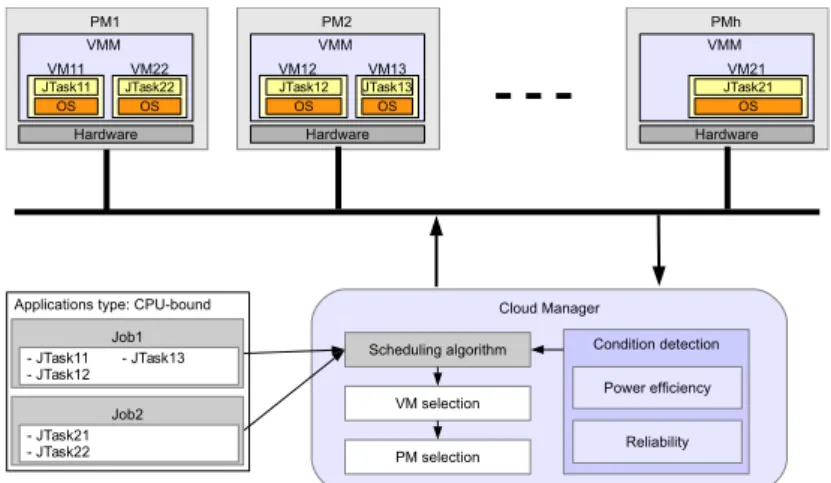
4.2 An Approach to Energy- and Failure-aware Virtual Clusters . . . 52
4.2.1 System Overview . . . 52
4.2.2 Problem Formulation . . . 53
4.2.3 Exploiting the PM States . . . 54
4.2.4 Exploiting Virtualization Features . . . 54
4.2.5 Power Efficiency Detection Mechanism . . . 54
4.2.6 The Cloud Manager . . . 55
4.3 Power- and Failure-aware Scheduling Algorithms . . . 57
4.3.1 Power- and Failure-aware Relaxed Time Execution Algorithm . . . 57
4.3.2 Power- and Failure-aware Minimum Time Execution Algorithm . . . 60
4.3.3 State-of-the-art Scheduling Algorithms . . . 60
4.4 Performance Evaluation . . . 61
4.4.1 Simulation Setup . . . 61
4.4.2 Performance Metrics . . . 62
4.4.3 Workload Characteristics . . . 63
4.4.4 Failures and Unavailability Properties . . . 64
4.4.5 Testbed Setup . . . 64
4.5 Simulation Results and Analysis . . . 65
4.5.1 Energy Optimizing Mechanism . . . 65
4.5.2 Simulation with Random Synthetic Workloads . . . 66
4.5.3 Simulation with Google Tracelogs-based Workloads . . . 68
4.5.4 Experiments in Real Cloud Testbed . . . 71
4.6 Conclusions . . . 72
5 Mitigating Performance Deviations in Energy-efficient Virtual Clusters 75 5.1 Introduction . . . 75
5.2 An Approach to Power- and Interference-aware Virtual Clusters . . . 77
5.2.1 Applications Overview . . . 77
5.2.2 Power Efficiency Logic . . . 79
5.2.3 Performance Deviation Logic . . . 79
5.2.4 Performance Enforcing Logic . . . 80
5.3 PIASA - A Power- and Interference-Aware Scheduling Algorithm . . . 82
5.3.1 VM Selection . . . 82 5.3.2 VM Deployment . . . 83 5.4 Performance Evaluation . . . 86 5.4.1 Simulation Setup . . . 86 5.4.2 Performance Metrics . . . 87 5.4.3 Workload Characteristics . . . 88
5.4.4 Alternative Strategies for Comparison Purposes . . . 89
5.5 Simulation Results and Analysis . . . 90
5.5.1 CPU-bound Workloads . . . 90
5.5.2 Network-bound Workloads . . . 93
5.5.3 Mixture of CPU- and Network-bound Workloads . . . 95
6 Conclusions and Future Directions 97
6.1 Findings and Contributions . . . 97
6.2 Future Research Directions . . . 99
6.2.1 Other Sources of Energy Consumption . . . 99
6.2.2 Combination with Fault-tolerant Reactive Schemes . . . 99
6.2.3 Performance Interference and Application Affinities . . . 100
1.1 The expected growth in failure rate . . . 2
1.2 Total electricity used by data centers worldwide . . . 3
2.1 Virtualization concept . . . 14
3.1 Approximate distribution of peak power usage by hardware subsystem in one of Google’s data centers . . . 33
3.2 Power consumption versus CPU utilization for the 8-core Xeon server . . . 34
3.3 LANL systems statistics for failures . . . 36
3.4 Power supply efficiency . . . 40
4.1 Private cloud management architecture . . . 53
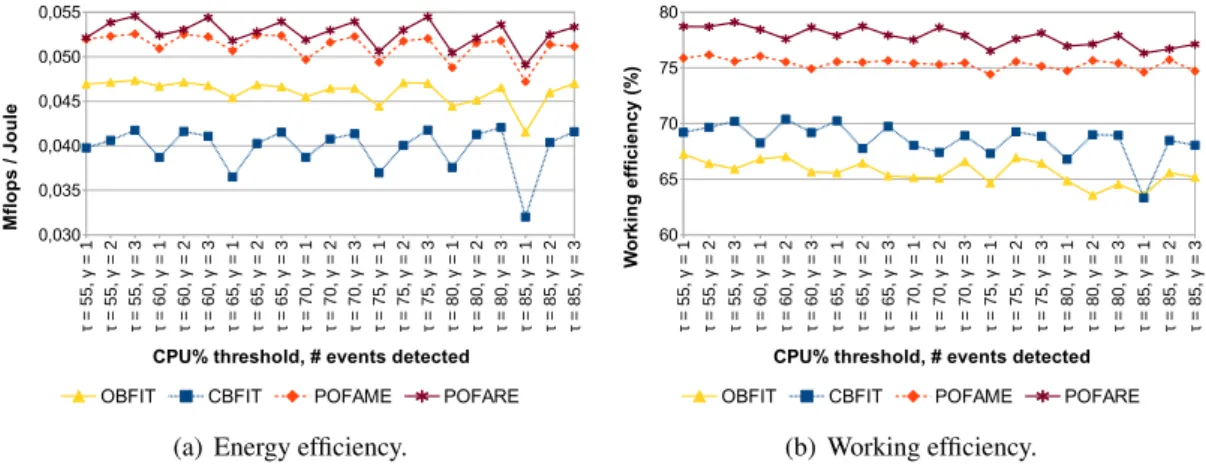
4.2 Tuning energy optimizing mechanism, with workloads based on Google cloud tracelogs . . . 66
4.3 Impact of consolidation of VMs in energy consumption, with workloads based on Google cloud tracelogs . . . 67
4.4 Impact of the average task length to MTBF ratio in the performance of scheduling algorithms, without dynamic consolidation, for random workloads. . . 68
4.5 Energy- and failure-aware scheduling algorithms, without dynamic consolidation, for Google-based workloads . . . 70
4.6 Energy- and failure-aware scheduling algorithms, with dynamic consolidation, for Google-based workloads . . . 71
4.7 Experiments for energy- and failure-aware scheduling algorithms, with dynamic consolidation, for Google-based workloads . . . 73
5.1 Private cloud management architecture . . . 78
5.2 Performance deviation estimator module for CPU-bound workloads . . . 81
5.3 Performance deviation estimator module for network-bound workloads . . . 82
5.4 Comparison among slowdown estimator mechanisms in the management of CPU-bound workloads, combined with PIASA . . . 92
5.5 Dynamic adjustment of bandwidth and CPU resources for a VM running a network-bound workload . . . 94
3.1 Data centers worldwide power consumption in 2012 . . . 32 4.1 Results for Google cloud tracelogs, with failures, without and with energy
opti-mization . . . 72 4.2 Results for Google cloud tracelogs, without failures, without and with energy
op-timization . . . 72 5.1 Performance of the algorithms in scheduling CPU-bound workloads without
per-formance deviation . . . 91 5.2 Performance of the scheduling algorithms in the management of CPU-bound
workloads, with interference among co-hosted tasks . . . 91 5.3 Performance of PIASA + KFLR in the management of CPU-bound workloads,
while varying ASE . . . 93 5.4 Performance of scheduling algorithms in the management of network-bound
workloads . . . 94 5.5 Performance of proposed KFLR + KFIO + PIASA, while varying α . . . 96
Introduction
C
LOUD computing has proven to be a major commercial success over recent years by en-abling on-demand provisioning of elastic computing resources on a pay-as-you-go basis. It refers to both the applications delivered as services over the Internet and the hardware and systems software in the data centers that sustain such services. Cloud computing’s aim is to make a bet-ter use of distributed resources, which the massive compubet-ters constitute, while offering dynamic flexible infrastructures and Quality-of-Service (QoS) guaranteed services. From a hardware point of view, it gives users the illusion of infinite computing resources available on demand. Cloud infrastructures allow organizations to outsource their computational needs so as to reduce man-agement overhead and to minimize investment costs in private computing infrastructures, or to extend existing limited private infrastructures to improve the resource management and provision-ing processes. Even more importantly, cloud systems allow providers to offer further types of applications to a wide market whilst minimizing the entry costs.Virtualization is considered the base of cloud computing. The intrinsic nature of system vir-tualization technologies renders flexible and scalable system services to cloud systems, creating a powerful computing environment where virtualized resources can be dynamically allocated, ex-panded, shrunk or moved as demand varies. Based on virtualization, cloud computing addresses most important inherent features such as scalability, interoperability, failover, load balancing, etc. Today’s virtualization technologies enable virtualization of many factors, such as Information Technology (IT) resources, hardware, software, operating systems (OSs) and storage, whereas environment is decoupled from physical platform.
In spite of the advantages brought by the cloud computing emerging business model, nowa-days IT industry is adopting cloud to offer users high-available, reliable, scalable and inexpensive dynamic computing environments. However, proliferation of cloud computing and consequently the establishment of large-scale data centers all over the world containing massive number of interconnected compute nodes brought new challenges to the management of these computing environments: failures and energy consumption. Node failures are a characteristic of very large-scale distributed systems, that can have thousands of nodes running a variety of different jobs. A study conducted by Los Alamos National Laboratory (LANL) [Phi05] estimated that a node’s
Figure 1.1: The expected growth in failure rate [SG07].
mean time between failures (MTBF) is 1.25 h in a petaflop system. In Figure1.1 is shown the expected increase in failure rate, with numbers of cores doubling every 18, 24 and 30 months. Today’s available information suggests that failure occurrences will become far more common in the coming decade, severely impacting the system performance and operation costs.
On the other hand, as cloud computing becomes more widespread, the amount of electri-cal energy consumed by data centers increases, resulting in high operational costs and emission of carbon dioxide (CO2) to the environment. This approach creates great pressure for cloud
providers that need to reduce operational costs through improved energy utilization. As shown in Figure1.2, the electricity used by data centers worldwide increased by about 56% from 2005 to 2010, and in 2010 was accounted for between 1.1% and 1.5% of total electricity use. Moreover, Koomey [Koo11] estimates that energy consumption in data centers will continue to grow in the future. Energy-efficient resource management solutions must be developed to help reducing the energy consumption.
Failure occurrences and power consumption have become a critical concern in designing mod-ern cloud systems, because the success of petascale computing will depend on the ability to pro-vide dependability at scale, at acceptable operational costs. To address the problem of failure occurrences, adopting failure-aware resource management is crucial. Failure prediction technique can be used to proactive and autonomically construct adaptive computing infrastructures, that self-adjusts their configuration dynamically at runtime according to the components’ availability. In turn, eliminating inefficiencies and waste in the way, resources are utilized to serve applications, workloads help improving energy efficiency. The Open Compute Project has reported recently that Facebook’s Prineville, Oregon, data center presents a Power Usage Effectiveness (PUE) of 1.08 (PUE concept is defined in Section3.2.2), which means that about 92% of energy from the data center is consumed directly by the computing resources [Pro11]. Also Forest City data cen-ter is reported having a PUE of 1.09. These numbers suggest that source of energy waste occurs due to the inefficient usage of computing resources. Garraghan et al. [GTX13] have analysed
Figure 1.2: Total electricity used by data centers worldwide [Koo11].
the resource utilization in Google cloud data center and have concluded that resource utilization remains between 40 – 60%. Additionally, the same authors concluded that the amount of re-source utilization wasted due to task termination and consequent preceding work being lost varies between 4.53–14.22%. Considering that an idle server consumes from 50% to 70% of its total power [BGDG+10], cloud users’ applications can be consolidated and servers underutilized can go into sleep mode in order to reduce the energy consumption.
Guarantee the expected QoS for applications, and reduce the energy consumption via con-solidation at the same time, is challenging because of performance deviations. Technological limitations related to virtualization, and diverse scheduling policies are the root of the problem. Despite the enormous progress in virtualization capabilities in the last years, the technology is still unable to handle performance isolation among virtual machine (VM) instances sharing the same physical host. Several studies (e.g., [CKK11, MLPS10, SC09, ZT12]) have studied this phenomenon, and concluded that, in the case of deadline-driven applications, the performance interference among co-hosted workloads can cause a 120% slowdown in the execution of appli-cations. Another problem regarding QoS deviations is related to the type of workload a VM is running, which makes previous scheduling conditions outdated. In the case of web applications, in which workloads demand are bursty, outdated schedules can result in situations of scarcity of resources, with consequent penalty in QoS of applications perceived by end-users. On the other hand, over-provisioning of resources to applications is not a solution in the sense that it will result in waste of energy. This problem is even more serious since current cloud data centers either do not offer any performance guarantee or prefer static VM allocation over dynamic. For example, Amazon EC2 offers only guarantees on availability of resources, not on performance of applica-tions running within VMs [GTGB14]. In this regard, it is imperative to consider these limitations in the scheduling of applications in the cloud.
1.1
Motivation and Scope
In a first stage, the scope of this thesis is creating and managing energy-efficient and fault-tolerant Infrastructure-as-a-Service (IaaS) cloud data centers under QoS constraints. In typical cloud computing systems, IaaS providers directly partition the physical resources into VMs, over which applications are deployed. Then, VMs are managed according to established policies. Consolidation of VM instances has been shown to be effective in improving utilization of re-sources [MMP13,XF10,XF11,ZZA10, RJQ+10, BAB12], because power consumption of the computing resources is linearly related to the application workload and consequently to the CPU utilization either [XF10]. One capability provided by virtualization is VM migration, an extremely powerful management tool allowing administrators to move a VM instance to another server in a seamless way. Also, several virtualization technologies deploy a cap mechanism, that specify a hard limit to implement an upper bound of resource consumption, to control the amount of CPU resource a VM instance can use. This thesis uses both migration and cap mechanisms to im-plement vertical and horizontal dynamic consolidation [SHRE13] of CPU-bound tasks executing within VMs, to improve the utilization of resources and reduce energy consumption.
An essential property for effective consolidation is to be able to efficiently utilize system re-sources for high-availability computing and energy efficiency optimization, because both factors have impact in energy consumption and QoS of the system perceived by end-users. Virtualization technology is increasingly being utilized to guarantee availability properties, in alternative to tra-ditional expensive hardware solutions. Despite the existence of different fault tolerance schemes, there is a shift onto failure prediction tools [Fu10] in recent research on systems dependability to implement proactive fault tolerance, in response to excessive overhead traditional schemes im-ply [Phi05]. By continuously analysing performance data in a system, a resource manager can be applied to help determine possible occurrences of fatal events in the near future. In this way, proactive fault tolerance can be promoted by migrating VMs from health-deteriorating node to a healthy one for failure resilience and improving system availability.
However, while VM consolidation contributes to improved energy efficiency in a data cen-ter, current virtualization technologies do not provide performance isolation among co-hosted VM instances. To this end, in a second stage this thesis aims at creating and managing energy-efficient and interference-aware IaaS cloud data centers. Deviation in performance can occur due to performance interference among co-hosted VMs executing different workload types with diverse QoS constraints, that contend for hardware resources. CPU-bound contending for on-chip [HL13] resources and scheduling policies associated with the time characteristics of web workloads [GTGB14], for example, are the cause of the problem. Notable research efforts in this field delivered some performance interference meters [DFB+12] to measure the performance deviation with some error due to contention in on-chip resources. This thesis combines these state-of-the-art performance interference meters, with VM capabilities (i.e., migration and cap limits), to build interference- and power-aware IaaS cloud environments.
In order to make decisions about resources management aiming at optimizing energy effi-ciency, while maintaining compute environment availability and achieving desired application QoS requirements, online heuristics-based optimization algorithms are applied to solve the prob-lem quickly in a time span up to a few seconds. Since the management of resources at each stage under investigation in this thesis comprehends two objectives, the problem can be solved following a multi-objective optimization (MOO) methodology. MOO is referred as the process of optimiz-ing systematically and simultaneously a collection of objectives [MA04]. The aim is to search for an optimal state in the feasible decision space that maximizes the set of criteria, meaning that it is guaranteed that the solution found does not violate the given constraints. In contrast to single-objective optimization, in typical multi-single-objective problems there is no single global solution, and therefore it is necessary to determine a set of states that all fit a predetermined definition for an optimum. According to Abrishami et al. [ANE12], multi-objective scheduling algorithms can be addressed in three possible ways, namely: (i) finding the pareto optimal solutions, and let the user select the best solution; (ii) combination of the two functions in a single objective function; and (iii) bicriteria scheduling in which the user specifies a limitation for one criterion, and the algorithm tries to optimize the other criterion under this constraint.
The important aspects distinguishing the work presented in this thesis from the related research are the design and implementation of integrated power- and failure-aware scheduling algorithms, that implement horizontal and vertical elasticity of IaaS environments. Moreover, mechanisms to detect energy optimizing opportunities are developed, allowing to dynamically update the VMs to physical machines (PMs) mapping in order to improve energy efficiency and thus reducing oper-ational costs. Availability is implemented through multi-objective scheduling algorithms, which autonomical and proactively tolerate faults in compute nodes. Another aspect distinguishing this work from the related research is the development of a mechanism that efficiently detects viola-tions in diverse applicaviola-tions QoS requirements, based on noisy estimaviola-tions. All algorithms take into account the migration overhead due to VM migrations to dynamically manage virtual envi-ronments in the cloud, in an effort to enforce applications QoS requirements. The performance analysis of the proposed solutions to tackle the issues evidenced is carried out through simula-tion and experiments in real cloud testbed, and using workloads, failures, and interference which characteristics follow the state-of-the-art studies in the area.
1.2
Research Problems and Objectives
The problem addressed in this thesis is twofold, namely the management of resources in cloud data centers to: (i) improve energy efficiency, where physical resources are subject to failure; and to (ii) comply with the performance required by different types of applications, with diverse QoS constraints, in energy-efficient cloud data centers. In particular, the following research problems are investigated:
• What amount of resources to assign. Since submitted applications to the cloud can have diverse QoS constraints (i.e., deadline or throughput), it is necessary to derive the amount
of resources necessary to comply with the application QoS constraints. By assigning the correct amount of resources to applications, wastage of resources by over-provisioning is diminished, and scarcity is avoided.
• When to migrate VMs. Dealing with energy inefficiencies, tolerating nodes failure, and mitigating performance deviation in applications, implies determining when active PMs are utilizing power inefficiently, or the time at which those PMs are predicted to fail, or even when the deviation in performance imposes violation of the QoS constraints. In this context, it is necessary to develop mechanisms to detect: (i) energy optimizing opportunities; (ii) nodes with insufficient reliability to satisfy applications in terms of QoS constraints; and (iii) applications executing under performance.
• Which VMs to migrate. Once a condition detection is made (i.e., energy inefficiency, node about to fail, or unbearable deviation in performance of VM), it is required to determine which VMs should be migrated to improve IaaS environment in terms of proposed objec-tives. The decision to migrate VMs must consider the overhead caused by migration in QoS requirements, the status of PMs in terms of power efficiency, reliability, and deviation in performance of hosted VMs, and the reason why migration is occurring to establish an order of migration.
• Where to migrate the VMs selected for migration. When a VM is marked for migrating or a new VM is submitted for scheduling, a PM must be selected to host the VM. Selecting the most appropriated PM is essential in the way it directly influences the quality of IaaS in terms of energy efficiency, dependability of virtual resources, and satisfaction of QoS constraints.
Derived by the aforementioned challenges, this thesis follows the objectives here delineated: 1. Investigate fault-tolerant mechanisms to deploy high-available virtual computing
environ-ments in the cloud, and develop and implement an energy optimizing detector that efficiently detects energy inefficiencies in IaaS environments.
2. Design an online scheduling algorithm to create power- and failure-aware IaaS environ-ments.
3. Investigate performance interference causes and detectors in co-hosted VMs, and design and implement a performance deviation estimator that determines, for different QoS constraints, the differential in resources needed to satisfy the QoS requirements.
4. Design an online scheduling algorithm to create interference- and power-aware IaaS envi-ronments.
1.3
Evaluation Methodology
The mechanisms proposed in this thesis are evaluated through discrete-event simulation and ex-periments in real cloud testbed created for this purpose. In a first attempt, simulation approach is essential to deal with the extremely complex process of evaluating the efficacy of different mecha-nisms on large-scale virtualized data center production environments, where it is hard to guarantee repeatable conditions for such a set of experiments. Simulation provides the ability to ensure the reproducibility and repeatability of experiments, which can be easily conducted with different pa-rameters to examine the behaviour of the proposed mechanisms in diverse circumstances. There-fore, discrete-event simulation has been chosen as a first step, towards creating cloud computing environments and deploying views of infinite computing resources, so as to evaluate the perfor-mance of the proposed mechanisms. In a second moment, tests are done in a real platform in order to provide preliminary results of the adoption of the proposed algorithms.
The application workloads to use in simulations and experiments in real cloud testbed, follow the last version of the Google cloud tracelogs [MGTX13]. The data collected from Google data centers spans for over 29 days, yielding significant data on the characteristics of submitted work-loads and the management of cluster machines. These studies enable further work on important issues, such as resource optimization, energy efficiency improvements, and failure correlation. In turn, the failure characteristics describing nodes reliability are modelled based on failure data col-lected at two large high-performance computing sites [SG10]. The first data set has been collected at LANL and spans over nine years. The second data set has been collected on one large supercom-puting system comprising 20 nodes and more than 10,000 processors, over the period of one year. Regarding performance deviation, the attributes of interference occurring among applications dur-ing runtime follow the characteristics obtained from the in-depth analysis of the state-of-the-art in this topic.
In order to consistently evaluate the performance of the mechanisms proposed in this thesis, state-of-the-art scheduling algorithms are implemented for comparison purposes.
1.4
Summary of Contributions
Considering the aforementioned objectives, the major contributions of this thesis are listed as follows:
1. The development of power- and failure-aware scheduling algorithms that implement vertical and horizontal platform elasticity. This thesis proposes two improved scheduling algorithms to construct power- and failure-aware IaaS cloud environments, aiming at pro-viding to end-users a high-available and reliable computing environment, while the energy consumed is reduced, with a limited application performance impact.
2. The development of a mechanism to reactively detect energy optimizing opportunities to assist in creating and managing power- and failure-aware virtual clusters. This
thesis proposes a threshold-based power efficiency optimizing mechanism that, based on PMs statuses, detects under-loaded PMs that can be switched to low power modes in order to optimize the energy efficiency of the whole cloud system.
3. An extensive evaluation of the energy optimizing mechanism and scheduling algo-rithms with randomly generated workloads and with workloads that follow the lat-est version of the Google cloud tracelogs. The proposed mechanisms in this thesis are tested with random- and Google cloud tracelogs-based workloads, through simulation and experiments in real cloud testbed.
4. A dynamic configuration of the CPU portion assigned to each VM that reduces the consumed energy and maintains the service-level performance. Unlike state-of-the-art scheduling algorithms implemented in cloud middle-ware stacks such as OpenStack [Jac12], the proposed power- and failure-aware scheduling algorithm implements horizontal and ver-tical elasticity of resources. For that, the algorithm leverages tools presented in state-of-the-art virtualization technology, such as cap from the Xen credit scheduler.
5. A mechanism to detect and estimate the performance deviation in CPU-bound work-loads from the QoS requirements, even when performance data samples are noisy. This thesis proposes a mechanism to deal with performance deviation in CPU-bound tasks due to contention in on-chip resources, by estimating the slowdown occurring in tasks runtime, and assigning resources accordingly to assure that the tasks are executed by their deadlines. 6. A strategy for the enforcement of QoS requirements of network-bound applications which workloads are bursty in time. In order to deal with oscillation in demand of re-sources by network-bound applications, this thesis proposes a strategy that detects perfor-mance deviations in the number of requests served per time unit, and dynamically defines soft limits accordingly during application runtime. In this regarding, the strategy assures application QoS requirements by avoiding scarcity of resources, and it diminishes the waste of resources at the same time.
7. An algorithm for scheduling of heterogeneous workloads in virtualized data centers, with different characteristics and specific SLA requirements. This thesis proposes an improved power- and interference-aware scheduling algorithm, that performs vertical and horizontal elasticity, to construct interference- and power-aware virtual clusters (i.e., IaaS cloud environments) to execute the tasks under the QoS requirements.
8. A study about the trade-off between the two opposite objectives: energy efficiency ver-sus performance improvement. An extensive set of simulations is carried out in order to assess the performance of improved power- and interference-aware algorithm in terms of construction of power-efficient vs high-performance clusters. To this end, a control param-eter in the algorithm was tuned, and the results properly discussed.
1.5
Thesis Organization
The core chapters of this thesis are structured as listed below, and are derived from the set of research papers published during the course of the PhD candidature. The remainder of this thesis is organized as follows:
• Chapter 2 presents a literature review on the current related work in IaaS management, intro-duces a comprehensive analyses of virtualization capabilities and limitations in enhancing IaaS management, and positions this thesis in regards to those works.
• Chapter 3 introduces an overview of power and energy concepts, analyses and identifies the sources of power consumption in a data center, and follows with a taxonomy and survey of fault tolerance schemes in computing systems. The chapter introduces the current related work as well, and positions this thesis in regards to those works.
• Chapter 4 presents a energy optimization mechanism, which detects energy optimizing op-portunities, and two scheduling algorithms that create energy-efficient and high-available IaaS cloud environments. This chapter is derived from [SB13b,SB13c,SB14c]:
– Sampaio, Altino M., and Jorge G. Barbosa, "Dynamic power- and failure-aware cloud resources allocation for sets of independent tasks.", in IEEE International Conference on Cloud Engineering (IC2E), San Francisco, 2013.
– Sampaio, Altino M., and Jorge G. Barbosa, "Optimizing energy-efficiency in high-available scientific cloud environments.", in 3rd IEEE International Conference on Cloud and Green Computing (CGC), Karlsruhe, Germany, 2013.
– Sampaio, Altino M., and Jorge G. Barbosa, "Towards high-available and energy-efficient virtual computing environments in the cloud.", Future Generation Computer Systems, Elsevier, vol. 40, pp. 30–43, 2014.
• Chapter 5 presents an approach to detect and mitigate the performance deviations in two different types of applications, with specific QoS constraints, and it proposes a scheduling algorithm to create interference- and power-aware IaaS cloud environments. This chapter is derived from [SB13a,SB14a,SB14b]:
– Sampaio, Altino M., and Jorge G. Barbosa, "Last-Level Cache Interference-Aware Scheduling in Scientific Clouds", Parallel & Cloud Computing, vol. 2, n. 4, pp. 116– 125, Oct. 2013.
– Sampaio, Altino M., and Jorge G. Barbosa, "Estimating Effective Slowdown of Tasks in Energy-Aware Clouds.", in 12th IEEE International Symposium on Parallel and Distributed Processing with Applications (ISPA), Milan, 2014.
– Sampaio, Altino M., and Jorge G. Barbosa, "A Performance Enforcement Mecha-nism for Energy- and Failure-Aware Cloud Systems.", in 5th IEEE International Green Computing Conference (IGCC), Dallas, 2014.
– Sampaio, Altino M., Jorge G. Barbosa, and Radu Prodan, "PIASA: a Power and Interference Aware Resource Management Strategy for Heterogeneous Workloads in Cloud Data Centers.", Simulation Modelling Practice and Theory, submitted in Febru-ary, 2015.
• Chapter 6 concludes the thesis by summarising the main findings and contributions, and by discussing the future research directions.
Virtualization-based Resource
Provisioning in Modern Data Centers
Virtualization is extensively applied in cloud computing data centers to implement the vision of IaaS, in which IT infrastructure is deployed in a provider’s data center as VMs. Users’ applica-tions are packaged within VMs, which addresses significant benefits for cloud providers in recon-figuring the cloud infrastructure to achieve predefined goals. Today’s virtualization technologies enable virtualization of many factors, such as IT resources, hardware, software, operating systems and storage, whereas the execution environment is decoupled from the physical platform. The aim of this chapter is to provide a view of IaaS management, and a comprehensive analyses of virtual-ization software capabilities and limitations in enhancing IaaS management, and positioning this thesis in regards to those works.
2.1
Introduction
M
ODERN society increasingly depends on large-scale distributed systems to conduct busi-ness, government, and defence. A distributed system is essentially a collection of indepen-dent computers, sharing resources and interacting with each other towards achieving a common goal, via a computer network [TVS02]. From the users’ point of view, a distributed system appears as a single coherent system. The shared resources in a distributed system include data, storage ca-pacity, and computational power, and the distributed computing infrastructure can be used to serve diverse objectives, ranging from executing resource-intensive applications (e.g., CPU-bound ap-plications) to serving scalable Internet applications (e.g., CPU- and network-bound apap-plications). In particular, in the last recent years, large-scale distributed systems have been consolidated it-self as a very powerful platform to develop and operate a new generation of business, delivered through the Internet. No matter the size or location of the business, the Internet allows almost any business to reach a very large market. And so, distributed systems have become a powerful mean to support the evolution of civilizations, providing services for business, development of researchand science, and welfare of populations. However, articulation of provided services and deployed resources is challenging, making the integration of decentralized services and resources difficult.
Recently, an increasingly interest in Service Oriented Architectures (SOA) [Erl05] and con-stantly growing solutions for virtualization have leading to the concept of cloud. Cloud comput-ing [AFG+10] can be defined as a specialized distributed computing paradigm that utilizes net-worked computing systems to handle data and computation seamlessly. It represents a new type of computational model, providing better use of distributed resources, while offering dynamic, flexible infrastructures and QoS guarantees. Key concepts distinguishing cloud computing from other paradigms includes on-demand, high-availability, and high-scalability access to large-scale distributed resources, with Service Level Agreement (SLA)-driven management [BYV+09]. From a hardware point of view, users have the illusion of infinite computing resources that are available on demand. By using cloud based systems, costumers can have easy access to large distributed in-frastructures, with the ability to scale up and down the assigned computing resources according to their applications needs. Such ability represents an enormous advantage compared to other com-puting paradigms since cloud users can concentrate specifically in developing their work, without concerning about over- or under-provisioning of resources. What is more, cloud users are free from the burden of requiring the large capital outlays in hardware to deploy their applications or the human expense to operate it, because cloud manages it transparently to costumers. Another important feature of cloud is that organizations pay for computing resources on a consumption basis, very much like the utility companies charge for basic utilities such as electricity, potentially leading to cost savings.
According to Schubert et al. [SJNL10], clouds can be classified according to their service types and deployment modes.
• Infrastructure as a Service (IaaS): It provides resources, that have been virtualized, as services to the user, such as virtual computers, meeting various computing needs, and even virtual clusters. Cloud infrastructures apply resource elasticity and server consolidation techniques to rapidly adapt to environment changes (i.e., variation in computational capacity needs, physical nodes availability, etc.), and provide on-demand access to computational resources in a pay-as-you-go basis. Common operation in clouds implies that provisioning of services are specified and regulated using SLAs, and requests for instantiation of services may be accepted or rejected based on current and predicted infrastructure load and capacity. Among public IaaS providers, Amazon EC21 offers access to EC2 instances which looks much like physical hardware, letting users control the software from the kernel upwards. However, this approach has inherent difficulty supporting automatic scalability and failover, since traditional methods, such as replication, are highly application-dependent.
• Platform as a Service (PaaS): It provides developers with an environment upon which ap-plications and services can be developed and hosted. Typically, users control the behaviour
and execution of a server hosting engine through dedicated Application Programming Inter-face (API) deployed by cloud providers. In this way, developers can concentrate in creating services instead of worrying about building an environment for running them.
• Software as a Service (SaaS): It provides access to software packages / services using the cloud infrastructure or platform, but keeping users unaware of underlying infrastructure. SaaS allows end-users to avoid rigid license agreements or infrastructure costs.
Furthermore, clouds can be classified based on the business model of the provider as:
• Private Clouds: Typically owned by the respective organization, services deployed can be accessed and managed exclusively by people of the organization, thus not being directly exposed to the customer.
• Public Clouds: Organizations may offer their own cloud services to clients or other service providers, thus being available to general public. In this context, enterprises can utilize such cloud providers services to avoid build up their own infrastructure with consequent cost reduction.
• Hybrid Clouds: It consists of mixing private and public cloud infrastructures and services. This model allows enterprises to keep control over sensitive data by employing local private clouds, and to outsource parts of their infrastructure to public clouds so as to achieve a maximum of cost reduction.
Additional classifications can eventually be found in literature, or at different granularity. This thesis addresses the problem of IaaS resources management in a private cloud, where users submit applications, which may have different types of workloads and diverse QoS requirements.
2.2
Virtualization Technology
Virtualization [VNE+08] is the main technology in cloud computing to deploy IaaS. It promises a reduction in cost and complexity through the abstraction of computing resources such that a single PM is able to support a large number of disparate applications running simultaneously. In turn, each application runs in a logical container – the VM. In this sense, virtualization enables a reduction in the number of physical components, meaning fewer assets to configure and monitor, and consequent reduction in complexity and cost of managing cloud infrastructures.
2.2.1 Concept
The concept of virtualization was first introduced with the IBM mainframe systems in the 1960s, to refer to a virtual machine [Ada66]. A virtualization system is an architecture able to separate and isolate an operating system from the underlying hardware resources and lower level functionalities (e.g., servers, network links, and host bus adapters). Server virtualization [Gol74] is performed
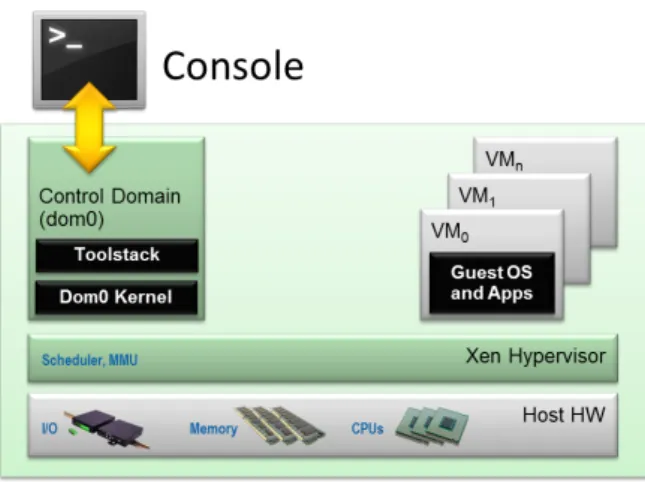
Figure 2.1: Virtualization concept2.
on a given hardware platform by introducing a thin hypervisor layer, sometimes called virtual machine monitor (VMM), which sits on top of the physical hardware resources and creates a simulated computer environment (i.e., a VM).
Hypervisors can be implemented in server firmware or in software [LDL+08]. Virtualization splits a single physical computer into multiple logical computers, or VMs, each accommodating its own guest software, as described in Figure2.1. Then, the hypervisor multiplexes and arbitrates access to resources of the host platform so that they can be shared efficiently among multiple VMs. The guests run just as if they were installed on a stand-alone hardware platform. The number of VMs per PM is limited by the host hardware capability, such as core number, CPU power, RAM resources, and can be defined as well by the software provider.
According to the type of virtualization, there is no requirement for a guest operating system (GOS) to be the same as the physical host one. Guests are able to access specific hardware com-ponents, such as hard disk drives, network interfaces, etc.
2.2.2 Classification of Virtualization
In the x86 CPU architecture, hierarchical protection domains, also called protection rings, are a mechanism to manage access to the computer hardware with different privileges. Rings are arranged in a hierarchy from most privileged (i.e., the ring 0) to least privileged (i.e., the ring 3). The kernel of an OS executes its instructions at the most privileged level, the ring 0, to have direct access to the memory and hardware. The virtualization software is placed under the OS to be able to run in ring 0 and to directly access the hardware, forcing the OSs to move to a level ring with less privilege than the VMM executing in ring 0. In this regarding, VMMs have to implement a mechanism to support privileged operations in OSs hosted in VMs and no more executing in ring 0. For that, three major alternative architectures exist for handling sensitive and privileged instructions [VMw07], namely:
• Full Virtualization: The guest OS needs no modification, because it is completely decou-pled from the hardware and is unaware that it is being virtualized. The hypervisor translates OS instructions on the fly into instructions that have the intended effect on the virtual hard-ware. Instead, user level instructions are directly executed on the processor to improve the performance. All requests to access the hardware are handled on demand by the hypervi-sor, which caches the results for future use. This alternative offers the best security and flexibility, allowing a higher number of operating systems to be virtualized.
• Para-virtualization: In this mode, the hypervisor layer runs directly over the hardware, which provides the resources needed by the virtual machines. Then, a privileged operating system instance runs over the hypervisor, and is responsible for controlling it, and for man-aging virtual machines. The hypervisor provides hypercall interfaces to be used by guest operating systems. This means that guest operating systems are modified, in order to re-place the privileged operations with hypervisor calls, in such a way that they know that are being virtualized. Para-virtualization environments impose a low virtualization overhead and provides optimized operations, but their performance can vary greatly depending on the workload. Examples of para-virtualization systems are Xen3and VMware Infrastructure4. • Hardware Assisted: This alternative implies hardware support such as Intel VT-x5 and
AMD AMD-V6 based machines, present in systems since 2006. In this technology, the VMM runs in a new root mode below ring 0, meaning that specific CPU calls are not trans-lated by the hypervisor, and are sent directly to the CPU. However, this approach introduces a high hypervisor to guest transition overhead.
2.2.3 Virtualization Features
The recently resurgence of virtualization relates to the possibility to deal with issues in the data center, such as variance in demanding requirements of computing resources, power inefficiency due to hardware underutilization, high system administration costs, and reliability and high-availability. Current virtualization technologies provide powerful mechanisms to tackle these is-sues, namely VMs resizing, migration and checkpointing. VM resizing mechanism permits the adjustment of resources allocation, by adding additional CPUs, network interfaces, or memory. In turn, VM migration [CFH+05] mechanism gives the ability to easily move VMs from one phys-ical node to another one using live or stop and copy migration alternatives. Both VM resizing and migration techniques are the necessary conditions to achieve elasticity and the appearance of infinite capacity available on demand. At the same time, virtualization benefits cost reduction by server consolidation (i.e., aggregation of existing VMs in less quantity of PM, hence decreasing the number of active PMs), since the number of hosting servers can be minimized based on better
3http://www.xen.org 4http://www.vmware.com
5htto://www.intel.com/go/virtualization
utilization of the expensive hardware resources. Therefore, through resource elasticity and server consolidation techniques, cloud infrastructures are able to rapidly adapt to energy inefficiencies and failures in physical nodes, providing high-availability access to computational resources on demand. Thus, VMs resizing and migration have emerged nowadays as promising techniques to be utilized by resource management algorithms since they can cope with resources alloca-tion problems in modern data centers. For example, based on these techniques, Lagar-Cavilla et al. [LCWS+09] developed the SnowFlock system, a VM fork approach that rapidly clones a VM into several replicas running on different PMs. Similiar to [HUM+11], it uses fast VM in-stantiation by initially copying and transmitting only the critical metadata (authors called it VM descriptor) necessary to start execution on remote host. Memory-on-demand mechanism fetches portions of VM state, from an immutable copy of the VM’s memory from the time of cloning, over the network as it is accessed. Cooperatively, avoidance heuristics algorithms try to reduce su-perfluous memory transfers that will be immediately overwritten, and multicast replies to memory page requests. These key techniques enable SnowFlock to introduce little runtime overhead and small consumption of I/O resources, leading to good scalability. VMs disks are implemented with blocktap driver. SnowFlock represents an example of how modern data centers can leverage virtu-alization to provide excess load handling, opportunistic job placement or even parallel computing, as well as to provide fault tolerance due to replication of VM instances.
Nowadays, there are several system-level virtualization solutions offered by some commercial companies and open-source projects. Some of the major virtualization software include Xen7, KVM8, and VMware9. The next subsection discusses one of the most popular virtualization tech-nology solution – Xen hypervisor, which supports the management mechanisms here described.
2.2.4 The Case of Xen Hypervisor
The Xen hypervisor is an open-source high performance resource-managed hypervisor [BDF+03]. Xen was initially created by the University of Cambridge Computer Laboratory and is now devel-oped and maintained collaboratively by the Xen community and engineers from several innovative data center solution vendors. The software is available at no charge in both source and object for-mats, and it is released under the GNU General Public License (GPL2).
Xen is classified as a "bare-metal" hypervisor because it runs directly on top of the physical machine in the most privileged processor-level. The hypervisor is the first program running after exiting the bootloader, and it is responsible for handling CPU, Memory, and interrupts. On top of that, Xen can execute a number of virtual machines, also known as domains or guests. There can be two types of domains, namely: (i) the privileged domain known as Dom0 or driver domain; (ii) and the unprivileged domains called DomUs. The Xen Dom0 is a special domain that is responsible for controlling the hypervisor and managing virtual machine (i.e., DomUs) creation, destruction, and configuration. For that, Dom0 runs a modified version of operating system that uses native
7http://www.xensource.com 8http://www.linux-kvm.org 9http://www.vmware.com
drivers to manage all the physical devices in the system. In turn, domains DomUs communicate with Dom0 by generating traps into it, and can also use hypercalls to invoke functions in the hypervisor. Xen hypervisor virtualizes the physical CPUs, providing virtual CPUs (VCPUs), on which the VMs run. This software supports para-virtualization and hardware assisted modes of virtualization.
Xen currently supports various scheduling algorithms to schedule domains, some of them were extensively analysed to determine their performance considering different scheduling pa-rameters [CGV07,XSWJ08,SC08]. Xen CPU credit scheduler10is the default scheduler in Xen since version 3.0, and is designed to ensure that each VM and/or a VCPU gets a fair share of the physical CPU resource. In the credit scheduler, to each domain is given the opportunity to con-figure CPU affinity and priority, by means of pinning VCPUs to specific cores and defining cap and weight scheduler parameters, respectively. The cap scheduler parameter specifies the max-imum percentage of CPU resources that a VM can get, while weight parameter determines the number of credits associated with the VM, which controls the priority in the execution of VMs. According to those weights (e.g., number of credits), the scheduler assigns physical CPU time allocation among all the VMs. For example, Xen credit scheduler can allow execution of two tasks, one VM receiving 30% of total CPU capacity, and the other the 70% remaining. In this regarding, there are examples of capping use to adjust dynamically resource allocation based on task usage, and to make sure co-located tasks cannot consume more resources than those allocated to them [SSGW11]. This thesis leverages the cap parameter feature in scheduling applications.
Xen supports migration of VM instances from one PM to another. It works by transferring the entire memory state of the kernel, all processes, and all application states, of the VM to be moved to another PM. Live migration and stop-and-copy migration are the two forms of migration supported by Xen hypervisor [CFH+05]. Stop-and-copy migration methodology involves sus-pending the original VM, copying all pages across to the destination VM, and then starting the new VM in the final PM. The downtime and total migration time are proportional to the amount of physical memory allocated to the VM, and depends on the free bandwidth at the moment of migra-tion [Fu10,MCTL+14]. In turn, live migrating VMs between physical nodes implies to iteratively copy the memory of the VM to the destination without stopping its execution [CFH+05].
Fu et al. [Fu10] investigated the performance of both migration methods in fault tolerance systems and concluded that stop-and-copy migration is simpler and faster to accomplish, de-spite introducing superior service downtime. In turn, live migration imposes shorter service downtime, but the overall migration time is longer. In this regard, this thesis leverages stop-and-copy migrations method because they are more preferable in failure-aware resource man-agement schemes due to small overhead and the imperfection of state-of-the-art failure predic-tion techniques [FX07a]. Yet in the context of fault tolerance, Xen implements a checkpoint mechanism called Remus [CLM+08], which uses copy-on-write (CoW) techniques [YAB+86] to asynchronously replicate/checkpoint the primary VM memory and disk to the backup VM in a very high frequency. The backup VM maintains a pre-copied disk image file to receive the
updates. Unfortunately, these pre-copies operations are very time consuming and often prove counter-effective [Phi05]. Fault tolerance approach based on checkpointing/restart mechanisms is out of the scope of this thesis, in favour of lighter alternatives in terms of performance over-head. In this investigation work, Xen is the selected hypervisor followed throughout the research to implement proposed mechanisms.
2.2.5 Virtualization-based QoS in Modern Data Centers
The current service oriented economy trend [AD09], supported by distributed computing paradigms such as cloud computing, has led to an increased concern about aspects regarding the quality and reliability of the services offered. As consumers move towards adopting such SOAs, the exploitation of service oriented technologies is followed by a growing interest of QoS mech-anisms [SS09]. However, providing QoS guarantees to users is a very difficult and complex task, because the demands of the consumers’ service vary significantly, and initially assigned comput-ing resources to applications tend to not perform as expected as they are becomput-ing shared among different types of workloads. In this regarding, services to costumers are often provided within the context of a SLA, which ensures the desired QoS. SLAs can be defined as a static mechanism of agreements between users and service providers, in which all expectations and obligations of a service are explicitly defined [PRS09]. The SLA’s main objective is to serve as the foundation for the expected level of service between the consumer and the provider, translating users’ expec-tations in terms of QoS into infrastructure level requirements. This way, users define their QoS requirements in high-level SLA metrics, which in turn correspond to low-level resource metrics used by cloud management system to enforce service utilization policies and usage commitments. The QoS attributes are generally part of an SLA, such as response time, throughput, and maximum execution time to accomplish a task, and need to be closely monitored so the management system can guarantee the QoS attributes on each application execution [KL03].
Virtualization technology is useful for cloud providers, in assisting the management of IaaS to fulfil users’ applications QoS requirements. The correct and effective use of the features provided by virtualization, such as migration and Xen credit scheduler parameters, allows cloud providers to cope with important current data centers issues, such as fault tolerance and energy consumption (see Chapter 3). Despite the advantages of using virtualization, there are unfortunately some limitations related with the use of the technology as well. Next, technological limitations are discussed.
2.3
Technological Limitations of Virtualization
Nowadays, cloud providers are faced with new challenges such as reduction of power consump-tion and guaranteeing SLAs, the key element to support and empower QoS in these environments. However, guaranteeing the expected QoS for applications, and reducing the energy consumption at the same time, is not trivial due to QoS deviations. In the base of such deviations from expected
performance and promised resources availability and capacity lies technological limitations and di-verse scheduling policies. Regarding the former reason, modern virtualization technologies do not guarantee effective performance isolation between VMs, meaning that the performance of appli-cations can change due to the existence of other co-resident VMs sharing the underlying hardware resources (e.g., [CKK11, MLPS10, SC09, ZT12]). In fact, a task running in the same VM on the same hardware but at different times will perform disparately based on the work performed by other VMs on that physical host. This phenomenon has been studied, and is known as performance interference. The later reason involves cloud providers policies, regarding achieving specific ob-jectives such as reduction of operational costs. To this end, cloud providers try to schedule multiple VMs onto fewer servers (i.e., consolidation of VMs) in order to improve resource utilization, and to reduce power consumption. However, optimizing energy efficiency through consolidation of VMs is challenging since it can lead to additional degradation in applications’ performance. The counter effect of consolidation can be even more severe depending on the type of workload a VM is running. For example, in the case of web applications, with bursty workloads, the demand of resources can lead to scarcity of resources, and consequent SLA violations. In the case of batch jobs, consolidation can produce severe slowdown due to contention in on-chip resources, mean-ing that workloads take much longer to complete under consolidation than without it, despite the advantages in energy savings [BZF10].
Dealing with performance deviations is a complex task, because some resources are very hard to isolate, such as on-chip shared resources (e.g., cache memory, memory buses), and because of bursty oscillation in demand of resources (e.g., I/O network). Research literature on this subject analyses diverse causes of performance degradation due to contention in shared resources [HL13, ZT12, PLM+13]. Next, the sources of performance interference, considered in this thesis, are presented.
2.3.1 Last-Level Cache
Current multi-core processors are equipped with a hierarchy of caches. Commonly, a CPU chip has one or more cache levels L1 / L2 dedicated to each of its cores, and a single shared last-level cache (LLC) L3, such as the Intel Nehalen Core i7. For most processors, data is inserted and evicted from the cache hierarchy at the granularity of a cache line of 64 Bytes of size [GLKS11]. If the co-hosted applications total working set size exceeds the PMs CPU LLC size, then appli-cations will definitely degrade in performance [MTS+12]. Because presently it is not possible to measure the cache usage directly, the hypervisor can measure the impact of co-hosted VMs in one another performances by tracking the misses per instruction, collected through performance counters [DFB+12].
2.3.2 I/O Network
Network interface cards (NICs) can also affect the performance of co-hosted VMs. For security reasons, Xen hypervisor imposes that VMs perform I/O operations through special device located
at privileged domain Dom0. Each VM uses a virtual NIC (VNIC) that allows exchanging data with Dom0, by sharing memory pages. The notification of VMs is done based on virtual inter-rupts. High number of received/transmitted packets to/from VMs, as well as small fragmented packets, generate high rate of hypervisor interrupts and data multiplexing to the corresponding VMs. High rate of multiplexing/demultiplexing of packets among Dom0 and VMs creates a com-munication bottleneck and causes interferences among VMs, such as packet loss for high latency, fragmentations and increased data copying overhead [PLM+10].
2.3.3 CPU Scheduling Policies
While cloud providers try to reduce operational costs by improving utilization of resources by means of consolidation, from the consumer point-of-view it is essential that the cloud provider offers guarantees about service delivery. However, to deal with these two opposite objectives is challenging, because while the former’s objective is essential for profit, the second is crucial for the trust of the service perceived by users. Some techniques, such as cap parameter in Xen credit scheduler (see Section2.2.4) and Linux traffic controller (tc) [HGM+02], enforce the iso-lation of execution environments by imposing limits in the usage of resources. However, because some application workloads, such as web workloads, are bursty and vary according to the number of users accessing the applications, such limits must be updated dynamically and effectively to avoid scarcity and waste of resources. While scarcity of resources lead to SLA violations, waste increases unnecessary energy consumption.
2.4
Performance-aware Scheduling
A large volume of research has been done in the area of performance interference modelling and scheduling, due to contention for multiple resources in a system. The efforts represent a great contribute because they offer deeper understanding of the key factors for effective resource sharing among applications running in virtualized cloud environments. Next, the research efforts in interference analysis and QoS-aware scheduling are presented.
2.4.1 Interference Analysis and Modelling
Notable research work has contributed with models to capture performance interference effects among consolidated workloads. The extent of degradation clearly depends on the combination of applications that are co-hosted, shared resources, and even the kind of virtualization mode. There-fore, determining the contribution of all these parameters to the interference level on application QoS is critical.
Somani et al. [SC09] conducted research, by running combined benchmarks to give an insight about the isolation properties of Xen hypervisor relating to CPU, network bandwidth, and disk I/O speed resources. The results showed that Xen credit scheduler behaves well when running two non-similar resource intensive applications. Specifically, it provides good isolation when running
![Figure 1.1: The expected growth in failure rate [SG07].](https://thumb-eu.123doks.com/thumbv2/123dok_br/15963883.1099960/22.892.218.640.143.432/figure-expected-growth-failure-rate-sg.webp)
![Figure 1.2: Total electricity used by data centers worldwide [Koo11].](https://thumb-eu.123doks.com/thumbv2/123dok_br/15963883.1099960/23.892.272.660.164.420/figure-total-electricity-used-data-centers-worldwide-koo.webp)
![Table 3.1: Data centers worldwide power consumption in 2012 [L + 13].](https://thumb-eu.123doks.com/thumbv2/123dok_br/15963883.1099960/52.892.140.713.179.340/table-data-centers-worldwide-power-consumption-in-l.webp)
![Figure 3.1: Approximate distribution of peak power usage by hardware subsystem in one of Google’s data centers [BH09].](https://thumb-eu.123doks.com/thumbv2/123dok_br/15963883.1099960/53.892.275.681.153.437/figure-approximate-distribution-power-hardware-subsystem-google-centers.webp)
![Figure 3.2: Power consumption versus CPU utilization for the 8-core Xeon server [RRK08].](https://thumb-eu.123doks.com/thumbv2/123dok_br/15963883.1099960/54.892.207.641.148.440/figure-power-consumption-versus-cpu-utilization-xeon-server.webp)
![Figure 3.3: LANL systems statistics for [SG07]: a) The breakdown of failures by root cause](https://thumb-eu.123doks.com/thumbv2/123dok_br/15963883.1099960/56.892.122.734.144.318/figure-lanl-systems-statistics-breakdown-failures-root-cause.webp)
![Figure 3.4: Power supply efficiency [BAHT07].](https://thumb-eu.123doks.com/thumbv2/123dok_br/15963883.1099960/60.892.222.623.167.439/figure-power-supply-efficiency-baht.webp)