A European review on Critical
Thinking educational practices in
Higher Education Institutions
A European review on Critical
Thinking educational practices in
Higher Education Institutions
TECHNICAL AND CATALOGING DATA Cover layout
Image created by Harryarts / Freepik.com Date of publication
January 2018
Recommended cataloging
A EUROPEAN REVIEW ON CRITICAL THINKING EDUCATIONAL PRACTICES IN HIGHER EDUCATION INSTITUTIONS
A european review on critical thinking educational practices in higher education institutions/ coord. CRITHINKEDU proj. Caroline Dominguez. - Vila Real: UTAD, 2018 ISBN 978-989-704-258-4
1. Pensamento crítico--Competências--Séc. 21 / 2. Educação--Ensino superior--Pensamento crítico--Séc. 21
CDU 378.025"20" 165.19"20"
Funding
This work is part of the ‘Critical Thinking Across the European Higher Education Curricula - CRITHINKEDU’ project, with the reference number 2016-1-PT01-KA203-022808, funded by the European Commission/EACEA, through the ERASMUS + Programme.
Disclaimer
The European Commission support for the production of this publication does not constitute an endorsement of the contents which reflects the views only of the authors, and the Commission cannot be held responsible for any use which may be made of the information contained therein.
AUTHORS
Bucharest University of Economic Studies (ASE Bucuresti), Romania DANIELA DUMITRU, PhD, Associate Professor, Department for Teacher Training DRAGOS BIGU, PhD, Senior Lecturer, Department of Philosophy and Human Sciences
Catholic University of Leuven (KU Leuven), Belgium
JAN ELEN, PhD, Full Professor, Centre for Instructional Psychology and Educational
Sciences
LAI JIANG, PhD, Postdoc, Centre for Instructional Psychology and Educational
Sciences
Modern Didactics Centre (MDC), Lithuania
ASTA RAILIENĖ, PhD, Trainer and Researcher of the MDC, Associate Professor at Mykolas Romeris University, Institute of Education and Social Work
DAIVA PENKAUSKIENĖ, PhD, Director of the MDC, Lecturer at Mykolas Romeris
University, Institute of Education and Social Work
Technological Educational Institute of Thessaly (TEI of Thessaly), Greece IOANNA V.PAPATHANASIOU, PhD, Assistant Professor, Nursing Department
KONSTANTINOS TSARAS, PhD, Assistant Professor, Nursing Department
EVANGELOS C. FRADELOS, PhD, Scientific and Research Collaborator, Nursing Department
University College Dublin (UCD), Ireland
AOIFE AHERN, PhD, Associate Professor, School of Civil Engineering
CIARAN MCNALLY, PhD, Assistant Professor, School of Civil Engineering
JOHN O’SULLIVAN, PhD, Assistant Professor, School of Civil Engineering
University College Leuven-Limburg (UCLL), Belgium
AN VERBURGH, PhD, Educational Quality Assurance Officer and Educational
Specialist
University of Economics, Prague (VŠE), Czech Republic
EVA JAROŠOVÁ, PhD, Associate Professor, Department of Managerial Psychology
and Sociology
HANA LORENCOVÁ, PhD, Assistant Professor, Department of Managerial Psychology
University of Roma Tre (UNIROMA3), Italy
ANTONELLA POCE, PhD, Associate Professor, Department of Education
FRANCESCO AGRUSTI, PhD, Full-time Researcher, Department of Education
MARIA ROSARIA RE, Research Fellow, Department of Education
University of Santiago de Compostela (USC), Spain
BLANCA PUIG, PhD, Assistant Professor, Faculty of Education Sciences
PALOMA BLANCO, PhD, Assistant Professor, Faculty of Education Sciences
INÉS MOSQUERA, Research Fellow, Faculty of Education Sciences
BEATRIZ CRUJEIRAS-PÉREZ, PhD, Assistant Professor, Faculty of Education Sciences
University of Trás-os-Montes and Alto Douro (UTAD), Portugal
CAROLINE DOMINGUEZ, PhD, Assistant Professor, Engineering Department,
LabCIDTFF - Centre of Didactics and Technology in Education of Trainers GONÇALO CRUZ, Research Fellow, Engineering Department
HELENA SANTOS SILVA, PhD, Associate Professor, Department of Education and
Psychology, Centre for Research and Intervention in Education
MARIA DA FELICIDADE MORAIs, PhD, Assistant Professor, Department of Letters, Arts and Communication
MARIA M. NASCIMENTO, PhD, Assistant Professor, Mathematics Department,
LabCIDTFF - Centre of Didactics and Technology in Education of Trainers
RITA PAYAN-CARREIRA, PhD, Assistant Professor, Zootechnics Department, CECAV
- Animal and Veterinary Research Centre
University of Western Macedonia (UOWM), Greece
CATHERINE DIMITRIADOU, PhD, Full Professor, Department of Primary Education, Faculty of Education
DIMITRIS PNEVMATIKOS, PhD, Full Professor, Department of Primary Education,
Faculty of Education
SOFIA AVGITIDOU, PhD, Full Professor, Department of Early Childhood Education, Faculty of Education
GEORGE PALAIGEORGIOU, PhD, Lecturer, Department of Primary Education, Faculty
Executive summary and key findings
Within the scope of CRITHINKEDU project, this report is directed to university teachers, pedagogical support teams and institutional leaders, providing an overall understanding on how European Higher Education Institutions (EHEI) foster Critical Thinking (CT), taking into account both the current educational intervention studies reported in the literature and teachers’ educational practices. Adopting a mixed method research design, 46 papers from the literature were reviewed and 53 interviews with university teachers from 9
European countries were carried out. The analysis comprised both studies and teachers’ interviews from 4 different professional fields, namely Biomedical Sciences, STEM (Sciences, Technology, Engineering and Mathematics), Social Sciences and the Humanities.
The key findings are in line with previous
reviews (Abrami et al., 2008; Behar-Horenstein & Niu, 2011; Tiruneh, Verburgh & Elen, 2014; Abrami et al., 2015):
1. Research on CT Education is a growing field within the European Higher Education (EHE) landscape. There is an increasing interest in how teaching strategies may influence the development of CT, although with scarce evidence on which characteristics of teaching strategies and learning environments better support the development of students’ CT;
2. CT dispositions are undervalued by EHE teachers. CT intervention studies and educational practices mainly address the development of CT skills in students and seem to neglect the value of CT dispositions and the importance of considerable practice, effort and long-term interventions;
3. CT instruction within subject-matter courses is the most used approach by EHE teachers. The reported studies and practices tend to be based mostly on an Immersive CT approach (Ennis, 1997), in which CT principles are not made explicit to students, assuming that the skills will be acquired once they engage in the subject-matter instruction. However, the clear identification and definition of CT skills to be developed are critical elements for the effectiveness of CT interventions, to be recognized by the students and taught directly by the instructors;
4. Active Learning methodologies, Teachers’ training and Students’ support are fundamental for CT development. Lecture-Discussion Teaching (LDT) and Problem-Based Learning (PBL) are the most used strategies reported both in the literature and by the teachers, suggesting that engaging students with active learning methodologies seems to help achieving higher improvements on CT development. Furthermore, the use of real-world situations and/or workplace-based scenarios are commonly used to support teaching and
This report provides an
overall understanding
on how European
Higher Education
Institutions (EHEI) foster
Critical Thinking (CT)
learning processes. Here, evidence points out that not only do CT-driven materials have a higher impact on students’ CT outcomes, but that teachers’ training on CT is also crucial aspects for effective CT development;
5. EHE teachers have difficulties to assess their students’ CT development. Both literature and teachers reported several difficulties in relation to assessing students’ CT progression. In particular, most of the studies and practices presented qualitative assessment methods, based mainly on students’ and teachers’ perceptions, and few adopted formal CT tests, rubrics or research designs with an experimental/quasi-experimental nature - in which the effect size of the intervention was measured. Besides that, it is clear that researchers and teachers have critical limitations to assess CT students’ permanency (the capacity of CT skills and dispositions to remain active in students after the intervention) and generalization (the ability to apply CT skills and dispositions in other contexts, such as the labour market or everyday life). Also, different difficulties were detected at the pedagogical, methodological and organizational levels. These highlight the major role of EHEI in the provision of adequate structural settings and policies to nurture teachers and students in active learning and CT development.
Several implications for practice are outlined at three main levels: organizational, programme and course levels. Resulting in the main outcome and novelty of the current report, from the comparison between the first CRITHINKEDU’ intellectual output - “A European collection of the Critical Thinking skills and dispositions needed in different professional fields for the 21st century” (CRITHINKEDU_O1,
2018) - and this review (CRITHINKEDU_O2), a preliminary proposal of guidelines for quality in CT education in EHEI is presented. The focus of this proposal is on quality assurance related to CT learning and teaching in higher education, including the overall process of designing, conceiving and delivering CT instruction (and relevant associations to research). This does not exclude the already existing institutional processes to ensure and improve the quality of teaching, learning and research activities, but instead it constitutes a specific and complementary path to ensure CT learning environments in which the content of programmes, learning opportunities and facilities are fit for this purpose.
Some issues were encountered when conducting this research, related to the research methodology (e.g., keywords used for papers selection), the research sample (e.g., teachers’ background or experience on CT instruction), or even data analysis procedures (e.g., language barriers in the process of data translation). However, after overcoming these difficulties, this report sheds light on how the current educational interventions and practices foster CT skills and dispositions in European Higher Education (EHE) students, on the barriers and on what is now important to focus on to improve CT education.
Table of contents
1. Introduction, goals and structure of the report ... 9
2. Literature review on CT educational intervention studies ... 11
2.1. Methods... 11
2.2. Findings ... 19
2.2.1. An overview on CT educational interventions research ... 19
2.2.2. CT learning outcomes and difficulties ... 24
2.3. Conclusions and implications for practice ... 31
3. Teachers’ interviews on CT educational practices ... 36
3.1. Methods... 37
3.2. Findings ... 40
3.2.1. An overview on CT educational practices used by university teachers ... 40
3.2.2. CT interventions in different fields ... 44
3.3. Conclusions, limitations and implications for practice... 50
4. Preliminary guidelines for quality in CT education ... 52
4.1. Synthesis from the literature review and teachers’ interviews ... 53
4.2. Gaps between labour market needs (CRITHINKEDU_O1) and CT educational practices in EHEI (CRITHINKEDU_O2) ... 54
4.3. A preliminary proposal of guidelines for quality in CT education ... 55
5. List of references ... 57
6. Funding and acknowledgments ... 61
List of figures
Figure 1. Summary of the selection of papers and the process of analysis ... 12
List of tables Table 1. Number of CT articles searched by each CRITHINKEDU partner ... 13
Table 2. Distribution of selected academic papers in databases ... 13
Table 3. Summary of CT skills and subskills according to Facione (1990) ... 15
Table 4. Dispositions and sub-dispositions according to Facione & Facione (1992)... 16
Table 5. CT instructional approaches (Sternberg, 1986; Ennis, 1989) ... 17
Table 6. Summary of the literature review on CT educational intervention studies in EHEI . 20 Table 7. Distribution of CT educational intervention studies by fields ... 21
Table 8. Distribution of CT educational intervention studies by methodology of research, CT approach, type of intervention and teaching methods/strategies ... 22
Table 9. CT interventions in the CRITHINKEDU literature review by fields ... 23
Table 10. Summary of PBL studies in Biomedical Sciences, STEM and Social Sciences ... 27
Table 11. Summary of studies on application of LDT according to fields ... 29
Table 12. Summary of studies reporting the aplication of PBL + LDT according to fields .... 32
Table 13. Interview' questions for teachers on CT educational practices ... 37
Table 14. Distribution of the interviewed teachers by fields and partner countries ... 39
Table 15. Summary of the analysis of interviews by field ... 41
Table 16. CT interventions in STEM ... 45
Table 17. CT interventions in Biomedical Sciences ... 46
Table 18. CT interventions in Social Sciences ... 47
Table 19. CT interventions in Humanities ... 48
1. Introduction, goals and structure of the report
In the scope of the second intellectual output of the project CRITHINKEDU ‘Critical Thinking Across the European Higher Education Curricula’1, funded by the European Commission under the Erasmus+ Programme, reference number 2016-1-PT01-KA203-022808, the current report was elaborated by partners from 9 countries: Belgium, Czech Republic, Greece, Ireland, Italy, Lithuania, Romania, Portugal and Spain. It includes contributions from 11 European Higher Education Institutions (EHEI) and over 59 scholars and experts from different fields (Biomedical Sciences, STEM – Science, Technology, Engineering and Mathematics –, Social Sciences, and Humanities). It is part of the research developed for the second intellectual output of CRITHINKEDU (CRITHINKEDU_O2), led by the University of Santiago de Compostela (USC). It arises from the concern of improving the quality of learning in universities across the curriculum, which converges in a common need on how to better support the development of CT education according to the labour market needs and societal challenges.
There is an emerging consensus on the importance of Critical Thinking (CT) as a goal in Education, which derives primarily from initiatives like the “Partnership for 21st skills”2, or
the “21st century skills” Project3. Both reinforce
the need of reforms in order to respond to the social and economic needs of students and society in the 21st century (Ananiadou & Claro,
2009). In response to this growing awareness, some generalist CT subjects have been included in university curricula, fostering new pedagogical methods, promoting a closer collaboration with experts and companies for forthcoming curricula reforms and redefinition of learning outcomes (McAleese et al. 2013). Even though underlined by educational policies, the opportunities to develop CT skills remain scarce and undervalued within the HE curricula, which mainly stress memorization, retrieval and a passive transfer of knowledge (DiCarlo, 2009).
However, trends in educational research indicate an increasing interest in how teaching strategies may influence the development of CT. Nevertheless, very little is known about what characteristics of teaching strategies and learning environments support the development of CT (Ennis, 2016). Research on intervention studies reinforces the need for good (empirically investigated) instructional approaches in CT (Abrami et al., 2008) and increasing teacher training and professional development on this matter. With this purpose, a literature review on CT educational intervention studies in HE was performed by each CRITHINKEDU partner in its own country; thereafter, interviews with university teachers from diverse fields were applied to gain
1 For more information, please visit http://crithinkedu.utad.pt/en/crithinkedu/ 2 For more information, please visit http://www.p21.org/
3 For more information, please visit http://www.atc21s.org
Critical Thinking (CT)
is pointed out as one
of the main skills of
the 21
stCentury to be
promoted in Higher
Education (HE)
an insight on how CT is being promoted in HE. Finally, a comparison between the first CRITHINKEDU’ intellectual output - the “A European collection of the Critical Thinking skills and dispositions needed in different professional fields for the 21st century”4 (CRITHINKEDU_O1, 2018) -, and the second CRITHINKEDU’
intellectual output (the current report; CRITHINKEDU_O2) is presented to investigate whether there is a gap between CT labour market/societal demands and CT university teaching. This report ends up with a preliminary proposal of guidelines for quality in CT education, to be improved in forthcoming reports, in CRITHINKEDU’ third and fourth intellectual outputs (CRITHINKEDU_O3 and CRITHINKEDU_O4, respectively). The resulting report seeks to stimulate, among other issues, further understanding and interest in how to promote CT in HEI. Its aims are:
1. To provide an international overview of the literature on CT educational intervention studies in EHEI;
2. To characterize the current CT educational practices adopted in EHEI, attending to the learning outcomes and difficulties identified;
3. To analyse the gaps between the current CT educational practices in EHEI and the needs expressed by the labour market professionals.
This report is divided in three main sections: 1) the international literature review (section 2); 2) the analysis of HE teachers’ interviews on CT (section 3); 3) the preliminary guidelines and recommendations5, based on the comparison between
CRITHINKEDU_O1 and CRITHINKEDU_O2 (section 4).
The partners collaborating in this report are: Universidade de Trás-os-Montes e Alto Douro (UTAD), Portugal; Università degli Studi Roma Tre (UNIROMA3), Italy; University of Western Macedonia (UOWM), Greece; Technological Educational Institute of Thessaly (TEI THESSALY), Greece; University College Dublin (UCD), Ireland; Katholieke Universiteit Leuven (KU Leuven), Belgium; University Colleges Leuven-Limburg (UCLL), Belgium; Modern Didactics Center (MDC), Lithuania; University of Economics Prague (VŠE), Czech Republic; Bucharest University of Economic Studies (ASE Bucuresti), Romania; Universidad de Santiago de Compostela (USC), Spain.
4 The “A European collection of the Critical Thinking skills and dispositions needed in different professional
fields for the 21st century” is a technical report resulting from the first intellectual output of CRITHINKEDU
(CRITHINKEDU_O1, 2018). Adopting a qualitative research methodology, with the delivery of 32 focus groups enrolling 189 professionals from 9 European countries and 4 different professional fields (Biomedical Sciences, STEM - Sciences, Technology, Engineering and Mathematics -, Social Sciences and Humanities), this report provides an overall analysis of the understanding of Critical Thinking (CT) by employers and establishes similarities and differences in its expression, need and practical application at the workplace. Available at http://bit.ly/CRITHINKEDUO1
5 These preliminary guidelines will be improved and deepened in the CRITHINKEDU’ fourth intelectual output, and
transformed into the “European guidelines for Critical Thinking education in EHEI” (CRITHINKEDU_O4). These final guidelines are intended to orient EHE teachers, pedagogical support teams and leaders on how to adopt and promote CT educational practices, attending to a set of quality criteria that can drive educational change and innovation in this context.
2. Literature review on CT educational intervention studies
This section presents a European review of intervention studies on CT in HE across CRITHINKEDU partners’ countries. Before starting the review, all partners adopted the CT definition from APA Delphi panel (Facione, 1990), aiming to provide an insight into good examples of research on CT interventions in HE in order to promote CT practices at the university. Despite the large body of research about teaching CT in HE, it is often claimed that there is a gap to be filled, related to the conditions under which instruction could result in greater CT outcomes (Tiruneh, Verburgh & Elen, 2014). There are a few relatively recent systematic reviews attempting to analyse the evidence on CT instruction in HE (Abrami et al., 2008; Behar-Horenstein & Niu, 2011; Tiruneh et al., 2014; Abrami et al., 2015). Previous reviews have however provided limited information on the conditions under which instruction could enhance students’ CT in HE; therefore, this is one of the main contributions of the present report. It is focused on the empirical research on CT interventions in EHEI in different fields, with special attention to the examination of: the factors that make CT interventions successful, helping students to develop their CT skills and dispositions; the commonalities and differences among the studies in different fields regarding how CT practices are addressed. Theoretical studies on CT were not considered for this review, since the conceptualization of CT is not a goal of this report.
2.1. Methods
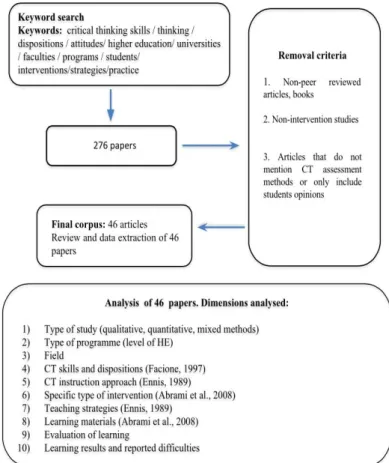
A systematic literature search was conducted at national levels, in order to identify and retrieve empirical research about CT interventions in EHEI across the different CRITHINKEDU partner countries. Figure 1 provides a summary on how the papers were searched, selected and analysed. The methodological process was commonly adopted by each partner. It followed the steps of review methods (Bennet et al., 2005):
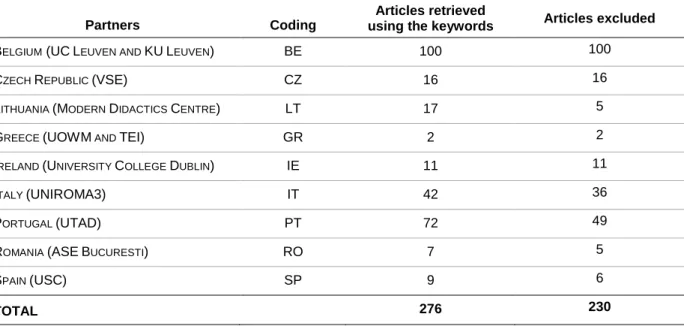
1) Database and Keywords identification: papers were searched by the different partners in international and national databases: Web of Science, SCOPUS, EBSCO, etc. (Table 2). The following keywords, agreed between partners, were used in English and also translated to the native language of each partner country for searching the papers: “critical thinking skills” / “thinking” / “dispositions” / “attitudes” / “higher education” / “universities” / “faculties” / “programs” / “students” / “interventions” / “strategies” / “practice”. These search keywords could be used in the title or descriptor/topic. This search resulted in a total of 276 articles. Table 1 shows the number of papers searched by each partner.
The current literature
review focuses on the
educational
practices
which could effective
enhance students’ CT
in HE
2) Selection of papers for analysis: Each partner assessed the papers to ensure they met rigorous selection criteria. The studies that seemed to meet the criteria were listed by means of electronic-database searching, and then the abstracts of the papers were screened to see if they met the inclusion criteria. The following inclusion/exclusion criteria were agreed by the partners: a) only peer-review articles concerning CT interventions in HE were included; b) only empirical-based research rather than theoretical-based research was included; c) articles which did not meet quality criteria in their methods, such as c.1) papers which did not present and describe an CT assessment method or c.2) papers that only included students’ opinions as CT assessment method, were excluded; d) book chapters, proceedings or thesis were also excluded.
This filter narrowed the set of analysed articles to a total of 46. From those, 31 were published in the last seven years (2010-2017) and 7 papers were very recent publications (2016-2017), whereas 15 were published from 2000-2010. Papers distribution by database is displayed in Table 2. Fifteen of those papers were published in high impact international databases such as the Web of Science (Clarivate Analytics), ESCI (the Emerging Sources Citation Index by Thomson Reuters/Clarivate Analytics) and SCOPUS, while 31 papers were part of medium-low impact databases, such as Dialnet and SciELO (Scientific Electronic Library Online).
Table 1. Number of CT articles searched by each CRITHINKEDU partner
Partners Coding
Articles retrieved
using the keywords Articles excluded
BELGIUM (UCLEUVEN AND KULEUVEN) BE 100 100
CZECH REPUBLIC (VSE) CZ 16 16
LITHUANIA (MODERN DIDACTICS CENTRE) LT 17 5
GREECE (UOWM AND TEI) GR 2 2
IRELAND (UNIVERSITY COLLEGE DUBLIN) IE 11 11
ITALY (UNIROMA3) IT 42 36
PORTUGAL (UTAD) PT 72 49
ROMANIA (ASEBUCURESTI) RO 7 5
SPAIN (USC) SP 9 6
TOTAL 276 230
3) Review, data-extraction and analysis: the papers were examined by each partner according to a rubric (Supplementary document 16), built together by the
leading partners of the CRITHINKEDU_O2 and CRITHINKEDU_O4, considering the results from CRITHINKEDU_O1 and previous literature review studies on CT interventions (e.g., Abrami et al., 2008; Tiruneh et al., 2014; Abrami et al., 2015). Two main dimensions were included in the rubric: 1) information about the type of the study, in particular, the research methodology used, the field and level of HE addressed; and 2) the instructional methods and resources used to promote CT. The examination of this second dimension included six sub-dimensions: a) CT aims (skills and dispositions that are addressed or promoted); b) CT overall approach; c) the type of intervention, d) the teaching strategies; e) the learning materials; and f) the learning assessment and the difficulties reported. For the analysis, we drew from previously established categories provided by Facione (1990), Ennis (1989; 2016) and Abrami et al. (2015). Part of them are briefly described in the following paragraphs.
Table 2. Distribution of selected academic papers in databases
Database7 RC AAP W E B O F S CIE N CE SCO PUS ESCI EBSC O S CI EL O I ND E X C OP E RN ICUS RAC O DIAL NET L IT HU ANITI SKA C. E. E. O. L. TOTAL Number of papers 12 9 4 2 8 2 3 1 1 3 1 46
6 For more information, please see http://bit.ly/Supplementary1-O2
7 This list includes both medium/low international databases (RCAAP; ScIELO; Index Copernicus; RACO;
a) CT aims (skills and dispositions): There is a consensus that CT, as a broad concept, involves both skills and dispositions (Facione, 1990). In 1990, the American Philosophical Association funded a two-year research project to determine CT skills. They assembled a panel of 46 experts with US and Canada, representing disciplines in Humanities, Science, Social Science and Education, and conducted a Delphi study. The APA Delphi Report indicates (Facione, 1990, p.2): “Critical thinking is the process
of purposeful, self-regulatory judgment, attending to the evidential conceptual, methodological, criteriological, or contextual consideration upon which that judgment is based (…)”. Those experts stated that critical thinkers approach specific issues,
questions or problems with "clarity in stating the question or concern, orderliness in
working with complexity, diligence in seeking relevant information, reasonableness in selecting and applying criteria, care in focusing attention on the concern at hand, persistence through difficulties encountered, precision to the degree permitted by the subject and the circumstances" (Facione, 1990). The six core CT skills set by the
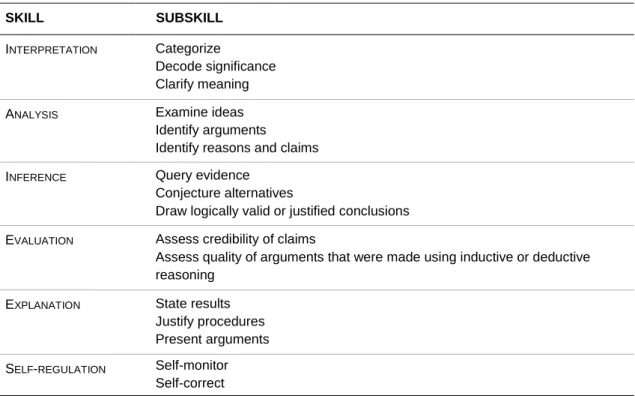
experts are interpretation, analysis, evaluation, inference, explanation, and self-regulation. The definition of each one is presented below.
Interpretation: “to comprehend and express the meaning or significance of a
wide variety of experiences, situations, data, events, judgments, conventions,
beliefs, rules, procedures, or criteria.” (Facione, 1990, p.16)
Analysis: “to identify the intended and actual inferential relationships among
statements, questions, concepts, descriptions, or other forms of representation intended to express belief, judgment, experiences, reasons, information, or
opinions.” (Facione, 1990, p.17)
Evaluation: “to assess the credibility of statements or other representations
which are accounts or descriptions of a person’s perception, experience, situation, judgment, belief, or opinion; and to assess the logical strength of the actual or intended inferential relationships among statements, descriptions, questions or
other forms of representation.” (Facione, 1990, p.18)
Inference: “to identify and secure elements needed to draw reasonable
conclusions; to form conjectures and hypotheses; to consider relevant information and to deduce the consequences flowing from data, statements, principles, evidence, judgments, beliefs, opinions, concepts, descriptions, questions, or other forms of representation." (Facione, 1990, p.19)
Explanation: "to state the results of one's reasoning; to justify that reasoning
in terms of the evidential, conceptual, methodological, criteriological and contextual considerations upon which one's results were based; and to present one's
reasoning in the form of cogent arguments.” (Facione, 1990, p.21)
Self-regulation: "self-consciously to monitor one's cognitive activities, the
elements used in those activities, and the results deduced, particularly by applying skills in analysis and evaluation to one's own inferential judgments with a view
toward questioning, confirming, validating, or correcting either one's reasoning or one's results." (Facione, 1990, p.22)
Table 3 summarizes the CT skills and subskills reported in the Delphi Report that have been used for the analysis of CT in the literature review and in the teachers’ interviews (section 3 of this report).
Table 3. Summary of CT skills and subskills according to Facione (1990)
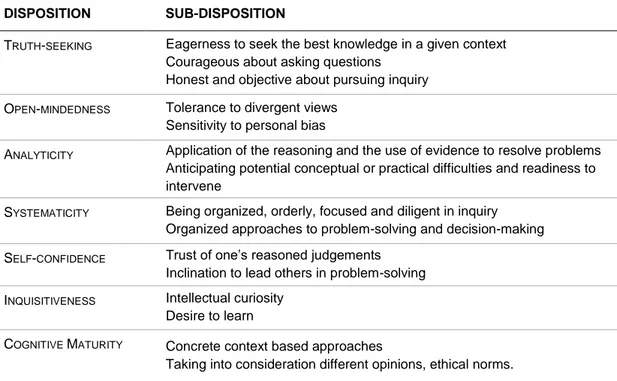
Using the findings of the APA Delphi Report (Facione, 1990), Facione & Facione (1992) identified further seven attributes/dispositions for CT. These attributes are defined below.
Truth-seeking: “Being eager to seek the best knowledge in a given context,
courageous about asking questions and honest and objective about pursuing inquiry even if the findings do not support one’s self-interests or one’s preconceived
opinions.” (Facione, Sánchez, Facione & Gainen, 1995, p.8)
Open-mindedness: “Tolerant of divergent views and sensitive to the possibility
of one’s own bias.” (Facione et al., 1995, p.6)
Analyticity: “Prizing the application of reasoning and the use of evidence to
resolve problems, anticipating potential, conceptual or practical difficulties, and
consistently being alert to the need to intervene.” (Facione et al., 1995, p.7)
Systematicity: “Being organized, orderly, focused and diligent in inquiry.” (Facione et al., 1995, p.7)
SKILL SUBSKILL
INTERPRETATION Categorize
Decode significance Clarify meaning ANALYSIS Examine ideas
Identify arguments
Identify reasons and claims INFERENCE Query evidence
Conjecture alternatives
Draw logically valid or justified conclusions EVALUATION Assess credibility of claims
Assess quality of arguments that were made using inductive or deductive reasoning
EXPLANATION State results Justify procedures Present arguments SELF-REGULATION Self-monitor
Self-confidence: “Trust the soundness of one’s own reasoned judgements and
inclination to lead others in the rational resolution of problems.” (Facione et al.,
1995, p.8)
Inquisitiveness: “One’s intellectual curiosity and one’s desire for learning even
when the application of the knowledge is not readily apparent.” (Facione et al.,
1995, p.6)
Cognitive maturity: “Approach to problems, inquiry and decision making with
a sense that some are necessarily ill-structured, some situations admit of more than one plausible option and many times judgements must be made based on
standards, contexts and evidence which preclude certainty.” (Facione et al., 1995,
p.9)
Table 4, presented below, summarizes the dispositions and sub-dispositions according to Facione & Facione (1992).
Table 4. Dispositions and sub-dispositions according to Facione & Facione (1992)
b) CT instructional approach: According to the Delphi panel experts, CT cannot be considered as a body of knowledge to be delivered to students as one more school subject along with others. CT can occur in programs rich with discipline-specific content or in programs that rely on the events of everyday life as the basis for developing one’s CT. Ennis (1989, p1.) affirms that incorporating the CT in higher education curricula brings out what he called the curriculum question: “Should we have
a separate course or should we embed CT in the standards courses we are teaching
DISPOSITION SUB-DISPOSITION
TRUTH-SEEKING Eagerness to seek the best knowledge in a given context Courageous about asking questions
Honest and objective about pursuing inquiry OPEN-MINDEDNESS Tolerance to divergent views
Sensitivity to personal bias
ANALYTICITY Application of the reasoning and the use of evidence to resolve problems Anticipating potential conceptual or practical difficulties and readiness to intervene
SYSTEMATICITY Being organized, orderly, focused and diligent in inquiry Organized approaches to problem-solving and decision-making SELF-CONFIDENCE Trust of one’s reasoned judgements
Inclination to lead others in problem-solving INQUISITIVENESS Intellectual curiosity
Desire to learn
COGNITIVE MATURITY Concrete context based approaches
anyway?”. This author advocated for a third alternative that only few authors
considered - the mixed approach. Therefore, the curriculum question is: “Should CT
be taught separately, embedded or both?”. Ennis (1989) categorized the various
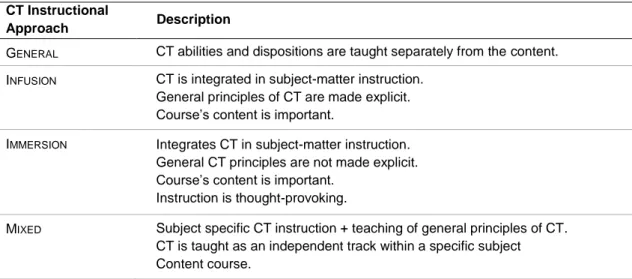
approaches to CT instruction as general, infusion, immersion, and mixed. Table 5 summarizes these four approaches:
In the general approach, CT is taught separately from the presentation of the content of an existing subject-matter.
The infusion approach is a “deep, thoughtful, and well-understood
subject-matter instruction in which students are encouraged to think critically in the subject”
(Ennis, 1985, p. 5). It attempts to integrate CT instruction in standard subject-matter instruction and makes the general principles of CT explicit to the students. This approach stems from debates concerning whether a generalist or specific method is the most effective way to teach CT in HE.
The immersion approach also tries to incorporate CT within standard subject-matter instruction. However, general CT principles and procedures are not made explicit to students.
The mixed approach, named by Sternberg (1986), consists of a combination of the general approach with either the infusion or immersion approach. In the mixed approach, there is a separate thread or course aimed at teaching general principles of CT, but students are also involved in subject-specific CT (Tiruneh et al., 2014).
Table 5. CT instructional approaches (Sternberg, 1986; Ennis, 1989)
We should keep in mind that a variety of practical and theoretical considerations exist, such as the recurring question whether CT is a specific domain or not. Controversy remains on whether CT includes a set of generic skills that apply across subject domains (Ennis, 1989; Siegel, 1992) or if CT can only be taught in the context of a
CT Instructional
Approach Description
GENERAL CT abilities and dispositions are taught separately from the content. INFUSION CT is integrated in subject-matter instruction.
General principles of CT are made explicit. Course’s content is important.
IMMERSION Integrates CT in subject-matter instruction. General CT principles are not made explicit. Course’s content is important.
Instruction is thought-provoking.
MIXED Subject specific CT instruction + teaching of general principles of CT. CT is taught as an independent track within a specific subject Content course.
specific domain - assuming that a domain-specific knowledge is a precondition to CT development (Willingham, 2008). In this context, current research considers CT as a generic skill that is influenced by the culture of the discipline in which it is taught and/or practiced (Jones, 2009; Grace & Orrock, 2015; Sin et al., 2015). This is because what constitutes valid evidence, arguments and standards tends to vary across domains, depending upon the epistemological context (Jones, 2010).
c) The type of intervention: We have drawn from Abrami et al. (2015) categorization of instruction interventions. These authors expanded the analysis beyond a single instructional classification scheme and offered a fine-grained approach, which might explain more of the variability in CT outcomes, and may highlight especially effective instructional approaches.
d) CT teaching strategies: Ennis (2016) describes two basics teaching methods for promoting CT, the Lecture-Discussion Teaching (LDT) and the Problem-Based Learning (PBL), which contrast with each other. According to Ennis, LDT is the most common approach to college teaching. There is a lecture (usually accompanied by some reading in a textbook) presenting one or more aspects of the subject-matter, followed by a discussion section (or a discussion at the end of the period in which the lecture was presented). PBL method calls for dealing with a subject-matter issue, usually requiring investigating, developing, testing, and discussing of hypotheses or solutions and possible alternatives. Ennis (2016) proposes PBL as a strategy to impart lectures about CT in which the teacher can present, explain, challenge and interact with the students; engaging them in discussions with practical examples that foster argumentation and inquiry practices. According to Niu, Behar-Horenstein & Garvar, (2013) and Pithers & Soden (2000), PBL is one of the most widely-used learning approaches in CT instruction because it is motivating, challenging and enjoyable [e.g., since PBL might require more instruction skills, training, effort, and preparation time than LDT, the relative costs and benefits should also be explored (Ennis, 2016)].
e) Synthesis and quantitative/qualitative data: a summary of the analysis of all papers was presented in one table (Table 6) by each partner country, retrieving the patterns regarding the distribution of papers according to the research method used within each study, the field and level of HE addressed, as well as the aspects of the instructional practice (e.g., CT approach, intervention and teaching strategy). Tables 7 and 8 provide a general overview for these data.
All the papers were assigned into four larger categories representing different curricular areas, adapted from several European classifications (e.g., Erasmus Subject Areas Codes; DFG Classification of Scientific Disciplines, Research Areas, Review Boards and Subject Areas), namely: Biomedical Sciences, STEM – Science, Technology, Engineering and Mathematics –, Social Sciences, and Humanities. These categories, the same used in the “A European collection of the Critical Thinking skills and dispositions needed in different professional fields for the 21st century”
report (CRITHINKEDU_O1, 2018), were adopted for data analysis purposes since they are similar to the main study fields taught in the different EHEI. That takes in account the final aim of the project CRITHINKEDU: adapt the existing European university curricula in terms of CT skills and dispositions needed for the 21st century
societal and labour market challenges. On the other hand, Tables 9 to 11 address the instructional approaches and resources used for promoting CT practices as well the assessment methods
The descriptive information about each CT paper and the analysis made according to the rubric developed is presented in Supplementary document 28.
2.2. Findings
2.2.1. An overview on CT educational interventions research
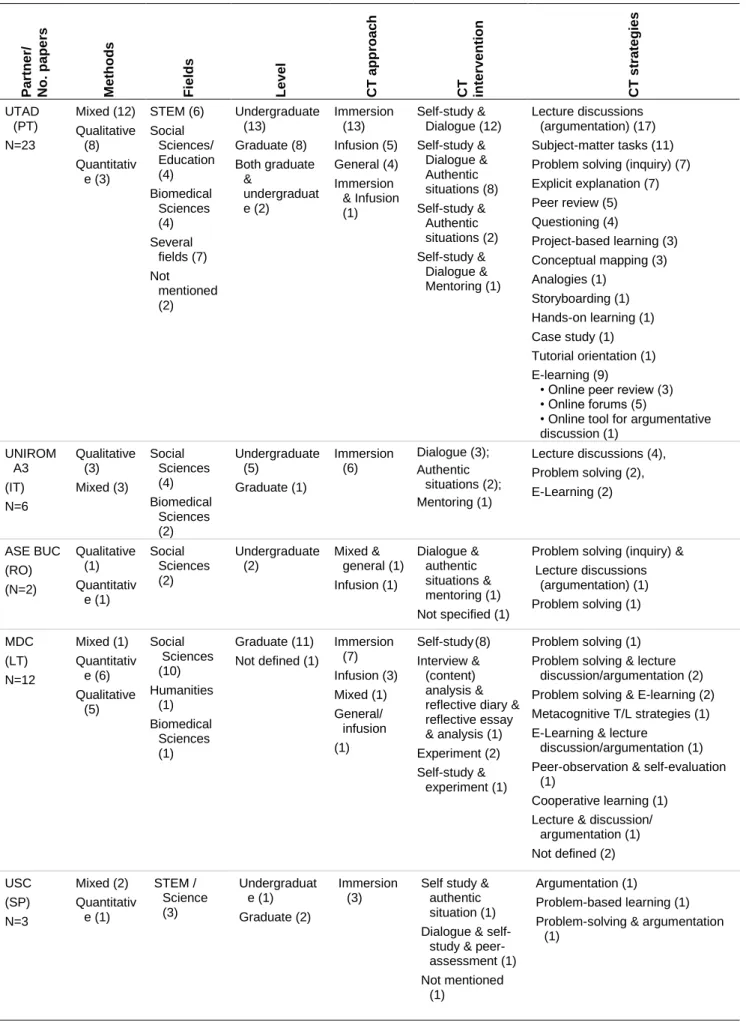
This section provides an overview on CT interventions in EHEI based on the analysis of the literature review carried out by each partner and consolidated by the USC team (see Supplementary document 2 for the full analysis of the literature review). Table 6 displays the distribution of papers within fields and a general overview of the analysis of CT interventions is summarized (refer to Table 7) and finally discussed.
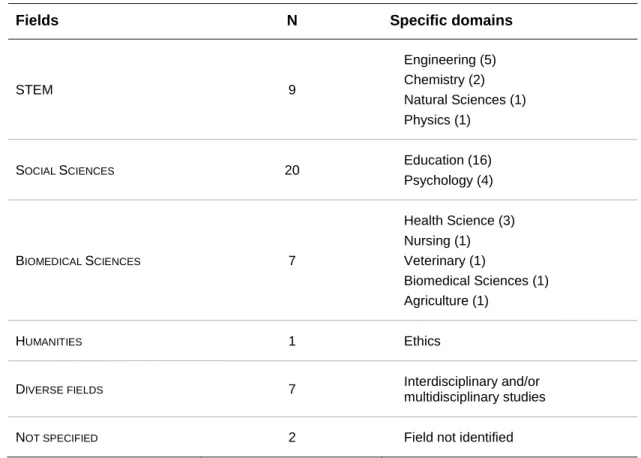
CT intervention studies in EHEI were carried out in diverse fields (Table 6 and 7), although the majority were related to Social Science studies (18 out of 46 papers). Education was the most frequent domain within this field (15 out of 18 papers). STEM was the second most frequent field (n=9). Half of the studies in STEM corresponded to Engineering while the other half were distributed between Chemistry (2), Natural Sciences (1) and Physics (1). CT studies in Mathematics were not found in the literature review. Interdisciplinary papers corresponded to studies that used a multi and/or interdisciplinary model or that had been implemented in multiple university degrees.
Regarding the level of HE, most studies were mostly carried out in experiences with graduate students (21 out of 46 papers) and undergraduates (22 out of 46) and only two studies with both of them. One study did not specify the targeted level of HE. With respect to the CT approach, the type of intervention or the teaching strategies (Table 8), it is possible that one paper is included in more than one category; therefore, the frequencies in each dimension may be higher than the total number of analysed papers (N=46).
Table 6. Summary of the literature review on CT educational intervention studies in EHEI Pa rtne r/ No. pa pe rs M e tho d s Fi e ld s Le v e l CT a pp roa c h CT inte rve nti on CT s trate gi e s UTAD (PT) N=23 Mixed (12) Qualitative (8) Quantitativ e (3) STEM (6) Social Sciences/ Education (4) Biomedical Sciences (4) Several fields (7) Not mentioned (2) Undergraduate (13) Graduate (8) Both graduate & undergraduat e (2) Immersion (13) Infusion (5) General (4) Immersion & Infusion (1) Self-study & Dialogue (12) Self-study & Dialogue & Authentic situations (8) Self-study & Authentic situations (2) Self-study & Dialogue & Mentoring (1) Lecture discussions (argumentation) (17) Subject-matter tasks (11) Problem solving (inquiry) (7) Explicit explanation (7) Peer review (5) Questioning (4) Project-based learning (3) Conceptual mapping (3) Analogies (1) Storyboarding (1) Hands-on learning (1) Case study (1) Tutorial orientation (1) E-learning (9)
• Online peer review (3) • Online forums (5)
• Online tool for argumentative discussion (1) UNIROM A3 (IT) N=6 Qualitative (3) Mixed (3) Social Sciences (4) Biomedical Sciences (2) Undergraduate (5) Graduate (1) Immersion (6) Dialogue (3); Authentic situations (2); Mentoring (1) Lecture discussions (4), Problem solving (2), E-Learning (2) ASE BUC (RO) (N=2) Qualitative (1) Quantitativ e (1) Social Sciences (2) Undergraduate (2) Mixed & general (1) Infusion (1) Dialogue & authentic situations & mentoring (1) Not specified (1)
Problem solving (inquiry) & Lecture discussions (argumentation) (1) Problem solving (1) MDC (LT) N=12 Mixed (1) Quantitativ e (6) Qualitative (5) Social Sciences (10) Humanities (1) Biomedical Sciences (1) Graduate (11) Not defined (1) Immersion (7) Infusion (3) Mixed (1) General/ infusion (1) Self-study (8) Interview & (content) analysis & reflective diary & reflective essay & analysis (1) Experiment (2) Self-study & experiment (1) Problem solving (1) Problem solving & lecture
discussion/argumentation (2) Problem solving & E-learning (2) Metacognitive T/L strategies (1) E-Learning & lecture
discussion/argumentation (1) Peer-observation & self-evaluation
(1)
Cooperative learning (1) Lecture & discussion/
argumentation (1) Not defined (2) USC (SP) N=3 Mixed (2) Quantitativ e (1) STEM / Science (3) Undergraduat e (1) Graduate (2) Immersion (3)
Self study & authentic situation (1) Dialogue &
self-study & peer-assessment (1) Not mentioned
(1)
Argumentation (1)
Problem-based learning (1) Problem-solving & argumentation
Table 7. Distribution of CT educational intervention studies by fields
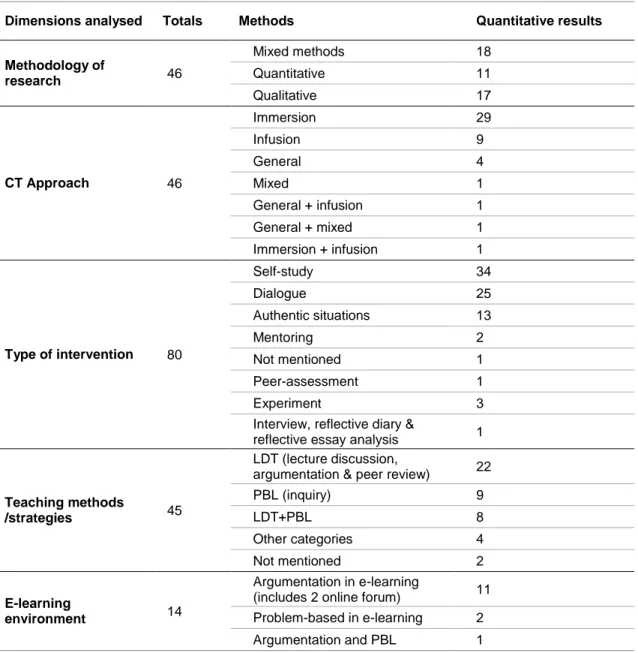
Most studies on CT interventions used a mixed (18 out of 46) or a qualitative methodology of research (17 out of 46). The most commonly adopted CT Approaches were Immersion (29 out of 46) and Infusion (9 out of 46) while General and the Mixed Approaches were the least used (4 and 1 studies, respectively). When analysing the Interventions and Teaching methods/strategies (according to Abrami et al., 2015), the most frequent intervention was Self-Study (34 out of 80), followed by Dialogue (25 out of 80). Real scenarios or Authentic situations were also quite common (13 out of 80) (Table 8).
Following Ennis’s (2016) categorization of CT instruction methods, we found that 22 papers reported LDT and 9 PBL methods. Eight studies used a combined method, namely PBL plus lecture discussions or argumentation. Five other papers were coded in other categories different from Ennis’s (2016): subject-matter tasks (2); Metacognitive learning strategy (1); peer observation and self-evaluation (1) and cooperative learning (1). Two other studies did not explicitly mention the strategy used and were classified as “not mentioned”. E-learning was used as a learning environment in 14 CT intervention studies (Tables 8 & 9). Most of those studies (11 out of 14) consisted in online forums where the students discussed and argued; two were related to the use of
problem-Fields N Specific domains
STEM 9
Engineering (5) Chemistry (2) Natural Sciences (1) Physics (1)
SOCIAL SCIENCES 20 Education (16) Psychology (4) BIOMEDICAL SCIENCES 7 Health Science (3) Nursing (1) Veterinary (1) Biomedical Sciences (1) Agriculture (1) HUMANITIES 1 Ethics
DIVERSE FIELDS 7 Interdisciplinary and/or multidisciplinary studies NOT SPECIFIED 2 Field not identified
The most commonly
adopted CT
approaches are
Immersion and
Infusion – both are
subject-matter
instruction
based teaching strategies while the rest combined both, argumentation and problem-based learning.
Table 8. Distribution of CT educational intervention studies by methodology of research, CT
approach, type of intervention and teaching methods/strategies
Table 9 summarizes the analysis of CT interventions in the literature review according to the study fields. In some dimensions the frequencies are higher than the total number of analysed papers (n=46) since those can be categorised in several sub-dimensions.
Dimensions analysed Totals Methods Quantitative results Methodology of research 46 Mixed methods 18 Quantitative 11 Qualitative 17 CT Approach 46 Immersion 29 Infusion 9 General 4 Mixed 1 General + infusion 1 General + mixed 1 Immersion + infusion 1 Type of intervention 80 Self-study 34 Dialogue 25 Authentic situations 13 Mentoring 2 Not mentioned 1 Peer-assessment 1 Experiment 3
Interview, reflective diary &
reflective essay analysis 1
Teaching methods
/strategies 45
LDT (lecture discussion,
argumentation & peer review) 22
PBL (inquiry) 9 LDT+PBL 8 Other categories 4 Not mentioned 2 E-learning environment 14 Argumentation in e-learning
(includes 2 online forum) 11 Problem-based in e-learning 2
Table 9. CT interventions in the CRITHINKEDU literature review by fields STEM Social Sciences Bio medical Humanities Not specified Diverse fields Type of study Quantitative 2 7 1 - - 1 Qualitative 2 8 2 1 - 4 Mixed Methods 5 5 4 - 2 2 CT approach Immersion 7 12 6 1 2 1 Infusion 2 4 1 - - 2 General - - - 4 Mixed - 1 - - - - General + Infusion - 1 - - - - General + Mixed - 1 - - - - Immersion + Infusion - 1 - - - - Type of intervention Self-study 8 12 5 - 2 7 Dialogue 6 7 3 - 2 7 Authentic situations 4 1 6 - - 2 Mentoring - 1 - - - 1 Not mentioned 1 - - - - - Other Peer-assessment (1) Experiment (3) - Interviews, reflective diary and reflective essay analysis (1) - - Teaching methods/strategies LDT 4 8 1 - 2 7 PBL 1 4 4 - - - LDT + PBL 2 4 2 - - - Not mentioned - 2 - - - - Other Subject-matter tasks (1) Peer-observation and self-assessment (1) Cooperative learning (1) - Metacognitive learning strategy (1) - - E-learning LDT (includes online forums) 3 3 1 - - 4 PBL - 1 - - 1 - LDT + PBL - - 1 - - -
2.2.2. CT learning outcomes and difficulties
This section presents the current CT educational practices in EHEI according to the teaching methods and strategies reported in the
46 analysed CT intervention studies. Tables 10, 11 and 12 compare these results amongst fields, regarding the learning materials, assessment methods, CT outcomes and difficulties.
PBL (N=10): Problem-Based Learning studies were carried out in three fields:
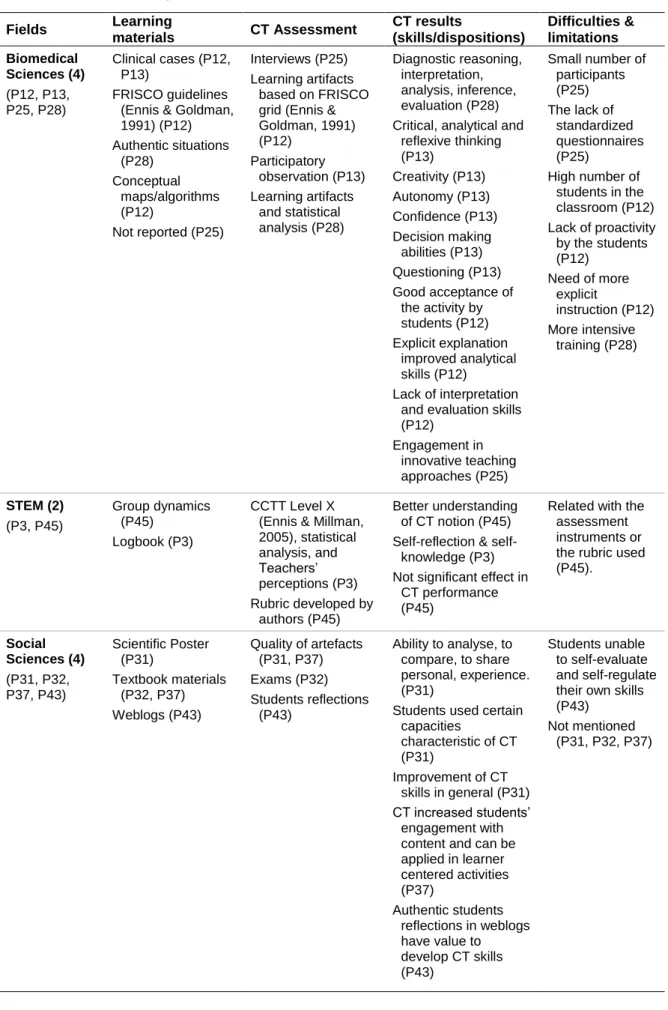
Biomedical and Social Sciences (both with 4 out of 10), and STEM (2 out of 10). These studies provide diverse contexts and learning scenarios to promote CT. Most of them use real-world experiences (e.g., authentic situations) or workplace-based scenarios (e.g., clinical cases) that engage students in problem-solving and decision-making. Teacher’s role consists mainly in guiding the activity as a facilitator, providing support and feedback. For the CT skills assessment, diverse type of tests, questionnaires and interviews were performed, but also rubrics were built for assessing students’ level of competency in CT. Although positive results were found in general (e.g., better understanding of CT notion, improvement in terms of reflection and self-knowledge, clinical reasoning, reflexive thinking, creativity, autonomy, etc.), the majority were based on teachers’ and students’ perceptions - lacking other assessment methods or research designs needed to measure the effect size of the educational intervention.
In some of these papers, the authors reported difficulties related to students’ lack of motivation and/or the workload of the teacher, whereas others did not report any difficulty and only provided information about the research limitations. Among the identified limitations, the small number of participants and constraints with the assessment instruments were included. In particular, the limitations of the rubrics used for CT skills assessment and the lack of standardized questionnaires were mentioned. For instance, one study reported in STEM (P45) that students worked collaboratively to reach to an agreement on what CT was and how to measure it. A rubric for peer-assessment and a questionnaire (open questions) for self-peer-assessment were applied to measure overall students’ CT competencies using 4 criteria (number of arguments, quality of arguments, explain yourself, and listening to the others); nevertheless, when compared, no significant differences between the pre- and post-intervention scores were found.
PBL in Biomedical Sciences studies used authentic situations consisting in
clinical cases and/or workplace-based scenarios (applied to nursing and/or veterinary medicine) to engage students in clinical reasoning and diagnosis processes. Most of the studies were carried in Nursing degrees. For instance, P13 proposes the recreation of problem situations requiring the application of nursing care standardized processes (according to Murphy, 1997), in which students should be able to structure
A total of 46 CT
intervention studies
from 9 European
countries were
analysed
the initial evaluation of a patient and family, elaborate the appropriate diagnosis, identify the main objectives and actions, and define the resulting criteria. Based on a survey assessing the students’ perceptions and a participatory observation, studies such as P13 defend that, by using problem situations, students were abler to transfer and contextualize knowledge. This strategy helped students to develop dispositions through the enhancement of their self-confidence, empowering them to become more reflexive and querying professionals. Moreover, students were able to identify and mobilize previous knowledge and integrate it with new one. The skills and dispositions developed were critical, analytical and reflexive thinking when confronting different ideas, respecting the other's opinion as well as creativity, autonomy, motivation and decision-making. One paper (P28) consisting in an experimental study with 1 control group and 1 intervention group was analysed. It reported positive results in terms of CT skills development with students in Biomedical Sciences (Nursing). In P28, with an Immersive approach supported by the analysis of a case study with diagnostic tasks and patient’s history, students increased their inference skills. Through the application of a standardized evaluation, researchers assessed the mistaken diagnosis hypotheses made by students using the same case history, and found that those who had intensive tutorial strategies aimed at developing CT skills formulated fewer wrong hypotheses.
PBL in STEM studies used different
group dynamics techniques and peer-assessment to promote CT. They defended their usefulness in helping students to understand better what CT is and to reflect on the need of backing-up their opinions with evidences. One study (P1) engaged students in a Product Design Development project for the promotion of healthy eating habits. Based on the Cornell Critical Thinking Test (CCTT) – Level X (Ennis & Milman, 1985) and the TAEC Creativity Test (De la Torre, 1991) data, the intervention contributed to develop the enhancement of students’ creative performance and metacognitive reflection (the ability that students developed to perceive the thinking styles they should/should not activate when generating ideas). It also promoted students’ reflection and self-knowledge while helping them manage and guide their own course of action through the project.
PBL in Social Sciences studies were developed in Education. Despite the fact
that the studies were not solid on their conclusions, they pointed out to students’ use of certain abilities related to CT, such as comparing and analysing, as shown in paper P31.
Table 10 summarizes the results of PBL studies in each field in terms of Learning materials, CT Assessment, CT results, Difficulties and limitations.
Problem-Based
Learning (PBL) was
the most common
strategy in the
Biomedical and Social
Sciences, and STEM
fields
LDT (N=20): This category includes studies engaging students in argumentation; most of them corresponded to argumentation studies in the context of critical evaluation. They were implemented in Social Sciences (8 out of 20), STEM (5 out of 20), but also across diverse fields (7 out of 20) such as Biomedical Sciences and Humanities. Table 11 summarizes the results for this category in STEM and Social Sciences. LDT studies used opinion texts or Socio-Scientific Issues (SSIs) information and/or articles from media to involve students in the critical analysis of information and argumentative discussions. Students had to express their own opinions and arguments orally and/or in writing. The learning materials included mainly texts on scientific or socio-scientific topics retrieved from diverse sources (journal articles, textbooks, internet, books, etc.). For instance, in Social Science studies, they addressed texts from classic authors (e.g., Galileo, Descartes).
LDT studies provided different
argumentative contexts in order to enhance CT
skills, being argumentation for decision-making and for critical evaluation the most frequent context appearing in those papers. For instance, in one study (P19) students debated in groups about a problematic and/or dilemma (e.g., studying outside in a foreign country – yes or not? Working outside in a foreign country – yes or not? etc.) in which they had to assume their own point of view. Students exchanged arguments in order to consider the most relevant alternatives and then each student had to explain his/her process of decision making, justifying it based on Nosich’s CT elements (2011). Another study (P44) analysed the critical capacity of students when provided with texts written by “experts”: their argumentation skills, capacity to reflect and to defend a position regarding the SSIs.
Most LDT studies showed that fostering argumentation had a positive effect on other CT skills. They reported students’ improvement on the CT skills related with “analysis”, “evaluation” or the ability to make judgments on texts, as well as other cognitive skills. CT dispositions were also reported to be promoted in some of these studies. In P15, students recognized to have gained CT dispositions and skills during the activities. P7 and P8 reported an increase in students’ individual responsibility and autonomy; P9 highlighted students’ accountability for their own learning. Interpersonal skills and applicability in other courses (transference) (P15) as well as active listening (P26) were also cited as findings. Difficulties were not reported in the majority of the studies. However, some studies identified limitations of the development of the activities, namely the availability of institutional resources, the workload of students, the differences in students’ background, among others. CT assessment methods included questionnaires, interviews (open or semi-structured), tests (pre- and post-test) and rubrics. Also, content analysis was used to assess students’ arguments.
Lecture Discussions
(LDT) was not only
implemented in Social
Sciences and STEM,
but also in Biomedical
Sciences and
Table 10. Summary of PBL studies in Biomedical Sciences, STEM and Social Sciences Fields Learning materials CT Assessment CT results (skills/dispositions) Difficulties & limitations Biomedical Sciences (4) (P12, P13, P25, P28) Clinical cases (P12, P13) FRISCO guidelines (Ennis & Goldman, 1991) (P12) Authentic situations (P28) Conceptual maps/algorithms (P12) Not reported (P25) Interviews (P25) Learning artifacts based on FRISCO grid (Ennis & Goldman, 1991) (P12) Participatory observation (P13) Learning artifacts and statistical analysis (P28) Diagnostic reasoning, interpretation, analysis, inference, evaluation (P28) Critical, analytical and
reflexive thinking (P13) Creativity (P13) Autonomy (P13) Confidence (P13) Decision making abilities (P13) Questioning (P13) Good acceptance of the activity by students (P12) Explicit explanation improved analytical skills (P12) Lack of interpretation and evaluation skills (P12) Engagement in innovative teaching approaches (P25) Small number of participants (P25) The lack of standardized questionnaires (P25) High number of students in the classroom (P12) Lack of proactivity by the students (P12) Need of more explicit instruction (P12) More intensive training (P28) STEM (2) (P3, P45) Group dynamics (P45) Logbook (P3) CCTT Level X (Ennis & Millman, 2005), statistical analysis, and Teachers’ perceptions (P3) Rubric developed by authors (P45) Better understanding of CT notion (P45) Self-reflection &
self-knowledge (P3) Not significant effect in
CT performance (P45)
Related with the assessment instruments or the rubric used (P45). Social Sciences (4) (P31, P32, P37, P43) Scientific Poster (P31) Textbook materials (P32, P37) Weblogs (P43) Quality of artefacts (P31, P37) Exams (P32) Students reflections (P43) Ability to analyse, to compare, to share personal, experience. (P31)
Students used certain capacities characteristic of CT (P31) Improvement of CT skills in general (P31) CT increased students’ engagement with content and can be applied in learner centered activities (P37) Authentic students reflections in weblogs have value to develop CT skills (P43) Students unable to self-evaluate and self-regulate their own skills (P43)
Not mentioned (P31, P32, P37)
Three papers (P4, P16 & P18), consisting in different intervention studies reporting similar teaching strategies with students from Biomedical Sciences, STEM and Social Sciences, were analysed. With an Infusion approach, students engaged in a peer-review activity by analysing an article and peer-reviewing the analysis of their peers (counter arguing them when applied), using the FRISCO guidelines and/or the SWOT analysis grid. Through the application of the CCTT (pre- and post-test), researchers found a positive increase in CT skills such as synthesis, analysis, inference and evaluation. Moreover, they found that explicit instruction and specific support to students are of utmost importance for the success of this type of CT activities - in which peers’ feedback and rewriting tasks are powerful tools for CT skills and dispositions (such as open-mindedness) development.
Table 11 summarizes the results of LDT studies by fields in terms of Learning materials, CT Assessment, CT results, Difficulties and limitations.
PBL + LDT studies (N=8): Eight papers were included in this category. They were developed in 3 fields: Biomedical Sciences (2 out of 8), STEM (2 out of 8) and Social Sciences (4 out of 8). They used Problem-Based and Cooperative Learning techniques to engage students in argumentation and collaborative work. Learning tasks included, amongst others, interdisciplinary projects, reading and analysis of texts and articles from different sources and problem-based tutorials, among others. In all these studies, CT outcomes were positive. Reference was made to an increase on students’ CT skills, particularly critical analysis in STEM and Biomedical Sciences fields.
Those studies applied a variety of CT assessment instruments: formal CT tests (e.g., Cornell Critical Thinking Test [CCTT (Ennis & Milman, 1985)]; and other instruments, e.g., FRISCO guidelines (Ennis, 1987), or the SOLO Taxonomy (1982), for the evaluation of the learning assignments given to students. As already commented upon for the PBL and LDT studies, the main difficulties reported were related to the research and assessment methods.
Jointly, the
combination of both
PBL and LDT were
used in 3 fields:
Biomedical Sciences,
STEM and Social
Table 11. Summary of studies on application of LDT according to fields
Fields Learning materials CT Assessment CT results (skills/dispositions) Difficulties & limitations
STEM
(N=5) (P4, P5, P6,
P44)
SSIs controversial articles from media and literature review, diagrams and open-ended questions (P44)
Lecture and laboratory sessions’ resources; online forums in Moodle (P5, P6) Economic articles,
FRISCO guidelines (Ennis & Goldman, 1991), SWOT analysis, N&S feedback model (Nelson & Schunn, 2009) (P4)
Pre-/Post-test about the course content and learning materials (P44)
Survey on students’ perceptions, CCTT Level X (Ennis & Milman, 1985), statistical analysis and quality of the artifacts based on FRISCO guidelines and N&S model (P4)
Interviews & focus groups (P5, P6)
Students improve CT skills, but problem-solving skills were the most difficult ones to acquire (P44)
Articles on controversial SSIs facilitate the understanding of the relationship between science and society (P44)
Questioning information helps the development of CT skills such as inference and evaluation (detecting fallacies) and values such as democratic participation on science and technology (P44) Specific support, guidance,
andexplicit instructions are of utmost importance for the success of this type of activities promoting CT and Students felt that their CT skills had increased in various domains (synthesis, evaluation, relating reasons and onclusions), confirming that the inclusion of feedback and the rewriting is a powerful tool for CT development (P4)
Negative results in terms of students’ participation and engagement in questioning due different learning design limitations and technical issues (P5, P6)
Lack of teacher training on giving feedback and students’
understanding of FRISCO guidelines (P4)
CCTT seems confusing, too long and the type of questions (multiple choice) seems to be too far from daily life problems and not suitable to assess accurately the bachelor students’ CT skills (P4) Course duration is too
short to trigger effective differences on CT level (P4) Assessment methods, learning design limitations and technical issues (P5, P6) Not mentioned (P44) Social Sciences (N=8) (P7, P8, P9, P24, P26, P27, P29, P41) Online forums (P27, P29)
Online tool for argumentative discussions (P9) Texts from classic authors (Galileo, Descartes) (P24, P27, P29) and podcasts (P24) Scientific paper (P7, P8) Multimedia laboratories (P26) E-Learning materials (texts, tasks, case studies, etc.) (P41) Assessment grids (P24) Semi-structured questionnaire (P26) Survey on students’ perceptions (P7, P8) Students discussion’
assignments based on Ennis (1987) or SOLO taxonomy (Biggs & Collis, 1982) (P9) Essay assessment grid to
evaluate students’ essays written by hand or using keyboard (P24)
Semi-structured questionnaire to evaluate and assess students’ changes and improvements in reflexive skills between the textual analysis of narrative logbooks and the use of laboratory experiences (P26) Pre-test in a form of essay,
lexicometric analyses using a specific content analysis method to measure CT (Newman, Webb & Cochrane, 1995) (P27) Short essay and a survey to
indicate the descriptive data of participants (P29) Students’ self-evaluation,
participatory observation (P41)
The online tool for argumentative discussions promotes a
systematic reflection of students’ questions and arguments, enabling the communication of results, questioning and argumentative levels of students (P9)
CT increase in all categories, particularly the ability to argue (P27, P29)
Students’ development of deeper cognitive and analytical skills, the ability to make judgments about texts and to create texts (P41) Students’ perceptions are positive
in relation to cooperative learning activities in terms of CT
development (synthesis, argumentation, respect for different perspectives),
responsibility and autonomy (P7, P8)
Students were satisfied with the use of multimedia laboratories and acquire a practice that gradually leads to an experience first-hand awareness of listening Positive results on CT
development, particularly in argumentative skills (P27) Not reported (P24, P29)
Technical problems with the online tool (P9) Not reported (P7, P8,
P24, P26, P27, P29 P41)