UNIVERSIDADE DE LISBOA
Faculdade de Ciências
Departamento de Biologia Animal
A review of Amietia angolensis (Bocage, 1866)
and Amietia fuscigula (Duméril and Bibron, 1841)
(Anura: Pyxicephalidae), using morphology and
advertisement calls
Ninda Lara Baptista
Mestrado em Biologia da Conservação
2011
UNIVERSIDADE DE LISBOA
Faculdade de Ciências
Departamento de Biologia Animal
A review of Amietia angolensis (Bocage, 1866)
and Amietia fuscigula (Duméril and Bibron, 1841)
(Anura: Pyxicephalidae), using morphology and
advertisement calls
Dissertação orientada por:
Professor Alan Channing
(University of the Western Cape)
Professor Rui Rebelo
(Universidade de Lisboa)
Ninda Lara Baptista
Mestrado em Biologia da Conservação
2011
“As coisas têm peso, massa, volume,
tamanho, tempo, forma, cor, posição, textura, duração, densidade, cheiro, valor, consistência, profundidade, contorno, temperatura, função, aparência, preço, destino, idade, sentido. As coisas não têm paz.”
Arnaldo Antunes
“Things have weight, mass, volume,
size, time, shape, colour, position, texture, length, density, smell, value, consistency, depth, contour, temperature, function, appearance, price, destination, age, direction. Things do not have peace.”
i
ACKNOWLEDGEMENTS
This work resulted from a series of contretemps and different plans until reaching a definite subject. It would not have been possible without the help and willingness of several people, to whom I am honestly thankful:
Professor Alan Channing, from the University of the Western Cape (UWC), for accepting the supervision of the thesis, for kindly providing the final subject of the thesis, for all the availability, for providing a working place, access to bibliography, for making collection specimens available for this study, for providing photographs of type specimens, advertisement calls – one of which was recorded by Harold Braack; and for contacting Denise
Hamerton from the Iziko Museum, Werner Conradie from Bayworld, Victor Wasonga from the
National Museums of Kenya, Stefan Lötters from Trier University and Carl J. Franklin from the University of Texas at Arlington – to whom I am thankful – for getting specimens;
Professor Rui Rebelo, from the University of Lisbon, for accepting the supervision of the thesis, and for all the availability, support, advice and patience during all the phases of the work; Doctor Jeremy Anderson, from the International Conservation Services, for the invitation to make the thesis in Bazaruto, and the total availability and patience for making all the alternative plans work;
Everybody from the Life Sciences Building from the UWC for helping with everything that was needed there, especially Linda Van Heerden and Professor Andreas Elepfandt;
Andrew Rossaak, Ricky and Judy Pott from the Wildlife and Environment Society of South
Africa, Andrew Haigh, Nathan Cook, Pat Donaldson, Llew Taylor, Anthony Emery, Doctor
Marc Stalmans, who helped while the plan was to work in White River; and John Dias–Ferreira
and Vincent Smith from the Likweti Game Reserve for the availability when we tried to work there;
Professor Eddie van Dijk, Jeanne Tarrant, Stéphanie Davister, Nelito, São Neto, Marta Santos and Raquel Mendes, for helping with access to bibliography;
Gonçalo M. Rosa for helping with the advertisement calls analyses and for kindly providing the
ii
Silva for helping with pagination and indexing of the thesis, António Baptista for helping with
the maps;
Doctor Jeremy and Liz Anderson, and Professor Alan and Jenny Channing, for the crucial accommodation, for all the availability, attention and kindness during the stay in White River and in Stellenbosch, respectively;
Associação Tchiweka de Documentação, for providing their installations for writing the thesis,
and Kimi de Sousa and Tia Raquel, for accommodation during the final writing phase of the work;
Marta Santos for looking after the house;
And all my friends and my family… for all the support, in every ways, and to whom thanking is not enough to express what I really mean!
iii
SUMMARY
The ability of identifying a species is vital for its effective conservation. River frogs from the genus Amietia are widespread from Southern to north-Eastern Africa, but delineation of species within this genus is at an early stage. The widespread distribution of two species, A.
angolensis and A. fuscigula suggests their unresolved taxonomy.
A new phylogeny for the genus based on genetic data is under construction. It resulted in a new arrangement for some species, and proposed provisional names for some clades. The present work comprised seven clades from the referred phylogeny, five included in “A.
angolensis group”, from Southern and Eastern Africa, and two included in “A. fuscigula group”,
from Southern Africa.
This study used an integrative approach, based on morphological data from all seven clades; and acoustic data from two clades from Southern Africa, in order to corroborate the clades which delineation was based in genetic data. Morphological data were obtained from a total of 110 frogs and 31 tadpolesfrom museums and personal collections. Morphometric data were obtained from 76 adults belonging to seven clades, and were used for discriminant function analyses. The results were used to assess the appropriateness of the proposed working names for the clades and to try to identify the most useful features for distinguishing species within this genus.
The main results generally support the clades proposed on the new phylogeny. The provisional working names were, in most cases, supported by this work, except for two clades from Eastern Africa, for which there was neither support nor rebuttal. No observed character alone was enough for distinguishing all seven clades. Throat coloration pattern alone identified unequivocally adults from Southern Africa. Body measurements were useful for distinguishing groups of clades. Clades discovered through genetics show consistent morphological differences that seem to have been confused with a high intra-specific morphological variability.
Key words: Anura, Pyxicephalidae, Amietia angolensis, Amietia fuscigula, morphometrics,
iv
RESUMO
A capacidade de identificar uma espécie é crucial para a efectiva conservação da mesma. Em regiões pouco conhecidas como Angola e em “hotspots” de biodiversidade como as Eastern Arc Mountains na África Oriental, a Região Florística do Cabo Ocidental na África do Sul são prioritárias para a conservação, e, consequentemente, para a documentação da biodiversidade existente.
O género Amietia (Anura: Pyxicephalidae) ocorre desde o Sul da África Austral (África do Sul) ao Norte da África Oriental (Etiópia). Este género inclui actualmente quinze espécies. No entanto, o estudo da sua taxonomia encontra-se ainda num estádio inicial. A sugerir isto está o facto de duas das espécies terem amplas áreas de distribuição – Amietia angolensis ocorre desde a África do Sul à Etiópia, e Amietia fuscigula em quase toda a África do Sul e na Namíbia – contrastando com outras espécies, que têm distribuições muito limitadas – como por exemplo Amietia vandijki, conhecida apenas das montanhas nos arredores da Cidade do Cabo, e Amietia dracomontana, conhecida apenas do planalto do Lesoto.
A distinção entre ambas as espécies foi alvo de muito debate durante mais de um século, tendo sido considerada como um dos problemas clássicos da herpetologia africana. Apesar de actualmente já não haver dúvidas sobre a sua distinção, as complexas listas de sinónimos atribuídos a ambas as espécies sugerem também que a posição taxonómica actualmente atribuída a cada uma delas ainda não é definitiva.
Uma nova filogenia baseada em sequências genéticas está a ser construída para o género Amietia, e inclui exemplares de grande parte da sua área de ocorrência. Esta filogenia reconhece um determinado número de clados, alguns dos quais são novos, outros dos quais corroboram o conhecimento já existente sobre algumas espécies.
Este trabalho focou-se num total de sete clados reconhecidos pela referida filogenia: cinco pertencentes ao “grupo A. angolensis” – incluindo exemplares da África do Sul, Angola, Lesoto, Malawi, Quénia, Ruanda, Tanzânia, Uganda, Zimbabué, e dois pertencentes ao “grupo
A. fuscigula” – incluindo exemplares da África do Sul e da Namíbia.
v utilizar uma abordagem integrativa para complementar os resultados obtidos através de dados genéticos com dados morfológicos – disponíveis para os sete clados – e acústicos – disponíveis para dois clados da África Austral;
discutir os nomes provisórios propostos para os clados, comparando os resultados obtidos com as descrições originais das espécies e fotografias dos holótipos, quando disponíveis;
procurar características morfológicas que permitam a distinção das espécies no campo, dada a elevada variabilidade morfológica referida para este género.
Para tal foram utilizados ao todo 110 exemplares adultos, juvenis, e recém-metamorfoseados, e 31 girinos depositados em colecções pessoais e museológicas. Os dados morfométricos foram recolhidos de 76 exemplares adultos, enquanto que os dados relativos ao padrão de coloração e à forma do corpo foram recolhidos de adultos, juvenis e recém-metamorfoseados. Para os girinos registou-se apenas a fórmula dentária.
Os dados morfométricos foram analisados através de análises exploratórias, testes de diferenças de médias entre as variáveis mais importantes para a rápida distinção dos clados no campo, e análises discriminantes entre várias combinações de clados. Os padrões de coloração e outros dados qualitativos relativos à textura da pele e à forma de partes do corpo foram, sempre que possível, transformados em categorias para facilitar a interpretação dos resultados obtidos. Estes dados foram analisados apenas descritivamente. Para analisar os dados bioacústicos foram determinadas as taxas de repetição dos pulsos por comboio de pulsos, taxas de repetição dos pulsos por nota, intervalo entre comboios de pulsos, intervalos entre notas, e frequência das vocalizações.
Os resultados morfométricos – nomeadamente o rácio entre a largura da cabeça e o comprimento da tíbia – permitiram uma separação entre o “grupo A. angolensis” e o “grupo A.
fuscigula”, característica já anteriormente referida na bibliografia como útil para distinguir as
duas espécies. As análises discriminantes efectuadas com outros rácios entre os vários grupos mostraram capacidade de distinguir alguns clados, indicando que os clados descobertos têm diferenças morfométricas.
vi Os resultados dos dados qualitativos revelaram que os clados têm diferentes frequências para vários dos caracteres, e que existem poucos caracteres diagnosticantes de cada clado. Por exemplo, recorrendo apenas ao padrão de coloração da garganta, foi possível identificar correctamente todos os indivíduos adultos dos clados da África Austral. No entanto, nenhuma outra característica qualitativa se revelou tão útil para a distinção entre todas as combinações de clados, principalmente de clados da África Oriental.
Os dados acústicos revelaram diferentes frequências de vocalização, diferentes taxas de repetição dos pulsos e notas relativamente aos taxa com os quais foram comparados, corroborando a proposta revalidação de clados da África Austral.
A falta de caracteres exclusivos de cada clado revelou a grande variabilidade morfológica do género Amietia. Ainda assim, e apesar da elevada variabilidade, alguns dos resultados sugeriram que há padrões de variação consistentes em cada clado, e, por isso, também corroboram os clados propostos pela nova filogenia do género.
A discussão sobre a adequação dos sete nomes propostos para os clados sugeriu concordância entre cinco nomes [Amietia angolensis (Bocage, 1866) de Angola, Amietia
fuscigula (Duméril & Bibron, 1841) do sudoeste da África do Sul, Amietia quecketti (Boulénger,
1845) do centro–norte da África à Sul e Namíbia, Amietia tenuoplicata (Pickersgill, 2007) da Tanzânia, Amietia theileri (Mocquard, 1906) para espécimens da África do Sul e Zimbabué], e nenhum suporte conclusivo para dois dos nomes [Amietia desaegeri (Laurent, 1972), do Uganda e Ruanda, e Amietia viridireticulata (Pickersgill, 2007), No Sul da Tanzania e Norte do Quénia].
Os padrões de variação morfológica consistentes de cada clado sugerem que, apesar da grande variabilidade morfológica relatada para várias espécies de Amietia, é possível que essa variabilidade possa ser devida não a uma variabilidade intra-específica extremamente elevada, mas sim ao facto de existirem várias espécies. No entanto, este estudo, por não ser exaustivo e por incluir amostras muito pequenas, pode ser considerado uma abordagem preliminar ao assunto.
Palavras-chave: Anura, Pyxicephalidae, Amietia angolensis, Amietia fuscigula, morfometria,
vii
INDEX
ACKNOWLEDGEMENTS ... i SUMMARY ... iii RESUMO ...iv INDEX ... vii 1. INTRODUCTION ... 11.1. Anuran taxonomy and conservation ... 1
1.2. River frogs ... 2
1.3. History of Amietia angolensis and Amietia fuscigula ... 3
1.4. Recent research ... 5
1.5. Study aim ... 6
2. MATERIALS AND METHODS ... 8
2.1. Specimens ... 8
2.2. Morphometrics... 9
2.3. Other morphological traits ... 10
2.4. Bioacoustic data ... 15 2.5. Data analysis ... 16 2.5.1. Morphometric data ... 16 2.5.2. Qualitative data ... 17 2.5.3. Bioacoustic data ... 17 3. RESULTS ... 18 3.1. Morphometrics... 18 3.2. Qualitative characters ... 21 3.3. Bioacoustic data ... 24 4. DISCUSSION ... 29 4.1. Bioacoustic data ... 29 4.2. Methodology ... 29
4.3. Provisional working names of clades ... 30
4.3.1. Clade A – proposed working name: Amietia angolensis (Bocage, 1866) ... 31
4.3.2. Clade B – proposed working name: Amietia desaegeri (Laurent, 1972) ... 31 4.3.3. Clade C – proposed working name: Amietia fuscigula (Duméril and Bibron, 1841) . 33
viii
4.3.4. Clade D – proposed working name: Amietia quecketti (Boulénger, 1895) ... 34
4.3.5. Clade E – proposed working name: Amietia tenuoplicata (Pickersgill, 2007) ... 35
4.3.6. Clade F – proposed working name: Amietia theileri (Mocquard, 1906) ... 36
4.3.7. Clade G – proposed working name: Amietia viridireticulata (Pickersgill, 2007) ... 38
4.3. Final Considerations ... 39
REFERENCES ... 43
APPENDIX 1 – Statistics ... 47
APPENDIX 2 – Error estimates ... 48
APPENDIX 3 – Notes on the clades... 49
Clade A – proposed working name: Amietia angolensis (Bocage, 1866) ... 49
Clade B – proposed working name: Amietia desaegeri (Laurent, 1972)... 49
Clade C – proposed working name: Amietia fuscigula (Duméril and Bibron, 1841) ... 51
Clade D – proposed working name: Amietia quecketti (Boulénger, 1895) ... 51
Clade E – proposed working name: Amietia tenuoplicata (Pickersgill, 2007) ... 52
Clade F – proposed working name: Amietia theileri (Mocquard, 1906) ... 53
Clade G – proposed working name: Amietia viridireticulata (Pickersgill, 2007) ... 54
APPENDIX 4 – Proposed dichotomous key ... 55
APPENDIX 5 – Body ratios ... 57
APPENDIX 6 – Representation of characters’ states ... 59
APPENDIX 7 – List of specimens ... 71
APPENDIX 8 – Comparative tables ... 63
1
1. INTRODUCTION
This work is the result of a proposal of a new phylogeny for the genus Amietia, based on genetic data (Channing, in prep.). Data included is from seven clades from the referred phylogeny, five included in “Amietia angolensis group”, and two included in “Amietia fuscigula group” (Channing, pers. comm.). These clades have been given a provisional working name and will probably be proposed as species in the new phylogeny (Channing, pers. comm.). Because of the complex historic and taxonomic confusion associated with the two main groups where the clades are included in, a brief description of these groups’ history will be made, with reference to the original descriptions and the most relevant eventsconcerning Channing’s (in
prep.) new findings.
1.1. Anuran taxonomy and conservation
To effectively conserve a species it is of course important to be able to identify it (Dayrat, 2005). The necessity of identifying species is even more important in biodiversity hotspots and in poorly known areas, where baseline information such as floral and faunal lists is still incomplete. For African anurans, clear examples of priority research areas are the Eastern Arc Mountains (Poynton et al., 2007; Burgess et al., 2007; Menegon et al., 2008) a biodiversity hotspot where new species of anurans are continuously being described (Channing & Schmitz, 2008; Poynton et al., 2008; Blackburn, 2009), areas with a high degree of anuran endemics, such as the southwestern cape of South Africa (Seymour et al., 2001); where new species are also still being discovered (Turner & Channing, 2008) and poorly studied areas such as Angola (Seymour et al., 2001; Andreone et al., 2008).
Currently, the importance of an integrative approach when delineating species is clearly recognized, as it allows more rigorous, informative and reliable results (Dayrat, 2005; Padial, 2010). Integrative approaches should include phylogeography, comparative anatomy, genetics, ecology and behavioural biology (Dayrat, 2005), including bioacoustical studies in anurans, which have species-specific advertisement calls (Padial, 2009).
2
1.2. River frogs
River frogs of the genus Amietia are widespread in the Afromontane region (Visser & Channing, 1997). There are 15 species presently recognised in this genus (Frost, 2011). Most of the species are listed as data deficient (DD) and some are listed as of least concern (LC), in the IUCN Red List (IUCN, 2011). Species of this genus were previously included in the genus Rana (Poynton, 1964). The generic name of these species was changed to Afrana Dubois, 1992, and in 2006 all species included in the genus Afrana were transferred to the so far monotypic genus Amietia (sensu Dubois 1987) (Frost et al., 2006).
This genus is included in the African anuran family Pyxicephalidae (Bonaparte 1850) (Frost et al., 2006), which includes the “typical” frogs, with big eyes, pointed snouts, alert postures and long legs (Spawls et al., 2006). River frogs are associated to permanent bodies of water, usually large and flowing, from small streams to large rivers (Channing, 2001; 2004a). They spend a lot of time in the water, have extensive webbing and are excellent swimmers (Spawls et al., 2006). Species of Amietia are known for the high variability on coloration pattern (Channing 1979; 2001; Channing & Howell, 2006). They are both nocturnal and diurnal, and some species are reproductively active throughout the whole year (Channing, 1979; 2004b; 2004c).
As large frogs, Amietia play an important ecological role in the food webs. Members of this genus prey on flying and crawling arthropods, like Hemiptera, Coleoptera, Orthoptera, ants, spiders, caterpillars, millipedes, crabs, and snails (Channing, 1979; 2004a; Channing & Howell, 2006; Barbour & Loveridge, 1928), and even small vertebrates, such as mice and frogs (Rose, 1962 in Channing, 2004c). Small mammals like otters, mongooses and genets, as well as large birds, frogs, snakes and terrapins eat river frogs (Rowe-Rowe, 1977a, 1977b in Channing, 1979; Channing & Howell, 2006). Large specimens are even eaten by humans (Channing, 2004a). Many carnivorous insect larvae feed on Amietia tadpoles (Channing, 1979).
At least 11 Amietia species are known to occur in Southern and Eastern Africa: six species in South Africa and Lesotho: A. angolensis, A. fuscigula, A. vandijki, A. dracomontana,
A. vertebralis, A. umbraculata, one single species in Angola – A. angolensis; another single
species in Namibia – A. fuscigula; and five in Eastern Africa – A. desaegeri, A. lubrica, A.
ruwenzorica, A. tenuoplicata, A. viridireticulata, A. wittei. Some species have limited
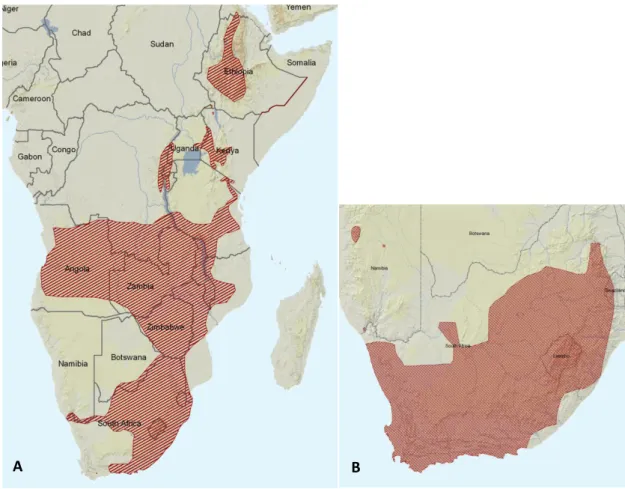
3 Province, and A. dracomontana, restricted to the Leshoto plateau (Channing, 2004), but there are two widespread species: A. angolensis, from Southern to Northeastern Africa, and A.
fuscigula, in Southern Africa, with overlapping distributions in some areas of Southern Africa
(Figure 1).
Figure 1 Currently known range of A. angolensis (A) and A. fuscigula (B). Source: Poynton et al., 2011; Minter &
Channing, 2004, in IUCN Red List of Threatened Species.
1.3. History of Amietia angolensis and Amietia fuscigula
Amietia angolensis (Bocage, 1866)
Duméril & Bibron (1841) described Rana Delalandii, allegedly from the type locality Cape of Good Hope, South Africa, a type locality that would later be considered as erroneous by Boulénger (1918). This taxon has been considered a synonym of R. angolensis Bocage, 1866 by Boulénger (1882), with no justification. Poynton (1964) argues that «...a certain amount of doubt must be attached to this synonymy», based on differences on coloration pattern and skin texture between specimens of Angola and South Africa.
4 Bocage (1866) described Rana angolensis, based on two male specimens from the type locality Duque de Brangança (now Calandula Waterfalls), in Angola. This species is currently known as Amietia angolensis (Bocage, 1866).
In 1906, Mocquard described Rana Theileri, from the type locality Nelspruit (Transvaal), South Africa, based on one single specimen. This species has been considered a synonym of R. angolensis by Boulénger (1918), with no justification.
In a comparative work involving species of Amietia from Eastern Africa, Laurent (1972) used detailed descriptions of coloration pattern of adults and tadpoles, webbing, and a series of ratios. Based on these data, collected from hundreds of specimens, two new species were described: Amietia ruwenzorica and Amietia desaegeri (Laurent, 1972).
Several descriptions and synonymies of species of Amietia occurred in Eastern Africa (Frost, 2011), which will not be referred in the present work. It is thought that at least in Eastern Africa A. angolensis has been a “lump” taxon (Harper et al. 2010), and is almost certainly a complex of multiple cryptic species (Channing & Howell, 2006). These authors agree that more work is needed to clarify its status, including molecular studies and detailed advertisement call analysis, and that a full resolution of this species complex will probably result in the description of several new species.
Corroborating this, three species were recently split from A. angolensis by Pickersgill (2007) in Eastern Africa: A. lubrica from Lake Bunyoni in Southwestern Uganda; A. tenuoplicata from the Usambara Mountains in Northeastern Tanzania; and A. viridireticulata from the Udzungwa Mountains in Southern Tanzania and Nyika Plateau in northern Malawi.
Although Broadley et al. (2007) recognize that Pickersgill (2007) based this new classification by carefully comparing the specimens with other known species, they criticize the description of the new species based on such a few specimens – A. tenuoplicata description was based on 1 female and tadpoles from Amani, Tanzania, and A. viridireticulata was based on 2 females, 1 male and 1 froglet from Dabaga, Tanzania. Thus, it would be useful to corroboratethe validity of these species examining further material.
5
Amietia fuscigula (Duméril & Bibron, 1841)
Rana fuscigula was described in 1841 by Duméril and Bibron, from the type–locality
Cape of Good Hope, South Africa. In 1895, Boulénger described Rana quecketti based on one single female specimen collected near Pietermaritzburg, Natal, South Africa. Rana quecketti Boulénger 1895 was considered a synonym of R. fuscigula by Boulénger (1910), with no justification. Later, Boulénger (1918) provisionally considered the holotype of R. quecketti as an «abnormal» R. angolensis, based on the similar shape of the head, the narrow interorbital space, and in the webbing of the toes of the holotype, highlighting, however, its shorter hindlimbs. Poynton (1964) synonymized it with R. fuscigula, based on its head width/tibia length ratio.
Several authors doubted that Rana angolensis and Rana fuscigula were different species, which as lead to comparative morphologic studies between these two species (Poynton, 1964). The distinction between these two species has been regarded as «… one of the classical problems of African herpetology» (Poynton, 1964). Boulénger (1918), analysing adults and tadpoles, and Poynton (1964), analysing only adults, both using material exclusive from Angola and South Africa, provided evidence showing that they are indeed different species. Poynton (1964) showed that the most useful feature to distinguish these species is the ratio head width/tibia length. Channing (1979), using specimens from the region of Natal, South Africa, provided acoustic, ecologic and morphologic data that distinguished the two species. Scott (2005) provided osteological data distinguishing both, and referred the potential of the distal subarticular tubercle on the third finger for this distinction. Presently there is no doubt about their specific status.
Nevertheless, the complex taxonomic history, reflected by their long lists of synonyms, and the widespread distribution of both A. angolensis and A. fuscigula suggest that the current knowledge of their specific status and distribution is not complete. In a review including species of this genus, Tarrant et al. (2008) note that there are still taxonomic difficulties associated with it, and that good delimitation of species still requires further taxonomic work.
1.4. Recent research
A recent study (Channing, in prep.) used genetic data to build a phylogeny of the genus
6 indicated the existence of several clades in Eastern Africa, apparently corroborating previously described species of this group. The phylogeny also revealed that the A. angolensis specimens from Angola are a different taxa than the A. angolensis specimens from South Africa, supporting the revalidation of Amietia theileri (Mocquard, 1906) (Channing, in prep.). Moreover, it showed that A. fuscigula specimens from South Africa and Namibia can in fact be divided in two clades: one that occurs only in Southern South Africa, and one that has a northernmost distribution, occurring in South Africa and Namibia, supporting the revalidation of Amietia quecketti (Boulénger, 1845) (Channing, in prep.).
1.5. Study aim
On the present study, seven clades from the phylogeny (Channing, in prep.) were used. Five clades are included on the “A. angolensis group”, and two are included on the “A.
fuscigula group” (Channing, pers. comm.). These clades include some regional variants that are
in the process of being proposed as new or revalidated species (Channing, in prep.), and correspond to “A. angolensis” from Angola, “A. fuscigula” from South Africa and Namibia, “A.
angolensis” from South Africa, Leshoto and Zimbabwe, and “A. angolensis” (including A. desaegeri, A. tenuoplicata and A. viridireticulata) from the Eastern Arc Mountains of Kenya and
Tanzania, from Malawi, Rwanda and Uganda.
Channing (in prep.) proposed the following provisional working names for the clades included on the present study:
Clade A: Amietia angolensis (Bocage, 1866) for the clades from the “A. angolensis group” with specimens from Angola;
Clade B: Amietia desaegeri (Laurent, 1972) for the clades from the “A. angolensis group” with specimens from Kenya, Rwanda, Tanzania, Uganda,
Clade C: Amietia fuscigula (Duméril & Bibron, 1841) for A. fuscigula occurring on the southwestern South Africa,
Clade D: Amietia quecketti (Boulénger, 1845) for the northernmost clade from the “A. fuscigula group”,
Clade E: Amietia tenuoplicata (Pickersgill, 2007) for one of clades from the “A.
7 Clade F: Amietia theileri (Mocquard, 1906) for the clade from the “A. angolensis group” with specimens from South Africa and Zimbabwe,
Clade G: Amietia viridireticulata (Pickersgill, 2007) clade from the “A. angolensis group” from Tanzania and Malawi.
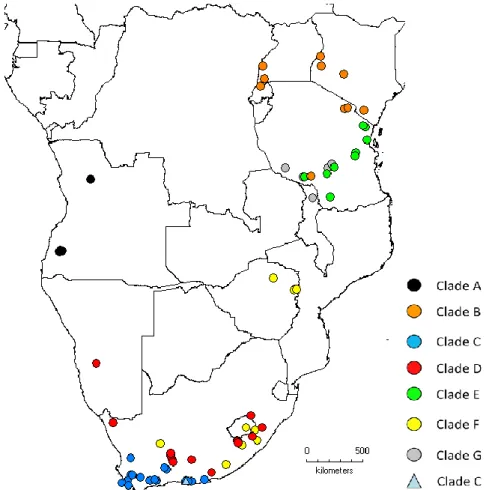
These names will probably be used in the overall taxonomic revision of the genus (Channing, pers. comm.). Fig. 2 depicts the collecting localities of the specimens and advertisement call with no voucher assigned to each clade on the present study.
Figure 2 Map representing the collecting localities of the genetically and not genetically analysed specimens of each
clade, with circles, and of the recording locality of the advertisement call with no voucher, with a triangle.
The main objectives of this study were:
complement results obtained with molecular data with morphological – available for all seven clades – and bioacoustic data – available for two clades;
discuss the provisional names proposed to the clades;
look for characters useful for distinguishing species of Amietia in nature, giving the high morphological variability associated with this genus.
8
2. MATERIALS AND METHODS
2.1. Specimens
The analysed specimens belonged to Collection of Alan Channing (University of the Western Cape) – AC; Bayworld (Port Elizabeth Museum) – PEM; National Museums of Kenya – NMK; Collection of Stefan Lötters (Trier University) – SL; University of Texas at Arlington – UTA; Iziko (South African Museum) – SAM. Examined specimens and their collection locality is reported on Appendix 7, Table 15. Type specimens were analysed by observation of photographs provided by Alan Channing or available on the species’ original descriptions. Abbreviations of museums to which type specimens belong to are as follows: Musée Royal de l’Afrique Centrale, Belgium – MRAC, Museum National d’Histoire Naturelle, Paris – MNHNP; Museum für Naturkunde, Berlin – ZMB.
First, the available specimens were separated into seven groups (A, B, C, D, E, F and G) according to the clades proposed by Channing (in prep.), using only those from which molecular data were known. On a second step, non sequenced specimens were assigned to these clades, according to similarities with the sequenced specimens, and their collecting locality. All the observed tadpoles belonged to batches from which the molecular classification of at least one individual was known.
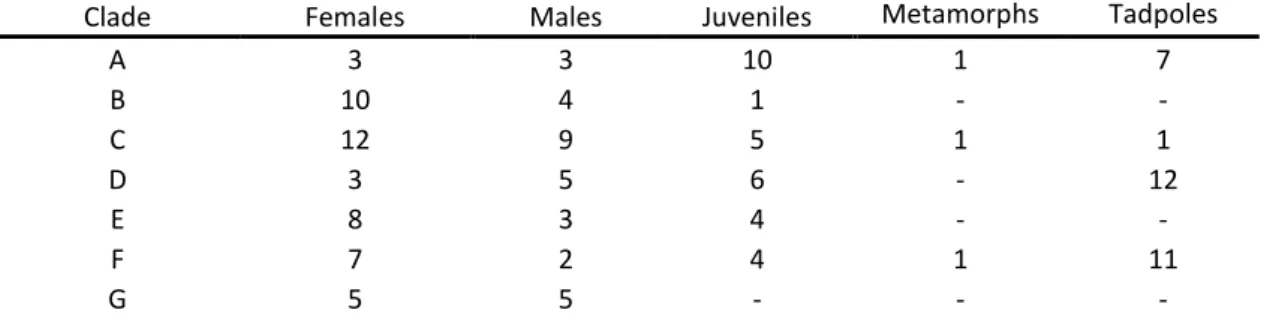
Sex was determined by observation of external secondary sexual characters – velvety nuptial excrescences on the thumbs present in breeding males, and absent in females (Scott, 2005). Adult age class was established by determining the SUL of the smallest male within all seven clades. Frogs with an SUL equal or longer than the smallest male (42,3 mm) were considered adults. Frogs with a SUL shorter than the smallest male were considered juveniles, and froglets with traces of tail were considered metamorphs. The total number of specimens analysed for each clade are listed on Table 1.
Table 1 Total number of specimens available for each clade.
Clade Females Males Juveniles Metamorphs Tadpoles
A 3 3 10 1 7 B 10 4 1 - - C 12 9 5 1 1 D 3 5 6 - 12 E 8 3 4 - - F 7 2 4 1 11 G 5 5 - - -
9 Because of the preservation status of some specimens, it was not always possible to measure all characters on each specimen, which explains the sample size differences among analyses.
2.2. Morphometrics
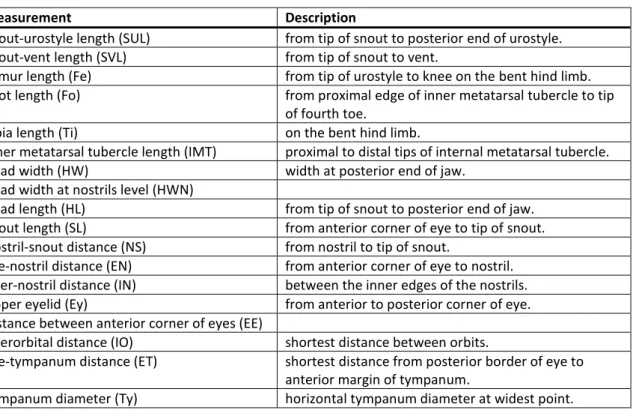
Eighteen measurements (listed on Table 2) were taken from formalin–preserved specimens with a digital calliper to the nearest 0.01 mm. These were rounded to one decimal to avoid pseudo precision, following Hayek et al. (2001). To reduce the effects of allometry (Hayek et al. 2001), only data from adults were used. Measurements were taken on the right side of the specimen whenever possible.
Table 2 List of measurements, abbreviations and description.
Measurement Description
Snout-urostyle length (SUL) from tip of snout to posterior end of urostyle.
Snout-vent length (SVL) from tip of snout to vent.
Femur length (Fe) from tip of urostyle to knee on the bent hind limb.
Foot length (Fo) from proximal edge of inner metatarsal tubercle to tip
of fourth toe.
Tibia length (Ti) on the bent hind limb.
Inner metatarsal tubercle length (IMT) proximal to distal tips of internal metatarsal tubercle.
Head width (HW) width at posterior end of jaw.
Head width at nostrils level (HWN)
Head length (HL) from tip of snout to posterior end of jaw.
Snout length (SL) from anterior corner of eye to tip of snout.
Nostril-snout distance (NS) from nostril to tip of snout.
Eye-nostril distance (EN) from anterior corner of eye to nostril.
Inter-nostril distance (IN) between the inner edges of the nostrils.
Upper eyelid (Ey) from anterior to posterior corner of eye.
Distance between anterior corner of eyes (EE)
Interorbital distance (IO) shortest distance between orbits.
Eye-tympanum distance (ET) shortest distance from posterior border of eye to
anterior margin of tympanum.
Tympanum diameter (Ty) horizontal tympanum diameter at widest point.
To assess the error associated to each measurement, one specimen was measured seven times during a period of ten days. The coefficient of variation of each measurement was determined and is available on Appendix 2, Table 14.
For two specimens from clade D (SAM 44658, SAM 44861) femur length, foot length, head length and snout length were not measured. The lack of these values would turn the number of measurements even smaller (given the 8–adult sample). Therefore, these values were estimated from linear regressions: femur length was estimated from a regression
10 between this and tibia length (R²= 0.92; p<0.002), head length estimated from a regression between this and HW (R²= 0.84; p<0.01), foot length estimated from a regression between this and tibia length (R²= 0.88; p<0.005), snout length estimated from a regression between this and the sum of EN and NS (R²= 0.75; p<0.03). Regressions included only the specimens from clade D. In all cases residuals showed normal distribution and homocedasticity. The error (95% confidence limit) of each estimative is provided in Appendix 2, Table 13.
To control for the effect of body size on morphometric variables, ratios were determined between body measurements and SUL, between head measurements and head width, and between the inner metatarsal tubercle length and foot length. Other ratios used for distinguishing species of Amietia were also determined: head width/tibia length (Poynton, 1964), foot length/head width (Channing, 1978; 1979), interorbital distance/upper eyelid and intra-nostril distance/eye-nostril distance (Laurent, 1972). Measurements were also used to determine the snout angle (SA= [arcsine ((head width / 2) / head length)] x 2).
2.3. Other morphological traits
Coloration features
Coloration features were described from preserved specimens. Each specimen was photographed from several angles. Colour photos of live specimens were available for some clades and used as a complement for colour diagnosis. Dark markings on the dorsum of the body were called blotches – roundish markings with variable size, dark highlight of the dorsolateral ridges was called ridge delineation, and dark markings along the anterior part of the thighs were called bars.
The term vermiculation was used referring to any kind of elongate wormlike dark marking, present on the flanks, ventral part of the body, and posterior surface of the thighs. Vermiculations were classified as follows: marbled – elongated vermiculations not forming a network; reticulate – wormlike markings forming a network in which elongated pale markings are closed; lacy – a network delimiting pale oval or round dots. Spots and vermiculations were further classified as thin or coarse, and as diffuse or conspicuous.
11
Skin texture
Ridges on dorsum were defined as dorsolateral (DL) – starting behind the eyes; dorsal – on dorsum; and lateral – on the space between the dorsolateral ridges and the ventral region. Ridges were classified according to shape (straight or wavy) and length: maximum detectable size reached by the ridge before any interruption. When the ridge continued beyond the scapular region, its classification was relative to space between armpit and groin.
Foot webbing
The amount of foot webbing was registered and included the number of phalanges free of web in each toe and depth of webbing notches, on the left foot whenever possible. Foot webbing formulas followed Savage & Heyer (1997). Depth of the notches was expressed relatively to the subarticular tubercles of fingers II, II, III and IV (see Fig. 2). In the formula, depth is written in brackets in Arabic numerals between the Roman numerals that represent the toes.
Vomerine odontophores
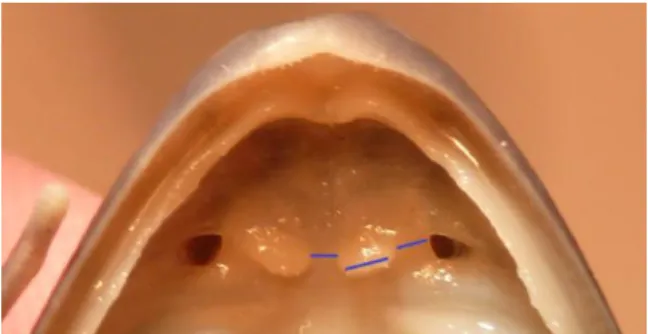
Vomerine odontophore shape, size, position and number of vomerine teeth were registered. Vomerine odontophore size (OS) was visually compared to the distance from each odontophore to the nostril (DN), and with the shortest distance between odontophores (DO), as shown in Fig. 3.
Other traits
General shape of the head and body, shape of snout from ventral view, presence of distal subarticular tubercle on the third finger of the third hand were also observed and registered.
12
Tadpole labial tooth row formula
Tadpole labial tooth row formula (LTRF) followed McDiarmid & Altig (1999) in Channing (2001), where the total number of the anterior and posterior rows of labial teeth are followed in brackets by the number(s) of the incomplete anterior and posterior rows. The numbering of the rows increases from anterior to posterior, and the rows anterior to the jaw sheath are separated from the posterior rows by a slash.
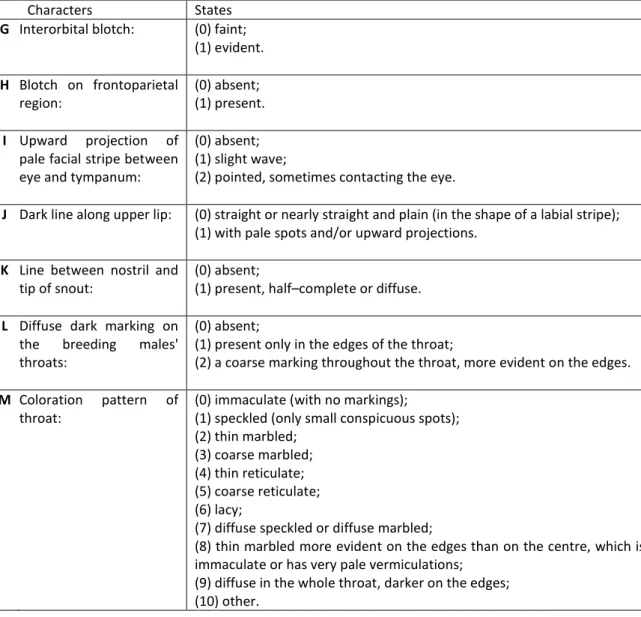
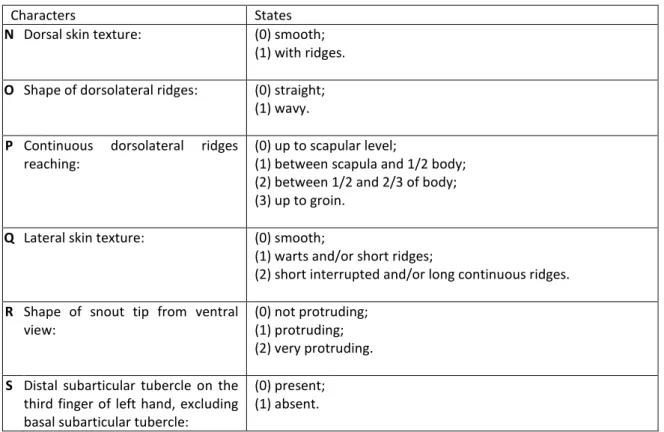
Nineteen characters relative to coloration pattern, skin texture (relative only to ridges), and morphology were selected and their variation was classified in categories as described in Tables 3, 4 and 5. Photographs representing some of the characters and their states are provided on Appendix 6.
Figure 4 Mouthparts from a tadpole assigned to clade
F. Not all of the labial tooth rows are visible.
Figure 2Webbing of the left foot of a specimen (AC 1789, Clade B). Numerals represent the toe that contains the sub– articular tubercle used to express the depth of each webbing notch.
III II II
IV
Figure 3Palate of a specimen (AC 1953, Clade E), showing vomerine odontophores. Traces from left to right represent respectively the shortest distance between vomerine odontophores (DO); odontophore size (OS); and distance from odontophore to nostril (DN).
13
Table 3 Characters and states observed relative to body coloration pattern.
Characters States
A Vertebral stripe: (0) absent; (1) present.
B Dorsolateral ridges
delineation:
(0) absent; (1) present.
C Dorsal blotches pattern: (0) absence of blotches except for vertebral row , when present, and/or small blotches on the sacral region;
(1) several blotches more or less organised in one or more longitudinal series, forming a relatively symmetrical pattern;
(2) blotches confusingly scattered, usually with a diffuse pale outline, not organised in rows nor forming a symmetrical pattern;
(3) plain dorsum; (4) other.
D Pale outline of bars on
thighs: (0) absent or diffuse; (1) evident. E Dominant coloration pattern on posterior surface of thighs:
(0) nearly plain (coarse dark marking with very small pale dots); (1) lacy;
(2) thin vermiculations (either reticulate or marbled); (3) coarse vermiculations (either reticulate or marbled).
F Dominant coloration pattern of flanks:
(0) irregular vermiculations (speckled or elongated, coarse or thin, conspicuous or diffuse);
(1) apart from vermiculations, very conspicuous small white dots or stains scattered, usually coinciding with lateral ridges;
(2) almost no other vermiculations except a conspicuous line with or without upwards and/or downwards projections, from the groin to the top of the forelimbs;
14
Table 4 Characters and states observed relative to head coloration pattern.
Characters States
G Interorbital blotch: (0) faint; (1) evident. H Blotch on frontoparietal region: (0) absent; (1) present. I Upward projection of
pale facial stripe between eye and tympanum:
(0) absent; (1) slight wave;
(2) pointed, sometimes contacting the eye.
J Dark line along upper lip: (0) straight or nearly straight and plain (in the shape of a labial stripe); (1) with pale spots and/or upward projections.
K Line between nostril and
tip of snout:
(0) absent;
(1) present, half–complete or diffuse.
L Diffuse dark marking on
the breeding males'
throats:
(0) absent;
(1) present only in the edges of the throat;
(2) a coarse marking throughout the throat, more evident on the edges.
M Coloration pattern of throat:
(0) immaculate (with no markings);
(1) speckled (only small conspicuous spots); (2) thin marbled;
(3) coarse marbled; (4) thin reticulate; (5) coarse reticulate; (6) lacy;
(7) diffuse speckled or diffuse marbled;
(8) thin marbled more evident on the edges than on the centre, which is immaculate or has very pale vermiculations;
(9) diffuse in the whole throat, darker on the edges; (10) other.
15
Table 5 Characters and states observed relative to skin texture and morphology.
Characters States
N Dorsal skin texture: (0) smooth; (1) with ridges.
O Shape of dorsolateral ridges: (0) straight; (1) wavy.
P Continuous dorsolateral ridges
reaching:
(0) up to scapular level;
(1) between scapula and 1/2 body; (2) between 1/2 and 2/3 of body; (3) up to groin.
Q Lateral skin texture: (0) smooth;
(1) warts and/or short ridges;
(2) short interrupted and/or long continuous ridges.
R Shape of snout tip from ventral
view:
(0) not protruding; (1) protruding; (2) very protruding.
S Distal subarticular tubercle on the third finger of left hand, excluding basal subarticular tubercle:
(0) present; (1) absent.
2.4. Bioacoustic data
Analysed recordings were provided by Alan Channing:
a) from Humpata, Angola; one recording by Alan Channing on 22nd January 2009, at 21oC, from a not genetically analysed voucher (AC 3120) assigned to the clade A;
b) from Northern Cederberg, South Africa; one recording by Alan Channing on the 6th February 2010, at 21h00, with a air temperature of 22oC, from a genetically identified voucher (AC 3164) assigned to the clade C;
c) from Bloukrans River, South Africa; one recording by Harold Braack on 2009, at 19oC, included calls of two individuals, and assigned to the clade C, based on the recording locality and the clade’s distribution. This recording’s location is shown on Fig. 2.
16
2.5. Data analysis
2.5.1. Morphometric data
Amietia species have sexual dimorphism: females are larger and have wider heads
than males. A search for sexual dimorphism on the used ratios was performed, as suggested by Hayek et al. (2001).
Tests were conducted to look for significant differences among all clades relatively to the easier features to measure in the field: SUL and HW/Ti ratio. Normality and homocedasticity tests were performed for both variables. When these were normal and homocedastic (case of HW/Ti ratio), an ANOVA was conducted, and when not (case of SUL), Kruskal-Wallis test was. To find which clades showed significant differences in these features, a
posteriori tests were conducted, and consisted in a Tukey honest significance differences test
corrected for unequal sample sizes for HW/Ti, and multiple comparison of mean ranks for SUL. Box and whiskers plots were built for several body ratios, as these might be useful for identification of specimens.
Discriminant analyses
Body ratios were used for discriminant function analysis (DFA), to find the more useful ratios for distinguishing species (Quinn & Keough, 2002). Most of the ratios had normal distribution (pers. obs.). Tests to assess for homogeneity of variances and for outliers, recommended for discriminant analysis, were not performed. However, the main goal of this analysis was to find the most useful variables for distinguishing clades, and not to classify specimens. In this case the fulfilment of these assumptions is not as important (Quinn & Keough, 2002)
Separate DFAs were conducted using the clades belonging to: “A. angolensis group” (A, B, E, F and G);
“A. fuscigula group” (C and D);
“A. angolensis” from Southern Africa (A and F), discovered to be different taxa by
Channing (in prep.);
“A. angolensis” from East Africa (B, E and G), more likely to occur in sympatry.
The best final subset of variables for each group was chosen by a forward stepwise selection procedure. Because of the high correlation between some ratios, not every ratios were included in the discriminant analyses. Ratios including measurements with the higher
17 coefficients of variation (eye–tympanum distance, interorbital distance, and nostril–snout distance) were not used. Ratios used to build the final model were the same for every models: HW/SUL, HL/SUL, HWN/HW, SL/HW, EN/HW, IN/HW, Ey/HW, EE/HW, Ty/HW, HW/Ti, Fo/HW.
Interpretation of the obtained models was based, on the value of Wilk’s lambda (λ) for the model – varying between 1 (meaning no discrimination) and 0 (meaning complete discrimination) (StatSoft, 2001) –, on the percentage of discrimination explained by each variable (based on the partial Wilk’s λ values, the lowest meaning the greatest discrimination ability of the variable), and on the percentage of correct classifications. All the analyses were carried out using Statistica (v. 7.0) software.
2.5.2. Qualitative data
Due to the small sample sizes, no statistical analyses were used for qualitative data. These were used on comparative tables and for the description of the clades.
2.5.3. Bioacoustic data
Nomenclature hereafter follows Ryan (2001). Amietia calls are biphasic, having a first clicking phase consisting in pulse trains, and a second phase consisting in rapidly pulsed notes (Channing, 1979; Visser & Channing, 1997).
Measured parameters for the first phase were: length, as the length of the pulse trains, pulse rate, length of the interval between the pulses, frequency of the pulses. The length of the interval between the two phases was also determined. All of these parameters were only determined for the call from clade A.
For the second phase, the determined parameters were length, as the length of each pulsed note, pulse rate per note, note repetition rate, length of the interval between notes, and notes frequency. These second phase parameters were determined for all the calls. Temporal measurements are given as range, followed by mean ± standard deviation and number of analysed units (notes, pulses, calls or intervals).
Calls were analysed with the acoustic software Adobe Audition 3.0. All the calls were resampled at 44.1 kHz and 16 bit resolution in the mono pattern and saved as uncompressed files. Frequency information was obtained through Fast Fourier Transformation (FFT, width 1024 points). The audiospectrograms were provided by Gonçalo M. Rosa and obtained using a Hanning window function with 256–band resolution.
18
3. RESULTS
A summary of the main results of qualitative features for all clades Appendix 8 (Table 16, Table 17 and Table 18). Box and whiskers plots for body ratios are available on Appendix 5 (Fig. 17, Fig. 18). Raw measurements for every adult specimens are provided on Appendix 9. Notes on the identification of each clade, and specimens assigned to each clade are available on Appendix 3. A dichotomous key proposed for distinguishing adult specimens belonging to the seven studied clades, is provided on Appendix 4.
Specimens belonging to clade D are currently – before Channing (in prep.) – assigned to A. fuscigula (Duméril & Bibron, 1841), and specimens belonging to clade F are currently assigned to A. angolensis (Bocage, 1866). In the present work, it is assumed that clade D is the same as Rana fuscigula (sensu Channing, 1979), and that clade F is the same as Rana
angolensis (sensu Channing, 1979). These assumptions are based on distributional similarities.
3.1. Morphometrics
Although there seemed to be a tendency for females having larger body sizes and wider heads in most clades (pers. obs.), the few significant differences among sexes (pers.
obs.), the small samples, and the main goal of the work – providing data to help distinguishing
clades, regardless of the sex of the specimen – lead to the decision that sexes would not be separated for subsequent analysis.
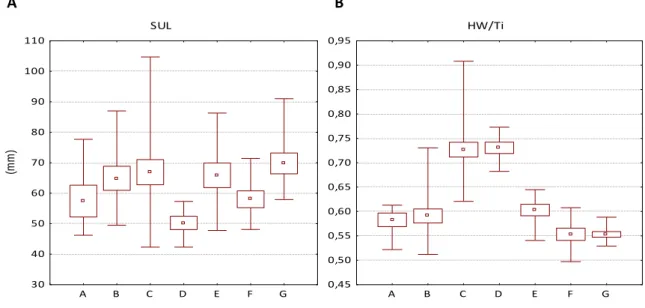
For SUL, the Kruskal-Wallis test was significant (H=15.3; p=0.02), and a posteriori tests revealed that there were significant differences between body size of clades D and G (Appendix 1, Table 12). An ANOVA including all seven clades (p=0.000000) showed significant differences in HW/Ti, and a posteriori Tukey test revealed significant differences between the five clades from “A. angolensis group” and both clades from “A. fuscigula group” (Appendix 1, Table 11). Box and whiskers plots of the analysed samples are represented on Fig. 6. Despite the significant differences in both features, there are overlapping values among most of the clades.
19 A SUL Mean Mean±SE Min-Max A B C D E F G 30 40 50 60 70 80 90 100 110 (m m ) B HW/Ti Mean Mean±SE Min-Max A B C D E F G 0,45 0,50 0,55 0,60 0,65 0,70 0,75 0,80 0,85 0,90 0,95
Figure 6 Box and whisker plots (central square=mean, boxes=mean±standard error, whiskers=maximum and minimum values) showing morphological variation among clades. A: snout-urostyle length (mm); B: head width/tibia length ratio.
Discriminant analyses
The results of the discriminant function analysis (DFA) are summarized on Table 6. Table 6 Summary of the discriminant power of the models selected for each combination of clades. The
first line depicts the ability of each model in discriminating clades. Partial Wilk’s λ are presented for the variables present on the final models, a * depicts those that were significant, blank cells represent variables absent in the final model.
“A. fuscigula group” (clades C, D) “A. angolensis group” (clades A, B, E, F, G) “A. angolensis” from Southern Africa
(clades A, F)
“A. angolensis” from East Africa (clades B, E, G) General Wilk’s λ Significance value 0.52 F (3.23)=7.1 p< 0.0015 0.15 F (32.134)=2.8 p< 0.0000 0.20 F (4.10)=9.99 p< 0.0016 0.19 F (14.48)=4.36 p< 0.0001 Model’s overall correct classification 92.6% 72.9% 93.3% 88.2% P artial Wilk ’s λ f o r e ach ra tio HW/SUL 0.92 – – – HL/SUL 0.93 0.81 0.65 * 0.80 HWN/HW – 0.90 – 0.91 SL/HW – 0.78 – 0.73 * EN/HW 0.64 * 0.84 – 0.87 IN/HW – 0.88 – – Ey/HW – – – – EE/HW – – 0.45 * – Ty/HW – 0.89 – 0.90 HW/Ti – 0.55 * 0.37 * 0.56 * Fo/HW – 0.60 * 0.73 0.60 *
20 The discrimination within all groups of clades was statistically significant, indicating that there are detectable differences among the clades, and reinforcing Channing’s (in prep.) proposed clades. The percentage of correct classifications was above 70% in each group. Nevertheless, these results also show that using only morphometrics it is not possible to accurately identify all the specimens belonging to each clade.
“A. fuscigula group” (clades C and D)
The only significant ratio identified for the model for distinguishing the clades was EN/HW. Despite the statistical significance of the model (p<0.0015), the Wilks’ lambda is above 0,5, showing that the discrimination between both clades is notevident. The model had an overall correct classification of 92.6%: 100% (19 / 19) for clade C, and 75% (6/8) for clade D. These values suggest that unequivocal distinction of theseclades based on morphometric data is not possible.
“A. angolensis group” (clades A, B, E, F, G)
The ratios with higher discriminant power for this group were, by order: HW/Ti and Fo/HW. Nevertheless, the overall correct classification of this model was 72.9% (50% (3/6) for clade A, 71.4% (10/14) for clade B, 66.7% (6/9) for clade E, 66.7% (6/9) for clade F, and 100% (10/10) for clade G), showing that, except for clade G, variables on the model do not enable accurate discrimination of the clades belonging to this group.
“A. angolensis” from Southern Africa (clades A and F)
This model had an overall correct classification of 93.3% (100% (6/6) for clade A, and 88.8% (8/9) for clade F. The ratios with higher discriminant power for this group were, by order, HW/Ti, EE/HW and HL/SUL. The variables on the model do not enable accurate discrimination of the clades A and F.
21
“A. angolensis” from Eastern Africa (clades B, E and G)
The ratios with higher discriminant power for this group were, by order HW/Ti, Fo/HW, SL/HW. This model had an overall correct classification of 88.2%, 92.8% (13/14) for clade B, 70% (7/10) for clade E, and 100% (10/10) for clade G, showing that using only these variables is not enough for accurate discrimination of clades belonging to this group, except for clade G.
3.2. Qualitative characters
The observed variation of all the registered qualitative characters and their states in each clade is summarized in the following tables. Table 7 depicts the body coloration pattern, Table 8 refers to head coloration pattern, and Table 9 to skin texture and morphology. Missing data were not included on the tables.
Table 7 Distributions (and percentage) of states relative to body coloration pattern among the seven clades.
n=number of specimens for which data were available.
Vertebral stripe DL ridges delineation Dorsal blotches pattern
Clade n A0 A1 n B0 B1 n C0 C1 C2 C3 C4 A 17 8 (47) 9 (53) 17 17 (100) 17 17 (100) B 14 13 (93) 1 (7) 14 12 (83) 2 (17) 14 1 (8) 3 (25) 8 (58) ((58) 1 (8) 1 (8) C 27 22 (81) 5 (19) 24 24 (100) 24 13 (54) 11 (46) D 14 11 (79) 3 (21) 14 14 (100) 12 8 (67) 4 (33) E 12 12 (100) 12 2 (17) 10 (83) 12 10 (83) 2 (17) F 14 1 (7) 13 (93) 14 14 (100) 14 14 (100) G 10 8 (80) 2 (20) 10 10 (100) 10 7 (70) 3 (30)
Thigh bars outline Posterior surface of thighs
coloration pattern Flanks coloration pattern
Clade n D0 D1 n E0 E1 E2 E3 n F0 F1 F2 F3 A 17 17 (100) 17 1 (6) 9 (53) 6 (35) 1 (6) 17 14 (82) 3 (18) B 14 9 (64) 5 (36) 14 2 (14) 7 (50) 5 (36) 14 12 (86) 2 (14) C 26 17 (65) 9 (35) 23 2 (9) 4 (17) 4 (17) 13 (57) 15 15 (100) D 13 11 (85) 2 (15) 10 7 (70) 3 (30) 8 8 (100) E 12 10 (83) 2 (17) 12 8 (67) 3 (25) 1 (8) 9 2 (22) 7 (78) F 14 14 (100) 13 2 (15) 6 (46) 5 (38) 14 10 (71) 4 (29) G 10 8 (80) 2 (20) 10 10 (100) 10 10 (100)
22
Table 8 Distributions and percentage (in parentheses) of states relative to head coloration pattern the seven clades.
n=number of specimens for which data were available.
Interorbital blotch Frontoparietal blotch Facial stripe projection
Clade n G0 G1 n H0 H1 n I0 I1 I2 A 17 17 (100) 17 6 (35) 11 (65) 17 1 (6) 16 (94) B 15 9 (60) 6 (40) 15 14 (93) 1 (7) 14 6 (43) 8 (57) C 23 9 (39) 14 (61) 24 24 (100) 22 2 (9) 10 (45) 10 (45) D 9 3 (33) 6 (67) 11 11 (100) 10 1 (10) 9 (90) E 13 9 (69) 4 (31) 15 15 (100) 12 11 (92) 1 (8) F 14 2 (14) 12 (86) 14 14 (100) 14 1 (7) 1 (7) 12 (86) G 10 8 (80) 2 (20) 10 10 (100) 10 2 (20) 4 (40) 4 (40)
Marking along upper lip Nostril-snout line Breeding males' throat
Clade n J0 J1 n K0 K1 n L0 L1 L2 A 17 10 (59) 7 (41) 17 16 (94) 1 (6) 3 3 (100) B 15 1 (7) 14 (93) 13 8 (62) 5 (38) 4 3 (75) 1 (25) C 19 13 (68) 6 (32) 21 6 (29) 15 (71) 9 9 (100) D 10 10 (100) 6 1 (17) 5 (83) 5 5 (100) E 11 9 (82) 2 (18) 12 2 (17) 10 (83) 3 3 (100) F 14 14 (100) 13 4 (31) 9 (69) 2 2 (100) G 10 10 (100) 10 8 (80) 2 (20) 5 4 (80) 1 (20)
Throat coloration pattern of adults
Clade n M0 M1 M2 M3 M4 M5 M6 M7 M8 M9 M10 A 6 6 (100) B 13 1 (8) 3 (23) 7 (54) 1 (8) 1 (8) C 15 2 (13) 13 (87) D 8 6 (75) 2 (25) E 10 1 (10) 1 (10) 3 (30) 1 (10) 2 (20) 2 (20) F 9 1 (11) 1 (11) 1 (11) 4 (44) 2 (22) G 10 6 (60) 2 (20) 1 (10) 1 (10)
For most of the observed characters, frequencies of states differed among clades, but no states were diagnostic of any clade. However, some of the characters had states exclusive of certain clades: flanks coloration pattern, dorsal blotches pattern, throat coloration pattern of adults, breeding males' throat darkening, and these allowed an immediate and easy identification of the clade to which the specimen belonged.
23
Table 9 Distributions and percentage (in parentheses) of states relative to skin texture and morphology (among the
seven clades. n=number of specimens for which data were available.
Dorsal ridges DL ridges shape DL ridges size
Clade n N0 N1 n O0 O1 n P0 P1 P2 P3 A 5 2 (40) 3 (60) 17 16 (94) 1 (6) 17 1 (6) 3 (18) 13 (76) B 12 6 (50) 6 (50) 15 13 (87) 2 (13) 15 3 (20) 7 (47) 5 (33) C 18 1 (5) 17 (95) 17 17 (100) 20 17 (85) 2 (10) 1 (5) D 5 5 (100) 8 2 (25) 6 (75) 9 8 (89) 1 (11) E 9 8 (89) 1 (11) 12 12 (100) 13 4 (31) 5 (38) 4 (31) F 8 8 (100) 14 1 (7) 13 (93) 14 11 (79) 3 (21) G 10 6 (60) 4 (40) 10 9 (90) 1 (10) 10 2 (20) 8 (80)
Lateral skin texture Snout shape from
ventral view DST on third finger
Clade n Q0 Q1 Q2 n R0 R1 R2 n S0 S1 A 17 12 (71) 5 (29) 17 3 (18) 12 (71) 2 (12) 16 15 (94) 1 (6) B 11 11 (100) 14 8 (57) 6 (53) 13 13 (100) C 18 18 (100) 27 23 (85) 4 (15) 21 21 (100) D 11 10 (91) 1 (9) 14 12 (86) 2 (14) 12 12 (100) E 11 3 (27) 6 (55) 2 (18) 13 6 (46) 7 (54) 10 9 (90) 1 (10) F 14 11 (79) 3 (21) 14 7 (50) 7 (50) 13 11 (85) 2 (15) G 10 6 (60) 4 (40) 10 10 (100) 10 3 (30) 7 (70)
The distal subarticular tubercle on the third finger (DST) has been reported as a potentially diagnostic character for distinguishing A. fuscigula from A. angolensis, being present on the first, and absent on the late (Scott, 2005). On the present study, the DST was always present on both clades previously included in the “A. fuscigula group” (C and D), agreeing with this finding, but it was not always absent in the clades belonging to the “A.
angolensis group”. Therefore, this feature, if present, is not useful for distinguishing both
groups. Specimens from clade G had a considerably high frequency of absence of DST, contrasting to every other clade.
The main obtained results relative to the number of phalanges free of webbing for every clades are presented in Fig. 8 and Fig. 9.
Figure 8 Frequencies of the number of phalanges free
of webbing (f) on the outer 4th toe on each clade.
Figure 9 Frequencies of the number of phalanges free of
webbing (f) on the inner 5th toe on each clade.
0% 20% 40% 60% 80% 100% A B C D E F G f=1 1<f<2 f=2 2<f≤3 0% 20% 40% 60% 80% 100% A B C D E F G f=0 0<f<1 f=1
24 Results relative to number of vomerine odontophores, complete foot webbing formulae, depth of webbing notches, and tadpoles labial tooth row formulae are summarized in Appendix 8, Table 16. Tadpoles from reached clade A a higher number of labial tooth rows than the maximum described for A. angolensis (Boulénger, 1918; Channing, 2001). The small sample suggested that TLRF was variable and similar among clades, and that this is not a diagnostic feature for species of Amietia. Results relative to vomerine odontophores were partially in accordance with Boulénger (1918): there seemed to be a tendency of clades from the “A. fuscigula group” to having smaller odontophores (frequently with oval) and less vomerine teeth (maximum 6 per odontophore) than clades from “A. angolensis group”, with longer odontophores (frequently elongate) and more vomerine teeth (reaching 11 per odontophore). Nevertheless, its usefulness for distinguishing clades was inconclusive.
3.3. Bioacoustic data
Clade A
Length of each pulse train in the initial phase was 430–493 ms (462±44.5, n=2). Each pulse train had eleven pulses (n=2), and the duration of each pulse varied between 2–4 ms (2.8±0.7, n=22), and the interval between pulses 29–61 ms (43.1±8, n=20). The pulse rate of the initial phase was 22.3–25.6 pulses/s (23.95±2.3, n=2). The frequency of the pulses ranged from 2.6 to 3.9 kHz, and the energy range of the first pulses of each pulse train (3.1–3.4 kHz) was smaller than the energy range of the last pulses (2.6–3.7 kHz). No harmonics were detected. The interval between the first and second phase was of 433 ms seconds (n=1).
On the second phase, note duration range was 32–52 ms (38.8±7.8, n=5), pulse rate ranged from 96.2–187.5 pulses/ms (145.6±34.8, n=5), and notes were vocalised at 2.6–3.7 kHz. The note repetition rate was 3.45 notes/s, and the interval between notes ranged from 230– 363 ms (320±60; n=4). A sonogram and oscillogram of part of the analysed stretch is in Fig. 10.
25
Figure 10 Sonogram (top) and oscillogram (bottom) of the advertisement call of clade A, recorded by Alan Channing,
at Humpata, Angola (21°C, voucher specimen: AC 3120). Figure kindly provided by Gonçalo M. Rosa.
Clade C
Stretches of calls from 3 individuals were analysed for this clade. All calls consisted in series of pulsed notes vocalised in relatively regular intervals, a structure that resembled the second phase of the typical biphasic call of the genus Amietia. The sonogram and oscillogram of stretches of the analysed calls are depicted in Fig. 11 (representing the call of only one individual) and Fig. 12 (first two notes from one individual, and third note, with a broader frequency range,from a different individual).
The following parameters result from the combined data from all three individuals. In general, notes’ duration ranged from 37 to 65 ms (48.7±7.4, n=23), pulse rate 30.8–133.3 pulses/s (91.4±27.4, n=23). Interval between notes varied from 1.3 s to 14.8 s(3.2±3.2, n=20). The note repetition rate was 0.14–0.59 notes/s (0.39±0.23, n=3), and frequency ranged from 0.1–3.1 kHz.
Call frequency varied highly among individuals. On the call from Northern Cederberg (Fig. 11), there was a more energetic band of frequencies from 0.7 to 2.4 kHz, another energetic band from 2.6–3.0 kHz, and there was appreciable energy up to 3.5 kHz. On the call from one of the individuals from Bloukrans River (Fig. 12, two first notes) the more energetic
26 call frequencies were at 0.6–1.1 kHz and 1.3–1.5 kHz, with considerable energy reaching 3.1 kHz. The other call from Bloukrans River (Fig. 12, third note) showed a broad range of frequencies, from 0.3–2.2 kHz lower frequencies, with considerable energy reaching 3.1 kHz.
Interval between notes also varied considerably: individuals calling at higher frequencies with intervals from 1.3 to 4.1 seconds, and the individual calling in lower frequencies with larger intervals, from 4.9 to 14.8 s. The considerable variation in frequency range among individuals might be due to different body sizes, which is known to be negatively correlated with the fundamental frequency of advertisement calls (Bee, 2002).
Figure 11 Sonogram (top) and oscillogram (bottom) of the advertisement call of clade C recorded by Alan
Channing at Northern Cederberg, South Africa (22 °C, voucher specimen AC 3164). Figure kindly provided by Gonçalo M. Rosa.
27
Figure 12 Sonogram (top) and oscillogram (bottom) of advertisement calls of two individuals of clade C recorded
by Harold Braack at Bloukrans River, South Africa (19oC, no voucher specimens). Figure kindly provided by Gonçalo M. Rosa.
The obtained parameters for clade A are compared to the call parameters described for A. angolensis (sensu Frost 2006), from Channing (1979). The obtained parameters for clade C are compared to the call parameters described for A. fuscigula (sensu Frost 2006), from Channing. A summary of the compared values is presented in Table 10.
Table 10 Values [mean (range)] of pulse rates (pulses/s), duration (ms) and frequency (kHz) from calls
described in the present work (clades A and C), and calls assigned to the species to which these clades were previously assigned to: A. angolensis and A. fuscigula, respectively. Values from Channing (1979).
First phase Second phase
pulse rate duration frequency n pulse rate duration frequency n
Clade A (22.3–25.6) 24 (430–493) 462 2.6–3.9 2 (96,2–187,5) 146 (32–52) 39 2.6–3.7 5 A. angolensis (sensu Frost 2006) 12.4 (8.9–16.6) 353 (159–868) 1.5–2.7 occasionally lower 91 112 (87–162) 540 (200–1300) 0.7–2.7 harmonics at 0.8 and 1.6 91 Clade C _ 91.4 (30.8–133.3) 49 (37– 65) 0.1–3.1 23 A. fuscigula (sensu Frost 2006) 174 (110–265) 110 (37–302) 0.3–1.6 83