NEW PROJECT INNOVATIVENESS: THE CASE OF PORTUGUESE FINANCIAL SERVICES
J.M. Carvalho Vieira a, Elisabete Serra', Alberto Castro' and A. L. Guevara Martinezb 'Univ. Cat(Mica Portuguesa Portugal
bUniv. Pompeu Fabra, Spain
ABSTRACT
Services marketing literature has a tendency to perceive new services as generic and easily imitable. This paper examines the relationship of new services performance determinants (strategic/environment) from the application of a generic model. In particular, we investigate the degree of discontinuity of new projects (innovativeness to market/firm) impacts upon different levels of performance (financial/no-financial). The results of binary logistic regression analysis suggest that the factors that discern best-high marginal success is slightly different, and even lessened, than those that discern successful from unsuccessful innovations. Univariate analysis of variance indicates that there is a significant individual/interactions effect from new product innovativeness (to market/firm).
INTRODUCTION
The rising importance of services in industrialized economies justifies the growing attention, in recent years, to understanding its conditions and mechanisms of integration and success in the economic system. Commentators and those of the academic community consider the creation, development and launch of new and successful services as a sustainable source of differentiation; resulting in value adding and connectivity to the client. The literature on marketing services supports the notion that new services should be regarded as generic and easily imitated. Fulfilling this goal will demand the adoption of a continual process that will bring about, in a superior and original way, new and existing needs / problems clearly differentiating the experience of the service.
Research, exploratory and sector based, on strategic and environmental factors that determine the success or failure of new services and, especially explain different levels of positive performance, are still scarce. From a methodological stance, the evolution of a limited focus on identification of the determinants and reasons for success or failure of new services is now apparent. Recently, the analyses widened to include the identification of factors that explain different degrees of return, i.e., discriminate between new projects of average and high success. The proliferation of new services in the market, demands that a there is a more selective allocation of resources, supported by more accurate forecasts of the performance of new projects.
Following this framework, we propose to verify:
I. If the services performance measures for and new projects are effected by different innovation strategies;
2. If the set of discriminates between new services that are successful / failures is different due to the indicators used to capture its performance.
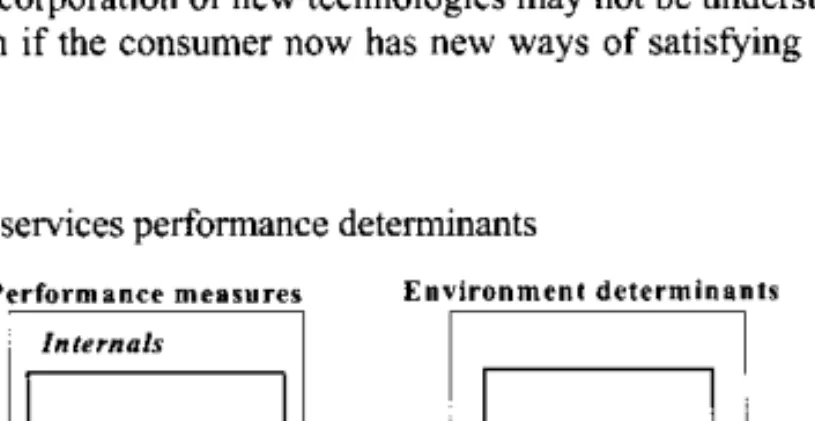
Internals Financial Time to break-ever Relationship enhancement Market development External Market Compctitivenes Forecast / Regulation )
Innovativeness degree, as a multidimensional construct, constitutes an important moderator of the relationship between various identified factors and the return of new products [19];
The perception of the degree of innovative intensity intrinsic to the new service does not seem compatible with the difference between its technical and market content. The exclusive incorporation of new technologies may not be understood, or may not allow it, even if the consumer now has new ways of satisfying their needs available [IS].
Figure I. Global Model of new services performance determinants
Strategic Determinants Performance measures Environment determinants
Directs Global quality Communicatio consistence Inno vat iviness Relative advantage Development process Cycle time Management synergies Innovation strategy Corporate image In directs
Consequently, we consider that the innovative intensity of the new service should transform the combined magnitude of its discontinuity (differentiation) when compared to the market and the company. That is, it will express lesser experience, both of the consumers, in their use, as well as the company, in their development and their rendering, for which we expect to see lesser probability of success (financial / non-financial), more so the greater new service innovativeness
(to
market/firm),To investigate the success of new services (low /
average / high),
the research was based conceptually and empirically on a set of relationships, the structure of which foresees (see Figure 1.):1. The performance of new services derives from a wide group of factors. This investigation intends to capture the influence from the two categories of determinants: (a) strategic those relative to the resources and capacities of the organization; to the quality, relative advantage, superiority and degree of innovation of the new service; to the direction of marketing and formalization of its development and launch; and to the commitment of senior management in creating a co-operative environment that encourages innovation. (b) environmental 2 : those relating to the attractiveness and competitive intensity of the target-market of the new service, as well as its degree of regulation.
: New service global quality'; "new service communication consistence'', "new service innuvativeness":"new service relative advantage": new service development formalization": "new service development time cycle"; "management synergies"; "innovation strategy" and "corporate image"
2. The success of new services is a multidimensional construct. To exceed the limits of information captured by traditional indicators, four types of measures were used, grouped into two generic categories: (1) financial performance: its performance in terms of market share and financial objectives reached, as well as the magnitude of the long term expectations that the company associates to them; (2) time to break-even: its short, medium, long initial cycle of profit creation; (3) relationship enhancement: its potential to enhance the relationship between the company and its present clients, i.e., strengthening loyalty and profitability; (4) market development: its potential to build a "window of opportunity" for entrance into new markets and/or launch of other new services.
METHODOLOGY Sample and Data Collection
In support of our research and in preparation of the design of the questionnaire, a summary was prepared of the material gathered from reviewing literature and the series of exploratory interviews. From analysing the information obtained, a group of 67 variables were selected distributed by:
- 45 new project' describers: Global quality [7]; Communication consistence [7]; Innovativeness Degree [3, 4, 5, 7, 14, 15]; Relative advantage [3, 4, 13]; NSD process [3]; Cycle time (NSD) [15];
- 10 company and environment describers: Innovation Strategy [4]; Corporate Image [4, 7]; Market Competitiveness [3]; Forecast / Regulation [4];
- 8 performance indicators and 4 market, company and services classification factors. The group was used as a basis for the creation of a "mail questionnaire" structured into three groups of Liekart-type scales of 1-7 points (strongly disagree to strongly agree) that, after being tested, was submitted to managers with direct responsibility in the preparation, launching, and accompaniment of new financial services of 347 Portuguese companies (banks, real estate and investment funds, brokerage, insurance, risk capital, leasing and factoring). The percentage of answers received was 30% (105 companies). However, only 62% of the questionnaires could be considered valid, i.e., 120 new services (63 failures and 57 successful).
Data Processing
To contrast the formulated hypotheses whilst taking account of the nature of the variables used, a multi-varied analytical sequence was adopted in 3 phases:
I. Identification of the project, company and environment describers that best differentiate the groups of new services. Those that replied previously classified the commercial successes and failures. Given that previous investigations do not provide consistent and valid measures for the models being tested, the different variables were subjected to an exploratory analysis using Principal Components Analysis (PCA), to examine its eventual underlying relationships.
2. Based on the dimensions derived from the a Principal Components Analysis (it's) and on the previous success/failure classification (DVs), the data was submitted to a binary logistic regression analysis, to identify the dimensions of the environment, company and new service that best discriminates between success and failure. The objective was not to foresee which will be the new services that are successful or failures, but to see
if the success (high/average) / failure can be anticipated by the information obtained on the determinants of its performance.
Given that the classification previously obtained from those that replied limits the approximation to the underlying dimensions of the success/failure of new services, what is intended is to check whether the factors that show potential to discriminate between positive and negative performance are, also, able to explain high success levels. For this purpose, its influence on each of the four individual performance indicators (financial performance,. relationship enhancement; market development and time to break-even) was tested by a sequence of binary logistic regressions.
Finally, to check the occurrence and the direction of eventual interaction effects, the data were subject to successive univariate analysis of variance.
RESULTS
New Project, Firm, Environment and Performance dimensions
Despite the data analysis showing a moderate correlation between the variables relating to the new service, the organization and the environment (r between 0.19 and 0.44), the results of a Principal Components Analysis with Varimax rotation, show 11 independent factors compatible with the proposed structure of indicators and that together explain 64percent of the variance in the original variables.
Despite the high internal consistency (a=0.86) in the performance measures (financial/non-financial), the impact of each of the discriminators identified on each indicator was also explored: ( I ) internal: "financial" and 'time to break-even"; (2) external: "relationship enhancement" and "market development" (see Table 1), contrasting them in line with the two performance levels ( high / average).
Yet, contradicting the expectations identified in the literature, it was not possible to totally confirm that service organisations measure the performance of their new projects, in so far as the sample does not recognise the multiplicity of its indicators. Inversely, the expected variability of the impact of new services success factors, through the different return indicators, obtained full confirmation.
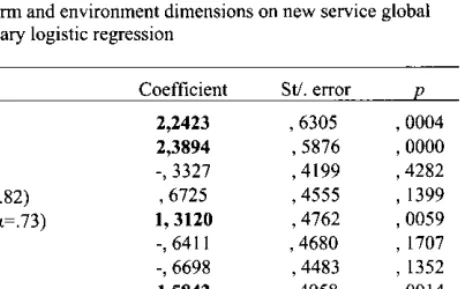
Predicting success (high / average) / failure from project, firm and environment factors As identified in Tables 1. and 2., logistic regression analysis shows that:
I. "Marketing effort ": by constituting the first discriminator of the success and failure of new services, restates the importance that the empirical literature on innovation assigns to the presence of a high level of marketing effort during the development process and launch of the new products/services (see table I.). In the same way, the results on the success (high and average) show that different degrees of marketing effort lead to different performance levels. Excluding the results obtained by the "time to break-even" measure, the "marketing effort" gives rise to a strong differentiation between new services of high/average success (see Table 2.).
2. "Global quality": the high discriminatory power of this factor between total success and failure adapts itself to the evidence of its strong positive influence on the performance of new services (see Table 1). A more detailed analysis of the individual scales of "financial and non-financial" returns show that the measure of "market development" is the indicator that best expresses the differentiating impact of the quality between new services of high/average performance (see Table 2).
Table 1. Effect of project, firm and environment dimensions on new service global success/failure: binary logistic regression
Factors Coefficient St/. error
Global Quality (a= .64) 2,2423 , 6305 , 0004
Marketing Effort (a= .65) 2,3894 , 5876 , 0000
Innovation strategy (a= .60) -, 3327 , 4199 , 4282
Innovativeness (to firm) (a— .82) , 6725 , 4555 , 1399
Innovativeness (to market) (a=.73) 1, 3120 , 4762 , 0059
Corporate image (a= .56) -, 6411 , 4680 , 1707
Forecast/Regulation (a= .52) -, 6698 , 4483 , 1352
NSD Process (a= .87) 1,5842 , 4958 , 0014
Management Synergies (a= .87) 1,4319 , 4996 , 0042
Market competitiveness ( I item) -, 0166 , 4271 , 9690
Relative Advantage (a= .79) 1,7236 , 5228 , 0010
Number of observations 102
-2 Log Likelihood 48,505
Goodness of fit 108,948
Cox & Snell — R A2 , 597
Nagelkerke — R^2 , 797
"Relative advantage": the strong discrimination that the possession of this attribute operates between new services that are successful and failures is, also, confirmed by the financial results indicators (see Table 1). However, when the results obtained by the non-financial performance indicators are looked at, the relative superiority of the new service does not support the prioritisation of new projects (high/average success) (see Table 2).
"New service development (NSD) process": the discriminatory power that the quality and the detail of the development activities executes between success and failure is significant (see Table 1). In any way, the results observed in the financial/non-financial measures support the fact that positive performances may be explained by this factor (see Table 2).
"Innovativeness": the strong discrimination between success/failure that is due to the innovative intensity "to market' s of the new service (see Table 1), is consistent with its power to separate new projects of high/average positive "financial" performance; "relationship enhancement" and "time to break-even" (see Table 2). Low "innovativeness to firm" 4 seems to be a good platform to "market development" and short "time to break-even".
"Management synergies": the results also show a positive relation between the degree and the quality of internal synergies (marketing, technology, financial and operational ones) and the success of new services (see Table I). Their intensity and direction are validated at both levels of the "relationship enhancement" indicator (see Table 2). The pattern observed confirms that management energies increase the probability of high non-financial performance for the new service.
3
Innovativeness to market = Maintenance of high innovation; Innovative Technology; Market Pioneer; Response to new needs; Difficult to imitate.
4 Innovativeness to firm: More experience in production; More experience in commercialisation; More experience in conception
"Corporate image": if the corporate image did not integrate a group of discriminators between total success and failure (see Table 1), it is interesting to see the positive impact of this factor in the reduction of the "time to break-even" in terms of possessing a strong reputation for innovation and quality (see Table 2).
"Forecast/regulation level": weighs although this factor does not separate new services that are successful from failures (see Table I), the specific measure of "market development" shows a positive impact of this environmental attribute (see Table 2). 9. In regards to the interaction effects, the results observed are consistent with previous
indications from empirical literature, as both "financial performance" as well as "relationship enhancement" show significant average variations resulting from the interaction between innovativeness to markets [F=2.427, p=0.055 ] and marketing effort [F-3.939 (4), p-0.006].
Table 2. Project, firm and environment dimensions impacts on new service performances: bin. logistic regression
Performance Factors A (a .79) (high/average) B (a= .52) (high/average) C (a= .77) (high/average) D (1 item) (short/average) Global Quality 1,0870 , 7102 2,3404 ** -1,3907 Marketing Effort 1,7434 ** 1,7295 * 1,2692 * -, 6693 Innovation Strategy , 3827 , 2544 , 5793 -, 4588 NS Innovativeness (to firm) -, 3341 -, 5217 -1,2864 * -1,5410 * NS Innovativeness (to market) 1,3887 * 1,9270 ** , 1546 -1,7849 * Corporate Image -, 1988 -, 3854 -, 2807 1,3317 * Forecast / Regulation -, 0884 -, 2969 1,1451 * -, 7494 NSD Process , 7184 1,1228 -, 6805 -1,0363 Management 1,1388 2,1789 * ,5074 ,3774 Synergies Market -, 3355 -, 3288 -, 1645 -, 1980 Competitiveness NSRelative Advantage 1,8501 ** , 9418 , 7428 -, 8954 N°. of observations 53 53 53 53 -2 Log Likelihood 50,240 48,044 45,553 44,275 Goodness of fit 47,659 40,910 44,319 44,435
Cox & Snell — RA2 , 355 , 381 , 392 , 423
Nagelkerke —12'2 , 473 , 508 , 528 , 565
A: Financial; B: Relationship Enhancement; C: Market Development; D: Time to break-even *p < .05; ** p <.01; *** p <.001
Marketing effort: marketing experience; understanding and valuation of the new service concept; communication mix; quality planning, adjustment of commercialisation system; generating of new clients; coherent communications
CONCLUSIONS AND MANAGERIAL IMPLICATIONS
Not observing the significant link of any one of the four performance dimensions of new services with "innovation strategy" and "market competitiveness," suggests the financial organizations operating in Portugal must reinforce their market orientation.
The financial and non-financial return of the new services is determined by nine of the eleven strategic and environmental factors foreseen by the global model, namely "marketing effort"; "relative advantage"; "global quality"; "management synergies", "innovativeness to market"; "NSD process formalization"; "corporate image" and "forecast/regulation".
The group of factors that discriminate between new services of average and high success is, however, slightly different and less than those that just separate successes from failures. Thus:
New services of high return, global and financial, receive special investment in "relative advantage", "marketing effort" and "innovativeness".
The relationship between the company and its clients is enhanced strongly by new services of greater value than those existent, the development and launch of which benefits from many "management synergies", "innovativeness to market" and significant "marketing effort".
c) New services, the launch of which opens new opportunities for the organization
(projects/markets),
are linked to strong investments in "global quality", "marketing effort" and "forecast/regulation", as well as the experience that an organization has in development, production and commercialisation.The significant reduction in the initial returns cycle of the new service - "time to break-even" — is only obtainable if the company enjoys a strong "corporate image", and the service is sufficiently familiar to both the company and the market; The managers of innovation should consider the competitive advantages that they have available for the effective control of financial and market risks, whenever they compensate high innovativeness with a strong R&D /Marketing integration.
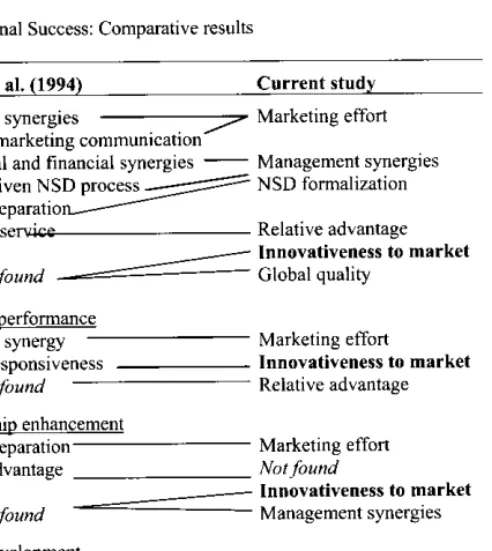
The direct comparison with the results from previous investigations [15] suggests that the platform for prioritising new projects will be more complex as the number of contextual describers is included increases (see Figure 2.).
Finally, several future research opportunities arose from some of the constraints of this research.
The aggregated treatment of the group of determinants did not allow the observation of individual behaviour. Future investigations may concentrate more specifically on the success factors already identified, modelling and defining their individual and interactive influence on the returns from new services.
Notwithstanding the progression seen in the quality of the results obtained by the complementary use of comparative approaches between new services that are successful (average / high) and failures, it would be interesting to widen the present analysis to projects of new services that do not reach the launch stage.
Figure 2. Best-high from Marginal Success: Comparative results
Cooper et al. (1994) Current study
Success/failure
Marketing synergies Marketing effort
Effective marketing communication
Managerial and financial synergies — Management synergies Market-driven NSD process — NSD formalization Launch
Customer service-- Relative advantage Innovativeness to market
Not found
Global quality
High/marginal success Financial performance Marketing synergy Product responsiveness
Not found
Marketing effort Innovativeness to market Relative advantage Relationship enhancement
Launch preparation Marketing effort
Product advantage
Not found
Innovativeness to market
Not found
Management synergies
Market development
Marketing synergy Marketing effort
Managerial and financial synergy
Not found
Global quality
Not found
Innovativeness to firm (-)Forecast / regulation Time to break-even
Not found
Innovativeness to firm (-) Innovativeness to market (-) Corporate image REFERENCES
Easingwood, C., 1986, 'New Product Development for Service Companies',
Journal
ofProduct Innovation Management,
Vol. 3, pp. 264-275.Brentani, U., 1989, 'Success and Failure in New Industrial Services',
Journal
of ProductInnovation Management,
Vol. 6 (4), pp. 239-258.Brentani, U., 1991, 'Success Factors in Developing New Business Services',
European
Journal of Marketing,
March-April, Vol. 25 (2), pp. 33-59.Wright, L. K., 1990,
Characterizing Successful New Business Services,
Dissertation. Pensylvania State University.Cooper, R.G., and U. Brentani, 1991, 'New Industrial Financial Services: What Distinguishes the Winners', Journal of Product Innovation Management, June, Vol. 8 (2), pp.75-90.
Brentani, U. and R. G. Cooper, 1992, 'Developing Successful New Financial Services for Business', Industrial Marketing Management, July, Vol. 21 (3), pp. 231-241.
Easingwood, C., and C. Storey, 1993, 'Marketplace Success Factors for New Financial Services', Journal of Services Marketing, V ol. 7 (1), pp. 41-54.
Athuahene-Gima, K., 1996, 'Differential Potency of Factors Affecting Innovation Performance in Manufacturing and Services Firms in Australia', Journal of Product Innovation Management, Vol. 13, pp. 35-52.
Easingwood, C., and c. Storey, 1991, 'Success Factors for New Consumer Financial Services', International Journal of Bank Marketing, Vol. 9 (1), pp. 3-10.
Jallat, F., 1992, Le Management de L'innovation dons les Entreprises de Services au Particulier: Concepts Processus et Performances, Dissertation, Universite Aix-Marseille III, Aix en Provence.
[II] Beleflamme, C., 0. Ruyssen, J. Hourd and B. Michaux, 1986, 'Innovation and Research and Development Process Analysis in Services Activities', IRES - Institute de Recherches Economiques, Aug., Louvain.
Cooper, R.G., and E. J. Kleinschmidt, 1987, 'New Products: What Separates Winners from Losers?', Journal of Product Innovation Management, Vol.4 (3), pp.169-184. Cooper, R.G., C. Easingwood, S. Edgett, E. J. Kleinschmidt and C. Storey, 1994, 'What
Distinguishes the Top Performing New Product in Financial Services', Journal of Product Innovation Management, Vol. 11, pp.281-299.
Olson, EM., Walker, Jr. 0.C., e Ruekert, R.W., 1995, "Organizing for Effective New Product Development: the Moderating Role of Product Innovativeness", Journal of Marketing, January, Vol. 59, p. 48-62.
Ali, A. Krapfo R., e LaBhan D., 1995, "Product Innovativeness and Entry Strategy: Impact on Cycle Time and Break-Even Time", Journal of Product Innovation Management, Vo1.12, p. 54-69.
Angelmar, R., 1990, "Product Innovation: a Tool for Competitive Advantage", European Journal of Operational Research, July, Vol. 47 (2), p. 182.189.
Kleinschmidt, e Cooper, R.G., 1991, "The Impact of Product Innovativeness on Performance", Journal of Product Innovation Management, Vol. 8, p. 240-251. Ettlie, J. E., 1982, "The Commercialization of Federally Sponsored Technological Innovation", Research Policy, p. 173-192.
Montoya-Weiss, MM., e Calantone, R., 1994, "Determinants of New Product Performance: a Review and Meta-Analysis", Journal of Product Innovation Management, Vol. 11, p. 397-417.