M
ASTER OF SCIENCE IN
MARKETING
M
ASTERS
F
INAL
W
ORK
PROJECT
RESEARCH ON CHINESE GRAPE WINE CONSUMER BEHAVIOUR AND
STRATEGY FOR PORTUGUESE WINE IN CHINA
M
ASTER OF
S
CIENCE IN
MARKETING
M
ASTERS
F
INAL
W
ORK
PROJECT
RESEARCH ON CHINESE GRAPE WINE CONSUMER BEHAVIOUR AND
STRATEGY FOR PORTUGUESE WINE IN CHINA
URBANO RUBEN COITO NEVES DE OLIVEIRA
SUPERVISOR:
Abstract
!!
Understanding the market characteristics and consumer behaviour are the main factors to achieve success in any country. However, China has specificities that are very different from what marketers are used to. This study aims to research the consumers’ behaviour in terms of purchase and consumption, as well as, their perception towards Portugal, its’ products and wine. It also intends to create a strategic marketing plan that can serve exporters that want to enter the Chinese market. To this end, an online survey was administered to a selected sample of Shanghai’s population. As a result, it was concluded that Portuguese products may have a chance to enter this market, if they are presented in the right places, with the right prices, if it can get to the right people and publications but, especially, if the business relation and country brand are well managed.
Key words: Consumer behaviour, Country-of-origin effects, Marketing Planning,
Acknowledgments
This was a challenging project, which could only be achieved with the help of my supervisor. Professor Fernanda Ilhéu was a major help and inspiration during all the process, especially when I was in China.
I would also want to thank Professor Rui Brites, with him I understood how to be humble and comprehend that failing is part of the game.
A special thanks must be addressed to all the Chinese students and professors of Shanghai!International!Studies!University (SISU) that helped me in a time of need, in particular to Victoria who translated my questionnaire.
I have to thanks my parents for believing in me and providing me the opportunity to have a higher education and my friends, for being there when they are needed.
Last, but not the least, my girlfriend became involved with my thesis almost as much as I did. Without her support, this study would not be possible.
TABLE OF CONTENTS
I. Introduction ... 8!
1.1 Objectives ... 9!
II. Literature Review ... 9!
2.1 Consumer Behaviour ... 9!
2.1.1 Chinese Wine Consumer ... 10!
2.2 Country-of-origin ... 15!
2.3 Marketing Planning ... 17!
2.3.1 Analyse the current external and internal situation ... 18!
2.3.2 Research and analyse markets and customers ... 18!
2.3.3 Determine segmentation, targeting and positioning ... 18!
2.3.4 Set marketing plan objectives and strategies ... 19!
2.3.5 Marketing-mix ... 19!
2.3.6 Plan to measure progress and performance ... 24!
III. Research Methodology ... 24!
3.1. Sample ... 24!
3.2 Questionnaire ... 25!
3.3 Results ... 26!
3.4 Conclusions ... 31!
IV. Strategic Marketing Plan ... 32!
4.1 Executive Summary ... 32!
4.2 External Analysis ... 32!
4.2.1 Chinese Wine Market ... 32!
4.3 Internal Analysis ... 34!
4.3.1 Portuguese Wine Market ... 34!
4.4 SWOT – Portuguese Wines in the Chinese Market ... 35!
4.5 Objectives ... 36!
4.6 Strategy ... 36!
4.6.1 Segmentation & Targeting ... 36!
4.6.2 Positioning ... 37!
4.7 Marketing-mix ... 37!
4.7.1 Product ... 38!
4.7.3 Promotion ... 40! 4.7.4 Place ... 41! 4.8 Budgeting ... 42! 4.9 Scheduling ... 42! V. Limitations ... 43! VI. References ... 44! ATTACHMENTS ... 49!
ATTACHMENT 1 – STRATEGIC MARKETING PLAN MODEL ... 49!
ATTACHMENT 2 – QUESTIONNAIRE (ENGLISH AND MANDARIN) ... 50!
ATTACHMENT 3 – SAMPLE DEMOGRAPHIC ANALYSIS ... 57!
ATTACHMENT 4 – QUESTIONNAIRE ANALYSIS ... 58!
ATTACHMENT 5 – PORTUGUESE WINE ANALYSIS ... 59!
CONTENT OF TABLES
TABLE I - CROSS-CULTURAL PROBLEMS ... 10!
TABLE II - CHINESE WINE DRINKING CUSTOMS ... 11!
TABLE III - CONSUMERS WITH SIGNIFICANT DISPOSABLE INCOME ... 13!
TABLE IV - FACTORS AFFECTING WINE PURCHASE DECISION AND CONSUMPTION ... 14!
TABLE V - PRODUCT / PROMOTION ADAPTATION ... 20!
TABLE VI - COSTS FROM PRODUCER TO END CONSUMER ... 22!
TABLE VII - KINDS OF CHINESE IMPORTERS ... 23!
TABLE VIII - PROPOSED RETAIL PRICE FOR BOTH PRODUCTS ... 40!
TABLE IX - PERCENTAGE OF WINE USED FOR PROMOTIONAL PURPOSES ... 40!
TABLE X - DISTRIBUTION STRATEGY ... 41!
TABLE XI - SCHEDULING PLAN ... 43!
TABLE XII - SAMPLE (AGE) ... 57!
TABLE XIII - SAMPLE (GENDER) ... 57!
TABLE XIV - SAMPLE (EDUCATION) ... 57!
TABLE XV - SAMPLE (INCOME) ... 57!
TABLE XVI - GRAPE WINE CONSUMERS ... 58!
TABLE XVII - PORTUGUESE GRAPE WINE PRODUCTION PER REGION ... 59!
TABLE XVIII - EXPORTED GRAPE WINE PRODUCED IN PORTUGAL PER COUNTRY ... 59!
CONTENT OF FIGURES
FIGURE 1 - Parameswaran & Yaprak model ... 16!FIGURE 2 - Reasons for drinking grape wine ... 26!
FIGURE 3 - Consumption locations of grape wine ... 26!
FIGURE 4 - Factors affecting grape wine purchasing ... 27!
FIGURE 5 - Knowledge about Portugal ... 28!
FIGURE 6 - Perception of Portuguese general attributes ... 28!
FIGURE 7 - Perception of Portuguese product attributes ... 28!
FIGURE 8 - Familiarity with Chinese grape wine brands ... 29!
FIGURE 9 - Familiarity with grape wines from different regions ... 29!
FIGURE 10 - Purchase locations of grape wine ... 30!
FIGURE 11 - Sources of information about grape wine ... 30!
FIGURE 12 - Participation in grape wine educational activities ... 30!
FIGURE 13 - Price that consumers are willing to pay for a bottle of grape wine ... 31!
FIGURE 14 - Wood (2007) Marketing plan model ... 49!
FIGURE 15 - Number of glasses of grape wine per week ... 58!
FIGURE 16 - Price range 19-50 RMB ... 61!
FIGURE 17 - Price range 50-125 RMB ... 62!
FIGURE 18 - Price range 125-300 RMB ... 63!
I. Introduction
Despite its long isolation from the world (Kurlantzick, 2007), in 2001 the Chinese government promoted several policies in order to “Go Global”. Those encouraged Chinese companies to internationalise, though in accordance with national interests and objectives (Ilhéu, 2010). This new policy also opened China to the world’s products and their purchase and consumption has been growing ever since, grape wine is no exception.
While wine consumption in most European countries is levelling out, the Chinese market has grabbed the world’s attention with high growth – 67% and 81% by volume and by value respectively, in 2009, and 92% by volume in 2011 (AICEP, 2011). Although the biggest players in the wine market (France, Australia, Italy, Spain, etc.) have had a strong presence in China for years, new brands of different origins are gaining market share every year (EU SME Centre, 2011).
Although the demand for wine in Europe is decreasing, the demand in Asia is growing. China, in particular, can become the largest wine consumer in the world over the next three decades. (Camilo, 2012)
In Popular Republic of China, in 2010, grape wine sales grew 12%, corresponding to 3.9 billion litres, during the same period red wine sales grew 22%. Nonetheless, rice wine (mijiu) is still acknowledged as the most traditional wine in the country. National players dominate the Chinese wine market: Yenta Changyu Pioneer Wine has the largest market share (9.2%), followed by COFCO Wines & Spirits (9.0%) and Yantai Wilong Grape Wine (4.9%). (AICEP, 2011)
Portugal, which is usually recognized for its’ wines quality and diversity, has the 7th largest vineyard area in the world and it is the 11th wine exporter with a volume of 230 million litres – 2% of the world’s wine export (OIV, 2011). In 2010,the Portuguese wine exports to Popular Republic of China have grown 155%, corresponding to 7.4 million USD; as for Hong Kong, 2.1 million USD (123% growth); 0.44 million for Taiwan (increase of 99%); and, in Macau, the exports declined 5.8% to 6.1 million USD (AICEP, 2011). In 2011, the exported grape
wine, in volume, to Mainland China was 4.4 million litres and in 2012 it was 3.9 million litres (Instituto da Vinha e do Vinho, 2012).
In markets such as France, Italy, Germany, Spain and Portugal, consumer characteristics and behaviour are not a topic of great interest to scholars, considering that “wine is already an integral part of European culture and consumption begins at such a young age” (Camillo, 2012).
1.1 Objectives
The research at hand adds to the existing literature and provides a new perspective on wine purchasing and consumption behaviour of Chinese consumers. This study additionally aims to create a plan for Portuguese grape wine to succeed in the Chinese market – “competitive advantages can be drawn for organizations that act in global markets” (Jaffe & Nebenzahl, 1984). Therefore, this study’s objectives are:
- Research Chinese wine consumers’ purchase and consumption behaviour;
- Research Chinese wine consumers’ perception of Portugal general attributes, Portuguese products attributes and about Portuguese wine;
- Create a Strategic Marketing Plan for the Portuguese wine in China.
With these objectives in mind, the following literature review will focus on consumer’s behaviour, country-of-origin effects and strategic marketing planning.
II. Literature Review
2.1 Consumer Behaviour
Consumer Behaviour is defined as “the study of the buying units and the exchange processes involved in acquiring, consuming and disposing of goods, services, experiences and ideas”. (Mowen & Minor, 1997; p. 5)
Mowen & Minor (1997; p. 3) suggest that the study of cross-cultural processes and people’s reactions in different countries is fundamental to international marketing.
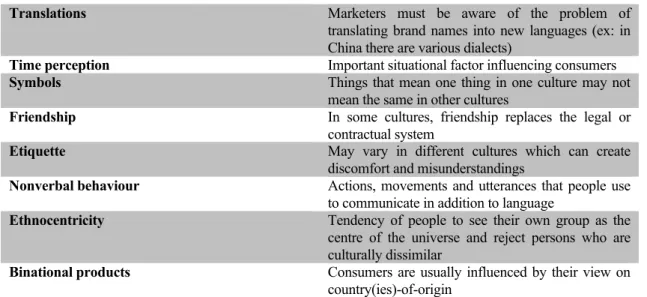
Culture can be defined as the socially acquired behaviour patterns, passed through language and other means to the members of a particular society. Norms, or rules of behaviour, create orderliness to society; values define what is good, right and important. (Mowen & Minor, 1997, pp. 556-557) (TABLE I)
TABLE I - CROSS-CULTURAL PROBLEMS
Translations Marketers must be aware of the problem of translating brand names into new languages (ex: in China there are various dialects)
Time perception Important situational factor influencing consumers
Symbols Things that mean one thing in one culture may not mean the same in other cultures
Friendship In some cultures, friendship replaces the legal or contractual system
Etiquette May vary in different cultures which can create discomfort and misunderstandings
Nonverbal behaviour Actions, movements and utterances that people use to communicate in addition to language
Ethnocentricity Tendency of people to see their own group as the centre of the universe and reject persons who are culturally dissimilar
Binational products Consumers are usually influenced by their view on country(ies)-of-origin
Source: Mowen & Minor (1997; pp. 634-637)
2.1.1 Chinese Wine Consumer
Asian wine consumption behaviour is affected by globalization, particularly in what concerns to economic, socio-cultural and technological factors – “driving forces” (Lee, 2009). In China, there is a cultural tradition of consuming alcoholic beverages, though the habit remains, the amount of alcoholic drinks available has grown significantly. Considering the health benefits associated with wine consuming and the rising of disposable incomes of China’s middle class, beer and spirits are being substituted by consumers. (Noppé, 2012)
TABLE II - CHINESE WINE DRINKING CUSTOMS
- Tea remains the number one beverage in China – 50 billion litres consumed
- Wine consumers are in economic growth regions – Beijing, Guangzhou and Shanghai - 80% of the wine consumed is red – associations with happiness and celebration
- Imported wines are more popular among the younger generation and expatriate community – Shanghai - More older, wealthy executives are becoming familiar with western wine
culture
- Consumers will purchase the product if the price is right and they can taste it first
- Majority of wine purchases are made during the major holidays – New Year, Spring Festival and Mid-Autumn Festival
- Wine is rarely consumed with everyday food/meal - Wine as an alternative to beer and spirits
- Mixing wine with soft drinks, result of lack of quality wine – Coca-Cola with white wine and Sprite with red wine
- Promotion: Sprite bottle tapped to wine packages
- Wines are consumed to get drunk, in shots, instead of sipped for taste – even high-end premium wines are often consumed this way
- Wine is thought to have healing power to SARS (Severe Acute Respiratory Syndrome) and to take the edge off more brain-bending forms of alcohol
- Wrapped boxes with a bottle of wine, corkscrew and wine glasses are popular gift items, often re-wrapped and given several times
- Wine is bought for status, either for themselves or the person they offer it to.
Source: Noppé (2012) Composed by a numerous population, Chinese market offers opportunities for all “stakeholders, exporters, importers, wholesale distributers, retailers and hospitality operations” (Camilo, 2012).
Deloitte (2010) proposes that in order to “win the wallet of today’s Chinese consumers” marketers have to take into consideration that:
- International brands are marketable to a consistent share of the population across city tiers; - Brand image influences men’s choices more than it does women’s;
- Value for money is eclipsing brand as the top criterion for purchases;
- The Chinese consumer is willing to experiment and try new brands, products and services; - Consumers in China have unclear perceptions about many brands and products, which present opportunities as well as challenges;
Differently from what wine companies are used to in western countries, Chinese consumers are uneducated about wine, but they are also emerging and curious. (Camillo, 2012)
Consumers need to be informed, better educated and willing to invest time, money and energy to understand more about wine. A consumer that knows more about what he is buying may well be willing to learn more about it. Both retailers and hospitality operators need to comprehend that wine cannot be positioned as something that can only be consumed by a wealthy and educated elite. (Hussain et al., 2006; Camillo 2012)
Accenture’s (2010) also suggests that the majority of Chinese consumers welcome wine brands from other countries. However, it must ensure that the products are being marketed according to consumers’ needs and wants (Camillo, 2012). So, in order to fully understand the consumption behaviour of wine consumers in China, it is crucial that “consumers’ demographic characteristics, country history, cultural heritage and supply chain logistics are investigated” (Camilo, 2012).
Nevertheless, Chinese markets change constantly, which makes it difficult to conduct business. Accenture (2010) conducted a study focusing in the Chinese market and discovered several consumer segments. The most significant were:
1. Young Royals: professional men and women in their thirties, who have the highest disposable income.
2. Aspirationals: a mix of young male and female consumers, who are highly brand-conscious but favour brand names that are affordably priced.
3. Established money: older men and women with above-average incomes, who want the latest in technology and high-end/exclusive products.
4. Patriots: middle-income consumers, who eschew the latest generation products for long-established local brands in some product categories.
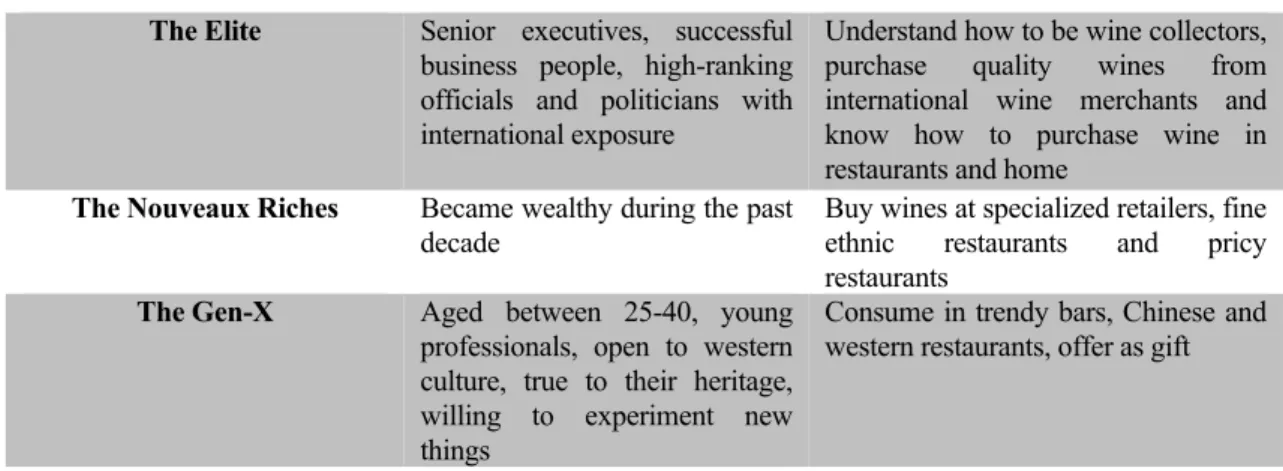
Yvon (2007) suggests that wine consumers with significant disposable income can be divided demographically in three categories: “the Elite”, “the Nouveaux Riches” and “the Gen-X”. (TABLE III)
TABLE III - CONSUMERS WITH SIGNIFICANT DISPOSABLE INCOME Categories Characteristics Consumer Behaviour
The Elite Senior executives, successful business people, high-ranking officials and politicians with international exposure
Understand how to be wine collectors, purchase quality wines from international wine merchants and know how to purchase wine in restaurants and home
The Nouveaux Riches Became wealthy during the past decade
Buy wines at specialized retailers, fine ethnic restaurants and pricy restaurants
The Gen-X Aged between 25-40, young professionals, open to western culture, true to their heritage, willing to experiment new things
Consume in trendy bars, Chinese and western restaurants, offer as gift
Source: Yvon (2007) If on one hand there are some similarities with western countries, on the other hand Chinese upper middle-class drinkers prefer to go online – 13 million people access Internet frequently – to look for wine information, using social media as a preferable source. They are reluctant to rely on recommendations of shop staff or word-of-mouth from friends and family. (Noppé, 2012)
Spawton (1991) proposes that when it comes to buying behaviour the attributes that affect purchasing decisions the most are: perceived risk, brand, label, price, product, experience and knowledge of the product. These are more important when “consumers buy wine in restaurants on special occasions”. (Camillo, 2012)
Ehrenberg (1988) suggests that there is a correlation between current and past usage of a brand and consumers’ attitudes towards it. Jenster and Jenster (1993) state that the crucial criterion in wine purchasing is personal familiarity, which is related to brand awareness. This occurs particularly in restaurants, “a returning restaurant patron will most likely buy the same wine he/she consumed during a previous visit because of the experience and familiarity (awareness) gained with the product” (Camillo, 2012). However, Lockshin and Rhodus (1993) advocate that even if the sample takes place before purchase, other factors such as price or country-of-origin will be proven stronger than personal experience of the product.
Understanding that wine buying behaviour in China might not be unique; Goodman (2009) developed a study across 12 countriesconcluding that there were similarities in wine buying behaviour across all the countries investigated.
Yu et al. (2009) conducted a study on two Beijing wine consumer groups and evaluated the influence of different factors on their decision-making process. This resulted in understanding that, in the Chinese market, participants tended to pay low prices for daily consumption, but higher for gifts, especially French wines. Previous tasting experience, country-of-origin and brand were also considered the most influential factors in the wine purchasing decision-making.
Lockshin & Rhodus (1993) studied quality perceptions of wine consumers and the influence of internal and external wine attributes. They suggest that quality can be measured objectively using intrinsic cues as grape variety, alcohol content and wine style; and subjectively by extrinsic cues such as price, packaging, labelling, brand name, which can be altered without actually changing the product. Consumers with little knowledge tend to rate wine based on extrinsic cues, instead of taste. (TABLE IV)
TABLE IV - FACTORS AFFECTING WINE PURCHASE DECISION AND CONSUMPTION Intrinsic Extrinsic
- Wine education
- Acquired knowledge of wine and food pairing - Personal lifestyle
- Health-related motivation - Religious beliefs
- Age, gender and marital status
- Image of wine as perceived by consumers - Willingness to try new things
- Simplicity of product consumption
- Nostalgic drinking, remembering special occasions - Innate taste and interest to explore novelty beverages
- Level of personal knowledge about wine
- Family size and relationship to income and spending
- Cultural heritage, family and personal drinking habits
- Job status, type of employment - Previous tasting experience
- Wine marketing strategies by resellers - Product positioning
- Visits to wineries and educational seminars - Country-of-origin
- Wine discovery travel - Availability of wine - Import legislation and tariffs
- Health regulations and drinking safety - State of the economy
- Environmental issues
- Economic, socio-cultural and technological globalization
- Changes in the wine distribution systems - Wine types influencing consumer demography - Convenience shopping
- Price levels of commodities - Brand
Source: Lockshin & Rhodus (2006), Goodman (2009), Lee (2009), Yu et al. (2009), Gil & Sánchez (1997), Martinez-Carrasco et al. (2005)
2.2 Country-of-origin
The country-of-origin’s (COO) effect on consumer purchase behaviour have been widely explored. It has been demonstrated that consumers’ inclination to purchase products is related to “economic, political, and cultural characteristics of the product’s origin country” (Parameswaran & Pisharodi, 2002).
Nagashima (1970) was the first to define country image as “the picture, the representation, the stereotype that businessmen and consumers attach to products of a specific country. This image is created by such variable as representative products, national characteristics, economic and political background, history and tradition”.
The country image’s concept is also defined, by Roth & Romeo (1992), as the “overall perception consumers form of products from a particular country, based on their prior perceptions of the country’s production and marketing strengths and weaknesses” (p. 480). These authors after analysing various studies (Nagashima, 1970; White, 1979; Narayana, 1981; Cattin, Jolibert & Lohnes, 1982; Jaffe & Nebenzahl, 1984; Johansson & Benzhal, 1986; Han & Terpstra, 1988) defined four dimensions for country image:
- Innovativeness: use of new technology and engineering; - Design: appearance, style, colours, variety;
- Prestige: exclusivity, status, brand name reputation;
- Workmanship: reliability, durability, craftsmanship, manufacturing, quality.
Papadopoulos et al. (1989) concluded that the perceptions of sourcing countries are impacted by cognition, affect and conative orientation regarding that country’s peoples. The same author summarized that a “consumer’s image of people with whom they are not familiar may well be formed upon the basis of knowledge about that people’s capacity for producing quality products from that country”. Furthermore, Roth & Romeo (1992) also note that “country image perceptions may vary depending upon the consumer’s nationality” (p. 484).
Yaprak & Parameswaran (1986) created a model that notes the structure of country image and its’ effects on intention to purchase. They conceptualize that “the dependent variable, consumer purchase intent and behaviour (IP: intention to purchase), is directly influenced by
the specific product attributes (SPA) of a brand. Consumer purchase intent and behaviour are also influenced by consumers' general perceptions of products from a source country (GPA: general product attributes), as well as perceptions of the source country and its people (GCA: general country attributes)” (Parameswaran & Pisharodi, 2002). (FIGURE 1)
FIGURE 1 - Parameswaran & Yaprak model
Shimp & Samiee (1993) coined the concept of country equity, which describes an evaluation of a product by a consumer, exclusively in association with a certain country. It is the emotional result of the consumer’s association of a brand with a country. In this study, the author combines the traditional brand equity concept with the new concept of country equity providing a “potential valuable way of thinking about global brands” (p. 328).
Numerous researches have proved that the COO affects consumers’ product evaluations (Bilkey and Nes, 1982; Erickson et al, 1984; Han, 1989; Han and Terpstra, 1988; Johansson et al., 1985; Al-Sulaiti and Baker, 1998; Phau and Prendergast, 1998; Okechuku and Onyemah, 1999; Supanvanij and Amine, 2000; cited by Balestrini & Gamble, 2006). COO effects have been found on general products (Darling and Wood, 1990; Howard, 1989), specific categories of products (Cordell, 1992; Hong and Wyer, 1989, Hong and Wyer, 1990; Roth and Romeo, 1992) and even for certain brands (Chao, 1993; Han and Terpstra, 1988; Haubl, 1996; Tse and Gorn, 1993). Even low involvement products like bread and coffee have proven to be influenced by COO effects (Ahmed et al., 2004).
However, for some products consumers might not care about COO information. Lascu and Babb (1995) found out that Polish consumers were less inclined to use COO information on less expensive items or on a product that was already accepted by family and/or friends.
the result of regulations governing the production and labeling of wines (Balestrini & Gamble, 2006). Duhan et al. (1999) also suggests that the unique characteristics of wine market make them sensitive to COO information.
Lockshin and Rhodus (1993) advocates that wine consumers are more likely to follow extrinsic cues, like price or origin, when making quality assessments. According to Balestrini & Gamble (2006), the origin of wines is often perceived, rightly or wrongly, as an indicator of quality. Empirical observations and experiments have found that COO influences the quality perception of a product (Bilkey & Nes, 1982; Huber & McCann, 1982; Shimp and Samiee, 1993). Wall et al. (1991) go further and suggest that, in product quality assessment, COO information is even more important than price or brand information.
Nevertheless, Olsen and Jacoby (1972) argue that intrinsic cues have more effect on quality judgements. This means that studies of extrinsic cues, as COO, can only identify strong effects on perception, if intrinsic cues have been omitted.
2.3 Marketing Planning
Kotler et al. (2008) argue that the marketing plan is the main instrument for the coordination of marketing activities, focusing in two levels: strategic and tactical. For McDonald (2011) the marketing plan’s purpose is to identify and create competitive advantages, it is the “application of marketing resources to achieve marketing objectives” (p. 8). Marketing planning is a way of monitoring and controlling the internal and external influences (p. 25).
Wood (2011) considers that no marketing plan lasts forever, companies should have alternative plans that can be implemented in case of major changes. For that reason, strategic decisions should be flexible during the marketing planning (p. 4). For this author, the marketing planning process begins many months before the plan is implemented and should start with the analysis of the external and internal environment, follow by researching and analysing markets and consumers, then segmentation, targeting and positioning, afterwards defining objectives and strategies and, finally, measuring the progress, implementing and controlling.
From the analysed marketing plan structures, it was chosen to follow the one presented in ATTACHMENT 1 – FIGURE 14. This is composed by the following structure:
2.3.1 Analyse the current external and internal situation
In an early stage, we must learn about the situation inside the organization (internal audit) and outside the organization (external audit). Once gathered all information, we are able to create a SWOT analysis, reflecting the strengths, weaknesses, opportunities and threats (Wood, 2007). When creating an international marketing strategy, we need to firstly assess the external and internal country environment (Canteora & Graham, 2001).
2.3.2 Research and analyse markets and customers
The consumer market “consists of individuals and families who buy goods and services for their own use” (Wood, 2007; p. 49). The business market “consists of companies, institutions, non-governmental organisations and government agencies that buy goods and services for organisational use” (p. 49).
The research should focus on perceptions, demographics, buying patterns and customer satisfaction. On the research and analysis it is important to focus on what consumers will need in the future and what they need today. (Wood, 2007; p. 6)
2.3.3 Determine segmentation, targeting and positioning
No organisation has the capability to serve every customer in every market, so it is important to use the knowledge about the market and consumers to determine the specific groups that can be targeted (segmentation). Then, a decision must be made about which segments to focus on (targeting). Finally, for each segment selected we have to create a competitive position to place the product or brand (positioning). (Wood, 2007; pp. 70-89)
Kotler et al. (2008) divides segmentation into three categories: geographic, demographic and behavioural. In terms of brand positioning, the referred author presents three levels: attributes, benefits and beliefs and values.
2.3.4 Set marketing plan objectives and strategies
Depending on what kind of company that is analysed, different objectives and strategies must be formulated. If a company intends to grow, maintain the position or retrench. (Wood, 2007; p. 95) These objectives have to be relevant, specific and measurable, time defined, realistic, challenging and consistent. There are three kinds of objectives: financial, marketing and societal. (Wood, 2007; pp. 95-96)
2.3.5 Marketing-mix
One important principle of global marketing is that the international marketing process should be standardized across national boundaries (Terpstra, 1987). However, long-existing cultural, political and economic differences between nations oblige the marketing programs to adapt to the local reality (Boddewyn, et al., 1986; Hill & Still, 1984; Quelch & Hoff 1986; Sorenson & Wiechmann 1975; Wind 1986, cited by Cavusgil et al., 1993).
The researchers that vouch for an adaptation of the marketing program, commonly point to differences among nations in terms of culture, stages of economic and market development, political and legal systems, customer values and life styles. (Cavusgil et al., 1993)
4.3.5.1 Product & Promotion
Hill & Still (1984) propose that product adaptation, mandatory or discretionary, can strengthen the product’s competitive position in the marketplace. Nevertheless, Kotler (1986) advices managers that it can be dangerous to blindly implement standardized marketing programs.
Recent researchers suggest that neither complete standardization nor complete adaptation of marketing program is plausible, they should be observed as “two extremes of the same continuum” (Jain, 1989; Quelch & Hoff, 1986, Walters, 1986; cited by Cavusgil et al., 1993).
In the framework proposed by Cavusgil et al. (1993) it states that company, product/industry and export market characteristics influence the degree of adaptation. (TABLE V)
TABLE V - PRODUCT / PROMOTION ADAPTATION Company characteristics - Firms international experience
- Export sales goal - Entry scope
Product industry characteristics - Technology orientation of industry - Product uniqueness
- Cultural specificity of product - Type of product
Export market characteristics - Similarity of legal regulations - Competitiveness of export market - Product familiarity of export customers
Source: Cavusgil et al. (1993; p. 485) Product adaptation upon entry is a reflection of export market’s legal and technical regulations. After entry, it will reflect management’s better understanding of the export market idiosyncrasies. (Cavulgil et al., 1993)
While product adaptation incurs in costs for developing alternative variations, promotion adaptation involves costs of using distinctive promotional messages, packaging/labelling and media (Buzzel, 1968, Douglas and Wind, 1987; Onkvisit & Shaw, 1987; cited by Cavusgil et
al., 1993).
In what concerns to highly culture specific products, substantial adaptation is needed upon and after entering the new market. Also, when the market is intensely competitive, managers should react by offering high customization of product and promotion. (Cavusgil et al., 1993)
Cavusgil et al. (1993) suggests that, in terms of promotion, there are three aspects to take into consideration: positioning, packaging/labelling and promotional approach.
Studies developed by Lonidou et al. (2002) concluded that product design and style have a positive effect in performance. This author also says that branding involves decisions related to name, logo, design or a combination between the elements, with the objective of differentiating the exporter’s product in the international market.
Wood (2007, p. 183) analysis the communications tools and divides them into five groups: advertising, sales promotion, personal selling, direct marketing and public relations. This
author also states that strategies for marketing communications “help you engage and influence the thoughts, feeling and behaviour of audiences that are important to your brand” (p. 200).
4.3.5.2 Price
Assael (1995) suggests that price does not simply represent the monetary cost of an item; it also implies quality level for both brand and product and, consequently, the expected satisfaction level. When there are few cues available, price is an important cue to quality, especially when there is some degree of risk of making a wrong choice. (Zeithaml, 1988)
Higher prices may signify superior quality, which makes costumers, for some specific goods, reject cheaper items to avoid dissatisfactory. For example, some companies, like Avon cosmetics, improved their market penetration simply by increasing prices. (Kotler, 2012)
However, some researchers like Mitchel & Greatorex (1991) disagree that price is important in reducing perceived risk and that it may not be an effective cue for quality assessment. Chao (1993) added that perceptions on price might depend on both product and the COO. Thus if a country is perceived to be incapable of producing quality products, this prevails over perceptions based on price.
Lockshin & Horowitz (2002) researched prices as a cue for predicting the quality of Australian wine. They found a positive relationship between price and its perceived quality, even when they were able to taste and evaluate the wine before making quality judgments.
Dodds (1991) and Montgomery & Wernerfelt (1992) found that consumers that lack knowledge about a product might use brand image to assume product quality. Branded products are found to have less risk, because they are perceived to a have a lower variance in product quality.
Another important consideration is that distribution channels have a large influence on price. Wholesaler and distributor discounts are well established and these discounts significantly reduce a producer’s profit margin. From the moment it leaves the producer, each Portuguese bottle exported to China will become 12% more expensive due to transportation, especially if the bottles are sent by sea. When in enters China, taxes will add 23% of the produced price and
the distributers will ask for 25% more, that includes transportation and some promotion costs. Finally, the retailer will ask for 7-8% more (TABLE VI). (AICEP, 2011)
TABLE VI - COSTS FROM PRODUCER TO END CONSUMER EUR % of the price
Producer 3 33% Transportation 1.1 12% Taxes 2.1 23% Distributor 2.3 25% Retailer 0.6 7% Final Price 9.1 Source: AICEP (2011) 4.3.5.3 Place
When a company enters a foreign market it has to decide whether their products will be distributed via company-owned distribution channel or through contracting an independent organization. (Anderson & Coughlan, 1987)
This is considered a “make or buy” issue, which Robison (1978) calls “one of the most debated and critical areas in international business”. He posts that ownership gives the entrant control over its distribution channel. Nevertheless, this also brings responsibility, commitment and attendant risks (Ahmed, 1977).
Anderson & Coughlan (1987) suggest a model of overseas distribution channel, stating that the integration of the distribution channel is more likely:
- The greater the level of transaction-specific assets in the sales force; - The less mature the product category;
- The higher the service level associated with the product; - The more differentiated the products in the product class;
- The less prevalent, the legal restriction constraining direct foreign investment;
- When an integrated distribution channel is already in place – the converse is true for the case of a non-integrated channel;
- The more closely related the product, to the company’s core business;
- The more competitors have integrated distribution channels in the foreign market; - The more similar to the country-of-origin, the culture of the country being entered.
Twenty years ago, China did not have distribution or networks for imported wines. They started finding their clients and building their own distribution method with employees who had never tasted wine. (Noppé, 2012)
Since the 1990’s, China has brought wine expertise to the market. Beijing, Shanghai and Guangzhou have been the most profitable markets, though there are some other cities emerging. Nowadays, foreign and domestic distributors have good access to hotels, restaurants, bars, supermarkets and specialty stores. (Noppé, 2012)
TABLE VII - KINDS OF CHINESE IMPORTERS The importer of fine wines - Importer of famous brands
- Normally owned by foreign companies - They choose who they work with
The importer of small producers - Foreigner with good connection to luxury hotels and fine restaurants
- Knowledgeable of wine
The opportunistic importer - Opportunistic importer that changed business - Does not understand or even like wine - Wants to get big margins
The logical importer - Has 200 expansive and expensive outlets in Beijing selling other kinds of wine
- Works with a foreigner in order to import grape wine
The 2nd type of logical importer - Food importer that realizes that can also import wine
The passionate wine importer - Passionate and knowledgeable about wine - Interested in quality wines from all regions
The “internet generation” wine importer - Young person with knowledge of the internet - Develops a website and starts importing wines
Source: Noppé (2012) Noppé (2012) suggests that consumers trust international supermarket chains and quotes Charles Carrard, Commercial and Communications Director at French Paradox Wines, “building your wine brand image in China consists in having a presence at Carrefour”.
Carrefour, Metro and other hypermarkets offer a wide ranger of wines, domestic and foreign, showing different countries-of-origin sections. However, there has been a new marketing
phenomenon with specialty retail wine shops in Shanghai offering educational eventsand wine and food matching seminars. (Noppé, 2012)
2.3.6 Plan to measure progress and performance
Wood (2007, p. 226) states that every tactic on a marketing plan must have measurement and presents four tools to do it: metrics, forecasts, budgets and schedules.
III. Research Methodology
In order to better understand Chine wine consumers’ purchase and consumption behaviour a survey was undertaken in Shanghai, China. Consumers in Shanghai were chosen as the population for the research for several reasons. Firstly, Shanghai, as the largest city in China, ranks the 3rd in population density of all the cities in China, after Chongqing and Beijing (Camillo, 2012). Secondly, Shanghai is a modern and metropolitan city. The disposable income of the citizens has always been above the national average. Finally, Shanghai has always been an international city with one of the chief ports in China. It has a long history of foreign trade and therefore Shanghai people may have a wider choice of imported wine.
This research pretends to answer three questions:
- What is the purchase and consumption behaviour of the Chinese wine consumer?
- What are the consumers’ perceptions of Portugal, its’ products and wine?
- How does the current marketing-mix program affect the Chinese wine consumer?
3.1. Sample
The demographic characteristics measured were from 19 male and 33 female respondents. The sample included respondents from the ages of 19 to 45 years, with 71.15% of them falling in the 19-25 age group. About 32.69% earn between 5,000 and 10,000 China Yuan Renminbi (RMB). All respondents had undergraduate degrees (80.77%) or postgraduate degrees (19.23%). (ATTACHMENT 3)
3.2 Questionnaire
The questionnaire was first drafted in English. As the respondents were Chinese, a translation was performed by a professional Chinese translator to improve the understanding of the questionnaire. (ATTACHMENT 2) From the 52 respondents whose data was used in the analysis, 32 were wine consumers or people who purchase wine.
The questionnaire was divided into 5 sections:
Section A: was concerned with Chinese customers’ wine consuming habits and preferences. Questions included: how many glasses of grape wine they consume, why they drink grape wine and where they drink it.
Section B: contained questions aiming to collect information concerning several facets of COO. In order to establish the importance of the COO, questions regarding the impact of other cues affecting the consumers’ wine evaluation, such as price and brand factor, were also included.
Section C: was concerned with Chinese wine consumers’ perception about the marketing-mix (product, promotion, price and place) related to wine consumption and purchase.
Section D: contained questions aiming to collect information about the wine consumers’ perceptions on the Portuguese society, products and wine.
Section E: contained questions about the respondents’ demographic information such as gender, age, income, and educational level.
Data for this study was collected by an online questionnaire targeted to a mailing list containing residents in Shanghai (China). As referred previously, Shanghai was selected as it is the largest Chinese city and is considered as a key economic centre. It has the largest port in China and is an important centre for foreign trade of all kinds.
3.3 Results
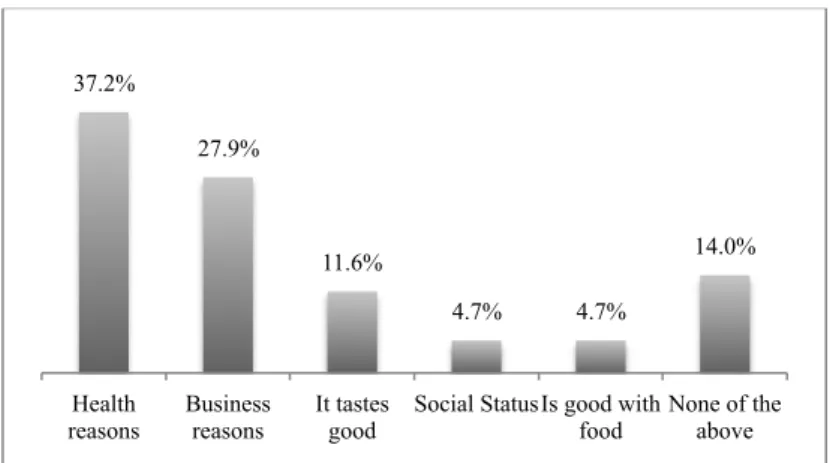
Analysing the consumption behaviour of respondents, we conclude that 32 respondents (61.54%) consume wine (ATTACHMENT 4 – TABLE XVI), 18 respondents (37.2%) consume it because of health-related reasons and 12 respondents (27.9%) consume it due to business-related reasons. (FIGURE 2) Over 27 respondents (84.4%) drink less than 2 glasses of grape wine weekly, followed by 4 respondents (9.3%) who drink 2 to 5 glasses (ATTACHMENT 4 – FIGURE 15). When questioned about the location of grape wine consumption, drinking at home (45.8%) and in restaurants (37.5%) are the preferred choices (FIGURE 3).
FIGURE 2 - Reasons for drinking grape wine
FIGURE 3 - Consumption locations of grape wine
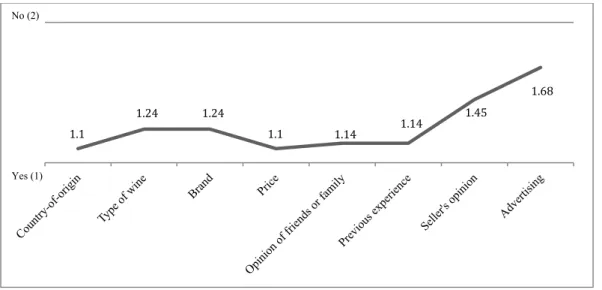
FIGURE 4 shows the factors that affect purchasing behaviour of respondents. Analysing the data presented on the chart, we can see that country-of-origin (Mean=1.1), price (1.1), previous experiences (1.14) and the opinion of friends and family (1.14) are the main factors taken into consideration. 37.2% 27.9% 11.6% 4.7% 4.7% 14.0% Health reasons Business reasons It tastes good
Social Status Is good with food None of the above 45.8% 37.5% 12.5% 4.2% 0 Home Restaurants Bars / Clubs Hotels None of the
FIGURE 4 - Factors affecting grape wine purchasing (Mean = 1.26; Std Dev=0.205)
From the 32 respondents who expressed their perception about Portuguese society and Portuguese products, only 7 people had experienced Portuguese wine, so they were the only ones that could evaluate it. This numbers may not express the majority of the population in Shanghai, but can give us some perspective about the opinion of people with a high level education (undergraduates and postgraduates). These are some of the individuals that will possibly fill high positions in society in the nearest future, therefore their opinion is extremely valuable.
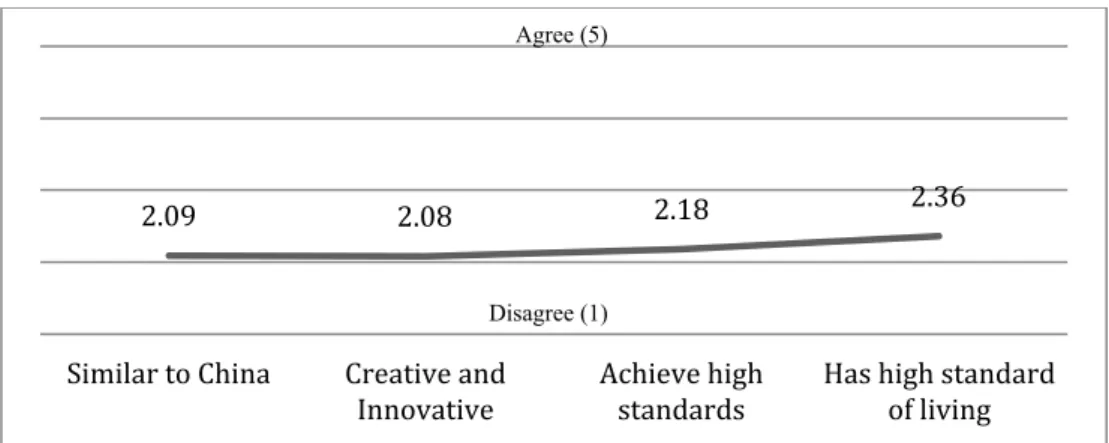
When questioned about their knowledge about Portuguese society and products, 11 respondents considered to have “reasonable knowledge” (34.4%), while 7 had “bad knowledge” (21.9%) and 5 (15.6%) had “good knowledge” (FIGURE 5). In terms of how wine consumers perceive Portugal general attributes (high standard of living, achieving high standards, creative and innovative and similarity to China), we can observe that all data is below 3 (the middle point – neither agree, nor disagree), meaning that their perspective about this matter is not positive. (FIGURE 6)
1.1! 1.24! 1.24! 1.1! 1.14! 1.14! 1.45! 1.68! No (2) Yes (1)
FIGURE 5 - Knowledge about Portugal
FIGURE 6 - Perception of Portuguese general attributesv(Mean= 2.18; Std Dev=0.129)
Analysing the Portuguese products, we observe in FIGURE 7 that the respondents do not consider our products “expensive” (Mean=2.5). Nevertheless, they also do not consider that Portugal produces luxury products or that they are “easily available”. In terms of the production of good value products they stand has the worst category.
FIGURE 7 - Perception of Portuguese product attributes (Mean= 2.29; Std Dev=0.193)
It was also considered the SPA (Specific Product Attributes – Portuguese Wine), but the number of answers (7) does not give enough information. Though it is important to notice that
6.3% 21.9% 34.4% 15.6% 3.1% 18.8% Very bad knowledge Bad knowledge Reasonable knowledge Good knowledge Very good knowledge No knowledge 2.09! 2.08! 2.18! 2.36! Similar!to!China! Creative!and!
Innovative! Achieve!high!standards! Has!high!standard!of!living!
Agree (5)
Disagree (1)
2.4! 2.5!
2.1! 2.15!
Luxurious Expensive Good value Easily availabe
Agree (5)
few people actually ever tasted Portuguese wine and this fact should strongly be taken into consideration.
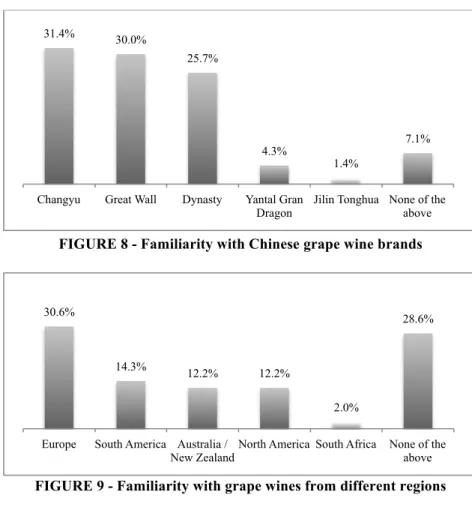
Confronted with five brands of Chinese grape wines, respondents were especially familiarized with Changyu (31.4%), Great Wall (30%) and Dynasty (25.7%). (FIGURE 8) In terms of familiarity with grape wines from different regions, Europe (30.6%) was the most acknowledged. (FIGURE 9)
FIGURE 8 - Familiarity with Chinese grape wine brands
FIGURE 9 - Familiarity with grape wines from different regions
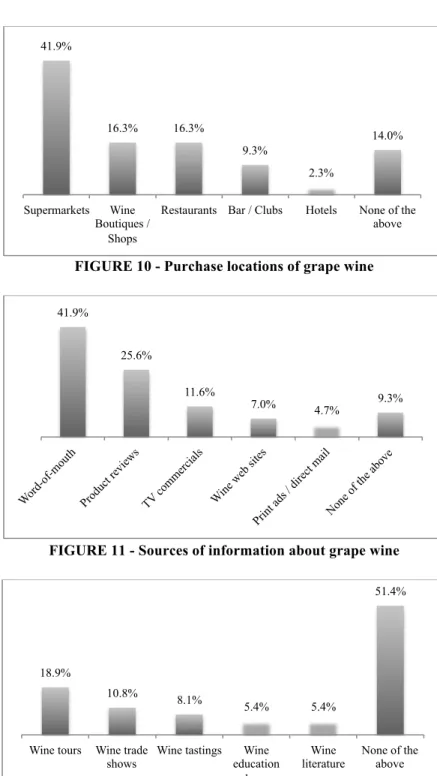
While supermarkets, selected by 18 respondents (41.9%), are on the top of the list when it comes to purchase locations, word-of-mouth (41.9%) and product reviews (25.6%) are the preferred sources of information about grape wine. Most respondents do not participate in grape wine educational activities (51.4%), but the ones that do elect wine tours (18.9%) as their favourite. (FIGURE 10-12)
31.4% 30.0%
25.7%
4.3%
1.4%
7.1%
Changyu Great Wall Dynasty Yantal Gran
Dragon Jilin Tonghua None of the above
30.6%
14.3% 12.2% 12.2%
2.0%
28.6%
Europe South America Australia / New Zealand
North America South Africa None of the above
FIGURE 10 - Purchase locations of grape wine
FIGURE 11 - Sources of information about grape wine
FIGURE 12 - Participation in grape wine educational activities
When asked about how much respondents were willing to pay for a bottle of grape wine, 101-200 RMB (36.7%) was the most selected choice. (FIGURE 13)
41.9% 16.3% 16.3% 9.3% 2.3% 14.0% Supermarkets Wine Boutiques / Shops
Restaurants Bar / Clubs Hotels None of the above 41.9% 25.6% 11.6% 7.0% 4.7% 9.3% 18.9% 10.8% 8.1% 5.4% 5.4% 51.4%
Wine tours Wine trade
shows Wine tastings education Wine classes
Wine
FIGURE 13 - Price that consumers are willing to pay for a bottle of grape wine
3.4 Conclusions
Even in a small population sample, we observe that only 32 people (62.7%) are wine consumers and most of them (84.4%) only drink less than 2 glasses per week, especially in restaurants and at home. Not only the number of consumers is low, also when they purchase grape wine country-of-origin and price are the most important factors.
The image of Portugal through Chinese wine consumers’ eyes is not positive. Portuguese products are not considered to be expensive, which can be good, but also bad due to Chinese associations between high prices and quality. Portuguese products are also not seen as easy to obtain, luxury or of good value. So, there is a serious need to change this perspective in order to have success in this market. Exporting Portuguese wine, that is almost unknown amongst the respondents, must go along a change in how the Chinese consumers perceive Portugal and its’ products.
When it comes to the marketing-mix, Chinese wine consumers are familiarized with the most important Chinese grape wine brands, but they also recognize Europe as a producer, more than other continents. We can infer from this results that there some very well established Chinese brands that, as we seen before, dominate the market. However, Portuguese products may have a chance to enter this market, if they are presented in the right places (supermarkets), with the right price (101-200 RMB) and can get to the right people and publications (word-of-mouth and public reviews). Betting in wine educational activities (specially wine tours), where people can develop their knowledge about wine, how to drink it and pair it, can also a great way to increase purchase and consumption.
6.7% 20.0% 36.7% 26.7% 10.0% < 50 RMB 51-100 RMB 101-200 RMB 201-500 RMB > 500 RMB
For Portuguese wine to be successful in the Chinese market it is marketing-mix must be well managed. The knowledge about grape wine, and especially Portuguese grape wine amongst the general population in Shanghai is very low, so there must be a shift on consumers’ awareness about Portugal and its’ wine.
Considering the previous research, we decided to develop the following strategic marketing plan for the Portuguese wine in China.
IV. Strategic Marketing Plan
4.1 Executive Summary
Entering the Chinese market is not an easy achievement and many have failed, either with wine or with other products that companies believed to fit the Chinese consumer. Consumption and purchasing is changing in China, middle-class is growing and consumers are becoming more demanding. If, in the past, foreign and pricy meant immediate sales, today that assessment is shifting.
In order to understand the Chinese market we must comprehend its’ diversity and even this study, that targets a part of the population of Shanghai, does not represent all the niches that we can find in this 24-million-people city.
This strategic marketing plan has the objective to design and position a Portuguese wine brand created specifically to meet the Chinese market and consumers needs. This plan will also aid any Portuguese wine exporter that desires to enter Shanghai’s market with a new product.
4.2 External Analysis
4.2.1 Chinese Wine Market
Asia is a vast continent composed by countries with different sizes, cultural concepts, religions, ethnic groups, environments, historical ties and government systems. (Noppé, 2012)
Until the 1990’s, Asia was considered to be far from thriving in the world of wine, particularly because it was assumed that Asian consumers preferences laid on non-alcoholic or grain-based drinks. However, this hypothesis was rapidly rejected due to a sudden interest from buyers in Hong Kong, Singapore and Taiwan. The fast-growing economy of theses countries and the fact that red wine is thought to have health benefits, moved wine drinking from a foreign practice to a symbol of status in countries as Thailand, Taiwan, India, Korea and China. (Noppé, 2012)
By 2013, Asia-Pacific wine market is forecasted to have a value of 21 billion USD and a volume of 1.5 billion litres. In terms of market value, China tops the list with 31,5%, Japan with 22,5%, South Korea accounts for 3,6%, followed by Taiwan, Thailand, The Philippines, Singapore and India. Asia’s estimated growth is around 10-20% per year, by 2017 the consumption value is expected to be 27 billion USD and the investment made by Asian wine investors is projected to be around 970 million USD. (Noppé, 2012)
Traditionally, the consumption of distilled beverages, instead of grape wine, has prevailed in China. Due to traditional and historical practices, rice spirits and beer have always been favoured over grape wine (Li, 2006). For the Chinese, wine has represented a symbol of luxury and decadence. The foundation of winemaking industry is dated to the later part of the 1800’s. Zhang Bi-shi was responsible for the formation of the first wine company – the ZhanYu Winery. (Berberoglu, 2004)
Since the 1980’s, the domestic wine production in China has grown significantly (Camillo, 2012). However, China’s per capita consumption is less than 0,5 litres (Wine Intelligence, 2010), very different from countries like France, Italy, Australia, Germany and the USA – average of 7,5 litres per capita (Jin, 2004). Wine knowledge in China is advocated as one of the main influencers on the low per capita consumption (He, 2004).
However, Thorpe (2009) suggested that China is a potential key player in the future of global industry, specially with the decline in consumption in western countries – “as the wine culture in China matures there will be a great potential for both increased consumption as well as production” (Thorpe, 2009; Lee, 2009; cited by Camillo, 2012).
Even though Chinese wine market is growing at 10-15% per year, there are some doubts whether this will continue due to a lack of transparency, counterfeit products, unreliable information, dominance of the domestic giants, consumer and cultural challenges and distribution and logistics. (Noppé, 2012)
A study performed by Wine Intelligence (2010) suggests that perceived quality, respect in a business context and sophistication are the major differentiators between imported and domestic wines.
There is a link between the communist party and domestic producers, which pose challenges for importers. For example, the largest producer by volume – COFCO Great Wall – is 100% owned by the national government. The top three wineries in China, by value, are: Changyu, COFCO Great Wall and Dynasty. (Noppé, 2012)
The Chinese wine market is considered an “egg timer” market, which means there are two markets in China. A low price / quality wine and a high bracket market composed by expensive wines that are sold out before production. In between, there is a developing medium-price market that still has to find its’ place. (Noppé, 2012)
4.3 Internal Analysis
4.3.1 Portuguese Wine Market
Portugal is divided in fifteen wine growing regions, from north to south and from west to east. The climate and landscape differences of those fifteen regions allows a diversity of wine categories that goes from red, white and green wine to other specific types such as port, madeira, muscatel or sparkling wine. Its known quality has been recognized worldwide and, in 2012, a total of 2364 wines conquered awards through the participation in 21 contests (Instituto da Vinha e do Vinho, 2012).In terms of wine production, in the past year, we can see that the most productive was Douro/Oporto, which produced in 2011/2012 1.329.423.000 litres (ATTACHMENT 5 – Table XVII).
In what regards to the global wine market, the Portuguese presence in external markets through exportation and expedition has globally grown in 2011/2012 to 138.077.000€, recording a raise
of 29% comparing to the previous year, which corresponds to a total of 1.697.295 litres – volume of exported wine in 2012 (Instituto da Vinha e do Vinho, 2012). The top four destinations in value in 2012 were Angola, France, Spain, and United Kingdom. In volume, the top four countries were: Angola, France, Spain and Germany (Instituto da Vinha e do Vinho, 2012).
The Portuguese wine exports have continuously grown, particularly to Asiatic markets (INE, 2012). China is one of the priority targets of the domestic production, as it represents 13.7 million EUR in value to national exports. In 2011 there was an increase of 91.7%, in value, in the domestic wine exports to this market. The investment and dynamism of Portuguese producers in the Chinese market, aided by the links between Portugal and Macao, influenced this market’s growing interest in the domestic production and directly contributed to the exponential growth of exports to this market (Instituto da Vinha e do Vinho, 2012). (ATTACHMENT 5 – TABLE XVIII)
However, a lot more could have been done in the past and can be done in the future, regarding the exportation to Asia, as Portugal in Mandarin is pú táo yá and the word pú táo means “grapes”. For future marketing purposes, part of the solution may be the investment in the development of a strong country brand. (AIECEP, 2011)
4.4 SWOT – Portuguese Wines in the Chinese Market
STRENGTHS WEAKNESSES
- Quality wines from different regions and categories - “Portugal” in Mandarin is pú táo yá and pú táo means “grapes”
- Number of wine exporters have grown in the last few years
- Portugal and Portuguese products are known through Macau
- Unique wines and good climatic conditions
- Lack of resources and money from individual producers
- Almost inexistent country brand development - Not enough after-sales promotion and support from exporters
- Dimension of vineyards
- Public institutions with mixed responsibilities - Unbalanced relation between production and distribution
OPPORTUNITIES THREATS
- Regular food & wine festivals in major cities - Various international wine fairs
- Raising middle-class
- Wines are perceived by consumers as an healthy drink
- Chinese consumers welcome wine brands from other countries
- Consumers are “emerging and curious” - Tradition of consuming alcoholic beverages - Consumption of grape wine has been growing in the last years
- Wine is bought for status, either for themselves or the person they offer it to
- French domination of the luxury market - Too many low cost brands in market - Distribution barriers
- Fraud and copying of brands
- Chinese consumers not aware of Portugal as source of quality wines
- Youth of Chinese wine market (trade & consumer level)
- Cultural differences
- No control by producers on their products marketing
- Very competitive market with wines from France, Italy, Spain, Australia, Chile, etc.
- No habits of drinking during meals and clueless on how to pair wine with food
Source: Noppé (2012), AICEP (2011), Alberto & Ferreira (2007) & Camillo (2012)
4.5 Objectives
This plan aims to raise awareness and strengthen the image of Portuguese wines in China. As seen in the past two chapters, this can only be achieved by developing the COO-image and by understanding Chinese consumers. The second objective is to create a Portuguese wine brand, composed by two products, that is adapted to the Chinese market and consumers characteristics.
4.6 Strategy
4.6.1 Segmentation & Targeting
One of the fundamental things which Portuguese companies have to take into consideration is that China is a complex market formed by different regions. Consequently, in terms of geographic segmentation (Kotler et al., 2008; p. 411), Shanghai represents the largest market for Western foods and most major hotels and restaurants in this city serve wine quite frequently.
In order to make a demographic segmentation (Kotler et al., 2008; p. 413), age and gender are significant, since men drink more than women and the Chinese are starting to drink in early ages (“the Gen-X”). But, the main aspects to take into consideration are income and occupation, since “the Nouveaux Riches” and “the Elite” (Yvon, 2007), when it comes to
business gifts, expensive grape wines from well-known brands and countries are chosen frequently.
The biggest challenge comes in the behavioural segmentation (Kotler et al., 2008; p. 415), since grape wine in China is rarely consumed with everyday food/meal and consumers usually, even when it comes expensive wines, mix it with soft drinks. Wine is consumed to get drunk and/or is bought for status. Though all these aspects seem hard to overcome, grape wine is also seen as having healing powers and to have health benefits associated.
The proposed product is firstly targeting end consumers who are from the two different segments: “the Nouveaux Riches” and “the Gen-X”. These ideal customers are highly educated, enjoy dinning out and regularly offer gifts to friends or business associates. The second target market consists of various business groups; the first being wholesale distributers. Distributers are responsible for selling wine to restaurants, hotels, bars and wine shops located through out Shanghai. The second targeted business group is F&B managers.
4.6.2 Positioning
The intention of this marketing plan is to position our brand as having products from prestigious Portuguese varieties, a country known for its’ great wines, food and natural ingredients. Additionally, all the health benefits in comparisons with other alcoholic drinks should be enhanced. Finally, depending which product is chosen, you can have the perfect gift for a family member, friend or business associate.
4.7 Marketing-mix
The marketing program intends to ally the marketing-mix specifications – include product, price, promotion and place – with the specific characteristics of the local reality, given by the analysis of the consumers’ behaviour and market’s characteristics.
Thus, having into consideration the research carried out before, it is clear that the Portuguese strength to penetrate in the Chinese wine market is grounded in Portugal as a country and not in the wineries individually nor in the wine growing regions. Therefore, taking that into
account and the fact that the Chinese name for Portugal contains the expression pú táo, which means “grape”, it is clear that the best approach is to propose an umbrella brand – Pú táo – for the product.
4.7.1 Product
As it was pointed out in the segmentation section, there are two groups of Chinese amongst the population of Shanghai, “the Nouveau Riches” and “the Gen-X”, who are the ideal customers to purchase foreign wine of premium quality. The Chinese population prefers red wine, there is a custom of drinking wine to get drunk and mix with soft drinks; also, wine is often purchased as a gift, either for personal or business reasons.
The products we aim to create will have both a high degree of alcohol (>12º) and a sweet and fruity taste. So, in order to meet these requirements three major Portuguese red wine varieties were chosen: Touriga Nacional, Aragonez and Baga.
4.7.1.1 Brand
The umbrella brand Grape (Pú táo) will have two products – Red Grape Gift and Special Red
Grape Gift – with similarities but still adapted to their target consumers.
4.7.1.2 Packaging
Any item, regardless of its value, is far more exciting when wrapped in an attractive package. Hence, when creating a wine, there must be decisions on labels, text on labels, bottles, corks, capsules and boxes. Each of these elements contributes to an individual’s consumption experience and these packaging decisions reveal a great deal of information about the quality of the wine inside the bottle (extrinsic cues).
Considering that we are dealing with a Portuguese product, and that Portugal is the number one supplier worldwide of cork, a natural cork must be used instead of a synthetic version, also as a way to promote another Portuguese product of top quality. That particular type of cork allows the consumers to smell the cork, adding to the romance and sophistication of the wine drinking experience. Wineries from around the world generally follow European traditional when
selecting bottles. However, in this case, there should be an adaptation ofthe bottle to a more traditional approach.
In terms of boxing, for the second label wine we choose twelve bottle cases (standard in the wine industry) for distributors, restaurants and hotels. For the first label wine we choose the twelve bottle cases for distributors, restaurants and hotels and one bottle wooden cases for wine shops. Distributors will also receive three bottle sampler packs of both products.
4.7.1.3 Labeling
However, both have distinctive characteristics and the first label wine Special Red Grape Gift has better quality than the second label, which means that the first one targets the most wealthier segmentation group “the Nouveau Riches” and the second label targets “the Gen-X”. The marketing plan of this two-label strategy stipulates that 30% of the exportation volume will be set aside for the first label, while 70% will be bottled under the second label. This two-label strategy will enable the proposed umbrella brand to market lower quality wines without bringing down the first label’s reputation for quality.
According to the literature review and everything pointed out before, the wine label should take into consideration that grape wine is good for health, it comes from Portuguese (country of the “grapes”) fruits andit is meant to be a gift to someone special, either friend/family or business associate.
4.7.2 Price
The proposed brands will adopt a high price/high quality pricing strategy. Prestige pricing will be used to inform customers of the high quality product being sold. The following table (TABLE VIII) lists the proposed retail bottle prices for the products. The prices were determined by looking at competitor’s prices (ATTACHMENT 6) and through market research. During the competitor analysis we noticed that the price ranges from 19 to 3.842 RMB, depending on the country-of-origin and type of wine varieties. At the same time, during our research we came to the conclusion that the majority of the respondents were more willing to pay between 101 and 200 RMB for a bottle of wine.