1
International Strategy
Has mainstream Vinho Verde wine generalised the international
image of the region, limiting the positioning of its more
value-driven producers?
Ricardo Alves
Dissertation written under the supervision of Prof. Ricardo Reis
Dissertation submitted in partial fulfilment of requirements for the
International MSc in Management with specialisation in Strategy and
Consulting, at the Universidade Católica Portuguesa, 4
thJanuary 2017
2
Acknowledgements
I would like to thank my supervisor in this thesis, Professor Ricardo Reis, for his helpful insights and guidance throughout this process.
I would also like to express my gratitude to all the interviewees, who so willingly gave up their time to answer my questions. It was a pleasure.
A very special thank you to my family – Mum, Dad and Kiara – for your ongoing support, understanding and faith in me.
Last but not least, I want to thank my dear girlfriend – Isabella – for your kind words of encouragement, and for your love.
3
Abstract
Perhaps the greatest challenge of the regional brand is its endeavour to mutually benefit the individual brands under its own. For regional brands to succeed in the wine industry, they must seek to maintain a consistent brand image, and a positioning in the market that does not conflicting with that of its individual brands.
The case of Vinho Verde epitomizes the struggle of a wine regional brand to grow in its quality-driven segment, due to the strong international image and reputation which it has in the lower segments of the market.
Consequently, this study discovers that the Vinho Verde wine region is generalised by its low cost style of wine to the extent that the region itself is misperceived as a wine style, rather than a region.
Further, this study attempts to draw the link between this low-cost image and the implications which it could have on the positioning of the region’s recently emerged value-driven producers. The research finds that these producers are in fact limited by the mainstream-style image of the region. This is proven not only by the prices of the value-driven segment – that are perceived to be lower than their potential – but by the
tendency of these producers to avoid using the regional name (Vinho Verde) on the front of their bottles.
Key words: Regional brands, Vinho Verde, international image, mainstream style, low-cost, value-driven
4
Resumo
Talvez o maior desafio da marca regional é o seu esforço para beneficiar mutuamente as marcas individuais sob a sua própria. Para que as marcas regionais tenham sucesso na indústria vitivinícola, elas devem buscar manter uma imagem de marca consistente e um posicionamento no mercado que não entre em conflito com o posicionamento das suas marcas individuais.
O caso do Vinho Verde simboliza a dificuldade que uma marca regional de vinho tem em aumentar o seu segmento de qualidade, devido à forte imagem e reputação
internacional que tem nos segmentos mais baixos do mercado.
Consequentemente, este estudo descobre que a região vinícola do Vinho Verde é generalizada pelo seu estilo de vinho genérico e de baixo custo, ao ponto que a própria região é mal interpretada como um estilo de vinho, em vez de uma região.
Este estudo tenta traçar o elo entre a imagem de baixo custo e as consequências que ela pode vir a ter no posicionamento dos produtores de maior valor da região. A pesquisa conclui que estes produtores estão de fato limitados pela imagem do estilo genérico da região. Isto é comprovado não apenas pelos preços do segmento dos produtores de mairo valor - que estão inferiores ao seu potencial - mas pela tendência destes
produtores de evitar o uso do nome regional (Vinho Verde) no rótulo das suas garrafas. Palavras-chave: Marcas regionais, Vinho Verde, imagem internacional, estilo genérico, baixo custo, marcas de valor
5
Content:
List of Figures
List of Tables
1. Introduction………6
1.1 Topic relevance and motivation behind the study……….6
1.2 Problem statement, research questions and objectives………..6
1.3 Structure of the thesis……….7
2. Literature Review……….8
RQ1: How can promoting a wine region generalise the image of its individual producers? 2.1 The cluster origins………10
2.2 Wine clustering………11
2.3 The territorial brand………...11
2.4 The effect of regionality………...12
2.5 The appellation: creating a territorial identity………...13
2.6 Other types of branding in the wine industry………...14
RQ2: How does the generic image of a wine region deter individual producers from positioning themselves differently? 2.7 The positional implications of regional and territorial branding……….15
2.7.1 Chile: starting with a low product positioning………15
2.7.2 Lambrusco: using a wine style to target mass markets………...16
2.8 Summary of the literature review……….17
3. Introduction to Vinho Verde………..18
RQ3: How does the generic image of a wine region deter individual producers from positioning themselves differently? 3.1 Portuguese wine………...18
3.2 Vinho Verde………...19
3.3 Vinho Verde’s sub-regions………...20
3.4 The history and development of the region...21
6
3.6 ‘New wave’ Vinho Verde...23
3.7 Performance and Perceptions of Vinho Verde in 3 key markets:…………...23
3.7.1 United States……….25 3.7.2 Germany………25 3.7.3 United Kingdom………28
4. Methodology………...31
4.1 Research Approach………..31 4.2 Data collection……….31 4.3 Interviewee sample………..324.4 Process and construction of the interviews……….33
4.5 Qualitative Analysis Method: Thematic Analysis………..34
5 Thematic Analysis Report………36
5.1 Generalising Vinho Verde...36
5.1.1 Style vs. region……….36
5.1.2 Style or a region – does it matter?...37
5.1.3 The image: at home and abroad...39
5.2 Generic style as a limitation...40
5.2.1 Are value-driven producers limited by the regional image?...40
5.2.2 Is the region well price-positioned?...41
5.3 Other Issues………..42
5.3.1 Monção & Melgaço: a conflict of image?...42
5.3.2 The importance of the mainstream style………...43
5.3.3 The need for a value-driven market………...43
6 Conclusion of the Study……….45
6.1 Conclusion………45
6.2 Limitations………...46
6.3 Recommendations for further research………47
7 Appendix………...48
7
List of Figures:
Figure A……….20 Figure B……….26 Figure C……….26 Figure D……….29List of Tables:
Table 1………..24 Table 2……….….27 Table 3……….….28 Table 4……….….30 Table 5……….….26 Table 6……….….33 Table 7……….….34 Table 8……….….358
1. Introduction
1.1 Topic relevance and motivation behind the study
The result of this research has several implications on not only the promotion of wine regions, but on the study of umbrella brands in general management. Understanding how such brands manage to aggregate diverse individual brands in a way that is mutually beneficial is a key aim of this investigation. Umbrella brands are especially useful in the context of wine because of the proliferation of wine producers in the world, and of the complexity of the product itself. This leads consumers to rely more and more on information cues to signal the value of their buying options – the regional brand being one of them. However, the underlying aim in this thesis is to examine the
proneness that regional brands have of generalising individual brands in the mind of the consumer, particularly when the former brand has a reputation within lower market segments.
Though previous studies have focused on global perspectives of Portuguese wine, this research focuses exclusively on Vinho Verde – the most international of the country’s wine regions and which has a history of being misunderstood. The author’s motivations stem from a personal curiosity to uncover Vinho Verde’s many misconceptions, and from the desire to support the region’s quest for wider recognition of quality.
1.2 Problem statement, research questions and objectives
This thesis seeks to answer two related questions concerning the Vinho Verde wine region. Firstly, it focuses on confirming whether the perception that international consumers have of the region has been generalised, or stereotyped, by the region’s popular wine style. Secondly, and assuming the first problem to be true, the research looks to understand whether Vinho Verde’s value-driven producers have been hindered as a consequence of this stereotype. The problem statement of this paper is hence the following: has mainstream Vinho Verde wine generalised the international image of the
region, limiting the positioning of its more value-driven producers?
To solve the problem statement, the study focuses on answering three main research questions:
9 RQ1: How can promoting a wine region generalise the image of its individual
producers?
RQ2: How does the generic image of a wine region deter individual producers
from positioning themselves differently?
RQ3: Is Vinho Verde an example of the problems investigated in the first two
research questions?
It is hypothesised that Vinho Verde has been, on an international level, categorised as a single and generic style of wine - and overlooked as a region. This is believed to be due to the recognition, scale and success of the region’s vast majority of producers that manufacture this wine style of light, semi-sweet, sparkling and inexpensive features. It is also hypothesised that, as a result of this style, the more value-driven producers of the region are being limited in charging higher prices they would otherwise demand if the region were not typecast by this image. It is believed that these producers face image hurdles related to the name and association with the mainstream wine, which prevents them from positioning themselves further upmarket.
1.3 Structure of the thesis
The paper is divided into 6 chapters that are intended to address the research questions and hypotheses postulated above: the Introduction; Literature Review; Introduction to Vinho Verde; Methodology; Thematic Analysis Report; and the Conclusion of the Study. The first chapter discusses the motives and importance behind this investigation, followed by the research questions and hypotheses designed to answer the problem statement. The second chapter addresses the first two research questions - explaining the theory behind wine region and using examples to highlight problems that arise from regional brands. The third chapter introduces Vinho Verde, outlining the past and present situation of the region. This chapter and subsequent ones focus on the third research question. In the fourth chapter, the methodology adopted is described in line with the objectives of the study. The fifth chapter is an extensive report of the results of the qualitative research (interviews) carried out. Lastly, the sixth chapter concludes the main findings of the study, whilst addresses several limitations.
10
2. Literature Review
RQ1: How can promoting a wine region generalise the image of its individual producers?
This section of the paper analyses the emergence of the wine regional brand. We look at its importance in conveying quality and gaining recognition in the global wine market, as well as its drawbacks through the use of two key examples.
2.1 The cluster origins
The way in which wine regions function is very often a collective endeavour. In broad terms, Michael Porter’s notion of clusters helps to explain the power behind this
synergetic concept. His theory argues how sustainable competitive advantages can arise from the physical proximity of businesses within related industries (Porter, 1998). Most importantly, the particularity that defines clusters is the paradoxical relationship of competition and cooperation between these parties (Porter, 1998), which drives the cluster as a source of shared knowledge and innovation. Small and independent
businesses in particular, which often lack the resources and expertise in the marketing of their trade, can benefit tremendously from the prestige from being part of a recognised cluster.
As a result, the mutual dependence of cluster members means that the successes of one enables others to benefit as if they were larger in size, or working together, yet
preserving the autonomy of acting alone (Porter, 1998). Image and reputation are the product of successful clusters who work together to create a regional brand, which is not only the aspect that makes the cluster more marketable, but less replicable. In this respect, wine regions are arguably the oldest example of modern functioning clusters.
11
2.2 Wine clustering
Since the publication of Porter’s original theory, many parallels have been drawn between cluster theory and the wine industry. Like most agricultural commerce, the incidence of regions with conditions favourable for viniculture naturally forms an ideal setting for such industries to flourish and for producers to emerge, competing for space and success. Wine regions, hence, are embedded in the geophysical roots of their region; which implies that neighbouring producers not only reside in the same location, but also share natural elements that are integral in the nature of their product (S.
Charters, 2011). In other words, the producers are bound by the distinct properties of their terroir: the microclimate, soil type, and the bundle of environmental factors that influence the composition and taste of their wine (Puckette, 2013). It is this naturally homogenous territory (R. Mueller, 2006) that becomes the foundation for localised viniculture, and where regional producers develop shared common identity and practice.
2.3 The territorial brand
The term territorial brand is consequently used in the context of wine to refer to a regional designation that combines local producers under a territorial name, due to the unique terroir of that location and the style of wine that results from it (S. Charters, 2011). The often complex and culturally-laden properties of wine enable the territorial brand to become the face of a product which is representative of its region, making it impossible to reproduce elsewhere (S. Charters, 2011), and which ultimately allows producers under the brand to differentiate themselves from domestic and foreign competition (T. Atkin, 2010).
Using such regional brands to convey an image of quality and distinctiveness is claimed to heighten the expectations consumers may have towards the region’s individual producers and sub-regions (R. Johnson, 2007). Nevertheless, the success of a strong territorial brand relies on the same condition that Porter identifies in well-functioning clusters: cooperation. It is not only necessary that producers collaborate to create a brand that supersedes that of any individual producer (S. Charters, 2011), but that there is commitment towards forming a consistent image in the market (Aaker, 1996). Previous studies in the field have also made reference to how consumers often name
12 regions as their preferred wine brands (Payne, 2007) - an example of this being Rioja, Spain’s most recognised wine region. This highlights the strength behind the regional image in an industry that is crowded with offers. And whilst high-end producers might seek to rely on their own brand image, most can only demand higher prices when supported by a strong regional perception (McGechan, 2013).
2.4 The effect of regionality
Perceiving wine regions as territorial brands enables us to understand the significance of
regionality in wine studies. In a more general sense, when consumers associate a style
of wine with its region of origin, the reputation the region reaps for itself is known as ‘regionality’ (Easingwood, 2007). As a broad and subjective term, regionality
assimilates multiple factors which consumers use in their interpretation of the style of a wine, only one of which is the terroir (Easingwood, 2007). This implies that a region may produce a style of wine that is well regarded in the home market, yet it may have a poorly established regionality abroad (Easingwood, 2007) – and vice versa. Regionality has also proven to influence the price which the wine from a particular region dictates in the market (Oczkowski, 1994), which in turn mirrors the perception of quality that the market has of the region. It is therefore an important element in strengthening the territorial brand.
In some cases the name of a territorial brand is used interchangeably with a recognisable style of wine from that region, and so the name comes to represent both. Such are the cases of Champagne, and Vinho Verde - as we are yet to explore in this paper. Historically, many wine regions from Old World producer countries (France, Italy, Portugal etc.) have specialised in cultivating individual styles of wine, and in doing so, have often succeeded in being regarded as exceptional (Easingwood, 2007). These styles are vital in protecting such regions from surges of the same grape variety in other areas that seek to replicate their success.
13
2.5 The appellation: creating a territorial identity
It is important to note that the concept of territorial branding is not always simply a case of branding directed at consumers. Often behind the regional brand lies a complex and cohesive community of parties involved in the commercialisation of the regional wine (Christensen, 2015).
In 1935, France institutionalised its territorial brands. It achieved this by regulating its wine terroirs through the Appellation d'Origine Contrôlée system (AOC). This process ensured that designated wine regions became legally protected by the state, meaning wineries must comply with strict local regulations in order to be granted the certification of their respective AOC (M. Porter, 2013). The AOC system is, therefore, not only a form of territorial branding that is used to identify wine from a distinctive territory; it is also a guarantee that the producers under this name have met the standards for
preserving the region’s cultural identity. It is the culmination of quality and image. The AOC, or appellation, has been adopted for generations by Old World producing countries such as France, Portugal and Italy, where the regions are linked to a strong cultural heritage.
In economic terms, the appellation system is an example of a club good (Torre, 2002). The privilege of holding the certification is equally shared by all who conform to its requirements; bearing the characteristics of being both non-rivalrous (i.e. no member within the appellation can benefit more from the title) and exclusive (Calvet, 2010). Unlike any regular wine territory, however, the exclusivity feature plays a crucial role. Membership in an appellation transcends much beyond location as the eligible factor (Calvet, 2010). It is protected by stringent regulations concerning the blends and types of grape (usually only local are allowed), the adoption of traditional planting systems, and custom harvesting techniques by growers (M. Porter, 2013) during the wine
making. Lastly, the wine itself must meet the physical characteristics which embody the typical wine from that AOC. These procedures combined emphasize the underlying goal of the appellation – preserving the typicity of the wine, which reveals the identity of each terroir and the cultural heritage of the land (Calvet, 2010).
14 The body responsible for overseeing these interests of the appellation is known as an Institution for Collaboration (IFC), who’s function is also to coordinate the funding and promotion of the region (M. Porter, 2013).
In theory, the conditions for exclusion have ultimately two significant strategic implications for appellation-based wine regions. Firstly, the complex combination of technique and long-standing tradition create a level of uniqueness to the wine which is virtually impossible to replicate elsewhere. Secondly, the prestigious status becomes its primary competitive advantage (Calvet, 2010); a reliable signal of quality and
authenticity intended to boost the reputation and value of the region.
2.6 Other types of branding in the wine industry
It is important to mention that territorial branding is not the only way in which wine producers can communicate their worth. In a highly globalised industry such as wine, the regional brand cannot be looked at in isolation, since country-of-origin perceptions have been proven to be significant in the buying choices of consumers (Perrouty, 2006). A study by Easingwood et. al claims that after brand and price, consumers consider the origin to be the next most significant factor when buying wine (Easingwood, 2011). Furthermore, grape varietal marketing has also been a common strategy amongst New World producing countries such as the US and Australia (R. Johnson, 2007).
Interestingly, this type of branding does not always stem from a country or region’s desire to promote its own grape. For example, New Zealand has become most famous for producing Sauvignon Blanc - a grape indigenous to France.
15
RQ2: How does the generic image of a wine region deter individual producers from positioning themselves differently?
2.7 The positional implications of regional and territorial branding
It has thus far been discussed how territorial branding, and identities, have been
developed as a way for wine regions to differentiate themselves in the market. In some studies, the territorial brand has upheld itself as the most revealing indicator of quality for consumers, which underpins it as an indisputable source of value for the producers which it represents (S. Charters, 2011).
Nevertheless, the rewards which territorial branding creates for producers are met with corresponding dangers - they are essentially two sides of the same coin. The point at which the consumer makes inferences about the quality of a regional brand is the point at which individual brands of the region become susceptible to the effects of
generalisation, for better or for worse.
Harmonising producers and sub-regions under an umbrella brand challenges the regional brand to maintain a consistent image that is coupled with positive regionality. This is especially difficult when the producers of a region span multiple market
segments. If the image of a region is one which an individual winery does not wish to associate with, it is usually difficult for the winery to detach itself from this mainstream image (M. Porter, 2013). Further, the lack of empowered authority in many wine regions implies that individual brands cannot be prevented from position themselves in a way that jeopardises the regional image. Some of these problems are explained in the following examples.
2.7.1 Chile: starting with a low product positioning
Over the past 30 years Chile has established itself as one of the leading global producers and exporters of wine. It is currently the 5th largest exporter in the world and has the highest global export rate, at 70% of its total wine production (Felzensztein, 2011).
16 A major factor in Chile’s recipe for international prominence has been its strategic positioning as a country. When first entering the international market, it adopted low pricing to gain a competitive edge over other growing New World producers such as Argentina, Australia and South Africa. This strategy is evident by looking at the two most renowned Chilean producers - Concha y Toro and San Pedro - who’s most
successful wines both compete in the lower price segment (Winnaar, 2008). With prices as low as 3 dollars a bottle, they pursued an aggressive value-for-money strategy, such that the appraisal of Chilean wines as good quality is commonly made in light of its inexpensive pricing (Lee, 2016). In its major markets, Chilean wines generally have a strong reputation of being ‘good and cheap’ (Winnaar, 2008). Though value-for-money is often major factor in the buying decision of wine consumers in general, an excessive focus on low-pricing means that producers risk devaluing the quality of their product (Anon., 2012).
In recent years, the rise in Chilean wine exports has been coupled with falling sales value (Lee, 2016), which means it now faces the challenge to shift consumer
perceptions about its wines. Not only are value-driven producers finding it difficult to move upmarket (Lee, 2016) and charge what consumers are willing to pay for in other countries (Anon., 2012), but its lower-priced segment is exposed to constant price fluctuations and aggressive competition (Moguillansky, 2006) from countries with better established reputations in the premium market.
Focusing entirely on the lower segment has put Chile on the back foot because it limits consumers’ belief that the country’s wine can be anything more than an inexpensive wine, which prevents Chilean producers from charging higher prices. A strong presence in the premium market, it is claimed, will elevate the image of the country’s quality overall (Veseth, 2011).
2.7 2 Lambrusco: using a wine style to target mass markets
Lambrusco is both a red grape type and, most famously, a style of Italian wine that originates from eight DOCs between the Emilia-Romagna and Lombardy regions, in Italy. It had its international breakthrough between the 1970s and 1980s when sweet,
17 inexpensive and low-alcohol versions of Lambrusco wine became mass-marketed to the UK and the US (Rossi, 2014). This light and generic style was driven by large regional cooperatives, which targeted the night-life scene and succeeded in attracting younger generations of drinkers (Shah, 2003). The Lambrusco hype was an enormous
commercial success.
Yet the opportunistic behaviour of the large cooperatives to standardise and price-hike Lambrusco dumped both its image and reputation which generations of traditional producers had strived to cultivate. The once qualitative and diverse appeal of
Lambrusco became commercially overlooked by the stereotype of a light and easy-to-drink wine. The consequences of this are such that, today, in an effort to elevate Lambrusco’s image as a ‘serious’ wine, its most refined and independent wineries are still struggling to gain attention from more sophisticated consumers (Rossi, 2014). Reverting the prejudice associated with the Lambrusco name is the greatest challenge to raising the perceived quality of the product itself, and to recapture its prestigious
identity as a diverse wine.
2.8 Summary of the Literature Review
In this chapter we have looked at how wine regions naturally develop as territorial brands, and more broadly, regional brands. It has been discussed how the regionality, shared image and identity of a territorial brand gives its individual brands greater
exposure, yet makes them prone to being generalised by the market (RQ1). The cases of Chile and Lambrusco underline the difficulties that regional and territorial brands may face when garnering a strong reputation in the lower, mass-market segments. As a result, this generic image makes it difficult for value-driven producers to thrive in these regions and to break through the regional stereotype (RQ2).
18
3. Introduction to Vinho Verde
RQ3: Is Vinho Verde an example of the problems investigated in the first two research questions?
Following the conclusions of the Literature Review, this chapter introduces the wine region which is being investigated in this thesis – Vinho Verde. The key aim of this chapter, and in the succeeding chapters of this paper, is to discover whether Vinho Verde faces a similar problem to those found in the cases of Chile and Lambrusco (RQ3). This section looks at the history of the region, with a focus on its past and present development in the international market.
3.1 Portuguese Wine
Like several other southern European countries, Portugal is an Old-World wine producer with a longstanding tradition in the trade. Portuguese history in wine making is believed to be a craft that was first taught by the Romans (Enterprises, s.d.), and which over time has steadily become a key product in the country’s agricultural commerce – employing today around 25% of its workforce (Enterprises, s.d.). The 400,000 hectares that represent Portugal’s vinicultural landscape produce on average 10 milion hectolitres of wine a year (Enterprises, s.d.), which makes it the11th largest wine producing country in the world (Central, 2016). Portugal has 14 wine regions in total; the two most renowned being Douro (most famous for Port wine) and Vinho Verde. The combination of economic, social and cultural value in Portuguese wine is reflected in the country’s own appellation system (Enterprises, s.d.). The term Denominação de
Origem Controlada, or DOC, is the most valued communal designation given to local vinicultural products, inextricably linked to their region of origin by requirements concerning human practice, natural factors and geography. These regional designations are each managed by a Comissão Vitivinícola Regional (CVR), which are essentially IFCs that manage the regional wine and vine practices.
19 Previous studies which focus on global perceptions of Portuguese wine have concluded that, in general, the wine is described as having a good price-quality ratio (Henne, 2015) by those who know it. Whilst in many large wine consuming markets Portugal has not yet established any clear associations in the minds of consumers, there have been warnings for Portugal to position itself as higher quality in order to develop a positive image (Henne, 2015). It is claimed that the relatively small size of Portuguese wine producers makes it difficult for them to lower production costs and hence compete in the low-price/large-volume segment (Henne, 2015).
3.2 Vinho Verde
Vinho Verde is a coastal wine region located in the northwest province of Portugal, known as the Minho. It is the country’s largest demarcated wine region, covering an area of 21,000 hectares (Anon., s.d.), and is characterised by vast green and humid landscapes, abundant rainfall and a mostly granitic soil of high acidity (Anon., s.d.). Its eastern coast stretches along the Atlantic Ocean, and large populations of vineyards are concentrated along the valleys of the region’s main rivers. Vinho Verde is considered to be one of Portugal’s most differentiated wine regions.
Still to date, the true origin of the Vinho Verde name is a subject of much confusion. It is the only Portuguese wine region which does not share the name of the geographical area; and whilst some say the name comes from the intense green backdrop of the region, others claim it relates to the youthful nature of the wine, which is most commonly drunk within a year of bottling. There are also the myths of those who believe that the grapes are picked whilst still unripe, or that green is a third type of wine, after red and white. In a practical sense, the name Vinho Verde generally refers to both the region and its wine.
Vinho Verde is predominantly a white wine region, which takes up around 80% of production in the denomination (IVV, 2015). The remaining is divided between red and rosé. Because most of the wine is famously claimed to be best drunk when young, a common misconception is to think of Vinho Verde as synonymous with young wine: some believe it is the opposite of mature wine. However, like any other wine region,
20 Vinho Verde, too, offers a wine that matures well after 10 or 15 years – although this is a more recent development.
3.3 Vinho Verde’s sub-regions
The Vinho Verde DOC is split into nine sub-regions, displayed in Figure A. The
division was made taking into account factors related to the culture, types of wine, grape varieties and methods of vineyard management of the region’s sub-areas (vinhoverde.pt, s.d.). Generally, each of the sub-regions is known for specialising in a particular grape variety.
o Monção & Melgaço is situated the furthest north of the sub-regions. Its vineyards are protected from the Atlantic winds by a mountainous landscape (vinhoverde.pt, s.d.), which means that the climate here is warmer and drier. Monção & Melgaço is the most recognised and developed sub-region of Vinho Verde, known for its long-standing nurture of the Alvarinho grape - considered the most prestigious variety in Vinho Verde. Producers here commonly use it to make single-variety wines of 11-13% alcohol (much higher than the rest of the region), and often refer to their wine as “Vinho Alvarinho”.
21 o Lima, Cávado and Basto are where the majority of the region’s wine is produced
(Enterprises, s.d.). Most of these wines have 9-10% alcohol content and are blends of grape varieties, including Loureiro, Trajadura and Arinto (ibid). Some single-variety wines using Loureiro can also be found, particularly in Lima.
o The most south-eastern sub-region, Amarante, is home to a variety of grapes and wine types. Further inland from here, in Baião, the Avesso grape is favoured the most (Enterprises, s.d.).
3.4 The history and development of the region
Vinho Verde is thought to have been amongst the first wines exported from Portugal: sent first to England in 1295 (Enterprises, s.d.), then to other European countries like Belgium and Germany. In particular, the wines from Monção & Melgaço and Lima are claimed to be amongst those that were first exported.
During the 16th century, the Minho region’s land laws prioritised the planting of maize in the land, which led grape farmers to grow their vines up trees - hanging them high above the ground. This is known as the traditional enforcado vine-training method. However, when the vines were planted this way they struggled to compete for light, which meant that the grapes did not mature properly and as a result remained green – which is believed to have prompted the name Vinho Verde. The grapes made an extremely acidic wine; not because of their potential, but because of this alternative practice. Although the enforcado method made it difficult for the grapes to ripen, there was never a tradition of picking the grapes prematurely (Infovini, s.d.). The practice is still adopted today, yet it is rare, since producers tend to opt for more modern vine training methods that enable the production of greater quality and quantities of wine (Anon., s.d.).
Another interesting feature of the old Vinho Verde wine which resulted from the traditional production methods, was the process of malolactic fermentation. This was due to a natural phenomenon that occurred during the fermentation of the unripen
22 grapes. The significant levels of malic acid produced, created a natural carbon dioxide in the wine - giving it its signature sparkle (vinhoverde.pt, s.d.). Though this was considered a mistake in the vinification process, the slight fizz was generally
appreciated on a consumer level and so it was kept. Its downside, however, was that the effects of the malolactic fermentation made the physical appearance of the wine less appealing. The feature was also deemed to lower the freshness and young aromas of the grapes, particularly in white wine (vinhoverde.pt, s.d.). Losing these subtleties of the palate hinders the quality and potential of a wine.
Vinho Verde was demarcated for the first time in 1908, becoming later a DOC in 1984. The region became overseen by the newly formed commission, the Comissão de
Viticultura da Região dos Vinhos Verdes (CVRVV), who became the regulatory entity
for protecting the authenticity of the wine (vinhoverde.pt, s.d.), the vineyard
management and for promoting the region abroad. Approximately 96% of wine from the Minho province is Vinho Verde DOC (IVV, 2015).
3.5 The beginning of the mainstream style of wine
During the 20th century some of the largest producers of the region, Quinta da Aveleda and Borges, had the vision to develop the wine further by investing heavily in
technology and human capital for wine making (Moreira, 2013). They countered the naturally high acidity of the old Vinho Verde by adding sweetness to the wine, creating a lighter and more likeable taste. They also replicated the natural effervescence of the traditional Vinho Verde wine through artificial carbonation. These producers had the resources to develop a wine that was to become highly commercial and economically scalable. This was the start of the standard Vinho Verde as we know it today – a typically light in alcohol white wine made from a blend of regional grape varieties. In 1956 the region grouped many individual producers to create 21 cooperative wine houses, a decision motivated by the drive to improve the wine production and its expansion. The combined efforts helped raise further the average quality of the wine (vinhoverde.pt, s.d.), betting on the same style of wine that the larger producers had developed.
23
3.6 Vinho Verde’s International Presence
During the late 1930s, around 90% of the Vinho Verde production was consumed within the region, whilst the remainder was exported(vinhoverde.pt, s.d.). Decades later, between the 1950s and 1970s and through a greater focus on regional promotion, mass-production and commercialisation of the wine, the situation changed drastically. Large bulk volumes of Vinho Verde became consumed abroad, particularly in the Portuguese colonies of the time (ibid). Collectively, the colonies became the region’s largest market (ibid). However, following the collapse of the Portuguese dictatorship in 1974 and the subsequent loss of its colonial ties, the region was forced to rely on other markets across Europe, the US and Brazil (ibid). In the case of Quinta da Aveleda, one of the region’s giant producers then and to date, the aftermath of the Portuguese Revolution led to a 6-year struggle in shifting to new exporting markets (Moreira, 2013). It eventually recovered in sales by exporting to countries with a high presence of Portuguese immigrant communities – such as France and the US (Moreira, 2013). These so-called ‘saudade markets’ (‘saudade’ being the Portuguese term for ‘longing’) were pivotal in driving the new export strategy for the region.
When Portugal entered the European Union in 1986, the region not only benefitted greatly from access to new foreign markets (particularly markets with no significant presence of Portuguese communities), but also from EU funding that was provided towards the region’s roads and vineyards. Nowadays it receives an annual grant of €3m from the EU for marketing purposes directed at Vinho Verde’s export markets (Schmitt, 2014).The rising exports which the region has been experiencing for the last 30 years has been, by and large, driven by the European single-market, representing more than half of the total exports.
3.7 ‘New wave’ Vinho Verde
A modern generation of Vinho Verde wine has now developed within the last few decades (Anon., s.d.). The technological advancements of the region’s vinification equipment and processes have enabled a new wave of producers to emerge
(vinhoverde.pt, s.d.), introducing more diversified offerings that bring out the natural quality in the wine, and which differentiate from the standard Vinho Verde style. These
24 are often drier, single-variety wines that generally have none of the artificial
effervescence so as to allow the climatic, geographical and cultural particularities of the wine to come across better. This has been referred to as Vinho Verde’s quality
revolution towards becoming known as a more ‘serious’ wine (Sussman, 2016) and these new styles have in recent years helped the region to boost international sales (Schmitt, 2014). The President of the CVRVV has admitted that the region is purposefully trying to create a segment of greater added value (ibid).
Quinta de Soalheiro, Anselmo Mendes and Quinta do Ameal are some of the most
notable labels behind the shift, and have over recent years received critical acclaim by respected wine reviewers. Last year, Quinta do Ameal’s 2015 Loureiro Vinho Verde was awarded 94 points by world-renowned critic Robert Parker. These more quality-driven wines generally retail between €15-20 a bottle, which is around five times the price that Aveleda’s Casal Garçia commonly retails for. But despite gaining the
approval of the wine critics, convincing the less wine-educated consumer to spend over €5 for the wine of a region that they would usually pay for is a perceptual barrier believed to be much more challenging for the region to break.
With the objective of raising the volume and value of Vinho Verde wine consumed abroad, it is argued that this can be achieved by both expanding the number of labels with greater scale and promoting more wines with superior quality from the region (Rodrigues, 2012). In the last 5 years, the CVRVV has set out clear strategies to achieve this goal:
Table 1 Strategies set out by CVRVV in 2012
1. To raise the average price of the wine bottle
2. To bet on promoting a quality-drive product, strongly linked to the region, its culture and unique history and traditions behind it
3. To promote the product through a simple and uncomplicated language
4. To use premium category wines to target niche segments of consumers with a wide knowledge about wine
25
3.8 Performance and Perceptions of Vinho Verde in 3 Key Markets
This section analyses Vinho Verde’s exporting performance in recent years, focusing specifically on 3 key markets for the region: the United States, the United Kingdom and Germany.
The US and Germany are long-time export markets and represent the top sales markets for the region, respectively. Combined they make up almost 50% of Vinho Verde’s sales volume and value abroad, which implies that the way in which consumers in these markets perceive Vinho Verde is highly influential on its international success. Further, the United Kingdom is also examined as a significant market because of the history Vinho Verde has had here.
In 2016 the region is on track to reach a growth rate of 10% compared to last year’s results, having recorded sales of 20.9 million litres of wine (worth €48.4m) this year up until September (IVV, 2015). Vinho Verde is the most internationalised wine region of Portugal, with 45% of its total sales coming from abroad. In its home market the region is second, with 17% of the market share (ibid).
3.8.1 United States
The United States is, indisputably, Vinho Verde’s most significant foreign market where the region is consistently showing record growth. In 2015 the US accounted for 31% of its total exports (Anon., 2016) and nearly 50% of all Portuguese non-fortified wine sold to the US.
Nowadays Vinho Verde has spread much beyond the ‘saudade market’ of states such as Massachusetts, to places where there are no historical traces of a strong Portuguese presence, such as Nevada and California (Paulo, 2015) - which interestingly are now Vinho Verde’s most successful markets. Every year approximately 25% of the
CVRVV’s €3m annual promotion budget is used towards the US market (IVV, 2015); considered to be a dynamic market with high buying power and a growing consumption of wine per capita (Anon., 2011).
26 The volume of Vinho Verde exported to the US in 2015 shows an increase of over four times in sales since the year 2000 (see Figure B). Portuguese DOC exports have also risen significantly during this period, which shows how the US has become a primary destination for Portuguese wines. However, Figure C indicates that the average price of Vinho Verde sold to the American market has remained consistently below that of average DOC wines. The fact that all 3 of the most sold Vinho Verde labels in the US (Pereira, 2011) retail for significantly below 10 dollars a bottle (Casal Garçia, Gazela and Lancers) could suggest that this market is saturated with lower value Vinho Verde, relative to the more qualitative wines exported from other Portuguese DOC regions.
0 20000 40000 60000 80000 100000 120000 140000
NATIONAL DOC WINE VINHO VERDE DOC
Info source: http://www.vinhoverde.pt/pt/estatisticas
Figure B 0,00 0,50 1,00 1,50 2,00 2,50 3,00 3,50
VINHO VERDE DOC NATIONAL DOC WINE
Info source: http://www.vinhoverde.pt/pt/estatisticas
27
3.8.2 United Kingdom
Despite being only the 7th largest importer of Vinho Verde in the world (Anon., s.d.), the United Kingdom is one of Vinho Verde’s fastest growing export markets (Dean, 2014) and remains an important landmark market in the region’s exporting history. Throughout the 1980s, a period when the region’s ‘light and easy’ standard white wines became prominent (Gordon, 2016), Vinho Verde was hugely successful in the UK. The wine was mainly sold in bulk under the brand names of the large supermarket retailers, whilst Vinho Verde’s own labels had only a small presence in the market and which meant they had little control over the image of the regional brand. The supermarkets ultimately entered into fierce price wars, driving down the price of Vinho Verde and damaging the wine’s image.
In 2011 the CVRVV decided to focus again on targeting the UK, after re-branding the Vinho Verde image, with the goal of regaining the share of the market that the region made back in the 80s (Anon., 2011).
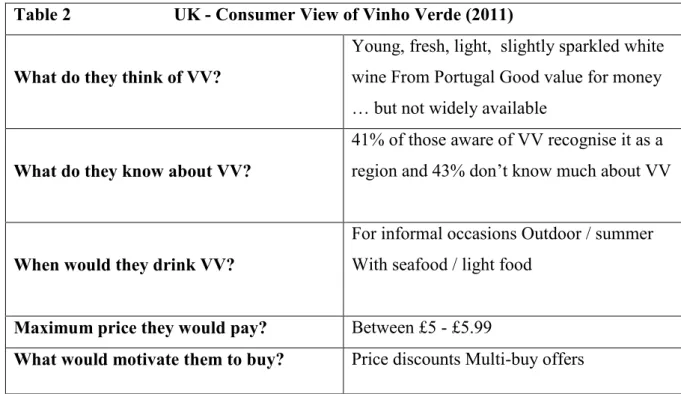
The tables below summarise the findings of a study carried out in 2011, which looks at the perceptions that consumers and traders in the UK have of Vinho Verde:
Table 2 UK - Consumer View of Vinho Verde (2011)
What do they think of VV?
Young, fresh, light, slightly sparkled white wine From Portugal Good value for money … but not widely available
What do they know about VV?
41% of those aware of VV recognise it as a region and 43% don’t know much about VV
When would they drink VV?
For informal occasions Outdoor / summer With seafood / light food
Maximum price they would pay? Between £5 - £5.99
What would motivate them to buy? Price discounts Multi-buy offers
28 Table 2 displays the feedback from a sample of regular wine consumers from the UK who were aware of Vinho Verde. Their unprompted associations with the term Vinho Verde appear to confirm the hypothesis concerning the region’s generic style. The most frequent connotations involved “Portugal, young, fresh, light and sparkled”, which highlight the style’s dominance in the mind of the general consumer. The links to summer and informal occasions also convey the notion that consumer’s perceive the wine as more ‘easy-going’. Only 41% of the respondents who knew of Vinho Verde realised it was a region, yet many admitted the wine was difficult to find in shops. In terms of pricing, the respondents’ price sensitivity and ceiling price of £7 underlines their lower-priced perception of the wine.
In Table 3 we can see how traders of Vinho Verde complement the wine’s lightness and fresh appeal, yet admit that the regional image has negative associations. A call for greater product quality and appearance is deemed to be the solution to this problem.
3.8.3 Germany
In 2016 Germany has shot up by 25% in sales value compared to the previous year, and continues to be the region’s most significant European market. As with the United States, Vinho Verde’s exports volume to Germany grew by 4 times between 2005 and 2015, making it one of the fastest-growing markets.
One of the key factors in the success within this market is claimed to be the fixed contracts made between producers and the country’s primary distribution channels, which now distribute Vinho Verde throughout the year as opposed to solely during the
Table 3 UK - Trade View of Vinho Verde (2011)
Positive factors about VV
A familiar brand with potential in the refreshing / light still white wine category
Negative factors about VV
Negative brand connotations persist. Room for quality and packaging improvements. Source: http://www.vinhoverde.pt/media/Files/elem_files/564.original.pdf
29 summer (Pinto, 2015). Germany is known for having a great variety of wine distribution (Szolnoki, 2014).
A particularity concerning the German market, however, is that in 2015 it recorded the lowest price p/litre ratio out of Vinho Verde’s 10 largest export markets, with €1.98 (see Figure D). This is substantially below the national DOC price average in Germany by over €0.30/litre, and is likely to be due to the fact that Vinho Verde faces tough white wine competition from this market. Previous research has found that the German wine market is characterised by two distinct traits: consumers that are highly discount-driven and value-for-money orientated, whilst also eager to purchase expensive wines when these have been well-recommended (Henne, 2015).
Germany is not only considered to be a highly price-aggressive market for wine, but is also known as a country of white grapes - which occupy roughly 88% of Germany’s 13 demarcated regions (Borges, 2005). Its most notable and prestigious white grape variety, the Riesling, produces some of the country’s finest wines, which too makes it harder for Vinho Verde to gain recognition at the top end of white wines. Nevertheless, if we take into consideration Germany’s average import price of wine (€1.61/litre) (Engelhard, 2016), Vinho Verde is priced significantly higher.
0,00 0,50 1,00 1,50 2,00 2,50 3,00
VINHO VERDE DOC NATIONAL DOC WINE
Info source: http://www.vinhoverde.pt/pt/estatisticas
30 Table 4 shows the answers from a sample of regular wine consumers in Germany who were aware of Vinho Verde. Their feedback in this survey is remarkably similar to the results shown from the study focused on the UK. The unprompted associations with the term Vinho Verde highlight again the features of “Portugal, young, fresh, light and sparkled” as the most common answers, though more respondents recognised the value and improving quality of the wine. Again a low percentage of the respondents recognised Vinho Verde as a region, and as was the case in the UK, the maximum price they were willing to pay for Vinho Verde remained below €10.
From the traders’ perspective (Table 5), the region’s wine has good value relative to its price, yet the low positioning and appearance of the wine was seen as a setback to allowing consumers’ to value the region more.
Table 4 Germany - Consumer View of Vinho Verde (2011)
What do they think of VV? Young, fresh, light, sparkling, Portugal Holidays Good value for money … but not widely available, good/improving quality
What do they know about VV? 38% of those aware of VV recognise it as a region and 38% don’t know much about VV
When would they drink VV? For informal occasions Outdoor / summer With seafood / light food
Maximum price they would pay? Between 6€ - 7.99€
What would motivate them to buy? Price discounts Multi-buy offers, wine certified as sustainable
Source: http://www.vinhoverde.pt/media/Files/elem_files/564.original.pdf
Table 5 Germany Trade View of Vinho Verde (2011)
Positive factors about VV A small but distinct category. Good value.
Negative factors about VV Packaging and image positioning are the main areas for Vinho Verde improvement Source: http://www.vinhoverde.pt/media/Files/elem_files/564.original.pdf
31
4. Methodology
This chapter explains the research methodology chosen to answer this speculative research problem. It discusses the reasons for pursuing a qualitative method, the choice of data collection and the type of analysis carried out.
4.1 Research Approach
Due to the nature of the research problem, this study follows a qualitative and
explanatory approach throughout. Qualitative material facilitates the understanding of areas that are relatively unknown (Stern, 1980), and enables a more holistic view of a problem to be developed. It helps to consider new themes, diverse opinions and to explain their links to the problem. Breaking down open-ended outcomes, such as the impact of mainstream Vinho Verde on the value-driven producers (RQ2), can be explored in more depth by considering a wide scope of theories, perceptions and experiences.
4.2 Data collection
The primary research was carried out through a series of face-to-face and semi-structured telephone interviews, designed to extract information from diverse
participants. There are several benefits of using this approach for data gathering, and particularly for this exploratory research. Firstly, the decision to carry out interviews is advantageous in:
overcoming the issue of low response rates with questionnaires (Austin, 1981); guaranteeing that the interviewee does not seek an external opinion when answering
(Bailey, 1987);
facilitating the process of gathering large amounts of relevant and in-depth information
32 discovering further the motives and beliefs behind the interviewee’s answers (S.A
Richardson, 1965), which is not possible through standardised and entirely pre-planned interviews.
Arguably, the most important tool in semi-structured interviews is the use of probing (Skodol-Wilson, 1992). Probing is considered a method for ensuring reliable
information as it gives interviewers the opportunity to:
explore new topics and sensitive issues (Nay-Brock, 1984) that were not considered prior to the meeting;
seek clarification for any inconsistent answers or new information (Skodol-Wilson, 1992);
create an interactive conversation which helps reduce the bias of sociably desired answers (Patton, 1990).
Secondly, the decision to adopt face-to-face interviews (when possible) was motivated by the fact that it stimulates greater interest in the topic from the interviewees and enables a sense of empathy between the interviewee and researcher (While, 1994). In this research, audio recording was used throughout the interviewing process when possible. This tool greatly helps with the analysis of the interview content because it enables the interviewees’ answers to be captured in their entirety, avoiding any possible interviewer bias or inaccuracies that arise from note-taking mistakes. In the few
interviews where audio recording was not practical, the interviewee’s answers were recorded by extensive note-taking.
4.3 Interviewee sample
The choice of sampling method used for the interviews is judgemental sampling (i.e. non-random), which implies participants were chosen by the researcher based on their knowledge, experience and relatedness to the topic. This method allows the researcher to carefully select expert interviewees who can provide an informed opinion on the topic area.
33 For this investigation, diverse stakeholders in the Vinho Verde business and Portuguese wine industry were chosen for interviewing. Four categories of interviewees were targeted for their direct link with the problem statement:
4.4 Process and construction of the interviews
A total of 10 interviews were carried out, each averaging 50 minutes long. This length of time allowed interviewees to engage in in-depth discussions. The interviews were recorded and transcribed in full (with the exception of two interviews that were not feasible to record). The majority of the interviewing process occurred during a space of two weeks, which allowed new ideas from initial interviews to be explored in
subsequent ones without the disruption of long time periods that could interrupt the flow of ideas.
An interview-guide is provided in the Appendix A, showing some of the types of questions asked that were asked to the interviews. These questions represent the structure behind the semi-structured interviews undergone. The questions are designed
Table 6
Category A: Specialist importers of Vinho Verde
Importers from US, UK and Germany were selected for their knowledge of international market preferences
Category B: Vinho Verde producers High-exporting producers of different sizes were selected Category C: Regional representatives
of Vinho Verde
Representatives from either the CVRVV or other regional bodies
Category D: National representatives of Portuguese wine
Representatives from national organisations who work with VV abroad
34 to answer the third research question, as well as to validate the two hypotheses
mentioned in the introduction of this thesis. The list of interviewees is the following:
4.5 Qualitative Analysis Method: Thematic Analysis
The method of analysis adopted in this investigation is that of a thematic analysis, defined by Braun and Clarke (2006) as “a method for identifying, analysing and
reporting patterns within data”. It is a simple method which follows a systematic
approach for organising large amounts of qualitative information into themes, which are then used to interpret patterns and construct the story behind the research problem. Thematic analysis is beneficial in that it creates flexibility for researchers to choose whether to apply theoretical frameworks or independent theory in their analysis (Clarke,
Table 7
Interviewee category
Role of the interviewee Interviewee Company/organisation
Category A
German importer Karsten Kubin Weingalerie – Wein aus PORTugal
US importer Rui Abecassis Obrigado Vinhos
UK importer Nick Oakley Oakley Wine Agencies
Category B
Producer Martim Guedes Aveleda
Producer Anselmo
Mendes
Anselmo Mendes
Producer Pedro Vieira Quinta da Lixa
Category C
Regional representative Manuel Pinheiro Comissão de Viticultura da Região dos Vinhos Verdes
Regional representative & boutique producer
Miguel Queimado
Associação de Produtores de Alvarinho & Vale dos Ares
Category D
National representative Nuno Vale Wines of Portugal
National representative & producer (non-VV)
João Roquette Wines of Portugal & Herdade do Esporão
35 2006). It also helps to descriptively summarise key elements from large and detailed data sets, whilst underlining the main similarities and differences between them (Clarke, 2006). Finally, the method also enables psychological interpretations to be made
(Clarke, 2006).
Below are the 6 steps of the thematic analysis:
Step Description
1. Familiarisation with the data Recorded material is transcribed, re-read and initial note-taking is made
2. Generating initial codes Notes and all sections of the data are coded so that identical codes can be grouped
3. Searching for themes The list of codes is sorted into potential themes and sub-themes
4. Reviewing themes Data and themes are refined, ensuring
there is coherence in the patterns. Themes are reviewed in light of the research problem
5. Defining and naming themes A narrative is created using the themes and data. Sub-themes are identified and
thematic titles finalised
6. Producing the report Write-up of the report, using specific
examples from the data
Table 8
Information from: https://sites.google.com/site/howtousethematicanalysis/home/how-to-use-thematic-analysis/6-producing-the-report
36
5. Thematic Analysis Report
This chapter includes the report on the thematic analysis undergone in this study. It seeks to answer the research questions and the two hypotheses stipulated in the beginning of the paper. We recall the hypotheses:
1. Vinho Verde is categorised as a single and generic style of wine, whilst overlooked as a region
2. Value-driven producers are limited by the region’s image to be able to charge higher prices and position themselves further upmarket
During the interviewing process, in general the interviewees were asked to express their views on the role of mainstream Vinho Verde and how it has shaped the current image and strategy of the region. In no specific order, several topics were covered:
Vinho Verde’s national and international development in the market The misconception of Vinho Verde as a style, rather than a region; The current situation that value-driven producers face;
General pricing of Vinho Verde wine;
The promotion of the region’s grape varieties and sub-regions; The future challenges of the region
The report is divided into themes and sub-themes which are intended to sequentially answer both parts of the problem statement, whilst raise new issues concerning the region’s image. The results of the interviews show topics where the interviewees were in general agreeance, whilst also those where opinions were more divided. The
discussion below is the result of a thematic analysis of all the interview transcripts.
5.1 Generalising Vinho Verde
5.1.1 Style vs. region
To better understand how the region’s wine may have been generalised in image, it is important to firstly consider the confusion that people seem to have in thinking of Vinho Verde as a style of wine, as opposed to a region.
37 When asked, none of the interviewees denied that the confusion exists. Amongst
producers and regional representatives alike there was a sense that Vinho Verde had been facing this misconception for a long time. One interviewee claimed that the generic style was “the foundation for which people thought Vinho Verde was unique
and different (…) and unfortunately people still say it’s a style”. This emphasizes the
idea that the style of wine created the confusion in the first place, and that the region still, today, has difficulty in contradicting this common belief. When asked about the features that characterise this wine style, the interviewees confirmed the following: a semi-sweet, effervescent, low in alcohol and low-priced white wine.
Seemingly, the myth has also stuck with consumers in foreign markets; the importers who were interviewed recognised that Vinho Verde was too often regarded as a style of wine in their respective markets. One explained how he believed the days of mainstream Vinho Verde are overdue, adding: “I don’t think that style does any favours”. Another importer complained: “we always have to explain it is an area and not a style” (…) I
always say that the Portuguese people selling it in the country are making a big mistake”. This importer argued that in Portugal there was a lack of effort to educate
tourists about the difference. However, it is hardly surprising to find that people in Portugal pass on the wrong message to tourists, when one producer admitted that even locals within the region itself still think of Vinho Verde as the generic style of wine. Furthermore, some of the interviewees also acknowledged the name ‘Vinho Verde’ to be somewhat confusing for the consumer because the name does not derive from that of the geographical region. “The name exemplifies the uniqueness of the region, but then
subjects us to these misconceptions” – as one of the producers explained.
As a result, both Vinho Verde’s name and strong regionality have made it easier for people to confuse it for a style of wine.
5.1.2 Style or region – does it matter?
Although we have confirmed that Vinho Verde’s style/region confusion is very much present, it is necessary to discover whether this exacerbates the generalisation of the wine.
38 As a preliminary view of the problem, most of the interviewees were asked whether they agreed with the following statement:
Most considerably, all of the interviewees agreed with this observation. This underlines the fact that Vinho Verde’s distinct style has narrowed the perceptions of the region. However, where opinions proved to be most divided was in considering whether the style/region confusion is a real problem for the Vinho Verde business. One producer did not regard the misconception as an issue, saying “as long as the consumer knows what
to find in the bottle”. Alternatively, on the demand side, an importer argued that it was
harmful because “people come back from holiday in Portugal thinking that it is a style,
and when that happens they cannot imagine that there is anything else”. This importer
reasoned that selling any alternative Vinho Verde wine proved especially difficult because people did not acknowledge it as a region, and continued to associate the name to the style. Another interviewee reinforced this argument by describing it as an
example of a “double-edged sword”: whilst the generic style of Vinho Verde was and continues to be extremely successful in its international markets, the downside was that it “limits the consumer’s perspective of Vinho Verde”.
“The confusion that people have in considering Vinho Verde a style of wine (as opposed to a region) has had ultimately two effects:
Firstly, the unique style that defined Vinho Verde wine gave it greater recognition and differentiation in the beginning, if compared to the other Portuguese wines (excluding Port)
Secondly, and as a consequence of the above, the fact that people began associating Vinho Verde with a particular style of wine made difficult the process of educating the consumer that it is instead a region of great diversity and which offers multiple
39 5.1.3 The image: at home and abroad
To conclude the theme of Vinho Verde’s image, the interviewees were asked how they thought Vinho Verde to be perceived both in Portugal and internationally. Most
significantly, all of the interviewees agreed that Vinho Verde was typecast as a single-style wine.
From the importers’ perspective, they stated that the majority of consumers in their respective foreign markets viewed Vinho Verde as a young, fresh and cheap wine. One importer summarised the situation: “people here think of the generic style as the real
Vinho Verde”. He explained it was generalised to such an extent that he knew of a case
where some customers in a restaurant sent back a good quality bottle of Vinho Verde, saying that it was not what they had expected, nor that it was Vinho Verde.
The question of whether the generic style is well-viewed in the market was, according to another interviewee, “really depending on the country”. He used the US as an example where the product is received variably, depending on the state. He claimed Vinho Verde’s image was better in states where it has started to emerge more recently. “This is because these places have no stereotype”, he reasoned. Whereas in places where the product has a history, he suggested market perceptions were narrower. This trend appears to suggest the downside of using the Portuguese communities as a
gateway for new markets – to which one regional representative said: “The challenge is
not via the communities – there is too much risk of becoming stuck within the communities”.
Interestingly, all of the producers agreed that Vinho Verde’s generic style was generally well received in foreign countries, but that in Portugal the region’s wine was viewed unfavourably. This was depicted as a cultural problem.As one producer explained: “I think in Portugal we are still fixed on this idea of Vinho Verde as a summer wine, but we are trying to change these sorts of mentalities”. Likewise, another producer labelled
the problem as a case of ‘cultural inertia’, adding that the stereotype in the country still makes it difficult for people to change the way that they view the region’s wine.
40 Whether attached to positive or negative associations, it is understood that the generic Vinho Verde style has defined the region’s image to a large extent.
5.2 Generic style as a limitation
At this point in the analysis we look at the second hypothesis: whether the region’s style is harming its value-driven wine producers.
5.2.1 Are value-driven producers limited by the regional image?
A vast majority of the interviewees in this research admitted that, in one way or another, mainstream Vinho Verde wine was hindering the image of the value-driven segment. Though a few prompted that the latter segment was still young and growing, there was a consensus that the region’s fame as a ‘light and easy-to-drink’ wine could be considered a limitation. “Many people are not in the position to pay more for a style of wine which
they don’t think deserves more of their money” – was the response of one of the
producers, who admitted the generic image of the wine was not only a question of style, but a signal of the product’s value.
Two importers claimed it is difficult to sell a quality product whilst using the region’s name. One explained that on the high-quality wine bottles “no one uses the Vinho Verde
name on the front label”, insinuating that these producers avoided the region’s name so
as not to become associated with that style. As a result, he claimed that people usually had to have wine-tastings before buying a more value-driven Vinho Verde, since they often came with low-cost preconceptions. As one producer put it; “the Vinho Verde
brand is a strangler for the more expensive brands - it does not allow them to reach a certain level. Charging above 10 euros is already an effort. Above 15 it is a big challenge”.
Two other interviewees deemed this issue to be ultimately a consequence of
disproportionality; reasoning that the market is overcrowded with lower value Vinho Verde wine in the market, whilst quality-driven producers are still at a disadvantage since they represent a minority.