A Work Project, presented as part of the requirements for the Award of a Master Degree in Management from the NOVA – School of Business and Economics
A SCENARIO BASED APPROACH ON HOW NON-VESSEL OPERATING COMMON CARRIERS CAN CHALLENGE THE UNCERTAIN ENVIRONMENT OF OCEAN CARRIERS
Miriam Scherf, 2997
A Project carried out on the Master in Management Program, under the supervision of Prof. Manuel Baganha
Abstract
The aim of this work is in the first step to uncover different possible scenarios Non-Vessel Operating Common Carriers (NVOCCs) might face in the near future. In the second step, early warning signals and strategic implementations have been developed to allow NVOCCs better preparation and proactive actions to master upcoming challenges.
Due to the unpredictable Ocean Freight market, the scenario based planning approach is used to allow a broad view on possible future scenarios.
Qualitative interviews with industry experts have been conducted to gain insights into major challenges and uncertainties.
The two main critical uncertainties - rate volatility and carrier consolidations – form the basis for four different possible future scenarios. Rates might stabilize or remain volatile; carriers might consolidate into fewer players on the market or might join in alliances. Full transparency regarding the carrier’s financial situation is key to foresee critical situations. Stable long-term contracts with carriers and customers allow better planning. Service differentiation and quality lead to customer loyalty, which could lead to secure the business in difficult times.
This work summarizes different influence factors of the ocean freight industry and serves as a basis to support future strategic implementations.
Table of Content
LIST OF TABLES ... I LIST OF ACRONYMS ... II 1. INTRODUCTION ...1 2. LITERATURE REVIEW ...2 3. INDUSTRY OVERVIEW ...2 4. RESEARCH QUESTION ...4 5. METHODOLOGY ...5 6. INDUSTRY CHALLENGES ...86.1 INCREASED VESSEL SIZES ... 8
6.2 THE IMPACT OF THE GLOBAL FINANCIAL CRISIS ON HANJIN ... 11
6.3 ALLIANCES BETWEEN COMPETITION AND COOPERATION ... 12
6.4 CURRENT CHALLENGES ... 12
6.5 OUTLOOK ... 13
7 SCENARIO DEVELOPMENT ... 14
7.1 SCENARIO I–THE WINNER TAKES IT ALL ... 19
7.2 SCENARIO II–JOINT GROWTH... 20
7.3 SCENARIO III–NEGOTIATION AT ITS BEST ... 21
7.4 SCENARIO IV–HUNGER GAMES ... 22
8 STRATEGY DEFINITION ... 23
9 CONCLUSION ... 25
List of Tables
Table 1: Adapted from HHL-Roland Berger Approach to Scenario Based Strategic Planning (Wulf, Meißner, & Stubner, 2010)
Table 2: Adapted from: HHL-Roland Berger Approach to Scenario Based Strategic
Planning (Wulf, Meißner, & Stubner, 2010)
Table 3: Adapted from: HHL-Roland Berger Approach to Scenario Based Strategic
List of Acronyms
CSI Customer Solutions & Innovations1
DGF DHL Global Forwarding Management GmbH
FCL Full container load
LCL Less container load
M&A Merger and Acquisition
MNC Multinational Customers
MNGWY Multi-national Gateways
NVOCC Non-Vessel Operating Common Carrier
NVO Non-Vessel Operator
OFR Ocean Freight
OPS Operations
PESTEL Political, Environmental, Social, Technological, Economic, Legal TEU Twenty-foot Equivalent Unit (standard container)
1
1. Introduction
The ocean freight industry became more and more challenging in the past years. The market is hard to predict as rates are often volatile and customers have become more price sensitive. Many carriers tried to reduce their shipping costs by purchasing larger container vessels. After substantial investments in larger vessels, combined with the aftermath of the global financial crisis in 2008 which caused market growth to decline dramatically, almost all carriers were in financially poor conditions. In 2016, a new incident occurred: Hanjin, formerly one of the largest carriers, became bankrupt and the industry was unprepared for the impacting of this event, such as confiscated cargo all around the world.
This thesis aims to identify possible strategies for Non-Vessel Operating Common Carriers (NVOCCs) to challenge this uncertain environment of the ocean freight business, and to find early warning signals to be better prepared for the next crisis to come.
The chosen methodology is the scenario-based approach, which allows a broad view on different possible scenarios that might happen in the unpredictable ocean freight market. Based on research and qualitative interviews with industry experts, past indications of threats are carved out and analysed. Rate volatility and carrier consolidations are identified as the two most critical uncertainties with the biggest impact on the daily work of NVOCCs, and early warning signals are developed. Finally, strategic implementations are worked out, to allow better preparation for NVOCCs for any future scenario.
Sections 2 and 3 provide an overview over the existing literature and the ocean freight carrier market. Sections 4 and 5 then present the research question for this thesis and discuss the chosen methodology. The core analysis of the paper is conducted in section 6, where
uncertainties and build future scenarios. Then, a strategy is defined in section 7 to better prepare for these uncertainties. Finally, section 8 concludes this thesis.
2. Literature Review
Container transportation has been a subject of research for a long time, since maritime logistics became one of the main transportation modes during the last century. Jansson & Shneerson (1987) and Alderton (2008) for example provide an overview of container shipping.
The impact of increasing vessel sizes or the maximization of capital intensive resources have been discussed by Nguyen & Haasis (2015) and Fransoo & Lee (2012), whereas Lim (1994) analyses the costs and benefits of larger vessels.
This paper aims to contribute to this literature by combining different previously noticed threats and putting them into a current context: the Hanjin crisis. Furthermore, it differs from the previous work above by specifically focusing on the challenges that NVOCCs currently face.
3. Industry Overview
In times of globalization, goods are exported and imported through all different types of channels, such as airfreight, ocean freight or trucking. In 2009, 75% of world trade has been carried by sea, mainly by container vessels (Lee & Song, 2017). As customers become more price sensitive, the ocean freight market is growing and becoming more attractive, the transport cost per unit has been reduced e.g. for consumer goods to approximately 1% of the shelf price. The market volume of ocean freight is more than double the market volume of air freight (Appendix A: Figure 1). Standardization is the key concept of container shipping.
Due to better planning and improved supply chains it is a serious competition to air freight transportations. This is because containers can be transported through the whole supply chain. Also, before and after the sea leg, on trucks and trains there is no need for repacking. Even though it takes longer, customers can still receive their goods on a frequent base – because of accurate order placing (Lee & Song, 2017).
In the ocean freight business, up to three major parties are involved in the shipping process: carriers, customers, and NVOCCs.
Carriers ship cargo and own assets and equipment, such as container vessels and containers. Alternatively, carriers often charter vessels. They can be part of an alliance, where vessels or containers are shared among each other to increase efficiency and utilization.
Customers are the second involved party. They either book directly with the carriers or use freight forwarders to arrange either the door-to-door shipment process or to arrange the booking. Freight forwarders or NVOCCs do not own containers or vessels, but some assets to do the pick-up at origin or delivery at destination (Universal Cargo Management, 2016). The ocean freight market is fragmented, even the NVOCC market leaders Kuehne & Nagel and DHL Global Forwarding hold market shares of only 7.6% and 5.9% respectively (Appendix A: Figures 1&2).
Still, the market is profitable. In 2016, the Ocean Freight department of DHL generated revenue of €3.3b, which accounts for 24% of DHL’s Global Forwarding business unit revenue (Appendix B: Figures 3&4).
Despite the growing market and increased demand, however, the market faces tremendous challenges. Overcapacity, due to increased container capacity on vessels and the global financial crisis in 2008, resulted in a price war. There are many players in the market fighting
for customers, which put downward pressure on prices and made the business less and less profitable for carriers and NVOCCs, such as DHL (Lee & Song, 2017).
In the fall of 2016, Hanjin, formerly 7th biggest carrier worldwide went bankrupt and caused an incomparable crisis for the industry and forwarders. The industry was not prepared for such a scenario and suffered for months to for example reclaim the customers’ cargo (Appendix C: Figure 5).
4.
Research Question
The definition of a clear and precise research question is the first step of any research project (Eisenhardt, 1989). By defining the research question, the author can directly verify the requirements and therefore, the relevance of the topic. The question must be inter alia clear, focused, not too abstract, connected to existing research, feasible and of interest of the author. A methodology can then, in a second step, be defined based on the research question (Ritchie & Lewis, 2013).
The impact of the uncertain and unpredictable carrier market on NVOCCs has not been analysed yet. NVOCCs play a strong role in the ocean freight market and are the link between customers and carriers. They depend strongly on the carriers’ performance in order to offer good service to the customers. Also, they might be liable for incidents caused by the carriers. Therefore, they need to be prepared for future scenarios and the possible impacts need to be analysed carefully. This leads to the following research question:
“How can NVOCCs master the challenge of an uncertain environment in the ocean carrier industry?”
This question can then be split into smaller sub-questions, which help to dive deeper into different aspects of the analysis and to ensure the coverage of all aspects during the interviews.
A) What are current challenges and potential threats for the ocean carrier industry? B) How can trends and uncertainties be detected proactively?
C) Which strategies should be implemented to overcome those threats?
5. Methodology
Due to the topicality of the subject, qualitative research is crucial to gain deep insights into the ocean carrier industry and its challenges. Different expert interviews will build the base of this thesis, aiming at a holistic view. The interviews are in-depth interviews rather than group interviews, due to the nature of the research question (Ritchie & Lewis, 2013). There are multiple challenges foreseen for NVOCCs, therefore it is useful to have single interviews with experts in this specific area to come up with a generic strategy in the end. Historical data, actual data and different research papers will round off the approach.
In order to include different perspectives into answering the research question, this project uses the scenario based approach used by the company Royal Dutch Shell in the 1970s (Wulf, 2010). This approach develops possible future scenarios while always asking the question “What if...?”. For those scenarios, early warning signals and strategies will be developed that help to be prepared in the best possible way for all cases (Wack, 1985). This methodology is particularly suitable in this case because it is designed to analyse companies that act in an uncertain or even unpredictable environment. Multiple scenarios are possible, but it is not possible to predict one single future scenario, the company needs to prepare to all possible future scenarios to react proactively instead of reactively.
The choice of the scenario based approach allows to think outside the box and to consider possible solutions for multiple uncertain scenarios.
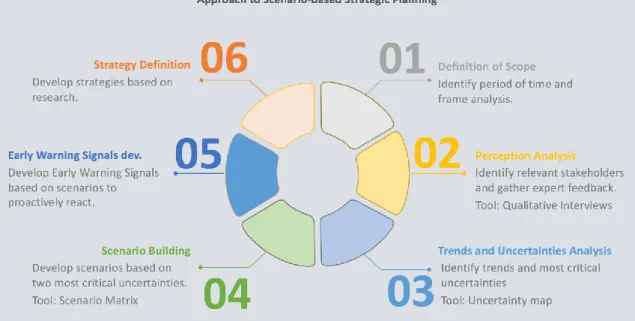
Table 1: Own compilation; Adapted from: HHL-Roland Berger Approach to Scenario Based Strategic Planning (Wulf, Meißner, & Stubner, 2010)
The methodology consists of six different steps, which will be explained in detail, following Wulf, Meibner & Stubner, 2010.
1. Definition of Scope:
The first step of the approach is to set the basic framework. The time frame and the purpose of the analysis need to be defined to generate a common baseline
2. Perception Analysis:
To get a holistic view, assumptions of both external and internal stakeholders must be identified. This second step aims to compare the perceptions of all relevant stakeholders before starting the core analysis.
3. Trend and uncertainty analysis:
Identifying the trends and uncertainties of the company or industry is crucial for the scenario based approach. By making use of the PESTEL2 analysis, major drivers of the industry are identified and mapped based on their grade of uncertainty and grade of impact. This step helps to identify major trends, critical uncertainties and secondary elements.
4. Scenario Building:
Building different scenarios out of the before identified critical uncertainties is the heart of this approach. Those scenarios allow an outlook on different possible future scenarios, which might challenge the industry and the company in different ways and with different impacts. 5. Early Warning Signals:
For each critical uncertainty, early warning signals are identified to prepare the company in the best possible way to any upcoming challenge. Good preparation and proactive crisis management can be crucial.
6. Strategy Definition:
Based on the built scenarios decisions and strategic options can be tested to strengthen the company’s strategy. Finding the best solution before a certain situation occurs can prepare the company on time and allows the management to plan for multiple possible futures and to avoid ad-hoc decisions.
Limitations & Weaknesses of the Methodology
As most strategic frameworks, also this approach cannot be taken as an all-round solution and suffers some weaknesses and limitations. One of the main aspects is that the scenario based approach is time consuming and therefore difficult to implement in practice. It is said that the
whole process usually takes around five months. Apart of the consumption of time, many other sources are needed.
Furthermore, the scenarios are still constructed and therefore limited. Not all aspects can be considered when building different future scenarios. This means that there are many uncertainties, which have not been considered and can affect the company without sufficient preparation. One of the reasons for the limitations is that the construction of scenarios is often based on interviews (Shell, 2003).
Nevertheless, having a good and solid guideline can be helpful for companies operating in uncertain industries and it motivates the managers and stakeholders involved to think outside the box.
6. Industry challenges
6.1 Increased vessel sizes
The container vessel market is a competitive and capital-intensive industry (Lee & Song, 2017). More than 100 companies operate on the market, whereas the top 10 carriers share 60% market share among each other. Maersk Line, as the largest carrier worldwide, owns approximately 15% market share, whereas the tenth-largest carrier holds around 3% market share. This demonstrates a fragmented market structure (Wang, 2015).
Total capacity of the global ship fleet has increased dramatically since the 1990s. In 1990, 4772 ships were counted with a total capacity of 3.17m TEUs whereas in 2014, already 8337 ships were counted with a total capacity of 18.9m TEUs constituting an increase in capacity of 500%, (Nguyen & Haasis, 2015).
One of the largest drivers of competition is cost reduction through larger vessel size. Carriers are buying larger container vessels to reach economies of scale (Ibid.). In 2004, less than 1% of the existing 3036 container vessels had a capacity of more than 7,000 TEUs (Appendix D:
Figure 6), whereas by the end of December 2016 more than 7.5% of the existing 5,106 container vessels carried more than 7,000 TEUs each (Appendix D: Figure 7).
The container vessel Emma Maersk, launched in 2006, inaugurated the new era of ultra-large container ships. So-called ultra-large container ships or mega container ships carry more than 10,000 TEUs. According to Maersk, Emma Maersk has a capacity of 15,500 TEUs. The era of mega container ships set new benchmarks, and already in 2011 Maersk announced the acquisition of ten container vessels, the Triple E series, with a capacity of 18,000 TEUs each, at a total cost of around $1.9b (Nguyen & Haasis, 2015).
The trend towards ultra-large container vessels will probably continue. Considered historically, container vessel size has increased from under 2,000 TEUs in the early 1970s to less than 5,000 TEUs in the 1990s (Ibid.). In 2016 already, there were 47 vessels with a capacity of 18,000 to 20,000 TEUs (Appendix D: Figure 7). Vessels are often ordered in series to decrease production costs. This way, cost advantage has been one of the main drivers for increasing vessel capacity.
Different types of cost must be considered. Regarding transportation cost it can be said that cost per unit decreases as vessel capacity increases. The transportation cost per unit of a mega vessel is 26% lower compared to former large vessels (Nguyen & Haasis, 2015). Operating cost per unit also decreases when increasing capacity. The required number of staff members for vessels does not increase proportionally with increasing capacity, as 17 crew members are required for a vessel with a capacity of 2,468 TEUs, whereas 20 members are required for a 20,000 TEU vessel. Acquisition cost is high, as there is not only the high cost for the vessels, but also new containers that need to be purchased. This leads to a payoff of the previous mentioned cost advantages, due to the relatively high investment (Ibid.).
Another aim of acquiring giant vessels is to increase energy efficiency and reduce the environmental impact. CO2 emission per unit of a mega vessel can be halved compared to former big vessels (Nguyen & Haasis, 2015).
Acquiring mega container vessels leads also to competitive advantage, as it increases entry barriers for possible competitors, due to the high fixed costs when entering the market and acquiring competitive container vessels. This phenomenon of high fixed costs also leads to high exit barriers (Nguyen & Haasis, 2015).
The price the carriers pay for competitive advantage and economies of scale is the high risk that mega vessels carry. Whereas price per unit decreases if the vessel is at sea, port costs for a 18,000 TEU vessel are approximately 2.5 times higher per day than for a 6,000 TEU vessel, as more cargo needs to be loaded and discharged at port. Naturally, turnaround time at port is proportional to the vessel’s capacity. This cost is, therefore, strongly linked to accurate planning and any delay leads to increased costs.
Not only vessel operators need to improve their planning, also ports are affected. To handle the increased number of cargo, more staff and equipment is required, but only when mega vessels are at port. On the one hand, off-peak times at ports become inefficient if the port adapts to the high capacity (Matthews, 2003); on the other hand, over time loans become very expensive in case ports do not adapt (Prince, 1997).
Increasing vessel capacity is only beneficial if the utilization is guaranteed, as they require high cargo volume to effectively take advantage of economies of scale. For example, comparing a 14,000 TEU vessel with a full load 4,000 TEU vessel a utilization of at least 60% is required to have a cost advantage (Ibid.). An example of the risk carriers took is presented and discussed in section 6.2.
6.2 The impact of the global financial crisis on Hanjin
Before the global financial crisis in 2008 and 2009, larger container ships were ordered to challenge the competitive price policy in the carrier industry and to meet the expected growing demand. During the global financial crisis, the carrier industry suffered dramatically, the overall loss for the industry in those years was around $15b. Hanjin, one of the biggest carriers at the time (Appendix C), lost $1.1b (Hellenic Shipping News, 2016).
Due to the Eurozone crisis in 2009, the trade between Europe and Asia decreased, which represented a crucial part of Hanjin’s business, (Braden & Abt, 2016) followed by slow growth and cautious investments (Ibid.). Because of the crisis, the demand was lower than expected and brought many carriers into financial distress. Instead of recovering from the crisis, Hanjin lost another $500m in 2011 ending up in debt (Ibid.). The following years were, even though demand grew, characterized by overcapacity and historically low rates for shipping. Rates fell by approximately 50% compared to the average range. By handing over the control for its operations to their largest creditor in April 2016, the Korea Development Bank, Hanjin sent rumours came up that Hanjin is not able to pay its stakeholders, and by the end of August 2016 the rumours proved true when the company announced bankruptcy (Ibid.).
Hanjin has not been the only carrier that struggled with financial issues; almost all carriers are financially in bad conditions (Appendix H, Q5). Nevertheless, it set an example and was the only one going bankrupt. This hit the forwarder industry tremendously and unfortunately, they were not prepared. There were no early warning signals, nobody expected Hanjin to be the one going bankrupt first. Hyundai, who in the end bought parts of Hanjin, was expected to be financially worse off than its South Korean brother (Appendix H, Q8).
The result of the crisis was that around 100 Hanjin container vessels, carrying goods worth $14b, were standing around not being allowed to pass the Suez channel or to be discharged at port (Paris & Philipps, 2016).
6.3 Alliances between competition and cooperation
Carriers are competing among each other. But they only reach operational efficiency and service effectiveness through cost reduction and improved asset utilisation. Therefore, strategic alliances became more popular in the last 20 years. This leads to a co-existence of competition and cooperation. Within alliances, services and containers are shared to help improve the utilization of assets. One of the main characteristics for strategic alliances is the joint usage of vessels for specific routes. This improves the vessel utilization to avoid free capacity on the vessels (Lee & Song, 2017). Nevertheless, those alliances might have negative consequences for NVOCCs as they book with a certain shipping line, but the sea transport is performed by a different carrier. This reduces the control NVOCCs can have over the choice of carriers. Especially nowadays where the financial situation of carriers is unstable they cannot guarantee their customers that only financially stable carriers ship their goods. This happened for example during the Hanjin crisis; containers were booked with another carrier but were shipped by Hanjin and then affected by the bankruptcy (Appendix H, Q5). Alliances are no static constructions, they are pragmatic arrangements and change on a regular base, NVOCCs need to adapt to these changes (Poskus, 2017). Recently, in April 2017, four alliances were drilled down to three major alliances (Appendix F).
6.4 Current challenges
The market has not recovered yet from the Hanjin Crisis and tries to stabilize by reorganizing the Alliances, executing M&As and buying and selling vessels. Rates are still volatile from historical low rates around €200 per container on a certain lane to an increase up to €2,000 per container on the same lane. Players cannot foresee the future and do not know what might
happen the next month. This insecurity and uncertainty complicates the planning and slows down the recovery process. Long-term strategies cannot be rolled out if the market remains unpredictable. Another challenge is the unstable capacity management. Usually, there was more business on the lane Asia to Europe and the lane Europe to Asia has been used mainly to bring back empty containers to the Asian ports. Out of a sudden, an unexpected demand on this lane occurred which not only affects the lanes, but also the planning for NVOCCs as the available capacity on those lanes decreases (Appendix H, Q11).
6.5 Outlook
The sea carrier industry will face more changes the coming years. Long-term planning is not possible, due to the fast pace of changes. Therefore, the market remains unpredictable for experts (Appendix H, Q11). Investors will probably be conservative regarding investments, due to the uncertain situation and carriers will go through difficult times. Some carriers (e.g. Maersk Line) are financially in a better position, whereas others (e.g. Yangming) need to be observed carefully (Appendix H, Q14). Alliances might change again, as members could disappear from the market and the set-up needs to be rearranged (Ibid.).
Larger vessels are still crucial for carriers, even though they learnt their lessons from the Hanjin crisis, customers are still price sensitive and prefer lower unit costs, which can be only offered on larger vessels (Appendix H, Q7).
NVOCCs need to prepare for different scenarios, and adapt their strategy, capacity management and priorities fast to any changes in the ocean carrier environment.
7 Scenario Development
Grounded on the scenario based approach discussed in the methodology chapter and the information gained from expert interviews and research papers, four possible scenarios for the carrier industry will be developed.
Definition of Scope
The formulated research questions at the beginning of this research paper marks the basis of the approach. Because market changes are still on-going and happen at a high speed, the approach will take into consideration strategies and challenges the industry might face until 2020.
Perception Analysis
In the second step of the approach, the perception and opinion of different stakeholders is retrieved through qualitative expert interviews. These will be supplemented by different current research papers which address the uncertain and critical ocean carrier industry.
The interview partners have been chosen to gather different point of views based on the person’s professional focus. The developed interview framework (Appendix G) aims at finding out about current and future challenges for NVOCCs and is adaptable to the different expertise of the interview partners. All interview partners are employees of DHL Global Forwarding Management GmbH, based in Germany, the Netherlands and Switzerland. Trends and Uncertainties Analysis
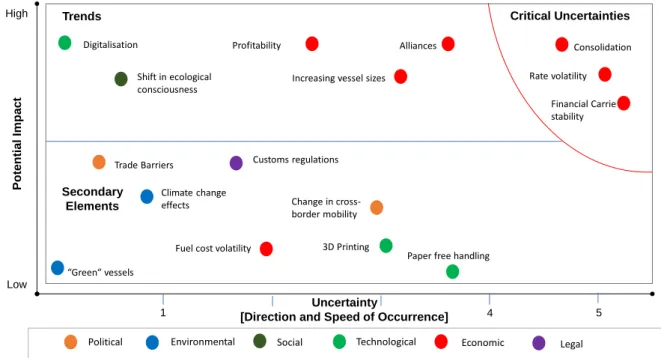
The third step of the process includes retrieving main factors of the interviews to identify trends and uncertainties of the sea carrier industry. Based on the interviews, a PESTEL analysis has been conducted to group and rank the factors by political, environmental, economic, social, technological and legal nature. The identified factors have then been ranked by their potential impact (x-axis) and their degree of uncertainty (y-axis). The bigger
the impact of a factor is seen by the interviewed experts, the higher it is ranked on the x- axis. The more unpredictable a factor is seen by the experts in the interviews, the higher it ranks on the y- axis. Factors with a low degree of uncertainty, but high potential impact are trends, whereas factors with a high degree of uncertainty and high degree of potential impact are the critical uncertainties. Factors having a relatively low impact for NVOCCs are, independently of the degree of uncertainty, seen as secondary elements.
P ot e nt ia l Im pac t Uncertainty
[Direction and Speed of Occurrence] Uncertainty Map High Low 1 5 Trends Secondary Elements Critical Uncertainties Rate volatility Financial Carrier stability Consolidation
Political Environmental Social Technological Economic 4 Fuel cost volatility
Alliances
Change in cross-border mobility 3D Printing Increasing vessel sizes
Climate change effects Trade Barriers Shift in ecological consciousness Legal Customs regulations “Green“ vessels
Paper free handling Digitalisation Profitability
Table 2: Own compilation; Adapted from: HHL-Roland Berger Approach to Scenario Based Strategic Planning (Wulf, Meißner, & Stubner, 2010)
Political
Political events, such as the Brexit or the election of Donald Trump might impact globalization and thereby the ocean freight business. Those events might result in changes in
cross border mobility, which impact the business of NVOCCs.
countries. Both of these uncertainties are secondary elements, as they have only a medium impact on NVOCCs (Appendix E).
Environmental
The usage of “green fuel” is a trend in the automotive industry, but also in the sea carrier industry a trend towards “green” vessels might become a topic. Pollution through container vessels is immense and carriers are certified if they reduce their ecological footprint. Changing the fuel leads to higher costs, but these costs are invoiced directly to the customer and do not affect the rates. Hence the impact for NVOCCs is rather low.
Climate change effects are often discussed to reduce the overall CO2 emission. The ocean
freight business offers a more environmentally friendly alternative to air freight. This might potentially result in market growth (Appendix E).
Social
A shift in ecological consciousness has been noted during the past. Customers restrict NVOCCs with regards to their choice of carriers. The shift is noted and certain, and impacts NVOCCs heavily. This factor is a trend in the ocean freight business (Appendix E).
Technological
3D printers are discussed often in recent days and could make transportation of certain goods
redundant as pieces can be produced directly at the facility. Nevertheless, for the overall ocean freight business the impact is rather low. Also, paper free handling due to digitalization becomes more and more popular. Both factors are secondary elements. Digitalisation is a trend, because it is likely to happen, and will affect the business of NVOCCs as some parts of the business might become redundant. Customers will be able to do their bookings easily on a digital tool without going via NVOCCs (Appendix E).
Economic
Fuel cost volatility is a secondary element. There will be changes, but costs will not impact
NVOCCs directly. Volatile rates are critically uncertain, it is not clear whether rates will stabilize or remain volatile. This impacts the daily business of NVOCCs dramatically as negotiations with both carriers and customers will increase, and contracts can only be set for a few weeks. With stable rates, contracts can be closed for up to a year, which facilitates planning.
The development of the profitability of the market is uncertain. NVOCCs sometimes carry loss-making goods, if the rates at which they buy from the carrier are less than the rates at which they sold to the customers.
Alliances formed by carriers have not been stable during the last years. Stable alliances allow
better planning for NVOCCs and increase stability in the market. Uncertain alliances bring challenges for NVOCCs, as lanes will change and NVOCCs need to adapt their strategy to the current situation. Also, NVOCCs have less power to choose carriers as the cargo might be transported with another carrier and locating the cargo becomes more difficult. Another, even more critical aspect, is the consolidation of carriers where single players disappear from the market due to M&As. A decrease in the number of players increases rates and gives more power to the carriers. Further, restructuring of the carrier landscape always requires NVOCCs to adapt their business and strategy. Both the degree of uncertainty and the impact on NVOCCs are extremely high.
Increasing vessel sizes have been a trend over the past years and it is still not clear in which
direction this will go. Bigger vessels reduce unit costs, but require accurate planning. Due to the overcapacity, carriers struggle financially. While larger vessels are built, older vessels
the carriers’ financial situation. Many carriers do not publish their annual report, which makes it difficult for NVOCCs to see impending insolvency early enough to react and reallocate the cargo to other carriers (Appendix E).
Legal
Regulation, for example by the European Commission or customs regulation, impacts the
carrier landscape as it controls M&As to protect customers and prevent the formation of a monopoly (Appendix E).
Scenario Building
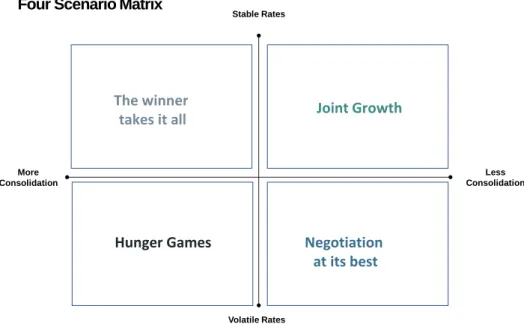
Out of all trends and uncertainties, the two most critical uncertainties build the base for the scenario building. Both consolidation and rate volatility are difficult to predict and impact NVOCCs dramatically, as the overall strategy depends highly on those two factors. Rates might stabilize or stay volatile. Consolidation might lead to fewer players in the market or the single players remain as they are. The critical uncertainties are mapped on a chart to create four possible future scenarios. NVOCCs need to prepare to be able to react proactively in case of any fast occurrences.
More Consolidation Volatile Rates Stable Rates Less Consolidation
Four Scenario Matrix
Negotiation at its best The winner
takes it all Joint Growth
Hunger Games
Table 1: Own compilation; Adapted from: HHL-Roland Berger Approach to Scenario Based Strategic Planning (Wulf, Meißner, & Stubner, 2010)
7.1 Scenario I – The winner takes it all
The first scenario built is characterized by stable rates and more consolidation. Fewer and stronger players compete in the market and can take advantage of the opportunity to make long-term contracts. NVOCCs benefit from those long-term contracts, as they can return to enter into long-term contracts with their own customers. This allows better planning and forecasting and secures the business. The business strategy can be stabilized and optimized, as no ad hoc implementations are necessary. Due to the stable rates, carriers can offer different rates for smaller and bigger customers, where NVOCCs also benefit through buying high volumes. This gives a cost advantage and could pave the way for growth. As fewer players compete in the market, there is less room for alliances and new M&As, lanes are fixed and NVOCCs do not need to change their own facilities, this also allows for better and more secure planning. The few players in the market can take advantage of the stable situation and recover financially; this reduces the risk of bankruptcy, which is also a positive aspect for
Nevertheless, the downside of the “The winner takes it all” – scenario is, as the name suggests, the increased risk of monopoly formation and a dependency of NVOCCs on certain carriers. If there are only few players in the market, they will specialise on certain lanes (e.g. Europe – Asia trade) and cannot offer the full service on all lanes. This again leads to less control for NVOCCs over which carrier to choose and an unhealthy dependency on them.
7.2 Scenario II – Joint Growth
The second scenario is characterized by stable rates and less consolidation, meaning that more carriers compete in the market. Following the motto “competition is good for business”, NVOCCs can take advantage of the several players in the market competing for business. Less specialisation leads to more control for NVOCCs over which carrier to choose and returns market power to them. Since carriers prefer high volume customers, NVOCCs can not only take advantage from long-term contracts, but also negotiate special rates, as they have more selection. In the best case, both carriers and NVOCCs grow jointly and sustainably, benefitting from stable rates.
The downside of this scenario is nevertheless the number of different players in the market, as further changes in alliances might come up. More alliances lead to less visibility for NVOCCs as they book cargo with a certain carrier, but it might be shipped with an alliance partner without telling the NVOCC.
All changes influence the strategy of NVOCCs, as carriers might change the lanes they operate and NVOCCs’ control is reduced. Changing the lanes carriers operate on might have a crucial impact, as NVOCCs have so-called Multi-National Gateways on certain port locations, where LCL containers from different customers are consolidated into one FCL container, or the content of one container is split into different containers. The locations of the
MNGWYs3 are carefully chosen and in line with operated lanes. Radical changes regarding ports and lanes carriers operate on might lead to redundant or missing MNGWYs. Those MNGWYs might need to be reallocated, which involves huge costs and would affect many jobs. Currently, DGF owns eight MNGWYs; the last has been added in 2012, involving an investment of €500,000 (shippingonline.cn, 2012). Obviously, those strategic changes need to be planned carefully and require a lot of time to be discussed and finally implemented.
7.3 Scenario III – Negotiation at its best
The third scenario represents a disrupted market with many different single players and volatile rates. The name “Negotiation at its best” shows the difficulties NVOCCs will face: volatile rates impact the duration of contracts, as no long-term contracts are possible due to rate changes. Short-term contracts offer the possibility to always go for better offers, but require time exposure. Those contracts complicate planning and ad-hoc implementations become essential. Another difficulty is the instability regarding carrier financial situation and alliances. Carriers also suffer the effects of volatile rates and short-term contracts and not all players will win the fight. Some players might therefore disappear from the market and potentially leave behind a mess, equivalent to the post Hanjin time. NVOCCs need to prepare the scenarios and rethink where to allocate the containers booked on the jeopardised carriers. Knowing about the financial situation of the carriers is crucial to avoid overnight surprises. Also, customers will feel the uncertainty and request NVOCCs to avoid certain carriers or services. As more players are in the market, alliances will become a relevant topic again and NVOCCs need to prepare to changing alliances and lanes.
7.4 Scenario IV – Hunger Games
During times with volatile rates, more consolidation can strengthen the carrier landscape and the single players in it, as the remaining players can increase their efficiency and benefit from less competition. Also, they can specialize on certain lanes and services. As consolidations always require high capital investment, not all carriers will get the possibility to do so and few strong players will continue with M&As (Jacobs, 2017).
The benefits for some carriers will bring other players into trouble and not all players will survive, as in the hunger games. Especially for NVOCCs it will become difficult to differentiate. Due to the volatile rates, no price benefits for larger customers can be offered and they need to differentiate by their service. Carriers will specialize on lanes and services, leaving little scope for NVOCCs. To still be competitive in the market, NVOCCs need to adapt their strategy and follow the carriers’ strategies regarding lanes to offer.
Early warning signals
To verify proactively which scenario is likely become reality, it is important to identify and detect early warning signals. Rate volatility is strongly linked to market stability: in a stable market, rates level off and allow further planning. A constant growing market, where carriers take advantage of higher demand and positive utilization, makes the business more profitable. Then constant rates and long-term contracts can be offered. Early warning signals regarding rate volatility are therefore political decisions that impact the export and import business, as well as negative market growth. An imminent crisis, as seen in 2008, is also a clear indication towards instable rates. Finally, the financial situation of carriers is accompanied by market shocks and indicates volatile rates.
Regarding carrier consolidation, the financial situation of the carriers is the strongest indicator. Inequality regarding size and capital only enables space for consolidations. If two or
more carriers operate the same lane, but there is a clear difference regarding their financial capital, it is very likely that consolidations will take place.
8 Strategy Definition
First, the precarious financial situation of ocean carriers has been detected as an early warning signal for both critical uncertainties. The first and most important step for NVOCCs is therefore to be completely aware of the current financial situation of all carriers in the market. It needs to be taken into consideration that some ocean freight carriers have additional business. Maersk for example competes strongly in the oil business. Experts need to monitor all current developments and analyse changes and trends. An investment into good analysts is crucial to always be aware of the current financial situation and to avoid risks. Only monitoring the development on the stock market is not enough, as the results might be diluted by additional company activities. Being one step ahead of the competition can prevent cost-intensive ad-hoc implementations, such as rebuying the cargo out of the ports, after an incident occurs. Privately owned companies that do not publish annual reports need to be pressured by all other parties working strongly together, to get the full picture of the current situation.
Second, as soon as a weak player has been detected, measures need to be taken to be prepared for the worst-case. Large NVOCCs will have difficulties to re-allocate the booked cargo on other carriers and vessels. NVOCCs need to know where their cargo is located; a good Track & Trace tool can be crucial and simplifies reallocation. With the identified weak carriers, only FCL shipments should be shipped, and container consolidations (LCL) need to be avoided. This is because container consolidation implies that one container contains cargo of different
only one customer per container is affected. For the remaining LCL containers, an alternative option should be considered even if different routing will be necessary.
Again, deep knowledge of the market situation is crucial, increased knowledge on which carriers operate which lanes is essential to proactively monitor potential carrier consolidations and to implement Plan B routing when it comes to an unforeseen crisis. The first option should always be to book with strong carriers and negotiate safe long-term contracts to secure both players’ business. In difficult times, strong cooperation between customers, carriers and NVOCCs is crucial. Where no long-term contract negotiation with carriers is possible, the business needs to be carefully revised. For smaller customers, long-term contracts between the customers and the NVOCC can be possible, as the taken risk is relatively low. For larger customers, long-term contracts should only be negotiated when the rates are on an upwards trend, otherwise, the cost of constant negotiation of short-term contracts should be preferred. Changes in the carrier landscape, for example due to consolidation, the lanes of the carriers might change. This impacts the NVOCC’s strategy. Re-allocation of Multinational Gateways should nevertheless be considered strategically as the last option, as it involves high capital investments regarding costs and human resources. Due to the instability of the market, those drastic changes need to be considered carefully and only implemented if the operated lanes are changed completely and sustainably.
Finally, NVOCCs cannot only differentiate themselves from their competition by offering competitive rates; they are primarily service providers. NVOCCs should therefore do the best they can to differentiate by services, providing high standards and customized solutions to secure their own business.
9 Conclusion
The ocean freight environment is struggling and constantly exposed to change. In the past years, the ocean freight business suffered under the global financial crisis and historically low rates. The Hanjin crisis affected the business of NVOCCs and caused a lasting shock in the market that is still felt by carriers, NVOCCs and customers until today. Due to the nature of the business and the current crisis, no long-term planning is possible. The market is challenging and not all players will survive these tough times. Thus, preparation is key to not be surprised by unforeseen changes.
Current uncertainties can become future threats that impact the business and the financial situation of NVOCCs. Uncertainties can be of political, environmental, social, technological, economic or legal nature. The most critical uncertainties are of economic nature and need to be made aware of.
NVOCCs are still in a relatively good position, as they do not own any assets and act as a service provider. Still, the market is not only extremely risky, it has the potential to be profitable if NVOCCs invest in market analyses and see potential threats.
The unhealthy relationship between carriers and NVOCCs is due to the fact that it is not only a customer – vendor relationship, but also competition. All parties need to work strongly together to overcome times of crisis and grow together constantly and sustainably in the future. Once the market has stabilized again, the motto “competition is good for business” becomes true again.
This thesis used the scenario based approach to identify the two critical uncertainties in this market: rate volatility and consolidation. With information gathered from expert interviews it helped to develop a strategy that will help NVOCCs detect early warning signals and prepare
10 References
Alderton, P., (2008). Port Mangement and Operations. Informa, London.
Arslog (2017). http://arslog.by/wp-content/uploads/2016/08/Top_100_figures.pdf, Alphaliner – Top 100.
Braden, D. & Abt, S. (2016). Hanjin Shipping Bankruptcy Timeline – How did we get here? Journal of Commerce: http://www.joc.com/sites/default/files/u1390826/Hanjin-timeline-v3%20%283%29.jpg (latest accessed: 03/26/2017).
DHL Global Forwarding Ocean Freight Market Update April 2017
http://www.dhl.com/content/dam/downloads/g0/logistics/ocean_freight_market_updat es/dhl-ocean-freight-market-update-may2017.pdf
Eisenhardt, K. (1989). Building Theories from Case Study Research. The Academy of
Management Review 14 (4), 532-550.
Fransoo, J. & Lee, C. (2012) The Critical Role of Ocean Container Transport in Global Supply Chain Performance. Production and Operations Management Volume 22,
Issue 2, 253-268.
Hellenic Shipping News (2016). Fall of Hanjin Shipping: What implications for
international trade?
http://www.hellenicshippingnews.com/fall-of-hanjin-shipping-what-implications-for-international-trade/
Jacobs, B. (2017). More carrier consolidation coming, XPO’s Jacobs says. Retrieved from: http://www.joc.com/international-logistics/logistics-providers/more-carrier-consolidation-coming-xpo’s-jacobs-says_20170301.html
Jansson, J.-O., Shneerson, D., 1978. Economies of scale of general cargo ships. Rev. Econ. Stat. 60 (2), 287–293.
Lee, C. & Song, D. (2017). Ocean container transport in global supply chains: Overview and research opportunities. Transportation Research Part B:
Methodological. Vol.95. Elsevier Ltd. 442-474.
Lim, S.-M., 1994. Economies of container ship size: a new evaluation. Marit. Policy
Manag. 21 (2), 149–160.
Matthews, S., 2003. Malacca-max: too big for boats. Lloyd's Shipping Economist.
February 2003, 9–13.
Nguyen, K. & Haasis, H. (2015). An empirical study of fleet expansion and growth of ship size in container liner shipping. Int. J. Production Economics 159, 241-253. Paris, C. & Phillips, E. (2016). Hanjin bankruptcy puts as much as $14 billion in cargo
in limbo. Retrieved from:
http://www.marketwatch.com/story/hanjin-bankruptcy-puts-as-much-as-14-billion-in-cargo-in-limbo-2016-09-07
Poskus, N. (2017). A Guide to Ocean Alliances. Retrieved from:
Prince, T., 1997. Post-panamax ships—an alternate view (Spring/Summer 1997). Int. Container Rev., 108–109.
Ritchie, J. & Lewis, J. (2003). Qualitative research practice: a guide for social science students and researchers. London, UK: Sage Publications.
Shell International (2003): Scenarios: An Explorer’s Guide. London: Shell.
Shipping online.cn (2012). DHL launches eight global multinational gateway LCL hub
in Busan. http://www.shippingonline.cn/news/newsContent.asp?id=24675
Statista (2017). Number of container ships in the global fleet as of December 31, 2016,
by TEU capacity. Retrieved from https://www.statista.com/statistics/198381/
containerships-of-the-global-fleet-by-nominal-teu/
Universal Cargo Management (2016). Logistics Glossary. Retrieved from: http://www.universalcargo.com/logistics-glossary/
Wack, P. (1985): Scenarios: Uncharted waters ahead. In: Harvard Business Review, 63(5): 73-89.
Wang, D. (2015): A Guide to the Largest Ocean Carriers in the World. Retrieved from: https://www.flexport.com/blog/who-are-the-largest-ocean-carriers/
Wulf, T., Meißner, P., & Stubner, S. (2010). A Scenario-based Approach to Strategic
Planning - Integrating Planning and Process Perspective of Strategy (1st ed.).
Leipzig: HHL. Retrieved from