CERN-PH-EP/2013-153 2013/12/17
CMS-EWK-11-015
Measurement of the cross section and angular correlations
for associated production of a Z boson with b hadrons in
pp collisions at
√
s
=
7 TeV
The CMS Collaboration
∗Abstract
A study of proton-proton collisions in which two b hadrons are produced in associ-ation with a Z boson is reported. The collisions were recorded at a centre-of-mass energy of 7 TeV with the CMS detector at the LHC, for an integrated luminosity of 5.2 fb−1. The b hadrons are identified by means of displaced secondary vertices, with-out the use of reconstructed jets, permitting the study of b-hadron pair production at small angular separation. Differential cross sections are presented as a function of the angular separation of the b hadrons and the Z boson. In addition, inclusive measure-ments are presented. For both the inclusive and differential studies, different ranges of Z boson momentum are considered, and each measurement is compared to the pre-dictions from different event generators at leading-order and next-to-leading-order accuracy.
Published in the Journal of High Energy Physics as doi:10.1007/JHEP12(2013)039.
c
2013 CERN for the benefit of the CMS Collaboration. CC-BY-3.0 license
∗See Appendix A for the list of collaboration members
1
Introduction
The measurement of Z/γ∗(henceforth denoted by “Z”) production in association with b quarks at the Large Hadron Collider (LHC) is relevant for various experimental searches. In particular, the process constitutes one of the dominant backgrounds to standard model (SM) Higgs boson production associated with a Z boson, where the Higgs boson decays subsequently to a bb pair. The discovery by the ATLAS and Compact Muon Solenoid (CMS) experiments of a neu-tral boson with a mass of about 125 GeV [1, 2] motivates further studies to establish its nature and determine the coupling of the new boson to b quarks. Furthermore, for models featuring an extended Higgs sector, such as two-Higgs-doublet models [3–6], an interesting discovery channel is φ1 →Zφ2with the subsequent decay φ2→bb, where φ1,2are neutral Higgs bosons.
Since the mass difference mφ1−mφ2 may be large, the Higgs decay would consist of a pair of
collinear b quarks produced in association with a Z boson.
Of particular interest is the measurement of angular correlations of b hadrons, especially at small opening angles, where significant theoretical uncertainties in the description of the col-linear production of b quarks remain. Several theoretical predictions, obtained with different techniques and approximations, can be tested. Tree-level calculations allowing for large num-bers of extra partons in the matrix elements (as initial- and final-state radiation) are available. These are provided by MADGRAPH[7, 8],ALPGEN[9], andSHERPA [10], in both the five- and four-flavour approaches, i.e. by considering the five or four lightest quark flavours in the pro-ton parpro-ton distribution function (PDF) sets. Next-to-leading-order (NLO) calculations have been performed in both the five-flavour (MCFM) [11] and four-flavour [12, 13] approaches. A fully automated NLO computation matched to a parton shower simulation is implemented by the aMC@NLO event generator [14, 15]. A detailed discussion of b-quark production in the
different calculation schemes is available in Ref. [16].
From the experimental point of view, the study of b-hadron pair production using the stan-dard jet-based b-tagging methods [17] suffers from geometrical limitations due to the jet cone size. Hadronic cascades from b-quark pairs at small angular separation can merge into a single jet, making this region of phase space difficult to access using jet-based b-tagging techniques. To overcome this obstacle, an alternative method is used, consisting of the identification of b hadrons from displaced secondary vertices, which are reconstructed from their charged decay products. This approach is implemented in the inclusive secondary vertex finder (IVF) [18]. The IVF exploits the excellent tracking capabilities of the CMS detector and, being indepen-dent of the jet reconstruction, extends the sensitivity to small angular separations and softer b-hadron transverse momenta (pT).
Four variables are used to parametrise the angular correlations in the Zbb final state: ∆RBB,
∆φBB, min∆RZB, and AZBB. The angular correlation between the b hadrons is described by
two variables,∆RBBand∆φBB, the angular separation between the flight directions of the two
particles in (η, φ)and in the transverse plane, respectively. The variable ∆RBB is defined as
∆RBB =
p
(∆φBB)2+ (∆η
BB)2, where∆φBBand∆ηBBare the azimuthal (in radians) and
pseu-dorapidity separations. The pseupseu-dorapidity is defined as η = −ln[tan(θ/2)], where θ is the
polar angle relative to the anticlockwise beam direction. The∆RBBdistribution constitutes a
di-rect test of the modelling of the different pp→ZbbX production modes. This quantity allows the identification of the contribution from the qi → ZbbX subprocesses (where i = q, g) for which the scattering amplitude modelling is based on Feynman diagrams with g → bb split-ting. Leading order diagrams for these subprocesses are shown in Figs. 1 (a) and (b), together with diagrams representative of other pp → Zbb production modes: emission of a Z boson from a b-quark line (c), and b-quark fusion gg→Zbb (d).
2 1 Introduction (a) q q Z g b b (b) Z g q q g b b (c) q q g b b Z (d) g b Z g b
Figure 1: Tree-level Feynman diagrams for (a,b) qi → ZbbX subprocesses (where i = q, g) involving g → bb splitting; (c) qq→ Zbb with the emission of a Z boson from a b quark; and (d) gg→Zbb.
A second variable, the angular separation between the b hadrons in the transverse plane,∆φBB,
is also considered because it is a better observable for the back-to-back configuration. Since the relative fraction of quark- and gluon-initiated subprocesses is correlated with the Z-boson momentum pZT, the differential∆RBBand∆φBBdistributions are measured in different intervals
of pZT.
Two additional angular variables are considered: the angular separation between the Z boson and the closest b hadron in the (η, φ) plane, min∆RZB, and the asymmetry between the
b-hadron emission directions and the Z production direction, AZBB, defined as
AZBB= max∆RZB
−min∆RZB
max∆RZB+min∆RZB
, (1)
where max∆RZBis the distance between the Z boson and the further b hadron. Configurations
in which the two b hadrons are emitted symmetrically with respect to the Z direction yield a value of AZBB close to zero. Emission of additional gluon radiation in the final state results
in a nonzero value of AZBB. Hence, the AZBB variable helps to indirectly test the validity of
quantum chromodynamics (QCD) at higher orders of the perturbative series. The min∆RZB
variable identifies events with the Z boson in the vicinity of one of the two b hadrons, and is therefore useful for testing NLO corrections involving Z radiation from a quark [19].
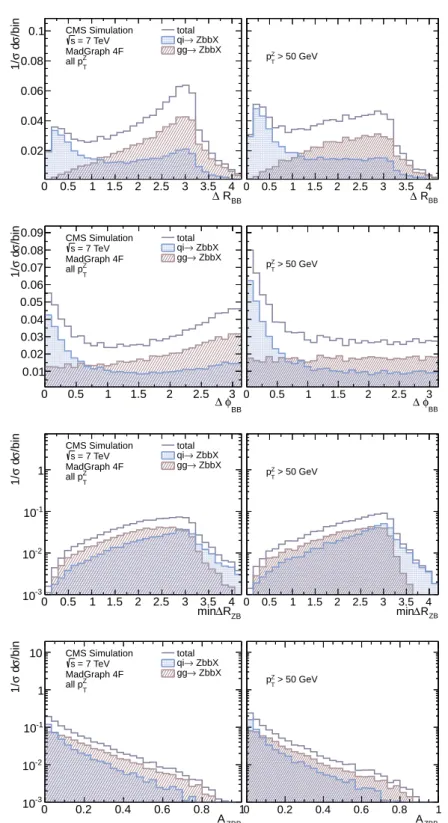
The contribution of the qi → ZbbX subprocesses to the total production is illustrated in Fig. 2 as a function of each of the four variables described above. The distributions are shown for both the nonboosted (all pZT) and the boosted (pZT > 50 GeV) regions of the Z transverse mo-mentum. For all the variables, the contribution of the qi → ZbbX subprocesses differs from the contribution of gg → ZbbX. The qi → ZbbX subprocesses are dominant in the following regions: ∆RBB<1,∆φBB<0.75, min∆RZB >3.2, and AZBB<0.05.
In this analysis, the differential production cross sections for the process pp → ZbbX (hence-forth the processes are denoted by their final state, here “Zbb”) as functions of the four kine-matic variables listed above are evaluated from CMS data. These cross sections are given at the hadron level and compared to the predictions provided by several of the Monte Carlo (MC) generators mentioned above. The total cross section is also measured. The results are given for different regions of pZT. Because of the limited size of the available data sample, the differential measurements are calculated in the nonboosted and boosted regions. The total cross section is evaluated for pZT larger than 0, 40, 80, and 120 GeV. Z bosons are reconstructed in the e+e− and µ+µ−decay modes. The analysis exploits the full 2011 data set recorded at
√
s = 7 TeV, corresponding to an integrated luminosity of (5.2±0.1)fb−1. Measurements of the Z-boson production cross section in association with one or two b-tagged jets at the LHC have been reported previously by the ATLAS and CMS Collaborations [20, 21].
ZBB A 0 0.1 0.2 0.3 0.4 0.5 0.6 0.7 0.8 0.9 1 /bin σ d σ 1/ BB R ∆ 0 0.5 1 1.5 2 2.5 3 3.5 4 /bin σ d σ 1/ 0.02 0.04 0.06 0.08 0.1 total ZbbX → qi ZbbX → gg CMS Simulation = 7 TeV s MadGraph 4F Z T all p BB R ∆ 0 0.5 1 1.5 2 2.5 3 3.5 4 /bin σ d σ 1/ > 50 GeV Z T p ZBB A 0 0.1 0.2 0.3 0.4 0.5 0.6 0.7 0.8 0.9 1 /bin σ d σ 1/ BB φ ∆ 0 0.5 1 1.5 2 2.5 3 /bin σ d σ 1/ 0.01 0.02 0.03 0.04 0.05 0.06 0.07 0.08 0.09 total ZbbX → qi ZbbX → gg CMS Simulation = 7 TeV s MadGraph 4F Z T all p BB φ ∆ 0 0.5 1 1.5 2 2.5 3 /bin σ d σ 1/ > 50 GeV Z T p ZBB A 0 0.1 0.2 0.3 0.4 0.5 0.6 0.7 0.8 0.9 1 /bin σ d σ 1/ ZB R ∆ min 0 0.5 1 1.5 2 2.5 3 3.5 4 /bin σ d σ 1/ -3 10 -2 10 -1 10 1 total ZbbX → qi ZbbX → gg CMS Simulation = 7 TeV s MadGraph 4F Z T all p ZB R ∆ min 0 0.5 1 1.5 2 2.5 3 3.5 4 /bin σ d σ 1/ > 50 GeV Z T p ZBB A 0 0.2 0.4 0.6 0.8 1 /bin σ d σ 1/ ZBB A 0 0.2 0.4 0.6 0.8 1 /bin σ d σ 1/ -3 10 -2 10 -1 10 1 10 total ZbbX → qi ZbbX → gg CMS Simulation = 7 TeV s MadGraph 4F Z T all p ZBB A 0 0.2 0.4 0.6 0.8 1 /bin σ d σ 1/ > 50 GeV Z T p
Figure 2: Distribution of∆RBB(first row),∆φBB(second row), min∆RZB (third row), and AZBB
(fourth row) as predicted by MADGRAPHin the four-flavour scheme, in the nonboosted (left) and boosted (right) regions of the Z transverse momentum. The component from gg→ZbbX is represented by the hatched histogram, while the contribution from qi→ZbbX subprocesses (where i=q, g) is represented by the shaded histogram. The unshaded histogram corresponds to the sum of the two components.
4 3 Event reconstruction and selection
The paper is organised as follows: the description of the CMS experiment and simulated sam-ples are given in Section 2; the event reconstruction and selection are presented in Section 3; the measurement technique is explained in Section 4; the systematic uncertainties are discussed in Section 5; the theoretical uncertainties associated with different models of Zbb production are summarized in Section 6; the results and conclusions are presented in Sections 7 and 8, respectively.
2
CMS detector and simulated samples
A detailed description of the CMS experiment can be found in Ref. [22]. The main subdetectors used in this analysis are the silicon tracker, the electromagnetic calorimeter (ECAL), and the muon system. The tracker consists of silicon pixel and strip detector modules and is immersed in a 3.8 T magnetic field, which enables the measurement of charged particle momenta over the pseudorapidity range|η| < 2.5. The electromagnetic calorimeter consists of nearly 76 000
lead tungstate crystals, which provide coverage for|η| .1.48 in a cylindrical barrel region and
1.48. |η| .3.0 in two endcap regions, except for a insensitive gap in the region 1.442< |η| <
1.566 between the ECAL barrel and endcap. Muons are identified in the range |η| < 2.4 by
gas-ionisation detectors embedded in the steel return yoke. The first level of the CMS trigger system consists of custom hardware processors and uses information from the calorimeters and muon system to select the most interesting events in less than 1 µs. The high level trigger processor farm further decreases the event rate to less than 300 Hz before data storage.
Samples of signal and background events are produced using various event generators to es-timate the signal purity, efficiency, and detector acceptance, with the CMS detector response modelled in extensive detail with GEANT4 [23].
The Zbb signal sample is produced with the MADGRAPH 1.4.8 generator in the four-flavour
approach. No b quarks are present in the initial state, while up to two additional light partons are produced in association with the Z boson and the two b quarks. The PDF set is CTEQ6L1 and the simulation of parton shower, hadronisation, and multiparton interactions is done with
PYTHIA 6.4.2.4 [24]. The background samples are Z plus jets, where the additional jets are from light quarks or gluons (u, d, c, s, g), top pair production (tt), and Z pair production. The Z+jets sample is extracted from a Drell–Yan inclusive sample produced with MADGRAPHin the five-flavour approach and interfaced with PYTHIA. The tt sample is also produced with
the MADGRAPHgenerator interfaced withPYTHIA, while the diboson ZZ sample is generated
with PYTHIA. The tune considered in PYTHIAis Z2∗, which is the Z1 tune [25] with the PDF
set changed to CTEQ6L1 and minor modifications of the underlying event modelling, namely PARP(90)=0.227 and PARP(82)=1.921.
Additional interactions per bunch crossing (pileup) are included in the simulation with the distribution of pileup interactions matching that observed in data.
3
Event reconstruction and selection
The first step of the analysis is the online event selection with the loosest available dimuon and dielectron triggers in order to enrich the sample with Z→µ+µ−and e+e−decays. The
dielec-tron trigger line requires loose elecdielec-tron identification and isolation and imposes 17 and 8 GeV transverse momentum thresholds on the two electron candidates, respectively. The transverse momentum thresholds of the muon trigger line, which changed with time to cope with increas-ing instantaneous luminosity, were initially 7 GeV on both muon candidates, then 13 or 17 GeV
on one candidate and 8 GeV on the other.
Muon candidates are then required to pass tight selection requirements to ensure high pu-rity [26]. Electron candidates are reconstructed from energy deposits in the ECAL, and must satisfy the standard CMS electron identification criteria [27]. Leptons are required to have pT > 20 GeV, and to be within the pseudorapidity range |η| < 2.4. Prompt leptons are
selected by requiring a distance of closest approach between the track and the primary pp interaction (identified as the vertex with the largest quadratic sum of its constituent tracks’ pT) smaller than 200 µm. A requirement is applied on the lepton isolation, computed using
the particle-flow technique [28], which exploits the information from all subdetectors to indi-vidually identify the particles produced in the collisions. The isolation, defined as the ratio between the scalar sum of the transverse momentum or transverse energy (ET) of the
parti-cles within a∆R < 0.4(0.3)cone around the muon (electron) and its transverse momentum,
(∑charged had.pT+∑neutral had.ET+∑photonET)/pT, must be at most 0.15. In order to ensure
that the selection is stable regarding the large and varying number of primary interactions, the charged particle-flow candidates are required to be associated with the selected primary vertex (PV). In addition, a correction is applied to subtract the energy contribution of neutral hadrons and photons produced in pileup interactions. This correction is estimated event by event from the median of the energy density distribution and applied within the isolation cone [29]. Only events with two oppositely charged same-flavour lepton candidates with invariant mass between 60 and 150 GeV are selected. The signal region is then defined as the 81 < M`` <
101 GeV interval to reduce the contamination from tt events.
Events containing b hadrons are selected by applying the inclusive vertex finder technique. The secondary vertex (SV) reconstruction on which the IVF is based is initiated by the iden-tification of a set of “seed” tracks that are significantly displaced with respect to the primary vertex. Such tracks are selected by requiring their three-dimensional impact parameter to be larger than 50 µm, and their impact parameter (IP) significance SIP = IP/σIP larger than 1.2,
where σIP is defined from the uncertainties on both the PV position and the point of closest
approach between the track and the PV. Additional tracks are clustered together with the seed tracks if they fulfil several requirements. First, the distance of closest approach of a track to the seed must not exceed 500 µm, and its significance must be smaller than 4.5. Second, the angle between the vector defined by the PV and the point of closest approach on the seed track and the seed track direction at the vertex has to be smaller than 45◦ so only forward tracks from b-hadron decays are retained. Secondary vertices are built from the seeds and clustered tracks [30].
The SV four-momentum is calculated as pSV =∑ piwhere the sum is over all tracks associated
with that vertex. The pion mass hypothesis is used for every track to obtain its energy Ei. The
vertex mass mSVis given by m2SV =ESV2 −p2SV.
The IVF technique establishes a list of b-hadron (B) candidates from the reconstructed SVs. If two SVs are present, they can potentially be the signature of a b → cX decay chain and are merged into a single B candidate if the following conditions are fulfilled: i)∆R(SV1, SV2) <0.4,
ii) the sum of the invariant masses of track candidates associated with the vertices is smaller than 5.5 GeV, and iii) cos δ>0.99, where δ is the angle between the vector from the position of the SV that is closer to the PV to the position of the other SV and the three-momentum of the vertex with larger decay length. The flight distance significance of a B candidate is calculated from the distance between the PV and SV divided by its uncertainty. More details of the SV and B candidate reconstruction can be found in Ref. [18].
6 4 Cross section measurement
dimuon invariant mass (GeV)
60 70 80 90 100 110 120 130 140 150 N(events)/(3 GeV) 0 20 40 60 80 100 120 140 160 = 7 TeV s -1 CMS L = 5.2 fb data signal+background background
dielectron invariant mass (GeV)
60 70 80 90 100 110 120 130 140 150 N(events)/(3 GeV) 0 20 40 60 80 100 120 140 160 = 7 TeV s -1 CMS L = 5.2 fb data signal+background background
Figure 3: Fit results for the dimuon (left) and dielectron (right) invariant mass distributions for events with two leptons and two B candidates selected as described in Section 3. The dashed line shows the fitted background component and the solid line the sum of the fitted signal and background components, which are described in the text. The vertical dashed lines indicate the boundaries of the signal region. The points with errors represent the data.
The flight distance L is defined as the length of the three-dimensional vector connecting the primary and secondary vertices. Its significance SLis obtained by dividing L by its uncertainty,
calculated as quadratic sum of the PV and SV position uncertainties. A b hadron candidate is retained if SL>5,|η| <2, pT >8 GeV, and invariant mass m>1.4 GeV. The B candidate mass
and flight distance significance cuts, along with the requirement of at least three tracks associ-ated with the secondary vertex, are the most effective requirements for rejecting background events from Zcc production.
Events that have exactly two B candidates are retained. The resulting dimuon and dielectron invariant masses are shown between 60 and 150 GeV in Fig. 3. In total, 330 (223) events pass all the selection requirements in the muon (electron) channel in the 81< M``<101 GeV signal
mass region. Thanks to the excellent performance of the CMS tracking system, the IVF angular resolution is approximately 0.02 for∆RBBand∆φBBand 0.03 for min∆RZBand AZBB.
The main source of background contamination in the final sample is top-quark pair produc-tion. The tt fraction is assessed from an unbinned maximum-likelihood fit to the measured dilepton invariant mass distribution as described in Section 4. The fit yields a tt contamination of approximately 30% in the inclusive event sample, and of about 23% for pZ
T >50 GeV.
The measured and simulated distributions of the most significant event properties are com-pared at the detector level, as shown in Fig. 4. The measured distributions of mass and trans-verse momentum of the leading B candidate, i.e. that with the largest pT, as well as pZT, agree
with MC predictions within uncertainties.
4
Cross section measurement
The differential and total cross sections are obtained by subtracting the background and cor-recting for detector acceptance, signal efficiency, and purity. The correction factors refer to the kinematic phase space for events with exactly two b hadrons and a lepton pair from a Z decay. The b hadrons have pT > 15 GeV and pseudorapidity |η| < 2. Each lepton has pT > 20 GeV,
|η| < 2.4, and the dilepton invariant mass is 81 < M`` < 101 GeV. The differential cross
sec-tions are measured for pZT > 0 GeV and pZT > 50 GeV. In the former case, the bin sizes are 0.7, 0.53, 0.84, and 0.2 for ∆RBB, ∆φBB, min∆RZB, and AZBB, respectively. In the latter, the
corre-1.5 2 2.5 3 3.5 4 4.5 5 5.5 N(events)/(0.56 GeV) 0 20 40 60 80 100 120 140 160 180 200 data DY+light,c DY+b TTbar diboson MC stat. uncertainty = 7 TeV s -1 CMS L = 5.2 fb
leading B-candidate mass (GeV)
1.5 2 2.5 3 3.5 4 4.5 5 5.5 data/MC 0 1 2 10 20 30 40 50 60 70 80 90 100 N(events)/(8 GeV) 0 20 40 60 80 100 120 140 160 180 200 220 dataDY+light,c DY+b TTbar diboson MC stat. uncertainty = 7 TeV s -1 CMS L = 5.2 fb (GeV) T leading B-candidate p 10 20 30 40 50 60 70 80 90 100 data/MC 0 1 2 0 20 40 60 80 100 120 140 160 180 200 220 N(events)/(15 GeV) 0 20 40 60 80 100 120 140 data DY+light,c DY+b TTbar diboson MC stat. uncertainty = 7 TeV s -1 CMS L = 5.2 fb (GeV) T Z candidate p 0 20 40 60 80 100 120 140 160 180 200 220 data/MC 0 1 2
Figure 4: Distribution of the leading B candidate invariant mass (left), transverse momentum (centre), and pZT (right) for the muon and electron channels combined, in the signal region (81 < M`` < 101 GeV). The CMS data are represented by solid points and the MC simulation
by stacked histograms. The shaded region represents the statistical uncertainty in the MC pre-diction. The fraction of signal and top background in the simulation is extracted by mean a fit (Fig. 3) and the sum is normalised to the number of entries in the data. The bottom plots show the ratio of measured and simulated numbers of entries in each bin with the MC uncertainty represented by the dotted area.
sponding values are 0.84, 0.63, 1.0, and 0.25. Since the IVF angular resolution is significantly smaller than the bin size for all the measured distributions, no unfolding procedure is applied to measure the hadron-level differential cross sections.
The hadron-level differential cross section is calculated from
σα,j = F (n µ α,j, n e α,j) · SB α,j e2Bα,j · Pα,j· 1 L, (2) where n`α,j= N ` α,j e`α,j·A`α,j, (3)
with ` = e, µ. For each bin j of the angular variable α, indicating one of the four variables defined in Section 1, the number of signal events Nα`,jis extracted from an extended unbinned maximum-likelihood fit to the lepton pair invariant mass distribution. A Breit–Wigner distri-bution convolved with a Gaussian resolution function is used for the signal and a third-degree Chebychev polynomial distribution for the background, as shown in Fig. 3. The signal shape parameters are evaluated from data while the background parameters are obtained from sim-ulation. Nα`,j is corrected for the dilepton reconstruction and selection efficiency e`α,j and ac-ceptanceA`
α,j. The corrected yields n `
α,j in the muon and electron channels are found to be in
agreement, within statistical uncertainties.
The two channels are combined into a single measurementF (nµα,j, neα,j)using the BLUE algo-rithm [31, 32], which performs a weighted average of the input values taking into account the respective uncertainties and their correlations.
The resulting yield is corrected for the b-hadron pair identification efficiency e2B
α,j, the b-hadron
purityPα,j, and the integrated luminosityL. The factorSB
α,jcorrects for events with b hadrons
8 5 Systematic uncertainties
The dilepton trigger efficiency is estimated from data with a tag-and-probe method, as a func-tion of the lepton kinematics. It is approximately 93% for the dimuon and 98% for the dielectron trigger selections. The lepton offline reconstruction and selection efficiencies, around 80% for muon and 50% for electron pairs, are obtained from simulation and are rescaled to match the values measured in data with a tag-and-probe procedure, as a function of the lepton pseudora-pidity.
The total b-hadron identification efficiency is estimated using multijet events containing semilep-tonic decays of b-hadrons and from events enriched with top quarks. In addition, a dedicated study is performed to verify that the efficiency measurements are valid for the inclusive vertex finding algorithm as well.
The efficiency for identifying b-hadron pairs, which ranges between 8% and 10%, is corrected by applying a factor of 0.88 to account for the discrepancy observed between the measured and simulated efficiency. This scale factor is measured from data, in the same way as it is done for the Simple Secondary Vertex method that identifies b hadrons inside jets [17]. This study requires the association of the vertices reconstructed with the IVF with jets and exploits the features of muons produced in semileptonic decays of the b hadrons, namely their high transverse momenta with respect to the jet axis. The purityPα,j and correction factor SBα,j are evaluated to be about 85% and 97%, respectively, based on MC simulation.
The same method is used to derive the total cross section for different ranges of pZT. The ex-tended maximum-likelihood fit and the procedure to extract the correction factors are applied to the corresponding event sample.
5
Systematic uncertainties
The following uncertainties on the differential cross sections are considered:
• Uncertainty in combined dilepton signal
The procedure to combine the muon and electron channels takes into account the systematic uncertainties on the Nα`,j yields and on the dilepton efficiency correction factors. The systematic uncertainty affecting the resulting combination is estimated by the BLUE algorithm, and is approximately±2%. More details are given below.
– Uncertainty in the signal yield
The systematic uncertainty associated with the extraction of Nα`,jfrom the extended unbinned maximum-likelihood fit is estimated by varying the shape parameters within their uncertainties. For the signal, the shape pa-rameters are the Breit–Wigner mean and width, as well as the Gaussian standard deviation. For the background, the parameters of the Cheby-chev polynomial distribution are considered. A variation of these factors leads to a signal yield uncertainty below±2%.
– Uncertainty in the trigger efficiency and the lepton efficiency scale factors The lepton reconstruction and selection efficiency corrections are com-puted with the MC simulation, and rescaled to match the efficiency values measured from data with the tag-and-probe method. The corresponding systematic uncertainty is estimated by varying the scale factors and the trigger efficiency extracted from data within their systematic uncertain-ties, mostly due to the background shape parametrisation. The resulting variation is±0.5% for the muon channel and±1% for the electron
chan-nel.
• Uncertainty in the efficiency scale factor
The scale factors between the b-hadron pair identification efficiency in data and sim-ulation are determined as a function of the jet transverse momentum. The maximal deviation of the measured values from a constant leads to a±12% systematic uncer-tainty assigned to the cross section.
• Uncertainty in the purity correction factor
The purity correction factor accounts for the contamination from events with at least one reconstructed B candidate produced by a charm hadron decay or, more rarely, by a light jet. Three categories contribute to such impurity: Zbb events with a charm hadron from a sequential c decay reconstructed as b hadron, Zcc events, and Zbbc events. The uncertainty in the purity originates essentially from the Zbbc and Zcc processes, where there is no measurement related to the production of one or two charm quarks produced in association with a Z boson. We therefore provide a con-servative estimate of such uncertainty by varying the Zbbc and Zcc fractions by 50% in the simulation. The resulting uncertainty inPα,jis±2.1%.
• Bin-to-bin migrations
Possible migrations of events from one bin to the adjacent ones are accounted for as a source of systematic uncertainty. The effect varies between±1–2% for∆RBBand
min∆RZB, and±3–4% for the∆φBBand AZBBvariables. Such uncertainty does not
affect the total cross section measurement.
• Uncertainty in the luminosity
The luminosityLis known with a systematic uncertainty of±2.2% [33].
• MC statistical uncertainty
The uncertainties on the efficiency and purity corrections are dominated by the lim-ited size of the four-flavour Zbb MADGRAPHsample. The effect is evaluated in each
bin for the differential measurements, and globally for the total cross section deter-mination, and is taken as an additional source of uncertainty that varies between
±2% and±3.7%.
The systematic uncertainties are summarised in Table 1, for the differential cross sections and the total cross section measurements.
Table 1: Summary of systematic uncertainties assigned to the differential and total cross section measurements. The systematic uncertainties in Nα,jand in the dilepton efficiency are used in
the combination of the muon and electron channels, and are reported in the text.
Source Uncertainty (%)
Dilepton channel combination 2
IVF efficiency scale factors 12
B purity 2.1
Bin-to-bin migrations (∆RBB, min∆RZB) 1–2
Bin-to-bin migrations (∆φBB, AZBB) 3–4
MC statistics — Differential 2.0–3.7
MC statistics — Total 1.0–3.5
10 6 Theoretical predictions and uncertainties
Table 2: Summary of the central scale functional forms used in the different theoretical predic-tions for the factorisation (µ2F) and renormalisation (µ2R) scales. The label jets can be (u, d, s, c, b, g) for the MG5F production, while it is (u, d, c, s, g) for the MG4F one, for which the label b is mentioned explicitly to denote the b quark. mTdenotes the transverse mass.
µ2F µ2R
MG5F m2Z+p2T(jets) k2Tat each vertex splitting MG4F mT,Z·mT(b, b) k2Tat each vertex splitting (excl. b)
ALPGEN m2Z+∑jets(mjets2 +p2T,jets) k2Tat each vertex splitting (excl. b) aMC@NLO m2``0+p2T(``0) + m2 b+p2T(b) 2 + m02 b+p2T(b0) 2 =µ2F
6
Theoretical predictions and uncertainties
The measured cross sections are compared at hadron level to the predictions by the MAD -GRAPHMC, in both the five- (MG5F) and four-flavour (MG4F) approaches, and by theALPGEN
generator in the four-flavour approach.
The MG5F prediction is based on a matrix-element calculation where up to four partons are produced in association with the Z boson, the b quarks are assumed massless, the proton PDF set is CTEQ6L1, and the jet matching is performed using the standard kT-MLM scheme at a
matching scale Qmatch = 20 GeV [34]. Events with b-hadron pairs from a second partonic scattering are included.
The MG4F prediction considers massive b quarks in the matrix-element calculation with the mass set to mb = 4.7 GeV. In the matrix element two additional light partons are produced in
association with the Zbb final state. The jet matching scheme is also the kT-MLM withQmatch=
30 GeV.
TheALPGENprediction adopts the four-flavour calculation scheme, with the MLM jet matching and CTEQ5L PDF set. The matching parameters are ∆Rmatch(parton-jet) = 0.7 and pmatchT =
20 GeV. In addition to the tree-level predictions mentioned above, the measurements are com-pared to the NLO expectations by aMC@NLO, which implements the four-flavour scheme with
the MSTW2008 NLO PDF set.
The parton shower and hadronisation of all tree-level samples is obtained withPYTHIA, with pT-ordered showers, while aMC@NLOis interfaced withHERWIG. The choices of QCD
factori-sation and renormalifactori-sation scales are summarised in Table 2.
The MG5F prediction is rescaled by a k-factor of 1.23, corresponding to the ratio between the next-to-next-to-leading-order (NNLO) prediction of the inclusive Z production cross section, and the tree-level cross section from MADGRAPH. The tree-level cross section prediction for MG4F (ALPGEN) is rescaled by a k-factor obtained from the aMC@NLOcross section of 16 pb obtained for M``>30 GeV divided by the corresponding MG4F (ALPGEN) prediction.
The following uncertainties on the theoretical predictions are considered and combined quadrat-ically:
• The shape uncertainties associated with the b-quark mass, mb, for the MADGRAPH
4F prediction are assessed by varying mbbetween 4.4 and 5.0 GeV. Each distribution
is rescaled so that the normalisation matches the NLO cross section provided by aMC@NLOand the envelope is considered as the uncertainty band.
as-sessed for the MADGRAPH4F and 5F predictions by varying their values simultane-ously by a factor of two. The MADGRAPH4F (5F) distributions are rescaled so that the normalisation matches the NLO (NNLO) cross section provided by aMC@NLO
(FEWZ [35]) and the envelopes are considered as uncertainty bands.
• The uncertainties associated with the matching scale are assessed by varying it by
±15% for MADGRAPH4F and by a factor of two for the 5F case.
• The shape uncertainties associated with the choice of PDF set are found to be neg-ligible. The effect of PDF variations are included as normalisation uncertainties as described in the next item.
• For MADGRAPH4F andALPGENpredictions the normalisation uncertainty is given
by the corresponding aMC@NLO cross section uncertainty. The latter is obtained
by varying the factorisation and renormalisation scales simultaneously by a factor of two, and by replacing the MSTW2008 PDF set with CT10. For MADGRAPH 5F the normalisation uncertainty is given by the corresponding NNLO cross section uncertainty [35].
• For aMC@NLOthe uncertainty associated with the parton shower is assessed from
the difference betweenPYTHIA(D6T tune) with virtuality-ordered showers andHER -WIG.
• The statistical uncertainty due to the finite size of the simulated sample is propa-gated for all theoretical predictions.
7
Results
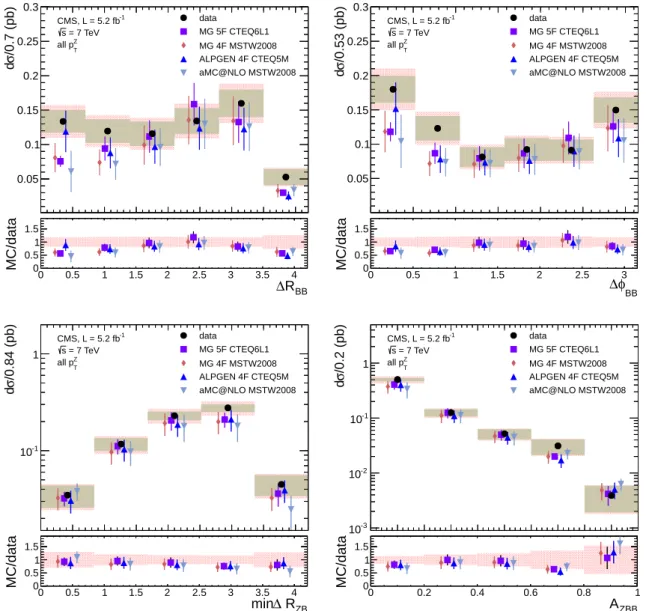
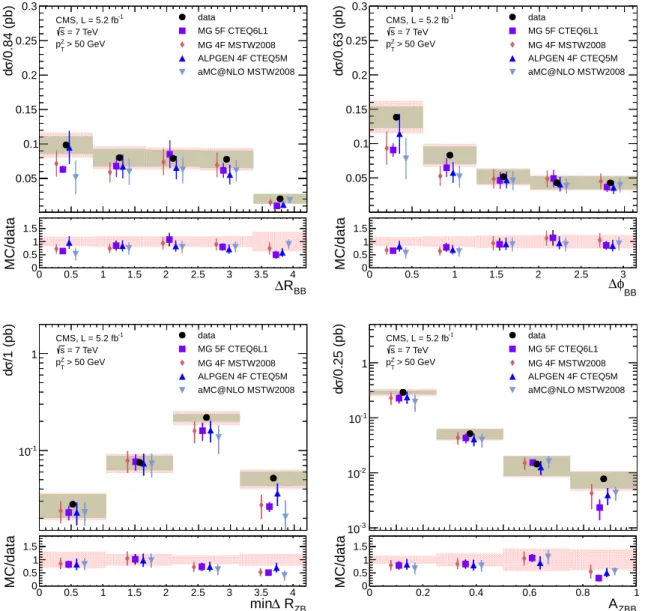
The measured differential cross sections as a function of the three angular variables and the angular asymmetry variable are shown in Figs. 5 and 6 for all pZ
T and for pZT > 50 GeV,
respec-tively. Figure 5 shows that the∆RBBcollinear region is better described byALPGEN, while the
four- and five-flavour MADGRAPHas well as aMC@NLOpredictions tend to underestimate the data. At large∆RBB, all predictions are in good agreement with the data. The fraction of the
cross section with collinear b hadrons increases for pZT > 50 GeV and in this caseALPGENalso gives the best description of the measured distributions.
Similar conclusions can be drawn from the ∆φBB distribution. In the nonboosted case, data
are above all MC predictions in the region of back-to-back b-hadron pairs by approximately one standard deviation. This discrepancy vanishes for pZT > 50 GeV. The simulated min∆RZB
and AZBB generally agree with the data. Some discrepancy is observed at min∆RZB > 2 in
both ranges of pZT, and at low AZBB. The data are found to be above the predictions primarily
in the regions where the contributions from the qi → ZbbX subprocesses are expected to be dominant, as shown in Fig. 2.
The total hadron-level cross section is shown in Fig. 7 for four different regions of pZT: for the inclusive spectrum, and for pZT > 40, 80, and 120 GeV. Data points are generally above all simulations by about 15%, apart from aMC@NLOfor which the discrepancy can be as large as
50% at large pZ T.
8
Conclusions
The first measurement of angular correlations in the process pp→ZbbX has been performed. The analysed data set corresponds to an integrated luminosity of 5.1 fb−1recorded by the CMS
12 8 Conclusions 0 0.5 1 1.5 2 2.5 3 3.5 4 /0.7 (pb) σ d 0.05 0.1 0.15 0.2 0.25 0.3 data MG 5F CTEQ6L1 MG 4F MSTW2008 ALPGEN 4F CTEQ5M aMC@NLO MSTW2008 -1 CMS, L = 5.2 fb = 7 TeV s Z T all p BB R ∆ 0 0.5 1 1.5 2 2.5 3 3.5 4 MC/data 0 0.5 1 1.5 0 0.5 1 1.5 2 2.5 3 /0.53 (pb) σ d 0.05 0.1 0.15 0.2 0.25 0.3 data MG 5F CTEQ6L1 MG 4F MSTW2008 ALPGEN 4F CTEQ5M aMC@NLO MSTW2008 -1 CMS, L = 5.2 fb = 7 TeV s Z T all p BB φ ∆ 0 0.5 1 1.5 2 2.5 3 MC/data 0 0.5 1 1.5 0 0.5 1 1.5 2 2.5 3 3.5 4 /0.84 (pb) σ d -1 10 1 data MG 5F CTEQ6L1 MG 4F MSTW2008 ALPGEN 4F CTEQ5M aMC@NLO MSTW2008 -1 CMS, L = 5.2 fb = 7 TeV s Z T all p ZB R ∆ min 0 0.5 1 1.5 2 2.5 3 3.5 4 MC/data 0 0.5 1 1.5 0 0.1 0.2 0.3 0.4 0.5 0.6 0.7 0.8 0.9 1 /0.2 (pb) σ d -3 10 -2 10 -1 10 1 data MG 5F CTEQ6L1 MG 4F MSTW2008 ALPGEN 4F CTEQ5M aMC@NLO MSTW2008 -1 CMS, L = 5.2 fb = 7 TeV s Z T all p ZBB A 0 0.2 0.4 0.6 0.8 1 MC/data 0 0.5 1 1.5
Figure 5: Differential cross sections for all pZT, as a function of∆RBB(top left),∆φBB(top right),
min∆RZB (bottom left), and AZBB (bottom right). The measured values are shown as black
points. The dotted bands correspond to the quadratic sum of statistical and systematic un-certainties. Statistical uncertainties are shown separately as solid bands. The measurements are compared to the hadron-level predictions by MADGRAPH in the four- and five-flavour
schemes, ALPGEN, and aMC@NLO. For each distribution the ratio between the Monte Carlo
predictions and the measurements is also shown, with the total experimental uncertainty indi-cated by the dotted area.
experiment in 2011 at a centre-of-mass energy of 7 TeV. Z bosons are reconstructed in the e+e− and µ+µ− decay modes. The use of the inclusive vertex finder, which exploits the excellent
CMS tracking performance, allows the full angular range to be probed, including configura-tions with collinear b hadrons.
The production cross sections are measured as functions of four angular variables:∆RBB,∆φBB,
min∆RZB, and AZBB. The measurements are compared with tree-level predictions by the MAD
0 0.5 1 1.5 2 2.5 3 3.5 4 /0.84 (pb) σ d 0.05 0.1 0.15 0.2 0.25 0.3 data MG 5F CTEQ6L1 MG 4F MSTW2008 ALPGEN 4F CTEQ5M aMC@NLO MSTW2008 -1 CMS, L = 5.2 fb = 7 TeV s > 50 GeV Z T p BB R ∆ 0 0.5 1 1.5 2 2.5 3 3.5 4 MC/data 0 0.5 1 1.5 0 0.5 1 1.5 2 2.5 3 /0.63 (pb) σ d 0.05 0.1 0.15 0.2 0.25 0.3 data MG 5F CTEQ6L1 MG 4F MSTW2008 ALPGEN 4F CTEQ5M aMC@NLO MSTW2008 -1 CMS, L = 5.2 fb = 7 TeV s > 50 GeV Z T p BB φ ∆ 0 0.5 1 1.5 2 2.5 3 MC/data 0 0.5 1 1.5 0 0.5 1 1.5 2 2.5 3 3.5 4 /1 (pb) σ d -1 10 1 data MG 5F CTEQ6L1 MG 4F MSTW2008 ALPGEN 4F CTEQ5M aMC@NLO MSTW2008 -1 CMS, L = 5.2 fb = 7 TeV s > 50 GeV Z T p ZB R ∆ min 0 0.5 1 1.5 2 2.5 3 3.5 4 MC/data 0 0.5 1 1.5 0 0.1 0.2 0.3 0.4 0.5 0.6 0.7 0.8 0.9 1 /0.25 (pb) σ d -3 10 -2 10 -1 10 1 data MG 5F CTEQ6L1 MG 4F MSTW2008 ALPGEN 4F CTEQ5M aMC@NLO MSTW2008 -1 CMS, L = 5.2 fb = 7 TeV s > 50 GeV Z T p ZBB A 0 0.2 0.4 0.6 0.8 1 MC/data 0 0.5 1 1.5
Figure 6: Differential cross sections for pZT >50 GeV, as a function of∆RBB(top left),∆φBB(top
right), min∆RZB (bottom left), and AZBB (bottom right). The measured values are shown as
black points. The dotted bands correspond to the quadratic sum of statistical and systematic uncertainties. Statistical uncertainties are shown separately as solid bands. The measurements are compared to the hadron-level predictions by MADGRAPH in the four- and five-flavour
schemes, ALPGEN, and aMC@NLO. For each distribution the ratio between the Monte Carlo
predictions and the measurements is also shown, with the total experimental uncertainty indi-cated by the dotted area.
variables most sensitive to the b-hadron production process, ∆RBB and ∆φBB, show that the
four-flavour prediction implemented inALPGENprovides the best description of CMS data.
The MG5F MC generator has been one of the standard tools used to simulate backgrounds from associated production of vector bosons and heavy quarks for Higgs boson and new physics searches as well as SM studies. The results reported here indicate that such a description may not be optimal for analyses sensitive to the production of collinear b hadrons. This fact may be particularly important in the simulation of the Wbb process, where collinear b-hadron
produc-14 8 Conclusions cut (GeV) Z T,min p cut ] (pb) Z T,m in > p Z T [ p σ -1 10 1 data MG 5F CTEQ6L1 MG 4F MSTW2008 ALPGEN 4F CTEQ5M aMC@NLO MSTW2008 -1 CMS, L=5.2 fb = 7 TeV s cut (GeV) Z T,min p MC/data 0.5 1 0 40 80 120
Figure 7: Total cross section as function of the cut on pZT. The measured values are shown as black points. The solid bands include statistical and systematic uncertainties combined quadratically. Statistical uncertainties are shown separately as dotted bands. The measure-ments are compared to the hadron-level predictions by MADGRAPH in the four- and
five-flavour scheme,ALPGEN, and aMC@NLO. The ratio between the Monte Carlo predictions and
the measurements is also shown, with the total experimental uncertainty indicated by the dot-ted area.
tion is expected to be enhanced compared to the Zbb process.
This is the first time that aMC@NLOpredictions, in which QCD contributions are computed to
NLO, have been compared with data for the Zbb process. It is found that aMC@NLO
under-estimates the cross section at low ∆RBB and ∆φBB, and at large min∆RZB. A comprehensive
assessment of the aMC@NLOpredictions requires further studies of the scale choices and par-ton shower modelling. It is worth noting that the use of NLO jet matching would also improve the precision of the prediction at small values of∆RBB.
The total hadron-level cross section σtot = σ(pp → ZbbX)B(Z → `+`−)is also evaluated in
different ranges of the Z boson transverse momentum. For the case where no cut is applied on the Z momentum, the total cross section is σtot =0.71±0.08 pb; for pZT >40 GeV, σtot =0.44±
0.05 pb; for pZ
T >80 GeV, σtot=0.17±0.02 pb; and for pZT >120 GeV, σtot =0.07±0.01 pb. The
measured values are systematically larger than MC predictions, partly because of the excess observed in the collinear∆RBBregion. The shape of the measured integrated cross section as a
function of the minimum transverse momentum of the Z boson is in good agreement with the tree-level 4F predictions, while slightly larger discrepancies are observed for MG5F and even more for aMC@NLO, particularly at large pZT.
Acknowledgements
We thank Marco Zaro for his dedication in simulating aMC@NLOsamples for this analysis. We congratulate our colleagues in the CERN accelerator departments for the excellent perfor-mance of the LHC and thank the technical and administrative staffs at CERN and at other CMS
institutes for their contributions to the success of the CMS effort. In addition, we gratefully acknowledge the computing centres and personnel of the Worldwide LHC Computing Grid for delivering so effectively the computing infrastructure essential to our analyses. Finally, we acknowledge the enduring support for the construction and operation of the LHC and the CMS detector provided by the following funding agencies: the Austrian Federal Ministry of Science and Research and the Austrian Science Fund; the Belgian Fonds de la Recherche Scien-tifique, and Fonds voor Wetenschappelijk Onderzoek; the Brazilian Funding Agencies (CNPq, CAPES, FAPERJ, and FAPESP); the Bulgarian Ministry of Education, Youth and Science; CERN; the Chinese Academy of Sciences, Ministry of Science and Technology, and National Natural Science Foundation of China; the Colombian Funding Agency (COLCIENCIAS); the Croatian Ministry of Science, Education and Sport; the Research Promotion Foundation, Cyprus; the Ministry of Education and Research, Recurrent financing contract SF0690030s09 and European Regional Development Fund, Estonia; the Academy of Finland, Finnish Ministry of Education and Culture, and Helsinki Institute of Physics; the Institut National de Physique Nucl´eaire et de Physique des Particules / CNRS, and Commissariat `a l’ ´Energie Atomique et aux ´Energies Alternatives / CEA, France; the Bundesministerium f ¨ur Bildung und Forschung, Deutsche Forschungsgemeinschaft, and Helmholtz-Gemeinschaft Deutscher Forschungszentren, Germany; the General Secretariat for Research and Technology, Greece; the National Scientific Research Foundation, and National Office for Research and Technology, Hungary; the Department of Atomic Energy and the Department of Science and Technology, India; the Institute for Stud-ies in Theoretical Physics and Mathematics, Iran; the Science Foundation, Ireland; the Istituto Nazionale di Fisica Nucleare, Italy; the Korean Ministry of Education, Science and Technology and the World Class University program of NRF, Republic of Korea; the Lithuanian Academy of Sciences; the Mexican Funding Agencies (CINVESTAV, CONACYT, SEP, and UASLP-FAI); the Ministry of Science and Innovation, New Zealand; the Pakistan Atomic Energy Commission; the Ministry of Science and Higher Education and the National Science Centre, Poland; the Fundac¸˜ao para a Ciˆencia e a Tecnologia, Portugal; JINR (Armenia, Belarus, Georgia, Ukraine, Uzbekistan); the Ministry of Education and Science of the Russian Federation, the Federal Agency of Atomic Energy of the Russian Federation, Russian Academy of Sciences, and the Russian Foundation for Basic Research; the Ministry of Science and Technological Develop-ment of Serbia; the Secretar´ıa de Estado de Investigaci ´on, Desarrollo e Innovaci ´on and Pro-grama Consolider-Ingenio 2010, Spain; the Swiss Funding Agencies (ETH Board, ETH Zurich, PSI, SNF, UniZH, Canton Zurich, and SER); the National Science Council, Taipei; the Thai-land Center of Excellence in Physics, the Institute for the Promotion of Teaching Science and Technology of Thailand and the National Science and Technology Development Agency of Thailand; the Scientific and Technical Research Council of Turkey, and Turkish Atomic Energy Authority; the Science and Technology Facilities Council, UK; the US Department of Energy, and the US National Science Foundation.
Individuals have received support from the Marie-Curie programme and the European Re-search Council and EPLANET (European Union); the Leventis Foundation; the A. P. Sloan Foundation; the Alexander von Humboldt Foundation; the Belgian Federal Science Policy Of-fice; the Fonds pour la Formation `a la Recherche dans l’Industrie et dans l’Agriculture (FRIA-Belgium); the Agentschap voor Innovatie door Wetenschap en Technologie (IWT-(FRIA-Belgium); the Ministry of Education, Youth and Sports (MEYS) of Czech Republic; the Council of Science and Industrial Research, India; the Compagnia di San Paolo (Torino); the HOMING PLUS pro-gramme of Foundation for Polish Science, cofinanced by EU, Regional Development Fund; and the Thalis and Aristeia programmes cofinanced by EU-ESF and the Greek NSRF.
16 References
References
[1] ATLAS Collaboration, “Observation of a new particle in the search for the Standard Model Higgs boson with the ATLAS detector at the LHC”, Phys. Lett. B 716 (2012) 1, doi:10.1016/j.physletb.2012.08.020.
[2] CMS Collaboration, “Observation of a new boson at a mass of 125 GeV with the CMS experiment at the LHC”, Phys. Lett. B 716 (2012) 30,
doi:10.1016/j.physletb.2012.08.021, arXiv:1207.7235.
[3] J.-M. G´erard and M. Herquet, “Twisted Custodial Symmetry in Two-Higgs-Doublet Models”, Phys. Rev. Lett. 98 (2007) 251802, doi:10.1103/PhysRevLett.98.251802, arXiv:hep-ph/0703051.
[4] S. de Visscher et al., “Unconventional phenomenology of a minimal two-Higgs-doublet model”, JHEP 08 (2009) 042, doi:10.1088/1126-6708/2009/08/042,
arXiv:0904.0705.
[5] R. Dermisek, “Light CP-odd Higgs and Small tan beta Scenario in the MSSM and Beyond”, (2008). arXiv:0806.0847.
[6] R. Dermisek and J. F. Gunion, “Many light Higgs bosons in the next-to-minimal supersymmetric model”, Phys. Rev. D 79 (2009) 055014,
doi:10.1103/PhysRevD.79.055014, arXiv:0811.3537.
[7] J. Alwall et al., “MadGraph/MadEvent v4: the new web generation”, JHEP 09 (2007) 028, doi:10.1088/1126-6708/2007/09/028, arXiv:0706.2334.
[8] J. Alwall et al., “MadGraph 5: going beyond”, JHEP 06 (2011) 128, doi:10.1007/JHEP06(2011)128, arXiv:1106.0522.
[9] M. L. Mangano et al., “ALPGEN, a generator for hard multiparton processes in hadronic collisions”, JHEP 07 (2003) 001, doi:10.1088/1126-6708/2003/07/001,
arXiv:hep-ph/0206293.
[10] T. Gleisberg et al., “Event generation with SHERPA 1.1”, JHEP 02 (2009) 007, doi:10.1088/1126-6708/2009/02/007, arXiv:0811.4622.
[11] J. M. Campbell and R. K. Ellis, “Radiative corrections to Zbb production”, Phys. Rev. D
62(2000) 114012, doi:10.1103/PhysRevD.62.114012, arXiv:hep-ph/0006304. [12] F. Febres Cordero, L. Reina, and D. Wackeroth, “NLO QCD corrections to Zbb production
with massive bottom quarks at the Fermilab Tevatron”, Phys. Rev. D 78 (2008) 074014, doi:10.1103/PhysRevD.78.074014, arXiv:0806.0808.
[13] F. Febres Cordero, L. Reina, and D. Wackeroth, “W- and Z-boson production with a massive bottom-quark pair at the Large Hadron Collider”, Phys. Rev. D 80 (2009) 034015, doi:10.1103/PhysRevD.80.034015, arXiv:0906.1923.
[14] R. Frederix et al., “W and Z/γ∗boson production in association with a
bottom-antibottom pair”, JHEP 09 (2011) 061, doi:10.1007/JHEP09(2011)061, arXiv:1106.6019.
[15] S. Frixione and B. R. Webber, “Matching NLO QCD computations and parton shower simulations”, JHEP 06 (2002) 029, doi:10.1088/1126-6708/2002/06/029, arXiv:hep-ph/0204244.
[16] F. Maltoni, G. Ridolfi, and M. Ubiali, “b-initiated processes at the LHC: a reappraisal”, JHEP 07 (2012) 022, doi:10.1007/JHEP04(2013)095, arXiv:1203.6393. [17] CMS Collaboration, “Identification of b-quark jets with the CMS experiment”, JINST 8
(2013) P04013, doi:10.1088/1748-0221/8/04/P04013, arXiv:1211.4462. [18] CMS Collaboration, “Measurement of BB angular correlations based on secondary vertex
reconstruction at√s=7 TeV”, JHEP 03 (2011) 136, doi:10.1007/JHEP03(2011)136, arXiv:1102.3194.
[19] M. Rubin, G. P. Salam, and S. Sapeta, “Giant QCD K-factors beyond NLO”, JHEP 09 (2010) 084, doi:10.1007/JHEP09(2010)084, arXiv:1006.2144.
[20] ATLAS Collaboration, “Measurement of the cross-section for b−jets produced in association with a Z boson at√s=7 TeV with the ATLAS detector”, Phys. Lett. B 706 (2012) 295, doi:10.1016/j.physletb.2011.11.059, arXiv:1109.1403. [21] CMS Collaboration, “Measurement of the Z/γ√ ∗+b-jet cross section in pp collisions at
s =7 TeV”, JHEP 06 (2012) 126, doi:10.1007/JHEP06(2012)126, arXiv:1204.1643.
[22] CMS Collaboration, “The CMS experiment at the CERN LHC”, JINST 3 (2008) S08004, doi:10.1088/1748-0221/3/08/S08004.
[23] GEANT4 Collaboration, “GEANT4–a simulation toolkit”, Nucl. Instrum. Meth. A 506 (2003) 250, doi:10.1016/S0168-9002(03)01368-8.
[24] T. Sj ¨ostrand, S. Mrenna, and P. Z. Skands, “PYTHIA6.4 physics and manual”, JHEP 05
(2006) 026, doi:10.1088/1126-6708/2006/05/026, arXiv:hep-ph/0603175. [25] R. Field, “Early LHC Underlying Event Data - Findings and Surprises”, (2010).
arXiv:1010.3558.
[26] CMS Collaboration, “Performance of CMS muon reconstruction in pp collision events at√ s =7 TeV”, JINST 7 (2012) P10002, doi:10.1088/1748-0221/7/10/P10002, arXiv:1206.4071.
[27] CMS Collaboration, “Measurements of inclusive W and Z cross sections in pp collisions at√s=7 TeV”, JHEP 01 (2011) 080, doi:10.1007/JHEP01(2011)080,
arXiv:1012.2466.
[28] CMS Collaboration, “Particle-Flow Event Reconstruction in CMS and Performance for Jets, Taus, and EmissT ”, CMS Physics Analysis Summary CMS-PAS-PFT-09-001, (2009). [29] M. Cacciari and G. P. Salam, “Pileup subtraction using jet areas”, Phys. Lett. B 659 (2008)
119, doi:10.1016/j.physletb.2007.09.077, arXiv:0707.1378.
[30] W. Waltenberger, R. Fr ¨uhwirth, , and P. Vanlaer, “Adaptive vertex fitting”, J. Phys. G 34 (2007) N343, doi:10.1088/0954-3899/34/12/N01.
[31] L. Lyons, D. Gibaut, and P. Clifford, “How to combine correlated estimates of a single physical quantity”, Nucl. Instrum. Meth. A 270 (1988) 110,
doi:10.1016/0168-9002(88)90018-6.
[32] A. Valassi, “Combining correlated measurements of several different physical quantities”, Nucl. Instrum. Meth. A 500 (2003) 391, doi:10.1016/S0168-9002(03)00329-2.
18 References
[33] CMS Collaboration, “Absolute Calibration of the Luminosity Measurement at CMS: Winter 2012 Update”, CMS Physics Analysis Summary CMS-PAS-SMP-12-008, (2012). [34] J. Alwall et al., “Comparative study of various algorithms for the merging of parton
showers and matrix elements in hadronic collisions”, Eur. Phys. J. C 53 (2008) 473, doi:10.1140/epjc/s10052-007-0490-5, arXiv:0706.2569.
[35] R. Gavin, Y. Li, F. Petriello, and S. Quackenbush, “FEWZ 2.0: A code for hadronic Z production at next-to-next-to-leading order”, Comput. Phys. Commun. 182 (2011) 2388, doi:10.1016/j.cpc.2011.06.008, arXiv:1011.3540.
A
The CMS Collaboration
Yerevan Physics Institute, Yerevan, Armenia
S. Chatrchyan, V. Khachatryan, A.M. Sirunyan, A. Tumasyan
Institut f ¨ur Hochenergiephysik der OeAW, Wien, Austria
W. Adam, T. Bergauer, M. Dragicevic, J. Er ¨o, C. Fabjan1, M. Friedl, R. Fr ¨uhwirth1, V.M. Ghete, N. H ¨ormann, J. Hrubec, M. Jeitler1, W. Kiesenhofer, V. Kn ¨unz, M. Krammer1, I. Kr¨atschmer, D. Liko, I. Mikulec, D. Rabady2, B. Rahbaran, C. Rohringer, H. Rohringer, R. Sch ¨ofbeck,
J. Strauss, A. Taurok, W. Treberer-Treberspurg, W. Waltenberger, C.-E. Wulz1
National Centre for Particle and High Energy Physics, Minsk, Belarus
V. Mossolov, N. Shumeiko, J. Suarez Gonzalez
Universiteit Antwerpen, Antwerpen, Belgium
S. Alderweireldt, M. Bansal, S. Bansal, T. Cornelis, E.A. De Wolf, X. Janssen, A. Knutsson, S. Luyckx, L. Mucibello, S. Ochesanu, B. Roland, R. Rougny, Z. Staykova, H. Van Haevermaet, P. Van Mechelen, N. Van Remortel, A. Van Spilbeeck
Vrije Universiteit Brussel, Brussel, Belgium
F. Blekman, S. Blyweert, J. D’Hondt, A. Kalogeropoulos, J. Keaveney, M. Maes, A. Olbrechts, S. Tavernier, W. Van Doninck, P. Van Mulders, G.P. Van Onsem, I. Villella
Universit´e Libre de Bruxelles, Bruxelles, Belgium
B. Clerbaux, G. De Lentdecker, L. Favart, A.P.R. Gay, T. Hreus, A. L´eonard, P.E. Marage, A. Mohammadi, L. Perni`e, T. Reis, T. Seva, L. Thomas, C. Vander Velde, P. Vanlaer, J. Wang
Ghent University, Ghent, Belgium
V. Adler, K. Beernaert, L. Benucci, A. Cimmino, S. Costantini, S. Dildick, G. Garcia, B. Klein, J. Lellouch, A. Marinov, J. Mccartin, A.A. Ocampo Rios, D. Ryckbosch, M. Sigamani, N. Strobbe, F. Thyssen, M. Tytgat, S. Walsh, E. Yazgan, N. Zaganidis
Universit´e Catholique de Louvain, Louvain-la-Neuve, Belgium
S. Basegmez, C. Beluffi3, G. Bruno, R. Castello, A. Caudron, L. Ceard, C. Delaere, T. du Pree, D. Favart, L. Forthomme, A. Giammanco4, J. Hollar, P. Jez, V. Lemaitre, J. Liao, O. Militaru, C. Nuttens, D. Pagano, A. Pin, K. Piotrzkowski, A. Popov5, M. Selvaggi, J.M. Vizan Garcia
Universit´e de Mons, Mons, Belgium
N. Beliy, T. Caebergs, E. Daubie, G.H. Hammad
Centro Brasileiro de Pesquisas Fisicas, Rio de Janeiro, Brazil
G.A. Alves, M. Correa Martins Junior, T. Martins, M.E. Pol, M.H.G. Souza
Universidade do Estado do Rio de Janeiro, Rio de Janeiro, Brazil
W.L. Ald´a J ´unior, W. Carvalho, J. Chinellato6, A. Cust ´odio, E.M. Da Costa, D. De Jesus Damiao, C. De Oliveira Martins, S. Fonseca De Souza, H. Malbouisson, M. Malek, D. Matos Figueiredo, L. Mundim, H. Nogima, W.L. Prado Da Silva, A. Santoro, A. Sznajder, E.J. Tonelli Manganote6,
A. Vilela Pereira
Universidade Estadual Paulistaa, Universidade Federal do ABCb, S˜ao Paulo, Brazil
C.A. Bernardesb, F.A. Diasa,7, T.R. Fernandez Perez Tomeia, E.M. Gregoresb, C. Laganaa, P.G. Mercadanteb, S.F. Novaesa, Sandra S. Padulaa
Institute for Nuclear Research and Nuclear Energy, Sofia, Bulgaria
20 A The CMS Collaboration
University of Sofia, Sofia, Bulgaria
A. Dimitrov, R. Hadjiiska, V. Kozhuharov, L. Litov, B. Pavlov, P. Petkov
Institute of High Energy Physics, Beijing, China
J.G. Bian, G.M. Chen, H.S. Chen, C.H. Jiang, D. Liang, S. Liang, X. Meng, J. Tao, J. Wang, X. Wang, Z. Wang, H. Xiao, M. Xu
State Key Laboratory of Nuclear Physics and Technology, Peking University, Beijing, China
C. Asawatangtrakuldee, Y. Ban, Y. Guo, Q. Li, W. Li, S. Liu, Y. Mao, S.J. Qian, D. Wang, L. Zhang, W. Zou
Universidad de Los Andes, Bogota, Colombia
C. Avila, C.A. Carrillo Montoya, L.F. Chaparro Sierra, J.P. Gomez, B. Gomez Moreno, J.C. Sanabria
Technical University of Split, Split, Croatia
N. Godinovic, D. Lelas, R. Plestina8, D. Polic, I. Puljak
University of Split, Split, Croatia
Z. Antunovic, M. Kovac
Institute Rudjer Boskovic, Zagreb, Croatia
V. Brigljevic, S. Duric, K. Kadija, J. Luetic, D. Mekterovic, S. Morovic, L. Tikvica
University of Cyprus, Nicosia, Cyprus
A. Attikis, G. Mavromanolakis, J. Mousa, C. Nicolaou, F. Ptochos, P.A. Razis
Charles University, Prague, Czech Republic
M. Finger, M. Finger Jr.
Academy of Scientific Research and Technology of the Arab Republic of Egypt, Egyptian Network of High Energy Physics, Cairo, Egypt
A.A. Abdelalim9, Y. Assran10, S. Elgammal9, A. Ellithi Kamel11, M.A. Mahmoud12, A. Radi13,14
National Institute of Chemical Physics and Biophysics, Tallinn, Estonia
M. Kadastik, M. M ¨untel, M. Murumaa, M. Raidal, L. Rebane, A. Tiko
Department of Physics, University of Helsinki, Helsinki, Finland
P. Eerola, G. Fedi, M. Voutilainen
Helsinki Institute of Physics, Helsinki, Finland
J. H¨ark ¨onen, V. Karim¨aki, R. Kinnunen, M.J. Kortelainen, T. Lamp´en, K. Lassila-Perini, S. Lehti, T. Lind´en, P. Luukka, T. M¨aenp¨a¨a, T. Peltola, E. Tuominen, J. Tuominiemi, E. Tuovinen, L. Wendland
Lappeenranta University of Technology, Lappeenranta, Finland
A. Korpela, T. Tuuva
DSM/IRFU, CEA/Saclay, Gif-sur-Yvette, France
M. Besancon, S. Choudhury, F. Couderc, M. Dejardin, D. Denegri, B. Fabbro, J.L. Faure, F. Ferri, S. Ganjour, A. Givernaud, P. Gras, G. Hamel de Monchenault, P. Jarry, E. Locci, J. Malcles, L. Millischer, A. Nayak, J. Rander, A. Rosowsky, M. Titov
Laboratoire Leprince-Ringuet, Ecole Polytechnique, IN2P3-CNRS, Palaiseau, France
S. Baffioni, F. Beaudette, L. Benhabib, L. Bianchini, M. Bluj15, P. Busson, C. Charlot, N. Daci, T. Dahms, M. Dalchenko, L. Dobrzynski, A. Florent, R. Granier de Cassagnac, M. Haguenauer,
P. Min´e, C. Mironov, I.N. Naranjo, M. Nguyen, C. Ochando, P. Paganini, D. Sabes, R. Salerno, Y. Sirois, C. Veelken, A. Zabi
Institut Pluridisciplinaire Hubert Curien, Universit´e de Strasbourg, Universit´e de Haute Alsace Mulhouse, CNRS/IN2P3, Strasbourg, France
J.-L. Agram16, J. Andrea, D. Bloch, D. Bodin, J.-M. Brom, E.C. Chabert, C. Collard, E. Conte16, F. Drouhin16, J.-C. Fontaine16, D. Gel´e, U. Goerlach, C. Goetzmann, P. Juillot, A.-C. Le Bihan, P. Van Hove
Centre de Calcul de l’Institut National de Physique Nucleaire et de Physique des Particules, CNRS/IN2P3, Villeurbanne, France
S. Gadrat
Universit´e de Lyon, Universit´e Claude Bernard Lyon 1, CNRS-IN2P3, Institut de Physique Nucl´eaire de Lyon, Villeurbanne, France
S. Beauceron, N. Beaupere, G. Boudoul, S. Brochet, J. Chasserat, R. Chierici, D. Contardo, P. Depasse, H. El Mamouni, J. Fay, S. Gascon, M. Gouzevitch, B. Ille, T. Kurca, M. Lethuillier, L. Mirabito, S. Perries, L. Sgandurra, V. Sordini, Y. Tschudi, M. Vander Donckt, P. Verdier, S. Viret
Institute of High Energy Physics and Informatization, Tbilisi State University, Tbilisi, Georgia
Z. Tsamalaidze17
RWTH Aachen University, I. Physikalisches Institut, Aachen, Germany
C. Autermann, S. Beranek, B. Calpas, M. Edelhoff, L. Feld, N. Heracleous, O. Hindrichs, K. Klein, A. Ostapchuk, A. Perieanu, F. Raupach, J. Sammet, S. Schael, D. Sprenger, H. Weber, B. Wittmer, V. Zhukov5
RWTH Aachen University, III. Physikalisches Institut A, Aachen, Germany
M. Ata, J. Caudron, E. Dietz-Laursonn, D. Duchardt, M. Erdmann, R. Fischer, A. G ¨uth, T. Hebbeker, C. Heidemann, K. Hoepfner, D. Klingebiel, P. Kreuzer, M. Merschmeyer, A. Meyer, M. Olschewski, K. Padeken, P. Papacz, H. Pieta, H. Reithler, S.A. Schmitz, L. Sonnenschein, J. Steggemann, D. Teyssier, S. Th ¨uer, M. Weber
RWTH Aachen University, III. Physikalisches Institut B, Aachen, Germany
V. Cherepanov, Y. Erdogan, G. Fl ¨ugge, H. Geenen, M. Geisler, W. Haj Ahmad, F. Hoehle, B. Kargoll, T. Kress, Y. Kuessel, J. Lingemann2, A. Nowack, I.M. Nugent, L. Perchalla, O. Pooth, A. Stahl
Deutsches Elektronen-Synchrotron, Hamburg, Germany
M. Aldaya Martin, I. Asin, N. Bartosik, J. Behr, W. Behrenhoff, U. Behrens, M. Bergholz18,
A. Bethani, K. Borras, A. Burgmeier, A. Cakir, L. Calligaris, A. Campbell, F. Costanza, C. Diez Pardos, S. Dooling, T. Dorland, G. Eckerlin, D. Eckstein, G. Flucke, A. Geiser, I. Glushkov, P. Gunnellini, S. Habib, J. Hauk, G. Hellwig, D. Horton, H. Jung, M. Kasemann, P. Katsas, C. Kleinwort, H. Kluge, M. Kr¨amer, D. Kr ¨ucker, E. Kuznetsova, W. Lange, J. Leonard, K. Lipka, W. Lohmann18, B. Lutz, R. Mankel, I. Marfin, I.-A. Melzer-Pellmann, A.B. Meyer, J. Mnich, A. Mussgiller, S. Naumann-Emme, O. Novgorodova, F. Nowak, J. Olzem, H. Perrey, A. Petrukhin, D. Pitzl, R. Placakyte, A. Raspereza, P.M. Ribeiro Cipriano, C. Riedl, E. Ron, M. ¨O. Sahin, J. Salfeld-Nebgen, R. Schmidt18, T. Schoerner-Sadenius, N. Sen, M. Stein, R. Walsh, C. Wissing
University of Hamburg, Hamburg, Germany
22 A The CMS Collaboration
R.S. H ¨oing, G. Kaussen, H. Kirschenmann, R. Klanner, R. Kogler, J. Lange, I. Marchesini, T. Peiffer, N. Pietsch, D. Rathjens, C. Sander, H. Schettler, P. Schleper, E. Schlieckau, A. Schmidt, M. Schr ¨oder, T. Schum, M. Seidel, J. Sibille19, V. Sola, H. Stadie, G. Steinbr ¨uck, J. Thomsen, D. Troendle, L. Vanelderen
Institut f ¨ur Experimentelle Kernphysik, Karlsruhe, Germany
C. Barth, C. Baus, J. Berger, C. B ¨oser, E. Butz, T. Chwalek, W. De Boer, A. Descroix, A. Dierlamm, M. Feindt, M. Guthoff2, F. Hartmann2, T. Hauth2, H. Held, K.H. Hoffmann, U. Husemann, I. Katkov5, J.R. Komaragiri, A. Kornmayer2, P. Lobelle Pardo, D. Martschei, Th. M ¨uller, M. Niegel, A. N ¨urnberg, O. Oberst, J. Ott, G. Quast, K. Rabbertz, F. Ratnikov, S. R ¨ocker, F.-P. Schilling, G. Schott, H.J. Simonis, F.M. Stober, R. Ulrich, J. Wagner-Kuhr, S. Wayand, T. Weiler, M. Zeise
Institute of Nuclear and Particle Physics (INPP), NCSR Demokritos, Aghia Paraskevi, Greece
G. Anagnostou, G. Daskalakis, T. Geralis, S. Kesisoglou, A. Kyriakis, D. Loukas, A. Markou, C. Markou, E. Ntomari
University of Athens, Athens, Greece
L. Gouskos, T.J. Mertzimekis, A. Panagiotou, N. Saoulidou, E. Stiliaris
University of Io´annina, Io´annina, Greece
X. Aslanoglou, I. Evangelou, G. Flouris, C. Foudas, P. Kokkas, N. Manthos, I. Papadopoulos, E. Paradas
KFKI Research Institute for Particle and Nuclear Physics, Budapest, Hungary
G. Bencze, C. Hajdu, P. Hidas, D. Horvath20, B. Radics, F. Sikler, V. Veszpremi,
G. Vesztergombi21, A.J. Zsigmond
Institute of Nuclear Research ATOMKI, Debrecen, Hungary
N. Beni, S. Czellar, J. Molnar, J. Palinkas, Z. Szillasi
University of Debrecen, Debrecen, Hungary
J. Karancsi, P. Raics, Z.L. Trocsanyi, B. Ujvari
National Institute of Science Education and Research, Bhubaneswar, India
S.K. Swain22
Panjab University, Chandigarh, India
S.B. Beri, V. Bhatnagar, N. Dhingra, R. Gupta, M. Kaur, M.Z. Mehta, M. Mittal, N. Nishu, L.K. Saini, A. Sharma, J.B. Singh
University of Delhi, Delhi, India
Ashok Kumar, Arun Kumar, S. Ahuja, A. Bhardwaj, B.C. Choudhary, S. Malhotra, M. Naimuddin, K. Ranjan, P. Saxena, V. Sharma, R.K. Shivpuri
Saha Institute of Nuclear Physics, Kolkata, India
S. Banerjee, S. Bhattacharya, K. Chatterjee, S. Dutta, B. Gomber, Sa. Jain, Sh. Jain, R. Khurana, A. Modak, S. Mukherjee, D. Roy, S. Sarkar, M. Sharan, A.P. Singh
Bhabha Atomic Research Centre, Mumbai, India
A. Abdulsalam, D. Dutta, S. Kailas, V. Kumar, A.K. Mohanty2, L.M. Pant, P. Shukla, A. Topkar
Tata Institute of Fundamental Research - EHEP, Mumbai, India
S. Kumar, M. Maity25, G. Majumder, K. Mazumdar, G.B. Mohanty, B. Parida, K. Sudhakar, N. Wickramage26
Tata Institute of Fundamental Research - HECR, Mumbai, India
S. Banerjee, S. Dugad
Institute for Research in Fundamental Sciences (IPM), Tehran, Iran
H. Arfaei, H. Bakhshiansohi, S.M. Etesami27, A. Fahim28, H. Hesari, A. Jafari, M. Khakzad, M. Mohammadi Najafabadi, S. Paktinat Mehdiabadi, B. Safarzadeh29, M. Zeinali
University College Dublin, Dublin, Ireland
M. Grunewald
INFN Sezione di Baria, Universit`a di Barib, Politecnico di Baric, Bari, Italy
M. Abbresciaa,b, L. Barbonea,b, C. Calabriaa,b, S.S. Chhibraa,b, A. Colaleoa, D. Creanzaa,c, N. De Filippisa,c, M. De Palmaa,b, L. Fiorea, G. Iasellia,c, G. Maggia,c, M. Maggia, B. Marangellia,b, S. Mya,c, S. Nuzzoa,b, N. Pacificoa, A. Pompilia,b, G. Pugliesea,c, G. Selvaggia,b, L. Silvestrisa, G. Singha,b, R. Vendittia,b, P. Verwilligena, G. Zitoa
INFN Sezione di Bolognaa, Universit`a di Bolognab, Bologna, Italy
G. Abbiendia, A.C. Benvenutia, D. Bonacorsia,b, S. Braibant-Giacomellia,b, L. Brigliadoria,b, R. Campaninia,b, P. Capiluppia,b, A. Castroa,b, F.R. Cavalloa, M. Cuffiania,b, G.M. Dallavallea, F. Fabbria, A. Fanfania,b, D. Fasanellaa,b, P. Giacomellia, C. Grandia, L. Guiduccia,b, S. Marcellinia, G. Masettia,2, M. Meneghellia,b, A. Montanaria, F.L. Navarriaa,b, F. Odoricia, A. Perrottaa, F. Primaveraa,b, A.M. Rossia,b, T. Rovellia,b, G.P. Sirolia,b, N. Tosia,b, R. Travaglinia,b
INFN Sezione di Cataniaa, Universit`a di Cataniab, Catania, Italy
S. Albergoa,b, M. Chiorbolia,b, S. Costaa,b, F. Giordanoa,2, R. Potenzaa,b, A. Tricomia,b, C. Tuvea,b
INFN Sezione di Firenzea, Universit`a di Firenzeb, Firenze, Italy
G. Barbaglia, V. Ciullia,b, C. Civininia, R. D’Alessandroa,b, E. Focardia,b, S. Frosalia,b, E. Galloa, S. Gonzia,b, V. Goria,b, P. Lenzia,b, M. Meschinia, S. Paolettia, G. Sguazzonia, A. Tropianoa,b
INFN Laboratori Nazionali di Frascati, Frascati, Italy
L. Benussi, S. Bianco, F. Fabbri, D. Piccolo
INFN Sezione di Genovaa, Universit`a di Genovab, Genova, Italy
P. Fabbricatorea, R. Musenicha, S. Tosia,b
INFN Sezione di Milano-Bicoccaa, Universit`a di Milano-Bicoccab, Milano, Italy
A. Benagliaa, F. De Guioa,b, L. Di Matteoa,b, S. Fiorendia,b, S. Gennaia, A. Ghezzia,b, P. Govonia,b, M.T. Lucchinia,b,2, S. Malvezzia, R.A. Manzonia,b,2, A. Martellia,b,2, D. Menascea, L. Moronia,
M. Paganonia,b, D. Pedrinia, S. Ragazzia,b, N. Redaellia, T. Tabarelli de Fatisa,b
INFN Sezione di Napoli a, Universit`a di Napoli ’Federico II’ b, Universit`a della
Basilicata (Potenza)c, Universit`a G. Marconi (Roma)d, Napoli, Italy
S. Buontempoa, N. Cavalloa,c, A. De Cosaa,b, F. Fabozzia,c, A.O.M. Iorioa,b, L. Listaa, S. Meolaa,d,2, M. Merolaa, P. Paoluccia,2
INFN Sezione di Padovaa, Universit`a di Padovab, Universit`a di Trento (Trento)c, Padova,
Italy
P. Azzia, N. Bacchettaa, D. Biselloa,b, A. Brancaa,b, R. Carlina,b, P. Checchiaa, T. Dorigoa, U. Dossellia, S. Fantinela, F. Fanzagoa, M. Galantia,b,2, F. Gasparinia,b, U. Gasparinia,b, P. Giubilatoa,b, A. Gozzelinoa, K. Kanishcheva,c, S. Lacapraraa, I. Lazzizzeraa,c, M. Margonia,b,