EUROPEAN ORGANISATION FOR NUCLEAR RESEARCH (CERN)
CERN-PH-EP-2015-048
Submitted to: Physical Review Letters
Measurements of the Total and Differential Higgs Boson
Production Cross Sections Combining the
H → γγ
and
H → ZZ
∗
→ 4`
Decay Channels at
√
s = 8
TeV
with the ATLAS Detector
The ATLAS Collaboration
Abstract
Measurements of the total and differential cross sections of Higgs boson production are performed
using 20.3 fb
−1of pp collisions produced by the Large Hadron Collider at a center-of-mass energy
of
√
s = 8
TeV and recorded by the ATLAS detector. Cross sections are obtained from measured
H → γγ
and H → ZZ
∗→ 4` event yields, which are combined accounting for detector efficiencies,
fiducial acceptances and branching fractions. Differential cross sections are reported as a function of
Higgs boson transverse momentum, Higgs boson rapidity, number of jets in the event, and transverse
momentum of the leading jet. The total production cross section is determined to be σ
pp→H= 33.0 ±
5.3 (stat) ± 1.6 (sys) pb. The measurements are compared to state-of-the-art predictions.
c
2015 CERN for the benefit of the ATLAS Collaboration.
Reproduction of this article or parts of it is allowed as specified in the CC-BY-3.0 license.
Measurements of the Total and Differential Higgs Boson Production Cross Sections
Combining the H → γγ and H → ZZ
∗→ 4` Decay Channels at
√
s = 8 TeV
with the ATLAS Detector
The ATLAS Collaboration(Dated: September 7, 2015)
Measurements of the total and differential cross sections of Higgs boson production are performed using 20.3 fb−1 of pp collisions produced by the Large Hadron Collider at a center-of-mass energy
of√s = 8 TeV and recorded by the ATLAS detector. Cross sections are obtained from measured
H → γγ and H → ZZ∗→ 4` event yields, which are combined accounting for detector efficiencies, fiducial acceptances and branching fractions. Differential cross sections are reported as a function of Higgs boson transverse momentum, Higgs boson rapidity, number of jets in the event, and transverse
momentum of the leading jet. The total production cross section is determined to be σpp→H =
33.0 ± 5.3 (stat) ± 1.6 (sys) pb. The measurements are compared to state-of-the-art predictions.
PACS numbers: 13.85.Lg,13.85.Qk,14.80.Bn
This Letter presents measurements of the total and differential cross sections of inclusive Higgs boson pro-duction using 20.3 fb−1 of pp collisions produced by the Large Hadron Collider (LHC) [1] at a center-of-mass
en-ergy of√s = 8 TeV and recorded by the ATLAS
detec-tor [2]. The measured cross sections probe the properties of the Higgs boson and can be directly compared to the theoretical modeling of different Higgs boson production mechanisms, such as the most recent gluon fusion (ggF) QCD calculations. They can also be used to constrain new physics scenarios, for example using the effective field theory framework as proposed in Refs. [3–7]. The analysis uses event yields measured in the H → γγ and H → ZZ∗→ 4` decays and detector efficiencies, both de-termined as described in Refs. [8,9]. The statistical un-certainties on the Higgs boson signal yields in both chan-nels are larger than the systematic uncertainties, while the total uncertainties in the two channels are similar. Combining the analyses improves the precision of the cross-section measurements by up to 40%, and by 25-30% on average, with respect to the corresponding measure-ments in the most precise individual channel.
Distributions of the differential pp → H cross sections are reported as a function of the transverse momentum pH
Tand the rapidity |yH| of the Higgs boson, the jet
multi-plicity Njets, and the transverse momentum of the
lead-ing jet pj1T. The observables pH
T and |yH| describe the
kinematics of the Higgs boson. They are sensitive to
perturbative QCD modeling in ggF production, which is the dominant Higgs boson production mechanism in the Standard Model (SM). The |yH| distribution furthermore offers a clean probe of the gluon parton distribution func-tion (PDF) and will play a role in future PDF fits. The Njets and pj1T observables probe the theoretical modeling
of partonic radiation in ggF production as well as the overall rate and modeling of jets in vector-boson fusion (VBF) and associated Higgs boson production (VH and t¯tH). Jets produced in VBF, VH and t¯tH processes tend
to have higher transverse momenta than those produced via ggF production, however the sensitivity to measuring these contributions is weak with the current amount of data.
Cross sections are extracted using a combined like-lihood built from the signal yields in the H → γγ channel and the data and background yields in the H → ZZ∗→ 4` channel, as well as detector efficiencies,
fiducial acceptances and SM branching fractions [10]. A complementary approach, using a separate likelihood, measures the shape of the differential distributions by imposing a unity normalization constraint, which re-moves the implicit SM assumption on the branching frac-tions. For the extraction of the signal yields and the cor-rections of detector efficiencies, it is assumed that the signal in both channels is due to a narrow resonance
with a mass mH = 125.36 ± 0.41 GeV as measured by
the ATLAS Collaboration [11]. The signal yield in the H → γγ channel is obtained from fits to the diphoton mass spectra [8], and from the background subtracted data yield in a m4` mass window of 118 to 129 GeV for
the H → ZZ∗→ 4` channel [9]. The fiducial acceptance in both channels [8, 9] is derived using a set of Monte Carlo (MC) event generators. Powheg-box [12–14], in-terfaced with Pythia8 [15] for showering, is used to gen-erate ggF and VBF events, while Pythia8 is used to simulate VH and associated production with top quarks (t¯tH) and b-quarks (b¯bH). The fiducial acceptance for events with |yH| < 1.2 is approximately 72% for H → γγ,
and 55–59% for H → ZZ∗→ 4`. For higher |yH|, the
ac-ceptance decreases to 35–38% in both channels. The fidu-cial acceptance is more constant as a function of the other variables and is in the range 56–62% for the H → γγ
channel and 44–53% for the H → ZZ∗→ 4` channel.
After correcting the differential cross sections and nor-malized shapes for fiducial acceptance and branching fractions, the corresponding measurements in both chan-nels are found to be in good agreement with each other; p-values obtained from χ2 compatibility tests are in the
range 56–99%.
In the binned maximum-likelihood fit, the statisti-cal uncertainty of the H → γγ event yield is modeled using a Gaussian distribution, while the event yield
in the H → ZZ∗→ 4` channel follows a Poisson
dis-tribution due to the small sample size.
Experimen-tal and theoretical systematic uncertainties affecting the signal yields, detector efficiencies, branching fractions and fiducial acceptance corrections are taken into ac-count in the likelihood as constrained nuisance param-eters. Nuisance parameters describing the same uncer-tainty sources are treated as fully correlated between
bins and channels. Systematic uncertainties on the
H → γγ and H → ZZ∗→ 4` background estimates and
efficiency correction factors, as well as the uncertainty on the integrated luminosity, are described in detail in Refs. [8, 9]. The branching fraction uncertainty due to the assumed quark masses and other theoretical uncer-tainties are evaluated following the recommendations of Ref. [16], considering uncertainty correlations between
the H → γγ and H → ZZ∗→ 4` decay channels.
Un-certainties on the acceptance correction related to the choice of PDF set are evaluated by taking the envelope of the sum in quadratures of eigenvector variations of the baseline (CT10 [17]) and the central values of
alter-native (MSTW2008NLO [18] and NNPDF2.3 [19]) PDF
sets. Uncertainties on the acceptance correction asso-ciated with missing higher-order corrections are evalu-ated by varying the renormalization and factorization scales coherently and individually by factors of 0.5 and 2 from their nominal values, and by reweighting the pH T
distribution from Powheg-box to the prediction of the HRes 2.2 calculation [20,21]. The envelope of the max-imum deviation of the combined scale variations and the pHT reweighting is used as the systematic variation. To account for the uncertainty in the mass measurement, the Higgs boson mass is varied by ±0.4 GeV. To as-sess the systematic uncertainty due to the assumption of SM cross-section fractions of the Higgs boson production modes, the VBF and VH fractions are varied by factors of 0.5 and 2 from the SM prediction and the fraction of t¯tH is varied by factors of 0 and 5. These factors are based on current experimental bounds [22–26]. The total un-certainties on the acceptance correction range from 1% to 6%, depending on the channel, distribution and bin .
The total systematic uncertainties on the combined dif-ferential cross sections range from 4% to 12%, depending on the distribution and bin. For the kinematic variables pH
T and |y
H|, the largest systematic uncertainties on the
differential cross sections are due to the luminosity and the background estimates in both channels. For the jet variables Njets and pj1T, the largest systematic
uncertain-ties on the differential cross sections are due to the jet en-ergy scale and resolution. In the shape combination, the normalization uncertainties including luminosity, branch-ing fractions, and efficiency uncertainties do not apply.
Data LHC-XS ADDFGHLM [pb] H → pp σ 15 20 25 30 35 40 45 50 ATLAS γ γ → H H→ZZ*→4l
comb. data syst. unc.
-1 = 8 TeV, 20.3 fb s pp→H, mH = 125.4 GeV 0.1 pb ± = 3.0 XH σ XH σ + ggF σ H b b + H t t + VH = VBF + XH QCD scale uncertainty ) s α PDF+ ⊕ (scale Total uncertainty NNLO+NNLL N3LO
FIG. 1. Measured total cross section of Higgs boson produc-tion compared to two calculaproduc-tions of the ggF cross secproduc-tion. Contributions from other relevant Higgs boson production modes (VBF, VH, t¯tH, b¯bH) are added using cross sections and uncertainties from Ref. [10]. Details of the predictions are presented in TableI.
Statistical uncertainties dominate all resulting distribu-tions, ranging from 23% to 75%.
The total pp → H cross section is determined in the
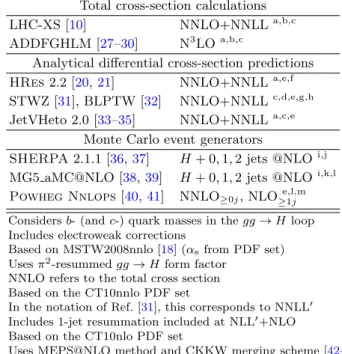
TABLE I. Summary of the ggF predictions used in the
comparison with the measured cross sections. The second
column states the order in QCD perturbation theory and which threshold resummation is applied, if any. Further de-tails are provided in the footnotes. All predictions are for
mH= 125.4 GeV and
√
s = 8 TeV.
Total cross-section calculations
LHC-XS [10] NNLO+NNLLa,b,c
ADDFGHLM [27–30] N3LOa,b,c
Analytical differential cross-section predictions
HRes 2.2 [20,21] NNLO+NNLLa,e,f
STWZ [31], BLPTW [32] NNLO+NNLLc,d,e,g,h
JetVHeto 2.0 [33–35] NNLO+NNLLa,c,e
Monte Carlo event generators
SHERPA 2.1.1 [36,37] H + 0, 1, 2 jets @NLOi,j
MG5 aMC@NLO [38,39] H + 0, 1, 2 jets @NLOi,k,l
Powheg Nnlops [40,41] NNLO≥0j, NLO≥1je,l,m a Considers b- (and c-) quark masses in the gg → H loop b Includes electroweak corrections
c Based on MSTW2008nnlo [18] (α
sfrom PDF set)
d Uses π2-resummed gg → H form factor
e NNLO refers to the total cross section
f Based on the CT10nnlo PDF set
g In the notation of Ref. [31], this corresponds to NNLL0
h Includes 1-jet resummation included at NLL0+NLO
i Based on the CT10nlo PDF set
j Uses MEPS@NLO method and CKKW merging scheme [42–44]
k Software version 2.2.1, NLO merged using FxFx scheme [39] l Interfaced with Pythia8 for parton showering
H → γγ channel to be 31.4 ± 7.2 (stat) ± 1.6 (sys) pb and in the H → ZZ∗→ 4` channel to be 35.0 ± 8.4 (stat) ±
1.8 (sys) pb. Combining the analyses yields σpp→H =
33.0 ± 5.3 (stat) ± 1.6 (sys) pb. Figure1 presents a com-parison of these measurements with two ggF predictions to which contributions from other relevant Higgs boson production modes (VBF, VH, t¯tH, b¯bH) are added us-ing cross sections and uncertainties from Ref. [10]. The LHC-XS ggF prediction, recommended in Ref. [10], is ac-curate to next-to-next-to-leading order (NNLO) in QCD and utilises threshold resummation accurate to next-to-next-to-leading logarithms (NNLL). A significant effort has been undertaken by the theory community to provide ggF cross sections beyond this precision through various improvements in the perturbative calculations [31, 47–
51]. Recently, the ADDFGHLM group has provided a
fixed-order calculation accurate to next-to-next-to-next-leading order (N3LO) [27–30]. A PDF uncertainty of +7.5
−6.9% is assigned to the LHC-XS prediction, derived
fol-lowing the recommendations in Ref. [16]. This uncer-tainty is increased by +0.3−0.1% for the ADDFGHLM pre-diction corresponding to the change in uncertainty of the MSTW2008nnlo PDF set when changing the calculation
from NNLO to N3LO. The PDF uncertainty is treated
as uncorrelated with the QCD scale uncertainty.
The central value of the measured total cross section is larger than the SM predictions presented in Fig. 1. A likelihood-ratio test statistic is used to quantify the agreement, using a bifurcated Gaussian to model the asymmetric theory uncertainties. The resulting p-values are 5.5% and 9.0% for the agreement between data and the predictions from LHC-XS and ADDFGHLM, respec-tively. The ratio of the measured cross section to the LHC-XS prediction is higher than the results presented in Refs. [22, 23, 58], which use an event categorization based on the expected SM yields in the different Higgs boson production modes.
The larger Higgs event yield observed in data moti-vates measurements of differential cross sections to in-vestigate if the excess is localized to specific kinematic regions. Figure2shows the comparison of the combined cross sections in different inclusive and exclusive jet mul-tiplicity bins with state-of-the-art predictions, including NLO-accurate multi-leg (ML) merged ggF MC event gen-erators (further details are given in Table I). Jets are reconstructed using the anti-ktalgorithm [52] with a
ra-dius parameter R = 0.4 [53], and are required to have pT > 30 GeV and |y| < 4.4. Simulated particle-level
jets are built from all particles with cτ > 10 mm exclud-ing neutrinos, electrons and muons that do not originate from hadronic decays. Photons are excluded from jet-finding if they lie inside a cone of radius ∆R < 0.1 of an electron or muon, and neither the photon nor lep-ton originate from a hadron decay. To allow compar-isons with the unfolded measurements, the analytical cal-culations are corrected for effects of hadronization and
0 1 2 3 4 5 6 [pb] σ 1 10 2 10 XH 8 + Y +P NLOPS N XH 8 + Y +P MG5_aMC@NLO XH + HERPA 2.1.1 S XH STWZ + XH BLPTW + H b b + H t t + VH = VBF + XH H → pp ATLAS
data, tot. unc. syst. unc.
-1 = 8 TeV, 20.3 fb s > 30 GeV jet T p = 0.4, R t k anti-jets N 1 ≥ ≥ 2 ≥ 3 = 0 = 1 = 2 NNLOPS Ratio to 0 2 4
FIG. 2. Measured Higgs boson production cross sections
in inclusive and exclusive jet multiplicity bins compared to different theoretical predictions (see TableI for details and references).
multiple particle interactions. These correction factors and their associated uncertainties are obtained using the
Pythia8 and Herwig [54] MC event generators with
different tunes [55–57]. The total cross sections from the ML merged predictions are lower than from fully inclusive
NNLO+NNLL calculations. However, for Njets ≥ 1, the
MC predictions formally have NLO accuracy, which is the same as the analytical calculations. Contributions from other relevant Higgs boson production modes are gener-ated using Powheg for VBF and Pythia8 for VH, t¯tH, and b¯bH, and are scaled to the cross sections in Ref. [10]. Uncertainties are assigned to all MC predictions from QCD scale and PDF variations. The ML-merged ggF predictions also have uncertainties due to the choice of merging scale. The SHERPA uncertainties further in-clude resummation scale variations. The measured cross sections are higher than the predictions for all measured jet multiplicities. The poorest agreement between data and predictions can be found in the inclusive and exclu-sive 1-jet bins, with local p-values ranging between 0.1% and 3.6%. Normalizing the total expected cross section to the data results in an improved agreement for these bins, with local p-values ranging from 4-29%.
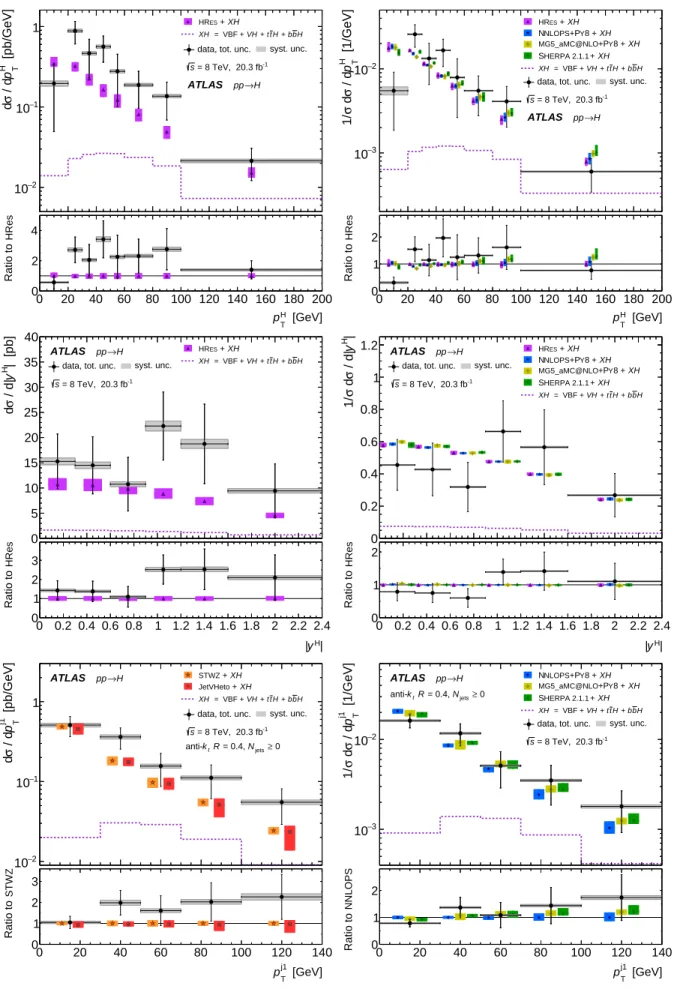
The combined differential cross sections as a function of pH
T, |y
H|, and pj1
T are shown in Fig. 3 (left). The
measured pH
T and |yH| distributions are compared to
the HRes calculation and the pj1T measurement is
com-pared to STWZ and JetVHeto predictions. Figure 3
(right) shows the comparisons of the normalized shapes to predictions from the MC event generators NNLOPS,
0 20 40 60 80 100 120 140 160 180 200 [pb/GeV] H T p / d σ d 2 − 10 1 − 10 1 HRES + XH H b b + H t t + VH = VBF + XH H → pp ATLAS
data, tot. unc. syst. unc.
-1 = 8 TeV, 20.3 fb s [GeV] H T p 0 20 40 60 80 100 120 140 160 180 200 HRes Ratio to 0 2 4 0 20 40 60 80 100 120 140 160 180 200 [1/GeV] H T p / d σ d σ 1/ 3 − 10 2 − 10 XH + ES HR XH 8 + Y +P NLOPS N XH 8 + Y +P MG5_aMC@NLO XH + HERPA 2.1.1 S H b b + H t t + VH = VBF + XH H → pp ATLAS
data, tot. unc. syst. unc.
-1 = 8 TeV, 20.3 fb s [GeV] H T p 0 20 40 60 80 100 120 140 160 180 200 HRes Ratio to 0 1 2 0 0.2 0.4 0.6 0.8 1 1.2 1.4 1.6 1.8 2 2.2 2.4 | [pb] H y / d| σ d 0 5 10 15 20 25 30 35 40 XH + ES HR H b b + H t t + VH = VBF + XH H → pp ATLAS
data, tot. unc. syst. unc.
-1 = 8 TeV, 20.3 fb s | H y | 0 0.2 0.4 0.6 0.8 1 1.2 1.4 1.6 1.8 2 2.2 2.4 HRes Ratio to 0 1 2 3 0 0.2 0.4 0.6 0.8 1 1.2 1.4 1.6 1.8 2 2.2 2.4 | H y / d| σ d σ 1/ 0 0.2 0.4 0.6 0.8 1 1.2 HRES + XH XH 8 + Y +P NLOPS N XH 8 + Y +P MG5_aMC@NLO XH + HERPA 2.1.1 S H b b + H t t + VH = VBF + XH H → pp ATLAS
data, tot. unc. syst. unc.
-1 = 8 TeV, 20.3 fb s | H y | 0 0.2 0.4 0.6 0.8 1 1.2 1.4 1.6 1.8 2 2.2 2.4 HRes Ratio to 0 1 2 0 20 40 60 80 100 120 140 [pb/GeV] j1 T p / d σ d 2 − 10 1 − 10 1 XH + STWZ XH + JetVHeto H b b + H t t + VH = VBF + XH H → pp ATLAS
data, tot. unc. syst. unc.
-1 = 8 TeV, 20.3 fb s 0 ≥ jets N = 0.4, R t k [GeV] j1 T p 0 20 40 60 80 100 120 140 STWZ Ratio to 0 1 2 3 0 20 40 60 80 100 120 140 [1/GeV] j1 T p / d σ d σ 1/ 3 − 10 2 − 10 XH 8 + Y +P NLOPS N XH 8 + Y +P MG5_aMC@NLO XH + HERPA 2.1.1 S H b b + H t t + VH = VBF + XH H → pp ATLAS
data, tot. unc. syst. unc.
-1 = 8 TeV, 20.3 fb s 0 ≥ jets N = 0.4, R t k [GeV] j1 T p 0 20 40 60 80 100 120 140 NNLOPS Ratio to 0 1 2
FIG. 3. Differential cross sections (left) and normalized cross-section shapes (right) for inclusive Higgs boson production
measured by combining the H → γγ and H → ZZ∗→ 4` channels. The measured variables are the Higgs boson transverse
momentum pHT(top) and its rapidity |yH| (middle), and the transverse momentum of the leading jet p j1
T(bottom). The 0–30 GeV
bin of the pj1T distributions corresponds to events without jets above 30 GeV. Various theoretical predictions are presented, using the same bin widths as the measurement.
SHERPA 2.1.1, and MG5 aMC@NLO, as well as the HRes calculation. The uncertainties on the predicted shapes are evaluated following the same approach as for the differential cross-section predictions. They are de-rived from the impact of QCD scale, merging scale and
PDF variations. The mean of the measured pH
T
distri-bution is 40.1 ± 3.0 GeV, while the means of the MC predictions range from 34 to 37 GeV.
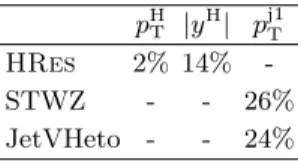
The p-values quantifying the compatibility of the mea-sured cross sections and predictions range from 2% to 26%, and for the shapes from 8% to 88%. For the calcula-tion of these values, the theory uncertainties are assumed to be Gaussian distributed and fully correlated between bins.
In conclusion, this Letter presents the first measure-ments of total and differential cross sections and shapes for inclusive pp → H production. The measurements
were performed in the H → γγ and H → ZZ∗→ 4`
channels using the full 2012 dataset, which consists of
20.3 fb−1 of pp collisions produced by the LHC at a
center-of-mass energy of √s = 8 TeV and recorded by
the ATLAS detector. The results of the two channels are compatible and have similar precision. The measure-ments indicate that the total production cross section of the Higgs boson is larger, and that it is produced with larger transverse momentum and more associated jets than predicted by the current most advanced SM cal-culations, however more data is needed to confirm these observations.
We thank CERN for the very successful operation of the LHC, as well as the support staff from our institutions without whom ATLAS could not be operated efficiently. We acknowledge the support of ANPCyT, Argentina; YerPhI, Armenia; ARC, Australia; BMWFW and FWF, Austria; ANAS, Azerbaijan; SSTC, Belarus; CNPq and FAPESP, Brazil; NSERC, NRC and CFI, Canada; CERN; CONICYT, Chile; CAS, MOST and NSFC, China; COLCIENCIAS, Colombia; MSMT CR, MPO CR and VSC CR, Czech Republic; DNRF, DNSRC and Lundbeck Foundation, Denmark; EPLANET, ERC
and NSRF, European Union; IN2P3-CNRS,
CEA-DSM/IRFU, France; GNSF, Georgia; BMBF, DFG, HGF, MPG and AvH Foundation, Germany; GSRT and NSRF, Greece; RGC, Hong Kong SAR, China; ISF, MINERVA, GIF, I-CORE and Benoziyo Center, Israel; INFN, Italy; MEXT and JSPS, Japan; CNRST, Mo-rocco; FOM and NWO, Netherlands; BRF and RCN, Norway; MNiSW and NCN, Poland; GRICES and FCT, Portugal; MNE/IFA, Romania; MES of Russia and NRC KI, Russian Federation; JINR; MSTD, Serbia; MSSR,
Slovakia; ARRS and MIZˇS, Slovenia; DST/NRF, South
Africa; MINECO, Spain; SRC and Wallenberg Foun-dation, Sweden; SER, SNSF and Cantons of Bern and Geneva, Switzerland; NSC, Taiwan; TAEK, Turkey; STFC, the Royal Society and Leverhulme Trust, United
Kingdom; DOE and NSF, United States of America. The crucial computing support from all WLCG part-ners is acknowledged gratefully, in particular from CERN and the ATLAS Tier-1 facilities at TRIUMF (Canada), NDGF (Denmark, Norway, Sweden), CC-IN2P3 (France), KIT/GridKA (Germany), INFN-CNAF (Italy), NL-T1 (Netherlands), PIC (Spain), ASGC (Tai-wan), RAL (UK) and BNL (USA) and in the Tier-2 fa-cilities worldwide.
[1] L. Evans and P. Bryant, JINST 3 (2008) S08001. [2] ATLAS Collaboration, JINST 3 (2008) S08003. [3] G. Giudice, C. Grojean, A. Pomarol, and R. Rattazzi,
J. High Energy Phys. 06 (2007) 045, arXiv:hep-ph/0703164 [hep-ph].
[4] B. Grzadkowski, M. Iskrzynski, M. Misiak, and J. Rosiek, J. High Energy Phys. 10 (2010) 085, arXiv:1008.4884 [hep-ph].
[5] R. Contino, M. Ghezzi, C. Grojean, M. Muhlleitner, and M. Spira, J. High Energy Phys. 07 (2013) 035, arXiv:1303.3876 [hep-ph].
[6] J. Ellis, V. Sanz, and T. You, J. High Energy Phys. 03
(2015) 157,arXiv:1410.7703 [hep-ph].
[7] C. Englert and M. Spannowsky, Phys. Lett. B 740 (2015) 8–15,arXiv:1408.5147 [hep-ph].
[8] ATLAS Collaboration, J. High Energy Phys. 09 (2014) 112,arXiv:1407.4222 [hep-ex].
[9] ATLAS Collaboration, Phys. Lett. B 738 (2014)
234–253,arXiv:1408.3226 [hep-ex].
[10] LHC Higgs cross section working group, S. Dittmaier, C. Mariotti, G. Passarino, and R. Tanaka (Eds.),
CERN-2011-002 (2011),arXiv:1101.0593 [hep-ph].
[11] ATLAS Collaboration, Phys. Rev. D 90 (2014) 052004, arXiv:1406.3827 [hep-ex].
[12] P. Nason, J. High Energy Phys. 11 (2004) 040, arXiv:hep-ph/0409146.
[13] S. Frixione, P. Nason, and C. Oleari, J. High Energy
Phys. 11 (2007) 070,arXiv:0709.2092 [hep-ph].
[14] S. Alioli, P. Nason, C. Oleari, and E. Re, J. High Energy
Phys. 06 (2010) 043,arXiv:1002.2581 [hep-ph].
[15] T. Sj¨ostrand, S. Mrenna, and P. Z. Skands, Comput.
Phys. Commun. 178 (2008) 852–867,arXiv:0710.3820
[hep-ph].
[16] LHC Higgs Cross Section Working Group, S. Heinemeyer, C. Mariotti, G. Passarino, and R. Tanaka (Eds.), CERN-2013-004 (2013), arXiv:1307.1347 [hep-ph].
[17] H.-L. Lai et al., Phys. Rev. D 82 (2010) 074024, arXiv:1007.2241 [hep-ph].
[18] A. D. Martin, W. J. Stirling, R. S. Thorne, and G. Watt, Eur. Phys. J. C 63 (2009) 189–285, arXiv:0901.0002 [hep-ph].
[19] R. D. Ball et al., Nucl. Phys. B 849 (2011) 296–363, arXiv:1101.1300 [hep-ph].
[20] D. de Florian, G. Ferrera, M. Grazzini, and
D. Tommasini, J. High Energy Phys. 06 (2012) 132, arXiv:1203.6321 [hep-ph].
[21] M. Grazzini and H. Sargsyan, J. High Energy Phys. 09
[22] ATLAS Collaboration, Phys. Rev. D 90 (2014) 112015, arXiv:1408.7084 [hep-ex].
[23] ATLAS Collaboration, Phys. Rev. D 91 (2015) 012006, arXiv:1408.5191 [hep-ex].
[24] ATLAS Collaboration,arXiv:1412.2641 [hep-ex].
[25] ATLAS Collaboration, Phys. Lett. B 740 (2015)
222–242,arXiv:1409.3122 [hep-ex].
[26] CMS Collaboration, J. High Energy Phys. 09 (2014) 087,arXiv:1408.1682 [hep-ex].
[27] C. Anastasiou, S. Buehler, F. Herzog, and
A. Lazopoulos, J. High Energy Phys. 12 (2011) 058, arXiv:1107.0683 [hep-ph].
[28] C. Anastasiou, C. Duhr, F. Dulat, E. Furlan, T. Gehrmann, F. Herzog, and B. Mistlberger, Phys.
Lett. B 737 (2014) 325–328,arXiv:1403.4616
[hep-ph]. Predictions quoted in this paper derived by the authors using ihixs 2.0.
[29] C. Anastasiou, C. Duhr, F. Dulat, E. Furlan, T. Gehrmann, F. Herzog, and B. Mistlberger, arXiv:1411.3584 [hep-ph].
[30] C. Anastasiou, C. Duhr, F. Dulat, F. Herzog, and B. Mistlberger,arXiv:1503.06056 [hep-ph]. [31] I. W. Stewart, F. J. Tackmann, J. R. Walsh, and
S. Zuberi, Phys. Rev. D 89 (2014) 054001,
arXiv:1307.1808 [hep-ph]. Prediction quoted in this paper derived by the authors.
[32] R. Boughezal, X. Liu, F. Petriello, F. J. Tackmann, and J. R. Walsh, Phys. Rev. D 89 (2014) 074044,
arXiv:1312.4535 [hep-ph]. Predictions quoted in this paper derived by the authors.
[33] A. Banfi, P. F. Monni, G. P. Salam, and G. Zanderighi,
Phys. Rev. Lett. 109 (2012) 202001,arXiv:1206.4998
[hep-ph].
[34] A. Banfi, G. P. Salam, and G. Zanderighi, J. High
Energy Phys. 06 (2012) 159, arXiv:1203.5773
[hep-ph].
[35] A. Banfi, P. F. Monni, and G. Zanderighi, J. High
Energy Phys. 01 (2014) 097, arXiv:1308.4634
[hep-ph].
[36] T. Gleisberg et al., J. High Energy Phys. 02 (2009) 007, arXiv:0811.4622 [hep-ph].
[37] S. Hoeche, F. Krauss, and M. Sch¨onherr, Phys. Rev. D
90 (2014) 014012,arXiv:1401.7971 [hep-ph].
Predictions quoted in this paper derived by the authors. [38] J. Alwall et al., J. High Energy Phys. 07 (2014) 079,
arXiv:1405.0301 [hep-ph]. Predictions quoted in this paper derived by the authors.
[39] R. Frederix and S. Frixione, J. High Energy Phys. 12
(2012) 061,arXiv:1209.6215 [hep-ph].
[40] K. Hamilton, P. Nason, E. Re, and G. Zanderighi, J.
High Energy Phys. 10 (2013) 222,arXiv:1309.0017
[hep-ph].
[41] S. Catani and M. Grazzini, Phys. Rev. Lett. 98 (2007) 222002,arXiv:hep-ph/0703012.
[42] S. Hoeche, F. Krauss, S. Schumann, and F. Siegert, J.
High Energy Phys. 05 (2009) 053,arXiv:0903.1219
[hep-ph].
[43] S. Catani, F. Krauss, R. Kuhn, and B. Webber, J. High
Energy Phys. 11 (2001) 063,arXiv:hep-ph/0109231
[hep-ph].
[44] S. Hoeche, F. Krauss, M. Sch¨onherr, and F. Siegert, J.
High Energy Phys. 04 (2013) 027,arXiv:1207.5030
[hep-ph].
[45] M. Grazzini, J. High Energy Phys. 02 (08) 043, arXiv:0801.3232 [hep-ph].
[46] M. Grazzini and H. Sargsyan, J. High Energy Phys. 09
(2013) 129,arXiv:1306.4581 [hep-ph].
[47] V. Ahrens, T. Becher, M. Neubert, and L. L. Yang,
Phys. Lett. B 698 (2011) 271–274,arXiv:1008.3162
[hep-ph]. Prediction quoted in this paper derived by the authors using the RGHiggs 1.1 program.
[48] D. de Florian, J. Mazzitelli, S. Moch, and A. Vogt, J.
High Energy Phys. 10 (2014) 176,arXiv:1408.6277
[hep-ph]. Prediction quoted in this paper provided by the authors.
[49] R. D. Ball, M. Bonvini, S. Forte, S. Marzani, and G. Ridolfi, Nucl. Phys. B 874 (2013) 746–772, arXiv:1303.3590 [hep-ph].
[50] M. Bonvini, R. D. Ball, S. Forte, S. Marzani, and G. Ridolfi, J. Phys. G 41 (2014) 095002,
arXiv:1404.3204 [hep-ph]. Prediction quoted in this paper derived by the authors using the ggHiggs 2.0 and ResHiggs 2.2 programs.
[51] M. Bonvini and S. Marzani, J. High Energy Phys. 09
(2014) 007,arXiv:1405.3654 [hep-ph].
[52] M. Cacciari, G. P. Salam, and G. Soyez, J. High Energy
Phys. 04 (2008) 063,arXiv:0802.1189 [hep-ph].
[53] ATLAS uses a right-handed coordinate system with its origin at the nominal interaction point (IP) in the center of the detector and the z-axis along the beam pipe. The x-axis points from the IP to the center of the LHC ring, and the y-axis points upward. Cylindrical coordinates (r, φ) are used in the transverse plane, φ being the azimuthal angle around the beam pipe. The pseudorapidity is defined in terms of the polar angle θ as η = −2 ln tan(θ/2).
[54] G. Corcella et al., J. High Energy Phys. 01 (2001) 010. [55] ATLAS Collaboration, ATL-PHYS-PUB-2011-014.
https://cds.cern.ch/record/1400677.
[56] ATLAS Collaboration, ATL-PHYS-PUB-2011-009. https://cds.cern.ch/record/1363300.
[57] ATLAS Collaboration, ATL-PHYS-PUB-2011-008. https://cds.cern.ch/record/1345343.
[58] V. Khachatryan et al. [CMS Collaboration], Eur. Phys. J. C 75, no. 5, 212 (2015)arXiv:1412.8662 [hep-ex].
The ATLAS Collaboration
G. Aad85, B. Abbott113, J. Abdallah152, O. Abdinov11, R. Aben107, M. Abolins90, O.S. AbouZeid159,
H. Abramowicz154, H. Abreu153, R. Abreu30, Y. Abulaiti147a,147b, B.S. Acharya165a,165b,a, L. Adamczyk38a,
D.L. Adams25, J. Adelman108, S. Adomeit100, T. Adye131, A.A. Affolder74, T. Agatonovic-Jovin13,
J.A. Aguilar-Saavedra126a,126f, M. Agustoni17, S.P. Ahlen22, F. Ahmadov65,b, G. Aielli134a,134b,
H. Akerstedt147a,147b, T.P.A. ˚Akesson81, G. Akimoto156, A.V. Akimov96, G.L. Alberghi20a,20b, J. Albert170,
S. Albrand55, M.J. Alconada Verzini71, M. Aleksa30, I.N. Aleksandrov65, C. Alexa26a, G. Alexander154,
T. Alexopoulos10, M. Alhroob113, G. Alimonti91a, L. Alio85, J. Alison31, S.P. Alkire35, B.M.M. Allbrooke18,
P.P. Allport74, A. Aloisio104a,104b, A. Alonso36, F. Alonso71, C. Alpigiani76, A. Altheimer35, B. Alvarez Gonzalez90,
D. ´Alvarez Piqueras168, M.G. Alviggi104a,104b, K. Amako66, Y. Amaral Coutinho24a, C. Amelung23, D. Amidei89,
S.P. Amor Dos Santos126a,126c, A. Amorim126a,126b, S. Amoroso48, N. Amram154, G. Amundsen23,
C. Anastopoulos140, L.S. Ancu49, N. Andari30, T. Andeen35, C.F. Anders58b, G. Anders30, K.J. Anderson31, A. Andreazza91a,91b, V. Andrei58a, S. Angelidakis9, I. Angelozzi107, P. Anger44, A. Angerami35, F. Anghinolfi30, A.V. Anisenkov109,c, N. Anjos12, A. Annovi124a,124b, M. Antonelli47, A. Antonov98, J. Antos145b, F. Anulli133a, M. Aoki66, L. Aperio Bella18, G. Arabidze90, Y. Arai66, J.P. Araque126a, A.T.H. Arce45, F.A. Arduh71,
J-F. Arguin95, S. Argyropoulos42, M. Arik19a, A.J. Armbruster30, O. Arnaez30, V. Arnal82, H. Arnold48,
M. Arratia28, O. Arslan21, A. Artamonov97, G. Artoni23, S. Asai156, N. Asbah42, A. Ashkenazi154,
B. ˚Asman147a,147b, L. Asquith150, K. Assamagan25, R. Astalos145a, M. Atkinson166, N.B. Atlay142, B. Auerbach6,
K. Augsten128, M. Aurousseau146b, G. Avolio30, B. Axen15, M.K. Ayoub117, G. Azuelos95,d, M.A. Baak30,
A.E. Baas58a, C. Bacci135a,135b, H. Bachacou137, K. Bachas155, M. Backes30, M. Backhaus30, E. Badescu26a,
P. Bagiacchi133a,133b, P. Bagnaia133a,133b, Y. Bai33a, T. Bain35, J.T. Baines131, O.K. Baker177, P. Balek129,
T. Balestri149, F. Balli84, E. Banas39, Sw. Banerjee174, A.A.E. Bannoura176, H.S. Bansil18, L. Barak30,
S.P. Baranov96, E.L. Barberio88, D. Barberis50a,50b, M. Barbero85, T. Barillari101, M. Barisonzi165a,165b,
T. Barklow144, N. Barlow28, S.L. Barnes84, B.M. Barnett131, R.M. Barnett15, Z. Barnovska5, A. Baroncelli135a,
G. Barone49, A.J. Barr120, F. Barreiro82, J. Barreiro Guimar˜aes da Costa57, R. Bartoldus144, A.E. Barton72,
P. Bartos145a, A. Bassalat117, A. Basye166, R.L. Bates53, S.J. Batista159, J.R. Batley28, M. Battaglia138,
M. Bauce133a,133b, F. Bauer137, H.S. Bawa144,e, J.B. Beacham111, M.D. Beattie72, T. Beau80, P.H. Beauchemin162, R. Beccherle124a,124b, P. Bechtle21, H.P. Beck17,f, K. Becker120, M. Becker83, S. Becker100, M. Beckingham171, C. Becot117, A.J. Beddall19c, A. Beddall19c, V.A. Bednyakov65, C.P. Bee149, L.J. Beemster107, T.A. Beermann176, M. Begel25, J.K. Behr120, C. Belanger-Champagne87, W.H. Bell49, G. Bella154, L. Bellagamba20a, A. Bellerive29, M. Bellomo86, K. Belotskiy98, O. Beltramello30, O. Benary154, D. Benchekroun136a, M. Bender100,
K. Bendtz147a,147b, N. Benekos10, Y. Benhammou154, E. Benhar Noccioli49, J.A. Benitez Garcia160b,
D.P. Benjamin45, J.R. Bensinger23, S. Bentvelsen107, L. Beresford120, M. Beretta47, D. Berge107,
E. Bergeaas Kuutmann167, N. Berger5, F. Berghaus170, J. Beringer15, C. Bernard22, N.R. Bernard86, C. Bernius110,
F.U. Bernlochner21, T. Berry77, P. Berta129, C. Bertella83, G. Bertoli147a,147b, F. Bertolucci124a,124b, C. Bertsche113,
D. Bertsche113, M.I. Besana91a, G.J. Besjes106, O. Bessidskaia Bylund147a,147b, M. Bessner42, N. Besson137,
C. Betancourt48, S. Bethke101, A.J. Bevan76, W. Bhimji46, R.M. Bianchi125, L. Bianchini23, M. Bianco30,
O. Biebel100, S.P. Bieniek78, M. Biglietti135a, J. Bilbao De Mendizabal49, H. Bilokon47, M. Bindi54, S. Binet117,
A. Bingul19c, C. Bini133a,133b, C.W. Black151, J.E. Black144, K.M. Black22, D. Blackburn139, R.E. Blair6,
J.-B. Blanchard137, J.E. Blanco77, T. Blazek145a, I. Bloch42, C. Blocker23, W. Blum83,∗, U. Blumenschein54,
G.J. Bobbink107, V.S. Bobrovnikov109,c, S.S. Bocchetta81, A. Bocci45, C. Bock100, M. Boehler48, J.A. Bogaerts30, A.G. Bogdanchikov109, C. Bohm147a, V. Boisvert77, T. Bold38a, V. Boldea26a, A.S. Boldyrev99, M. Bomben80, M. Bona76, M. Boonekamp137, A. Borisov130, G. Borissov72, S. Borroni42, J. Bortfeldt100, V. Bortolotto60a,60b,60c, K. Bos107, D. Boscherini20a, M. Bosman12, J. Boudreau125, J. Bouffard2, E.V. Bouhova-Thacker72,
D. Boumediene34, C. Bourdarios117, N. Bousson114, A. Boveia30, J. Boyd30, I.R. Boyko65, I. Bozic13, J. Bracinik18, A. Brandt8, G. Brandt15, O. Brandt58a, U. Bratzler157, B. Brau86, J.E. Brau116, H.M. Braun176,∗,
S.F. Brazzale165a,165c, K. Brendlinger122, A.J. Brennan88, L. Brenner107, R. Brenner167, S. Bressler173,
K. Bristow146c, T.M. Bristow46, D. Britton53, D. Britzger42, F.M. Brochu28, I. Brock21, R. Brock90, J. Bronner101,
G. Brooijmans35, T. Brooks77, W.K. Brooks32b, J. Brosamer15, E. Brost116, J. Brown55,
P.A. Bruckman de Renstrom39, D. Bruncko145b, R. Bruneliere48, A. Bruni20a, G. Bruni20a, M. Bruschi20a,
L. Bryngemark81, T. Buanes14, Q. Buat143, P. Buchholz142, A.G. Buckley53, S.I. Buda26a, I.A. Budagov65,
F. Buehrer48, L. Bugge119, M.K. Bugge119, O. Bulekov98, H. Burckhart30, S. Burdin74, B. Burghgrave108,
S. Burke131, I. Burmeister43, E. Busato34, D. B¨uscher48, V. B¨uscher83, P. Bussey53, C.P. Buszello167, J.M. Butler22,
A.I. Butt3, C.M. Buttar53, J.M. Butterworth78, P. Butti107, W. Buttinger25, A. Buzatu53, R. Buzykaev109,c,
L.P. Caloba24a, D. Calvet34, S. Calvet34, R. Camacho Toro49, S. Camarda42, D. Cameron119, L.M. Caminada15, R. Caminal Armadans12, S. Campana30, M. Campanelli78, A. Campoverde149, V. Canale104a,104b, A. Canepa160a, M. Cano Bret76, J. Cantero82, R. Cantrill126a, T. Cao40, M.D.M. Capeans Garrido30, I. Caprini26a, M. Caprini26a,
M. Capua37a,37b, R. Caputo83, R. Cardarelli134a, T. Carli30, G. Carlino104a, L. Carminati91a,91b, S. Caron106,
E. Carquin32a, G.D. Carrillo-Montoya8, J.R. Carter28, J. Carvalho126a,126c, D. Casadei78, M.P. Casado12,
M. Casolino12, E. Castaneda-Miranda146b, A. Castelli107, V. Castillo Gimenez168, N.F. Castro126a,g, P. Catastini57,
A. Catinaccio30, J.R. Catmore119, A. Cattai30, J. Caudron83, V. Cavaliere166, D. Cavalli91a, M. Cavalli-Sforza12,
V. Cavasinni124a,124b, F. Ceradini135a,135b, B.C. Cerio45, K. Cerny129, A.S. Cerqueira24b, A. Cerri150, L. Cerrito76,
F. Cerutti15, M. Cerv30, A. Cervelli17, S.A. Cetin19b, A. Chafaq136a, D. Chakraborty108, I. Chalupkova129,
P. Chang166, B. Chapleau87, J.D. Chapman28, D.G. Charlton18, C.C. Chau159, C.A. Chavez Barajas150,
S. Cheatham153, A. Chegwidden90, S. Chekanov6, S.V. Chekulaev160a, G.A. Chelkov65,h, M.A. Chelstowska89,
C. Chen64, H. Chen25, K. Chen149, L. Chen33d,i, S. Chen33c, X. Chen33f, Y. Chen67, H.C. Cheng89, Y. Cheng31,
A. Cheplakov65, E. Cheremushkina130, R. Cherkaoui El Moursli136e, V. Chernyatin25,∗, E. Cheu7, L. Chevalier137, V. Chiarella47, J.T. Childers6, G. Chiodini73a, A.S. Chisholm18, R.T. Chislett78, A. Chitan26a, M.V. Chizhov65, K. Choi61, S. Chouridou9, B.K.B. Chow100, V. Christodoulou78, D. Chromek-Burckhart30, M.L. Chu152,
J. Chudoba127, A.J. Chuinard87, J.J. Chwastowski39, L. Chytka115, G. Ciapetti133a,133b, A.K. Ciftci4a, D. Cinca53, V. Cindro75, I.A. Cioara21, A. Ciocio15, Z.H. Citron173, M. Ciubancan26a, A. Clark49, B.L. Clark57, P.J. Clark46, R.N. Clarke15, W. Cleland125, C. Clement147a,147b, Y. Coadou85, M. Cobal165a,165c, A. Coccaro139, J. Cochran64,
L. Coffey23, J.G. Cogan144, B. Cole35, S. Cole108, A.P. Colijn107, J. Collot55, T. Colombo58c, G. Compostella101,
P. Conde Mui˜no126a,126b, E. Coniavitis48, S.H. Connell146b, I.A. Connelly77, S.M. Consonni91a,91b, V. Consorti48,
S. Constantinescu26a, C. Conta121a,121b, G. Conti30, F. Conventi104a,j, M. Cooke15, B.D. Cooper78,
A.M. Cooper-Sarkar120, K. Copic15, T. Cornelissen176, M. Corradi20a, F. Corriveau87,k, A. Corso-Radu164,
A. Cortes-Gonzalez12, G. Cortiana101, G. Costa91a, M.J. Costa168, D. Costanzo140, D. Cˆot´e8, G. Cottin28,
G. Cowan77, B.E. Cox84, K. Cranmer110, G. Cree29, S. Cr´ep´e-Renaudin55, F. Crescioli80, W.A. Cribbs147a,147b,
M. Crispin Ortuzar120, M. Cristinziani21, V. Croft106, G. Crosetti37a,37b, T. Cuhadar Donszelmann140,
J. Cummings177, M. Curatolo47, C. Cuthbert151, H. Czirr142, P. Czodrowski3, S. D’Auria53, M. D’Onofrio74,
M.J. Da Cunha Sargedas De Sousa126a,126b, C. Da Via84, W. Dabrowski38a, A. Dafinca120, T. Dai89, O. Dale14,
F. Dallaire95, C. Dallapiccola86, M. Dam36, J.R. Dandoy31, A.C. Daniells18, M. Danninger169,
M. Dano Hoffmann137, V. Dao48, G. Darbo50a, S. Darmora8, J. Dassoulas3, A. Dattagupta61, W. Davey21, C. David170, T. Davidek129, E. Davies120,l, M. Davies154, P. Davison78, Y. Davygora58a, E. Dawe88, I. Dawson140, R.K. Daya-Ishmukhametova86, K. De8, R. de Asmundis104a, S. De Castro20a,20b, S. De Cecco80, N. De Groot106, P. de Jong107, H. De la Torre82, F. De Lorenzi64, L. De Nooij107, D. De Pedis133a, A. De Salvo133a, U. De Sanctis150,
A. De Santo150, J.B. De Vivie De Regie117, W.J. Dearnaley72, R. Debbe25, C. Debenedetti138, D.V. Dedovich65,
I. Deigaard107, J. Del Peso82, T. Del Prete124a,124b, D. Delgove117, F. Deliot137, C.M. Delitzsch49, M. Deliyergiyev75,
A. Dell’Acqua30, L. Dell’Asta22, M. Dell’Orso124a,124b, M. Della Pietra104a,j, D. della Volpe49, M. Delmastro5,
P.A. Delsart55, C. Deluca107, D.A. DeMarco159, S. Demers177, M. Demichev65, A. Demilly80, S.P. Denisov130,
D. Derendarz39, J.E. Derkaoui136d, F. Derue80, P. Dervan74, K. Desch21, C. Deterre42, P.O. Deviveiros30,
A. Dewhurst131, S. Dhaliwal107, A. Di Ciaccio134a,134b, L. Di Ciaccio5, A. Di Domenico133a,133b,
C. Di Donato104a,104b, A. Di Girolamo30, B. Di Girolamo30, A. Di Mattia153, B. Di Micco135a,135b, R. Di Nardo47,
A. Di Simone48, R. Di Sipio159, D. Di Valentino29, C. Diaconu85, M. Diamond159, F.A. Dias46, M.A. Diaz32a,
E.B. Diehl89, J. Dietrich16, S. Diglio85, A. Dimitrievska13, J. Dingfelder21, P. Dita26a, S. Dita26a, F. Dittus30,
F. Djama85, T. Djobava51b, J.I. Djuvsland58a, M.A.B. do Vale24c, D. Dobos30, M. Dobre26a, C. Doglioni49,
T. Dohmae156, J. Dolejsi129, Z. Dolezal129, B.A. Dolgoshein98,∗, M. Donadelli24d, S. Donati124a,124b,
P. Dondero121a,121b, J. Donini34, J. Dopke131, A. Doria104a, M.T. Dova71, A.T. Doyle53, E. Drechsler54, M. Dris10, E. Dubreuil34, E. Duchovni173, G. Duckeck100, O.A. Ducu26a,85, D. Duda176, A. Dudarev30, L. Duflot117,
L. Duguid77, M. D¨uhrssen30, M. Dunford58a, H. Duran Yildiz4a, M. D¨uren52, A. Durglishvili51b, D. Duschinger44, M. Dyndal38a, C. Eckardt42, K.M. Ecker101, W. Edson2, N.C. Edwards46, W. Ehrenfeld21, T. Eifert30, G. Eigen14,
K. Einsweiler15, T. Ekelof167, M. El Kacimi136c, M. Ellert167, S. Elles5, F. Ellinghaus83, A.A. Elliot170, N. Ellis30,
J. Elmsheuser100, M. Elsing30, D. Emeliyanov131, Y. Enari156, O.C. Endner83, M. Endo118, R. Engelmann149,
J. Erdmann43, A. Ereditato17, G. Ernis176, J. Ernst2, M. Ernst25, S. Errede166, E. Ertel83, M. Escalier117,
H. Esch43, C. Escobar125, B. Esposito47, A.I. Etienvre137, E. Etzion154, H. Evans61, A. Ezhilov123, L. Fabbri20a,20b,
G. Facini31, R.M. Fakhrutdinov130, S. Falciano133a, R.J. Falla78, J. Faltova129, Y. Fang33a, M. Fanti91a,91b,
A. Farbin8, A. Farilla135a, T. Farooque12, S. Farrell15, S.M. Farrington171, P. Farthouat30, F. Fassi136e,
P. Fassnacht30, D. Fassouliotis9, M. Faucci Giannelli77, A. Favareto50a,50b, L. Fayard117, P. Federic145a,
O.L. Fedin123,m, W. Fedorko169, S. Feigl30, L. Feligioni85, C. Feng33d, E.J. Feng6, H. Feng89, A.B. Fenyuk130,
R. Ferrari121a, D.E. Ferreira de Lima53, A. Ferrer168, D. Ferrere49, C. Ferretti89, A. Ferretto Parodi50a,50b, M. Fiascaris31, F. Fiedler83, A. Filipˇciˇc75, M. Filipuzzi42, F. Filthaut106, M. Fincke-Keeler170, K.D. Finelli151, M.C.N. Fiolhais126a,126c, L. Fiorini168, A. Firan40, A. Fischer2, C. Fischer12, J. Fischer176, W.C. Fisher90,
E.A. Fitzgerald23, M. Flechl48, I. Fleck142, P. Fleischmann89, S. Fleischmann176, G.T. Fletcher140, G. Fletcher76,
T. Flick176, A. Floderus81, L.R. Flores Castillo60a, M.J. Flowerdew101, A. Formica137, A. Forti84, D. Fournier117,
H. Fox72, S. Fracchia12, P. Francavilla80, M. Franchini20a,20b, D. Francis30, L. Franconi119, M. Franklin57,
M. Fraternali121a,121b, D. Freeborn78, S.T. French28, F. Friedrich44, D. Froidevaux30, J.A. Frost120, C. Fukunaga157,
E. Fullana Torregrosa83, B.G. Fulsom144, J. Fuster168, C. Gabaldon55, O. Gabizon176, A. Gabrielli20a,20b,
A. Gabrielli133a,133b, S. Gadatsch107, S. Gadomski49, G. Gagliardi50a,50b, P. Gagnon61, C. Galea106,
B. Galhardo126a,126c, E.J. Gallas120, B.J. Gallop131, P. Gallus128, G. Galster36, K.K. Gan111, J. Gao33b,85, Y. Gao46,
Y.S. Gao144,e, F.M. Garay Walls46, F. Garberson177, C. Garc´ıa168, J.E. Garc´ıa Navarro168, M. Garcia-Sciveres15,
R.W. Gardner31, N. Garelli144, V. Garonne119, C. Gatti47, A. Gaudiello50a,50b, G. Gaudio121a, B. Gaur142,
L. Gauthier95, P. Gauzzi133a,133b, I.L. Gavrilenko96, C. Gay169, G. Gaycken21, E.N. Gazis10, P. Ge33d, Z. Gecse169, C.N.P. Gee131, D.A.A. Geerts107, Ch. Geich-Gimbel21, M.P. Geisler58a, C. Gemme50a, M.H. Genest55,
S. Gentile133a,133b, M. George54, S. George77, D. Gerbaudo164, A. Gershon154, H. Ghazlane136b, B. Giacobbe20a, S. Giagu133a,133b, V. Giangiobbe12, P. Giannetti124a,124b, B. Gibbard25, S.M. Gibson77, M. Gilchriese15,
T.P.S. Gillam28, D. Gillberg30, G. Gilles34, D.M. Gingrich3,d, N. Giokaris9, M.P. Giordani165a,165c, F.M. Giorgi20a, F.M. Giorgi16, P.F. Giraud137, P. Giromini47, D. Giugni91a, C. Giuliani48, M. Giulini58b, B.K. Gjelsten119,
S. Gkaitatzis155, I. Gkialas155, E.L. Gkougkousis117, L.K. Gladilin99, C. Glasman82, J. Glatzer30, P.C.F. Glaysher46,
A. Glazov42, M. Goblirsch-Kolb101, J.R. Goddard76, J. Godlewski39, S. Goldfarb89, T. Golling49, D. Golubkov130,
A. Gomes126a,126b,126d, R. Gon¸calo126a, J. Goncalves Pinto Firmino Da Costa137, L. Gonella21,
S. Gonz´alez de la Hoz168, G. Gonzalez Parra12, S. Gonzalez-Sevilla49, L. Goossens30, P.A. Gorbounov97,
H.A. Gordon25, I. Gorelov105, B. Gorini30, E. Gorini73a,73b, A. Goriˇsek75, E. Gornicki39, A.T. Goshaw45,
C. G¨ossling43, M.I. Gostkin65, D. Goujdami136c, A.G. Goussiou139, N. Govender146b, H.M.X. Grabas138,
L. Graber54, I. Grabowska-Bold38a, P. Grafstr¨om20a,20b, K-J. Grahn42, J. Gramling49, E. Gramstad119,
S. Grancagnolo16, V. Grassi149, V. Gratchev123, H.M. Gray30, E. Graziani135a, Z.D. Greenwood79,n, K. Gregersen78,
I.M. Gregor42, P. Grenier144, J. Griffiths8, A.A. Grillo138, K. Grimm72, S. Grinstein12,o, Ph. Gris34, J.-F. Grivaz117,
J.P. Grohs44, A. Grohsjean42, E. Gross173, J. Grosse-Knetter54, G.C. Grossi79, Z.J. Grout150, L. Guan33b,
J. Guenther128, F. Guescini49, D. Guest177, O. Gueta154, E. Guido50a,50b, T. Guillemin117, S. Guindon2, U. Gul53, C. Gumpert44, J. Guo33e, S. Gupta120, P. Gutierrez113, N.G. Gutierrez Ortiz53, C. Gutschow44, C. Guyot137, C. Gwenlan120, C.B. Gwilliam74, A. Haas110, C. Haber15, H.K. Hadavand8, N. Haddad136e, P. Haefner21, S. Hageb¨ock21, Z. Hajduk39, H. Hakobyan178, M. Haleem42, J. Haley114, D. Hall120, G. Halladjian90,
G.D. Hallewell85, K. Hamacher176, P. Hamal115, K. Hamano170, M. Hamer54, A. Hamilton146a, S. Hamilton162,
G.N. Hamity146c, P.G. Hamnett42, L. Han33b, K. Hanagaki118, K. Hanawa156, M. Hance15, B. Haney122,
P. Hanke58a, R. Hanna137, J.B. Hansen36, J.D. Hansen36, M.C. Hansen21, P.H. Hansen36, K. Hara161, A.S. Hard174,
T. Harenberg176, F. Hariri117, S. Harkusha92, R.D. Harrington46, P.F. Harrison171, F. Hartjes107, M. Hasegawa67,
S. Hasegawa103, Y. Hasegawa141, A. Hasib113, S. Hassani137, S. Haug17, R. Hauser90, L. Hauswald44,
M. Havranek127, C.M. Hawkes18, R.J. Hawkings30, A.D. Hawkins81, T. Hayashi161, D. Hayden90, C.P. Hays120,
J.M. Hays76, H.S. Hayward74, S.J. Haywood131, S.J. Head18, T. Heck83, V. Hedberg81, L. Heelan8, S. Heim122,
T. Heim176, B. Heinemann15, L. Heinrich110, J. Hejbal127, L. Helary22, S. Hellman147a,147b, D. Hellmich21,
C. Helsens30, J. Henderson120, R.C.W. Henderson72, Y. Heng174, C. Hengler42, A. Henrichs177,
A.M. Henriques Correia30, S. Henrot-Versille117, G.H. Herbert16, Y. Hern´andez Jim´enez168, R. Herrberg-Schubert16,
G. Herten48, R. Hertenberger100, L. Hervas30, G.G. Hesketh78, N.P. Hessey107, J.W. Hetherly40, R. Hickling76, E. Hig´on-Rodriguez168, E. Hill170, J.C. Hill28, K.H. Hiller42, S.J. Hillier18, I. Hinchliffe15, E. Hines122,
R.R. Hinman15, M. Hirose158, D. Hirschbuehl176, J. Hobbs149, N. Hod107, M.C. Hodgkinson140, P. Hodgson140, A. Hoecker30, M.R. Hoeferkamp105, F. Hoenig100, M. Hohlfeld83, D. Hohn21, T.R. Holmes15, T.M. Hong122, L. Hooft van Huysduynen110, W.H. Hopkins116, Y. Horii103, A.J. Horton143, J-Y. Hostachy55, S. Hou152,
A. Hoummada136a, J. Howard120, J. Howarth42, M. Hrabovsky115, I. Hristova16, J. Hrivnac117, T. Hryn’ova5,
A. Hrynevich93, C. Hsu146c, P.J. Hsu152,p, S.-C. Hsu139, D. Hu35, Q. Hu33b, X. Hu89, Y. Huang42, Z. Hubacek30,
F. Hubaut85, F. Huegging21, T.B. Huffman120, E.W. Hughes35, G. Hughes72, M. Huhtinen30, T.A. H¨ulsing83,
N. Huseynov65,b, J. Huston90, J. Huth57, G. Iacobucci49, G. Iakovidis25, I. Ibragimov142, L. Iconomidou-Fayard117,
E. Ideal177, Z. Idrissi136e, P. Iengo30, O. Igonkina107, T. Iizawa172, Y. Ikegami66, K. Ikematsu142, M. Ikeno66,
Y. Ilchenko31,q, D. Iliadis155, N. Ilic159, Y. Inamaru67, T. Ince101, P. Ioannou9, M. Iodice135a, K. Iordanidou35,
V. Ippolito57, A. Irles Quiles168, C. Isaksson167, M. Ishino68, M. Ishitsuka158, R. Ishmukhametov111, C. Issever120,
S. Istin19a, J.M. Iturbe Ponce84, R. Iuppa134a,134b, J. Ivarsson81, W. Iwanski39, H. Iwasaki66, J.M. Izen41,
S. Jakobsen30, T. Jakoubek127, J. Jakubek128, D.O. Jamin152, D.K. Jana79, E. Jansen78, R.W. Jansky62,
J. Janssen21, M. Janus171, G. Jarlskog81, N. Javadov65,b, T. Jav˚urek48, L. Jeanty15, J. Jejelava51a,r, G.-Y. Jeng151, D. Jennens88, P. Jenni48,s, J. Jentzsch43, C. Jeske171, S. J´ez´equel5, H. Ji174, J. Jia149, Y. Jiang33b, S. Jiggins78,
J. Jimenez Pena168, S. Jin33a, A. Jinaru26a, O. Jinnouchi158, M.D. Joergensen36, P. Johansson140, K.A. Johns7,
K. Jon-And147a,147b, G. Jones171, R.W.L. Jones72, T.J. Jones74, J. Jongmanns58a, P.M. Jorge126a,126b, K.D. Joshi84,
J. Jovicevic160a, X. Ju174, C.A. Jung43, P. Jussel62, A. Juste Rozas12,o, M. Kaci168, A. Kaczmarska39, M. Kado117,
H. Kagan111, M. Kagan144, S.J. Kahn85, E. Kajomovitz45, C.W. Kalderon120, S. Kama40, A. Kamenshchikov130,
N. Kanaya156, M. Kaneda30, S. Kaneti28, V.A. Kantserov98, J. Kanzaki66, B. Kaplan110, A. Kapliy31, D. Kar53,
K. Karakostas10, A. Karamaoun3, N. Karastathis10,107, M.J. Kareem54, M. Karnevskiy83, S.N. Karpov65,
Z.M. Karpova65, K. Karthik110, V. Kartvelishvili72, A.N. Karyukhin130, L. Kashif174, R.D. Kass111, A. Kastanas14,
Y. Kataoka156, A. Katre49, J. Katzy42, K. Kawagoe70, T. Kawamoto156, G. Kawamura54, S. Kazama156,
V.F. Kazanin109,c, M.Y. Kazarinov65, R. Keeler170, R. Kehoe40, J.S. Keller42, J.J. Kempster77, H. Keoshkerian84,
O. Kepka127, B.P. Kerˇsevan75, S. Kersten176, R.A. Keyes87, F. Khalil-zada11, H. Khandanyan147a,147b,
A. Khanov114, A.G. Kharlamov109,c, T.J. Khoo28, V. Khovanskiy97, E. Khramov65, J. Khubua51b,t, H.Y. Kim8, H. Kim147a,147b, S.H. Kim161, Y. Kim31, N. Kimura155, O.M. Kind16, B.T. King74, M. King168, R.S.B. King120, S.B. King169, J. Kirk131, A.E. Kiryunin101, T. Kishimoto67, D. Kisielewska38a, F. Kiss48, K. Kiuchi161,
O. Kivernyk137, E. Kladiva145b, M.H. Klein35, M. Klein74, U. Klein74, K. Kleinknecht83, P. Klimek147a,147b, A. Klimentov25, R. Klingenberg43, J.A. Klinger84, T. Klioutchnikova30, P.F. Klok106, E.-E. Kluge58a, P. Kluit107,
S. Kluth101, E. Kneringer62, E.B.F.G. Knoops85, A. Knue53, D. Kobayashi158, T. Kobayashi156, M. Kobel44,
M. Kocian144, P. Kodys129, T. Koffas29, E. Koffeman107, L.A. Kogan120, S. Kohlmann176, Z. Kohout128,
T. Kohriki66, T. Koi144, H. Kolanoski16, I. Koletsou5, A.A. Komar96,∗, Y. Komori156, T. Kondo66,
N. Kondrashova42, K. K¨oneke48, A.C. K¨onig106, S. K¨onig83, T. Kono66,u, R. Konoplich110,v, N. Konstantinidis78,
R. Kopeliansky153, S. Koperny38a, L. K¨opke83, A.K. Kopp48, K. Korcyl39, K. Kordas155, A. Korn78,
A.A. Korol109,c, I. Korolkov12, E.V. Korolkova140, O. Kortner101, S. Kortner101, T. Kosek129, V.V. Kostyukhin21,
V.M. Kotov65, A. Kotwal45, A. Kourkoumeli-Charalampidi155, C. Kourkoumelis9, V. Kouskoura25,
A. Koutsman160a, R. Kowalewski170, T.Z. Kowalski38a, W. Kozanecki137, A.S. Kozhin130, V.A. Kramarenko99,
G. Kramberger75, D. Krasnopevtsev98, A. Krasznahorkay30, J.K. Kraus21, A. Kravchenko25, S. Kreiss110,
M. Kretz58c, J. Kretzschmar74, K. Kreutzfeldt52, P. Krieger159, K. Krizka31, K. Kroeninger43, H. Kroha101, J. Kroll122, J. Kroseberg21, J. Krstic13, U. Kruchonak65, H. Kr¨uger21, N. Krumnack64, Z.V. Krumshteyn65, A. Kruse174, M.C. Kruse45, M. Kruskal22, T. Kubota88, H. Kucuk78, S. Kuday4c, S. Kuehn48, A. Kugel58c,
F. Kuger175, A. Kuhl138, T. Kuhl42, V. Kukhtin65, Y. Kulchitsky92, S. Kuleshov32b, M. Kuna133a,133b, T. Kunigo68, A. Kupco127, H. Kurashige67, Y.A. Kurochkin92, R. Kurumida67, V. Kus127, E.S. Kuwertz148, M. Kuze158,
J. Kvita115, T. Kwan170, D. Kyriazopoulos140, A. La Rosa49, J.L. La Rosa Navarro24d, L. La Rotonda37a,37b,
C. Lacasta168, F. Lacava133a,133b, J. Lacey29, H. Lacker16, D. Lacour80, V.R. Lacuesta168, E. Ladygin65, R. Lafaye5,
B. Laforge80, T. Lagouri177, S. Lai48, L. Lambourne78, S. Lammers61, C.L. Lampen7, W. Lampl7, E. Lan¸con137,
U. Landgraf48, M.P.J. Landon76, V.S. Lang58a, J.C. Lange12, A.J. Lankford164, F. Lanni25, K. Lantzsch30,
S. Laplace80, C. Lapoire30, J.F. Laporte137, T. Lari91a, F. Lasagni Manghi20a,20b, M. Lassnig30, P. Laurelli47,
W. Lavrijsen15, A.T. Law138, P. Laycock74, O. Le Dortz80, E. Le Guirriec85, E. Le Menedeu12, M. LeBlanc170,
T. LeCompte6, F. Ledroit-Guillon55, C.A. Lee146b, S.C. Lee152, L. Lee1, G. Lefebvre80, M. Lefebvre170, F. Legger100,
C. Leggett15, A. Lehan74, G. Lehmann Miotto30, X. Lei7, W.A. Leight29, A. Leisos155, A.G. Leister177,
M.A.L. Leite24d, R. Leitner129, D. Lellouch173, B. Lemmer54, K.J.C. Leney78, T. Lenz21, B. Lenzi30, R. Leone7,
S. Leone124a,124b, C. Leonidopoulos46, S. Leontsinis10, C. Leroy95, C.G. Lester28, M. Levchenko123, J. Levˆeque5,
D. Levin89, L.J. Levinson173, M. Levy18, A. Lewis120, A.M. Leyko21, M. Leyton41, B. Li33b,w, H. Li149, H.L. Li31, L. Li45, L. Li33e, S. Li45, Y. Li33c,x, Z. Liang138, H. Liao34, B. Liberti134a, A. Liblong159, P. Lichard30, K. Lie166, J. Liebal21, W. Liebig14, C. Limbach21, A. Limosani151, S.C. Lin152,y, T.H. Lin83, F. Linde107, B.E. Lindquist149, J.T. Linnemann90, E. Lipeles122, A. Lipniacka14, M. Lisovyi42, T.M. Liss166, D. Lissauer25, A. Lister169,
A.M. Litke138, B. Liu152,z, D. Liu152, J. Liu85, J.B. Liu33b, K. Liu85, L. Liu166, M. Liu45, M. Liu33b, Y. Liu33b,
M. Livan121a,121b, A. Lleres55, J. Llorente Merino82, S.L. Lloyd76, F. Lo Sterzo152, E. Lobodzinska42, P. Loch7,
W.S. Lockman138, F.K. Loebinger84, A.E. Loevschall-Jensen36, A. Loginov177, T. Lohse16, K. Lohwasser42,
M. Lokajicek127, B.A. Long22, J.D. Long89, R.E. Long72, K.A. Looper111, L. Lopes126a, D. Lopez Mateos57,
B. Lopez Paredes140, I. Lopez Paz12, J. Lorenz100, N. Lorenzo Martinez61, M. Losada163, P. Loscutoff15,
P.J. L¨osel100, X. Lou33a, A. Lounis117, J. Love6, P.A. Love72, N. Lu89, H.J. Lubatti139, C. Luci133a,133b,
A. Lucotte55, F. Luehring61, W. Lukas62, L. Luminari133a, O. Lundberg147a,147b, B. Lund-Jensen148, M. Lungwitz83,
D. Lynn25, R. Lysak127, E. Lytken81, H. Ma25, L.L. Ma33d, G. Maccarrone47, A. Macchiolo101, C.M. Macdonald140,
J. Machado Miguens122,126b, D. Macina30, D. Madaffari85, R. Madar34, H.J. Maddocks72, W.F. Mader44,