The business model of long-haul low-cost carriers –
An analysis of future viability at the example of Norwegian
Air Shuttle ASA and Eurowings GmbH
Jan Meyer
Dissertation written under the supervision of Rute Xavier
Dissertation submitted in partial fulfilment of requirements for the MSc in Management (Strategy & Entrepreneurship), at the Universidade Católica Portuguesa, 08.01.2020.
- II -
Abstract
Title: The business model of long-haul low-cost carriers – An analysis of future viability at the example of Norwegian Air Shuttle ASA and Eurowings GmbH
Author: Jan Meyer
Over the last decades, low-cost carriers used to revolutionize short- and medium-haul markets globally. With the viability of their business model being proven through profitable operations, an increasing number of low-cost carriers entered the lucrative long-haul segment more recently. However, there is yet no prevalent view of the business model viability of long-haul low-cost carriers; recent events such as Wow Air’s insolvency raised strong doubts. This thesis aims at examining the future viability of the long-haul low-cost carriers’ business model by conducting an in-depth investigation of Norwegian Air Shuttle ASA’s and Eurowings GmbH’s long-haul business model. Subsequently, an innovated business model is developed. Key findings include that the business model of long-haul low-cost carriers is principally viable. However, the two selected airlines show that operating profitably remains difficult, regardless of the operating model and organizational structure. To ensure future viability, the business model needs to be innovated. In this context, a lean operating model is crucial to the success of long-haul low-cost carriers. Furthermore, new-generation, fuel-efficient narrow-body aircraft such as the Airbus A321 XLR may open up new potentials for profitable long-haul operations. Keywords: airline industry; long-haul low-cost carrier; business model viability; new-generation aircraft; business model innovation
- III -
Resumo
Título: Modelo de negócio de companhias aéreas de baixos preços em rotas de longo curso – Uma análise da viabilidade com o exemplo da Norwegian Air Shuttle ASA e Eurowings GmbH Autor: Jan Meyer
Nas últimas décadas, as companhias aéreas de baixos preços revolucionaram os mercados de rotas de curta e longa distância a nível global. A viabilidade deste modelo de negócio foi confirmada pelas suas operações rentáveis, o que recentemente suscitou um aumento no número de companhias aéreas de baixos preços a apostar no lucrativo mercado das viagens de longo curso. No entanto, não há até ao momento provas consistentes quanto à viabilidade do modelo de negócio de companhias aéreas de preços baixos em rotas de longa distância; eventos recentes tal como a insolvência da Wow Air deram origem a fortes dúvidas. Esta tese pretende examinar a viabilidade do modelo de negócio de companhias aéreas de baixo custo em voos de longo curso, conduzindo a uma detalhada investigação da Norwegian Air Shuttle ASA e da Eurowings GmbH em rotas de longa distância. Posteriormente, um inovador modelo de negócio é desenvolvido. As conclusões principais incluem a revelação que o modelo de negócios das companhias aéreas de preços baixos em rotas de longo curso é maioritariamente viável. Contudo, as duas companhias aéreas selecionadas revelaram que atingir lucros ainda permanece difícil, independentemente do modelo operacional e da estrutura organizacional. Para assegurar a sua viabilidade, o modelo de negócio tem de ser inovado. Neste contexto, um modelo operacional simples é crucial para o sucesso de companhias aéreas de reduzido custo a operar em rotas de longa distância. Adicionalmente, aviões estreitos de nova-geração com gastos eficientes de combustível, como o Airbus A321 XLR poderão potenciar novas oportunidades de manter operações lucrativas em voos de longo curso.
Palavras-chave: indústria da aviação civil; companhia aérea de baixo preço em voos de longo curso; viabilidade do modelo de negócio; nova-geração de aviões; inovação do modelo de negócio
- IV -
I. Outline
I. Outline ... IV II. List of figures ... V III. List of abbreviations ... VI
1 Introduction ... 1
1.1 Topic presentation ... 1
1.2 Academic and managerial relevance ... 1
1.3 Problem statement definition ... 2
1.4 Research questions ... 2
1.5 Thesis structure ... 2
2 Literature review ... 3
2.1 Long-haul low-cost carriers ... 3
2.2 The business model concept ... 3
2.3 Business model innovation ... 6
3 The case of Norwegian Air Shuttle ASA and Eurowings GmbH ... 7
3.1 The long-haul low-cost passenger airline industry ... 7
3.2 Methodology and data collection ... 9
3.3 Business models of Norwegian Air Shuttle ASA and Eurowings GmbH ... 10
3.3.1 Norwegian Air Shuttle ASA ... 10
3.3.2 Eurowings GmbH ... 15
3.4 Comparison of business models ... 19
4 Results ... 21
4.1 General findings ... 21
4.2 Assessment of business model viability ... 24
4.3 Presentation of innovated business model ... 24
5 Conclusion ... 28
5.1 Summary ... 28
5.2 Limitations ... 29
5.3 Avenues for future research ... 30 IV. Glossary ... VI V. List of appendices ... VIII VI. List of references ... XXV
- V -
II. List of figures
Figure 1: The business model canvas framework ... 5 Figure 2: Overview of the five largest long-haul LCCs based on weekly seats (October 2nd to
October 8th, 2017) ... 8
Figure 3: Norwegian’s long-haul low-cost business model ... 11 Figure 4: Eurowings’ long-haul low-cost business model ... 16 Figure 5: Overview of the similarities and differences of Norwegian’s and Eurowings’
business model ... 21 Figure 6: The innovated business model of long-haul low-cost carriers ... 25
- VI -
III. List of abbreviations
Approx. Approximately
BMC Business Model Canvas BMI Business model innovation LCC Low-cost carrier
- 1 -
1 Introduction
1.1 Topic presentation
Legacy carriers such as Lufthansa and United Airlines once dominated the global passenger airline industry. The U.S. Airline Deregulation Act of 1978, followed by the European equivalent in the 1980s, sparked the development of the first low-cost carriers (LCCs) (Pels, 2008). In the last decades, these carriers revolutionized short- and medium-haul markets globally. With the viability of their business model being proven through profitable operations, an increasing number of LCCs such as Eurowings GmbH (hereinafter referred to as Eurowings) and Norwegian Air Shuttle ASA (hereinafter referred to as Norwegian) entered the long-haul segment more recently (Soyk et al., 2017). Yet, academic literature is indecisive about the future viability of the long-haul LCCs’ business model (Soyk et al., 2017). Recent events, such as Wow Air’s bankruptcy and Norwegian experiencing severe financial difficulties through its long-haul operations, raised strong doubts (Sigurdardottir, 2019; Goldstein, 2019). Hence, the question remains whether the LCCs’ business model also works for long-haul operations.
1.2 Academic and managerial relevance
The field of LCCs’ business model viability for long-haul operations is becoming a more frequently discussed topic in the passenger airline industry. While the subject finds increasing attention among scholars and practitioners, there is yet no prevalent view of the viability of long-haul LCCs. For instance, Francis et al. (2007) argue that the success of long-haul low-cost flights is questionable. Nevertheless, according to Flottau and Schofield (2019), long-haul low-cost operations are possible when a premium product, feeder service and freight transportation is provided.
However, exemplary events like the recent insolvency of the Icelandic long-haul LCC Wow Air (Sigurdardottir, 2019) emphasize the great need for long-haul low-cost airline managers to rethink their business model. Likewise, the aggressively growing long-haul low-cost competition exerts strong pressure on legacy carriers’ traditional premium-priced long-haul offers, which forces managers of legacy airlines to constantly observe the development of long-haul LCCs (Soyk et al., 2017). Furthermore, previous studies like the one conducted by Morrell (2008), focused on an operational point of view through, for instance, examining market stimulation and feeder services. Hence, an investigation of additional determinants and the potential innovation of the long-haul LCCs’ business model is necessary.
- 2 -
1.3 Problem statement definition
The thesis aims at examining the future viability of the long-haul LCCs’ business model as part of a cross-case business model analysis of Norwegian and Eurowings. Then, based upon that, an innovated business model for long-haul LCCs will be developed.
1.4 Research questions
In order to approach this challenge, the following research questions shall guide the course of the investigation.
Research question 1: What are the characteristics of the long-haul low-cost passenger airline industry?
Research question 2: What are the strengths and flaws of Norwegian’s and Eurowings’ long-haul business model?
Research question 3: Considering the results discovered in research question one and two, does the long-haul LCCs’ business model need to be innovated to ensure future viability and, if yes, in which way?
1.5 Thesis structure
The thesis is structured as follows: Chapter 2 presents a review on long-haul low-cost airlines, the business model concept, including the notion of business model viability and the Business Model Canvas (BMC) framework, as well as business model innovation (BMI). Chapter 3 is devoted to the cross-case analysis of Norwegian’s and Eurowings’ long-haul business model. At the beginning of this chapter, an overview of the long-haul low-cost passenger airline industry will be presented to provide a general understanding as well as recent developments of the industry. Afterwards, the underlying methodology and data collection approach will be described, followed by the presentation of the two selected airlines’ long-haul business model as well as the subsequent comparison of their business models. In Chapter 4, both the results of the analysis will be presented and the viability of the long-haul LCCs’ business model will be assessed and, based upon that, an innovated business model will be developed. Finally, Chapter 5 concludes with a summary of the findings, the presentation of limitations and the suggestion of avenues for future research.
- 3 -
2 Literature review
2.1 Long-haul low-cost carriers
With the rise of the first long-haul LCCs in the 2000s, scholars and practitioners started to examine the key characteristics of their business model. For instance, previous studies emphasize that long-haul LCCs use point-to-point networks, unlike legacy carriers that most commonly use hub-and-spoke networks (Soyk et al., 2017). Next, De Poret et al. (2015) address the unbundling of services, pointing out the no frills service as another distinctive feature. Also, previous studies mention that the target customer segments of long-haul LCCs consist of leisure travelers, business travelers that are sensitive to price, as well as travelers visiting family and friends. Besides, unlike legacy carriers that usually offer daily frequencies on long-haul routes, long-haul LCCs offer considerably less frequencies per week (Soyk et al., 2017).
More recent insolvencies of long-haul LCCs such as Zoom Airlines that date back to the late 2000s then casted doubt on and initiated evaluations about the viability of their business model (Blondel et al., 2017). However, academic literature is indecisive about the business model viability of long-haul LCCs. In this regard, cost advantages of long-haul LCCs over legacy carriers have been examined with different results. For instance, Moreira et al. (2011) find that the cost advantage of long-haul LCCs does not exceed 10%, concluding that “…the viability of long-haul LCC operations must be highly questionable”. Conversely, other studies suggest higher cost advantages: Francis et al. (2007) identify a cost advantage of approx. 20%, Soyk et al. (2017) find one of about 30% and Morrell (2008) identifies a cost advantage of about 50%. Furthermore, other studies have been focusing on requirements under which long-haul low-cost operations may be successful. For instance, Daft and Albers (2012) state that an unbundling of the conventional legacy carrier product as well as adequate demand at the origin airport is needed. De Poret et al. (2015) do also stress the importance of adequate demand and consider boosting cargo and ancillary revenues as crucial. Furthermore, aircraft profitability analyses have been conducted. While earlier studies from, for instance, Pels (2008) and Morrel (2008) suggest wide-body aircraft to be used on long-haul routes, more recent studies from, e.g., Daft and Albers (2012) and De Poret et al. (2015) recommend the usage of smaller aircraft types such as the Boeing 787-800.
2.2 The business model concept
In the 1990s, the internet caused the rise of the business model concept and it gained increasing importance among both scholars and practitioners subsequently (Zott et al., 2010). A business model can be defined as “…the rationale of how an organization creates, delivers, and captures
- 4 -
value” (Osterwalder & Pigneur, 2009). Further, a business model can be considered as a collection of “…activities that a firm puts together to translate its strategy into action” (Markides, 2015). However, Foss and Saebi (2016) have conducted a vast amount of research on business models and find that there is no clear consensus on how a business model is best defined. Besides, Massa et al. (2017) argue that “…terminology has not kept pace with new ways of doing business and with how to describe business models…”.
Since an organization is a complicated construct due to activities that affect and depend upon each other, it is of crucial importance to conceptualize these activities in the form of a business model (Markides, 2015). A clearly defined business model illustrates how a firm’s strategies are coordinated with each other and, hence, strengthens its competitive advantage (Joyce & Paquin, 2016). Achieving a competitive advantage, however, requires a business model to be viable (Zwilling, 2011). A viable business model “…delivers the maximum value proposition and enhances the willingness among target customers to pay given the ability of a provider to optimise the real cost of the provision of services…” (Sharma & Gutierrez, 2010). Moreover, all stakeholders involved need to be willing to be part of the business model, implying that they can gain from it (Dsouza et al., 2015). Financially, a viable business model enables a firm to generate profits by creating customer value at an appropriate price, in order to keep the business sustainable (Zwilling, 2011; Sharma & Gutierrez, 2010).
The BMC, as proposed by Osterwalder and Pigneur (2009), is a popular tool for conceptualizing an organization (Joyce & Paquin, 2016) that aims at being “…simple, relevant, and intuitively understandable, while not oversimplifying the complexities of how enterprises function” (Osterwalder & Pigneur, 2009). Building upon that, the BMC can be considered a common language that enables users to challenge business models and innovate effectively. As illustrated in Figure 1, the BMC consists of nine building blocks that depict a firm’s approach of how to achieve and sustain competitive advantage: customer segments, value propositions, channels, customer relationships, revenue streams, key resources, key activities, key partnerships and cost structure.
- 5 -
Firstly, the customer segments building block describes the various target groups a firm wants to sell its products or services to. Assigning people or organizations into individual groups in terms of, for instance, specific attributes is important in order to more effectively satisfy their needs. Next, the building block of value propositions explains the different product and service bundles that a firm creates to meet the needs of the defined customer segments. Being of either quantitative (e.g., price) or qualitative nature (e.g., customer experience), value propositions “…may be innovative and represent a new or disruptive offer. Others may be similar to existing market offers, but with added features and attributes” (Osterwalder & Pigneur, 2009). The
channels building block illustrates the different ways through which a firm plans to reach its
customer segments. In this regard, communication, distribution, and sales channels are to be differentiated, serving different functions (e.g., advertising products and services). Then, the
customer relationships building block defines the different types of connections a firm wants
to build with its customer segments. Depending on the underlying motivation, customer relationships can be of either personal or automated nature with several types such as personal assistance and self-service that may be present simultaneously. The building block of revenue
streams illustrates the different sources of revenue that a firm receives from each customer
segment. While each revenue stream may possess distinct pricing schemes, a business model can have two distinct types of revenue streams: transaction revenues from single customer payments (e.g., asset sale) and recurring revenues from recurring payments (e.g., licensing). The building block of key resources “…describes the most important assets required to make a business model work” (Osterwalder & Pigneur, 2009). While key resources can be of physical,
Figure 1: The business model canvas framework
- 6 -
financial, intellectual or human nature, the distinct type highly depends upon the business model. Next, the key activities building block depicts crucial actions that a firm needs to undertake to ensure successful operation. In this regard, a distinction is made between three different types of key activities: production (i.e., the design, manufacture and delivery of a product), problem-solving (i.e., the development of solutions to solve customer problems) or platforms (i.e., the management and marketing of the platform as well as the provisioning of the service). The building block of key partnerships represents the required network of partners and suppliers. In this context, it needs to be differentiated between four types of partnerships: partnerships between non-competitors, partnerships between competitors, joint ventures, and buyer-supplier relationships. Lastly, the cost structure building block comprises the costs involved in running a business model. A business model’s cost structure is either cost-driven (i.e., minimizing costs in any conceivable way) or value-driven (i.e., prioritizing value creation over cost reduction), yet many business models fall somewhere in between (Osterwalder & Pigneur, 2009).
Due to nowadays’ increasing societal expectation for organizations to embrace sustainability, developments have been made in the field of the BMC framework. Building upon the BMC, Joyce and Paquin (2016) have developed the Triple Layered BMC that extends the traditional BMC by adding an environmental and a social layer. The consideration of the economic, environmental and social layer allows for a “…more holistic and integrated view of a business model; which also supports creatively innovating towards more sustainable business models” (Joyce & Paquin, 2016).
2.3 Business model innovation
BMI has gained growing importance in management research over the last 15 years (Foss & Saebi, 2016). According to Geissdoerfer et al. (2018), “…at least two business model elements have to change for an innovation to qualify as a business model innovation”. Due to changes in the business environment caused by, for instance, new regulatory environments and disruptive technologies, BMI became utterly important to firms, since competitors challenge their business models with both novel value propositions and revolutionary innovations (Broekhuizen et al., 2018). Hence, firms “…need to transform their business models more rapidly, more frequently and more far-reachingly than in the past” (Doz & Kosonen, 2010). In practice, however, BMI is very hard to accomplish due to substantial constraints that are involved, such as the required change of the firm’s culture and the willingness to conduct business model testing. Furthermore, BMI involves an organizational paradox, since it requires firms to continue performing well in
- 7 -
their current business model while at the same time conducting an experimental approach to develop a new model. Thus, the current and the new business model need to co-exist for a prolonged period of time and, therefore, resources need to be shifted from one to the other (Chesbrough, 2010). Nevertheless, unlike ordinary ways that often involve significant investments (e.g., R&D) to achieve revenue growth or increase profit margins, BMI tends to be less costly (Zott & Amit, 2010).
Firms are using different strategies when approaching BMI; diverse strategies work for different companies, ranging from targeting new market segments to developing new revenue models (Giesen et al., 2007; Foss & Saebi, 2016). Although measuring financial performance as an outcome of BMI is difficult since a firm’s performance and BMI are complexly interconnected, many studies argue that BMI can substantially contribute to the improvement of firm competitiveness. For instance, the development of a new value proposition may make customers pay higher prices, and the revision of a revenue model may attract new customers. This can lead to higher value creation that may, in turn, provide the firm a competitive advantage (Foss & Saebi, 2016).
3 The case of Norwegian Air Shuttle ASA and Eurowings GmbH 3.1 The long-haul low-cost passenger airline industry
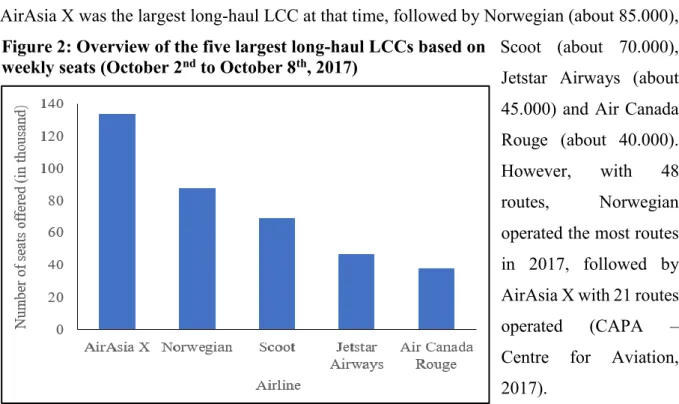
The concept of long-haul LCCs emerged with Loftleidir commencing its no-frills flights from Reykjavik to New York in 1948. Initially tested in Asia-Pacific with moderate success by Jetstar and AirAsia X, the long-haul low-cost business model was then brought to the Western world in 2013 when Norwegian operated its first transatlantic flights (CAPA – Centre for Aviation, 2018; Woods, 2018). Subsequently, an increasing number of haul LCCs arised since long-haul markets (i.e., flight distances larger than 4000 km) are highly attractive, largely contributing to the revenues of legacy carriers (Soyk et al., 2017; Flottau & Schofield, 2019; Binggeli & Weber, 2013). The expansion of the long-haul low-cost business model was promoted by both the maturity of traditional airline business models and new aircraft types (e.g., the Boeing 787) that allow for increased fuel efficiency. The long-haul low-cost airline market experienced a steep increase in available seating capacity, rising from 3.7 to 12.7 million seats offered within the time period of 2010 to 2016 (Blondel et al., 2017). Whereas in 2013, only three long-haul LCCs operated worldwide (Jetstar, AirAsia X and Scoot), today, about 20 long-haul LCCs exist that operate roughly 50 scheduled routes, representing approx. 3% of the total long-haul airline market (CAPA – Centre for Aviation, 2018; Blondel et al., 2017). Figure 2 presents an overview of the five largest long-haul LCCs in terms of the number of weekly
- 8 -
seats offered from October 2nd to October 8th, 2017. With about 135.000 weekly seats offered,
AirAsia X was the largest long-haul LCC at that time, followed by Norwegian (about 85.000), Scoot (about 70.000), Jetstar Airways (about 45.000) and Air Canada Rouge (about 40.000). However, with 48 routes, Norwegian operated the most routes in 2017, followed by AirAsia X with 21 routes operated (CAPA – Centre for Aviation, 2017).
Despite the proven financial success of LCCs on short- and medium-haul markets, most of their attempts have failed on long-haul markets (Soyk et al., 2017; Flottau & Schofield, 2019). Asian long-haul LCCs, however, tend to perform better than European ones, due to geographical differences, making Asia a more favourable market overall (e.g., cheaper labour) (CAPA – Centre for Aviation, 2017). While many long-haul LCCs cancelled routes and reduced their fleet size due to unprofitable operations, some carriers (e.g., Wow Air) most recently, have declared bankruptcy (Flottau & Schofield, 2019; Sigurdardottir, 2019). Consequently, the financial viability of the long-haul LCCs’ business model remains a vividly discussed topic in the aviation industry (Flottau & Schofield, 2019). For instance, Moreira et al. (2011) find that “…the viability of long-haul LCC operations must be highly questionable”, whereas Woods (2018) argues that “…long-haul, low cost is here to stay. It will work”.
Compared to the legacy carriers’ high-quality service that includes larger costs (Pels, 2008), LCCs have managed to operate with approx. 50% lower costs per available seat kilometre through streamlining processes such as removing frills (e.g., free food and beverages). However, on long-haul operations, the cost advantage is substantially reduced due to factors such as:
• Fuel costs, a major part of operating expenses, are much larger on long-haul flights (Morrell, 2008; Daft & Albers, 2012).
Source: own illustration based on CAPA – Centre for Aviation, 2017
Figure 2: Overview of the five largest long-haul LCCs based on weekly seats (October 2nd to October 8th, 2017)
- 9 -
• Larger aircraft types are needed in addition to the models used in typical short-haul fleets, which is contrary to the operation of a single aircraft type and results into additional costs (e.g., cabin crew training) (Pels, 2008).
• On-board amenities such as meals and beverages are of increased importance to passengers due to the longer travel time (Binggeli & Weber, 2013).
Nowadays, long-haul LCCs are working on the refinement of the on-board customer experience, trying to provide an attractive product for passengers that is competitive compared to, for instance, legacy carriers’ in-flight entertainment (Blondel et al., 2017). Currently, the low interest rate environment and stable economies are convenient to airlines, making them benefit from continuing growth in passenger demand as well as low oil prices (Woods, 2018). Yet, Woods (2018) notes that no upswing is going to last forever and that “…the next financial or economic crisis will impact the market hard”.
However, especially with the introduction of new-generation aircraft that consume less fuel, it is to be predicted that LCCs will continue to enter long-haul markets. This raises the need for legacy carriers to reconsider their conventional long-haul business model (Soyk et al., 2017; Binggeli & Weber, 2013).
3.2 Methodology and data collection
To evaluate the future viability of the long-haul LCCs’ business model, the case of Norwegian and Eurowings will be analysed, allowing for an in-depth investigation of their long-haul business models (Yin, 2014). Therefore, a cross-case analysis will be conducted to reveal similarities and differences in their operations (Ridder, 2017). The BMC framework, as previously introduced, builds the foundation for the cross-case analysis. Secondary data, collected from journal and newspaper articles, as well as publicly available information (e.g., CAPA), is used to fill in the BMC of the two airlines. Based upon both the findings of the cross-case analysis as well as primary data provided through an expert interview, an innovated business model for long-haul LCCs will be developed.
Norwegian and Eurowings are chosen for three reasons. First, the selected airlines do currently not operate profitably on long-haul markets, initiating the consideration of business model innovation. Second, their operating models differ, fulfilling the requirement of achieving variation on relevant dimensions as part of the cross-case analysis (Seawright & Gerring, 2008). Third, the aviation industry is heavily regulated and, hence, it seems reasonable to select two
- 10 -
long-haul LCCs that operate in a similar business environment in order to ensure that the innovated business model will be applicable for that specific business environment.
3.3 Business models of Norwegian Air Shuttle ASA and Eurowings GmbH 3.3.1 Norwegian Air Shuttle ASA
Norwegian, headquartered in Fornebu, is a low-cost airline that has been established in 1993. It is the parent company of the Norwegian Group, employing approx. 10.000 people in 14 countries across four continents. The Group consists of different subsidiaries in Norway, Denmark, Finland, Sweden, Spain, the United Kingdom, Ireland and Argentina. Norwegian’s entities are further organized into four main business areas: Assets, Aircraft Operations, People and Services and Other Business Areas. While Norwegian belongs to the market leading European short-haul point-to-point airlines, it has also fortified its position on the long-haul transatlantic market over the last years. In 2018, Norwegian has operated approx. 500 routes to about 150 destinations. The Group currently holds six unique national air operator certificates and 29 bases globally (in Norway, Denmark, Finland, Sweden, Ireland, the United Kingdom, Spain, Thailand, the Netherlands, the United States, Italy, France and the French Caribbean) through which the Group runs its commercial airline activities (Norwegian Air Shuttle ASA, 2019a; CAPA – Centre for Aviation, 2013).
Despite the constant revenue growth over the last years (approx. €4 billion in 2018), Norwegian incurred a loss of approx. €145.000 last year. Based on the financial results and the business objectives, including generating profitability and return to shareholders, Norwegian has “…defined four strategic objectives towards 2022:
• Be the preferred airline for customers seeking value for money. • Return to sustainable profitability.
• Fortify position as the leading short-haul carrier in the Nordics.
• Build a global low-cost alliance with our long-haul operation as the backbone” (Norwegian Air Shuttle ASA, 2019a).
Figure 3 illustrates Norwegian’s long-haul low-cost business model. Therefor, the nine building blocks of the BMC are taken into consideration.
- 11 -
Key activities: To date, Norwegian is operating a total of 98 long-haul routes with a strong focus
on the transatlantic market from its bases in Oslo, Stockholm, Copenhagen, London, Paris, Rome, Amsterdam, Barcelona and Madrid. The remaining non-transatlantic routes lead to, but are not limited to, leisure destinations such as Gran Canaria and destinations in Southeast Asia such as Bangkok. Taking flight distances between the origin and destination airport into consideration, Norwegian operates 49% of its long-haul flights within a flight distance of 4.000 to 5.999 kilometres, 20% of the flights within a flight distance of 6.000 to 7.999 kilometres and the remaining 31% of flights within a flight distance of at least 8.000 kilometres (Norwegian Air Shuttle ASA, 2019b; cf. Appendix I). The possession of different air operator certificates gives Norwegian a broad market access, ensuring the operation of its long-haul network. In this regard, Norwegian Air Shuttle ASA operates flights from Norwegian’s European bases to North and South America, the Middle East and Southeast Asia, while Norwegian Air UK Ltd. operates routes from London-Gatwick to North and South America (Norwegian Air Shuttle ASA, 2019a). Also, Sales and Network Management are key activities to make Norwegian’s business model work (cf. Appendix IX).
Key partnerships: Norwegian partners with easyJet, a leading European LCC, through the
latter’s “Worldwide by easyJet” platform since 2017. The platform is a connection service that enables easyJet passengers to connect their short-haul flights with onward long-haul connecting
Source: own illustration based on Norwegian Air Shuttle ASA, 2019a, b, c, d, e, f, g, h; Norwegian Air Shuttle ASA, 2017; Appendix I, II, III, IV
- 12 -
flights of Norwegian in one unique booking. Norwegian’s vast long-haul route network combined with easyJet’s large European route network provides passengers the opportunity to travel to popular destinations at low ticket prices and with convenient connections (Norwegian Air Shuttle ASA, 2017). Additionally, recently, Norwegian and JetBlue, a major American LCC, have announced agreement for an upcoming interline agreement. “The partnership will allow customers to combine low fares in a convenient single booking for connecting flights between Europe and the Americas” (Norwegian Air Shuttle ASA, 2019c). Passengers have the option to book connecting flights on the website of both airlines. From Summer 2020 on, the partnership will create a multitude of novel connections for passengers on both sides of the market by connecting “…more than 60 U.S. and nearly 40 Caribbean and Latin American cities to Norwegian’s network via New York-JFK, Boston and Fort Lauderdale airports” (Norwegian Air Shuttle ASA, 2019c).
Key resources: The long-haul fleet of Norwegian currently consists of a total of 54 aircraft,
including 36 Boeing 787 Dreamliner and 18 Boeing 737 Max 8 aircraft. With the Boeing 787-800 and the Boeing 787-900, Norwegian possesses two different types of the Dreamliner: the Boeing 787-800 has 291 seats (32 in the Premium cabin and 259 in the Economy cabin), whereas the Boeing 787-900 has 344 seats (35 in the Premium cabin and 309 in the Economy cabin) in total. Norwegian’s fleet is one of the youngest globally, averaging 3.8 years (Norwegian Air Shuttle ASA, 2019d). The cabin crew are another major key resource of Norwegian. They are considered as Norwegian’s faces, being in charge of the passengers’ well-being as well as the provision of superior service aboard (Norwegian Air Shuttle ASA, 2019e).
Customer segments: Norwegian’s long-haul business model distinguishes between market
segments that have (slightly) different needs. Passengers have different sensitivities concerning price and time of the trip that may, in turn, differ from one trip to another. Norwegian mainly focuses on attracting leisure travelers that are price sensitive but time insensitive. According to Belobaba et al. (2009), this group is characterized by being “…willing to change their time and day of travel, and even destination airports, to find a seat at the lowest possible fare.” Besides, Norwegian aims at attracting business travelers that are sensitive to both time and price. Passengers of this segment must necessarily take a flight, but are willing to, for instance, make trips at flight times that are less convenient, in order to find a low fare (Belobaba et al., 2009).
Value propositions: Norwegian unbundles its services and in-flight amenities into different
- 13 -
different cabins (Economy and Premium cabin) exist and five different products are offered on long-haul flights (cf. Appendix II). Norwegian’s “Lowfare” product (i.e., the cheapest fare available, only including hand baggage of up to 10 kilogram) is specifically tailored to the customer segment of leisure travelers that are price sensitive and insensitive to time constraints. Norwegian offers significantly lower fares compared to other carriers that operate the same long-haul routes. For instance, passengers can book the “Lowfare” product one-way from Paris (CDG) to New York (JFK) for, on average, €140 in calendar week ten of 2020, undercutting Air France and Delta Air Lines by 1513%. By offering the “Lowfare” product for, on average, €183 one-way from Oslo (OSL) to Dubai (DXB) in calendar week eleven of 2020, Norwegian undercuts Emirates by 105% (cf. Appendix III). Furthermore, leisure travelers that want additional amenities beside the hand baggage have the option to book the “Lowfare+” and “Flex” product that are both available for the Economy cabin (cf. Appendix II). Norwegian’s Premium cabin allows for increased convenience and is destined for business travelers that are sensitive to both time and price. Beside having a larger seat pitch, the “Premium” and “PremiumFlex” product come with additional amenities such as checked baggage and meals, compared to the “Lowfare” product. With the “PremiumFlex” product, passengers do also have airport lounge access (cf. Appendix II). Moreover, in-flight entertainment is available on any flight and free Wi-Fi is available on most of Norwegian’s long-haul flights (Norwegian Air Shuttle ASA, 2019f).
Channels: Norwegian uses Facebook, Instagram, Twitter, YouTube and LinkedIn as
communication channels to promote its destinations, products and services as well as inform customers about organizational developments. The company posts very frequently and has thus reached a solid follower base that amounts to approx. 1.28 million followers on Facebook, 353.000 followers on Instagram, 113.000 followers on Twitter, 18.300 followers on YouTube and 115.000 followers on LinkedIn (cf. Appendix IV). As for the sale of tickets, Norwegian uses both its own channels and indirect distribution channels. Customers can book flights directly through Norwegian’s website, the customer service hotline and the “Norwegian Travel Assistant” application. Furthermore, customers can book flights indirectly through both travel fare aggregator websites (e.g., www.momondo.com) and travel agencies. In this regard, Norwegian has recently renewed its partnership with Amadeus IT Group SA, a Spanish information technology company that provides the same-named global distribution system used by travel agents to access airlines’ fares (Saki, 2018). The share of ticket sale through own channels was 79% in 2018 (Norwegian Air Shuttle ASA, 2019a).
- 14 -
Customer relationships: Norwegian maintains and solidifies customer relationships through its
frequent flyer program “Norwegian Reward”. Cash points are earned every time a member books a flight with Norwegian or uses a service from Norwegian Reward’s partners. To redeem cash points, members can use them for their next Norwegian flight (either receiving a partial or full redemption) and several perks such as extra baggage, seat reservation and booking changes on future flights (Norwegian Air Shuttle ASA, 2019g). Furthermore, Norwegian provides both automated and personal assistance to customers for pre- (e.g., profile and general enquiries) and after-sales service issues (e.g., flight booking and feedback). As for automated assistance, customers can either use the website, the “Norwegian Travel Assistant” application or the chatbot that answers frequently asked questions. On the other hand, personal assistance is provided through the customer service hotline and the Facebook Messenger (Norwegian Air Shuttle ASA, 2019h).
Revenue streams1: Norwegian generates revenues through both one-time customer payments and ongoing payments. About 80% of the total revenues of approx. €4 billion that was generated in 2018 accounts for the sale of tickets, representing one-time customer payments of both the previously defined leisure and business traveler segment. In this context, the United States is the most important long-haul market, contributing with approx. 17% to Norwegian’s total revenues. Furthermore, ancillary revenues that comprise ticket-related products and services such as seating and premium upgrades, amount to about 16% of the total revenues, being one-time customer payments as well. Freight carried on passenger flights can be considered another one-time payment revenue generating source, contributing with approx. 2% to the total revenues in 2018. Lastly, other revenues, consisting of third-party revenues such as lease of aircraft, amounted to about 2% of Norwegian’s total revenues and can be considered as revenues from ongoing payments (Norwegian Air Shuttle ASA, 2019a).
Cost structure2: Norwegian’s long-haul low-cost business model is cost-driven, seeking to minimize costs wherever possible. In 2018, Norwegian had total expenses of about €4.1 billion. Thereof, aircraft fuel accounted for the largest share with about 30%, followed by airport and handling charges (approx. 23%), personnel costs (approx. 16%), aircraft leases (approx. 11%),
1 The revenue streams, including respective revenues, also relate to the short- and medium-haul business.
Norwegian’s annual report does not present a separate revenue summary of the long-haul business.
2 This cost structure is consolidated, including the short- and medium-haul business as well. Norwegian’s annual
- 15 -
maintenance costs (approx. 8%), overhead costs (approx. 7%) and other aircraft expenses (approx. 5%) (Norwegian Air Shuttle ASA, 2019a).
3.3.2 Eurowings GmbH
Eurowings, headquartered in Dusseldorf and founded in 1996, is the Lufthansa Group’s low-cost airline. The German airline is part of the Eurowings Group that also includes Brussels Airlines. Further, the Eurowings brand consists of Eurowings Europe, Germanwings, Luftfahrtgesellschaft Walter and SunExpress (Lufthansa Group, 2019a). Eurowings, currently employing 10.000 people and holding 14 bases, specializes in low-cost direct flights and has been offering long-haul flights since 2015. With a current fleet of 205 aircraft and more than 210 destinations in 60 countries around the world, Eurowings is the third-largest European point-to-point carrier, having carried 38 million passengers in 2018 (Eurowings GmbH, 2019a; Lufthansa Group, 2019a).
The German airline has experienced strong growth in 2018 due to the acquisition of major parts of the former Air Berlin fleet. This has both led to an increase in operational complexity and enabled Eurowings to become the leading airline at eight airports in Germany, Austria and Belgium. Despite the revenue growth of 5%, on average, over the last years (€4.2 billion in 2018), Eurowings incurred a loss of €231 million in 2018 (Lufthansa Group, 2019a). Due to the ongoing negative results, Lufthansa is going to take over the commercial planning of Eurowings’ long-haul operations. In this context, Lufthansa expects Eurowings to break even in 2021 (Hegmann, 2019). The strategic goal of Eurowings is to establish the airline as an essential pillar of the Lufthansa Group, further develop it to fortify its leading position and make it become the number three in the European low-cost market in the coming years (Eurowings GmbH, 2019a). Figure 4 depicts Eurowings’ long-haul low-cost business model.
- 16 -
Key activities: Eurowings currently operates a total of 24 long-haul routes with a strong focus
on the transatlantic market. The routes are operated from its bases in Dusseldorf, Frankfurt am Main and Munich. Taking flight distances between the origin and destination airport into consideration, the German airline operates 58% of its long-haul flights within a flight distance of 6.000 to 7.999 kilometres and the remaining 42% of the flights within a flight distance of at least 8.000 kilometres. (Eurowings GmbH, 2019b; cf. Appendix V). Eurowings plans and sells, but does not operate the long-haul flights itself; Brussels Airlines and SunExpress operate the flights (Gasser, 2019). Hence, the operational responsibility for its long-haul flights is transferred to these two partner airlines (s. next paragraph), but the commercial responsibility remains at Eurowings. Also, Sales and Network Management are key activities to make Eurowings’ business model work (cf. Appendix IX).
Key partnerships: Eurowings has both operating and commercial partners. As for operating
partners, Brussels Airlines and SunExpress operate Eurowings’ long-haul flights on the basis of wet lease agreements. In this context, Brussels Airlines is operating Eurowings’ flights from the Dusseldorf base, while SunExpress is operating the flights from the Frankfurt am Main and Munich base (Lufthansa Group, 2019a). The wet lease agreements cover several Airbus A330 widebody aircraft. As for commercial partners, Eurowings has interline and codeshare agreements with several airlines in place: most relevantly, with Lufthansa and United Airlines
Source: own illustration based on Lufthansa Group, 2019a, b; Eurowings GmbH, 2019b, c, d, e; Gasser, 2019; Appendix V, VI, VII, VIII
- 17 -
to both market each other’s flights and provide as well as receive feeder services for the operation of transatlantic routes (Eurowings GmbH, 2019c).
Key resources: The long-haul fleet of Eurowings currently consists of a total of eleven Airbus
A330-200/300. With the Airbus A330-200 and the Airbus A330-300, Eurowings possesses two different types of the Airbus A330: the A330-200 310 seats, whereas the A330-300 has 283 seats in total (Lufthansa Group, 2019b). The German airline has an average fleet age of eleven years with a high age spread of 25 years (Lufthansa Group, 2019c). Another key resource of Eurowings is its cabin crew. They are responsible for the provision of a great travel experience to keep the customers happy (Eurowings GmbH, 2019d).
Customer segments: Eurowings focuses on attracting both leisure travelers that are price
sensitive but time insensitive, and business travelers that are sensitive to both time and price. The former group is characterized by being “…willing to change their time and day of travel, and even destination airports, to find a seat at the lowest possible fare” (Belobaba et al., 2009). Passengers of the latter segment must necessarily take a flight, but are willing to, for instance, make trips at flight times that are less convenient, in order to find a low fare (Belobaba et al., 2009). Besides, Eurowings targets tour operators that can either charter an entire aircraft or sell single seats through dynamic packaging (cf. Appendix IX).
Value propositions: Eurowings unbundles its services and in-flight amenities into different
products to meet the needs of the two customer segments mentioned above. The German airline offers four different products and a three-class cabin, including a standard economy class (“BASIC” and “SMART fare”), a section labelled as “BEST section” (“BEST fare”) that offers increased legroom, and a premium class (“BIZclass fare”) with a lie-flat seat in an exclusive area. Eurowings’ “BASIC fare” (i.e., the cheapest fare offered, only including hand luggage of up to eight kilograms) is specifically tailored to leisure travelers that are price sensitive and insensitive to time constraints. In case customers of this segment want to have a meal included as well as a one bag up to 23 kilograms free of charge, they can book the “SMART fare” (cf. Appendix VI). Eurowings offers low fares on long-haul routes. For instance, passengers can fly from Frankfurt am Main (FRA) to Windhoek (WDH) one-way for, on average, €415 with the “BASIC fare” in calendar week ten of 2020, undercutting Air Namibia, Namibia’s national carrier, by 57%. Furthermore, passengers can book the “BASIC fare” one-way from Dusseldorf (DUS) to New York (EWR) for, on average, €220 in calendar week eleven of 2020. The leisure destination Havana (HAV) can be reached for, on average, €326 one-way from Dusseldorf
- 18 -
(DUS) in March 2020 (cf. Appendix VII). Eurowings’ “BEST section” is destined for both leisure and business travelers since the additional amenities such as the comfort seat may be appealing to both customer segments. The “BIZclass fare”, however, is specifically tailored to business travelers. In-flight entertainment is included in any fare, while passengers need to pay a surcharge to access Wi-Fi (cf. Appendix VI).
Channels: Eurowings uses Facebook, Instagram, Twitter, YouTube and LinkedIn as
communication channels to both promote its destinations, products and services, and inform customers about organizational developments. Being part of the Lufthansa Group, Eurowings is getting promoted through the Group’s communication channels as well. The German airline posts very frequently on all channels and, hence, has reached a solid follower base: approx. 947.000 followers on Facebook, 307.000 followers on Instagram, 89.000 followers on Twitter, 18.900 followers on YouTube and 13.000 followers on LinkedIn (cf. Appendix VIII). Taking the sale of tickets into consideration, Eurowings uses both its own channels and indirect distribution channels. Passengers can book flights directly through Eurowings’ website, the customer service hotline and the Eurowings application. Besides, passengers can book flights indirectly through both travel fare aggregator websites such as momondo.com, touristic sales and travel agencies. In this regard, customers have the option to book combined flights with Eurowings’ partner airlines at travel agencies (Eurowings GmbH, 2019c; cf. Appendix IX).
Customer relationships: Eurowings maintains and solidifies customer relationships through its
loyalty program “Boomerang Club” and Lufthansa Group’s “Miles & More” program, Europe’s leading frequent flyer program. Miles will be earned after every flight that can be redeemed to take advantage of all related services such as award flights (Eurowings GmbH, 2019e). Besides, Eurowings provides both automated and personal customer assistance. With regard to automated assistance, passengers can either use the website or the application. On the other hand, personal assistance is provided through the customer service hotline and the Facebook Messenger (Eurowings GmbH, 2019a; cf. Appendix VIII).
Revenue streams3: The split between passenger revenues, ancillary revenues and other revenues of Eurowings is not reported. However, it can be assumed that the German airline generates revenues through both one-time customer payments and ongoing payments since this is the
3 The revenue streams, including respective revenues, also relate to the short- and medium-haul business.
Lufthansa Group’s annual report does not present a separate revenue summary of Eurowings’ long-haul business.
- 19 -
traditional approach in the airline industry. The largest part of the total revenues is generated through one-time customer payments, primarily the sale of tickets to leisure and business travelers, followed by ancillary revenues (mainly through the “BASIC fare” and “SMART fare”) and carried freight. Ongoing payments generated through other revenues such as lease may only constitute a small part of the total revenues.
Cost structure4: The cost structure of Eurowings’ long-haul low-cost business model is cost- driven, seeking to minimize costs wherever possible. In 2018, Eurowings had total expenses of about €4.8 billion. Thereof, aircraft fuel accounted for the largest share with about 20%, followed by fees and charges such as landing fees (approx. 20%), personnel costs (approx. 13%), other operating expenses (approx. 13%), maintenance costs (approx. 9%), aircraft leases and charter expenses (approx. 7%), and other costs (Lufthansa Group, 2019a).
3.4 Comparison of business models
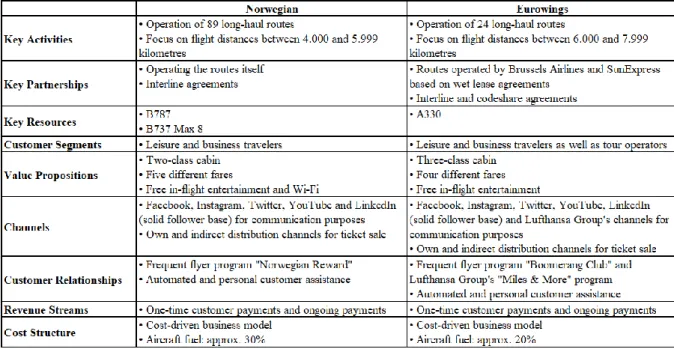
Taking the key activities into consideration, Norwegian and Eurowings differ greatly in terms of the number of long-haul routes operated and the routes’ flight distances. In this context, Norwegian currently operates more than three times as many long-haul routes as Eurowings does, and primarily focuses on short long-haul flight distances between 4.000 and 5.999 kilometres, while Eurowings focuses on flight distances between 6.000 and 7.999 kilometres. The key partnerships of the two airlines show that their operating models differ; Eurowings does not operate the long-haul routes itself, having wet lease agreements with Brussels Airlines and SunExpress instead. Norwegian, however, operates the routes itself. Both airlines have interline agreements with selected carriers in place to extend the number of flight connections for their passengers. Additionally, Eurowings has codeshare agreements in place.
Considering the long-haul fleet, Norwegian uses the Boeing 787 Dreamliner and Boeing 737 Max 8 aircraft. Eurowings, however, uses a homogenous fleet of Airbus A330 aircraft.
Both airlines target leisure travelers that are price sensitive but time insensitive, as well as business travelers that are sensitive to both time and price. Besides, Eurowings focuses on tour operators. However, the two airlines differ in the number of both cabins and products offered. While Norwegian offers a two-class cabin with five different fares, Eurowings offers a
4 This cost structure is consolidated, including the short- and medium-haul business as well. Lufthansa Group’s
- 20 -
class cabin with four different fares. Furthermore, Norwegian offers in-flight entertainment and Wi-Fi, if available, for free, whereas Eurowings does only offer in-flight entertainment for free. Taking communication channels into consideration, both airlines use the same channels (Facebook, Instagram, Twitter, YouTube and LinkedIn), having reached a solid follower base by posting very frequently. The only difference is that Lufthansa Group raises awareness about Eurowings’ destinations, products and services on their communication channels as well. Furthermore, both airlines sell their tickets through their own (e.g., website) and indirect distribution channels (e.g., travel agencies).
Besides, the two airlines use the same strategies to maintain and solidify their customer relationships. While Norwegian uses its frequent flyer program “Norwegian Reward”, Eurowings uses both its own “Boomerang Club” and Lufthansa Group’s “Miles & More” program. Besides, the two airlines provide automated (e.g., application) and personal assistance (e.g., customer service hotline) to customers.
It is likely that both airlines generate revenues through one-time customer payments and ongoing payments. Also, Norwegian’s and Eurowings’ long-haul low-cost business model are cost-driven. In this context, it is noticeable that aircraft fuel accounts for a significantly larger share to Norwegian’s operating costs compared to aircraft fuel in the case of Eurowings. However, the shares for the remaining cost blocks are very similar.
Figure 5 summarizes the similarities and differences of Norwegian’s and Eurowings’ long-haul low-cost business model. Major differences in terms of the operating model can be observed, which will be further analysed in the following chapter.
- 21 -
4 Results
4.1 General findings
The fact that Norwegian currently operates almost four times as many long-haul routes as Eurowings is salient, illustrating Norwegian’s aggressive expansion that has come at a high cost (Asquith, 2019). However, for a long time, Norwegian seems to have underestimated the complexity that the operation of long-haul routes brings, compared to the operation of short- and medium-haul routes (cf. Appendix IX). After the airline placed a substantial aircraft order as part of its fleet expansion in 2012, net debt and aircraft lease liabilities increased to $7.1 billion (approx. €6.4 billion) (Asquith, 2019). Similarly, Eurowings has experienced strong growth after acquiring significant parts of the former Air Berlin fleet at the end of 2017. According to industry experts, the airline was not able to cope with the growth, resulting in an increase of flight cancellations by ten times in the first half of 2018, compared to the previous year (Reichert, 2018).
While Norwegian is a uniform brand operating under the Group’s umbrella, the Eurowings Group consists of different brands. This setup has been confusing customers since it is not clear whether the airline operates as a point-to-point carrier, a LCC that competes with easyJet and Ryanair, a carrier that provides feeder services to the Lufthansa hubs Frankfurt am Main and Munich, or a touristic long-haul carrier. Additionally, passengers may experience several brands throughout their journey. For instance, passengers may experience the Lufthansa brand
Source: own illustration based on Figure 3; Figure 4
Figure 5: Overview of the similarities and differences of Norwegian’s and Eurowings’ business model
- 22 -
when booking on the Lufthansa website, but then enter a Eurowings aircraft with a SunExpress crew aboard. The complexity that results from the different brands makes it extremely difficult to create a satisfying customer experience (or at least awareness); instead, it leads to confusion and, hence, low customer satisfaction.
Furthermore, Eurowings belongs to the Lufthansa Group which is of both an advantage and disadvantage. In this context, the German airline benefits from being integrated into the Lufthansa Group sales organization, but is restricted in its flexibility. For instance, Eurowings is not able to offer cheap flights that fall under the transatlantic joint venture between Lufthansa Group, United Airlines and Air Canada. Norwegian, however, enjoys a higher degree of flexibility since it does not belong to any other corporation (cf. Appendix IX).
Both Norwegian and Eurowings have strong commercial partnerships. With easyJet and JetBlue, Norwegian has partners on both sides of the Atlantic, which benefits its long-haul operations: easyJet provides feeder services in Europe while JetBlue provides feeder services in the United States (Norwegian Air Shuttle ASA, 2017; Norwegian Air Shuttle ASA, 2019c). On the other hand, Eurowings benefits from being part of Lufthansa Group and, hence, receives feeder services mainly from Lufthansa in Europe and United Airlines in the United States (Eurowings GmbH, 2019c).
With the Boeing 787 Dreamliner and the Boeing 737 Max 8 aircraft, Norwegian operates two comparably fuel-efficient aircraft types, allowing the airline to offer cheap flights. Hence, the financial problems were not rooted in the fleet itself; instead, Norwegian suffered misfortune due to groundings of both aircraft types. While the Boeing 787 Dreamliner had troubles with the Rolls Royce engine over the last few years, the two recent fatal crashes of Lion Air and Ethiopian Airlines forced Norwegian to ground its Boeing 737 Max 8 fleet. Consequently, grounded aircraft result in a loss of money, since they cannot be utilized (Asquith, 2019). In comparison, Eurowings operates a comparably old and fuel-inefficient fleet of aircraft (Lufthansa Group, 2019c; cf. Appendix IX).
Despite focusing on the transatlantic market, Norwegian has cancelled ten routes between the U.S. and Europe starting with the 2019/20 winter season, representing a drop of approx. 25% in the number of flights, compared to last year’s winter season. Hence, Norwegian’s aggressive expansion continues to be scaled back. Although operating transatlantic routes profitably is challenging since they are usually highly competitive (Nikel, 2019), the partnership with JetBlue that has been formed very recently, implies that Norwegian seems to hold on to the
- 23 -
transatlantic market. Yet, it remains difficult for Norwegian to generate profits given its very cheap flights, even though the airline operates a fuel-efficient fleet of aircraft (Farmbrough, 2019; cf. Appendix III). Furthermore, the airline “…lacks the lucrative business and first-class passengers that make up the profits on other transatlantic carriers, although reviews of its 787 premium economy service, with 46-inch leg-room, compare favorably with other airlines'” (Farmbrough, 2019). These passengers usually have a high degree of loyalty, which is difficult to build up with the Norwegian Reward loyalty program since it does not yield network effects compared to Lufthansa Group’s Miles & More loyalty program or an alliance membership such as Star Alliance (cf. Appendix IX).
With earnings deteriorating, Norwegian “…has just tapped up their bondholders for a two-year extension in paying back $380 million of debt…” (Asquith, 2019). Goldstein (2019) concludes that Norwegian’s expansion of its long-haul network has lastingly damaged the airline’s balance sheet with an extremely high debt level. This has forced Norwegian to change its strategy, focusing on profitability instead of growth. Former CEO Bjørn Kjos, who stepped down in July 2019, noted:
“Norwegian has been through a period with significant growth. Focus going forward will increasingly be on cost savings and CAPEX reductions. We will now get in place a strengthened balance sheet that supports the further development of the company” (Farmbrough, 2019).
Although the cost reduction program runs well and the airline delivers on its new business strategy, Lufthansa and British Airways are not bidding to acquire assets of Norwegian anymore. The airline may not be able to maintain independency; many industry experts predict that Norwegian will need external financing to continue its low-cost long-haul operations (Asquith, 2019). In comparison, Eurowings has the substantial advantage that it belongs to the Lufthansa Group, since Lufthansa will continue supporting the airline (Kiani-Kreß, 2019). To tackle the problems and return to profitability, Eurowings has announced several measures, such as modernizing the fleet of aircraft, substantially decreasing overhead costs (e.g., through a reduction of the number of air operator certificates), and transferring commercial responsibility for long-haul routes to Lufthansa Group to refocus on the short-haul network. Thereby, Thorsten Dirks, CEO of Eurowings, predicts that the German airline will break even in 2021 and achieve an adjusted EBIT margin of at least 8% in the long run (Lufthansa Group, 2019c).
- 24 -
4.2 Assessment of business model viability
The long-haul LCCs’ business model seems to be principally viable, but both Norwegian and Eurowings show that operating profitably remains difficult, regardless of the operating model and organizational structure. The aggressive expansion of the two airlines implies that both seem to have underestimated the complexity of operating long-haul routes. The cost base is a decisive factor in the long-haul LCCs’ business model; the substantial cost reduction has been giving LCCs a comparative advantage over legacy carriers on short- and medium-haul markets. However, this cost advantage cannot be achieved on long-haul operations, since the cost base grows disproportionately, especially with the use of wide-body aircraft (e.g., the Airbus A330) that are operated by both Norwegian and Eurowings. Besides, Norwegian has operated a narrow-body aircraft, the Boeing 737 Max 8, on long-haul routes; the grounding, however, required Norwegian to cancel the respective routes. Another decisive factor is the maximization of revenues per seat. Long-haul LCCs usually target hub airports to fill seats on the wide-body aircraft based on the higher passenger demand, compared to smaller airports. However, according to Schulz (2019), on these markets, they compete with legacy carriers that can easily cope with selling a small contingent of tickets at a similar price.
More efficient narrow-body aircraft may open up new potentials for LCCs on long-haul markets. Specifically, the Airbus A321 XLR could make this possible; the first aircraft will be delivered in 2023. The new-generation engines allow for a fuel-efficient operation and flight distances of up to 8.700 kilometres, exceeding the maximum flight distance of the Boeing 737 Max 8 aircraft. Besides, due to the reduced number of seats compared to wide-body aircraft, long-haul LCCs can target smaller airports that are not as competitive as hub airports. With the use of more efficient narrow-body aircraft, long-haul LCCs may be able to exploit new markets, keep the cost base at a low level and, hence, operate profitably (Schulz, 2019). Hence, the business model of long-haul LCCs needs to be innovated to ensure future viability.
4.3 Presentation of innovated business model
Having a lean operating model seems critical to the success of the innovated business model of long-haul LCCs, which is summarized in Figure 65. In this regard, two different models can be
considered.
5 Figure 6 applies to both Model A and Model B. Notes are added whenever the input provided is specifically
- 25 -
• Model A: a completely virtual model on the basis of wet lease agreements; the focus is solely put on sales and marketing activities.
• Model B: a very simple model with a single type of aircraft.
However, it needs to be noted that Model A is difficult to implement, since it requires a long-haul LCC to be part of a Group; otherwise, the likelihood of finding operating partners is comparably low. For instance, Eurowings initially failed with its “plug and play” approach (i.e., the connection of external airlines to the model), because there were no external airlines interested in joining (cf. Appendix IX). Hence, Model B serves as an alternative option.
Key activities: The operation of long-haul routes remains a key activity; yet, I cannot
recommend a specific number of routes to be operated. In this context, a dense route network, offering passengers a wide range of connections through at least one central hub, and appropriate frequencies are of great importance; otherwise, the customer acquisition costs will be very high. The route network density and frequencies, in turn, depend upon the customer segments that the airline targets. For instance, in case the airline wants to attract low-cost business travelers, it is required to offer higher weekly frequencies to the respective business destination, while leisure travelers demand attractive leisure destinations for which the frequencies are of less importance. Besides, new-generation narrow-body aircraft such as the
Source: own analysis
- 26 -
Airbus A321 XLR may open up new potentials in terms of destinations. In this regard, due to the reduced number of seats, long-haul LCCs can target smaller airports that are not as competitive as hub airports (cf. Appendix IX). Taking flight distances into consideration, I recommend long-haul LCCs to focus on shorter flight distances (e.g., flight distances between 4.000 and 5.999 kilometres), since the scope for cost differentiation over legacy carriers is significantly reduced for long flight distances, according to De Poret et al. (2015). Other key activities include Sales and Network Management to make the business model work. To boost sales, long-haul LCCs must either be integrated into a strong sales organization (e.g., Eurowings with Lufthansa Group) or have strong commercial partnerships (cf. Appendix IX).
Key partnerships: Having strong key partners is of great importance to the long-haul LCCs’
business model. In this context, it needs to be differentiated between operating and commercial partners. Model A requires having operating partners. Therefor, LEVEL, the long-haul low-cost airline brand of the International Airlines Group, serves as a good example. LEVEL has wet lease agreements with selected airlines of International Airlines Group that operate its long-haul flights (International Airlines Group, 2019). This model allows for higher flexibility, since the airline can grow and shrink quickly by concluding and terminating contracts. However, it needs to be noted that this model only tends to work on the condition that the long-haul LCC belongs to a Group. Furthermore, commercial partnerships allow passengers to freely combine flights and take advantage of additional travel options and connecting flights. In case the airline focuses on transatlantic long-haul flights, it needs to ensure that strong partnerships are created on both sides of the Atlantic (e.g., following the example set by Norwegian) to benefit from the partners’ sales strength in their home markets.
Key resources: The fleet of aircraft is another success factor of the long-haul LCCs’ business
model. The interviewee recommends Model A: operating a young, fuel-efficient fleet of aircraft that the airline does not possess, since it allows for higher flexibility (cf. Appendix IX). On the other hand, Model B requires operating a single type of aircraft. However, it needs to be noted that not every long-haul aircraft type fits any route operated (cf. Appendix IX). In either model, I recommend the use of fuel-efficient aircraft types such as the Boeing 787 Dreamliner. Prospectively, the Airbus A321 XLR should be taken into consideration, as explained previously. Furthermore, another key resource is the cabin crew that is supposed to provide superior service to customers aboard.