i
UNIVERSITÀ DEGLI STUDI DI PADOVA
DIPARTIMENTO DI SCIENZE STORICHE,
GEOGRAFICHE E DELL'ANTICHITÀ
LAUREA
MAGISTRALE
IN
SCIENZE
STORICHE
MASTER
ERASMUS
MUNDUS
TPTI
Techniques, Patrimoine, Territoires de l'industrie : Histoire, Valorisation, Didactique
TESI DI LAUREA Mémoire de Master
A methodology for the enhancement and reuse of company towns.
The case of Hershey in Santa Cruz del Norte, Cuba
Une méthodologie pour la réutilisation et la valorisation des cités
ouvrières. Le cas de Hershey, à Santa Cruz del Norte, Cuba
Relatore: Prof. Giovanni Luigi Fontana
Laureando: Jan Michel Sanchez Hoyos matricola: 1133364
Ce mémoire ne comporte pas les corrections apportées par le jury
iii
To my mother and my father
À ma mère et à mon pèrev
Acknowledgments
To Giovanni Luigi Fontana, for his constant guidance, for putting his experience and energy to shape this work. For being an excellent teacher, a passionate professional and give me the opportunity to work with him.
To Mancuso, for his enthusiasm, acuteness and experience to encourage this work.
To all TPTI professors that in one way or another have been responsible for the result of this work. Thank you for sharing your knowledge and experiences.
To Raffaella, for his constant concern and help. For making my stay in Italy easier.
To Anne-Sophie, for her earnest enthusiasm to criticize with tact without discouraging.
To my parents, for their constant concern and support.
To Lorena for her continuous support and for being always available to help.
To my classmates.
To all those that with their skepticism forced me to be more acute.
To whom I may have forgotten, it has not been intentional. To all, apologies for these improvised and timeless lines.
vii Index Index / vii Index of Figures / ix Preface / xiii Abstract / xvi Résumé / xvii Introduction / 2
Issue and justification /2 Aims / 5
State of the art / 6
Methodology and structure / 9
Chapter 1: Industrial Heritage in company towns / 13 1.1 Characteristics of company towns / 14
1.2 Company towns, maximum exponents of industrial heritage / 16 1.2.1 Paternalism / 18
1.2.2 Planning and Urbanism / 22
1.2.3 Architecture. Housing and Industry / 24 1.2.4 Landscape / 29
1.3 Actions in favor of the reuse and conservations of company towns. / 31 1.4 Variables to consider in the analysis of company towns / 34
Chapter 2: Enhancement and reuse of three Italian company towns / 38 2.1 Method for comparative analysis of company towns / 39
2.2 Selection and justification of study cases / 41 2.3 Nuova Schio, Crespi d’Adda, Torviscosa / 43
2.3.1 Nuova Schio / 43 2.3.2 Crespi d’Adda / 52 2.3.3 Torviscosa / 62
2.4 Identification of good practices in the study cases. / 70
Chapter 3: Sugar company towns in Cuba. The case of Hershey / 74 3.1 Sugar industrial heritage / 75
3.2 El central as a company town / 87 3.2.1 Paternalism / 87
viii 3.2.2 Planning and urbanism / 88
3.2.3 Architecture / 90 3.2.4 Landscape / 91
3.3 Hershey Sugar Company Town / 93
3.4 Conservation and valorization of Industrial Heritage in Cuba / 103 Chapter 4: Methodology for the reuse and enhancement of Hershey Sugar Company Town / 110
4.1 Methodology for the enhancement and reuse of company towns / 111 4.1.1 First stage: Data recovery and value declaration / 111
4.1.2 Second stage: Protection actions / 112
4.1.3 Third Stage: Management and continuity / 112
4.2 Current situation in the conservation and valorization of Hershey Sugar Company Town / 113
4.3 Application of the methodology to the study case: Hershey Sugar Company Town / 117
4.3.1 First stage: Data recovery and value declaration / 118 4.3.2 Second stage: Protection actions / 121
4.3.3 Third Stage: Management and continuity / 124 4.4 Results of the application of the methodology / 125 Conclusions and recommendations / 128
Bibliography / 132 Annexes / 13737
ix
Index of Figures
Image of the Introduction
0.1 Framework for methodology / 10 Images of Chapter 1
1.1 Dance class at the New Institute for the Formation of Character / 20 1.2 The Institute for the Formation of Character by Robert Owen / 20 1.3 New Lanark Company Town / 21
1.4 New Lanark Current aerial view / 21
1.5 Arc et Senans. France / 22 1.6 Nuevo Baztán. Spain / 22
1.7 Floor plan of a second class house in Mulhouse / 25 1.8 View of a workers’ house with garden in Mulhouse / 25 1.9 Terrace House by Alvar Aalto in Kauttua / 26
1.10 Houses of the Sunila cellulose factory by Alvar Aalto / 26
1.11. Image of the revolutionary structural system of the building of turbines. Noisiel-sur-Marne / 28
1.12 Noisiel-sur-Marne. Building of turbines / 28 1.13 Painting of Ynysfach Ironworks / 30
1.14 Picture of Penydarren ironworks in 1875 / 30 Images of Chapter 2
2.1 Alessandro Rossi / 44
2.2 Geographical location of Schio in the Province of Vicenza. Veneto, Italy / 45 2.3 Nuova Schio. General planning presented in 1872 / 46
2.4 Image of the original project of the Rossi industrial complex / 47 2.5 Current image of the complex / 47
2.6Workers’ houses typologies in Nuova Schio original project / 48 2.7 Ancient image of Nuova Schio definitive workers’ houses / 48 2.8 Image of the Jacquard Garden / 49
2.9 Image of the project for the Asilo d’Infianza (Children center) / 49 2.10 Cristoforo Benigno Crespi and Silvio Benign Crespi / 53
x
2.11 Geographical location of Crespi D’adda in the Province of Bergamo. Lombardy, Italy / 54
2.12 Aerial view of Crespi d’Adda / 55
2.13 Crespi d’Adda. Main entrance to the factory / 56 2.14 Crespi d’Adda. Image of productive buildings / 56 2.15 Crespi d’Adda. One of the manager’s villas / 57 2.16 Crespi d’Adda. Workers’ houses / 57
2.17 Crespi d’Adda. Current picture of the school / 58 2.18 Crespi d’Adda. Current picture of the church / 58 2.19 Crespi d’Adda and the surrounded landscape / 59 2.20 Franco Marinotti / 63
2.21 Geographical location of Torviscosa in the Province of Udine. Friuli-Venezia Julia, Italy / 64
2.22 Torviscosa general plannig in 1937 by Giuseppe De Min / 65 2.23 Torviscosa industrial complex / 66
2.24 The two Jensen towers destined for the production of calcium bisulphite in 1940/66 2.25 Image of the Colombiae houses in 1950 / 67
2.26 Image of the Gialle houses in 1950 / 67
2.28 The afterwork theater 1941. Il teatro dopo il lavoro / 68 2.29 The elementary school 1941 / 68
2.30 Cane plantation and cutting center, defoliator / 69
2.31 Transportation and stacks of cane are part of the everyday landscape / 69 Images of Chapter 3
3.1 Typical vertical sugar mill of 18th century / 76 3.2 Typical French Train / 76
3.3 Interior Image of the Sugar Mill Jaronú / 78 3.4 Sugar Mill in Aguacate, Cuba. 1904 / 78 3.5 Don Mateo Pedroso’s house in 1938 / 79
3.6 Ground floor of Don Mateo Pedroso’s house / 79 3.7 Wind powered vertical sugar mill / 80
3.8 18th century water powered horizontal sugar mill / 3.8 3.9 Carts in Havana docks / 82
xi
3.10Little railway that connected the Havana docks with Regla warehouses / 82 3.11 A cargo of sugar in a Cuban plantation. 1904 / 84
3.12 Railway of the sugar mill Yaguajay, Cuba. 1901 / 84 3.13 Manager’s house of the central Jaronú / 85
3.14 Cinema of the Central Jaronú / 85 3.15 Aerial view of the Central Jaronú / 90 3.16 Aerial view of Central Cunagua / 90 3.17 Moron Sugar Mill in 1912 / 91
3.18 American chalet at Central Preston / 91 3.19 Sugar Mill Union / 93
3.20 Sugar Mill Acana Cuba 1857 / 93
3.21 Image of Milton Snavely Hershey in 1910 / 94 3.22 Micro-localization of Central Hershey / 96
3.23 Central Hershey and its relationship with other railways, sugar mills and plantations / 96
3.24 A small hydroelectric power station inside the natural park, Hershey Gardens / 97 3.25 A family swimming in natural park Hershey Gardens / 97
3.26 Satellite view of Central Hershey / 98 3.27 Railways workshop of Central Herhey / 99 3.28 Current Image of the Hershey Power Plant / 99 3.29 Image of Central Hershey / 101
3.30 Image of the Hershey industrial complex / 101 3.31 Image of a manager house in Batey North / 101 3.32 Image of a worker house in Batey South / 101 3.33 Rio Blanco Valley, ancient cultivation areas / 102 3.34 Abandoned cultivated lands / 102
3.35 Current state of the general store / 103 3.36 The boys of the orphan school / 103 3.37 San Jose Warehouses in Habana Bay / 106
3.38 Interior image of the National Railway Museum / 106 Images of Chapter 4
xii 4.2 Current image of the electric power plant / 114 4.3 Current image of the hotel / 114
4.4 Hershey railway station / 114
4.5 The coal house and the boilers house state before demolition / 115 4.6 Tandems and warehouse of miscellaneous before demolition / 115
4.7 Hershey Sugar Mill. Map of the industrial complex. Existing and demolished buildings
4.8 Hershey Sugar company Town. Map of buildings conservation stage / 117 4.9 Ancient sugar warehouse reconverted into a ceramic factory / 117
Figure 4.10 Railways workshop 117
xiii
Preface
The Master Erasmus Mundus TPTI. Practical and theoretical training.
This thesis is the final work of the Master Erasmus Mundus TPTI, The acronym stands for Techniques, Patrimoine et Territoire de l’Industrie. It is designed for students or professionals wishing to develop a comprehensive (methodological, theoretical and practical) approach to the investigation and enhancement of heritage. The program duration is two years, divided into for semesters in different universities.
The first semester was developed at the University Paris 1 Panthéon-Sorbonne (France), the master program begins with the introduction on history and anthropology of techniques, the process of patrimonialization, operative thought, technical systems, technology transfers, heritage and technical culture. This semester was very constructed for the realization of this work because it allowed to have a different approach on the processes of patrimonialization and enriched the personal research with this important dimension.
After the semester in Paris we moved to Italy and started the studies in the University of Padua. Here we acquired skills in industrial archeology and heritage, inventory, conservation, valorization, interpretation and management of industrial heritage and components related like archives, factories, social infrastructure, communication and know-how. This semester was the most productive according to the nature of the thesis. It contributed with the essential content of the research, although it included workshops and terrain visits. To different places of interest, including Crespi d’Adda and Schio, two company towns analyzed in this research.
The third semester was in the University of Evora (Portugal), there we were trained in the analysis of cultural landscapes, in terms of technical heritage, the musealization of tangible and intangible heritage and critical approach to the art-technical link. This semester contributed with the thesis by its deep content of landscape’s analysis. The realization of papers relating the personal research with the topics of conferences was very useful. Also field activities, workshops, visits to museums, industrial places and sites
xiv
of cultural value was very feasible to understand the processes of management and conservation of these sites.
In the framework of the TPTI Master Degree Program, we spent a five weeks period of Specialty mobility or Mobilité de spécialité in the University of Prague. Such activity was intended to implement the research work to carry out for the final thesis. In this case it was very useful by visits to archives, industrial old buildings and museums. The access to local bibliography was also significant.
The thesis presented in this document corresponds to the personal project entitled “A methodology for the enhancement and reuse of company towns. The case of Hershey in Santa Cruz del Norte, Cuba”. Author’s interest in industrial heritage, its architectural and urban importance built up to the Industrial Heritage Research Group at the Architecture Department of the University of Havana in 2008. He has been assigned to perform a diagnosis of the implications of deactivation of industrial infrastructure, urbanism and landscape in 12 sugar settlements of Havana. Furthermore, in his architecture and urban planning degree at the University of Havana, he focused his thesis on the valorization of the Cultural Landscape of the Hershey Electric Railway.
Once in the TPTI Master program it was started to apply methodological acquired abilities for the developments of this research. It was very productive to adapt the study case to content of different course works during the program. This allowed the constant strengthen of the subject by professors’ opinions, bibliography and methodologies. Semesters in the University of Padua were very productive. Its academic content is more linked to the thesis topic and the workshops and terrain visits constituted examples to follow in the study case, allowing the creation of a strongest theoretical frame. During the Master it was possible to receive video conferences from diverse professionals belonging to the partner universities.
As part of the academic strategic of the master program TPTI students must collectively develop a project for the heritage of an object and / or a know-how in the historical-heritage field of production. Themes are imposed. They are chosen at the annual
xv
debriefing workshop, so that students can mobilize the resources of the professional and scientific network in the three universities of curriculum mobility.
Our team was assigned the subject of the fish. After a previous investigation the team decided to select a specie of great significance for the three countries involved in the program. Cod was the selected fish. Taking into account the formation of the members of our team, we analyzed the cod from different perspectives. Fishing techniques, artistic representation, consumption, ports and patrimonialization. The second report presented in this document after the personal project belongs to the study of cod fishing technics.
xvi
Abstract
This work focuses on the enhancement and reuse of company towns through the study of the Hershey Sugar Company Town in Santa Cruz del Norte, Cuba. The thesis responds to the current need to rescue and protect the abandoned and deteriorated heritage of the sugar industry in Cuba. After the economic restructuring of the sugar sector carried out in 2002, many sugar mills were abandoned or demolished and the cultural consequences were devastating. Each sugar mill is attached to a human settlement in a codependent and indissoluble unit. Following the abandonment and demolition of the sugar factories, the surrounding local population has faced the severe consequences of social, economic and urban dysfunctionality.
The productive, urban, and socio-economic configuration of these sugar settlements responds to archetypal models of company towns. In Cuba, this phenomenon is mainly linked to the American capital that invaded the country in the first half of the 20th century. In order to achieve a proposal that solves the problems of the Hershey Sugar Company Town, a research on the specific characteristics of such productive settlements was carried out. The study of three examples of Italian company towns allowed the identification of good practices for revalorization processes. The final result was the conception of a methodology for the possible enhancement and reuse of the Hershey Sugar Company Town.
xvii
Résumé
Ce travail aborde la question de l’amélioration et de la réutilisation des cités ouvrières au travers du cas de la Cité Ouvrière Hershey à Santa Cruz del Norte, sur l’île de Cuba. Ce mémoire se préoccupe du besoin actuel de sauver et de protéger le patrimoine abandonné et détérioré de l'industrie du sucre à Cuba. Après une restructuration économique de l’industrie sucrière en 2002, de nombreux moulins à sucre ont été abandonnés ou démolis. Les conséquences culturelles ont été dévastatrices. À côté de chaque moulin à sucre se trouvait un établissement humain si dépendant du lieu de production qu’il en était devenu indissociable. Suite à l'abandon et à la démolition des usines de sucre, cette population locale a souffert des répercussions du dysfonctionnement social, économique et urbain.
La configuration productive, urbaine, économique et sociale de ces établissements industriels fait écho aux modèles des cités ouvrières. À Cuba, ce phénomène est principalement lié au capital américain qui a envahi le pays pendant la première moitié du XXème siècle. Afin d’apporter une solution aux problèmes présentés par le cas d'étude, une recherche a été réalisée sur les caractéristiques spécifiques de ce fonctionnement productif. L'étude de trois exemples de cités ouvrières italiennes a permis d'identifier les bonnes démarches à suivre lors des processus de requalification. Le résultat final se présente sous la forme d'une méthodologie pour améliorer et réutiliser la cité ouvrière Hershey.
1
2
Introduction
Issue and justification
Sugar production has been the support of Cuban economy for several centuries. It is precisely the central1 that has represented its industrial development, even when it depended on the incredible operation of installations with almost hundred years of existence. The genesis of the central lies in the use of animal driven sugar mills as the only industrial element in rural areas. During centuries various forms of production were put into practice to obtain sugar and other derivatives. After the Haitian revolution, sugar production in Cuba began to have a considerably development, in 1792 there were 245 mills which had hundreds of slaves and production of 10,000 arrobas a year. By the year 1804 the mills increased to 350 with more than 300 slaves for an annual production of 50000 arrobas of sugar (Funes Monzote, 2005).
During the nineteenth century, the consolidation of this industry was achieved through the introduction of technological advances, such as the steam engine in 1819 and the construction in 1837 of the first Cuban railway (Charadán López, 1978, p. 32). Cuban sugar historians as Oscar Zanetti and Moreno Fraginals stated that it was not the introduction of the steam machine to the sugar industry that gave impulse to this industry, but the introduction of the railway, introduced exclusively by need of sugar industry. The accelerated expansion of the industry all over the territory brought serious consequences to the landscape. Between 1815 and 1926 sugar production increased 120 times, the vegetal layer was reduced from 80% to 20% in this period. (Funes Monzote, 2005). Considering the previous we can establish the expansion of this industry also caused great modifications to the Cuban landscape.
With the constitution of the Republic in 1900 began a movement of creation of big factories. The First World War affected the global sugar production, countries like Cuba were favored. After 1914 foreign investors mainly from United States found the country as a potential destiny for investment. Older sugar mills paralyzed during the Cuban Independence War were modernized and new ones were constructed. The pattern of
3
economic development was then traced by American interests. In 1958 Cuba was the first country in sugar cane exportation.
The appearance of the first mills as a productive complex created an entirely new impact on the landscape of Cuban savannas. It began to appear a gradual mechanization of a productive activity, wagons pulled by oxen, loaded of sugar cane and slaves working on the fields. The plantations and the typology of the constructions constituted in rural landscape real feudal lordships, built on the basis of slavery exploitation (Rodríguez, 2004).
Sugar production centers were always located in rural areas, where large areas of sugar cane were harvested. The need of a concentrated population for the continuous work in the factories and in plantations lead the administrative to consider and to incorporate workers’ houses. At the beginning it was the simple guarantee of a temporary accommodation that with time it became a support for the stable permanence of families. Thus, human settlements were created in the factory environment, whose main existence reason was the link to industrial activity, where residential types were grouped according to social class, economic category and ethnic (Gutiérrez & Rodríguez, 2009, p. 22), as it happens in company towns around the world.
With the Cuban Revolution in 1959 all sugar enterprises were nationalized. In the 1970s, historical highest yields of sugar cane production were reached. During this period processes are initiated leading to the unification of agriculture with the sugar industry, arising agro-industrial complexes (CAI). Cuban political and economic factors of the 1990s due to the collapse of the communist field depressed significantly the entire productive system.
In 2002, the Ministry of Sugar launches a plan for the restructuring of the sugar industry in the country, known as Alvaro Reinoso Task. The plan searched to concentrate the productive effort in those plants that were really efficient and had the necessary raw material to guarantee the factory activity. To this end, it was decided that of a total of 155 plants in the country, 71 would produce sugar, 14 would make sugar and molasses destined to cattle food, while the remaining 70, would wait for better times or would be gradually deactivated. The weakest point in this restructuring was that no planning was
4
made to safeguard the industrial heritage, there was not register, catalogue neither redeveloping plan that considered this abandoned settlements and its industrial components and infrastructure during demolitions and deactivation processes.
This action has been devastating, industrial buildings have been demolished and productive infrastructure has been left to ruin or sold as scrap. The resulting socio-cultural impact and territorial dysfunction have been dramatic and portrayed in the future is the lack of iconic historical symbols of Cuba. It is believed that the solution adopted by the leaders was convenient but it was not considered their socio-cultural and economic implications. For this reason measures should be taken to reincorporate this sites to local and territorial dynamics through the reutilization of industrial heritage.
One of the sugar settlements that reunite various elements of industrial value is the Hershey Sugar Company Town. This is one of the most significant exponents of the development achieved in sugar production in Cuba. It was built in 1917 generating an enhancement in the economic and population’s life of the territory of Santa Cruz del Norte, where it is located. The development strategy was marked by the construction of an electric railway to transport the sugar cane, its construction was completed in 1922. This railway also incorporated the passenger transfer service, from Havana Bay to Matanzas Bay.
The Hershey Sugar Mill did not escape the economic restructuring, and despite the great dismantling that has suffered since the productive activity stopped, the urban settlement retains its original urban structure, and the railway is still operative. But the abandonment process together with the dismantling of large part of the technical infrastructure of the sugar mill, which included the demolition of main productive buildings, don’t allow the reuse of industrial structures in new economic objectives of productive nature.
In such circumstances, the urban settlement lost services that benefited the inhabitants and were managed by the industrial activity. The problems that had been presenting for several years, in terms of service infrastructure, lack of maintenance of buildings, green areas and the lack of public or social spaces, are increased. Nevertheless, the town retains its original urban and architectural characteristics which can be considered vanguard for its time. The former sugar mill constitute no longer the main source of employment for
5
the inhabitants, it has stopped producing more than a decade ago. Today the Hershey Sugar Mill is just part of the memory of the workers. The urban space with distinctive architectural and the remains of the productive infrastructure are a source of citizen pride and constitute a phenomenon worthy of enhancement.
Industrial values of the settlements invite us to take measures to solve the dysfunctionality and the population’s needs, by promoting respect for their history and preservation of their identity. International industrial heritage organizations call on states and related organizations to develop campaigns to raise awareness among the public, authorities and institutions in the urgent need to save the industrial and technical heritage of the territories. Allowing to understand the economic and social development of countries, and Cuba should not ignore this issue.
The previously exposed happens in a moment where urbanism professionals of the country don’t count with enough information about the management of industrial heritage and its potentialities in local redevelopment. Also the lack of entities dedicated to deal with the industrial heritage constitute a weakness at the time to interact with sectorial representations.
This work is motivated by the current dysfunctionality of Cuban sugar company towns. The economic situation caused by the embargo imposed by United States in addition to the rigidity of the Cuban government didn’t allow the implementation of initiatives to redevelop the isolated industrial sites, there is not register of the values’ system related to this settlements or studies that propose solutions and guidelines to reuse or reconvert this sites. However, today things are changing, international relationships are getting better and the government is more flexible. It is the time to begin thinking how to consider the potential of industrial heritage in local redevelopment. The Hershey Sugar Mill is a clear example of company town that shows singular characteristics that needs to be preserved and has potential for its reuse.
Aims
A methodology for the enhancement and reuse of company towns is the aim of this work, being the study case The Hershey Sugar Company Town. Considering this as the main objective the following question is generated: What is required to enhance and reuse
6
company towns by the conservation and valorization of industrial heritage? The answer to this interrogation leads to a group of secondary or specific aims that are described below:
The first is to identify the particularities of a company town as industrial heritage sites, in order to understand the importance of this complexes during the processes of conservation and reconversion. The second specific aim is to identify the variables needed for the comparison and analysis of company towns. It is also important to analyze the experiences in the conservation and reconversion of company towns in order to identify good practices in the transmission and protection of industrial heritage. The fourth aim will be the recognition of sugar settlements in Cuba as company towns. The last specific aim will be the verification of the methodology by its application to the Hershey Sugar Company Town.
State of the art
Two main thematic conform this work research’s core: company towns and the sugar heritage in Cuba. Both of them count with precise and well founded literature for this work’s realization. A part of the bibliography deals with the subject of Cuban sugar historiography, where prestigious works by recognized national historians have been selected. Cuban bibliography’s main objective is to situate in time and space sugar industry, its genesis, importance, main characteristics and specially; what means sugar industrial heritage?
The main obstacle from the bibliographic point of view is the current situation in Cuban sugar industry and the reality of human settlements linked to sugar mills after the restructuration made by the sugar ministry. Nevertheless there are various articles published by academics and sugar sector specialist that talk about this thematic by analyzing random examples. The main consulted documental sources of Cuban literature are mentioned below:
El Ingenio by Manuel Moreno Fraginals, doctor in Social Sciences and Law, sub director of the National Library 1949-1950, history teacher in the University of Oriente 1950-1951. This work constitutes a classic of Cuban Historiography. Fraginals (1964) detailed Cuban sugar industry development just to 19th century, highlighting its technical
7
evolution, as much as socio-economic importance. Its participation in Cuban countryside transformation and in the process of construction of settlements and roads.
Caminos para el azúcar by the doctors in Historical Sciences Oscar Zanetti Lecuona and Alejandro García Alvares. It is a historical study guided by the history department of the University of Havana between 1974 and 1977. It clearly shows the importance and decisive participation of the railway in the sugar development of the country during the 19th century and the process of foundation of settlements and towns along its route.
La Historia como condicionante del territorio, el caso de Cuba is a work of Juan de Dios Fernández Figueroa. Lecturer at the Faculty of Architecture of Havana and specialist in regional planning and urban planning in the activity of physical planning. It is a book that shows an analysis of the whole country, population, economy, territorial distribution, concentrated population centers, technical infrastructure, land routes and docks and its development through the centuries.
500 años de Arquitectura en Cuba is a work published in 2001 by Juan de las Cuevas Toraya. Member of the Cuban Society of Science and Technology, the Academy of Sciences and the Cuban Architects and Engineer National Union. It offers a wide and detailed information on the constructions in Cuba. It is a work that can be classified as an encyclopedia. The author collects both architectural and engineering works, explains the sources that allowed them to be financed, and detailed the constructive details of the most relevant buildings.
To deal with the study case: Hershey Sugar Company Town. The following materials and sources has been mainly used:
In 2008 Amarilys Ribot Enriquez published, Hershey. She is researcher, Engineer in Chemical Processes, Assistant Professor of the Agricultural University of Havana. Ribot (2008) brings us the history of this settlement, its legends, traditions, intimate secrets and people. To achieve this, she addresses the research in three essential themes, the batey, the sugar mill and the railway.
8
There are also the result of the academic works of the Industrial Heritage Group of the ISPJAE Faculty of Architecture. This group led and coordinated by Dr. Architect Tania Gutiérrez and Architect Renán González worked since 2005 with student groups on different research projects on the sugar industrial heritage and the reality of the Cuban sugar settlements. The result of this work was reflected in several thesis and scientific publications.
The site web of Hershey community archives: On December 22, 1981 a group, composed of representatives from the Hershey entities, met to lay out a plan of action concerning the preservation and use of the various materials of Hershey's history. The mission of the archives is to preserve, organize, describe, make available and interpret documents which promote the study, vision and understanding of Milton S. Hershey. Over the years, the Archives has further developed its programs by increasing public research hours, conducting community outreach through public programs, exhibits, and articles in local publications and has acquired the records of community organizations and businesses.
The other part of the bibliography is composed of the international literature that analyzes the company towns, the industrial heritage and those works related to the examples to be studied in this work. The most important are the following:
Company Towns in the World / Città e villaggi operai nel mondo, edited by Giovanni Luigi Fontana in 2017. In this work an international tour of the company towns is made by the hand of different authors that show examples in different countries. In this book, company towns are approached from different angles like: the particularities of those inscribed in the Unesco World Heritage List, singular cases of workers’ housing are studied, indispensable examples are mentioned, and international regulations applicable to the company towns are stated.
The Company Town: Architecture and Society in the Early Industrial Age. By John S. Garner. This is a very interesting collection of articles on "company towns" from an Oxford University Press publication. The various contributions, with the exception of Leland Roth, were the result of a session organized by Professor Garner on the subject at a meeting of the Society of Architectural Historians that took place in Boston in April 1990.
9
Company Towns: Labor, Space, and Power Relations across Time and Continents. This work edited by Marcelo J. Borges and Susana B. Torres shows a panoramic that shows historical and contemporary examples from Europe, the Americas, Africa, and Asia, this book explores company towns' global reach and adaptability to diverse geographical, political, and cultural contexts by the hand of other authors. In the theoretical part they encode company towns as sites of urban experimentation, paternalism, and welfare practices, and also as contested terrain of negotiations and confrontations between capital and labor.
Les Villages Ouvrieres comme éléments du patrimoine de l’industrie. This report written by Luis Bergeron and published on the UNESCO website is a reference when registering a site with specific characteristics in the World Heritage List. The author provides his definition of company town, in addition proposes criteria to consider when studying this type of settlements.
Other important literatures have been consulted to deal with the subject of the industrial heritage in the north of Italy, among them we can find: Mercanti, Pionieri e Capitani d’Industria: Imprenditori e imprese nel Vicentino tra ‘700 e ‘900 by Giovanni Luigi Fontana. Schio e Alessandro Rossi: Imprenditorialità, Política, Cultura e Paessaggi Social del Secondo Ottocento, by Giovanni Luigi Fontana. Archeología Industriale Nel Veneto, by Franco Mancuso. Manuale per "Nuova Schio": Piano particolareggiato per la riqualificazione urbanistica ed ambientale del quartiere operaio "alessandro rossi"
Methodology and structure
The methodological structure of this work began with the bibliographical review on the study of companies towns. Important works were consulted which are shown in the bibliographical list, in addition to other smaller articles that also support the realization of the investigation.
The research relies heavily on the criteria of several specialists through meetings and discussions which contributed to this work with their experience and guide and also acting as tutors and consultants. They are divided into Italian and Cuban professionals who have great experience in the topic of the company towns and in the conservation and protection of the industrial heritage.
10
The work methodology is also strengthened by participating in workshops and field visits to museums, industrial sites and various Italian towns including the examples to be analyzed. In Cuba visits were also made to study case site. The field works was always enriched by talks with the inhabitants, and people involved in the processes of protection and reuse of the sites.
Based on the established variables, an analytical procedure is designed and applied to three Italian company towns (Nuova Schio, Crespi d’Adda and Torviscosa), whose main objective is to identify the evolutionary process, strategies and plans adopted on the basis of conservation and the reuse of the industrial heritage that allowed its permanence in time. The implementation of this analytical procedure will make possible the identification of good practices for such cases.
Being the study case a former sugar mill and its Batey, it is essential the understanding and recognition of these productive sugar sites as company towns. It is also of great interest for this work to know the institutions and actions that rule the conservation of industrial heritage in Cuba.
The work is composed of four chapters, the first is dedicated to the company towns, and it discusses, their genesis, specific features, its evolution and also theoretical criteria derived from the bibliographic review where basic concepts are analyzed for a better understanding of what company towns means for industrial heritage, an important result will be the determination of variables to consider in the analysis of company towns.
In the second chapter an analytic procedure will be realized to three Italian company towns determining how they have been reinvented in order to survive, maintain and transmit the industrial culture. In this chapter is important also the study of guidelines that have been followed or methodologies that have been applied in these cases, and which principles have been considered. An important result of these chapter will be the identification of good practices in the reuse and conservation of company towns.
Chapter three deals with the issue of sugar in Cuba, its importance and contribution to Cuban culture, defining the sugar industrial heritage. In this same chapter the characteristics that define the sugar mill as company towns are mentioned. The study case
11
is presented and an overview of the actions for the reuse and conservation of industrial heritage in Cuba are studied.
Having the mastery and knowledge of the conservation of industrial heritage in Cuban context, the variables, the good practices established in the analytical procedure of the three examples and the actions in favor of the reuse and conservation of the company towns at international level; It is possible to arrive to a group of elements that allow to propose in the fourth chapter a methodology in favor of the reuse and the enhancement of company towns. It is applied to the study case, the Hershey Sugar Company Town. The correct application of this methodology starts after the analysis of the current situation of this settlement, to later outline the strategies to be followed and the plan of actions for the reuse and enhancement of this industrial settlement.
12
Chapter 1
Industrial heritage in company towns13
Chapter 1: Industrial Heritage in company towns.
Résumé
Pour traiter de l'amélioration et de la réutilisation des cités ouvrières, il est nécessaire de connaître les singularités de ce type d’établissement humain. Lorsqu’on est confronté au patrimoine industriel dans de tels complexes socio-productifs, il est indispensable de définir les caractéristiques particulières des cités ouvrières et de comprendre comment se manifestent les composantes du patrimoine industriel dans ce type d’établissement humain.
Après avoir clarifié ces deux éléments, il apparaît que la cité ouvrière d’Hershey est par sa valeur, un des exemples les plus significatifs et extraordinaire du patrimoine industriel. Ensuite, on procède à l’étude des actions et des outils utilisés pour protéger ce patrimoine exceptionnel.
Par la résonnance des caractéristiques particulières du patrimoine industriel dans les cités ouvrières, ce chapitre a permis d’identifier un ensemble de variables uniques autour de ce type d’établissement industriel. Ces variables constituent la base d'une approche scientifique permettant d’analyser par la suite, les trois cités ouvrières italiennes et le cas d'étude.
14 1.1 Characteristics of company towns.
The debate on company towns has been addressed by various specialists. John S. Garner (1992, p. 3) depicts the idea that company towns are settlements characterized by industrial activity, which are constructed and operated by a single business enterprise, these type of settlements were generally directed by an unique owner and were constructed in short periods of time that required great investments of capital. Among the works carried out in these sites, we can find iron smelting, mining, lumber milling, the manufacture of textiles, foodstuffs and others kind of industrial activities. Most of the company towns appeared in capitalist countries of open market trading in the time lapse of 1830-1930.
Louis Bergeron (1995) in the article "Les villages ouvriers comme éléments du patrimoine de l'industrie" defined these sites as any set of housing created by the initiative of a patron in direct symbiosis with the work site. These settlements can be understood as a small group of quasi-rural houses that appear next to a large old-style forge, to a small villa that incorporates all the services presented in an urban project such as the case of Carbonia in Sardinia created during fascist Italy, on one of the last coal mines to be exploited in Europe. He emphasizes as a specific feature of these sites, the physical separation from neighbor communities because of the remoteness imposed by the dependence of an energy source or a deposit or by the deliberate will of isolation.
The subject to guarantee housing for workers goes far in History. Archeological excavations has revealed the existence of settlements with housing infrastructure linked to mines, quarries and activities related with mass production. Gracia Dorel-Ferre (2017, p. 16) characterized company towns as physiognomic and functional units characterized by its morphology, a housing group next to a factory and far from the urbanization, its population homogeneity and the diversity of services and equipment product of paternalistic initiatives, ruled by an unique patron.
These industrial settlements were developed in Europe and North America with the industrial revolution, as a means for the manufacture of industrial products or the extraction of raw materials. As investments in industry and capital expanded, company towns appeared in other regions such as Latin America, Africa and Asia. Marcelo J.
15
Borges and Susana B. Torres (2012, p. 1) affirm that the denomination of industrial sites with these characteristics were influenced by this worldwide expansion, adopting names like: single enterprise communities, mill towns, factory villages, and enclaves. They were also known as colonias industriales in Spain, cités ouvrères in France, arbeitersiedlungen in Germany and villas obreras y ciudades empresa in South America. In Italia they have been named as villaggio operaio and città fabbrica.
The decision to build a company town was directly influenced by accessibility to raw materials, energy sources, transportation, and labor availability. For example, textile mills in the early stages of mechanization were highly dependent on water in order to power all the machinery which was connected to a hydraulic wheel. Being so far from urban centers, access to labor was crucial, this need conditioned the success of a company town to depend on specialized labor as well as workers with no skills to perform less complex tasks.
Because of these isolation conditions, the owner had to provide housing and other services to attract and keep a big population that increased meanwhile the company developed itself and augmented its productive capacity. In company towns everything was associated to the enterprise, including houses, businesses, schools, even the chapel was subordinated to the company. According to local and national authorities these were autonomous, owners were responsible of the security and social harmony, everything that happened in the dynamics of the settlement was managed by the company (Borges & Torres, 2012, p. 2).
Company towns have taken place in different economic contexts, their genesis as we mentioned are closely linked to single entrepreneurs, but states have also participated in its development and administration. State-run company towns were established in both capitalist and socialist economies. Central planning and resource rationalization were some of the reasons that motivated governments to create or manage company towns, as was the case in China and the Soviet Union. Other factors have also motivated states like the development of new industrial activities or the protection and management of strategic resources. (Borges & Torres, 2012, p. 3) Another case that links states to the management of company towns happens as a result of interventionist nationalization policy processes where the governments expropriate the company towns of their owners or founders, as
16
has happened in Iran in the 50s, in Peru in the 60s, and in Cuba after the Cuban revolution in 1959.
After analyzing the historical context of company town, it has been possible to understand that this phenomena had taken place in different regions of the world, in different periods of time and under diverse socio-economic and political situations. Considering this we can establish that it can be considered as company town, those complexes composed of an industrial manufacturing component, of private or public nature, attached to a housing area in a codependent and indissoluble unit.
1.2 Company towns, maximum exponents of industrial heritage.
Company towns are complex industrial sites, they have a large number of facilities and goods dedicated to different functions acting under the same industrial activity. These settlements possess typical components that make them sites of high cultural value. Therefore their heritage will have a vast network of elements of great cultural richness. To understand the importance this sites represent to our historical culture, it is necessary to recapitulate on industrial heritage particularities.
As established in Moscow 2003 in the National Assembly of the TICCIH (The Nizhny Tagil Charter for the Industrial Heritage, 2003)
Industrial heritage consists of the remains of industrial culture which are of historical, technological, social, architectural or scientific value. These remains consist of buildings and machinery, workshops, mills and factories, mines and sites for processing and refining, warehouses and stores, places where energy is generated, transmitted and used, transport and all its infrastructure, as well as places used for social activities related to industry such as housing, religious worship or education (p.1).
For a better understanding of the scope of industrial Heritage Eusebi Casanelles (2007) Clasified and organized its components in 5 groups according to their function in industrial processes.
1. Productive places: Workshops, mills and factories, and production site of any kind of productive and transformative process.
17
2. Warehouses and stores: where raw materials and finished or semi-finished products are stored.
3. Services: places where energy is generated, transmitted and used, and places that supply and purify water.
4. Communications: means of transportation of people and goods and all its infrastructure, which are composed of water routes, ports, railway and stations, roads and airports.
5. Social places: where activities related to a specific industrial activity are developed, such as housing, religious cult or education.
This organization allows us to understand the physical dimension of industrial heritage, t corresponds to the technical infrastructure and can be observed in cities and country side in daily life. Buildings are the first elements to consider since they are visible and are landscape’s milestones for people linked or not to the industrial activity, to these tangible components are added machinery, ducts, appliances linked to energy and spare parts. (Dambron, 2004, p. 56)
But industrial heritage is much more complex because in its lack of singularity, non-exclusivity and repetitiveness, also lies its cultural value. Industry changed completely the social consumption, it was an unprecedented social phenomenon based on production, distribution and consumption. It was a change in the lifestyle of societies.
For this reason industrial heritage can’t be seen as an element constituted only by the components mentioned above, there is a segmentation in its essence that also includes: the type of energy used by the company and how it changed the way and production results, raw materials ruled the location of industry beside to the source of energy, labor and everything related to its organization and way of life, sources of capital, finished product and all that implies its design like prototypes, sketches, logos, commercial patents, etc. It is also important to consider the internal or external communication of the company that includes administrative documents, technological process, files and documents that organized and describe the work and production.
This complex heritage is also the result of men and women’s work, engineers, technicians and workers each one specialist in a specific process. This no longer visible industrial
18
component carries the everyday life and the knowhow transmitted between generations. Their memories constitute anecdotes of tension, satisfaction, disappointment and intense moment of and industrial life (Dambron, pp. 57-58).
To support the complexity of what industrial heritage means Fontana (2013, p. 7) evokes the thought that industrial heritage is not only the physical components, but also consists of the intangible components of the industrialization process. The industry is a complex and extensive phenomenon, which during its development combines factors of physical and environmental, technical and economic, cultural and institutional character. The components of the industrial heritage are consequently multiple and of diverse nature, material and immaterial. These include paper documentation, company archives, models and productive technical knowledge. It is then a heterogeneous and extensive heritage, usually private and unprotected or subjected to less rigorous restrictions than those of the public heritage.
When analyzing the components of industrial heritage and company towns we can see that these industrial settlements have a big quantity of these components. But the particularities of these settlements as maximum exponents of industrial heritage lies not only in the presence of components that conform industrial heritage, but also in a serial of exclusive phenomena that took place only in this kind of industrial settlements. Company towns are analyzed bellow according to features like paternalism, planning and urbanism, architecture and landscape to describe how many particular situations took place in these isolated sites under the principle of industrial activity.
1.2.1 Paternalism
From the 18th century, the new industrial architecture opened space for a phenomenon that conditioned a radical change in life and working context. It is a process that included fixed and stable wages for workers, hygiene and educational standards, which has as a background industrial activity through actual royal manufactory. It is a very complex phenomenon that is formed and transformed with the development of industrialization, constituting a privileged observatory for the understanding of the philosophy that shows the owner - labor relationship (Fontana G. L., 2003, p. 17).
19
Company towns constitute one of the most complete expressions of the impact practiced by industry on social organization on the life of men. It is not possible to speak of company towns without taking into account that many of these sites in addition to adjusting to the needs of location and facilitating access to resources and labor, some of them resulted from the vision of entrepreneurs who wanted to create orderly, harmonious workers’ communities. Infused by the ideas of social order and paternalism that left a lasting cultural legacy.
In paternalistic cases the adoption by the owners extended beyond the architectural requirements of the industrial infrastructure. The owners' concern for the welfare of their workers was greater. This was an unusual interest on the part of the proprietors. This was reflected in good quality houses, schools, bookstores, and meeting halls, all well designed within an attractive urban setting. But this interest was not only reflected in construction scale, there were social programs for workers and their families. In other cases, paternalism pursued a dual purpose, such as maintaining or recruiting a greater labor, as well as profit of financial interests in investments, buildings and grounds.
The capitalist logic was always present in company towns, including those strongly marked by paternalism. This logic searched to create optimal conditions of production. But these owners’ interest in creating harmonious communities also had social mechanisms that shaped the differences generated by the industrialization and was generally expressed in the quality of the houses and the community. Model cities presented by some owners and town planners searched to motivate bidirectional communication between workers and industrial activity, rather than conflicts, and labor-capital confrontation. (Borges & Torres, 2012, p. 3)
In this way the employer acted beyond the actions directly related to the industrial activity such as: hiring, firing and organizing the production staff, its figure was also in charge of controlling the allocation of housing, providing education, medical and health services, supply business, supervised leisure activities of workers and social life in the areas of his domain.
According to Louis Bergeron (1995) it should be highlighted those company towns that where the result of a formulated original social thought. Creators’ utopian thoughts must
20
be considered, because utopia was the indispensable reservoir in which creators influenced generations until reality. Exceptional projects of company towns were the direct precedent of Garden Cities and New Towns.
To state that paternalism was deeper than its physical expression in housing and service buildings, and that utopian thinking is transmitted between generations, we can cite the example of New Lanark, founded in 1785 by David Dale. The construction of new houses allowed Dale to convince people of the region to work in their new cotton mills. The community had three types of buildings: industrial, housing and community. Tenement housing was constructed with three, four and five stories to achieve the quantity of rooms required to accommodate workers and their families. This type of housing was typical only of urban centers, in a rural landscape it was a whole new image. (Davidson, 2015, p. 126)
Dale was considered a great humanist, in New Lanark, orphans and pauper children were employed as apprentices, and clothing, food, and shelter were given to them. A system of structured education was also provided. Dale's concern for the entertainment and morale of the working class was the precedent of the later development of this community.
Robert Owen, Dale's son-in-law took over the company town in the period of 1800-1825, during this time Owen's paternalistic actions gave New Lanark a reputation as a model of industrial community. During this period, a series of practical measures were carried out to improve the standard of housing and the quality of life of workers and their families. “The housing stock was increased, so that larger families could have more living space. Owen’s Rules & Regulations for the inhabitants of New Lanark were variously design to promote health and hygiene, and, more ambitiously, a harmonious community, in which people respected their neighbors’ property, and their religions opinions”. (Davidson, 2015, p. 127)
Owen advocated religious tolerance and freedom of thought. A village council was elected to assist the mill managers in overseeing community affairs and several large community buildings were constructed. Owen’s expansions plans included educational and recreational facilities for the whole community, gardens and landscaped areas. He
21
believed that character was formed by environment and education, and working on this subjects peopled could become a happy and responsible citizen.
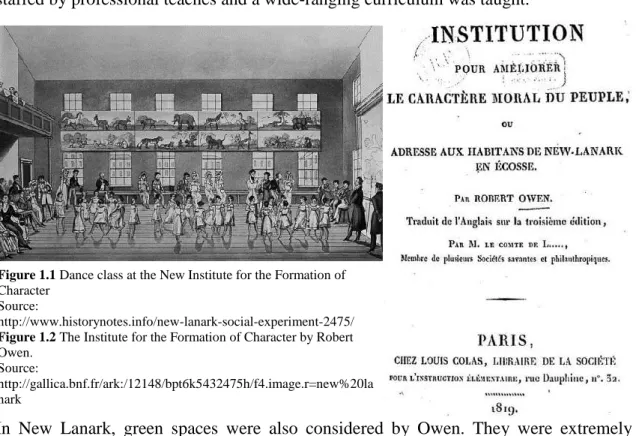
Robert Owen paid close attention to workers’ access to services. A shop for the community was open, where the inhabitants obtained products at a very good price and the profit of the store was reinvested in the school, therefore the community was benefited in two senses, through the acquisition of products at good prices and a quality education. An insurance system was established and people were guided to deposit money in the community savings bank. The result of many of these initiatives was the basis of a fund which the company also cooperated to pay the injured or sick workers. A qualified doctor was employed, and the population received free and quality medical service. "The New Institution for the Formation of Character"2 was a very innovative project of Owen. Two large new buildings were designed to provide generously provisioned educational and recreational facilities to the whole community. (Davidson, 2015, p. 130) The school was staffed by professional teaches and a wide-ranging curriculum was taught.
In New Lanark, green spaces were also considered by Owen. They were extremely important for health and well-being. Owen was conscious that workers spent a lot of time
2 Robert Owen created the New Institution for the Formation of Character dedicated to people who were
not concerned with their private interest, who seek the truth in good faith in order to improve social state, and who have the courage to follow it without being shaken by prejudice wherever it comes from.
Figure 1.1 Dance class at the New Institute for the Formation of
Character Source:
http://www.historynotes.info/new-lanark-social-experiment-2475/
Figure 1.2 The Institute for the Formation of Character by Robert
Owen. Source:
http://gallica.bnf.fr/ark:/12148/bpt6k5432475h/f4.image.r=new%20la nark
22
in the interior of the factories and he provided green spaces in which employees and populations could exercise in the fresh air, allotments gardens were created where villagers could grow their flowers and vegetables. Owen arranged for landscaped areas and paths, and planted trees on the hill side above the village.
The moral, social and environmental values started with Dale and continued by Owen at New Lanark provided the basis for seminal material and intangible development that had a lasting influence on following societies.
1.2.2 Planning and Urbanism
Company towns are settlements with unique morphological characteristics that make them exceptional. Most of these sites were isolated from urban centers either because of the need of energy sources or because of the presence of raw material. The implementation of the settlement in the field is one of the first features to consider. For example, if we analyze the case of New Lanark in the early 19th century in Scotland, we see that the buildings were generally located near the course of the Clyde River which constituted the source of energy to power the mills.
Architecturally speaking this implementation was not easy. The technology of the textile industry of the time, the vertical production known as Factory System conditioned a specific architectural form that consisted in adapting the buildings of various levels to the complex topography of the terrain creating impressive adaptations and unprecedented urban layouts as shown in figure 1.4.
Figure 1.3 New Lanark Company Town. The buildings are located close to the source of energy, the water.
Source: http://newlanark.org/uploads/image/Tidy%20Edge%20Watercolour.jpg
Figure 1.4 New Lanark Current aerial view. It is possible to appreciate the irregular conformation of the settlement.
23
Along with the complex topographical adaptation, we must consider its spatial organization which followed the productive logic. These sites are composed of two fundamental elements or spaces with different functions and characteristics but interconnected between them through a fluid and functional relationship. One is the productive area, be it the production building, the mill or the mine, which constitutes the neuralgic center of the complex. The other important area is the settlement that includes the area of housing and services for workers where power relation, socio-occupational hierarchies, ethnic, racial, and gender composition of the labor population also structured the social area.
According to John S. Garner (1992, p. 10) “Planning was a part of any business venture, but the layout of company towns often appeared haphazard. Camps and villages occupied the leftover spaces adjacent to the work. When site planning did occur, it often progressed in stages and not all at once” as is logic because the most significant was the productive building. For these reason is important to consider and give special attention to those examples that were conceived as planned towns like Nuevo Baztán in Spain and Arc-et-Senans in France. These planned company towns were created under the principle of recognizing the place of workers in a new order.
In the case of Arc-et-Senans in France, the complex was created under a neoclassical architecture. The layout was based on a circle, on the diameter of the circle were the factory and the director’s and clerk’s houses. On the perimeter of the outer circle facing
Figure 1.5 Arc et Senans. France.
Sources: https://commons.wikimedia.org/wiki/File:Arc-et-Senans_-_Plan_de_la_saline_royale.jpg
Figure 1.6 Nuevo Baztán. Spain.
24
center sat the multifamily houses of workers with little gardens behind. The other case, Nuevo Baztán, the project was conceived laid out on a grid, occupying the center of the town the Plaza Mayor a castle and a baroque church. Around this center were located the productive activity and later the housing.
Some owners planned model towns as a way of transcending labor-capital confrontation with spaces of cooperation instead of conflicts. A sure house constituted also a mechanism to enroll the workers and their families to the company. It was very common where company towns included aspects of planning without embracing the full program of building models communities for company workers. (Borges & Torres, 2012, p. 3) But other industrialists did assume more complexes layouts that considered the services necessaries for the wellbeing of the workers. The result were well designed settlements with impressive attractive urban scenarios. Some of these company towns were the precedent of Garden Cities and New Towns as Letchworth and New Earswick in England by the architects Parker and Unwin.
1.2.3 Architecture. Housing and Industry
In the document presented by Louis Bergeron Les villages ouvriers comme éléments du patrimoine de l'industrie (1995), he carries out an analysis of the criteria used by UNESCO to consider company towns as industrial heritage sites. It is highlighted that to define company towns, working habitats developed inside or in continuity of preexistent settlement are excluded, that is to say, that company towns were new creations, projects started from scratch, where architecture played an important role in the cultural value of these sites.
Architecture in company towns can be analyze from two perspectives, industrial architecture and housing architecture. Although the evolution of the industrial architecture has been relevant, housing architecture has been the center of attention in company towns because of its social implication.
Provide housing to workers is an old subject, during the Middle Ages, houses were already constructed for miners, weavers, crystal workers, farmers and others. Houses were made by the owners of the enterprises, and were sold, rented or given to workers. This situation had its particularities according to the relation of the settlement with urban
25
cores. At the end of the 16th century the manufacture’s appearance characterized by the high concentration of labor within large buildings had a big development in the countryside due to the availability of hydraulics resources, raw material cheap labor and craft skills. Social and space component of the production began to change because of the relation between technical culture, enterprise and territory (Dorel-Ferre, 2017, p. 15).
Meanwhile a slow evolution was happening in the housing frame motivated by paternalism and utopian climate that searched employees’ wellbeing, company towns were spreading all over the world. There were too many experiences, including those that were not looking for human and social improvement where workers’ life conditions were precarious.
In the search of cultural values it’s important to mention those sites that because of paternalism they made available high quality houses. The housing’s standard was based on the number of rooms and dimensions, also by comfort furniture presented in the rooms, outer spaces like garden, and also their urban and landscape position. These housing gave a quality of life that searched to respect the workers instead of a profitable resource and financial returns. It should be also pointed out that the quality of materials used in the construction, the use of decorative motifs, the assimilation of various architectural models and constructive style as benefit of housing individualization.
During the universal exposition of London in 1851, the thematic of popular housing acquires greater interest. Here appears a sector dedicated to operators’ houses with typologies presented under the patriarchy of Prince Alberto. In the exhibition of Paris of 1867 the example is Mulhouse, with a prototype of housing realized by Emile Müller. (Dorel-Ferre, 2017, p. 19) This houses had square floor plans, with two levels, each one could accommodate two families. They had, kitchen, attic and basement even a small garden when family could raise vegetables as diet supplement.
Emile Müller was an engineer, after graduating he gained a place in a railway company, he was touched by the precarious life conditions of railway workers. He developed a sort of curiosity by life conditions’ enhancement and housing accessibility for workers. Müller housing success doesn’t lies just in architecture, he was able to see that in the French context the conditions were given for him to create L’Associasion des Industrieles de