A Work Project, presented as part of the requirements for the Award of a Master's Degree in Management from the Nova School of Business and Economics.
TAKING A STAND: REGAINING POWER BY PURCHASING
CONTROVERSIAL BRANDS
Marta Carvalho Gomes, Student No. 25803
Work project carried out under the supervision of: Professor Irene Consiglio
1
Taking a Stand: regaining power by purchasing controversial brands
People want to escape the aversive state of powerlessness, as it makes them feel out of control and induces negative effects. One way through which people resolve the absence of personal control is compensatory consumption. This work theorizes that powerless individuals will consume more controversial brands because they are perceived by those individuals as powerful. By conducting an experimental study, in which brand controversy was manipulated via two scenarios, no evidence was found to support the main hypothesis. Unexpectedly, it was found that controversial brands are perceived as less powerful by powerless individuals than by powerful individuals.
Keywords: power, compensatory consumption, controversial brands, brand risk-taking.
This work used infrastructure and resources funded by Fundação para a Ciência e a Tecnologia (UID/ECO/00124/2013, UID/ECO/00124/2019 and Social Sciences DataLab, Project 22209), POR Lisboa (LISBOA-01-0145-FEDER-007722 and Social Sciences DataLab, Project 22209) and POR Norte (Social Sciences DataLab, Project 22209).
2
1. Introduction
Believe in something, even if it means sacrificing everything. The commercial launched by Nike in September 2018 featuring American football player Colin Kaepernick, secured the brand an accolade for Outstanding Commercial at the Creative Arts Emmy Awards. Despite this recognition, the controversial campaign produced reactions that were polar opposites. On YouTube, reactions to the advert ranged from the most negative “It’s simple Nike, your link to Kaepernick is why I don’t buy your products anymore” to the most positive “Love it! This ad is empowering and encouraging”. All in all, the campaign was positive for Nike: its stock prices registered an unprecedented high value in the immediate aftermath of the advert’s release (Wertz, 2018).
Indeed, controversial campaigns are not a novelty but in recent years brands have been increasingly resorting to these shock-marketing tactics (Parry et al., 2013) and controversial activities as a means of sparking interest in a wide population (Agrawal, 2016). Gillette, for instance, triggered mass interest after launching the 2019 advert with the phrase The Best a Man Can Be, which is proved by the soar in word-of-mouth (WOM) immediately after the ad’s launch (YouGov, 2019). However, Gillette was unsuccessful in increasing willingness to buy (WTB) (Gogarty, 2019). The brand took a stand on a topic (toxic masculinity) that offended a large part of their customers as many did not agree with the company’s viewpoint. In practice, succeeding in controversial campaigns is challenging because positive reactions depend on the degree of issue alignment with customers’ views (Agrawal, 2016; Kennedy, 2014). Data shows that WTB increases if the company’s stance on key matters is consistent with individuals’ beliefs (Qualtrics, 2015). Accordingly, a brand will decide more effectively whether to venture into controversy or not, if it can understand properly its consumer base as well as their views and predict accurately how consumers will behave in response to controversial actions.
3
Currently, the socio-political scene around the world along with activist movements like Me Too, the Climate Strike, Black Lives Matter, etc., are some of the controversial issues that brands are choosing to address in their communication endeavours. The high number of activist movements observed in the last decade is a manifestation of the powerless joining together to make their voices heard against the powerful (Satell & Popovic, 2017). According to the WEF (2015), the growing sense of powerlessness comes from the lack of meaningful choice people feel as consumers, voters and workers. Simultaneously, there is an observable growth in belief-driven consumers (Edelman, 2018). On one hand, this can be seen as people endorsing causes they believe in through purchasing power; on the other hand, the consumption of controversial brands can be regarded by consumers as a means of gaining the sense of power they are lacking.
Although there is no implication of a correlation, the trends mentioned above – an increase in brands’ controversy, an increase in activist movements, a growing sense of powerlessness, and a surge of belief-driven consumers – prompted the study that follows. This work project will deal with consumers’ psychological state of power and how those who face a threat to power relate to controversial brands. The developed hypothesis is that when people feel powerless, they will prefer to consume controversial brands – over non-controversial brands – as they might be seen as more powerful, and therefore might serve as a means to regain one’s own sense of power. The following work uses past research related to controversy, personal control and compensatory behaviour to establish the main hypotheses. To test the hypotheses, an experiment was conducted which is described in detail in the methodology section. The results were thoroughly analysed to draw conclusions. Lastly, the limitations of the study are discussed as well as possible directions for future research.
2. Literature Review
In the scope of consumer behaviour and research, there have been several studies on how people seek to diminish threats to personal control and compensate for their negative effects
4
through many different processes. Some of the relevant authors for this research are Rucker and Galinsky, as their work focuses on compensatory behaviour in response to threats to power. Regarding controversial matters there is also existing literature, mostly focused on how controversy causes conversation and opinion sharing (Chen & Berger, 2013; Tassiello et al., 2016), on reactions to controversial advertising (Parry, 2013), and neighbouring concepts such as polarization (Rozenkrants et al., 2017). This section will build on existing literature related to controversy, power and compensatory behaviour to formulate the main hypothesis that powerless consumers have a higher purchase intention for controversial brands.
2.1. Controversy & Controversial Brands
Defining controversy: The Cambridge Dictionary (2019) gives a broad definition of controversy, describing it as “a lot of disagreement or argument about something, usually because it affects or is important to many people”. Even though it is a simple definition, it conveys the main idea that controversy causes divergent opinions and non-consensual reactions. That being said, not every topic that causes disagreement is controversial or causes controversy. As Chen & Berger (2013) explained, it is possible to disagree on which soap smells better but it is unlikely that people find that issue controversial. However, if they disagree on the topic of legal abortion, they are more likely to find that a controversial topic. Indeed, an issue is controversial if people have disagreeing views on it and strongly hold those views (Boring, 1929). Issues thatinvolve moral judgement (right vs. wrong) or that have a political or religious nature are expected to be considered controversial as a lot of people will most likely have opposing viewpoints on them. Previous research also pointed out that “controversy is in the eye of the beholder” (Chen & Berger, 2013), as for instance sports fans might consider a certain annulled goal controversial whereas non-sports-fans are unlikely to consider this controversial. Moreover, the characterisation of an issue as controversial might even depend on culture and time (Ralston & Podrebarac, 2014).
5
WOM has a substantial effect on consumers’ everyday purchasing decisions and it is considered a very useful marketing instrument (Arndt, 1967; Berger, 2014; De Angelis et al., 2012). One reason why brands take part in activities that might be perceived as controversial is to take advantage of the WOM generated. In fact, a brand should not be described in its whole as controversial since a brand, in its pure existence, is unlikely to cause opposing and strongly held viewpoints by a large part of the population. Therefore, for the purpose of this research, a controversial brand will hinge on the definition of controversy and will be described as a brand which performs controversial actions and/or takes a stance on controversial topics1. For
instance, a brand is controversial when it communicates in a controversial manner, as were the examples of Nike and Gillette mentioned previously. Likewise, sometimes a company carries out a controversial action in another scope of its activity, which results in the brand being perceived as controversial – for example, the North American fast-food chain Chick-Fil-A caused controversy when it became public that the company donated to charities with anti-LGBTQ stances (Sandler, 2019). In practice, a controversial brand does not need to be controversial constantly but instead, it performs controversial actions that are perceived by the general public as such.
Controversy and polarization: Several bodies of literature, mainly within the fields of consumer research and social psychology, have touched upon the subject of polarization of products, of groups and others (Rozenkrants et al., 2017; Rao & Steckel, 1991; Ann Smith, 1989; Lamm & Myers, 1978; Mackie, 1986). Such research can be transposed and applied to controversial brands. Controversy can be said to be a form of polarization, considering that something polarizing is defined by Rozenkrants et al. (2017) as that which some people like a great deal and others dislike a great deal. Some characteristics of polarizing products are that they transmit more self-expressive information than nonpolarizing products and for this reason,
6
they constitute a stronger signal of one’s taste or personality (Rozenkrants et al., 2017). Thus, if something causes divergent opinions, individual’s opinions on that target are more demonstrative about the character of the person who expresses such opinions (Rozenkrants et al., 2017). Brands that choose to be controversial are likely to also become polarizing, since a great deal of people will like them and a great deal will dislike them. With this in mind, it makes sense that the consumption of controversial brands is more informative regarding an individual’s character than the consumption of non-controversial brands.
Controversy and its links to power: Other academic publications that are enlightening for the present research concern non-conforming behaviour, which is broadly defined by Nail, MacDonald, & Levy (2000) as an action or belief which is not in line with rules or standards. Behaving in accordance with social norms and expected conduct is motivated by a need of social acceptance (Cialdini & Goldstein, 2004) and a fear of punishment, like social rejection and mockery (Kruglanski & Webster, 1991; Miller & Anderson, 1979; Levine, 2015). In contrast, non-conforming behaviour involves a social cost and represents a high risk (Schachter, 1951; Levine, 2015). For these reasons, behaving in a non-conforming manner can indicate higher status and capability to others but only if the non-conforming behaviour is intentional (Bellezza et al., 2014). The same authors focused particularly on how the characteristics of observers affect the perceptions of non-conforming behaviour; they concluded that observers’ need for uniqueness, familiarity with the environment, and the presence of expected norms of behaviour mediate status and competence inference. Overall, “observers may infer that a non-conforming individual is in a powerful position that allows her to risk the social costs of nonconformity without fear of losing her place in the social hierarchy” (Bellezza et al., 2014).
Likewise, when brands choose to be controversial it can be said that they are non-conforming to the normal and expected standards. Much like it happens with individuals, when a brand is non-conforming – in this case by being controversial – it is also incurring in high
7
costs and high risks. There is a plethora of non-controversial actions that brands might choose, but some of them use their brand agency to influence outcomes in a controversial domain that is dividing and difficult to approach. By doing this, brands are risking their brand image and possibly incurring in costs since a part of the brand’s customers, that take on a contrary view regarding the same controversial matter, might decide to stop consuming the brand. Overall, being controversial is a form of signalling as it is costly and observable by others (Spence, 1973), so it is expected that observers make inferences according to that signal.
Given the information gathered on controversy, this work hypothesizes that, by being controversial, brands will be perceived as more powerful comparing to non-controversial ones. Individuals will perceive that controversial brands take the risk of positively influencing world outcomes because they are in a position of power where they no longer need to worry about losing their place in the market and can afford the risks and costs associated with being controversial.
H1A: controversial brands compared to non-controversial brands are perceived as more
powerful.
H1B: controversial brands are perceived to take more risk compared to non-controversial
brands and this, in turn, affects perceptions of power. 2.2. Power & Compensatory Behaviour
Power and its effects: Power is defined as the relative control over other individuals, valued resources and/or outcomes, of oneself or others (Magee & Galinsky, 2008; Hunt & Nevin, 1974). The concept of power is relative, in the sense that it is assessed in comparison to others and can differ for one individual depending on the context and relationship (Pfeffer, 1981; Emerson, 1962); a CEO, for example, is typically seen as powerful but it is possible that an employee quitting for another job makes them feel powerless (Rucker & Galinsky, 2008). Many sources can provoke feelings of power, namely economic sources, positions of authority,
8
respect from others and having knowledge in a certain field (French & Raven, 1959). The feeling of power can also be described as a psychological state which is quite easy to manipulate (e.g. Galinsky et al., 2003) and has a wide impact on one’s behaviour. One of the areas that power impacts is consumption patterns and purchase behaviour: individuals who feel powerful might be more willing to acquire luxury brands (Mandel et al., 2006), while individuals who feel powerless might be less willing to spend money on consumer goods overall (Dacher et al., 2003) or, paradoxically, they might tend to purchase goods that have characteristics, like status, which make them feel more powerful (Rucker, 2009). In short, the degree of power which one feels greatly sways the patterns of consumption of such individual.
Power and personal control: Focusing on the state of feeling powerless, it is defined as an aversive state (Dacher et al., 2003) that individuals want to mitigate whenever possible (Rucker & Galinsky, 2008). Powerlessness is normally linked to lacking control and control is highly desirable; by the same logic, regaining power will be associated with regaining control. Past research has shown that power induces people to trust they have control over all sorts of resources and consequences (Fast et al., 2009). Skinner, Chapman, & Baltes (1988) referred to personal control as the extent to which an individual can produce desirable outcomes and avert undesirable ones. Extensive scholarship on the notion of personal control has agreed upon the idea that the perception of one’s personal control results in mental and physical welfare (Langer & Rodin, 1976; Luck et al., 1999), thus people strongly desire control. Sensing personal control is also beneficial because it motivates one to take action to solve problems (Ross & Mirowsky, 1989), improves individuals’ sense of competence (Thompson, 1981) and lowers anxiety-related feelings stemming from world randomness and chaos (Kay et al. 2009).
Personal control, much like power, might be achieved through various replaceable sources. Inesi et al. (2011) provided evidence for this theory through a substitutability hypothesis, which proved the interchangeability of choice and power to achieve control. So,
9
when individuals sense a threat to one of these forces and they feel powerless, for example, they will seek to achieve the basic need for control through alternative sources that will serve the same purpose. In fact, personal control might be threatened in several ways, for example, when social density is high (Baum & Valins, 1977; Consiglio et al., 2018) or when there is spatial confinement (Levav & Zhu, 2009). When facing a threat to control, which in turn triggers feelings of anxiety and discomfort, individuals engage in compensatory behaviour. For example, Kay et al. (2009) demonstrated that to reduce anxiety resulting from threats to the belief that our world is non-random, people will perceive patterns in noise, support their government more fiercely and strengthen their beliefs in God. Also, Cutright (2012) demonstrated that individuals might respond to threats to control by engaging in structured consumption (e.g. a preference for boundaries).
Threats to power and compensatory behaviour: In the same way other psychological threats lead to compensatory behaviour, feelings of powerlessness are also expected to result in compensatory behaviour to restore power. A likely mechanism through which this behaviour manifests is in product preference and choice (Rozenkrants et al., 2017). Authors Rucker & Galinsky (2013) defined the term compensatory consumption as “the desire for, acquisition, or use of products to respond to a psychological need or deficit”. This type of consumption is compensatory as it is carried out to offset a threat to one’s self-identity and there are several findings supporting the fact that it does result in alleviation of the threat (e.g. Gao et al., 2009). People engage in this behaviour to symbolically signal mastery of the threatened dimension via symbols of completeness (Wicklund & Gollwitzer, 1981). There are many reasons why an individual chooses to engage in compensatory consumption instead of directly addressing the threat, however, in agreement with signalling theory, there is a higher probability that it happens when consumption is seen and recognized by others.
10
Marketing research has found that products convey information about the characteristics of their holders (e.g. Shavitt & Nelson, 1999). Individuals often choose brands which associate with their self-image and portray the identity that they see in themselves and want others to see in them. As mentioned previously, Rozenkrants et al. (2017) posited that polarizing products are more self-expressive than non-polarizing ones and that they are deemed to communicate more information about the consumers than non-polarizing products. From this perspective, it is logical that powerless individuals might prefer controversial brands as they might be more effective in expressing the individual’s identity and boost their sense of power.
Linking prior studies to the present research, it is expected that individuals who feel powerless will use compensatory consumption as a means to alleviate the threat they are experiencing and that they do so by choosing brands that have self-expressive attributes. Therefore, the consumption of controversial brands is hypothesized as a way to regain power: controversial brands are perceived as powerful and for this reason, powerless individuals will be more inclined – than powerful individuals – to consume those brands, which serve as a surrogate means of attaining power. This rationale leads to the next hypothesis tested, that:
H2: individuals who feel powerless have a higher purchase intention for controversial brands
(vs. non-controversial brands) when compared to individuals who feel powerful. Sources of power: Previously, it was mentioned that power can originate from different sources. To extend the results of the second hypothesis, it seemed relevant to analyse how the different spheres where power stems from can affect individuals’ relationship with controversial brands. In this research, the Spheres of Control scale is used as a measure of power (see 4. Methodology for further details), which includes three domains of life: personal, interpersonal and socio-political. Given that powerless individuals will utilize the consumption of controversial brands as a compensatory behaviour to restore power, it is logical that they will prefer brands that are controversial in the domain in which they feel powerless. To illustrate, if
11
a person is feeling powerless in relation to the ruling government it is expected that this person prefers a brand that is controversial in the socio-political domain rather than a brand that is controversial regarding weight loss for example. Work by Wicklund & Gollwitzer (1981) supports the premise that individuals will compensate in a threat-specific manner, and the present research aims to add to these findings by analysing threats to different scopes of power. Summarizing, the third hypothesis investigated in this research is the following:
H3: individuals who feel powerless versus powerful in one domain (personal, interpersonal,
socio-political) prefer controversial brands versus non-controversial in the same domain. 3. Research framework
Now that the hypotheses have been presented, it is pertinent to summarize the model which will be tested (Figure 1). It is posited that controversial brands are perceived as higher risk takers than non-controversial brands because controversial issues are dividing and difficult to approach which might harm the brand acting controversially. In turn, this affects the perception of brand power: existing literature has shown that risk-takers are perceived as being in a powerful position which allows them to take risks without worrying about the consequences (Bellezza et al., 2014). If a controversial brand is perceived as powerful – through the explained mechanism – then, there will be higher purchase intention for this brand. Actually, individuals who suffer threats to personal control have higher purchase intention for high-agency brands (brands that have a high ability to impact widespread outcomes) (Beck et al., 2019). Further, this model is mediated by individuals’ sense of power. The anticipated effects are stronger as an individual’s sense of power decreases, meaning that the positive effect of brand controversy on purchase intention is likely stronger when individuals feel powerless (vs. when individuals feel powerful). This is expected to happen since the perception of brand power is more relevant to individuals who feel powerless, and therefore controversial brands are more appealing to powerless individuals than non-controversial brands which are perceived as less powerful.
12
Figure 1. Hypothesized model
The present work intends to contribute to the literature on controversy as well as research regarding compensatory consumption in response to threats to power. The novelty of this study is that it proposes brand controversy as a possible attractive factor for powerless individuals. Individuals see it as a signal of power on the side of the brand and so, the consumption of such brand might be used as a way to regain their own sense of power. A meticulous search of the relevant literature led to the conclusion that there is currently no research of this kind therefore, this work aims to close this literature gap. The gathered insights will be useful for companies to know whether it is favourable to venture into controversy according to the type of consumers that the brand attracts or aims to attract.
4. Methodology
To test the hypotheses presented previously, a quantitative experimental study was conducted through an online questionnaire, using the data collection platform Qualtrics. Participants were randomly assigned to either a controversial or non-controversial scenario, via the platform’s randomizer tool which presented both scenarios evenly. Employing the scenario method allowed to control the controversy variable, namely it guaranteed that all participants were prompted to think of a controversial (or non-controversial) topic that met the criteria defined by this research. Prior studies have defined that something is controversial when it causes disagreement, divergent opinions and when, at the same time, many people feel strongly about the topic (Chen & Berger, 2013; Boring, 1929). With this in mind, two scenarios were
13
created that were loosely based on Gillette’s campaign “The best a man can be”, in which the brand criticised the problematic of toxic masculinity and pledged to donate 1 million dollars to “non-profit organizations executing (…) programs designed to help men of all ages achieve their personal best” (Gillette, 2019). Both scenarios first presented a short description of a movement that was talked about in recent years so that even if the participant was not totally familiar with the movement, they could answer the questions with knowledge of the topic. The controversial scenario described a brand that supported the #MeToo movement, which fit the definition of controversial brand. This movement became viral online and generated a wide discussion – just 24 hours after the conversation started 4.7 million people used #MeToo on Facebook, and on Twitter the hashtag was used 1 million times in 48 hours (CBS News, 2017); the widespread discussion revealed opposite views regarding the movement and sexual harassment. For the non-controversial scenario, the same situation was described with the difference that the movement supported by the brand was non-controversial. For this scenario the World Cleanup Day was chosen, a movement that joins volunteers to take part in a waste collection day happening once a year worldwide. This movement, which started in 2018, did not cause controversy: many people were aware of it and talked about it on social media but in general, opinions were positive and consensual and it is safe to say that people did not feel as strongly about this issue (it was intended that the non-controversial movement was not related to climate change as this is regarded as a controversial topic).
The questionnaire used the Spheres of Control scale to measure individual’s power (Paulhus & Van Selst, 1990). This scale is appropriate to assess power as the items measure relative control over oneself, others and general world outcomes. Most importantly, the comparative nature of power is captured by this scale because it allows to infer that individuals who score higher in the scale feel more powerful than individuals who score lower in the scale.
14
4.1. Procedure
This study used the snowball sampling method (Kalton & Anderson, 1986) which resulted in a non-probability convenience sample of 131 participants that responded to an online questionnaire. Participants were randomly assigned to one of two conditions (Annex 1 for full questionnaire). Those in the non-controversial condition first read about a non-controversial topic, as follows:
Non-controversial scenario: movement description
World Cleanup Day is a movement against the global solid waste problem that spread virally. On social media, the hashtag #worldcleanupday created a conversation on the topic and aimed to demonstrate how common the solid waste problem is all around the world. A great deal of people thought the movement was very positive for the environment, and no one really had a negative reaction to it. Therefore, the World Cleanup Day movement obtained a consensual positive response.
Instead, participants in the controversial condition read the following: Controversial scenario: movement description
#MeToo is a movement against sexual harassment that spread virally. On social media, the hashtag #metoo created a conversation on the topic and it aimed to demonstrate how common sexual harassment is all around the world. A great deal of people thought the movement was very positive for women but a significant amount of people had a negative reaction to it. Therefore, the #MeToo movement was surrounded with controversy.
Subsequently, a manipulation check was included in the questionnaire to assess if the controversy manipulation was successful in producing the intended effect. All participants were required to evaluate on a 7-point Likert scale (1-Strongly disagree; 7-Strongly agree) their level of agreement regarding if the movement caused opposing opinions, if it was relevant to society, if it was necessary, if it was changing outcomes and if it was controversial.
Next, all participants read a description of a brand that launched a campaign in support of the movement they had just read about. Particularly, participants in the non-controversial (controversial) condition read, respectively:
15
Non-controversial scenario: brand description
Imagine that Brand X, a well-known multinational fashion brand, launched a campaign in support of the World Cleanup Day movement in which it pledged to offer 1 million dollars per year, during the next 5 years, to non-profit organizations that help organize Clean Ups around the world. This campaign has the following slogan: “Buy at Brand X, support World Cleanup Day”. The campaign was spread through an advert on YouTube and television, billboards on the street, the company’s online store website, and in windows of their shops.
Controversial scenario: brand description
Imagine that Brand X, a well-known multinational fashion brand, launched a campaign in support of the World Cleanup Day movement in which it pledged to offer 1 million dollars per year, during the next 5 years, to non-profit organizations that help organize Clean Ups around the world. This campaign has the following slogan: “Buy at Brand X, support World Cleanup Day”. The campaign was spread through an advert on YouTube and television, billboards on the street, the company’s online store website, and in windows of their shops.
In order to measure the dependent variable purchase intention, participants were asked to evaluate on a 7-point Likert scale (1-Very unlikely; 7-Very likely) how likely they would be to purchase a pair of jeans from this brand. After, the brand description was shown again and some brand perceptions were measured using single-items evaluated on a 7-point Likert scale (1-Strongly disagree; 7-(1-Strongly agree) namely: influence in society, likelihood to cause debate, ability to change world outcomes, brand controversy, brand risk-taking, brand power, differentiation from competitors and the brand’s campaign genuineness.
In order to evaluate individuals’ sense of power, the Spheres of Control scale was used (Paulhus & Van Selst, 1990). This scale consists of a battery of thirty items, evaluated on a 7-point Likert scale (1-Strongly disagree; 7-Strongly agree), which are designed to assess control over three spheres of life: personal (e.g. “I can usually achieve what I want if I work hard for it.”), interpersonal (e.g. “I have no trouble making and keeping friends.”) and socio-political (e.g. “With enough effort we can wipe out political corruption.”).
Finally, individuals’ attitude towards brands supporting causes was measured on a 7-point Likert scale (1-Strongly disagree; 7-Strongly agree) through averaging three-items: (a) “I
16
think brands have an obligation to support a cause”, (b) “I like brands that voice their opinions on controversial issues” and (c) “I pay attention to initiatives carried out by brands”.
5. Analysis
Before starting the data analysis, it was necessary to do a preliminary manual data cleaning in order to ensure maximum quality of responses which in turn increased the accuracy of the subsequent analysis (Rahm & Do, 2000). The four factors considered for excluding participants from the sample were completeness, response time, answer straightlining, and inconsistency (Qualtrics, 2019). There were 17 participants who did not complete the whole questionnaire and were excluded from the sample but for the remaining criteria, there were no abnormalities observed. Thus, the final sample consisted of 114 participants of which 78 were women and 36 were men with ages ranging from 19 to 70 years old (Annex 2 for all demographics). Out of 114 participants, 61 responded to the controversial scenario whereas 53 responded to the non-controversial scenario. The different number of participants in each scenario was due to questionnaires that were only partially completed.
5.1. Reliability of measures
Two variables were measured using multiple-item scales, therefore it was necessary to evaluate their internal consistency. Both measures are deemed internally consistent according to Cronbach’s alpha: the measure of individual’s power had an alpha value of 0.794 (30-items) and the measure of attitude towards brands supporting causes had a value of 0.683 (3-items).
5.2. Manipulation check
By analysing the manipulation check it was concluded that participants who were subjected to the controversial scenario indeed perceived the movement as more controversial (Mc=5.03, SDc=1.4; Mnc=3.47, SDnc=1.68) and more likely to cause opposing opinions
(Mc=5.42, SDc=1.28; Mnc=3.72, SDnc=1.69) than participants who were exposed to the
17
were significant (t(112)=5.40, p<.001; t(112)=6.12, p<.001). As expected, the controversial movement was also perceived as more prone to changing world outcomes (Mc=5.21, SDc=1.18;
Mnc=4.64, SDnc=1.19; t(112)=2.56, p<.05). However, there was no statistically significant
difference (p>.05) in the movements’ perceptions regarding their necessity and relevance to society. In sum, both topics were perceived as necessary and relevant, but one topic was more controversial than the other, as intended. Therefore, the manipulation of controversy was successful.
5.3. Hypotheses testing
Tests of normality were performed for all variables (Annex 3). Although most variables are not normally distributed, according to Central Limit Theorem (n=114) the tests performed below are valid.
H1A: Participants in the non-controversial scenario perceived the brand as more powerful than participants exposed to the controversial scenario (Mnc=5.26, SDnc=1.02; Mc=4.73,
SDc=1.39), contrary to what was hypothesized. An independent sample t-test confirmed that
the difference in means is significant (t(112)=2.27, p<.05). This result implies that H1A is denied
and that, according to the present sample, the opposite is confirmed – non-controversial brands are perceived as more powerful than controversial brands.
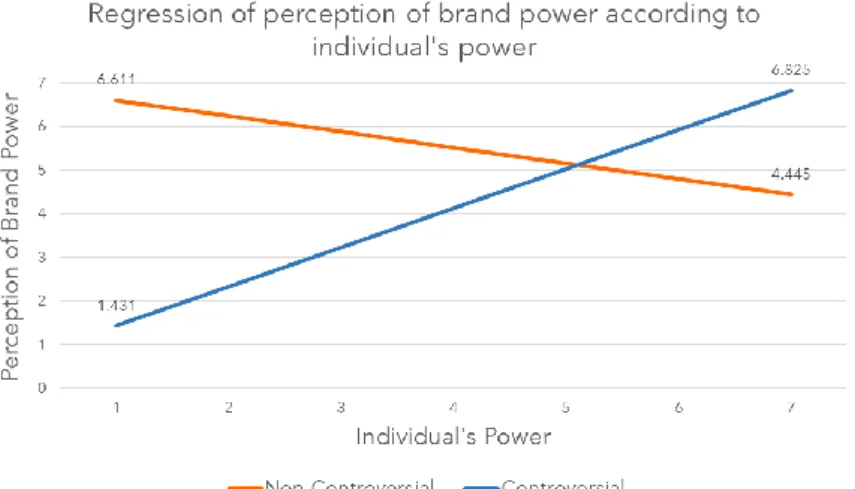
Additionally, it is interesting to examine if there are differences between scenarios (non-controversial and (non-controversial) in perceptions of brand power while controlling for the effects of individuals’ power on their perceptions of brand power. In order to assess this, an ANCOVA test was performed which yielded that the interaction effect between the scenario and individual’s power is significant (F(1, 110)=8.47, p<.01). This result means that there is no homogeneity of regression slopes and thus, for each scenario, it is expected that the level of an individual’s sense of power affects the perception of brand power differently. Indeed, when running a regression (F(3,110)=5.09; p<.01) to fit each scenario it was concluded that this was
18
the case: in the controversial scenario when an individual’s power increases their perception of brand power also increases, while in the non-controversial scenario when an individual’s power increases their perception of brand power decreases (Figure 2).
Figure 2. Regression of perception of brand power according to individual’s power. (n=114)
H1B: As hypothesized, participants in the controversial scenario perceived the brand as taking more risk than participants exposed to the non-controversial scenario which perceived the brand as taking less risk (Mc=5.33, SDc=1.42; Mnc=4.58, SDnc=1.63). Once again, an
independent sample t-test concluded that the difference in means is statistically significant (t(112)=-2.6, p<.05).
For this hypothesis, it is also relevant to check if there are differences between scenarios (non-controversial and controversial) in perceptions of brand risk-taking while controlling for the effects of individuals’ power on their perceptions of brand risk-taking. Again, an ANCOVA test was performed which concluded that the interaction effect between the scenario and individual’s power is not significant (F(1, 110)=.276, p>.05). This result implies that the hypothesis of homogeneity of regression slopes is not rejected so, for both scenarios, it is expected that individuals’ sense of power affects the perception of brand risk-taking in a similar manner whether the brand is controversial or non-controversial.
To bring together the first hypothesis, the estimated effects of brand controversy on the perception of brand power via the perception of the brand’s risk-taking are presented (Figure
19
3). The only direct effect which proved to be significant was the effect of brand controversy on the perception of risk-taking (R2=.13, F(1, 112)=16.68, p<.001; β=.366, p<.001). Conversely, the effect of perceived risk-taking on perception of brand power (R2=.007, F(1, 112)=0.826, p>.05; β=.069, p>.05) and the direct effect of brand controversy on the perception of brand power (R2=.005, F(1, 112)=.514, p>.05; β=.055, p>.05) were not statistically significant.
Figure 3. Representation of H1(**p < .001)
Additionally, as exploratory research, other brand perceptions were assessed and compared between the two scenarios. Only for the likelihood to cause debate variable were there significant differences between the means (Mnc=5.26, SDnc=1.11; Mc=5.67, SDc=1.08;
t(112)=-1.99, p<.05). Although the controversial movement was perceived as more prone to changing world outcomes, this did not carry over to a significant difference in the perception of brand’s ability to change world outcomes (Mnc=5.42, SDnc=1.23; Mc=5.07, SDc=1.24;
t(112)=1.51, p>.05). For the remaining perceptions tested – brand’s campaign genuineness (Mnc=4.28, SDnc=1.39; Mc=4.24, SDc=1.43; t(112)=.14, p>.05), influence in society (Mnc=5.36,
SDnc=1.3; Mc=5.28, SDc=1.1; t(112)=.36, p>.05), differentiation from competitors (Mnc=5.13,
SDnc=1.18; Mc=4.95, SDc=1.37; t(112)=.75, p>.05) – it is not possible to say that there are
differences in means caused by the difference in scenarios, which means that being controversial is not causing the difference in these brand perceptions.
H2: Regarding the second hypothesis, it was posited that individuals who feel powerless would have a higher purchase intention for controversial brands (than individuals who feel powerful), as they see in those brands a possible way of regaining power. Even though the
20
hypothesis that controversial brands are perceived as more powerful did not hold true, it was tested if regardless of this situation the second hypothesis remains valid.
Overall, there was no statistically significant difference in purchase intention for the brand in the non-controversial and the controversial scenario (Mnc=5.68, SDnc=1.59; Mc=5.52,
SDc=1.56; t(112)=-.524, p>.05). To check if there is a difference in purchase intention between
scenarios for individuals with different levels of power, an ANCOVA test was run. The results do not allow to reject the hypothesis that there is homogeneity of regression slopes, as it was concluded that the interaction term between the scenario and individual’s power was not significant (F(1, 110)=.797, p>.05). Hence, it is presumed that the behaviour of brand purchase intention, along the scale of individuals’ sense of power, is similar in both scenarios. Still, the regression was plotted (Annex 4) and it alludes to the fact that individuals who feel less power have a lower purchase intention for controversial brands than individuals who feel more power, and for non-controversial brands the opposite is verified. However, the difference in slopes was not statistically significant.
H3: Lastly, it was hypothesized that individuals who feel powerless in one domain, will prefer a controversial brand in the same domain, instead of a non-controversial brand. Despite the fact that the previous hypothesis was not confirmed, it is still worthwhile to test this last hypothesis, focusing on the domain of socio-political power. This was the domain of power chosen because the controversial scenario described a brand which is controversial in this same domain (#MeToo is considered a social movement). The method used is the same: an ANCOVA test to check if there is homogeneity of regression slopes. Once again, the interaction term between the scenario and individual’s sense of socio-political power was not significant (F(1,110)=.068, p>.05) meaning that the possibility of homogeneity of regression slopes is not rejected. This suggests that individual’s sense of power in a specific domain does not mediate purchase intention for controversial and non-controversial brands in a different manner.
21
Hypothesized model: Since there was no evidence to support hypotheses H2 and H3, and
H1A was rejected, it is meaningless to test the hypothesized model as a whole.
6. Discussion
The first relationship hypothesized in the model was the only one confirmed: it was found that controversial brands are perceived as taking more risk than non-controversial brands. This finding is in accordance with past research which says that behaving in a non-conforming manner – as is the case of being controversial – is risky and potentially costly (Bellezza et al., 2014). In the case of controversial brands, they risk losing customers by speaking out on issues that are dividing and could go against the customers’ views on that same issue. Also, there was no proof that an individual’s sense of power mediates the perception of brand risk-taking differently for both scenarios. In reality, it is logical that the perception of brand risk-taking is not directly affected by an individual’s sense of power as it is a straightforward characteristic. Controversial brands being perceived as taking more risk should lead them to be viewed as more powerful, or so it was thought. Instead, the opposite is true and non-controversial brands are viewed as more powerful than controversial brands which contradicts what Bellezza et al. (2014) had found regarding risk-taking being positively associated with power. Perhaps this occurs because people might associate taking risks with going to the last resort to get out of a position of disadvantage (Anderson & Galinsky, 2006), as for example low power. This research was applied to individuals and not brands, but intuitively a brand that has a less established position in the market (less power) also has less to lose and therefore might engage in more risky behaviour to attract attention. Another unexpected finding was that, in the controversial scenario, when an individual’s power increases their perception of brand power also increases, while in the non-controversial scenario the contrary is true. While it was this study’s belief that individuals’ lack of power would enhance their perception of brand power,
22
it is possible that these individuals’ perceptions of controversial brands are biased towards their own feelings of power.
For the other hypotheses posited by this work – mainly that powerless individuals would have a higher purchase intention for controversial brands than non-controversial brands – no evidence was found to support the theory. Overall, it was not confirmed that there even exists a difference in purchase intention between both types of brands. The lack of significance in results might be due to several reasons, the main one being a flaw in the design of the experiment. When subjected to online questionnaires, participants often had not previously considered or put significant thought into the topic being dealt with. This means that real purchase intention for these brands might differ from what individuals reported, due to lack of reflection. It is also possible that controversy comes across as fake or only as a plan to attract attention, and that the main purpose of such controversy is not genuine concern over the matter (Kanter, 2009; Mattis, 2008). Finally, it might be the case that simply there is not an effect of individuals’ power on their purchase intention for controversial brands. Individuals might neither value nor be aware of brand controversy or brand’s support for controversial matters so for them, regardless of their sense of power, this is not something that is weighed in when considering a purchase.
6.1. Implications
As well as relevant theoretical implications, this research also provides some practical implications. Brands that aim to be controversial, or that are pondering to act controversially, should do so with caution. They should bear in mind that controversy will create an image of a risk-taker and can potentially make them seem less powerful when compared to other brands that are not controversial. Ultimately, consumer knowledge is crucial if a brand is deliberately considering controversy: if a brand’s consumers mostly feel powerful, they will react to controversy by viewing the brand as powerful as well. According to the findings, controversial
23
brands are also perceived as more likely to cause debate than non-controversial ones. Previous research has touched upon this (Chen & Berger, 2013) and being controversial might in fact be a way of attracting attention to a brand. It is just important to keep in mind that once a brand becomes controversial and it starts being discussed by the public, opinions about the brand will diverge and some potential consumers might be lost while others might be drawn to brand because of controversy.
6.2. Limitations
Inevitably, this study entails some additional limitations inherent to its methodology. First, the most noteworthy limitation pertains to sample attributes which hinder the generalization of the findings. The sample failed in terms of representativity: out of 114 participants, 91.2% were Portuguese and 68.4% were women. This lack of diversity means that the results cannot be extrapolated to other populations. Culture might also play a role in perceptions and purchase intention of controversial brands. For instance, Asian cultures are believed to display more collectivist behaviours (Han & Shavitt, 1994) which could imply that they have lower purchase intention for dividing brands – such as controversial brands. Moreover, another limitation is related to the scenarios proposed: the brand description was succinct and participants assessed the campaign’s authenticity based on it. Although the campaign’s perceived genuineness was measured, this variable was not included in the tests as a mediating factor in purchase intention. This might have impacted the results, as perceived lack of authenticity is likely to affect purchase intention negatively. Finally, something that could have biased this study was the possibility of experimenter’s demand effects (Zizzo, 2010). However, the questionnaire had a final question meant to examine this concern, which confirmed that no one accurately guessed the aim of the study.
24
7. Conclusion & Future Research
Past research has looked at how consumers respond to threats to power by consuming in a compensatory fashion, and this study aimed to add to this literature by offering controversial brands as a possible way to do so. Even though it was not found that individuals who feel powerless respond by preferring controversial brands over non-controversial ones, some conclusions can be drawn. Controversial brands are perceived as taking more risk than non-controversial ones. Also, they are perceived as less powerful than non-non-controversial brands, an effect that is negatively mediated by individual’s own sense of power. While it was expected that the perception of brand power would have an effect on powerless individuals purchase intention for controversial brands no evidence was found to support this. As a consequence, there was also no evidence to support the theory that powerless individuals in one domain prefer controversial brands in that same domain.
One possible direction for future research is to inspect additional mediating factors in purchase intention for controversial brands, namely the effect of perceived campaign authenticity. This study did not include that as a mediating factor for purchase intention but, as a matter of fact, it is common for campaigns that do not seem to be genuine to have the opposite effect on purchase intention of the intended one. Companies that speak out on controversial issues are often accused of taking advantage of the issue itself to boost their image among the group of individuals who agrees with the opinion they express, as was the example of Gillette. Yet, if those individuals view it as a publicity stunt it is likely that they heavily criticize and even refrain from consuming the brand, which might harm brand image.
Another possible continuation for this research would be to examine individual’s political orientation as a factor which influences support for controversial movements and causes. It might be the case that one’s political beliefs have a stronger influence in support for controversial brands than an individual’s sense of power. Or even that powerless individuals
25
with a certain political orientation respond differently to controversial brands than powerless individuals of the opposed political orientation.
8. References
Agrawal, AJ. 2016. “The Pros And Cons Of Controversial Marketing.” Forbes Magazine. January 8.
https://www.forbes.com/sites/ajagrawal/2016/01/08/the-pros-and-cons-of-controversial-marketing/#1a9e1a1d3e51.
Anderson, Cameron, and Adam D. Galinsky. 2006. “Power, optimism, and risk‐taking.” European Journal of Social Psychology 36 (4): 511-536. https://doi.org/10.1002/ejsp.324
Ann Smith, Ruth. 1989. “The Role of Situational Involvement in Consumers’ Attitude Polarization.” Journal of Business and Psychology. https://doi.org/10.1007/BF01020711.
Arndt, Johan. 1967. “Word of mouth advertising: A review of the literature.” Advertising Research Foundation. Baum, Andrew and Stuart Valins. 1977. “Architecture and Social Behavior” Psychological Studies of Social
Density. Hillsdale, NJ: Erlbaum.
Beck, Joshua T, Ryan Rahinel, and Alexander Bleier. 2019. “Company Worth Keeping: Personal Control and Preferences for Brand Leaders.” Journal of Consumer Research. https://doi.org/10.1093/jcr/ucz040. Bellezza, Silvia, Francesca Gino, and Anat Keinan. 2014. “The Red Sneakers Effect: Inferring Status and
Competence from Signals of Nonconformity.” Journal of Consumer Research 41 (1): 35–54. https://doi.org/10.1086/674870.
Berger, Jonah. 2014. “Word of mouth and interpersonal communication: A review and directions for future research.” Journal of Consumer Psychology 24(4): 586-607.
Boring, E. G. 1929. “The Psychology of Controversy.” Psychological Review. https://doi.org/10.1037/h0072273. Cambridge Dictionary. 2019. “Controversy: meaning in the Cambridge English Dictionary.” Accessed October
24. https://dictionary.cambridge.org/dictionary/english/controversy
CBS News. 2017. “More than 12M "Me Too" Facebook posts, comments, reactions in 24 hours.” Accessed November 3. https://www.cbsnews.com/news/metoo-more-than-12-million-facebook-posts-comments-reactions-24-hours/
Chen, Zoey, and Jonah Berger. 2013. “When, Why, and How Controversy Causes Conversation.” Journal of Consumer Research 40 (3): 580–93. https://doi.org/10.1086/671465.
Cialdini, Robert B., and Noah J. Goldstein. 2004. “Social Influence: Compliance and Conformity.” Annual Review of Psychology. https://doi.org/10.1146/annurev.psych.55.090902.142015.
Consiglio, Irene, Matteo de Angelis, and Michele Costabile. 2018. “The Effect of Social Density on Word of Mouth.” Journal of Consumer Research 45 (August). https://doi.org/10.1093/jcr/ucy009.
Cutright, Keisha M. 2012. “The Beauty of Boundaries: When and Why We Seek Structure in Consumption.” Journal of Consumer Research 38 (5): 775–90. https://doi.org/10.1086/661563.
Dacher, Keltner, Deborah. H. Gruenfeld, and Cameron Anderson. 2003. “Power, Approach and Inibition.” Graduate School of Business, Stanford University.
De Angelis, Matteo, Andrea Bonezzi, Alessandro M. Peluso, Derek D. Rucker, and Michele Costabile. 2012. “On braggarts and gossips: A self-enhancement account of word-of-mouth generation and transmission.” Journal of Marketing Research 49(4): 551-563. https://doi.org/10.1509/jmr.11.0136
Edelman. 2018. “Brands Take a Stand 2018: Edelman Earned Brand,” no. October.
https://www.edelman.com/sites/g/files/aatuss191/files/2018-10/2018_Edelman_Earned_Brand_Global_Report.pdf.
Emerson, Richard M. 1962. “Power-Dependence Relations.” American Sociological Review. https://doi.org/10.2307/2089716.
Fast, Nathanael J., Deborah H Gruenfeld, Niro Sivanathan, and Adam D. Galinsky. 2009. “Illusory Control.” Psychological Science 20 (4): 502–8. https://doi.org/10.1111/j.1467-9280.2009.02311.x.
French, John R. P. and Bertram Raven. 1959. “The Bases of Social Power.” In Studies in Social Power, edited by Dorwin Cartwright, Ann Arbor, 150–67. MI: Institute for Social Research.
Galinsky, Adam D., Deborah H. Gruenfeld, and Joe C. Magee. 2003. “From Power to Action.” Journal of Personality and Social Psychology. https://doi.org/10.1037/0022-3514.85.3.453.
Galinsky, Adam and Derek Rucker. 2009. “Lifestyles of the Powerless and Powerful: Compensatory and Non-Compensatory Consumption.” Advances in Consumer Research 36, eds. Ann L. McGill and Sharon Shavitt, Duluth, MN: Association for Consumer Research, Pages: 131-134
Gao, Leilei, S. Christian Wheeler, and Baba Shiv. 2009. “The ‘Shaken Self’: Product Choices as a Means of Restoring Self-View Confidence.” Journal of Consumer Research. https://doi.org/10.1086/596028.
Gogarty, Sean. 2019. “The real impact and effectiveness of Gillette’s ‘#metoo’ ad.” Marketing Week, May 13. https://www.marketingweek.com/the-real-impact-and-effectiveness-of-gillettes-metoo-ad/
26 Han, Sang Pil, and Sharon Shavitt. 1994. “Persuasion and Culture: Advertising Appeals in Individualistic and Collectivistic Societies.” Journal of Experimental Social Psychology. https://doi.org/10.1006/jesp.1994.1016.
Hunt, Shelby D. and John R. Nevin. 1974. “Power in a Channel of Distribution: Sources and Consequences.” Journal of Marketing Research 11 (May):186–93. https://doi.org/10.1177/002224377401100210
Inesi, M. Ena, Simona Botti, David Dubois, Derek D. Rucker, and Adam D. Galinsky. 2011. “Power and Choice: Their Dynamic Interplay in Quenching the Thirst for Personal Control.” Psychological Science 22 (8): 1042– 48. https://doi.org/10.1177/0956797611413936.
Kalton, Graham, and Dallas W. Anderson. 1986. “Sampling Rare Populations.” Journal of the Royal Statistical Society. Series A (General). https://doi.org/10.2307/2981886.
Kanter, James. 2009. “Study: For Consumers, Green Is Greenwash.” The New York Times. Accessed December 10. https://green.blogs.nytimes.com/2009/04/30/study-for-consumers-green-is-greenwash/
Kay, Aaron C, Jennifer A Whitson, Danielle Gaucher, and Adam D Galinsky. 2009. “And the Heavens.” Current Directions in Psychological Science 18 (5): 264–68. https://doi.org/10.1111/j.1467-8721.2009.01649.x. Kennedy, Dan. 2014. “Build Your Brand by Cultivating Controversy.” Entrepreneur. March, 18.
https://www.entrepreneur.com/article/231593
Kruglanski, Arie W., and Donna M. Webster. 1991. “Group Members’ Reactions to Opinion Deviates and Conformists at Varying Degrees of Proximity to Decision Deadline and of Environmental Noise.” Journal of Personality and Social Psychology. https://doi.org/10.1037/0022-3514.61.2.212.
Lamm, Helmut, and David G. Myers. 1978. “Group-Induced Polarization of Attitudes and Behavior.” Advances in Experimental Social Psychology. https://doi.org/10.1016/S0065-2601(08)60007-6.
Langer, Ellen J. and Judith Rodin. 1976. “The effects of choice and enhanced personal responsibility for the aged: A field experiment in an institutional setting.” Journal of Personality and Social Psychology 34 (2): 191– 198. https://doi.org/10.1037/0022-3514.34.2.191
Levav, Jonathan, and Rui Zhu. 2009. “Seeking Freedom through Variety.” Journal of Consumer Research 36 (4): 600–610. https://doi.org/10.1086/599556.
Levine, John M. 2015. “Reaction to Opinion Deviance in Small Groups.” In Psychology of Group Influence: Second Edition. https://doi.org/10.4324/9781315715544.
Luck, Andrew, Sue Pearson, Guy Maddem, and Peter Hewett. 1999. “Effects of video information on pre-colonoscopy anxiety and knowledge: A randomized trial.” The Lancet, 354 (9195): 2032–2035.
Mackie, Diane M. 1986. “Social Identification Effects in Group Polarization.” Journal of Personality and Social Psychology. https://doi.org/10.1037/0022-3514.50.4.720.
Magee, Joe C, and Adam D Galinsky. 2008. “The Self-Reinforcing Nature of Power and Status.” The Academy of Management Annals 2 (1): 1941–6067. https://doi.org/10.1080/19416520802211628.
Mattis, Michael. 2008. “CSR-Washing is the New Greenwashing.” CBS News. Accessed December 10. https://www.cbsnews.com/news/csr-washing-is-the-new-greenwashing/
Mandel, Naomi, Petia K. Petrova, and Robert B. Cialdini. 2006. “Images of Success and the Preference for Luxury Brands.” Journal of Consumer Psychology. https://doi.org/10.1207/s15327663jcp1601_8.
Miller, Charles E., and Patricia Doede Anderson. 1979. “Group Decision Rules and the Rejection of Deviates.” Social Psychology Quarterly. https://doi.org/10.2307/3033805.
Nail, Paul R., Geoff MacDonald, and David A. Levy. 2000. “Proposal of a Four-Dimensional Model of Social Response.” Psychological Bulletin. https://doi.org/10.1037/0033-2909.126.3.454.
Parry, Sara. 2013. “‘Shockvertising’: An Exploratory Investigation into Attitudinal Variations and Emotional Reactions to Shock Advertising.” Jornal of Consumer Behavior 29 (1): 66–72. https://doi.org/10.1002/cb. Paulhus, Delroy L., and Mark Van Selst. 1990. “The Spheres of Control Scale: 10 Yr of Research.” Personality
and Individual Differences. https://doi.org/10.1016/0191-8869(90)90130-J.
Pfeffer, Jeffrey. 1981. Understanding the role of power in decision making. Power in Organizations, issued 1981. Qualtrics. 2015. “Brands Take a Stand: When Speaking Up About Controversial Issues Hurts Or Helps Business.” Forbes Magazine. March 18. https://www.forbes.com/sites/datafreaks/2015/03/12/brands-take-a-stand-when-speaking-up-about-controversial-issues-hurts-or-helps-business/#6c7bfc3352d4
Qualtrics. 2019. “Survey Data Cleaning: How to get the Most Accurate Survey Data”. Accessed December 1. https://www.qualtrics.com/uk/experience-management/research/survey-data-cleaning/
Rahm, E, and Hh Do. 2000. “Data Cleaning: Problems and Current Approaches.” IEEE Data Eng. Bull. https://doi.org/10.1145/1317331.1317341.
Ralston, Michelle, and Elizabeth Podrebarac. 2014. “Abortion Laws Around the World.” Pew Forum on Religion & Public Life, no. August 2008: 1–7.
Rao, Vithala R., and Joel H. Steckel. 1991. “A Polarization Model for Describing Group Preferences.” Journal of Consumer Research. https://doi.org/10.1086/209245.
Reich, Robert. 2015. “Why do so many Americans feel powerless?” World Economic Forum. April 27. https://www.weforum.org/agenda/2015/04/why-do-so-many-americans-feel-powerless/
27 Ross, Catherine E., and John Mirowsky. 1989. “Explaining the Social Patterns of Depression: Control and Problem Solving - or Support and Talking.” Journal of Health and Social Behavior 30 (2): 206-219. https://doi.org/10.2307/2137014.
Rozenkrants, Bella, S. Christian Wheeler, and Baba Shiv. 2017. “Self-Expression Cues in Product Rating Distributions: When People Prefer Polarizing Products.” Journal of Consumer Research 44 (4): 759–77. https://doi.org/10.1093/jcr/ucx067.
Rucker, Derek. 2009. “Compensatory Consumption: How Threat Directs Consumers’ Product Preferences.” In Advances in Consumer Research.
Rucker, Derek D., and Adam D. Galinsky. 2008. “Desire to Acquire: Powerlessness and Compensatory Consumption.” Journal of Consumer Research 35 (2): 257–67. https://doi.org/10.1086/588569.
———. 2013. “Compensatory Consumption.” In The Routledge Companion to Identity and Consumption. https://doi.org/10.4324/9780203105337.ch21.
Sandler, Rachel. 2019. “Chick-fil-A Stops Donations To Anti-LGBTQ Groups”. Forbes Magazine. November 18.
https://www.forbes.com/sites/rachelsandler/2019/11/18/chick-fil-a-stops-donations-to-anti-lgbtq-groups/#2be0ea6d253
Satell, Greg, and Srdja Popovic. 2017. “How Protests Become Successful Social Movements.” Harvard Business Review. https://hbr.org/2017/01/how-protests-become-successful-social-movements.
Schachter, Stanley. 1951. “Deviation, Rejection, and Communication.” Journal of Abnormal and Social Psychology. https://doi.org/10.1037/h0062326.
Shavitt, Sharon and Michelle R Nelson. 1999. “The Social-Identity Function in Person Perception: Communicated Meanings of Product Preferences.” In Why We Evaluate: Functions of Attitudes, ed. Gregory Maio and James M. Olson, Mahwah, 37–57. NJ: Erlbaum.
Skinner, Ellen A., Michael Chapman, and Paul B. Baltes. 1988. “Control, means-ends, and agency beliefs: A new conceptualization and its measurement during childhood.” Journal of personality and social psychology, 54(1): 117. https://doi.org/10.1037/0022-3514.54.1.117
Spence, Michael. 1973. “Job Market Signaling.” The Quarterly Journal of Economics. https://doi.org/10.2307/1882010.
Tassiello, Vito, Mateo De Angelis, Cesare Amatulli, and Michele Costabile. 2016. “Topic Controversy and Wom: The Effect of Opinion Extremeness on Sharing.” Advances in Consumer Research 44: 651–52.
Wertz, Jia. 2018. “Taking Risks Can Benefit Your Brand - Nike's Kaepernick Campaign Is A Perfect Example.” Forbes Magazine. September 30. https://www.forbes.com/sites/jiawertz/2018/09/30/taking-risks-can-benefit-your-brand-nikes-kaepernick-campaign-is-a-perfect-example/#51b633e745aa
Wicklund, Robert A., and Peter M. Gollwitzer. 1981. “Symbolic Completion, Attempted Influence, and Self-Deprecation.” Basic and Applied Social Psychology. https://doi.org/10.1207/s15324834basp0202_2. YouGov. 2019. “Ad of the Month UK – Gillette.” Accessed November 15.
https://yougov.co.uk/topics/media/articles-reports/2019/02/01/ad-month-uk-gillette
Zizzo, Daniel John. 2010. “Experimenter Demand Effects in Economic Experiments.” Experimental Economics. https://doi.org/10.1007/s10683-009-9230-z.
28
9. Annexes
Annex 1: Online questionnaire.
Q1. Disclaimer
As part of my Master’s thesis, I am investigating people’s opinions about certain brands. This survey will serve to collect data needed for my analysis. Your participation in this study is completely voluntary and you can withdraw at any time. All answers are anonymous. Please answer as truthfully as possible and keep in mind that there are no right or wrong answers. Answering this survey will take approximately 10 minutes.
Thank you in advance for your contribution!
Q2. Movement description (randomly assigned: non-controversial or controversial)
World Cleanup Day is a movement against the global solid waste problem that spread virally. On social media, the hashtag #worldcleanupday created a conversation on the topic and aimed to demonstrate how common the solid waste problem is all around the world. A great deal of people thought the movement was very positive for the environment, and no one really had a negative reaction to it. Therefore, the World Cleanup Day movement obtained a consensual positive response.
OR
#MeToo is a movement against sexual harassment that spread virally. On social media, the hashtag #metoo created a conversation on the topic and it aimed to demonstrate how common sexual harassment is all around the world. A great deal of people thought the movement was very positive for women but a significant amount of people had a negative reaction to the it. Therefore, the #MeToo movement was surrounded with controversy.
Q3. Manipulation check
To what extent do you agree with the following statements? (1-Strongly disagree; 7-Strongly agree)
1) The __________ movement causes opposing opinions 2) The __________ movement is relevant to society 3) The __________ movement is necessary
4) The __________ movement is changing outcomes 5) The __________ movement is controversial
29
Imagine that Brand X, a well-known multinational fashion brand, launched a campaign in support of the World Cleanup Day movement in which it pledged to offer 1 million dollars per year, during the next 5 years, to non-profit organizations that help organize Clean Ups around the world. This campaign has the following slogan: “Buy at Brand X, support World Cleanup Day”. The campaign was spread through an advert on YouTube and television, billboards on the street, the company’s online store website, and in windows of their shops.
OR
Imagine that Brand X, a well-known multinational fashion brand, launched a campaign in support of the #MeToo movement in which it pledged to offer 1 million dollars per year, during the next 5 years, to non-profit organizations that help victims of sexual harassment access legal resources. This campaign has the following slogan: “Buy at Brand X, support #MeToo”. The campaign was spread through an advert on YouTube and television, billboards on the street, the company’s online store website, and in windows of their shops.
Q5. Assess purchase intention
Imagine that you are looking for some jeans. If they were available at a good price, how likely would you be to purchase them from Brand X?
(1-Very unlikely; 7-Very likely)
Q6. Assess brand perceptions
To what extent do you agree with the following statements regarding Brand X? (1-Strongly disagree; 7-Strongly agree)
1) Brand X is influential in society 2) Brand X is likely to cause debate
3) Brand X is helping to change outcomes in the world
4) This campaign by Brand X might be perceived as controversial 5) Brand X is taking risks
6) Brand X is a powerful brand
7) Brand X is different from its competitors
8) The support shown by Brand X to the #MeToo movement is genuine
Q7. Measure individual’s power: Spheres of Control scale To what extent do you agree with the following statements? (1-Strongly disagree; 7-Strongly agree)
1) I can usually achieve what I want if I work hard for it.
2) In my personal relationships, the other person usually has more control than I do. 3) By taking an active part in political and social affairs, we the people can influence