Influence of drying treatment on the physical and chemical properties of cucumber
Francisca Henriquesa, Raquel Guinéb, Maria João Barrocaca Polytechnic Institute of Viseu, ESAV
Quinta da Alagoa, Ranhados, 3500-606 Viseu, Portugal E-mail: [email protected]
b CI&DETS, Polytechnic Institute of Viseu, ESAV Quinta da Alagoa, Ranhados, 3500-606 Viseu, Portugal Tel.: + 351 232 446 641, E-mail: [email protected]
cCERNAS-ESAC-IPC / Department of Chemical en Biological Engineering, ISEC-IPC Rua Pedro Nunes, Quinta da Nora, 3030-199 Coimbra, Portugal
Tel.: +351 239 790 200, E-mail: [email protected]
ABSTRACT
The present study evaluates the effect of drying treatments such as convective air drying and freeze-drying on the colour, texture, chemical properties (ash, sugars, fibre and vitamin C), phenolic compounds and antioxidant activity of cucumber. The trials in the convective chamber were done at 40 ºC and 60 ºC, in the drying tunnel were done at 60ºC and in the freeze dryer were done at -50ºC. It was possible to conclude that the air drying at 60 ºC (drying chamber and drying tunnel) produces small changes in colour of cucumber whereas air drying at 40 ºC and freeze drying originate more intense colour changes.With relation to texture it has been possible to deduce that the skin is harder than the peel in the fresh product, and that increasing drying temperature increases the hardness of the peel. In terms of ashes it was possible to verify that all values are similar but the value more similar to the fresh product was the one dried at 40ºC. The sugars contents (reducing, non reducing and total), were higher for the freeze drying and the trials for air drying at 60ºC (chamber and tunnel). Regarding fibres, it was found out that the higher value was obtained for air drying at 60ºC and the lower for freeze drying. In terms of vitamin C it has been possible to conclude that all treatments have a very pronounced effect in its reduction. In terms of antioxidant activity and phenolic compounds it is possible to verify that the different drying treatments are quite similar and do not produce significant reductions as compared to the fresh product.
Keywords: Cucumber; colour; texture; phenolic compounds, antioxidant activity.
INTRODUCTION
Cucumber belongs to cucurbits family such as melon, watermelon, pumpkin and zucchini. These vegetables/fruits in fresh have many health benefits. Epidemiological studies have shown a strong and consistent protective effect of vegetable consumption against the risk of several age-related diseases such as cancer, cardiovascular disease, cataract and macular degeneration [1]. Fresh vegetables contain nutritional and healthful constituents, including minerals, antioxidant components, vitamins, such as C, E and A, phytochemicals such as folates, glucosinolates, carotenoids, flavonoids and phenolic acids, lycopene, selenium and dietary fibers[2], being relatively low in calories.
Portugal is known for use fresh vegetables, such as cucumber mainly on salads and convenience foods. Under therapeutic aspect, cucumber has refreshing and diuretic properties and can also be used against intestinal cramps [3]. Cucumber is a fruit that, despite the low sugar content and low calorific value, has a high nutritional value [4].
It is valued mainly for its freshness, to be eaten raw in salads or in the form of canned sour (pickles), and the size of the seeds influences the quality of the fruit, regardless of whether to be used in fresh or to be pickled [5]. However, they are quite sensitive to microbial spoilage, even when refrigerated, being sometimes convenient to use some conservation methodologies, such as drying, in order to extend their life.
Dehydration is important either for the chemical or the food processing industries. Drying aims at removing the water in the food up to a level at which microbial spoilage and deterioration reactions are greatly minimized.The wide variety of dehydrated foods available nowadays to the consumer in the form of snacks,
soups or dried fruits, as well as the quality demands and energy savings, make it inevitable the understanding of the drying process [6].
Conventional air-drying is the most frequently used dehydration operation in food industry, and the drying kinetics is greatly affected by air temperature, as well as the material characteristic dimension. On the other hand, the other process factors practically do not influence the drying rate. Due to the lost of great amounts of water, dried products are characterized by low porosities and high apparent densities. Significant color changes occur during air drying, due to oxidation processes and Mailhard reactions. Therefore, the evaluation of the colour after drying is a pivotal aspect, since this characteristic is frequently expected to be as similar as possible to the fresh product [7].
Dried products maintain a high fraction of their nutritive value but often are devalued due to their texture. In fact, drying damages the product texture considerably and causes, in many cases, loss of integrity. When controlling the textural characteristics during drying, it is necessary to attend to the product changes and the drying conditions [8]. Instrumental Texture Profile Analyses (TPA) allows measuring the mechanical properties of foods in an objective way, and the profile obtained can be used to estimate the textural attributes: hardness, adhesiveness, and chewiness (related to the elastic nature) and cohesiveness and springiness (related to the plastic nature) [8].
The present study aims to compare the colour, texture, chemical properties, phenolic compounds and antioxidant activity of the cucumber in fresh and after drying, specifically freeze-drying, convective air drying in tunnel and convective air drying in a chamber at different temperatures.
MATERIALS & METHODS
The cucumber was purchased in a local market, washed, peeled and cut into slices of approximately 1 cm thick, prior to drying. For the convective drying, a chamber with ventilation was used (Binder WTB), and the operating temperatures were set to 40ºC and 60ºC. In the drying tunnel (Tray Drier UOP-8, Armfield) the temperature was kept at about 60ºC. For these three trials the drying time was 24, 12 and 5 hours, respectively.For the freeze drying, the samples were frozen in a kitchen conventional freezer, and then left in the freeze-drier for 96 hours at a temperature between - 50 ºC and - 54 ºC, and a pressure of 0.7 Pa.
The colour of the fresh and dried samples was assessed using a handheld tristimulus colorimeter (Chroma Meter - CR-400, Konica Minolta) calibrated with a white standard tile. The texture of the fresh (skin and peel) and dried (peel) samples was assessed using a texture analyser (TA – XT Plus, Stable Microsystems). The chemical properties of the fresh and dried samples were evaluated in terms of ash, sugars, fiber and vitamin C, using established methodologies [9]. The phenolic compounds and antioxidant activity of the fresh and dried samples were assessed using a spectrophotometer (Shimadzu – UV Mini-1240) at different absorbencies.
RESULTS & DISCUSSION
The average values of the colour parameters for cucumber in fresh, after drying in the chamber, in the tunnel and in the freeze-drier are presented in Table 1, where L* stands for brightness (from 0-black to 100-white), a* for green-red balance (negative-green, positive-red) and b* for blue-yellow balance (negative-blue, positive-yellow).
The air drying at 40 ºC produced some changes in the colour parameters, in relation to the fresh product. L* increased from 64.68 to 73.18, indicating that the dried samples were lighter. a* increases from 10.15 to -0.22, showing that the greenish colour almost disappeared with drying. As for b*, it increases just slightly, from 25.07 to 29.81, being the dried samples more yellow. Considering these changes, it looks as if the cucumber is maturating and that no browning reactions are taking place.
The drying at 60 ºC in the chamber turns the final product slightly lighter, much less green and more yellow with L*, a* and b* values of 68.08, -2.59 and 31.89, respectively.
The product dried in the tunnel (also at 60 ºC) is the one that presents less changes as compared to the fresh product, among the convective dryings tested. It became slightly lighter, less green and less yellow (L*= 65.47, a*= -8.26 and b*= 21.04), which may be due to decomposition of chlorophyll and other pigments [10]. The freeze drying induces the highest change in lightness, although the other colour parameters practically do not change (L*= 81.80, a*= -9.49 and b*= 24.88).
Table 2 shows the values obtained for sugar contents (reducing, non reducing and total) for cucumber in fresh, after air drying in the chamber and in the tunnel and after freeze-drying, expressed in dry basis.
Table 1. Colour parameters of fresh and dried cucumber.
Table 2. Sugar contents of fresh and dried cucumber.
The total sugars of the fresh cucumber were 2.33 g/100 g d.s., and all drying treatments produced a drastic reduction in this chemical property. Comparing the different dryings, the freeze drying is the one where the higher value was obtained for total sugar content, although it still represents a loss of 90 % of sugars in relation to the fresh state. Reducing and non reducing sugars also present the same kind of trend, diminishing in all dryings.
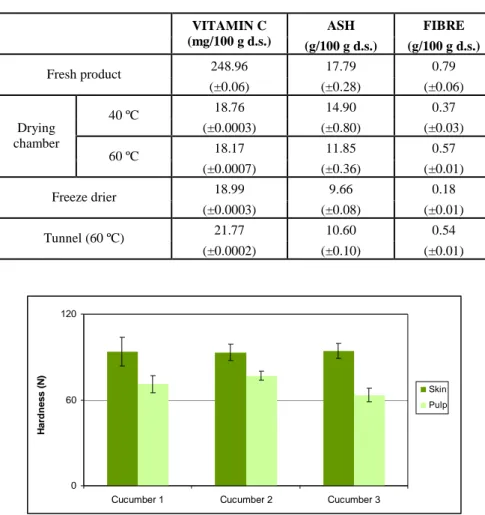
In Table 3 it is possible to find the mean values encountered for vitamin C, ash and fiber contents for cucumber in fresh and after the different dryings. As for vitamin C, the fresh cucumber content was 248.98 mg/100 g dry solids, corresponding to 12 mg, when expressed in wet basis, which is a value higher than that reported by Kang et al., around 9 mg [11]. In all dryings the vitamin C contents decreases drastically, corresponding to a degradation of more than 90 %. This would be expected, taking in consideration that this chemical compound is very much affected by temperature.
The mean value for the ash contents of the fresh cucumber was 17.79 g (dry basis). The dryings induced some losses in the ash contents, with the freeze drying giving the higher loss (almost 50 %).
The value for the fibre of the fresh cucumber was 0.79 g (dry basis), and also in this case there were some losses with drying, particularly in the case of freeze drying.
With respect to texture, Figure 1 presents the average values of hardness for the skin and the peel of fresh cucumbers. Three different cucumbers were analysed and 9 measurements were performed in each cucumber. The results show that the hardness of skin is higher than the hardness of peel, for all cucumbers, and that the results of the three cucumbers are very much alike. From the results obtained the value estimated for the hardness of the skin is around 94 N and for the pulp around 70 N. Kang et al. [11] report values for firmness of fresh cucumber between 70 and 90 N.
COLOUR L* a* b* 64.68 - 10.15 25.07 Fresh product (±5.68) (±1.96) (±4.60) 73.18 - 0.22 29.81 40 ºC (±5.06) (±2.00) (±4.45) 68.08 - 2.59 31.89 Drying chamber 60 ºC (±4.96) (±3.87) (±3.05) 81.80 - 9.49 24.88 Freeze drier (±3.50) (±1.51) (±2.82) 65.47 - 8.26 21.04 Tunnel (60 ºC) (±5.18) (±2.03) (±4.31) SUGARS Reducing (g/100 g d.s.) Non Reducing (g/100 g d.s.) Total (g/100 g d.s.) 1.93 0.38 2.33 Fresh product (±0.03) (±0.04) (±0.04) 0.11 0.15 0.04 40 ºC (±0.01) (±0.004) (±0.002) 0.05 0.11 0.06 Drying chamber 60 ºC (±0.01) (±0.01) (±0.01) 0.18 0.05 0.24 Freeze drier (±0.001) (±0.003) (±0.01) 0.05 0.06 0.11 Tunnel (60 ºC) (±0.002) (±0.002) (±0.0004)
Table 3. Vitamin C, ash and fibre contents of fresh and dried cucumber.
Figure 1. Hardness of cucumber measured in the skin and in the pulp.
Figure 2 presents the variations in firmness of the pulp from the fresh state to the various dried ones. The drying in the chamber at 40ºC almost does not produce changes in the pulp firmness, whereas the drying in the chamber at 60 ºC is the treatment that induces the highest changes, increasing hardness to around 120 N. The freeze drying produces intermediate changes in firmness, increasing to around 90 N.
Figure 2. Hardness of the cucumber pulp in the fresh form and after the different drying treatments.
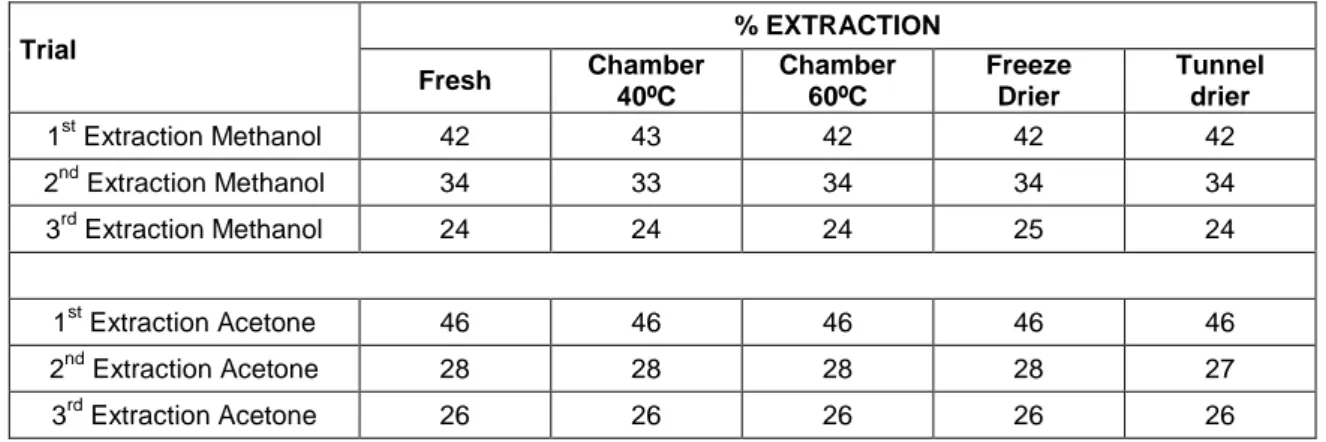
Tables 4 and 5 show the percentages of extraction with methanol and acetone, for the estimation of the antioxidant activity and phenolic compounds, respectively. In all cases three extractions were made. It is possible to verify that the values obtained are very similar for all the samples of cucumber analysed, and
ASH FIBRE VITAMIN C (mg/100 g d.s.) (g/100 g d.s.) (g/100 g d.s.) 248.96 17.79 0.79 Fresh product (±0.06) (±0.28) (±0.06) 18.76 14.90 0.37 40 ºC (±0.0003) (±0.80) (±0.03) 18.17 11.85 0.57 Drying chamber 60 ºC (±0.0007) (±0.36) (±0.01) 18.99 9.66 0.18 Freeze drier (±0.0003) (±0.08) (±0.01) 21.77 10.60 0.54 Tunnel (60 ºC) (±0.0002) (±0.10) (±0.01) 0 60 120
Cucumber 1 Cucumber 2 Cucumber 3
H a rd n e s s ( N ) Skin Pulp 0 40 80 120 160 Fresh Chamber 40ºC Chamber 60ºC Tunnel 60 ºC Freeze Drier H a rd n e s s ( N ) Pulp
furthermore, in the last extraction still an important percentage of recovery was obtained, either for the methanol or the acetone solvents. The same trend is observed in the Table 5, being however important to notice that the 3rd extraction of methanol and 3rd extraction of acetone gave higher percentages of extraction for the phenolic compounds than for the antioxidant activity.
Table 4. Percentage of extraction with methanol and acetone for the fresh and dried cucumbers to determine the
Antioxidant Activity. % EXTRACTION Trial Fresh Chamber 40ºC Chamber 60ºC Freeze Drier Tunnel drier 1st Extraction Methanol 53 51 54 54 53 2nd Extraction Methanol 31 30 29 30 30 3rd Extraction Methanol 16 19 17 17 17 1st Extraction Acetone 40 40 45 51 45 2nd Extraction Acetone 34 35 32 32 33 3rd Extraction Acetone 26 24 23 17 21
Table 5. Percentage of extraction with methanol and acetone for the fresh and dried cucumbers to determine the
Phenolic Compounds contents.
In the case of antioxidant activity, two calibration lines were done: y = 371.33x + 4.7398; R² = 0.9893 was the first one, and it was used for the fresh cucumber, and the cucumber dried in the chamber (40 and 60 ºC); y = 350.45x + 5.4233; R² = 0.9915 was the second line and it was used for the freeze dried and the cucumber dried in the tunnel. For the estimation of the phenolic compounds content, only one calibration curve was determined: y = 2.998x + 0.1583; R² = 0.9934.
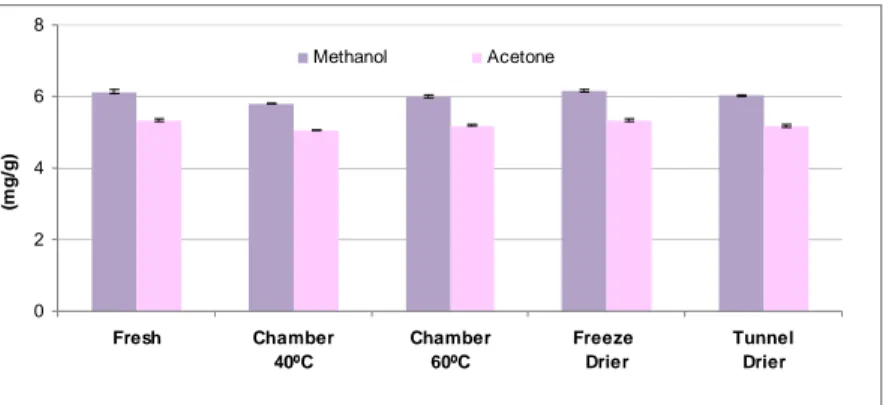
Figures 3 and 4 present the results of antioxidant activity and phenolic compounds, respectively, for the different cucumber samples analysed.
Figure 3. Antioxidant Activity for fresh and dried cucumber, with methanol and acetone extractions. % EXTRACTION Trial Fresh Chamber 40ºC Chamber 60ºC Freeze Drier Tunnel drier 1st Extraction Methanol 42 43 42 42 42 2nd Extraction Methanol 34 33 34 34 34 3rd Extraction Methanol 24 24 24 25 24 1st Extraction Acetone 46 46 46 46 46 2nd Extraction Acetone 28 28 28 28 27 3rd Extraction Acetone 26 26 26 26 26 0 1 2 3 4 5 Fresh Chamber 40ºC Chamber 60ºC Freeze Drier Tunnel Drier (µµµµ m o l/ g ) Methanol Acetone
From both graphs in Figure 3 and 4 it is possible to conclude that the values are very identical for all samples, thus indicating that drying has a negligible effect on the antioxidant capacity and in the phenolic compounds contents. In Figure 3, the value obtained for the acetone extract in fresh cucumber was a little higher than for the methanol extract.
Figure 4. Phenolic compounds for fresh and dried cucumber, with methanol and acetone extractions.
CONCLUSION
The present work evaluates the effect of different drying treatments on the colour, texture, chemical properties, antioxidant activity and phenolic compounds of cucumber, which were dried using three different methods: convective air drying in chamber, convective air drying in tunnel and freeze-drying.
The results obtained for the cucumber enable us to conclude that the air drying in tunnel, at 60ºC, and freeze drying were those treatments that produced products with properties more similar to the fresh cucumber, thus allowing to preserve the characteristics of this food product.
REFERENCES
[1] Turkmen N., Sari F., Velioglu Y. S. 2005. The effect of cooking methods on total phenolics and antioxidant activity of selected green vegetables. Food Chemistry, 93, 713-718.
[2] Murcia M.A., Jiménez-Monreal A.M., Gárcia-Diz L., Carmona M., Maggi L., Martínez-Tomé M. 2009. Antioxidant activity of minimally processed (in modified atmospheres), dehydrated and ready-to-eat vegetables. Food and Chemical Toxicology, 47, 2103-2110.
[3] Ripado M. F. B. 1991. O pepino – Cultura e normas em vigor na CEE. Publicações Europa-América, Mem-Martins, Portugal. p. 16.
[4] Maroto J. V. 1995. Horticultura Herbacea Especial (4ª edición). Ediciones Mundi-Prensa, Madrid, España. p. 465. [5] Widders I.E. & Kwantes M. 1995. Ontogenic changes in seed weight and carbohydrate composition as related to
growth of cucumber (Cucumis sativus L.) fruit. Scientia Horticulturae, 63, 155-165.
[6] Krokida M.K., Karathanos V.T., Maroulis Z. B., Marinos-Kouris D. 2003. Drying kinetics of some vegetables. Journal of Food Engineering, 59, 391-403.
[7] Gonçalves E. M., Pinheiro J., Abreu M., Brandão T. R. S., Silva C. L. M. 2007. Modelling the kinetics of peroxidase inactivation, colour and texture changes of pumpkin (Cucurbita maxima L.) during blanching. Journal of Food Engineering, 81, 693-701.
[8] Rahman M. S. & Al-Farsi A. 2009. Instrumental texture profile analysis (TPA) of date flesh as a function of moisture content. Journal of Food Engineering, 66, 505-511.
[9] AOAC. 1990. Official methods of analysis. 15.ed. Washington: Association of Official Analytical Chemists.
[10] Maskan M. 2001. Kinetics of color change of kiwi fruits during hot air and microwave drying. Journal of Food Engineering, 48, 169-175.
[11] Kang H.-M., Park K.W. & Saltveit M.E. 2002. Elevated growing temperatures during the day improve the postharvest chilling tolerance of greenhouse-grown cucumber (Cucumis sativus) fruit. Postharvest Biology and Technology, 24, 49-57.
[12] Mamelona J., Pelletier E., Girard-Lalancette K., Legault J., Karboune S & Kermasha S. 2007. Quantification of phenolic contents and antioxidant capacity of Atlantic sea cucumber, Cucumaria frondosa. Food Chemistry, 104, 1040-1047. 0 2 4 6 8 Fresh Chamber 40ºC Chamber 60ºC Freeze Drier Tunnel Drier (m g /g ) Methanol Acetone