1
Service development – a radical innovation in a cross
country development case
Sofia Salgado Pinto ([email protected])
School of Economics and Management, Catholic University of Portugal
Abstract
This paper reports a study of a service development process at a multinational level. It describes the inputs of the development process and it aims to further understanding on how the initial stages of the development cycle can influence the final service design. It also analysis the design elements used at the international level to maintain multinational consistency of services. It describes how enablers of the development process are used in each stage of NSD. The findings are contrasted with existing literature.
Keywords: service development, multinational, research paper
Introduction
Different papers and studies have addressed the new service development (NSD) in diverse perspectives and with many aims and focus. Menor et al. (2002) contribute with a comprehensive literature review in NSD topic, highlighting potential areas for exploitation and for exploration. Other authors focus on the NSD process (Bitran and Pedrosa, 1998, Johnson et al., 2000, Fitzsimmons and Fitzsimmons, 2008) concerned with the process of developing new services, while others are focused on the result of the NSD process (see for example, Bitran and Pedrosa, 1998, Voss and Mikkota, 2007). In this way, the literature on service development covers several perspectives such as: typologies of developments or innovations (radical versus incremental innovations); the NPD/NSD success factors; the NPD/NSD models (partial, translational and comprehensive models) and the NSD cycle; and the innovation matrix (Johnson et al. 2000). However, the literature appears to be meager on studies which detail development processes at the multinational level. Survey research on 90 transnational product introductions allowed some findings about the development and the transferring knowledge overseas (Subramaniam and Venkatraman, 2001). But in order to be meaningful and useful for the operations managers (OM) such findings need to be further detailed with OM specific studies, which explore how services are designed and controlled (Pinto, 2009, Pinto and Johnston, 2009). In addition, OM specific studies on multinational service developments would also contribute to grasp the impact of the different stages of the development process on the final product design in cross-country service developments.
We believe that the understanding of the development process, of interlink between the different stages, and of the influence of the inputs in the final service product may be useful for the service operations manager. It may help planning service developments
2
at an international level, for the best use of the organization’s resources spread by different countries, while fulfilling the customer needs also in diverse countries.
The research question that prompted this research was:
(Q1) How service innovations are developed at a multinational level?
This paper details the service development process entailed by a multinational company. It provides an empirical example that services not simply “happen” but, at a multinational level, can and are intentionally developed. The focus of the paper is not the analysis of the intentionality of the new service development process. However, the evidence of a deliberate service development supports the relevance of the study and the case choice. The study of a deliberate development process prompted a few managerial questions, specifically: Why did the company decide to develop a new service and to it at the multinational level from the first instance? How is the service developed? How is the development process organized? What resources are involved in the development process?
Framed in the existing literature on NSD process and cycle (Johnson et al., 2000) the initial research question was detailed in three other research questions:
(Q2) How the development stage of the NSD Cycle impacts on the final service design? (Q3) How the NSD enablers (teams, tools and the organization context) influence the final service design?
(Q4) How information from customers and non-customers can be used for service development?
This paper reports part of an in-depth longitudinal research with one multinational company. The new service development is still ongoing which has a twofold impact. On the one hand, it allows complete questioning alongside the development process and a research development in many fronts, which results in the collection of rich data enabling a detailed description of the process. On the other hand, it hinders the collection, analysis and exploitation of some data with regard to the final outcome of the NSD process. It results that Q1 and Q2 cannot be addressed at this stage of the research, but it will be the focus of future papers. This paper presents the research structured around Q3 and Q4. In order to do so, it starts, in the next section, with a brief literature review on the relevant concepts for the research. Then, in the methods section, it situates this piece of research in the NSD process and it details the collection and analyzing methods employed, which is followed by a section presenting some structured data, its analysis and a discussion of the main findings on the current research stage. The paper ends with the preliminary research conclusions and with the indication of the research further steps.
Literature review
Menor et al. (2002) propose that scholars should clarify the type of new service being studied in order to frame the implications of the research findings. The literature review starts by specifying what constitutes a new service and a NSD classification, then it presents the NSD process cycle and it ends with the measures of NSD outcome and process performance.
The first essential distinction opposes radical innovation to incremental innovation (Johnson et al., 2000). Such distinction is made on the basis of the service offering being or not being available to the organization’s existing customers. Accordingly, the new service is a radical innovation if it has not been offered to an organization’s
3
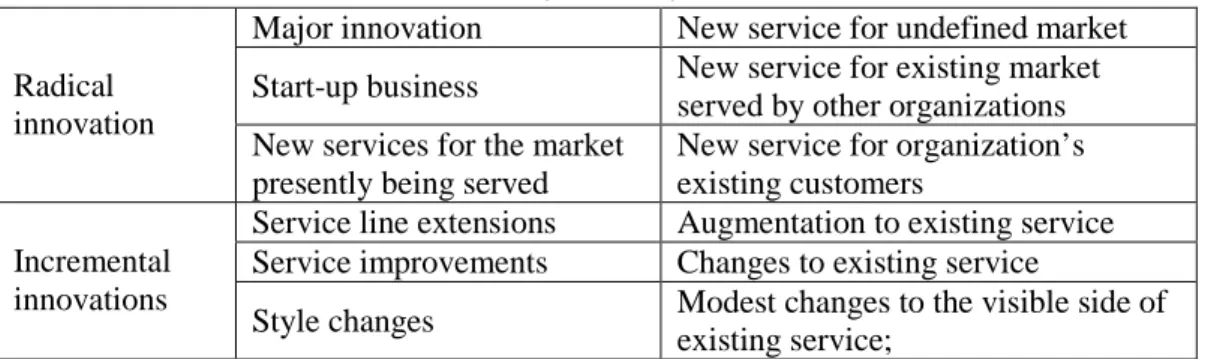
existing customers and it is an incremental innovation if it consists in changes to services previously offered to the organization’s customers (Johnson et al., 2000). This first classification is then subdivided in a second level of analysis within each type of innovation. Radical innovations can be characterized by major innovations, start-up businesses or new services for the market presently served, according to the non-existence or non-existence of the market for other organizations or for the innovative organization. Incremental innovations can be typified by service line extensions, service improvements or style changes, based on the degree of change incorporated in the service previously offered (Johnson et al., 2000). This classification is presented in Table 1.
Table 1 – Classification of new services
Major innovation New service for undefined market Start-up business New service for existing market
served by other organizations Radical
innovation
New services for the market presently being served
New service for organization’s existing customers
Service line extensions Augmentation to existing service Service improvements Changes to existing service Incremental
innovations
Style changes Modest changes to the visible side of existing service;
Source: adapted from Johnson et.al (2000)
This taxonomy helps classifying service innovations for analytical and descriptive purposes, but it is of limited help in the operational perspective because it does not distinguishes different degrees of newness in the service process and/or in the service outcome. A discussion on this is found in the work of Menor et al. (2002) when referring to internal versus external newness. “External newness captures the novelty of the service as the customer perceives it (...). In contrast, internal newness captures what exactly must be developed and put in place vis-à-vis the service concept for the new service to be operational” (Menor et al., 2002: p.139). As such, the operations perspective starts with the understanding of the degree of external newness (captured in a service idea) in order to understand and put in place the required internal service process, this is, how component designs are linked together for delivery of the specific service concept. One of the challenges of this research is to further understand of the process of internal innovation in a cross-country development. It aims to describe what are the component designs and how are they linked together in a multinational service development.
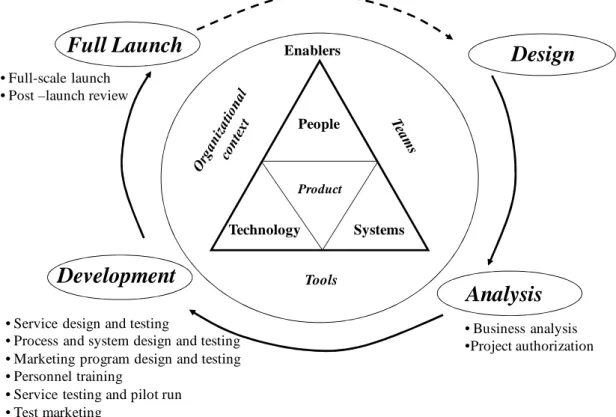
The need to further understanding the service development process goes back more than ten years (Johnston, 1999). As Johnston asked over in 1999: “do we understand how services are designed from conception to consumption (...)?: what is a service design? How is a service concept developed into a service? (...) What are the most effective methods of developing a service? What are good design tools and techniques? (Johnston, 1999: p. 116)” Since then, some studies have been dedicated to NSD. One of the most cited ones is the work of Johnson et al. (2000), which presents the NSD process cycle. The NSD process cycle (Johnson et al., 2000) argues about the non-linearity of the development process and includes the reference to the enablers of the process, as represented in Figure 1.
In order to deepen understanding about service development at a multinational level, we decided to explore the NSD cycle with its different stages and enablers. Table 2 was depicted to present the activities of the NSD cycle along with the NSD enablers. Its
4
construction raised one question. How are the enablers of the process used in the different stages of the development of the new service? This meaning, how the superior part of the table links with the inferior one? Which enablers are enablers used in each stage of the service development?
People
Technology Systems
Product
Full Launch
Design
Development
Analysis
Tools Enablers • Business analysis •Project authorization • Full-scale launch• Post –launch review
• Service design and testing
• Process and system design and testing • Marketing program design and testing • Personnel training
• Service testing and pilot run • Test marketing
Figure 1 – The NSD process cycle Source: Johnson et al. (2000)
Table 2 – NSD process
Stage Design Analysis Development Full launch
Service design and testing
Formulation of new services
objective/strategy Process and system design and testing Business
analysis
Marketing program design and testing
Full scale launch Idea generation and
screening
Personnel training Service testing and pilot run Development activities Concept development and testing Project authorization Test marketing Post launch review
Teams Tools Organization context
Enablers
People and systems Technology
and systems People and technology
For the exploration of table 2 we detailed each stage of the cycle in its main activities and we considered a set of elements of the service concept (Johnston and Clark, 2008) to detail the enablers of the process. The service concept, which results from the development process, is the service in the mind. This is the concept of the service
5
should result in a specific service process that delivers an also specific service experience, for one service outcome with a corresponding service value (Johnston and Clark, 2008). The alignment of these four elements will, in turn, result in a service in the mind of its customers. The elements considered in the service concept are the inputs of the process, specifically: equipment and technology, materials, facilities, customer and staff. These elements help in the analysis of the enablers of the service development, because they are the inputs of the service company developing the innovation and they also are useful in the analysis of the development outcome, i.e. the final service design. For example, the design stage of the NSD cycle includes the formulation of the new service objective and its strategy, the idea generation and screening, as well as the concept development and testing (Johnson et al., 2000). The enablers in these activities may be the equipment and technology used to communicate a strategic intent or to collect and analyze data from customers (i.e. the voice of the customer), and the staff involved in collecting data from customers or in the concept generation and selection. This rationale underlies the construction of table 3 developed to support the preliminary data collection and analysis.
Table 3 – NSD activities and enablers Stage Development activity
e.g., Strategy and objective formulation for the new service Development
/ Enablers Equipment and technology Materials and facilities Customer Staff
The next section details the methods used to empirically study the NSD process and to answer the research questions.
Methodology
This study builds on one exploratory longitudinal case of a company providing training, consultancy services at a multinational level. For confidentiality purposes this company is, in this paper, designated by Alpha.
The company Alpha specialised in attitudes and behaviours, since 1982, was founded in Switzerland. It started out by developing training in the areas of Management and Leadership but soon after entered new areas, such as the Commercial and Customer Care. Alpha now operates in 14 countries in three different continents doing training; consulting and coaching delivered through standard programmes, open seminars or client programmes.
The company targets companies from all industries and sizing from small to large or multinational ones. At the international level, the company has a strong accumulated experience in the financial services, retail, telecommunications and pharmaceutical sectors and in the automobile industry.
Alpha is developing a new service at the international level for the launching of an innovative service for the market presently served. The new concept, if proved to be market relevant will capture new customers. The service can be seen as a radical innovation according to the classification proposed by Johnson et al. (2000), presented above. The starting idea was the development of a major innovation also made available to the company existing customers, but only the service fully launched in the market will enable the final classification between major innovation and start-up business.
The company claims “we can equally implement a project in different countries with different social and cultural realities, ensuring a high level of consistency of our work” (company website, 11thApril2010). Framed in this argument research questions three and four gained relevance. In fact, based on the company ability to operate at the
6
multinational level, how is it developed, at an international level, a service innovation (Q4)? And, how teams, tools and the organization context influence the final service design of a service innovation at a multinational level (Q3)? In order to answer this third question the research details how teams, tools were used in the different activities of the development process.
The option of a case study is justified by the focus on “understanding the dynamics present” in the particular development (Eisenhardt, 1989) of a service at a multinational level. The unit of analysis is the process of service development and the activities in the process, resulting in a holistic single-case design (Yin, 1994). The sole justification for the study of one single case is the opportunity that the researcher had to observe and analyse a phenomenon not previously detailed in the existing literature, potentially being what Yin (1994) designates as revelatory case. The holistic design is chosen because no logical subunits could be identified so far (Yin, 1994). However, it may change from holistic to embedded design with the progress of the research, if the service development assumes different processes in different regions or countries.
This paper presents one part of an ongoing research. The research aims to observe and analysis the complete new service development. It started from scratch, by monitoring the articulation done by Alpha of the NSD goals and process. It continued through data collection from Alpha’s customers and non-customers as the company external researcher, and observing the first idea generation and screening. This paper describes this first stage of the development process in what is called preliminary data of the development process. The process continues with the concept testing and service development. Future papers will describe the next stages of the process.
Data was collected through direct observation, participation-observation (Yin, 1994) as an external researcher and interviews. Preliminary data refers to the inputs of the NSD process, i.e. the process enablers, market and customer information and new service strategic intents. Customer and market data were collected through interviews with top managers in different countries. A total of 43 interviews were undertaken in five different countries with managers from different nationalities, managing different sized companies and in different industries. These data was analysed and used by the company top management to develop the new service concept.
Next section presents the findings of the preliminary stages of this longitudinal study.
Findings and discussion
The NSD has not been completed and the service product has not been launched yet. Hence, the findings report to the first stages of the NSD process. Due to a confidentiality agreement the paper introduces details of inputs and of the NSD process, but cannot present, so far, details of the NSD process output.
The new service development activities already executed in the NSD process at Alpha were the following:
• Formulation of new services objective/strategy
• Idea generation and screening
• Concept development and testing
• Service design and testing
• Business analysis
These activities were performed in an interactive not always sequential process, what is in line with the argument of a non-linear process (Johnson et al., 2000) and with the recommendations for the development of new services (Bitran and Pedrosa, 1998). For the execution of an activity people and tools were mobilized for specific goals. Table 4
7
details each development activity in terms of actions performed and the people, materials, technology and facilities involved.
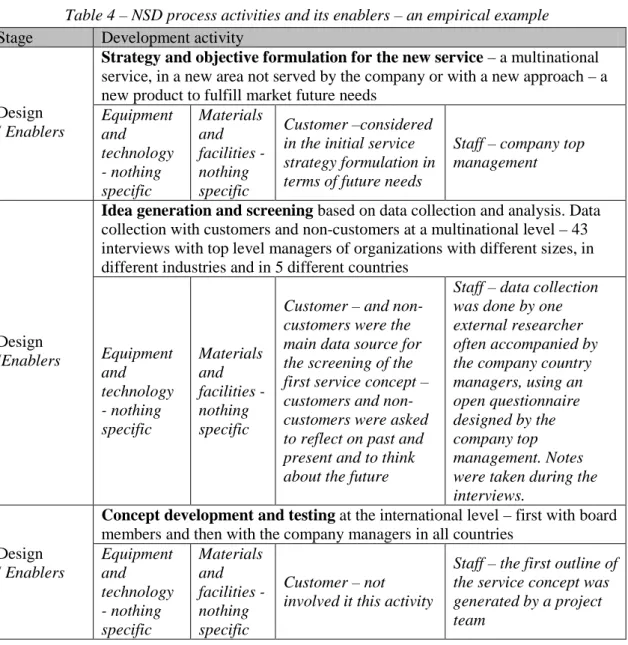
For example, one of the first activities in the development service process was the formulation of the development objective, included in the first line of Table 4. This was done by the top management of the multinational company (staff), who informed top managers in the different countries about the process planned to start, who was going to be involved in the preliminary activities of data collection from customers and the planned moment for the presentation of the initial service concept. In the second activity of the process – idea generation and screening – two main sub- activities were carried: data collection from customers and non-customers and initial service idea generation. Data collection from customers and non-customers were collected by an external researcher accompanied by the country-managers, using an open questionnaire designed by the top management of Alpha. The equipments, technology, materials and facilities used in this stage of the process were not relevant or specific to the process.
Table 4 – NSD process activities and its enablers – an empirical example Stage Development activity
Strategy and objective formulation for the new service – a multinational service, in a new area not served by the company or with a new approach – a new product to fulfill market future needs
Design / Enablers Equipment and technology - nothing specific Materials and facilities - nothing specific Customer –considered in the initial service strategy formulation in terms of future needs
Staff – company top management
Idea generation and screening based on data collection and analysis. Data collection with customers and non-customers at a multinational level – 43 interviews with top level managers of organizations with different sizes, in different industries and in 5 different countries
Design /Enablers Equipment and technology - nothing specific Materials and facilities - nothing specific
Customer – and non-customers were the main data source for the screening of the first service concept – customers and non-customers were asked to reflect on past and present and to think about the future
Staff – data collection was done by one external researcher often accompanied by the company country managers, using an open questionnaire designed by the company top management. Notes were taken during the interviews.
Concept development and testing at the international level – first with board members and then with the company managers in all countries
Design / Enablers Equipment and technology - nothing specific Materials and facilities - nothing specific Customer – not involved it this activity
Staff – the first outline of the service concept was generated by a project team
8
Service design and testing – the first outline of the service concept was presented internationally, at a first moment to the board of directors, and then the service concept was presented to the overall company in the summer academy. It was evaluated the first impact of the concept.
Development / Enablers Equipment and technology – info not available Materials and facilities – info not available Customer – not involved it this activity)
Staff – top management at headquarters, company top managers in different countries, company staff
Business analysis – this activity is being done along with another activity in the development stage process and system design. It would be difficult to do an effective business analysis without detail of the systems and process needed for the service delivery.
Analysis /Enablers Equipment and technology – info not available Materials and facilities – info not available Customer – not involved it this activity
Staff – top managers and financial people
From the preliminary stages of this service development it can be argued that:
⋅ The process of development has been non-linear – some of the development activities have been intertwined by or simultaneous than others. For example, the customer voice started to be collected, and with some of that data the service concept began to be generated. It did not start only when the previous activity was completed, but part of it was simultaneous. The concept was made robust as more data were collected from customers and non-customers at the international level;
⋅ The enablers used in the NSD differ along the different activities of the development process – for example, the first idea generation was done in the project team, and then presented to the board of directors. The concept was developed and then presented to all the company in the summer academy (the annual company event that brings together all the company managers and consultants) in order to have a first impact of the concept at a global company level;
⋅ The major enablers used in the first stages of the development were people – top management, external researcher, customers and non-customers. Some equipment was used to record and share information.
⋅ The initial service concept that is the basis for the final service is common to all the countries. So far the customization that might be required at the country level or at world specific regions level (e.g. Asia or South America) has not been raised.
⋅ The first idea generation will be advanced at the national level (in Alpha home country) and then presented to the different country managers who can be involved in the concept development
⋅ The architectural elements are being defined, but cannot be detailed so far, due to the confidentiality agreement.
⋅ The link between the architectural elements, e.g. the platform (Voss and Mikkola, 2007) and the different design components (Bitran and Pedrosa, 1998; Menor et al. 2002) is also being developed and will be known.
9
Conclusions and next research steps
From the preliminary stages of the development process already performed it can be concluded that different activities are completed in a non-linear order, requiring the use of different company resources at the national and multinational levels. The enablers of the first activities of the service development were essentially people (staff, customers and non-customers). The first activities were performed at the top level, but early on were spread to the next hierarchical level to involve the board of directors, country managers and customers and non-customers in diverse countries.
This study expected results are a clear description of a NSD process, from the decision of innovation to the description of complete launch of the service at the international level. This research aims to contribute to a deeper understanding of the elements at the different stages of the development process, that most influence the final service design in radical innovations. The research will contribute to theory through the discussion of the existing models of NSD process in light of this international service development process. At the managerial level, the study expects to contribute to a better understanding of the use of customers’ and non-customers’ data to the service development, as well as of the elements that most influence the final service design and process.
Furthermore, this research aims to describe the level of standardization/ customization allowed at the multinational level and how that decision is incorporated in the service and process design. At the managerial level, the research expects to contribute to a better description of an architectural service platform and of its adoption at a multinational level, as well as of the service design components that coupled in the service platform complete the multinational innovation.
Though the study contributes to foster understanding of the development of radical service innovations at the multinational level, its findings might well be useful for the manufacturing context.
References
Bitran, G., Pedrosa, L. (1998), A structured product development perspective for service operations, European Management Journal, 16 (2), 169-189.
Eisenhardt, K. M. (1989), “Building theories from case study research”, Academy of Management Review, Vol.14, No 4, 532-550.
Fitzsimmons, J.A. and Fitzsimmons, M.J. (2008), Service Management: operations, strategy, information technology, 6th Edition, McGraw-Hill International Edition.
Johnson, S.P., Menor, L.J., Roth, A.V., Chase, R.B. (2000), A critical evaluation of the new service development process: integrating service innovation and service design. In: Fitzsimmons, J.A., Fitzsimmons, M.J. (Eds.), New Service Development - Creating Memorable Experiences. Sage Publications, Thousand Oaks, CA, pp. 1–32.
Johnston, R. (1999), “Service operations management: return to roots”, International Journal of Operations and Production Management, Vol.19, No 2, pp. 104-124.
Johnston, R. and Clark, G. (2008), Service Operations Management – improving service delivery, 3rd Edition, FT - Prentice-Hall, Pearson Education.
Menor, L.J., Tatikonda, M.V. and Sampson, S.E. (2002), “New service development: areas for exploitation and exploration”, Journal of Operations Management, 20, 135-157.
Pinto, S. and Johnston, R. (under review), “Service specifications for control and improvement”, Journal of Service Management.
10
Pinto, S. and Johnston, R. (2009) – “Understanding Specifications for the control of services”, Proccedings of the 16th International Conference of the European Operations Management Association (EurOMA), June, Gothenburg, Sweden.
Pinto, S. (2009), “The Soft features of service: Specifications and standards for control and improvement”, Proceedings of QUIS 11 – The Service Conference, June, Wolfsburg, Germany.
Subramaniam, M. and Venkatraman, N. (2001), “Determinants of transnational new product development capability: testing the influence of transferring and deploying tacit overseas knowledge”, Strategic Management Journal, 22: pp. 359-378.
Voss, C. and Mikkola, J. (2007), Services Science – The opportunity to re-think what we know about service design, Position paper for Services Science meeting – Cambridge (June). Voss, C., Johnston, R., Silvestro, R., Fitzgerald, L., Brignall,T. (1992), Measurement of
innovation and design performance in services, Design Management Journal, Winter, 40-46. Yin, R. K. (1994), Case study research – design and methods, 2nd Edition, Sage Publications,