INFLUENCE OF WEEDS ON MORPHOLOGICAL AND PHYSIOLOGICAL CHARACTERISTICS OF CORN SEEDS
PAULO SÉRGIO LIMA E SILVA1,KATHIA MARIA BARBOSA e SILVA2, GLAUCO VIEIRA
MIRANDA3,MARIA CLARETE CARDOSO RIBEIRO4 eLEÍLSON COSTA GRANGEIRO4 1Bolsista do CNPq, Professor, Departamento de Ciências Vegetais, Universidade Federal Rural do Semi-Árido - UFERSA;
C.P. 137, 59625-900 Mossoró, RN; [email protected] (Corresponding author).
2Professora, Departamento de Ciências Biológicas, Universidade do Estado do Rio Grande do Norte – UERN; C.P. 70,
59610-090 Mossoró, RN.
3Bolsista do CNPq, Professor, Departamento de Fitotecnia, Universidade Federal de UFV; 36571-000
Viçosa-MG.
4Professor, Departamento de Ciências Vegetais, UFERSA; C.P. 137, 59625-900 Mossoró, RN.
Revista Brasileira de Milho e Sorgo, v.5, n.2, p.232-240, 2006
ABSTRACT - In family agriculture in the Brazilian Northeast, it is a common practice
to plant corn seeds harvested during previous cultivations. Because weed control in those properties does not get appropriate attention, it is possible that weeds interfere with seed quality. The objective of this work was to evaluate the effects of weed control on germination, vigor (plantlet, first count and dry matter data), dimensions, and weight of corn seeds. Two experiments were carried out as a random block design with split-plots, and five replicates, either with six (AG 405 C, DKB 425, EX 6005, AG 2060, BA 8517, and BA 9513) or four (BA 9012, BA 8512, EX 4001, and EX 6004) cultivars, respectively. In both, cultivars were assigned to plots and weed control to subplots. In the first experiment, weed control was achieved by means of two hoeings. In the second, control was accomplished by two hoeings or by intercropping with cowpea (Vigna unguiculata (L.) Walp.). In both experiments, it was verified that weeds did not have an influence on germination percentage or on first count data (except for one cultivar); however, plantlet dry matter weight was higher in hand hoed plots. In those plots, width, height, and seed weight were also higher. In both experiments, the cultivars were not different in relation to germination percentage. In the first experiment, the cultivars were different with respect to first count data, while in the second experiment they were different with regard to first count and plantlet dry matter data.
Key words: Zea mays, physiological quality, weed control
INFLUÊNCIA DAS PLANTAS DANINHAS SOBRE CARACTERÍSTICAS MORFOLÓGICAS E FISIOLÓGICAS DAS SEMENTES DO MILHO
RESUMO - Na agricultura familiar do Nordeste brasileiro, é comum o plantio de
se-mentes de milho colhidas de cultivos anteriores. Como o controle de plantas daninhas nessas propriedades não recebe a devida atenção, existe a possibilidade de as plantas daninhas interferirem na qualidade da semente. O objetivo do trabalho foi avaliar os efeitos do controle de plantas daninhas sobre a germinação, vigor (dados de primeira contagem e matéria seca de plântulas), dimensões e massa de sementes do milho. Dois
experimentos foram realizados, no delineamento de blocos ao acaso, com parcelas sub-divididas, com cinco repetições, com seis (AG 405 C, DKB 425, EX 6005, AG 2060, BA 8517 e BA 9513) e quatro (BA 9012, BA 8512, EX 4001 e EX 6004) cultivares, respectivamente. Em ambos, as cultivares foram aplicadas às parcelas e o controle de plantas daninhas, às subparcelas. No primeiro experimento, o controle das plantas dani-nhas foi feito mediante duas capinas com enxada. No segundo, esse controle foi feito com duas capinas ou com a consorciação com caupi (Vigna unguiculata (L.) Walp.). Verificou-se que, em ambos os experimentos, as plantas daninhas não influenciaram a percentagem de germinação, nem os dados de primeira contagem (exceto em uma culti-var), mas a massa da matéria seca de plântulas foi maior nas parcelas capinadas. Nessas parcelas, a largura, a altura e a massa das sementes também foram maiores. Nos dois experimentos, as cultivares não diferiram na percentagem de germinação. No primeiro experimento, diferiram nos dados de primeira contagem e, no segundo experimento, diferiram nos dados de primeira contagem e de matéria seca de plântulas.
Palavras-chave: Zea mays, qualidade fisiológica, controle de plantas daninhas
In the Northeastern region of Brazil, corn (Zea mays L.) is grown by large companies for export and also in small properties where subsistence agriculture is practiced. In large properties, improved cultivars and other so-called modern input are used, but small properties utili-ze traditional varieties and little input. In such properties, it is common for the farmer to use the grain harvested in the previous cultivation as corn seeds. In addition, weed control, made by hand hoeing, is dependent upon labor availability. Thus, there is a possibility that weeds will inter-fere with “seed” quality, as verified for other agricultural regions (Saayman & Van de Venter, 1996). Corn seeds with higher vigor show supe-rior performance under water deficit conditions (Piana & Silva, 1998), which are frequent in the Brazilian Northeast.
The use of herbicides has increased, but many weeds are becoming resistant to them (Altieri & Liebman, 1986). In addition, herbicides pose hazards to human health and the environment, and are unaffordable under the family production system (Ford & Mt. Pleasant, 1995). In order to reduce the use of
herbicides, several strategies that employ mechanical weed control are being currently studied (Zuofa & Tariah, 1992), including the use of intercropping. The effectiveness of weed control by means of intercropping depends on several factors, among which are the intercrop system and the species used as an intercrop (Carruthers et al., 1998). In the Brazilian Northeast, corn intercropping with cowpea is generalized, aimed at a greater effectiveness in the use of environmental resources in relation to monocrops. Weed control in this intercrop system may also be achieved through this practice, but this is not, generally, the farmers’ objective. It is therefore interesting to evaluate the use of cowpea intercropped with corn, in order to achieve weed control in this grass.
Varietal differences in weed suppression capacity have been reported for a number of crops, including corn (Begna et al., 2001). Early hybrids tolerate infestations by Setaria glauca L.P. Beauv. better than late hybrids (Staniforth, 1961). Under high pressure from weeds and nitrogen rates, modern hybrids show smaller
mean yield losses than older hybrids (Tollenaar et al., 1994). Therefore, it is interesting to take different cultivars into consideration when practices aimed at weed control are evaluated.
The objective of this work was to evaluate the effects of weed control on the morphological and physiological aspects of seeds from corn cultivars.
Material and Methods
Two experiments were carried out as random blocks with split-plots and five replicates. Each subplot consisted of four 6.0 m long rows. The usable area was considered as that occupied
by the central 5.2 m2 from the two central rows.
The crops were grown at Fazenda Experimental “Rafael Fernandes” (5° S latitude, 37° 20’ W lon-gitude and elevation 18 m), Mossoró municipality, Rio Grande do Norte State, Brazil, under sprinkler irrigation.
The experimental soil, classified according to the Brazilian Soil Classification System as Argissolo Vermelho-Amarelo Eutrófico (Sistema, 1999) and as Ferric Lixisol according to the Soil Map of the World (FAO, 1988), was tilled by means of two harrowings
and fertilized with 30 kg N (urea), 60 kg P2O5
(single superphosphate), and 30 kg K2O
(potassium chloride) per hectare. The fertilizers were applied in furrows located alongside and below the sowing furrows. The analysis of a sample taken from the experimental soil
indicated: pH = 6.8; Ca = 1.80 cmolcdm-3; Mg = 0.40 cmolc dm-3; K = 0.10 cmol c dm-3; Na = 0.01 cmolc dm-3; Al = 0.00 cmol c dm-3; P = 25mg dm -3; Org. Mat. = 1.90 g kg-1.
Planting was carried out on 03/23/2003, and four seeds were used per pit. The spacing between rows was 1.0 m, and pits on each row were spaced by 0.4 m. Thinning was performed
20 days after planting, leaving the two more vigorous plants in each pit (50 thousand plants/ ha). Deltamethrin sprays (250 ml/ha) were performed at 7 and 14 days after planting, respectively, in order to control the fall armyworm (Spodoptera frugiperda Smith). Sidedressing applications were performed at 20 and 40 days
after planting with 30 kg ha-1 (ammonium sulfate).
Soil tillage was done with a tractor; the sprays were performed with a back-pack sprayer, and the other operations were accomplished by hand. In the first experiment, cultivars AG 405, AG 2060, BA 8517, BA 9513, DKB 435, and EX 6005 received from Sementes Agroceres, were submitted to the following treatments (applied in the subplots): no hoeing and two hoeings (at 20 and 40 days after planting).
In the second experiment, cultivars BA 8512, BA 9012, EX 4001, and EX 6004 also received from Sementes Agroceres, were submitted to the following treatments (applied in the subplots): no hoeing, hoeing (at 20 and 40 days after planting), and intercropped with cowpea (Sempre Verde cultivar). In the intercropping treatment, cowpea was planted together with corn planting, between the rows of the grass, in pits spaced 1.0 m apart, using two seeds of the Sempre Verde cultivar per pit.
The ears of corn were threshed by hand and the seeds were submitted to the following evaluations: germination test – according to the criteria established in Regras de Análise de Se-mentes (Brasil, 1992); first count test – performed
at the first count in the germination test (4th day
after incubation), and seedling dry matter weight. The tests were carried out using trays, with a 3.5 cm height, 37.0 cm length, and 26.0 cm width, which received sifted, washed and sterilized “river sand” as substrate; after physical analysis, the sand indicated the following as granulometric
fractions (in kg kg-1): 0.87 coarse sand, 0.12 fine
sand, and 0.03 silt. Moisture retention (in kg kg
-1) was 0.04 (at 0.03 Mpa) and 0.01 (at 1.5 Mpa);
the apparent and actual densities (kg dm-3) were
1.53 and 1.60 respectively, and porosity was 41%. Five 100-kernel samples were taken from each subplot, in order to evaluate weight, and ten kernels were taken to estimate kernel dimensions. The data were statistically analyzed by the analysis of variance method (Zar, 1999).
Results and Discussion
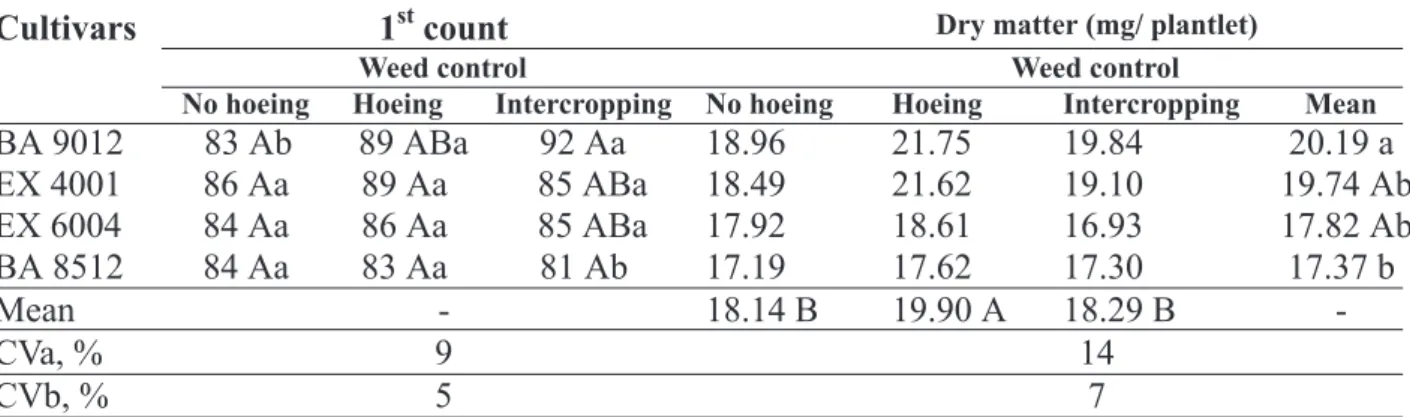
In the experiment where weeds were controlled by hoeing only, there was no effect of weed control (WC), cultivars (C), or of the WC × C interaction on seed germination (mean of 94%, CVa = 7 % and CVb = 6 %). With regard to the first count data, there was an effect of cultivars only (Table 1). Cultivar AG 405 C showed the highest mean for the trait, but only surpassed cultivars BA 8517 and BA 9513. With regard to plantlet dry matter weight, only a weed control effect was observed. Seeds produced in hoed plots yielded plantlets with greater mass than seeds produced in the presence of weeds (Table 1).
In the experiment where attempts were made to control weeds by means of hoeings or by cowpea intercropping, the weed control (WC) x cultivars (C) interaction was verified only for first count data (Table 2). In relation to germination percentage, similarly as in the previous experiment, no WC or C effects were observed (mean of 93 %, CVa = 13 % and CVb = 6 %). For first count data, cultivar BA 9012 showed a higher mean when seeds were produced with cowpea as an intercrop than when they were produced without hoeing or with two hoeings. This behavior was different from that of other cultivars, whose first count data were not changed by the weed control methods. Such difference in
behavior was responsible for the WC × C interaction. Seeds produced with hoeings yielded plantlets with greater mass than seeds produced without hoeing or with cowpea as an intercrop, which were not different among themselves. Cultivar BA 9012 showed heavier plantlets, but was only different from cultivar BA 8512.
Therefore, weed control and cultivars did not change germination, but influenced seed vi-gor (Tables 1 and 2). Partly similar results were observed in the competition between corn and Xanthium strumarium L. (Saayman & Van de Venter, 1996). In this case, corn seed vigor decreased as weed density increased. Corn germination was also reduced under interference from X. strumarium L. Vigor differences among seeds from different cultivars (Tables 1 and 2) have also been observed by other authors (Santipracha et al., 1997).
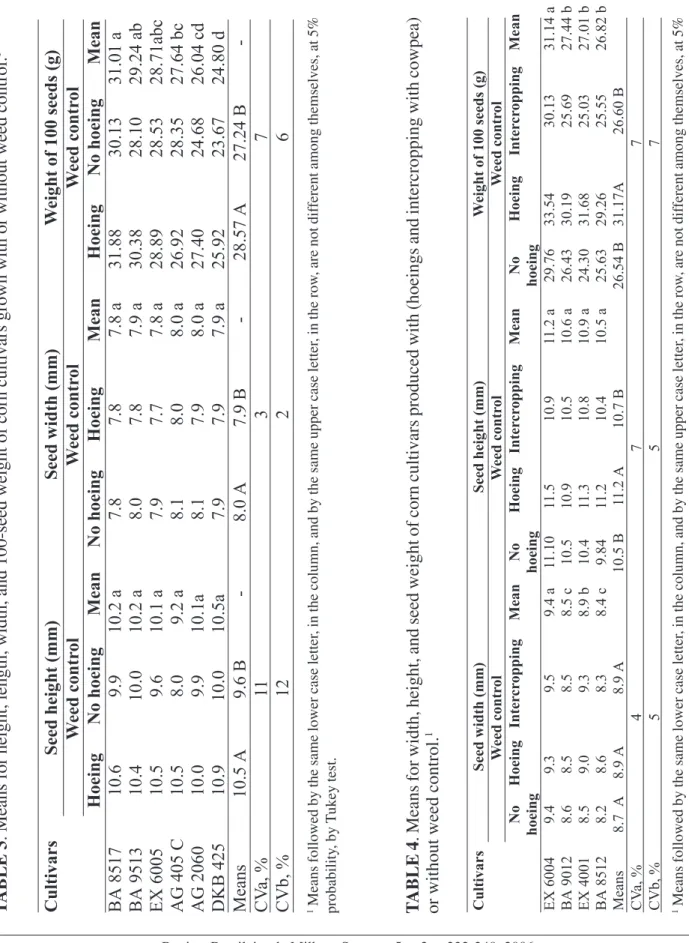
Various authors (Moreno-Martinez et al., 1998; Shieh & MacDonald, 1982; Pinho et al., 1995) verified a positive correlation between corn seed size and vigor. In the present work, it was observed that hoed plots in both experiments (Tables 3 and 4) yielded seeds with greater height and mass. In experiment-1, the mean seed thickness was 4.30 mm and the CV value (3%) was the same for plots and subplots respectively. In experiment-2, thickness was 4.70 mm and the CV value (7%) was also the same in plots and subplots. In experiment-1, hoed plots also yielded seeds with greater width.
Vigor involves the capacity of an organism to biosynthesize energy and metabolic compounds such as proteins, nucleic acids, carbohydrates, and lipids. Such capacity is associated with cell activity, the integrity of cell membranes, and the transportation or usage of storage substances (Association of Official Seed Analysts, 1983).
Although the experiments were irrigated, weeds may reduce the corn root system’s ability to absorb water and nutrients (Rajcan & Swanton, 2001). Under water stress, photosynthesis by the plant is reduced, affecting the accumulation and allocation of dry matter to plant organs (Nissanka et al., 1997). Reduced nitrogen absorption could
influence seed vigor by means of phytohormones in general and by the level of cytokinins in parti-cular. Among nutrients, nitrogen has the most prominent influence on the production and export of cytokinins (Marschner, 1995). Cytokinins, together with gibberellins and abscisic acid, are important germination regulators (Khan, 1975). 1 Means followed by the same lower case letter, in the column, and by the same upper case letter, in the row, are not different among themselves, at 5% probability, by Tukey test.
TABLE 1. Means for first count, and dry matter weight data of seedlings from seeds of corn cultivars
produced with or without weed control.1
1 Means followed by the same lower case letter, in the column, and by the same upper case letter, in the row, are not different among themselves, at 5% probability, by Tukey test.
TABLE 2. Means for first count, and dry matter weight data of plantlets from seeds of corn cultivars
T
ABLE 3
. Means for height, length, width, and 100-seed weight of corn cultivars grown with or without weed control.
1
1 Means followed by the same lower case letter
, in the column, and by the same upper case letter
, in the row
, are not dif
ferent
among themselves, at 5%
probability
, by T
ukey test.
1 Means followed by the same lower case letter
, in the column, and by the same upper case letter
, in the row
, are not dif
ferent among themselves, at 5% probability , by T ukey test. T ABLE 4
. Means for width, height, and seed weight of corn cultivars produced with (hoeings and intercropping with cowpea)
or without weed control.
Gibberellins promote the activation of embryo growth and the mobilization of endosperm nutritional reserves (Taiz & Zeiger, 2002). On the other hand, about 3/4 of the total N reduced in the leaf could be related to photosynthesis. The nitrogen compounds involved include soluble proteins and chloroplast compounds, which are associated with light reactions, including chlorophyll, chlorophyll proteins, and several enzymes (Grindlay, 1997). It is convenient to mention that flower formation and “set” (Lauer & Blevins, 1989) are positively related to phosphorus supply. In addition, low phosphorus availability increases the formation of roots and changes root system architecture, providing morphological adaptations that increase soil exploitation and P acquisition. Although auxins and ethylene are implied, the role of these hormones in root responses to external P availability is not completely understood. Among nutrients, potassium is present at higher concentration in phloem sap, playing an important role in carbohydrate translocation (Bel, 1993). Thus, weed interference, reducing potassium absorption, would also contribute to smaller and less heavy grain (Tables 3 and 4). This inter-ference would also occur in the absorption of other nutrients that play important roles in the plant (Taiz & Zeiger, 2002).
In terms of amount of light, it has been suggested (Rajcan and Swanton, 2001) that corn yield losses resulting from the competition with weeds would be caused more by a decrease in leaf area index (less leaf area and/or accelerated leaf senescence) than by a reduction in the photosynthetic rates of shaded leaves. With regard to light quality, it has been speculated (Rajcan & Swanton, 2001) that in the presence of weeds, corn at its initial growth stage would receive light of a different quality, which would impart a
smaller root system/above-ground part relation to the crop. During seed filling, this trait would be detrimental, when competition for water and nutrients would become more limiting.
Conclusions
a) Weeds do not influence germination percentage or first count data; however, seedling dry matter weight is higher in hand hoed plots. In those plots, width, height, and seed weight are also higher.
b) The cultivars are not different in relation to germination percentage. In the first experiment, the cultivars were different with respect to first count data, while in the second experiment they were different with regard to first count and seedling dry matter data.
Literature Cited
ALTIERI, M. A.; LIEBMAN, M. Insect, weed, and plant disease management in multiple cropping systems. In: FRANCIS, C. A. (Ed.).
Multiple cropping systems. New York:
Macmillan, 1986. p. 183-218.
ASSOCIATION OF OFFICIAL SEED ANALYSTS (Lincoln, NE). Seed vigour testing
handboock. Lincoln, 1983. 93 p.
BEGNA, S. H.; HAMILTON, R. I.; DWYER, L. M.; STEWART, D. W.; CLOUTIER, D.; ASSEMAT, L.; FOROUTAN-POUR, K.; SMITH, D. L. Morphology and yield response to weed pressure by corn hybrids differing in canopy architecture. European Journal of Agronomy, Montrouge, v. 14, n. 4, p. 293-302, 2001. BEL, A. J. E. van. Strategies of phloem loading.
Annual Review of Plant Physiology and Plant Molecular Biology, San Diego, v. 44, p. 253-281,
BRASIL. Ministério da Agricultura e Reforma Agrária. Secretaria Nacional de Defesa Agropecuária. Regras de análise de sementes. Brasília, DF, 1992. 365 p.
CARRUTHERS, K.; FE, Q.; CLOUTIER, D.; SMITH, D. L. Intercropping corn with soybean, lupin and forages: weed control by intercrops combined with interrow cultivation. European
Journal of Agronomy; Montrouge, v. 8, n. 2, p.
225-238, 1998.
FAO (Rome, Italy). Soil map of the world; revised legend. Roma: FAO: Unesco: ISRIC, 1987. 119 p. (World Soil Resources Report, 60). FORD, G. T.; PLEASANT, J. Competitive abilities of six corn (Zea mays L.) Hybrids with four weed control practices. Weed Technology, Champaign, v. 8, p.124-128, 1994.
GRINDLAY, D. J. C. Towards an explanation of crop nitrogen demand based on the optimization of leaf nitrogen per unit leaf area. Journal of
Agricultural Science, Cambridge, v.128, n. 2,
p. 377-396, 1997.
KHAN, A. A. Primary, preventive and permissive roles of hormones in plant systems. The
Botanical Reviews, Bronx, v. 41, n. 1, p.
391-420, 1975.
LAUER, M. J.; BLEVINS, D. G. Flowering and podding characteristics on the main stem of soybean grown on varying levels of phosphate nutrition. Journal of Plant Nutrition, New York, v. 12, p. 1061-1072, 1989.
MARSCHNER, H. Mineral nutrition of
higher plants. 2.ed. London: Academic Press,
1995. 889 p.
MORENO-MARTINEZ, E.; VASQUEZ-BADILLO, M. E.; RIVERA, A.; NAVARRETE,
R.; ESQUIVEL-VILLAGRANA, F. Effect of seed shape and size on germination of corn (Zea mays L.) stored under adverse conditions. Seed
Science and Technology, Zürich, v. 26, n. 2, p.
439-448, 1998.
NISSANKA, S. P.; DIXON, M. A.; TOLLENAR, M. Canopy gas exchange response to moisture stress in old and new maize hybrids. Crop
Science, Madison, v. 37, n. 1, p. 172-181, 1997.
PIANA, Z.; SILVA, W. R. da. Respostas de se-mentes de milho, com diferentes níveis de vigor, à disponibilidade hídrica. Pesquisa
Agropecuária Brasileira, Brasília, DF, v. 33, n.
9, p. 1525-1531, 1998.
PINHO, E. V. R. von; SILVEIRA, J. F.; VIEIRA, M. G. G. C.; FRAGA, A. C. Influência do tama-nho e do tratamento de sementes de milho na pre-servação da qualidade durante o armazenamento e posterior comportamento no campo. Ciência e
Prática, Lavras, v. 19, n. 1, p.3 0-36, 1995.
RAJCAN, I.; SWANTON, C. J. Understanding maize-weed competition: resource competition, light quality and the whole plant. Field Crop
Research, Amsterdam, v. 71, n. 2, p. 139-150,
2001.
SAAYMAN, A E. J.; VENTER, H. A. van der. Influence of weed competition on subsequent germination and seed vigour of Zea mays. Seed
Science and Technology, Zürich, v. 25, n. 1, p.
59-65, 1996.
SANTIPRACHA, W.; SANTIPRACHA, Q.; WONGVARODOM, V. Hybrid corn seed quality and accelerated aging. Seed Science and
Technology, Zürich, v. 25, n. 1, p. 203-208, 1997.
SHIEH, W. J.; McDONALD, M. B. The influence of seed size, shape and treatment on inbred seed
corn quality. Seed Science and Technology, Zürich, v. 10, n. 2, p. 307-313, 1982.
SISTEMA brasileiro de classificação de solos. Brasília, DF: Embrapa Produção de Informação; Rio de Janeiro: Embrapa Solos, 1999. 412 p. STANIFORTH, D. W. Responses of corn hybrids to yellow foxtail competition. Weeds, Ithaca, v. 9, p. 132-136, 1961.
TAIZ, L.; ZEIGER, E. Plant physiology. 3.ed. Sunderland: Sinauer Associates, 2002. 690 p.
TOLLENAAR, M.; NISSANKA, S. P.; AGUILERA, A.; WEISE, S. F.; SWANTON, C. J. Effects of weed interference and soil nitrogen on four maize hybrids. Agronomy Journal, Madison, v. 86, p. 596-601, 1994.
ZUOFA, K.; TARIAH, N. M. Effects of weed control methods on maize and intercropping yields and net income of small-holder farmers, Nigeria. Tropical Agriculture, Trinidad, v. 69, n. 1, p. 167-170, 1992.