2014, 1(2):213-220 - http://www.jonse.com.br Received: 12 August, 2014 - Accepted: 29 October, 2014 DOI: 10.15696/2358-9884/jonse.v1n2p213-220
Functional defict and sensitive outcomes to nursing care for elderly:
Systematic literature review
César João Vicente da Fonseca1, Manuel José Lopes2, Silvana Sidney Costa Santos3 ABSTRACT
Objective of this study was to determine sensitive outcomes to nursing care in relation to the functional deficit of people aged 65 and older. It is a Systematic Literature Review with qualitative synthesis and meta-analysis. From the qualitative synthesis, it was found that sensitive outcomes to nursing care, observed from structured intervention, were described as improvement of: functional status, self-care, symptom control, safety/adverse events, customer satisfaction, psychological support, decreased healthcare costs, therapeutic system management and quality of life. In meta-analysis we found that there is an improvement of effect on the level of sensitive outcomes to the nursing care between the experimental and control groups. It is noticed that it is necessary to rouse more guided study in clinical practice, to understand the importance of interventions sensitive to nursing care and health outcomes.
Descriptors: Elderly; International Classification of Functioning, Disability and Health; Health Status Indicators; Nursing
Deficit de funcionalidade e resultados sensíveis aos cuidados de enfermagem em idosos: Revisão sistemática de literatura
RESUMO
Foi objetivo deste estudo determinar os resultados sensíveis aos cuidados de enfermagem em relação ao deficit de funcionalidade das pessoas com 65 e mais anos. Trata-se de uma Revisão Sistemática da Literatura com síntese qualitativa e meta-análise. A partir da síntese qualitativa verificou-se que os resultados sensíveis aos cuidados de enfermagem, observados a partir da intervenção estruturada, foram descritos como melhoria: do estado funcional, do autocuidado, do controle de sintomas, da segurança/ocorrências adversas, satisfação do cliente, do apoio psicológico, diminuição dos custos em saúde, da gestão do regime terapêutico e da qualidade de vida. Na meta-análise verificou-se que existe uma melhoria do efeito ao nível dos resultados sensíveis aos cuidados de enfermagem entre os grupos experimentais e de controle. Percebe-se que torna-se necessário estudo mais pautado nas prática clínicas, para se compreender a importância das intervenções sensíveis aos cuidados de enfermagem e os resultados em saúde.
Descritores: Idoso; Classificação Internacional de Funcionalidade, Incapacidade e Saúde; Indicadores Básicos de Saúde; Enfermagem
1 Enfermeiro do Centro Hospitalar Lisboa Norte. Doutorando em Enfermagem da Universidade de Lisboa. E-mail: [email protected] Rua Eduardo Viana, nº 7. Ramada. Lisboa. Portugal. 2620-535. Fone: +351 969042537
2 Professor. Doutor. Diretor da Escola Superior de Enfermagem de São João de Deus da Universidade de Évora. E-mail: [email protected]
Introduction
The increase in the number of people aged 65 and older is a reality worldwide, although it is more acute in some countries, the so-called Western world. The world population in the period from 1950 to 2010 has increased 2.94% per year (from 2,532,229 to 7,001,141). In more developed regions (Europe, North America, Australia/New Zealand and Japan) population growth was 0.98% per year over the same period (811,187 to 1,288,962)1,2.
The elderly population is growing faster than the total population in almost all regions of the world. This increase is even more significant in the very old population (80+ years old). The difference in growth tends to increase2.
In the described scenario it is necessary to rethink healthcare in general, but in particular nursing care, as it has a direct impact on functionality and self-management capacity of chronic non-communicable diseases (CNCDs)4.
We have adopted the concept of functioning of the International Classification of Functioning, Disability and Health (ICF), by grouping different domains of a person with a given health condition. Thus functioning is the term that encompasses all body functions, activities and participation. Disability is a term that includes impairments, activity limitations or participation restrictions4.
Sensitive outcomes to nursing care are developed in the same quality framework proposed by Donabedian and is related to client variables (age, gender, education, type and adversity of the disease and comorbidities) and nurses variables (level of education, experience, ratios, organization and workload). Sensitive outcomes
to nursing care are those arising from nursing care
directed to the needs of people or group, in their determinant factors of health. They are based on organizational factors, experience and high level of knowledge, with direct impact on functional status, self-care, symptom control, safety/adverse events and customer satisfaction2.
Objective of this study was: to determine the sensitive outcomes to nursing care in relation to the functional deficit of people aged 65 and older.
Methods
It was developed a Systematic Literature Review, with the starting point PICO5 question: For people
over 65 years old with functional deficit (P), which are the health outcome indicators (O) of nursing care (I)? We conducted a search in electronic databases in EBSCO (CINAHL Plus with Full Text, MEDLINE with Full Text). The guiding keywords used were previously validated by descriptors of the United States National Library of National Institutes of Health, with the following guidance: (Function OR Functional OR OR Functional capacity OR Functional status OR Activities of daily living OR Independent living) And (Nursing care OR Nursing intervention OR Nursing OR Nursing assessment) AND (Nursing Practice Outcomes OR Nursing Outcomes).
The search of the words was made in full text, in time period from June 2000 to June 2011, resulting 229 articles in total. Systematic literature reviews should take into account the evidence of the last five years5. In this research we opted for the time period
of 10 years, because the first studies on this issue date from 19986 and to assess the levels of evidence it was
used escalation in five levels5.
Inclusion criteria were: articles focusing on the issue of sensitive outcomes to nursing care in regarding self-care deficit, using qualitative, quantitative methodology, case studies and systematic literature review that clarify the sensitive outcomes to them. Exclusion criteria included all articles with unclear methodology, repeated in the two databases, with date prior to 2000, unrelated to the object of study, or that did not describe the intervention of nursing care to people aged 65 and older. Methodological path is summarized in Table 1.
Results
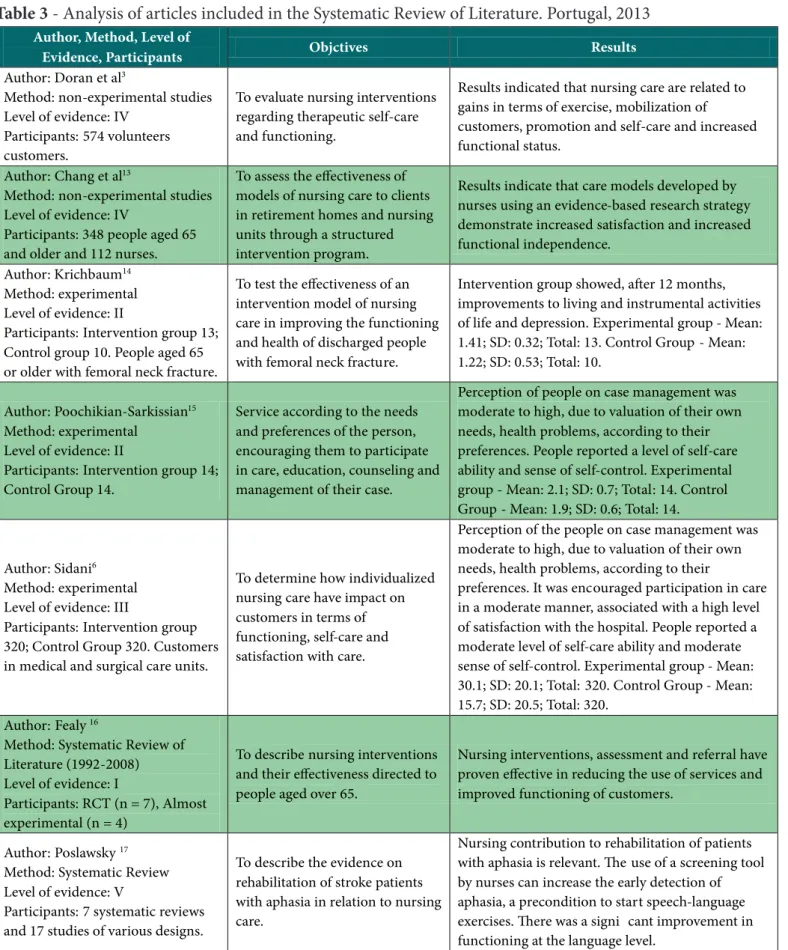
To make the used method visible and transparent, it is presented the list of the 14 filtered articles, which were the substrate for the development of the discussion and respective conclusions (Table 2 and Table 3).
Discussion
We observed the influence of nursing leadership programs for health processes in health units. Analyzing several indicators, we realized the positive influence on many factors such as length of stay, functional status, readmission, complications, patient satisfaction and decreased hospital costs7.
Table 1 - Search and selection process of Systematic Literature Review. Portugal, 2013 Protocol
Identi cation:
No. of records identi ed through research database (CINAHL, MEDELINE) – 255 No. of records identi ed in full-text, year 2000-2010 - 229
Screening:
No. of duplicate and removed records – 22 No. of selected records (title and abstract) – 156 No. of deleted records (title and abstract) – 51 Inclusion criteria (full reading):
No. of full text articles without inclusion criteria – 141 No. of full text articles with inclusion criteria - 14 Included articles (level of evidence)
Level I – 2, Level II – 5, Level III- 1, Level IV – 4, Level V – 2.
Table 2 - Analysis of articles included in the systematic literature review. Portugal, 2013
Author, Method, Level of Evidence,
Participants Objectives Results
Author: Griffiths7
Method: search in databases MEDLINE, CINAHL, EMBASE, BNI e HMIC (2001-2006)
Level of evidence: I
Participants: ten experimental and almost experimental studies
To determine the inxuence of nursing-led programs in health units, regarding various indicators.
Signimcant inxuence on the length of stay, functional status, readmission, complications, customer satisfaction, and hospital costs.
Author: Griffiths7
Method: experimental Level of evidence: II
Participants: intervention group 97; control group 73. Admission by orthopedic, gastrointestinal and neurological problems.
Multidisciplinary intervention, led by a nurse reference, responsible approach to the management of all employees focused on needs from nursing care.
It was observed positive gains in terms of: length of stay, health status, psychological well-being, functional dependency, mortality, readmission, complications, customer satisfaction, and decreased costs. Experimental group -Mean: 13.4; SD: 18.9; Total: 80. Group Control - Mean: 10.6; SD: 19.6; Total: 73 Author: Griffiths8
Method: experimental Level of evidence: II
Participants: Intervention group 79; control group 79. Customers admission at a unit with nursing care needs.
Multidisciplinary intervention, programmed from the reference nurse, through information obtained in data collection.
It was observed positive gains in terms of: functional status, mortality, complications, customer satisfaction. Experimental group - Mean: 3.6; SD: 3.29; Total: 79. Control group - Mean: 2.6; SD: 3.38; Total: 79.
Author: Steiner9
Method: experimental Level of evidence: II
Participants: intervention group 104; Control Group 108 Customer admission at school unit with respiratory,
cardiovascular diagnostics and stroke.
Unit with 10 beds for nursing care, with nurses leading the approach to customers, multidisciplinary, with specimc mechanisms for decision-making in relation to customers’ trajectory by nursing care.
It was observed positive gains in terms of: length of stay, functional dependency, quality of care. Experimental group -Mean: 11.39; SD: 17.3; Total: 104. Control group - Mean: 8.47; SD: 12.96; Total: 108.
Author: Von Krogh10
Method: Consensus technique Level of evidence: V
Participants: Group of experts, 25 nurses.
To describe the methods used in order to understand the development of nursing reasoning in relation to people with functional demcit.
Results organized into eight domains (physiological, functional, psycho-cognitive, safety, existential, lifestyle, family and environment).
Author: Schein11
Method: longitudinal Level of evidence: IV
Participants: 175 residents in the community, with 70 years old and more (with multiple admissions).
To associate nursing interventions carried out under the quality management and the functional capacity of older people.
Older people who received follow-up, based on case management showed an increase in instrumental activities of daily living and functioning.
Table 2 - Continuation
Author, Method, Level of Evidence,
Participants Objectives Results
Author: Ouslander12
Method: non-experimental studies Level of evidence: IV
Participants: 528 elderly residents in nursing home
To test the effects of an intervention in terms of rehabilitation regarding incontinence, mobility and muscle strength.
ere was a signi cant effect of intervention in almost all indicators, incontinence, mobility and muscle strength.
Table 3 - Analysis of articles included in the Systematic Review of Literature. Portugal, 2013
Author, Method, Level of
Evidence, Participants Objctives Results
Author: Doran et al3
Method: non-experimental studies Level of evidence: IV
Participants: 574 volunteers customers.
To evaluate nursing interventions regarding therapeutic self-care and functioning.
Results indicated that nursing care are related to gains in terms of exercise, mobilization of customers, promotion and self-care and increased functional status.
Author: Chang et al13
Method: non-experimental studies Level of evidence: IV
Participants: 348 people aged 65 and older and 112 nurses.
To assess the effectiveness of models of nursing care to clients in retirement homes and nursing units through a structured intervention program.
Results indicate that care models developed by nurses using an evidence-based research strategy demonstrate increased satisfaction and increased functional independence.
Author: Krichbaum14
Method: experimental Level of evidence: II
Participants: Intervention group 13; Control group 10. People aged 65 or older with femoral neck fracture.
To test the effectiveness of an intervention model of nursing care in improving the functioning and health of discharged people with femoral neck fracture.
Intervention group showed, a er 12 months, improvements to living and instrumental activities of life and depression. Experimental group - Mean: 1.41; SD: 0.32; Total: 13. Control Group - Mean: 1.22; SD: 0.53; Total: 10.
Author: Poochikian-Sarkissian15
Method: experimental Level of evidence: II
Participants: Intervention group 14; Control Group 14.
Service according to the needs and preferences of the person, encouraging them to participate in care, education, counseling and management of their case.
Perception of people on case management was moderate to high, due to valuation of their own needs, health problems, according to their preferences. People reported a level of self-care ability and sense of self-control. Experimental group - Mean: 2.1; SD: 0.7; Total: 14. Control Group - Mean: 1.9; SD: 0.6; Total: 14.
Author: Sidani6
Method: experimental Level of evidence: III
Participants: Intervention group 320; Control Group 320. Customers in medical and surgical care units.
To determine how individualized nursing care have impact on customers in terms of functioning, self-care and satisfaction with care.
Perception of the people on case management was moderate to high, due to valuation of their own needs, health problems, according to their
preferences. It was encouraged participation in care in a moderate manner, associated with a high level of satisfaction with the hospital. People reported a moderate level of self-care ability and moderate sense of self-control. Experimental group - Mean: 30.1; SD: 20.1; Total: 320. Control Group - Mean: 15.7; SD: 20.5; Total: 320.
Author: Fealy16
Method: Systematic Review of Literature (1992-2008) Level of evidence: I
Participants: RCT (n = 7), Almost experimental (n = 4)
To describe nursing interventions and their effectiveness directed to people aged over 65.
Nursing interventions, assessment and referral have proven effective in reducing the use of services and improved functioning of customers.
Author: Poslawsky17
Method: Systematic Review Level of evidence: V
Participants: 7 systematic reviews and 17 studies of various designs.
To describe the evidence on rehabilitation of stroke patients with aphasia in relation to nursing care.
Nursing contribution to rehabilitation of patients with aphasia is relevant. e use of a screening tool by nurses can increase the early detection of aphasia, a precondition to start speech-language exercises. ere was a signi cant improvement in functioning at the language level.
In a recovery unit for older people with 24 beds and through a multidisciplinary approach, focusing on customer needs in nursing care, with nursing leadership programs there were positive gains such as: length of stay, state health, psychological well-being, functional dependency, mortality, readmission, complications, customer satisfaction, lower costs7,8.
In a 19-bed unit of a district hospital, by means of a programmed multidisciplinary approach from reference nurses we observed positive gains in performance status, mortality, complications, customer satisfaction8.
In a unit with 10 beds for nursing care, with nurses leading the multidisciplinary approach to customers, with specific mechanisms for decision-making in relation customers’ routes by nursing care, positive gains were observed for: length of stay, functional dependency, quality of care. Nursing interventions were carried out under the quality management, associated with functional capacity of elderly, resulting in very significant gains in terms of instrumental activities of daily living and functional status9.
Effects of an intervention in nursing care through rehabilitation programs were observed, with positive effects on incontinence, mobility and muscle strength in 528 elderly people living in nursing home of the Department of Veterans Affairs, USA12.
Nursing interventions in relation to therapeutic self-care and functionality were evaluated, with gains in health of nursing care in promoting exercise, positioning and functional status3.
It was estimated effectiveness of the models of nursing care directed to elderly residents in long-term and nursing institutions, by means of a structured intervention program, and it was observed increased levels of satisfaction, functional independence, daily living activities and knowledge of therapeutic system by customers13.
By testing the effectiveness of an intervention model of nursing care in improving the functioning and health directed to people with femoral neck fracture in their home, it was found that the intervention group showed, after 12 months, improvements regarding life activities, instrumental activities and depression14.
It was found in a study on service according to the needs and preferences of the person, encouraging them to participate in care, education, counseling and management of their case, that perception of people on the management of their case was
moderate to high due to the fact that they valued their needs, health problems and took into account their preferences. It was encouraged moderate participation in care associated with high level of satisfaction with hospitalization. People reported a level of self-care ability and self-control15.
It was determined how individualized nursing care has effects on customers and the level of functioning, self-care and satisfaction with care6.
Nursing interventions and their effectiveness directed to people over 65 years old were described7. It was
observed that nursing interventions, assessment and referral have proven effective in reducing the use of services and improved customer functioning.
The use of a screening tool by nurses can increase the early detection of aphasia, a precondition to start speech-language exercises. There was a significant improvement in functioning on language17.
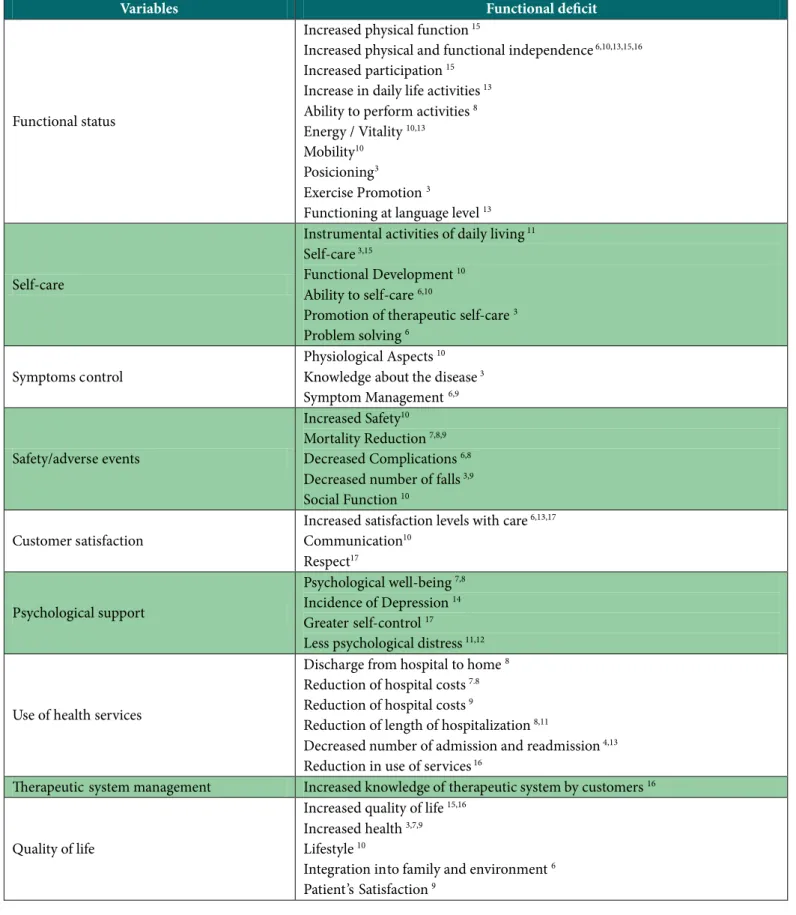
Table 4 summarizes, according to studies that have integrated this meta-synthesis, the relationship between functional deficits and variables.
Regarding quantitative synthesis, it may be noted that sensitive outcomes to nursing care observed from structured intervention thereof are described as improvements of: functional status (increase of physical function, increased physical and functional independence, increased participation, increase in activities of daily living, energy/vitality, mobility, positioning, promotion of exercise), care (instrumental activities of daily living, self-care, functional development, ability for self-self-care, promotion of therapeutic self-care, problem solving), symptoms control (physiological aspects, knowledge about the disease, symptom management), safety/ adverse events (increased safety, reduced mortality, reduced complications, decreased number of falls, social function), customer satisfaction (increased satisfaction levels with care, communication, respect), psychological support (psychological well-being, incidence of depression, greater self-control, less psychological distress), decreased health care costs (discharge from hospital to home, decreased hospital costs, reduction of length of hospitalization, decreased number of admission and readmission, reduced use of services), therapeutic system management (increasing knowledge of the therapeutic system by customers) and quality of life (increased quality of life, increased health, lifestyle, integration into family and environment, patient’s satisfaction).
Table 4 - Relation between variables of sensitive outcomes to nursing care and self-care and functional deficit.
Portugal, 2013
Variables Functional de cit
Functional status
Increased physical function15
Increased physical and functional independence6,10,13,15,16
Increased participation15
Increase in daily life activities13
Ability to perform activities8
Energy / Vitality10,13
Mobility10
Posicioning3
Exercise Promotion3
Functioning at language level13
Self-care
Instrumental activities of daily living11
Self-care3,15
Functional Development10
Ability to self-care6,10
Promotion of therapeutic self-care3
Problem solving6
Symptoms control
Physiological Aspects10
Knowledge about the disease3
Symptom Management6,9
Safety/adverse events
Increased Safety10
Mortality Reduction7,8,9
Decreased Complications6,8
Decreased number of falls3,9
Social Function10
Customer satisfaction
Increased satisfaction levels with care6,13,17
Communication10 Respect17 Psychological support Psychological well-being7,8 Incidence of Depression14 Greater self-control17
Less psychological distress11,12
Use of health services
Discharge from hospital to home8
Reduction of hospital costs7.8
Reduction of hospital costs9
Reduction of length of hospitalization8,11
Decreased number of admission and readmission4,13
Reduction in use of services16
erapeutic system management Increased knowledge of therapeutic system by customers16
Quality of life
Increased quality of life15,16
Increased health3,7,9
Lifestyle10
Integration into family and environment6
Patient’s Satisfaction9
Based on included articles with level of evidence II, it is shown in Chart 1, in Meta-analysis format, interventions in health promotion after the loss of functional status, carried out or led by nurses, through structured interventions based on increased functioning. Comparison was between structured practice and conventional practice. Health outcomes
were measured in various ways, in relation to functional state.
Through studies included in this meta-analysis, it can be seen that structured interventions of nurses have a effects sensitive in the level of the variables of functioning (Overall Effect Z Test = 2.66, P = 0.008; I2 = 0%) (Chart 1).
Conclusion
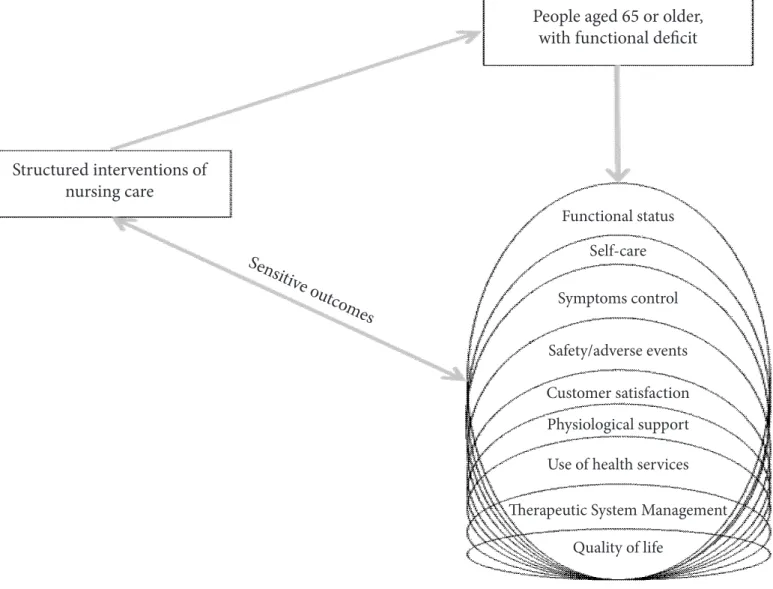
As it can be seen in our results, structured interventions of nursing care for clients over 65 years old, regarding loss of functioning, have the variables: functional status, self-care, symptom control, safety/ adverse events, customer satisfaction, psychological support, use of health services, therapeutic system management and quality of life, which clearly relate to improve the described functional deficit.
Figure 1 shows a diagram about the relationship found in this systematic literature review and the influence of structured interventions of nursing care, in people over 65 years old in relation to outcome of nursing care variables.
After this systematic literature review on the study object, authors consider it is necessary: to study functionality depending on age and sex of people over 65 years old, regarding: functional status (consciousness functions; exercise tolerance
Chart 1 - Meta-Analysis summary, Portugal, 2013
Figure 1 - Intervention process of nursing care in relation to the functional deficit. Portugal, 2013
Structured interventions of nursing care
People aged 65 or older, with functional deficit
Sensitive outco mes
OUTCOME VARIABLES
Quality of life
Therapeutic System Management Use of health services Physiological support Customer satisfaction Safety/adverse events Symptoms control Self-care Functional status
functions; joints mobility functions, structure of members on extent and nature of disabilities, capacity of utilization of hands and arms); self-care (excretory functions, reading and writing ability, ability to move, capacity regarding bath, dressing, eating and drinking, caring for body parts, developing care associated with excretion); symptoms control (feeling and location of pain, blood pressure), safety adverse events (types of skin lesions and their location); psychological support; use of health services; therapeutic system management; quality of life.
Conflicts of Interest
“The authors declared that there is no conflict of interest of any nature.”
References
1. United Nations. Department of Economic and Social Affairs. Population Division. Population Ageing and Development. 2009.
2. United Nations. Department of Economic and Social Affairs. Population Division (UN) (2011). Total population (both sexes combined) by major area, region and country, annually for 1950-2100 (thousands), Estimates, 1950-2010. World Population Prospects: The 2010 Revision, CD-ROM Edition.
3. Doran D, Harrison M, Laschinger H, Hirdes J, Rukholm E, Cranley L, et al. Relation between nursing interventions and outcome achievement in acute care settings. Research in Nursing & Health. 2006; 29(1): 61-70.
4. Prodinger B, Salzberger T, Stucki G, Stamm T, Cieza A. Measuring Functioning in People with Fibromyalgia (FM) Based on the International Classification of Functioning, Disability and Health (ICF)-A Psychometric Analysis. Pain Practice. 2010; 12(4): 255-265.
5. Melnyk B, Fineout-Overholt E, Stetler C, Allan J. Outcomes and implementation strategies from the first U.S. evidence-based practice leadership summit. Worldviews on Evidence-Based Nursing. 2005; 2(3): 113-121.
6. Sidani S. Effects of patient-centered care on patient outcomes: an evaluation. Research & Theory for Nursing Practice. 2008; 22(1): 24-37.
7. Griffiths P. Effectiveness of intermediate care delivered in nurse-led units. British Journal of Community Nursing. 2006; 11(5): 205-208.
8. Griffiths P, Harris R, Richardson G, Hallett N, Heard S, Wilson-Barnett J. Substitution of a nursing-led inpatient unit for acute services: randomized controlled trial of outcomes and cost of nursing-led intermediate care. Age & Ageing. 2001; 30(6): 483-488.
9. Steiner A, Walsh B, Pickering R, Wiles R, Ward J, Brooking J. Therapeutic nursing or unblocking beds? A randomised controlled trial of a post-acute intermediate care unit... including commentary by Torgerson DJ with author response. BMJ: British Medical Journal (International Edition). 2001; 322(7284): 453-460.
10. Von Krogh G, Dale C, Naden D. A framework for integrating NANDA, NIC, and NOC terminology in electronic patient records. Journal of Nursing Scholarship. 2005; 37(3): 275-281.
11. Schein C, Gagnon A, Chan L, Morin I, Grondines J. The association between specific nurse case management interventions and elder health. Journal of The American Geriatrics Society. 2005; 53(4): 597-602.
12. Ouslander J, Griffiths P, McConnell E, Riolo L, Kutner M, Schnelle J. Functional incidental training: a randomized, controlled, crossover trial in Veterans Affairs nursing homes. Journal Of The American Geriatrics Society. 2005; 53(7): 1091-1100.
13. Chang E, Hancock K, Hickman L, Glasson J, Davidson P. Outcomes of acutely ill older hospitalized patients following implementation of tailored models of care: a repeated measures (pre- and post-intervention) design. International Journal of Nursing Studies. 2007; 44(7): 1079-1092. 14. Krichbaum K. GAPN postacute care coordination improves
hip fracture outcomes... Gerontologic Advance Practice Nurse. Western Journal of Nursing Research. 2007; 29(5): 523-544.
15. Poochikian-Sarkissian S, Wennberg R, Sidani S. Examining the relationship between patient-centred care and outcomes on a neuroscience unit: a pilot project. Canadian Journal Of Neuroscience Nursing. 2008; 30(2): 14-19.
16. Fealy G, McCarron M, O’Neill D, McCallion P, Clarke M, Cullen A, et al. Effectiveness of gerontologically informed nursing assessment and referral interventions for older persons attending the emergency department: systematic review. Journal of Advanced Nursing. 2009; 65(5): 934-945. 17. Poslawsky I, Schuurmans M, Lindeman E, Hafsteinsdóttir
T. A systematic review of nursing rehabilitation of stroke patients with aphasia. Journal of Clinical Nursing. 2010; 19(1-2): 17-32.