FISH ASSEMBLAGES AS BIOLOGICAL
INDICATORS OF ECOLOGICAL QUALITY
IN PORTUGUESE RIVERS
Paula Rute Pereira Matono Alves
Tese apresentada à Universidade de Évora para obtenção do Grau de Doutor em Ciências do Ambiente ORIENTAÇÃO:Doutora Maria Ilhéu, Universidade de Évora CO-ORIENTAÇÃO: Doutor Thierry Oberdorff, Muséum National d’Histoire Naturelle, Paris
FISH ASSEMBLAGES AS BIOLOGICAL
INDICATORS OF ECOLOGICAL QUALITY
IN PORTUGUESE RIVERS
Paula Rute Pereira Matono Alves
Tese apresentada à Universidade de Évora para obtenção do Grau de Doutor em Ciências do Ambiente
ORIENTAÇÃO:Doutora Maria Ilhéu, Universidade de Évora CO-ORIENTAÇÃO: Doutor Thierry Oberdorff, Muséum National d’Histoire Naturelle, Paris
Esta tese beneficiou do apoio financeiro da Fundação para a Ciência e Tecnologia (Bolsa de doutoramento SFRH/BD/23435/2005) e do Instituto de Investigação e Formação Avançada da Universidade de Évora.
À Doutora Maria Ilhéu, minha orientadora, por me ter proporcionado a realização desta tese, pelo constante entusiasmo, dinamismo e perseverança, mesmo nos momentos de maior desânimo e nas longas horas, mesmo muito longas, de discussão de dados. O meu reconhecimento também pela amizade resultante de treze anos de trabalho em conjunto.
Ao Doutor João Bernardo, por todo o acompanhamento e revisão da tese, pela inspiradora mente inquieta, pelas sessões de trabalho únicas e por sempre me ter transmitido o valor de nos pautarmos por elevados critérios de exigência e rigor.
To Dr. Thierry Oberdorff, my co-advisor, for giving me the opportunity to share his knowledge. For all the kindness and invaluable comments and insightful reviews of the thesis.
À Doutora Ana Costa, pelo apoio e enorme pragmatismo quando as sessões de trabalho em conjunto se afiguravam desesperantes e mesmo dramáticas!
Aos meus colegas Luísa Sousa, João Matos, Ana Curto e Santiago Suarez, pelos fantásticos anos de trabalho e aprendizagem em conjunto, com muitas aventuras e desventuras partilhadas no gabinete, laboratório e campo. Um agradecimento especial à Luísa, pela amizade, cumplicidade e longas horas de luta em frente ao computador com tratamentos estatísticos, redacção de textos e afins.
Ao Dárcio Sousa, por todo o companheirismo, esforço e dedicação com que enfrentou comigo alguns dos momentos mais árduos do trabalho de campo, e pela ajuda nas questões de cartografia.
Ao Luís Santa Maria, pela infindável amabilidade e disponibilidade, pelas maravilhosas estórias e deliciosas romãs, e claro, pelo inestimável empenho em me ensinar a manobrar o Jeep com o reboque do barco!
Ao Paulo Alves, Rebecca Hale, António Vareia, Sofia Ramalho, Cleyton Calderan, Luís Mexia de Almeida e todos os voluntários que se dispuseram a ajudar nas muitas campanhas de campo.
À Márcia Barbosa, pela disponibilidade para ajudar nas questões de cartografia e esclarecimento de algumas dúvidas estatísticas.
A todas as pessoas que integraram equipas a nível nacional e participaram na recolha de dados de diferente natureza entre 2004 e 2006 durante a fase de implementação da Directiva Quadro da Água, designadamente Universidade de Trás-os-Montes e Alto Douro, Universidade do Porto, Universidade de Coimbra, Universidade de Aveiro, Universidade Nova de Lisboa, Universidade Técnica de Lisboa e Universidade de Évora.
À Fátima Mendes e Maria José Barão, por assegurarem toda a logística do Laboratório de Ecologia Aquática e a realização de parte das análises da água. Uma palavra especial para a Fátima, pela enorme simpatia, disponibilidade e apoio nas tarefas de laboratório ao longo de todos estes anos.
Às meninas do Secretariado do Departamento de Paisagem, Ambiente e Ordenamento, Rita Menezes, Vanda Prazeres e Arlete Sousa, por toda a simpatia e boa disposição.
Aos amigos que foram esperando (e desesperando!) pela entrega da tese, pelo apoio demostrado, mesmo sem perceberem muito bem o que ando para aqui a fazer!
Aos amigos de sempre, Carla, Luís, Tátá, Nuno, Catarina, Filipa e Raquel, que também viveram as agruras de um doutoramento, ou simplesmente sofreram os danos colaterais! À Tátá, e especialmente à Carla, por aturarem neuras, desabafos e crises existenciais! Ainda à Carla tenho que agradecer a preciosa ajuda na maratona final de revisões e artes gráficas.
À minha família Tomarense, os meus sogros, cunhados e belíssimo ramalhete de sobrinhos, pelo carinho e preocupação.
Aos meus pais, meu eterno porto seguro e melhor exemplo de carácter, a quem devo absolutamente tudo, pela admiração e apoio incondicionais em todos os momentos e por serem os melhores avós do mundo.
Ao Francisco, meu wing man a quem confiei o meu percurso de vida, por todo o carinho, estímulo e dedicação enquanto marido, amigo e pai, que me permitiram manter o equilíbrio e a
Ás minhas filhas, Margarida e Catarina, a melhor coisa que alguma vez fiz, por generosamente me concederem o maior dos privilégios: ser mãe!
RESUMO
No contexto da aplicação da Directiva-Quadro da Água, a ictiofauna é considerada como um relevante elemento biológico. Pela primeira vez foi desenvolvido um sistema de classificação para avaliação do estado ecológico dos ecossistemas aquáticos em Portugal, apesar dos constrangimentos impostos pela variedade e ubiquidade das pressões humanas e pelas peculiaridades dos agrupamentos piscícolas. Foram definidos grupos piscícolas para posterior estabelecimento de uma tipologia nacional de rios, foram seleccionadas métricas responsivas ás pressões humanas e foi desenvolvido um índice biótico piscícola. Os resultados evidenciam a necessidade de diferenciar correctamente a resposta da ictiofauna ás perturbações naturais e antropogénicas, considerando quer a variabilidade espacial, quer temporal dos agrupamentos piscícolas, típica dos cursos de tipo Mediterrânico. O uso de solo tem fortes consequências na degradação dos rios e na integridade da ictiofauna, sendo importante que a avaliação dos impactos considere a interacção entre diferentes pressões. A compreensão da influência relativa dos factores ambientais e humanos na ocorrência e abundância das espécies não nativas permitiu evidenciar o potencial papel das mesmas como indicadores biológicos. Esta tese contribuiu para o desenvolvimento e aperfeiçoamento de ferramentas de avaliação ecológica em Portugal, permitindo igualmente um aumento do conhecimento sobre a ecologia das comunidades piscícolas e funcionamento dos ecossistemas em rios de tipo Mediterrânico, com vista à sua conservação e reabilitação.Palavras-chave: Fauna piscícola; avaliação ecológica; tipos de rios; índice biótico; perturbação
ABSTRACT
Under the implementation of the Water Framework Directive fish fauna is considered a useful biological element. For the first time a Portuguese classification system to assess the ecological status of aquatic ecosystems was established, despite several constrains posed by the variety and ubiquity of human pressures and by the peculiarities of the fish assemblages. It was possible to define fish-based geographical groups for the subsequent establishment of a national river typology, to select metrics responsive to human pressures and to develop a fish biotic index. Results underline the needs for accurately differentiate between fish responses to natural and anthropogenic disturbances by accounting for the spatial and temporal variability of fish assemblages. Land use may lead to strong impacts on stream degradation and fish assemblages integrity and this evaluation must consider the interaction of different pressures. Understanding the influence of environmental and human factors in the occurrence and abundance of non-native species enlightened their role as a reliable tool in the ecological assessment of rivers. This thesis represents an important contribution to improve the ecological assessment tools in Portugal, while increasing knowledge on the ecology of fish communities and ecosystem functioning in Mediterranean climate rivers in view of their urgent conservation.Keywords: Freshwater fish; ecological assessment; river-types; biotic index; natural and
1.GENERAL INTRODUCTION
Mediterranean climate rivers: general characteristics, constrains and threats 2
Patterns of fish assemblages in rivers 3
Human impacts on freshwater ecosystems 5
Ecological assessment of rivers 6
Fish as biological indicators 7
Aims and structure of the thesis 9
References 10
2. FISH-BASED GROUPS FOR ECOLOGICAL ASSESSMENT IN RIVERS: THE IMPORTANCE OF ENVIRONMENTAL DRIVERS ON TAXONOMIC AND FUNCTIONAL TRAITS OF FISH ASSEMBLAGES Abstract 18
Introduction 19
Materials and Methods 21
Study area 21
Sampling 23
Data analysis 25
Results 27
Fish-based geographical groups 27
Environmental drivers 32
Discussion 36
References 41
3.DEVELOPMENT OF A FISH INDEX FOR THE RIVERS OF CONTINENTAL PORTUGAL Abstract 52 Introduction 53 Methods 54 Sampling 54 Metrics selection 56 Fish Index 59 Results 61
Applicability of the Fish Index 61
Littoral river-type 61
North Group with small drainage area 62
North Group with medium and large drainage area 62
Southern mixed Group 64
South river-type with medium and large drainage area 64
Discussion 66
References 70
4. EFFECTS OF NATURAL HYDROLOGICAL VARIABILITY ON FISH ASSEMBLAGES IN SMALL MEDITERRANEAN STREAMS: IMPLICATIONS FOR ECOLOGICAL ASSESSMENT Abstract 78
Introduction 79
Methods 81
Structural and functional changes in fish assemblages 96
Relationships between fish assemblages variability, human pressure and hydrological variability 98
Discussion 100
References 106
5.EFFECTS OF LAND USE INTENSIFICATION ON FISH ASSEMBLAGES IN MEDITERRANEAN CLIMATE STREAMS Abstract 116
Introduction 117
Methods 118
Study area 118
Site selection and sampling 119
Data analysis 120
Results 122
Anthropogenic disturbance and water quality 122
Changes in fish assemblages structure 125
Discussion 127
References 131
6.NON-NATIVE FISHES IN MEDITERRANEAN RIVER-TYPES: THE IMPORTANCE OF ENVIRONMENTAL DRIVERS AND HUMAN PRESSURE ON THE INVASIBILITY Abstract 138
Introduction 139
Methods 140
Study area 140
Sampling and data collection 143
Data analysis 144
Results 146
Abundance and distribution of non-native species 146
Environmental variables 148
Total human pressure 152
Variation partition 155
Discussion 158
Ecological and environmental factors 159
Human-disturbance factors 161
References 164
7.CONCLUSIONS Fish-based groups for ecological assessment in Portuguese rivers 176
Development of a Fish Index for Portuguese rivers: a methodological challenge 176
Implications of hydrological variability on the ecological assessment 177
Ecological response of fish assemblages along a gradient of land use intensification 178
Environmental and anthropogenic drivers of non-native fish species 179
Final remarks and future needs 180
References 183
Chapter 1
General introduction
Barbus sclateri F. Filipe Barbus sclateri F. FilipeMediterranean climate rivers: general characteristics, constrains and threats
Mediterranean ecosystems are limited to five relatively small areas around the world: the region bordering the Mediterranean Sea (Mediterranean basin), central Chile, the Cape region of South Africa, southwestern and southern Australia, and California south to northern Baja California. These ecosystems occur mainly along the western edges of continents between the 30° and 40° parallels in both northern and southern hemispheres.
The Mediterranean climate, moderated by cold ocean currents offshore, is characterized by mild, rainy winters and warm, dry summers. Seasonality and variability in rainfall is the principal attribute of the Mediterranean climate (Gasith and Resh 1999). Mediterranean climate rivers are strongly influenced by climate and river discharge depends on the rainfall pattern, thus these rivers are shaped by predictable seasonal events of flooding and drying over an annual cycle, but also presenting a strong interannual flow variation (Gasith and Resh 1999). Accordingly, aquatic communities undergo a yearly cycle whereby abiotic (environmental) controls that dominate during floods are reduced when the discharge declines, which is also a time when biotic controls (e.g. predation, competition) can become important. As the dry season progresses, habitat conditions become harsher and environmental pressures may again become the most important regulators of stream populations and communities structure (Gasith and Resh 1999).
Portugal is located in the largest area of Mediterranean climate in the world, presenting a complex climatic and topographic diversity. A decrease in precipitation from North to South and from West (littoral) to East (interior) is observed, whereas temperature shows an opposite pattern. Rainfall is mostly concentrated between October and March, and the dry summer period extends from June to September. The South is quite homogeneous, mostly represented by lowland streams and rivers (flat, less rainy, with long hot dry summers), while the North presents a much more complex climatic and geomorphological patchiness, with higher average altitudes, higher annual precipitation, and milder summers in general. Consequently, most rivers are permanent in the North and intermittent in the South.
Under this scenario, intermittent rivers are particularly affected by natural hydrological variability, as during the dry period they are completely dry or reduced to scattered and isolated pools, which serve as refugia for fish until fluvial connectivity is restored (Schlosser 1991; Magalhães et al. 2002a). Flow intermittence is an extreme form of flow variation and one that has major pervasive
ecological processes in rivers (Poff and Ward 1989). In the future, this situation can be aggravated in regions that predictably experience drying trends due to climate change and by water abstraction for socio-economic uses (Larned et al. 2010) as expected in Mediterranean regions.
The environmental variability generated by natural disturbances subjects the native fish fauna to natural harsh conditions, promoting the development of a variety of species adaptations such as short lifespans, rapid growth rates and high fecundity (e.g. Vila-Gispert and Moreno-Amich 2002; Clavero et al. 2004), as well as behavioural adaptations (Magalhães et al. 2002a,b; Magoulick and Kobza 2003; Ilhéu 2004) to cope with the environmental stressors and associated changes in habitat conditions. In that sense, resistance (the capacity to withstand) and resilience (the capacity to recover) are common attributes found in the elements of the biota subjected to highly variable flow regimes, as observed in Mediterranean climate rivers (Gasith and Resh 1999; Lake 2011).
In addition to the harsh natural conditions, Mediterranean climate areas have been exposed since many years ago to human disturbances. In nowhere else in the world the endemic fauna is declining as rapidly as in Mediterranean regions because facing important threats (Smith and Darwall 2006; Ribeiro et al. 2009) due to non-native introductions, anthropogenic impacts (such as damming, water abstraction and land use changes and intensification) or limited availability of water and unsatisfactory management (Smith and Darwall 2006; Ribeiro et al. 2009; Hermoso and Clavero 2011).
Patterns of fish assemblages in rivers
The organization of biotic assemblages in rivers is influenced by a variety of abiotic and biotic factors operating at a range of spatial and temporal scales (Poff 1997; Whittaker et al. 2001; Hoeinghaus et al. 2007; Hugueny et al. 2010). At larger spatial scales, factors related to energy availability, climate, habitat availability and history determine the composition of available species from which local communities are assembled (Oberdorff et al. 2011). Local factors, both biotic interactions and abiotic constrains, often dictate which of the species from the regional pool will occupy a particular community and in what abundance. Additionally, regional factors can interact
community structure, and their relative importance may be dependent on the scale of the study (Jackson et al. 2001).
The identification of environmental gradients structuring fish assemblages in rivers constitutes a major challenge for ecologists and is fundamental to understand the functioning of these systems. Several conceptual models analysed the ecological process operating in rivers and have led to progressive insights into the relative importance of abiotic and biotic factors along spatial and temporal scales in driving aquatic ecosystems structure and function (e.g. Vannote et al. 1980; Elwood et al. 1983; Frissel et al. 1986; Junk et al. 1989; Townsend 1989; Ward 1989).
Flow variability is one of the most important determinants of ecological patterns and processes in rivers (Poff and Ward 1989; Poff and Allan 1995; Richter et al. 2003), playing an important role in structuring fish assemblages in Mediterranean streams (Marchetti and Moyle 2001; Magalhães et al. 2002b; Magalhães et al 2007) and completely shapes their ecological features, as well as habitat patchiness and availability (Bernardo et al. 2003; Ilhéu 2004). Because streamflow conditions exerts control over many important structural attributes in streams (e.g. habitat volume, current velocity, channel geomorphology, and substratum stability), flow measures represent an integration of complex environmental conditions (Poff and Ward 1989).
Both taxonomic and functional approaches can be used to study fish community organization, in a fruitful complementary way (Hoeinghaus et al. 2007). This knowledge is fundamental to allow detecting and measuring deviations from the natural condition resulting from responses to anthropogenic disturbances, and hence to develop and improve management tools and rehabilitation programs in streams.
Introduction of new species and other human interventions can also influence assemblage composition in streams (Vila-Gispert et al. 2002), promoting faunal homogeneization and constituting possible confounding factors (Scott and Helfman 2001), therefore highlighting the need to accurately distinguish natural environmental variability and drivers from anthropogenic disturbances, especially in the context of ecological assessment.
Human impacts on freshwater ecosystems
Society relies on freshwater systems for drinking water, food, commerce and recreation, as well as waste removal, decomposition and aesthetics (Karr and Chu 1999). Consequently, these systems, belonging to the most intensively used and altered ecosystems of the world (Saunders et al. 2002), have been broadly impaired and continue to deteriorate as a result of human activities. The conservation of the biological elements of freshwater systems, as well as the processes sustaining them, is crucial to maintaining the goods and services fresh water provides (Karr and Chu 1999).
Human activities can disturb relationships between fish and the environment by direct action on the communities (e.g. introduction of alien species, chemical and organic pollutions) or indirect action by modification of the ecosystem (e.g. channel and bank modifications, flow regulation and fragmentation) (Karr and Chu 1999).
Rivers are strongly influenced by their surrounding landscape at multiple scales (Schlosser 1991; Allan et al. 1997; Fausch et al. 2002; Townsend et al. 2003), thus land use is emphasized as a major factor affecting the ecological integrity of fluvial ecosystems (e.g. Roth et al. 1996; Lammert and Allan 1999; Allan 2004). Allan (2004) highlighted the importance of land use impacts and identified six main factors of influences on aquatic ecosystems: sedimentation, nutrient enrichment, contaminant pollution, hydrologic alteration, riparian clearing/canopy opening and loss of large woody debris.
Land uses can be roughly summarised in three categories: agricultural, urban and natural (usually forested). Agriculture occupies by far the largest fraction of land area in many developed catchments (Allan 2004) like in Mediterranean regions. This situation is also observed in Portugal, but the agricultural practices have been changing over the last decades towards progressively more intensive and irrigated agriculture, due to the perspective of high profits promoted by the European Common Agriculture Policy (Pinto-Correia and Vos 2004). Olive production is a good example, as hyper-intensive olive groves are increasing exponentially, and incorporating new approaches of production with high uptakes of energy and water at the natural resources expenses.
1999), withdrawal of water for agricultural irrigation representing the largest fraction. Moreover, most of the human water demands in Mediterranean climate areas occur in the dry summer months, when water is required for agricultural irrigation and yet precipitation is rare. This asynchrony between water availability and demands, together with high interannual variability of Mediterranean river flows makes water management critical to the conservation of these freshwater ecosystems (Grantham et al. 2010).
With a predominant intermittent character, southern Portuguese streams are particularly vulnerable to these practices, as many river basins impacted by olive intensive/irrigated farming already suffer from excessive water abstraction, morphological degradation and poor water quality. Balancing freshwater ecosystems integrity with intensive agricultural practices under a scenario of water deficit constitutes a major challenge for southern European countries, including the Portuguese streams.
Ecological assessment of rivers
The assessment of the biotic or ecological integrity of water bodies is a central issue to water policies and to nature conservation in general, being defined as “the ability to support and maintain a balanced, integrated, adaptative community of organisms having a species composition, diversity and functional organization comparable to that of the natural habitat of the region” (Karr and Dudley 1981). In Europe, the implementation of the Water Framework Directive (WFD) (European Commission 2000) underlined the central role of biological indicators to assess the ecological status of rivers, requiring its evaluation based on four biotic elements (diatoms, macroinvertebrates, macrophytes and freshwater fish). According to the WFD, all Member States have to assess, monitor, and where necessary, improve the ecological status of surface waters, seeking to achieve at least ‘good ecological status’ by 2015.
Regarding the assessment methods, two different approaches can be distinguished: spatially based or type-specific methods (Schmutz et al. 2007) and site-specific methods (Oberdorff et al. 2002; Pont et al. 2007). Both approaches are based on the reference condition approach (Reynoldson et al. 1997; Bailey et al. 2004), i.e. deviations in ecological quality are established as the difference between expected (reference conditions) and observed conditions. Under this perspective, reference condition is defined as the expected background condition with no or
minimal anthropogenic stress. Type-specific and site-specific methods differ in the way they establish the reference conditions for a given site under evaluation. Type-specific approaches rely on grouping techniques (Roset et al. 2007) to cluster reference sites in a set of homogeneous landscape groups environmentally discriminated and biologically meaningful. The site-specific approach does not require any classification and it simply finds specific reference conditions for every new given site according to its environmental characteristics (Roset et al. 2007).
The spatially based approach is the underlying methodological principle in WFD for assessing the ecological status of running waters. Accordingly, the definition of river-types to classify rivers and streams is the first and fundamental step for the ecological assessment, allowing comparisons between groups of streams, and constituting classes for which assessment procedures can be developed and applied. In this sense, accurate estimation of reference assemblage characteristics is therefore crucial and obviously depending both on accurate site selection criteria and on standardised sampling protocols.
The Portuguese continental territory includes a diverse array of lotic ecosystems (permanent, intermittent and ephemeral) and a high spatial complexity regarding climatic, geomorphological and hydrological features. A type-specific approach is then a way to stratify the spatial variability in streams and rivers monitoring and assessment.
In Portugal, before the implementation of the WFD no attempts had been made to establish a river typology or a classification system to assess the ecological status of aquatic ecosystems. Indeed, the process faced considerable constrains, namely the absence of biological monitoring programs, the lack of available databases and the lack of standardised sampling protocols for biological elements.
Fish as biological indicators
The use of biological indicators has gained increasing importance in the quality assessment of inland waters. In this context, fish fauna did not receive as much attention as other biological quality elements (BQE), such as invertebrates or diatoms. The reasons for this situation are related to the particular difficulties of that taxonomic group, such as limited knowledge on the tolerance of some species, differences on the fish fauna occurring in the river basins of a country
In spite of some undeniable difficulties, fish fauna is considered today as a quite promising BQE. Fish fauna is sensitive to different kinds of pressures and, as some fish species are long lived, they respond to larger time scales than the other BQE, making them a potentially useful element in the biotic assessment. Moreover, some fish species represent the upper trophic levels and thus show an integrated view of the ecosystem, revealing possible problems occurring at lower levels (Barbour et al. 1999).
Regarding fish indexes, the importance of Karr’s (1981) multimetric Index of Biotic Integrity should be mentioned as a benchmark and many multimetric indexes developed afterwards in quite different ecological conditions and for different faunas are adaptations of this pioneer fish index (e.g. Oberdorff and Hughes 1992; Oberdorff et al. 2002; Angermeier and Davideanu 2004; Pont et al. 2006). In southern Europe countries, particularly in Portugal, this topic is still relatively undeveloped. The existing approaches are regional and/or mainly based on expert knowledge and not on sensitivity analysis (Ferreira et al. 1996; Oliveira and Ferreira 2002; Bernardo et al. 2004; Magalhães et al. 2008).
Due to zoogeographical isolation, fish assemblages from Iberian Peninsula show high degree of endemism, low number of species per site, high dissimilarity in assemblages composition among river basins, and high ecological plasticity of species (Almaça 1995). Moreover, they are naturally adapted to constraining environmental conditions and present high seasonal and inter-annual variability (e.g. Magalhães et al. 2002b; Bernardo et al. 2003; Ilhéu 2004), determined by the profound influence of the Mediterranean climate. All these aspects hamper the use of fish fauna as evaluators of anthropogenic pressures exerted on the systems (namely the hydrological ones), and consequently the development of tools to assess the ecological status of Mediterranean climate streams. Furthermore, under human pressure circumstances fish fauna may be more vulnerable to the natural harsh conditions and disturbances, with possible implications on the ecological assessment. Therefore, to use fish as reliable indicators it is crucial to distinguish between the effects of anthropogenic and natural disturbance (Oberdorff et al. 2002; Pont et al. 2006), as well as evaluating the possible interaction of both factors on fish assemblages structure and function.
Whether or not non-native fish species should be considered in the ecological assessment of rivers is a very debated question. Non-native species are considered one of the major threats to the conservation of native fish communities (e.g. Clavero et al. 2004). The impact of non-native
fish species seems to be related to human disturbance, as their populations may benefit from a certain level of ecosystem degradation, and they have negative direct or indirect effects on biodiversity, causing decline of native population with risk of extinction of endangered species (Manchester and Bullock 2000).
Aims and structure of the thesis
This thesis was partially developed under the implementation of the Water Framework Directive (WFD) in continental Portugal and aims to:
1. Determine the environmental factors that, in the absence of anthropogenic pressures, influence the structure and distribution of fish assemblages both at a regional (basin) and local scale (stream reach and habitat);
2. Define fish-based river-types and characterize fish assemblages under reference conditions for each one, therefore contributing to the establishment of the national river typology in compliance with the WFD goals;
3. Select the fish metrics (structural and functional) that best reflect the changes in fish communities subjected to anthropogenic pressures and develop a fish-based biotic index to evaluate the ecological quality in Portuguese rivers;
4. Investigate the influences of environmental variability on fish response to anthropogenic pressure and the consequent effects on the ecological assessment;
5. Assess the biological response to the most important anthropogenic pressures identified in rivers, i.e. the way fish assemblages structure and function change along a gradient of human pressure;
6. Examine the relationship between non-native fish species and anthropogenic disturbance and their potential relevance on the ecological assessment of Portuguese rivers.
The thesis comprises 7 chapters, five of them corresponding to papers published, in review or submitted to scientific journals. For that reason, these chapters are organized into introduction,
Chapter 1 is a general introduction and includes a synthesis of current knowledge on the issues in order to contextualize the objectives.
Chapter 2 identifies fish-based geographical groups for continental Portugal using taxonomic and functional traits and their relationship with environmental and geographical descriptors. A characterization of fish assemblages in each group is made, constituting the reference condition under the absence of significant anthropogenic pressures.
Chapter 3 presents the selection procedure of biological metrics responsive to different types of anthropogenic pressures and the development of a biotic index to assess the ecological status of Portuguese rivers based on fish fauna.
Chapter 4 addresses the effects of hydrological variability on the responses of fish assemblages to anthropogenic pressures in small intermittent streams, where this environmental factor constitutes the major source of natural disturbance and plays a key role structuring fish assemblages, therefore leading to possible implications on the accuracy of the ecological assessment.
Chapter 5 stresses the effects of land use intensification on fish assemblages integrity in Mediterranean climate streams of southern Portugal, specifically focusing on the main environmental disturbances resulting from the accelerated change in land use towards intensive farming systems, as olive production.
Chapter 6 investigates the possible relevance of non-native fish species in the ecological assessment of rivers, namely through evaluation of the environmental drivers that favour their success and of the relative importance of environmental variables and human-induced pressures for their occurrence and abundance in Portuguese rivers.
Chapter 7 summarises and integrates the main findings arising from the results obtained in each chapter, and identifies areas of future research that should further strengthen the conclusions.
References
Allan JD, Erickson DL, Fay J (1997) The influence of catchment land use on stream integrity across multiple spatial scales. Freshwater Biology 37:149–61.
Almaça C (1995) Freshwater fish and their conservation in Portugal. Biological Conservation 72:125-127.
Angermeier PL, Davideanu G (2004) Using fish communities to assess streams in Romania: initial development of an index of biotic integrity. Hydrobiologia 511:65–75.
Bailey R C, Norris RH, Reynoldson TB (2004) Bioasseessment of Freshwater Ecosystems Using the Reference Condition Approach. Kluwer Academic Publishers, Boston.
Barbour MT, Gerritsen J, Snyder BD, Stribling JB (1999) Rapid Bioassessment Protocols for Use in Streams and Wadable rivers: periphyton, benthic macroinvertebrates and fish. EPA 841-B-99-002. US Environmental Protection Agency. Office of Water. NW, USEPA.
Bernardo JM, Ilhéu M, Matono P, Costa AM (2003) Interannual variation of fish assemblage structure in a Mediterranean river: implications of streamflow on the dominance of native or exotic species. River Res. Appl. 19, 1-12.
Bernardo JM, Ilhéu M, Costa AM (2004) Ictiofauna do rio Sado: características gerais e valor de conservação In: Moreira I, Saraiva MG,Nunes Correia F. (ed) Gestão ambiental dos sistemas fluviais. Aplicação à bacia hidrográfica do rio Sado. Lisboa, ISA Press, pp. 300-316.
Clavero M, Blanco-Garrido F, Prenda J (2004) Fish fauna in Iberian Mediterranean basins: biodiversity, introduced species and damming impacts. Aquatic Conservation: Marine and Freshwater Ecosystems 14:575–585.
Elwood JW, Newbold JD, O’Neill RV, Van Winkle W (1983) Resource spiraling: An operational paradigm for analyzing lotic ecosystems In: Fontaine TD, Bartell SM (eds) Dynamics of lotic ecosystems. Ann Arbor Science, Ann Arbor, Michigan pp. 3-27.
European Commission (2000) Directive 2000/60/EC of the European Council and of the Council of 23 October 2000 establishing a framework for Community action in the field of water policy. Official Journal of the European Communities, L3271–72. Available at
Fausch KD, Torgersen CE, Baxter CV, Li HW (2002) Landscapes to riverscapes: bridging the gap between research and conservation of stream fishes. BioScience 52:483–498.
Ferreira MT, Cortes RM, Godinho FN, Oliveira JM (1996) Biological indicators of water quality applied to the Guadiana basin (in Portuguese). Recursos Hídricos 17:9–20.
Frissel CA, Liss WJ, Warren CE, Hurley MD (1986) A hierarchical framework for stream habitat classification: viewing streams in a watershed context. Environmental Management 10:199–214.
Gasith A, Resh VH (1999) Streams in Mediterranean climate regions: abiotic influence and biotic responses to predictable seasonal events. Annual Review of Ecology and Systematics 30:51-81.
Grantham TE, Merenlender AM, Resh VH (2010) Climatic influences and anthropogenic stressors: an integrated framework for streamflow management in Mediterranean-climate California, U.S.A. Freshwater Biology 55:188–204.
Hermoso V, Clavero M (2011) Threatening processes and conservation management of endemic freshwater fish in the Mediterranean basin: a review. Marine and Freshwater Research 62:244-254.
Hoeinghaus DJ, Winemiller KO, Birnbaum JS (2007) Local and regional determinants of stream fish assemblage structure: inferences based on taxonomic vs. functional groups. Journal of Biogeography 34:324–338.
Hugueny B, Oberdorff T, Tedesco PA (2010) Community ecology of river fishes: a large scale perspective. In: Gido K, Jackson DA (eds) Community Ecology of Stream Fishes: Concepts, Approaches and Techniques. American Fisheries Society Symposium 73:23-62.
Ilhéu M (2004) Patterns of habitat use by freshwater fishes in Mediterranean rivers (in Portuguese). PhD Thesis, University of Évora.
Jackson DA, Peres-Neto PR, Olden JD (2001) What controls who is where in freshwater fish communities — the roles of biotic, abiotic, and spatial factors. Canadian Journal of
Junk WJ, Bayley PB, Sparks RE (1989) The flood pulse concept in river-floodplain systems. Canadian Special Publications in Fisheries and Aquatic Sciences 106:110–127.
Karr JR, Chu EW (1999) Restoring Life in Running Waters: Better Biological Monitoring, Island Press, Washington.
Karr JR (1981) Assessment of biotic integrity using fish communities. Fisheries 6:21–27.
Karr JR, Dudley DR (1981) Ecological perspective on water quality goals. Environmental Management 5:55-68.
Lake PS (2011) Drought and aquatic ecosystems: Effects and responses. Whiley-Backwell, UK.
Lammert M, Allan JD (1999) Assessing biotic integrity of streams: effects of scale in measuring the influence of land use/cover and habitat structure on fish and macroinvertebrates. Environmental Management 23:257–70.
Larned ST, Datry T, Arscott DB, Tockner K (2010) Emerging concepts in temporary-river ecology. Freshwater Biology 55:717–738.
Magalhães MF, Beja P, Canas C, Collares-Pereira MJ (2002a) Functional heterogeneity of dry-season fish refugia across a Mediterranean catchment: the role of habitat and predation. Freshwater Biology 47:1919-1934.
Magalhães MF, Batalha DC, Collares-Pereira MJ (2002b) Gradients in stream fish assemblages across a Mediterranean landscape: contributions of environmental factors and spatial structure. Freshwater Biology 47:1015-1031.
Magalhães MF, Beja P, Schlosser IJ, Collares-Pereira MJ (2007) Effects of multi-year droughts on fish assemblages of seasonally drying Mediterranean streams. Freshwater Biology 52:1494–1510.
Magalhães, M.F., Ramalho, C.E., Collares-Pereira, M.J., 2008. Assessing biotic integrity in a Mediterranean watershed: development and evaluation of a fish-based index. Fisheries Management and Ecology 15:273–289.
Manchester S, Bullock J (2000) The impacts of non-native species on UK biodiversity and the effectiveness of control. Journal of Applied Ecology 37:845-864.
Marchetti MP, Moyle PB (2001) Effects of flow regime and habitat structure on fish assemblages in a regulated California stream. Ecological Applications 11:530-539.
Oberdorff T, Tedesco PA, Hugueny B, Leprieur F, Beauchard O, Brosse S, Dürr HH (2011) Global and regional patterns in riverine fish species richness: A review. International Journal of Ecology doi: 10.1155/2011/967631.
Oberdorff T, Hughes RM (1992) Modification of an index of biotic integrity based on fish assemblages to characterize rivers of the Seine basin, France. Hydrobiologia 228:117-130.
Oberdorff T, Pont D, Hugueny B, Porchers JP (2002) Development and validation of a fish-based index for assessment of river health in France. Freshwater Biology 47:1720–1734.
Oliveira JM, Ferreira MT (2002) Development of an index of biotic integrity to assess environmental quality in warmwater streams (in Portuguese). Revista de Ciências Agrárias 25:198– 210.
Pinto-Correia T, Vos W (2004) Multifunctionality in Mediterranean Landscapes – past and future. In: Jongman R (ed) The New Dimension of the European Landscapes. Wageningen FRONTIS Series, Springer, pp 135-164.
Poff NL (1997) Landscape filters and species traits: towards mechanistic understanding and prediction in stream ecology. Journal of North American Benthologcal Society 16:391– 409.
Poff NL, Allan JD (1995) Functional organization of stream fish assemblages in relation to hydrologic variability. Ecology 76:606–27.
Poff NL, Ward JV (1989) Implications of streamflow variability and predictability for lotic community structure: a regional analysis of streamflow patterns. Canadian Journal of Fisheries and Aquatic Sciences 46:1805-1818.
Pont D, Hugueny B, Beier U, Goffaux D, Melcher A, Noble R, Rogers C, Roset N, Schmutz S (2006) Assessing river biotic condition at a continental scale: a European approach using functional metrics and fish assemblages. Journal of Applied Ecology 43:70–80.
Pont D, Hugueny B, Rogers C (2007) Development of a fish-based index for the assessment of river health in Europe: the European Fish Index. Fisheries Management and Ecology 14:427–439.
Reynoldson TB, Norris RH, Resh VH, Day KE, Rosenberg DM (1997) The reference condition: a comparison of multimetric and multivariate approaches to assess water-quality impairment using benthic macroinvertebrates. Journal of the North American Benthological Society 16:833–852.
Ribeiro F, Collares-Pereira MJ, Moyle PB (2009) Non-native fish in the fresh waters of Portugal, Azores and Madeira Islands: a growing threat to aquatic biodiversity. Fisheries Management and Ecology 16:255–264.
Richter BD, Mathews R, Harrison DL, Wigington R (2003) Ecologically sustainable water management: managing river flows for ecological integrity. Ecological Applications 13:206–224.
Roset N, Grenouillet G, Goffaux D, Pont D, Kestemont P (2007) A review of existing fish assemblage indicators and methodologies. Fisheries Management and Ecology 14:393– 405.
Roth NE, Allan JD, Erickson DL (1996) Landscape influences on stream biotic integrity assessed at multiple spatial scales. Landscape Ecology 11:141–56.
Schlosser IJ (1991) Stream fish ecology: a landscape perspective. BioScience 41:704–12.
Schmutz S, Melcher A, Frangez C, Haidvolg G, Beier U, Böhmer J, Breine J, Simoens I, Caiola N, De Sostoa A, Ferreira MT, Oliveira J, Grenouillet G, Goffaux De Leeuw JJ, Noble RAA, Roset N, Virbickas T (2007) Spatially based methods to assess the ecological status of riverine fish assemblages in European ecoregions. Fisheries Management and Ecology 14:441–452.
Scott MC, Helfman GS (2001) Native invasions, homogenization, and the mismeasure of integrity of fish assemblages. Fisheries 26:6–15.
Smith KG, Darwall WRT (2006) The Status and Distribution of Freshwater Fish Endemic to the Mediterranean Basin. IUCN – The World Conservation Union, Gland, Switzerland and Cambridge, UK.
Townsend CR (1989) The patch dynamics concept of stream community ecology. Journal of North American Benthological Society 8:51-63.
Townsend CR, Dolédec S, Norris R, Peacock K, Arbuckle C (2003) The influence of scale and geography on relationships between stream community composition and landscape variables: description and prediction. Freshwater Biology 48:768–85.
Vannote RL, Minshall WG, Cummins KW, Sedell JR, Cushing CE (1980) The river continuum concept. Canadian Journal of Fisheries and Aquatic Sciences 37:130–37.
Vila-Gispert A, García-Berthou E, Moreno-Amich R (2002) Fish zonation in a Mediterranean stream: Effects of human disturbances. Aquatic Sciences 64:163–170.
Vila-Gispert A, Moreno-Amich R (2002) Life-history patterns of 25 species from European freshwater fish communities. Environmental Biology of Fishes 65:387–400.
Ward JV (1989) The four dimensional nature of lotic ecosystems. Journal of North American Benthological Society 8:2-8.
Whittaker RJ, Willis KJ, Field R (2001) Scale and species richness: towards a general, hierarchical theory of species diversity. Journal of Biogeography 28:453–470.
Chapter 2
Fish-based groups for ecological assessment in rivers: the
importance of environmental drivers on taxonomic and
functional traits of fish assemblages
Published as Matono P, Bernardo JM, Ferreira MT, Formigo N, Raposo de Almeida P, Cortes R, Ilhéu M. (2012) Fish-based groups for ecological assessment in rivers: the importance of environmental drivers on taxonomic
Anaecypris hispanica F. Filipe Anaecypris hispanica F. Filipe
Abstract
The use of river-types is of practical value, serving as groups for which assessment procedures can be developed and applied. An abiotic typology was set by the Portuguese Water Agency, mainly based on 6 major morphoclimatic regions. However, to be biologically meaningful, this typology should fit the distribution patterns of the biological quality elements communities proposed in Water Framework Directive under the lowest possible human pressure. This study aimed to identify and characterize fish-based geographical groups for continental Portugal and their environmental and geographical discriptors, using taxonomic and functional traits. Sampling took place between 2004 and 2006 during Spring. Fish fauna from 155 reference sites was analysed using a multivariate approach. Cluster Analysis on fish composition identified 10 fish-groups, expressing a clear correspondence to the river basin level, due to the restrict basin distribution of many species. Groups showed a wider aggregation in 4 regions with a larger geographical correspondence, statistically supported by Similarity Analysis, both on fish composition and mostly on fish metrics/guilds. Principal Components Analysis revealed major environmental drivers associated to fish-groups and fish-regions. Fish-groups were hierarchically grouped over major and local regions, expressing a large-scale response to a North-South environmental gradient defined by temperature, precipitation, mineralization and altitude, and a regional scale response mainly to drainage area and flow discharge. From North to South, fish-regions were related to the morphoclimatic fish-regions. Results contributed to reduce redundance in abiotic river-types and set the final typology for Portuguese rivers, constituting a fundamental tool for planning and managing water resources.
Keywords: Freshwater fish; Water Framework Directive; river-types; environmental drivers;
Introduction
Running waters belong to the most intensively used and altered ecosystems of the world (Saunders et al., 2002; Clavero et al., 2004; Levin et al., 2009). In Europe, about 80% of rivers are affected by water pollution, water removal for hydropower and irrigation, structural alterations and the impact of dams (Schinegger et al., 2011).
Over the last few decades tremendous efforts have been undertaken to develop management strategies to improve the ecological status of these ecosystems. The European Union has taken a new course in water policy towards an integrated management of water bodies by enacting a new legislation, the Water Framework Directive (WFD) (European Commission, 2000). The WFD requires Member States of the European Union to assess, monitor and, where necessary, improve the ecological quality status of surface waters, seeking to achieve at least “good ecological status” by 2015. This landmark piece of environmental legislation incorporates for the first time the importance of the aquatic biota to determine the quality of fresh and marine waters (Sweeting, 2001; Logan and Furse, 2002), and the importance of biogeographical drivers of species distribution patterns (e.g. Illies, 1978).
According to WFD, the definition of a typology to classify rivers and streams is the first and fundamental step for the ecological assessment. Differences between climate, hydrology, geomorphology, geology, soil composition, land use and vegetation make comparison of communities in running waters difficult. Thus, a typological approach is a way to stratify the spatial variability in stream and river monitoring and assessment, i.e. allowing comparing groups of streams, and constituting classes for which assessment procedures can be developed and applied. In Portugal, no attempts to derive a national river typology were made before the implementation of the WFD.
The establishment of a river typology is supported by a set of reference sites, i.e., in the absence of anthropogenic disturbance, as it is assumed that biological communities are optimal developed at undisturbed or reference conditions (Karr and Chu, 1999). Reference conditions are best described at the scale of a river-type (Nijboer et al., 2004) and the comparison of conditions at a current site with those of a reference site belonging to the same stream-type allows an ecological quality evaluation. In short, a typology should be simple, intuitively understandable, with a minimum number of river types, whilst reducing natural variation of reference conditions within
Reference sites should be viewed as the least disturbed sites within a river-type, rather than actual pristine conditions, as they rarely exist in most European countries. Although human-induced disturbance occur among all river-types, some areas exhibit higher degradation status. Overall, river-types with higher human density tend to present higher degradation conditions and therefore reference sites can be quite rare (Matono, 2012). The least disturbed river-types are usually located in high altitude regions (and small drainage basins), frequently in isolated areas with difficult human access, far from the main human pathways (Chaves et al 2006; Schinegger et al., 2011).
The WFD defined abiotic descriptors for classifying streams and rivers into types (Annex II, section 1 of the WFD) according to two alternative systems: (i) “System A”, the fixed typology, is defined by ecoregions (according to Illies, 1978), based on the catchment area, catchment geology and altitude; (ii) “System B” uses five obligatory factors (latitude, longitude, altitude, geology and drainage area of the basin), and an additional group of optional factors. The Portuguese Water Agency (INAG) chose System B, as it expressed better the ecological heterogeneity of Portuguese rivers (Alves et al., 2004; INAG, 2008a). Therefore, besides the obligatory factors, six more optional factors are also considered: slope, mean annual precipitation, coefficient of variation of precipitation, mean annual discharge, mean annual temperature and mean annual temperature range. These optional factors together with altitude, latitude and longitude allowed identifying 6 major morphoclimatic regions in continental Portugal as the main base for the definition of the abiotic typology (Alves et al., 2004; INAG, 2008a). Further interception of these regions with geological and drainage area classes made possible the establishment of the final abiotic river-types (Alves et al., 2004; INAG, 2008a).
To be biologically meaningful, the abiotic river-types should fit the distribution patterns of the biological quality elements, namely fish fauna, under the lowest possible human pressure. Though in the past fish fauna deserved much less attention than other biological groups regarding environmental monitoring, it presents several important attributes as a bio-indicator (Barbour et al., 1999).
Due to zoogeographical traits, Iberian fish fauna is very rich in endemisms, many restricted to particular basins. Native species richness per site is generally low (Griffiths, 2006; Reyjold et al., 2007) and had undergone a steep decline during the last decades (Doadrio, 2002; Cabral et al., 2005; Smith and Darwall, 2006; Ribeiro et al., 2009). Moreover fish assemblages from Iberain
Peninsula may present a high variability both at seasonal and inter-annual scale determined by the influence of Mediterranean climate (Gasith and Resh, 1999; Bernardo et al., 2003; Ilhéu, 2004). All these aspects cause considerable difficulties in the development of tools to assess the ecological status of Mediterranean climate streams, namely regarding fish fauna.
This study aimed to identify environmental and geographical discriptors of fish assemblages and characterize fish-based geographical groups for continental Portugal, using taxonomic and functional traits. Furthermore it should contribute to adjust the abiotic types limits and, if possible, to reduce their number, while improving its consistency.
The complementary use of fish composition, structural and functional fish metrics constitutes an added value in the approach of defining fish-based groups to subsequently derive river-types. Indeed, the analysis of functional organization of fish assemblages allows characterizing different aspects of the community structure other than taxonomic organization (Hoeinghaus et al., 2007; Higgins and Strauss, 2008) and permit comparisons among broad geographic regions even when communities present different taxa (Simberloff and Dayan, 1991). In the Iberian Peninsula this approach will contribute to avoid problems related to spatially restricted endemisms. Moreover, it provides a means of testing theoretical expectations of changes in species traits along environmental gradients, such as those generated from habitat templates (Southwood, 1977), the river continuum concept (Vannote et al., 1980), and landscape filters (Poff, 1997).
Materials and Methods
Study area
Continental Portugal is located in the SW extreme of the Iberian Peninsula, covering an area of nearly 90 000 km2. The geography is dominated by a mixture of Atlantic (in the northern regions)
and Mediterranean (in the southern regions) influences.
The climate is Mediterranean, although the influence of factors such as topography and proximity to the Atlantic Ocean cause significant climatic contrasts in a country of a small size as Portugal (Ribeiro, 2011). The general conditions of the atmospheric circulation cause a decrease in precipitation from North to South and from West (littoral) to the East (interior), enhanced by
topographical asymmetry. The temperature shows an opposite pattern, increasing from North to South (http://www.igeo.pt/atlas/).
Regarding the relief, the territory is very unequal. The South is a lowland region with few low altitude mountains. To the North of river Tagus the land presents high spatial heterogeneity, including 95% of the areas above 400 m and all the elevations higher than 1000 m. The altitude causes a decrease in temperature and an increase in rainfall (http://www.igeo.pt/atlas/).
The characteristics of the hydrographical network are related to the nature of the rocks, tectonic accidents and climate of the areas traversed. Rivers flow regimes reflect the rainfall variations and are among the most irregular of Europe.
While the South is quite homogeneous, mostly represented by lowland streams and river (flat, less rainy, with long hot dry summers), the North presents a much more complex climatic and geomorphological patchiness, with higher average altitudes, higher annual precipitation, and milder summers in general. Due to these features, most rivers are permanent in the North and intermittent in the South (http://geo.snirh.pt/AtlasAgua; Bernardo and Alves, 1999; INAG, 2008a).
Considering the 6 major morphoclimatic regions identified for Portugal (Alves et al., 2004; INAG, 2008a), four are located at the North of river Tagus (regions 3, 4, 5 and 6) and two at the South (regions 1 and 2) (Figure 2.1). In the South, region 3 is present in small areas with higher altitude and humidity. The numbering of the regions reflects an environmental gradient, with regions 1 and 6 presenting more extreme characteristics. Region 1 is the most arid one, showing higher temperature and less precipitation. Region 6 is located in northern Portugal and includes regions with relatively high altitude and rainfall. The remaining regions form a gradient between these extremes.
Figure 2.1 Major morphoclimatic regions identified for continental Portugal (Alves et al., 2004; INAG,
2008a).
Sampling
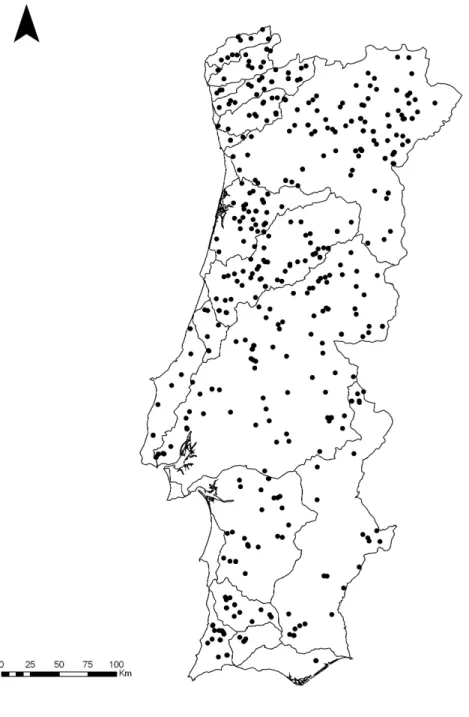
Sampling was carried out during spring between 2004 and 2006 in 155 undisturbed sites in the main Portuguese river basins (Figure 2.2). For the selection of these undisturbed sites, a preliminary pressure screening using GIS and information on pollution loads was followed. The
River basins Region 6 Region 5 Region 4 Region 3 Region 2 Region 1 Morphoclimatic Regions River basins Region 6 Region 5 Region 4 Region 3 Region 2 Region 1 Morphoclimatic Regions
variables assessed at each site (formerly developed within EU-project FAME, 2004; available at http://fame.boku.ac.at): land use, urban area, riparian vegetation, longitudinal connectivity of the river segment, sediment load, hydrological regime, morphological condition, presence of artificial lentic water bodies, toxicological and acidification levels, and nutrient/organic load. Each variable was scored from 1 (minimum disturbance) to 5 (maximum disturbance) (Appendix 1) and only sites with scores 1 and/or 2 and only one variable with a 3 were considered as undisturbed or least disturbed (references) (following CIS-WFD, 2003).
Figure 2.2 Map of the sampled sites in the principal continental Portuguese river basins: 1-Minho, 2-Lima,
3-Cávado, 4-Ave, 5-Douro, 6-Vouga, 7-Mondego, 8-Tagus, 9-West streams, 10-Sado, 11-Guadiana, 12-Mira, 13-Algarve streams.
0 200 km Rivers River basins l Sites 1 2 3 4 5 Douro River 6 7 8 Tag us 9 10 11 Gu ad ian aR iver 12 13 River 0 200 km Rivers River basins l Sites 1 2 3 4 5 Douro River 6 7 8 Tag us 9 10 11 Gu ad ian aR iver 12 13 River
Several physicochemical variables complemented and supported the evaluation of human pressure in each site, after laboratory measurements and analyses according to the Standard Methods for the Examination of Water and Wastewater (Clesceri et al., 1998): biological oxygen demand - BOD5 (mg/L), chemical oxygen demand - COD (mg/L), oxidability (mg/L), total
suspended solids - TSS (mg/L), total dissolved phosphorous – P (mg/L), nitrite - NO2- (mg/L),
nitrate - NO3- (mg/L), ammonium - NH4+ (mg/L) and total dissolved nitrogen - N (mg/L).
Fish were collected by electrofishing according to the WFD compliant sampling protocol (INAG, 2008b), which follows the CEN standards (CEN, 2003). All collected individuals were measured, identified to the species level and immediately returned to the river.
Landscape and regional variables were obtained from digital cartography with free internet access and included latitude, longitude, mineralization level, drainage area of the basin (km2),
distance from source (km), altitude (m), slope (%), mean annual discharge (mm), mean annual air temperature (ºC), mean temperature range, mean annual precipitation (mm) and coefficient of variation of precipitation. Rainfall, temperature and flow variables were described from 30-year data series.
Local variables were assessed during the sampling procedure: water temperature (ºC), conductivity (µS/cm), pH, dissolved oxygen (mg/L), mean stream wetted width (m), maximum and mean water depth (m), mean current velocity (m/s), dominant substrate class (adapted from Wentworth scale (Giller and Malmqvist, 1998): 1-mud and sand; 2-gravel; 3-pebble; 4-cobble; 5-boulders; 6-boulders larger than 50 cm), riparian vegetation (%), shadow (%) and proportion of different habitat types (pool, run, riffle).
Data analysis
Captures were quantified as density (ind./100 m2). Besides taxonomic data, the community
structure was also considered: fish density (number of fish/100 m2), number of species (S),
species diversity (Shannon-Wiener Index – H), relative abundance of potamodromous individuals, habitat guilds (proportion of rheophilic, limnophilic, eurytopic, benthic and water column individuals), trophic guilds (proportion of omnivorous and insectivorous individuals) and reproductive guilds (proportion of lithophilic and phytophilic individuals) (Appendix 2). The species
2004; Cabral et al. 2005; Holzer, 2008; Magalhães et al., 2008) and expert judgement on their life history traits, when necessary.
Hierarchical Cluster Analysis using Euclidean distance and Ward’s method was used to identify groups of sites based on fish composition (density).
Similarity Analysis (ANOSIM) for 1-way layout (Clarke and Warwick, 1994) was performed on fish composition and metrics/guilds to determine if there were significant differences between fish-groups. The test value (R) varies between 1, when samples are completely separated, and 0 if there is no separation on the averages between and among samples. As a rule of thumb, Clarke and Gorley (2001) consider pairs of samples which display an R≥0.75 as being well separated from each other, those with 0.5≤R≤0.75 as overlapping but still clearly different and those with R≤0.5 as barely separable at all.
Reference sites include undisturbed (all human pressure variables scored with 1 and/or 2) and least disturbed sites (one human pressure variable scored with 3 and the remaining ones with 1 and/or 2), when these were the only available ones for sampling. As such, Similarity Analysis (ANOSIM) was also performed on fish assemblages composition (density) between undisturbed and least disturbed sites in order to understand if the influence of some anthropogenic pressure (score 3 in one of the variables) in least disturbed sites could result in significant differences in the occurrence of some species, thus hampering the consistency of the reference sites.
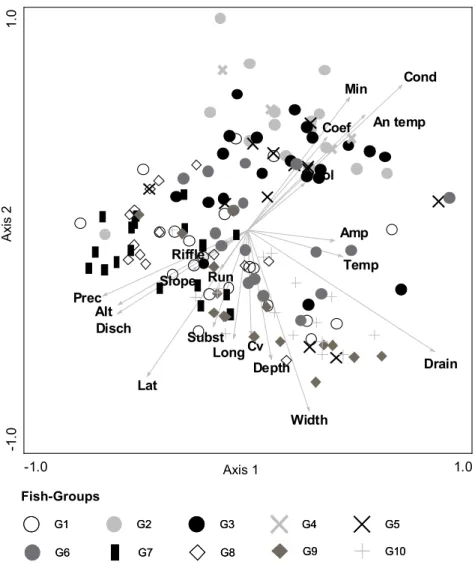
Environmental drivers of fish-groups were explored with Principal Components Analysis (PCA), based on large, regional and local scale variables of sampling sites. Most intercorrelated variables (Spearman's rank correlations |r| >0.8; P < 0.05) were excluded.
Indicator Species Analysis (Dufréne and Legendre, 1977) allowed recognizing species that identified each group.
For statistical analysis data were transformed to improve normality: percentages were arcsin [sqrt(x)] and linear measurements were log (x+1) (Legendre and Legendre, 1998). Species with very low frequency of occurrence (smaller than 0.02) were excluded from the analysis.
Data analysis was performed with statistical programs Pc-ord 4, Primer 6 and Canoco 4.5. For geographical delimitation of fish-groups/regions the image processing program Gimp 2.6 was used.
Results
Fish-based geographical groups
A total of 32 fish species from 10 families were captured, including freshwater and 2 diadromous species. Although 7 non-native species were captured, freshwater native species (N = 23) represented 72% of the total sampled species and 98% of the fish density in the captures.
No fish was captured in 13% of the sampling sites. These sites were mainly located in small drainage areas (smaller than 30 km2), in upstream reaches (mean water depth lower than 0.2 m)
with low mineralization level. Northern river basins represented 44% of fishless sites (Minho, Lima, Cávado and Douro river basins).
Hierarchical Cluster Analysis performed on fish species composition allowed identifying 10 fish-groups (Figure 2.3), further characterized concerning fish metrics and guilds (Table 2.1).
Group 1 included streams from the Littoral, both in the Centre and North regions with a clear dominance of Achondrostoma oligolepis. The most representative guilds were omnivorous, limnophilic and phytophilic individuals. Nevertheless, salmonids also presented some expression, accounted for the significant presence of Salmo trutta, comparatively to other groups, making this group a mixed cyprinid-salmonid one. This group presented high fish density (mean = 37.7ind/100 m2, SD = 43.5), species richness (mean S = 5.2; SD = 2.3) and diversity (mean H =
1.1; SD = 0.5) per site.
Groups 2, 3, 4, 5 and 6 belonged to the South region of Portugal. Group 2 included the southern Littoral river basins from Algarve region. The dominant species were Squalius aradensis and Anguilla anguilla. Group 3 was mostly represented by streams from Guadiana river basin. The dominant species were Squalius alburnoides and the endemic barbels from Guadiana basin, especially Barbus microcephalus. Group 4 was represented by streams from Mira river basin. Fish assemblages were dominated by Squalius torgalensis, endemic from this basin. Group 5 was represented by fish assemblages common to Guadiana, Sado and Tagus river basins. Squalius alburnoides was the most representative and abundant species, followed by Squalius pyrenaicus. Group 6 was mostly represented by streams from Tagus river basin, therefore located in a transitional region between the North and the South of Portugal. Fish assemblages were dominated by Barbus bocagei, Pseudochondrostoma polylepis and Squalius pyrenaicus.
Figure 2.3 Cluster of the sampled sites based on fish species densities identifying 10 fish-groups and 4
fish-regions.
Overall, compared to the other fish-groups, southern ones showed high abundance of Squalius spp., followed by barbel species. Fish assemblages were dominated for eurytopic, water column, lithophilic and insectivorous individuals. Most of these groups showed high fish density, including the group with the highest values of total density (mean = 73.7 ind/100 m2; SD = 97.2) and total
captured species (N=18). Nevertheless, mean species richness and mean diversity were high only in groups 3, 5 and 6.
1 0 5 _ 1 0 1 1 4 _ 1 0 1 2 0 _ 1 0 1 0 6 _ 1 0 1 1 2 _ 1 0 1 1 0 _ 1 0 1 1 1 _ 1 0 1 0 7 _ 1 0 1 0 8 _ 1 0 1 0 0 _ 1 0 1 1 7 _ 1 0 1 0 2 _ 1 0 1 0 3 _ 1 0 1 1 3 _ 1 0 1 2 10 7 9 8 6 3 4 5
Distance (Objective Function) Information Remaining (%)
0 3.2E+01 6.4E+01 9.6E+01 1.3E+02
100 75 50 25 0
Littor al Ce ntre/ Nor th stre ams:
Lima, Mondego, Vouga river basins
Littor al South stre ams: Oeste, Algarve basins
Mountain North streams
Nor th stre ams: sma ll basins South stre ams: Tagus, Guadiana river basin
South stre ams: Tagus river basin South stre ams: Tagus, Sado, Guadiana rive r basins South stre ams: Mira rive r basin
Nor th stre ams: med iu m-large basins
Nor the ast streams: A lto Douro, med iu m-large basins
A B C D 1 0 5 _ 1 0 1 1 4 _ 1 0 1 2 0 _ 1 0 1 0 6 _ 1 0 1 1 2 _ 1 0 1 1 0 _ 1 0 1 1 1 _ 1 0 1 0 7 _ 1 0 1 0 8 _ 1 0 1 0 0 _ 1 0 1 1 7 _ 1 0 1 0 2 _ 1 0 1 0 3 _ 1 0 1 1 3 _ 1 0 1 2 10 7 9 8 6 3 4 5
Distance (Objective Function) Information Remaining (%)
0 3.2E+01 6.4E+01 9.6E+01 1.3E+02
100 75 50 25 0
Distance (Objective Function) Information Remaining (%)
0 3.2E+01 6.4E+01 9.6E+01 1.3E+02
0 3.2E+01 6.4E+01 9.6E+01 1.3E+02
100 75 50 25 0
100 75 50 25 0
Littor al Ce ntre/ Nor th stre ams:
Lima, Mondego, Vouga river basins
Littor al South stre ams: Oeste, Algarve basins
Mountain North streams
Nor th stre ams: sma ll basins South stre ams: Tagus, Guadiana river basin
South stre ams: Tagus river basin South stre ams: Tagus, Sado, Guadiana rive r basins South stre ams: Mira rive r basin
Nor th stre ams: med iu m-large basins
Nor the ast streams: A lto Douro, med iu m-large basins
A
B
C
T ab le 2 .1 C ha ra cte riz ati on o f th e t en fis h-gr ou ps b as ed o n m etr ic s a nd g uil ds (m ea n + S D ) T ab le 2 .1 C ha ra cte riz ati on o f th e t en fis h-gr ou ps b as ed o n m etr ic s a nd g uil ds (m ea n + S D )