arXiv:1603.08791v2 [hep-ex] 23 Jun 2016
EUROPEAN ORGANISATION FOR NUCLEAR RESEARCH (CERN)
Submitted to: Phys. Lett. B CERN-EP-2016-066
24th June 2016
Search for resonances in the mass distribution of jet pairs with one
or two jets identified as b-jets in proton–proton collisions at
√ s = 13 TeV with the ATLAS detector
The ATLAS Collaboration
Abstract
Searches for high-mass resonances in the dijet invariant mass spectrum with one or two jets identified as b-jets are performed using an integrated luminosity of 3.2 fb−1of proton–proton collisions with a centre-of-mass energy of √s = 13 TeV recorded by the ATLAS detector at
the Large Hadron Collider. No evidence of anomalous phenomena is observed in the data, which are used to exclude, at 95% credibility level, excited b∗ quarks with masses from 1.1 TeV to 2.1 TeV and leptophobic Z′bosons with masses from 1.1 TeV to 1.5 TeV. Contri-butions of a Gaussian signal shape with effective cross sections ranging from approximately 0.4 to 0.001 pb are also excluded in the mass range 1.5–5.0 TeV.
c
2016 CERN for the benefit of the ATLAS Collaboration.
1 Introduction
Many extensions to the Standard Model (SM) predict the existence of new massive particles that couple to quarks or gluons. If produced in proton–proton (pp) collisions at the Large Hadron Collider (LHC), these new beyond-the-SM (BSM) particles could decay into quarks (q) or gluons (g), creating resonant excesses in the two-jet (dijet) invariant mass distributions [1–6]. If the new particle couples to the b-quark and decays into b¯b, bq or bg pairs, a dedicated search for dijet resonances with one or both jets identified as originating from a b-quark (“b-jet”) could greatly increase the signal sensitivity.
Prior resonance searches in dijet events containing b-jets were performed by the CDF [7] and CMS [8,
9] experiments, probing the mass ranges 200–750 GeV and 1–4 TeV respectively. Excited heavy-flavour quarks have been investigated in alternative decay modes as well [10]. No BSM phenomena have been observed yet. The increase in centre-of-mass energy of the pp collisions at the LHC from √s = 7 and
8 TeV to 13 TeV provides a new energy regime in which to search for such a heavy resonance. This is particularly true for heavy states coupling to b-quarks from the proton sea, when compared to states produced by valence quarks. The parton luminosity to create a 2 TeV object increases by an additional factor of 2–3 for b¯b and bg over q ¯q and qg pairs, when increasing the centre-of-mass energy from 8 TeV to 13 TeV. The total production rate for dijet BSM signals can become large enough to allow a good signal sensitivity even with a relatively small data sample. In this paper the search for a new narrow resonance decaying to b-quarks with the ATLAS detector, using 3.2 fb−1 integrated luminosity of proton–proton collisions at √s = 13 TeV, is reported. The mass range 1.1–5.0 TeV is probed.
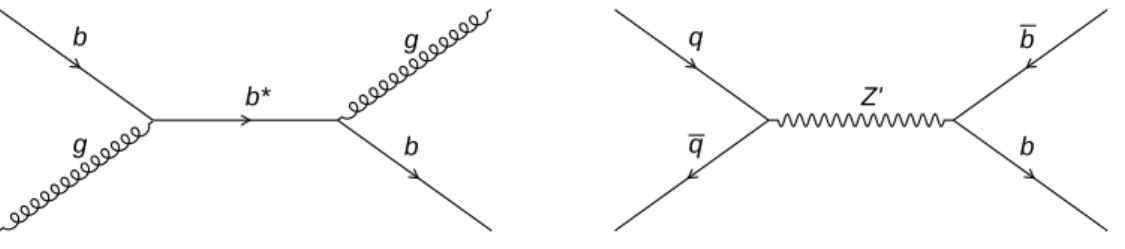
b g b g b* q q b b Z'
Figure 1: Leading-order Feynman diagrams for the two processes considered: gb → b∗→ bg and q ¯q → Z′→ b¯b.
The results are interpreted in the context of two benchmark processes shown in Figure1: an excited heavy-flavour quark b∗and a new gauge boson Z′. Excited quarks are a consequence of quark compos-iteness models that were proposed to explain the generational structure and mass hierarchy of quarks [11,
12]. The Z′ boson arises in many extensions to the SM with an additional U(1) group. Two Z′ mod-els are considered, one with SM-like fermion couplings in the Sequential Standard Model (SSM) and a leptophobic Z′model [13,14]. All benchmark model decays are expected to result in a narrow resonance superimposed on a smoothly falling dijet invariant mass distribution. This search divides the events into samples with one or two jets identified as b-jets to enhance the signal sensitivity to the benchmark models
b∗→ bg and Z′ → b¯b. In addition, the results are interpreted in the context of possible Gaussian-shaped
signal contributions to the dijet invariant mass spectra where one or both jets are identified as b-jets. The results, presented in terms of the the cross section times acceptance times branching ratio (σ × A × BR), are quoted for contributions with widths of up to 15% of the resonance mass.
2 The ATLAS detector
The ATLAS experiment [15] at the LHC is a multi-purpose particle detector with a forward-backward symmetric cylindrical geometry and a near 4π coverage in solid angle.1 It consists of an inner tracking detector surrounded by a thin superconducting solenoid providing a 2 T axial magnetic field, electro-magnetic and hadronic calorimeters, and a muon spectrometer. The inner tracking detector covers the pseudorapidity range |η| < 2.5. It consists of, in ascending order of radius from the beam-line, silicon pixel, silicon microstrip, and transition radiation tracking detectors. The pixel detectors are crucial for b-jet identification. For the second LHC data-taking period, a new inner pixel layer, the Insertable B-Layer (IBL) [16,17], was added at a mean sensor radius of 3.2 cm from the beam-line. Lead/liquid-argon (LAr) sampling calorimeters provide electromagnetic (EM) energy measurements with high granularity. A had-ron (steel/scintillator-tile) calorimeter covers the central pseudorapidity range (|η| < 1.7). The end-cap and forward regions are instrumented with LAr calorimeters for EM and hadronic energy measurements up to |η| = 4.9. The first-level trigger is implemented in hardware and uses a subset of the detector in-formation to reduce the input rate from the nominal LHC collision rate to an acceptance rate of 100 kHz. This is followed by a software-based trigger that reduces the rate of events recorded to 1 kHz.
3 Data and simulated event samples
The data used in this analysis were collected by the ATLAS detector in pp collisions at the LHC with a centre-of-mass energy of 13 TeV during 2015. Events were recorded using a jet-based trigger requiring at least one jet with a transverse momentum pT of at least 360 GeV. The full dataset corresponds to an
integrated luminosity of 3.2 fb−1with an associated uncertainty of 5% after applying quality criteria to the data. The measurement of the integrated luminosity is derived, following a methodology similar to that detailed in Ref. [18], from a calibration of the luminosity scale using a pair of x–y beam-separation scans.
Monte Carlo (MC) simulated event samples are used to model the expected signals and study the com-position of SM background processes. The QCD dijet process is simulated with Pythia8 [19] using the A14 tuned parameter set [20] for the modelling of the parton shower, hadronization and underlying event. The leading-order (LO) parton distribution function (PDF) set NNPDF2.3 [21] is used for the generation of events. The renormalization and factorization scales are set to the average transverse momentum pTof
the two leading jets. The EvtGen decay package [22] is used for bottom and charm hadron decays. The three signal samples are generated with Pythia8 using the A14 set of tuned parameters and the
NNPDF2.3 PDF set. For the b∗ model, the compositeness scale is set to the excited-quark mass and
85% of decays are to bg. The remaining decay modes are to a SM gauge boson (Z boson, W boson or photon) and a b-quark. In the SSM Z′ model, the Z′ boson has the same couplings to SM fermions as
the SM Z boson and the bottom quark decay branching ratio BR(Z′ → b¯b) is 13.8%. The leptophobic
Z′model differs by having vanishing couplings to leptons. The corresponding value of BR(Z′ → b¯b) is
1 ATLAS uses a right-handed coordinate system with its origin at the nominal interaction point (IP) in the centre of the detector and the z-axis along the beam pipe. The x-axis points from the IP to the centre of the LHC ring, and the y-axis points upwards. Cylindrical coordinates (r, φ) are used in the transverse plane, φ being the azimuthal angle around the z-axis. The pseudorapidity is defined in terms of the polar angle θ as η = − ln tan(θ/2). Angular distance is measured in units of
18.9%. For both, only decays to b-quark pairs are simulated. The intrinsic decay width is Γ ∼ 0.6% of the resonance mass for the b∗model and Γ ∼ 3% of the mass for the SSM Z′boson.
The generated samples are processed with the ATLAS detector simulation [23], which is based on the GEANT4 package [24]. To account for additional pp interactions from the same or close-by bunch
cross-ings, a number of minimum-bias interactions generated using Pythia8 and the MSTW2008LO PDF [25]
set are superimposed onto the hard scattering events. The MC samples are re-weighted to match the collisions per bunch crossing observed in the data.
4 Event reconstruction and selection
Jets are reconstructed from noise-suppressed topological clusters [26] of energy deposited in the calor-imeters using the anti-kt algorithm [27] with a radius parameter of 0.4. Jet energies and directions are
corrected by the jet calibrations derived from √s = 13 TeV simulation, and pp collision data taken at
√
s = 8 TeV and √s = 13 TeV, as described in Ref. [28]. Jets are required to have pT >50 GeV. Events
where any of the three leading jets with pT > 50 GeV is compatible with non-collision background or
calorimeter noise are removed. Events are preselected in the same way as in the dijet analysis of Ref. [5], requiring that the pT of the leading jet is greater than 440 GeV to ensure full trigger efficiency. An
ad-ditional requirement is placed on the jet pseudorapidity, |η| < 2.4, to ensure tracker coverage for b-jet identification. The analysis is performed in an unbiased dijet mass range of mjj > 1.1 TeV. To reduce
the background from QCD multijet processes and enhance s-channel processes, the rapidity difference
y∗= (y1− y2)/2 between the two leading jets is required to be |y∗| < 0.6. Here y1and y2are the rapidities
of the leading and sub-leading jet respectively.
To identify jets originating from b-hadrons (b-tagging) a multivariate algorithm that combines information about the impact parameters of inner detector tracks associated with the jet, the presence of displaced secondary vertices, and the reconstructed flight paths of b- and c-hadrons associated with the jet [29,30] is employed. The b-tagging working point with 85% efficiency, as determined when integrating over all jets in a simulated sample of t¯t events, is chosen because it gives the highest signal sensitivity. As the average jet energies in this analysis are larger than in t¯t events and the b-tagging efficiency drops with jet
pT, the per-jet efficiencies are below 85% and are roughly 50% for jets with a pTof 1 TeV.
The b-jet identification algorithm is applied to the two leading jets, and events are categorized as inclusive, single b-tagged “1b” or double b-tagged “2b”, in order to enhance the sensitivity of different signal compositions. The “1b” category is defined inclusively, including events from the “2b” category.
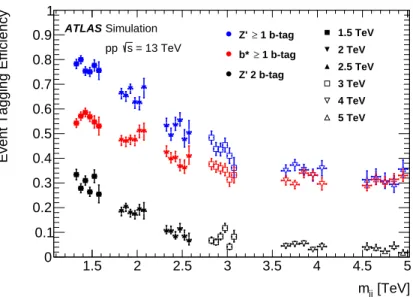
The per-event b-tagging efficiencies as functions of the reconstructed invariant mass are shown in Fig-ure2. Efficiencies are for benchmark models with different b∗and Z′ resonance masses, after the event selection is applied. The tagging efficiency for Z′events in the inclusive “1b” category is higher than for
b∗events because this process has more b-quarks in the final state. At high mass, the gluon from the decay of the b∗has a higher probability to produce a b¯b-pair, which causes the event tagging efficiency to be comparable for the Z′and b∗. The tagging efficiency in the “2b” category is about 2.5 times lower at low mass and a factor 10 lower at high mass compared to the inclusive “1b” category for the same Z′events.
The average light-flavour jet rejection factor for jets passing the kinematic selection is approximately 30 for jet transverse momenta up to ∼ 1 TeV.
Correction factors are applied to the simulated event samples to compensate for differences between data and simulation in b-tagging efficiencies and mis-identification rates. These corrections were derived from
[TeV]
jj
m
1.5 2 2.5 3 3.5 4 4.5 5
Event Tagging Efficiency
0 0.1 0.2 0.3 0.4 0.5 0.6 0.7 0.8 0.9 1 1 b-tag ≥ Z' 1 b-tag ≥ b* Z' 2 b-tag 1.5 TeV 2 TeV 2.5 TeV 3 TeV 4 TeV 5 TeV ATLAS Simulation = 13 TeV s pp
Figure 2: The per-event b-tagging efficiencies after the event selection as a function of the reconstructed invariant mass for simulated samples with six different b∗and Z′resonance masses.
comparisons of samples of b-quark-enriched events in data and simulation [31]. The average combined signal acceptance and efficiency is around 20% for the b∗benchmark in the “1b” category and drops with increasing mass from 9% at 1.5 TeV to 2% at 5.0 TeV for the Z′signals for the “2b” category.
5 Dijet mass spectrum
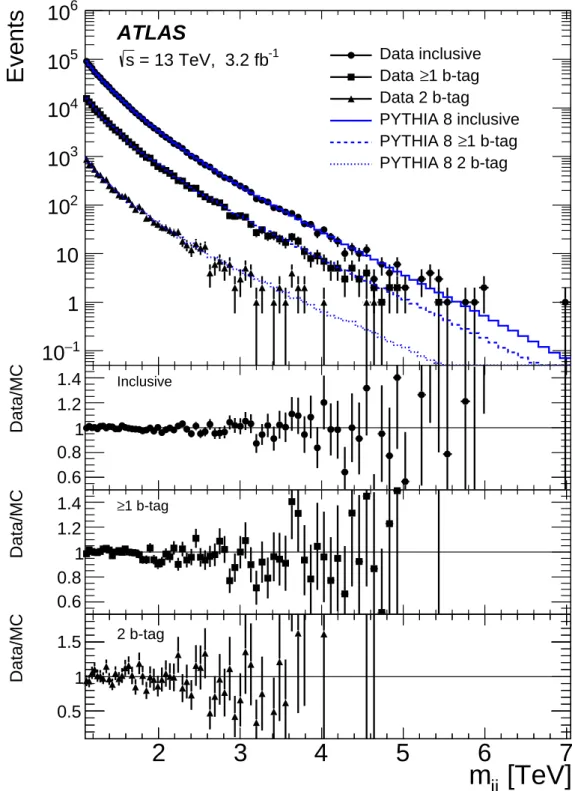
The dijet mass spectrum is predominantly composed of jets arising from QCD interactions. Figure3
shows the comparison between data and Pythia8 multijet MC simulation. The simulated distributions are normalized to the number of events observed in the data in each category separately. The bin widths are chosen to approximate the mjj resolution as derived from simulated QCD processes, which range from
3% at 1.0 TeV to 2% at 5.0 TeV. Good agreement between the shapes of the Pythia8 multijet predictions and the data is found. The inclusive distribution, not restricted in the inner tracking detector acceptance, was analysed in Ref. [5].
The dijet background estimation does not rely on the simulation as it is obtained directly from a fit to the
mjjdistribution. The following parameterization ansatz is adopted to fit the distribution in the mjjrange
from 1.1 TeV up to the last data point of the inclusive, “1b” and “2b” mass distributions separately,
f (z) = p1(1 − z)p2zp3, (1)
where piare free parameters and z = mjj/√s. This ansatz was used in previous searches [5] and is found
to provide a satisfactory fit to leading-order Pythia8 multijet MC simulation at √s = 13 TeV. Employing
Wilks’ theorem [32], a log-likelihood statistic is used to confirm that no additional parameters are needed to model these distributions for a data set as large as the one used for this analysis.
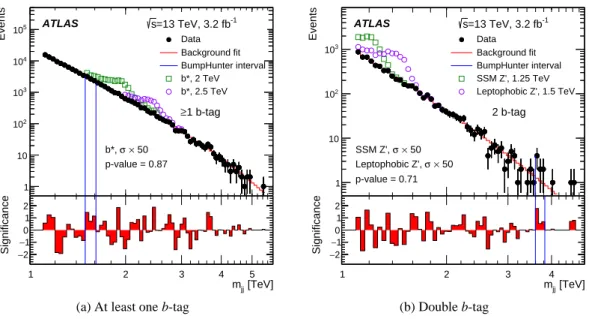
The results of the fits are shown in Figure 4. The fits of this ansatz to the data without considering systematic uncertainties return p-values of 0.73, 0.90 and 0.66 for the inclusive, “1b” and “2b” categories
2000 3000 4000 5000 6000 7000
Events
1 −10
1
10
210
310
410
510
610
-1 = 13 TeV, 3.2 fb sATLAS
Data inclusive 1 b-tag ≥ Data Data 2 b-tag PYTHIA 8 inclusive 1 b-tag ≥ PYTHIA 8 PYTHIA 8 2 b-tag Data/MC 0.6 0.8 1 1.2 1.4 Inclusive Data/MC 0.6 0.8 1 1.2 1.4 ≥1 b-tag[TeV]
jj
m
2
3
4
5
6
7
Data/MC 0.5 1 1.5 2 b-tagFigure 3: The invariant mass distribution of the inclusive dijet (dots), “1b” (squares) and “2b” (triangles) categories in data. The inclusive distribution is similar to Ref. [5], but an additional requirement is placed on the jet pseu-dorapidity, |η| < 2.4. The MC distributions are normalized to the data in the three categories separately: a solid line for inclusive dijets, a dashed line for “1b” and a small dashed line for “2b” categories. The lower panels show the ratio between data and MC simulation for all three categories.
Events 1 10 2 10 3 10 4 10 5 10 [TeV] jj m Significance −−21 0 1 2 1 2 3 4 5 ATLAS s=13 TeV, 3.2 fb-1 Data Background fit BumpHunter interval b*, 2 TeV b*, 2.5 TeV 1 b-tag ≥ 50 × σ b*, p-value = 0.87
(a) At least one b-tag
Events 1 10 2 10 3 10 [TeV] jj m Significance −−21 0 1 2 1 2 3 4 ATLAS s=13 TeV, 3.2 fb-1 Data Background fit BumpHunter interval SSM Z', 1.25 TeV Leptophobic Z', 1.5 TeV 2 b-tag 50 × σ SSM Z', 50 × σ Leptophobic Z', p-value = 0.71 (b) Double b-tag
Figure 4: Dijet mass spectra overlaid with the fits to the background function together with the results from BumpHunter and benchmark signals scaled by a factor of 50. The most discrepant region is indicated by the two blue lines. The lower panels show the significances per bin of the data with respect to the background fit, in terms of the number of standard deviations, considering only the statistical fluctuations. The distributions are shown for the (a) “1b” and (b) “2b” categories.
respectively. The p-value was calculated as a goodness-of-fit measure using a χ2test statistic determined from pseudo-experiments.
The lower panels of Figure4show the significances of bin-by-bin differences between the data and the fit. These equivalent Gaussian significances are calculated from the Poisson probability, considering only statistical uncertainties.
The statistical significance of any localized excess in the dijet mass distribution is quantified using the BumpHunter algorithm [33]. The algorithm compares the binned mjjdistribution of the data to the fitted
background estimate, considering contiguous mass intervals in all possible locations, from a width of two bins to one-half of the distribution. For each interval in the scan, it computes the significance of any excess found. The algorithm identifies the intervals 1493–1614 GeV in the “1b” and 3596–3827 GeV in the “2b” sample, indicated by the two vertical lines in Figure4, as the most discrepant intervals. The statistical significance of these outcomes is evaluated using the ensemble of Poisson outcomes across all intervals scanned, by applying the algorithm to many pseudo-data samples drawn randomly from the background fit. Without including systematic uncertainties, the probability that fluctuations of the background model would produce excesses at least as significant as those observed in the data, anywhere in the distribution, is greater than 60% in the “1b” and “2b” categories. Thus, there is no evidence of localized contributions to the mass distribution from BSM phenomena.
6 Systematic uncertainties
Uncertainties in the parameters of the fitted background function Eq. (1) are evaluated by fitting the an-satz to pseudo-data drawn via Poisson fluctuations around the fitted background model. The uncertainty in the prediction in each mjj bin is taken to be the root mean square of the function value for 10000
generated pseudo-experiments. To estimate an uncertainty due to the choice of background parameter-ization, one additional degree of freedom, zp4log(z), is appended as a multiplicative factor to the nominal ansatz (Eq. (1)), and the difference between the estimated parameters from the two fits is taken as an uncertainty.
The uncertainty in the jet energy scale is estimated using various methods in 8 TeV data, corrected to the new centre-of-mass energy by taking the difference between the 8 TeV and 13 TeV runs into account using MC simulation [28]. The jet energy scale uncertainty used in this analysis relies on a set of three nuisance parameters [34]. For untagged jets it is within the range 1–5% for jet transverse momenta greater than 200 GeV.
The relative additional uncertainty in the energy scale of b-tagged jets is estimated using the MC samples and verified with data following the method described in Ref. [35]. The ratio rtrk of the sum of track
transverse momenta inside the jet to the total jet transverse momentum measured in the calorimeter is used for this estimate. The double ratio of rtrk from data and simulation is formed and compared for
inclusive jets and b-jets. The estimated relative additional uncertainty for jets with 200 < pT < 800 GeV
is found to be less than 2.6%, and this value is subsequently used in the higher pTregions. This relative
uncertainty is applied in addition to the nominal jet energy scale uncertainty. The maximum uncertainty for b-tagged jets is estimated to be 6% and is conservatively applied to all pTregions.
The uncertainty in the jet energy resolution is estimated using the same method as the untagged jet energy scale uncertainty and relies on an additional Gaussian smearing of the reconstructed jet energies in MC simulation. For jets with pT >50 GeV, the uncertainty is less than 2%.
The uncertainty introduced by the application of the b-tagging algorithm is the largest systematic un-certainty in the analysis. The unun-certainty in the measured tagging efficiency of b-jets is estimated by studying t¯t events in 13 TeV data for jet pTup to 200 GeV [31]. The uncertainties in the measured rate
of mistagging c-jets and light-flavour jets are estimated in 8 TeV data. The uncertainties are extrapolated to 13 TeV, taking into account the addition of the new IBL system as well as reconstruction and tagging improvements. An additional term is included to extrapolate the measured uncertainties to the high-pT
re-gion of interest. This term is calculated from simulated events by considering variations on the quantities affecting the b-tagging performance such as the impact parameter resolution, percentage of poorly meas-ured tracks, description of the detector material, and track multiplicity per jet. The dominant effect on the uncertainty when extrapolating at high-pTis related to the different tagging efficiency when smearing the
tracks impact parameters based on the resolution measured in data and simulation. The difference in the impact parameter resolution is due to effects from alignment, dead modules and additional material not properly modelled in the simulation. The impact of the b-tagging efficiency uncertainty increases with jet
1
1.5
2
2.5
3
3.5
4
4.5
5
5.5
3 −10
2 −10
1 −10
1
10
1
1.5
2
2.5
3
3.5
4
4.5
5
5.5
3 −10
2 −10
1 −10
1
10
[TeV]
b*m
1
1.5
2
2.5
3
3.5
4
4.5
5
5.5
BR [pb]
×
A
×
σ
3 −10
2 −10
1 −10
1
10
b* model Observed 95% CL Expected 95% CL σ 1 ± σ 2 ±1 b-tag
≥
-1 =13 TeV, 3.2 fb sATLAS
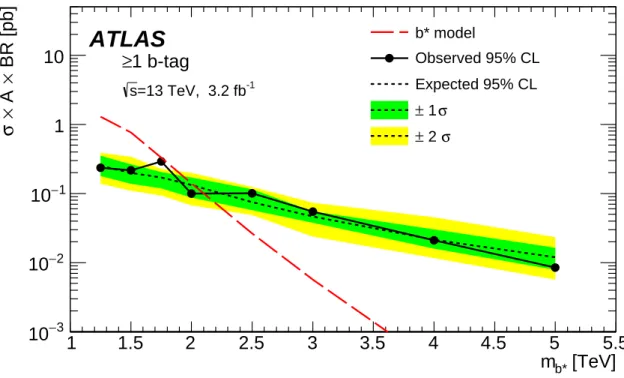
Figure 5: Observed (filled circles) and expected (dotted line) 95% credibility-level upper limits on the cross section σtimes acceptance A times branching ratio BR, including kinematic acceptance and b-tagging efficiencies, for the
b∗model. The dashed line shows the cross section calculated from theory. The plot shows the case with a single
b-tag.
7 Results
Due to the absence of a signal, 95% credibility-level upper limits are set on the cross section for new processes that would produce a contribution to the dijet mass distribution with b-tagging. The signal shapes are taken as provided by b∗→ bg and Z′→ b¯b production processes.
The limits on b∗ and Z′ cross sections are shown in Figures5 and 6. The limits were obtained using a Bayesian method [36]. The Bayesian credible intervals were calculated using a posterior probability density from the likelihood function for the observed mass spectrum obtained by a fit to the background (Eq. (1)), while the signal shape was derived from MC simulations. The limit is interpolated between discrete values of the mass to create a continuous curve. The systematic uncertainties associated with the uncertainty in the integrated luminosity, jet energy scale, jet energy resolution, b-tagging and alternative fit functions are all included in the limit-setting.
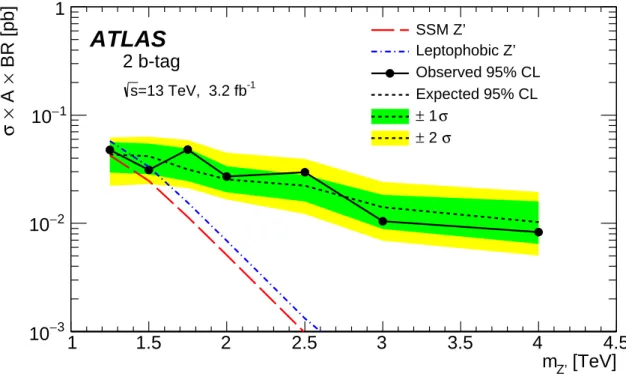
Figure5shows that the b∗model, with the decay to g + b(¯b), is excluded for b∗masses from 1.1 TeV up to 2.1 TeV at leading-order in QCD. Figure6shows that the leptophobic Z′ → b¯b model with SM-like
couplings to quarks is excluded up to 1.5 TeV at leading-order in QCD. The present data are not sufficient to provide an exclusion limit for the SSM Z′model.
As shown in Figure7, narrow resonance contributions of various widths with visible cross sections σ × A × BR ranging from approximately 0.4 to 0.001 pb are excluded in the mass range 1.5–5.0 TeV. These
1
1.5
2
2.5
3
3.5
4
4.5
3 −10
2 −10
1 −10
1
[TeV]
Z’m
1
1.5
2
2.5
3
3.5
4
4.5
BR [pb]
×
A
×
σ
3 −10
2 −10
1 −10
1
SSM Z’ Leptophobic Z’ Observed 95% CL Expected 95% CL σ 1 ± σ 2 ±2 b-tag
-1 =13 TeV, 3.2 fb sATLAS
Figure 6: Observed (filled circles) and expected (dotted line) 95% credibility-level upper limits on the cross section σtimes the acceptance A times branching ratio BR, including kinematic acceptance and b-tagging efficiencies, for the Z′→ b¯b models. The dashed lines show the cross section calculated from theory. The plot shows the case with double b-tag.
limits should be used when long low-mass off-shell tails from PDFs and non-perturbative effects on the narrow resonance signal shape can be safely truncated or neglected and, after applying the selection described in Section4, the reconstructed mass distribution approximates a Gaussian distribution. For a detailed description of how to use these limits, see the instructions in Ref. [37]. To estimate the b-tagging efficiency, invariant-mass-dependent correction factors as given in Figure2can be used.
8 Summary
A search for new resonances decaying to jets with a single or double b-tag in pp collisions with the ATLAS detector at the LHC is presented. The dataset corresponds to an integrated luminosity of 3.2 fb−1collected at √s = 13 TeV in 2015. The studies use the dijet invariant mass mjjin the range of 1.1–
5.0 TeV with b-tagging applied to the leading and sub-leading jets and categorize the events according to their b-jet multiplicity.
The background from jets initiated by b-quarks is well described by the leading-order parton-shower models. The dijet background is also well described by the analytic fit function with three parameters which is used in the light-flavour dijet analysis [5].
No evidence of a significant excess of events is found compared to the expectations of the Standard Model. The largest observed local excess is less than 2σ for both the single and double b-tag channels.
[TeV]
Xm
1
2
3
4
5
BR [pb]
×
A
×
σ
3 −10
2 −10
1 −10
1
ATLAS
-1 =13 TeV, 3.2 fb s 1 b-jet ≥ = 0.15 X /m X σ = 0.10 X /m X σ = 0.07 X /m X σ = Res. X /m X σ(a) At least one b-tag
[TeV]
Xm
1
2
3
4
5
BR [pb]
×
A
×
σ
3 −10
2 −10
1 −10
1
ATLAS
-1 =13 TeV, 3.2 fb s 2 b-jet = 0.15 X /m X σ = 0.10 X /m X σ = 0.07 X /m X σ = Res. X /m X σ (b) Double b-tagFigure 7: The 95% credibility-level upper limits on the cross section σ times the acceptance A times branching ratio BR, including kinematic acceptance and b-tagging efficiencies, for resonances exhibiting a generic Gaussian shape. The circles, squares and triangles correspond to the cases where the width of the Gaussian signal is 15%, 10% or 7% of the signal mass. The figure also shows as a red line the case where the width is given by the dijet mass resolution, which is as low as 2% at 5.0 TeV. The plots show the limits obtained, applying (a) at least one
The expected contribution from the b∗model is excluded in the mass range 1.1–2.1 TeV at leading-order in QCD using the single b-jet channel. The results can not exclude contributions from the SSM Z′ → b¯b model in the mass range 1.1–5.0 TeV in the double b-jet channel. For the leptophobic Z′ model with SM-like couplings to quarks, the mass range 1.1–1.5 TeV is excluded at leading-order in QCD in this channel.
This analysis excludes generic high-mass particles decaying to two jets, where one or two jets originate from b-quarks, with visible cross sections ranging from 0.4 to 0.001 pb in the mass range 1.1–5.0 TeV. The exclusion limits are applicable for resonances exhibiting a Gaussian shape and width similar to the
b∗or Z′models. The limits were calculated assuming that the width of the Gaussian signal is 15%, 10% or 7% of its mass.
Acknowledgements
We thank CERN for the very successful operation of the LHC, as well as the support staff from our institutions without whom ATLAS could not be operated efficiently.
We acknowledge the support of ANPCyT, Argentina; YerPhI, Armenia; ARC, Australia; BMWFW and FWF, Austria; ANAS, Azerbaijan; SSTC, Belarus; CNPq and FAPESP, Brazil; NSERC, NRC and CFI, Canada; CERN; CONICYT, Chile; CAS, MOST and NSFC, China; COLCIENCIAS, Colombia; MSMT CR, MPO CR and VSC CR, Czech Republic; DNRF and DNSRC, Denmark; IN2P3-CNRS, CEA-DSM/IRFU, France; GNSF, Georgia; BMBF, HGF, and MPG, Germany; GSRT, Greece; RGC, Hong Kong SAR, China; ISF, I-CORE and Benoziyo Center, Israel; INFN, Italy; MEXT and JSPS, Japan; CNRST, Morocco; FOM and NWO, Netherlands; RCN, Norway; MNiSW and NCN, Poland; FCT, Por-tugal; MNE/IFA, Romania; MES of Russia and NRC KI, Russian Federation; JINR; MESTD, Serbia; MSSR, Slovakia; ARRS and MIZŠ, Slovenia; DST/NRF, South Africa; MINECO, Spain; SRC and Wallenberg Foundation, Sweden; SERI, SNSF and Cantons of Bern and Geneva, Switzerland; MOST, Taiwan; TAEK, Turkey; STFC, United Kingdom; DOE and NSF, United States of America. In addition, individual groups and members have received support from BCKDF, the Canada Council, CANARIE, CRC, Compute Canada, FQRNT, and the Ontario Innovation Trust, Canada; EPLANET, ERC, FP7, Ho-rizon 2020 and Marie Skłodowska-Curie Actions, European Union; Investissements d’Avenir Labex and Idex, ANR, Région Auvergne and Fondation Partager le Savoir, France; DFG and AvH Foundation, Ger-many; Herakleitos, Thales and Aristeia programmes co-financed by EU-ESF and the Greek NSRF; BSF, GIF and Minerva, Israel; BRF, Norway; the Royal Society and Leverhulme Trust, United Kingdom. The crucial computing support from all WLCG partners is acknowledged gratefully, in particular from CERN and the ATLAS Tier-1 facilities at TRIUMF (Canada), NDGF (Denmark, Norway, Sweden), CC-IN2P3 (France), KIT/GridKA (Germany), INFN-CNAF (Italy), NL-T1 (Netherlands), PIC (Spain), ASGC (Taiwan), RAL (UK) and BNL (USA) and in the Tier-2 facilities worldwide.
References
[1] R. M. Harris and K. Kousouris, Searches for dijet resonances at hadron colliders,
Int. J. Mod. Phys. A 26 (2011) 5005–5055, arXiv:1110.5302 [hep-ex]. [2] UA1 Collaboration, C. Albajar et. al.,
Two–jet mass distributions at the CERN proton–antiproton Collider, Phys. Lett. B 209 (1988) 127–134.
[3] UA2 Collaboration, P. Bagnaia et al.,
Measurement of jet production properties at the CERN p ¯p Collider, Phys. Lett. B 144 (1984) 283–290.
[4] CDF Collaboration, T. Aaltonen et al.,
Search for new particles decaying into dijets in proton-antiproton collisions at √s = 1.96 TeV, Phys. Rev. D 79 (2009) 112002, arXiv:0812.4036 [hep-ex].
[5] ATLAS Collaboration, Search for new phenomena in dijet mass and angular distributions from
pp collisions at √s = 13 TeV with the ATLAS detector,Phys. Lett. B 754 (2016) 302–322,
arXiv:1512.01530 [hep-ex].
[6] CMS Collaboration,
Search for narrow resonances decaying to dijets in proton–proton collisions at √s = 13 TeV, Phys. Rev. Lett. 116 (2016) 071801, arXiv:1512.01224 [hep-ex].
[7] CDF Collaboration, F. Abe et al.,
Search for new particles decaying to b¯b in p ¯p collisions at √s = 1.8 TeV, Phys. Rev. Lett. 82 (1999) 2038–2043, arXiv:hep-ex/9809022 [hep-ex].
[8] CMS Collaboration, Search for narrow resonances and quantum black holes in inclusive and
b-tagged dijet mass spectra from pp collisions at √s = 7 TeV,JHEP 01 (2013) 013,
arXiv:1210.2387 [hep-ex].
[9] CMS Collaboration, Search for resonances and quantum black holes using dijet mass spectra in
proton-proton collisions at √s = 8 TeV,Phys. Rev. D 91 (2015) 052009,
arXiv:1501.04198 [hep-ex].
[10] ATLAS Collaboration, Search for the production of single vector-like and excited quarks in the
Wt final state in pp collisions at √s = 8 TeV with the ATLAS detector,JHEP 02 (2016) 110,
arXiv:1510.02664 [hep-ex].
[11] U. Baur, I. Hinchliffe and D. Zeppenfeld, Excited Quark Production at Hadron Colliders,
Int. J. Mod. Phys. A 2 (1987) 1285.
[12] U. Baur, M. Spira and P. M. Zerwas, Excited-quark and -lepton production at hadron colliders,
Phys. Rev. D 42 (1990) 815–824.
[13] P. Langacker, The Physics of Heavy Z′Gauge Bosons,Rev. Mod. Phys. 81 (2009) 1199–1228,
arXiv:0801.1345 [hep-ph].
[14] C.-W. Chiang, T. Nomura and K. Yagyu,
Phenomenology of E6-inspired leptonphobic Z′boson at the LHC,JHEP 05 (2014) 106,
arXiv:1402.5579 [hep-ph].
[15] ATLAS Collaboration, The ATLAS Experiment at the CERN Large Hadron Collider,
[16] ATLAS Collaboration, ATLAS Insertable B-Layer Technical Design Report, (Sept. 2010), CERN-LHCC-2010-013. ATLAS-TDR-19,
url:http://cds.cern.ch/record/1291633.
[17] ATLAS, Collaboration, ATLAS Insertable B-Layer Technical Design Report Addendum,
(May 2012), Addendum to CERN-LHCC-2010-013, ATLAS-TDR-019,
url:http://cds.cern.ch/record/1451888.
[18] ATLAS Collaboration, Improved luminosity determination in pp collisions at √s = 7 TeV using the ATLAS detector at the LHC,Eur. Phys. J. C 73 (2013) 2518, arXiv:1302.4393 [hep-ex]. [19] T. Sjöstrand, S. Mrenna and P. Z. Skands, A Brief Introduction to PYTHIA 8.1,
Comput. Phys. Commun. 178 (2008) 852–867, arXiv:0710.3820 [hep-ph].
[20] ATLAS Collaboration, ATLAS Pythia 8 tunes to 7 TeV data, ATL-PHYS-PUB-2014-021, 2014,
url:http://cdsweb.cern.ch/record/1966419.
[21] NNPDF Collaboration, R. D. Ball et al., Parton distributions with LHC data,
Nucl. Phys. B 867 (2013) 244–289, arXiv:1207.1303 [hep-ph]. [22] D. J. Lange, The EvtGen particle decay simulation package,
Nucl. Instrum. Meth. A 462 (2001) 152 –155.
[23] ATLAS Collaboration, The ATLAS Simulation Infrastructure,Eur. Phys. J. C 70 (2010) 823–874,
arXiv:1005.4568 [physics.ins-det].
[24] GEANT4 Collaboration, S. Agostinelli et al., GEANT4: A simulation toolkit,
Nucl. Instrum. Meth. A 506 (2003) 250–303.
[25] A. D. Martin et al., Parton distributions for the LHC,Eur. Phys. J. C 63 (2009) 189–285,
arXiv:0901.0002 [hep-ph].
[26] ATLAS Collaboration,
Topological cell clustering in the ATLAS calorimeters and its performance in LHC Run 1, (2016),
arXiv:1603.02934 [hep-ex].
[27] M. Cacciari, G. P. Salam and G. Soyez, The anti-kt jet clustering algorithm,JHEP 04 (2008) 063,
arXiv:0802.1189 [hep-ph].
[28] ATLAS Collaboration, Jet Calibration and Systematic Uncertainties for Jets Reconstructed in the
ATLAS Detector at √s = 13 TeV, ATL-PHYS-PUB-2015-015, 2015,
url:https://cds.cern.ch/record/2037613.
[29] ATLAS Collaboration, Performance of b-Jet Identification in the ATLAS Experiment, (2015),
arXiv:1512.01094 [hep-ex].
[30] ATLAS Collaboration, Expected performance of the ATLAS b-tagging algorithms in Run-2,
ATL-PHYS-PUB-2015-022, 2015, url:http://cds.cern.ch/record/2037697.
[31] ATLAS Collaboration,
Commissioning of the ATLAS b-tagging algorithms using t¯t events in early Run 2 data,
ATL-PHYS-PUB-2015-039, 2015, url:http://cdsweb.cern.ch/record/2047871.
[32] S. S. Wilks, The large-sample distribution of the likelihood ratio for testing composite hypotheses,
Ann. Math. Statist. 9 (1938) 60–62.
[33] G. Choudalakis, On hypothesis testing, trials factor, hypertests and the BumpHunter, (2011),
[34] ATLAS Collaboration, A method for the construction of strongly reduced representations of
ATLAS experimental uncertainties and the application thereof to the jet energy scale,
ATL-PHYS-PUB-2015-014, 2015, url:http://cdsweb.cern.ch/record/2037436.
[35] ATLAS Collaboration, Jet energy measurement and its systematic uncertainty in proton–proton
collisions at √s = 7 TeV with the ATLAS detector,Eur. Phys. J. C 75 (2015) 17,
arXiv:1406.0076 [hep-ex].
[36] ATLAS Collaboration, Search for New Physics in Dijet Mass and Angular Distributions in pp
Collisions at √s = 7 TeV Measured with the ATLAS Detector,New J. Phys. 13 (2011) 053044,
arXiv:1103.3864 [hep-ex].
[37] ATLAS Collaboration, Search for new phenomena in the dijet mass distribution using pp
collision data at √s = 8 TeV with the ATLAS detector,Phys. Rev. D 91 (2015) 052007,
The ATLAS Collaboration
M. Aaboud136d, G. Aad87, B. Abbott114, J. Abdallah65, O. Abdinov12, B. Abeloos118, R. Aben108, O.S. AbouZeid138, N.L. Abraham150, H. Abramowicz154, H. Abreu153, R. Abreu117, Y. Abulaiti147a,147b, B.S. Acharya164a,164b ,a, L. Adamczyk40a, D.L. Adams27, J. Adelman109, S. Adomeit101, T. Adye132, A.A. Affolder76, T. Agatonovic-Jovin14, J. Agricola56, J.A. Aguilar-Saavedra127a,127f, S.P. Ahlen24, F. Ahmadov67,b, G. Aielli134a,134b, H. Akerstedt147a,147b, T.P.A. Åkesson83, A.V. Akimov97,
G.L. Alberghi22a,22b, J. Albert169, S. Albrand57, M.J. Alconada Verzini73, M. Aleksa32,
I.N. Aleksandrov67, C. Alexa28b, G. Alexander154, T. Alexopoulos10, M. Alhroob114, M. Aliev75a,75b, G. Alimonti93a, J. Alison33, S.P. Alkire37, B.M.M. Allbrooke150, B.W. Allen117, P.P. Allport19, A. Aloisio105a,105b, A. Alonso38, F. Alonso73, C. Alpigiani139, M. Alstaty87, B. Alvarez Gonzalez32,
D. Álvarez Piqueras167, M.G. Alviggi105a,105b, B.T. Amadio16, K. Amako68, Y. Amaral Coutinho26a, C. Amelung25, D. Amidei91, S.P. Amor Dos Santos127a,127c, A. Amorim127a,127b, S. Amoroso32, G. Amundsen25, C. Anastopoulos140, L.S. Ancu51, N. Andari109, T. Andeen11, C.F. Anders60b,
G. Anders32, J.K. Anders76, K.J. Anderson33, A. Andreazza93a,93b, V. Andrei60a, S. Angelidakis9, I. Angelozzi108, P. Anger46, A. Angerami37, F. Anghinolfi32, A.V. Anisenkov110 ,c, N. Anjos13, A. Annovi125a,125b, M. Antonelli49, A. Antonov99, F. Anulli133a, M. Aoki68, L. Aperio Bella19, G. Arabidze92, Y. Arai68, J.P. Araque127a, A.T.H. Arce47, F.A. Arduh73, J-F. Arguin96,
S. Argyropoulos65, M. Arik20a, A.J. Armbruster144, L.J. Armitage78, O. Arnaez32, H. Arnold50, M. Arratia30, O. Arslan23, A. Artamonov98, G. Artoni121, S. Artz85, S. Asai156, N. Asbah44,
A. Ashkenazi154, B. Åsman147a,147b, L. Asquith150, K. Assamagan27, R. Astalos145a, M. Atkinson166, N.B. Atlay142, K. Augsten129, G. Avolio32, B. Axen16, M.K. Ayoub118, G. Azuelos96,d, M.A. Baak32, A.E. Baas60a, M.J. Baca19, H. Bachacou137, K. Bachas75a,75b, M. Backes32, M. Backhaus32,
P. Bagiacchi133a,133b, P. Bagnaia133a,133b, Y. Bai35a, J.T. Baines132, O.K. Baker176, E.M. Baldin110,c, P. Balek130, T. Balestri149, F. Balli137, W.K. Balunas123, E. Banas41, Sw. Banerjee173,e,
A.A.E. Bannoura175, L. Barak32, E.L. Barberio90, D. Barberis52a,52b, M. Barbero87, T. Barillari102, M. Barisonzi164a,164b, T. Barklow144, N. Barlow30, S.L. Barnes86, B.M. Barnett132, R.M. Barnett16, Z. Barnovska5, A. Baroncelli135a, G. Barone25, A.J. Barr121, L. Barranco Navarro167, F. Barreiro84, J. Barreiro Guimarães da Costa35a, R. Bartoldus144, A.E. Barton74, P. Bartos145a, A. Basalaev124, A. Bassalat118, R.L. Bates55, S.J. Batista159, J.R. Batley30, M. Battaglia138, M. Bauce133a,133b, F. Bauer137, H.S. Bawa144, f, J.B. Beacham112, M.D. Beattie74, T. Beau82, P.H. Beauchemin162,
P. Bechtle23, H.P. Beck18,g, K. Becker121, M. Becker85, M. Beckingham170, C. Becot111, A.J. Beddall20e, A. Beddall20b, V.A. Bednyakov67, M. Bedognetti108, C.P. Bee149, L.J. Beemster108, T.A. Beermann32, M. Begel27, J.K. Behr44, C. Belanger-Champagne89, A.S. Bell80, G. Bella154, L. Bellagamba22a, A. Bellerive31, M. Bellomo88, K. Belotskiy99, O. Beltramello32, N.L. Belyaev99, O. Benary154, D. Benchekroun136a, M. Bender101, K. Bendtz147a,147b, N. Benekos10, Y. Benhammou154, E. Benhar Noccioli176, J. Benitez65, D.P. Benjamin47, J.R. Bensinger25, S. Bentvelsen108, L. Beresford121, M. Beretta49, D. Berge108, E. Bergeaas Kuutmann165, N. Berger5, J. Beringer16, S. Berlendis57, N.R. Bernard88, C. Bernius111, F.U. Bernlochner23, T. Berry79, P. Berta130, C. Bertella85, G. Bertoli147a,147b, F. Bertolucci125a,125b, I.A. Bertram74, C. Bertsche44, D. Bertsche114, G.J. Besjes38, O. Bessidskaia Bylund147a,147b, M. Bessner44, N. Besson137, C. Betancourt50, S. Bethke102,
A.J. Bevan78, W. Bhimji16, R.M. Bianchi126, L. Bianchini25, M. Bianco32, O. Biebel101,
D. Biedermann17, R. Bielski86, N.V. Biesuz125a,125b, M. Biglietti135a, J. Bilbao De Mendizabal51, H. Bilokon49, M. Bindi56, S. Binet118, A. Bingul20b, C. Bini133a,133b, S. Biondi22a,22b, D.M. Bjergaard47, C.W. Black151, J.E. Black144, K.M. Black24, D. Blackburn139, R.E. Blair6, J.-B. Blanchard137,
G.J. Bobbink108, V.S. Bobrovnikov110 ,c, S.S. Bocchetta83, A. Bocci47, C. Bock101, M. Boehler50, D. Boerner175, J.A. Bogaerts32, D. Bogavac14, A.G. Bogdanchikov110, C. Bohm147a, V. Boisvert79, P. Bokan14, T. Bold40a, A.S. Boldyrev164a,164c, M. Bomben82, M. Bona78, M. Boonekamp137, A. Borisov131, G. Borissov74, J. Bortfeldt101, D. Bortoletto121, V. Bortolotto62a,62b,62c, K. Bos108, D. Boscherini22a, M. Bosman13, J.D. Bossio Sola29, J. Boudreau126, J. Bouffard2,
E.V. Bouhova-Thacker74, D. Boumediene36, C. Bourdarios118, S.K. Boutle55, A. Boveia32, J. Boyd32, I.R. Boyko67, J. Bracinik19, A. Brandt8, G. Brandt56, O. Brandt60a, U. Bratzler157, B. Brau88,
J.E. Brau117, H.M. Braun175,∗, W.D. Breaden Madden55, K. Brendlinger123, A.J. Brennan90,
L. Brenner108, R. Brenner165, S. Bressler172, T.M. Bristow48, D. Britton55, D. Britzger44, F.M. Brochu30, I. Brock23, R. Brock92, G. Brooijmans37, T. Brooks79, W.K. Brooks34b, J. Brosamer16, E. Brost117, J.H Broughton19, P.A. Bruckman de Renstrom41, D. Bruncko145b, R. Bruneliere50, A. Bruni22a, G. Bruni22a, L.S. Bruni108, BH Brunt30, M. Bruschi22a, N. Bruscino23, P. Bryant33, L. Bryngemark83, T. Buanes15, Q. Buat143, P. Buchholz142, A.G. Buckley55, I.A. Budagov67, F. Buehrer50, M.K. Bugge120, O. Bulekov99, D. Bullock8, H. Burckhart32, S. Burdin76, C.D. Burgard50, B. Burghgrave109, K. Burka41, S. Burke132, I. Burmeister45, E. Busato36, D. Büscher50, V. Büscher85, P. Bussey55, J.M. Butler24, C.M. Buttar55, J.M. Butterworth80, P. Butti108, W. Buttinger27, A. Buzatu55, A.R. Buzykaev110 ,c,
S. Cabrera Urbán167, D. Caforio129, V.M. Cairo39a,39b, O. Cakir4a, N. Calace51, P. Calafiura16, A. Calandri87, G. Calderini82, P. Calfayan101, L.P. Caloba26a, D. Calvet36, S. Calvet36, T.P. Calvet87, R. Camacho Toro33, S. Camarda32, P. Camarri134a,134b, D. Cameron120, R. Caminal Armadans166, C. Camincher57, S. Campana32, M. Campanelli80, A. Camplani93a,93b, A. Campoverde142, V. Canale105a,105b, A. Canepa160a, M. Cano Bret35e, J. Cantero115, R. Cantrill127a, T. Cao42,
M.D.M. Capeans Garrido32, I. Caprini28b, M. Caprini28b, M. Capua39a,39b, R. Caputo85, R.M. Carbone37, R. Cardarelli134a, F. Cardillo50, T. Carli32, G. Carlino105a, L. Carminati93a,93b, S. Caron107,
E. Carquin34b, G.D. Carrillo-Montoya32, J.R. Carter30, J. Carvalho127a,127c, D. Casadei19, M.P. Casado13 ,h, M. Casolino13, D.W. Casper163, E. Castaneda-Miranda146a, R. Castelijn108,
A. Castelli108, V. Castillo Gimenez167, N.F. Castro127a,i, A. Catinaccio32, J.R. Catmore120, A. Cattai32, J. Caudron85, V. Cavaliere166, E. Cavallaro13, D. Cavalli93a, M. Cavalli-Sforza13, V. Cavasinni125a,125b, F. Ceradini135a,135b, L. Cerda Alberich167, B.C. Cerio47, A.S. Cerqueira26b, A. Cerri150, L. Cerrito78, F. Cerutti16, M. Cerv32, A. Cervelli18, S.A. Cetin20d, A. Chafaq136a, D. Chakraborty109,
I. Chalupkova130, S.K. Chan59, Y.L. Chan62a, P. Chang166, J.D. Chapman30, D.G. Charlton19,
A. Chatterjee51, C.C. Chau159, C.A. Chavez Barajas150, S. Che112, S. Cheatham74, A. Chegwidden92, S. Chekanov6, S.V. Chekulaev160a, G.A. Chelkov67 , j, M.A. Chelstowska91, C. Chen66, H. Chen27, K. Chen149, S. Chen35c, S. Chen156, X. Chen35f, Y. Chen69, H.C. Cheng91, H.J Cheng35a, Y. Cheng33, A. Cheplakov67, E. Cheremushkina131, R. Cherkaoui El Moursli136e, V. Chernyatin27 ,∗, E. Cheu7, L. Chevalier137, V. Chiarella49, G. Chiarelli125a,125b, G. Chiodini75a, A.S. Chisholm19, A. Chitan28b, M.V. Chizhov67, K. Choi63, A.R. Chomont36, S. Chouridou9, B.K.B. Chow101, V. Christodoulou80, D. Chromek-Burckhart32, J. Chudoba128, A.J. Chuinard89, J.J. Chwastowski41, L. Chytka116,
G. Ciapetti133a,133b, A.K. Ciftci4a, D. Cinca55, V. Cindro77, I.A. Cioara23, A. Ciocio16, F. Cirotto105a,105b, Z.H. Citron172, M. Citterio93a, M. Ciubancan28b, A. Clark51, B.L. Clark59, M.R. Clark37, P.J. Clark48, R.N. Clarke16, C. Clement147a,147b, Y. Coadou87, M. Cobal164a,164c, A. Coccaro51, J. Cochran66, L. Coffey25, L. Colasurdo107, B. Cole37, A.P. Colijn108, J. Collot57, T. Colombo32, G. Compostella102, P. Conde Muiño127a,127b, E. Coniavitis50, S.H. Connell146b, I.A. Connelly79, V. Consorti50,
S. Constantinescu28b, G. Conti32, F. Conventi105a ,k, M. Cooke16, B.D. Cooper80, A.M. Cooper-Sarkar121, K.J.R. Cormier159, T. Cornelissen175, M. Corradi133a,133b, F. Corriveau89 ,l, A. Corso-Radu163,
A. Cortes-Gonzalez13, G. Cortiana102, G. Costa93a, M.J. Costa167, D. Costanzo140, G. Cottin30,
G. Cowan79, B.E. Cox86, K. Cranmer111, S.J. Crawley55, G. Cree31, S. Crépé-Renaudin57, F. Crescioli82, W.A. Cribbs147a,147b, M. Crispin Ortuzar121, M. Cristinziani23, V. Croft107, G. Crosetti39a,39b,
T. Cuhadar Donszelmann140, J. Cummings176, M. Curatolo49, J. Cúth85, C. Cuthbert151, H. Czirr142, P. Czodrowski3, G. D’amen22a,22b, S. D’Auria55, M. D’Onofrio76,
M.J. Da Cunha Sargedas De Sousa127a,127b, C. Da Via86, W. Dabrowski40a, T. Dado145a, T. Dai91, O. Dale15, F. Dallaire96, C. Dallapiccola88, M. Dam38, J.R. Dandoy33, N.P. Dang50, A.C. Daniells19, N.S. Dann86, M. Danninger168, M. Dano Hoffmann137, V. Dao50, G. Darbo52a, S. Darmora8,
J. Dassoulas3, A. Dattagupta63, W. Davey23, C. David169, T. Davidek130, M. Davies154, P. Davison80, E. Dawe90, I. Dawson140, R.K. Daya-Ishmukhametova88, K. De8, R. de Asmundis105a,
A. De Benedetti114, S. De Castro22a,22b, S. De Cecco82, N. De Groot107, P. de Jong108, H. De la Torre84, F. De Lorenzi66, A. De Maria56, D. De Pedis133a, A. De Salvo133a, U. De Sanctis150, A. De Santo150, J.B. De Vivie De Regie118, W.J. Dearnaley74, R. Debbe27, C. Debenedetti138, D.V. Dedovich67, N. Dehghanian3, I. Deigaard108, M. Del Gaudio39a,39b, J. Del Peso84, T. Del Prete125a,125b,
D. Delgove118, F. Deliot137, C.M. Delitzsch51, M. Deliyergiyev77, A. Dell’Acqua32, L. Dell’Asta24, M. Dell’Orso125a,125b, M. Della Pietra105a,k, D. della Volpe51, M. Delmastro5, P.A. Delsart57, C. Deluca108, D.A. DeMarco159, S. Demers176, M. Demichev67, A. Demilly82, S.P. Denisov131, D. Denysiuk137, D. Derendarz41, J.E. Derkaoui136d, F. Derue82, P. Dervan76, K. Desch23, C. Deterre44, K. Dette45, P.O. Deviveiros32, A. Dewhurst132, S. Dhaliwal25, A. Di Ciaccio134a,134b, L. Di Ciaccio5,
W.K. Di Clemente123, C. Di Donato133a,133b, A. Di Girolamo32, B. Di Girolamo32, B. Di Micco135a,135b, R. Di Nardo32, A. Di Simone50, R. Di Sipio159, D. Di Valentino31, C. Diaconu87, M. Diamond159, F.A. Dias48, M.A. Diaz34a, E.B. Diehl91, J. Dietrich17, S. Diglio87, A. Dimitrievska14, J. Dingfelder23, P. Dita28b, S. Dita28b, F. Dittus32, F. Djama87, T. Djobava53b, J.I. Djuvsland60a, M.A.B. do Vale26c, D. Dobos32, M. Dobre28b, C. Doglioni83, T. Dohmae156, J. Dolejsi130, Z. Dolezal130,
B.A. Dolgoshein99 ,∗, M. Donadelli26d, S. Donati125a,125b, P. Dondero122a,122b, J. Donini36, J. Dopke132, A. Doria105a, M.T. Dova73, A.T. Doyle55, E. Drechsler56, M. Dris10, Y. Du35d, J. Duarte-Campderros154, E. Duchovni172, G. Duckeck101, O.A. Ducu96,m, D. Duda108, A. Dudarev32, E.M. Duffield16,
L. Duflot118, L. Duguid79, M. Dührssen32, M. Dumancic172, M. Dunford60a, H. Duran Yildiz4a, M. Düren54, A. Durglishvili53b, D. Duschinger46, B. Dutta44, M. Dyndal40a, C. Eckardt44,
K.M. Ecker102, R.C. Edgar91, N.C. Edwards48, T. Eifert32, G. Eigen15, K. Einsweiler16, T. Ekelof165, M. El Kacimi136c, V. Ellajosyula87, M. Ellert165, S. Elles5, F. Ellinghaus175, A.A. Elliot169, N. Ellis32, J. Elmsheuser27, M. Elsing32, D. Emeliyanov132, Y. Enari156, O.C. Endner85, M. Endo119, J.S. Ennis170,
J. Erdmann45, A. Ereditato18, G. Ernis175, J. Ernst2, M. Ernst27, S. Errede166, E. Ertel85, M. Escalier118, H. Esch45, C. Escobar126, B. Esposito49, A.I. Etienvre137, E. Etzion154, H. Evans63, A. Ezhilov124, F. Fabbri22a,22b, L. Fabbri22a,22b, G. Facini33, R.M. Fakhrutdinov131, S. Falciano133a, R.J. Falla80, J. Faltova130, Y. Fang35a, M. Fanti93a,93b, A. Farbin8, A. Farilla135a, C. Farina126, T. Farooque13, S. Farrell16, S.M. Farrington170, P. Farthouat32, F. Fassi136e, P. Fassnacht32, D. Fassouliotis9,
M. Faucci Giannelli79, A. Favareto52a,52b, W.J. Fawcett121, L. Fayard118, O.L. Fedin124,n, W. Fedorko168, S. Feigl120, L. Feligioni87, C. Feng35d, E.J. Feng32, H. Feng91, A.B. Fenyuk131, L. Feremenga8,
P. Fernandez Martinez167, S. Fernandez Perez13, J. Ferrando55, A. Ferrari165, P. Ferrari108, R. Ferrari122a, D.E. Ferreira de Lima60b, A. Ferrer167, D. Ferrere51, C. Ferretti91, A. Ferretto Parodi52a,52b, F. Fiedler85, A. Filipˇciˇc77, M. Filipuzzi44, F. Filthaut107, M. Fincke-Keeler169, K.D. Finelli151,
M.C.N. Fiolhais127a,127c, L. Fiorini167, A. Firan42, A. Fischer2, C. Fischer13, J. Fischer175, W.C. Fisher92, N. Flaschel44, I. Fleck142, P. Fleischmann91, G.T. Fletcher140, R.R.M. Fletcher123, T. Flick175,
A. Floderus83, L.R. Flores Castillo62a, M.J. Flowerdew102, G.T. Forcolin86, A. Formica137, A. Forti86, A.G. Foster19, D. Fournier118, H. Fox74, S. Fracchia13, P. Francavilla82, M. Franchini22a,22b,
D. Francis32, L. Franconi120, M. Franklin59, M. Frate163, M. Fraternali122a,122b, D. Freeborn80, S.M. Fressard-Batraneanu32, F. Friedrich46, D. Froidevaux32, J.A. Frost121, C. Fukunaga157,
E. Fullana Torregrosa85, T. Fusayasu103, J. Fuster167, C. Gabaldon57, O. Gabizon175, A. Gabrielli22a,22b, A. Gabrielli16, G.P. Gach40a, S. Gadatsch32, S. Gadomski51, G. Gagliardi52a,52b, L.G. Gagnon96,
P. Gagnon63, C. Galea107, B. Galhardo127a,127c, E.J. Gallas121, B.J. Gallop132, P. Gallus129, G. Galster38, K.K. Gan112, J. Gao35b,87, Y. Gao48, Y.S. Gao144, f, F.M. Garay Walls48, C. García167,
J.E. García Navarro167, M. Garcia-Sciveres16, R.W. Gardner33, N. Garelli144, V. Garonne120, A. Gascon Bravo44, C. Gatti49, A. Gaudiello52a,52b, G. Gaudio122a, B. Gaur142, L. Gauthier96, I.L. Gavrilenko97, C. Gay168, G. Gaycken23, E.N. Gazis10, Z. Gecse168, C.N.P. Gee132,
Ch. Geich-Gimbel23, M. Geisen85, M.P. Geisler60a, C. Gemme52a, M.H. Genest57, C. Geng35b,o, S. Gentile133a,133b, S. George79, D. Gerbaudo13, A. Gershon154, S. Ghasemi142, H. Ghazlane136b, M. Ghneimat23, B. Giacobbe22a, S. Giagu133a,133b, P. Giannetti125a,125b, B. Gibbard27, S.M. Gibson79, M. Gignac168, M. Gilchriese16, T.P.S. Gillam30, D. Gillberg31, G. Gilles175, D.M. Gingrich3,d, N. Giokaris9, M.P. Giordani164a,164c, F.M. Giorgi22a, F.M. Giorgi17, P.F. Giraud137, P. Giromini59, D. Giugni93a, F. Giuli121, C. Giuliani102, M. Giulini60b, B.K. Gjelsten120, S. Gkaitatzis155, I. Gkialas155, E.L. Gkougkousis118, L.K. Gladilin100, C. Glasman84, J. Glatzer32, P.C.F. Glaysher48, A. Glazov44, M. Goblirsch-Kolb102, J. Godlewski41, S. Goldfarb91, T. Golling51, D. Golubkov131,
A. Gomes127a,127b,127d, R. Gonçalo127a, J. Goncalves Pinto Firmino Da Costa137, L. Gonella19,
A. Gongadze67, S. González de la Hoz167, G. Gonzalez Parra13, S. Gonzalez-Sevilla51, L. Goossens32, P.A. Gorbounov98, H.A. Gordon27, I. Gorelov106, B. Gorini32, E. Gorini75a,75b, A. Gorišek77,
E. Gornicki41, A.T. Goshaw47, C. Gössling45, M.I. Gostkin67, C.R. Goudet118, D. Goujdami136c, A.G. Goussiou139, N. Govender146b, E. Gozani153, L. Graber56, I. Grabowska-Bold40a, P.O.J. Gradin57, P. Grafström22a,22b, J. Gramling51, E. Gramstad120, S. Grancagnolo17, V. Gratchev124, P.M. Gravila28e, H.M. Gray32, E. Graziani135a, Z.D. Greenwood81 ,p, C. Grefe23, K. Gregersen80, I.M. Gregor44, P. Grenier144, K. Grevtsov5, J. Griffiths8, A.A. Grillo138, K. Grimm74, S. Grinstein13 ,q, Ph. Gris36, J.-F. Grivaz118, S. Groh85, J.P. Grohs46, E. Gross172, J. Grosse-Knetter56, G.C. Grossi81, Z.J. Grout150, L. Guan91, W. Guan173, J. Guenther129, F. Guescini51, D. Guest163, O. Gueta154, E. Guido52a,52b, T. Guillemin5, S. Guindon2, U. Gul55, C. Gumpert32, J. Guo35e, Y. Guo35b,o, S. Gupta121, G. Gustavino133a,133b, P. Gutierrez114, N.G. Gutierrez Ortiz80, C. Gutschow46, C. Guyot137,
C. Gwenlan121, C.B. Gwilliam76, A. Haas111, C. Haber16, H.K. Hadavand8, N. Haddad136e, A. Hadef87, P. Haefner23, S. Hageböck23, Z. Hajduk41, H. Hakobyan177 ,∗, M. Haleem44, J. Haley115, G. Halladjian92, G.D. Hallewell87, K. Hamacher175, P. Hamal116, K. Hamano169, A. Hamilton146a, G.N. Hamity140, P.G. Hamnett44, L. Han35b, K. Hanagaki68 ,r, K. Hanawa156, M. Hance138, B. Haney123, P. Hanke60a,
R. Hanna137, J.B. Hansen38, J.D. Hansen38, M.C. Hansen23, P.H. Hansen38, K. Hara161, A.S. Hard173, T. Harenberg175, F. Hariri118, S. Harkusha94, R.D. Harrington48, P.F. Harrison170, F. Hartjes108, N.M. Hartmann101, M. Hasegawa69, Y. Hasegawa141, A. Hasib114, S. Hassani137, S. Haug18, R. Hauser92, L. Hauswald46, M. Havranek128, C.M. Hawkes19, R.J. Hawkings32, D. Hayden92, C.P. Hays121, J.M. Hays78, H.S. Hayward76, S.J. Haywood132, S.J. Head19, T. Heck85, V. Hedberg83, L. Heelan8, S. Heim123, T. Heim16, B. Heinemann16, J.J. Heinrich101, L. Heinrich111, C. Heinz54, J. Hejbal128, L. Helary24, S. Hellman147a,147b, C. Helsens32, J. Henderson121, R.C.W. Henderson74, Y. Heng173, S. Henkelmann168, A.M. Henriques Correia32, S. Henrot-Versille118, G.H. Herbert17, Y. Hernández Jiménez167, G. Herten50, R. Hertenberger101, L. Hervas32, G.G. Hesketh80,
N.P. Hessey108, J.W. Hetherly42, R. Hickling78, E. Higón-Rodriguez167, E. Hill169, J.C. Hill30, K.H. Hiller44, S.J. Hillier19, I. Hinchliffe16, E. Hines123, R.R. Hinman16, M. Hirose158,
D. Hirschbuehl175, J. Hobbs149, N. Hod160a, M.C. Hodgkinson140, P. Hodgson140, A. Hoecker32, M.R. Hoeferkamp106, F. Hoenig101, D. Hohn23, T.R. Holmes16, M. Homann45, T.M. Hong126, B.H. Hooberman166, W.H. Hopkins117, Y. Horii104, A.J. Horton143, J-Y. Hostachy57, S. Hou152, A. Hoummada136a, J. Howarth44, M. Hrabovsky116, I. Hristova17, J. Hrivnac118, T. Hryn’ova5,
A. Hrynevich95, C. Hsu146c, P.J. Hsu152,s, S.-C. Hsu139, D. Hu37, Q. Hu35b, Y. Huang44, Z. Hubacek129, F. Hubaut87, F. Huegging23, T.B. Huffman121, E.W. Hughes37, G. Hughes74, M. Huhtinen32,
I. Ibragimov142, L. Iconomidou-Fayard118, E. Ideal176, Z. Idrissi136e, P. Iengo32, O. Igonkina108, T. Iizawa171, Y. Ikegami68, M. Ikeno68, Y. Ilchenko11 ,t, D. Iliadis155, N. Ilic144, T. Ince102, G. Introzzi122a,122b, P. Ioannou9 ,∗, M. Iodice135a, K. Iordanidou37, V. Ippolito59, M. Ishino70, M. Ishitsuka158, R. Ishmukhametov112, C. Issever121, S. Istin20a, F. Ito161, J.M. Iturbe Ponce86, R. Iuppa134a,134b, W. Iwanski41, H. Iwasaki68, J.M. Izen43, V. Izzo105a, S. Jabbar3, B. Jackson123, M. Jackson76, P. Jackson1, V. Jain2, K.B. Jakobi85, K. Jakobs50, S. Jakobsen32, T. Jakoubek128, D.O. Jamin115, D.K. Jana81, E. Jansen80, R. Jansky64, J. Janssen23, M. Janus56, G. Jarlskog83,
N. Javadov67 ,b, T. Jav˚urek50, F. Jeanneau137, L. Jeanty16, J. Jejelava53a ,u, G.-Y. Jeng151, D. Jennens90, P. Jenni50,v, J. Jentzsch45, C. Jeske170, S. Jézéquel5, H. Ji173, J. Jia149, H. Jiang66, Y. Jiang35b,
S. Jiggins80, J. Jimenez Pena167, S. Jin35a, A. Jinaru28b, O. Jinnouchi158, P. Johansson140, K.A. Johns7, W.J. Johnson139, K. Jon-And147a,147b, G. Jones170, R.W.L. Jones74, S. Jones7, T.J. Jones76,
J. Jongmanns60a, P.M. Jorge127a,127b, J. Jovicevic160a, X. Ju173, A. Juste Rozas13,q, M.K. Köhler172, A. Kaczmarska41, M. Kado118, H. Kagan112, M. Kagan144, S.J. Kahn87, E. Kajomovitz47,
C.W. Kalderon121, A. Kaluza85, S. Kama42, A. Kamenshchikov131, N. Kanaya156, S. Kaneti30, L. Kanjir77, V.A. Kantserov99, J. Kanzaki68, B. Kaplan111, L.S. Kaplan173, A. Kapliy33, D. Kar146c, K. Karakostas10, A. Karamaoun3, N. Karastathis10, M.J. Kareem56, E. Karentzos10, M. Karnevskiy85,
S.N. Karpov67, Z.M. Karpova67, K. Karthik111, V. Kartvelishvili74, A.N. Karyukhin131, K. Kasahara161, L. Kashif173, R.D. Kass112, A. Kastanas15, Y. Kataoka156, C. Kato156, A. Katre51, J. Katzy44,
K. Kawagoe72, T. Kawamoto156, G. Kawamura56, S. Kazama156, V.F. Kazanin110 ,c, R. Keeler169, R. Kehoe42, J.S. Keller44, J.J. Kempster79, K Kentaro104, H. Keoshkerian159, O. Kepka128,
B.P. Kerševan77, S. Kersten175, R.A. Keyes89, F. Khalil-zada12, A. Khanov115, A.G. Kharlamov110 ,c, T.J. Khoo51, V. Khovanskiy98, E. Khramov67, J. Khubua53b ,w, S. Kido69, H.Y. Kim8, S.H. Kim161, Y.K. Kim33, N. Kimura155, O.M. Kind17, B.T. King76, M. King167, S.B. King168, J. Kirk132, A.E. Kiryunin102, T. Kishimoto69, D. Kisielewska40a, F. Kiss50, K. Kiuchi161, O. Kivernyk137, E. Kladiva145b, M.H. Klein37, M. Klein76, U. Klein76, K. Kleinknecht85, P. Klimek147a,147b,
A. Klimentov27, R. Klingenberg45, J.A. Klinger140, T. Klioutchnikova32, E.-E. Kluge60a, P. Kluit108, S. Kluth102, J. Knapik41, E. Kneringer64, E.B.F.G. Knoops87, A. Knue55, A. Kobayashi156,
D. Kobayashi158, T. Kobayashi156, M. Kobel46, M. Kocian144, P. Kodys130, T. Koffas31, E. Koffeman108, T. Koi144, H. Kolanoski17, M. Kolb60b, I. Koletsou5, A.A. Komar97,∗, Y. Komori156, T. Kondo68,
N. Kondrashova44, K. Köneke50, A.C. König107, T. Kono68,x, R. Konoplich111 ,y, N. Konstantinidis80, R. Kopeliansky63, S. Koperny40a, L. Köpke85, A.K. Kopp50, K. Korcyl41, K. Kordas155, A. Korn80, A.A. Korol110,c, I. Korolkov13, E.V. Korolkova140, O. Kortner102, S. Kortner102, T. Kosek130,
V.V. Kostyukhin23, A. Kotwal47, A. Kourkoumeli-Charalampidi155, C. Kourkoumelis9, V. Kouskoura27, A.B. Kowalewska41, R. Kowalewski169, T.Z. Kowalski40a, C. Kozakai156, W. Kozanecki137,
A.S. Kozhin131, V.A. Kramarenko100, G. Kramberger77, D. Krasnopevtsev99, M.W. Krasny82,
A. Krasznahorkay32, J.K. Kraus23, A. Kravchenko27, M. Kretz60c, J. Kretzschmar76, K. Kreutzfeldt54, P. Krieger159, K. Krizka33, K. Kroeninger45, H. Kroha102, J. Kroll123, J. Kroseberg23, J. Krstic14, U. Kruchonak67, H. Krüger23, N. Krumnack66, A. Kruse173, M.C. Kruse47, M. Kruskal24, T. Kubota90, H. Kucuk80, S. Kuday4b, J.T. Kuechler175, S. Kuehn50, A. Kugel60c, F. Kuger174, A. Kuhl138, T. Kuhl44, V. Kukhtin67, R. Kukla137, Y. Kulchitsky94, S. Kuleshov34b, M. Kuna133a,133b, T. Kunigo70, A. Kupco128, H. Kurashige69, Y.A. Kurochkin94, V. Kus128, E.S. Kuwertz169, M. Kuze158, J. Kvita116, T. Kwan169, D. Kyriazopoulos140, A. La Rosa102, J.L. La Rosa Navarro26d, L. La Rotonda39a,39b, C. Lacasta167, F. Lacava133a,133b, J. Lacey31, H. Lacker17, D. Lacour82, V.R. Lacuesta167, E. Ladygin67, R. Lafaye5, B. Laforge82, T. Lagouri176, S. Lai56, S. Lammers63, W. Lampl7, E. Lançon137, U. Landgraf50,
M.P.J. Landon78, V.S. Lang60a, J.C. Lange13, A.J. Lankford163, F. Lanni27, K. Lantzsch23, A. Lanza122a, S. Laplace82, C. Lapoire32, J.F. Laporte137, T. Lari93a, F. Lasagni Manghi22a,22b, M. Lassnig32,
O. Le Dortz82, E. Le Guirriec87, E.P. Le Quilleuc137, M. LeBlanc169, T. LeCompte6,
F. Ledroit-Guillon57, C.A. Lee27, S.C. Lee152, L. Lee1, G. Lefebvre82, M. Lefebvre169, F. Legger101, C. Leggett16, A. Lehan76, G. Lehmann Miotto32, X. Lei7, W.A. Leight31, A. Leisos155,z, A.G. Leister176, M.A.L. Leite26d, R. Leitner130, D. Lellouch172, B. Lemmer56, K.J.C. Leney80, T. Lenz23, B. Lenzi32, R. Leone7, S. Leone125a,125b, C. Leonidopoulos48, S. Leontsinis10, G. Lerner150, C. Leroy96,
A.A.J. Lesage137, C.G. Lester30, M. Levchenko124, J. Levêque5, D. Levin91, L.J. Levinson172, M. Levy19, D. Lewis78, A.M. Leyko23, M. Leyton43, B. Li35b,o, H. Li149, H.L. Li33, L. Li47, L. Li35e, Q. Li35a, S. Li47, X. Li86, Y. Li142, Z. Liang35a, B. Liberti134a, A. Liblong159, P. Lichard32, K. Lie166, J. Liebal23, W. Liebig15, A. Limosani151, S.C. Lin152,aa, T.H. Lin85, B.E. Lindquist149, A.E. Lionti51, E. Lipeles123, A. Lipniacka15, M. Lisovyi60b, T.M. Liss166, A. Lister168, A.M. Litke138, B. Liu152,ab, D. Liu152, H. Liu91, H. Liu27, J. Liu87, J.B. Liu35b, K. Liu87, L. Liu166, M. Liu47, M. Liu35b, Y.L. Liu35b, Y. Liu35b, M. Livan122a,122b, A. Lleres57, J. Llorente Merino35a, S.L. Lloyd78, F. Lo Sterzo152,
E. Lobodzinska44, P. Loch7, W.S. Lockman138, F.K. Loebinger86, A.E. Loevschall-Jensen38,
K.M. Loew25, A. Loginov176, T. Lohse17, K. Lohwasser44, M. Lokajicek128, B.A. Long24, J.D. Long166, R.E. Long74, L. Longo75a,75b, K.A. Looper112, L. Lopes127a, D. Lopez Mateos59, B. Lopez Paredes140, I. Lopez Paz13, A. Lopez Solis82, J. Lorenz101, N. Lorenzo Martinez63, M. Losada21, P.J. Lösel101,
X. Lou35a, A. Lounis118, J. Love6, P.A. Love74, H. Lu62a, N. Lu91, H.J. Lubatti139, C. Luci133a,133b, A. Lucotte57, C. Luedtke50, F. Luehring63, W. Lukas64, L. Luminari133a, O. Lundberg147a,147b, B. Lund-Jensen148, P.M. Luzi82, D. Lynn27, R. Lysak128, E. Lytken83, V. Lyubushkin67, H. Ma27, L.L. Ma35d, Y. Ma35d, G. Maccarrone49, A. Macchiolo102, C.M. Macdonald140, B. Maˇcek77, J. Machado Miguens123,127b, D. Madaffari87, R. Madar36, H.J. Maddocks165, W.F. Mader46,
A. Madsen44, J. Maeda69, S. Maeland15, T. Maeno27, A. Maevskiy100, E. Magradze56, J. Mahlstedt108, C. Maiani118, C. Maidantchik26a, A.A. Maier102, T. Maier101, A. Maio127a,127b,127d, S. Majewski117, Y. Makida68, N. Makovec118, B. Malaescu82, Pa. Malecki41, V.P. Maleev124, F. Malek57, U. Mallik65, D. Malon6, C. Malone144, S. Maltezos10, V.M. Malyshev110, S. Malyukov32, J. Mamuzic167,
G. Mancini49, B. Mandelli32, L. Mandelli93a, I. Mandi´c77, J. Maneira127a,127b,
L. Manhaes de Andrade Filho26b, J. Manjarres Ramos160b, A. Mann101, A. Manousos32,
B. Mansoulie137, J.D. Mansour35a, R. Mantifel89, M. Mantoani56, S. Manzoni93a,93b, L. Mapelli32, G. Marceca29, L. March51, G. Marchiori82, M. Marcisovsky128, M. Marjanovic14, D.E. Marley91,
F. Marroquim26a, S.P. Marsden86, Z. Marshall16, S. Marti-Garcia167, B. Martin92, T.A. Martin170, V.J. Martin48, B. Martin dit Latour15, M. Martinez13,q, S. Martin-Haugh132, V.S. Martoiu28b,
A.C. Martyniuk80, M. Marx139, A. Marzin32, L. Masetti85, T. Mashimo156, R. Mashinistov97, J. Masik86, A.L. Maslennikov110 ,c, I. Massa22a,22b, L. Massa22a,22b, P. Mastrandrea5, A. Mastroberardino39a,39b, T. Masubuchi156, P. Mättig175, J. Mattmann85, J. Maurer28b, S.J. Maxfield76, D.A. Maximov110,c, R. Mazini152, S.M. Mazza93a,93b, N.C. Mc Fadden106, G. Mc Goldrick159, S.P. Mc Kee91, A. McCarn91, R.L. McCarthy149, T.G. McCarthy102, L.I. McClymont80, E.F. McDonald90, K.W. McFarlane58,∗, J.A. Mcfayden80, G. Mchedlidze56, S.J. McMahon132, R.A. McPherson169,l, M. Medinnis44,
S. Meehan139, S. Mehlhase101, A. Mehta76, K. Meier60a, C. Meineck101, B. Meirose43, D. Melini167, B.R. Mellado Garcia146c, M. Melo145a, F. Meloni18, A. Mengarelli22a,22b, S. Menke102, E. Meoni162, S. Mergelmeyer17, P. Mermod51, L. Merola105a,105b, C. Meroni93a, F.S. Merritt33, A. Messina133a,133b, J. Metcalfe6, A.S. Mete163, C. Meyer85, C. Meyer123, J-P. Meyer137, J. Meyer108,
H. Meyer Zu Theenhausen60a, F. Miano150, R.P. Middleton132, S. Miglioranzi52a,52b, L. Mijovi´c23, G. Mikenberg172, M. Mikestikova128, M. Mikuž77, M. Milesi90, A. Milic64, D.W. Miller33, C. Mills48, A. Milov172, D.A. Milstead147a,147b, A.A. Minaenko131, Y. Minami156, I.A. Minashvili67, A.I. Mincer111, B. Mindur40a, M. Mineev67, Y. Ming173, L.M. Mir13, K.P. Mistry123, T. Mitani171, J. Mitrevski101, V.A. Mitsou167, A. Miucci51, P.S. Miyagawa140, J.U. Mjörnmark83, T. Moa147a,147b, K. Mochizuki96, S. Mohapatra37, S. Molander147a,147b, R. Moles-Valls23, R. Monden70, M.C. Mondragon92, K. Mönig44,
J. Monk38, E. Monnier87, A. Montalbano149, J. Montejo Berlingen32, F. Monticelli73, S. Monzani93a,93b, R.W. Moore3, N. Morange118, D. Moreno21, M. Moreno Llácer56, P. Morettini52a, D. Mori143,
T. Mori156, M. Morii59, M. Morinaga156, V. Morisbak120, S. Moritz85, A.K. Morley151, G. Mornacchi32, J.D. Morris78, S.S. Mortensen38, L. Morvaj149, M. Mosidze53b, J. Moss144, K. Motohashi158,
R. Mount144, E. Mountricha27, S.V. Mouraviev97 ,∗, E.J.W. Moyse88, S. Muanza87, R.D. Mudd19, F. Mueller102, J. Mueller126, R.S.P. Mueller101, T. Mueller30, D. Muenstermann74, P. Mullen55, G.A. Mullier18, F.J. Munoz Sanchez86, J.A. Murillo Quijada19, W.J. Murray170,132, H. Musheghyan56, M. Muskinja77, A.G. Myagkov131 ,ac, M. Myska129, B.P. Nachman144, O. Nackenhorst51, K. Nagai121, R. Nagai68,x, K. Nagano68, Y. Nagasaka61, K. Nagata161, M. Nagel50, E. Nagy87, A.M. Nairz32, Y. Nakahama32, K. Nakamura68, T. Nakamura156, I. Nakano113, H. Namasivayam43,
R.F. Naranjo Garcia44, R. Narayan11, D.I. Narrias Villar60a, I. Naryshkin124, T. Naumann44,
G. Navarro21, R. Nayyar7, H.A. Neal91, P.Yu. Nechaeva97, T.J. Neep86, P.D. Nef144, A. Negri122a,122b, M. Negrini22a, S. Nektarijevic107, C. Nellist118, A. Nelson163, S. Nemecek128, P. Nemethy111,
A.A. Nepomuceno26a, M. Nessi32,ad, M.S. Neubauer166, M. Neumann175, R.M. Neves111, P. Nevski27, P.R. Newman19, D.H. Nguyen6, T. Nguyen Manh96, R.B. Nickerson121, R. Nicolaidou137, J. Nielsen138, A. Nikiforov17, V. Nikolaenko131 ,ac, I. Nikolic-Audit82, K. Nikolopoulos19, J.K. Nilsen120, P. Nilsson27,
Y. Ninomiya156, A. Nisati133a, R. Nisius102, T. Nobe156, L. Nodulman6, M. Nomachi119, I. Nomidis31, T. Nooney78, S. Norberg114, M. Nordberg32, N. Norjoharuddeen121, O. Novgorodova46, S. Nowak102, M. Nozaki68, L. Nozka116, K. Ntekas10, E. Nurse80, F. Nuti90, F. O’grady7, D.C. O’Neil143,
A.A. O’Rourke44, V. O’Shea55, F.G. Oakham31,d, H. Oberlack102, T. Obermann23, J. Ocariz82, A. Ochi69, I. Ochoa37, J.P. Ochoa-Ricoux34a, S. Oda72, S. Odaka68, H. Ogren63, A. Oh86, S.H. Oh47, C.C. Ohm16, H. Ohman165, H. Oide32, H. Okawa161, Y. Okumura33, T. Okuyama68, A. Olariu28b, L.F. Oleiro Seabra127a, S.A. Olivares Pino48, D. Oliveira Damazio27, A. Olszewski41, J. Olszowska41, A. Onofre127a,127e, K. Onogi104, P.U.E. Onyisi11,t, M.J. Oreglia33, Y. Oren154, D. Orestano135a,135b, N. Orlando62b, R.S. Orr159, B. Osculati52a,52b, R. Ospanov86, G. Otero y Garzon29, H. Otono72, M. Ouchrif136d, F. Ould-Saada120, A. Ouraou137, K.P. Oussoren108, Q. Ouyang35a, M. Owen55, R.E. Owen19, V.E. Ozcan20a, N. Ozturk8, K. Pachal143, A. Pacheco Pages13, C. Padilla Aranda13, M. Pagáˇcová50, S. Pagan Griso16, F. Paige27, P. Pais88, K. Pajchel120, G. Palacino160b, S. Palestini32, M. Palka40b, D. Pallin36, A. Palma127a,127b, E.St. Panagiotopoulou10, C.E. Pandini82,
J.G. Panduro Vazquez79, P. Pani147a,147b, S. Panitkin27, D. Pantea28b, L. Paolozzi51,
Th.D. Papadopoulou10, K. Papageorgiou155, A. Paramonov6, D. Paredes Hernandez176, A.J. Parker74, M.A. Parker30, K.A. Parker140, F. Parodi52a,52b, J.A. Parsons37, U. Parzefall50, V.R. Pascuzzi159,
E. Pasqualucci133a, S. Passaggio52a, Fr. Pastore79, G. Pásztor31,ae, S. Pataraia175, J.R. Pater86, T. Pauly32, J. Pearce169, B. Pearson114, L.E. Pedersen38, M. Pedersen120, S. Pedraza Lopez167, R. Pedro127a,127b, S.V. Peleganchuk110 ,c, D. Pelikan165, O. Penc128, C. Peng35a, H. Peng35b, J. Penwell63, B.S. Peralva26b, M.M. Perego137, D.V. Perepelitsa27, E. Perez Codina160a, L. Perini93a,93b, H. Pernegger32,
S. Perrella105a,105b, R. Peschke44, V.D. Peshekhonov67, K. Peters44, R.F.Y. Peters86, B.A. Petersen32, T.C. Petersen38, E. Petit57, A. Petridis1, C. Petridou155, P. Petroff118, E. Petrolo133a, M. Petrov121, F. Petrucci135a,135b, N.E. Pettersson88, A. Peyaud137, R. Pezoa34b, P.W. Phillips132, G. Piacquadio144, E. Pianori170, A. Picazio88, E. Piccaro78, M. Piccinini22a,22b, M.A. Pickering121, R. Piegaia29, J.E. Pilcher33, A.D. Pilkington86, A.W.J. Pin86, M. Pinamonti164a,164c ,a f, J.L. Pinfold3, A. Pingel38, S. Pires82, H. Pirumov44, M. Pitt172, L. Plazak145a, M.-A. Pleier27, V. Pleskot85, E. Plotnikova67, P. Plucinski92, D. Pluth66, R. Poettgen147a,147b, L. Poggioli118, D. Pohl23, G. Polesello122a, A. Poley44, A. Policicchio39a,39b, R. Polifka159, A. Polini22a, C.S. Pollard55, V. Polychronakos27, K. Pommès32, L. Pontecorvo133a, B.G. Pope92, G.A. Popeneciu28c, D.S. Popovic14, A. Poppleton32, S. Pospisil129, K. Potamianos16, I.N. Potrap67, C.J. Potter30, C.T. Potter117, G. Poulard32, J. Poveda32,