Universidade de Trás-os-Montes e Alto Douro
The spawns of creative behaviour: Exploring
the role of enrichment environments to foster
creativity in team sports
Tese de Doutoramento em Ciências do Desporto
Candidata: Sara Diana Leal dos Santos
Orientador: Professor Doutor Nuno Miguel Correia Leite
Coorientador: Professor Doutor António Jaime da Eira Sampaio
Universidade de Trás-os-Montes e Alto Douro
The spawns of creative behaviour: Exploring
the role of enrichment environments to foster
creativity in team sports
Tese de Doutoramento em Ciências do Desporto
Candidata: Sara Diana Leal dos Santos
Orientador: Professor Doutor Nuno Miguel Correia Leite
Coorientador: Professor Doutor António Jaime da Eira Sampaio
Composição do Júri:
Presidente: Professor Doutor Artur Agostinho de Abreu e Sá
Arguente: Professora Doutora Isabel Maria Ribeiro Mesquita
Arguente: Professora Doutora Júlia Isabel Coelho Campos Alves de
Castro
Vogal: Professora Doutora Isabel Maria Rodrigues Gomes
Orientador: Professor Doutor Nuno Miguel Correia Leite
Funding
The work presented in this thesis was supported by the Foundation for Science and Technology (FCT, Portugal) and European Social Fund (ESF), through a Doctoral grant endorsed to the first author (SFRH/BD/91836/2012) under the Human Potential Operating Program (POPH).
This thesis was also supported by the Project Symbiotic technology for societal efficiency gains: Deus ex Machina (DEM), NORTE-01-0145-FEDER-000026, co-financed by Fundo Europeu de Desenvolvimento Regional (FEDER) by NORTE 2020.
VII
Dedicado aos meus pais e avós
The difference between the impossible and the possible lies in a person’s determination. Thomas Tommy Lasorda
IX
Aknowledgements In Portuguese
A realização desta tese de doutoramento contou com importantes apoios e incentivos, sem os quais esta jornada criativa não se teria tornado exequível, e aos quais estarei eternamente grata.
Um especial agradecimento ao Professor Doutor Nuno Leite, pela sua orientação não só no processo de doutoramento, mas também durante todo o meu percurso académico, pela disponibilidade e apoio incondicional e por todas as palavras de incentivo. Obrigado por ter acreditado em mim.
Ao Professor Doutor Jaime Sampaio, pela sua orientação, pelo conhecimento partilhado e exímia competência científica, sem dúvida uma fonte de inspiração ao longo de todo este processo.
Aos meus amigos e colegas de investigação, Bruno Gonçalves, Diogo Coutinho e Eduardo Abade, pela constante partilha de conhecimento, paciência, colaboração e criticismo. Não posso deixar de expressar a minha admiração perante as vossas qualidades científicas e acima de tudo Humanas. Certamente esta jornada tornou-se mais regular, coletiva e fortalecida devido ao vosso companheirismo.
À Fundação para a Ciência e Tecnologia (FCT) e Fundo Social Europeu pelo financiamento desta bolsa (SFRH/BD/91836/2012) e pelo apoio à impressão desta tese. Um profundo agradecimento aos meus pais, sem vocês esta jornada nunca teria sido percorrida. Decididamente, são o meu exemplo de vida e significam tudo para mim. Espero que estejam orgulhosos, de facto este trabalho é dedicado a vocês.
Ao meu irmão Hélder Santos pelo apoio e ajuda nas minhas excentricidades criativas. Tenho muito orgulho em ti.
Aos meus avós, os quais devo tudo aquilo que sou hoje. Obrigada Avô Pedro pela sua genialidade sem precedentes que me inspira a cada segundo. Obrigada Avó Ilda pela dedicação, amabilidade e ternura com que me educou. Obrigada Avó Margarida e Avô Domingos, pela vossa dedicação, apoio e preocupação ao longo de todos estes anos. Este trabalho também é dedicado a vocês.
X
A toda minha família e amigos pela paciência e incentivo, apesar da minha constante ausência e falta de acompanhamento. Não posso deixar de expressar o meu apreço e confidenciar que em nenhum momento me esqueci de vocês. Obrigada pelo vosso carinho e amizade.
A ti, a melhor pessoa que conheço, com quem tive o privilégio de partilhar esta jornada. Certamente a primeira de muitas. Obrigada pela dedicação e carinho e por fazeres de mim uma pessoa verdadeiramente feliz e realizada.
A todos aqueles que de alguma forma contribuíram para a minha formação académica e pessoal.
XI
Aknowledgements In English
To Professor Daniel Memmert. Your contributions on this domain are remarkable and served as a productive inspiration for this thesis.
To Professor Wolfgang Schöllhorn. Your attentive support and scientific contributions were outstanding for this thesis. It has been a pleasure to work and learn from you.
Resumo
A respetiva tese, teve como objetivo investigar a influência de contextos facilitadores no desenvolvimento da criatividade individual e coletiva, avaliada em situações ecológicas, e enquadrada nos pressupostos teóricos do Creativity Developmental Framework. Adicionalmente, esta tese apresentou novas orientações face aos instrumentos utilizados para a avaliação da criatividade em contexto de jogo, combinando dados provenientes da análise notacional com dados posicionais, permitindo assim, fornecer uma descrição detalhada acerca do potencial criativo de jovens jogadores. O Creativity Developmental Framework referenciado no artigo de revisão da literatura, sugere os pressupostos gerais que sustentam a criatividade numa perspetiva a longo prazo, contemplando as diretrizes que devem suportar as práticas dos treinadores e professores. Este artigo, identifica diversas fragilidades apresentadas pela literatura, tal como postula as abordagens mais apropriadas para promover a criatividade. Desta forma, a diversificação desportiva sustentada em atividades não estruturadas, pedagogias não lineares e pensamento divergente fomentam o comportamento criativo nos jogos desportivos coletivos, tal como foi evidenciado pelo programa Skills4Genius. Esta intervenção foi sustentada na etapa Explorer do Creativity Developmental Framework e demonstrou claramente um incremento do pensamento criativo, da performance motora, das ações técnico-táticas em jogo e favoreceu a regularidade posicional. Adicionalmente, os resultados indicaram que os participantes com um percurso diversificado incrementaram a sua performance motora e ações técnico-táticas, revelando assim, uma elevada adaptação e aprendizagem quando expostos a programas de treino sustentados na literacia física e aprendizagem diferencial. Pela primeira vez, a aprendizagem diferencial foi aplicada em situações de jogos reduzidos, emergindo como uma abordagem com bastante potencial para fomentar a criatividade, visto que, desenvolve as suas componentes (tentativas, versatilidade e originalidade), e diminuiu as ações falhadas durante o jogo. De salientar, que a variabilidade técnica facilita a regularidade em jogo, indicando assim, que a exploração individual é suportada em princípios posicionais coletivos. A natureza inovadora desta tese, providenciou resultados pioneiros face à importância de desenvolver envolvimentos que facilitam a emergência de comportamentos criativos.
Palavras chave: diversificação, prática estruturada, aprendizagem diferencial,
Abstract
Currently, there is a clear need for creativity in sports and it is urge to invest in programs that are intended to empower this predisposition during the lifespan. Therefore, this thesis aims to explore the influence of enrichment environments to develop in-game technical and tactical creativity in team sports, sharing the Creativity Developmental Framework as common background. The current thesis added further insights regarding to the creativity measurements tools, by combining both notational analysis with positional data to provide a more reliable description of the players’ creative predisposition. The Creativity Developmental Framework presented in the literature review, scrutinized the main assumptions that support a long-term development of creativity in team sports, which should be considered as preliminary guideline to support teachers and coaches’ practices. In this work, several literature gaps were identified, as well as, were postulated the best creative approaches. Nevertheless, the sports diversification sustained in unstructured activities, nonlinear pedagogies and divergent thinking nurture the creative behavior, as demonstrated by the Skills4Genius program. This training program was sustained in the explorer stage of the Creativity Developmental Framework, which lead to an increase in the divergent thinking, motor performance, in game technical-tactical skills and favored the positional regularity. In addition, thesis results indicated that a diversified path revealed a better adaptation and learning rates when exposed to training programs grounded on physical literacy and differential learning approaches. For the first time, the differential learning was embedded in small-sides games and emerged as a suitable approach to aid creativity in team sports, since it enhanced the creative components (attempts, versatility and originality) and decrease the fails during the game. Further, common results showed the technical variability as a facilitator of game regularity, indicating that the individual exploration is supported in positional collective principles. In conclusion, the thesis findings stressed the role of training programs to boost the creative behavior and also sustained the Creativity Developmental Framework assumptions. The innovative nature of this research provided insightful outcomes in this unexplored domain and might act as a starting point to understand how to nurture a creative environment, which is urgently required in sports domain.
Key words: diversification, unstructured practice, differential learning, exploratory
XVII
List of Publications and Communications
During the undergoing elaboration process of the thesis, some work has been published and accepted for publication in peer-reviewed journals. Additionally, some exploratory results of this thesis have been presented in national and international scientific meetings, originating some publications in proceedings and abstract books. Above, we present a selection of the publications and communications specifically related with the work developed in this thesis. Some parallel work was also developed with the thesis advisors Prof. Dr. Nuno Leite, Prof. Dr. Jaime Sampaio and others PhD students supervised by the previous ones.
Peer-reviewed Papers in International Journals (ISI)
Santos, S., Coutinho, D.; Gonçalves, B., Schöllhorn, W., Sampaio, J. & Leite, N.
(accepted to Research Quarterly for Exercise and Sport). Differential learning as a key training approach to improve creative and tactical behavior in youth football players. IF: 1.815
Santos, S., Jiménez, S., Sampaio, J., & Leite, N. (2017). The effects of the
Skills4Genius sports-based training program in creative behavior, PLOS ONE, 12(2): e0172520. IF: 2.806.
Santos, S., Memmert, D., Sampaio, J., & Leite, N. (2016). The spawns of creative
behaviour in team sports: A creativity developmental framework. Frontiers in
Psychology, 7:1282. doi: org/10.3389/fpsyg.2016.01282. IF: 2.323.
Santos, S., Mateus, N., Sampaio, J., & Leite, N. (2016). Do previous sport experiences
determine the effect of an enrichment training program in basketball skills?
Journal of Sports Sciences, 35(17): 1759-1767. doi: org/10.1080/02640414.2016.1236206. IF: 2.539.
XVIII
Communications at Scientific Meetings Oral communications
Santos, S., Coutinho, D., Gonçalves, B., Schöllhorn, W., Sampaio, J. & Leite, N.
(2017). Exploring the differential learning routes on creative and tactical behavior in Association football players. Oral presentation at the Complex Systems in Sport. Linking Theory and Practice (5-6th, October), Barcelona, Spain.
Santos, S., Sampaio, J. & Leite N. (2016). The effects of an enrichment training
program in thinking, motor, and game creative behaviour in team sports. Exercise Health, Sports and Human Development - CIDESD (11-12th, November), Évora, Portugal.
Santos, S., Sampaio, J., & Leite, N. (2016). Is it possible to unify the teaching games
for understanding with nonlinearity to improve creativity in team sports? Oral presentation at the 6th International TGfU Conference (25-27th, July), Cologne, Germany.
Santos, S., Sampaio, J., & Leite, N. (2015). Effects of the Skills4Genius program in
motor performance, part I. Oral presentation at the 1st Scientific Conference on Motor Skill Acquisition, Kisakallio, (18-20 th, November), Finland.
Santos, S., Sampaio, J., & Leite, N. (2015). Effects of the Skills4Genius program in
creative thinking and game behaviour, part II. Oral presentation at the 1st Scientific Conference on Motor Skill Acquisition, Kisakallio, (18-20th, November), Finland.
Santos, S., Gonçalves, B., Coutinho, D., Silva, A., Sampaio, J., & Leite, N. (2015).
Influence of skills4genius program in thinking and game creative behaviour. An exploratory study focused in team sports. Presentation at the II International Seminar on Critical Thinking (8-9th, May), Vila Real, Portugal.
Santos, S., Leite, N., Mateus, N., & Sampaio, J. (2014). The influence of early sport
involvement in a basketball enrichment training program. Oral presentation at the CIDESD 2014: International Congress of Exercise and Sports Performance (14-15th, November), Guarda, Portugal.
Santos, S., Mateus, M., Gonçalves, B., Silva, A., Sampaio, J., & Leite, N. (2014) The
influence of previous sport experiences in transfer of behaviour patterns among team sports. Oral presentation at the VII Congreso Ibérico de Baloncesto (3-6th, September), Madrid, Spain.
XIX
Other publications
Leite, N., Santos, S., Gonçalves, B., Silva, A., Duarte, R. & Sampaio, J., (accepted). Examining the Birthdates Distribution of Beijing Olympic Athletes. Revista
Psicologia del Deporte.
Gonçalves, B., Coutinho C., Santos, S., Lago-Penas, C., Jiménez, S., & Sampaio, J. (2017). Exploring team passing networks and player movement dynamics in youth association football, PLOS ONE, 12(1): e0171156.
Mateus, M., Santos, S., Vaz, L., Gomes, I., & Leite, N. (2016). The effect of a physical literacy and differential learning program in motor, technical and tactical basketball skills. Revista de Psicologia del Deporte, 24(1): 73-76.
Santos, S., Mateus, N., Gonçalves, B.; Silva, A.; Sampaio, J., & Leite, N. (2016). The
influence of previous sport experiences in transfer of behaviour patterns among team sports. Revista de Psicologia del Deporte, 24(1): 73-76.
Leite, N., Borges, J., Santos, S., & Sampaio, J. (2013). The relative age effect in school and federative sport in basketball. Revista de Psicologia del Deporte, 22(1): 219-223.
XXI
List of Abbreviations
ABCs - Agility, balance, coordination and speed ApEn - Approximate entropy
CBATS – Creative Behavior Assessment in Team Sports CDF – Creativity developmental framework
CV – Coefficient of variation DL – Differential learning FGS – Fundamental game skills FMS – Fundamental movement skills GK – Goalkeeper
U – Under
UTAD – University of Trás-os-Montes and Alto Douro OPP - Opponent
SSG – Small-sided games
TGfU – Teaching games for understanding TTCT – Torrance Tests of Creative Thinking
XXIII
General Index
Aknowledgements ... IX Resumo ... XIII Abstract ... XV List of Publications and Communications ... XVII List of Abbreviations ... XXI
Chapter 1 ... 1 1. Introduction ... 3 1.1. General Introduction ... 3 Rising the creative spark ... 3 Developmental trends of creativity ... 3 The nurturing of creative enrichment environments ... 6 Measuring creativity in ecological settings ... 9 1.2. Aim of the Thesis ... 10 1.3. Structure of the Thesis ... 10 1.4. References ... 11
Chapter 2 ... 17 The Spawns of Creative Behaviour in Team Sports: A Creativity Developmental
Framework ... 17 Abstract ... 19 Introduction ... 20 Summary and Implications ... 39 References ... 42
Chapter 3 ... 51 Do Previous Sports Experiences Influence the Effect of an Enrichment Program in Basketball Skills? ... 51 Abstract ... 53 Introduction ... 54 Methods... 56 Results ... 63 Discussion ... 65
XXIV
Conclusion ... 69 References ... 69
Chapter 4 ... 75 Effects of the Skills4Genius Sports-Based Training Program in Creative Behavior ... 75 Abstract ... 77 Introduction ... 78 Methods... 82 Results ... 89 Discussion ... 92 Conclusions ... 97 References ... 98 Chapter 5 ... 105 Differential Learning as a Key Training Approach to Improve Creative and Tactical Behavior in Soccer ... 105 Abstract ... 107 Introduction ... 108 Method ... 110 Results ... 118 Discussion ... 122 Conclusions ... 126 References ... 128 Chapter 6 ... 131 Final Considerations ... 133 Overview of main findings ... 133 Recommendations for practice ... 137 Future directions ... 139 References ... 140
XXV
Index of Figures
Chapter 2 ... 17 Figure 1. The Creativity Developmental Framework structure supports the creative
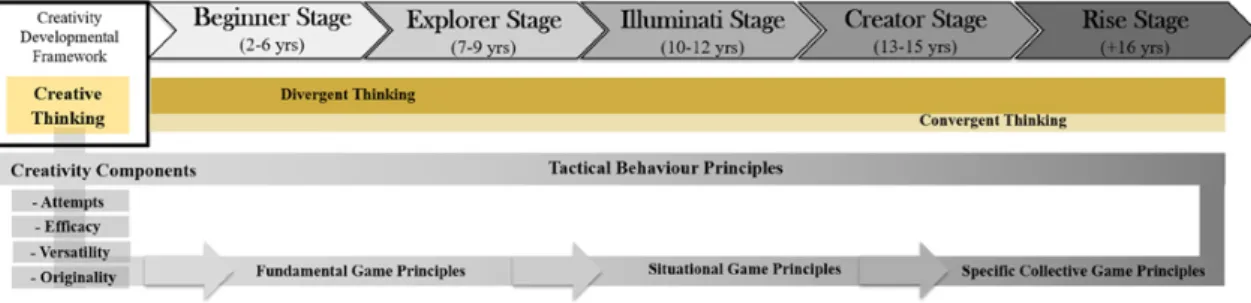
behavior in team sports. ... 22
Figure 2. The connection between creative thinking and the learning of tactical
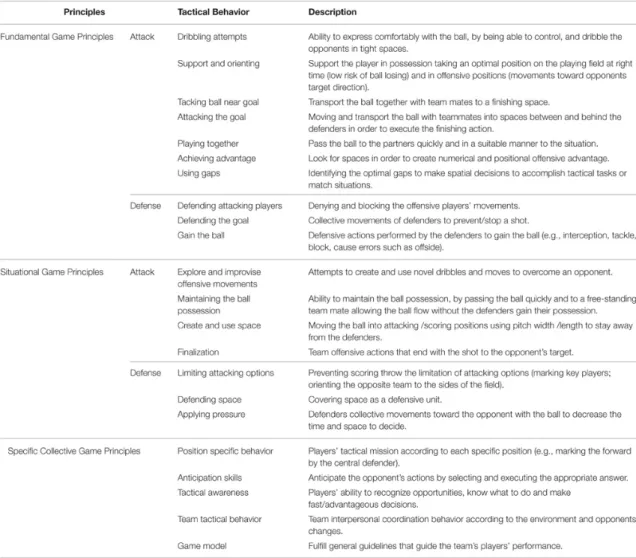
behavior principles. ... 23
Figure 3. The type of practice pathway and physical literacy structure embodied in
creativity training stages. ... 31
Figure 4. The nonlinear pedagogy assumptions embodied in the creativity training
stages. ... 39
Chapter 3 ... 51 Figure 1. Taco Bell skills challenge. ... 60
Chapter 4 ... 75 Figure 1. Creativity training program schedule during different mesocycles. ... 88
Figure 2. Standardized (Cohen) differences in thinking, motor, in-game individual and
in-game collective variables. ... 90
Chapter 5 ... 105 Figure 1. Methodological differences between the typical and differential learning
small-sided games. ... 113
Figure 2. Descriptive analysis expressed as mean and standard deviation of the absolute
values for the five considered creative components. ... 119
Figure 3a and 3b. Standardized (Cohen’s d) differences in positional variables between
pre-post control and experimental groups. ... 121
Chapter 6 ... 131 Figure 1. Main practical implications of the thesis findings. ... 137
XXVII
Index of Tables
Chapter 2 ... 17 Table 1. Description of the tactical behavior principles used to classify the tactical game
complexity in team sports. ... 27
Table 2. Creativity stages of the Creativity Developmental Framework in team sports.
... 41
Chapter 3 ... 51 Table 1. Training plan structure for the experimental and control group. ... 59
Table 2. Sport career milestones for the early specialization and late specialization
paths. ... 64
Table 3. Additional activities that the students participated prior to specialization. ... 64
Table 4. Descriptive and inferential statistics for the non-structured path. ... 66
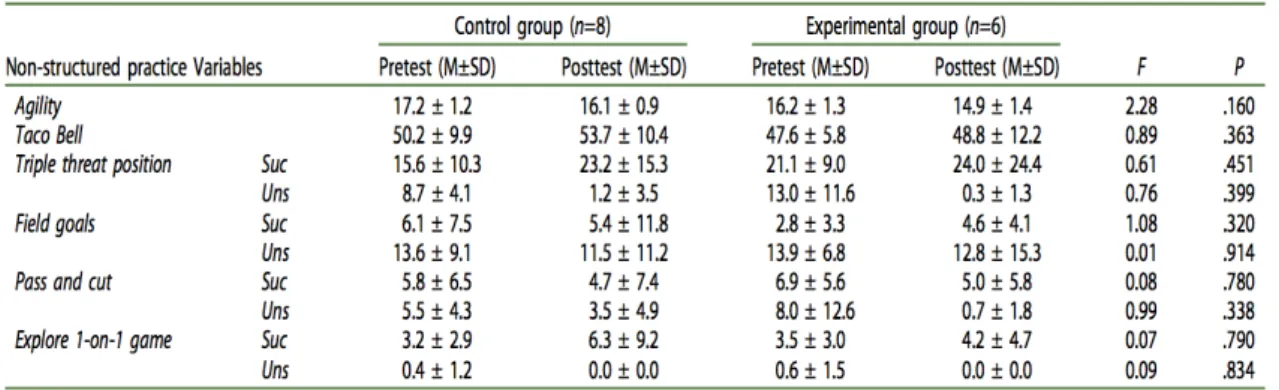
Table 5. Descriptive and inferential statistics for the early specialization path. ... 66
Table 6. Descriptive and inferential statistics for the late specialization path. ... 67
Chapter 4 ... 75 Table 1. Description of the general Skills4genius training program tenets. ... 87
Table 2. Descriptive analysis and standardized (Cohen) differences in group means for
the Skills4Genius program effects. ... 91
Table 3. Inferential statistics of thinking and game pre-post variation and the coefficient
correlation between pre-pre and pre-post of the control and experimental groups. ... 92
S1 Table. Description of the variables observed using the Creative Behavior
Assessment in Team Sports. ... 102
S2 Table. A simplified example of the measurement the in-game technical skills of one
player using the Creative Behavior Assessment in Team Sports. ... 104
Chapter 5 ... 105 Table 1. Example of the variations performed in traditional and differential learning
small-sided games. ... 114
Table 2. Description of the creative components observed through the Creative
XXVIII
Table 3. Pre- and post-tests descriptive and inferences analysis for the U13 and U15
creative components measurements. ... 120
Table 4. Descriptive and inferential analysis for positional variables between control
and experimental groups. ... 122
Chapter 1
Chapter 1
3
1. Introduction
1.1. General Introduction Rising the creative spark
Creativity is a multifaceted phenomenon manifested in different domains, such as in technical innovation, education, religion, expressive arts, business, science, sports and many other fields (Runco, 2014). Before the twentieth century, creativity was usually addressed within discussions of genius widely associated to the divine. However, during the second half of the twentieth century, Joy Paul Guilford warned about the lack of focus in studying this higher-order human predisposition. After Guilford’s advocating the necessity of systematic research on creativity in 1950, this domain has been studied in a great variety of disciplines, including sports (Becker, 1995; 2011). In 1968, Guilford addressed a controversial proposal, suggesting that the creative performance in individuals could be enhanced and consequently should be measured (Guilford, 1950; 1967). Inspired on Guilford’s assumptions Ellis Paul Torrance elevated the discussion surrounding this field by introducing several educational theories and developing the Torrance Test of Creative Thinking (TTCT), the most common assessment tool of creativity used nowadays (Cramond, Matthews-Morgan, Bandalos, & Zuo, 2005; Kim, 2011; Torrance, 1962). Over the years, the concept of creativity has evolved from the unidimensional to a multidimensional perspective and from factors related to personal characteristics to those concerning the role of the environment (Harrington, 2011). This conceptual advance was well received in sports domain through the pioneer work of Daniel Memmert, which sustains a multidimensional and environmental supported theory entitled the Tactical Creativity Approach (Memmert, 2013; 2015a; 2015b). However, creativity remains a challenging and fascinating topic of study but still difficult to define.
Developmental trends of creativity
The most common definition of creativity involves the production of something appropriate, yet new or rare that is valued and accepted in the society (Kaufman & Baer, 2012; Kaufmann, 2003; Runco, & Jaeger, 2012). Creativity is usually described as a characteristic of human thinking that reflects a capacity to solve problems in an original way and to produce work, which is novel, appropriate, and socially valued (Razumnikova, 2007). Most contemporary researchers agree on the generic description
Chapter 1
4
proposed by the Sternberg and Lubart (1995, 1999) which defined creativity as the ability to produce work that is both novel (original, unexpected) and appropriate (useful). Indeed, the criteria of product novelty and appropriateness have long been seen as the hallmarks of creativity (Sowden, Pringle, & Gabora, 2014).
Additionally, the concept of creativity has also been associated with the Guilford’s definition of divergent thinking. Divergent thinking involves the production of solutions to a given problem with an emphasis on variety and quantity of output involving fluency, versatility, originality and elaboration. Accordingly, recent reports confirmed that divergent thinking is a reliable and a valid predictor to gauge creativity (Pinheiro & Cruz, 2014; Runco & Acar, 2012). However, it is widely accepted that creative production does not derive alone from divergent thinking, but also requires a convergent thinking which consists in create a single correct solution to a given problem and provide criteria to select the most appropriated solution (see Cropley, 2006). Despite the obvious importance of both for creativity, the divergent processes have received a higher considerable attention in literature since it is well sustained by the Sarnoff Mednick’s Associative Theory. This theory refers that a creative solution to a problem comes about bringing together multiple ideas which only combined in a new way may became useful as a novel solution (Mednick, 1962). It means, that the production of a lot more possibilities will likely increase the chances of producing something truly outstanding. Taking this into consideration, it is fundamental in sport that youth players think and perform a wide range of technical and tactical solutions to increase the likelihood of emerge creative solutions on the field. Moreover, it is also important to note that according to Alfonso-Benlliure, Meléndez and Garcia-Ballesteros (2013) creative abilities follow distinct patterns across the developmental path. While convergent thinking progressively improves with age, divergent abilities significantly decrease overtime without training. For this reason, the divergent thinking training should be stressed through the educational and sports contexts during the early years.
In sports, appears to be consensual when considering that a creative player, must be able to perform actions that involves varying, novel, original, unexpected and appropriate decisions in field (Memmert & Roth, 2007). Nevertheless, this concept is too narrow and does not represent the entire multidisciplinary associated to the sports context. To overcome this issue, recently emerged the following definition of creativity: in the first years, the youth player must be comfortable to discover and reorganize new
Chapter 1
5
personal solutions, toward a continuously challenge of their self-adaptation ability. Concomitantly, players should be able to move and attune “outside the box” under the guidance of sport environment to solve a specific game problem in a novel, feasible, unexpected and original way by starting a single act or flowing in a collective action contributing to team success (Santos, Memmert, Sampaio, & Leite, 2016). In addition, this definition disrupts with previous concepts that are applied only to eminent adults because children or youth players are unlikely to produce something truly new or valued by the society (Cohen, 2011). Hence, those types of definitions became useless to the stakeholders concerned with creativity in educational and youth sport environments.
To overcome the previous gap, several creative trajectories were identified. The Bonden’s Impossibility Theory to Creativity, divides creativity into two categories: H-creativity (historical H-creativity) and P-H-creativity (personal H-creativity). The H-H-creativity refers to something that is produced which no one has ever created or discovered, whereas P-creativity refers to something that an individual creates or discovers, which they have never done before, even thoughts, but it could have been done by others (Boden, 1996). On the other hand, considering the developmental nature of creativity, James Kaufman and Ronald Beghetto (2009) proposed four creativity categories: mini-c; little-mini-c; pro-c, and big-C, which supports the Creativity Developmental Framework ideology. Mini-c creativity refers to novel interpersonal insights about interpretations of personal experiences or actions, which highlights that creativity is inherent during the learning process. The little-c creativity is based on the assumption that creativity is part of human nature and can be found in average people’s everyday lives. People who attain professional-level expertise in any creative area are likely to have pro-c. Big-C creativity consists of eminent creative contributions that last forever. In football, Ronaldinho, Messi, Ibrahimovic, Cristiano Ronaldo, had a great impact on sports field and they are an accurate example of the Big-C creativity. Both mini-c and little-c forms of creativity are relevant to stress in youth sports environments, since these forms of creativity are a pre-requisite for Pro-c and Big-c in a particular field of expertise.
In sport and educational environments, it is crucial to understand if creativity is domain-specific or domain-general. In other words, if the individuals can be creative in many domains or who are creative in one domain are not necessarily creative in others domains. In this vein, Pluncker and Beghetto in 2004, stated that creativity could be both specific and general and such hybrid model suggests, that the level of specificity
Chapter 1
6
may change with the social context and with the development through childhood into adulthood (Amabile, 1996; Sternberg & Lubart, 1995). In general, creative thinkers require both the knowledge of a particular domain and that of cross domains (Sternberg, 2005). Indeed, the truly revolutionary creative acts come from synthesizing across domains, as Picasso did with African and European art or Darwin did by combining insights from economics, geology and biology to come up with the theory of natural selection. A broad knowledge in several domains may lead to a higher generation of major innovations, thus making lasting contributions to their specific domain (Baer & Kaufman, 2005). Basically, as explained by the Componential Model, three sets of variables are needed to arouse creativity: domain-relevant skills, creativity-relevant skills, and task motivation (for refs see, Conti, Coon, & Amabile, 1996). At least, if we want more creative players, then we must provide an enabling environment, that allows creativity to flourish (Scott, Leritz, & Mumford, 2004; Ma, 2006). In these training programs should prevail such confluence-theories, which assume that multiple components must converge for creativity occur, as the Four Ps of Creativity: Person, Product, Process and Press (Kharkhurin, 2014; Rhodes, 1961; Runco & Kim, 2011). Indded, the previous approaches address creativity from a more holistic, dynamic, and multidimensional perspective as required in team sports.
The nurturing of creative enrichment environments
Over the past few decades, several creativity training programs have been used to aid players to maximize their creative potential. Recently, according to the Tactical Creativity Approach designed by Memmert (2015a, 2015b), which was grounded in the previous confluence-theories, has been considered different factors that affect the development of creativity in sports. Further, a ranging across training-related variables are pointed out, such as the six Ds training principles which encompasses the deliberate practice and play, diversification, the quality of coaching, motivational instructions and one-dimension games to fostering creativity in team sports (Memmert, 2015a, 2015b). To support these statements, a (Memmert, 2006) study, demonstrated the effectiveness of a diversified sporting training program in increasing the creative behavior in team ball sports. Additionally, Memmert and colleagues (2010) research, intended to understand the developmental path predictors in order to become a creative player in several invasion games (basketball, football, handball and field hockey) and the results
Chapter 1
7
showed an association between the time spent in deliberate play activities and the creativity gains in team sports. More recently, Bowers, Green, Hemme, and Chalip (2014) examined if the amount of time spent in two different sport settings (organized vs. unstructured activities) during childhood had a later influence in general creative thinking. According to this analysis, the time spent in unstructured sport activities was positively related to the achievement of creative thinking in adulthood. Although the previous studies addressed the impact of distinct training programs on creativity, it is still essential to establish general guidelines across childhood and the junior age span to ensure an optimal development of creative behavior.
Traditionally, sports training have adopted approaches which are prescriptive and repetitive, employing a technical “criterion model” to encourage players to recreate exactly the desired skill (Williams & Hodges, 2005). Such pedagogies fail to consider how performance environment shape functional behaviors and decision-making process (Davids & Araújo, 2010). Clearly, it separates the information and movement seeking to facilitate players search for standardized solutions and not accounting that the broader context is not compatible with the creative developmental process. An increasing amount of evidence from the Dynamical Systems Theory challenged these traditional assumptions that neglect the active role of the environment to shape behavior (Gréhaigne & Godbout, 2014; Ovens, Hopper, & Butler, 2013). The core of the Dynamical Systems Theory emphasizes the natural phenomena as a system with many interacting component parts (Davids, Button, & Bennett, 2008; McGarry, Anderson, Wallace, Hughes, & Franks, 2002). Specifically, it is a “self-organizational under constraints” process (Davids, et al., 2008; Bernstein, 1967), which advocates that the emergence of self-organized pattern movement solutions are facilitated through the interaction of performer, environment, and task constraints (Newell’s constraint model) (Newell, 1986).
Due to the dynamism and complexity nature of team sports, it is necessary to design learning environments that should be grounded in nonlinearity (Chow & Atencio, 2012; Lee, Chow, Komar, Tan, & Button, 2014; Tan, Chow, & Davids, 2012). Chow and colleagues (2007) were the first to propose the term Nonlinear Pedagogy, a constraints-lead approach, focusing particularly on the manipulation of constraints in team sports settings, which plays a key role to encourage the emergence of functionally movement solutions during the game performance (Chow et al., 2006; Renshaw, Chow,
Chapter 1
8
Davids, & Hammond, 2010; Rovegno, Nevett, Brock, & Babiarz, 2001). Firstly, the role of constraints has been put forth as a central tenet of Nonlinear Pedagogy. Typically, task constraints, can be readily manipulated to boost the exploration for different movement solutions by the players (Hristovski, Davids, Araújo, & Passos, 2011). The “noise” provided by the right task constraints manipulation amplifies the exploratory pattern (Schöllhorn, Mayer-Kress, Newell, & Michelbrinck, 2009; Torrents, Ric, Hristovski, Torres-Ronda, Vicente, & Sampaio, 2016) and players will be channeled for functional and versatile connections that lead them to creative behaviors. The exploratory behavior is a prerequisite of player’s creative thinking (divergent, convergent and critical abilities). Moreover, giving opportunities to youth players to explore their boundaries will make them more adaptive without being afraid to attempt and risk-taking during the game performance. According to Hristovski and colleagues (2012), it was suggested that constraints manipulation allows for greater fluency and flexibility in discovering atypical but yet functional movement solutions to a task goal.
The creative behavior needs to be supported by the acquisition of complex patterns skills (Farrow & Robertson, 2016). In this vein, the differential learning seems to emerge as a promising approach to enhance the creative behavior (Memmert, 2015b). The differential learning is characterized by increasing the number of movement fluctuations, through no movement repetition and without corrections during the skill acquisition process (Henz & Schöllhorn, 2016; Schöllhorn, Hegen, & Davids, 2012; Wagner & Müller, 2008). Specifically, this approach amplifies the fluctuations by applying infinite variations in technique movement. Indeed, the players are trained within “noisy” exercises sequences. For example, the players are instructed to perform movement errors instead of abolish them or by focusing on the perfect technique execution (e.g. during a shot put arms raised up or standing leg had to be placed well to the side of the ball) (Schöllhorn et al., 2006). In fact, the well-known philosophy of differential learning is: “never practice the right thing in order to play right” (see Schöllhorn et al., 2012). Differential learning provides a highly improvisation demands during the training session (Schöllhorn, et al., 2012). According to Lewis and Lovatt (2013, p 46), improvisation is the act of creating something new on the spur of the
moment. Indeed, the improvisation is considered a progressive form of problem-finding
and problem solving and also it is associated with a “releasing effect”, that leads to a greater creative behavior (Kleinmintz, Goldstein, Mayseless, Abecasis, &
Shamay-Chapter 1
9 Tsoory, 2014).
Measuring creativity in ecological settings
Nowadays, the technology minimizes the barriers related to the measurement of the creativity in sports (Piffer, 2012). Accordingly, several tools have been proposed to assess in-game technical and tactical behavior, which can be reliable indicators of the creative players’ predisposition. Due to the development of affordable technology, the notational analysis is now widely used in football. This type of analysis is concerned with the technical and tactical evaluation and statistical compilation though a permanent record of the events of players’ actions (James, 2006; Liu, Gomez, Gonçalves, & Sampaio, 2016; Winter & Pfeiffer, 2012). Regarding the creativity measurements, the Creative Behavior Assessment in Team Sports - CBATS, has been used to calculate the individual technical variables (attempts, fluency, and versatility) to determine players’ creative potential. Indeed, notational analysis is recognized as powerful tool to produce valid and reliable description of teams’ performance (Carling, Reilly & Williams, 2009). In spite of the importance of the notational analysis to study creativity, this type of assessment did not allow to represent the relationships established by the players’ dynamics (Gonçalves, Coutinho, Santos, Lago-Penas, Jiménez, & Sampaio, 2017; Travassos, Davids, Aráujo, & Esteves, 2013).
On the other hand, the GPS technology has changed the performance analysis in sports (Memmert, Lemmink & Sampaio, 2017). In this vein, measuring team’s tactical performance implies the analysis of individual player positions, while taking into account their time and context dependence (Sampaio & Macas, 2012; Travassos, Duarte, Vilar, Davids, & Aráujo, 2012). These analyses can be addressed by using the player’s relative pitch positioning data. Available studies (Folgado, Duarte, Fernandes, & Sampaio, 2014; Gonçalves, Marcelino, Torres-Ronda, Torrents, & Sampaio, 2016) tend to focus their analysis, either on the cooperation or competition behaviours (intra or inter team/player analysis) or, on the density of relations established (study the relations of a pair of players or players’ dyad; a group of players or the whole team) (Gonçalves, Esteves, Folgado, Ric, Torrents, & Sampaio, 2016). Different combinations of these positional variables represent distinct approaches to study tactical behaviour, by trying to capture and describe players and teams’ performance characteristics at different levels of interaction. In fact, insightful information can be derived from both
Chapter 1
10
notational and positional data to measure creativity in team sports, decreasing the weakness of creative measurements usually associated to a lack of ecological validity (Piffer, 2012).
1.2. Aim of the Thesis
Currently, there is a clear need for creativity and urge to invest in programs that are intended to empower this predisposition during the lifespan. Nevertheless, further evidence is required in order to establish the best sport practices, specifically designed to nurture the creative behaviour within different kinds of expertise. Therefore, this thesis aims to explore the influence of supportive environments to develop in-game technical and tactical creativity, sharing the Creativity Developmental Framework as common background. Additionally, this thesis added further insights regarding to the creativity measurements tools in team sports, combining notational analysis with positional data to provide a more reliable description of the players’ creative potential. The innovative nature of this research will provide insightful findings in this unexplored domain and might act as a starting point to understand how to nurture a creative environment which is urgently required.
1.3. Structure of the Thesis
The present thesis was elaborated in conformity with the requirements and guidelines of the University of Trás-os-Montes and Alto Douro. This thesis is structured according to the Scandinavian model, which encompasses a set of four original research articles, accepted or published on peer- reviewed international journal with ISI Impact Factor. Therefore, six distinctive chapters compose this thesis.
The current chapter (chapter 1) introduces both the theoretical background and the relevance of the theme considering the research already done in this domain. In addition, the thesis general purpose and its structure are also exposed within this chapter.
The chapter 2 is dedicated to the theoretical component of the thesis which encompasses an overview of the literature published in the last decades. Specifically, this chapter presents a review article entitled “The spawns of creative behaviour in
Chapter 1
11
provide a sustained theoretical basis to the following experimental research articles covered by this thesis.
Chapter 3 presents the first experimental research article entitled “Do previous
sport experiences influence the effect of an enrichment program in basketball skills?” intended to examine the effects of a physical literacy and differential learning
program in motor, technical and tactical skills when accounting for the age of youth sport specialization.
Chapter 4 introduces another experimental research article “Effects of the
Skills4Genius sports-based training program in creative behaviour”. This study
was two-fold: firstly, it intends to identify the effects of the Skills4Genius sports-based training program in creative thinking, motor skills, in-game individual creative behaviour, and in-game collective behaviour in team sports. Secondly, it explores the possible relationship between creative thinking and in-game creativity.
Chapter 5 encompasses the study “Differential learning as a key training
approach to improve creative and tactical behaviour in youth soccer players”. The
aim of this study was to identify the effects of a differential learning program in creativity and tactical behaviour of youth players during football small-sided games.
The Chapter 6 is dedicated to the final thoughts, supported by the conclusions of each experimental research article incorporated in the present thesis. Concomitantly, the main findings were interpreted, related and summarized in order to added new routes in creativity domain. This Chapter also underpins suggestions and insights for further research. In addition, the references of each chapter are presented in the end of it.
1.4. References
Alfonso-Benlliure, V., Meléndez, J., & García-Ballesteros, M. (2013). Evaluation of a creativity intervention program for preschoolers. Thinking Skills and Creativity, 10(0), 112-120.
Amabile, T.M. (1996). Creativity in Context. Westview, Boulder, CO.
Baer, J. & Kaufman, J. (2005). Bridging generality and specificity: The amusement park theoretical (APT) model of creativity. Roeper Review, 27(3), 158-163.
Becker, M. (2011). Creativity through history. In: M. Runco &. S. Pritzker (Eds.). Encyclopedia of Creativity, 2nd ed, vol. 1 (pp. 303-310). San Diego, CA:
Chapter 1
12
Becker, M. (1995) Nineteenth-Century foundations of creativity research. Creativity
Research Journal, 8(3), 219-229.
Bernstein, N. A. (1967). The coordination and regulation of movements. Oxford: Pergamon Press.
Boden, M. A. (1996). Dimensions of Creativity. Cambridge: MIT Press.
Bowers, M., Green, C., Hemme, F., & Chalip, L. (2014). Assessing the relationship between youth sport participation settings and creativity in adulthood. Creativity.
Research Journal, 26, 314–327.
Carling C., Reilly T., & Williams M. (2009). Performance Assessment for field sports. London and New York: Routledge.
Chow, J., Davids, K., Button, C., Shuttleworth, R., Renshaw, I., & Araújo, D. (2006). Nonlinear pedagogy: a constraints-led framework for understanding emergence of game play and movement skills. Nonlinear Dynamics, Psychology and Life
Sciences, 10(1), 71-103.
Chow, J. & Atencio, M. (2012). Complex and nonlinear pedagogy and the implications for physical education. Sport, Education and Society, 19(8), 1034-1054.
Chow, J., Davids, K., Button, C., Shuttleworth, R., Renshaw, I., & Araújo, D. (2007). The role of nonlinear pedagogy in physical education. Review of Educational
Research, 77(3), 251-278.
Conti, R., Coon, H., & Amabile, T. (1996). Evidence to support the componential model of creativity: Secondary analyses of three studies. Creativity Research
Journal, 9(4), 385-389.
Cohen, L. M. (2011). Adaptation, adaptativeness and creativity. In: M. Runco M. & S.
Pritzker (eds.). Encyclopedia of Creativity, 2nd edn, vol 1. (pp. 9-17). San Diego, CA: Academic Press.
Cramond, B., Matthews-Morgan, J., Bandalos, D., & Zuo, L. (2005). A Report on the 40-Year follow-up of the torrance tests of creative thinking: Alive and well in the new millennium. Gifted Child Quarterly, 49, 283-291.
Cropley, A. (2006). In praise of convergent thinking. Creativity Research Journal, 18(3), 391-404.
Davids, K. & Araújo, D. (2010). The concept of ‘Organismic Asymmetry’ in sport science. Journal of Science and Medicine in Sport, 13(6), 633-640.
Davids, K., Button, C., & Bennett, S. J. (2008). Coordination and control of movement
in sport: An ecological approach. Champaign, IL: Human Kinetics.
Farrow, D. & Robertson, S. (2016). Development of a skill acquisition periodisation framework for high-performance sport. Sports Medicine, 47(6), 1043-1054.
Folgado, H., Duarte, R., Fernandes, O., & Sampaio, J. (2014). Competing with lower
level opponents decreases intra-team movement synchronization and time-motion demands during pre-season soccer matches. PLOS ONE, 9(5): e97145. Gonçalves, B., Coutinho, D., Santos, S., Lago-Penas, C., Jiménez, S., & Sampaio, J.
(2017). Exploring team passing networks and player movement dynamics in youth association football. PLOS ONE, 12(1), e0171156.
Chapter 1
13
Gonçalves, B., Esteves, P., Folgado, H., Ric, A., Torrents, C., & Sampaio, J. (2016). Effects of pitch area-restrictions on tactical behavior, physical and physiological performances in soccer large-sided games. Journal of Strenght and Conditioning
Research. Publish Ahead of Print.
Gonçalves, B., Marcelino, R., Torres-Ronda, L., Torrents, C., & Sampaio, J. (2016). Effects of emphasising opposition and cooperation on collective movement behaviour during football small-sided games. Journal of Sports Science, 34(14), 1346-1354.
Gréhaigne, J. & Godbout, P. (2014). Dynamic systems theory and team sport coaching.
Quest, 66(1), 96-116.
Guilford, J. P. (1950). Creativity. American Psychologist, 5, 444-454. Guilford, J. P. (1967). The nature of human intelligence. McGraw-Hill, Inc.
Harrington, D. M. (2011). Creative environments, conditions and settings. In: M. Runco & S. Pritzker (Eds.). Encyclopedia of Creativity, 2nd edn, vol 1. (pp.264-272). San Diego, CA: Academic Press.
Henz, D. & Schöllhorn, W. (2016). Differential training facilitates early consolidation in motor learning. Frontiers in Behavioral Neuroscience, 10:199.
Hristovski, R., Davids, K., Araújo, D., & Passos, P. (2011). Constraints-induced emergence of functional novelty in complex neurobiological systems: A basis for creativity in sport. Nonlinear Dynamics Psychology Life Science, 15(2), 175-206.
Hristovski, R., Davids, K., Passos, P., & Araújo, D. (2012). Sport performance as a domain of creative problem solving for self organizing performer-environment systems. Open Sports Sciences, 5(Suppl. 1–M4), 26–35.
James, N. (2006). Notational analysis in soccer: Past, present and future. International
Journal of Performance Analysis in Sport, 6(2), 67-81.
Kaufmann, G. (2003). What to Measure? A new look at the concept of creativity.
Scandinavian Journal of Educational Research, 47(3), 235-251.
Kaufman, J. & Baer, J. (2012). Beyond new and appropriate: Who decides what is creative? Creativity Research Journal, 24(1), 83-91.
Kaufman, J. C. & Beghetto, R. A. (2009). Beyond big and little: The four C model of creativity. Review of General Psychology, 13(1), 1-12.
Kim, H. (2011). The creativity crisis: The decrease in creative thinking scores on the torrance tests of creative thinking. Creatitiy Research Journal, 23(4), 285-295. Kharkhurin, A. (2014). Creativity.4in1: Four-criterion construct of creativity. Creativity
Research Journal, 26(3): 338-352.
Kleinmintz, O., Goldstein, P., Mayseless, N., Abecasis, D., & Shamay-Tsoory, S. (2014). Expertise in musical improvisation and creativity: The mediation of idea evaluation. PLOS ONE, 9(7).
Lee, M., Chow, J., Komar, J., Tan, C., & Button, C. (2014). Nonlinear pedagogy: An effective approach to cater for individual differences in learning a sports skill.
Chapter 1
14
Lewis, C. & Lovatt, P. (2013). Breaking away from set patterns of thinking: Improvisation and divergent thinking. Thinking Skills and Creativity, 9(0), 46-58.
Liu, H., Gomez, M. A., Goncalves, B., & Sampaio, J. (2016). Technical performance and match-to-match variation in elite football teams. Journal of Sports Sciences, 34(6), 509-518.
Ma, A. (2006). Synthetic analysis of the effectiveness of single components and packages in creativity training programs. Creativity Research Journal, 18(4), 435-446.
McGarry, T., Anderson, I., Wallace, A., Hughes, D., & Franks, M. (2002). Sport competition as a dynamical self-organizing system. Journal of Sports Sciences, 20(10), 771-781.
Mednick, S. A. (1962). The association basis of the creative process. Psychological Review, 69.
Memmert, D. (2015a). Development of tactical creativity in sports. In J. Baker & D. Farrow (Eds.). Routledge Handbook of Sport Expertise (pp. 363-372). Abingdon: Routledge.
Memmert, D. (2015b). Teaching Tactical Creativity in Sport. Research and Practice. New York: Routledge.
Memmert, D. (2013). Tactical creativity. In T. McGarry, P. O'Donoghue, & J. Sampaio (Eds.) Routledge Handbook of Sports Performance Analysis (pp. 297-308). Abingdon: Routledge.
Memmert, D. (2006). Developing creative thinking in a gifted sport enrichment program and the crucial role of attention processes. High Ability Studies, 17: 101–115.
Memmert, D., Baker, J., & Bertsch, C. (2010). Play and practice in the development of sport-specific creativity in team ball sports. High Ability Studies, 21: 3–18. Memmert, D., & Roth, K. (2007). The effects of non-specific and specific concepts on
tactical creativity in team ball sports. Journal of Sports Sciences, 25(12), 1423-1432.
Memmert, D., Lemmink, K., & Sampaio (2017). Current approaches to tactical performance analyses in soccer using position data. Sports Medicine, 47(1), 1-10.
Newell, K. M. (1986). Constraints on the development of coordination. In M. Wade & H. Whiting (Eds.). Motor development in children: Aspects of coordination and control (pp. 341-60). Dordrecht: Martinus Nijhoff.
Ovens, A., Hopper, T., & Butler, J. (2013). Complexity thinkingin physical education. London, England: Routledge.
Piffer, D. (2012). Can creativity be measured? An attempt to clarify the notion of creativity and general directions for future research. Thining. Skills and
Creativity, 7(3), 258-264.
Pinheiro, I. & Cruz, R. (2014). Mapping creativity: Creativity measurements network analysis. Creativity Research Journal, 26(3), 263-275.
Chapter 1
15
Plucker, J. A., Beghetto, R. A., (2004). Why creativity is domain general, why it looks
domain specific, and why the distinction does not matter. In: R. J. Sternberg, E.
G. Grigorenko, & J. L. Singer (Eds.) Creativity: From potential to realization (pp. 153-167). Washington, DC: American Psychological Association, Washington.
Razumnikova, O. M. (2007). Creativity related cortex activity in the remote associates task. Brain Research Buletin, 73(1-3), 96-102.
Renshaw, I., Chow, J. Y., Davids, K., & Hammond, J. (2010). A constraints-led perspective to understanding skill acquisition and game play: A basis for integration of motor learning theory and physical education praxis? Physical
Education and Sport Pedagogy, 15(2), 117-137.
Rhodes, M. (1961). An analysis of creativity. Phi Delta Kappan.
Rovegno, I., Nevett, M., Brock, S., & Babiarz, M. (2001). Teaching and learning basic invasion-game tactics in 4th grade: A descriptive study from situated and constraints theoretical perspectives. Journal of Teaching in Physical Education 20, 370-388.
Runco, M. (2014). Creativity: Theories and Themes: Research, Development, and
Practice. Elsevier Science.
Runco, M. & Acar, S. (2012). Divergent Thinking as an Indicator of Creative Potential.
Creativity Research Journal, 24(1), 66-7.
Runco, M., & Jaeger, G. (2012). The Standard Definition of Creativity. Creativity
Research Journal, 24(1), 92-96.
Runco, M. & Kim, D. (2011). The fours Ps of creativity: Person, product, process and
press. In: M. Runco & S. Pritzker (Eds.). Encyclopedia of Creativity, 2nd edn, vol. 1 (pp. 534-537). San Diego, CA: Academic Press.
Santos, S., Memmert, D., Sampaio, J., & Leite, N. (2016). The spawns of creative behavior in team sports: A creativity developmental framework. Frontiers in
Psychology, 7:1282.
Sampaio, J. & Macas, V. (2012). Measuring tactical behaviour in football. Inernational
Journal of Sports Medicine, 33(5), 395-401.
Schöllhorn, W., Hegen, P., & Davids, K. (2012). The nonlinear nature of learning - A differential learning approach. The Open Sports Sciences Journal, 5: 100-112. Schöllhorn, W. I., Beckmann, H., Michelbrink, M., Trockel, M., Sechelmann , M., &
Davids, K. (2006). Does noise provide a basis for the unification of motor learning theories? International Journal Sport Psychology, 37, 1-21.
Scott, G., Leritz, L. E. & Mumford, M. D. (2004). The effectiveness of creativity training: A quantitative review. Creativity Research Journal, 16(4), 361-388. Sowden, P., A. Pringle, & Gabora, L. (2014). The shifting sands of creative thinking:
Connections to dual-process theory. Thinking & Reasoning, 21(1), 40-60.
Sternberg, R. J. & Lubart, T. I. (1999). The concept of creativity: Prospects and
paradigms. In R. J. Sternberg (Ed). Handbook of Creativity (pp. 3-15)
Chapter 1
16
Sternberg, R. J. & Lubart, T. I. (1995). Defying the crowd: Cultivating creativity in a
culture of conformity. Free Press, New York.
Sternberg R J. (2005). Creativity or creativities? International Journal of
Human-Computer Studies. 63(4), 370-82.
Tan, C., Chow, J., & Davids, K. (2012). ‘How does TGfU work?’: Examining the relationship between learning design in TGfU and a nonlinear pedagogy.
Physical Education and Sport Pedagogy, 17(4), 331-348.
Torrance, E. P. (1966). The torrance tests of creative thinking-norms-technical manual
research edition-verbal tests, forms A and B-figural tests, forms A and B.
Princeton, NJ: Personnel Press.
Torrents, C., Ric, A., Hristovski, R., Torres-Ronda, L., Vicente, E., & Sampaio, J. (2016). Emergence of exploratory, technical and tactical behavior in small-sided soccer games when manipulating the number of teammates and opponents.
PLOS ONE, 11(12), e0168866.
Travassos, B., Davids, K., Aráujo, D., & Esteves, P. (2013). Performance analysis in team sports: Advances from an ecological dynamics approach. Performance
Analysis in Sports, 13(1), 83-95.
Travassos, B., Duarte, A., Vilar, R., Davids, K., & Aráujo, D. (2012). Practice task design in team sports: representativeness enhanced by increasing opportunities for action. Journal of Sports Sciences, 30(13), 1447-54.
Wagner, H. & Müller, E. (2008). The effects of differential and variable training on the quality parameters of a handball throw. Sports Biomechanics, 7(1), 54-71. Torrance, E.P. (1962). Guiding creative talent. Englewood Cliffs, NJ: Prentice Hall. Williams, M. & Hodges, N. (2005). Practice, instruction and skill acquisition in soccer:
Challenging tradition. Journal of Sports Sciences, 23(6), 637-650.
Winter, C. & Pfeiffer, M. (2012). Tactical metrics that discriminate winning, drawing and losing teams in UEFA Euro 2012. Journal of Sports Sciences, 34(6), 486-492.
Chapter 2
_________________________________________________
The Spawns of Creative Behaviour in Team Sports: A Creativity
Developmental Framework
Santos, S.1; Memmert, D.2; Sampaio J.1; Leite, N.1
1Research Center in Sports Sciences, Health Sciences and Human Development,
CreativeLab Research Community, University of Trás-os-Montes and Alto Douro, Vila Real, Portugal
2Institute of Cognitive and Team/Racket Sport Research, German Sport University
Cologne, Cologne, Germany
Published: Frontiers in Psychology (2016), 7:1282. DOI: org/10.3389/fpsyg.2016.01282. IF: 2.323
Chapter 2
19
Abstract
Developing creativity in team sports players is becoming an increasing focus in sports sciences. The Creativity Developmental Framework is presented to provide an updated science based background. This Framework describes five incremental creative stages (beginner, explorer, illuminati, creator, and rise) and combines them into multidisciplinary approaches embodied in creative assumptions. In the first training stages, the emphasis is placed on the enrollment in diversification, deliberate play and physical literacy approaches grounded in nonlinear pedagogies. These approaches allow more freedom to discover different movement patterns increasing the likelihood of emerging novel, adaptive and functional solutions. In the later stages, the progressive specialization in sports and the differential learning commitment are extremely important to push the limits of the creative progress at higher levels of performance by increasing the range of skills configurations. Notwithstanding, during all developmental stages the teaching games for understanding, a game-centered approach, linked with the constraints-led approach play an important role to boost the tactical creative behavior. Both perspectives might encourage players to explore all actions possibilities (improving divergent thinking) and prevents the standardization in their actions. Overall, considering the aforementioned practice conditions the Creativity Developmental Framework scrutinizes the main directions that lead to a long-term improvement of the creative behavior in team sports. Nevertheless, this framework should be seen as a work in progress to be later used as the paramount reference in creativity training.
Key words: exploratory behaviour, deliberate play, physical literacy, nonlinear
Chapter 2
20
Introduction
The relationship among creativity development and sport participation remains unarticulated. Creative behavior is an extremely valued disposition in everyday life (Runco, 2014), as well as in sport performance (Memmert, 2015b). Sports scientists are recognizing the importance of increasing research focused in the development of creativity in sport. Nowadays, there are many obstacles that restrain the creative potential, such as the lack of street sport, unadjusted training, mechanization of play, decrease of the game enjoyment and a narrow game knowledge. Moreover, the current sport systems are not aligned in order to supply these necessities. In fact, a rigid linear environment prevails and players are constantly overwhelmed by a lack of adaptability during the game. Although strategies can be planned and trained in advance, all dynamic interactions have a level of uniqueness to them and may even be unexpected. The resolution of competitive situations will always vary when taking into account the environmental influences. It is vital that the training environment reflects the real setting full of unpredictability, thus it is necessary to support the players' creativity. Creative solutions are of crucial importance to sport success, talent development and selection system and the key is let it blossom during the early years. Indeed, there is great potential in creative moments, which can lead the team toward outstanding performances. It appears that creative players make the difference, as they bring the unforeseeable into the game and disrupt the opponents (Memmert, 2013, 2015a).
Although there have been several empirically proven principles fostering tactical creativity driven by Memmert (2015a), little is known regarding the incorporation into age depending training programs specifically designed to develop and stimulate creative behavior in team sports within different kinds of expertise and/or levels. In this sense, the current article integrates the latest research in sport science and creativity into a developmental framework, in an attempt to provide a common ground for fostering tactical creativity across childhood and the junior age span. The Creativity Developmental Framework (CDF) highlights the idea that creativity depends on the mastery of thinking and sporting skills. For this reason, the creative behavior relies on distinct emerging patterns according to the players' progression in sport settings. Thus, it is mandatory to establish a supportive and rewarding environment for creative ideas to appear. To ensure an optimal development of creative behavior, the CDF mainly distinguishes five incremental training stages, that account for enhancing specific
Chapter 2
21
creative components: (a) Beginner stage (2–6 years); (b) Explorer stage (7–9 years); (c) Illuminati stage (10–12 years); (d) Creator stage (13–15 years); and (e) Rise stage (over 16 years). The presented stages are general guidelines created as a possible continuum of creativity boost during the early ages, however neither all players will follow this sequential path, adopting a more erratic, and distinct development.
Creativity development is a holistic process that underpins complex interactions among several domains (see Memmert, 2015b). In fact, the appropriate enrichment context proposed by our CDF combines a variety of training approaches embodied in creative assumptions: (a) practice pathway (from diversification to specialization); (b) physical literacy (learning of fundamental movement and game skills); (c) nonlinear pedagogy which underpins, the constraints-led approach, teaching games for understanding and differential learning; and (e) creative thinking (divergent and convergent thinking debate) (see Figure 1). Individual and integrated contribution of these approaches assures the ideal conditions that nurture and support the long-term creative development process.