Transactions
COMMUNICATION
Cite this:Dalton Trans., 2018, 47, 8193
Received 6th March 2018, Accepted 25th May 2018 DOI: 10.1039/c8dt00866c rsc.li/dalton
Comparison of microwave and mechanochemical
energy inputs in the catalytic oxidation of
cyclohexane
†
Ana P. C. Ribeiro,
aElisabete C. B. A. Alegria,
*
a,bMaximilian N. Kopylovich,
aAna M. Ferraria,
cAna M. Botelho do Rego
cand Armando J. L. Pombeiro
*
aThe effect of microwave and mechanochemical ball milling energy inputs was studied for the peroxidative oxidation (with aqueous H2O2) of cyclohexane to cyclohexanol and cyclohexanone, over
CoCl2and/or V2O5dispersed (μm scale) catalysts. A maximum total
yield of cyclohexanol and cyclohexanone of 43% after 1 h of reaction at 30 °C, in acetonitrile and under microwave irradiation (5 W), was achieved over the CoCl2–V2O5(3 : 1) catalyst prepared by ball milling.
Cyclohexanol is the mainfinal product with a selectivity of up to 93% over cyclohexanone. Conducting the oxidation reaction under micro-wave irradiation under the same conditions but without any mechan-ochemical treatment of the catalyst prior to use resulted in a lower total yield of 30% with a lower selectivity (69%) towards cyclohexanol over cyclohexanone. The sole application of mechanochemical treat-ment for the catalyst preparation and the catalytic oxidation of cyclo-hexane allowed to reach yields of 29% after 1 h of reaction, at room temperature, without microwave irradiation and any additive and in the absence of any organic solvent. Ball milling is shown to provide a convenient, solvent-free method to disperse these solid catalysts and to promote the above cyclohexane oxidation, although, in the latter case, not so effectively as microwave irradiation.
1.
Introduction
The application of alternative energy inputs, such as microwave or ultrasonic irradiation, is one of the ways to perform effective chemical transformations under mild reaction conditions.1As a result, a number of existing synthetic protocols can be signifi-cantly improved in comparison with those performed under
con-ventional heating. For instance, electromagnetic microwaves (MW) with wavelengths of 1 mm–1 m can directly transfer energy to polar intermediates or catalysts, thus improving the efficiency and decreasing the reaction time. However, the utilization of MW irradiation is not always advantageous due to its rather compli-cated relationship to the composition of the reaction mixture, the reaction mechanism and a number of other factors.2
Reactions can also be promoted by applying mechanical energy, for example, by ball milling (BM). If mechanical grinding is under consideration, the elevated rates of the performed reac-tions are related to high concentrareac-tions of the starting materials, interaction over large areas, formation of point defects and dis-locations in the crystal lattices, breaking the order of the crystal-line structure, production of new surfaces and cracks, ionic exchange, etc.1b At the point of collision of edges, the solids deform and melt, forming hot points where the molecules reach high excitation states.1bHowever, the energy accumulated in the defects of the crystalline structure can also lead to slower chemi-cal transformations. Hence, mechanochemichemi-cal processes can significantly differ from those performed under other energy inputs. For example, conventional heating of solid HgCl and AgCl leads to their melting and subliming, while their milling results in metal recovery with Cl2gas evolution.1b
Although the advantageous effects of alternative energy inputs have been well recognized and reviewed during the last decade,1 an experimental comparison of microwave and mechanochemical treatments has not yet been intentionally performed for the same catalytic reaction. Hence, we decided to fill this blank and compare microwave and mechano-chemical energy inputs in the catalytic oxidation of cyclo-hexane. We choose this reaction due to our longstanding inter-est in such a transformation3and its importance in industry.4
2.
Experimental
2.1. Materials
Vanadium oxide (V2O5, Sigma Aldrich), cobalt chloride (CoCl2,
Sigma Aldrich), multiwalled carbon nanotubes (MWCNT-HP
†Electronic supplementary information (ESI) available. See DOI: 10.1039/ c8dt00866c
aCentro de Química Estrutural, Instituto Superior Técnico, Universidade de Lisboa, Av. Rovisco Pais, 1049-001 Lisboa, Portugal. E-mail: [email protected] bChemical Engineering Departament, Instituto Superior de Engenharia de Lisboa, Instituto Politécnico de Lisboa, R. Conselheiro Emídio Navarro, 1, 1959-007 Lisboa, Portugal
cCentro de Química-Física Molecular, Institute of Nanoscience and Nanotechnology and IBB-Institute for Bioengineering and Biosciences, Instituto Superior Técnico, Universidade de Lisboa, 1049-001 Lisboa, Portugal
Published on 25 May 2018. Downloaded by Instituto Politecnico de Lisboa (IPL) on 7/11/2018 12:35:39 PM.
View Article Online
150, Bayer Material Science), acetonitrile (MeCN, Fisher Chemical), cyclohexane (C6H6, Sigma Aldrich), and 30%
aqueous solution of hydrogen peroxide (H2O2, Sigma Aldrich)
were handled under normal ambient conditions without any purification prior to use.
2.2. Preparation and characterization of dispersed catalysts V2O5 and/or CoCl2 with different molar ratios (total mass:
200 mg) were directly placed in a PM100/200 Retsch GmbH planetary ball mill equipped with a 50 mL bowl and mechani-cally ground with 10 stainless steel balls of 10 mm diameter for 1 h similar to the procedures described before.5 Multiwalled carbon nanotube (CNT) additives (loadings from 0.1 to 5 wt% or ca. 100–1000 metal-per-carbon molar ratios) were also added in some cases to prepare catalytic composi-tes.5a,c The milling frequency was 450 rpm, with rotational inversions every 5 minutes. All the dispersed mixtures were prepared by dry milling. The dispersed materials were charac-terized by scanning electron microscopy (SEM) using JEOL 7001F equipment. The composition of the (1 : 1) CoCl2–V2O5
ball milled mixture was studied by X-ray Photoelectron Spectroscopy (XPS) using a XSAM800 spectrometer from Kratos. The characterization of each individual salt was reported previously.5aThe operating and recording conditions as well as the details of data treatment were as described in ref. 5a. The sensitivity factors used for the mixture analysis were those of the software library when the radiation source is an aluminum anode.
2.3. Catalytic studies
100 μmol of catalyst (dispersed with or without ball milling treatment), 3 mL MeCN (solvent) and 5 mmol (540μL) cyclo-hexane (substrate) were introduced into a pyrex tube. Subsequently, 10 mmol of a 30% aqueous hydrogen peroxide solution (oxidant) was added. For the experiments under microwave radiation, the tube was sealed and placed in a microwave reactor and the system was stirred under 5 W at 30 °C for 1 or 2 h. CAUTION: Mixtures of H2O2 with organic
compounds are potentially explosive! At the end of the reac-tion, 10 mL of diethyl ether (for the substrate and organic product extraction) and 90 μL of cycloheptanone (internal standard) were added. The final mixture was stirred for 10 min and finally a sample (1μl) was taken from the organic phase and analyzed by GC. Following a method developed by Shul’pin,6an excess of triphenylphosphine (PPh3) was added
prior to the GC analysis, to reduce the cyclohexyl hydroper-oxide formed to the corresponding alcohol and the hydrogen peroxide to water. The reported and below-discussed cyclohexanone/cyclohexanol (ONE/OL) ratio corresponds to the cyclohexanone/(cyclohexanol + cyclohexyl peroxide) [ONE/(OL + ROOH)] ratio. Blank experiments were performed using different amounts of H2O2and confirmed that no
cyclo-hexane oxidation product was obtained in the absence of a metal catalyst.
For performing the oxidation of cyclohexane exclusively under mechanochemical (ball-milling) treatment, the
calcu-lated amount of the catalytic material was directly added to the grinding bowl of the ball mill, whereafter the substrate (cyclohexane) and the oxidant (H2O2, 30% aq. solution) were
added and the reaction was performed as described above, but without the addition of the NCMe solvent.
Gas chromatographic measurements were carried out using a FISONS Instruments GC 8000 series gas chromatograph with a FID detector and a capillary column (DB-WAX, column length: 30 m; internal diameter: 0.32 mm) (He as the carrier gas) and the Jasco-Borwin v.1.50 software. The temperature of injection was 240 °C. The initial temperature of the column was maintained at 100 °C for 1 min, then increased at a rate of 10 °C min−1up to 180 °C and the column was maintained at this temperature for 1 min. The attribution of the peaks was made by comparison with the chromatograms of genuine samples.
3.
Results and discussion
3.1. Preparation and characterization of the catalysts
The dispersed catalytic materials were prepared by the mechanical treatment of V2O5and/or CoCl2in a planetary ball
reactor7 as indicated above. The choice of these systems was made based on our previous studies3,5 and the literature data.2,4 According to SEM images (Fig. 1), the produced materials consist of non-uniform microcrystallites with different shapes and particle sizes above 1 µm for the ball milled CoCl2 (Fig. 1a), V2O5 (Fig. 1b), and the CoCl2–V2O5
(3 : 1)‡ mixture (Fig. 1c and d). More details of the morphology and structure of the prepared catalysts can be found in our pre-vious papers devoted to the preparation and study of related dispersed materials.5
Fig. 1 SEM images: (a) ball-milled CoCl2, scale, 10μm; (b) ball-milled
V2O5, scale, 100μm; (c) CoCl2–V2O5(3 : 1), scale, 100 µm; (d) CoCl2–
V2O5(3 : 1), scale, 10 µm.
XPS shows that after ball milling the composition of each salt is nearly the same as that before mixing.
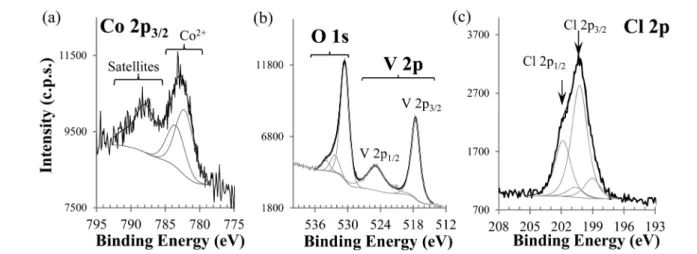
Fig. 2 shows the relevant XPS regions of the ball milled mixture CoCl2–V2O5(1 : 1). In Table 1, the atomic ratio Co/Cl >
0.5 suggests that the mixture is composed not only of cobalt chloride, but also of some cobalt hydroxides and/or oxyhydrox-ides, as in CoCl2.5a Actually, the main peaks in Co 2p3/2,
centred at 782.2 ± 0.2 eV and 783.9 ± 0.2 eV (Fig. 2a), are both assigned to Co2+in CoCl2and in Co(OH)2but, most probably,
included in powder phases with different resistivities.5aSuch an effect, which was also observed for a CoCl2–Fe2O3mixture
studied previously,5ais also detected in the Cl 2p region: Cl 2p was fitted with two doublets (the main Cl 2p3/2 component
being centred at ∼200.3 eV) revealing the presence of some differential charge resulting from mixed phases with different conductivities and/or important contact potential between powder particles. V 2p, detected next to O 1s, with V 2p3/2
centred at 517.6 eV ± 0.1 eV, confirms that the vanadium oxide is quite stable, maintaining the stoichiometry of the starting material (V2O55a) even after ball milling (Table 1). O 1s was
fitted with three peaks: the main peak, centred at 530.6 eV, is assigned to oxygen in V2O5(it is not detected in CoCl25a), and
the other two peaks, at the high binding energy side, with low relative intensities, centred at 532.4 and 534 eV, are assigned to oxygen bound to cobalt (as showed by the quantitative ana-lysis) and to some oxidized carbonaceous contamination.8
3.2. Catalytic studies
To choose the most appropriate catalytic material for further comparative studies, several ball-milled CoCl2–V2O5 mixtures
with different metal ratios (1 : 1, 3 : 1 and 1 : 3) and starting V2O5and CoCl2samples (also dispersed in the ball mill under
the same conditions) were screened for the peroxidative micro-wave-assisted oxidation of cyclohexane with H2O2 (30%
aq. solution) (Table 2). CNTs were also added in several cases since our previous studies5 demonstrated that their addition can provide a significant promoting effect. In all cases, the for-mation of a mixture of cyclohexyl hydroperoxide (CyOOH,
primary product), cyclohexanol (CyOH) and cyclohexanone (CyO) (Scheme 1a and Fig. S1†) was observed. The alcohol and ketone are the major products upon the metal-assisted decomposition of CyOOH, the formation of the alcohol being promoted by the reduction of CyOOH with triphenylphosphine (PPh3) (Scheme 1b).6
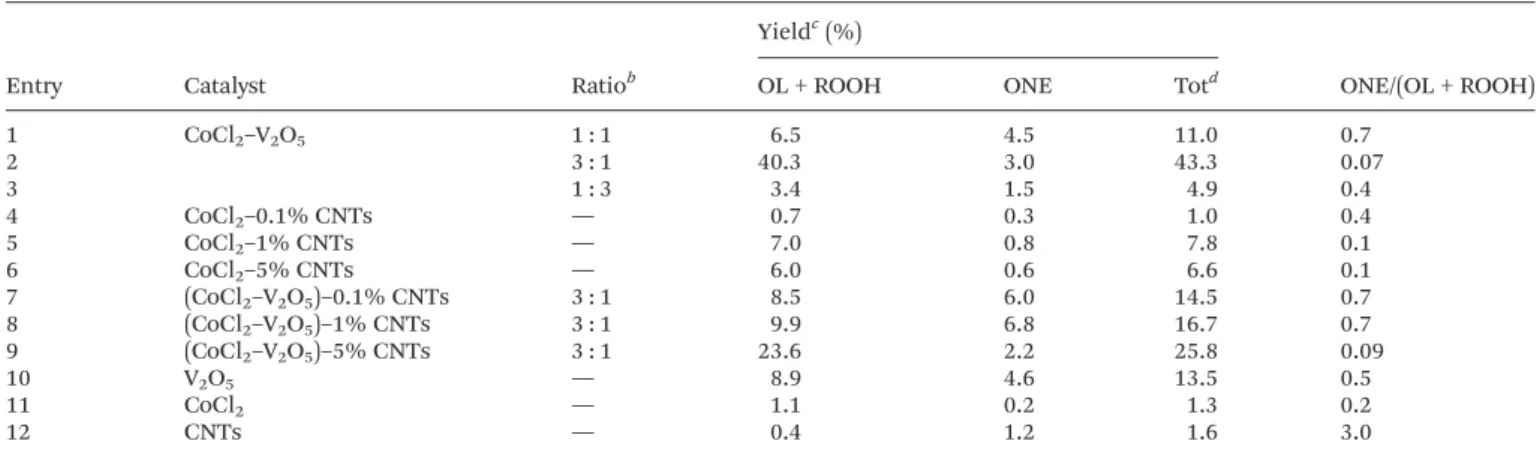
The CoCl2–V2O5(3 : 1) ball-milled mixture showed a
remark-able activity under the established experimental conditions, resulting in a 43% (in relation to the substrate) overall yield of cyclohexanol and cyclohexanone with a total turnover number (TON) of 22 (22 moles of products per mole of metal com-pound) (entry 2, Table 2) and a selectivity of up to 93% for (cyclohexanol + cyclohexyl peroxide), after 1 h of reaction at 30 °C and under microwave irradiation (5 W). In the tested catalytic systems, the cyclohexanone/cyclohexanol ratio is in the range of 0.07–0.7 (Table 2), whereas in the industrial processes,4,9the ratio generally falls in the 0.5–0.7 range. The common high predominance of cyclohexanol over cyclohexa-none in our systems suggests the presence of cyclohexyl hydro-peroxide in the reaction mixture as a primary oxidation product of cyclohexane which, after treatment with PPh3
(see the Experimental part), gives the corresponding alcohol in a relatively large quantity6(Scheme 1b).
The use of a ball milled CoCl2–V2O5mixture (3 : 1) resulted
in a marked yield increase relative to the use of any starting component, from 1.3% for CoCl2or 13.5% for V2O5to 43.3%
for CoCl2–V2O5 (3 : 1) (entries 11, 10 and 2, respectively,
Table 2). The achieved yield for the CoCl2–V2O5(3 : 1) mixture
(43.3% overall yield), with a concomitant high selectivity, is much higher than that (ca. 4–6%) of the industrial process4,9
Fig. 2 CoCl2–V2O5(1 : 1) XPS regions: (a) Co 2p3/2; (b) O 1s and V 2p; and (c) Cl 2p.
Table 1 XPS quantitative results for the precursor salts (studied in ref. 5a) and the mixed material CoCl2–V2O5(1 : 1)
Co/Cl O530.6/V
CoCl2 0.8
V2O5 2.5
CoCl2–V2O5 0.9 2.4
in spite of the mild reaction conditions used and is compar-able to those obtained3hin the presence of Fe(III)–Cr(III)
hydrox-ides (up to 45%). However, the latter catalytic system requires the use of a strong acid (HNO3).3hThe combination of such a
considerable yield achieved in a short reaction time (1 h) under mild conditions (30 °C, 5 W) and without any additive is a rare example which points out an outstanding activity of the catalytic system based on the CoCl2–V2O5(3 : 1) binary mixture
prepared by ball milling treatment.
The presence of CNT additives affects differently the cata-lytic activity of the studied systems (Table 2). Thus, for CoCl2, a
yield improvement is observed when 1 and 5 wt% of CNTs have been used, namely from 1.3% in the absence of CNTs (entry 11, Table 2) to 7.8 and 6.6%, (entries 5 and 6, Table 2, respectively). However, for the CoCl2–V2O5 systems, the yield
decreases in the presence of CNTs (entries 7–9, Table 2). This hampering effect of the CNTs contrasts with a few other cases where the presence of such additives can result in a significant improvement in the catalytic performance.5
In order to compare the influence of MW and mechano-chemical BM energy inputs, we have chosen the most active catalytic material, i.e. the CoCl2–V2O5(3 : 1) mixture. With this
catalytic material, some tests were carried out using the
follow-ing combinations (Scheme 2): (i) preparation of the catalyst by ball milling (1 h) and its subsequent application in the peroxidative oxidation of cyclohexane under MW irradiation (1 h, 30 °C) (BM + MW); (ii) conducting the oxidation reaction under MW irradiation without any BM treatment of the catalyst before use (MW) and (iii) conducting the catalyst preparation and the oxidation reaction by ball milling in one pot without MW irradiation (BM + BM). The results are presented in Table 3.
The first method (BM + MW), which is the one in which the catalyst is prepared by ball milling and then used in the peroxi-dative oxidation of cyclohexane under MW irradiation, results in the highest overall product yield (43%, entry 1, Table 3) with the maximum 93% selectivity towards cyclohexanol over
cyclo-Scheme 1 Microwave-assisted peroxidative (with H2O2) oxidation of
cyclohexane.
Scheme 2 Comparison of microwave and mechanochemical energy inputs.
Table 2 MW-assisted peroxidative oxidation of cyclohexane, over ball milled CoCl2–V2O5mixtures, V2O5or CoCl2as catalystsa
Entry Catalyst Ratiob
Yieldc(%)
ONE/(OL + ROOH)
OL + ROOH ONE Totd
1 CoCl2–V2O5 1 : 1 6.5 4.5 11.0 0.7 2 3 : 1 40.3 3.0 43.3 0.07 3 1 : 3 3.4 1.5 4.9 0.4 4 CoCl2–0.1% CNTs — 0.7 0.3 1.0 0.4 5 CoCl2–1% CNTs — 7.0 0.8 7.8 0.1 6 CoCl2–5% CNTs — 6.0 0.6 6.6 0.1 7 (CoCl2–V2O5)–0.1% CNTs 3 : 1 8.5 6.0 14.5 0.7 8 (CoCl2–V2O5)–1% CNTs 3 : 1 9.9 6.8 16.7 0.7 9 (CoCl2–V2O5)–5% CNTs 3 : 1 23.6 2.2 25.8 0.09 10 V2O5 — 8.9 4.6 13.5 0.5 11 CoCl2 — 1.1 0.2 1.3 0.2 12 CNTs — 0.4 1.2 1.6 3.0
aReaction conditions (BM + MW): Cyclohexane (5.0 mmol), 100 µmol of catalyst (2 mol% vs. substrate, after ball mill treatment, BM), NCMe
(3 mL), 30% aq. H2O2solution (10 mmol), 1 h, 30 °C, microwave (MW) irradiation (5 W); yield and TON determined by gas chromatography upon
treatment with PPh3(see the text).bMolar ratio between the components of the prepared catalyst mixture.cMolar yield (%) based on the
sub-strate, i.e. moles of products [cyclohexanol (OL) and cyclohexanone (ONE)] per 100 moles of cyclohexane.dTotal yield = moles of products [OL + ONE]/100 moles of C6H12. CNTs = multiwalled carbon nanotubes.
hexanone. Conducting the oxidation reaction under MW irradiation under the same conditions but without any ball milling treatment of the catalyst before use (MW method) gives a lower total yield of 30.4% with a 69% selectivity towards cyclohexanol over cyclohexanone (entry 2, Table 3).
The results obtained in the third procedure (BM + BM) (entries 4 and 5, Table 3) are rather interesting, since the cata-lyst preparation and the catalytic reaction were assisted only by ball milling, without any additive and in the absence of any organic solvent, leading to high overall yields of 28.6 and 32.1% after 1 or 2 h of reaction, respectively, at room temperature.
Additionally, the oxidation reactions were performed in the absence of microwave irradiation (entries 6–8, Table 3) using catalytic mixtures with (entry 6, Table 3) and without (entry 8, Table 3) previous ball milling treatment. In both cases, the yields were quite low (6.6 and 1.1%, respectively), demonstrat-ing once again the importance of MW irradiation in the cata-lytic reaction and the advantage of using ball milled catacata-lytic mixtures as catalysts. The oxidation of cyclohexane was also performed exclusively by ball milling without the addition of metal composites and residual amounts of the product were detected (entry 7, Table 3).
Among the reported vanadium or cobalt metal catalysts applied for alkane oxidations with H2O2, the product yields
achieved herein are remarkable.3,10Besides this, the catalytic systems under study involve greener reaction conditions, since they do not involve any additive or organic solvent (in the case of the sole use of mechanochemical treatment, BM + BM
method) and perform well at room temperature in a short reaction time (1 h). Compared to our catalysts, the binuclear oxidovanadium(V) complex bearing an NO2-donor Schiff
base ligand [{VO(EtO)(EtOH)}2(1κ2O,κN:2κ2O,κN-L)]·2H2O (H4L =
bis(2-hydroxybenzylidene)oxalohydrazonic acid), a homogeneous catalyst for the oxidation of gaseous and liquid alkanes by aqueous H2O2 under mild conditions, leads to 27.6% yield of
oxygenates (cyclohexanol + cyclohexanone) in the presence of the acid co-catalyst 2-pyrazinecarboxylic acid (PCA), using H2O2(50%
aqueous solution) as an oxidant, in acetonitrile, at 50 °C and after 4 h of reaction.11
4.
Conclusions
Cobalt and/or vanadium dispersed catalytic materials were pre-pared by a simple and solvent-free mechanochemical method, i.e., ball-milling. The prepared heterometallic systems act as efficient catalysts for the peroxidative oxidation (with aq. H2O2)
of cyclohexane to cyclohexanol and cyclohexanone, under mild conditions. The microwave and mechanochemical energy inputs were compared and it was shown that the most effective combination comprises the catalytic reaction performed under microwave irradiation and using the CoCl2–V2O5(3 : 1) catalyst
prepared mechanochemically. However, the catalyst prepa-ration and the catalytic reaction can be achieved in one-pot at room temperature and by using exclusively the mechanochem-ical BM energy input with considerable yields of 29 and 32% after 1 and 2 h, respectively. Hence, mechanochemical methods appear to be quite promising in the field of alkane functionalization and deserve to be further explored for a variety of catalytic systems and reactions.
Con
flicts of interest
There are no conflicts to declare.
Acknowledgements
Financial support from the Fundação para a Ciência e a Tecnologia, Portugal (fellowships SFRH/BPD/90883/2012 to A. P. C. R., SFRH/BPD/108338/2015 to A. M. F. and the “Investigador 2013” contract to M. N. K. IF/01270/2013/ CP1163/CT0007 project, UID/QUI/00100/2013, PTDC/QEQ-QIN/ 3967/2014 and UID/NAN/50024/2013 projects) and from the Instituto Politécnico de Lisboa (MechSynCat Project-Concurso Anual de IDI&CA, 710044/2016) is acknowledged.
References
‡Here and further molar ratios are indicated.
1 (a) A. Bruckmann, A. Krebs and C. Bolm, Green Chem., 2008, 10, 1131–1141; (b) R. B. Nasir Baig and R. S. Varma,
Table 3 Peroxidative oxidation of cyclohexane over the CoCl2–V2O5
(3 : 1) catalyst using MW and BM treatmentsa
Entry Method Reaction time (h) Yieldb(%) OL ONE Totalc 1d BM + MW 1 40.3 3.0 43.3 2e MW 1 20.9 9.5 30.4 3e MW 2 29.1 10.8 39.9 4f BM + BM 1 22.4 6.2 28.6 5f BM + BM 2 26.6 5.5 32.1 6g BM 1 0.2 0.1 0.3 7h BM 1 5.9 0.7 6.6 8i — 1 0.7 0.4 1.1
aReaction conditions: 5 mmol of substrate, 100μmol metal composite
(2 mol% vs. substrate), NCMe (3 mL) (only for the BM + MW and MW methods, entries 1–3), 10 mmol of H2O2(aq. 30%), 30 °C, microwave
irradiation (5 W).bMolar yield (%) based on the substrate, i.e. moles of product per 100 mol of substrate determined by GC.cTotal yield =
moles of products [cyclohexanol (OL) + cyclohexanone (ONE)]/100 mol of C6H12, determined by GC after treatment with PPh3.dBM + MW =
preparation of the catalyst with ball milling treatment (BM) and cataly-sis under MW irradiation.eMW = preparation of the catalyst without
ball milling treatment, by manual grinding, and used directly in perox-idative oxidation under MW irradiation.fBM + BM = catalyst
prepa-ration and catalytic reaction exclusively by ball milling treatment, without MW irradiation and without the NCMe solvent. gOxidation
reaction performed by ball milling without any catalyst. hCatalytic reaction performed with a ball milled catalyst and without microwave irradiation.iCatalytic reaction performed with a catalyst mixture used without previous ball milling treatment (mixed manually) and without microwave irradiation.
Chem. Soc. Rev., 2012, 41, 1559–1584; (c) S. L. James, C. J. Adams, C. Bolm, D. Braga, P. Collier, T. Frisčĭć, F. Grepioni, K. D. M. Harris, G. Hyett, W. Jones, A. Krebs, J. Mack, L. Maini, A. G. Orpen, I. P. Parkin, W. C. Shearouse, J. W. Steedk and D. C. Waddelli, Chem. Soc. Rev., 2012, 41, 413–447; (d) A. Stolle, T. Szuppa, S. E. S. Leonhardt and B. Ondruschka, Chem. Soc. Rev., 2011, 40, 2317–2329; (e) R. Schmidt, R. Thorwirth, T. Szuppa, A. Stolle, B. Ondruschka and H. Hopf, Chem.– Eur. J., 2011, 17, 8129–8138; (f ) J. Yu, Z. Jiang and W. Su, Cross Dehydrogenative Coupling Reactions by Ball Milling, in Ball Milling Towards Green Synthesis: Applications, Projects, Challenges, ed. A. Stolle and B. C. Ranu, RSC, Cambridge, 2015, pp. 96–113; (g) R. Schmidt, H. M. Scholze and A. Stolle, Int. J. Ind. Chem., 2016, 7, 181–186.
2 (a) Microwave Assisted Organic Synthesis, ed. J. P. Tierney and P. Lidstrom, Blackwell, UK, 2005; (b) Y. Y. Karabach, M. N. Kopylovich, K. T. Mahmudov and A. J. L. Pombeiro, Microwave-assisted catalytic oxidation of alcohols to carbo-nyl compounds (Chapter 18), in Advances in Organometallic Chemistry and Catalysis (The Silver/Gold Jubilee ICOMC Celebratory Book), ed. A. J. L. Pombeiro, J. Wiley & Sons, 2014, pp. 233–246.
3 (a) A. J. L. Pombeiro, Toward functionalization of alkanes under environmentally benign conditions (Chapter 2), in Organometallic Chemistry and Catalysis (The Silver/Gold Jubilee ICOMC Celebratory Book), ed. A. J. L. Pombeiro, J. Wiley & Sons, 2014, pp. 15–25; (b) A. P. C. Ribeiro, L. M. D. R. S. Martins and A. J. L. Pombeiro, Green Chem., 2017, 19, 1499–1501; (c) L. M. D. R. S. Martins and A. J. L. Pombeiro, Eur. J. Inorg. Chem., 2016, 2236– 2252; (d) O. V. Nesterova, M. N. Kopylovich and D. S. Nesterov, RSC Adv., 2016, 6, 93756–93767; (e) M. N. Kopylovich, M. J. Gajewska, K. T. Mahmudov, M. V. Kirillova, P. J. Figiel, M. F. C. Guedes da Silva, B. Gil-Hernandez, J. Sanchiz and A. J. L. Pombeiro, New J. Chem., 2012, 36, 1646–1654; (f ) T. C. O. Mac Leod, M. N. Kopylovich, M. F. C. Guedes da Silva, K. T. Mahmudov and A. J. L. Pombeiro, Appl. Catal., A, 2012, 439, 15–23; (g) M. N. Kopylovich, T. C. O. Mac Leod, M. Haukka, G. I. Amanullayeva, K. T. Mahmudov and A. J. L. Pombeiro, J. Inorg. Biochem., 2012, 115, 72–77; (h) M. N. Kopylovich, A. M. Kirillov, A. K. Baev
and A. J. L. Pombeiro, J. Mol. Catal. A: Chem., 2003, 206, 163–178.
4 (a) Ullmann’s Encyclopedia of Industrial Chemistry, Wiley-VCH, Weinheim, 6th edn, 2002; (b) U. Schuchardt, D. Cardoso, R. Sercheli, R. Pereira, R. S. da Cruz, M. C. Guerreiro, D. Mandelli, E. V. Spinacé and E. L. Pires, Appl. Catal., A, 2001, 211, 1–17; (c) K. Weissermel and H. J. Arpe, Industrial Organic Chemistry, VCH Press, Weinheim, 2nd edn, 1993.
5 (a) E. C. B. A. Alegria, E. Fontolan, A. P. C. Ribeiro, M. N. Kopylovich, C. Domingos, A. M. Ferraria, R. Bertani, A. M. Botelho do Rego and A. J. L. Pombeiro, Mat. Today Chem., 2017, 52–62; (b) E. Fontolan, E. C. B. A. Alegria, A. P. C. Ribeiro, M. N. Kopylovich, R. Bertani and A. J. L. Pombeiro, Inorg. Chim. Acta, 2017, 455, 653–658; (c) A. P. C. Ribeiro, E. Fontolan, E. C. B. A. Alegria, M. N. Kopylovich, R. Bertani and A. J. L. Pombeiro, J. Mol. Catal. A: Chem., 2017, 426, 557–563.
6 (a) G. B. Shul’pin, C. R. Chim., 2003, 6, 163–178; (b) G. B. Shul’pin, Y. N. Kozlov, L. S. Shul’pina, A. R. Kudinov and D. Mandelli, Inorg. Chem., 2009, 48, 10480–10482; (c) G. B. Shul’pin, Y. N. Kozlov, L. S. Shul’pina and P. V. Petrovskiy, Appl. Organomet. Chem., 2010, 24, 464–472; (d) G. B. Shul’pin, J. Mol. Catal. A: Chem., 2002, 189, 39–66; (e) G. B. Shul’pin, Dalton Trans., 2013, 42, 12794–12818.
7 (a) J. Wang, S. Ganguly, S. Sabyasachi, N. D. Browning and S. M. Kauzlarich, Polyhedron, 2013, 58, 156–161; (b) Z. Wronski, R. A. Varin, C. Chiu, T. Czujko and A. Calka, J. Alloys Compd, 2007, 434–435, 743–746; (c) T. D. Shen, C. C. Koch, T. L. McCormick, R. J. Nemanich, J. Y. Huang and J. G. Huang, J. Mater. Res., 1995, 10, 139–148.
8 G. Beamson and D. Briggs, High Resolution XPS of Organic Polymers, the Scienta ESCA300 Database, Wiley, New York, 1992.
9 A. P. Pokutsa, R. B. Sheparovich, A. B. Zaborovskii and V. I. Kopylets, Kinet. Catal., 2002, 43(5), 69–697.
10 (a) M. Sutradhar, E. C. B. A. Alegria, M. F. C. Guedes da Silva, L. M. D. R. S. Martins and A. J. L. Pombeiro, Molecules, 2016, 21, 425–437; (b) T. F. S. Silva, E. C. B. A. Alegria, L. M. D. R. S. Martins and A. J. L. Pombeiro, Adv. Synth. Catal., 2008, 350, 706–716.
11 S. Gupta, M. V. Kirillova, M. F. Guedes da Silva and A. J. L. Pombeiro, Appl. Catal., A, 2013, 460–461, 82–89.