Arq Neuropsiquiatr 2004;62(3-A):654-657
AUniversidade Bandeirante de São Paulo e BUniversidade Federal de São Paulo, Escola Paulista de Medicina, São Paulo SP - Brasil: 1Fisioterapeuta; 2Neurologista.
Recebido 24 Novembro 2003, recebido na forma final 1 Março 2004. Aceito 31 Março 2004.
Dra. Andréa Sanchez Navarro - Disciplina de Neurologia, UNIFESP / EPM - Rua Botucatu 740 - 04023-900 São Paulo SP - Brasil. E-mail: [email protected]
COORDENAÇÃO MOTORA E EQUILÍBRIO NÃO SÃO
TOTALMENTE DESENVOLVIDOS EM CRIANÇAS
CEGAS COM 7 ANOS DE IDADE
Andréa Sanchez Navarro
1A, Marcia Maiumi Fukujima
2B, Sissy Veloso Fontes
1A,B,
Sandro Luiz de Andrade Matas
2A,B, Gilmar Fernandes do Prado
2BRESUMO - As crianças portadoras de deficiência visual possuem dificuldades em conhecer seu próprio cor-po, objetos a sua volta e parâmetros espaciais imprescindíveis para locomoção independente. Este trabal-ho analisa o desenvolvimento neuropsicomotor de um grupo de crianças com deficiência visual congêni-ta em comparação a crianças com visão normal. Avaliamos dois grupos de crianças de sete anos de idade, através do exame neurológico evolutivo (ENE). O grupo estudado era constituído de 20 crianças cegas e o grupo controle constituído de 20 crianças com visão normal, pareadas por idade e sexo. Em algumas provas, as crianças cegas foram instruídas pelo tato. As crianças portadoras de deficiência visual tiveram pior desempenho nas provas que avaliaram o equilíbrio e coordenação apendicular, quando comparadas às crianças com visão normal (p<0,001), sugerindo que o déficit visual compromete o desenvolvimento
neuropsicomotor da criança.
PALAVRAS-CHAVE: deficiência visual, cegueira, desenvolvimento neurológico, exame neurológico evolutivo.
Balance and motor coordination are not fully developed in 7 years old blind children
ABSTRACT - Visually impaired children show difficulties in recognizing their own bodies, objects around then and the spatial parameters that are essential for independent movement. This study analyzes the neu-ro-psychomotor development of a group of congenitally visually impaired children as compared to chil-dren with normal sight. We have evaluated two groups of seven-year-olds by means of neurological evo-lution examination (NEE). The group studied comprised 20 blind children and the control group comprised 20 children with normal sight, and they were paired up according to age and gender. In some tests, the blind children were guided by touch. The visually impaired children performed worse in tests evaluating balance and appendage coordination compared to normal sighted children (p<0.001), and this suggests
that visual deficiency impairs children’s neuro-psychomotor development.
KEY WORDS: visual impairment, blindness, neurological development, neurological evolution examination.
The human visual sense is as complex as speech, and it develops in a similar way. Sight is not an inde-pendent sense, and it is strongly linked to children’s global motor activity, posture, skills, hand coordina-tion, intelligence and personality. Thus, even negli-gible losses of sense or motor visual function are important for health care professionals working with these children1,2.
Blind children need to integrate and synthesize data and information through other senses. They should be constantly and appropriately stimulat-ed from an early age, which ensures that they evolve properly without any neuro-psychomotor development deficiencies3,4.
A number of factors determine the development of posture control throughout life and sight plays an essential role in spatial orientation, which determi-nes visually impaired children’s motor behavior3,5,6.
The most used strategy for rehabilitating visu-al impairment subjects (VIS) is “Early Stimulation”, and this is also used with children who experience non-progressive chronic encephalopathy4. This
me-thod consists of evaluating the development pro-cess and stimulation that would, theoretically, ma-ke achieving motor and cognitive skills easier.
Arq Neuropsiquiatr 2004;62(3-A) 655
Visually impaired babies and children required greater labyrinth activity than normal sighted chil-dren do. Since they do not use sight to control pos-ture, their walking ability becomes solely depend-ent on muscle-skeletal and labyrinth functions7.
The aim of this study is to check neuro-psycho-motor skills in seven-year-old congenitally blind chil-dren by means of a neurological evolution examina-tion (NEE), which was standardized in Brazil by Lefèvre et al.8.
METHOD
We applied NEEs on 40 seven-year-old children, 20 congenitally blind ones and 20 normal sighted ones.
Study group - The study group was made up of 20
con-genitally blind children (7 boys and 13 girls) aged from seven to seven years and eleven months old, who were followed at the rehabilitation centers – “Instituto de Cegos Padre Chico –SP” [Padre Chico Institute for the Blind] and “CEPRE” (Study Center for Rehabilitation and Research) in Campinas, which specialize in blind children.
Control group- 20 normal sighted children, 9 boys and
11 girls, aged from seven to seven years and eleven months old from the school, “Colégio Nossa Senhora dos Remédios - SP”. Neurological Evolution Examination. Sta-tic balance: feet together, on one foot, with knees bent at a 90º-angle, crouched position, balancing a ruler on the index finger; we have considered it a failure, respec-tively, when examinees interrupted the balance position or used their arms, put the other foot on the floor, did not keep the knees at a straight angle, fell down in the crouched position, when the ruler fell or when the oth-er hand was used to help. Dynamic balance: jumping as high as they could, clapping twice; failure occurred when the children were not able to clap their hands while their feet were off the floor. Appendage coordination: copy-ing a lozenge shape, (blind subjects used a drawcopy-ing in relief); those who could not reproduce a diamond shape with its four distinct angles were considered to have fai-led. Rhythm reproduction: reproducing 6 rhythms made by the examiner (with intervals of 0.25 of a second for short ones and 1 second for long ones) made with the
point of a pencil; examinees were considered to have failed when they were unable to reproduce 3 or more rhythms. We examined diadocokinesis and trunk-extremity coor-dination (from lying down to upright position) and final-ly, we tested motor persistence8,9.
We used 12 neurological evolution examinations (NEEs) for the group of 7-year-olds8. Each child had the
examination in only one session, in which the examinee performed up to two attempts of each test following the example given by the examiner. In order for the blind child to clearly understand the exercises, demonstrating it by using touch or speech was allowed, always mak-ing sure that the child had understood the exercise. Children who have hypotonia or hypertonia, areflexia or hyporeflexia were not included.
A statistical analysis was carried out using a chi-square test and a Fisher exact test. We considered sig-nificant p-values < 0.05. The study was approved by the research ethical committee from Uniban (Universidade Bandeirante de São Paulo (protocolo 3/2002), and all chil-dren were included after signing the consent form.
RESULTS
The tests were easily understood both by the study group children and the control group chil-dren. A higher failure rate was seen when tests were performed on the group of blind children (p<
0.001), when entire subset of tests carried out had been taken into consideration (Table 1).
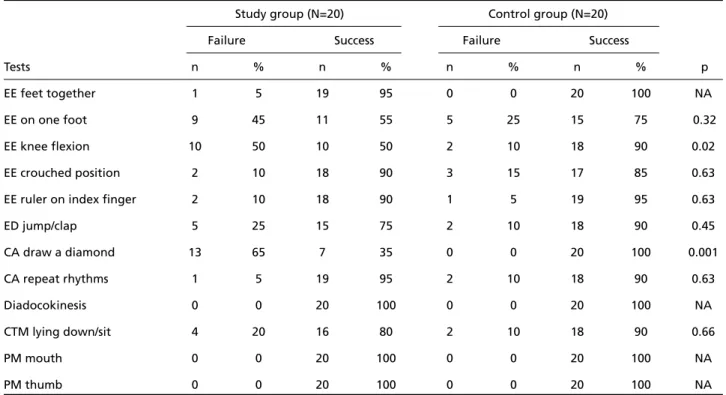
The blind children performed worse in the stat-ic balance tests when the knees were bent at a 90º-angle (Table 2), in which 50% of them could not balance, as compared to only 10% of control group children (p<0.02).
Sixty-five percent of the blind children were unable to correctly reproduce a lozenge shape (Table 2) bur all the control group children were successful in this test (p<0.001).
DISCUSSION
Blind children performed worse in NEE tests when compared to normal children, basically as a
Table 1. Global success and failure evaluation of 40 children in all 240 tests carried out, according to study and control groups.
Study group Control group
N % N %
Normal response 193 83.2 224 93.9
Failure 47 16.8 16 6.1
Total 240 100 240 100
656 Arq Neuropsiquiatr 2004;62(3-A)
result of balance and appendage coordination dif-ficulties.
Balance is the ability the keep the body orien-tated with relation to the external environment, and this depends on the continuous transmission of visual, labyrinth and proprioceptive information and on integrating these at the cerebral stem and cerebellum1,10,11.
Acquiring neuro-psychomotor skills with regard to balance occurs, and should occur, during every moment of the continuous development of the human being. It is essential that basic skills be acquired early, when the size of the body does not put the subject at high risk of harm relating to over-balancing and when there is not yet too much psychological worry about the consequences of this. Blind children lack an important afferent sys-tem for correcting motor behavior, which makes it difficult to contact objects or situations that motivate behavior that requires balance11,12.
Stability is closely related to the principles of bal-ance and eye movements. Sight helps the body to orientate itself in space and indicates where the foot can be safely placed in order to achieve con-trol, and blindness adversely influences a child’s bal-ance, which is why professionals from institutions specializing in blind children should direct
treat-ment so that children may acquire this skill, with-out delay.
Balance was present in both groups when both feet were kept on the floor or when they were kept 5 to 10 cm off the floor. Blind children demonstrat-ed proprioception in the first case, and they were positive about being close to the floor in the sec-ond case, which suggests that these factors were better performed by blind children. Sight is very important for balance skills; the accumulation of a space and time notion in children is directly relat-ed to the condition of moving and orientating with their own bodies, which occurs by trial and error. However, this may be impeded in visually impaired children, as a result of insecurity issues.
The major adaptation that blindness requires is that of converting the hand into a primary per-ception organ, without losing its performance function. The hand is used to locate, grab, recog-nize, take off, put on, open, close and pile up objects(13, 14). The coordination of both hands is
essential so that functions of perception and per-formance may be harmoniously carried out. Blind children’s hands have to accomplish the double task of performance and perception. In spite of this spe-cialization ability, blind children in our study did not perform well at the copying a lozenge test,
Table 2. Observed result (success or failure) in each of the ENE tests in study and control groups.
Study group (N=20) Control group (N=20)
Failure Success Failure Success
Tests n % n % n % n % p
EE feet together 1 5 19 95 0 0 20 100 NA
EE on one foot 9 45 11 55 5 25 15 75 0.32
EE knee flexion 10 50 10 50 2 10 18 90 0.02
EE crouched position 2 10 18 90 3 15 17 85 0.63
EE ruler on index finger 2 10 18 90 1 5 19 95 0.63
ED jump/clap 5 25 15 75 2 10 18 90 0.45
CA draw a diamond 13 65 7 35 0 0 20 100 0.001
CA repeat rhythms 1 5 19 95 2 10 18 90 0.63
Diadocokinesis 0 0 20 100 0 0 20 100 NA
CTM lying down/sit 4 20 16 80 2 10 18 90 0.66
PM mouth 0 0 20 100 0 0 20 100 NA
PM thumb 0 0 20 100 0 0 20 100 NA
Arq Neuropsiquiatr 2004;62(3-A) 657
which suggests that professional attention is need-ed to train skills of this nature. This is the basis of early intervention, since the purpose of the spe-cialized professional who takes care of these chil-dren is complete neuro-psychomotor develop-ment, which, as far as possible, makes up for visu-al impairment13,14.
Touch is one of the most stimulated systems in blind children, and it follows a similar learning course within the environment and develops in a similar way to their independence, as compared to normal sighted children. Learning to identify objects through touch requires a skill that is slow and not easy to acquire15.
Normal sighted children are interested in the shape and color of objects, whereas blind children need stimuli to be close to their perceptive, tac-tile and kinesthetic field13. The sense of hearing
helps blind children to understand and obtain information about their environment16. Normal
sighted babies seek out objects mainly because they can see them. This skill is usually developed around the age of five months. Visually impaired babies spend a considerable amount of time locat-ing objects, since they depend on sound clues, and do not start before the age of ten or eleven months13. The difficulty in seeking out objects is
directly related to the notion of object perma-nence, which is an essential condition for recog-nizing outer reality as being a different entity and apart from oneself14,17,18.
Awareness of neuroplasticity mechanisms and of several pathological processes has subsequently led to the development of new therapeutic procedures for patients presenting neurological disorders. Currently, such procedures aim at intervening in global functional tasks; however, working with the specific deficiencies of each patient enables skills to be accomplished faster and more efficiently19.
We reached the conclusion that seven-year-old blind children demonstrate balance and appendage coordination deficiencies in NEEs, which is why we suggest including specific techniques for the development of these skills in the general treat-ment program, and this may result in better social integration and a better quality of life.
REFERENCES
1. Gesell A, Amatruda CS. Avaliação e tratamento do desenvolvimento neuropsicológico no lactente e na criança pequena: o normal e o patológi-co. 3.Ed. São Paulo: Atheneu, 1972.
2. Stones JM, Kosma A. Balance and age in the sighted blind. Arch Phys Med Rehabil 1987;68:85-89.
3. Veríssimo H. Aprendizagem e déficit visual. Rio de Janeiro: Guanabara Koogan, 1982.
4. Revuelta RML. Palmo a palmo. Madrid: Guias, 2000.
5. Wade MG, Jones G. The role of vision and spatial orientation in the main-tenance of posture. Phys Ther 1997;77:619-628.
6. Navarro AS, Fontes SV, Fukujima MM. Estratégias de intervenção para habil-itação de crianças deficientes visuais. Rev Neurociências 1999;7:13-21. 7. Veitzman S. O desenvolvimento normal e anormal da visão. São Paulo:
Santa Casa, 1992.
8. Lefèvre AFB. Exame neurológico evolutivo do pré-escolar normal. 2.Ed. São Paulo: Sarvier, 1976.
9. Navarro AS. Avaliação do desenvolvimento neurológico de crianças cegas com sete anos Dissertação, Universidade Bandeirante de São Paulo, São Paulo 2002.
10. Kandel ER. Fundamentos da neurociência e do comportamento Rio de Janeiro: Prentice - Hall do Brasil, 1997.
11. Macewen CJ, Baines PS, Desai P. Eye injuries in children: the current picture. Br J Ophthalmol 1999;83:933-936.
12. Rydberg A, Ericson B. Assessing visual function in children younger than 1 1/2 years with normal and subnormal vision: evaluation of methods. J Ped Ophthmol Strabismus 1998;35:312-319.
13. Tolosa APM, Canelas HM. Propedêutica neurológica: temas essenciais. 2.Ed. São Paulo: Sarvier, 1975.
14. Holle B. Desenvolvimento motor na criança normal e retardada. São Paulo: Manole, 1990.
15. Wills DM. Problems of play mastery in the blind child. Br J Med Psychol 1968;41-213.
16. Revuelta RM. Juego simbólico y deficiência visual. Madrid: Once, 1992. 17. Veitzman S. Projeto piloto de um programa de estimulação precoce para crianças deficientes visuais na clínica oftalmológica da Santa Casa de Misericórdia de São Paulo. Arq Bras Oftal 1986;49:116-120. 18. Beelmann A, Brambring M. Implementation and effectiveness of a
home-based early intervention program for blind infants and preschool-ers. Res Dev Disabil 1998;19:225-244.