SHORT COMMUNICATION
Synthesis and evaluation of a pyrazinoic
acid prodrug in
Mycobacterium tuberculosis
Joa˜o Paulo-dos Santos Fernandes
a,*
, Fernando Rogerio Pavan
b,
Clarice Queico Fujimura Leite
b, Veni Maria Andres Felli
ca
Institute of Environmental, Chemical and Pharmaceutical Sciences, Federal University of Sa˜o Paulo (UNIFESP), Brazil
bDepartment of Biological Sciences, Faculty of Pharmaceutical Sciences, State University of Sa˜o Paulo (UNESP), Brazil c
Department of Pharmacy, Faculty of Pharmaceutical Sciences, University of Sa˜o Paulo (USP), Brazil
Received 11 October 2013; accepted 14 December 2013 Available online 25 December 2013
KEYWORDS
Antimycobacterial agent; Ester synthesis; Prodrug; Pyrazinoic acid; Tuberculostatic
Abstract Tuberculosis (TB) is a disease caused mainly by infection ofMycobacterium tuberculosis
affecting more than ten million people around the world. Despite TB can be treated, the rise of MDR-TB and XDR-TB cases put the disease in a worrying status. As pyrazinamide-resistant strains exhibit low or none pyrazinamidase activity, it is proposed that the active form of pyrazin-amide (PZA) is pyrazinoic acid (POA), although this acid has poor penetration in mycobacteria. In this work, we present a convenient one-pot synthesis of 2-chloroethyl pyrazinoate, and its activity in
M.tuberculosisH37Rv (ATCC27294) in MIC assay using the MABA technique. The obtained MIC
of the compound was 3.96 g/mL, and discussion about the activity profile of some previously eval-uated pyrazinoates is also performed.
ª2013 King Saud University. Production and hosting by Elsevier B.V. All rights reserved.
1. Introduction
Tuberculosis (TB) is a disease caused by the infection with members of Mycobacterium tuberculosis complex, affecting more than ten million people worldwide (Barry et al., 1998). The increase in HIV infection cases was the most important
factor in the growth in TB prevalence rate. Nowadays, the dis-ease is getting more worrying status since resistant cases are rising every day. Despite this, TB resistant cases can be classi-fied in multidrug resistant TB (MDR-TB, when the resistance to first-line agents is detected, including resistance to isoniazid or rifampin) and extensively drug-resistant TB (XDR-TB, when second-line agent resistance is detected) (WHO, 2012; Zumla et al., 2013).
Although there is an increase in MDR-TB and XDR-TB cases, the development of new therapeutic options to TB is stagnant. Since the discovery of rifampin, in 1965, no other important specific antimycobacterial drug has been introduced in therapeutics against susceptible TB. However, bedaquiline (a diarylquinoline) was recently introduced in the treatment of MDR-TB (Sirturo, 2013). Nevertheless, several research groups worldwide are involved in obtaining new chemical
enti-* Corresponding author. Address: Laborato´rio de Insumos Naturais e Sinte´ticos (LINS), Rua Sa˜o Nicolau 210, 2° andar, 09913-030 Centro, Diadema SP, Brazil. Tel.: +55 11 3319 3578.
E-mail address:[email protected](J.P.S. Fernandes). Peer review under responsibility of King Saud University.
Production and hosting by Elsevier
King Saud University
Saudi Pharmaceutical Journal
www.ksu.edu.sa
www.sciencedirect.com
1319-0164ª2013 King Saud University. Production and hosting by Elsevier B.V. All rights reserved.
ties (NCE) for TB therapy, some in clinical trials (Working Group on New TB Drugs, 2013; Zumla et al., 2013).
Mycobacteria are slow-growing bacilli that possess an external cell wall composed by highly lipophilic fatty acids, the mycolic acids (Barry et al., 1998; Brennan and Nikaido, 1995; Zumla et al., 2013). Because of this unusual characteris-tic, antimycobacterial agents might have good penetration through this barrier. In fact, this is one of the most important roles to be fulfilled by antimycobacterial agents. Many of the anti-TB compounds have difficulties to cross the mycobacterial cell wall (Liu et al., 1996).
Pyrazinamide (PZA) was discovered during investigations of analogs of nicotinamide (Kushner et al., 1952). It is consid-ered a bioisostere of nicotinamide. PZA is valuable in TB con-trol, because it becomes active in acid conditions and may kill bacteria inside the granuloma, while other drugs lose their activity under these conditions, but some mycobacterial strains are naturally resistant to PZA. It is proposed that PZA inter-fere with the energetics and functions of the membrane (Zhang et al., 2003). However, the entire mechanism of action of PZA is unknown. It was verified that the conversion of PZA to pyr-azinoic acid (POA) (Fig. 1) could play the main role in its ac-tion, because PZA-resistant strains do not express the enzyme responsible for the conversion to POA (named as pyrazinami-dase, PZAse) (Bergmann et al., 1996; Cynamon et al., 1992, 1995; Konno et al., 1967). POA itself is poorly active in anti-mycobacterial tests, while it cannot pass through mycobacte-rial cell walls. This inactivity is due to its low lipophilicity and highly ionized state in physiological pHs. Thus, the pro-drug approach to direct POA inside mycobacteria is suitable to increase its activity, including into PZA-resistant mycobac-terial strains, since it can change its physicochemical character-istics (Cynamon et al., 1992, 1995).
Cynamon et al. (1992, 1995)synthesized a series of POA es-ters and derivatives as prodrugs, exhibiting goodin vitro anti-mycobacterial activity against several anti-mycobacterial strains, including the PZA-resistant strain of M.tuberculosis ATCC 35828. In an earlier work (Bergmann et al., 1996), they pro-posed a classical quantitative structure–activity relationship (QSAR) model (N= 47, r2= 0.56, s= 0.54; and, N= 34,
r2= 0.57,s= 0.54) to those derivatives and several
mycobac-terial strains using the following independent variables: Ham-met’sr, n-octanol/water partition coefficient (log P), the time
of ester hydrolysis in serum (logt), and Charlton’s steric sub-stituent constant (). More recently, our group presented a mul-tivariate QSAR model of these compounds (N= 32,
r2= 0.68,q2= 0.59, LOF = 0.25, LSE = 0.19, outliers = 0), obtaining the Balaban indexJ, C log P, the stretching energy contribution (Estretch), the van der Waals molecular surface
area (SvdW) and the dipole moment (l) as important
descrip-tors (Fernandes et al., 2010). The validated model showed that lipophilicity and molecular size are the most important factors that determine the activity of these esters.
Although pyrazinoate esters are important alternatives to be considered in resistant TB strains, it did not achieve the therapeutics yet. Clinical studies were not performed with it, and economical aspects should be considered as a factor in its indifference. Considering these, the aim of this study is to present a convenient one-pot synthesis of a POA prodrug, and also its antimycobacterial activity againstM.tuberculosis
H37Rv (ATCC 27294).
2. Material and methods
Chemical compounds were commercially acquired in adequate purity and used without previous treatment. Spectrometric analysis in infrared (IR) was performed in Bomem FTIR Michelson series equipment, between wave numbers 4000 and 400 cm 1, using NaCl plates as support. NMR analyses were performed in Bruker DPX-300 equipment, operating at 300 for1H and 75 MHz for 13C. Chemical shifts (d= ppm)
were measured using tetramethylsilane (TMS) as reference. Elemental analysis was performed in Perkin–Elmer CHN 2400 equipment.
2.1. Synthetic procedure
In approximately 20 mL of 2-chloroethanol, 5 mmol (0.620 g) of POA was added under vigorous stirring. The solution was kept in reflux, when 5.5 mmol (0.650 g – 10% excess) of thionyl chloride was added. The solution was maintained under heat-ing and stirrheat-ing for 3 h. The reaction mixture was then evapo-rated, and the remaining oily liquid was dried under vacuum. After this, 10 mL of diethyl ether was added, and the organic solution was washed with 15 mL of saturated NaHCO3 and
brine. The organic phase was dried with anhydrous Na2SO4
and evaporated. The reaction was monitored by TLC, using chloroform:methanol (8:2) as eluent. The product was ob-tained as a yellowish oily liquid. Yield: 0.84 g (90%). IR (NaCl): mmax 1737.38 cm 1 (C‚O). 1H NMR: (300 MHz,
CDCl3, TMS,d= ppm) 9.34 (s, ArH7, 1H); 8.87 (s, ArH4,
1H); 8.82 (s, ArH5, 1H); 4.75 (t, OCH2, J= 5.7 Hz, 2H);
3.95 (t, CH2Cl,J= 5.7 Hz, 2H).13C NMR (75 MHz, CDCl3,
TMS,d= ppm) 163.54 (C1); 147.96 (C5); 146.44 (C7); 144.60
(C4); 143.05 (C2); 65.48 (OCH2); 41.18 (CH2Cl). Elemental
analysis calculated: C = 45.0%; H = 3.8%; N = 15.0%; Cl = 19.0%. Found: C = 44.8%; H = 3.7%; N = 14.6%; Cl = 18.9%.
2.2. Determination of antimycobacterial activity
The microplate Alamar blue assay (MABA) was used to mea-sure the minimal inhibitory concentration (MIC) for the tested compounds (minimum concentration necessary to inhibit 90% growth of M. tuberculosis H37Rv ATCC 27294) (Franzblau
et al., 1998). In a sterile 96-well microplate was added 200
lL of distilled water in each well of the outer-perimeter, to
avoid water evaporation during incubation. The test compounds (POA, 2-chloroethyl pyrazinoate and ciprofloxa-cin) were diluted in DMSO to obtain solutions, and thereafter, were diluted in Middlebrook 7H9 to obtain variable concentra-tions of the compounds, with starting concentration of 250 g/ mL. The M. tuberculosis H37Rv (ATCC 27294) strain was
cultivated in 7H9 broth at 37°C until reaching the turbidity PZAase
PZA POA
equivalent to McFarland 1 scale. The culture was diluted 25 times, and then 100lL of bacterial suspension was inoculated
in each well containing the compound solutions. The micro-plates were sealed with parafilm and incubated at 37°C for
6 days, when Alamar Blue solution was added to the control wells containing the mycobacterial strain. The plates were rein-cubated for 24 h, when the reading was performed. The blue color in the wells was defined as negative bacterial growth, while the pink color development was defined as positive growth. The microplates showing wells with violet color were reincubated for 24 h, and if color change to pink was detected, the growth was considered positive. If the color was main-tained, the growth is negative.
2.3. Log P calculation
The log P of POA and of the esters 2-chloroethyl, allyl,n -pro-pyl, isobutyl, tetradecyl and hexadecyl pyrazinoates were cal-culated using the freeware software Marvin 5.5 (Chemaxon, 2011). The structures were built up in the program prior to the calculation in its neutral form. The log P value was calcu-lated using the methodology described byViswanadhan et al. (1989). These calculations are fragment-based and are imple-mented in the software. The program MarvinSketch allows the user to weigh the calculation, extended by the methods ofKlopman et al. (1994)and PhysProp database (Syracuse Re-search Corporation, 1994), being 1 for all of them. The stipu-lated Na+, K+ and Cl concentrations used in the calculations were 0.1 M.
3. Results and discussion
Among the alternatives explored to achieve new antimycobac-terial agents is the prodrug approach. Prodrugs are transport forms that can solve several problems regarding well-known drugs (Chung et al., 2008). POA prodrugs can be considered an alternative to obtain antimycobacterial molecules. Despite POA being considered the active form of PZA, it cannot cross the hydrophobic cell wall of mycobacteria, due to its high hydrophilic and ionizable characteristics. Cynamon et al., 1992; proposed the esterification of POA to obtain more lipo-philic compounds of the active agent, able to cross the cell wall. Several compounds exhibiting activity were synthesized, 5-chloropyrazinoates and 5-methylpyrazinoates being the most active analogs (Cynamon et al., 1992, 1995). Other groups also evaluated some POA esters, with good activity results (Seitz et al., 2002).
Cynamon et al. (1992)presented the synthesis of POA es-ters through the alcoholysis reaction of pyrazinoyl chloride in two steps. The pyrazinoyl chloride was prepared using ex-cess of thionyl chloride (15 mL to 30 mmol of POA), isolated, and then the acyl chloride was used in the reaction with the corresponding alcohol in dichloromethane with the presence of pyridine as base to neutralize the HCl formedin situ. Using this procedure, the authors obtained 74% yield to the pyrazi-noyl chloride preparation, and variable yields ranging from 24% to 79% to the ester syntheses. Specifically to the synthesis of 2-chloroethyl pyrazinoate, the total obtained yield was 42%. In a following work (Cynamon et al., 1995), the authors reported again the pyrazinoate syntheses by the same method-ology, obtaining yields of 70–80% to the pyrazinoyl chloride,
and in the alcoholysis step, the yields were 60–90%. After two steps, the effective yields were around 50%.
In a latter work,Simo˜es et al. (2009)reported the synthesis of higher chain pyrazinoates than that previously reported by Cynamon and colleagues. The synthetic procedure was similar to earlier reports, however the pyrazinoyl chloride was ob-tained using thionyl chloride as solvent (25 mL to 26.5 mmol of POA), and the alcoholysis step was done using triethyl-amine as base. The final yields to the preparation of the esters were 42–46%.
In addition to this synthetic route, there are in the literature different procedures to obtain the pyrazinoate esters. Seitz et al. (2002)reported the esterification of POA by the reaction with dicyclohexylcarbodiimide (DCC) in the presence ofN,N -dimethylaminopyridine (DMAP) as catalyst. This method is widely used in ester synthesis, but the yields are frequently var-iable and it gives byproducts, such as dicyclohexylurea (DCU) andN-acylureas, very hard to remove (March, 1992). In a pre-vious work, our group presented the synthesis of POA esters by the reaction between alkyl halides and carboxylates, through nucleophilic substitution (Fernandes and Felli, 2009). With this method, were obtained two pyrazinoate esters, the ethyl andn-hexyl pyrazinoates, with 62–76% yields, higher than that presented by Cynamon et al. (1992), but with the advantage to be done in a one-pot reaction. The carboxylates were generatedin situusing DBU or triethylamine.
In the present work, is reported the synthesis of POA esters in a one-pot step, through the reaction with thionyl chloride and the corresponding alcohol, without any additional base (Fig. 2). This is possible because the pyrazine nitrogen can act as a base to quench the formed HCl, dispensing the use of triethylamine or pyridine. In fact, the pyrazine ring can act as pyridine, since they have the same characteristic.
It was observed that POA exhibit good solubility in 2-chlo-roethanol. This finding became possible using this reagent as the solvent of the reaction, improving the yield. Moreover, the 2-chloroethanol can easily be removed by evaporation due its low boiling point. The yield obtained with this method-ology (90%) is higher than that obtained by Cynamon et al. (1992, 1995). The characterization data of the product show that the desired 2-chloroethyl pyrazinoate was obtained and isolated with good purity. Thus, the results indicate the present methodology is more adequate to synthesize pyrazinoate esters.
The results obtained in the MIC assay showed a significant increase in the POA activity after esterification. The obtained MIC value (3.96 g/mL) is comparable to the MIC of ciproflox-acin, a second-line agent with high activity, and used in the treatment of MDR-TB and other mycobacteriosis (Table 1) and better than PZA (reported MIC 50–100 g/mL). This in-crease was predicted, however there were no MIC data of this compound againstM.tuberculosisH37Rv.
Kushner et al. (1952)evaluated the activity of thiopyrazino-ates and verified that some of these compounds, mainly the isopropyl-thiopyrazinoate, showed antimycobacterial activity.
SOCl2
However, the activity was attributed to the generation of eth-ylmercaptane, and not to POA. The first report that POA es-ters could present antimycobacterial activity was done by
Solomons and Spoerri (1953), in a work searching for local anesthetic activity of POA and 2,3-pyrazinedioic acid.
It is noted that PZA present better activityin vitroin acidic pH (Cynamon et al., 1992; Seitz et al., 2002). It is verified that the activity increases as pH decreases, being the optimum activity reached when the medium pH is approximately 5.8 (Cynamon et al., 1992, 1995).
In the MIC assay performed in this work, we obtained activity of 3.96 g/mL to the 2-chloroethyl pyrazinoate in pH 6.6 againstM.tuberculosisH37Rv. It is possible to infer that 2-chloroethyl pyrazinoate may show better activity in pH 5.8, and comparing with other compounds reported in the lit-erature, it is considered a highly active compound (Fernandes et al., 2010). It is observed a 2 to 8-fold increase in the activity of POA esters when the pH is lowered from 6.6 to 5.8 ( Cyna-mon et al., 1992). Thus, it can be estimated the activity of 2-chloroethyl pyrazinoate can be even lower.
In order to evaluate the potential biological activity of non-tested compounds, some pyrazinoates previously synthesized by us [18] had their activity predicted by our previously pub-lished QSAR model (Fernandes et al., 2010). The predicted pMIC value to 2-chloroethyl pyrazinoate was 2.32, but in a different protocol from that presented now. In this work, this compound had its activity evaluated against the strain M.
tuberculosis H37Rv ATCC 27294, using the Alamar Blue (MABA) methodology [20], and its experimental pMIC was 1.67 (equivalent to 3.96 g/ml).
It is reported in the literature a MIC value of 6.25 g/ml to 2-chloroethyl pyrazinoate in pH 5.8 against M. bovis ATCC 27289, and to M.tuberculosis BUR (Cynamon et al., 1992).
It is important to highlight theM.bovisis considered naturally resistant to PZA. Thus, the 2-chloroethyl pyrazinoate can be considered active in some resistant strains of mycobacteria. In this previous report, the authors did not perform the MIC assay of this compound inM.tuberculosisH37Rv. The com-pounds that exhibited better activity were the allyl and then -propyl pyrazinoates, with MIC values lower than 3.25 g/mL (Fig. 3). In the latter work, the authors obtained MIC values lower than 2 g/mL to four compounds, isobutyl, n-decyl, n -pentadecyl and benzyl pyrazinoates (Cynamon et al., 1995).
More recently, Simo˜es et al. (2009) presented a work reporting the synthesis, antimycobacterial activity and enzy-matic stability of POA esters and the equivalent amides. The authors observed that the amides were very stable, even in
M.smegmatishomogenates, concluding that they will not be activated inside mycobacteria. MIC assays corroborate with this finding, showing MIC values higher than 800 g/mL to these amides. However, the long-chain esters of POA (dodecyl, tetradecyl and hexadecyl esters) showed MIC values ranging from 10 to 40 g/mL (Fig. 3).
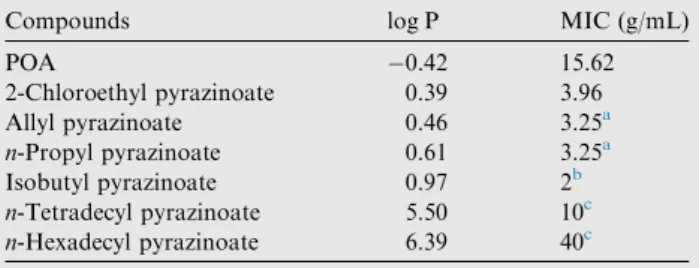
Analyzing these previous works, it is possible verify a strong positive relationship of the side chain of the esters (and also its lipophilicity) with the antimycobacterial activity. The higher the side chain, the higher is the lipophilicity and higher the antimycobacterial activity. Regarding this, in coun-terpart, it is possible to verify that lower chain derivatives show similar activity than the higher chain derivatives ( Ta-ble 2). This can be explained by the excessive lipophilicity,
Table 1 MICs results for POA, cip-rofloxacin and 2-chloroethyl pyrazino-ate using the Alamar Blue (MABA) technique.
Compounds MIC (g/mL)
POA 15.62
Ciprofloxacin 3.96
2-Chloroethyl pyrazinoate 3.96
2-chloroethyl pyrazinoate
allyl pyrazinoate n-propyl pyrazinoate isobutyl pyrazinoate
n-tetradecyl pyrazinoate n-hexadecyl pyrazinoate
Figure 3 POA esters.
Table 2 Log P values for the selected compounds.
Compounds log P MIC (g/mL)
POA 0.42 15.62
2-Chloroethyl pyrazinoate 0.39 3.96
Allyl pyrazinoate 0.46 3.25a
n-Propyl pyrazinoate 0.61 3.25a
Isobutyl pyrazinoate 0.97 2b
n-Tetradecyl pyrazinoate 5.50 10c
n-Hexadecyl pyrazinoate 6.39 40c
a
Obtained from Ref.Franzblau et al. (1998).
b
Obtained from Ref.Klopman et al. (1994).
c
which reduces the water solubility, becoming more difficult the diffusion through the bacterial cell wall, and compromising the usefulness of these compounds as future drugs. Thus, mole-cules with low log P and adequate MIC should be considered as more promising. Considering this, the 2-chloroethyl pyraz-inoate can be defined as a promising compound, since its log P is lower than derivatives with similar activity.
It is concluded that the 2-chloroethyl pyrazinoate can be synthesized by an efficient one-pot procedure, with high yield and adequate purity. Moreover, it can be considered a prom-ising alternative as prodrug with activity in PZA resistant strains.
Acknowledgements
The authors are grateful to FAPESP, PROPE and CNPq for the financial support of this work.
References
Barry, C.E., Lee, R.E., Mdluli, K., Sampson, A.E., Schroeder, B.G., Slayden, R.A., Yuan, Y., 1998. Mycolic acids: Structure, biosyn-thesis and physiological functions. Progr. Lipid Res. 37, 143–179.
http://dx.doi.org/10.1016/S0163-7827(98)00008-3.
Bergmann, K.E., Cynamon, M.H., Welch, J.T., 1996. Quantitative structure-activity relationships for the in vitro antimycobacterial activity of pyrazinoic acid esters. J. Med. Chem. 39, 3394–3400.
http://dx.doi.org/10.1021/jm950538t.
Brennan, P.J., Nikaido, H., 1995. The envelope of mycobacteria. Annu. Rev. Biochem. 64, 29–63. http://dx.doi.org/10.1146/ annurev.biochem.64.1.29.
Chemaxon Corporation Ltd., 2011. Marvin version 5.5.1. Budapest. Chung, M.C., Ferreira, E.I., Santos, J.L., Giarolla, J., Rando, D.G.,
Almeida, A.E., Bosquesi, P.L., Menegon, R.F., Blau, L., 2008. Prodrugs for the treatment of neglected diseases. Molecules 13, 616–677.http://dx.doi.org/10.3390/molecules13030616.
Cynamon, M.H., Klemens, S.P., Chou, T.S., Gimi, R.H., Welch, J.T., 1992. Antimycobacterial activity of a series of pyrazinoic acid-esters. J. Med. Chem. 35, 1212–1215. http://dx.doi.org/10.1021/ jm00085a007.
Cynamon, M.H., Gimi, R., Gyenes, F., Sharpe, C.A., Bergmann, K.E., Han, H.J., Gregor, L.B., Rapolu, R., Luciano, G., Welch, J.T., 1995. Pyrazinoic acid-esters with broad-spectrum in-vitro antimycobacterial activity. J. Med. Chem. 38, 3902–3907.http:// dx.doi.org/10.1021/jm00020a003.
Fernandes, J.P.S., Felli, V.M.A., 2009. Evaluation of influence of base and alkyl bromide on synthesis of pyrazinoic acid esters. Quı´m. Nova 32, 2464–2466. http://dx.doi.org/10.1590/S0100-40422009 000900040.
Fernandes, J.P.S., Pasqualoto, K.F.M., Felli, V.M.A., Ferreira, E.I., Brandt, C.A., 2010. QSAR modeling of a set of pyrazinoate esters as antituberculosis prodrugs. Arch. Pharm. 343, 91–97. http:// dx.doi.org/10.1002/ardp.200900216.
Franzblau, S.G., Witzig, R.S., Mclaughlin, J.C., Torres, P., Fuentes, P., Cook, M.B., Madico, G., Hernandez, A., Degnan, M.T.,
Quenzer, Ferguson, R.M., Sheen, P., Gilman, R.H., 1998. Rapid, low-technology MIC determination with clinical Mycobacterium tuberculosisisolates by using the microplate Alamar Blue assay. J. Clin. Microbiol. 32, 362–366.
Klopman, G., Li, J.Y., Wang, S.M., Dimayuga, M., 1994. Computer automated log P calculations based on an extended group-contri-bution approach. J. Chem. Inf. Comput. Sci. 34, 752–781.http:// dx.doi.org/10.1021/ci00020a009.
Konno, K., Feldmann, F.M., McDermott, W., 1967. Pyrazinamide susceptibility and amidase activity of tubercle bacilli. Am. Rev. Res. Dis. 95, 461–469.
Kushner, S., Dalalian, H., Sanjurjo, J.L., Bach, F.L., Safir, S.R., Smith, V.K., Williams, J.H., 1952. Experimental chemotherapy of tuberculosis.2. The synthesis of pyrazinamides and related com-pounds. J. Am. Chem. Soc. 74, 3617–3621. http://dx.doi.org/ 10.1021/ja01134a045.
Liu, J., Barry, C.E., Besra, G.S., Nikaido, H., 1996. Mycolic acid structure determines the fluidity of the mycobacterial cell wall. J. Biol. Chem. 271, 29545–29551.
March, J., 1992. Advanced Organic Chemistry: Reactions. Mecha-nisms and Structure. John Wiley & Sons, New York.
Seitz, L.E., Suling, W.J., Reynolds, R.C., 2002. Synthesis and antimycobacterial activity of pyrazine and quinoxaline derivatives. J. Med. Chem. 45, 5604–5606. http://dx.doi.org/10.1021/jm0203 10n.
Simo˜es, M.F., Valente, E., Go´mez, M.J.R., Anes, E., Constantino, L., 2009. Pyrazinoic acid-esters with broad-spectrum in-vitro antimy-cobacterial activity. Eur. J. Pharm. Sci. 37, 257–263. http:// dx.doi.org/10.1016/j.ejps.2009.02.012.
Sirturo, 2013. Sirturo (bedaquiline) official website. < http://www.sir-turo.com> (accessed in 30 09 2013).
Solomons, I.A., Spoerri, P.E., 1953. Esters of pyrazinoic and pyrazine-2,3-dicarboxylic acids. J. Am. Chem. Soc. 75, 679–681. http:// dx.doi.org/10.1021/ja01099a049.
Syracuse Research Corporation, 1994. Physical/Chemical Property Database (PHYSPROP). SRC Environmental Science Center, Syracuse.
Viswanadhan, V.N., Ghose, A.K., Revankar, G.R., Robins, R.K., 1989. Atomic physicochemical parameters for 3 dimensional structure directed quantitative structure-activity relationships. 4. Additional parameters for hydrophobic and dispersive interactions and their application for an automated superposition of certain naturally-occurring nucleoside antibiotics. J. Chem. Inf. Comput. Sci. 29, 163–172.http://dx.doi.org/10.1021/ci00063a006.
WHO, World Health Organization, 2012. Global Tuberculosis Report 2012. WHO Press, Geneva.
Working Group on New TB Drugs, 2013. < http://www.newtb-drugs.org> (accessed 30.09 2013).
Zhang, Y., Wade, M.M., Scorpio, A., Zhang, H., Sun, Z.H., 2003. Mode of action of pyrazinamide: disruption of Mycobacterium tuberculosis membrane transport and energetics by pyrazinoic acid. J. Antimicrob. Chemother. 52, 790–795.http://dx.doi.org/10.1093/ jac/dkg446.