FUNDAÇÃO
GETUliO VARGAS
FGV
SEMINÁRIOS DE PESQUISA
ECONÔMICA DA EPGE
A general test for rule of Thumb behavior
JOÃO VICTOR ISSLER
(EPGE/FGV)
Data: 17/05/2007 (Quinta-feira)
Horário: 16h
Local:
Praia de Botafogo, 190- 11° andar Auditório n° 1
Coordenação:
A General Test for Rule-of-Thumb Behavior
Fabio A. Reis Gomes (CEPE-MG and IBMEC-MG)
João Victor lssler (EPGE- Getulio Vargas Foundation)
• Consumption is about 70% of GDP. Because of its the size, finding sub-optimal behavior in consumption decisions can cast a serious doubt on whether optimizing behavior is a framework applicable on an economy-wide scale, which, in turn, can challenge whether it is applicable at ali.
• Rule-of-Thumb behavior questions optimal behavior for consumption. Camp-bell and Mankiw(1989, 1990): 50% of ali U.S. consumers follow the rule-of-thumb behavior of consuming their current income, not their permanent
• In econometric tests, usually we have auxiliary assumptions whenever a specific hypothesis test is being conducted. In Campbell and Mankiw's case, the auxiliary assumption is the validity of the first-order log-linearized version of the Euler Equation for optimizing consumers. Rejecting the nu li that there is no rule-of-thumb behavior in this context may be due to the fact that the first-order log-linearized approximation of the Euler Equation
This Paper:
セ@ We first show that, from a theoretical point-of-view, previous tests for Rule-of-Thumb behavior were inconsistent. This is based on an expansion of the basic non-linear euler equation for consumption.
セ@ We then propose a novel framework that encampasses:
Possible Rule-of-Thumb behavior in consumption for a fixed proportion
À of the population. General test for À = O.
Possible habit formation for agents whose behavior is optimal.
This Paper (Contd.):
Motivation
e Huge discrepancy between time-series versus panel-data empirical studies in the consumption literature, suggesting the existence of aggregation bias.
e Mulligan(2002) uses a linear framework to study the effects of real return aggregation on intertemporal substitution. He comes up with new mea-sures for the after-tax return to aggregate capital, which are associated with reasonable and precise estimates of the intertemporal marginal rate of substitution in consumption.
M otivation ( Contd.)
Related Research
e Large early literature using time-series data on consumption: Ha11(1978, 1988), Flavin(1981, 1993), Mankiw(1981), Hansen and Singleton(1982, 1983, 1984), Mehra and Prescott(1985), Campbell (1987), Campbell and Deaton(1989), and Epstein and Zin(1991).
e Whole literature on Rule-of-Thumb behavior following H ali and Mishkin(1982) and subsequent work in Campbell and Mankiw (1989, 1990).
Related Research ( Contd.)
Theory
Pricing Equation:
lEt { Mt+lxi,t+l}
=
Pi,t' i=
1, 2, ... , N, or (1)IEt { Mt+lRi,t+l} = 1, i = 1, 2, ... , N, (2) where IEt( ·) denotes the conditional expectation given the information available at time t, Mt is the stochastic discount factor, Pi t denotes the price of the
'
i-th asset at time t, xi t+l denotes the payoff of the i-th asset in t
+
1,Ri,t+l
=
クセエKャ@
denotes 'the gross return of the i-th asset int
+
1, and N is the numberセヲ@
assets in the economy.Assumption 1: The Pricing Equation (2) holds.
• Assumption 1 is present, either implicitly or explicitly, in virtually ali stud-ies in macroeconomics dealing with asset pricing and intertemporal sub-stitution; see, e.g., Hansen and Singleton (1982, 1983, 1984), Mehra and
Prescott (1985), Epstein and Zin (1991), Attanasio and Browning (1995), Lettau and Ludvigson (2001) and Mulligan (2002).
• "Assumption" 2 is required because we will take logs of Mt. Ali CCAPM studies implicitly assume Mt >O, since Mt =
ヲSオセHH」エIL@
>O, where ct isCt-1
consumption, {3 E (0, 1) and U1
Taylor expansion around x, with increment h, as follows:
h2ex+À(h)·h
ex+ hex
+
,
with .\(h) :IR-+ (0,1),
or, (3) 2ex+h
e h
1+h+
h2eÀ(h)·h-
'
(4)
Let h= ln(MtRi,t) to obtain:
[ln(MtRi
t)]
2 eÀ(In(MtRi,t))·ln(MtRi,t)MtRi,t
= 1+
ln(MtRi,t)
+
'
2 . (5)
The behavior of
MtRi t
,
is governed solely by that ofln(MtRi t).
' which moti-vates our next assumption.Assumption 3: Let
Rt
= (R1 t, R2 t,...
RN t)'
be an N x 1 vectorstack-' ' '
Higher-order term in (5):
z·
2,t
_.
2 l x [ln(M .t 2,t
R· )] 2 e,\(ln(MtRi,t))·ln(MtRi,t).Taking the conditional expectation of both sides of (5), imposing the Pricing Equation and rearranging terms, gives:
IEt-1 {
MtRi,t}
IEt-1 (
Zi,t)
1
+
IEt-1 {ln(MtRi,t)}
+
IEt-1 (zi,t)
,
or,-IEt-1
{ln(MtRi,t)}.
(6)
(7)
Equation (7) shows that behavior of the conditional expectation of the higher order terms depends only on that of IEt-1
{ln(MtRi,t)
}.
Sinceln(MtRi,t)
is covariance stationary, IEt-1 (
Zi,t)
will be a linear function of the laggedz· 2, t 2
1
X [ln(M t 2,t R· )] 2 e,\(ln(MtRi,t))·ln(MtRi,t)>
_O
1 implies 1Et-1 ( Zi,t) 'Yi,t 2
>
O.2- ( 2 2 2 )' - ( )'
Let '"'ft
=
'Y1,t, 'Y2,t , ... , "YN,t and ct=
E1,t, c2,t, ... , EN,t stack respec-tively the conditional means 'Y'i-t and the forecast errors Ei t = ln(MtRit)-(J' ' '
Et-1 {ln(MtRi,t) }.
From the definition of E:t and (6) we have:
Denoting
rt
= In(Rt),
with elements ri,t· and mt = In (Mt) in (8), and usingIEt-1 ( zi,t) = -IEt-1 { ln(MtRi,t) }we get:
mt = -ri,t - IEt-1 ( Zi,t)
+
Ei,t, i = 1, 2, ... , N.(9)
To connect this results with optimal consumption behavior we impose Mt =
{3
r
NZセイアャ@
.
.ó.ln (
ct)
= In,B
+_!_r.+
IE!t-1 ( Zi,t) Ei,t• lEt-lJzi,t) captures the effect of the higher-order terms of the taylor
expan-sion. lt will be a function of the variables in the conditioning set used by the econometrician to compute
IEt-1 (-).
• Omission of
QeエMャセコゥLエI@
in estimating (10) will generate an omitted-variable bias. The same is true of transformations of (10), in general.• lf {
Mt+lRi,t+l}
is not log-Normal, using log-normality to solve forRule of Thumb Behavior
セ@ Campbell and Mankiw (1989), following Hall and Mishkin(1982), proposed incorporating rule of thumb behavior to the optimizing model.
セ@ Credit constrained consumers (Cushing, 1992) consume their current in-come, q t
=
Yl t=
Àyt, where Yt is aggregate income.' '
セ@ À is the fraction of the total income which belongs to restricted consumers.
When À
=
1 there are only rule of thumb consumers and when À=
O ali consumers follow optimizing behavior.セ@
Use weight À to compute llln (ct)
rv Àllln ( C!,t)+
(1 - À) llln ( C2,t) rwhere
ct
=
q t+
c2 t• and Yt=
Yl t+
Y2 t·Rule of Thumb Behavior (Contd.)
Combine now
f),. I n ( c2,
t)
T
In (3+
1 IEt-1(zi,t)
E:i,t
4
/i,t
+
c/J --;j;'
i= 1, 2, ... , N, with,I::!,. In (
ct)
r-v .\I::!,. In (C!,t)+
(1-
.\)I::!,. In (c2,t), to get,r-v .Xbs.ln
(Yt)
+
(1 -
.X) I::!,. In ( c2,t)I::!,. In (
Ct)
MM]MH
QセMNx⦅[⦅I@
In (3+
.\I::!,. In(Yt)
+ (
1 - .X)ri t
+ (
1 - .X)IEt-1(zi
t)cjJ cjJ ' cjJ . '
(1-
.X) .-
E:i
t• ali セN@Econometrics
bt..ln
(ct)
MBMMH
QセMN|MGMI@
In ,8+
.\bt..ln(Yt)
+ (
1-.\)ri t
+ (
1 - .\)lEt-1(zi t)
4Y 4Y , 4Y ,
(1- .\)
- 4Y
Ei,t•
a 11 i.• lf the term
H
QセL|IャeエMQ@
(zi,t)
is omitted, (almost?) every instrument used in the past to estimate this equation is invalid.Econometrics ( Contd.)
.ô.ln (
ct)
⦅H
QセM⦅I@
In,6
+
À.Õ.in(Yt)
+ (
1-À)
rit
+ (
1 - À)lEt-1(zi
t)
cp
cp
'
cp
'
(1-
À)
- - é ' t
-
cp
'/,)
I i = 1, 2, ... ,N.
Econometrics ( Contd.)
• Since, in principie, the number of assets can go to infinity, i.e., N --+ oo,
unless T --+ oo at rate N 2 , estimating the whole system is unfeasible.
Most of the literature did not take this issue seriously and opted to let
N = 2: a risky and a "riskless" asset.
• This procedure is suboptimal compared to estimating the system as a whole.
• An alternative to estimating the system as a whole is cross-sectional ag-gregation: Mulligan(2002), where in principie we do not throw away useful
information contained in ri t• i = 1, 2, ... , N.
Stylized Version of Mulligan(2002): Cross-sectionally aggregate
Llln
(ct)
MGMH
QセM⦅I@
In/3
+
Àilln(yt)
+ (
1-À)
Ti t
+ (
1 - À)IEt-1(zi t)
セ@ セ@ ' セ@ '
(1-
À)
.
.
- si t. ali セN@ to obtam,
セ@ '
Llln
(ct)
(1-À)
In/3
+
Àilln(yt)
+ (
1-À)
Tt
+ (
1 - À)IEt-1(zt)
セ@ セ@ セ@
(1 -
À)
セ@ ct,
N
where
Tt
= N1 2:::::Ti t
is the logarithmic return to aggregate capital,zt
. 1 '
2=
1 N 1 N
N . 1 ' 2::::: Zi t. ct = N . 1 ' 2::::: éi t·
• Despite having a properly aggregated model, we have to take into account the term
HャセIャeエMャ@
(zt)-• lgnoring
HャセIャeエMQ@
(zt)
will also generate an omitted regressar problem under IV estimation, just as before. This happens whether or not À=
O.• Mulligan (2002) estimates the above regression imposing À = O.
Habit Formation
Consider now the extended CRRA utility, with habit formation,
U
(C[,
Cf-1)
=(C[
-
f'Ct1) 1-cp
1-cp
(11)
We let (o) stand for an optimizing consumer, and
(r)
stand for a credit-constrained consumer whose consumption isct;
= À.Yt· As before,o+
rct=Ct Ct·
lnstead of considering the response of consumption to ali i = 1, 2, ... , N,
As in Weber(2002), solve for consumption of the optimizing consumer:
o- \
Ct - ct - AYt·
Habit Formation and General Rule-of-Thumb
Use the nonlinear euler equation as in Weber(2002). Use here the return to
aggregate capital. Then we encompass habit formation and rule-of-thumb in a
very general framework, with proper cross-sectional aggregation:
Et-1
( cf-1- 'fCf-2)
-<P-f3
(
cf- 'Ycf-1)
-<Ph+
Rt]+'Jf3
(
cf+1- 'Ycf)
-<P RtSubstituting in
cf
= Ct- ÀYt we obtain:[( ct-1 -
ÀYt-Ü -'Y (
Ct-2 - ÀYt-2)]-<P=
o,
(12)
Et-1
<
-{3 [(ct-
Àyt) -'Y ( ct-1 -
ÀYt-1)]-<Ph+
Rt]t
= O. (13)Obtaining (12) and (13): cross-sectional aggregation of:
E J ( cf-1 - --ycf-2)
-r/J
-
f3
(
cf - --ycf-1)-r/J
[
'"Y+
Ri,t]t-1\ (
)-c/J
+--r/3
cf+1 - --ycf Ri,to
1, 2, ... , N. and,
.
'l
[(ct-1- ÀYt-1)- '"Y (ct-2- ÀYt-2)]-cP
O = Et-1
<
-j3 [(ct- Àyt)- '"Y (ct-1- ÀYt-Ü]-cP[--r+
Ri,t]+--r/3
[(
Ct+1 - ÀYt+1) - '"Y ( ct - Àyt)]-cP Ri,tz = 1,2, ... ,N.
N N
where Rt
=
L
wi t ·Ri t• whereL
wi t=
1, for alit.
. 1 ' ' . 1 '
H a bit Formation and Rule-of-Thumb ( contd.)
e lf there is no habit formation for the optimizing agent, "f = O, we obtain:
f3Et-1
I (
ct
-
ÀYt )-c/J
Ct-1 - ÀYt-1 Rt
I
= 1(14)
e lf there is no rule-of-thumb behavior, but there is habit formation, we obtain:
[ct-1 - "fCt-2]-c/J
Et-1 { -{3
[ct-
"fCt-1]-cP[I+
Rt]
+"tf3 [ct+1 -
"tct]-cP
Rt• lf there is neither rule-of-thumb nor habit formation, we obtain:
(
ct )
-c/J
f3Et-1
I
RtI
= 1.Our Contribution:
e Regarding Weber(2002): we deal with cross-sectional aggregation of asset returns. No information is thrown away by limiting the number of as-sets. lndeed, we use Mulligan's(2002) capital rental rate after income and
property taxes as a measure of Rt.
e Regarding Mulligan(2002): We deal with non-linearity, Rule-of-Thumb, and Habit Formation.
セ@ Cross sectional aggregation is properly taken care of by using the return to
aggregate capital and not a system of euler equations. This can be done beca use the euler equations are LINEAR on
Ri
t, i= 1, 2, ... ,N,
despite'
being non-linear on other variables and parameters.
セ@ The nonlinear equation is key to our study. Estimating it directly allows
us to encompass ali high-order terms: General Rule-of-Thumb test and a General test for Habit Formation.
セ@ The general model is ali in terms of observables. lt encampasses habit for-mation for the optimizing agent, ry
#-
O, as well as rule-of-thumb behavior for the credit-constrained consumer, À#-
O.セ@ Estimation of (3, cjJ and À is performed using GMM. Habit formation and
Data
• Annual frequency form 1947 to 1997.
• US Nationallncome and Product Account (NIPA) and from the US Census Bureau: real disposable personal income, real consumption of nondurable and services and real consumption of non-durables, and population.
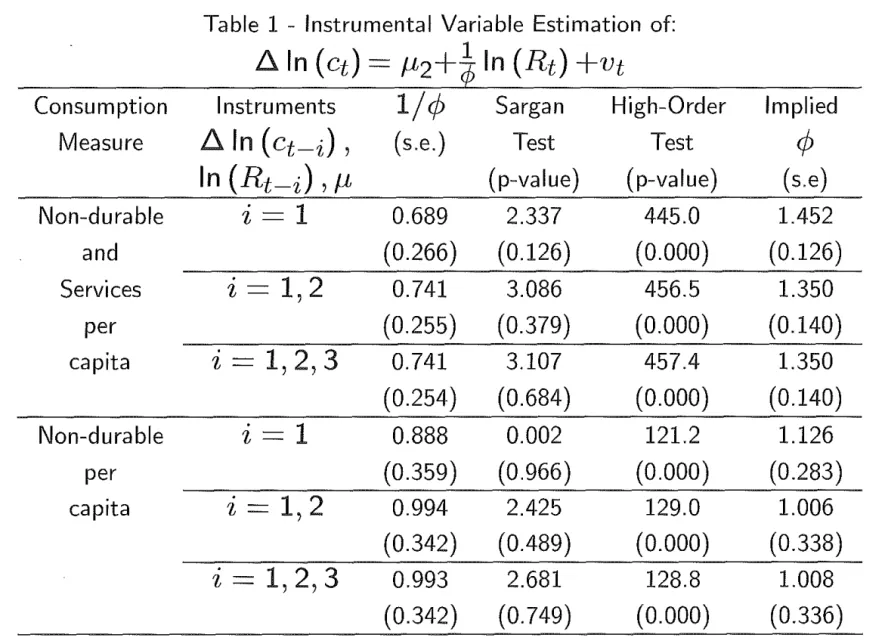
Table 1 - Instrumental Variable Estimation of:
f:::. In (
ct)
=JL2+
à
In (Rt) +vt
Consumption I nstru ments 1/c/J Sargan High-Order lmplied Measure L::::. In (
Ct-i)
,
(s.e.) Test Test cPIn
(Rt-i), JL
(p-value) (p-value) (s.e)Non-durable i= 1 0.689 2.337 445.0 1.452
and (0.266) (0.126) (0.000) (0.126)
Services i -- 1 2 ' 0.741 3.086 456.5 1.350
per (0.255) (0.379) (0.000) (0.140)
capita i = 1, 2, 3 0.741 3.107 457.4 1.350 (0.254) (0.684) (0.000) (0.140)
Non-durable i= 1 0.888 0.002 121.2 1.126
per (0.359) (0.966) (0.000) (0.283)
capita i -- 1 2
'
0.994 2.425 129.0 1.006 (0.342) (0.489) (0.000) (0.338)Table 2 - Instrumental Variable Estimation of:
.ó.ln (
ct)
= À.Ó.In(yt)
+
(1- À)HセQ@
+
à
In(Rt)
+
Vt)
Cons. lnst. (1- À)
/c/J
À Sargan Hi.-Order lmpl.Meas. .ó.ln (ct-i) (s.e.) (s.e.) Test Test cjJ
In
(Rt-i)
(p-val.) (p-val.) (s.e).ó. In
(yt_i) ,
cNon-dur. i=1 0.496 0.199 2.680 104.2 1.616
and (0.322) (0.238) (0.102) (0.000)
Serv. i= 1, 2 0.389 0.300 3.570 151.0 1.799
per (0.264) (0.149) (0.467) (0.000)
capita i = 1, 2, 3 0.322 0.341 7.183 163.3 2.044
(0.255) (0.141) (0.410) (0.000)
Non-dur. i=1 0.667 0.238 0.001 14.90 1.125
per (0.691) (0.635) (0.980) (0.002)
capita i - 1 2 -
'
0.361 0.559 0.955 102.3 1.223(0.374) (0.225) (0.917) (0.000)
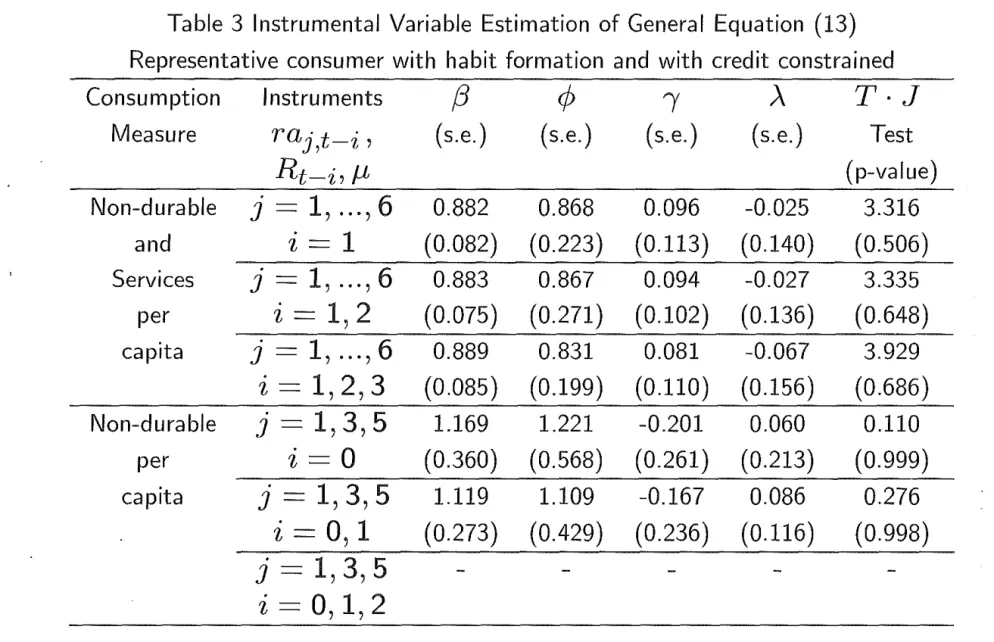
Table 3 Instrumental Variable Estimation of General Equation (13) Representative consumer with habit formation and with credit constrained
Consumption lnstruments j3
q;
"( À T·JMeasure raj,t-i' (s.e.) ( s.e.) (s.e.) (s.e.) Test
Rt-i, f.L (p-value)
Non-durable j=1, ... ,6 0.882 0.868 0.096 -0.025 3.316
and i= 1 (0.082) (0.223) (0.113) (0.140) (0.506)
Services j=1, ... ,6 0.883 0.867 0.094 -0.027 3.335
per i= 1 2
'
(0.075) (0.271) (0.102) (0.136) (0.648)capita j=l, ... ,6 0.889 0.831 0.081 -0.067 3.929
i=1,2,3 (0.085) (0.199) (0.110) (0.156) (0.686)
Non-durable j=1,3,5 1.169 1.221 -0.201 0.060 0.110 per i=O (0.360) (0.568) (0.261) (0.213) (0.999) capita j = 1, 3, 5 1.119 1.109 -0.167 0.086 0.276
i=
o,
1 (0.273) (0.429) (0.236) (0.116) (0.998)j = 1,3,5
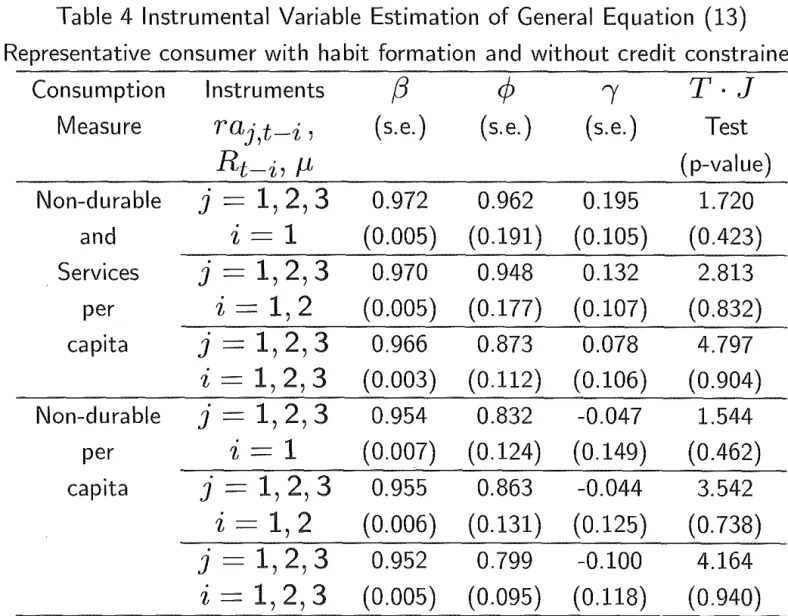
Table 4 Instrumental Variable Estimation of General Equation (13)
Representative consumer with habit formation and without credit constrained
Consumption lnstruments (3
cp
ry T·JMeasure raj,t-i' (s.e.) (s.e.) (s.e.) Test
Rt-i, p, (p-value)
Non-durable j
= 1,2,3
0.972 0.962 0.195 1.720 andi= 1
(0.005) (0.191) (0.105) (0.423) Services j= 1, 2, 3
0.970 0.948 0.132 2.813per
i- 1 2
-'
(0.005) (0.177) (0.107) (0.832) capita j= 1,2,3
0.966 0.873 0.078 4.797i= 1,2,3
(0.003) (0.112) (0.106) (0.904) Non-durable j= 1,2,3
0.954 0.832 -0.047 1.544per
i=1
(0.007) (0.124) (0.149) (0.462) capita j= 1, 2, 3
0.955 0.863 -0.044 3.542i- 1 2
-'
(0.006) (0.131) (0.125) (0.738)j
= 1,2,3
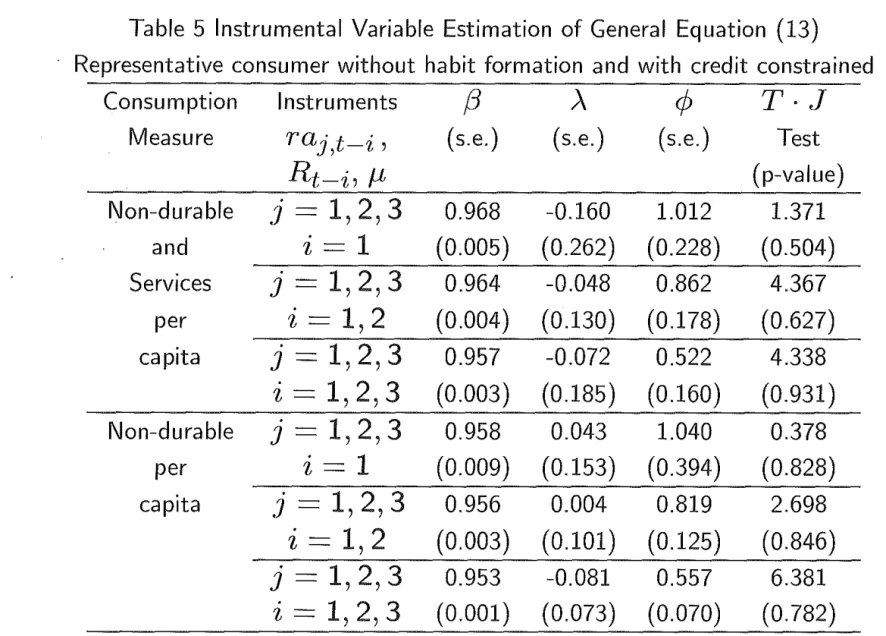
0.952 0.799 -0.100 4.164Table 5 Instrumental Variable Estimation of General Equation (13)
· Representative consumer without habit formation and with credit constrained
Consumption lnstruments fJ À
cp
T·JMeasure raj,t-í' (s.e.) ( s.e.) (s.e.) Test
Rt-í, fL (p-value)
Non-durable j = 1,2,3 0.968 -0.160 1.012 1.371
and i= 1 (0.005) (0.262) (0.228) (0.504)
Services j = 1,2,3 0.964 -0.048 0.862 4.367
per i - 1 2 -
'
(0.004) (0.130) (0.178) (0.627)capita j=1,2,3 0.957 -0.072 0.522 4.338
i=1,2,3 (0.003) (0.185) (0.160) (0.931)
Non-durable
j
= 1,2,3 0.958 0.043 1.040 0.378 per i=1 (0.009) (0.153) (0.394) (0.828) capitaj
= 1,2,3 0.956 0.004 0.819 2.698i -- 1 2
'
(0.003) (0.101) (0.125) (0.846)j
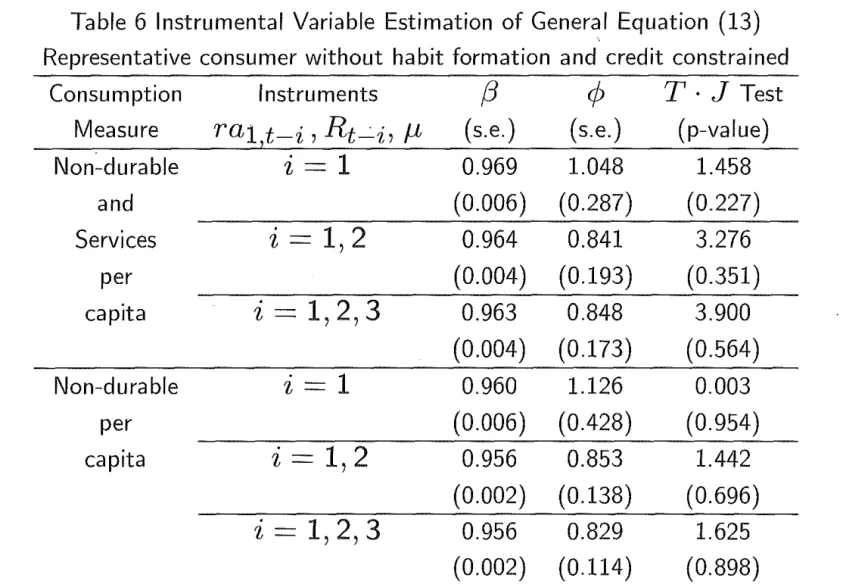
= 1,2,3 0.953 -0.081 0.557 6.381Table 6 Instrumental Variable Estimation of General Equation (13) Representative consumer without habit formation and credit constrained
Consumption lnstruments (3
cP
T · J Test Measure ra1 t-i , Rt__:_i, /L (s.e.) (s.e.) (p-value)Non-durable i= 1 0.969 1.048 1.458
and (0.006) (0.287) (0.227)
Services i= 1, 2 0.964 0.841 3.276
per (0.004) (0.193) (0.351)
capita i=1,2,3 0.963 0.848 3.900
(0.004) (0.173) (0.564)
Non-durable i= 1 0.960 1.126 0.003
per (0.006) (0.428) (0.954)
capita i= 1, 2 0.956 0.853 1.442
(0.002) (0.138) (0.696)
i=1,2,3 0.956 0.829 1.625
llllllllllllllllllll/1 11111
(BIBLIODATA)BB002936753
f I