FUNDAÇÃO GETULIO VARGAS
ESCOLA BRASILEIRA DE ADMINISTRAÇÃO PÚBLICA E DE EMPRESAS MESTRADO EXECUTIVO EM GESTÃO EMPRESARIAL
IMPLICATIONS OF INNOVATION FOR INCLUSIVE GROWTH:
A STUDY OF MEDELLIN, COLOMBIA'S METRO SYSTEM AND
INTEGRAL URBAN PROJECTS
DISSERTAÇÃO APRESENTADA À ESCOLA BRASILEIRA DE ADMINISTRAÇÃO PÚBLICA E DE EMPRESAS PARA OBTENÇÃO DO GRAU DE MESTRE
SAMANTHADOLS
IMPLICATIONS OF INNOVATION FOR INCLUSIVE GROWTH: A STUDY OF MEDELLIN, COLOMBIA'S METRO SYSTEM AND INTEGRAL URBAN PROJECTS
Master's thesis presented to Corporate International Master's program, Escola Brasileira de Administracao Publica,
Fundacao Getulio Vargas, as a requirement for obtaining the title o f Master in Business
Management.
ADVISOR: PAULO NEGREIROS FIGUEIREDO
Dois, Samantha
Implications of innovation for inclusive growth: a study of Medellín, Colombia's
metro system and integral urban projects
I
Samantha Dois. - 2015.56 f.
Dissertação (mestrado)- Escola Brasileira de Administração Pública e de Empresas, Centro de Formação Acadêmica e Pesquisa.
Orientador: Paulo Negreiros Figueiredo. Inclui bibliografia.
1. Políticas públicas- Medellín (Colômbia). 2. Inovações tecnológicas- Medellín
(Colômbia). 3. Política urbana- Medellín (Colômbia). 4. Planejamento urbano-Medellín (Colômbia). I. Figueiredo, Paulo N. (Paulo Negreiros). II. Escola Brasileira de Administração Pública e de Empresas. Centro de Formação Acadêmica e Pesquisa. III. Título.
セ fgv@
SAMANTHA JEAN DOLS
IMPLICATIONS OF INNOVATION FOR INCLUSIVE GROWTH: A STUDY OF MEDELLIN, COLOMBIA'S METRO SYSTEM AND INTEGRAL URBAN PROJECTS ..
Dissertação apresentada ao Curso de Mestrado Profissional Executivo em Gestão
Empresarial da Escola Brasileira de Administração Pública e de Empresas para
obtenção do grau de Mestre em Administração.
Data da defesa: 19/10/2015
ASSINATURA DOS MEMBROS DA BANCA EXAMINADORA
Paulo César Negreiros de Figueiredo
Orientador (a)
Roberto da Costa Pimenta
Acknowledgements ... ii
List o f lllustrations ...... iii
Abstract .... iv
I. Chapter One: Introduction .... I I.I Topic Area .......... I I. 2 Research Question & Objectives ......... .3
I.3 The Following Chapters ...... 4
2. Chapter Two: Literature Review ...... 5
2.I Inclusive Growth ...... 5
2.2 Inclusive Innovation ...... 6
2.3 Social Capital ... IO 2.4 Inter/ocking Concepts ......... I3 3. Chapter Three: Conceptua/ Framework .......... I5 3.I Framing Inclusive Growth with Economic and Social Capital ... .15
3.2 Role of Inclusive Innovation on Inclusive Growth ......... I7 3.3 Asia Development Bank ......... I8 3.4 Synthesized Frameworkfor Measuring Inclusive Growth .......... I9 3.5 Definingthe Terms ... 19
4. Chapter Four: Study Context ......... 22
4.1 WhyMedellín? ...... 22
4.2 Specific Inclusive Innovations in Medellin ......... 27
4.3 Three Neighborhoods of Focus in Medellín ... 30
5. Chapter Five: Methodology ......... 35
6. Chapter Six: Ma in Findings ... 3 7 6.I Implications.fiom the Metro System and Integral Urban Projects .......... 38
6.2 Measuring Inclusive Growth with Synthesized Framework ......... .40
7. Chapter Seven: Conc/usion .......... 50
7.1 Limitations ....... 50
7.2 Suggestions for Further Research ....... 54
8. Bibliography ......... 56
9. Appendices ... 65
Appendix I Survey for Medellín Residents ... 65
Acknowledgements
List o
f
Illustrations
Illustration 1: Base o f Pyramid Breakdown as presented by ... 7
C.K. Prahalad and Stuart Hart Illustration 2: Interlocking Concepts ... 13
Illustration 3: Synthesized Framework for Inclusive Growth Measurement ... 19
lllustration 4: Map o f Metro System, Medellín ... 29
lllustration 5: Map of 5 Main Zones for Integral Urban Projects, Medellín ... 30
Illustration 6: Area Map Santo Domingo, Medellín, Metro System, Line K +L ... .31
Illustration 7: Area Map San Javier, Medellín ... .32
Illustration 8: Area Map Mora via, Medellín ... 33
Illustration 9: Metro Cable and Integral Urban Projects, Main Successes and Main Limitations ... .40
Illustration 10: Medellín GDP in US$ Millions ... .41
Illustration 11: Non-Income Poverty Measurements ... .45
lllustration 12: Access to/lnputs ofEducation Measurements ... .46
lllustration 13: Access to/lnputs ofHealthcare Measurements ... .47
lllustration 14: Social Bonds Measurements ... .48
Abstract
Medellín, Colombia continues to attract global recognition for its evolution from a crime-saturated and desegregated city to an award-winning paragon o f innovation. Two innovations in particular, the Metro System & the Integral Urban Projects, have fostered and contributed to Medellín 's inclusive growth, as indicated by a corresponding increase in both social and economic capital. Through a mixed methodology analysis ofthese two experiences, including participant observation, in-depth interviews with different industry leaders, and household surveys, this thesis explores tbe extent to which inclusive innovation has contributed to inclusive growth in Medellín. The surveys were distributed to three sensitive neighborhoods o f Medellín and apply a Synthesized Framework for measuring inclusive growth, one that includes five indicators for social capital and five indicators for economic capital, emphasizing the importance o f progression in both dimensions. By drawing on concepts o f inclusivity surfacing more
This chapter provides a broad introduction to the topic area o f the thesis, highlights the main research question and objectives, and outlines the goals for the following chapters.
1.1 Topic Area
The topic o f exploration in this thesis is that o f inclusive innovation and its capacity to contribute to inclusive growth. Dueto the vast scope ofthe fundamental terms at play, this study focuses on two initiatives led by the local government o f Medellín, Colombia, in order to obtain a holistic understanding of two specific experiences - from the contributing factors to the innovations, the resulting growth in social and economic capital, and the existing and potential obstacles for increasing impact. Discussions surrounding inclusive growth are becoming increasingly commonplace in the domains of ethical business strategy, social entrepreneurship, and urban development. A consequence o f a burgeoning consciousness in the corporate sector,
leaders are starting to "look at the poor not as mendicants and beneficiaries o f philanthropy but consumers and business partners - a more sustainable approach for business involvement in reducing poverty" (Geron, Chua, Songco, 20 11). Inclusive growth is a resulto f and contributor to the global progression towards leveraging economic potentials as sustainable pathways out of poverty. (What is Inclusive Growth? 2009) Simply defined as a concept that promotes equitable opportunities for the majority ofthe labor force, inclusive growth can be a complex notion that requires a novel understanding ofthe following terms and their relationship(s) to each other: inclusive innovation, poverty, and social capital. The deconstruction o f these tenns, followed by a reintegration o f their differing definitions is essential for grasping the impact o f the
transportation and urban innovations implemented in Medellín.
instances has become a type of shorthand for "community" (Quibria 2003) is affected in the situation ofinclusive growth; the leveis oftrust, tolerance, and civic responsibility within a community o f growth are affected; the nonns o f behavior, cu!ture, and the emergence and sustainability o f informal institutions changes, whether significant!y or incrementally. And so, derived through a composite o f the models put forth by the World Bank and Asia Development Bank, and interposed with theory on social capital and the importance o f community, this thesis offers a Synthesized Framework that gives equal weight to concepts of economic and social capital.
This study will focus on Medellín, an emerging city ofroughly 2.4 million in the north-central region o f Colombia. Fonnerly known as the Most Dangerous City in the World,
academics from myriad industries are studying Medellín in an effort to understand the nexus of movements contributing to its evolution. (Gold, 2014) Advances in education, overall qua!ity of Iife, and an arguably newfound political stability, make Medellín the preferred corporate business destination in South America and the future host si te for the Global Entrepreneurship Congress in March 2016. (Gold, 2014) In the past 5 years, the city has receíved a surplus ofawards,
including the Mobílity and Transportation Strategies: Cities for Mobility Prize, Awarded by Cities for Mobility Network & the Integral Neighborhood Intervention Program- Juan Bobo Housing Solution, Dubai International Award. Since 2000, the GDP ofMedellín has experienced an average annual growth o f I 0%, a trajectory that parallels a political agenda, led in
continuance by three consecutive mayors, which prioritized social integration and multi-industry iJmovation. (City ofthe Year, 2012) Branded now as a city transformed, Medellín serves as a beacon for urban areas crippled by high crime and unemployrnent rales, tumultuous inflation, an increased number ofthe populace Iiving beneath the poverty Iine, anda concentration of drug trafficking and political corruption.
Medellín,And The Surprising Company Behind It, 2014) The unique structure ofEPM- a private company, owned by the city, with services that are paid by the city and that pays taxes like any other corporate entity- "allows EPM to play a strong role in the city's success and transfonnation ... Yet, the company's commercial position hasn't been compromised." (Wharton 2013) While this study willnot delve thoroughly into the workings ofEPM, this partnership is important to consider when looking at the transferability o f the experiences in Medellín - the congruity between the local govemment, private, and public sectors is a vital instrurnent in the success o f Medellín's evolvement.
With the global attention spotlighting the successes o f Medellín, it is important to recognize the ways in which the city still can and ought to improve. With efforts to become a "City For Life", "a powerful vision that has become a rallying cry for a people-focused approach to planning and design", the remaining political and economic problems in Medellín can be quickly overlooked. (Toderian 2014). Public spaces are being refonnatted for community-based revitalization, a cross-sector priority on civic life has emerged, policies on education, culture, and community building aim to support equity and livability, but many areas are still seen as
"stomping grounds of prostitutes and drug addicts; others are where pickpockets and thieves congrega te, or the places embroiled in gang-related violence". (Baker 2014) Specific to the two inclusive innovations analyzed in this thesis, Juan La verde, Secretary o f Mines for the
Govemment of Antioquia believes that, while progress has been made, there are still issues: "It is unwelcome in the subway system, and the cable car cannot load up bikes o f any kind; in other countries, the meter has a single wagon for these items. Plus the subway is insufficient [ with just] one Jine from south to north and another from east to west, you have to move much to get to
this."
1.2 Research Question and Objectives
Projects- this thesis captures the successes, main limitations, and areas for improvement for each ilmovation. The hope then, is that lessons obtained can bc applied to further discussions
pertaining to: urban renewal o f emerging and developed cities, the role o f local govemment in leading change, and the relationship between social capital and economic capital.
1.3 The Following Clzapters
In the following chapters, I will discuss the following:
- The relevance o f the topic area o f inclusive innovation and inclusive growth
- The reasons for focusing on Medellin, Colombia and the ways in which the Metro Cable and Integral Urban Projects have impacted thrce sensitive neighborhoods
- Existing frameworks and concepts, and then offer a Synthesized Framework for measuring inclusive growth
- Through a literature review on Inclusive Innovation and Social Capital, define the terms that comprise the indicators in the Synthesized Framework
- Consolidate data collected through surveys, interviews, and participant observation to measure through the Synthesized Framework the extent to which inclusive innovation can contribute to inclusive growth in Medellin
Chapter 2: Literature Review
This chapter brings together a variety o f studies and Iiterature on inclusive growth, inclusive innovation, and social capital. The purpose isto give insight into the ideologies that exist in each area and further define the area o f study in this thesis.
2. 1 Inclusive Growth
Inclusive growth is ofhigh relevance in today's global economy, offering an opportunity to simultaneously mitigate inequalities and stimulate economic growth, when implemented successfully. (Inclusive Innovation for Inclusive Growth, 2013) Overlapping in some regards with discourse on corporate social responsibility, social inclusion, and base o f pyramid strategy, the core idea behind inclusive growth is popularizing rapidly: that "govemments and
corporations can practice growlh strategies that encompass equity, equality of opportunity, and protection in rnarket and ernployrnent transitions". (Ahmad, 2012) A repor! by lhe Comrnission on Growth and Developrnent advocates that persistent, determined focus on inclusive growlh is an irnportant policy for rnost govermnents and one o f lhe primary ingredients o f a successful development strategy. (The Growth Repor! Strategies for Sustained Growth and Inclusive Developrnent, 2008) Although rnost literature contextualizes inclusive growth to emerging economies, where the disparity between rich and poor is more significant, its strategies can also be productive in developed economies, especially in regions o f particular need. For exarnple, as explored in a study lhrough University o f Michigan 's Erb Institute, Detroit, a city whose inadequate transit service accelerated its decline and inhibited progress, can take lessons from Medellín's recognition ofpublic transportation as a precondition for social equity. "Medellín and Detroit face similar types o f challenges: both are large cities with unemployment rales o f more than 30 percent and the second-highest homicide rales in lheir respective countries. A
Development, for a country or city that has grown rapidly over a decade but has not seen substantial reduction in poverty rales, leaders may need to specifically prioritize the
inclusiveness o f its growth strategy and the equality o f opportunities for individuais and firms -this can be arguably relevant to the case ofMedellín, and the cities that are heeding its lessons; the importance oftargeting specific neighborhoods, demographics, and!or industries can help maximize the effectiveness ofplans for inclusion. (The Growth Report Strategies for Sustained Growth and Inclusive Development 2008)
Inclusiveness is a concept that encampasses equity, equality o f opportunity, and protection in market and employment transitions and should effect positively equality of opportunity in terms o f access to markets, resources, and unbiased regulatory environment for businesses and individuais. (''Inclusive Growth: Key to Identifying Development Priorities", 2012, p. 4) There are overlapping principies in analysis ofinclusive innovation and inclusive growth, two concepts that engage with the mass population in intent, process, and results, and work toward the alleviation o f poverty. The inclusion suggests ideais o f a desegregated economy and society; the delibera te inclusion o f ali demographics, including those typically marginalized, such as lhe poor, sick, displaced, or uneducated. Earlier literature on inclusive innovation
suggests that lhe inc/usion feature depends solely on the recipients of goods or services, but more recent literature, suggests inc/usion should refer to both lhe process in which lhe goods and services were created or delivered, and on lhe demographics they target. (The Innovation Policy Platfonn, n.d.) As par! ofthe Global ResearchAlliance on Inclusive Innovation, President Dr. R A Mashelkar believes "Inclusive innovation can be any innovation that leads to affordable access o f quality goods and services creating livelihood opportunities for the excluded population, primarily at the base o f the pyramid and on a long tenn sustainable basis with a significant outreach." ("Inclusive Innovation", 2014)
2.2 Inclusive Innovation
Arguably synonymous with BoP innovation, and undoubtedly highly similar, inclusive
Hart, who most famously popularized BoP strategy in The Fortune at the Bottom ofthe Pyramid. They believed " low-income markets present a prodigious opportunity for the world 's wealthiest companies- to seek their fortunes and bring prosperity to the aspiring poor", and suggested that within BoP innovation, profitability and capability - to fight poverty, integrate the marginalized, enhance community cohesion - can be achieved, effectively inciting sustainable growth in both business and social equity. (Prahalad and Hart, 2002) Considering the four billion low-income consumers who constitute the base ofthe pyramid, "new empirical measures oftheir aggregate purchasing power and behavior as consumers suggest significant opportunities for market-based approaches to better meet their needs, increase their productivity and incomes, and empower their entry into the fonnal economy." (Hammond, Allen, K.ramer et ai, 2007)
Ch>rt. 4 BoP (Bon of l'ynmid) bイッセォ、ッキョ@ :u pr .. ent•d by Probolod ond Hort
' Annu;L P.lr Caplta lncoma• Tiara Poplllat!Cin In MIIUons
Mort! Tnan $20.CQO
S 1.50C- $20.00J
lセウ ウ@ Th;ln$1.!:JC
セ AZN、yN|joiBGjZZ NNZ i[ョ@ 1"(l)C ... 、セNエイエZエBGjセAᆳ
.:.r.J .Jt:..ll I J ' '.\':;•IJ 1.:''-"-1111'-»""""'t fir)Crh.
75-lOD
2&3 1.500-i .75C
4 4.000
lllustration 1: Base o f Pyramid Breakdown as presented by C.K. Prahalad and Stuart Hart
and Hart, 2002) Suggested by Griesse (2006), "a key challenge in developing globally competitive industrialization processes isto avoid excluding the majority ofthe population, a major departure from the country's long historicallegacy ofinequality." (Hall, Jeremy, Matos, Sheehan and Silvestre, 2012) Themes ofinclusion often lack the grit and weightiness that business leaders pay attention to- but this is changing. Within the ambit o f BoP ideology, firms of all sizes, from predominately emerging economies, are adopting the philosophy of social inclusion with intentions to integrate, in meaningful ways, formerly excluded demographics in their business models.
A misconception with innovations targeted at the BoP populace is that a product or servi c e will necessarily be o f lesser value or quality, because the difference will no! be
recognizable or significant to the poor. (Sivakumaran, 2015) On the contrary, the objective ofan inclusive innovation is not to get 'less from 1ess', but instead to get 'more from less'- to hamess sophisticated science or technology or truly creative non-technological innovation to invent, design, produce and distribute quality goods and services that are also affordable for the majority o f the people. (Mashelkar, 20 12) To ensure mass affordability, inclusive innovation should be aimed at extreme reduction in both the costs o f production and distribution, and in pursuit o f sustainability, must not depend on government subsidies or procurement support systems but should work by retaining the market principies with which the private sector works comfortably. (Chakravorti, 2015)
difference between market need and demand and nltimately contributes the most shared value. (p. 4) The impact can be social, as in improved access to basic services and community
developments that increase quality o f life; economic, as in in come generation and employment; or ecological, as in renewing urban spaces and improving thc environment.
In "Inclusive lnnovation: Definition, Conceptualization and Future Research Priorities" by Richard Heeks, Mirta Amalia, Robert Kintu & Nishant Shah, the authors offer a ladder model ofinclusive innovation with intentions ofmaking dialogue, research, policy-making, practice, etc. easier for individuais and organizations to achieve, based on their unique circumstances and way o f framing inclusion. The ladder presents a set o f steps, with each succeeding step
representing a greater notion o f inclusivity in relation to innovation: Levei 1 !Jntention: an innovation is inclusive i f the intention o f that innovation is to address the needs or wants or problems ofthe excluded group; Leve/2/Consumption: an innovation is inclusive ifit is adoptcd and used by the excluded group; Levei 3/Jmpact: an innovation is inclusive if it has a positive impact on the livelihoods o f the excluded group; Levei 4/Process: an innovation is inclusive if the excluded group is involved in the development ofthe innovation, whether that be through being informed, being consulted, collaborating, being empowered, controlling; Leve! 5/Structure: an innovation is inclusive if it is created within a structure that is itself inclusive, i.e. the
understand the reach and limitations o f the concepts. Regardless o f varying academic opinions, however, inclusive growth is an undoubtedly important topic, which challenges the belief that "The Social Responsibility ofBusiness Isto Increase Its Profits" (Friedman, 1970) and offers a strategy that "marr[ies ]low cost, good quality, sustainability, and profitability at the same time". (Hart, 1999) Medellín, similarly, is becoming ever more important to examine as intemational leaders and govemments throughout Latin America are looking to the trajectory o f its practices for lessons and transferability capacity. The ideas o f affordable access, quality, and the creation o f opportunities that enhance and sustain quality o f life are fundamental in literature on inclusive innovation.
2.3 Social Capital
Because the literature put forth by the World Bank and the As ia Development Bank both emphasize the notion o f "social capital" as an important feature o f measuring Inclusive Growth, it is valuable to examine this concept in greater depth. Ofthe many resources consulted, the "Impact at the Bottom o f the Pyramid: The Role o f Social Capital in Capability Development and C01mnunity Empowennent" provides an overview most poignant and relevant to this study; its main topics include an examination o f income vs non-income poverty, the significance o f social capital in community development, and how commitrnent to such ideas by localleadership can trigger civilian transfonnation. Extrapolating from literature on BoP, development, and sociology, in particular with the concepts of capability development (Sen, 1985) and social capital (Putuam, 1995), the authors capture BoP initiatives from a community perspective, in addition to and more comprehensively than a corporate perspective. Furthermore, they
differentiate between initiatives that appear to truly help a community and those that do not (Hall et ai., 2012), and ultimately argue that any business initiative in the BoP should be evaluated based on whether it advances capability transfer and retention by (a) enhancing the social capital between a particular community and other more resource rich networks, and (b) preserving the existing social capital in the community. With an emphasis on a community-centric BoP
Ansari et ai, the authors ofthe article, support the idea that social capital can be an appropriate vehicle for developing capabilities. Capabilities are the properties o f groups as well as
individuais, and as the individual increases her capability to do certain things, she inevitably increases the capability o f the group, simply by being pari o f that group; additionally, the easier it is for that individual to transfer her knowledge, skills, capabilities to another member ofher community, the more likely it is for social capital to increase. Most poor communities have greater leveis of 'bonding' but need to foster 'bridging' social capital to enable access to important resources outside o f their usual network, including academic opportunities, employment opportunities, experts and financiai capital. (Ansari, Munir, and Gregg, 2012)
The authors recognize the importance o f reframing the BoP approach from the capability, community centric perspective. While most recent BoP approaches "mark an advance towards social and economic development by focusing on providing more employment opportunities for the BoP ... this change provides only a partia! solution to poverty alleviation." (Ansari, Munir, and Gregg, 2012) Additionally, more jobs can expand the functionings ofthe BoP community, but it does not address the problem o f rea!ly expanding capabilities within the community. And through much empirical evidence, the authors suggest that the increase ofjobs is in unskilled rather than skilled domains.
And so, in arder to increase structural diversity and enable BoP accessibility to resources, capabilities, andjobs within the skilled domain, businesses should collaborate with local
Social Capital, a concept initially pushed into the mainstream by Jacobs (1961) and Loury (1977), is vast and spans sociology, economics, organization, management, development, among other disciplines. Since economist Glenn Lonry introduced the term, roughly 2,500 papers have been published in the Social Sciences Citation Index on the topic, ones that relate social capital to higher economic growth (Knack and Keefer, 1997); higher education (Coleman,
1988); higher financia! development (Guisa, Sapienza, and Zingales, 2004); better innovative outcomes (Ak,comak. and ter Weel, 2006); lower homicide rales (Rosenfeld, Messner, and Baumer, 2001 ); lower suicide rales (Hel!iwell, 2007); better public health (Kawachi, Kim, Coutts, and Subramanian, 2004); higher value creation by firms (Nahapiet and Ghoshal, !997); and also papers that considerthe potentially adverse effects of social capital. (Fukuyama, 1995; Gambetta, 1996; Portes, 1998).
Social capital represents the idea that social networks -who people know and how they interact with each other - hold value and capacity to impact a community and economy. It encampasses the ability to exchange resources and mutual aid, pnrsue information flows and collective action, and exist with a sense of cohesion and "we" menta!ity. (Mignone, 2009) Social capital represents lhe sum o f the actual and potential resources embedded within, available through, and derived from the network o f relationships to enable coordination and cooperation for the benefit ofthe whole (Adler and Kwon, 2002; Portes, !998) As explored in "lmpact at lhe Bottom ofthe Pyramid: The Role ofSocial Capital in Capability Development and Community Empowennent", social capital can be categorized into three components: structural, network ties and features such as density and confignration; relational, trust and lhe type o f re!ationship; and cognitive, shared language, identities, beliefs, and norms. (Ansari, Munir, and Gregg, 2012, p. 4) Another type of categorization by which to understand how social capital can strengthen
community identity and give momentum to productive relationships, both personal and
common, and perhaps more necessary for low-income communities. 'Bridging' capital, which rises from peripheral ties that are often high in uni que resources and infonnation (Burt, 200 I) allows individuais to 'get ahead' and improve their situation and livelihood. (Barr, 1998; Kozel and Parker, 1998; Narayan, 1999) Also associated with the idea ofvarying leveis ofnetwork ties and the corresponding leveis o f trust, is the likelihood o f innovation. Murphy (2002) highlights the role o f trust as essential in improving the quality o f inforrnation exchange between
individuais, communities, and organizations, and thereby able to enhance innovative capabilities. Furtherrnore, Landry, Amara, and Lamari (2002) demonstrate how a finn 's social capital affects both the decision to innovate and the radicalness o f an emerging innovation.
Important to the daily survival o f poor communities (Moser, 1996; Narayan, 1995), social capital can ais o help address the survival and advancement o f a community over time. When high leveis o f trust and respect are the established norrns, a strong community can more easily communicate and coordinate in the face o f problem solving (Schafft, 1998; Varshney, 2000). Within a cohesive community, it becomes possible to collectively take advantage ofnew
opportunities by encouraging collaborations based on reciprocity, while simultaneously reducing the opportunity for opportunism and corruption (Isham, 1999).
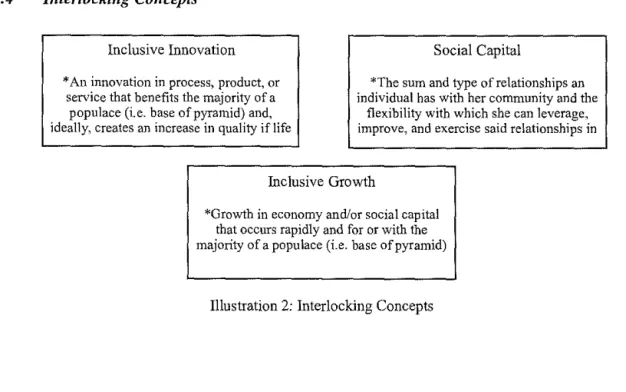
2.4 lnterlocking Concepts
Inclusive Innovation
*
An innovation in process, product, or service that benefits the majority ofa populace (i. e. base of pyramid) and, ideally, creates an increase in quality i f lifeSocial Capital
*The sum and type o f relationships an individual h as with her community and the
flexibility with which she can leverage, improve, and exercise said relationships in
Inclusive Growth
*Growth in economy and/or social capital that occurs rapidly and for or with the majority of a populace (i.e. base ofpyramid)
Chapter 3: Conceptual Framework
This chapters c1arifies the importance o f inclusive innovation on inclusive growth and presents a Synthesized Framework for examining inclusive growth. The framework gives equal weight to indicators o f both economic and social capital. I present a focused review o f inclusive growth, consider the existing framework o f measurement put forth by the Asia Development Bank, and highlight the idea o f social capital, in arder to integrate a new e1ement in to the traditional frameworks for measuring inclusive growth.
3.1 Framing Inclusive Growth with Economic and Social Capital
perspective and an explicit focus on structural transfonnation and internai migration, making the process not about immediate changes and results but about policies that lay the groundwork for sustainable growth in the future. In order to concurrently help with the alleviation ofpoverty, a high pace of growth over extended periods oftime is required, and this is achievable only when the sources o f growth are expanding and an increasing share o f the labor force is included in the growth process in an efficient way. Evidence shows that structural transforrnation and economic diversification is needed to achieve income growth and poverty reduction. (Imbs and Wacziarg, 2003)
Also essential in inclusive growth is the increase o f social capital. The World Bank suggests that social norrns and networks- social capital- are a key forrn of capital that people can use to move out ofpoverty, albeit a gradual and often prolonged process. (Grootaert and Van Bastelaer, 2001) Acting as the internai social and cultural coherence o f society, social capital is the "glue that holds societies together and without which there can be no economic growth or human well-being" (The World Bank: What is Social Capital?). The Asia Development Bank, advocates that developing human and social capital increases política! stability, raises
productivity, and enhances international competitiveness, leading to faster growth, an idea that attributes social capital with movement, the potential to drive real change in policy and economy. (Quibria, 2003)
Because the concept o f social capital is a heterogeneous one, with some experts believing it to be an individual asse! that comes from access to social connections, and others believing it to be a collective asset in the fonn o f a homogenous community with shared interests and values, the problem ofmeasurement and aggregation is significant. As stated by Dasgupta (2000, 327), "it encourages us to amalgamate incommensurable objects, namely (in that order) beliefs,
the social ramifications, related to quality oflife, increase in capabilities, improved access to education and health, as secondary and perhaps less important. The Asia Development Bank suggests a good framework that balances both dimensions. And so, considering this, and the abundance ofliterature the emphasizes the importance o f social capital, this thesis applies a Synthesized Framework for measurement o f inclusive growth that gives equal weight to progress in both economic and social capital.
3.2 Role o
f
Inclusive Innovation on Inclusive GrowthInclusive innovation is inextricably linked to inclusive growth and can engender an impactful and sustainable solution to problems of social and economic capital. (Heeks, Amalia, Kintu, and Shah, 2013) A variety ofintemational organizations are creating programs that instruct leaders, at the corporate, non-profit, and govemment leveis to pursue innovation, i. e Living Cities' "City Accelerator Guide for Embedding Innovation in Local Govemment" (2015), The European Commission's 'The Smart Guide to Service Innovation' (2013), and the United Nations Economic and Social Commission of Asia and the Pacific's "Managing Innovation in a Knowledge Economy" (201 0). While criteria for cultivating and measuring innovation within the corporate sphere has been in circulation for years, the belief that "innovation is now a city-based phenomenon" is emerging. (Innovation Cities Program: Making Cities Innovate, 20 15) In the case o f Medellín, the scope o f inclusive growth represents a unique, and in many ways ideal, joint effort by the local govemment and local corporations.
In "Shaping National Innovation Systems for Inclusive Growth in Latin America: Towards a Research Agenda" (20 14), Hall et ai elaborate on the explicit relationship between innovation and inclusive growth, suggesting that "a deeper understanding o f innovation and entrepreneurial dynamics within impoverished communities can improve national innovation policies resulting in solutions for improved social, cultural, economic, technological and environmental challenges." The potential o f marginalized communities to innovate and create both productive and unproductive products through entrepreneurship is recognized by Cozzens
can provide greater economic stability through integration into the global economy (Karnani, 2007). Seen as a panacea for inclusive growth, innovation becomes an essential component to consider when measuring the progress, both social and economic, of a nation's people. By this logic and the many definitions cited, the innovations in Medellín explored here are undoubtedly inclusive. Bom from a deliberate attentiveness to the BoP, the leadership o f the local government worked with the private and public sectors to integrate the marginalized in the process of
implementing the Metro System expansion and the Integral Urban Projects, and have the marginalized become a large part o f the demographic that was served by the innovations. As Sergio Farjado shares in an interview in 2010, "When you include the community in the construction, when they're part ofthe social process. lfthey don't participate and you make beautiful things in a given place for them, it's not theirs, they don't have ownership. That's how we went about building ali those parks ... we would go about taking the community by the hand; the community grew along with the project." (Architecture lnterview: Sergio Fajardo and Giancarlo Mazzanti)
3.3 Asia Development Bank
As a response to the need for greater inclusion in the As ia and the South Pacific growth process, the Asian Development Bank adopted inclusive growth as a strategic agenda under its Strategy 2020. The ADB created a framework with three main pillars: (i) promoting high,
a1so widens access to education beyond those who can pay for it upfront." ("Framework o f Inclusive Growth Indicators: Key Indicators for Asia and the Pacific", 2011) Education improves productivity, raises the quality o f jobs in the economy, and consequent1y, increases eco no mie growth. In addition to education, the main themes and indicator categories related to healthcare and infrastructure, and social bonds and institutions. The frameworks include: Income poverty and inequality, non-income poverty and inequality, economic growth and employment, key infrastructure endowments, access and inputs to education and health, access to basic infrastructure uti1ities and services, gender equality and opportunity, social safety nets, good governance and institntions. ("Framework o f Inclusive Growth Indicators: Key Indicators for Asia and the Pacific", 2011)
3.4 Synthesized Framework
Through consideration o f recurring themes in related literatnre and already existing frameworks, a Synthesized Framework is offered - acting as a amalgamation o f content and mode1s currently in place. This mo de! suggests that five components o f Economic Capital and five components of Social Capital must be used to measure inclusive growth.
Economic Capital Social Capital
Jncome Poverty Non-lncomc Poverty
Economic Growth Acccss/Jnputs to Education
Productivc Employmcnt Acccss/Inputs to 1-lealthcare
Local and Global Conncctivity Social Bonds
Forcign Dircct lnvestmcnt Social Bridges
Illustration 3: Synthesized Framework for Inclusive Growth Measurement
3.5 Defining the Terms
Economic Capital- lncome Poverty, Economic Growth, Productive Employment, Local and
Income Poverty: A more traditional measurement o f poverty, which suggests income as the main indicator; when the individual or family income is lower than the related poverty line. ("2015 Poverty Guidelines." 20 15)
Economic Growth: Increase in a country's productive capacity, as measured by comparing gross national product (GNP) in a year with the GNP in the previous year; increase in the capital stock, advances in technology, and improvement in the quality and levei o f literacy are considered to be the principal causes o f economic growth. In recent years, the idea o f sustainable development has brought in additional factors such as environmentally sound processes that must be taken in to account in growing an economy. ("What Is Economic Growth?" 2015)
Productive Employment: Employment growth generates new jobs and in come for the individual -from wages in ali types o f finns, or -from self employment, usually in micro finns - while
productivity growlh has the potential to lift lhe wages ofthose employed and the retums to lhe self-employed. (Arezki, Rabah, Pattillo, Quintyn, andZhu, 2012)
Local and Global Connectivity: Levei ofbroadband penetration, access to capital, and industry density. In a broader sense, technology itself increases lhe effectiveness and efficiency o f a city 's operating system, and therefore can be considered as tangible evidence o f the degree to which a city innovates. These indicators are used to quantify the technology and innovation ecosystem: Broadband penetration, Number ofmobile !ines per capita, Access to capital, Population
coverage(lldensity ofpopulation), Digital Economy ranking (e-readiness & beyond) ("The Mos! l!movative Cities: Methodology And Measurements" 2015)
Social Capital- Non-lncome Poverty, Accessllnputs to Education, Accessllnputs to Healthcare,
Social Bonds, Social Bridges,
Non-Jncome Poverty: A designation that considers 'lack of capabilities' as a measurement of poverty instead oftraditional economic indicators; refers to the freedom to attain and maintain a leve! ofwell-being, measured through a combination ofthe 'functioning', or doing of
individuais, and their 'capabilities', or capacity to realize those functionings. ("Rethinking Poverty: Report on the World Social Situation 2010", 2009)
Access/Inputs to Education: Accessibility to a fonnal educational institution and lhe quality and consistency o f educational inputs, including educationalleadership, resources, and other related materiais. ("Framework oflnclusive Growth Indicators: Key Indicators for Asia and the Pacific", 2011)
Access/Jnputs to Health Care: Accessibility to formal healthcare institutions and the quality and consistency o f healthcare services, including healthcare officials/leadership, resources, and other related materiais. ("Framework o f Inclusive Growth lndicators: Key Indicators for Asia and the Pacific", 2011)
Social Bonds: The relationshipslbonds that stems from ties in the core social network, typically high in closure, trust, and shared norms; the degree to which an individual is integrated into the local community. (Ansari, Munir, and Gregg, 2012)
Chapter 4: Study Context
This chapter gives an overview ofMedellín's recent history, and provides more detail on the specific innovations and neighborhoods within the city to which this thesis gives focus. The objective isto provide the empírica! context within which the study underpinning this thesis has been developed.
4.1 Why Medellín?
Medellín, an emerging city ofroughly 2.4 million in the north-central region of
Colombia, has experienced metamorphic changes in the past three decades. As the fonner home ofthe infamous Medellín Cartel and their notorious leader, Pablo Escobar, the city suffered a devastating urban war for the majority o f the 1980s and was, at one point, considered to be the mos! dangerous city in the world. (Gold, 2014) Julio AcostaArango, vice rector oftbe Escuela de Administración y Finanzas e Instituto Tecnológico, described the 1990s as "a period o f public insecurity and deep discontent...illegal activities took over the local economy, disheartening hard-working people. Students treated degrees as tickets to jobs outside the country." (Lowenthal and Mejias, 2014)
The innovation period, if we can refer to it as that, began in the early !990s when Escobar died and the comtption quieted, even if only temporarily. Escobar's demise did not trigger a precise transition into a novel period o f peace but rather mobilized the civilians o f Medellín around a new and positively charged set of social ideais. "They were tired ofthe guy" and desired cultural restoration anda change in leadership. (Swope, 2014, Part 4) Economist Paul Romer says, "a crisis is a terrible thing to waste", and tbe temporary deflation o f crises marked by Escobar's death- even if only symbolic- al!owed for a shift in the community consciousness; the debatably superficial dissolution of corruption was superseded by an incubator period that incentivized leaders in govemment, tbe private sector, and civillife to invent. A combination o f rebellious leaders from a variety o f industries - govemment, education, and artistry- directed the trajectory ofMedellín from the birth ofthe innovation period.
positive and innovative connotation, this rebelliousness was a common quality shared by leaders and embraced by the citizens. Although the occurrence o f a good leader can be considered merely serendipitous, it can be argued that the sequence o f events in the early 1990s positioned Medellín in a sensitive and unsettled situation that was actually conducive to the emergence of innovation and its leaders.
To highlight a few key accomplishments and perspectives ofMedellín's most
instnnnentalleaders: Luis Alfredo Ramos, dubbed the "best Mayor o f Colombia" joined forces with the Altemative o f Social Advancement during his time as Govemor, giving special attention to the marginalized. ("Luis Alfredo Ramos", n.d.) Alvaro Uribe, the Govemor of Antioquia from 1995-97 implemented a commnnitarian model, a philosophy that emphasized the relationship between the individual and the community, in order to help improve employment, education, administrative transparency, and public security ("Uribe", n.d.). He supported a national program o f privatized security services issued by the Colombian Defense Ministry to help minimize gang-related activity. Mayor Sergio Fajardo engaged in peace processes as the founding member ofthe Comisión Facilitadora de Paz de Antioquia ("Fajardo", n.d.) and believed strongly that
"[Medellín] has known how to innovate in every step, both in social programs, urban
developments or the combination ofboth." (Gold, 2014) Fajardo was an excellent team builder; a priority among his circle was to define ethical principies that everyone had to sign up for-"transparency and zero corruption were two ofthem, and he took that very seriously." (Swope, 2014, Part 4) The sequence o f strong mayoralleadership in Medellín caused a repriorítízation o f the goverrunenl's public policy, community enterprise, and overall infrastructure o f lhe grealer cily region. (Devlín and Chaskel, 2009)
Every leader, whelher through alliances wíth non-govemmenl organizations or collaborations wilh local artists, fonnulated their govemance around the theme o f social
landscape everywhere." (Ruble, 2014) While Medellín's metro system was constructed in the 1980s, mayor Luis Perez (2000 and 2003) elevated the levei of connectivity throughout the city with a new feature in 200 I: the first cable car !in e. Inspired by a visit to the Guggenheim Museum in Spain, Perez wanted to build something "emblematic to turn the image ofthe city mound." (Swope, 2014) In partnership with urbanismlmchitecture student Alejandro Echeverri, Perez argued that instead ofhaving something that runs above the neighborhoods, you needed interventions to run through those neighborhoods and weave their fragmented parts
together." (Swope, 2014) From this ideology came the Integral Urban Projects (PU!s- proyectos urbanos integrais), par! o f a bigger strategy to "recover the poorest sectors o f the city that [ at the time] were do.minated by communist groups, paramilitaries or drug smugglers." (Drissen, 2014) The continuous updating ofthe transportation network made Medellín suddenly more accessible for ali residents, reduced commute times, and made academic and professional opportunities easier to obtain.
A vital player in the game ofurban renewal is the state-owned Empresas Publicas de Medellín, which supplies basic facilities to the city, including water, telecommunications, and electricity. By law, the EPM is required to provide c!ean water and electricity to ali houses, even those in more rural or impoverished districts. Frederico Restrepo, who fonnerly managed EPM and acted as the main city planner under mayor Fajmdo, advertised the shared view that "everything is interconnected- education, culture, Iibraries, safety, public spaces." (Ortmans, 2014) EPM is Medellín's largest business and perhaps one ofthe biggest advocates for
sustainable change, donating profits directly to the construction of"new schools, public plazas, the metro and parks" (Ashoka, The Transfonnation O f Medellín, And The Surprising Company Behind It, 2014)
Appleyard, 2007) Fajardo saw value in social inclusion and wanted to provide the same resources for everyone, regardless o f neighborhood and financiai status. His priority was education - he wanted to pro vide more opportunities o f fonnal education for all citizens, shown by the number o f libraries and schools erected under his leadership, and provi de a mass social education, which made transparent the many injustices existent in lhe Medellín culture. He understood that while an individual ora govemment may have the ability to manufacture innovation, they do have the ability to increase the chance o f innovation occurring.
Medellín is comprised of249 neighborhoods, 16 communes, 6 zones, and within these regions, an estimated total of 600,000 housing units. The city is divided into 6 socioeconomic leveis, part o f the strict and legally recognized social stratification embedded in to Colombia. While the range in income for each stratum varies by city, the index maintains this
categorization:
Statum 1: Lowest Income
Statum 2: Low-Middle C/ass
Stratum 3: Middle C/ass
Stratum 4: Upper Middle Class
Stratum 5: Upper Class
Stratum 6: Wea/thy. Only 5% ofColombiansfit in this category.
consciously inlegrale lhe lowesl stratums inlo mainslream sociely. In lhe words o f Sergio Farjado, which are arguably represenlalive oflhe colleclive mindsel from Medellín leaders during lhe innovalion period, "our most beautiful buildings will be in our poorest
places" (Romero, 2007). While this sentiment refers directly to the projects ofurban architecture and renewal, it embodies Medellín's overall vision of"structuring and implementing policies which offer the population equal opportunities to dismantle structural violence and to build together with civil society the cohabitation ofthe urban space." (Editores, 2011, p. 26) The socioeconomic landscape ofMedellín is our starting point- with an understanding ofthe city's history- albeit abbreviated- we are better equipped to realize the intricacies o f its intentional transformation and the magnitude o f its global impact. Described by N athalie A! varado Renner, Citizen Security Lead Specialist at the Inter-American Development Bank , Medellín represents a "deliberate focus on consolidating a city that is inclusive and entrepreneurial. .. a dynamic vision that combines important institutional innovations with local social efforts and collective will in order to build alliances with the private sector, the civil society and
communities." (Editores, 2011, p. I 6)
In 2013, Medellín's economic growth exceeded severa! intermediate and capital cities of Latin America, including Mexi co City, Buenos Aires and Montevideo. While this uni que growth cannot be ümnediately isolated and credited to inclusive innovation, it is invaluable for leaders from neighboring metropolis' to consider the relationship between Medellín's economic stimulation and integration o f its urban, often marginalized populaces. (Dasuky, 20 14) As a whole, Latin America displays the quickest urban settlement rales in the world, with nearly a 40% increase in urban population from 1950 to 2010 (World Urbanization Prospects, 2014); and so, the emerging boroughs ofLatin America, along with countless global cities with similar DNA, ought to glean stories from Medellín, an increasingly sustainable city wilh hannonious strides of social, economic, environmental, and inslitutional progress.
Medellín, And The Surprising Company Behind It, 20 14) The uni que structnre o f EPM -a private company, owned by the city, with services that are paid by lhe city and that pays taxes like any other corporate entity- "allows EPM to play a strong role in the city's success and transformation ... Yet, lhe company's commercial position hasn't been compromised." (Wharton 2013) While this study will not delve thoroughly into lhe workings ofEPM, this partnership is important to consider when looking at lhe transferability o f lhe experiences in Medellín - the congruity between the local government, private, and public sectors is a vital instrument in the success ofMedellín's evolvement.
4. 2 Specific Inclusive Innovations in Medellín
The two inclusive innovations offocus in this thesis are:
I. The expansion o f the Metro System to include the cable car, which targets new customers in sensitive hillside neighborhoods
2. The construction oflntegral Urban Projects, which is a broad term to define a number ofvarious projects intended to improve resident's quality oflife
Medellín's Metro Cable, which first opened on November 30, 1995, currently has 5 metro !ines (including cable car !ines), 34 metro stations (including 7 metro cable stations) and averages a daily ridership ofroughly 550,000 patrons. (Arte Metro, 2015) The two main !ines, Line A and Line B, span 14.4 miJes and 3.5 miJes, respectively; Line A running east and west, Line B running north and south. In August o f 2004, the city inaugurated the first expansion project, Line K, a cable extension that extends from Acevedo Station up the
hill
to the district of Santo Domingo. (Arte Metro, 2015) In March of2008, the second expansion opened with Line J,spanning from San Javier Station through Juan XXIII and Vallejuelos to the La Aurora district. L in e L, inaugurated in 2009, serves the rural area near Lake Guame, past Santo Domingo, and intends to promote tourism for both local and foreign visitors. Finally, an extension to Line A was added from Itagüí to La Estrella, in the south ofthe metropolitan area in 2012, to contribute more comprehensive area coverage. (Joseph, 2014) It is estimated that the Metro saves 175,000 tons of carbon dioxide annually, equivalent to planting 380,000 trees on 11 percent ofthe city's land. The system also saves the city US$1.5 billion annually in respiratory health costs due to improved air quality, and $4 billion in avoided traffic accidents and congestion. (Yang, 2012)
The Metro system was funded by a public/private partnership led by the city and Empresas Publicas de Medellín and took approximately 10 years to complete, with the last major
expansion completed in 2006, and additional expansions planned for the future. ("Medellín Metro", n.d.) For a passenger using the Cable Car, the cost is 1,800 pesos (about $0.60) and can be adjusted depending on which the customer's income/social stratum. The Institute for
systems, tackling carbon emissions, poverty, and social inequality, gave Medellín the 2012 Sustainable Transport Award. (Garthwaite, 20 12)
seiiõ
セ m・エイッ@
セ セMセ@
ャ エGZBLセセᄋ@
'--··
...-セNッNセ@ ... ...
,_,
..
,_.__
_
... .,..._ セLNN@ ...
f'1:\(!C) E!I O.ll:l
'""""' El 6 CI
D。ョセSャオッNQ@ Ell l:l
ro fé ウセ ョ ᄋj[[ ゥGイ@ セセ@
8 Ôl V ... セZx xi ji@ La Auror11
riáQ'ó;
lllustration 4: Map ofMetro System, Medellín (Medellín Metro)
Saliãnêta
}
..
I
セ@
til!
j
Mセセ@
l a Estreita
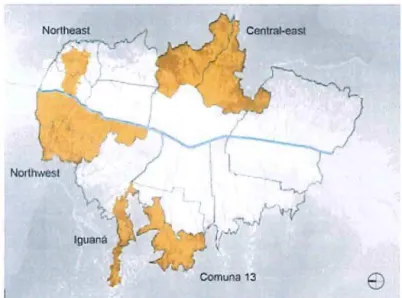
The Integral Urban Projects representa series of local government-led projects intended to improve the quality o f life for Medellín residents, especially those in the most deprived and marginalized areas. A group ofurban experts who studied Medellín during the late 20th century noted that its quantitative growth gave way to an alarming dispersion which produced "a city made up o f independent pieces in which physical segregation as well as cultural and social distances dramatically increased and became a setting suitable for violence" (Editores, 2011, p. 7 1). Furthermore, they found that measurements for quality of life and the buman development index were lowest in 20% ofMedellín's outlay: its communes that settled on the outskirts ofthe city and lacked resources, safe public spaces, and fel! most vulnerable to economic and/or natural risk factors. And so, as a response to a socially and spatially fragrnented population, the last two administrations o f Medellín concentrated their municipal investments on implementing PUis, which directly focused on improving conditions for 40% ofthe city's total population. (Editores, 2011 , p. 71) The projects include construction o f safe public spaces, urban renewal and
medicai centers and other services that contribute to social development and the alleviation of poverty. ("7th World Urban Forum Medellín Declaration", 2012) A community-centered approach to rebuilding, the PUis targeted Medellín's poorest neighborhoods, not only through physical built improvements, but also through participatory decision-making and
interdisciplinary coordination, considered, arguably, as a form "ofhighly participatory and contextualized slwn upgrading." (Swope, 2014, Part 2)
The f1vc Proyecto Urba no lntegroles (PUis) I 'Jiap: Enprcsa de
)esarrollo Urbano; Ovcrlay. Jeff Geismger
E)
Illustration 5: Map of 5 Main Zones for Integral Urban Projects, Medellín
4.3 Three Sensitive Areas o
f
MedellínWhile the entirety o f Medellín experienced a transformation in some capacity from the late 1990s to present day, this analysis focuses on three particularly sensitive areas ofthe city: Santo Domingo Savio, San Javier, and Moravia. Ofthe 249 barrios in Medellín, these areas were arguably part of a neighborhood collective that was most targeted by the local govemment in the execution o f their urban innovations. More impacted by economic tunnoil, unemployment, high rates ofviolence and drug activity before the innovations, tbese neighborhoods should
Cable and the Integral Urban Projects.
Santo Domingo Savio
Santo Domingo Savio, one o f Medellín 's most impoverished regions and fonnally one o f Latin America's most dangerous places, was controlled by urban militias up until2003, giving
residents limited mobility, security, and social activity. (Vulliamy, 2013) No public transportation existed, with the exception of private bus cartels, and if a resident o f Santo Domingo needed to access the main center o f Medellín for work, supplies, or medicai or educational reasons, the cornmute could take up to 2.5 hours one way. (Dal e, 201 O)
.,
'· 111, "' セ@
:1
.
..
S'\Nr0 Ol "1'/C:O
·UJ(O:I
• .. , -' GGiイセZ@ ·.r..
Silnto Domingo S;)vio
Wt• ç.
etc, .• セ@
セ@
';1\1 /11 I ,;
1 セ@ SALL ,V'.Pii. セGiイI@
C\11'\ NLセッ@ '1
PatQUtAf\11 J
Vdn pセイ、イ@ 1:;
Bloncao
lllustration 6: Area Map Santo Domingo, Medellín, Metro System, Line K + L
::>iln t r. 11p r.
Metro Cable: The region now serves as the final stop on the Metro Cable's Line K., which first opened in 2004, following an investrnent o f $26 million USD. (Dal e, 201 0). Additionally, it links with the beginning o f Line L, a tourist-oriented line which connects to Arví Park and is part o f a social project to bring retreats and nature to the masses.
integral Urban Projects: With assisted funding by the Spanish Agency for lnternational Development Cooperation, Colombian architect Giancarlo Mazzanti designed the Parque Biblioteca Espana, three interconnected buildings including a library, set o f academic training rooms, and auditorium, which was donated by the Spanish governrnent. ("Espana Library I
collections, recreation areas and free Internet access to tbe local community. Other Integral Urban Projects include the Parque La Candelaria, the reconstruction of Calle Puerto Rico, a former hub for violence and gang activity, and Unidad Deportiva Granizal, a soccer field and strong example ofphysical space fostering social capital- according to 」ッセオョゥエケ@ members, it has triggered the formation o f new teams and organized play, and is an identifiable place where people meet to play, socialize, and participate with the community at all hours o f the day. (Swope, 2014, Part 4)
San Javier
San Javier, or Commune 13, houses 134.472 people, 65% ofwbom are 39 years ofage or younger. Nearly thirty-six percent o f San Javier households live in the lowest economic stratum, and for 15-20 years, the neighborbood h as been an epicenter o f violence and struggle for
criminal control within the Medellín valley. (Lee, 20 14) As a result, residents o f ali ages have been caught in the crossfire, and forcibly displaced from their homes. In 2010, more than 10 percent ofthe city's 2,019 homicides occurred there. (Pachico, 2011)
r r
Callc 48 c..rcHb
IC
lllustration 7: Area Map San Javier, Medellín
llorestn t'll
- ,,
conditions improving for mass transportation and mobility. (Paclllco, 2011)
Integral Urban Projects: TI1e local government ofMedellín named ali ofSan Javier an Integral Urban Project in 2006, rolling out 23 initiatives to help refonn the neighborhood, from urban renewal through public parks, Parque Bibliotect Presbítero Jose Luis Arroyave, outdoor escalators, and more. (Editores, 2011, p. 74)
Moravia
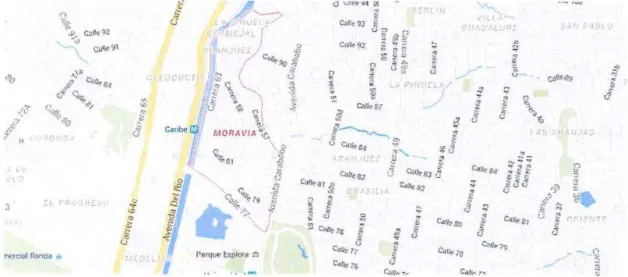
Originally named 'El Morro de Moravia' (Hill ofMoravia) during the 1970s and 80s, after an influx of displaced Colombians settled into an encampment in Medellín's northeast region, Moravia is a neighborhood that shares a common story with other neighborhoods in Latin America. Years after the erections of haphazard infrastructure, a complete intervention project began that involved different action stages: relocation o f inhabitants, decontamination and recovery o f Mora via as a public space. (Arellano, 2011) Mora via is located in Comuna 4 and houses 48.000 inhabitants, all of which fali under Statum 1 and 2. The integral plan for the improvement o f the Mora via neighborhood is divided is three ma in strategies o f transformation: econornic, social and the environmental regeneration, working in the environmental restoration o f the hill, the strengthening o f the productive units and social organization with the social accompanying o f the families in the resettlement process. (Gaviria, 20 14)
I セ@
セセX Q@ .Q .8
..
"J
<:. Nセ@g" o; セ セ@ セQAWY@ セ@
;z o セ@>_, ,.
-? -<"
!
j I(J "'"
ョ・イ」Zセ@ 110flda --. Perqu, ExpiOfa rl
」NMLセLX R@ c ッ ャャ セ Xャ@ セ@
g 2
セ@ J セ@ セ@ Co.'Jc 7e ?
J
C.:al.'t-71 cNエセ・@ 7(;
Metro Cable: Moravia is situated between the Universidad and Caribe stations, both of which run on Line A, the original constituent ofthe Metro Cable.
Chapter 5: Methodology
This chapter explains the methodological approaches nsed to obtain data in this thesis and provides the names ofthe industry leaders engaged with for the in-depth interviews.
Data was elicited throngh participatory observation, household surveys, and in-depth interviews with residents and key authority figures from both the private and public sectors of Medellín. Participatory observation took place during my visit to Medellín in November 2014, a
12-day visitation that involved frequent usage ofthe Metro System and Cable Cars, informal interactions and conversations with local residents, and both informal and formal tours of Integral Urban Projects. Particularly appropriate for this study, participatory observation allowed me to understand in greater depth the way in which Medellín residents view and relate to their city, including their acknowledgement ofthe changes the city has undergone, their reasons for feeling prideful in and loyal to their city, and the ways in which they believe the city can still nnprove.
Households surveys, with the assistance ofthe ACI, Medellín's Agency o f Cooperation and Investment, were distributed to residents ofMedellín's sensitive neighborhoods of San Javier, Santo Domingo, Moravia, the areas most directly affected by the Metro System and Integral Urban Projects. The survey contained questions that address how resident's lives have been changed by the innovations; it consisted o f tive sections that pertained to the indicators for measuring social capital; I consulted with ACI and other organizations within Medellín to gather information related to the tive relevant indicators.
The impact o f Medellín 's two inclusive innovations were measured using the Synthesized Framework provided above, noting how each indicator has either increased or decreased
In-depth interviews were conducted with the following leaders from different sectors within Medellín; interviews ranged from 7- 15 minutes, and the majority were filmed in Medellín.
-H atem Dasuky- Fon11er Journalist and Political Refugee, Current Commercial Director ofAlcaldia de Medellín
-Miguel Urquijo - Innovation Specialist, Ruta N Medellín
- Juan Fernando Laverde Valencia- Secretaria de Minas, Gobernación de Antioquia
- Juan Esteban Sosa Posada- Consu[tant, Agencia de Cooperación e Inversión de Medellín y el Área Metropolitana
- Isabel Cristina Mufioz - University student and business owner - Yusuke Emata - Expat and local hospitality business owner
- Oswaldo Baptista Duarte Filho - Secretario de Estado de Ciencia y Tecnologia para Inclusión, Ministerio de Ciencia, Tecnologia e Innovación de! Brasil
- Luiz Otávio de Alencar Miranda- Investigador de Desarrollo Tecnológico, Instituto de Tecnologias Sociales del Brasil
- Maria Fernanda Vega- Chief ofthe Social Lab at ITM University, Medellín
Chapter 6: Main Findings
This chapter outlines the main findings from the various methods of data collection, providing first a review o f the positive and negative implications ofboth innovations- the Metro System and Intergral Urban Projects - and then presenting the results from the surveys and the Synthesized Framework for measuring inclusive growth.
In examination ofMedellín's Metro System and network oflntegral Urban Projects, a unified response from fonnal and informal interviewees was that the quality oflife has
undoubtedly improved in Medellín over the past two decades. Long-time residents o f Medellín with anywhere from 10- 40 years as a citizen ofthe city unanimously agreed that they have experienced a positive transfonnation, an improvement that could be felt and measured. The participants o f the in-depth interviews cited three common themes when discussing the success ofMedellín's transfonnation and the reasons for its increase in social and economic capital: 1)
The hannonious, transparent collaboration between local government, public sector, and private sector; 2) The exceptionalleadership ofSergio Farjado and the continuity ofvision across mayoral terms; and 3) A new emphasis on education, whether through social programs or
traditional schooling. The survey responses from residents ofMedellín's sensitive neighborhoods elicited responses that were generally positive, agreeing that the expansion ofthe Metro Cable and the Integral Urban Projects caused positive change and lead to more opportunities. However, despite the optimistic perceptions ofMedellín's transformation, its citizens, particularly in the impoverished regions, are not yet content with the standards ofliving.
The details o f my findings will be categorized below, beginning with information and feedback related directly to the Metro System and Integral Urban Projects. Following will be the results from applying the Synthesized Framework for Inclusive Growth Measurement to
6.1 Metro Cable & Integral Urban Projects
The Metro Cable and Integral Urban Projects have accomplished a tremendous number of positive changes since their implementation. The inclusiveness involved in the planning was deliberate and consistent, with localleadership, at the government, private, and public leveis, committed to !arge scale change, with the underprivileged specifically at the center o f the targeted demographics. lnstallation ofthe cab!e cars and the expansion ofLine J have contributed to the reduction of criminal activity, the increase of quality in life, and the overall growth o f both economic and social capital -they h ave contributed to Medellín
s
inclusive growth. (Wilter, 2013) The Metro System and PUis have given more visibility and meaning to marginalized o r excluded populations and created a mutually beneficiai venue o f accessibility; residents in the poorer, hillside communities have greater access to the center o f the city, and residents in the wea!thier neighborhoods have greater access to the hillside communities, which can help with expansion o f their services, commerce, or tourism.Integral Urban Projects, while vast in their project detai!s, h ave ali incited a type o f spatial urban reclaiming in Medellín, in which previously dilapidated or neg!ected areas were beautified and given purpose. Unidad Deportiva Granizal reveals itself as a strong example ofphysical space fostering social capital-according to community members, it has triggered the formation o f new teams and organized play, and is an identifiable place where people meet to play,
socialize, and participate with the community at ali hours ofthe day. (Mui'íoz, 2014) The Moravia Community Center and lhe Parque Biblioteca Espana pro vide residents with opportunities for education, including traditional and non-traditional academic classes, community interest groups, technology-based resources. Residents ofthe Juan Bobo Housing Initiative now live with guaranteed access to clean water, sewage, and waste disposal and legal tenure oftheir homes. Within the housing community, workshops promoted capacity building, conflict resolution, and connnunity cooperation; through the establishn1ent o f an 'acceptable community behavior' manual, common standards o f coexistence were launched. ("Heartfelt Houses I Proyecta Juan Bobo", 2015)