ISSN 1409 - 8695 UDC: 582.475-113.551 (497.774 : 23) Original scientiic paper
Introduction
Pinus peuce Griseb. (Pinaceae), commonly called Macedonian pine or Balkan pine is an endemic conifer tree inhabiting the southern and western parts of the territory of R. Macedonia. This conifer is autothonus to the Baba Mountain (Pelister), Nidze and Shara Mountain. It can be also found in Bulgaria, Albania, Serbia and Greece, grow-ing typically at 1000 - 2200 m altitude. It is a member of the white or soft pine group (subgenus Strobus, section Strobus, subsection Strobi), and thus differes from the oth-er pine species (P. mugo, P.nigra and P.sylvestris) grow-ing in R. Macedonia, that belong to the yellow or hard pine group (subgenus Pinus, section Pinus, subsection Pinus).
For the irst time, Pinus peuce was described on Baba Mountain (Pelister) in 1839 by Grisebach, thus this loca-tion is locus classicus for this species.
In folk medicine, pine needle essential oils are main-ly used for the treatment of respiratory infections accom-panied by cough, bronchitis, bronchial asthma, emphyse-ma, tracheitis, sinusitis, laryngitis, pharyngitis, tonsillitis
Essential oils composition of Pinus peuce Griseb. (Pinaceae)
growing on Pelister Mtn., Republic of Macedonia
Marija Karapandzova*, Gjose Stefkov, Svetlana Kulevanova
Institute of Pharmacognosy, Faculty of Pharmacy, University “Ss. Cyril and Methodius”, Skopje, Macedonia
Received: May 2011; Accepted: June 2011
Abstract
The composition of essential oils obtained by hydrodistillation from needles, from branches without needles and from branches with needles of Pinuspeuce Griseb. (Pinaceae) from Pelister Mtn. (R. Macedonia) was analyzed by GC/FID/MS. One hundred and seven com-ponents (40 monoterpenes, 37 sesquiterpenes, 9 diterpenes and 21 other comcom-ponents - aliphatic and cyclic hydrocarbons; aliphatic alco-hols, aldehydes, and acids; phenols and other oxygenated benzene derivates) were identiied. The most abundant constituents were terpene hydrocarbons, encompassing the monoterpenes: α-pinene, β-pinene, limonene + β-phellandrene and bornyl acetate and the sesquiterpenes:
trans (E)-caryophyllene and germacrene D.
Key words: Pinus peuce, Macedonian pine, essential oil composition, GC/FID/MS. Natural park Pelister, locus classicus, R. Macedonia.
and inluenza (Dervendzi, 1992). Data from recent scien
-tiic literature suggest an increased interest in studying the
composition of the essential oil isolated from different pine species as well as biological activity. Generally, monoter-penes and sesquitermonoter-penes are dominant components of pine needle essential oils (Dob, 2007; Menkovic, 1993; Nikolic, 2007; Dob, 2006; Pagula, 2006; Dormont, 1998; Roussis, 1994; Yong-Suk, 2005; Oluwadayo, 2008, Barnola, 2000). It is important to notice that these essential oils have an-timicrobial (Oluwadayo, 2008; Yong-Suk, 2005; Sacchet-ti, 2005), antifungal and antioxidant activity (Guri, 2006; Limei, 2008; Pinelo, 2004; Jerez, 2005; Jerez, 2006; Guol-cin, 2003; Sacchetti, 2005). Because of their characteristic odor, pine essential oils are also appreciated in the cosmet-ic and perfume manufacture. There are several registered pharmaceuticals such as Pinimenthol® ointment which contains pine needle essential oil and is particularly suit-able for the treatment for upper respiratory tract infections both in adolescents and adults (Kamin, 2007).
natu-ral resources can have a signiicant socio-economic impact
on local community. In this direction, assessment of the es-sential oil of P.peuce would greatly contribute in its value added portfolio.
Up to present, there are no evident data about essential oil composition of Pinuspeuce population growing on NP Pelister (locus classicus) neither from any locality of the territory of R. Macedonia. On a subject of all previously mentioned, the aim to this study was to obtain data for the yield and composition of the essential oils isolated from needles, from branches without needles and from branches with needles of Pinuspeuce from NP Pelister.
Material and methods
Plant material
Only terminal, up to three years old branches were col-lected in July, 2008 and 2009, in the NP Pelister on 4 differ-ent altitudes (1208 m.a.s.l., 1723 m.a.s.l., 1943 m.a.s.l. and
2042 m.a.s.l.). Plant identity was veriied as Pinus peuce Grisebach and voucher specimens (No2008/Pp, No2009/
Pp) were deposited at the Herbarium at the Department of Pharmaceutical Botany, Institute of Pharmacognosy, Fac-ulty of Pharmacy, Skopje. Plant material was dried at room temperature and on draft for two weeks. The needles were separated from the branches just before the hydrodestilla-tion and were properly minced.
Essential oil isolation
Essential oil isolation from plant material was made by hydrodestillation in all-glass Clevenger apparatus (Ph. Eur 7). For that purpose, 20 g of plant material (needles, branches without needles and branches with needles) was distilled for 4 hours. After isolation, anhydrous sodium sul-fate was added to remove residual water and to dry essen-tial oil.
For GC/FID/MS analysis, the essential oil was dis-solved in xylene (1: 1000 v/v).
Gas chromatography
Essential oil samples were analyzed on Agilent 7890А
Gas Chromatography system equipped with FID detector and Agilent 5975C mass spectrometer as well as capillary
low technology which enables simultaneous analysis of
the sample on both detectors. HP-5ms 5% phenyl 95 % di-methylpolysiloxane bonded phase capillary column (30 m
x 0.25 mm, ilm thickness 0.25 µm) was used. Operating conditions were as follows: oven temperature at 60 °C for 5 min, then increased to 80 °C at rate of 1 °C/min and held 2 min and at the end increased to 280 °C at rate of 5 °C/min
and held 5 min; helium as carrier gas at a low rate of 1ml/
min; temperature of the injector 260 °C and that of the FID detector 270 °C; the GC split ratio 1:1. 1µl of each sample
was injected per GC run.
The mass spectrometry conditions were: ionization voltage 70 eV, ion source temperature 230 °C, transfer line temperature 280 °C and mass range from 50 - 500 Da. The MS was operated in scan mode.
Identiication of the components present in essential
oils was made by comparing mass spectra of components in essential oils with those from Nist, Wiley and Adams mass spectra libraries, by AMDIS (Automated Mass
Spec-tral Deconvolution and Identiication System) and by com -paring literature and estimated Kovat′s (retention) indices that were determined using mixture of homologous series of normal alkanes from C9 to C25 in hexane, under the same above mentioned conditions.
The percentage ratio of essential oils components was computed by the normalization method of the GC/FID peak areas and average values were taken into further con-sideration (n=4).
Results and discussion
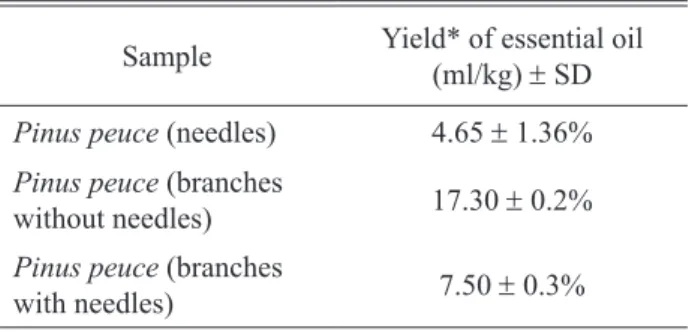
The yield of essential oils calculated on a dry mass and obtained by hydrodistillation from needles, from branch-es without needlbranch-es and from branchbranch-es with needlbranch-es of Pi-nuspeuce, is given in Table 1. The obtained essential oils
were transparent, light yellowish liquids with speciic and
strong odor.
Table 1. The yield of Pinus peuce essential oils isolated from needles, from branches without needles and from branches with needles.
Sample Yield* of essential oil
(ml/kg) ± SD
Pinus peuce (needles) 4.65 ± 1.36%
Pinus peuce (branches
without needles) 17.30 ± 0.2%
Pinus peuce (branches
with needles) 7.50 ± 0.3%
*(n=3)
Table 2 shows components that were identiied in the Pi-nuspeuce essential oils isolated from needles, from branch-es without needlbranch-es and from branchbranch-es with needlbranch-es with their percentage amount and Kovat′s retention indices. The estimated percentage values are averages of components that are present in the essential oils obtained from plant ma-terial (needles, branches without needles and branches with needles) collected from four various altitudes.
One hundred and seven components were identiied in
com-Table 2. Chemical composition of Pinuspeuce essential oil from Pelister Mtn .
No. KIL KIE Component
Pelister Mtn. 2008 (%) - n
Pelister Mtn. 2009 (%) - n
Pelister Mtn. 2008
(%) – n + b
Pelister Mtn. 2008
(%) – b
Monoterpene hydrocarbons
2 931 980.5 α-Thujene - - 0.02 0.02
3 939 983.7 α-Pinene 12.89 19.72 23.77 23.34
4 953 988.5 Camphene 2.69 5.03 3.68 0.69
8 975 1000.3 Sabinene 0.05 0.08 0.02 0.02
9 980 1002.8 β-Pinene 6.16 7.95 11.85 13.00
10 991 1010.9 Myrcene 0.57 0.79 1.17 2.50
12 1003 1019.8 α-Phellandrene 0.14 0.34 0.16 0.05
13 1007 1024.0 ∆3-Carene 0.33 - 0.58 0.79
14 1018 1028.8 α-Terpinene 0.05 0.10 0.05 0.02
16 1025 1035.2 p-Cymene 0.22 0.80 0.05 0.05
17 1031 1039.0 Limonene + β-Phellandrene 3.08 3.97 13.94 8.77
19 1040 1064.3 β-cis-Ocymene 0.02 - -
-22 1062 1064.5 γ-Terpinene 0.13 0.37 0.04 0.05
25 1088 1092.2 Terpinolene 0.50 0.65 0.37 0.24
14 components: 26.83 39.80 55.70 49.54
Oxigenated monoterpene
18 1033 1040.8 1,8-Cineole 0.13 0.20 -
-27 - 1131.2 trans-p-Menth-2-en-1-ol 0.30 0.07 0.08 0.02
28 1120 1136.4 α- Campholenal 0.13 0.02 0.08 0.10
29 1139 1144.8 trans-Pinocarveol 0.27 0.02 0.32 0.35
31 - 1148.0 Viridene - 0.02 -
-32 1143 1153.6 Camphor 0.06 - 0.02
-33 1144 1155.5 trans-Verbenol - - 0.03 0.06
34 1160 1169.1 trans-Pinocamphone - - 0.03 0.05
35 1162 1170.1 Pinocarvone 0.20 0.02 0.27 0.10
36 1165 1172.5 Borneol 0.64 0.76 0.62 0.14
37 1177 1181.9 Terpinene-4-ol 0.08 0.02 0.34 0.11
38 1183 1189.4 p-Cymene-8-ol 0.08 0.02 0.09 0.10
39 1189 1191.6 α-Terpineol 0.30 0.29 0.51 0.45
40 1193 1195.2 Myrtenal 0.29 0.16 0.32 0.35
42 1205 1205.6 trans-Piperitol 0.19 0.20 0.02
-43 - 1207.1 Verbenone 0.04 0.06 0.10 0.19
44 1212 1218.0 trans-Carveol 0.08 0.02 0.14 0.11
45 1220 1219.9 endo-Fenchyl acetate 0.03 0.02 0.02
-46 1235 1237.1 Thymol methyl ether - - - 0.02
47 1243 1246.2 Carvone - - 0.05 0.04
48 - 1254.6 Piperitone 0.02 - 0.02
-49 1256 1257.6 Linalool acetate 0.12 0.02 0.03 0.05
51 1285 1285.6 Bornyl acetate 10.56 9.29 5.60 1.13
55 1350 1347.5 α-Terpenyl acetate 2.97 1.20 1.04 0.42
58 1383 1380.9 Geranyl acetate 0.04 - -
-61 1401 1400.7 Methyl eugenol - - -
No. KIL KIE Component
Pelister Mtn. 2008 (%) - n
Pelister Mtn. 2009 (%) - n
Pelister Mtn. 2008
(%) – n + b
Pelister Mtn. 2008
(%) – b
Sesquiterpene hydrocarbons
54 1339 1336.1 δ-Elemene 0.21 0.11 0.13 0.18
56 1373 1371.1 α-Ylangene 0.02 - 0.08 0.12
57 1376 1374.0 α-Copaene 0.10 0.02 0.15 0.32
59 1384 1383.3 β-Bourbonene 0.11 0.12 0.14 0.08
60 1391 1389.2 β-Elemene 0.47 0.36 0.44 0.36
62 1402 1403.4 Longifolene 0.02 - 0.19 0.22
63 1418 1418.0 trans (E)-Caryophyllene 7.13 4.88 4.13 7.30
64 - 1430.1 β-Copaene 0.76 0.40 0.45 0.57
65 1439 1444.3 Aromadendrene 0.04 - 0.03 0.02
66 - 1446.8 γ-Amorphene 0.19 0.15 0.16
-67 1454 1453.6 α-Hummulene 1.59 0.79 1.00 1.68
68 - 1469.1
Epi-bicyclosesquiphellan-drene 0.06 0.52 0.26 0.31
70 1477 1475.8 γ-Muurolene 0.15 0.22 1.34 2.17
71 1480 1481.7 Germacrene D 19.90 8.75 9.47 10.28
72 1485 1493.9 β-Selinene 0.03 - 0.28 0.34
73 1494 1496.3 Bicyclogermacrene 0.99 1.43 0.12 0.02
74 1495 1497.9 α-Muurolene 0.92 0.25 0.87 1.60
75 - 1507.5 trans-Cadina-1(6)4-diene 0.02 - -
-76 1513 1513.7 γ-Cadinene 0.45 0.39 1.00 1.88
77 1524 1525.3 δ- Cadinene 2.71 1.52 3.06 4.18
78 1532 1532.0 trans-Cadina-1,4-diene 0.06 0.39 0.12 0.16
79 1538 1540.6 α- Cadinene 0.13 0.31 0.22 0.27
80 1547 1546.4 α-Calacorene 0.02 0.14 0.10 0.09
83 - 1571.3 β-Calacorene 0.02 - 0.07 0.10
24 components: 36.31 18.62 22.69 32.26
Oxygenated sesquiterpene
81 1564 1561.4 Nerolidol-(E) 0.18 0.05 0.18 0.10
85 1574 1577.0 Germacrene-4-ol 0.10 - -
-86 1576 1583.0 Spathulenol 0.32 0.08 0.46 0.35
87 1581 1586.4 Caryophyllene oxide 0.57 0.07 0.70 1.18
88 1590 1598.0 Viridilorol 0.03 - -
-89 1592 1609.0 Longiborneol - - 0.02 0.07
90 1606 1613.0 Humulene epoxide II 0.12 - 0.12 0.36
91 1627 1637.8 1-epi-Cubenol 0.07 0.02 0.16 0.31
92 1640
1641
1644.3 1647.4
τ-Cadinol (epi-α-Cadinol) +
τ-Muurolol (epi-α-Muurolol) 1.58 0.52 0.64 0.72
93 1645 1650.1 α- Muurolol (Torreyol) 0.24 0.23 0.06 0.34
94 1653 1657.0 α-Cadinol 1.99 0.46 1.16 1.44
95 - 1693.1 Amorpha-4,9-dien-2-ol 0.17 0.03 0.37 0.44
96 1733 1746.3 Oplopanone - - 0.02
No. KIL KIE Component
Pelister Mtn. 2008 (%) - n
Pelister Mtn. 2009 (%) - n
Pelister Mtn. 2008
(%) – n + b
Pelister Mtn. 2008
(%) – b
Diterpene
99 1929 1946.7 Cembrene 0.04 - 0.09 0.14
100 - 2009.4 Manool oxide 0.09 - 0.16 0.18
101 1967 2013.0 Sclarene 0.02 0.06 0.02 0.06
102 2054 2073.7 Abietatriene 0.02 0.02 0.03 0.06
103 2080 2101.4 Abietadiene 0.02 - 0.03 0.06
104 - 2166.4 Abienol - - 0.14 0.29
105 2220 2253.2 Sclareol - - 0.03 0.14
106 2263 2296.5 Dehydroabietal 0.02 - 0.06 0.22
107 2302 2332.1 Abietal - 0.08 0.03 0.14
9 components: 0.21 0.18 0.59 1.23
Other components
1 926 959.9 Tricyclene 0.02 0.02 0.21 0.02
5 - 990.1 Benzene acetaldehyde t 0.16 0.58 -
-6 - 993.6 p-Ethyl methyl benzenet 0.04 2.64 -
-7 - 998.1 1,2,5-Trimethyl benzenet 0.15 2.23 -
-11 1000 1016.7 n-Decane 0.34 3.02 -
-15 1023 1033.3 1,2,4- Trimethyl benzenet 0.02 0.42 -
-20 - 1057.2 2-Phenilpropanol t 0.12 0.02 -
-21 1057 1058.2 trans-Decahydronaphtalenet 0.06 0.39 -
-23 1067 1084.0 m-Tolualdehide 0.14 2.30 -
-24 1079 1084.4 p-Tolualdehide 0.50 1.37 -
-26 1099 1106.8 n-Undecane 1.10 1.75 -
-30 1261 1145.0 2.6-Dimethylphenolt 0.76 1.50 -
-41 1198 1199.2 Dodecanet 0.25 0.23 -
-50 1261 1263.1 2-Decenalt 0.02 0.12 - 0.02
52 1294 1296.2 Tridecanet 0.02 - -
-53 1314 1312.5 2E,4E-Decadienalt 0.02 0.02 -
-69 1473 1474.5 Dodecanol 0.15 0.07 -
-82 1568 1564.8 Dodecanoic acidt 0.50 0.06 -
-84 1570 1575.2 Hexenyl bezoate (3-Z-) 0.05 0.02 0.04
-97 1762 1769.9 Benzyl benzoate 0.05 0.02 0.02 0.02
98 - 1884.5 Hexenyl cinnamate (3-Z-) 0.15 1.23 0.03 0.02
21 components: 4.55 16.01 0.30 0.08
TOTAL 89.72 88.61 93.56 92.21
n=4; KIL - Kovat’s index literature, KIE – Kovat’s index estimated, n – needles, b – branches without needles, n+b – branches with needles, (-) - not found, t – tentative identiication, No. -ordinal number of the component according to its retention time.
ponents (aliphatic and cyclic hydrocarbons; aliphatic al-cohols, aldehydes, and acids; phenols and other
oxygen-ated benzene derivates) were identiied. Analysis of the es -sential oils composition shows variations in the content of components that are present, probably due to the impact of weather conditions throughout the year. Seasonal variabil-ity is mostly seen in the presence of monoterpenes
cam-phene and α-terpenil acetate and sesquiterpenes δ-cadinene
and α-cadinol (Table 2).
The most abundant components in the needle
essen-tial oil were monoterpenes α-pinene (12.89/19.72 %), β-pinene (6.16/7.95 %), limonene + β-phellandrene (3.08
germac-rene D (8.75/19.90 %). These components represent 54.56 %/59.72 % of the whole needle essential oil and are likely to determine the physico-chemical characteristics as well
as chemical proile of the oils.
Dominant components in the essential oil obtained from branches with needles were the same 6 compo-nents that were found in the needle essential oils, repre-senting 68.76 % of the total amount of the oil. Among
them, α-pinene (23.77 %), β-pinene (11.85 %), limonene + β-phellandrene (13.94 %) were the most abundant, while
germacrene D (9.47 %) and bornyl acetate (5.60 %) were present in smaller amounts.
The essential oil isolated from branches without
nee-dles contains large amount of α-pinene (23.34 %), β-pinene (13.00 %), limonene + β-phellandrene (8.77 %), trans (E)-caryophyllene (7.30 %) and germacrene D (10.28 %), but
Fig. 1. Different classes of components that are present in Pinus peuce essential oils isolated from nee-dles, from branches without needles and from branches with needles (THC – terpene hydro-carbons, OT – oxygenated terpenes, DT – diter-penes, OC – other components)
smaller amount of bornyl acetate (only 1.13 %). These components represent 63.82 % of the total essential oil. It is important to notice that this essential oil contains 4.18 % of δ-cadinene.
Among different classes of components that are pres-ent in the needle esspres-ential oil, the major constitupres-ents were terpene hydrocarbons (58.42 %/ 63.14 %). Oxygenated ter-penes were present from 14.00 %/21.80 %, other compo-nents 4.55 %/16.01 % and diterpenes only 0.18 %/0.21 % (Fig. 1).
The most abundant fraction among the total amount of monoterpenes and sesquiterpenes, diterpenes and oth-er components that are present in needle essential oil woth-ere monoterpenes (43.28 %/52.39 %) (Fig. 2).
The major constituents in the essential oil obtained from branches with needles from Pinus peuce were also components that belong to terpene hydrocarbons fraction (78.39 %) and fraction of oxygenated terpenes (14.28 %) (Fig.1). The same situation was with the essential oil iso-lated from branches without needles which contains 81.8 % of terpene hydrocarbons fraction and 9.1 % of oxygen-ated terpenes (Fig. 1). Diterpenes and other components were present in smaller amount (0.59 % diterpenes and 0.30 % other components in the essential oil from branches with needles and 1.23 % diterpenes and 0.08 % other com-ponents in the essential oil isolated from branches with-out needles).
The most abundant fraction among the total amount of monoterpenes and sesquiterpenes, diterpenes and other components that are present in essential oil obtained from branches with needles were monoterpenes (66.09 %) (Fig. 2), while essential oil isolated from branches without nee-dles contains 53.33 % and 37.57 % of monoterpenes and sesquiterpenes, respectively (Fig. 2).
Compared with the chemical composition of needle essential oil isolated from Pinus sylvestris (Pini sylves-tris aetheroleum) and from Pinus mugo (Pini pumillionis
aetheroleum) for which the European Pharmacopoeia pre-scribes certain limits for same components (Table 3), it is evident that the composition of needle essential oil from P. peuce is closer to the chemical composition of Pini pu-millionis aetheroleum. There is no big difference in
pres-ence of α-pinene and β-pinene between these two oils.
Camphene and bornyl acetate are present in larger amount in needle essential oil from Pinus peuce while ∆3-carene,
β-myrcene, limonene + β-phellandrene and terpinolene are
present in smaller amount.
Nowdays, there are a lack of data that are relate to chemical composition of Pinus peuce essential oil. Up
to now, there are only ive references that are concern to
the composition of the essential oils isolated from needles and branches from Pinuspeuce that grows on the territo-ry of Greece, Serbia and Montenegro (Henning, 1994; Pa-padopoulou, 1996; Koukos, 2000; Petrakis, 2001; Nikolic, 2008). Seventy eight components were detected, but only
ifty six components were identiied in the needle essential
oil. α-Pinene, camphene, β-pinene, β-phellandrene, bor
-nyl acetate, β-caryophyllene, germacrene D and citronelol
are declared as main components in the needle essential oil while α-pinene, β-pinene, β-phellandrene, β-caryophyllene and citronelol are concerned as main components in the es-sential oil isolated from branches from P. peuce. Compared with essential oils isolated from P. peuce from Macedonia, the needle essential oil isolated from P. peuce from Greece contains larger amount of α-pinene (23.07 %) and β-pinene (22.00 %) and large amount of citronellol (13.42 %), but it doesn’t contain germacrene D, while essential oil
isolat-ed from branches contains larger amount of β-phellandrene
(26.93 %) and large amount of citronellol (12.48 %), small-er amount of α-pinene (7.38 %), but it doesn’t contain ger-macrene D and bornyl acetate. The needle essential oils isolated from P. peuce from Montenegro and Serbia con-tain larger amount of α-pinene (36.5 %) and camphene (8.5 %), but smaller amount of bornyl acetate (6.8 %).
Table 3. Chemical composition of Pini sylvestris aetheroleum and Pini pumillionis aetheroleum (Ph. Eur 7).
Component Pini sylvestris
aetheroleum (%)
Pini pumillionis aetheroleum (%)
α-Pinene 32.0-60.0 10.0-30.0
Camphene 0.5-2.0 0.0-2.0
β-Pinene 5.0-22.0 3.0-14.0
∆3-Carene 6.0-18.0 10.0-20.0
β-Myrcene 1.5-10.0 3.0-12.0
Limonene 7.0-12.0 8.0-14.0
β-Phellandrene 0.0-2.5 10.0-19.0
p-Cymene 0.0-2.0 0.0-2.5
Terpinolene 0.0-4.0 0.0-8.0
Bornyl acetate 1.0-4.0 0.5-5.0
Conclusion
The yield of needle essential oil obtained by hydro-distillation of Pinuspeuce from Pelister Mtn. (Republic of Macedonia) ranged from 3.00/6.75 ml/kg. The branches
without needles contain signiicantly larger amounts of es -sential oil (17.30 ml/kg) in terms of needles, while the val-ues for content of essential oil in the branches with needles (7.50 ml/kg) were found between those obtained from nee-dles and from the branches without neenee-dles. The obtained essential oils were transparent, light yellowish liquids with
speciic and strong odor.
Dominant components in the Pinuspeuce essential oils obtained from needles, from branches without needles and
from branches with needles were monoterpenes: α-pinene, β-pinene, limonene + β-phellandrene and bornyl acetate
and sesquiterpenes: trans (E)-caryophyllene and germac-rene D. Among different classes of components in the es-sential oils, the major constituents were terpene hydrocar-bons, both monoterpenes and sesquiterpenes, representing almost 80% of the oils.
References
Barnola, L.F., Cedeno, A., 2000. Inter-population differences in the essential oils of Pinuscaribaea needles. Biochemical Systematics and Ecology 28, 923-931.
Dervendzi, V., 1992. Sovremeno lekuvanje so lekoviti bilki. Tabernakul, Skopje.
Dob, T., Berramdane, T., Chelghoum, C., 2006. Analysis of essential oil from the needles of Pinuspinaster growing in Algeria. Chemistry of Natural Compounds 41, 545-548. Dob, T., Berramdane, T., Chelgoum, C., 2007. Essential oil
composition of Pinushalepensis Mill. from three different regions of Algeria. Journal of Essential Oil Research Dormont, L., Roques, A., Malosse, C., 1998. Cone and foliage
volatiles emitted by Pinuscembra and some related conifer species. Phytochemistry 49, 1269-1277.
European Pharmacopoeia 7.0, 2010.
Grassmann, J., Hippeli, S., Vollmann, R., Elstner, E.F., 2003. Antioxidative properties of the essential oil from Pinus mugo. J. Agric. Food Chem. 51, 7576-7582.
Grassmann, J., Hippeli, S., Spitzenberger, R., Elstner, E.F., 2005. The monoterpene terpinolene from the oil of Pinus mugo
L. in concert with α-tocopherol and β-carotene effectively prevents oxidation of LDL. Phytomedicine 12, 416-423. Gulcin, I., Buyukokuroglu, M.E., Otkay, M., Kufrevioglu, O.I.,
2003. Antioxidant and analgesic activities of turpentine of Pinus nigra Arn. subsp. pallasiana (Lamb.) Holmboe. Journal of Ethnopharmacology 86, 51-58.
Guri, A., Kefalas, P., Roussis, V., 2006. Antioxidant activity of six pine species. Phytotherapy Research 20, 263-266.
Henning, P., Steinborn, A., Engewald, W., 1994. Investigation of the composition of Pinus peuce needle oil by GC-MS and GC-GC-MS. Chromatographia 38, 689-693.
Holzke, C., Hoffmann, T., Jaeger, L., Koppmann, R., Zimmer, 2006. Diurnal and seasonal variation of monoterpene and sesquiterpene emissions from Scots pine (Pinus sylvestris
L.). Atmospheric Environment 40, 3174-3185.
Idzojtic, M., Kajba, D., Franjic, J., 2005. Differentiation of F1
hybrids P. nigra J.F. Arnold x P. sylvestris L., P. nigra J.F. Arnold x P. densilora Siebold et Zucc., P. nigra J.F. Arnold x
P. thunbergiana Franco and their parental species by needle volatile composition. Biochemical Systematics and Ecology 33, 427-439.
Jerez, M., Tourino, S., Sineiro, J., Torres, J.L., Nunez, M. J., 2007. Procyanidins from pine bark: Relationships between structure, composition and antiradical activity. Food Chemistry 104, 518-527.
Jerez, M., Selga, A., Sineiro, J., Torres, J.L., Nunez, M. J., 2007. A comparison between bark extracts from Pinus pinaster
and Pinus radiate: Antioxidant activity and procyanidin composition. Food Chemistry 100, 439-444.
Judzentiene, A., Slizyte, J., Stikliene, A., Kupcinskiene, E., 2006. Characteristics of essential oil composition in the needles of young Scots pine (Pinus sylvestris L.) stands growing along an aerial ammonia gradient. Chemija 17 (4), 67-73.
Kainulainen, P., Holopainen, J.K., 2002. Concentrations of secondary compounds in Scots pine needles at different stages of decomposition. Soil Biology and Biochemistry 34, 37-42.
Kamin, W., Kieser, M., 2007. Pinimethol ointment in patients suffering from upper respiratory tract infections – A post-marketing observational study. Phytomedicine 14, 787-791. Kupcinskiene, E., Stikliene, A., Judzentiene, A., 2008. The
essential oil qualitative and quantitative composition in the needles of Pinus sylvestris L. growing along industrial traces. Environmental Pollution 20, 1-11.
Limei, Y., Zhao, M., Wang, J.S., Cui, C., Yang, B., Jiang, Y., Zhao, Q., 2008. Antioxidant, immunomodulatory and anti-breast cancer activities of phenolic extracts from pine (Pinus massoniana Lamb.) bark. Innovative Food Science and Emerging Technologies 9, 122-128.
Maciag, A., Milakovic, D., Christensen, H.H., Antolovic, V., Kalemba, D., 2007. Essential oil composition and plant-insect relations in scots pine (Pinus sylvestris L.). Food Chemistry and Biotechnology 1008, 71-95.
Menkovic, N.R., Ristic, M.S., Samardzic, Z.J., Kovacevic, N.N., Tasic, S.R., 1993. Investigations of relic Pinus species . II. The essential oil of Pinus heldreichii. ISHS Acta Horticulturae. 344.
Micevski, K., 1985. Flora na SR Makedonija.
Naydenov, K., Tremblay, F., Fenton, N., Alexandrov, A., 2006. Strucure of Pinus nigra Arn. populations in Bulgaria revealed by chloroplast microsatellites and terpenes analysis: Provanance tests. Biochemical Systematics and Ecology34, 562-574.
Nikolic, B., Ristic, M., Bojovic, S., Marin, P.D., 2007. Variability of the needle essential oils of Pinusheldreichii from different populations in Montenegro and Serbia. Chemistry and Biodiversity 4, 905-916.
Oluwadayo Sonibare, O., Olakunle, K., 2008. Chemical composition and antibacterial activity of the essential oil of Pinus caribaea from Nigeria. African Journal of Biotechnology 7 (14), 2462-2464.
Pagula, F., Baeckstrom, P., 2006. Studies on essential oil-bearing plants from mozambique: Part II. volatile leaf oil of needles of Pinus elliotti Engelm. and Pinus taeda L. Journal of Essential Oil Research18 (1), 32-34.
Petrakis, P.V., Tsitsimpikou, C., Tzakou, O., Couladis, M., Vagias, C., Roussis, V., 2001. Needle volatiles from ive Pinus
Pinelo, M., Rubilar, M., Sineiro, J., Nunez, M. J., 2004. Extraction of antioxidant phenolics from almond hulls (Prunus amygdalus) and pine sawdust (Pinus pinaster). Food Chemistry 85, 267-273.
Roussis, V., Petracis, P.V., Ortiz, A., Mazomenos, B.E., 1994. Volatile constituents of needles of ive Pinus species grown in Greece. Phytochemistry 39 (2), 357-361.
Sacchetti, G., Maietti, S., Muzzoli, M., Scaglianti, M., Manfredini, S., Radice, M., Bruni, R., 2005. Comparative evaluation of 11 essential oils of different origin as functional antioxidants, antiradicals and antimicrobials in foods. Food Chemistry 91, 621-632.
Semiz, G., Heijari, J., Isik, K., Holopainen, J.K., 2007. Variation in needle terpenoids among Pinus sylvestris L. (Pinaceae) provenances in Turkey. Biochemical Systematics and Ecology 35, 652-661.
Stevanovic, T., Garneau, F.X., Jean, F.I., Gagnon, H., Vilotic, D., Petrovic, S., Ruzic, N., Pichette, A., 1998. The essential
oil composition of Pinus mugo Turra from Serbia. Wiley InterScience Research Article.
Tognolini, M., Barocelli, E., Ballabeni, V., Bruni, R., Bianchi, A., Chiavarini, M., Impicciatore, M., 2006. Comparative screening ofplant essential oils: Phenylpropanoid moiety as basic core for antiplatelet activity. Life Science 78, 1419-1432.
Ucar, G., Balaban, M., 2004. Volatile needle extractives of Anatolian black pine varieties: P. nigra subsp. pallasiana var.
pallasiana and var. pyramidata. Biochemical Systematics and Ecology 32, 983-992.
Ustun, O., Sezik, E., Kurkcuoglu, M., Baser, K.H.C., 2006. Study of the essential oil composition of Pinus sylvestris from Turkey. Khimiya Prirodnykh Soedinenii 1, 22-25.
Youg-Suk, K., Dong-Hwa, Sh., 2005. Volatile components and antibacterial effects of pine needle (Pinus densilora S. and Z.) extracts. Food Microbiology 22, 37-45.
Резиме
Хемиски состав на етерично масло од молика (
Pinus peuce
Griseb., Pinaceae) од Пелистер, Р. Македонија
Марија Карапанџова
*,
Ѓоше Стефков, Светлана Кулеванова
Институт за Фармакогнозија, Фармацевтски факултет, Универзитет “Св. Кирил и Методиј”, Скопје, Р. Македонија
Клучни зборови: Pinuspeuce, македонски бор, хемиски состав на етерично масло, GC/FID/MS, Национален парк Пелистер, locus
classicus, Р. Македонија.
Анализата на хемиски состав на етерични масла добиени со дестилација со водена пареа од иглички, од гранки без иглички и од гранки со иглички од молика (PinuspeuceGriseb., Pinaceae) собрана на Пелистер (Р. Македонија) е направена со GC/FID/