Randomized Trial Evaluating the Impact of
Ribavirin Mono-Therapy and Double Dosing
on Viral Kinetics, Ribavirin Pharmacokinetics
and Anemia in Hepatitis C Virus Genotype 1
Infection
Jesper Waldenström1, Johan Westin1, Kristina Nyström1, Peer Christensen2, Olav Dalgard3, Martti Färkkilä4, Karin Lindahl5, Staffan Nilsson6, Gunnar Norkrans1, Henrik Krarup7, Hans Norrgren8, Mads Rauning Buhl9, Stephan Stenmark10, Martin Lagging1*
1Department of Infectious Medicine, Institute of Biomedicine at Sahlgrenska Academy, University of Gothenburg, Gothenburg, Sweden,2Department of Infectious Diseases, University of Southern Denmark, Odense, Denmark,3Department of Infectious Diseases, Akershus University Hospital, Oslo, Norway, 4Department of Gastroenterology, Helsinki University, Helsinki, Finland,5Department of Infectious Diseases, Karolinska University Hospital Huddinge, Karolinska Institute, Stockholm, Sweden,6Department of Mathematical Sciences, Chalmers University of Technology, Gothenburg, Sweden,7Section of Molecular Diagnostics, Clinical Biochemistry, Aalborg University Hospital, Aalborg, Denmark,8Department of Infectious Diseases, Skåne University Hospital, Lund, Sweden,9Department of Infectious Diseases, Aarhus University, Aarhus, Denmark,10 Department of Communicable Disease Control Västerbotten, Umeå, Sweden
Abstract
In this pilot study (RibaC), 58 hepatitis C virus (HCV) genotype 1 infected treatment-naïve patients were randomized to (i) 2 weeks ribavirin double dosing concomitant with pegylated interferon-α(pegIFN-α), (ii) 4 weeks ribavirin mono-therapy prior to adding pegIFN-α, or (iii)
standard-of-care (SOC) ribavirin dosing concurrent with pegIFN-α. Four weeks of ribavirin
mono-therapy resulted in a mean 0.46 log10IU/mL HCV RNA reduction differentially
regu-lated acrossIL28Bgenotypes (0.89 vs. 0.21 log10IU/mL for CC and CT/TT respectively;
P = 0.006), increased likelihood of undetectable HCV RNA week 4 after initiating pegIFN-α
and thus shortened treatment duration (P<0.05), and decreased median IP-10 concentra-tion from 550 to 345 pg/mL (P<0.001). Both experimental strategies impacted on ribavirin concentrations, and high levels were achieved after one week of double dosing. However, by day 14, double dosing entailed a greater hemoglobin decline as compared to SOC (2.2 vs. 1.4 g/dL; P = 0.03). Conclusion: Ribavirin down-regulates IP-10, and may have an anti-viral effect differently regulated acrossIL28Bgenotypes.
Trial Registration
ClinicalTrials.govNCT01226771 a11111
OPEN ACCESS
Citation:Waldenström J, Westin J, Nyström K, Christensen P, Dalgard O, Färkkilä M, et al. (2016) Randomized Trial Evaluating the Impact of Ribavirin Mono-Therapy and Double Dosing on Viral Kinetics, Ribavirin Pharmacokinetics and Anemia in Hepatitis C Virus Genotype 1 Infection. PLoS ONE 11(5): e0155142. doi:10.1371/journal.pone.0155142
Editor:Jason Grebely, University of New South Wales, AUSTRALIA
Received:July 10, 2015
Accepted:March 20, 2016
Published:May 11, 2016
Copyright:© 2016 Waldenström et al. This is an open access article distributed under the terms of the Creative Commons Attribution License, which permits unrestricted use, distribution, and reproduction in any medium, provided the original author and source are credited.
Data Availability Statement:All relevant data are within the paper and its Supporting Information files.
Introduction
Therapy for hepatitis C virus (HCV) infection recently has undergone major improvements regarding therapeutic efficacy and reduction of side effects following the introduction of inter-feron-free regimens comprising combinations of direct acting antivirals (DAA) [1–12], often including the use of ribavirin. Presently ribavirin is recommended for several DAA-based treat-ments for HCV genotype 1–3 infection [13], and likely will remain a vital component of therapy.
Ribavirin is a purine nucleoside analogue with broad-spectrumin vitroantiviral activity
against many RNA and DNA viruses [14]. In addition to its utility in HCV therapy, ribavirin also is administered for severe respiratory syncytia virus (RSV) infections [15], viral hemor-rhagic fevers such as Lassa and Crimean–Congo [16,17], and hepatitis E virus infections [18]. Unaided, ribavirin is insufficient to achieve clearance of HCV infection [19,20], but in inter-feron-based combination therapy, it is pivotal to increase the likelihood of achieving a sus-tained virological response (SVR) by means of reduced relapse risk [21,22]. Ribavirin mono-therapy reportedly has a modest effect on HCV RNA, with mean reductions of approximately 0.5 log10IU/mL, in addition to reducing systemic concentrations of liver enzymes [23].
The underlying molecular basis through which ribavirin impacts on HCV infection remains unclear, but several mechanisms of action have been proposed; direct inhibition of the viral RNA polymerase, inhibition of inosine monophosphate dehydrogenase (IMPDH) with ensu-ing GTP depletion, viral mutagenesis leadensu-ing to error catastrophe, and modulation of T cell responses [24]. Recently bothin vivo[25] andin vitro[26,27] studies also have suggested that
ribavirin modulates the expression of interferon-stimulated genes (ISGs). The observation that genetic variants of the inosine triphosphate pyrophosphatase gene, which likely also lead to decreased GTP intracellular concentrations, are associated with a ribavirin-like reduced relapse risk following treatment for HCV genotype 2/3 [28] support the IMPDH hypothesis as the pos-sible primary mechanism of action of ribavirin.
Ribavirin has a large distribution volume, has an elimination that is dependent on renal function, and has a long half-life requiring in excess of 4 weeks to reach steady state [29–31]. It is administered as a pro-drug, which subsequently is activated by intracellular phosphorylation to mono-, di- and triphosphates, and upon phosphorylation becomes irreversibly entrapped in erythrocytes. Higher ribavirin exposure during the early phase of treatment reportedly is important for HCV treatment response [32,33]. However, the use of high dose treatment is hampered by enhanced side effects, most importantly a dose dependent hemolytic anemia, possibly secondary to oxidative stress caused by posterior depletion of ATP in erythrocytes [34,
35]. Recently some studies have evaluated the effect of using a lead-in phase of ribavirin mono-therapy prior to the addition of interferon, with the goal of achieving steady state concentra-tions early in combination-treatment without causing severe anemia; however, thus far this strategy has not been reported to impact on outcome [27,36–38].
Several host and viral factors have been used to prognosticate HCV clearance, including genetic polymorphisms in the proximity of the interleukin 28B (IL28B) gene, also known as
interferon-λ4 (IFNL4), which have been coupled to both treatment response [39] and
sponta-neous resolution of infection [40,41]. Similarly, lower systemic concentrations of interferon gamma inducible protein 10 (IP-10 also known as CXCL10) are associated with successful therapeutic outcome [39,42,43] and spontaneous clearance [44].
The aim of the present pilot study (RibaC) was to further explore the impact on HCV viral kinetics, ribavirin pharmacokinetics and anemia of a 4-week lead-in phase of ribavirin mono-therapy prior to the addition of pegylated interferon-α(pegIFN-α), referred to as“priming”, as
well as an initial 2-week double-dosage of ribavirin concomitant with pegIFN-α, referred to as Competing Interests:The funding from the
“loading”, as compared to standard-of-care ribavirin and pegIFN-αtherapy for chronic HCV
genotype 1 infection. When the present study was designed and initiated, DAA-based regimens were not readily available, and the standard-of-care at the time was pegIFN-αand ribavirin
combination therapy. Later, the standard-of-care has been revised in many regions to include the use DAAs, especially HCV polymerase inhibitors, as well as interferon-free treatments often including the use of ribavirin [13].
Materials and Methods
Patients
Between October 22, 2010 (after registration at ClinicalTrials.gov) and January 2012, 63 patients with chronic HCV genotype 1 infection were screened for inclusion in a randomized, open-label, parallel group, multicenter pilot study (RibaC), conducted at 11 centers in Sweden, Denmark, Finland and Norway (disposition of patients inFig 1; study protocol in supporting informationS1 File). Sixty-one enrolled patients met the inclusion criteria and 58 patients agreed to start medication and constituted the intention to treat (ITT) population. All patient where adults (18 years of age), had compensated liver disease (Child-Pugh clinical classifica-tion A) and were interferon treatment naïve, seronegative for hepatitis B surface antigen and HIV antibodies and met the additional inclusion criteria: Serologic evidence of chronic hepati-tis C infection and serum HCV RNA15 IU/mL, HCV genotype 1, confirmed within 2 years of treatment initiation. Liver biopsy or elastography were not mandatory, but encouraged. Enrollment planned to include 105 patients, 35 per treatment group. However, this number of patients could not be recruited, secondary to swift establishment of DAA-based HCV therapy.
Treatment
Patients were randomized during the screening period between 4 to 12 weeks before treatment initiation to one of three arms; arm A“loading”, arm B“priming”and arm C“ standard-of-care”. Arm A“Loading”received pegIFNα-2a 180μg/week plus loading (26 mg/kg/day for 2 weeks followed by13 mg/kg/day) and concentration targeted (2.5 mg/L (10.25μmol/L) 28
days after initiation of pegIFN-αtherapy) dosing. This target was chosen based on the finding
that 2.0 mg/L (8.2μmol/L) was sufficient in HCV genotype 2/3 [45] and that genotype 1 would
require a higher goal concentration. Arm B“Priming”received standard-of-care dosing of riba-virin (13 mg/kg/day) without pegIFN for 4 weeks followed by 48 additional weeks of pegIFN
α-2a 180μg/week plus standard-of-care dosing of ribavirin (13 mg/kg/day) and concentra-tion targeted (2.5 mg/L (10.25μmol/L) 28 days after initiation of pegIFN-αtherapy) dosing.
Arm C“Standard-of-Care”received pegIFNα-2a 180μg/week plus standard-of-care dosing of
ribavirin (13 mg/kg/day). Regardless of treatment arm, all patients with undetectable HCV RNA as analyzed by their local laboratory 4 weeks after initiation of pegIFN-αreceived 24
weeks of combination treatment; otherwise the patient received 48 weeks. Follow up sampling was performed 24 weeks after end of treatment. Standard stopping rules were applied for treat-ment discontinuation if the patients had2 log10reduction in HCV RNA by week 12 or
detectable HCV RNA at week 24, and patient meeting the stopping rules were considered as “non-responders”not having achieved SVR.
Study endpoints
RNA, IP-10,IL28Bgenotype, ribavirin concentrations, as well as the proportion of patients
achieving VRVR, RVR, cEVR, pEVR and SVR in the different treatment arms. Additional end-points were evaluation of safety of“priming”and“loading”ribavirin-dosing regimens.
HCV RNA quantification and genotyping
Plasma was obtained with PPT-tubes at day (-28, only in arm B), 0, 3, 7, 28, week 12, End-of-Treatment, and Follow-Up week 24. Samples were kept frozen (-70°C) and analyzed at the cen-tral lab (Gothenburg, Sweden) using Cobas 48 Taqman HCV-RNA-test (Roche Diagnostics, Branchburg, NJ) that quantifies HCV RNA with a limit of detection of15 IU/mL. Genotyp-ing of HCV was initially performed at the local centers and subsequently confirmed at the cen-tral laboratory (Gothenburg, Sweden) with a TaqMan primer-specific reverse-transcription polymerase chain reaction method.
IL28B
(
IFNL4
) genotyping
rs12979860was determined using TaqMan SNP genotyping assays (Applied Biosystems Inc.,
Foster City, CA) as previously described [46].
IP-10 (CXCL10) quantification
Quantification of IP-10 was performed using Quantikine (R&D Systems, Minneapolis, MN), a solid-phase enzyme-linked immunosorbent assay, on plasma samples obtained at screening visit, days (-28, -27, -21 only in arm B), 0, 1, 3, 7, 14 and weeks 8, 18, 24. All samples were stored at−70°C until assayed at the central laboratory (Gothenburg, Sweden).
Ribavirin concentrations
Plasma samples for ribavirin drug concentration measurement were drawn immediately before the morning dose of ribavirin,i.e. trough concentrations, at day (-27, -21, 0, only in arm B), 1,
3, 7, 14, 28, and weeks 8, 12, 18, and at end of treatment. Plasma ribavirin concentrations were measured by use of solid phase extraction and high-performance liquid chromatography (HPLC; Merck-Hitachi, Tokyo, Japan) followed by UV-detection (wavelength 215 nm).
Statistics
Fisher’s exact test was used to evaluate differences in frequencies of SVR, and undetectable HCV RNA by week 12 and end-of-treatment. Mann-Whitney U-test was used when compar-ing groups and Spearman’s test for correlation analysis. Statistical analyses were performed using Prism (Version 5.0c, GraphPad Software, La Jolla, CA) or SPSS (Version 20.0.0, IBM Corp, Armonk, NY, USA) software. All reported P values are two-sided, and P values<0.05
were considered significant. The sample size calculation to demonstrate an increase in the reduction of HCV RNA from day 0 to 3 from 0.9 log10IU/mL in Group C (Standard-of-Care)
to 1.4 log10IU/mL in Group A or B or an increase in the reduction of HCV RNA from day 7 to
28 from 0.4 log10IU/mL/week in Group C (Standard-of-Care) to 0.6 log10IU/mL/week in
Group A or B the study required at least 35 patients per study arm, a number we were unable to recruit despite considerable efforts. The statistical power (chance) for the study to detect a superior effect in arm A or B as compared to C was 80%. Statistical sample-size calculation was
Fig 1. Flow diagram of the RibaC study trial showing enrollment and disposition of patients.Patients were randomized to arm A“loading”(2 weeks of ribavirin double dosing concomitant with pegIFN-α), arm B“priming”(4 weeks ribavirin mono-therapy prior to adding pegIFN-α), or arm C “standard-of-care”.
based on z-test for differences between proportions and was one-sided with a significance level of 5%.
Ethical Considerations
The treatment study conformed to the guidelines of the 1975 Declaration of Helsinki. Written informed consent was obtained from each participating patient, and ethics committees in each participating country approved the study as of May 3, 2010 (i.e. Regional Ethical Review Board, Gothenburg, Sweden (Regionala etikprövningsnämnden i Göteborg), Regional Com-mittee for Ethics in Medical Research, Oslo, Norway (Regionaletisk komite for medisinsk og helsefaglig forskning i Oslo), The Scientific Ethical Committee for the Region of South Den-mark, Vejle, Denmark (Den Videnskabsetiske Komité for Region Syddanmark), and the Ethics Committee, Department of Medicine for the Hospital District of Helsinki and Uusimaa, Fin-land (Etiska kommittén för invärtesmedicin)). The study also was approved by the Medical Products Agency in Sweden as of May 28, 2010.
Clinical Trial Registration
This trial has been registered at the National Institutes of Health trial registry as of October 21, 2010 (ClinicalTrials.gov identifier: NCT01226771). Recruitment of patients began after regis-tration. The authors confirm that all ongoing and related trials for this drug/intervention are registered.
Results
Baseline characteristics
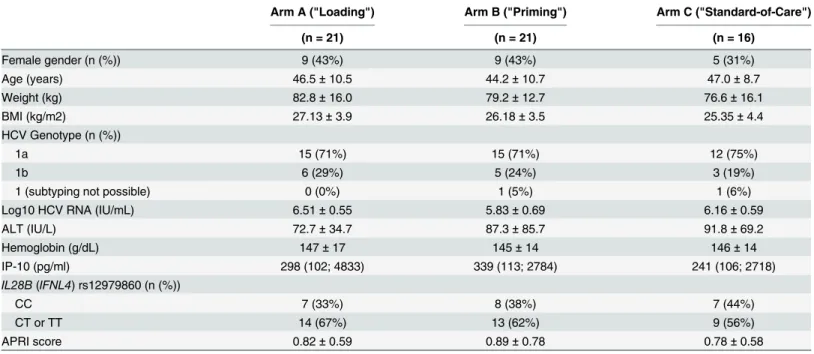
The investigational arms (arm A“loading”and B“priming”) were balanced according to base-line characteristics (Table 1) compared to the“standard-of-care”(SOC) arm C (disposition of patients shown inFig 1).
Impact on HCV RNA
In treatment arm B, patient were treated with weight-based ribavirin (13 mg/kg) mono-therapy for four weeks preceding the addition of pegIFN-α. During this period mean HCV RNA level
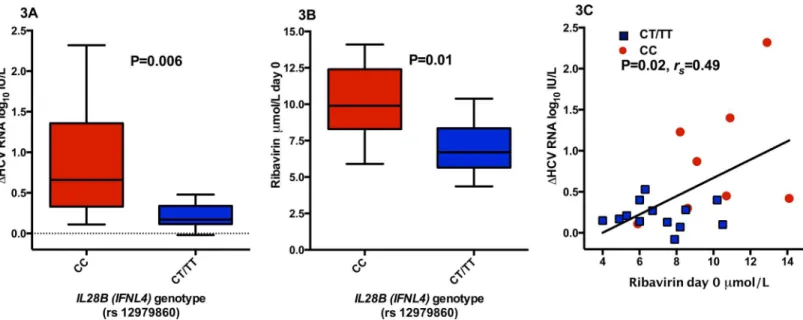
decreased by 0.46 log10IU/mL, from 5.83 (day -28) to 5.36 (day 0; P<0.0001 Wilcoxon
matched pairs signed rank test) (Fig 2). The viral load reduction was significantly associated withIL28Bgenotype (0.89 vs. 0.21 log10IU/mL, for CC (n = 8) and CT/TT (n = 13)
respec-tively; P = 0.006, Mann-Whitney U test) (Fig 3), but not with pre-treatment plasma IP-10 con-centrations. A positive correlation between the ribavirin concentration at day 0 in arm B “priming”, i.e. after four weeks of ribavirin mono-therapy, and viral decline was noted
(P = 0.02,rs= 0.49, Spearman correlation;Fig 3). Surprisingly in this study arm, carriage of the IL28BCC genetic variant entailed a significantly higher mean ribavirin concentration at day 0
compared to CT/TT (mean and standard deviation 10.1 ± 2.7 vs. 7.1 ± 2.0μmol/L for CC and
CT/TT respectively; P = 0.01, Mann-Whitney U test); however, when a stepwise linear regres-sion model for decline in HCV RNA was performed including both ribavirin concentration day 0 andIL28Bgenotype,IL28Bgenetic variant was the only significant predictive variable
(P = 0.004).
Impact on ALT
of 21 patients had ALT values within normal range at treatment initiation and 7 of 21 at day 0. A statistically significant association was noted between ALT and IP-10 fold change (P = 0.014,
rs= 0.53, Spearman correlation test), and a similar non-significant trend between ALT and
HCV RNA reduction was observed (P = 0.055,rs= -0.42). No significant association between IL28Bgenotype and ALT fold change was noted.
Impact on IP-10 (CXCL10)
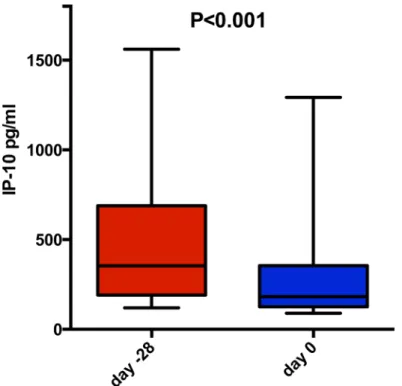
Interestingly, 4 weeks of ribavirin mono-therapy also was significantly associated with reduced mean IP-10 concentration from 548 to 345 pg/mL (P<0.001, Wilcoxon matched pairs signed
rank test;Fig 4), and a significant reduction could be seen as early as after 1 week of therapy (548 to 466 pg/mL, P = 0.003). Interestingly in contrast to reduction in HCV RNA, no associa-tion betweenIL28Bgenotype and IP-10 decline was observed, similar to ALT. At baseline,
plasma IP-10 and HCV RNA levels were significantly associated (P = 0.005,rs= 0.59 Spearman
correlation test), and a similar non-significant trend was observed between IP-10 fold reduc-tion and HCV RNA decline during 4 weeks of ribavirin mono-therapy (P = 0.051,rs= -0.43).
Decline in IP-10 was not associated with ribavirin concentration after 4 weeks of mono-therapy (P = 0.47). Upon the initiation of pegIFN-αtherapy, a rapid and similar increase in plasma
IP-10 concentration was noted in all three arms (mean 6.9, 7.2, and 8.3 fold in arm A, B and C respectively; P = 0.73 Kruskall Wallis test), as has been reported previously from other studies [42,43,47], likely secondary to a systematic activation of interferon stimulated genes leading to a release of IP-10 from many cellular sources aside from HCV infected hepatocytes.
Impact on ribavirin plasma concentrations
The“loading”arm, i.e. an initial 2-week double-dosage of ribavirin (i.e. 26 mg/kg/day) con-comitant with pegIFN-α, entailed significantly higher mean plasma ribavirin concentrations
Table 1. Baseline Characteristics for Patients According to Treatment Arm (ITT population).
Arm A ("Loading") Arm B ("Priming") Arm C ("Standard-of-Care")
(n = 21) (n = 21) (n = 16)
Female gender (n (%)) 9 (43%) 9 (43%) 5 (31%)
Age (years) 46.5±10.5 44.2±10.7 47.0±8.7
Weight (kg) 82.8±16.0 79.2±12.7 76.6±16.1
BMI (kg/m2) 27.13±3.9 26.18±3.5 25.35±4.4
HCV Genotype (n (%))
1a 15 (71%) 15 (71%) 12 (75%)
1b 6 (29%) 5 (24%) 3 (19%)
1 (subtyping not possible) 0 (0%) 1 (5%) 1 (6%)
Log10 HCV RNA (IU/mL) 6.51±0.55 5.83±0.69 6.16±0.59
ALT (IU/L) 72.7±34.7 87.3±85.7 91.8±69.2
Hemoglobin (g/dL) 147±17 145±14 146±14
IP-10 (pg/ml) 298 (102; 4833) 339 (113; 2784) 241 (106; 2718)
IL28B(IFNL4) rs12979860 (n (%))
CC 7 (33%) 8 (38%) 7 (44%)
CT or TT 14 (67%) 13 (62%) 9 (56%)
APRI score 0.82±0.59 0.89±0.78 0.78±0.58
For categorical variables n (%) are presented. For continuous variables Mean (SD) or Median (Min;Max) are presented. BMI, body mass index; HCV, hepatitis C virus; ALT alaninaminotransferase, IP-10 interferon-γinducible protein 10.
compared to SOC (i.e. 13 mg ribavirin dosing/kg/day) at day 3 (4.3 vs. 3.0μmol/L for“loading”
and SOC respectively; P = 0.002, Mann-Whitney U test;Fig 2), day 7 (6.9 vs. 4.2μmol/L;
P<0.0001), and day 14 (9.6 vs. 5.2μmol/L; P<0.0001). After 14 days of ribavirin double dosing
in the“loading”arm A, ribavirin was reduced to standard dosing but at day 28 a minor, albeit significant difference in ribavirin concentration could still be observed (7.6 vs. 6.2μmol/L for
“loading”and SOC respectively; P = 0.04, Mann-Whitney U test). In the“priming”group, riba-virin concentrations reached steady state after 4 weeks of mono-therapy.
Impact on hemoglobin
Patients in the“loading”arm suffered from a more pronounced mean hemoglobin decline from day 0 to day 14 compared to control patients receiving SOC (-2.18 vs. -1.38 g/dL; P = 0.03, Mann-Whitney U test;Fig 2). The difference in hemoglobin decline diminished after day 14, when normal ribavirin dosing was also administered in the“loading”arm. Apart from the planned dose reduction at day 14 in the“loading”arm, only one patient required a ribavirin dose adjustment during the first 28 days of therapy. This patient was enrolled in the“loading” arm and suffered from severe anemia, and ribavirin was discontinued after 14 days and all ther-apy was terminated after an additional 8 days. During the first 28 days, three patients in the “loading”arm and two patients in the SOC arm had a hemoglobin concentration below 10 g/ dL. Interestingly, no patients in the“priming”group had a hemoglobin level below 10 g/dL during the first 4-weeks when ribavirin mono-therapy was administered, and only one patient during the first 28 days after the addition of pegIFN-α.
Fig 2. Impact of“loading”(2 weeks of ribavirin double dosing concomitant with pegIFN-α),“priming” (4 weeks ribavirin mono-therapy prior to adding pegIFN-α), and“standard-of-care”on plasma ribavirin concentrations (A), hemoglobin (B), decline in HCV RNA (C), and ALT (D).Mean with standard error of the mean shown.
doi:10.1371/journal.pone.0155142.g002
Fig 3. Impact in arm B“priming”(i.e. 4 weeks ribavirin mono-therapy prior to adding pegIFN-α) of interleukin 28B (IL28B, also known asIFNL4) genetic variant CC (n = 8) vs. CT/TT (n = 13) on decline in HCV RNA (A) and ribavirin concentration day 0 (B), as well as correlation between decline in HCV RNA and ribavirin concentration day 0 (C).White squares showingIL28BCC patients and black dots showing CT/TT carriage. Mean with
standard deviation in (A and B). P values obtained using Mann-Whitney U test/Welch T test (3A), Mann-Whitney U test (3B) and Spearman correlation (3C).
Impact on outcome
No statistical significant differences between the experimental arms and the SOC arm regard-ing the first phase decline (mean and standard deviation 0.93 ± 0.66, 1.46, ± 0.89 and
1.04 ± 0.86 log10IU/mL for arm A, B and C respectively;Fig 2) or the second phase decline
(mean and standard deviation 1.64 ± 0.93, 1.53, ± 1.23 and 1.83 ± 0.83 log10IU/mL for arm A,
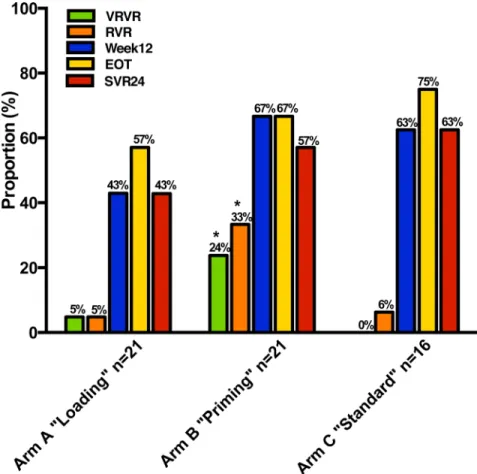
B and C respectively;Fig 2), which were the primary study endpoints, were noted. However, significantly more patients in the ribavirin mono-therapy”priming”arm achieved a very rapid virologic response (VRVR), i.e. HCV RNA below 1000 IU/mL day 7 (P = 0.02 for B vs. A+C, Fischer’s exact test;Fig 5), and this group maintained an approximately 1 log10IU/mL greater
decline in HCV RNA throughout the first 4 weeks after initiation of pegIFN-αcompared to the
other two groups (Fig 2). Similarly more patients in this study arm received 24 rather than 48 weeks of combination therapy, in accordance with the protocol, after achieving a rapid virolog-ical response (RVR), i.e. undetectable HCV RNA 4 weeks after initiation of pegIFN-α, as
mea-sured by their local laboratory (7 in“priming”, 2 in“loading”, and 1 in“SOC”). Nine of these ten patients treated for 24 weeks with combination therapy subsequently achieved SVR. Upon later evaluation at the central laboratory, significantly more patients in the ribavirin mono-therapy”priming”arm achieved RVR (7 in“priming”, 1 in“loading”, and 1 in“SOC”;
P = 0.008 for B vs. A+C, Fischer’s exact test), and all achieving RVR as determined by the cen-tral laboratory subsequently achieved SVR, with the exception of one patient who terminated therapy after week 12 because of insomnia and was subsequently lost to follow-up; differences in the proportions achieving VRVR and RVR were predefined secondary study endpoints.
InterestinglyIL28Bgenetic variant impacted on outcome, even in the ribavirin
mono-thera-py”priming”arm. Among the patients in the ribavirin mono-therapy”priming”arm achieving VRVR, 4 wereIL28BCC carriers and 1 was CT, and among those achieving RVR, 6 were Fig 4. Impact of ribavirin mono-therapy for four weeks on plasma IP-10 concentrations.Box plots displaying the 10th, 25th, 50th, 75th, and 90thpercentiles. P values obtained using Wilcoxon matched-pairs
signed rank test.
IL28BCC carriers and 1 was CT. Thus the proportion of CCrs12979860as compared to non-CC
was significantly higher among patients in the“priming”arm that achieved RVR as compared with those that did not (P = 0.0032; Fischer’s exact test). Among the patients in the“loading” arm, only one (IL28BCC carrier) achieved VRVR and RVR, and similarly in the“SOC”arm,
only one (IL28BCC carrier) achieved RVR. Thus amongIL28BCC carriers, patients in the
ribavirin mono-therapy”priming”arm were more likely to achieve both VRVR (4 of 8 vs. 1 of 14 for priming vs. loading/SOC; p = 0.04, Fischer’s exact test) and RVR (6 of 8 vs. 2 of 14 for priming vs. loading/SOC; p = 0.008) as compared patients in the“loading”or“SOC”arms. In spite of differences in likelihood of achieving RVR, and thus total treatment duration, there were no significant differences in later on-treatment responses or SVR between the three study arms (Fig 5).
Whether or not patients had ribavirin concentrations above or below the pre-defined target concentration of 10.25μmol/mL (or 2.5 mg/L), or above or below the median levels day 28,
week 12, or end-of-treatment did not impact on the likelihood of achieving SVR. Similarly the mean ribavirin concentrations did not differ significantly day 28, week 12, or end-of-treatment between patients achieving or not achieving SVR (data not shown). As of 28 days after the initi-ation of pegIFN-αtherapy, local assessments of ribavirin concentration were permitted. In the “loading”arm, this was performed in 13 patients up until study day 80, and 9 of these patients subsequently had an increase in ribavirin dosing because of low concentrations. In the
Fig 5. Proportion of patients achieving HCV RNA below 1000 IU/mL day 7 (VRVR), undetectable HCV RNA at week 4 (RVR), week 12 (Week 12), at end-of-treatment (EOT), and 24 weeks post treatment (SVR24).
“priming”and control arms, one patient in each arm similarly had an increase in ribavirin dos-ing because of sub-optimal local ribavirin concentrations between 28 and 80 days after initia-tion of pegIFN-α.
Discussion
Neither a 4-week“priming”with ribavirin mono-therapy nor 2-weeks double dosing had any significant impact on the primary study endpoints, i.e. first and second phase decline, or on SVR, consistent with several previous studies [37,48], but contrasting with the study by Quiles-Pérez et al. that noted an effect on early viral kinetics [36]. The lack of impact particu-larly on the second phase decline in HCV RNA in the“loading”arm was surprising, but may have resulted from double ribavirin dosing only being given for the first 2 weeks in addition to the use of relatively high ribavirin doses in all study arms. Nevertheless, significantly more patients receiving 4-weeks of ribavirin mono-therapy achieved VRVR and RVR, both of which were predefined secondary study endpoints, resulting in a greater proportion of patients quali-fying for shortened treatment duration from 48 to 24 weeks of combination therapy, thus spar-ing considerable side effects and cost. However, one should bear in mind that in addition to the decline in HCV RNA observed after 4 weeks of ribavirin mono-therapy, patients in the“ prim-ing”arm also had a slightly lower baseline viral load, which in combination likely impacted on the likelihood of achieving VRVR and RVR.
Presently ribavirin is recommended for several DAA-based treatments for HCV genotype 1–3 infection [13], and likely will remain a vital component of therapy, especially for retreat-ment following relapse after DAA-based therapy to prevent the selection and emergence of resistance, or when preexisting baseline resistance associated variants (RAVs) have been detected. NS5A RAVs often exist prior to any exposure to NS5A-inhibitor inclusive DAA regi-mens [49,50], and these RAVs often are enriched and persist following failure to achieve SVR. As ribavirin, when given as mono-therapy or in combination with interferon, does not appear to select for emergence of ribavirin-resistant variants [36,51], and as viral replication is a pre-requisite for development of RAVs, the findings in our present pilot study potentially may have implication for DAA-based, interferon-free therapy. For example, a 4-week“priming” with ribavirin mono-therapy could pave the way by modestly reducing the viral load prior to the initiation of DAAs, and thus reducing the risk of enrichment or selection of RAVs and sec-ondary adaptive mutations that improve viral fitness, possibly allowing for shorter treatment duration. Indeed SVR was achieved in 83% of treatment-naïve HCV genotype 1 infected patients with baseline NS5A RAVs conferring greater than 100-fold resistance enrolled in the ION-3 trial as compared to 95–100% SVR for the remaining patients without such RAVs entailing a high loss of potency when treated with ledipasvir and sofosbuvir for 8 weeks [52]. One might speculate that ribavirin“priming”or concomitant administration might have improved the likelihood of achieving SVR in the face of baseline NS5A RAVs in this latter study by modestly lowering HCV RNA levels. Additionally the findings in our present study may help explain the higher likelihood of achieving SVR after both 12 and 24 weeks of ledipas-vir and sofosbuledipas-vir therapy for HCV genotype 1a infection when ribaledipas-virin was co-administered as compared to when ribavirin was not given in the face of baseline NS5A RAVs (88% without vs. 94% with ribavirin, and 85% without vs. 100% with ribavirin for 12 and 24 weeks of therapy respectively) [53].
that the viral decline was significantly associated withIL28Bgenotype, with CC carriage
entail-ing a greater viral decline as compared to CT/TT. Interestentail-ingly, in the study by Rotman et al. a similar, non-significant trend was observed towards slightly greater decline in HCV RNA amongIL28BCC/CT carriers as compared toIL28BTT receiving ribavirin mono-therapy, as
well as a significantly greater decline in ALT amongIL28BCC patients [48]. In contrast, in the
study by Mihm et al., no association was noted between HCV RNA andIL28Bgenetic variant,
possible secondary to the limited sample size [37]. Similarly ribavirin concentrations after four weeks of mono-therapy were significantly associated with decline in HCV RNA, which also previously has been noted [23], but surprisingly also withIL28Bgenetic variation. In an
attempt to further delineate the impact on clearance of HCV RNA, a stepwise linear regression model for viral decline was performed, including bothIL28Bpolymorphism and ribavirin
con-centration. In this analysis onlyIL28BCC carriage remained a significant predictor of viral
decline during the 4 weeks of ribavirin mono-therapy. Since genetic variants in proximity to
IL28Bpreviously have been associated with HCV RNA reduction during pegIFN-αand
ribavi-rin combination therapy [39], spontaneous resolution of HCV infection [40,54] and recently also to early viral kinetics and treatment outcome in interferon-free HCV therapeutic trial [54,
55], it is reasonable that an impact also could be present during ribavirin mono-therapy. It is important to bear in mind that during ribavirin mono-therapy, endogenously produced inter-feron is present in spite of the lack of exogenous administration, and that the addition of ribavi-rin may trigger furtherIL28Bassociated innate anti-viral interferon responses, either by
directly lowering the viral load or indirectly by modifying host gene expression [24–27,56]. Ribavirin mono-therapy also decreased the plasma concentration of IP-10, which has been reported previously [48]. In this study there was a significant association between baseline plasma IP-10 and HCV RNA, and there also was a trend towards an association between IP-10 fold change and reduction in HCV RNA after 4 weeks of mono-therapy. A similar relationship has been noted in studies using ribavirin mono-therapy or interferon-free HCV therapy [48,
57,58]. Thus a possible explanation is that the decline in IP-10 is driven by the decline in viral load, although the decline in HCV RNA during ribavirin mono-therapy was regulated by
IL28Bgenetic variation, which the decline in IP-10 was not. Similarly, in the study by Meissner
et al., HCV RNA kinetics and IP-10 decline were significantly correlated among 60 treatment-naïve HCV genotype 1 infected patients receiving ribavirin and sofosbuvir for 24 weeks, but in spite of undetectable HCV RNA in all end-of-treatment samples, IP-10 levels were somewhat elevated in the 14 patients who later relapsed, also suggesting that HCV RNA levels do not exclusively regulate IP-10 [59]. A similarly plausible, alternative molecular mechanism is a ribavirin-powered modulation of ISGs, including IP-10, in congruence with priorin vivo[25]
andin vitro[26,27] studies, and lower baseline induction of ISGs has been reported to be
asso-ciated with favorable outcome following interferon-based HCV therapy [60]. The findings in the ribavirin mono-therapy“priming”arm in the present study that the decline in both IP-10 and ALT, unlike the reduction in HCV RNA, was not associated with hostIL28Bgenetic
varia-tion may further support this latter hypothesized mechanism of acvaria-tion of ribavirin.
Similarly by day 14, patients in the“loading”arm reached peak ribavirin concentrations, and levels subsequently decreased upon reverting to standard ribavirin dosing, i.e. 13 mg/kg/day. Thus it appears that 14 days of“loading”might have been excessive, and that in severe viral infections, where it is crucial to rapidly achieve high concentrations, one-week of ribavirin dou-ble dosing may be preferential.
The present pilot study, similar to previously published studies exploring alternative dosing of ribavirin for HCV [36,37,48], suffered from insufficient power to detect minor differences in SVR, which obviously is a limitation as small sizes risk introducing biases in addition to hampering the detection of significant findings. Our primary endpoint thus was focused on early on-treatment viral kinetics, as ribavirin reportedly predominantly impacts on the second phase decrease in HCV RNA [63], and the initial power calculation performed was based on the recruitment of 35 patients in each arm, a number we were unable to recruit, likely second-ary to the rapid introduction of DAA-based HCV therapy. In spite of this, many significant and important findings were made in the present study, which may further knowledge in the field.
Thus in conclusion, this pilot study indicates that (i) ribavirin mono-therapy may have an anti-viral effect differently regulated acrossIL28Bgenotypes, entails higher likelihood of
achieving VRVR as well as RVR and thus of shortened treatment duration, and down-regulates IP-10 independent ofIL28B, and (ii) one-week of ribavirin double dosing may be sufficient to
achieve high concentrations.
Supporting Information
S1 File. The study protocol for the RibaC trial.
(DOC)
S2 File. The CONSORT checklist for the RibaC trial.
(DOC)
Author Contributions
Conceived and designed the experiments: ML J. Waldenstrom J. Westin PC. Performed the experiments: ML J. Waldenstrom J. Westin KN PC OD MF KL GN HK HN MRB SS. Analyzed the data: ML J. Waldenstrom SN PC. Contributed reagents/materials/analysis tools: HK. Wrote the paper: ML J. Waldenstrom.
References
1. Lawitz E, Mangia A, Wyles D, Rodriguez-Torres M, Hassanein T, Gordon SC, et al. Sofosbuvir for previ-ously untreated chronic hepatitis C infection. N Engl J Med. 2013; 368(20):1878–87. Epub 2013/04/24. doi:10.1056/NEJMoa1214853PMID:23607594.
2. Zeuzem S, Soriano V, Asselah T, Bronowicki JP, Lohse AW, Mullhaupt B, et al. Faldaprevir and deleo-buvir for HCV genotype 1 infection. The New England journal of medicine. 2013; 369(7):630–9. Epub 2013/08/16. doi:10.1056/NEJMoa1213557PMID:23944300.
3. Afdhal N, Reddy KR, Nelson DR, Lawitz E, Gordon SC, Schiff E, et al. Ledipasvir and sofosbuvir for pre-viously treated HCV genotype 1 infection. N Engl J Med. 2014; 370(16):1483–93. Epub 2014/04/15. doi:10.1056/NEJMoa1316366PMID:24725238.
4. Feld JJ, Kowdley KV, Coakley E, Sigal S, Nelson DR, Crawford D, et al. Treatment of HCV with ABT-450/r-ombitasvir and dasabuvir with ribavirin. N Engl J Med. 2014; 370(17):1594–603. Epub 2014/04/ 12. doi:10.1056/NEJMoa1315722PMID:24720703.
6. Kwo PY, Mantry PS, Coakley E, Te HS, Vargas HE, Brown R Jr, et al. An interferon-free antiviral regi-men for HCV after liver transplantation. N Engl J Med. 2014; 371(25):2375–82. Epub 2014/11/12. doi: 10.1056/NEJMoa1408921PMID:25386767.
7. Lawitz E, Gane E, Pearlman B, Tam E, Ghesquiere W, Guyader D, et al. Efficacy and safety of 12 weeks versus 18 weeks of treatment with grazoprevir (MK-5172) and elbasvir (MK-8742) with or without ribavirin for hepatitis C virus genotype 1 infection in previously untreated patients with cirrhosis and patients with previous null response with or without cirrhosis (C-WORTHY): a randomised, open-label phase 2 trial. Lancet. 2014. Epub 2014/12/04. doi:10.1016/S0140-6736(14)61795-5PMID:25467591. 8. Lawitz E, Poordad FF, Pang PS, Hyland RH, Ding X, Mo H, et al. Sofosbuvir and ledipasvir fixed-dose
combination with and without ribavirin in treatment-naive and previously treated patients with genotype 1 hepatitis C virus infection (LONESTAR): an open-label, randomised, phase 2 trial. Lancet. 2014; 383 (9916):515–23. Epub 2013/11/12. doi:10.1016/S0140-6736(13)62121-2PMID:24209977.
9. Lawitz E, Sulkowski MS, Ghalib R, Rodriguez-Torres M, Younossi ZM, Corregidor A, et al. Simeprevir plus sofosbuvir, with or without ribavirin, to treat chronic infection with hepatitis C virus genotype 1 in non-responders to pegylated interferon and ribavirin and treatment-naive patients: the COSMOS ran-domised study. Lancet. 2014; 384(9956):1756–65. Epub 2014/08/01. doi:10.1016/S0140-6736(14) 61036-9PMID:25078309.
10. Manns M, Pol S, Jacobson IM, Marcellin P, Gordon SC, Peng CY, et al. All-oral daclatasvir plus asuna-previr for hepatitis C virus genotype 1b: a multinational, phase 3, multicohort study. Lancet. 2014; 384 (9954):1597–605. Epub 2014/08/01. doi:10.1016/S0140-6736(14)61059-XPMID:25078304. 11. Sulkowski MS, Gardiner DF, Rodriguez-Torres M, Reddy KR, Hassanein T, Jacobson I, et al.
Daclatas-vir plus sofosbuDaclatas-vir for previously treated or untreated chronic HCV infection. N Engl J Med. 2014; 370 (3):211–21. Epub 2014/01/17. doi:10.1056/NEJMoa1306218PMID:24428467.
12. Zeuzem S, Dusheiko GM, Salupere R, Mangia A, Flisiak R, Hyland RH, et al. Sofosbuvir and ribavirin in HCV genotypes 2 and 3. N Engl J Med. 2014; 370(21):1993–2001. Epub 2014/05/06. doi:10.1056/ NEJMoa1316145PMID:24795201.
13. EASL Clinical Practice Guidelines: management of hepatitis C virus infection. Journal of hepatology. 2014; 60(2):392–420. Epub 2013/12/18. doi:10.1016/j.jhep.2013.11.003PMID:24331294. 14. Sidwell RW, Huffman JH, Khare GP, Allen LB, Witkowski JT, Robins RK. Broad-spectrum antiviral
activity of Virazole: 1-beta-D-ribofuranosyl-1,2,4-triazole-3-carboxamide. Science. 1972; 177 (4050):705–6. Epub 1972/08/25. PMID:4340949.
15. Randolph AG, Wang EE. Ribavirin for respiratory syncytial virus infection of the lower respiratory tract. The Cochrane database of systematic reviews. 2000;(2: ):CD000181. Epub 2000/05/05. doi:10.1002/ 14651858.CD000181PMID:10796503.
16. Ascioglu S, Leblebicioglu H, Vahaboglu H, Chan KA. Ribavirin for patients with Crimean-Congo hae-morrhagic fever: a systematic review and meta-analysis. The Journal of antimicrobial chemotherapy. 2011; 66(6):1215–22. Epub 2011/04/13. doi:10.1093/jac/dkr136PMID:21482564.
17. Gowen BB, Bray M. Progress in the experimental therapy of severe arenaviral infections. Future micro-biology. 2011; 6(12):1429–41. Epub 2011/11/30. doi:10.2217/fmb.11.132PMID:22122440; PubMed Central PMCID: PMC3535293.
18. Lee KY, Hung CC. Ribavirin for chronic hepatitis E virus infection. The New England journal of medi-cine. 2014; 370(25):2447. Epub 2014/06/19. doi:10.1056/NEJMc1405191#SA3PMID:24941186. 19. Dusheiko G, Main J, Thomas H, Reichard O, Lee C, Dhillon A, et al. Ribavirin treatment for patients with chronic hepatitis C: results of a placebo-controlled study. J Hepatol. 1996; 25(5):591–8. PMID: 8938532.
20. Di Bisceglie AM, Conjeevaram HS, Fried MW, Sallie R, Park Y, Yurdaydin C, et al. Ribavirin as therapy for chronic hepatitis C. A randomized, double-blind, placebo-controlled trial. Annals of internal medi-cine. 1995; 123(12):897–903. Epub 1995/12/15. PMID:7486483.
21. Fried MW, Shiffman ML, Reddy KR, Smith C, Marinos G, Goncales FL Jr, et al. Peginterferon alfa-2a plus ribavirin for chronic hepatitis C virus infection. N Engl J Med. 2002; 347(13):975–82. PMID: 12324553.
22. Schvarcz R, Ando Y, Sonnerborg A, Weiland O. Combination treatment with interferon alfa-2b and riba-virin for chronic hepatitis C in patients who have failed to achieve sustained response to interferon alone: Swedish experience. Journal of hepatology. 1995; 23 Suppl 2:17–21. Epub 1995/01/01. PMID: 8720289.
23. Pawlotsky JM, Dahari H, Neumann AU, Hezode C, Germanidis G, Lonjon I, et al. Antiviral action of riba-virin in chronic hepatitis C. Gastroenterology. 2004; 126(3):703–14. Epub 2004/02/28. PMID:
14988824.
25. Feld JJ, Nanda S, Huang Y, Chen W, Cam M, Pusek SN, et al. Hepatic gene expression during treat-ment with peginterferon and ribavirin: Identifying molecular pathways for treattreat-ment response. Hepatol-ogy. 2007; 46(5):1548–63. Epub 2007/10/12. doi:10.1002/hep.21853PMID:17929300; PubMed Central PMCID: PMC2808168.
26. Thomas E, Feld JJ, Li Q, Hu Z, Fried MW, Liang TJ. Ribavirin potentiates interferon action by augment-ing interferon-stimulated gene induction in hepatitis C virus cell culture models. Hepatology. 2011; 53 (1):32–41. Epub 2011/01/22. doi:10.1002/hep.23985PMID:21254160; PubMed Central PMCID: PMC3498496.
27. Rotman Y, Noureddin M, Feld JJ, Guedj J, Witthaus M, Han H, et al. Effect of ribavirin on viral kinetics and liver gene expression in chronic hepatitis C. Gut. 2014; 63(1):161–9. Epub 2013/02/12. doi:10. 1136/gutjnl-2012-303852PMID:23396509; PubMed Central PMCID: PMC3778097.
28. Rembeck K, Waldenstrom J, Hellstrand K, Nilsson S, Nystrom K, Martner A, et al. Variants of the ino-sine triphosphate pyrophosphatase gene are associated with reduced relapse risk following treatment for HCV genotype 2/3. Hepatology. 2014; 59(6):2131–9. Epub 2014/02/13. doi:10.1002/hep.27009 PMID:24519039.
29. Morello J, Rodriguez-Novoa S, Jimenez-Nacher I, Soriano V. Usefulness of monitoring ribavirin plasma concentrations to improve treatment response in patients with chronic hepatitis C. The Journal of anti-microbial chemotherapy. 2008; 62(6):1174–80. Epub 2008/10/22. doi:10.1093/jac/dkn421PMID: 18931138.
30. Bruchfeld A, Lindahl K, Schvarcz R, Stahle L. Dosage of ribavirin in patients with hepatitis C should be based on renal function: a population pharmacokinetic analysis. Therapeutic drug monitoring. 2002; 24 (6):701–8. Epub 2002/11/27. PMID:12451285.
31. Paroni R, Del Puppo M, Borghi C, Sirtori CR, Galli Kienle M. Pharmacokinetics of ribavirin and urinary excretion of the major metabolite 1,2,4-triazole-3-carboxamide in normal volunteers. International jour-nal of clinical pharmacology, therapy, and toxicology. 1989; 27(6):302–7. Epub 1989/06/01. PMID: 2737800.
32. McHutchison JG, Manns M, Patel K, Poynard T, Lindsay KL, Trepo C, et al. Adherence to combination therapy enhances sustained response in genotype-1-infected patients with chronic hepatitis C. Gastro-enterology. 2002; 123(4):1061–9. Epub 2002/10/03. PMID:12360468.
33. Loustaud-Ratti V, Alain S, Rousseau A, Hubert IF, Sauvage FL, Marquet P, et al. Ribavirin exposure after the first dose is predictive of sustained virological response in chronic hepatitis C. Hepatology. 2008; 47(5):1453–61. Epub 2008/04/26. doi:10.1002/hep.22217PMID:18435468.
34. Brochot E, Castelain S, Duverlie G, Capron D, Nguyen-Khac E, Francois C. Ribavirin monitoring in chronic hepatitis C therapy: anaemia versus efficacy. Antiviral therapy. 2010; 15(5):687–95. Epub 2010/08/17. doi:10.3851/IMP1609PMID:20710050.
35. De Franceschi L, Fattovich G, Turrini F, Ayi K, Brugnara C, Manzato F, et al. Hemolytic anemia induced by ribavirin therapy in patients with chronic hepatitis C virus infection: role of membrane oxidative dam-age. Hepatology. 2000; 31(4):997–1004. Epub 2000/03/25. doi:10.1053/he.2000.5789PMID: 10733558.
36. Quiles-Perez R, Munoz-de-Rueda P, Maldonado AM, Martin-Alvarez A, Quer J, Salmeron J. Effects of ribavirin monotherapy on the viral population in patients with chronic hepatitis C genotype 1: direct sequencing and pyrosequencing of the HCV regions. Journal of medical virology. 2014; 86(11):1886– 97. Epub 2014/08/06. doi:10.1002/jmv.24035PMID:25091333.
37. Mihm U, Welker MW, Teuber G, Wedemeyer H, Berg T, Sarrazin C, et al. Impact of ribavirin priming on viral kinetics and treatment response in chronic hepatitis C genotype 1 infection. Journal of viral hepati-tis. 2014; 21(1):42–52. Epub 2013/12/18. doi:10.1111/jvh.12124PMID:24329856.
38. Furusyo N, Kubo N, Toyoda K, Takeoka H, Nabeshima S, Murata M, et al. Helper T cell cytokine response to ribavirin priming before combined treatment with interferon alpha and ribavirin for patients with chronic hepatitis C. Antiviral research. 2005; 67(1):46–54. Epub 2005/05/26. doi:10.1016/j. antiviral.2005.04.001PMID:15913800.
39. Ge D, Fellay J, Thompson AJ, Simon JS, Shianna KV, Urban TJ, et al. Genetic variation in IL28B pre-dicts hepatitis C treatment-induced viral clearance. Nature. 2009; 461(7262):399–401. Epub 2009/08/ 18. doi:10.1038/nature08309PMID:19684573.
40. Thomas DL, Thio CL, Martin MP, Qi Y, Ge D, O'Huigin C, et al. Genetic variation in IL28B and sponta-neous clearance of hepatitis C virus. Nature. 2009; 461(7265):798–801. Epub 2009/09/18.
nature08463 [pii] doi:10.1038/nature08463PMID:19759533.
42. Lagging M, Romero AI, Westin J, Norkrans G, Dhillon AP, Pawlotsky JM, et al. IP-10 predicts viral response and therapeutic outcome in difficult-to-treat patients with HCV genotype 1 infection. Hepatol-ogy. 2006; 44(6):1617–25. Epub 2006/11/30. doi:10.1002/hep.21407PMID:17133471.
43. Romero AI, Lagging M, Westin J, Dhillon AP, Dustin LB, Pawlotsky JM, et al. Interferon (IFN)-gamma-inducible protein-10: association with histological results, viral kinetics, and outcome during treatment with pegylated IFN-alpha 2a and ribavirin for chronic hepatitis C virus infection. J Infect Dis. 2006; 194 (7):895–903. PMID:16960776.
44. Grebely J, Feld JJ, Applegate T, Matthews GV, Hellard M, Sherker A, et al. Plasma interferon-gamma-inducible protein-10 (IP-10) levels during acute hepatitis C virus infection. Hepatology. 2013; 57 (6):2124–34. Epub 2013/01/18. doi:10.1002/hep.26263PMID:23325615; PubMed Central PMCID: PMC3663887.
45. Pedersen C, Alsio A, Lagging M, Langeland N, Farkkila M, Buhl MR, et al. Ribavirin plasma concentra-tion is a predictor of sustained virological response in patients treated for chronic hepatitis C virus geno-type 2/3 infection. Journal of viral hepatitis. 2011; 18(4):245–51. Epub 2010/04/14. doi: 10.1111/j.1365-2893.2010.01303.xPMID:20384961.
46. Lagging M, Askarieh G, Negro F, Bibert S, Soderholm J, Westin J, et al. Response prediction in chronic hepatitis C by assessment of IP-10 and IL28B-related single nucleotide polymorphisms. PloS one. 2011; 6(2):e17232. Epub 2011/03/11. doi:10.1371/journal.pone.0017232PMID:21390311; PubMed Central PMCID: PMC3044738.
47. Falconer K, Askarieh G, Weis N, Hellstrand K, Alaeus A, Lagging M. IP-10 predicts the first phase decline of HCV RNA and overall viral response to therapy in patients co-infected with chronic hepatitis C virus infection and HIV. Scandinavian journal of infectious diseases. 2010; 42(11–12):896–901. Epub 2010/07/09. doi:10.3109/00365548.2010.498019PMID:20608766.
48. Rotman Y, Noureddin M, Feld JJ, Guedj J, Witthaus M, Han H, et al. Effect of ribavirin on viral kinetics and liver gene expression in chronic hepatitis C. Gut. 2013. Epub 2013/02/12. doi: 10.1136/gutjnl-2012-303852PMID:23396509.
49. Lindstrom I, Kjellin M, Palanisamy N, Bondeson K, Wesslen L, Lannergard A, et al. Prevalence of poly-morphisms with significant resistance to NS5A inhibitors in treatment-naive patients with hepatitis C virus genotypes 1a and 3a in Sweden. Infectious diseases. 2015:1–8. Epub 2015/04/09. doi:10.3109/ 23744235.2015.1028097PMID:25851241.
50. Hirotsu Y, Kanda T, Matsumura H, Moriyama M, Yokosuka O, Omata M. HCV NS5A resistance-associ-ated variants in a group of real-world Japanese patients chronically infected with HCV genotype 1b. Hepatology international. 2015. Epub 2015/03/21. doi:10.1007/s12072-015-9624-2PMID:25791176. 51. Chevaliez S, Brillet R, Lazaro E, Hezode C, Pawlotsky JM. Analysis of ribavirin mutagenicity in human hepatitis C virus infection. Journal of virology. 2007; 81(14):7732–41. Epub 2007/05/12. doi:10.1128/ JVI.00382-07PMID:17494069; PubMed Central PMCID: PMC1933365.
52. Sarrazin C, Dvory-Sobol H, Svarovskaia E, Doehle B, McCarville J, Pang P, et al. Baseline and Post-baseline Resistance Analyses of Phase 2/3 Studies of Ledipasvir/Sofosbuvir±RBV. Hepatology. 2014; 60(4 (Suppl)):1128A.
53. Sarrazin C, Dvory-Sobol H, Svarovskaia E, Doehle B, Martin R, Zeuzem S, et al. The Prevalence And The Effect Of HCV NS5A Resistance Associated Variants In Subjects With Compensated Cirrhosis Treated With Ledipasvir/Sofosbuvir +/−RBV. Journal of Hepatology. 2015; 62(Supplement No. 2): s620.
54. Chu TW, Kulkarni R, Gane EJ, Roberts SK, Stedman C, Angus PW, et al. Effect of IL28B genotype on early viral kinetics during interferon-free treatment of patients with chronic hepatitis C. Gastroenterol-ogy. 2012; 142(4):790–5. Epub 2012/01/18. doi:10.1053/j.gastro.2011.12.057PMID:22248659. 55. Poordad F, Hezode C, Trinh R, Kowdley KV, Zeuzem S, Agarwal K, et al. ABT-450/r-ombitasvir and
dasabuvir with ribavirin for hepatitis C with cirrhosis. The New England journal of medicine. 2014; 370 (21):1973–82. Epub 2014/04/15. doi:10.1056/NEJMoa1402869PMID:24725237.
56. Werner JM, Serti E, Chepa-Lotrea X, Stoltzfus J, Ahlenstiel G, Noureddin M, et al. Ribavirin improves the IFN-gamma response of natural killer cells to IFN-based therapy of hepatitis C virus infection. Hepa-tology. 2014; 60(4):1160–9. Epub 2014/04/05. doi:10.1002/hep.27092PMID:24700342.
57. Schaefer CJ, Kossen K, Lim SR, Lin JH, Pan L, Bradford W, et al. Danoprevir monotherapy decreases inflammatory markers in patients with chronic hepatitis C virus infection. Antimicrobial agents and che-motherapy. 2011; 55(7):3125–32. Epub 2011/04/20. doi:10.1128/AAC.00131-11PMID:21502634; PubMed Central PMCID: PMC3122460.
The Journal of infectious diseases. 2014; 210(12):1881–5. Epub 2014/06/08. doi:10.1093/infdis/jiu325 PMID:24907384.
59. Meissner EG, Wu D, Osinusi A, Bon D, Virtaneva K, Sturdevant D, et al. Endogenous intrahepatic IFNs and association with IFN-free HCV treatment outcome. The Journal of clinical investigation. 2014; 124 (8):3352–63. Epub 2014/07/02. doi:10.1172/JCI75938PMID:24983321; PubMed Central PMCID: PMC4109554.
60. Sarasin-Filipowicz M, Oakeley EJ, Duong FH, Christen V, Terracciano L, Filipowicz W, et al. Interferon signaling and treatment outcome in chronic hepatitis C. Proceedings of the National Academy of Sci-ences of the United States of America. 2008; 105(19):7034–9. Epub 2008/05/10. doi:10.1073/pnas. 0707882105PMID:18467494; PubMed Central PMCID: PMC2383932.
61. Dusheiko G, Nelson D, Reddy KR. Ribavirin considerations in treatment optimization. Antiviral therapy. 2008; 13 Suppl 1:23–30. Epub 2008/04/25. PMID:18432160.
62. Lindahl K, Stahle L, Bruchfeld A, Schvarcz R. High-dose ribavirin in combination with standard dose peginterferon for treatment of patients with chronic hepatitis C. Hepatology. 2005; 41(2):275–9. Epub 2005/01/22. doi:10.1002/hep.20563PMID:15660393.