Amber Howerton, Manomita Patra, Ernesto Abel-Santos*
Department of Chemistry, University of Nevada - Las Vegas, Las Vegas, Nevada, United States of America
Abstract
Clostridium difficileinfection (CDI) is a leading cause of antibiotic-associated diarrhea, a major nosocomial complication. The infective form of C. difficile is the spore, a dormant and resistant structure that forms under stress. Although spore germination is the first committed step in CDI onset, the temporal and spatial distribution of ingestedC. difficilespores is not clearly understood. We recently reported that CamSA, a synthetic bile salt analog, inhibitsC. difficilespore germination in vitroandin vivo. In this study, we took advantage of the anti-germination activity of bile salts to determine the fate of ingestedC. difficilespores. We tested four different bile salts for efficacy in preventing CDI. Since CamSA was the only anti-germinant tested able to prevent signs of CDI, we characterized CamSa’sin vitrostability, distribution, and cytotoxicity. We report that CamSA is stable to simulated gastrointestinal (GI) environments, but will be degraded by members of the natural microbiota found in a healthy gut. Our data suggest that CamSA will not be systemically available, but instead will be localized to the GI tract. Sincein vitropharmacological parameters were acceptable, CamSA was used to probe the mouse model of CDI. By varying the timing of CamSA dosage, we estimated thatC. difficilespores germinated and established infection less than 10 hours after ingestion. We also showed that ingestedC. difficilespores rapidly transited through the GI tract and accumulated in the colon and cecum of CamSA-treated mice. From there,C. difficilespores were slowly shed over a 96-hour period. To our knowledge, this is the first report of using molecular probes to obtain disease progression information forC. difficileinfection.
Citation: Howerton A, Patra M, Abel-Santos E (2013) Fate of Ingested Clostridium difficile Spores in Mice. PLoS ONE 8(8): e72620. doi:10.1371/ journal.pone.0072620
Editor:Adam Driks, Loyola University Medical Center, United States of America ReceivedMarch 23, 2013;AcceptedJuly 10, 2013;PublishedAugust 30, 2013
Copyright:ß2013 Howerton et al. This is an open-access article distributed under the terms of the Creative Commons Attribution License, which permits unrestricted use, distribution, and reproduction in any medium, provided the original author and source are credited.
Funding:This material is based upon work supported by the National Science Foundation under grant number 0957400. The funders had no role in study design, data collection and analysis, decision to publish, or preparation of the manuscript.
Competing Interests:EAS received a grant from the National Science Foundation (grant number 0957400). These funds partially paid for this work. Materials described in this manuscript have been submitted for protection by a provisional patent application. A Provisional Patent entitled ‘‘Reducing Risk of Contracting Clostridium difficile Associated Disease’’ was filed on 8/13/2012 with the USPTO. The Application Number is 61682505. This patent application does not alter the authors’ adherence to all the PLOS ONE policies on sharing data and materials.
* E-mail: [email protected]
Introduction
Clostridium difficileinfection (CDI) is the major identifiable cause of antibiotic-associated diarrhea in hospitals [1]. In the US alone, CDI develops in over 500,000 patients with up to 20,000 deaths per year [2]. The yearly health care burden has been estimated to be greater than$3 billion.
The infective agent of CDI is the C. difficile spore, a hardy structure formed under nutrient deprivation [3]. In a healthy gut, indigenous microbes form a protective barrier against C. difficile
colonization of the gastrointestinal (GI) tract, but this protective function can be weakened by antibiotic therapy [4]. Under these favorable conditions,C. difficilespores interact with small molecule germinants, triggering a series of events committing the spore to germinate into toxin producing bacteria [5].
Since spore germination is the first committed step in CDI, understanding the behavior of spores in the GI tract of the host is a necessary first step in infection control [1]. Taurocholate, a natural bile salt, and glycine, an amino acid, were shown to activateC. difficile spore germination [6]. We have reported that C. difficile
spores bind taurocholate and glycine through a complex mechanism [7]. Using kinetic analysis, we showed that unknown receptor homo- and heterocomplexes are formed. Others and we also showed that chenodeoxycholate, another natural bile salt, is a competitive inhibitor of C. difficile spore germination [7,8,9,10]. These findings strongly implicate the presence of unidentified
proteinaceous germination receptor(s) thatC. difficileuses to bind small molecules to activate spore germination.
Analogs of taurocholate and glycine were used as chemical probes to determine structure activity relationships for germinant binding and activation of germination ofC. difficilespores in vitro
[8]. The putative germination machinery of C. difficileseems to contain unique binding sites for alkyl, aromatic, and basic amino acids as co-germinants whereas the binding region for bile salts is restricted to taurocholate analogs [8]. We reported that a meta -benzene sulfonic acid derivative of taurocholate, CamSA, is a strong competitive inhibitor of taurocholate-mediated C. difficile
spore germinationin vitro. Even more, a single 50 mg/kg dose of CamSA prevented CDI in mice without any observable toxicity [11]. Our results support a mechanism whereby the anti-germination effect of CamSA is responsible for preventing CDI signs.
Although the germination ofC. difficilespores has been studied
in vitro, the in vivo fate of ingested spores is not clear [1]. Determining the timing of ingested spore germination will allow assessing the time window when patients are at risk of developing CDI. Furthermore, determining the transit time of ingested spores through the GI tract will allow defining whether ingested spores contribute to CDI relapse.
endpoint in the hamster model of CDI [12]. This is further complicated by the ability of C. difficile vegetative cells to re-sporulate in the intestine of the animal host [13]. Indeed, previous works have not been able to distinguish between ingested spores and spores formed in the gut of infected animals [14].
In the current study, we tested the ability of four bile salt analogs asin vivoinhibitors ofC. difficilespore germination. Since CamSA had the best biological activity, we further characterized CamSA’s stability, distribution and cytotoxicity in vitro. Finally, we used CamSA as a probe to estimate the transit time of ingested C. difficile spores and the timing of CDI onset in mice. With this information we proposed a model that describes the spatial and temporal fate of ingestedC. difficilespores.
Results
CamSA had no Observable Adverse Effects on Mice To determine the acute toxicity of CamSA to mice, we used the fixed dose procedure [15]. No physical adverse effects or weight loss were observed when CamSA was administered for three consecutive days at doses up to saturating 300 mg/kg (Fig. S1). A 300 mg/kg dose of chenodeoxycholate caused immediate death, probably due to observed precipitation of chenodeoxycholate upon interaction with mouse saliva and gastric juice. Chenodeox-ycholate at 50 mg/kg did not cause any observable side effects.
Prevention of CDI by Bile Salt Analogs
As previously reported, when mice were challenged with 108CFU of C. difficile spores, severe CDI signs developed and all animals reached clinical endpoint by 48 hours post-challenge [16]. The large (108CFUs) inoculum of spores ensured synchro-nized CDI onset and fast CDI sign progression. Mice treated with up to 300 mg/kg taurocholate or ethyl cholate also developed severe CDI and signs were undistinguishable from control DMSO-treated animals (Fig. 1 and Fig. S2). Mice treated with 50 mg/kg chenodeoxycholate developed moderate to severe signs of CDI, but onset was delayed by 24 hours (Fig. S3). In contrast, all animals treated with 50 or 300 mg/kg CamSA showed no sign of CDI and were undistinguishable from non-challenged animals [11]. All asymptomatic animals remained free of CDI signs for at least 14 days post-challenge.
Stability of CamSA
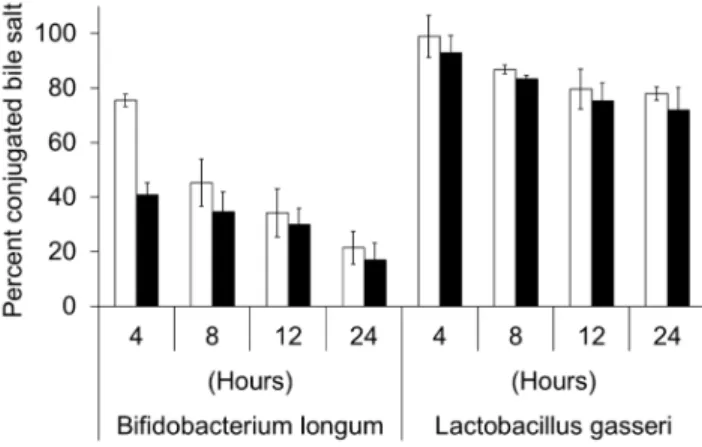
CamSA is a taurocholate analog with an amide bond linking cholic acid to meta-aminobenzene sulfonic acid. To be effective, CamSA must survive the changing environments of the GI tract. To test for stability, CamSA was incubated in artificial gastric juice and intestinal juice. No degradation of CamSA was evident even after 24 hours incubation under both conditions (data not shown). Bacterial bile salt hydrolases (BSHs) deconjugate primary and secondary bile salts [17].B. longumandL. gasseriare two intestinal bacteria commonly used as test strains for BSH production. After incubation with a culture ofB. longumfor 24 hours, CamSA and taurocholate are both hydrolyzed to cholic acid at similar rates (Fig. 2). CamSA and taurocholate are less sensitive to degradation by BSHs secreted byL. gasseri.Less than 30% of either CamSA or taurocholate was hydrolyzed to cholic acid after 24 hours (Fig. 2).
E. colidoes not produce BSH and both CamSA and taurocholate were stable after 24 hour incubation withE. colicultures (data not shown). CamSA was not degraded in growth medium alone.
Caco-2 Permeability of CamSA
To preventC. difficilespores from germinating, CamSA needs to be retained in the intestinal lumen. Caco-2 monolayers serves as
anin vitro surrogate assay for intestinal permeability, absorption, and metabolism [18]. CamSA was studied in a Caco-2 perme-ability assay and displayed an apical to basolateral apparent permeability coefficient (Papp) of,1026cm/s and basolateral to apical Papp of 10.961026cm/s. The efflux ratio suggests that
CamSA is a substrate for active transport (Table S1). In both assays, CamSA was recovered at 100% indicating low binding, accumulation, and metabolism by Caco-2 cells.
Figure 1. CamSA protects mice from CDI.Comparison of CDI sign severity after 48 hours (white bars) and 72 hours (black bars) of animals challenged withC. difficilespores and treated with DMSO, 300 mg/kg taurocholate (TC), 50 mg/kg chenodeoxycholate (CDCA), 50 mg/kg CamSA, or 300 mg/kg ethyl cholate (EC). Non-challenged (NC) animals were used as controls. Clinical endpoint was set as.6 in the CDI sign severity scale (dashed line). None of the animals in the DMSO and EC groups survived to 72 hours post-challenged. Standard deviations represent at least five independent measures.
doi:10.1371/journal.pone.0072620.g001
Figure 2. Stability of CamSA and taurocholate towards bile salt hydrolases.CamSA (white bar) and taurocholate (black bars) were incubated with cultures ofB. longumorL gasseri. Percent conjugated bile salts were derived by dividing the intensity of TLC spots obtained at different times by the intensity of the TLC spot obtained at the beginning of incubation (time 0). Time 0 was set at 100% and is not shown for clarity. Standard deviations represent at least five indepen-dent measures.
Effect of CamSA on Bacterial Growth
E. coli,B. longum, andL. gasseriare indigenous mammalian gut bacteria and are continuously exposed to bile salts [17]. As expected, growth of these bacteria was unaffected by the presence of CamSA in the growth medium. C. difficile cells also grew normally in the presence of CamSA (Fig. S4).
Cytotoxicity of CamSA
Cell viability was qualitatively determined by visual observation of rounded/detached cells and trypan blue staining. CamSA-treated Vero, Caco-2, and macrophage cells appeared healthy and were undistinguishable from DMSO-treated cells (Fig. S5). Cell viability was also quantitatively determined by ATP production. Vero and Caco-2 cells treated with 50 or 200mM CamSA produced ATP at similar levels to healthy control cells (Fig. 3).
CamSA Protection of Vero and Caco-2 Cells
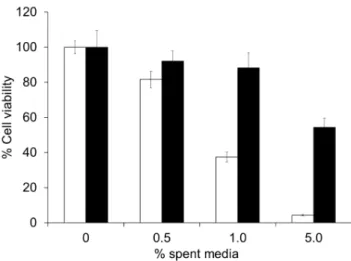
Spent media from outgrowingC. difficilespores killed Vero cells in a dose-dependent manner (Fig. 4). These data are consistent with previous reports indicating that vegetativeC. difficilesecretes cell-killing toxins during growth [19]. WhenC. difficilespores were incubated in medium containing 200mM CamSA, bacterial growth was reduced but not eliminated. As expected, spent media from CamSA-treated bacterial cultures were less effective at killing epithelial cells. Similar results were observed for Caco-2 cell cultures (data not shown).
Timing of CDI Onset
To determine the onset of CDI in mice, animals were challenged with C. difficile spores and treated with 300 mg/kg CamSA between 0 and 12 hours post-challenge. All animals treated with CamSA up to 6 hours post-challenge were fully protected from CDI. In contrast, all animals treated with CamSA at 9 or 12 hours post-challenge developed severe CDI undistin-guishable from untreated mice and reached the clinical endpoint 48 hours post infection (Figs. 5A and 5B).
Similar to previous reports, GI contents from animals with CDI signs contained almost exclusivelyC. difficilevegetative cells [13]. These animals started to excrete large amounts (.106105CFUs) of vegetative cells reaching a maximum between 8 and 10 hours post spore challenge (Fig. 5C). Although some C. difficile spores were excreted by diseased animals, the amounts were negligible (,10% of vegetative CFUs) compared to the high amount of excreted vegetative cells.
Recovery ofC. difficile Cells and Spores from Intestines and Feces of CamSA-treated Mice
Similar to the hamster CDI model [13], ingested C. difficile
spores narrowly localized to the cecum and colon of CamSA treated mice at every time point tested. A negligible amount ofC. difficilewas discovered in the small intestine and stomach (Fig. S6).
C. difficilespores remained in the cecum and colon for 72 hours after spore challenge (Fig. 6A). By 96 hours, the amount of spores recovered from the cecum and colon of CamSA treated animals decreased almost tenfold, from greater than 126105to less than
26105CFUs.
Consistent with the results from intestinal content, the feces of CamSA-treated animals contained almost exclusively spores (Fig. 6B). In these animals, excretion of ingestedC. difficilespores started 2 hours post-challenge and continued until at least 96 hours post-challenge. In fact, by 120 hours post-challenge, the sum of excreted C. difficile spores was quantitatively identical to the number of spores given by gavage.
Discussion
Germination ofC. difficilespores is believed to be the first step in establishing CDI [1]. However, determining the fate of ingestedC. difficilespores is challenging since spores can germinate and the resulting cells can then re-sporulate perpetuating a cycle of disease. Anti-germinants prevent CDI by effectively freezing ingested spores in their dormant state. We took advantage of this anti-Figure 3. Cytotoxicity of CamSA.Vero cells (white bars) or Caco-2
cells (black bars) were incubated overnight with 10% DMSO, 10% EtOH, 50mM CamSA or 200mM CamSA. Cell viability was determined with the
CellTiter Glo viability kit. The luminescence signal from DMSO-treated cells was undistinguishable from untreated cells and was set as 100% cell viability. Percent survival for other conditions was calculated relative to untreated cells. Error bars represent standard deviations from at least five independent measurements.
doi:10.1371/journal.pone.0072620.g003
Figure 4. Inhibition ofC. difficiletoxin production by CamSA treatment. C. difficile spores were incubated overnight in media containing 0mM CamSA (white bars) or 200mM CamSA (black bars).
The resulting spent media were added to Vero cell cultures and incubated for 24 hours. Cell viability was determined with the CellTiter Glo viability kit. The luminescence signal from untreated cells was set as 100% cell viability. Percent survival for other conditions was calculated relative to untreated cells. Error bars represent standard deviations from at least five independent measurements.
germinant property to study the temporal and spatial distribution of ingestedC. difficilespores.
Following our success using the anti-germination properties of CamSA to protect mice from CDI, we tested taurocholate (a natural germination enhancer), chenodeoxycholate (a natural germination inhibitor), and ethylcholate (a commercially available germination inhibitor) as prophylactics of CDI. Ethyl cholate inhibitsC. difficilespore germination with a half maximal inhibitory concentration (IC50) of 8.2mM, seven-fold more potent than CamSAin vitro(data not shown). Chenodeoxycholate, on the other hand, inhibits C. difficile spore germination with an IC50 of 235mM, approximately five-fold less potent than CamSA [20].
As previously reported, CamSA was a prophylactic of murine CDI [11]. In this study, we were able to prevent CDI with saturating concentrations of CamSA without any overt toxic effects. This is consistent with the low toxicity observed for taurocholate and cholate [21]. In fact, CamSA had anti-CDI activity at concentrations that were at least six times lower than its toxic threshold. Furthermore, CamSA-treated animals did not show signs of CDI even 14 days post-challenge. At 300 mg/kg
concentration, chenodeoxycholate showed acute toxicity probably due to low solubility in biological fluids. At lower concentrations, chenodeoxycholate was not able to prevent CDI. Animals treated with 50 mg/kg chenodeoxycholate show the same CDI sign patterns as animals treated with 5 mg/kg CamSA [11]. Another potent inhibitor ofC. difficilespore germinationin vitro, ethylcho-late, did not protect mice from CDI even at 300 mg/kg. Similarly, taurocholate, a germinant, was unable prevent CDI. CamSA was the only compound tested that was effective in preventing CDI. Hence, we further characterized CamSA’sin vitropharmacological properties.
To be effective asin vivo probes, anti-germination compounds must be stable to the variable GI tract environments. CamSA is stable to all tested GI tract microenvironments except incubation with the BSH-producing bifidobacteria. Antibiotics disrupt the normal microflora dynamics of the gut allowing for outgrowth of
C. difficile[22]. A recent study shows that antibiotic cocktails shift the normal murine gut bacterial population to a preponderance of
Lactobacilli [23]. Since BSHs produced by Lactobacilli were not Figure 5. CDI is established between 6 and 9 hours post-infection.(A) Survival of infected mice at 48 hours after challenge withC. difficile
spores. Mice were treated with 300 mg/kg CamSA at 0, 6, 9, or 12 hours post-challenge. (B) Comparison of CDI severity after 24 hours (white bars) and 48 hours (black bars) for animals challenged withC. difficilespores and treated with 300 mg/kg CamSA at 0, 6, 9, or 12 hours post-challenge. Clinical endpoint was set as.6 in the CDI sign severity scale (dashed line). (C)C. difficilevegetative cell count in feces of untreated, diseased animals. Feces were collected from cages housing five untreated mice challenged withC. difficilespores. Open bars representC. difficilevegetative cells. The amount ofC. difficilespores excreted by untreated animals was negligible (,10% of vegetative cell counts). Standard deviations represent at least five independent measures. Recovered CFU and recovered spores represent mean values from pools of five animals.
effective in hydrolyzing CamSA, CamSA should remain stable in the gut of antibiotic-treated mammals.
Since CDI is an intestinal infection, anti-germination com-pounds require low oral bioavailability and high GI tract stability for maximum efficacy.In vitroassays suggest that CamSA will be retained in the intestinal tract of mammals (Table S1). The efflux ratio of CamSA suggests that it is a substrate for Pgp [24]. Hence, the efficacy of CamSA might be in part due to retention in the GI tract due to Pgp mediated excretion of the drug back into the intestinal lumen. The poor bioavailability of CamSA will also reduce toxic effects to other organs since CamSA is unlikely to circulate outside of the intestinal lumen. Tox-ADME analyses also suggest low metabolism of CamSA by intestinal epithelial cells and further supports that CamSA will remain stable in the intestinal lumen.
Because the natural microbiota is key to resist C. difficile
infection, anti-germination compounds should not damage this natural barrier [22]. Indeed, CamSA did not affect growth of commensal bacteria, B. longum, L. gasseri, or E. coli. Although CamSA inhibits spore germination in vitro, it does not affectC. difficile vegetative growth (Fig. S4). These data support the proposed mechanism that CamSA inhibits spore germination and does not act as an antibacterial agent. Anti-germination compounds should also show low toxicity toward mammalian cells. Indeed, CamSA did not affect the viability of two different mammalian epithelial cell lines nor did it affect macrophage immune cells.
Since toxin is only secreted by metabolically activeC. difficile
cells, halting germination should result in less toxin production. Tissue culture protection experiments rely on decreasing the accumulation of toxins secreted into media during C. difficile
vegetative growth [19]. CamSA inhibitsC. difficilespore germina-tionin vitro and hence protects mammalian cells by reducing the number of toxin-producing bacteria.
Previous works have not been able to distinguish between ingested C. difficile spores and spores that were produced after colonization of the host’s GI tract. Indeed, enumeration of C. difficile in feces and GI content from infected hamsters yields mixtures of vegetative cells and spores [13,14]. Furthermore,
enumerated spore loads were higher than the original inoculum. These data suggest that ingestedC. difficilespores germinated and re-sporulated during colonization of the hamster gut. Due to the fast progression of CDI in untreated mice, we could only determine bacterial loads for the first 48 hours after challenge. Even then, we could not distinguish whether spores recovered from diseased animals came from the original inoculum or from re-sporulation in the intestines.
Since CamSA shows favorablein vitropharmacological proper-ties and can blockC. difficilespore germinationin vivo, we were able to follow the fate of ingestedC. difficilespores without interference from germination and/or re-sporulation. CamSA was effective in preventing CDI when administered up to six hours following spore challenge. In contrast, CamSA was ineffective when administered nine hours post-challenge, even at the highest concentration tested. This narrow three-hour window correlatesC. difficilespore germination with maximumC. difficilevegetative cell shedding in symptomatic mice. These data suggest that a fraction of germinated C. difficile cells are excreted soon after germination, while the remainingC. difficilevegetative cells lead to CDI onset. Human CDI shows more heterogeneous symptoms and longer disease progression than rodent models [12]. CamSA treatment allowed us to observe the behavior of ungerminated spores for a period extended beyond the normal clinical endpoint of CDI-diseased mice. Ingested C. difficile spores were quantitatively recovered from feces, cecum, and colon contents of CamSA-treated mice. Interestingly, ingestedC. difficilespores started to be shed soon after challenge, but part of the population remained in the lower GI for up to four days.
The mechanism of dormantC. difficilespore accumulation in the lower intestine is not understood, but suggests that ingested C. difficilespores can form a transitory reservoir that is slowly released from the lower intestine. A possibility is that a small fraction ofC. difficilespores enter a superdormant state that helps them to be retained in the intestine [25]. Although the amount of unattached spores in the intestines is small, it is tempting to speculate that these spore reservoirs serve as a focal point for CDI relapse.
CamSA’s anti-germination activity can be used to address mechanistic details about CDI initiation (Fig. 7). The sum of our Figure 6.C. difficilespores accumulate in the cecum, colon, and feces of CamSA-treated animals.(A) Amount ofC. difficilespores recovered at different time points following spore challenge from the cecum (white bars) and colon (black bars) of mice treated with 50 mg/kg CamSA. Student’s unpairedt-test was used to determine the significance of difference of means. *indicates recovered spores significantly below 72 hour levels (P= 0.019; Student’st-test). **indicates recovered spores significantly below 72 hour levels (P= 0.049; Student’st-test). (B) Feces were collected from cages housing five mice challenged withC. difficilespores and treated with 50 mg/kg CamSA. Closed bars representC. difficilespores. The amount ofC. difficilevegetative cells in CamSA-treated animals was negligible (,10% compared to spore counts). Standard deviations represent at least five independent measures. Recovered CFU and recovered spores represent mean values from a pool of five animals.
data suggests that ingested spores rapidly transit through the GI tract (Fig. 6B) and accumulate in the lower intestine (Fig. 6A and Fig. S6). Six to nine hours after ingestion enoughC. difficilespores germinate to establish infection (Fig. 5A).C. difficilevegetative cells start shedding almost immediately after germination and continue throughout the infection (Fig. 5C). In contrast, dormantC. difficile
spores are slowly shed over a four day period (Fig. 6B). The timing of C. difficile spore germination and the persistence of ungermi-nated spores in the lower intestine can have profound implication in the prophylactic treatment of CDI.
Materials and Methods
Materials
Bile salts were purchased from Sigma-Aldrich Corporation (St. Louis, MO) or were synthesized in the Abel-Santos laboratory [8]. All bile salts were dissolved in DMSO prior to use. Artificial gastric juice, intestinal juice and PRO disks were purchased from Fisher Scientific (Pittsburg, PA). Thin layer chromatography (TLC) silica gel 60 F254 plates were purchased from EMD Chemicals (Gibbstown, NJ). Cell Titer-Glo luminescent cell viability assay kit was obtained from Promega Corporation (Madison, WI).
Clostridium difficile selective agar plates were purchased from BD Biosciences (Franklin, Lakes, NJ). All bacterial strains used in this study were purchased from ATCC (Manassas, VA) and grown as suggested.
Animals
This study was performed in strict accordance with the recommendations in the Guide for the Care and Use of Laboratory Animals of the National Institutes of Health. The protocol was reviewed and approved by the Institutional Animal Care and Use Committee at the University of Nevada, Las Vegas (Permit Number: R0411-266). Weaned Female C57BL/6N mice were purchased from Harlan laboratories (Indianapolis, IN). Animals were housed in groups of 5 mice per cage in the
University of Nevada, Las Vegas animal care facility. All cages, water, food and bedding were autoclaved prior to contact with animals. Upon arrival, mice were allowed to acclimate for one week prior to experimentation. Post-challenge animal manipula-tions were performed in a biosafety level 2 laminar flow hood.
Acute Toxicity of CamSA in Mice
To determine acute toxicity of CamSA, we used the Fixed Dose Procedure (FDP) [15]. CamSA was dissolved in DMSO to a concentration of 100 mg/ml. Groups of five mice were treated by oral gavage for three consecutive days with 50 mg/kg body weight of CamSA or chenodeoxycholate. A control group was adminis-tered DMSO. Weight changes were recorded daily and mice were observed for adverse reactions such as vomiting, diarrhea, hair loss, hunched posture, weight loss, and lethargy. Other groups of mice were treated with 300 mg/kg CamSA or chenodeoxycholate and observed as above.
Prevention of CDI by Bile Salt Analogs
C. difficile630 (ATCC BAA-1382) were prepared as previously described [11]. PurifiedC. difficilespores of 630 strain were used to challenge mice as published [16,26]. Briefly, an antibiotic cocktail containing kanamycin (0.4 mg/ml), gentamycin (0.035 mg/ml), colistin (850 U/ml), metronidazole (0.215 mg/ml), and vancomy-cin (0.045 mg/ml) was prepared in autoclaved water and sterile filtered. For three consecutive days, mice were allowed to drink the antibiotic cocktailad libitum. The antibiotic water was refreshed daily. After three days of antibiotic water, all mice received autoclaved water for the remainder of the experiment. A single dose of clindamycin (10 mg/kg) was administered by intraperito-neal (IP) injection on the fourth day (24 hours beforeC. difficile
challenge). At this time, groups of five antibiotic-treated mice received neat DMSO, 300 mg/kg CamSA, 50 mg/kg chenodeox-ycholate, 300 mg/kg taurocholate, or 300 mg/kg ethylcholate oral gavage. The day of challenge, animals received 108CFUs of
C. difficilespores by oral gavage. One hour post challenge, animals received a second dose of the corresponding bile salt or DMSO. A third dose of bile salt or DMSO was administered 24 hours post-challenge. All animals were observed twice daily for signs of CDI. Disease signs were scored using the following rubric: pink anogenital area (score of 1), red anogenital area (score of 2), lethargy (score of 1), diarrhea/increase in soiled bedding (score of 1), wet tail (score of 2), hunchback posture (score of 2), 8-15% loss of body weight (score of 1),.15% loss of body weight (score of 2). Animals scoring 2 or less were undistinguishable from non-infected controls and were considered non-diseased. Animals scoring 3–4 were considered to have mild CDI with signs consisting of pink anogenital area, lethargy, an increase of soiled bedding and minor weight loss. Animals scoring 5–6 were considered to have moderate CDI with signs consisting of mild CDI signs plus red anogenital area and hunchback posture. Animals scoring.6 were considered to have severe CDI and were immediately euthanized. These animals displayed signs described above plus wet tail and severe weight loss. Asymptomatic animals were monitored for up to 14 days post-challenge to monitor CDI onset delay.
Stability of CamSA in Artificial Gastric and Intestinal Juices
CamSA was analyzed for stability in simulated gastric and intestinal juices as published [27]. Briefly, 100 mg CamSA was added to 1 ml of either artificial intestinal or artificial gastric juice and incubated at 37uC. Aliquots were taken at 4, 8, 12, and 24 hours. Samples (1ml) were spotted on silica TLC plates and Figure 7. Time line model for CDI onset in mice.C. difficilespores
(black circles) are ingested by the host. Spores rapidly transit through the upper GI tract and colonize the colon and cecum. Spore shedding begins less than 2 hours post-ingestion. Between 6 and 9 hours after ingestion sufficient numbers of spores germinate to establish infection. The outgrowingC. difficilecells (white circles) proliferate in the lower intestine, are shed, and can re-sporulate. A small amount of ingested spores remain in the lower intestine for more than 96 hours post ingestion.
allowed to air dry. Plates were developed with 75% ethyl acetate/ methanol. TLC plates were visualized by spraying with a 10% wt/ vol phosphomolybdic acid (PMA)/ethanol solution followed by heating at 100uC for 2 minutes. Quantification of CamSA was determined using a GE Healthcare Typhoon 9410 Variable Mode Imager and analyzed using ImageQuant TL 5.2 software.
Stability of CamSA after Incubation with Bile Salt Hydrolase (BSH) Producing Bacteria
Following previous procedures [28], Escherichia coli DH5a, Bifidobacterium longum (ATCC BAA-999) and Lactobacillus gasseri
(ATCC 33323) were incubated for 24 hours at 37uC. Bacterial cultures were then adjusted to an optical density of 1.0 with fresh media supplemented with 6 mM CamSA or taurocholate and incubated at 37uC. Samples of spent media were taken at 4, 8, 12, and 24 hours. Bile salt concentration was monitored by TLC as above. Percent conjugated bile salts were derived by dividing the intensity of TLC spots obtained at different times by the intensity of the TLC spot obtained before incubation.
In vitroPermeability Assays
Caco-2 permeability assays of CamSA were performed by Apredica, LLC (Watertown, MA). Briefly, CamSA was dissolved in DMSO and added to Caco-2 cell cultures to 10mM final concentration. CamSA was analyzed for both apical to basolateral permeability and basolateral to apical permeability across a Caco-2 cell monolayer. After a Caco-2 hour incubation, CamSA concentra-tions in the apical and basolateral sides of the Caco-2 monolayers were determined by HPLC-MS. Anin vitro ADME-Tox test was also conducted to estimate the percent recovery of CamSA from either the apical to basolateral permeability or basolateral to apical permeability.
Effect of CamSA on Bacterial Growth
Laboratory strains ofE. coli DH5a, B. longum,L. gasseri, andC. difficile were individually inoculated from freezer stock onto appropriate agar medium as directed by ATCC. Plates were incubated overnight at 37uC either aerobically (L. gasseriand E. coli) or anaerobically (C. difficile and B. longum). Anaerobic conditions consisted of a 5% CO2, 10% H2, and 85% N2 environment. Single cell clones were carefully selected and used to inoculate 5 mL of liquid medium. Inoculated broth was shaken at 37uC for approximately four hours until optical density at 580 nm reached 0.8 representing exponential phase of growth. Bacteria were sub-cultured (1:100) into fresh media and individually supplemented with 10 mM CamSA or taurocholate. An increase of optical density at 580 nm (OD580) was used to measure exponential bacterial growth. The OD580was recorded at 0, 1, 2, 3, 4, 6, and 8 hours post subculture inoculation. Growth inhibition was determined by comparing optical density of bile salt-treated cultures with untreated control cultures.
Cytotoxicity of CamSA
Vero cells, Caco-2 cells, and murine macrophages J774A.1 were seeded in complete medium (minimum essential medium (MEM), 10% fetal bovine serum (FBS), and 1% penicillin/streptomycin). Cells were grown at 37uC with 5% CO2. Cells were detached by incubation with 1 mM EDTA-trypsin for 5 minutes. Complete medium was then added and monolayers lifted with a cell scraper. Cells were recovered at 8006g for 5 minutes at room temperature and the cell pellet was resuspended in fresh complete medium. A sample of cell suspension was treated with trypan blue to determine background non-viable cells [29]. Culture cells were
plated in 12-well or 96-well tissue culture plates at a density of 105 cells/ml and allowed to attach overnight. Spent medium was removed and fresh complete medium supplemented with 50 or 200mM CamSA was added. As negative control, cells were treated with complete media supplemented with DMSO. As positive control, cells were treated with complete media supple-mented with 10% EtOH. Plates were incubated overnight as described above.
The 12-well plates containing cell cultures were used as a qualitative method to determine cytotoxicity by visual observation of morphological changes, such as cell rounding. Cell viability was also determined by trypan blue dye exclusion staining. The 96-well plates cultured with mammalian cells were used as a quantitative method to determine cytotoxicity using the CellTiter Glo Luminescent cell viability assay. This assay quantitates the concentration of ATP, which indicates metabolically active cells [30]. After overnight CamSA-treatment, the 96-well plates were equilibrated to room temperature for 30 minutes before addition of the CellTiter-Glo reagent. Luminescence was read with an integration time of 1 second per well using a Tecan Infinite 200 plate reader and iControl software. The luminescence signals from cell cultures supplemented with DMSO only were set as 100% cell viability. Percent survival for other conditions was calculated relative to these untreated cells.
C. difficileToxin-induced Cell Death
C. difficile strain 630 spores were washed five times with nanopure water, heat activated at 68uC for 30 minutes and washed five more times with water. Spore pellets were resus-pended in 0.1 M sodium phosphate buffer supplemented with 0.5% sodium bicarbonate (pH 6.0) to an OD580 of 1.0. Spores were diluted five-fold in BHI broth supplemented with 6 mM taurocholate/12 mM glycine (germination medium), germination medium supplemented with 50mM CamSA, or germination medium supplemented with 200mM CamSA. Spore suspensions were incubated anaerobically at 37uC overnight. The following day,C. difficilecells and spores were removed by centrifugation and spent media filter sterilized. In parallel, Vero and Caco-2 cells were cultured in 96-well plates, as described above. The mammalian cell cultures were then exposed to varying concen-trations of sterile spent media for 24 hours. Cell viability was determined as before with the CellTiter Glo viability kit. The luminescence signals from cell cultures supplemented with 0% spent media were set as 100% cell viability. Percent survival for other conditions was calculated relative to these untreated cells.
Onset of CDI Signs in Mice
Antibiotic treated mice were challenged by oral gavage with 108CFUs ofC. difficilestrain 630 spores. Individual groups of five mice were treated with a single 300 mg/kg dose of CamSA at 0, 6, 9 or 12 hours post-spore challenge. A second 300 mg/kg dose of CamSA was administered 24 hours after the first dose. Mice were observed for signs of CDI twice daily and scored accordingly.
serially diluted in water and plated onClostridium difficileselective agar (CDSA). Plates were incubated anaerobically for 48 hours and colonies were counted to enumerate colony-forming units (CFUs). CFUs obtained from unheated samples represent the sum of C. difficile vegetative cells and spores. CFUs obtained from heated samples represent the number ofC. difficilespores only. The presence ofC. difficilewas verified by PRO disk.
Statistical Analysis
Standard deviations represent at least three independent measures, unless otherwise stated. Recovered CFU and recovered spores represent mean values from a pool of five animals. Student’s unpairedt-test was used to determine the significance of difference of means.
Supporting Information
Figure S1 Mice treated with CamSA or chenodeoxycholate shows no weight changes. Groups of five mice were treated with DMSO (%), 50 mg/kg chenodeoxycholate (e), 50 mg/kg CamSA (D), or 300 mg/kg CamSA (#). Animal weight was obtained daily.
(TIFF)
Figure S2 Protection of mice from CDI by different bile salts. Kaplan-Meier survival plot forC. difficileinfected mice treated with DMSO (e), 300 mg/kg taurocholate (D), 50 mg/kg chenodeox-ycholate (#), 50 mg/kg CamSA (¤), or 300 mg/kg ethylcholate (6). Non-infected animals were used as control (%).
(TIFF)
Figure S3 Figure 3. Signs severity forC. difficileinfected animals treated with different bile salts. Non-infected animals were used as control (panel A). Animals challenged withC. difficilespores were
treated with three doses of DMSO (panel B), taurocholate (panel C), chenodeoxycholate (panel D), CamSA (panel E), or ethylcho-late (panel F). The severity of CDI signs was scored using the Rubicon scale discussed above.
(TIF)
Figure S4 CamSA does not affect vegetative bacterial growth.E. coli DH5a(%),B. longum(#),L. gasseri(D), andC. difficile(e) were
incubated in media supplemented with 0 or 10 mM CamSA. The OD580 was recorded at 0, 1, 2, 3, 4, 6, and 8 hours. Growth inhibition was determined by subtracting optical density of CamSA-treated cultures from untreated control cultures. (TIFF)
Figure S5 CamSA is not toxic to mammalian cells. Murine macrophages J774A.1 were treated with DMSO (panel A), 10% ethanol (panel B), or 200mM CamSA (panel C). Cell viability was determined by trypan blue dye exclusion staining
(TIFF)
Figure S6 Distribution of C. difficile spores in the GI tract of CamSA-treated animals. The stomach (St), duodenum (Du), jejunum (Je), and ileum (Il) showed negligible amounts of spores compared to the cecum (Ce) and colon (Co).
(TIFF)
Table S1 CamSA permeability across Caco-2 cell monolayera. (DOCX)
Author Contributions
Conceived and designed the experiments: EAS AH. Performed the experiments: AH MP. Analyzed the data: EAS AH MP. Contributed reagents/materials/analysis tools: MP AH. Wrote the paper: EAS AH MP.
References
1. Cohen S, Gerding D, Johnson S, Kelly CP, Loo V, et al. (2010) Clinical practice guidelines forClostridium difficileinfection in adults: 2010 update by the Society for Healthcare Epidemiology of America (SHEA) and the Infectious Diseases Society of America (IDSA). Infection Control and Hospital Epidemiology 31: 431–455.
2. Kachrimanidou M, Malisiovas N (2012) Clostridium difficile infection: A comprehensive review. Critical Reviews in Microbiology 37: 178–187. 3. Speight S, Moy A, Macken S, Chitnis R, Hoffman PN, et al. (2011) Evaluation
of the sporicidal activity of different chemical disinfectants used in hospitals againstClostridium difficile. Journal of Hospital Infection 79: 18–22.
4. Rolfe RD, Helebian S, Finegold SM (1981) Bacterial interference between Clostridium difficileand normal fecal flora. Journal of Infectious Diseases 143: 470– 475.
5. Setlow P (2003) Spore germination. Current Opinions in Microbiology 6: 550– 556.
6. Sorg JA, Sonenshein AL (2008) Bile salts and glycine as cogerminants for Clostridium difficilespores. Journal of Bacteriology 190: 2505–2512.
7. Ramirez N, Liggins M, Abel-Santos E (2010) Kinetic evidence for the presence of putative germination receptors inC.difficilespores. Journal of Bacteriology 192: 4215–4222.
8. Howerton A, Ramirez N, Abel-Santos E (2011) Mapping interactions between germinants andClostridium difficilespores. Journal of Bacteriology 193: 274–282. 9. Sorg JA, Sonenshein AL (2009) Chenodeoxycholate is an inhibitor ofClostridium
difficilespore germination. Journal of Bacteriology 191: 1115–1117.
10. Sorg JA, Sonenshein AL (2010) Inhibiting the initiation ofClostridium difficile spore germination using analogs of chenodeoxycholic acid, a bile acid. Journal of Bacteriology 192: 4983–4990.
11. Howerton A, Patra M, Abel-Santos E (2013) A new strategy for the prevention ofClostridium difficileinfections. Journal of Infectious Diseases 207: 1498–1504. 12. Best EL, Freeman J, Wilcox MH (2012 ) Models for the study ofClostridium
difficileinfection. Gut Microbes 3: 145–167.
13. Buckley AM, Spencer J, Candlish D, Irvine JJ, Douce GR (2011) Infection of hamsters with the UK Clostridium difficile ribotype 027 outbreak strain R20291. Journal of Medical Microbiology 60: 1174–1180.
14. Freeman J, Baines SD, Jabes D, Wilcox MH (2005) Comparison of the efficacy of ramoplanin and vancomycin in both in vitro and in vivo models of clindamycin-induced Clostridium difficile infection. Journal of Antimicrobial Chemotherapy 56: 717–725.
15. Walum E (1998 ) Acute oral toxicity. Environmental Health Perspectives 106: 497–503.
16. Chen X, Katchar K, Goldsmith JD, Nanthakumar N, Cheknis A, et al. (2008) A Mouse Model of Clostridium difficile-Associated Disease. Gastroenterology 135: 1984–1992.
17. Begley M, Gahan CG, Hill C (2005 ) The interaction between bacteria and bile. FEMS Microbiological Reviews 29: 625–651.
18. Teksin Z, Seo P, Polli J (2010) Comparison of drug permeabilities and BCS classification: Three lipid-component PAMPA system method versus Caco-2 monolayers. The AAPS Journal 12: 238–241.
19. Sutton PA, Li S, Webb J, Solomon K, Brazier J, et al. (2008) Essential role of toxin A inC. difficile027 and reference strain supernatant-mediated disruption of Caco-2 intestinal epithelial barrier function. Clinical and Experimental Immunology 153: 439–447.
20. Liggins M, Ramirez N, Magnuson N, Abel-Santos E (2011) Progesterone analogs influence germination ofClostridium sordelliiandClostridium difficilespores in vitro. Journal of Bacteriology 193: 2776–2783.
21. Klaassen CD (1973) Comparison of the toxicity of chemicals in newborn rats to bile duct-ligated and sham-operated rats and mice. Toxicology and Applied Pharmacology 24: 37–44.
22. Vollaard EJ, Clasener HA (1994) Colonization resistance. Antimicrobial Agents and Chemotherapy 38: 409–414.
23. Reeves AE, Theriot CM, Bergin IL, Huffnagle GB, Schloss PD, et al. (2011) The interplay between microbiome dynamics and pathogen dynamics in a murine model ofClostridium difficileInfection. Gut Microbes 2: 145–158.
24. Takano M, Hasegawa R, Fukuda T, Yumoto R, Nagai J, et al. (1998) Interaction with P-glycoprotein and transport of erythromycin, midazolam and ketoconazole in Caco-2 cells. European Journal of Pharmacology 358: 289–294. 25. Setlow P, Liu J, Faeder JR (2012) Heterogeneity in Bacterial Spore Populations. In: Abel-Santos E, editor. Bacterial Spores: Current Research and Applications. Norfolk: Caister Academic Press. 199–214.
26. Sun X, Wang H, Zhang Y, Chen K, Davis B, et al. (2011) Mouse Relapse Model of Clostridium difficile Infection. Infection and Immunity 79: 2856–2864. 27. Yan R, Ko NL, Li S-L, Tam YK, Lin G (2008) Pharmacokinetics and
Metabolism of Ligustilide, a Major Bioactive Component in Rhizoma Chuanxiong, in the Rat. Drug Metabolism and Disposition 36: 400–408. 28. Tanaka H, Doesburg K, Iwasaki T, Mierau I (1999) Screening of lactic acid
29. Strober W (2001) Trypan Blue Exclusion Test of Cell Viability. Current Protocols in Immunology: John Wiley & Sons, Inc. pp. Appendix 3B.