ISSN 1608-4217
© 2009 Science Publications
Corresponding Author: Dalla Santa HertaStutz, Department of Food Engineering, Midwest State University, Street Simeão Camargo de Varela de Sá, 03; CEP: 85040-080, Guarapuava, Paraná, Brazil Tel: 55XX4136298110 Fax: 55XX4136298102
Kidney Function Indices in Mice after Long Intake of Agaricus brasiliensis Mycelia
(=Agaricus blazei, Agaricus subrufescens) Produced by Solid State Cultivation
1,5
Dalla Santa Herta Stutz,
5Rubel Rosália,
5Vitola Francisco Menino Destéfanis,
2Leifa Fan,
3Tararthuch Ana Lucia,
4Lima Filho Cavalcante José Hermênio,
4Figueiredo Bonald Cavalcante,
1Dalla Santa Osmar Roberto,
1Raymundo Melissa dos Santos,
5Habu Sasha and
5Soccol Carlos Ricardo
1Department of Food Engineering, Midwest State University,
Street Simeão Camargo de Varela de Sá, 03; CEP: 85040-080, Guarapuava, Paraná, Brazil
2Institute of Horticulture, Zhejiang Academy of Agricultural Sciences, Hangzhou 310021, China
3Department of Physiology, Federal University of Paraná,
Jardim das Américas, CEP: 81531-990, Curitiba, Paraná,Brazil
4Department of Medical Pathology, Federal University of Paraná
5Bioprocess Engineering and Biotechnology Division, Federal University of Paraná,
Jardim das Américas, Cx Postal 19031, CEP: 81531-990, Curitiba, Paraná, Brazil
Abstract: Problem statement: Agaricus brasiliensis (=Agaricus blazei, Agaricus subrufescens) or Sun mushroom has widespread use for potential health benefits such anti-tumor and immunomodulatory effects. Studies detected that others edible mushrooms affected renal metabolism and despite the widespread use of A. brasiliensis there are no studies that address biological effects on the renal function indices after their oral administration. Therefore, this study had as objective to verify the effects on kidney function indices after long intake of A. brasiliensis mycelium. Approach: Wheat grains was cultured during 18 days with Agaricus brasiliensis myceliumby solid state culture and used for chown formulation. Groups of female Swiss mice (20 per group) were fed during 14 weeks with 100 and 50% of the formulated feed denominated A100 and A50, respectively. Control group received formulated chown with wheat grains without mycelium. The water intake and excreted urine volume; the physic chemistry analysis of the urine and the serum levels of glucose, proteins, urea, creatinin and uric acid was determined (Meditron Junior-Boehringer, reagent strips Combur 10; microscopy and ADVIA 1650 Bayer). Results: A100 and A50 groups ingested 19.1 and 15.8% more water compared to C group, respectively. The urine and serum analysis showed that the verified parameters remained invariables for all groups, including glucose levels, which resulted in a 10% reduction of A100 group, without statistical difference (p>0.05 Vs C). Conclusion/Recommendations: The prolonged intake of supplemented feed with A. brasiliensis mycelium didn’t result in indicative alterations in the kidney function indices. The preventive use of the mushroom did not show any deleterious effects on kidney; however complementary studies are necessary to guarantee complete safety; possible correlation between increase of urinary excretion and hypotensive effect reported in the literature and also studies with diabetics animals to verify an possible hypoglycemic effect of the A. brasiliensis mycelium.
Key words: Sun mushroom, renal metabolism, oral ingestion, safety
INTRODUCTION
Mushrooms have been used for hundred of years in oriental cultures as tea and food supplement. Agaricus blazei Murrill,renamedas Agaricus brasiliensis[1] and more recently as A. subrufescens[2]-popularly
Researches were carried out in Japan demonstrating their effective antitumoral action, awaking the scientific and popular interests around this mushroom and then, in the 90s, the commercial production of A. brasiliensis has started in Brazil. This mushroom reaches excellent prices in the market, due their singular flavor, almond fragrance, optimum texture, with innumerous culinary possibilities and nutritional value and mainly because their antitumoral and immune stimulant properties[4]. Between the most important biomolecules, are the proteoglucanas, lectins, ergosterol, steroids, which are detected on the fruiting body, mycelium and in the culture medium. These stimulate the sale of a lot of products derived from the dried whole or milled fruiting body, or in other forms such as tablets, extracts, teas and capsules; mainly in Brazil, China and Japan[5]. Further, the mycelium of A. brasiliensis is also used for formulation of nutraceutical and functional foods[6-8].
The significant interest in the use of these mushrooms and their extracts as diet supplements is based both on popular medicine and on modern scientific studies[9]. Despite their widespread use for potential health benefits, there are no studies that address the biological effects of A. brasiliensis on the renal function indices after oral administration to animals or humans[10]. Tam et al.[11] report that the extract of the mushroom Pleurotus sajor caju affects the renal hemodynamics, causing a decrease in the glomerular filtration rate by more than 50% after 120 min. Warner et al.[12] reported that a lectin derived from the mushroom Marasmius oreades caused a glomerular thrombotic microangiopathic lesion in mice.
The base materials and media used in Solid State Culture (SSC) are generally cheaper and simpler than other methods. SSC is characterized by the development of microorganisms in a low-water-activity environment on a nonsoluble material acting as both nutrient source and physical support. SSF offers numerous advantages, this process has lower energy requirements, produce less wastewater and is environmental-friendly as it resolves the problem of solid wastes disposal. In addition, the SSC medium generally contains low water content, which not only reduces the risk of contamination but also offers a favorable condition for fungal growth, because it resembles the natural habitats for fungi[13,14].
Agro-industrial residues are used for several bioprocess, including production of organic acids[15], enzymes and biological detoxification of coffee husks[16], aroma compounds[17-19], entomopathogenic fungi for biological control[20,21], edible mushrooms[22,23]. Further, SSC can be used as a method
for produce food, when the used substrates are nutritionally valuable and free of toxic components, such cereals.
The popular use of the preventive use of mushroom A. brasiliensis and the absence of studies about the effect of a long-term intake induces to this study. Therefore, to investigate the effect of A. brasiliensis mycelium on the kidney function indices in healthy mice it was conducted a two step work. First, to obtain great quantity of mycelium from the mushroom in a short time, without requirement of separation phases it was used wheat grains particles as substrate for solid state cultivation. The cultivated material was used to prepare a chown and given to mice during three months to verify the A. brasiliensis mycelium effect on the renal metabolism.
MATERIALS AND METHODS
Microorganism and inoculums: The strain utilized in this study was Agaricus brasiliensis-LPB 03[24] and preserved in the collection of Laboratório de Processos Biotecnológicos, UFPR. The strain was maintained at ambient temperature in agar slants and cultivated in Potato Dextrose Agar (PDA) and sub cultured every three months.
The strain was cultivated in Petri dishes with PDA, during 10 days at 30°C, then five pieces of mycelium (1 cm2) were cut and inoculated in 50 mL of medium containing (g L−1): glucose (20), yeast extract (3.95), MgSO47H2O (0.3), K2HPO43H2O (0.5) and pH 6.0
(±0.2)[24], previously sterilized (121°C min−15).The incubation was carried out at 30°C, 120 rpm, during 7 days. The mycelium was filtered (mesh of 0.5 mm2), washed with 50 mL of distilled sterilized water and inoculated in 500 mL of medium (g L−1): glucose (35), yeast extract (2.5), peptone (5), KH2PO4 (0.88),
MgSO4.7H2O (0.5), pH 5.5 [25]
. The incubation conditions were the same as described before. After filtration (mesh 0.5 mm) and washing with 500 mL of distilled sterilized water, this suspension of mycelium was used as inoculum.
Substrate and solid state cultivation procedures:
analyzed for centesimal composition[27] and, supplemented with lipids: 2.2 mL g−100 of soy oil, proteins: 5.0 of egg albumin, to fill up the nutrition needs[28]. Samples of the cultivated material were analyzed for fungi biomass trough ergosterol content[29].
Study design: The University Federal of Paraná Committee of Animal Welfare approved all procedures involving animals (Project n°70). Eighty swiss female mice (Mus musculus) aged 30-35 days weighing 17-24 g were housed in plastic cages and kept in an air-conditioned room (20-25°C), with a 12 h light-dark cycle, at 55±10% humidity. The animals were divided into four groups (20 per group) consisting of two control and two treatment groups. During 14 weeks the A100 group received the formulated chown, which contained 0.289 mg of A. brasiliensis mycelium/g of cultivated material. The second animals group was denominated as A50 and received 50% of the mycelium formulated chown mixed with 50% of regular chown. The control groups received regular chow (C). Water and chow were supplied ad libidum and the body weight monitored weekly.
Urine and blood samples: The water intake was monitored in intervals of 24 h during a period of 27 days. Urine samples were collected from each group of mice kept in fasting, with water ad libitum, during a period of 18h, by spontaneous excretion in metabolic cages. Due to the reduced urinary volume, sample of ten animals were collected in the same flask in order to provide one sample. At the end of the 14th week, blood was obtained via heart puncture in mice with a diethyl ether anesthesia; the samples were centrifuged at 3.500 rpm for 10 min and the serum was kept at -80°C until analyzed.
Measurement of samples: The volume of excreted urine was measured and the following parameters were analyzed: Urinary flow, color, aspect, pH, density, proteins, glucose, bilirubins, urobilinogen, cetonic bodies and nitrites (equipment: Meditron Junior-Boehringer, reagent strips: Combur 10). The urinary sediment was analyzed by microscopy focusing the presence of crystals, cylinders and cells (erythrocytes, leucocytes and epithelial cells). The serum levels of glucose, proteins, urea, creatinine and uric acid were determined by automatic assay (ADVIA 1650 Bayer).
Data and statistical analyses: All values are expressed as media ± SD of the three-fold analyses. For water
intake, an average of 20 samples was analyzed. Data were analyzed by one-way ANOVA (significant difference at p<0.05).
RESULTS
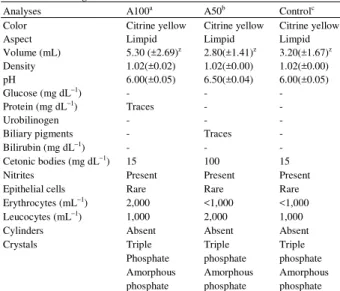
The results of the physicochemical analyses from the urine, biochemical serum analyses and water intake and excretion of urine from mice which ingested during a long-term feed supplemented with A. brasiliensis are showed at Table 1, 2 and Fig. 1, respectively.
Table 1: Physicochemical analyses of urine collected from mice submitted to long-term treatment with feed supplemented with Agaricus brasiliensis
Analyses A100a
A50b
Controlc Color Citrine yellow Citrine yellow Citrine yellow
Aspect Limpid Limpid Limpid
Volume (mL) 5.30 (±2.69)z
2.80(±1.41)z
3.20(±1.67)z Density 1.02(±0.02) 1.02(±0.00) 1.02(±0.00)
pH 6.00(±0.05) 6.50(±0.04) 6.00(±0.05)
Glucose (mg dL−1) - - -
Protein (mg dL−1
) Traces - -
Urobilinogen - - -
Biliary pigments - Traces -
Bilirubin (mg dL−1
) - - -
Cetonic bodies (mg dL−1
) 15 100 15
Nitrites Present Present Present
Epithelial cells Rare Rare Rare
Erythrocytes (mL−1
) 2,000 <1,000 <1,000 Leucocytes (mL−1
) 1,000 2,000 1,000
Cylinders Absent Absent Absent
Crystals Triple Triple Triple
Phosphate phosphate phosphate Amorphous Amorphous Amorphous phosphate phosphate phosphate
Note: a: A100; b: A50: Chown with 29 and 14,5% of mycelium,
respectively; c: Controls: Chown without mushroom. Data represent
the media ± SD from n = 20; z: Without statistic difference (p>0.05)
0 10 20 30 40
C A100 A50
W a te r i n g es t (m L . h
-2 4)
Table 2: Biochemical analyses of serum collected from mice submitted to a long-term treatment with feed supplemented with Agaricus brasiliensis
Groups
--- Parameters (mg dL−1
) A100a
A50b
Controlc Glucose 214.00 (±9.89)z
223.00 (±21.21)z
238.00 (±1.41)z Total protein 5.20 (±0.28) 5.40 (±0.14) 5.70 (±0.14) Albumin 2.40 (±0.00) 2.50 (±0.07) 2.60 (±0.14) Globulin 2.80 (±0.28) 2.95 (±0.07) 3.10 (±0.00) Creatinine 0.55 (±0.07) 0.50 (±0.0) 0.45 (±0.07) Urea 38.00(±2.83) 33.50 (±4.95) 28.50 (±0.7) Uric acid 2.10 (±0.28) 3.30 (±0.14) 2.50 (±0.42)
Note: a: A100; b: A50: Chown with 29 and 14.5% of mycelium,
respectively; c: Control: Chown without mushroom. Data represent
the media ± SD from n = 20; z: Without statistic difference (p>0.05)
DISCUSSION
The results of the physicochemical analyses from the urine did not reveal important alterations (Table 1). In group A100 only protein traces were detected, whereas they were absent in A50, indicating an efficient glomerular filtration and tubular reabsorption of the proteins (Table 1)[30]. Additionally, it was possible to observe a normal level of total proteins (albumins and globulins) in the blood serum of the studied groups-as shown in Table 2- which confirms the sign of normality of the renal function. The negative values for glucose in all groups imply the absence of any renal damage.
Bilirubins and urobilinogen are eliminated through the urine when there is hemolysis or in hepatopathies[31] and the absence of these metabolites was detected in the group A100. The presence of rare epithelial cells is within normal parameters and so are the leukocytes values. Macrohematuria is characterized by the presence of high values of erythrocytes and the values found in the present study are within the normal standard. The absence of cylinders confirms the signs of normality of the renal function that were found. The long period of urine sample collection led to the precipitation of phosphate crystals, from food intake, but with no clinic interest. During this sampling period, the animals were kept in a fast, taking only water, what resulted in the appearance of cetonic bodies in the urine, the presence of which is due to the complete oxidation of fats[32].
The serum levels of glucose, proteins, uric acid, urea and creatinine are listed on Table 2. There are not significant statistical differences between the treatment groups and the control group (p>0.05). The serum creatinine is one of the most widespread ways of evaluating the glomerular filtration and represents an excellent means of measuring the renal function[33]. The serum concentrations of urea, creatinine and uric acid
remain within the standard of normality in the groups under study, implying an absence of kidney damage.
The decrease in serum values of glucose found for groups A100 and A50 were 10 and 6%, respectively. Although they do not represent any significant difference between groups (p>0.05), the reduction up to 10% in the levels of serum glycemia is an important datum when related to the occurrence of diabetes. This is the first report on a glycemia reducing activity using Agaricus brasiliensis through a chronic oral ingest of mycelium from this mushroom. These data suggest a dose-dependent hipoglycemic activity of that mushroom. The Agaricus brasiliensis has been commonly used in the treatment of many diseases, including diabetes[34] and the present results suggest that there is a support for this health claim. Others studies with diabetics animals are necessary to verify an possible hypoglycemic effect of the A. brasiliensis mycelium. Diabetes, characterized by the increase in the levels of glucose in the bloodstream, causes a number of deleterious effects on the organs of the body and according to World Health Organization’s projections, diabetes may become a widespread epidemics before 2030[35]. Therefore, preventing, stopping or decreasing the progression rate of diabetes is truly a worthwhile goal.Other mushrooms proved to have a similar effect. The extracts of Agaricus bisporus, Agrocybe aegerita, Cordyceps sinenesis, Auricularia auricula-judae, Lentinus edodes, Pleurotus ostreatus, Phellinus linteus, Ganoderma lucidum and Tremella aurantia have proved to be able to lower blood glucose. For the first three species mentioned above, the lowering glycemia was due to the polysaccharide, with confirmed action in insulin-dependent-diabetes[36-40].
in 2003, in subsequent studies, these mushroom proved to have similar effects on mild hypertensive humans[41,42].
Sorimachi et al.[43] drew the conclusion that Agaricus blazei Murill has some components that activate macrophages resulting in the induction of cytokines secretion and NO in vitro. NO, being a free-radical, binds to oxygen, producing two main products: the nitrites (NO2) and nitrates (NO3)6. NO plays a basic
role in function regulation of various systems-cardiac, nervous, muscular, immune and arterial-where it acts over the rate of glomerular filtration (GRF). A decrease in NO produces a greater reabsorption of sodium and that induces an increase in the bood flow, promoting the appearance of the basic arterial hypertension-HTA-[44,45]. Experiments in mice have shown that a reduced production of O2− resulted in high renal blood flow,
with urinary excretion of nitrate/nitrite, indicating an increase in NO bioavailability[46]. The presence of nitrites in the analyzed samples of urine in the A100 and A50 groups can be related to this mechanism.
Fungi have traditionally been one of the single most abundant sources of lead compounds for the development of therapeutics by the biopharmaceutical industry. It is estimated that one third of adults in the Western world use alternative natural products, including mushrooms. Contrary to chemical drugs, these medications have sometimes been claimed to be non-toxic, because of their natural origin and long-term use as folk medicines. However, problems may arise due to intrinsic toxicity, adulteration, substitution, contamination, misidentification, drug-fungi interactions and lack of standardization[47]. The medicinal qualities of A. brasiliensis have been widely spread by the media, so much so that its use nowadays is totally popularized. There are few reports on possible side effects that the use of this mushroom may have over various organic functions. The data presented in the present work indicate that a long-term ingestion of A. brasiliensis proved to reduce the glucose levels in up to 10% and did not cause any alterations indicating renal lesion or any functioning abnormality. Further researches must be carried out in order to guarantee safety and effectiveness in the medicinal and nutraceutic uses of A. brasiliensis.
CONCLUSION
The physicochemical analyses did not reveal any significant alteration of renal lesion or any functional alteration. All physical, chemical and cellular parameters varied discretely, within the range of normality, for each studied group. The long-term intake of feed supplemented with A. brasiliensis did not result in visible alterations in the kidney function indices, but
decreased in 10% the blood glucose (p>0.05). Future studies are necessary to uncover a possible correlation between the increase of urinary excretion and the hypotensive effect reported in the literature; to verify an possible hypoglycemic effect diabetics animals and to guarantee complete safety of the ingest form A. brasiliensis mycelium cultured on wheat grains.
ACKNOWLEDGEMENT
To National Counsel of Technological and Scientific Development for granting the financial support (Process N°475798/2003-1); to Federal University of Paraná and Midwest State University also for their financial support.
REFERENCES
1. Wasser, S.P., M.Y. Didukh, M.A.L.A. Amazonas, E. Nevo, P. Stamets and A.F. Da Eira, 2002. Is a widely cultivated culinary-medicinal royal sun Agaricus (the himematsutake mushroom) indeed Agaricus blazei Murill? Int. J. Med. Mushr., 4: 267-290. http://www.begellhouse.com/journals/708ae68d64b1 7c52,0d0f121956dd501b,3dc8a3c253c58bd5.html 2. Kerigan, R.W., 2005. Agaricus subrufescens, a
cultivated edible and medicinal mushroom and its synonyms. Mycology, 97: 12-24. http://www.ncbi.nlm.nih.gov/pubmed/16389952 3. Takashi, Y. and T. Mizuno, 2002. Medicinal
properties and clinical effects of culinary-medicinal mushroom agaricus blazei Murrill (agaricomycetideae). Int. J. Med. Mushr., 4: 112. http://www.begellhouse.com/journals/708ae68d64 b17c52,72e968661ff5d957,59adaadf2fc4d3fb.html 4. Stamets, P., 2000. Techniques for the cultivation of
the medicinal mushroom royal sun agaricus blazei Murrill (agaricomycetidae). Int. J. Med. Mushr., 2: 151-160.
http://dl.begellhouse.com/journals/708ae68d64b17 c52,452b39d115b42ef7,46c0829c3c9f279f.html 5. Dias, E.S., C. Abe and R.F. Schwan, 2004. Truths
and myths about the mushroom Agaricus blazei. Sci. Agric.,61: 545-549. DOI: 10.1590/S0103-90162004000500014.
6. Hasler, C.M., A.S. Bloch, C.A. Thomson, E. Enrione and C. Manning, 2004. Position of the American Dietetic Association: Functional foods. J. Am.
Diet. Assoc., 104: 814-826.
7. Ribeiro, L.R. and D.M.F. Salvadori, 2003. Dietary components may prevent mutation-related diseases in humans. Mutat. Res., 544: 195-201. http://www.ncbi.nlm.nih.gov/pubmed/14644321 8. Akihiro, M., Y. Masaaki, Y. Hidehiko and
N. Masahiko, 2001. Physiologically functional food having brain function-improving, learning ability-enhancing and memory-enhancing
functions. US Patent 6284243.
http://www.freepatentsonline.com/6284243.html 9. Suzuki, N., 2004. Complementary and alternative
medicine: A japanese perspective. Evid. Based Complement. Alternt. Med., 1: 113-118. DOI: 10.1093/ecam/neh029
10. Borschers, A.T., C.L. Keen and M.E. Gershwin, 2004. Mushrooms, tumors and immunity: an update. Exp. Biol. Med., 229: 393-406. http://www.ncbi.nlm.nih.gov/pubmed/15096651 11. Tam, S.C., K.P. Yip and K.P. Fung, 1986.
Hypotensive and renal effects of an extract of the edible mushroom. Life Sci., 38: 1155-1161. http://www.ncbi.nlm.nih.gov/pubmed/3959747 12. Warner, R.L., H.C. Winter and C.L. Speyer, 2004.
Marasmius oreades lectin induces renal thrombotic microangiopathic lesions. Experim. Mol. Pathol., 77: 77-84.
http://www.ncbi.nlm.nih.gov/pubmed/15351229 13. Pandey, A., 2003. Solid-state fermentation.
Biochem. Eng. J., 13: 81-84. DOI: 10.1016/S1369-703X(02)00121-3
14. Li, P.J. and C.G. Shen, 2003. Method for propagating fungi using solid state fermentation.
US Patent 6558943.
http://www.freepatentsonline.com/6558943.html 15. Soccol, C.R. and L.P.S. Vandenberghe, 2003.
Overview of applied solid-state fermentation in Brazil. Biochem. Eng. J., 13: 205-218. DOI: 10.1016/S1369-703X(02)00133-X
16. Brand, D., A. Pandey, S. Roussos and C.R. Soccol, 2000. Biological detoxification of coffee husk by filamentous fungi using a solid state fermentation system. Enzy. Microb. Technol., 27: 127-133. http://www.ncbi.nlm.nih.gov/pubmed/10862912 17. Bramorski, A., P. Christen, M. Ramirez, C.R.
Soccol and S. Revah, 1998. Production of volatile compounds by edible fungus Rhizopus oryzae during solid state cultivation on tropical agro-industrial substrates. Biotechnol. Lett., 20: 359-362. DOI:10.1023/A:1005323229125
18. Medeiros, A.B.P., P. Christen, S. Roussos, J.C. Gern and C.R Soccol, 2003. Coffee residues as substrates for aroma production by Ceratocystis fimbriata in solid-state fermentation. Braz. J. Microbiol., 34: 245-248.
http://biblioteca.universia.net/ficha.do?id=643483
19. Medeiros, A.B.P., A. Pandey, P. Christen, R.J.S. Freitas, P.S.G. Fontoura and C.R. Soccol, 2001. Aroma compounds produced by Kluyveromyces marxianus in solid-state fermentation on packed bed column bioreactor. World J. Microbiol. Biotechnol., 17: 767-771.
http://cat.inist.fr/?aModele=afficheN&cpsidt=1345 0303
20. Dalla Santa, H.S., O.R. Dalla Santa, D. Brand, L.P.S. Vandenberghe and C.R. Soccol, 2004. Spore production of Beauveria bassiana from agro-industrial residues. Braz. Arch. Biol. Technol., 48: 51-60.
http://www.scielo.br/pdf/babt/v48nspe/25278.pdf 21. Dalla Santa, H.S., N.J. Sousa, D. Brand,
O.R. Dalla Santa, A. Pandey, M. Sobotka, J. Páca and C.R. Soccol, 2004. Conidia production of Beauveria sp. by solid-state fermentation for biocontrol of Ilex paraguariensis caterpillars. Folia
Microbiol., 49: 418-422.
http://www.ncbi.nlm.nih.gov/pubmed/15530007 22. Leifa, F., A. Pandey and C.R. Soccol, 2000. Solid
state culturing-an efficient method to use toxic agro-industrial residues. J. Basic Microbiol.,
40: 177-187. DOI:
10.1002/1521- 4028(200007)40:3<187::AID-JOBM187>3.0.CO;2-Q
23. Leifa, F., A. Pandey and C.R. Soccol, 2000. Use of various coffee industry residues for the production of Pleurotus ostreatus in solid state fermentation.
Acta Biotechnol., 20: 41-52.
http://cat.inist.fr/?aModele=afficheN&cpsidt=1342775 24. Fan, L., A.T. Soccol, A. Pandey, S. Germano,
R. Rau, A. Pedroso and C.R. Soccol, 2003. Production of polysaccharide by culinary-medicinal mushroom Agaricus brasiliensis S. Wasser et al., LPB 03 (Agaromycetidae) in submerged fermentation and its antitumor effect. Int. J. Med. Mushr., 5: 17-23. http://dl.begellhouse.com/journals/708ae68d64b17 c52,58cadf0c6c913237,59c0db70674643c7.html 25. Tang, Y.J. and J.J. Zhong, 2002. Fed batch
fermentation of Ganoderma lucidum for hyperproduction of polysaccharide and ganodermic acid. Enz. Microb. Tech., 31: 20-28. http://cat.inist.fr/?aModele=afficheN&cpsidt=1380 6659
27. AOAC., 2000. Association of Official Analytical Chemists Official Methods of Analysis. 17 Edn., Washington, DC., ISBN: 0- 935584-67-6, pp: 2.200. 28. Reeves, P.G., F.H. Neilsen and G.C. Jr. Fahey,
1993. AIN-93 purified diets for laboratory rodents: Final report of the American Institute of Nutrition ad hoc writing committee on the reformation of the AIN-76A rodent diet. J. Nutr., 123: 1939-1951. http://cat.inist.fr/?aModele=afficheN&cpsidt=3865184 29. Carvalho, J.C., B.O. Oishi, D. Brand,
J.A. Rodriguez-Leon, A. Pandey and C.R. Soccol, 2006. Relation between growth, respirometric analysis and biopigments production from Monascus by solid substrate fermentation. Biochem. Eng. J., 29: 262-269. http://cat.inist.fr/?aModele=afficheN&cpsidt=17671868 30. Wei, Q., Y. Li, B. Du and C.H. Duan, 2005. Rapid
and highly sensitive determination of trace proteins using dibromomethyl carboxyazo-Pb(II) complex as a spectroscopic reagent. Clin. Chim. Acta, 362: 79-84.
http://cat.inist.fr/?aModele=afficheN&cpsidt=17270441 31. Coppo, J.A., N.B. Mussart and S.A. Fioranelli,
2005. A. Blood and urine physiological values in farm-cultured Rana catesbeiana (Anura: Ranidae) in Argentina. Rev. Biol. Trop., 53: 545-559. <http://www.scielo.sa.cr/scielo.php?script=sci_artt ext&pid=S0034-77442005001200022&lng=es& nrm=iso>. ISSN 0034-7744.
32. Mittra, N.R. and N.N. Dhar, 1925. Induced reactions and diabetes from the viewpoint of induced oxidation. J. Phys. Chem. 5: 376-394. DOI: 10.1021/j150250a002
33. Wijeysundera, D.N., K. Karkouti, J.Y. Dupuis, V. Rao, C.T. Chan, J.T. Granton and W. S. Beattie, 2007. Derivation and validation of a simplified predictive index for renal replacement therapy after cardiac surgery. J. Am. Med. Assoc. 297: 1801-1809. http://jama.ama-assn.org/cgi/content/full/297/16/1801 34. Liu,Y., Y. Fukuwatari, K. Okumura, K. Takeda
and K. Ishibashi et al., 2008. Immunomodulating activity of Agaricus brasiliensis KA21 in mice and in human volunteers. Evid. Based Complement. Alternat. Med., 5: 205-219. DOI: 10.1093/ecam/nem016
35. Rodriguez, B.L., R.D. Abbott, W. Fujimoto, B. Waitzfelder and R. Chen et al., 2002. The American Diabetes Association and World Health Organization Classifications for Diabetes: Their impact on diabetes prevalence and total and cardiovascular disease mortality in elderly Japanese-American men. Diabetes Care, 25: 951-955. http://care.diabetesjournals.org/cgi/content/abstract /25/6/951
36. Kim, O.H., B.K. Yang, N.L. Hur, S. Das, J.W. Yun, Y.S Choi and C.H. Song, 2001. Hypoglycemic effects of mycelia produced from submerged culture of Phellinus linteus (Berk. Et Curt) Teng (A phyllopharomycetideae) in streptozotocin-induced diabetic rats. Int. J. Med. Mushr., 3: 21-26. http://www.begellhouse.com/journals/708ae68d64b1 7c52,1e7e12444d8980d5,53cc6b4e4ec25a3e.html 37. Yuan, Z., P.M. Hei, J.H. Cui and H. Takeuchi,
1998. Hypoglycemic effect of water soluble polysaccharide from Auricularia auricula-judae Quel on genetic diabetic KK-Ay mice. Biosci. Biotechnol. Biochem., 62: 1898-1903. http://cat.inist.fr/?aModele=afficheN&cpsidt=1697935 38. Kim, M.W., M.H. Park and G.H. Kim, 1997.
Effects of mushroom protein-bound polysaccharides on the blood glucose levels and energy metabolism in streptozotocin-induced diabetic rats. J. Kor. Nutr.,30: 743-750.
http://www.fao.org/agris/search/display.do?f=./200 0/v2601/KR1999002827.xml;KR1999002827 39. Kiho, T., H. Morimoto, M. Sakushima, S. Usui and
S. Ukai, 1995. Polysaccharides in fungi. XXXV. Anti-diabetic activity of an acidic polysaccharide from the fruiting bodies of Tremella aurantia. Biol. Pharmaceut. Bul., 18: 1627-1629. http://cat.inist.fr/?aModele=afficheN&cpsidt=2995986 40. Hikimo, H., M. Ishiyama, Y. Suzuki and C. Konno,
1989. Mechanisms of hypoglycemic activity of ganoderan B: A glycan of Ganoderma lucidum fruitbodies. Planta Med., 55: 423-428. http://www.ncbi.nlm.nih.gov/pubmed/2682700 41. Watanabe, T., T. Yamada, H. Tamaka, S. Jiang,
T.K. Mazumder, S. Nagai and K. Tsuji, 2002. Antihypertensive effect of gamma-aminobutyric acid-enriched Agaricus blazei on spontaneously hypertensive rats. J. Jap. Soc. Food Sci. Technol. Nippon Shokuhin Kagaku Kaishi, 49: 166-173.
http://sciencelinks.jp/j-east/article/200209/000020020902A0331152.php 42. Watanabe, T., A. Kawashita, S. Ishi, T.K. Mazumder,
S. Nagai, K. Tsuji and T. Dan, 2003. Antihypertensive effect of gamma-amino butyric acid-enriched Agaricus blazei on mild hypertensive human subjects. J. Jap. Soc. Food Sci. Technol. Nippon Shokuhin Kagaku Kaishi, 50: 167-173.
http://sciencelinks.jp/j-east/article/200312/000020031203A0324723.php 43. Sorimachi, K., K. Akimoto, Y. Ikehara, K. Inafuku,
A. Okubo and Y. Sunao, 2001. Secretion of
TNF-α, IL-8 and nitric oxide by macrophages activated with Agaricus blazei Murill fractions in vitro.Cell
Struct. Funct., 2: 103-108.
44. Telles Filho, P.A., 2005. Asma brônquica-Resposta tardia da asma.
http://www.asmabronquica.com.br/medical/respost a-tardia-oxido-nitrico.html
45. Brenner, B.M. and S.A. Levine, 2004. Brenner and Rector the Kidney. 7 Edn., W.B. Saunders Company, Philadelphia, ISBN: 0-7216-0164-2, pp: 1943.
46. Haque, M.Z. and D.S.A. Majid, 2004. Assessment of renal functional phenotype in mice lacking gp91phox subunit of NAD(P)H oxidase. Hypertension, 43: 335-340.
http://hyper.ahajournals.org/cgi/content/full/43/2/335