Original Article ▌
WOMEN LITERACY AND INFANT FEEDING PRACTICES
IN RURAL INTEGRATED CHILD DEVELOPMENT
SCHEME (ICDS) BLOCK OF DELHI
Davey Sanjeev 1, Davey Anuradha2
Financial Support: None declared
Conflict of interest: Nil
Copy right: The Journal retains the copyrights of this article. However, reproduction of this article in the part or total in any form is permissible with due
acknowledgement of the source.
How to cite this article:
Davey S, Davey A. Women Literacy and Infant Feeding Practices in Rural ICDS Block of Delhi. Natl J Community Med 2012; 3(3):385-90.
Author’s Affiliation:
1Assistant Professor, Department of
Community Medicine, Veer Chandra Singh Garwali Medical Science and Research Institute, Pauri Garhwal, Uttarakand,
2Assistant Professor, Department of
Community Medicine, Subharti Medical College, Meerut. Uttar Pradesh
Correspondence:
Dr. (Mrs) Anuradha Davey, Y-60, Narain Bhawan, Subharti Medical College, Meerut. Uttar Pradesh-250002
E Mail:
Date of Submission: 14-04-12
Date of Acceptance: 22-06-12
Date of Publication: 01-09-12
ABSTRACT
Background: Infant feeding practices have significant effect on the child nutrition, which largely dependent upon the mothers correct knowledge and awareness for the same. Objective: To find out effect of rural women empowerment through literacy on infant feeding practices in an ICDS block. Material and Methodology: Interview of the mothers of registered children up to 6 years in the rural ICDS block for the feeding practices and recording of the weight of those registered children by the salter weighing scale for their nutritional status.
Results: Three fourth of the children had received ceremonial feed in the form of honey or gutti and 40 percent of the mothers in our study has discarded colostrums, considering it as ‘bad milk’. Exclusive breast feeding was received by 34.6% children. As literacy level of mothers increased the nutritional status of children was better. This could be because most of the women who are middle school passed or above are non working, so are able to give more time for care and feeding practices. The Severe malnutrition (grade III and IV) was evident only in illiterate category of mothers, where 58.7% women were working in unskilled or semiskilled job outside home.
Conclusion: Women living in chronic hunger are forced to unskilled jobs for income generation for the family, thereby influencing the feeding practices of their children. In such scenario AWCs and AWWs can be a unique opportunity with their focused approach to take care of severe and moderate malnutrition.
Keywords: Anganwadi centre (AWC), Mother’s literacy and working status, Child Malnutrition.
INTRODUCTION
The children are the invaluable human assets and they are real wealth of the societies. Nutritional indicator is one of the indicators of
the all children under age four are malnourished 2, which is not much changed even in NFHS-3.
Infant feeding practices has significant effect on children nutritional state. To prevent malnutrition infant should be given exclusive breast milk for the six months of age. An early introduction of the breast milk substitute and late introduction of semisolid complementary items are responsible for rapid increase in the prevalence of under nutrition during 6 -24 months of age3. Mothers at home bears the prime responsibility for correct infant feeding practices, which largely dependent upon their correct knowledge and awareness for the same. Therefore, the present study seeks to find out effect of rural women empowerment through literacy on infant feeding practices in an ICDS block.
MATERIALS AND METHODS
The study design is cross sectional descriptive. Study period was from May 2004- April 2005. Out of total 28 Integrated Child development scheme (ICDS) projects running in 9 districts of Delhi, 5 are running in the rural blocks. One of the rural ICDS projects from Narela block was selected randomly. In the selected block, one bad performing anganwadi centre (AWC-A) and one good performing Anganwadi Centre
(AWC-B) was selected on the basis of their malnourishment status among under 6 children in the past 3 years. For the feeding practices primary data was collected from all the mothers of the registered children on pre-designed and pre-tested interview schedule. All the registered children in both AWCs were weighed on salter weighing scale at the time of data collection for their nutritional status by weight for age criteria. The study was ethically approved by the Institutional review board of National Institute of Health and Family welfare. All interviews were conducted after taking the prior permission of the respondents.
RESULTS
Nutritional profile of the children
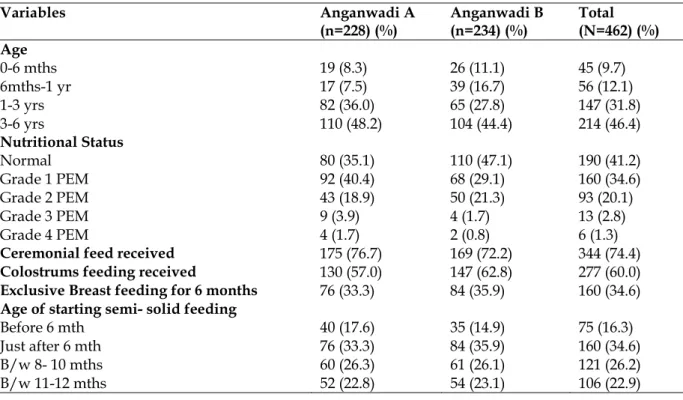
There were 228 children under 6 years of age in the anganwadi centre A and 234 children in AWC B. The majority of children (48.2% in A, 44.4% in B) were in 3-6 years age group. The infants were 15.8% in AWC A and 27.8% in AWC B. Overall 42.1% children were normal. In both the AWC A and B, the most common grade was grade I PEM and the least common grade was grade 4 PEM. The proportion of malnourished children in all the grades of PEM was higher in AWC A than in AWC B except in grade II PEM [Table 1].
Table 1: Distribution of children by age, nutritional status and feeding practices
Variables Anganwadi A
(n=228) (%)
Anganwadi B (n=234) (%)
Total (N=462) (%) Age
0-6 mths 19 (8.3) 26 (11.1) 45 (9.7)
6mths-1 yr 17 (7.5) 39 (16.7) 56 (12.1)
1-3 yrs 82 (36.0) 65 (27.8) 147 (31.8)
3-6 yrs 110 (48.2) 104 (44.4) 214 (46.4)
Nutritional Status
Normal 80 (35.1) 110 (47.1) 190 (41.2)
Grade 1 PEM 92 (40.4) 68 (29.1) 160 (34.6)
Grade 2 PEM 43 (18.9) 50 (21.3) 93 (20.1)
Grade 3 PEM 9 (3.9) 4 (1.7) 13 (2.8)
Grade 4 PEM 4 (1.7) 2 (0.8) 6 (1.3)
Ceremonial feed received 175 (76.7) 169 (72.2) 344 (74.4) Colostrums feeding received 130 (57.0) 147 (62.8) 277 (60.0) Exclusive Breast feeding for 6 months 76 (33.3) 84 (35.9) 160 (34.6) Age of starting semi- solid feeding
Before 6 mth 40 (17.6) 35 (14.9) 75 (16.3)
Just after 6 mth 76 (33.3) 84 (35.9) 160 (34.6)
B/w 8- 10 mths 60 (26.3) 61 (26.1) 121 (26.2)
Feeding Practices
Ceremonial (Pre lacteal) feeding were received by three fourth of the children and were almost equal in both the AWC. The most common pre lacteal feed was honey followed by gutti, in belief that it will provide strength to fight against the infection. However 60% of the children received the colostrums and rest had discarded the colostrums thinking it as ‘bad milk’. Exclusive breast feeding for 6 months was received by 34.6% of the children and they were given semi solid feeding just after 6 months. Majority of the mothers have started the complementary feeding either before 6 months (16.3%) or after 8 months (49.1%).[Table 1].
Literacy and working Status of mothers
The female literacy was fairly high with only 30.7% and 29.1% of the mothers being illiterate in AWC A and B respectively [Table 2]. Overall
nearly quarter of the mothers (27.8%) had completed high school.
The total non working mothers were 60.2%, which were more in AWC B (63.2%) as compared to AWC A (57%) [Table 2]. Among the non-working mothers majority were in completed middle school and above category, and majority of their children have either normal nutritional status or grade I malnutrition [Table 3]. Among working category majority were either illiterate (58.7%) or primary school passed (67.4%); among most of them were in semi skilled jobs outside their home. Also children with severe malnutrition, grade III & IV (13.7%) were associated with women who are illiterate; and grade II malnutrition was more prevalent in children whose mothers were either just literate or primary school passed women [Table 3].
Table 2: Distribution of mothers by their literacy status
Variables Anganwadi A (n=228) (%) Anganwadi B (n=234) (%) Total (N=462) (%) Literacy
Illiterate 70 (30.7) 68 (29.1) 138 (29.9)
Just literate 17 (7.5) 3 (1.3) 20 (4.3)
Completed Primary School 48 (21.1) 41 (17.5) 89 (19.3)
Completed Middle School 42 (18.4) 44 (18.8) 86 (18.7)
Completed High School 27 (11.8) 34 (14.5) 61 (13.2)
Completed Sr. Sec School 24 (10.5) 44 (18.8) 68 (14.6)
Working status of mothers
Working 98 (43.0) 86 (36.8) 184 (39.8)
Non-Working 130 (57.0) 148 (63.2) 278 (60.2)
Table 3: Distribution of Mothers according to their literacy and working status
Illiterate Just Literate Primary school
Middle School
High school
Senior Secondary
Total
Working Status
Yes 81 (58.7) 4 (20) 60 (67.4 ) 25 (29.1 ) 11 (18.0) 3 (4.4) 184 (39.8) No 57 (41.3) 16 (80) 29 (32.6) 61 ( 70.9) 50 (82.0) 65 (95.6) 278 (60.2) Total 138 (100) 20 (100) 89 (100) 86 (100) 61 (100) 68 (100) 462 (100) Nutritional grades of children
Normal 3 (2.2) 2 (10) 18 (20.2) 46 (53.5) 53 (86.9) 68 (100) 190 (41.2) Grade I PEM 70 (50.7) 7 (35) 46 (51.7) 30 (34.9) 7 (11.5) 0 160 (34.6) Grade II PEM 46 (33.3) 11 (55) 25 (28.1) 10 (11.6) 1(1.6) 0 93 (20.1)
Grade III PEM 13 (9.4) 0 0 0 0 0 13 (2.8)
Grade IV PEM 6 (4.3) 0 0 0 0 0 6 (1.3)
Total 138 20 89 86 61 68 462(100)
DISCUSSION
Malnutrition is the major public health problem in the developing countries. In any form, malnutrition contributes for more than 50% of
knowledge on child nutrition to further reduce the figures for all types of child malnutrition.
India is facing child malnutrition despite progress in food production, disease control and socio economic development. Although India
accounts for less than 20% children in the world but 40% of the undernourished children in the world reside in India, which contribute to high morbidity and mortality in the country.5
Table 4: Distribution of the nutritional status of the children against their feeding practices
Variable AWW A AWW B
Yes No P value Yes No P value Received Ceremonial feeding
Normal 27(15.4) 53(100) χ2=118.56
P<0.001
45(26.6) 65(100) χ2= 100.62 P<0.001
Malnourished 148 (84.6) 0 (0) 124(73.4) 0(0)
Total 175 (100) 53 (100) 169(100) 65(100)
Received Colostrum feeding
Normal 73 (56.2) 7(7.1) χ2= 54.72
P<0.001
102(69.4) 8(9.2) χ2= 77.22 P<0.001
Malnourished 57(43.8) 91(92.9) 45(30.6) 79(90.8)
Total 130(100) 98(100) 147(100) 87 (100)
Received Exclusive Breast Feeding for 6 months
Normal 61(80.3) 19(12.5) χ2= 100.32
P<0.001
64(76.2) 46(30.7) χ2= 100.32 P<0.001
Malnourished 15(19.7) 133(87.5) 20(23.8) 104(69.3)
Total 76(100) 152(100) 84(100) (100)
Initiated semisolid feeding just after 6 months
Normal 61(80.3) 19 (12.5) χ2= 102.1
P<0.001
64(76.2) 46 (30.7) χ2= 44.8 P<0.001
Malnourished 15(19.7) 133(87.5) 20(23.8) 104(69.3)
Total 76(100) 152(100) 84(80.3) 150(100)
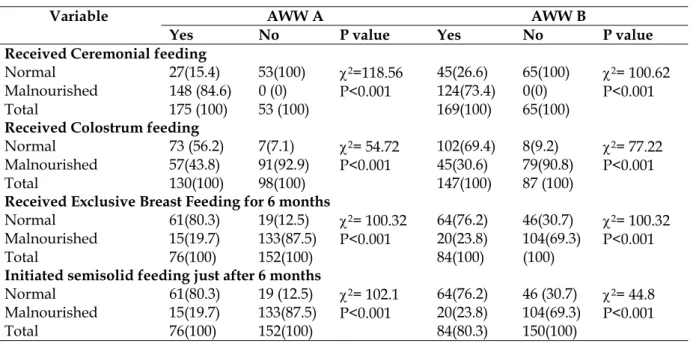
In India breast feeding practices in rural areas appears to be shaped by the health beliefs of a community which are further influenced by the socio cultural and economic factors. One of such tradition is ceremonial feeding (also called as Pre lacteal feeding), which is widely prevalent since the ancient times.6 In our study three fourth of the children had received ceremonial feed in the form of honey or gutti in the belief that it will help the child to fight against the infections. All the children who had not received the ceremonial feeding were normal in nutritional status in both the AWCs. 84.6 % of children in AWC A and 73.4% in AWC B were malnourished in all grades among those who had received ceremonial feeding. The ceremonial feeding received was significantly associated with the poor nutritional status of children in both the AWCs (Table No.:4). Ceremonial feeding is also prevalent worldwide in most of the countries. Marques N M et al in North East Brazil7 had interviewed 364 mothers in the first week of their delivery. He found that 80% of the mothers gave tea/ water and 56% gave pacifier to their new borne child. Similarly in rural area of the Malawi most babies were given water or other supplement soon after birth
as reported in a cohort study conducted by Mvaahtera M et al8 on 720 new borne.
Regarding colostrums feeding 40 percent of the mothers in our study has discarded colostrums, considering it as‘bad milk’. Among the children who did not receive colostrums feeding after birth majority were malnourished in both the AWCs (92.9% in A and 90.8% in AWC B) [Table No. 4]. The colostrums feeding were significantly associated with the normal nutritional status of children (p < 0.01). In another study conducted in East Delhi by Grover9 had also revealed that though majority of mothers had good knowledge and positive attitude towards breast feeding but colostrums was thought to be harmful for the babies by 52%. Agnarsson I et al10 had also reported that in women in rural part of the Tanzania have practice to discard colostrums.
exclusive breast feeding for 6 months were in normal nutritional status. The exclusive breast feeding for 6 months was significantly associated with the normal nutritional status of children (p < 0.001). [Table No.:4]
Weaning practices play a critical role in determining the nutritional status of the infants. Timely complementary feeding rate in Delhi is only 37 percent2. In the present study, majority of the mothers have started the complementary feeding either before 6 months (16.3%) or after 8 months (49.1%) [Table No.:1]. The majority of children, in whom semi solid feeding was initiated at just after 6 months, were normal (80.3% in AWC A and 76.2% in AWC B). But those children who received semi solid feed either before 6 month or 8 months onward were malnourished. The age of initiation of semi-solid feeding just after 6 month was significantly associated with normal nutritional status of children in both the AWCs (p <0.01). [Table No.: 4].
Literacy of the mothers raises their awareness for the correct feeding practices and also enhances their curiosity to learn feeding practices that would help in the better health of their children. In both the AWCs all the children were normal in nutritional status with their mothers with completed senior secondary school. Majority of children whose mothers were either middle school or High school were in normal nutritional status (53.5% and 86.9% respectively) [Table No.:3].
In illiterate category of mothers all 4 grades of PEM were evident. From just literate to completed high school category only mild to moderate malnourished children were found, severe malnutrition was evident only in illiterate category of mothers only. In present study, literacy of the mothers was also significantly associated with the normal nutritional status (<0.001) [Table No.3] .It shows that as literacy level of mothers increased the nutritional status of children was better as depicted in graph 1. Froozani MD et al12 and Radhakrisna, R & Ravi, C13 also found that the mothers education had significant impact on malnutrition. It could be because of the fact that in our study most of the women who were middle school passed and above were non working; and severe malnutrition was noticed in children whose mother were illiterate and were involved in semi skilled or unskilled job. It seems to be a vicious cycle of poverty in which poor mothers are
forced to work for earning and giving less time to their children for their nutritional care. Working status of women plays significant role in care of the children in the crucial stage of their development. In one hand it empowers women for their purchasing power but on other hand takes majority of time to work outside home for earning. The fact is also strengthened by the fact that non working women were higher in AWC B(63.2%) than AWC A(57%), which could be the one of the reason of good performance of AWC B in its past 3 years record. The Radhakrisna, R & Ravi, C13 also found that the mother’s employment status had significant impact on child malnutrition. The NFHS-22 data also shows that, under nutrition is lower in children whose mothers have not worked in past 12 months than for children of mothers who work for someone else.
CONCLUSION
Under nutrition is a major public health problem in India and should no longer be looked upon as a problem of health sector alone. Child malnutrition is generally caused by combination of inadequate and inappropriate food intake, gastro intestinal parasites, and other childhood illness and improper care during illness. It must be seen both as a cause and consequence of poverty and social inequality hindering the nation’s development.
Traditionally, women bear primary responsibility for the well-being of their families. Unequal access to education restricts the women’s ability to learn the skills that require even functional level of literacy. Women living in chronic hunger are forced to unskilled jobs for income generation for the family.
REFERENCES
1. Sectoral Policies & Programmes (Nutrition). In: 10th Five year Plan,(2002-2003) Vol 2. Document of Planning Commision ,New Delhi. P.315- 63.
2. National Family Health Survey(NFHS)- II, (1998-99) Document, Delhi- Report. P.151-57.
3. Ramachandran, P. Breast feeding Practices in South Asia. Indian Journal of Medical Research. 2004; 119 (6): 13-15.
4. Child health epidemiology: Key facts [Internet]. Available from:
http://www.who.int/maternal_child_adolescent/epid emiology/child/en/index.html. Last accessed on 15-6-2012
5. James Levinson, F., 1998. India-Sector Review of Nutrition Programmes. A background paper prepared for the World Bank, New Delhi.
6. Kishore S, Garg BS. Practice of Pre-lacteal feeding in a rural community. Indian J Public Health. 1999; Oct-Dec; 43(4):144-7.
7. Marques NM, Lira PIC, Lima MC, da Silva NL, Batista Filho M, Huttly SRA, Ashworth A. Breastfeeding and early weaning practices in northeast Brazil: a
longitudinal study. Indian Journal of Pediatrics. 2001; 108:66-67.
8. MVaahtera M, Kulmala T, Hietanen A, Ndekha M, Cullinan T, Salin ML, Ashorn P. Breastfeeding and complementary feeding practices in rural Malawi. Acta Paediatr 2001;90: 328-32.
9. Grover VL; Chhabra P; Aggarwal OP.Knowledge, attitude and practices of breast feeding in a rural area of east Delhi. Health and Population-Perspectives and Issues. 1997 Apr-June; 20(2): 49-56.
10. Agnarsson I, Mpello A, Gunnlaugsson G, Hofvander Y, Greiner T. Infant feeding practices during the first six months of life in a rural area in Tanzania. East Afr Med J 2001;78: 9-13.
11. Hossain MM, Reves RR, Radwan MM, Arafa SA, Habib M, DuPont HL. Breast-feeding in Egypt. J R Soc Health. 1994 Dec; 114 (6):290-6.
12. Froozani MD et al. Effect of Breast feeding education on feeding pattern & health of 4 months old infants in the Islamic Republic of Iran. Bulletin of WHO,
1999,77(5):381-385.