Low Empathy in Deaf and Hard of Hearing
(Pre)Adolescents Compared to Normal
Hearing Controls
Anouk P. Netten1*, Carolien Rieffe2,3, Stephanie C. P. M. Theunissen1, Wim Soede1, Evelien Dirks3, Jeroen J. Briaire1, Johan H. M. Frijns1,4
1Department of Otorhinolaryngology and Head & Neck Surgery, Leiden University Medical Center, Leiden, The Netherlands,2Department of Developmental Psychology, Leiden University, Leiden, The Netherlands,
3Dutch Foundation for the Deaf and Hard of Hearing Child, Amsterdam, The Netherlands,4Leiden Institute for Brain and Cognition, Leiden, The Netherlands
Abstract
Objective
The purpose of this study was to examine the level of empathy in deaf and hard of hearing (pre)adolescents compared to normal hearing controls and to define the influence of lan-guage and various hearing loss characteristics on the development of empathy.
Methods
The study group (mean age 11.9 years) consisted of 122 deaf and hard of hearing children (52 children with cochlear implants and 70 children with conventional hearing aids) and 162 normal hearing children. The two groups were compared using self-reports, a parent-report and observation tasks to rate the children’s level of empathy, their attendance to others’ emotions, emotion recognition, and supportive behavior.
Results
Deaf and hard of hearing children reported lower levels of cognitive empathy and prosocial motivation than normal hearing children, regardless of their type of hearing device. The level of emotion recognition was equal in both groups. During observations, deaf and hard of hearing children showed more attention to the emotion evoking events but less support-ive behavior compared to their normal hearing peers. Deaf and hard of hearing children at-tending mainstream education or using oral language show higher levels of cognitive empathy and prosocial motivation than deaf and hard of hearing children who use sign (sup-ported) language or attend special education. However, they are still outperformed by nor-mal hearing children.
a11111
OPEN ACCESS
Citation:Netten AP, Rieffe C, Theunissen SCPM, Soede W, Dirks E, Briaire JJ, et al. (2015) Low Empathy in Deaf and Hard of Hearing (Pre) Adolescents Compared to Normal Hearing Controls. PLoS ONE 10(4): e0124102. doi:10.1371/journal. pone.0124102
Academic Editor:Claus Lamm, University of Vienna, AUSTRIA
Received:August 20, 2014
Accepted:February 26, 2015
Published:April 23, 2015
Copyright:© 2015 Netten et al. This is an open access article distributed under the terms of the
Creative Commons Attribution License, which permits unrestricted use, distribution, and reproduction in any medium, provided the original author and source are credited.
Data Availability Statement:All relevant data are within the paper and its Supporting Information files.
Conclusions
Deaf and hard of hearing children, especially those in special education, show lower levels of empathy than normal hearing children, which can have consequences for initiating and maintaining relationships.
Introduction
Hearing impairment poses many challenges to the developing child. Deaf and hard of hearing (DHH) children for instance frequently encounter language and communication problems. These difficulties in communication may result in reduced opportunities for incidental learn-ing. Especially abstract concepts such as emotions are therefore more difficult to understand
for children with hearing loss [1]. Regulating and understanding one’s own emotions is
essen-tial for the development of adequate empathic abilities. Consequently, DHH children are prone to develop lower empathic skills than normal hearing (NH) peers. Because empathy is of major importance in initiating and maintaining social relationships, this could have ongoing consequences in the development of DHH children.
Empathy
Empathy is defined as the ability to perceive and understand another person’s emotional state
and the competence to appropriately respond to others’emotions [2,3]. It is needed to induce
prosocial behavior: free-willing behavior to benefit others [4]. Therefore, empathy is often
re-ferred to as‘social glue’in relationships [4–6].
From a developmental perspective, empathy has been divided into different layers: affective empathy, cognitive empathy and prosocial motivation. Affective empathy, also known as emo-tional contagion, is the process in which the emoemo-tional states of others cause a level of arousal
in the observer. It consists of non-conscious behavioral mimicry of others’facial, vocal, and
bodily expressions [7]. This‘mirroring of emotions’is thought to be present at birth and
origi-nates from the Mirror Neuron System (MNS) in the brain. Through functional Magnetic Reso-nance Imaging (fMRI) studies, neuroscientific research has shown these neural networks. For instance, making a sad face or observing a sad face both activate the MNS via the amygdala and the anterior insula of the brain. This motor activation is then associated with an emotion
repre-sentation; the person acknowledges a sad feeling [8–10]. These patterns strongly suggest that
the formation of cortical representations about one’s own feelings is a necessary condition to
engage in vicarious predictions about the emotions of others [5] (see Lamm & Majdandžićfor
an in-depth discussion of the plausibility of this assumption [11].
Whereas young children become upset and need comforting themselves through affective
em-pathy, also referred to as‘contagious crying’or‘emotional sharing’, around the age of two
chil-dren change from a self-focused perspective towards another-focused perspective. Consequently, children gradually become to understand that their sad feelings are caused by another person in
distress. This evokes an urge to support or comfort that person, as to relief their distress [3,5,12].
Cognitive empathy develops as children grow older and involves a more sophisticated
com-prehension of the other person’s emotional state [13]. The child starts to understand why the
other is upset. Understanding emotions in others serves different goals. First, the observer is
ca-pable to distinguish between its own and the other’s emotions and thereby decreasing their
own feelings of distress. Second, understanding the other leads to an increased tendency to
support the other, and to care for the other [11]. This intrinsic prosocial motivation is essential because it signals to the person in distress that the observer pays attention to and highly values their emotions. He or she understands what is happening and wants to support. Moreover, a
stronger level of cognitive empathy can also help to overcome in-group preferences [11]. The
long-term purpose of cognitive empathy and prosocial motivation is to induce and maintain
good social relationships [12]. As such, the development of cognitive empathy is largely
depen-dent on social learning. fMRI studies have indirectly shown this as the relation between the
MNS and self-reported cognitive empathy is less clear than for affective empathy [7,11]. For
so-cial learning to develop, this requires incidental learning skills; unplanned and unorganized learning abilities, with no educational intentions. Social learning takes place while interacting with others, and by trial-and-error.
A lack of empathy is associated with violence, aggression, criminality, and insensitive and
unemotional behavior [14]. Empathic dysfunction has been associated with several psychiatric
disorders such as psychopathy, autism spectrum disorders [15], conduct disorder, acquired
sociopathy [16], and schizophrenia [17]. Children and adolescents who show little or no
empa-thy are deemed to fail in our social world, and are put aside as having antisocial behavior. These behavioral problems may lead to the development of an antisocial personality disorder later in
life [18]. Hence, it is of major importance for children to adequately develop empathic skills.
Empathy in deaf and hard of hearing children
Little is known about the development of empathy in DHH children. However, certain prereq-uisites for successful empathic maturation, such as emotion recognition and regulation together with development of a Theory of Mind (ToM), have recently been addressed in this population. Studies show lower levels of emotion recognition and labelling of emotions in deaf preadoles-cents than in NH peers. In this population the onset of deafness was related to the ability to rec-ognize emotions. Prelingually deaf preadolescents were more vulnerable than their
postlingually deaf peers [19]. Regarding emotion awareness, DHH children were found to be
less able to address multiple emotions in the negative domain simultaneously (e.g., anger and sadness) than NH peers during several emotion tasks. In the same study, children had to focus on approaching strategies towards an emotion-evoking situation. The results show less effective
emotion regulation in DHH children than in NH peers [20]. ToM has been measured in
tod-dlers with cochlear implants (CIs). Initially children with CIs were found to perform as well as NH children. However, at an older age they fell behind on more advanced ToM abilities such as
false belief tasks [21]. Regarding their empathic behavior, no differences were found between
young children with a CI and NH peers [5]. Yet, because of the young age of these children (1–
5 years), only the affective domain of empathy could be taken into account in this study.
Present study
Because of the continuous development of cognitive empathy in childhood and preadolescence we are interested whether empathic abilities in DHH children and adolescents differ from those of their NH peers. Therefore, the aim of this study was to determine the differences in the levels of self-reported and observed empathy between DHH on the one hand, and NH children and adolescents on the other. To identify those factors that may be most influential for the levels of empathy in DHH children we also investigated the influence of several audiological factors on empathic abilities, such as language development, intelligence, degree of hearing loss, age at in-tervention of hearing loss, type of device, mode of communication, and educational setting.
and prosocial motivation we expected DHH children to fall behind as a consequence of, among other things, their impaired ToM development. Concerning several audiological variables such as type of hearing amplification, it has been reported that DHH children wearing CIs
experi-ence lower levels of behavioral problems than children wearing Hearing Aids (HAs) [22].
Therefore, we expected to find differences in empathic ability between these two groups. Gender differences have been described frequently in the literature. Girls consistently report higher levels of affective empathy and prosocial behavior than boys. Some researchers doubt these conclusions. They hypothesize that the reported differences are a result of differences in
social desirability between boys and girls [8,23]. If true, we would find higher levels of
self-re-ported affective empathy and prosocial motivation in girls, regardless of their hearing status but equal levels of empathy and supportive behavior during observations.
Due to the improved developmental outcomes after early intervention programs as reported
by Yoshinaga-Itano et al. [24], we expected a relation between age at detection and intervention
of hearing loss, and empathic abilities. Educational placement (mainstream or special schools) and mode of communication (spoken or sign language) have been reported to be related to
lev-els of psychopathology in DHH children [25–28]. We therefore expected that children
attend-ing mainstream education and usattend-ing spoken language as their preferred mode of communication show higher levels of empathy.
Material and Methods
Participants
We recruited 122 DHH children and a control group consisting of 162 NH children from all over The Netherlands and the Dutch-speaking part of Belgium to participate in this study. All children were between 9 and 16 years of age at time of assessment. The age of 9 as a cut-off point was chosen because the children needed to be able to reflect on their own emotions and
behavior [29]. All children had an IQ of 80 or higher and no other known disabilities besides
their hearing loss. Of all DHH children, 52 were fitted with a CI and 70 children wore
conven-tional HAs. Hearing impairment was defined as experiencing a loss of40 dB in the best ear
that was detected pre- or perilingually. Children with postlingual onset or detection of hearing loss were excluded. The NH group was matched with the DHH group on sex and mean age. As
can be seen inTable 1, gender, intelligence, socio-economic status (SES), and age did not differ
between the groups. No differences were found in type of school and mode of communication when comparing children wearing a CI with children using HAs. The onset of hearing
im-pairment differed between the two groups;χ2(1,n= 115) = 3.92,p<.05. The HA-group
pre-sented more perilingual onset of hearing impairment than the CI group. As expected the
degree of hearing loss differed between the two groupsχ2(2,n= 114) = 73.62,p<.001.
Chil-dren with a CI mainly experienced profound losses whereas chilChil-dren with HAs showed more moderate to severe hearing losses. Permission for this study was granted by the Medical Ethics Committee of the Leiden University Medical Center under number P10.137.
Procedure
between two versions of the questionnaires: a written text, or a version in which this text was simultaneously accompanied by sign language. The questionnaires were assessed as part of a larger study on the socio-emotional development of DHH and NH children. In between sever-al tests, the experimenter acted live emotions to observe empathic reactions and supportive be-havior during the test session. Parents completed questionnaires at home, they were also asked to complete a list of background variables such as net income and level of education. A socio-economic status (SES) score was calculated using the net income of the family, job and level of
education of both parents. Audiological variables were extracted from the child’s medical and/
or audiological notes.
Table 1. Demographic characteristics of participants.
Total study population N = 284 HI study population N = 122
HI Controls CI HA
No. of children 122 162 52 70
Age
Mean—in years (SD) 11.9 (1.8) 11.9 (1.3) 11.8 (2.0) 12.0 (1.7)
Range—in months 100–194 99–176 100–194 110–188
Gender
Male (%) 60 (49) 73 (45) 24 (46) 36 (51)
Socioeconomic Status (SD) 11.5 (2.3) 11.7 (2.3) 11.7 (2.3) 11.3 (2.4)
Nonverbal intelligence (SD) 10.3 (2.8) 10.7 (2.5) 10.0 (2.7) 10.5 (3)
Language Skills (SD) 6.5 (2.7) 7.0 (1.9) 6.1 (2.8) 6.7 (2.6)
Preferred mode of communication
Oral language only (%) 94 (77) 39 (75) 55 (78)
Sign-supported Dutch (%) 26 (21) 13 (25) 13 (19)
Sign language only (%) 2 (2) 0 (0) 2 (3)
Type of education
Regular education (%) 74 (61) 162 (100)* 32 (62) 42 (60)
Onset of hearing loss
Prelingual (%) 103 (84) 48 (92) 55 (78)*
Perilingual (%) 12 (10) 2 (4) 10 (14)*
Unknown (%) 7 (6) 2 (4) 5 (7)
Degree of hearing loss
Moderate—40–60 dB (%) 29 (24) 0 (0) 29 (41)**
Severe—61–90 dB (%) 25 (21) 1 (2) 24 (34)**
Profound—>90 dB (%) 60 (49) 49 (94) 11 (16)**
Unknown 8 (6) 2 (4) 6 (9)
Age at detection of hearing loss—in months (SD) 19.1 (15.7) 14.6 (10.4) 22.9 (18.3)** Age atfirst hearing aid acquisition—in months (SD) 24.8 (17.0) 17.3 (10.2) 31.2 (18.9)** CI characteristics
Age at implantation (CI)—in months (SD) 44.5 (32.6)
Duration of CI use—in months (SD) 99 (33)
Bilateral CI (%) 13 (25)
Abbreviations: HI Hearing Impaired, CI Cochlear Implant, HA Hearing Aid, SD Standard Deviation. *p<.05,
**p<.01
Materials
The instruments used in this study are described here. Psychometric characteristics of all
ques-tionnaires are shown inTable 2.
Self-reported empathy. The Empathy Questionnaire for Children and Adolescents (EmQue-CA) consists of a total number of 18 items, scored by children on a 3-point Likert scale (1 = not true, 2 = somewhat true and 3 = true). The items measure the different levels of
empathy: affective empathy, cognitive empathy and the urge to support the other. The‘
affec-tive empathy’scale defines to what extent emotions in others cause isomorphic feelings in the
observer (e.g.,“If a friend is sad,I also feel sad”). The scale measuring cognitive empathy
de-fines to what level children understand the emotions they observe in others (e.g.,“When a
friend is angry,I tend to know why”). The third scale prosocial motivation’defines the tendency
to support a distressed other (e.g.,“If a friend is sad,I like to comfort him”). The Questionnaire
was validated for NH children of 9 years and older [30,31]. The internal consistency of the
scales is acceptable to good; and the questionnaire shows a good three-factor structure [30],
which warrants that the questionnaire is suitable to make group comparisons [11].
From the Emotion Awareness Questionnaire (EAQ), the‘attendance to others’emotions’
scale was used (e.g.,If a friend is upset,I try to understand why). Children rated how valuable
they found other children’s emotions on a 3-point Likert scale (1 = not true, 2 = sometimes
true, 3 = often true) [32]. The internal consistency of the scale is acceptable.
The‘emotion recognition’scale from the Emotion Expression Questionnaire (EEQ) was
scored by parents (e.g.,Does your child know when you are angry?). The questions were rated
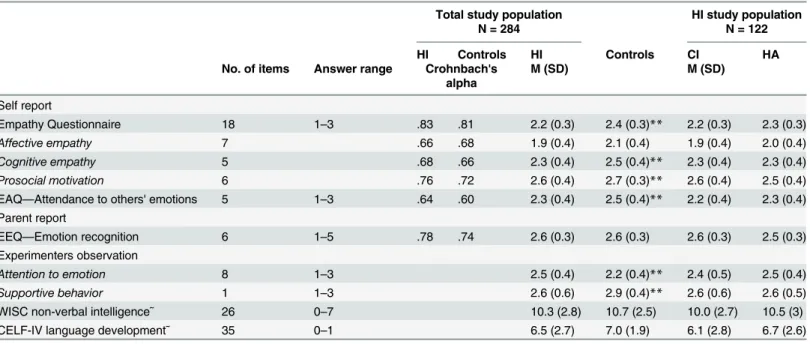
Table 2. Psychometric properties of empathy questionnaire, EAQ, EEQ and observations.
Total study population N = 284
HI study population N = 122
HI Controls HI Controls CI HA
No. of items Answer range Crohnbach's alpha
M (SD) M (SD)
Self report
Empathy Questionnaire 18 1–3 .83 .81 2.2 (0.3) 2.4 (0.3)** 2.2 (0.3) 2.3 (0.3)
Affective empathy 7 .66 .68 1.9 (0.4) 2.1 (0.4) 1.9 (0.4) 2.0 (0.4) Cognitive empathy 5 .68 .66 2.3 (0.4) 2.5 (0.4)** 2.3 (0.4) 2.3 (0.4) Prosocial motivation 6 .76 .72 2.6 (0.4) 2.7 (0.3)** 2.6 (0.4) 2.5 (0.4) EAQ—Attendance to others' emotions 5 1–3 .64 .60 2.3 (0.4) 2.5 (0.4)** 2.2 (0.4) 2.3 (0.4) Parent report
EEQ—Emotion recognition 6 1–5 .78 .74 2.6 (0.3) 2.6 (0.3) 2.6 (0.3) 2.5 (0.3)
Experimenters observation
Attention to emotion 8 1–3 2.5 (0.4) 2.2 (0.4)** 2.4 (0.5) 2.5 (0.4) Supportive behavior 1 1–3 2.6 (0.6) 2.9 (0.4)** 2.6 (0.6) 2.6 (0.5)
WISC non-verbal intelligence˜ 26 0–7 10.3 (2.8) 10.7 (2.5) 10.0 (2.7) 10.5 (3)
CELF-IV language development˜ 35 0–1 6.5 (2.7) 7.0 (1.9) 6.1 (2.8) 6.7 (2.6)
Abbreviations: HI Hearing Impaired, CI Cochlear Implant, HA Hearing Aid, SD Standard Deviation, EAQ Emotion Awareness Questionnaire, EEQ Emotional Expressivity Questionnaire.
*p<.05,
**p<.01, ˜normscores.
on a 5-point Likert scale (1 = (almost) never, 2 = rarely, 3 = sometimes, 4 = often, 5 = (almost)
always) [2]. The internal consistency of the scales is good.
Measurement invariance was not assessed for the above described questionnaires. However, the questionnaires were specifically designed to use in different clinical groups (Children with specific language impairments, autism spectrum disorders, and DHH children). Therefore, items were formulated with short sentences to increase understanding. Previous studies have
shown consistent and positive outcomes in these groups[30,31].
Observation of empathy. Participating children were faced with‘live’emotions from the experimenter to observe to what extent they would show empathic reactions. Multiple
situa-tions were acted out, which aimed to evoke attention for the situation and/or the experimenter’s
emotion and prosocial responses directed at the experimenter. Before data collection started, experimenters were instructed on how to simulate emotions. Emotions were modeled by a psy-chologist experienced in simulating emotions for behavioral assessment purposes. Additionally, experimenters watched multiple video clips of emotion simulations, which were obtained dur-ing a pilot study. Specific instructions were provided regarddur-ing the duration and intensity of the emotions displayed, as well as regarding the verbal and non-verbal cues that accompanied these. Experimenters then practiced and video-recorded multiple emotion simulations them-selves, and received feedback on their performance from the trainer. Training continued until all experimenters could simulate the emotions in a natural way, as judged by the trainer.
In the first situation, the experimenter pretended to receive text messages from a friend. The experimenter reached for her phone and pretended to read the first message, after which she shared with the participant that it contained an invitation from her friend to go to the movies that night. The experimenter had an excited, happy facial expression and said that she was looking forward to it. After that, she put away the phone and continued the test session. Ap-proximately 30 minutes later the experimenter pretended to have received another text mes-sage. This time, she shared with the participant that her friend had to cancel the appointment, meanwhile showing a disappointed, sad facial expression. After five seconds, the experimenter stored her phone and carried on with the session. During and after revealing the second mes-sage, the experimenter observed the behavioral and verbal responses of the participant.
In the second situation, the experimenter pretended she could not find her pen. Earlier, the pen was placed outside the direct line of sight of the experimenter (i.e., behind a binder), but in full view of the participant. For a duration of ten seconds, the experimenter looked around and
searched her bag, stating that she could not find her pen. Meanwhile, children’s responses
were observed.
In the third situation, the experimenter collected testing materials and dropped one item on
the floor. The experimenter looked at the item and said‘oops’, but continued to gather the rest
of the materials. Children’s behaviors in response to the situation were observed.
Children’s reactions across all three situations were scored on a checklist (1 =no, 2 =
slight-ly, 3 =yes) and were grouped into‘attention to emotions’(e.g., looking at the experimenter)
and‘supportive behavior’(e.g., returning the lost pencil). Unfortunately, due to time restraints
scores from 9 CI children, 9 HA children and 1 NH child are missing.
Language skills and intelligence. Nonverbal intelligence of participants was assessed using two components of the Wechsler Intelligence Scale for Children-Third Edition (WISC): block design (duplicating geometric designs with cubes) and picture concepts (arranging
pic-tures to create logical stories) [33]. These scores were compared with scores of earlier
complet-ed intelligence tests (either the Snijders-Oomen or the WISC) [34]. A high correlation was
found previously by Theunissen et al. [22] making the shorter subtest a good reflection of the
child’s intelligence level. The WISC has been proven to show excellent test-retest abilities and
Sufficient language abilities are regarded essential to ensure comprehension of the different questionnaires. This was tested using a sentence comprehension and a story comprehension task. Children using oral language as their preferred mode of communication completed the
Dutch version of the Clinical Evaluation of Language Fundamentals—Fourth Edition (CELF-IV)
[36,37]. The CELF has been proven to show high stability coefficients. Studies were conducted
in several clinical groups including children with language disorder, and hearing impairment
[10]. DHH children who preferred communicating by sign (supported) language completed
sub-tests from the Assessment Instrument for Sign Language of The Netherlands [38].
Statistical Analyses
Group demographics were compared using independent t-tests. To compare the levels of em-pathy (affective emem-pathy, cognitive emem-pathy and prosocial motivation) between the different subgroups repeated measures Multivariate Analysis of Variance (MANOVA) and Multivariate Analysis of Covariance (MANCOVA) were used. In case of differences between subgroups
within the DHH children, when sample sizes were small (<40 children per group) the
assump-tion of normality was violated. Therefore, to compare levels of empathy between these sub-groups (e.g., uni- versus bilateral CI, pre- versus perilingual onset of hearing loss) a non-parametric test was chosen (i.e., Mann-Whitney U test). Correlations between the empathy
subscales and audiological factors were calculated using Pearson’s correlations. These
correla-tions were compared between the different groups using Fisher’sr-to-ztransformations to be
able to show significant differences between correlations. Statistical analyses were carried out
using the programSPSSversion 21.0 (IBM Corp., Armonk, NY).
Results
Self-reported empathy in DHH and NH children
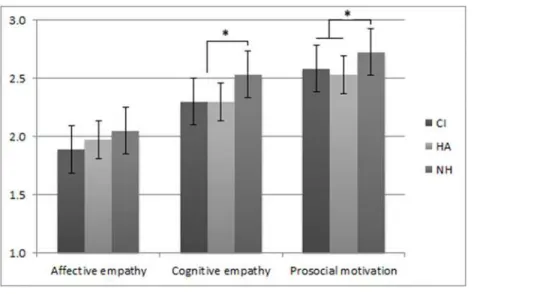
To analyze the differences in self-reported empathy levels between children with a CI, those with HAs, and hearing children, we carried out a repeated measures MANOVA with Group (CI, HA, NH) as the between-subjects variable and self-reported empathy (affective empathy, cognitive empathy, prosocial motivation) as the within-subjects variable. The analysis showed
a main effect for empathy (FHF(1.97, 553.96) = 303.81,p<.001,ηp2= .52) and for group (F(2,
281) = 11.44,p<.001,ηp2= .08), which was qualified by an empathy x group interaction (FHF
(3.92, 553.96) = 2.46,p<.05,ηp2= .02). Post-hoc t-tests showed that on affective empathy
chil-dren with CIs scored lower than the NH group. Scores on affective empathy by chilchil-dren with HAs did not differ from NH children. DHH children overall scored lower on cognitive empa-thy and prosocial motivation than NH peers, regardless of their type of hearing amplification. Because of the known influence of language development and intelligence on the socio-emo-tional development of DHH children, these variables were added as covariates in the analyses. In a MANCOVA that corrected for language development and intelligence, the main effect for
group remained (F(2, 236) = 6.30,p= .002,ηp2= .05), but the interaction effect was no longer
significant (FHF(3.95, 465.57) = 1.55,p= .19,ηp2= .01). Language development was significantly
related to the levels of empathy (F(1, 236) = 5.25,p= .02) whereas intelligence was not (Fig 1).
A gender x self-reported empathy repeated measures MANOVA was conducted to define differences in self-reported empathic abilities between boys and girls, regardless of their
hear-ing status. Results showed a main effect for empathy (F(1.97, 555.75) = 393.96,p<.001,ηp2=
.58) and for gender (F(1, 281) = 11.10,p= .001,ηp2= .04), which was qualified by an empathy
x gender interaction (FHF(1.97, 555.75) = 4.33,p<.05,ηp2= .02). Post-hoc analysis revealed
group) x 2 (gender) x 3 (self-reported empathy) repeated measured MANCOVA with language
development and intelligence as covariates. The main effect for group remained (F(2, 233) =
5.75,p= .004,ηp2= .05) whereas the results no longer showed a main effect for gender (F(1,
233) = 3.54,p= .06,ηp2= .02).
Concerning attendance to others’emotions, a 2 (DHH, NH) x 2 (boys, girls) one-way
ANCOVA that corrected for language skills and intelligence revealed an effect for hearing
group (F(1, 235) = 8.52,p<.01) and gender (F(2, 235) = 18.04,p<.001). NH children reported
higher scores than DHH children and girls scored higher than boys. Language development
was significantly related to the attendance towards others’emotions (F(1, 240) = 4.80,p<.05).
A one-way ANCOVA to compare the effect of hearing group and gender on emotion recogni-tion as scored by parents corrected for language development and intelligence showed no
dif-ferences between the hearing groups or gender (F(1, 182) = 0.03,p= .87 and (F(1, 182) =
0.065,p= .80, respectively).
Observation of empathy and supportive behavior
Differences between gender and hearing status in observed empathic behavior during the live emotions tasks were assessed with language and intelligence as covariates. A 2 (DHH, NH) x 2 (boys, girls) mixed ANCOVA revealed an effect for hearing status and for gender; DHH
chil-dren scored higher than their NH peers on emotion attention(F(1, 220) = 28.80,p<.001);
re-gardless of their type of hearing amplification. Girls scored higher than boys (F(1, 220) =
10.94,p= .001). To compare DHH and NH boys and girls on their observed supportive
behav-ior, a 2 (DHH, NH) x 2 (boys, girls) mixed ANCOVA was performed showing an effect for
hearing status but not for gender (F(1, 220) = 16.03,p<.001 andF(1, 220) = .66,p= .42,
re-spectively). Conversely to their‘emotion attention’, NH children more often showed
support-ive behavior than DHH children.
Audiological and socio-demographic factors influencing empathy
In order to properly examine levels of empathy between DHH children at special education (for the deaf and hard of hearing child) and at mainstream education, a MANCOVA was performed with school-type (special or mainstream) as the between-subjects variable, the self-reported
Fig 1. Mean empathy scores per group.*p<.01.
levels of empathy as the within-subjects variables and language development as a covariate. The two groups did not differ in background and audiological characteristics (e.g., age at detection of hearing loss, age at intervention, intelligence, SES). The analysis showed a main effect for
em-pathy (FHF(2, 204) = 9.16,p<.001,ηp2= .08) and for school-type (F(1, 102) = 4.38,p<.05,ηp2
= .04). Post-hoc ANCOVA’s revealed higher levels of cognitive empathy in DHH children
at-tending mainstream schools than in DHH children atat-tending special schools, (FHF(1, 102) =
7.89,p<.01), whereas for affective empathy and prosocial motivation no significant differences
were found (FHF(1, 102) = 1.61,p= .21. andFHF(1, 102) = .91,p= .34, respectively). No
signifi-cant differences were found in observed empathic reactions nor in parent reported emotion
rec-ognition or attendance to others’emotions comparing DHH children in mainstream and
special education when corrected for their language skills.
When comparing the child’s preferred mode of communication DHH children using sign
(supported) language scored lower on self-reported prosocial motivation and on observed
at-tention to emotions than DHH children who preferred to use spoken language (U= 986.5,z=
-2.95,p= .003 andU= 802.5,z= -2.32,p= .021, respectively). Two participants solely
commu-nicated by sign-language. All analyses were rerun without these two participants. The results did not differ.
No significant differences were found between the levels of empathy in children regarding the moment of detection of their hearing loss (i.e., pre- or perilingual). When comparing with-in the CI group, parents reported higher levels of emotion recognition with-in unilaterally implanted
children compared to bilaterally implanted children (U= 82,z= -2.54p= .01).
In the DHH group, the relation between several continuous audiological variables (degree of hearing loss, age at detection of hearing loss, age at intervention of hearing loss, age at im-plantation) and the levels of empathy (self-report, parent-report and observed) were analyzed
by means of Pearson’s correlations. No relations were found between these variables and the
different levels of empathy.
Discussion
Empathy is an important capacity which helps to build and maintain positive social
relation-ships [39]. It has been argued that affective empathy (i.e., feeling what the other person feels) is
neurologically hard-wired, i.e., present in children despite their social learning experiences
[35]. Yet, the level of cognitive empathy (i.e., understanding the other’s emotions) depends for
instance on the extent to which children can participate in a social environment [39]. We
hy-pothesized that DHH children would be seriously disadvantaged in this respect. The outcomes of this study support our hypothesis: DHH children report equal levels of affective empathy as
NH peers. Even higher levels of attention to others’emotions in DHH children than in NH
children were found during an observation task. Yet, DHH children reported lower levels of cognitive empathy, and valued emotional information about other people as less important. Moreover, both a self-report and an observation task show less supportive behavior in the DHH group compared to NH peers. In other words, DHH children might feel what the other person feels, and also attend to those emotions, but they have less understanding of their
causes; they value others’emotions as less important, and also react less adaptively to
support-ing the person in distress. Yet, especially the capacity for cognitive empathy, whereby one is more inclined not only to feel for the other, but also take the perspective of the other person, is
essential in overcoming in-group preferences and avoiding parochialism [11].
Consistent with other research in the domain of empathy, girls scored higher than boys on affective empathy and prosocial motivation. Only during the observation tasks, no differences
see that children in mainstream schools, or those who used spoken language as their primary mode for communication, did better on cognitive empathy than their DHH peers in special schools or using sign or sign(-supported) language, respectively. Unfortunately, they are still outperformed on these abilities by NH children.
Although the level of affective empathy was equal in both groups, this was only after we
con-trolled for the children’s language capacity. Language abilities were taken into account since
previous studies have shown communication skills and interaction with others are improved by sufficient language skills, resulting in better socio-emotional development and fewer
symp-toms of psychopathology in DHH children [6,22,27,40]. However, impaired language skills
only partly explain the lower empathic abilities we found in DHH children. Even when we con-trol for language skills, we still find that DHH children are outperformed by their NH peers on empathic abilities that are more dependent on social learning such as cognitive empathy and prosocial motivation. This indicates that for fully-fledged empathic functioning sufficient lan-guage skills alone are not enough.
By observing how others interact we learn how to deal with our own and others emotions and to place them in a social context. This so-called incidental learning (i.e., learning by experi-ence and with no educational intentions) is essential in order to develop empathic behavior
[41]. Observing how a mother comforts her son after he lost his favorite football not only helps
to understand how the boy feels (i.e., cognitive empathy) but also shows an adequate response (i.e., prosocial behavior). Since incidental learning often implies overhearing conversations be-tween others with quick and snappy dialogues, missing the opportunity for this kind of learn-ing will disadvantage DHH children.
For adequate cognitive empathy to develop a child needs to be able to recognize emotions in
others [42]. Previously, lower levels of emotion recognition were reported in DHH toddlers
[43] and school-aged children compared to NH peers [44]. This could explain the impaired
level of cognitive empathy in the DHH group in our study. However, our study also indicates that DHH children are just as capable as their NH peers when it comes to recognizing emotions in others. It may be that with increasing age DHH children are able to catch up on this ability, and identification of emotions in others no longer seems to be the problem. It is the more com-plex interpretation of the whole emotion-evoking situation that causes confusion: why is my friend angry, what has happened?
The DHH population is often characterized by its heterogeneity (e.g., differences in degree of hearing loss, type and duration of hearing amplification, educational setting, mode of com-munication). In our study DHH children attending mainstream schools reported higher levels of cognitive empathy than DHH children in special schools for the Deaf and Hard of Hearing. Yet, we have to note that reasons for professionals to advise children to attend special educa-tion are diverse. Language skills and intelligence are factors influencing school placement in DHH children. Because these abilities can also influence empathic functioning, we considered them to be confounding factors. However, our study indicates that even if the levels of language skills and intelligence are equal, DHH children attending special education still have difficulties
understanding others’emotions. Despite these difficulties, DHH children in special education
do not differ in their tendency to behave prosocial when compared to DHH children that at-tend mainstream education.
Children in special schools more often use sign language as their preferred mode of commu-nication. In our study we found that children who use sign (supported) language showed less prosocial motivation. However, when comparing signers in special and mainstream education we found no differences in any of their empathic abilities. Previous studies reported differences in socio-emotional development between children with CIs and those wearing HAs in favor of
other’instead of‘the self’, these differences no longer appear and both groups show equal levels of empathy. Yet, these results have to be interpreted with caution as the groups used for these analyses were rather small.
It is important to note that the children in this study were born before the start of early de-tection and intervention programs in the Netherlands and Belgium. Therefore, these children were rehabilitated at a relatively late age (e.g., mean age at first hearing amplification 24.8 months, mean age at implantation 44,5 months). With the introduction of newborn-hearing screening programs, intervention and rehabilitation now preferably starts before the child is six
months old [4]. As early intervention programs have been shown to improve speech and
lan-guage skills, these improvements will hopefully lead to better communication skills, resulting in more effective incidental learning and higher empathic functioning. Future research is need-ed to define the impact of early intervention on these aspects of social-emotional development.
In conclusion, with this study we hope to have created awareness of the impaired empathic abilities of the DHH child. This will severely affect their social relationships, because there is a strong positive association between empathy and friendship quality in both NH and DHH
chil-dren [45–48]. Lower empathic abilities influence a child’s social interaction, for example during
play. For cooperative play with peers children need to share one another’s goals, desires, and
be-liefs [49]. Not being able to empathize with the other may result in less participation in play with
others, causing isolation in the DHH child [50]. For their socio-emotional development DHH
children benefit from achieving sufficient language skills. Yet, it takes more to obtain sufficient empathic abilities. If these abilities are to improve more attention could be paid to these issues in rehabilitation programs and family support. Professionals should create awareness concerning
empathic abilities in the child’s surrounding. Parents and teachers can contribute to the
develop-ment of empathic skills by actively involving the DHH child in emotion-evoking situations, or by talking about emotions more often. Future research should focus on the development of rehabili-tation programs for DHH children that actively support the development of empathic abilities.
Future studies
The psychometric properties of the empathy questionnaire were satisfying with good reliability in both DHH children and their NH peers. However, to assure that DHH children are as capa-ble as hearing children in understanding the items well, further psychometric properties will be useful to examine. Item response theory models can shed further light on issues such as mea-surement invariance, which includes differential item functioning. Because of power issues we were not able to perform this type of analyses. Future studies with a larger cohort of DHH chil-dren are needed to address these issues. Regarding the design of this study, we have to point out that cross-sectional data were used, which prevents us from drawing conclusions about causality. Therefore, we started longitudinal data collection to confirm the assumptions made here.
Supporting Information
S1 Dataset. containing Deaf and Hard of Hearing participants and hearing controls. (SAV)
Acknowledgments
Author Contributions
Conceived and designed the experiments: AN CR ST WS ED JB JF. Performed the experiments: AN CR ST. Analyzed the data: AN CR. Wrote the paper: AN CR ST WS ED JB JF.
References
1. Calderon R, Greenberg M. Social and emotional development of deaf children. Oxford handbook of deaf studies, language, and education. (2003); 1: 177.
2. Rieffe C, Ketelaar L, Wiefferink CH. Assessing empathy in young children: Construction and validation of an Empathy Questionnaire (EmQue). Personality and Individual Differences. (2010); 49: 362–367.
3. Hoffman ML (1987) The contribution of empathy to justice and moral judgment. In: Eisenberg JS N, edi-tor. Empathy and its development. Cambridge: Cambridge University Press. pp. 47–80.
4. Jolliffe D, Farrington DP. Examining the relationship between low empathy and bullying. Aggressive Behavior. (2006); 32: 540–550.
5. Engen HG, Singer T. Empathy circuits. Current Opinion in Neurobiology. (2013); 23: 275–282. doi:10. 1016/j.conb.2012.11.003PMID:23219409
6. Eisenberg N, Miller PA. The relation of empathy to pro-social and related behaviors. Psychological Bul-letin. (1987); 101: 91–119. PMID:3562705
7. Pfeiffer JH, Dapretto M (2009) "Mirror, Mirror, in My Mind": Empathy, Interpersonal Competence, and the Mirror Neuron System. In: Ickes JDW, editor. The Social Neuroscience of Empathy. Cambridge: MA: The MIT Press. pp. 183–197.
8. Singer T, Lamm C (2009) The Social Neuroscience of Empathy. In: Miller MB, Kingstone A, editors. Year in Cognitive Neuroscience 2009. pp. 81–96.
9. Decety J, Lamm C. Human empathy through the lens of social neuroscience. Thescientificworldjournal. (2006); 6: 1146–1163. PMID:16998603
10. Bernhardt BC, Singer T. The Neural Basis of Empathy. Annual Review of Neuroscience, Vol 35. (2012); 35: 1–23.
11. Lamm C, MajdandžićJ. The role of shared neural activations, mirror neurons, and morality in empathy —A critical comment. Neuroscience Research. (2015); 90: 15–24.
12. Decety J, Cowell JM. Friends or Foes: Is Empathy Necessary for Moral Behavior? Perspectives on Psy-chological Science. (2014); 9: 525–537. PMID:25429304
13. Baron-Cohen S, Wheelwright S. The empathy quotient: An investigation of adults with Asperger syn-drome or high functioning autism, and normal sex differences. Journal of Autism and Developmental Disorders. (2004); 34: 163–175. PMID:15162935
14. Lovett BJ, Sheffield RA. Affective empathy deficits in aggressive children and adolescents: A critical re-view. Clinical Psychology Rere-view. (2007); 27: 1–13. PMID:16697094
15. Blair RJ. Responding to the emotions of others: dissociating forms of empathy through the study of typi-cal and psychiatric populations. Conscious Cogn. (2005); 14: 698–718. PMID:16157488
16. Spinella M. Prefrontal substrates of empathy: Psychometric evidence in a community sample. Biologi-cal Psychology. (2005); 70: 175–181. PMID:16105717
17. Zaki J, Ochsner K. The neuroscience of empathy: progress, pitfalls and promise. Nature Neuroscience. (2012); 15: 675–680. doi:10.1038/nn.3085PMID:22504346
18. Whitt A, Howard MO. Assessing empathy in antisocial youth: factor analytic and validation findings. Psychological Reports. (2013); 112: 325–339. PMID:23654045
19. Bachara GH, Raphael J, Phelan WJ. Empathy development in deaf pre-adolescents. American Annals of the Deaf. (1980); 125: 38–41. PMID:7377058
20. Rieffe C. Awareness and regulation of emotions in deaf children. British Journal of Developmental Psy-chology. (2012); 30: 477–492. doi:10.1111/j.2044-835X.2011.02057.xPMID:23039328
21. Ketelaar L, Rieffe C, Wiefferink CH, Frijns JH. Does hearing lead to understanding? Theory of mind in toddlers and preschoolers with cochlear implants. J Pediatr Psychol. (2012); 37: 1041–1050. PMID: 22847880
22. Theunissen SC, Rieffe C, Kouwenberg M, De Raeve LJ, Soede W, Briaire JJ, et al. Behavioral prob-lems in school-aged hearing-impaired children: the influence of sociodemographic, linguistic, and medi-cal factors. Eur Child Adolesc Psychiatry. (2013).
24. Yoshinaga-Itano C. Early intervention after universal neonatal hearing screening: impact on outcomes. Ment Retard Dev Disabil Res Rev. (2003); 9: 252–266. PMID:14648818
25. van Gent T, Goedhart AW, Hindley PA, Treffers PD. Prevalence and correlates of psychopathology in a sample of deaf adolescents. J Child Psychol Psychiatry. (2007); 48: 950–958. PMID:17714380
26. van Eldik T, Treffers PD, Veerman JW, Verhulst FC. Mental health problems of deaf Dutch children as indicated by parents' responses to the child behavior checklist. Am Ann Deaf. (2004); 148: 390–395. PMID:15132019
27. van Eldik T. Mental health problems of Dutch youth with hearing loss as shown on the Youth Self Re-port. Am Ann Deaf. (2005); 150: 11–16. PMID:15969220
28. Theunissen SC, Rieffe C, Kouwenberg M, Soede W, Briaire JJ, Frijns JHM. Depression in hearing-im-paired children. International Journal of Pediatric Otorhinolaryngology. (2011); 75: 1313–1317. doi:10. 1016/j.ijporl.2011.07.023PMID:21862140
29. Harris PL (1989) Children and emotion: The development of psychological understanding. Cambridge, MA, US: Basil Blackwell. viii, 243 p.
30. Overgaauw S, Rieffe C, Crone EA, Güroğlu B. Assessing empathy across childhood and adolescence: Validation of the Empathy Questionnaire. (submitted).
31. Pouw LBC, Rieffe C, Oosterveld P, Huskens B, Stockmann L. Reactive/proactive aggression and affec-tive/cognitive empathy in children with ASD. Research in Developmental Disabilities. (2013); 34: 1256–1266. doi:10.1016/j.ridd.2012.12.022PMID:23417131
32. Rieffe C, Oosterveld P, Miers AC, Terwogt MM, Ly V. Emotion awareness and internalising symptoms in children and adolescents: The Emotion Awareness Questionnaire revised. Personality and Individual Differences. (2008); 45: 756–761.
33. Wechsler D (1991) The Wechsler intelligence scale for children—third edition. San Antonio, TX: The Psychological Corporation.
34. Tellegen P, Laros J. The Construction and Validation of a Nonverbal Test of Intelligence: the revision of the Snijders-Oomen tests. European Journal of Psychological Assessment. (1993); 9: 147–157.
35. Hein G, Silani G, Preuschoff K, Batson CD, Singer T. Neural Responses to Ingroup and Outgroup Members' Suffering Predict Individual Differences in Costly Helping. Neuron. (2010); 68: 149–160. doi: 10.1016/j.neuron.2010.09.003PMID:20920798
36. Semel EM, Wiig EH, A SW (2003) Clinical evaluation of language fundamentals—4. San Antonio TX: Psych Corp/Harcourt.
37. Kort W, Schittekatte M, Compaan E (2008) CELF-4-NL: Clinical Evaluation of Language Fundamen-tals-vierde-editie. Amsterdam: Pearson Assessment and Information B.V.
38. Hermans D, Knoors H, Verhoeven L. Assessment of Sign Language Development: The Case of Deaf Children in the Netherlands. Journal of Deaf Studies and Deaf Education. (2010); 15: 107–119. doi:10. 1093/deafed/enp030PMID:19914957
39. Preston SD, de Waal FBM. Empathy: Its ultimate and proximate bases. Behavioral and Brain Sciences. (2002); 25: 1-+. PMID:12625087
40. Stevenson J, McCann D, Watkin P, Worsfold S, Kennedy C, Hearing Outcomes Study T. The relation-ship between language development and behaviour problems in children with hearing loss. Journal of Child Psychology and Psychiatry. (2010); 51: 77–83. doi:10.1111/j.1469-7610.2009.02124.xPMID: 19686333
41. Moeller MP. Current state of knowledge: Psychosocial development in children with hearing im-pairment. Ear and Hearing. (2007); 28: 729–739. PMID:17982361
42. Hall JA, Andrzejewski SA, Yopchick JE. Psychosocial Correlates of Interpersonal Sensitivity: A Meta-Analysis. Journal of Nonverbal Behavior. (2009); 33: 149–180.
43. Wiefferink CH, Rieffe C, Ketelaar L, De Raeve L, Frijns JHM. Emotion Understanding in Deaf Children with a Cochlear Implant. Journal of Deaf Studies and Deaf Education. (2013); 18: 175–186. doi:10. 1093/deafed/ens042PMID:23232770
44. Dyck MJ, Farrugia C, Shochet IM, Holmes-Brown M. Emotion recognition/understanding ability in hear-ing or vision-impaired children: do sounds, sights, or words make the difference? Journal of Child Psy-chology and Psychiatry. (2004); 45: 789–800. PMID:15056310
45. Chow CM, Ruhl H, Buhrmester D. The mediating role of interpersonal competence between adoles-cents' empathy and friendship quality: A dyadic approach. Journal of Adolescence. (2013); 36: 191– 200. doi:10.1016/j.adolescence.2012.10.004PMID:23176745
47. Smith RL, Rose AJ. The "Cost of Caring" in Youths' Friendships: Considering Associations Among So-cial Perspective Taking, Co-Rumination, and Empathetic Distress. Developmental Psychology. (2011); 47: 1792–1803. doi:10.1037/a0025309PMID:21895362
48. Kouwenberg M, Rieffe C, Theunissen SCPM, Rooij Md, Frijns JHM. Deaf or hard of hearing youth and their friends: A longitudinal exploration of best friendships. (submitted).
49. Brownell CA, Zerwas S, Balaram G. Peers, cooperative play, and the development of empathy in chil-dren. Behavioral and Brain Sciences. (2002); 25: 28-+.