Submitted12 December 2014
Accepted 31 March 2015
Published28 April 2015
Corresponding author Yusuke Kato, [email protected]
Academic editor Pietro Gatti-Lafranconi
Additional Information and Declarations can be found on page 10
DOI10.7717/peerj.904
Copyright 2015 Kato
Distributed under
Creative Commons CC-BY 4.0
OPEN ACCESS
Tunable translational control using
site-specific unnatural amino acid
incorporation in
Escherichia coli
Yusuke Kato
Genetically Modified Organism Research Center, National Institute of Agrobiological Sciences, Tsukuba, Ibaraki, Japan
ABSTRACT
Translation of target gene transcripts inEscherichia coliharboring UAG amber stop codons can be switched on by the amber-codon-specific incorporation of an exogenously supplied unnatural amino acid, 3-iodo-L-tyrosine. Here, we report that
this translational switch can control the translational efficiency at any intermediate magnitude by adjustment of the 3-iodo-L-tyrosine concentration in the medium,
as a tunable translational controller. The translational efficiency of a target gene reached maximum levels with 10−5M
3-iodo-L-tyrosine, and intermediate levels
were observed with suboptimal concentrations (approximately spanning a 2-log10 concentration range, 10−7–10−5M). Such intermediate-level expression was also
confirmed in individual bacteria.
Subjects Bioengineering, Biotechnology, Microbiology
Keywords Translational regulation,Escherichia coli, Expression system
INTRODUCTION
Controlling gene expression is a key methodology for biotechnology. Particularly, its fine-tuning and optimization are important for construction of artificial gene circuits in synthetic biology and for metabolic engineering. Tunable conditional expression systems regulated by extracellular inducers/repressors are thus very useful.
We previously demonstrated a translational switch using site-specific unnatural amino acid (UAA) 3-iodo-L-tyrosine (IY) incorporation in natural amber suppressor-free strains
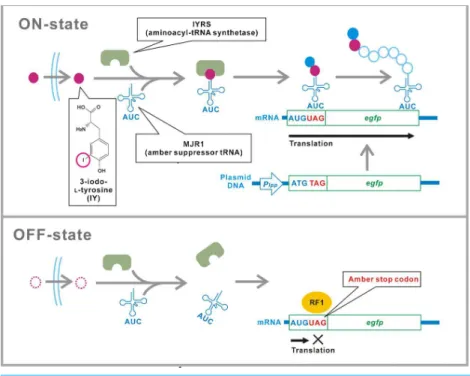
ofEscherichia coli(Minaba & Kato, 2014). Although IY is not perfectly “unnatural” and found in very specific biological tissues such as the thyroid cells (Tietze et al., 1989) and the sponge skeletons (Ueberlein et al., 2014), we cannot detect IY ubiquitously in natural environments. The translational switch is based on conditional read-through of the UAG amber stop codons that are inserted in target genes (Fig. 1). A variant of aminoacyl-tRNA synthetase (aaRS) IYRS that was derived from the archaebacteriumMethanocaldococcus jannaschiispecifically recognizes both IY and an amber suppressor tRNA (tRNACUA)
Figure 1 Schematic of the translational switch using the amber codon-specific IY.An amber stop codon is inserted next to the ATG translational start codon in the target gene (egfp). MJR1 is an amber suppressor tRNA. IYRS is an aminoacyl-tRNA synthetase that orthogonally recognizes IY and MJR1. Extracellular IY is taken up by the bacteria. The addition of IY in the media results in amber stop codon read-through and translation of the target gene. Translation is interrupted in the absence of IY. RF1, peptide chain release factor 1.
The UAA-controlling translational switch has distinct features for gene regulation (Minaba & Kato, 2014). First, this translational switch also can be controlled by the induction/repression of either aaRS or tRNACUA, in addition to the presence/absence
of UAA. The switchability can be modulated by combination use with aaRS- and/or tRNACUA- switching. Second, UAA does not naturally exist. Third, UAA is a “building
block” that forms an aminoacyl-tRNA and target proteins, distinct from simple regulation-specific molecules, such as isopropylβ-D-1-thiogalactopyranoside (IPTG)
for the derepression of the lactose operator. The switching mechanism involves the direct incorporation of UAA into target proteins, and is not effective for interventional systems. The second and third characteristics indicate that the UAA-controlling translational switch is robust against environmental and host-endogenous noises. Although an inducible tRNACUAhas been used as a similar translational switch based on amber suppression,
Riboswitches and small regulatory RNAs (sRNAs) are well known as post-transcriptional controlling tools in E. coli. Some riboswitches that are located in non-coding portions of mRNAs can regulate gene expressionin cisby binding a specific small molecule via controlling translational initiation and/or mRNA degradation (Caron et al., 2012). The sRNAs are trans-acting and target gene alterations are not required, although off-target effects are often detected (Bobrovskyy & Vanderpool, 2013). The sRNAs modulate the translation via controlling translation initiation and/or mRNA degradation. The distinct characteristics of these RNA-based post-transcriptional switches suggest that the UAA-controlling translational switch is complementary rather than competitive with the others.
To date, many systems for the incorporation of various UAAs have been developed (Liu & Schultz, 2010). In addition, similar translational switches controlled by UAAs are expected to be applicable also for eukaryotes, such as yeasts, nematodes, insects, mammalian cells, and plants, because the site-specific unnatural amino acid incorporation systems have already been introduced (Chin et al., 2003;Greiss & Chin, 2011;Bianco et al., 2012;Sakamoto et al., 2002;Li et al., 2013).
The target gene products that are controlled by the UAA-controlling translational switch necessitate the incorporation of UAA. Although the UAA-incorporation may cause functional alterations in some target proteins, we can avoid this problem by neutral site selection, incorporation into tag or processed-out sequences. Alternatively, the UAAs can be used as tools to facilitate purification or tracking of target gene products (Minaba & Kato, 2014).
In previous studies, we only focused on the on-offaspect of the IY-controlling translational switch. Here, we studied the intermediate states between the fully on- and off-states of the translational switch. The results suggest that this switch can control the translational efficiency at any intermediate magnitude by adjustment of the appropriate IY concentration, and thus, function as a tunable translational controller.
MATERIALS AND METHODS
Fluorescence measurement of pooled bacteria
Assays were performed as described previously (Minaba & Kato, 2014). Briefly, we used E. coli BL21-AI (F−ompT gal dcm lon hsdSB(rB−m−B)araB::T7RNAP-tetA) carrying
the plasmid pTYR MjIYRS2-1(D286) MJR1×3 encoding IYRS and MJR1 and the
amber-inserted EGFP expression plasmid (driven by theE. coli lpppromoter with an amber stop codon TAG inserted next to the start codon ATG). The sequence for the EGFP expression plasmid is shown inFig. S1. An overnight (approximately 16 h) culture of bacteria was resuspended in an equal volume of liquid LB medium (1% bacto tryptone, 0.5% yeast extract, and 1% NaCl) containing various concentrations of optically-pure IY. IY was directly dissolved and diluted in LB medium. After a 6 h culture (2 ml in a 14 ml-culture tube at 37◦C with rotary shaking at 200 rpm), the bacteria were collected by centrifugation (1,800×gfor 3 min). The pellet was washed and was resuspended in an
the bacterial suspension (150µl) was diluted in 3.0 ml of the 0.9% NaCl, and the OD590
was measured. The fluorescence intensity of the bacterial population was measured using a Shimadzu RF-5300PC spectrofluorometer (excitation, 480 nm; emission, 515 nm). The background fluorescence was estimated using the bacteria carrying a MJR1-deleted plasmid (ΔMJR1) at IY=0 (no significant IY-dependency was observed,Fig. S2). The
background-subtracted values were used to calculate the points for the dose–response curve. For the time course measurement of EGFP accumulation, we cultured the bacteria in 20 ml LB medium in a 200 ml culture flask. Aliquots of the bacterial culture (150µl) were withdrawn at various time points, and the OD590and fluorescence were measured.
Photomicrographs
Photomicrographs and Nomarski differential interference contrast images of the fluorescent bacteria were recorded using both a Carl Zeiss Axioskop 2 with a 38-HE Endow GFP filter-set (Carl Zeiss, Jena, Germany) and a Roper Scientific Photometrics CoolSNAP ver.1.1 (Roper Industries, Sarasota, Florida, USA).
Image analyses
Analyses of the fluorescence images were performed using ImageJ 1.48v (National Insti-tutes of Health, Bethesda, Maryland, USA). Prior to analyses, the fluorescence images were confirmed as not being saturated at any pixels. Three-dimensional graphs of the intensities of the pixels were generated using Surface Plot command. The fluorescence intensity of individual bacteria was measured using Particle Analysis command. A background value (bacteria-absent area) was used as a threshold for particle detection. A range of particle area was set to detect only individual and not-overlapping bacterial cell images.
Growth curve
Growth curves were determined as previously described with some modifications (Minaba & Kato, 2014). Overnight cultures of bacteria were diluted (1:200) in fresh LB medium and were incubated at 37◦
C with rotary shaking at 200 rpm. After reaching a visible density (around OD590=0.1), OD590was measured every 20 min for 2 h.
RESULTS AND DISCUSSION
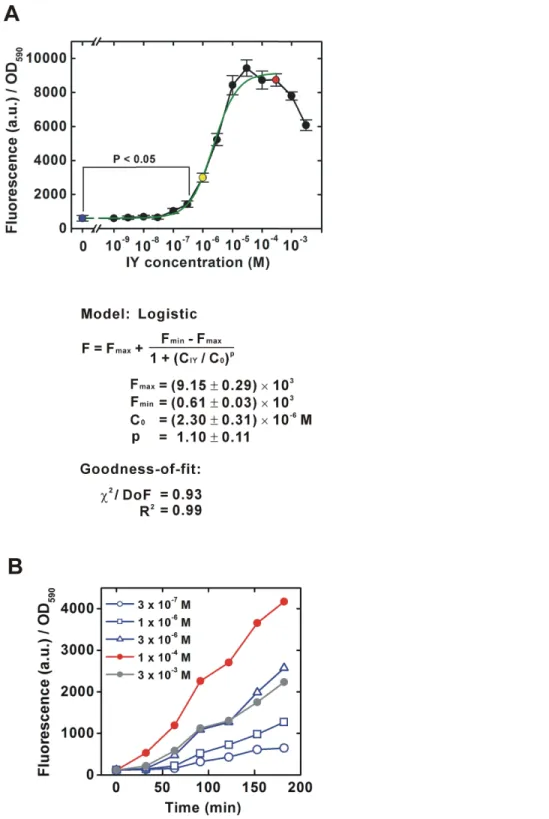
To characterize the intermediate states of the translational switch using the IY-incorporation system, the IY dose-dependency of translational efficiency for a target gene was first determined for a bacterial population (Fig. 2A). As shown inFig. 1, an EGFP gene containing an amber stop codon next to the ATG translational start codon was constitutively transcribed by thelpppromoter in theE. coliBL21-AI strain expressing IYRS and MJR1. The translational efficiency was estimated from the EGFP fluorescence 6 h after IY addition into the medium. The “gross” translational efficiency for the population started to increase significantly at 3×10⁻⁷M and reached maximum levels at 10−5M.
Figure 2 (...continued)
A single fitted dose-response curve (log-logistic, IY=0–3 × 10⁻⁴ M) was generated using Origin7. The equation for the fitted curve and assessments of goodness-of-fit are represented under the graph.
F, fluorescent intensity (arbitrary unit);Fmax, the initialFvalue (right horizontal asymptote);Fmin,
the finalFvalue (left horizontal asymptote);CIY, IY concentration (M);C0, 50% effectiveCIY(point
of inflection);χ2, reduced chi-squared value; DoF, degrees of freedom. (B) Time course of EGFP accumulation.
3×10⁻⁶M. The IY concentration-dependent change of the gross translational efficiency
was also confirmed by a direct measurement of the time course for EGFP accumulation (Fig. 2B). The EGFP accumulation rate was clearly slower at suboptimal concentrations than that at the optimal concentration. The accumulation rate increased with increasing IY concentration, also suggesting that an intermediate translational efficiency could be obtained in the suboptimal concentration range.
Intermediate levels of gene expression for the pooled bacteria are not always equal to that for an individual bacterium. In the case of conditional gene expression by thearaBAD promoter, intermediate expression levels in the cultures reflected a population average of the induced and non-induced cells, i.e., each cell responded to an inducerL-arabinose
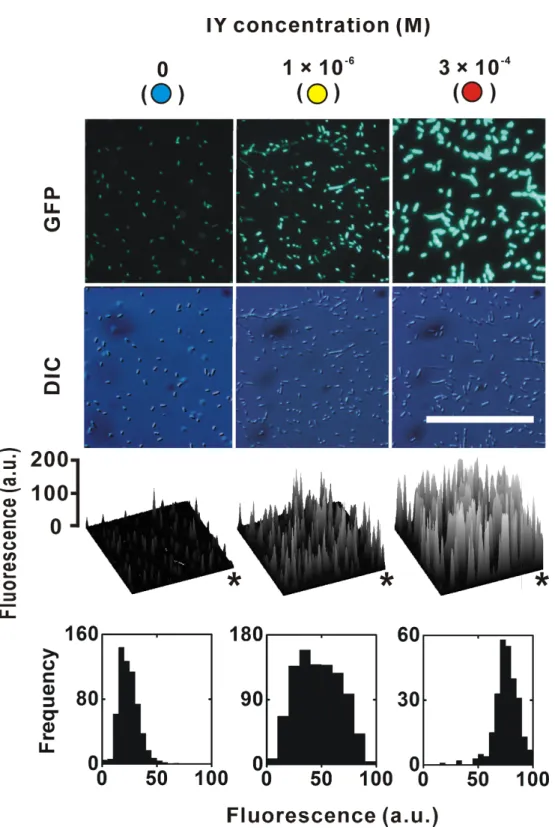
at a suboptimal concentration in an all-or-none manner (Siegele & Hu, 1997;Guzman et al., 1995). A similar non-uniform induction was also reported for thelacoperon (Novick & Weiner, 1957;Maloney & Rotman, 1973). We therefore determined whether the IY dose-dependent change of EGFP fluorescence in individual cells using fluorescence images (Fig. 3). The fluorescence intensity of these images was quantified by image analysis, and spatial maps were generated. The fluorescence intensity clearly increased with increasing IY concentration. Fluorescent intensity distribution histograms of individual bacteria were also examined. As expected from the fluorescence images and their spatial maps, the peak frequency at a suboptimal IY concentration (1×10⁻⁶M) was located between
Figure 3 EGFP expression in individual bacteria. The sampling points are indicated in the dose-response curve inFig. 2A. Upper and lower photographs are epifluorescence images and Nomarski differential interference contrast images, respectively. The photographic conditions were constant for all of the fluorescence images. Calibration bar=100µm. Asterisks in spatial distribution graphs indicate the
Figure 4 (...continued)
amber-inserted EGFP gene expression plasmid; ΔEGFP+Lux, a derivative strain in which the amber–inserted EGFP gene was substituted with an amber-inserted LuxB gene from the bacterium Vibrio harveyi as a vector control (Schultz & Yarus, 1990). Data are shown as mean±SEM.n=3 independent experiments. Statistical analysis was performed using Welch’st-test. ns, not significant. (B) Observation of leaky translation in individual bacteria. The EGFP fluorescence was measured in the absence of IY. In these images, non-specific background fluorescence was completely filtered out (note that this method is distinct from that ofFig. 4A). The exposure time for the EGFP images was twice that inFig. 3.
translational switch, the velocity of translation by a suppressor IY-tRNA is expected to depend on the intracellular IY concentration if the concentrations of the suppressor tRNA, IYRS, and peptide release factors are constant (Yarus et al., 1986). The intracellular IY concentration was possibly at a subsaturation level at the suboptimal concentration of extracellular IY. Although the uptake mechanism of IY remains unclear, positive feedback loops as seen in thelacoperon or thearaBADsystem may be weak or not be involved (Pittard, 1996).
Approximately 7% of the maximum translation was detected even in the absence of IY, as also described previously (Minaba & Kato, 2014). The leaky translation was completely abolished by deletion of the MJR1 gene, suggesting that mischarges of MJR1 were the cause (Figs. 4Aand4B). Although some countermeasure techniques have been proposed, reduction of leaky translation needs to be a priority (Minaba & Kato, 2014).
The translational efficiency decreased from the saturation level at an extremely high IY concentration (Figs. 2Aand2B). Although its mechanism remains to be elucidated, the decrease may not be due to non-specific toxicity of IY because the bacterial growth rates did not decrease both in the IY-incorporating strains and in the parent strain (Fig. S3).
In this study, we evaluated the IY-controlling translational switch using a single setting (a single amber codon in one position, and the single target gene EGFP). In the future, further studies using this application should clarify how general this system is.
CONCLUSIONS
The translational switch using site-specific IY incorporation can be used as a “tunable translational controller” that regulates the translational efficiency in each individual cell. Using this controller, we expect to be able regulate the translational efficiency over a wide range in combination with any transcriptional controlling systems (Minaba & Kato, 2014). The tunable translational controller is a promising tool for conditional fine-tuning and for optimizing the construction of artificial gene circuits in synthetic biology and in metabolic engineering (Yadav et al., 2012).
ACKNOWLEDGEMENTS
ADDITIONAL INFORMATION AND DECLARATIONS
Funding
This work was supported by JSPS KAKENHI Grant number 25660281. The funders had no role in study design, data collection and analysis, decision to publish, or preparation of the manuscript.
Grant Disclosures
The following grant information was disclosed by the author: JSPS KAKENHI: 25660281.
Competing Interests
The author declares there is no competing interests.
Author Contributions
• Yusuke Kato conceived and designed the experiments, performed the experiments,
analyzed the data, contributed reagents/materials/analysis tools, wrote the paper, prepared figures and/or tables, reviewed drafts of the paper.
Supplemental Information
Supplemental information for this article can be found online athttp://dx.doi.org/ 10.7717/peerj.904#supplemental-information.
REFERENCES
Bianco A, Townsley FM, Greiss S, Lang K, Chin JW. 2012.Expanding the genetic code of Drosophila melanogaster.Nature Chemical Biology8:748–750DOI 10.1038/nchembio.1043.
Bobrovskyy M, Vanderpool CK. 2013.Regulation of bacterial metabolism by small RNAs using diverse mechanisms.Annual Review of Genetics47:209–232
DOI 10.1146/annurev-genet-111212-133445.
Bowers LM, LaPoint K, Anthony L, Pluciennik A, Filutowicz M. 2004.Bacterial expression system with tightly regulated gene expression and plasmid copy number.Gene340:11–18 DOI 10.1016/j.gene.2004.06.012.
Caron MP, Bastet L, Lussier A, Simoneau-Roy M, Mass´e E, Lafontaine DA. 2012.Dual-acting riboswitch control of translation initiation and mRNA decay.Proceedings of the National Academy of Sciences of the United States of America109:E3444–E3453
DOI 10.1073/pnas.1214024109.
Chin JW, Cropp A, Anderson C, Mukherji M, Zhang Z, Schulz PG. 2003. An expanded eukaryotic genetic code.Science301:964–967DOI 10.1126/science.1084772.
Greiss S, Chin JW. 2011.Expanding the genetic code of an animal.Journal of the American Chemical Society133:14196–14199DOI 10.1021/ja2054034.
Guzman LM, Belin D, Carson MJ, Beckwith J. 1995.Tight regulation, modulation, and high-level expression by vectors containing the arabinosePBADpromoter.Journal of Bacteriology
Herring CD, Glasner JD, Blattner FR. 2003.Gene replacement without selection: regulated suppression of amber mutations inEscherichia coli.Gene331:153–163
DOI 10.1016/S0378-1119(03)00585-7.
Khlebnikov A, Keasling JD. 2002.Effect of lacY expression on homogeneity of induction from the P(tac) and P(trc) promoters by natural and synthetic inducers.Biotechnology Progress
18:672–674DOI 10.1021/bp010141k.
Li F, Zhang H, Sun Y, Pan Y, Zhou J, Wang J. 2013.Expanding the genetic code for photoclick chemistry inE. coli, mammalian cells, andA. thaliana.Angewandte Chemie International Edition
52:9700–9704DOI 10.1002/anie.201303477.
Liu CC, Schultz PG. 2010.Adding new chemistries to the genetic code.Annual Review of Biochemistry79:413–444DOI 10.1146/annurev.biochem.052308.105824.
Maloney PC, Rotman B. 1973.Distribution of suboptimally inducedβ-D-Galactosidase in Escherichia coli: the enzyme content of individual cells.Journal of Molecular Biology73(1):77–91 DOI 10.1016/0022-2836(73)90160-5.
Minaba M, Kato Y. 2014.High-yield, zero-leakage expression system with a translational switch using site-specific unnatural amino acid incorporation.Applied and Environmental Microbiology
80(5):1718–1725DOI 10.1128/AEM.03417-13.
Novick A, Weiner M. 1957.Enzyme induction as an all-or-none phenomenon.Proceedings of the National Academy of Sciences of the United States of America43(7):553–566
DOI 10.1073/pnas.43.7.553.
Pittard AJ. 1996.Biosynthesis of the aromatic amino acids. In: Neidhardt FC, Durtiss R, Ingraham L, Lin CC, Low KB, Magasanik B, ReznikoffWS, Riley M, Schaechter M, Umbarger HE, eds. Escherichia coli and Salmonella: cellular and molecular biology. 2nd edition. Washington D.C.: ASM Press, 458–484.
Sakamoto K, Hayashi A, Sakamoto A, Kiga D, Nakayama H, Soma A, Kobayashi T, Kitabatake M, Takio K, Saito K, Shirouzu M, Hirao I, Yokoyama S. 2002.Site-specific incorporation of an unnatural amino acid into proteins in mammalian cells.Nucleic Acids Research30:4692–4699DOI 10.1093/nar/gkf589.
Sakamoto K, Murayama K, Oki K, Iraha F, Kato-Murayama M, Takahashi M, Ohtake K, Kobayashi T, Kuramitsu S, Shirouzu M, Yokoyama S. 2009. Genetic encoding of
3-iodo-L-tyrosine inEscherichia colifor single-wavelength anomalous dispersion phasing in protein crystallography.Structure17(3):335–344DOI 10.1016/j.str.2009.01.008.
Schultz DW, Yarus M. 1990.A simple and sensitivein vivoluciferase assay for tRNA-mediated nonsense suppression.Journal of Bacteriology172(2):595–602.
Siegele DA, Hu JC. 1997.Gene expression from plasmids containing thearaBADpromoter at subsaturating inducer concentrations represents mixed populations.Proceedings of the National Academy of Sciences of the United States of America94(15):8168–8172
DOI 10.1073/pnas.94.15.8168.
Tietze F, Kohn LD, Kohn AD, Bernardini I, Andersson HC, Adamson MD, Harper GS,
Gahl WA. 1989.Carrier-mediated transport of monoiodotyrosine out of thyroid cell lysosomes. Journal of Biological Chemistry264:4762–4765.
Yadav VG, Mey MD, Lim CG, Ajikumar PK, Stephanopoulos G. 2012.The future of metabolic engineering and synthetic biology: towards a systematic practice.Metabolic Engineering
14(3):233–241DOI 10.1016/j.ymben.2012.02.001.
Yarus M, Cline SW, Wier P, Breeden L, Thompson RC. 1986.Actions of the anticodon arm in translation on the phenotypes of RNA Mutants.Journal of Molecular Biology192:235–255 DOI 10.1016/0022-2836(86)90362-1.