65
TOMATO SEEDS VIGOR UNDER WATER OR SALT STRESS
J. F. Silva Jr1*, A. E. Klar1, A. A. Tanaka2, I. P. Freitas E Silva1, A. E. I. Cardoso1, F. F.
Putti1
1 Faculdade de Ciências Agronômicas, UNESP – Univ Estadual de São Paulo, Campus de
Botucatu, SP, Brasil
2 UFMT - Univ Federal de Mato Grosso, Campus Universitário de Sinop, MT, Brasil
ABSTRACT
The aim of this study was to evaluate the water and salt stress in the germination process of two tomatoes cultivars. The experiment consisted of 16 treatments in a completely randomized design in triple 2 x 2 x 4 factorial design, with two tomatoes cultivars (Santa Adélia and Kátia), two imbibition solutions (PEG6000 and NaCl) and four osmotic potentials (0, -0.2, -0.4 and -0.6 MPa). Each plot was represented by a gerbox with 50 tomatoes seeds. The seeds were remained in contact with the solutions for fourteen days. The germination percentage, emergence rate index, length and dry weight of the seedlings were evaluated. Significant interactions between the factors were deployed. Qualitative factors underwent comparison of means by Tukey test (P < 0.05) and the quantitative analysis by linear regression. According to the results of the study, Santa Adélia cultivar was the most resistant for both situations, hydric and salt stress. The hydric stress was significantly more effective in reducing the results for each variable, except for dry mass. The osmotic potential, from -0.4 Mpa, significantly reduced the germination percentage, index emergency speed and seedlings.
Keywords: salinity, water deficit, Solanum lycopersicum.
VIGOR DE SEMENTES DE TOMATE SUBMETIDOS A ESTRESSE HÍDRICO OU SALINO
RESUMO
O objetivo deste trabalho foi investigar os efeitos do estresse hídrico e salino no processo germinativo de sementes de duas cultivares de tomate. O experimento, constituído por 16 tratamentos, em delineamento inteiramente casualizado e esquema fatorial triplo 2 x 2 x 4, sendo duas cultivares de tomate (Santa Adélia e Kátia), duas soluções para embebição das sementes (PEG6000 e NaCl) e quatro potenciais osmóticos (0; -0,2; -0,4 e -0,6 MPa). Cada parcela foi representada por uma caixa gerbox com 50 sementes de tomate. Foram avaliados a porcentagem de germinação, índice de velocidade de emergência, comprimento e matéria seca das plântulas. As interações significativas entre os fatores foram desdobradas. Os fatores qualitativos foram submetidos à comparação de médias pelo teste Tukey (P<0,05) e o quantitativo à análise de regressão linear. De acordo com os resultados a cultivar Santa Adélia apresentou melhor resistência, tanto ao estresse hídrico quanto ao salino. O estresse hídrico foi significativamente mais eficiente na redução das variáveis analisadas, com exceção da massa seca. Potenciais osmóticos a partir de -0,4 Mpa reduziram significativamente as variáveis porcentagem de germinação, índice de velocidade emergência e comprimento de plântulas.
Palavras-chave: salinidade, déficit hídrico e Solanum lycopersicum.
66
INTRODUCTION
The tomato (Solanum lycopersicon) became one of the most important vegetable in the world, reaching a worldwide production of 152 million tons harvested (FAO, 2012). It constitutes an important source of vitamins and an important cash crop for small and medium farmers (NAIKA, 2006). The tomato production has been growing over the years, driven by fast food chains and the need for faster food preparation, which increased the demand for processed or prepackaged foods. Recently, the demand for tomato was enhanced by the pursuit of healthier foods, also favoring the growth of sales of fresh produce (CARVALHO e PAGLIUCA, 2007)
For agricultural production, the seed germination is a critical step because it determines the establishment of the crops (ALMEIDA et al., 2001). The moistening of the seed is an essential factor for the germination process and each species has a critical moisture level below which germination does not occur, although it does not mean that the metabolism is inactivated. The varied behaviors regarding obtaining moisture mechanism are mainly
linked to the cell water potential (BORGES et al., 1991).
According to Silva et al. (2005), the water absorption by the seed occurs in three distinct phases, the relatively quick phase I where absorption of water occurs as a result of the matric potential of the various tissues of the seeds, in phase II seed absorbs virtually no water but keeps the hydration level reached at the end of phase I, finally, the large phase III water uptake occurs, this phase is being achieved only by viable and permeable seeds. At this stage, the embryo growth has started so that the new cells in the formation and growth process require a significant amount of water.
Water with salts or heavy molecules generates more negative osmotic potential. Very negative osmotic potential, especially in phase I, influence the absorption of water and may derail the sequence of events germination (FERREIRA et al., 2001). The present study aimed to investigate the effects of water and salt stress on the germination process and the seed vigor of two tomato cultivars.
MATERIAL AND METHODS
The water stress induction was taken reducing the osmotic potential of the solution by the addition of polyethylene glycol 6000 (PEG6000) at potentials of 0, -0.2, -0.4 and -0.6 MPa. The calculation of the solute quantities was based on the methodology suggested by Villela et al (1991). The salt stress induction for the same potential water stress was determined by the equation 1 proposed by Gheyi et al (1997):
yos = -0,039 EC (1) where,
yos– osmotic potential, MPa; EC – electric conductivity, dS m-1.
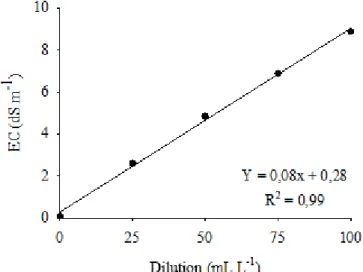
The EC was obtained experimentally in the laboratory, following the regression equation which related the electrical conductivity at different dilutions of 2M solution of NaCl in water (ml L- 1) (Figure 1).
67 period which the seeds were in contact
with the solutions was fourteen days. The experiment consisted of 16 treatments in a completely randomized design in a factorial scheme 2 x 2 x 4, with a control treatment, three treatments with PEG6000 and three treatments with NaCl. For each treatment there were 4 replicates, and the portion represented by a box type seedling with 50 seeds of Katia or Santa Adélia tomato cultivars. The germination speed index (GSI) was calculated by Maguire
(1962) formula; the length of seedlings in cm, evaluated according to Nakagawa (1999) and dry weight of seedlings, consisting of shoot and root in grams. The length of seedlings was assessed by performing the measurement of the entire seedling, leaving the apical meristem to the tip of the primary root, with the aid of a millimeter ruler. To determine the dry mass, its normal seedlings were extracted from cotyledons and were placed in an oven at 60 ° C to constant weight.
Figure 1- Electrical conductivity and different dilutions relationship (mL L-1), in 2M of NaCl water solution. Water-Soil-Plant Laboratory of Rural Engineering Department, FCA/UNESP.
The data were subjected to variance analysis using SAS 9.2 (SAS, 2008) software. The significant interactions were deployed. Qualitative factors, types of
farming and solution underwent
comparison of means by Tukey test (P < 0.05) and the quantitative factor to
polynomial regression. The best fitted equation was chosen according to the coefficient of determination and significance of the regression coefficients were tested by corrected t test based on variance analysis of variance t test.
RESULTS AND DISCUSSION
The osmotic potential decrease, more negative potential, provided by the NaCl or PEG6000 addition in the solution have influence significantly the percentage of germination and emergence rate index. The
68
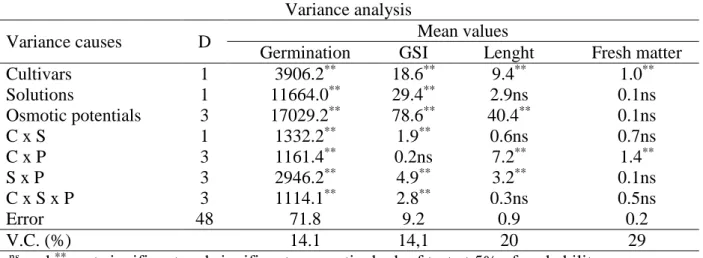
Table 1 - Variance analysis of tomatoes seeds, Santa Adélia and Kátia cultivars, under
different osmotic potentials. Variance analysis
Variance causes D Mean values
Germination GSI Lenght Fresh matter
Cultivars 1 3906.2** 18.6** 9.4** 1.0**
Solutions 1 11664.0** 29.4** 2.9ns 0.1ns
Osmotic potentials 3 17029.2** 78.6** 40.4** 0.1ns
C x S 1 1332.2** 1.9** 0.6ns 0.7ns
C x P 3 1161.4** 0.2ns 7.2** 1.4**
S x P 3 2946.2** 4.9** 3.2** 0.1ns
C x S x P 3 1114.1** 2.8** 0.3ns 0.5ns
Error 48 71.8 9.2 0.9 0.2
V.C. (%) 14.1 14,1 20 29
ns and **, not significant and significant, respectively, by f test at 5% of probability error.
The osmotic potential decreasing has a negative influence on germination percentage. Such influence varied according to the cultivar and the solution used in the experiment (Figure 2A and 2B).
Figure 2 - Germination percentage of tomato seeds under different osmotic potentials with
PEG6000 (A) or NaCl (B) addition.
The reduction in seeds germination percentage take place in a linear manner, as the osmotic potential of the solution became more negative (Table 2). The Santa Adélia cultivar germination average had a significantly higher Katia to grow 23 %. The solution with PEG6000 was significantly more effective in reducing germination compared to NaCl solution with 37 % fewer germinated seeds. The
osmotic potential at -0.6 MPa significantly reduced the seed germination by 78% when compared to the control treatment. Machado et al. (2006) found reductions in the bean seeds germination percentage as they fell up the osmotic potential. Osmotic potentials below -0.3 MPa were critical for soybean seeds germination and vigor (BRACCINI et al., 1996).
69
Table 2 - Linear regression percentage of two tomatoes cultivars seeds germination under
different osmotic potentials with PEG6000 or NaCl addition.
PEG6000 Equation R2
Sta. Adélia Y = 97.9** - 160.2**x 0.92
Kátia Y = 94.1** - 169.2**x 0.91
NaCl Equation R2
Sta. Adélia Y = 93.9** - 26.5**x 0.57
Kátia Y = 105.0** - 146.0**x 0.85
** significant by t test at 5% probability error.
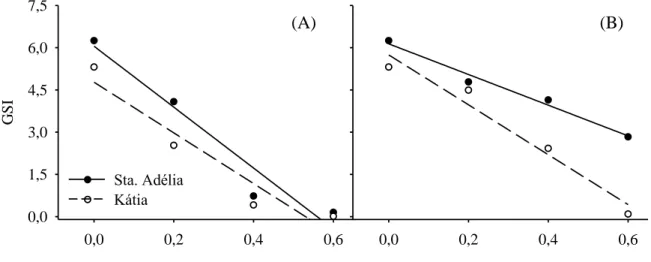
Similar analysis of tomato germination, IVG suffered significant reductions in their values according to the
osmotic potential lowering, varying according to the solution and cultivar (Figure 3A and 3B).
Figure 3 - Germination Speed Index (GSI) of tomatoes seeds under different osmotic
potentials with PEG6000 (A) or NaCl (B) addition.
The seed vigor reduction occurred linearly, as the osmotic potential of the solution became more negative (Table 3). The Santa Adélia cultivar presented a significantly higher seed to grow by 30% Katia. A solution of PEG6000 was significantly more effective in germination reducing compared to NaCl, with 36 % less vigor. The osmotic potential at -0.6
MPa significantly reduced seed
germination by 87% when compared to the control treatment. The vigor is more affected in seeds than germination, when these are subjected to water stress by osmotic solutions (MACHADO NETO et al., 2004; MORAES e MENEZES, 2003) which may also exhibit toxicity to the salts involved (MACHADO NETO et al., 2006).
Table 3 - GSI response of two tomatoes seeds cultivars under different osmotic potentials
with PEG6000 or NaCl addition.
PEG6000 Equation R2
Sta. Adélia Y = 6.1** - 10.8**x 0.94
Kátia Y = 4.7** - 9.0**x 0.89
NaCl Equação R2
Sta. Adélia Y = 6.1** - 5.4**x 0.89
Kátia Y = 5.7** - 8.9**x 0.91
Osmotic potentials (-MPa)
0,0 0,2 0,4 0,6
G
SI
0,0 1,5 3,0 4,5 6,0 7,5
Sta. Adélia Kátia
0,0 0,2 0,4 0,6
70 ** significant by t test at 5% probability error
The seedling cultivars development was significantly reduced by increasing in the osmotic potential and the types of used solutes (Fig. 4A and 4B). For each decrease of -0.1 MPa in the solution represented a linear reduction of 0.57 and
0.59 cm in seedlings of Santa Adélia and Katia cultivars, respectively. It was observed among the solution types the reductions of 0.61 and 0.55 cm in tomato seedlings height to NaCl and PEG6000 solutions, respectively (Table 4).
Figure 4 - Osmotic potential decreasing effect between the cultivars (A) and between the
solute types (B).
Table 4 - Tomatoes seedlings development under osmotic potential lowering between
cultivars and between the solute types.
Cultivar Equation R2
Sta. Adélia Y = 6.7** - 5.7**x 0.62
Kátia Y = 6.0** - 5.9**x 0.49
Solution Equation R2
PEG6000 Y = 6.7** - 6.1**x 0.50
NaCl Y = 6.1** - 5.5**x 0.57
** significant by t test at 5% probability error
Growth inhibition caused by salinity is due both to the osmotic effect, meaning the physiological drought produced as the toxic effects resulting from ions concentration in the plasma. The seeds are sensitive to the effects of salinity and when they were cultured in saline solution, initially were observed a decrease in water absorption (REBOUGAS e FERREIRA, 1992). In soybean, the osmotic potential increase adversely affect the growth of hypocotyls in mannitol, which showed a marked decrease of growth up to -1.2MPa, such as NaCl , which from -0.6MPa in
seedlings development (MACHADO
NETO et al., 2004). Duarte et al. (2006)
and Torres (2007) found that reducing the osmotic potential of NaCl substrate is detrimental to germination and seedling development of wheat and watermelon, respectively.
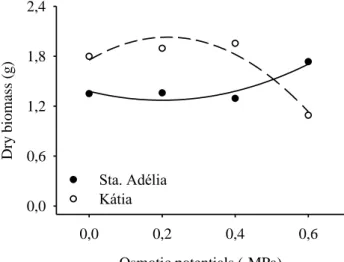
The behavior of dry matter accumulation (DM) was different among the studied cultivars (Figure 5). Regarding to the quadratic fit to Katia cultivar had a positive cumulative dry matter to -0.21 MPa when the potential started to decline. The Santa Adélia cultivar dry matter accumulation was to the potential -0.6 MPa (Table 5). The decrease in dry mass, both shoot and root, are related to the lack of water for metabolism, which slows the
0,0 0,2 0,4 0,6
L
eng
th (c
m)
0,0 1,6 3,2 4,8 6,4 8,0
Sta. Adélia Kátia
Osmotic potentials (-MPa)
0,0 0,2 0,4 0,6
PEG6000 NaCl
71 metabolic reactions and, consequently,
decreases the accumulation of dry matter (MARUR et al., 1994). Carvalho et al.
(2012) found linear decreases in dry mass of soybean seedlings by increasing the salt solution.
Figure 5 - Dry biomass of tomatoes seedlings under different osmotic potentials.
Table 5 - Seedlings development of Santa Adélia and Kátia cultivars response to solution
osmotic potential lowering.
Cultivar Equation R2
Sta. Adélia Y = 1.4** - 1.1nsx + 2.7**x2 0.86
Kátia Y = 1.7** + 2.6nsx – 6.0**x2 0.92
ns and ** respectively, not significant and significant by t test at 5% probability error.
CONCLUSIONS
The Santa Adélia cultivar was more apt to osmotic regulators in adverse conditions.
The PEG6000 solutions were more effective in reducing the soaked seed and
hence the reduction of the values of all variables.
Osmotic potential of -0.2 MPa can cause a significant loss in tomato seed vigor.
REFERENCES
ALMEIDA, F. A. C.; GONÇALVES, N. J. M.; GOUVEIA, J. P. G.; CAVALCANTE, L. F. Comportamento da germinação de sementes de arroz em meios salinos.
Revista Brasileira de Produtos
Agroindustriais, 2001, v.3, n.1, p.47-51. BORGES, E. E. L.; VASCONCELOS, P. C. S.; CARVALHO, D. V.; BORGES, R. C. G. Estudos preliminares sobre o efeito do estresse hídrico na germinação de sementes de jacarandá-da-bahia (Dalbergia nigra) e cedro-rosa (Cedrella fissilis). Revista Brasileira de Sementes, Brasília, v. 13, n. 2, p. 115-118, 1991.
BRACCINI, A.L.; RUIZ, H.A.;
BRACCINI, M.C.L.; REIS, M.S.
Germinação e vigor de sementes de soja sob estresse hídrico induzido por soluções de cloreto de sódio, manitol e polietileno glicol. Revista Brasileira de Sementes, Brasília, v.18, n.1, p.10-16, 1996.
CARVALHO, T. C. de; SILVA, S.; SILVA, R. C. da; PANOBIANCO, M. Germinação e desenvolvimento inicial de plântulas de soja convencional e sua derivada transgênica RR em condições de estresse salino. Ciência Rural, v. 42, n. 8, p. 1366-1371, 2012.
Osmotic potentials (-MPa)
0,0 0,2 0,4 0,6
D
ry
bio
ma
ss (
g
)
0,0 0,6 1,2 1,8 2,4
72 CARVALHO, J. C.; PAGLIUCA, L. G.
Tomate: um mercado que não para de crescer globalmente. Revista Hortifruti Brasil, São Paulo, v. 6, n. 58, p. 6-14, jun. 2007.
DUARTE, G.L.; LOPES, N.F.; MORAES, D.M.; SILVA, R.N. Physiological quality of wheat seeds submitted to saline stress. Revista Brasileira de Sementes, v.28, n.1, p.122-126, 2006.
FAO. Faostat. Disponível em:
<faostat.fao.org>. Acesso em: 23 out. 2012.
FERREIRA, L.G.R.; REBOUÇAS,
M.A.A. Influência da
hidratação/desidratação de sementes de algodão na superação de efeitos da salinidade na germinação. Pesquisa Agropecuária Brasileira, Brasília, v.27, n.4, p.609-615, 1992.
FERREIRA, R.G.; TAVORA, F. J. A. F.; HERNANDEZ, F. F. F. Distribuição da matéria seca e composição química das raízes, caule e folhas de goiabeira submetida a estresse salino. Pesquisa Agropecuária Brasileira, Brasília. v.36, n.1, p.79-88. 2001
GHEYI, H.R; QUEIROZ, J.E.;
MEDEIROS, J.F. Manejo e controle da salinidade na agricultura irrigada. Campina Grande: UFPB/SBEA, 1997. 383p.
MACHADO NETO, N. B.; CUSTÓDIO, C. C.; COSTA, P. R.; DONÁ, F. L. Deficiência hídrica induzida por diferentes agentes osmóticos na germinação e vigor de sementes de feijão. Revista Brasileira de Sementes, v. 28, n. 01, p. 142- 148, 2006. MACHADO NETO, N. B.; SATURNINO, S. M.; BOMFIM, D. C.; CUSTÓDIO, C. C et al Hydric stress induced by mannitol and sodium chloride in soybean cultivars. Brazilian Archives of Biology and Technology, v. 47, n. 04, p. 521-529, 2004.
MARUR, C.J.; SODEK, L.;
MAGALHÃES, A.C. Free aminoacids in leaves of cotton plants under water deficit. Revista Brasileira de Fisiologia Vegetal, Campinas, v.6, p.103-108, 1994.
MORAES, G. A. F.; MENEZES, N. L. Desempenho de sementes de soja sob condições diferentes de potencial
osmótico. Ciência Rural, v. 33, n. 02, p. 219-226, 2003.
MAGUIRE, J.D. Speed of germination aid in selection and evaluation for seedling emergence and vigor. Crop Science, Madison, v. 2, n. 2, p. 176-177, 1962. NAIKA, S.; JEUDE, J. V. L.; GOFFAU. M.; MARTIN. H.; BARBARA V. D. A
cultura do tomate: produção,
processamento e comercialização. Fundação Agromisa e CTA, Wageningen, 2006.
NAKAGAWA, J. Testes de vigor baseados no desempenho das plântulas. In: KRZYZANOSKI, F.C. et al (Ed.). Vigor de sementes: conceitos e testes. Londrina: ABRATES, 1999. Cap.2, p.1-24.
SAS Institute Inc. 2008. SAS/STAT® 9.2 User’s Guide. Cary, NC: SAS Institute Inc, 2008. 584 p.
SILVA, L. M. de M.; AGUIAR, I. B. de; MORAIS, D. L. de.; VIEGAS, R. A. Estresse hídrico e condicionamento osmótico na qualidade fisiológica de sementes de faveleira Cnidoscolus juercifolius. Revista Brasileira de Engenharia Agrícola e Ambiental, v. 9, n. 1, p. 66-72, 2005.
TORRES, S.B. Germinação e